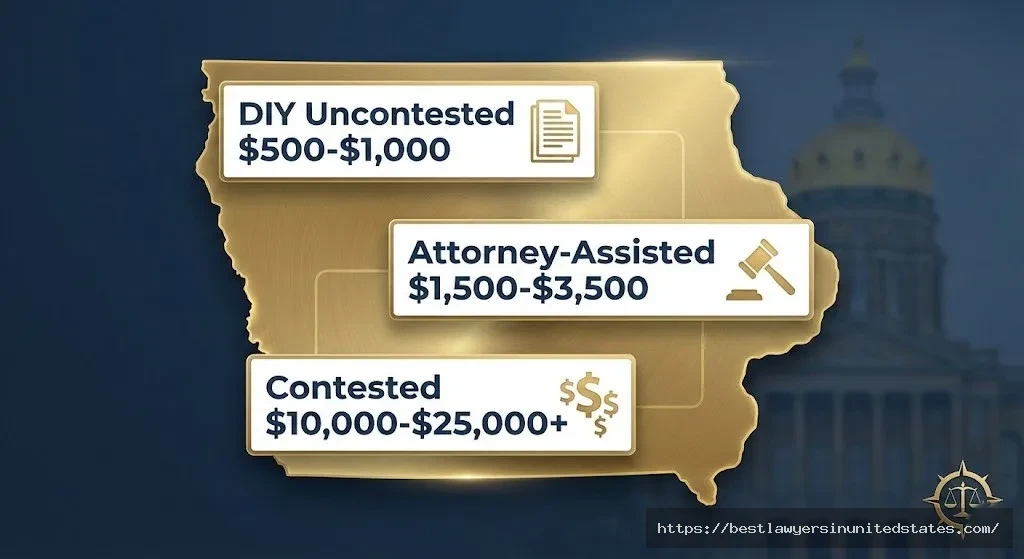
Quick Answer: Divorce costs in Iowa range from $500 for a simple DIY uncontested divorce to over $25,000 for a contested divorce with children and complex assets. Court filing fees alone cost $185-$265 depending on your county, while attorney fees typically run $200-$350 per hour with retainer fees starting at $1,500-$5,000.
Divorce Cost Calculator
Get an estimated cost for your divorce based on your specific situation
Your Estimated Divorce Cost
Cost Breakdown
📧 Get a Personalized Consultation
Have questions about your specific situation? Contact our legal experts for guidance tailored to your needs.
Contact Us via EmailUse our free calculator above to get a personalized cost estimate based on your specific situation—whether you’re filing in Polk County, Linn County, or anywhere else in Iowa.
What’s the Average Cost of a Divorce in Iowa?
The average divorce in Iowa costs between $2,500 and $15,000, but your actual costs depend heavily on whether your divorce is contested or uncontested and whether children are involved.
Here’s what Iowa residents actually pay:
| Divorce Type | Average Total Cost | Timeline |
|---|---|---|
| DIY Uncontested (no kids) | $500 – $1,000 | 90-120 days |
| Uncontested with Attorney | $1,500 – $3,500 | 90-120 days |
| Uncontested with Children | $2,500 – $5,000 | 120-180 days |
| Contested (no kids) | $8,000 – $15,000 | 6-12 months |
| Contested with Children | $15,000 – $25,000+ | 12-24 months |
Iowa is a no-fault divorce state, meaning you don’t need to prove wrongdoing to file for dissolution of marriage. This generally keeps costs lower than in fault-based states, but the level of agreement between you and your spouse matters far more than anything else.
Understanding how much a divorce costs nationally helps put Iowa’s costs in perspective—the state tends to fall in the middle range compared to coastal states like California or New York.
How Much Does It Cost to File for Divorce in Iowa?
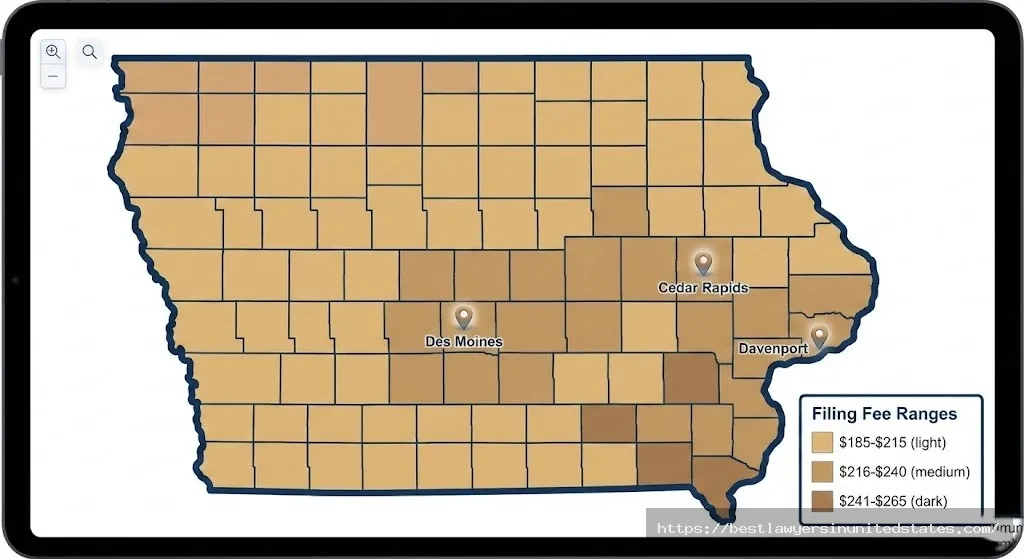
Filing fees for a Petition for Dissolution of Marriage in Iowa vary by county but typically range from $185 to $265. This fee is paid to the Clerk of Court when you submit your initial paperwork.
Major County Filing Fees (2026):
| County | Filing Fee | Service Fee | Total Initial Cost |
|---|---|---|---|
| Polk County | $265 | $55-$75 | $320-$340 |
| Linn County | $235 | $50-$70 | $285-$305 |
| Scott County | $225 | $50-$65 | $275-$290 |
| Johnson County | $240 | $55-$70 | $295-$310 |
| Black Hawk County | $220 | $50-$65 | $270-$285 |
| Woodbury County | $215 | $45-$60 | $260-$275 |
| Dubuque County | $210 | $50-$65 | $260-$275 |
| Story County | $225 | $50-$65 | $275-$290 |
| Pottawattamie County | $205 | $45-$60 | $250-$265 |
| Dallas County | $230 | $55-$70 | $285-$300 |
These are just the initial court costs. Additional fees may include certified copies of your divorce decree ($15-$25 each), document filing amendments ($50-$100), and mandatory parenting classes in some counties ($25-$75).
If you can’t afford the filing fees, you can apply for a fee waiver by submitting an Affidavit of Indigency to the court. The Iowa Judicial Branch reviews income and asset information to determine eligibility.
Similar to divorce filing fees in other states, Iowa’s costs are relatively moderate compared to states like Texas or Florida.
How Much Does a Divorce Lawyer Cost in Iowa?
Divorce attorneys in Iowa typically charge between $200 and $350 per hour, with most requiring an upfront retainer fee of $1,500 to $5,000. The retainer acts as a deposit that the attorney bills against as they work on your case.

Typical Attorney Fee Structures:
- Hourly Rates: $200-$350/hour (urban areas like Des Moines and Cedar Rapids tend toward the higher end)
- Retainer Fees: $1,500-$5,000 (replenished if depleted during your case)
- Consultation Fees: $0-$250 (many attorneys offer free initial consultations)
- Flat Fees: $800-$2,500 for simple uncontested divorces
What affects attorney costs:
Your total legal bill depends on how many hours your attorney spends on your case. Simple cases might require only 5-10 hours of work, while contested divorces with custody disputes can easily exceed 50-100 hours.
Common attorney activities that add to your bill include court appearances ($500-$1,500 per appearance), document preparation, phone calls and emails, negotiations with opposing counsel, discovery requests, and trial preparation.
For a deeper dive into what attorneys charge nationally, see our guide on divorce attorney fees.
How Much Does an Uncontested Divorce Cost in Iowa?
An uncontested divorce in Iowa—where both spouses agree on all major issues—costs between $500 and $3,500 total.
Breakdown of uncontested divorce costs:
| Expense Category | Cost Range |
|---|---|
| Court filing fees | $185-$265 |
| Service of process | $50-$75 |
| Attorney fees (if used) | $800-$2,500 |
| Mediation (optional) | $100-$300/hour |
| Document preparation service | $300-$500 |
| Parenting class (if kids) | $25-$75 |
| Total (DIY) | $500-$1,000 |
| Total (with attorney) | $1,500-$3,500 |
The key to keeping costs low is agreement. If you and your spouse can work out property division, debt allocation, and (if applicable) child custody and support without fighting, you’ll save thousands.
Iowa offers free divorce forms through the Iowa Interactive Court Forms (IICF) system at iowacourts.gov. These guided interviews help you complete the proper paperwork without hiring an attorney—perfect for straightforward cases.
Many Iowa residents handle uncontested divorces themselves, especially when there are no children, minimal assets, and short marriages. The process typically takes 90-120 days from filing to final decree.
How Much Does a Contested Divorce Cost in Iowa?
A contested divorce in Iowa—where spouses disagree on custody, property division, or other major issues—typically costs $10,000 to $25,000 or more.

Why contested divorces cost so much more:
Contested cases require extensive attorney time for negotiations, court filings, discovery (exchanging financial documents), depositions, expert witnesses, and potentially a full trial. Each court appearance alone can cost $500-$1,500 in attorney fees.
Additional contested divorce expenses:
| Service | Cost Range |
|---|---|
| Attorney hourly fees (50-100+ hours) | $10,000-$35,000 |
| Expert witnesses (custody evaluators, appraisers) | $2,000-$5,000 |
| Forensic accountant | $3,000-$10,000 |
| Home/business appraisal | $300-$800 |
| Court reporter/transcripts | $500-$2,000 |
| Private investigator (if needed) | $1,000-$5,000 |
The most expensive divorces in Iowa involve high-conflict custody battles, business ownership disputes, or hidden assets requiring forensic accounting. These cases can easily exceed $50,000 per spouse.
What Affects the Cost of Divorce in Iowa?
Several factors determine whether you’ll pay $500 or $25,000 for your Iowa divorce.
Type of Divorce (Contested vs. Uncontested)
This is the single biggest cost driver. Agreeing on terms before filing can save you $10,000-$20,000 compared to fighting in court. Even if you need some negotiation, every issue you resolve without a judge’s intervention saves money.
Children and Custody Disputes
Divorces involving minor children cost more because Iowa courts require parenting plans, child support calculations, and sometimes custody evaluations. If you and your spouse disagree about physical care or visitation, expect to pay $3,000-$8,000 extra for a custody evaluator and additional attorney time.
Custody battles are emotionally draining and financially devastating. Fighting over every detail of your parenting schedule can add months to your case and tens of thousands to your legal bill.
Property and Asset Division Complexity
Iowa follows equitable distribution, meaning marital property gets divided fairly (not necessarily equally). Simple cases with a house, two cars, and basic retirement accounts are straightforward. Complex cases involving business ownership, multiple properties, stock portfolios, or pension division require expert appraisals and extensive negotiation.
Business valuations alone can cost $5,000-$15,000, and fighting over who gets what adds significant attorney time.
Attorney vs. DIY
Hiring an attorney for a simple uncontested divorce costs $1,500-$3,500. Doing it yourself costs just filing fees ($185-$265) plus maybe a document preparation service ($300-$500). For straightforward cases, DIY is perfectly safe and legal in Iowa.
However, DIY is risky when there are children, significant assets, or any disagreement. One mistake in your settlement agreement could cost you far more than attorney fees would have.
County Filing Fees
As shown earlier, filing fees vary by county from $185 to $265. While this won’t make or break your budget, it’s worth knowing what your specific county charges.
Use of Mediation or Collaborative Divorce
Divorce mediation costs $100-$300 per hour in Iowa but can save you thousands compared to litigation. Most mediations resolve in 3-6 sessions (6-12 hours total), costing $600-$3,600.
Mediation works when both spouses are willing to negotiate in good faith. A neutral third party helps you reach agreements on custody, property division, and support without going to court. You’ll still need attorneys to review any agreement, but at limited-scope rates rather than full representation.
Collaborative divorce is another alternative where both parties hire specially trained collaborative attorneys and commit to settling out of court. Costs run $5,000-$15,000 per spouse but are still less than full litigation.
Hidden Divorce Costs Iowa Residents Should Know
Beyond the obvious attorney fees and filing costs, watch out for these often-overlooked expenses:
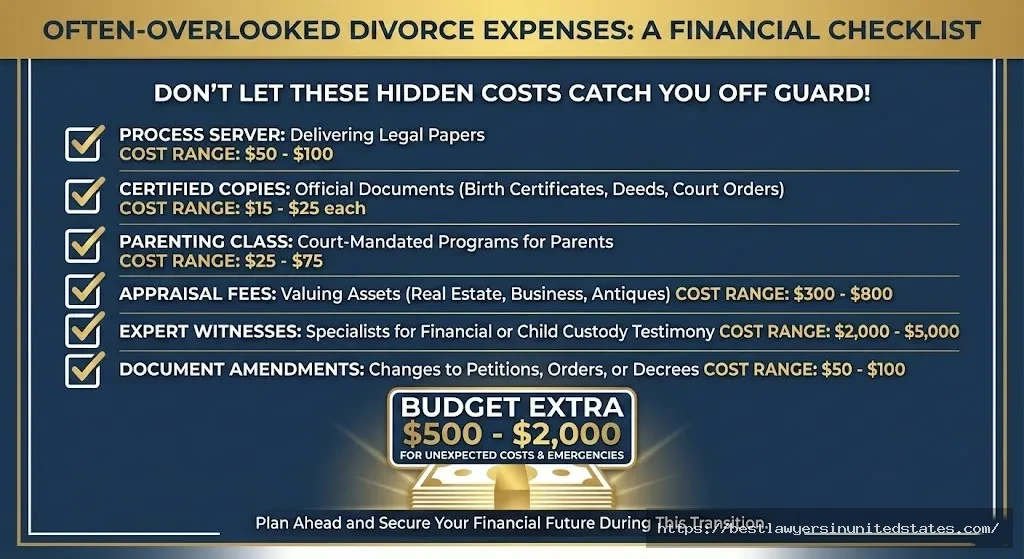
Process Server Fees: $50-$100 to serve divorce papers on your spouse if they won’t accept service voluntarily.
Certified Copies: $15-$25 each time you need an official copy of your divorce decree (you’ll need several for name changes, property transfers, etc.).
Parenting Class: Many Iowa counties require divorcing parents to complete a mandatory education program costing $25-$75.
Appraisal Fees: Real estate appraisals ($300-$500), business valuations ($5,000-$15,000), or personal property appraisals ($200-$800) if you can’t agree on values.
Expert Witness Fees: Custody evaluators ($2,000-$5,000), forensic accountants ($3,000-$10,000), vocational experts for alimony cases ($1,500-$3,000).
Document Amendments: $50-$100 each time you need to amend or correct filed documents.
Postage and Administrative Fees: $50-$200 for copying, mailing, and administrative costs from your attorney’s office.
Tax Consequences: Not an immediate cost, but property division and support payments can have significant tax implications. Consult a tax professional.
Credit Report Monitoring: $10-$30/month if you’re concerned about your spouse opening accounts in your name during the divorce.
Real Iowa Divorce Cost Examples
Here’s what actual Iowa divorces cost in different scenarios:

Case 1: Simple Uncontested, No Children
- Married 3 years, renting apartment, minimal assets
- Used Iowa Interactive Court Forms (DIY)
- No attorney hired
- Total cost: $650 (filing fees $265, service of process $60, document copies $25, certified decree copies $50)
- Timeline: 95 days from filing to final decree
Case 2: Uncontested with Children, Attorney-Assisted
- Married 8 years, one child age 5
- Owned home (agreed on sale), two cars, small 401(k) accounts
- Each spouse hired attorney for limited-scope representation
- Used mediation for parenting plan (4 hours)
- Total cost per spouse: $3,200 (attorney fees $2,000, filing fees $240, mediation $600, parenting class $50, home appraisal $300, certified copies $10)
- Timeline: 135 days
Case 3: Contested, Moderate Assets, No Children
- Married 12 years, disagreed on division of home equity and retirement accounts
- Two court hearings before settlement
- Total cost per spouse: $11,500 (attorney fees $9,500, filing fees $265, appraisals $800, expert witness fees $750, certified copies $35, administrative costs $150)
- Timeline: 9 months
Case 4: High-Conflict Custody Battle
- Married 10 years, two children ages 7 and 4
- Disputed physical care and visitation schedule
- Custody evaluation ordered by court
- Went to trial (3 days)
- Total cost per spouse: $23,800 (attorney fees $17,000, filing fees $265, custody evaluation $4,000, expert witnesses $1,500, court reporter $800, administrative costs $235)
- Timeline: 18 months
Case 5: DIY Online Divorce Service
- Married 2 years, no children, no significant assets
- Used online divorce document service
- No attorney involved
- Total cost: $435 (online service $150, filing fees $220, service of process $50, certified copies $15)
- Timeline: 92 days
How to Get a Divorce in Iowa for Free (or Cheap)
If money is tight, here are legitimate ways to reduce or eliminate divorce costs in Iowa.
Income-Based Legal Aid (Iowa Legal Aid)
Iowa Legal Aid provides free legal services to low-income residents. To qualify, your household income must fall below 125% of the federal poverty guidelines (roughly $37,650 for a family of three in 2026).
They handle uncontested divorces, provide advice on contested cases, and help with protective orders in domestic violence situations. Apply at iowalegalaid.org or call 1-800-532-1275.
Pro Bono Attorneys
The Iowa State Bar Association maintains a pro bono referral list. Many attorneys volunteer a limited number of free cases annually. Contact your local bar association to inquire about availability.
Free Court Forms (Iowa Interactive Court Forms)
Iowa’s court system offers completely free, guided interview-style forms at iowacourts.gov. The system asks you questions and automatically generates the correct documents for your situation—all without attorney fees.
The IICF covers uncontested divorces with and without children. You’ll need basic information about your marriage, assets, debts, and (if applicable) children.
Fee Waiver Application Process
Can’t afford the $185-$265 filing fee? File an Affidavit of Indigency (form available at iowacourts.gov) along with proof of income. The court reviews your financial situation and may waive all or part of the filing fees.
Common qualifying circumstances include receiving public assistance (SNAP, TANF, SSI), income below poverty guidelines, or genuine financial hardship due to medical bills or other emergencies.
Online Divorce Services (Comparison)
Several online services help you prepare Iowa divorce documents for $150-$500—cheaper than hiring an attorney but more guided than pure DIY. These work well for simple uncontested cases.
Popular services include:
- CompleteCase: $299 for document preparation
- 3StepDivorce: $299 plus filing fees
- DivorceWriter: $137 for forms
These services don’t provide legal advice, just document preparation. They’re best for straightforward cases with full agreement and no complex assets.
DIY Divorce (Pros, Cons, When It Works)
DIY makes sense when:
- Both spouses agree on all terms
- No minor children (or complete agreement on custody/support)
- Minimal assets and debts
- Short marriage (under 5 years)
- Both spouses are financially transparent
- No domestic violence or power imbalances
DIY is risky when:
- Children are involved and any custody disagreement exists
- Significant assets require division (homes, businesses, pensions)
- One spouse hides income or assets
- Complex tax implications exist
- Alimony might be appropriate
- Either spouse feels pressured or intimidated
Even in DIY cases, consider paying an attorney $300-$500 for a one-time consultation to review your settlement agreement before filing. This limited-scope representation catches mistakes that could be costly later.
For a comprehensive state-by-state comparison, check out our DIY divorce guide.
10 Proven Ways to Reduce Your Iowa Divorce Costs
Smart strategies can cut your divorce costs by thousands without sacrificing important rights.
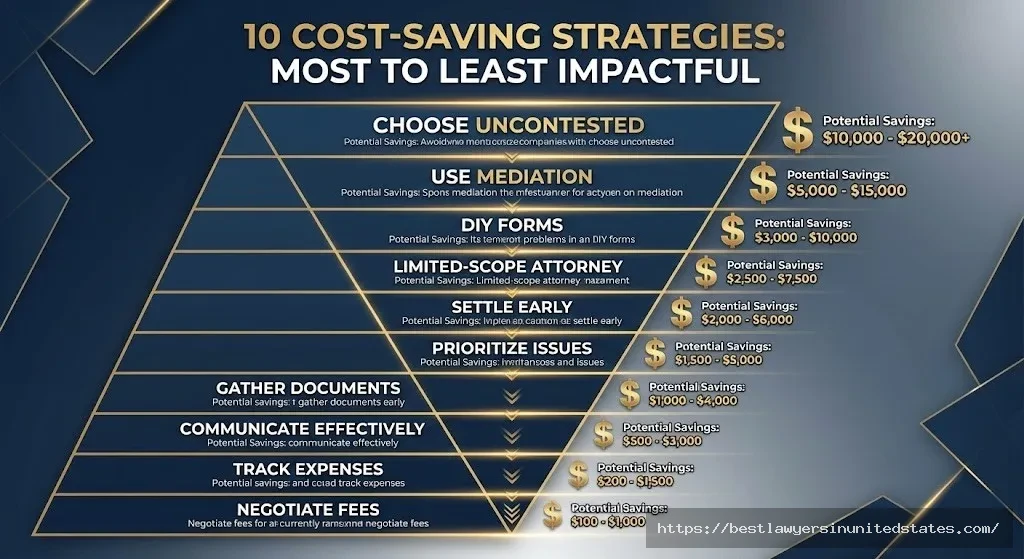
1. Choose uncontested divorce whenever possible. Every issue you resolve through direct negotiation with your spouse saves attorney time and money. Even if you start contested, settling before trial can save $10,000+.
2. Use mediation instead of litigation. Divorce mediation costs $100-$300/hour but resolves most cases in 6-12 hours ($600-$3,600 total). Compare that to $15,000-$25,000 for contested litigation.
3. Prepare your own documents using Iowa Interactive Court Forms. Why pay an attorney $1,500-$2,500 to fill out forms you can complete yourself for free? Save attorney fees for complex legal questions, not paperwork.
4. Negotiate limited-scope representation (unbundled services). Instead of hiring an attorney for full representation, pay them only for specific tasks like reviewing your settlement agreement ($300-$500) or making one court appearance ($500-$1,500). You handle the rest yourself.
5. Avoid unnecessary court appearances. Every time your attorney goes to court costs $500-$1,500. Request continuances only when absolutely necessary, and try to resolve issues through written stipulations instead of hearings.
6. Settle early and avoid trial. Trials are expensive—attorney prep time alone can run $5,000-$10,000. The week before trial, most attorneys work 40-60 hours on your case. Settle during mediation or pretrial conferences instead.
7. Use legal aid if you’re income-qualified. Free is better than expensive. If you qualify for Iowa Legal Aid, take advantage—it’s what the service exists for.
8. Negotiate attorney fees and payment plans. Many Iowa attorneys offer payment plans spreading costs over 6-12 months. Some reduce hourly rates for clients experiencing financial hardship. Always ask.
9. Be organized and prepared. Every email or phone call to your attorney costs money (billed in 6-15 minute increments). Batch your questions, provide organized financial documents, and respond promptly to requests. Disorganized clients pay more.
10. Track all expenses for potential tax deductions. While you can’t deduct the cost of divorce itself, some expenses (like tax advice related to property division or alimony) may be deductible. Keep detailed records and consult a CPA.
Uncontested vs. Contested vs. Mediation: Cost Comparison

Understanding your options helps you choose the most cost-effective path forward.
| Divorce Type | Average Cost | Timeline | Best For | Pros | Cons |
|---|---|---|---|---|---|
| Uncontested (DIY) | $500-$1,000 | 90-120 days | Short marriage, no kids, minimal assets, full agreement | Cheapest option; fastest resolution; you control the process | No legal advice; risky if you miss important issues; not suitable for complex cases |
| Uncontested (Attorney) | $1,500-$3,500 | 90-120 days | Agreement reached but want legal review; moderate assets; children involved | Professional guidance; proper documentation; peace of mind | More expensive than DIY; still requires cooperation |
| Mediation | $2,500-$6,000 | 3-6 months | Willing to negotiate; some disagreement but both want to avoid court | Much cheaper than litigation; you control outcome; less adversarial; faster than court | Requires good-faith negotiation; not suitable for domestic violence cases; both must participate willingly |
| Collaborative Divorce | $10,000-$30,000 | 6-12 months | Complex assets; want to avoid court; can work cooperatively | Less adversarial than litigation; team approach; creative solutions | Expensive; if it fails, must hire new attorneys; requires commitment from both spouses |
| Contested Litigation | $15,000-$50,000+ | 12-24+ months | High conflict; inability to negotiate; complex custody or asset disputes | Court makes final decision; formal discovery process; legal protection | Most expensive; longest timeline; most stressful; unpredictable outcomes; damages relationships |
The vast majority of Iowa divorces settle before trial. Even if you file a contested divorce, aim to resolve issues through negotiation or mediation to control costs.
Payment Options and Financial Assistance for Iowa Divorces
Worried about affording your divorce? Here are realistic options for managing costs.
Attorney Payment Plans
Most Iowa divorce attorneys offer payment plans for clients who can’t pay a full retainer upfront. Common arrangements include:
- Initial retainer: $1,500-$2,500 with monthly payments of $300-$500
- Split retainer: Half upfront, half in 30 days
- Contingency on property settlement: Attorney takes a percentage of secured assets (rare in family law, more common in other areas)
Always get payment terms in writing in your attorney fee agreement. Understand what happens if you fall behind on payments (most attorneys will withdraw from your case).
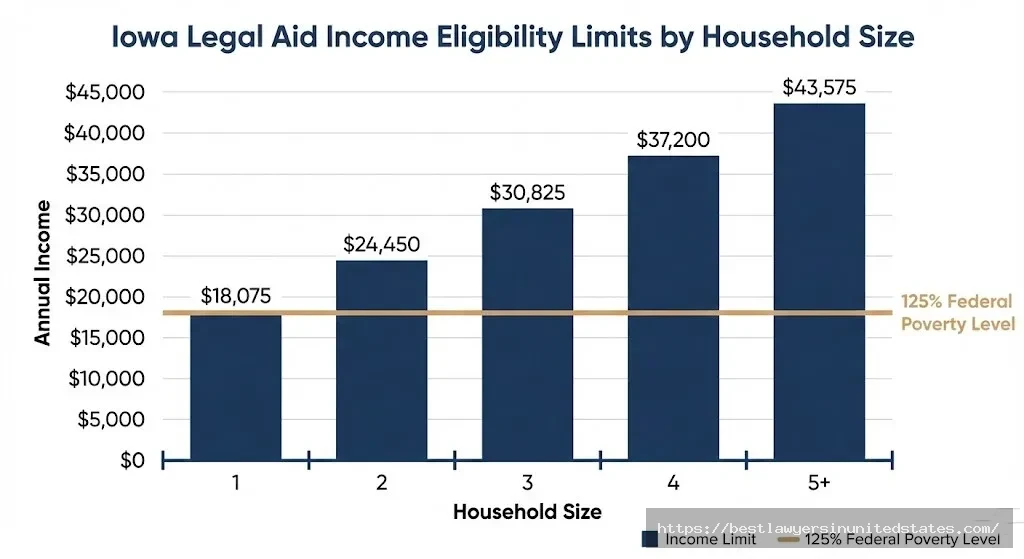
Legal Aid Eligibility Requirements
To qualify for free legal services through Iowa Legal Aid:
Income Limits (2026):
| Household Size | Annual Income Limit (125% FPL) |
|---|---|
| 1 person | $18,075 |
| 2 people | $24,450 |
| 3 people | $30,825 |
| 4 people | $37,200 |
| 5 people | $43,575 |
If you’re slightly over the income limit, you may still qualify if you have exceptional expenses (medical bills, disability-related costs, etc.). Iowa Legal Aid prioritizes cases involving domestic violence, child custody, and vulnerable populations.
Personal Loans and Legal Finance Companies
Some people use personal loans or credit cards to finance divorce costs. This can work if:
- You have good credit (interest rates 6%-12%)
- You’re confident you’ll secure assets in the divorce to repay the loan
- Other options (legal aid, payment plans) aren’t available
Legal finance companies like LawPay and others offer specialized divorce loans, but read the fine print—interest rates can be high (15%-25%+).
Fee Waiver Process for Court Costs
To request a filing fee waiver in Iowa:
- Complete the Affidavit of Indigency form (available at your county courthouse or iowacourts.gov)
- Attach proof of income (pay stubs, tax returns, public assistance award letters)
- File it with your Petition for Dissolution of Marriage
- The court reviews your application and grants or denies the waiver
- If approved, you pay no filing fees; if denied, you have 10 days to pay
Fee waivers don’t cover attorney fees—only court filing costs. They’re especially helpful for victims of domestic violence who need immediate court protection but lack financial resources.
Pro Bono Resources in Iowa
Beyond Iowa Legal Aid, check these resources:
- Iowa State Bar Association Pro Bono Program: iowafindlawyer.com
- County Bar Association Volunteer Programs: Contact your local bar association
- Legal Clinics: Many law schools and legal aid offices hold free walk-in clinics for basic advice
- Domestic Violence Organizations: Provide free legal assistance for protective orders and safety-related divorce issues
When to Hire a Lawyer vs. DIY Your Iowa Divorce
Use this decision framework to determine whether you need an attorney.

Hire an attorney if:
- ✅ Your spouse hired an attorney (never go unrepresented against a represented party)
- ✅ Children are involved and any custody disagreement exists
- ✅ Significant assets need division (home, retirement accounts, business, investments)
- ✅ Your spouse has hidden income or assets
- ✅ Alimony may be appropriate
- ✅ Domestic violence or power imbalances exist
- ✅ Your spouse is financially sophisticated and you’re not
- ✅ Complex tax implications exist
- ✅ You feel overwhelmed or unsure about the legal process
DIY may work if:
- ✅ Both spouses fully agree on all terms
- ✅ No minor children (or complete agreement on custody and support)
- ✅ Minimal assets and debts to divide
- ✅ Short marriage (under 5 years typically)
- ✅ Both spouses are financially transparent
- ✅ No domestic violence
- ✅ Both spouses are comfortable with paperwork and following instructions
- ✅ You’re willing to research Iowa divorce law and procedures
Consider limited-scope representation if:
- ✅ Mostly agreeable but want legal review of settlement terms
- ✅ Need help with one specific issue (pension division, tax implications)
- ✅ Can handle paperwork but want attorney for court appearance
- ✅ Want peace of mind without paying for full representation
Remember: paying $2,000 for an attorney now might save you $20,000 in lost assets or unfavorable terms later. Divorce mistakes are expensive to fix after the fact.
What is a wife entitled to in a divorce in Iowa?
Iowa follows equitable distribution, meaning marital property is divided fairly based on multiple factors—not automatically 50/50. “Entitled” depends on circumstances, not gender.
The court considers:
- Length of marriage
- Each spouse’s contribution to marital property (including homemaking)
- Each spouse’s economic circumstances
- Age and health of each party
- Earning capacity and education
- Separate property brought into the marriage
- Custody of minor children
In practice, marriages under 5 years often see each spouse keeping roughly what they brought in. Marriages over 20 years, especially where one spouse sacrificed career for homemaking, often result in more equal division.
Neither spouse is automatically “entitled” to more—courts decide based on fairness, not formulas.
How are assets divided in a divorce in Iowa?
Iowa uses equitable distribution, not community property. The court divides marital property (assets acquired during marriage) fairly, considering factors like marriage length, contributions, earning capacity, and custody.
What’s marital property:
- Income earned during marriage
- Homes, cars, furniture purchased during marriage
- Retirement accounts and pensions accrued during marriage
- Business interests developed during marriage
- Debts incurred during marriage
What’s separate property:
- Assets owned before marriage
- Inheritances and gifts specifically to one spouse
- Personal injury settlements for one spouse
- Property kept completely separate during marriage
The division doesn’t have to be equal. A 60/40 or 70/30 split might be “equitable” based on circumstances. Courts also consider tax consequences—receiving a taxable retirement account isn’t the same as receiving a tax-free home with equal value.
Similar principles apply in other equitable distribution states like Pennsylvania and Ohio.
How long does a divorce take in Iowa?
Iowa requires a 90-day waiting period from the date your spouse is served before the court can grant a divorce decree. This applies to all divorces—uncontested and contested.
Realistic timelines:
- Simple uncontested (no kids): 90-120 days
- Uncontested with children: 120-180 days
- Contested (moderate complexity): 6-12 months
- High-conflict contested with trial: 12-24 months
The 90-day waiting period is mandatory and non-waivable except in extraordinary circumstances (domestic violence with protective orders being one rare exception).
After the waiting period, uncontested divorces finalize quickly once all paperwork is submitted. Contested cases take much longer due to discovery, negotiations, hearings, and potential trial preparation.
Do you need a lawyer to get a divorce in Iowa?
No, Iowa law doesn’t require you to hire an attorney for divorce. You can represent yourself (called “pro se” representation) using free forms from Iowa Interactive Court Forms at iowacourts.gov.
However, representing yourself is risky when:
- Children are involved
- Significant assets need division
- Your spouse has an attorney
- You don’t understand legal procedures or financial matters
- Domestic violence exists
Lawyers know how to protect your rights, identify hidden assets, calculate proper support amounts, and avoid costly mistakes. The money saved by going pro se may cost you far more in unfavorable settlement terms.
At minimum, pay for a one-hour consultation ($0-$250) to understand your rights before proceeding DIY.
Can I file for divorce online in Iowa?
Yes, Iowa allows electronic filing in most counties. You can complete divorce forms online through Iowa Interactive Court Forms (IICF) at iowacourts.gov, then e-file them through the Iowa Electronic Document Management System (EDMS).
The process:
- Complete forms using IICF (free guided interviews)
- Create an account in Iowa EDMS
- Upload and submit documents electronically
- Pay filing fees by credit card
- Receive confirmation and case number
Not all counties accept e-filing for all document types—check with your specific county clerk. Some rural counties still require paper filing.
Online filing doesn’t mean “online divorce”—you still must follow all legal procedures, serve your spouse properly, and attend any required hearings.
Who pays attorney fees in divorce in Iowa?
Typically each spouse pays their own attorney fees in Iowa divorces. However, the court can order one spouse to contribute to the other’s legal fees if there’s a significant disparity in income or assets.
Iowa Code § 598.36 allows judges to award attorney fees when:
- One spouse has substantially greater financial resources
- One spouse has unreasonably increased litigation costs
- Denying fees would create injustice or hardship
Courts consider each spouse’s ability to pay, reasonableness of fees, and whether one party unnecessarily complicated the divorce through bad-faith litigation tactics.
In practice, fee awards are more common when one spouse earns $150,000 while the other is a stay-at-home parent, or when one spouse has engaged in extensive discovery or filed frivolous motions.
What is the cheapest way to get a divorce in Iowa?
The cheapest divorce in Iowa is a DIY uncontested divorce using free Iowa Interactive Court Forms, costing only the $185-$265 filing fee plus service of process ($50-$75). Total out-of-pocket: $235-$340.
Requirements for cheapest option:
- Both spouses agree on all terms
- No minor children (or complete custody/support agreement)
- Minimal assets and debts
- Both spouses willing to cooperate
If you have children or moderate assets but still agree, consider limited-scope attorney review ($300-$500) to ensure your settlement protects your interests—total cost still under $1,000.
For those who qualify, Iowa Legal Aid provides completely free legal services, making the cost truly just the filing fee (or $0 if you receive a fee waiver).
Is everything split 50/50 in a divorce in Iowa?
No. Iowa is an equitable distribution state, not a community property state. “Equitable” means fair, not equal. The court divides property based on multiple factors, and a 50/50 split isn’t required or automatic.
Factors courts consider:
- Length of marriage
- Each spouse’s contribution (financial and non-financial)
- Economic circumstances of each spouse at time of divorce
- Age and health
- Earning capacity
- Desirability of awarding family home to custodial parent
- Tax consequences
- Any economic fault (like waste of marital assets)
Short marriages often see each spouse leave with roughly what they brought in. Long marriages, especially where one spouse stayed home with children, often result in more equal divisions.
A 60/40, 70/30, or even 80/20 split could be “equitable” depending on circumstances. Courts have significant discretion.
In contrast, community property states like California and Texas follow different rules.
Can my wife take my retirement in a divorce in Iowa?
Yes, retirement accounts earned during marriage are marital property subject to division in Iowa divorce. This includes 401(k)s, pensions, IRAs, and government retirement plans.
Important distinctions:
- Only the portion earned during marriage is marital property
- Retirement accounts owned before marriage remain separate (though growth during marriage may be marital)
- Division requires a Qualified Domestic Relations Order (QDRO) for most accounts
- Both spouses have equal rights to retirement assets—gender doesn’t matter
Example: If you worked for 20 years before marriage and 10 years during marriage, roughly one-third of your pension is marital property.
“Taking” retirement doesn’t mean your spouse gets it all—the court divides retirement assets equitably along with all other marital property. You might keep your entire 401(k) while your spouse keeps the house, or you might split retirement accounts 50/50 while dividing other assets differently.
QDROs allow tax-free transfer of retirement funds as part of divorce without early withdrawal penalties.
Am I responsible for my spouse’s debt in Iowa?
You’re responsible for debts incurred during marriage, regardless of whose name is on the account. Iowa considers most debts acquired during marriage as marital obligations subject to division.
Marital debt typically includes:
- Credit cards used during marriage (even if only in one spouse’s name)
- Auto loans for family vehicles
- Mortgages on marital home
- Medical bills for either spouse or children
- Business loans for marital business
Separate debt typically includes:
- Debts incurred before marriage (remain with that spouse)
- Student loans from before marriage (though courts may consider when dividing assets)
- Debts from separate property purchases
- Debt from gambling, affairs, or other non-marital activities (may be assigned to responsible spouse)
The court divides marital debt equitably, not equally. One spouse might be assigned more debt if they have greater income or are keeping more assets.
Critical warning: Even if the divorce decree assigns a debt to your spouse, if your name is on the account, the creditor can still come after you if your spouse doesn’t pay. You’ll need to refinance joint debts to truly separate liability.
How much does it cost to file for divorce in Iowa with a child?
Filing fees for divorce in Iowa are the same with or without children: $185-$265 depending on your county. However, total divorce costs are significantly higher when children are involved.
Additional costs with children:
- Mandatory parenting class: $25-$75 (required in most counties)
- Child support calculations: included in basic attorney fees or free via online calculators
- Custody evaluation (if contested): $2,000-$5,000
- Guardian ad litem (if appointed by court): $150-$300/hour
- Parenting plan mediation: $100-$300/hour (typically 3-6 hours)
If custody is contested, total divorce costs can reach $15,000-$25,000 per spouse due to extensive attorney time, evaluations, and potential trial.
If you agree on custody and parenting time, the added cost is minimal—maybe $500-$1,000 more than a divorce without children due to additional paperwork and required parenting classes.
What disqualifies you from alimony in Iowa?
Iowa doesn’t have automatic disqualifiers for alimony (called “spousal support”), but several factors make an award unlikely:
Factors reducing or eliminating spousal support:
- Short marriage (under 5 years typically)
- Both spouses have similar earning capacity
- Requesting spouse has separate property or resources
- Requesting spouse committed adultery (Iowa Code allows courts to consider)
- Requesting spouse has sufficient property from the divorce to be self-supporting
- Requesting spouse hasn’t made reasonable efforts to become self-sufficient
Iowa courts consider marriage length, earning capacity, age, health, education, property division, contribution to the marriage (including homemaking), and time needed to acquire education or training.
Spousal support isn’t automatic. It’s awarded when one spouse needs financial assistance and the other can reasonably provide it. Courts prefer temporary “rehabilitative” support (2-5 years) over permanent support unless the marriage was very long (20+ years) or the receiving spouse has health issues preventing employment.
Adultery alone doesn’t disqualify support, but courts can consider it along with other factors.
How long do you have to be married to get alimony in Iowa?
Iowa has no minimum marriage length for spousal support eligibility. However, marriages under 5 years rarely result in alimony awards unless extraordinary circumstances exist (such as one spouse gave up a career for the marriage).
Typical patterns:
- Under 5 years: Alimony rare unless extreme income disparity or career sacrifice
- 5-10 years: Short-term rehabilitative support possible (1-3 years)
- 10-20 years: Moderate support more common (2-5 years)
- 20+ years: Longer-term or permanent support considered, especially if one spouse stayed home
Courts focus on need and ability to pay, not arbitrary timelines. A 7-year marriage where one spouse supported the other through medical school might result in support. A 15-year marriage where both spouses worked and have similar incomes likely won’t.
Duration of support often correlates with marriage length—support might last half the length of the marriage, though this isn’t a legal formula.
Does it matter who files for divorce first in Iowa?
Generally no. Iowa is a no-fault divorce state where filing first provides no legal advantage in property division or custody. The first filer is called the “petitioner” and the other spouse the “respondent,” but this is just procedural labeling.
Minor practical advantages to filing first:
- You choose which county to file in (if you live in different counties)
- You have slightly more time to prepare your case
- You present your case first at hearings
- Psychological advantage of being proactive
When filing first matters more:
- Domestic violence situations (file for divorce and protective order simultaneously)
- If you suspect your spouse will hide or dissipate assets
- If you want to establish a parenting schedule quickly through temporary orders
The vast majority of Iowa divorces settle through negotiation regardless of who filed first. Focus your energy on preparing financially and emotionally, not racing to the courthouse.
Frequently Asked Questions
How much does a simple divorce cost in Iowa?
A simple uncontested divorce in Iowa costs $500-$1,000 if you handle it yourself using free Iowa Interactive Court Forms. This includes filing fees ($185-$265), service of process ($50-$75), and certified copies of the final decree. If you hire an attorney for a simple uncontested case, expect to pay $1,500-$3,500 total.
How much does an uncontested divorce cost in Iowa?
Uncontested divorces in Iowa cost $500-$3,500 depending on whether you use an attorney. DIY costs run $500-$1,000 (just court fees), while attorney-assisted uncontested divorces cost $1,500-$3,500. Add $500-$1,000 if children are involved due to parenting plans and required classes.
How much does a divorce cost in Iowa with a child?
Iowa divorces with children cost $2,500-$5,000 for uncontested cases and $15,000-$25,000+ for contested custody battles. The filing fee is the same ($185-$265), but you’ll pay for mandatory parenting classes ($25-$75), and potentially custody evaluations ($2,000-$5,000) if custody is disputed.
How can I get a divorce in Iowa for free?
Apply for Iowa Legal Aid at iowalegalaid.org if your income is below 125% of federal poverty guidelines. Alternatively, request a filing fee waiver by submitting an Affidavit of Indigency to the court. Use free Iowa Interactive Court Forms at iowacourts.gov to prepare your own documents. Total cost can be $0 if you qualify for fee waivers and legal aid.
What are the hidden costs in an Iowa divorce?
Hidden costs include process server fees ($50-$100), certified decree copies ($15-$25 each), parenting classes ($25-$75), appraisals ($300-$800), expert witnesses ($2,000-$5,000), document amendments ($50-$100), and administrative fees ($50-$200). Budget an extra $500-$2,000 beyond basic filing and attorney fees.
Do I need a lawyer for an uncontested divorce in Iowa?
No, you can handle an uncontested divorce yourself using Iowa Interactive Court Forms (free at iowacourts.gov). However, consider paying for a one-time attorney consultation ($0-$250) to review your settlement agreement, especially if children or significant assets are involved. This limited-scope advice can prevent costly mistakes.
How long does divorce take in Iowa?

Iowa requires a mandatory 90-day waiting period from service of papers. Simple uncontested divorces finalize in 90-120 days. Contested divorces take 6-12 months on average, with high-conflict cases lasting 12-24 months. The timeline depends on county court schedules and complexity of disputed issues.
Who pays attorney fees in Iowa divorce?
Each spouse typically pays their own attorney fees. However, Iowa courts can order one spouse to contribute to the other’s fees if there’s significant income disparity or one party has unreasonably increased costs through bad-faith litigation. Fee awards are discretionary and fact-specific.
Can I use a payment plan for divorce attorney fees?
Yes, most Iowa divorce attorneys offer payment plans. Common arrangements include split retainers (half upfront, half in 30 days) or monthly payments of $300-$500. Always get payment terms in writing and understand what happens if you fall behind—most attorneys will withdraw from your case.
What’s the difference between mediation and collaborative divorce in Iowa?
Mediation uses a neutral third party to help you negotiate all issues, costing $100-$300/hour (typically $600-$3,600 total). Collaborative divorce involves specially trained attorneys for both spouses who commit to settling out of court, costing $10,000-$30,000 total. Both are cheaper than contested litigation but require good-faith participation.
How are retirement accounts divided in Iowa divorce?
Retirement accounts earned during marriage are marital property divided equitably. You’ll need a Qualified Domestic Relations Order (QDRO) to split most accounts without tax penalties. Only the portion accrued during marriage is subject to division—pre-marriage balances remain separate property.
Is Iowa a 50/50 divorce state?
No, Iowa uses equitable distribution (fair division based on factors) rather than community property (50/50 split). Courts consider marriage length, contributions, earning capacity, health, age, custody, and tax consequences. Divisions might be 60/40, 70/30, or any split the court deems fair.
What is a wife entitled to in an Iowa divorce?
Both spouses have equal rights under Iowa law regardless of gender. Entitlement depends on factors like marriage length, contributions (financial and non-financial), earning capacity, health, and custody. There’s no automatic formula—courts divide property equitably based on individual circumstances.
Can I get alimony in Iowa?
Possibly. Iowa courts award spousal support based on need, ability to pay, marriage length, earning capacity, health, age, and property division. Short marriages rarely result in support. Longer marriages (10+ years) with income disparity are more likely to include temporary rehabilitative support or, in very long marriages (20+ years), longer-term support.
How much does divorce cost in different Iowa counties?
Filing fees vary by county from $185 to $265. Polk County (Des Moines) charges $265, while smaller rural counties charge $185-$220. Attorney hourly rates are higher in urban areas ($250-$350) than rural areas ($200-$275). Overall divorce costs are similar statewide, with county filing fees making only a small difference.
Free Resources and Next Steps
Ready to move forward with your Iowa divorce? Here are your next steps:

Estimate your costs: Use the divorce cost calculator at the top of this page to get a personalized estimate based on your specific situation.
Download free forms: Visit iowacourts.gov to access Iowa Interactive Court Forms—completely free guided interviews that generate your divorce paperwork.
Find legal help: If you’re low-income, apply for Iowa Legal Aid at iowalegalaid.org or call 1-800-532-1275. For attorney referrals, contact the Iowa State Bar Association at iowabar.org.
Understand your options: Review our comprehensive guides on uncontested divorce costs, contested divorce costs, and divorce mediation to determine the best path for your situation.
Get financial advice: Consult with a financial advisor or CPA about tax implications of property division, retirement account splits, and support payments before finalizing your settlement.
Protect your credit: Pull your credit report, close joint credit accounts, and open individual accounts in your name only. Monitor for any unauthorized activity during the divorce process.
Document everything: Keep detailed records of all income, expenses, assets, and debts. Photograph valuable property and save financial statements. This preparation saves attorney time (and money) later.
Consider comparison shopping: If your situation isn’t straightforward, get consultations with 2-3 attorneys before choosing. Most Iowa divorce attorneys offer free or low-cost initial consultations ($0-$250).
Don’t rush, but don’t delay: While you shouldn’t make impulsive decisions, waiting too long to file can complicate property division and custody issues. If you’re serious about divorce, start gathering information and making a plan now.
The end of a marriage is difficult emotionally and financially, but understanding the costs upfront helps you make informed decisions and avoid unnecessary expenses. Whether you spend $500 or $25,000 on your Iowa divorce, the goal is the same—moving forward toward a better future.