
Quick Answer: A divorce in Connecticut costs between $1,500 and $50,000+ depending on whether it’s uncontested or contested. Court filing fees are $350, and most people pay $2,500-$15,000 in total when attorney fees are included.

If you’re facing a divorce in Connecticut, understanding the costs upfront can help you plan financially and choose the right path forward. This guide breaks down every expense you’ll encounter, from mandatory court fees to optional legal services, so you can make informed decisions without surprises.
Divorce Cost Calculator
Get an estimated cost for your divorce based on your specific situation
Your Estimated Divorce Cost
Cost Breakdown
📧 Get a Personalized Consultation
Have questions about your specific situation? Contact our legal experts for guidance tailored to your needs.
Contact Us via EmailConnecticut Divorce Cost Summary (2026)
Here’s what you need to know at a glance:
| Divorce Type | Total Cost Range | Timeline |
|---|---|---|
| Uncontested (DIY) | $350-$1,000 | 3-4 months |
| Uncontested (with attorney) | $1,500-$5,000 | 3-6 months |
| Uncontested (mediated) | $2,000-$7,000 | 4-6 months |
| Contested (moderate) | $15,000-$30,000 | 9-18 months |
| Contested (complex) | $30,000-$50,000+ | 12-24+ months |
| High-net-worth | $50,000-$150,000+ | 18-36+ months |
Mandatory costs everyone pays:
- Court filing fee: $350
- Service of process: $50-$75
Everything else depends on your situation and choices.
What Are the Court Filing Fees in Connecticut?
The Connecticut Judicial Branch sets a standard filing fee of $350 to file for divorce (officially called “dissolution of marriage”). This fee applies statewide—whether you’re in Hartford County, Fairfield County, or New Haven County.

What the filing fee covers:
- Processing your divorce complaint (Form JD-FM-159)
- Court administrative costs
- Case number assignment
Additional mandatory costs:
- Service of process: $50-$75 (sheriff or process server delivers papers to your spouse)
- Appearance fee: If your spouse files an appearance, there may be a small additional fee
Fee waiver options: If your household income is below 125% of the federal poverty level, you can request a fee waiver using Form JD-FM-75. Connecticut Legal Services can help determine if you qualify.
Similar to divorce filing fees in other states, Connecticut’s court costs are just the starting point—attorney fees typically make up the bulk of total divorce expenses.
How Much Does a Divorce Lawyer Cost in Connecticut?
Connecticut divorce attorneys typically charge $250-$450 per hour, with significant variation based on location, experience, and case complexity.
Average Attorney Hourly Rates by County
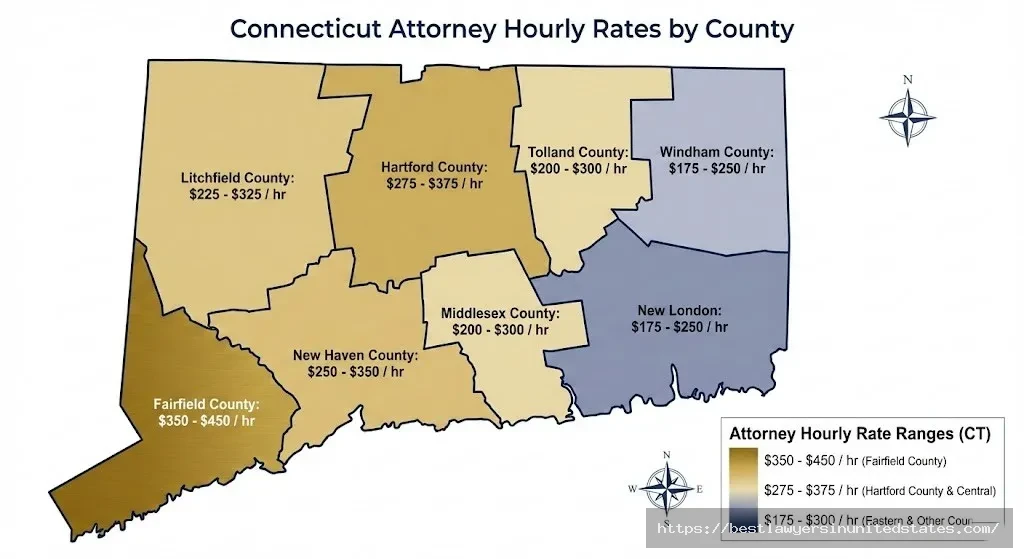
| County | Average Hourly Rate | Why the Difference? |
|---|---|---|
| Fairfield County | $350-$450/hour | Proximity to NYC, higher cost of living, wealthy clientele |
| Hartford County | $275-$375/hour | State capital, competitive market |
| New Haven County | $250-$350/hour | Mix of urban and suburban areas |
| Litchfield County | $225-$325/hour | More rural, lower overhead costs |
Total attorney costs for full representation:
- Uncontested divorce: $1,500-$3,500 (5-10 hours of work)
- Contested divorce (moderate): $10,000-$25,000 (30-60 hours)
- High-conflict contested: $30,000-$75,000+ (80-200+ hours)
For context on how Connecticut compares nationally, see our guide on divorce attorney fees across different states.
Retainer Fees Explained
Most Connecticut divorce attorneys require an upfront retainer—essentially a deposit against future work. Common retainer amounts:
- Uncontested cases: $1,500-$3,000
- Contested cases: $5,000-$15,000
- High-net-worth cases: $15,000-$50,000+
How retainers work:
- You pay the retainer upfront
- Attorney bills hourly against this amount
- You receive itemized statements (usually monthly)
- When retainer depletes, you replenish it
- Any unused portion is refunded when your case closes
Flat Fee vs. Hourly Billing

Some Connecticut attorneys offer flat-fee packages for straightforward uncontested divorces:
Typical flat-fee services ($1,500-$3,000):
- Preparing all court documents
- Filing with Connecticut Superior Court
- One court appearance (if required)
- Basic settlement agreement drafting
What flat fees usually DON’T include:
- Contested matters
- Extended negotiations
- Discovery disputes
- Multiple court hearings
- Child custody battles
When hourly makes more sense: If you anticipate disagreements over property, alimony, or custody, hourly billing gives you flexibility without unexpected charges for “extra” work beyond the flat-fee scope.
What Does an Uncontested Divorce Cost in Connecticut?
An uncontested divorce in Connecticut costs $1,500-$5,000 when you hire an attorney, or as little as $350-$1,000 if you handle it yourself.

What Qualifies as Uncontested?
Your divorce is uncontested when you and your spouse agree on ALL major issues:
✅ Division of all assets (house, cars, bank accounts, retirement funds)
✅ Division of all debts (mortgages, credit cards, loans)
✅ Alimony amount and duration (or waiver)
✅ Child custody and parenting schedule
✅ Child support amount
If you disagree on even one issue, your divorce becomes contested—at least partially.
Total Cost Breakdown for Uncontested Divorce
DIY (Pro Se) Divorce:
| Expense | Cost |
|---|---|
| Court filing fee | $350 |
| Service of process | $50-$75 |
| Document preparation service (optional) | $0-$300 |
| Notary fees | $10-$20 |
| Total DIY Cost | $410-$745 |
Attorney-Assisted Uncontested:
| Expense | Cost |
|---|---|
| Court filing fee | $350 |
| Service of process | $50-$75 |
| Attorney flat fee | $1,500-$3,000 |
| Financial affidavit preparation | Included |
| Settlement agreement drafting | Included |
| Total with Attorney | $1,900-$3,425 |
Mediation Costs in Connecticut
Divorce mediation offers a middle ground between DIY and full attorney representation. Connecticut mediators charge $150-$400 per hour.

Typical mediation timeline and costs:
- Simple case (no kids, few assets): 3-5 sessions = $900-$2,000
- Moderate case (kids, house, retirement): 5-8 sessions = $1,500-$3,200
- Complex case (business, multiple properties): 8-12 sessions = $2,400-$4,800
Total mediated divorce cost: $2,500-$7,000 when you include:
- Mediation fees: $1,500-$4,000
- Review attorney (recommended): $500-$1,500
- Court filing: $350
- Service of process: $50-$75
Many couples find mediation worth the investment because it typically costs 60-80% less than contested litigation while maintaining control over outcomes.
What Does a Contested Divorce Cost in Connecticut?
A contested divorce in Connecticut typically costs $15,000-$50,000+, with high-conflict or high-net-worth cases reaching $75,000-$150,000 or more.
Why Contested Divorces Cost More
Contested divorces require extensive attorney time for:
Discovery process ($3,000-$10,000+):
- Interrogatories (written questions)
- Document requests
- Depositions ($500-$1,500 per person)
- Subpoenas for financial records
Court appearances ($500-$2,000 per hearing):
- Pendente lite hearings (temporary orders)
- Motion hearings
- Pre-trial conferences
- Trial preparation and attendance
Expert witnesses ($2,000-$15,000+):
- Business valuations: $5,000-$15,000
- Real estate appraisals: $400-$800
- Custody evaluators: $3,000-$8,000
- Forensic accountants: $5,000-$20,000
- Pension valuators: $500-$2,500
Typical Cost Range by Complexity
Moderate contested divorce ($15,000-$30,000):
- One or two disputed issues (e.g., alimony amount or custody schedule)
- Some discovery required
- 2-4 court hearings
- Settlement reached before trial
High-conflict contested divorce ($30,000-$75,000):
- Multiple disputed issues
- Extensive discovery
- Multiple motions filed
- Guardian ad litem involvement
- Settlement just before trial or short trial
Trial divorce ($50,000-$150,000+):
- Full trial (2-5+ days)
- Expert witnesses testify
- Extensive motion practice
- Post-judgment enforcement issues
High-Net-Worth Divorce Costs
Connecticut divorces involving significant assets ($1 million+) often cost $75,000-$150,000+ per spouse due to:
- Complex business valuations
- Multiple real estate holdings
- Substantial retirement assets requiring QDROs
- Hidden asset investigations
- Tax implications analysis
- Lifestyle analysis for alimony
For comparison with other high-cost-of-living states, see our guides on New York divorce costs and Massachusetts divorce costs.
Hidden Costs of Divorce in Connecticut You Need to Budget For
Beyond attorney fees and court costs, Connecticut divorces often involve these overlooked expenses:

Real estate-related ($500-$2,000):
- Home appraisal: $400-$800
- Refinancing costs (to remove spouse from mortgage): $2,000-$5,000
- Real estate attorney for deed transfer: $500-$1,500
Financial professional fees ($1,000-$20,000+):
- QDRO preparation (splitting retirement): $500-$2,500
- Business valuation: $5,000-$15,000
- Forensic accountant: $5,000-$20,000
- Tax advisor consultation: $300-$1,000
Child-related expenses ($2,000-$10,000+):
- Guardian ad litem fees: $3,000-$8,000
- Custody evaluation: $3,000-$10,000
- Children’s therapist: $150-$300 per session
- Parenting coordinator: $200-$400 per hour
Personal costs (variable):
- Moving expenses: $500-$5,000
- Temporary housing deposits: $2,000-$5,000
- New household items: $1,000-$10,000
- Credit report monitoring: $10-$30/month
- Individual therapy: $100-$250 per session
Post-divorce filing ($300-$1,000):
- Name change documents: $150-$300
- Updated estate planning: $500-$2,000
- Car title transfers: $25-$50
- Insurance policy changes: varies
Total hidden costs: Budget an additional $3,000-$15,000 beyond your primary divorce expenses for a moderate case, or $15,000-$50,000+ for complex situations.
Connecticut Divorce Costs by County

While court filing fees are uniform statewide, attorney rates and total costs vary significantly by Connecticut county.
| County | Avg. Attorney Rate | Uncontested Range | Contested Range | Notes |
|---|---|---|---|---|
| Fairfield | $350-$450/hr | $2,500-$5,000 | $20,000-$75,000+ | Highest costs; Greenwich, Westport, Darien drive rates up |
| Hartford | $275-$375/hr | $2,000-$4,000 | $15,000-$50,000 | State capital; moderate-high costs |
| New Haven | $250-$350/hr | $1,800-$3,500 | $12,000-$40,000 | Urban/suburban mix |
| New London | $225-$325/hr | $1,500-$3,000 | $10,000-$35,000 | Coastal; moderate costs |
| Litchfield | $225-$325/hr | $1,500-$3,000 | $10,000-$30,000 | Rural; lower overhead |
| Middlesex | $250-$325/hr | $1,700-$3,200 | $12,000-$35,000 | Small county; moderate |
| Tolland | $225-$300/hr | $1,500-$2,800 | $10,000-$30,000 | Rural; lower costs |
| Windham | $200-$300/hr | $1,500-$2,800 | $10,000-$28,000 | Most rural; lowest costs |
Regional cost drivers:
Fairfield County premium: Proximity to New York City, wealthy demographics, and high cost of living push attorney rates 20-40% above state average. Divorces involving Greenwich or Westport residents often involve substantial assets, requiring specialized expertise.
Hartford County middle ground: As Connecticut’s capital, Hartford attracts experienced attorneys but maintains somewhat lower rates than Fairfield County due to less extreme wealth concentration.
Eastern/Northern Connecticut savings: Litchfield, Tolland, and Windham counties offer the lowest attorney rates while still providing competent representation. If you live near county borders, shopping for attorneys in adjacent lower-cost counties can save thousands.
How Can I Get a Divorce for Free or Under $1,000 in Connecticut?
Getting divorced for under $1,000 in Connecticut is possible if you qualify for fee waivers and handle the process yourself (pro se).
Legal Aid Eligibility
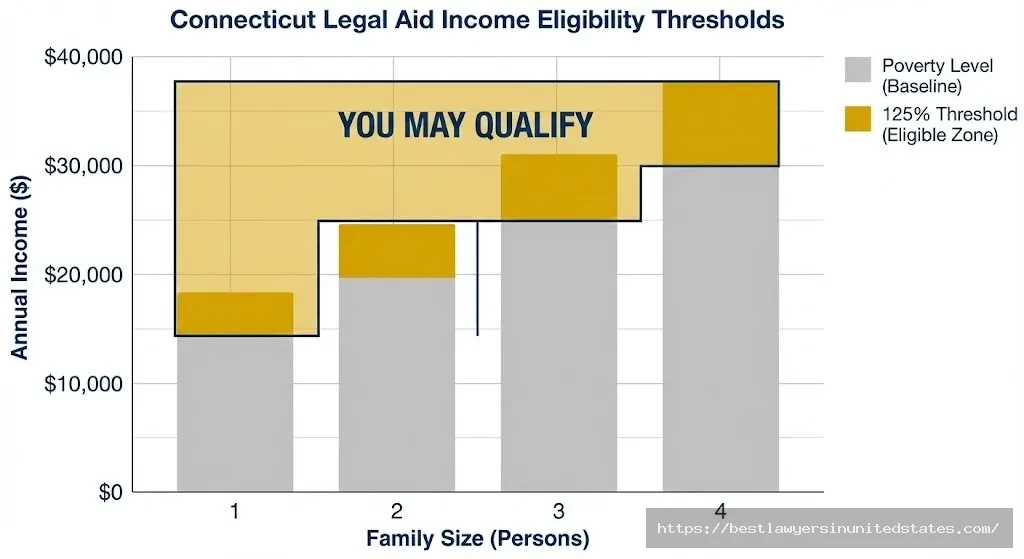
Connecticut offers free or low-cost legal services for low-income residents through:
Connecticut Legal Services (CLS):
- Income limit: Generally 125% of federal poverty level
- 2026 limits (approximate):
- Individual: $18,000/year
- Family of 2: $24,000/year
- Family of 4: $36,000/year
- Services: Full representation in some cases, limited advice in others
- Contact: 1-800-453-3320 or ctlegal.org
Statewide Legal Services:
- Similar income guidelines
- Focuses on family law cases
- May provide attorney representation or unbundled services
- Visit: slsct.org
Pro bono programs:
- Connecticut Bar Association runs a Lawyer Referral Service
- Some private attorneys take pro bono cases through CBA
- Law school clinics at UConn, Yale, and Quinnipiac offer free help
Pro Se Divorce Process
Handling your divorce without an attorney (DIY divorce) keeps costs minimal but requires time and attention to detail.
Required Connecticut divorce forms:
- Divorce Complaint (JD-FM-159)
- Summons (JD-FM-3)
- Notice of Automatic Court Orders (JD-FM-158)
- Appearance (JD-CL-12) (for responding spouse)
- Financial Affidavit (JD-FM-6) (both spouses)
- Separation Agreement (if uncontested)
- Advisement of Rights form
Where to get free forms:
- Connecticut Judicial Branch website: jud.ct.gov/webforms
- Court clerk’s office (any Connecticut Superior Court)
- Connecticut Legal Services
- Law libraries in Hartford, New Haven, other counties
Pro se divorce timeline:
- Complete all forms (2-4 hours if straightforward)
- File with Superior Court ($350 or request waiver)
- Serve spouse ($50-$75 or waive if spouse cooperates)
- Wait 90-day cooling-off period (mandatory)
- Attend hearing (often brief if uncontested)
- Receive divorce decree
Total DIY cost with fee waiver: $50-$100 (copying, notary, postage)
Total DIY cost without waiver: $410-$750
When DIY makes sense:
- Short marriage (under 5 years)
- No children
- Few assets to divide
- No retirement accounts
- Both spouses agree on everything
- Neither spouse has business ownership
When you should hire help:
- Children involved (custody, support calculations)
- Marital home or other real estate
- Retirement accounts requiring QDRO
- One spouse has significantly more financial knowledge
- Domestic violence concerns
- Any disagreement on major issues
How Can I Afford My Connecticut Divorce?
If divorce costs seem overwhelming, several options can make legal representation more accessible.
Payment Plans with Attorneys
Many Connecticut divorce attorneys offer payment plans, especially for middle-income clients who don’t qualify for legal aid but can’t afford a full retainer upfront.
Typical payment arrangements:
- Initial retainer: $1,500-$3,000 (reduced from standard $5,000-$10,000)
- Monthly payments: $300-$800 over 6-12 months
- Credit card acceptance (watch for processing fees)
- Interest-free periods (some attorneys offer 3-6 months interest-free)
Questions to ask attorneys about payment:
- Do you offer payment plans for retainers?
- What’s the minimum initial retainer you’ll accept?
- Do you charge interest on payment plans?
- Can I pay with credit cards?
- What happens if I fall behind on payments?
Financing Options
Personal loans:
- Credit unions often offer divorce loans: $5,000-$25,000
- Interest rates: 6-18% depending on credit
- Repayment: 2-5 years typical
Home equity loans/HELOCs:
- Access equity in marital home
- Lower interest rates than personal loans
- Risk: Home used as collateral
- May affect property division negotiations
401(k) loans:
- Borrow from your own retirement
- No credit check required
- Must repay within 5 years (usually)
- Risk: Taxes and penalties if you can’t repay
Credit cards:
- Use as last resort (high interest)
- Consider 0% APR promotional cards
- Balance transfer options
- Pay off aggressively to avoid debt spiral
Family loans:
- Formalize with written agreement
- Consider tax implications ($18,000+ annual gift limit)
- Clear repayment terms prevent family conflict
Limited Scope Representation (Unbundled Services)
Connecticut attorneys can provide limited scope representation where you pay only for specific services rather than full representation.
Common unbundled services ($500-$3,000 total):
- Document review only ($300-$800)
- Consultation and strategy session ($200-$500)
- Form preparation but you file yourself ($500-$1,500)
- Court appearance coaching ($200-$500)
- Settlement agreement drafting only ($800-$2,000)
- Single court hearing representation ($500-$1,500)
Benefits:
- Pay for only what you need
- Professional help on complex issues
- Handle routine tasks yourself
- Costs 50-70% less than full representation
Best for:
- Mostly uncontested divorces with one or two sticking points
- People comfortable with paperwork
- Cases where you need expert advice but not ongoing representation
What Are the Best Ways to Save Money on Your Connecticut Divorce?
These strategies can significantly reduce your total divorce costs:

✅ Organize financial documents before hiring an attorney
Gather bank statements, tax returns, retirement statements, mortgage documents, and credit card statements yourself. Attorneys charge $250-$450/hour for document gathering—you can do this work for free.
Potential savings: $1,000-$3,000
✅ Choose mediation over litigation
Mediation costs $2,500-$7,000 total versus $15,000-$50,000+ for contested litigation. You maintain control over outcomes rather than leaving decisions to a judge.
Potential savings: $10,000-$40,000+
✅ Agree on custody and parenting plans informally first
Custody battles are among the most expensive divorce elements. If possible, work out a parenting schedule before involving attorneys. Consider using a parenting coordinator ($200-$400/hour) instead of litigating.
Potential savings: $5,000-$20,000
✅ Use limited-scope representation for specific issues
Hire an attorney only for complex issues (property division, QDRO preparation) while handling routine paperwork yourself.
Potential savings: $5,000-$15,000
✅ File as uncontested if you agree on everything
Even if you hire attorneys, an uncontested divorce costs a fraction of contested litigation. Work through disagreements via negotiation or mediation before filing.
Potential savings: $10,000-$40,000+
✅ Avoid unnecessary discovery battles
Discovery (interrogatories, depositions, document requests) generates huge legal bills. Voluntarily exchange financial information when possible.
Potential savings: $3,000-$10,000
✅ Use online divorce services for form preparation
Services charge $150-$500 for Connecticut-specific divorce forms versus $1,500-$3,000 for attorney preparation. Only works for uncontested divorces.
Potential savings: $1,000-$2,500
✅ Respond promptly to attorney requests
Delays cause attorneys to spend time following up, sending reminder emails, and rescheduling. Quick responses reduce billable hours.
Potential savings: $500-$2,000
✅ Consider timing strategically
Filing in January/February (slower court months) may result in faster processing than June/July/December (busiest months).
Potential savings: Time savings reduce attorney fees
✅ Don’t use your attorney as a therapist
Emotional support from your attorney costs $250-$450/hour. Use friends, family, or actual therapists ($100-$200/hour) for emotional processing.
Potential savings: $1,000-$5,000
Total potential savings using multiple strategies: $15,000-$50,000+
What Factors Drive Up Divorce Costs in Connecticut?
Understanding what increases expenses helps you anticipate costs and make informed choices.
Children and custody disputes:
Custody disagreements are the single biggest cost driver. Court-ordered evaluations ($3,000-$10,000), guardian ad litem appointments ($3,000-$8,000), and multiple hearings quickly escalate costs. Child support calculations are straightforward, but custody battles are emotionally charged and expensive.
Number and value of assets:
More assets mean more to divide, value, and argue about. Each piece of property requires attention:
- Single home: Moderate complexity
- Multiple properties: Requires appraisals, tax analysis
- Business ownership: $5,000-$15,000 valuation costs
- Multiple retirement accounts: $500-$2,500 per QDRO
Retirement accounts and pensions:
Dividing 401(k)s, IRAs, and pensions requires Qualified Domestic Relations Orders (QDROs) prepared by specialized attorneys. Complex pensions (government, military) cost more to divide than simple 401(k)s.
Business ownership:
Business valuations cost $5,000-$15,000 and often become contentious. Spouses disagree on valuation methods, what counts as marital vs. separate property, and whether the business is a stream of income or an asset to divide.
Contentiousness level:
High-conflict divorces generate astronomical costs through:
- Excessive motion practice
- Refusing reasonable settlement offers
- Litigating minor issues
- Using divorce proceedings for revenge
- Changing attorneys multiple times
Hidden assets or financial dishonesty:
If you suspect hidden income, offshore accounts, or financial deception, forensic accountants ($5,000-$20,000) and extensive discovery become necessary. However, they often pay for themselves by uncovering undisclosed assets.
Alimony disputes:
Connecticut judges have broad discretion on alimony. Disagreements over amount and duration require extensive financial analysis, lifestyle documentation, and expert testimony. Long-term marriages (15+ years) typically involve more substantial alimony disputes.
Out-of-state assets:
Property in multiple states complicates division and may require attorneys licensed in those states, increasing costs significantly.
Special needs children:
Children with disabilities require additional considerations for custody, support, and long-term planning, often involving expert witnesses and specialized attorneys.
Domestic violence:
Restraining orders, supervised visitation, and safety concerns add layers of complexity and cost. However, Connecticut offers free legal aid for domestic violence victims through multiple organizations.
How Long Does a Connecticut Divorce Take?
Timeline directly impacts costs—longer divorces mean more attorney fees.
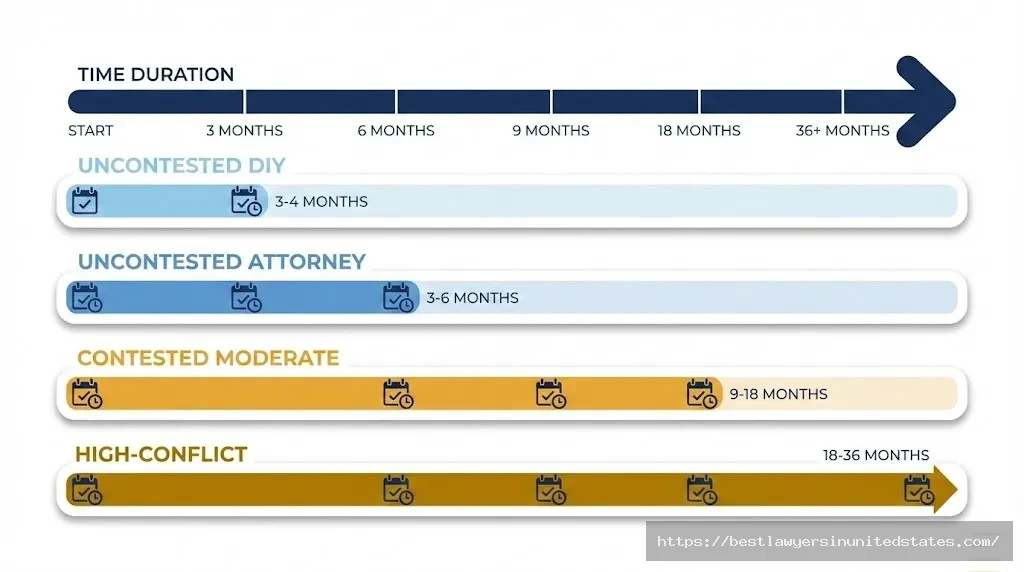
Uncontested divorce without complications:
- Filing to final decree: 3-4 months minimum
- Mandatory 90-day waiting period after filing
- If spouses agree on everything, court hearing is brief
- Total attorney time: 5-10 hours
Uncontested divorce with minor complications:
- Timeline: 4-6 months
- May need extra time for QDRO preparation
- Property appraisals can add weeks
- Total attorney time: 10-20 hours
Contested divorce (moderate):
- Timeline: 9-18 months
- Discovery takes 3-6 months
- Motion practice adds time
- Settlement negotiations extend process
- Total attorney time: 30-80 hours
Contested divorce (high-conflict):
- Timeline: 12-24 months
- Extensive discovery
- Multiple expert witnesses
- Numerous court hearings
- May settle just before trial
- Total attorney time: 80-150 hours
Trial divorce:
- Timeline: 18-36+ months
- Full trial preparation
- Court scheduling delays
- Post-trial motions
- Possible appeals
- Total attorney time: 150-300+ hours
Factors that extend timeline:
- Court backlog (varies by county)
- Attorney scheduling conflicts
- Refusal to compromise
- Complex asset division
- Custody evaluations (3-6 months alone)
- Expert witness availability
Strategies to shorten timeline:
- File complete, accurate paperwork
- Respond promptly to all requests
- Consider mediation for disputed issues
- Work cooperatively on discovery
- Accept reasonable settlement offers
Each additional month adds roughly $1,000-$5,000 in attorney fees for contested cases, making timeline reduction a significant cost-saving strategy.
Frequently Asked Questions About Connecticut Divorce Costs
What’s the minimum cost for a divorce in Connecticut?
The absolute minimum is $350 (court filing fee) if you qualify for a fee waiver for service of process and handle everything yourself. Realistically, expect $410-$750 for a DIY uncontested divorce including filing, service, and incidental costs.
Can I get a divorce for free in Connecticut?
Yes, if you qualify for legal aid based on income (generally below 125% of federal poverty level). Connecticut Legal Services and Statewide Legal Services provide free representation for eligible clients. You can also request fee waivers for court costs if you meet income requirements.
What’s the most expensive part of a divorce in Connecticut?
Attorney fees are typically the largest expense, especially in contested divorces. However, expert witness costs (business valuations, custody evaluations, forensic accountants) can rival attorney fees in complex cases, sometimes reaching $20,000-$40,000 combined.
Do I have to pay my spouse’s attorney fees in Connecticut?
Sometimes. Connecticut judges can order one spouse to pay the other’s attorney fees if there’s a significant income disparity and the lower-earning spouse can’t afford representation. This ensures both parties have equal access to legal counsel. It’s not automatic—your spouse must request it.
How much does it cost if we agree on everything?
An uncontested divorce where both spouses agree costs $1,500-$5,000 with attorney help, or $410-$750 if you handle it yourself. The court filing fee ($350) and service of process ($50-$75) are mandatory regardless of agreement level.
What’s the cost difference between mediation and litigation in Connecticut?
Mediation costs $2,500-$7,000 total versus $15,000-$50,000+ for contested litigation. Mediation saves approximately $10,000-$40,000 while giving you more control over the outcome. For cases where you’re not in complete agreement, mediation is often the most cost-effective approach.
Are there grants or assistance programs for divorce costs in CT?
Connecticut doesn’t offer grants for divorce costs, but several assistance programs exist:
- Fee waivers for those below 125% of poverty level
- Free legal services through Connecticut Legal Services and Statewide Legal Services
- Pro bono representation through Connecticut Bar Association
- Payment plans with many private attorneys
- Law school clinics offering free help
Can I deduct divorce costs on my taxes?
No. The Tax Cuts and Jobs Act of 2017 eliminated the deduction for legal fees related to divorce. Previously, you could deduct fees for tax advice and alimony-related legal work. However, you may be able to deduct some fees if they relate to tax advice or business asset protection—consult a tax professional.
How much does divorce mediation cost in Connecticut?
Connecticut mediators charge $150-$400 per hour. Most couples need 5-8 sessions for a moderate case, bringing total mediation costs to $1,500-$3,200. Add court filing ($350), service ($50-$75), and optional review attorney ($500-$1,500) for a total mediated divorce cost of $2,500-$7,000.
What if I can’t afford the retainer my attorney is asking for?
Discuss payment plans—many Connecticut attorneys offer reduced initial retainers with monthly payments. Consider limited-scope representation where you pay for specific services only. Apply for legal aid if you meet income requirements. Some attorneys accept credit cards or allow you to use funds from a joint account (if allowed by temporary orders).
Does having children make divorce more expensive?
Yes, usually by $3,000-$15,000+ if custody becomes contested. Child support calculations are straightforward and don’t add significant costs, but custody disputes require evaluations, guardian ad litem appointments, and additional hearings. If you can agree on custody and parenting time, children don’t substantially increase costs.
How much do I need to budget beyond attorney fees?
Budget an additional 20-30% beyond attorney fees for other costs:
- Court filing: $350
- Service of process: $50-$75
- Appraisals: $400-$800
- QDRO: $500-$2,500
- Moving costs: $500-$5,000
- Therapy: $500-$3,000
- Other miscellaneous: $500-$2,000
For a divorce with $10,000 in attorney fees, budget $12,000-$13,000 total.
Is it worth hiring an expensive attorney?
Not always. A $450/hour attorney isn’t necessarily better than a $275/hour attorney—you’re often paying for location (Fairfield County) and prestige rather than skill. For complex high-net-worth cases, experienced attorneys justify higher rates. For straightforward divorces, mid-priced attorneys often provide excellent representation at better value.
Can I use my 401(k) to pay for divorce?
Yes, but carefully. You can take a loan from your 401(k) (must repay within 5 years) or a hardship withdrawal (faces 10% penalty plus taxes). Better option: If your 401(k) will be divided in the divorce, you can sometimes access your share early to pay legal fees, though this requires careful QDRO drafting and court approval. Consult both your attorney and a financial advisor.
What happens if I run out of money during the divorce?
Several options:
- Request spousal support for attorney fees (pendente lite motion)
- Switch to limited-scope representation
- Represent yourself for remaining portions
- Request payment plan with your attorney
- Seek legal aid assistance
- Negotiate settlement to end the case sooner
Judges recognize that financial inequality during divorce can prevent fair representation and may order the higher-earning spouse to contribute to the other’s legal fees.
Connecticut Divorce Cost Comparison vs. Neighboring States
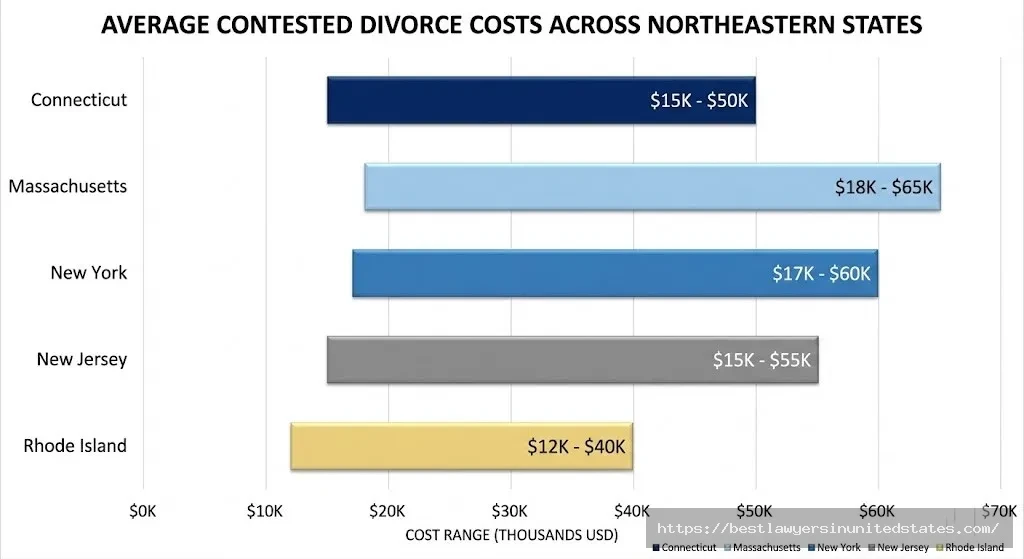
How Connecticut compares to nearby states:
| State | Avg. Uncontested Cost | Avg. Contested Cost | Filing Fee |
|---|---|---|---|
| Connecticut | $1,500-$5,000 | $15,000-$50,000 | $350 |
| New York | $2,000-$6,000 | $17,000-$60,000+ | $335-$350 |
| Massachusetts | $2,500-$7,000 | $18,000-$65,000+ | $215 |
| Rhode Island | $1,500-$4,500 | $12,000-$40,000 | $160 |
| New Jersey | $2,000-$6,000 | $15,000-$55,000 | $325 |
Connecticut’s divorce costs fall in the middle-to-high range among northeastern states. Fairfield County divorces approach New York City metro area prices, while eastern Connecticut costs align more with Rhode Island.
For a comprehensive comparison of divorce costs across all 50 states, see our complete divorce cost guide.
Final Thoughts: Planning Your Connecticut Divorce Budget
Connecticut divorce costs vary dramatically based on your choices and circumstances. A cooperative uncontested divorce costs $1,500-$5,000, while a contested divorce can reach $50,000-$150,000+.
Key takeaways:
💰 Court filing fees are fixed: $350 statewide, plus $50-$75 for service
💰 Attorney rates vary by county: $225-$450/hour depending on location and experience
💰 Uncontested saves the most: Agreeing on major issues before filing saves $10,000-$40,000+
💰 Mediation is cost-effective: $2,500-$7,000 total versus $15,000-$50,000+ for litigation
💰 Hidden costs add up: Budget 20-30% beyond attorney fees for additional expenses
💰 Timeline impacts cost: Each extra month in contested divorce adds $1,000-$5,000+
Your next steps:
- Assess your situation: Uncontested or contested? Simple or complex assets?
- Explore options: DIY, mediation, limited-scope, or full representation?
- Budget realistically: Use the ranges in this guide to plan financially
- Consult attorneys: Most offer free initial consultations—use them
- Consider alternatives: Mediation and collaborative divorce save money while maintaining control
Need help getting started? Use our divorce cost calculator for a personalized estimate based on your Connecticut county and circumstances.
This guide provides general information about Connecticut divorce costs and should not be considered legal advice. Divorce laws and costs vary by individual circumstances. Consult with a Connecticut-licensed family law attorney for advice specific to your situation.
