
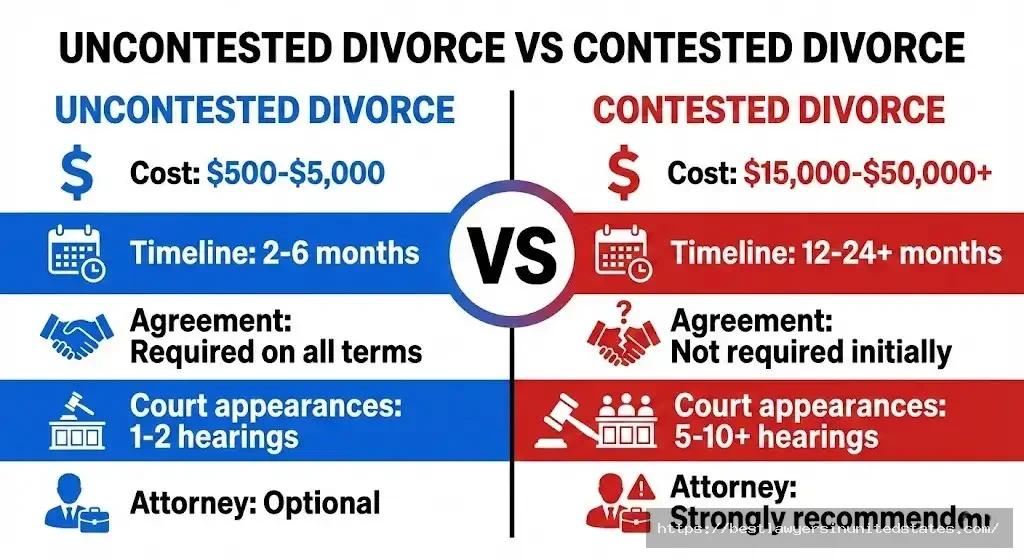
When facing divorce, one decision shapes everything else: contested or uncontested. An uncontested divorce costs $500 to $5,000 and takes 2 to 6 months. A contested divorce costs $15,000 to $50,000+ and takes 12 to 24 months or longer.
The difference comes down to agreement. If you and your spouse agree on all terms, you can file an uncontested divorce. If you disagree on property, children, or support, your divorce becomes contested.
This guide breaks down costs, timelines, and processes for both types. You’ll learn when each applies, how to switch from contested to uncontested, and what to expect at each stage.
What Is Contested vs Uncontested Divorce?
A contested divorce means you and your spouse disagree on one or more divorce terms. An uncontested divorce means you both agree on everything. The type you choose affects your costs, timeline, and stress level.
Most divorces start contested and become uncontested through negotiation. Only 5% of divorces actually go to trial, according to the American Academy of Matrimonial Lawyers.
Contested Divorce Definition & When It Applies
A contested divorce happens when spouses cannot agree on key issues. These issues include property division, child custody, child support, or spousal support. Even one disagreement makes your divorce contested.
Common contested divorce triggers:
- One spouse wants more time with children
- Disagreements about house ownership or sale
- Disputes over retirement accounts or investments
- Arguments about spousal support amounts
- Hidden assets or financial deception
- Business valuation disagreements
Contested divorces require court intervention. A judge makes final decisions on disputed issues. This process involves discovery, depositions, and potentially a trial.
Uncontested Divorce Definition & Requirements
An uncontested divorce requires complete agreement on all terms. Both spouses sign a marital settlement agreement covering every issue. Courts then approve the agreement with minimal involvement.
What you must agree on for uncontested divorce:
✅ Property division (house, cars, bank accounts, debts)
✅ Child custody and parenting time schedule
✅ Child support amounts and payment terms
✅ Spousal support (if applicable)
✅ Division of retirement accounts and investments
✅ Who pays marital debts
✅ Tax filing status and exemptions
Some couples hire attorneys for uncontested divorces. Others use online services or file paperwork themselves. The DIY divorce route works when both parties cooperate and have simple finances.
Key Legal Differences Explained
The main difference is court involvement. Uncontested divorces need one or two court appearances maximum. Contested divorces require multiple hearings, motions, and potentially a trial.
| Feature | Uncontested | Contested |
|---|---|---|
| Agreement Required | Complete | None initially |
| Court Appearances | 1-2 hearings | 5-10+ hearings |
| Discovery Process | Not required | Extensive |
| Trial | Never | Possible |
| Attorney Needed | Optional | Strongly recommended |
| Judge’s Role | Approve agreement | Decide disputed issues |
Discovery makes contested divorces expensive. This formal process exchanges financial documents, answers questions under oath, and may include depositions. Each discovery request costs money in attorney time.
Can a Contested Divorce Become Uncontested?
Yes, and this happens frequently. About 95% of contested divorces settle before trial. Couples reach agreements through negotiation, mediation, or collaborative divorce processes.
Common reasons divorces settle:
- Discovery reveals financial reality and reduces disputes
- Mediation helps spouses find compromise
- Rising legal costs motivate settlement
- Court deadlines force decision-making
- Attorneys negotiate reasonable terms
Once you settle all issues, your attorney files a marital settlement agreement. The judge reviews and approves it just like an uncontested divorce. You save money on trial preparation and court time.
The earlier you settle, the more you save. Settling before depositions can cut costs by 50% or more compared to going to trial.
Cost Comparison: Contested vs Uncontested Divorce
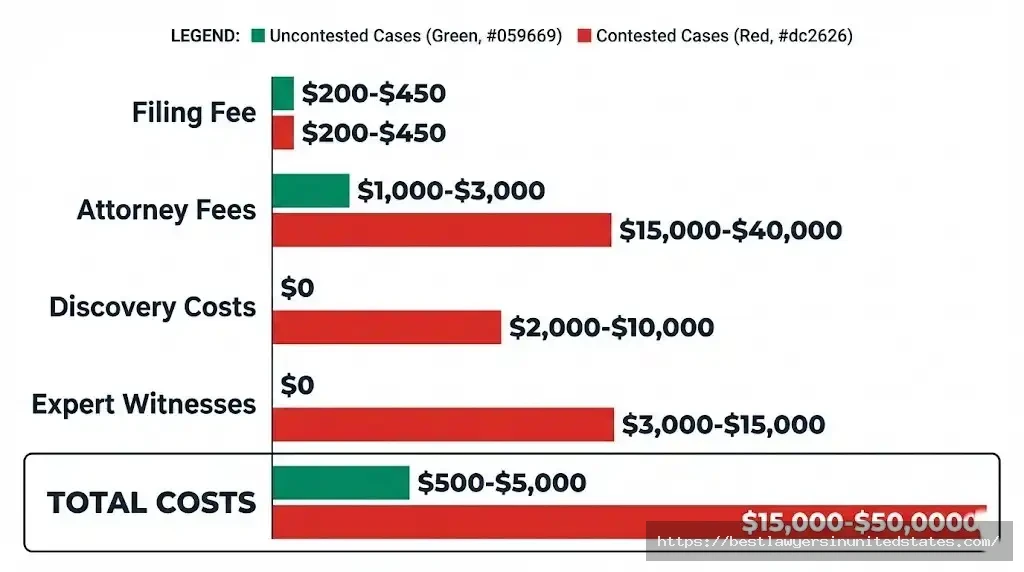
Cost differences between contested and uncontested divorces are dramatic. Divorce costs vary by state, complexity, and whether you hire attorneys. Most people pay far more than they expect for contested cases.
Average Cost of Uncontested Divorce (2026 Data)
The national average for uncontested divorce ranges from $500 to $5,000. DIY divorces cost as little as $300 to $500. Attorney-assisted uncontested divorces cost $1,500 to $3,500.
Typical uncontested divorce costs:
| Cost Type | Amount | Notes |
|---|---|---|
| Filing Fee | $200-$450 | Varies by state |
| Service Fee | $50-$100 | Process server or certified mail |
| Attorney (if used) | $1,000-$3,000 | Flat fee common |
| Online Service | $150-$500 | Document preparation |
| Mediation | $500-$2,000 | If needed for final details |
| Total Range | $500-$5,000 | Most pay $1,500-$2,500 |
State-by-state examples:
- California uncontested divorce: $1,500-$3,500 (filing fee $435-$450)
- Texas uncontested divorce: $1,000-$2,500 (filing fee $300)
- Florida uncontested divorce: $1,200-$2,800 (filing fee $408-$409)
- New York uncontested divorce: $1,500-$3,000 (filing fee $335)
Many attorneys offer flat-fee uncontested divorce packages. This makes costs predictable and affordable for most families.
Average Cost of Contested Divorce (2026 Data)
Contested divorces cost $15,000 to $50,000 on average. Complex cases with trials can exceed $100,000. The national median is approximately $20,000 per spouse.
Typical contested divorce costs:
| Cost Type | Amount | Notes |
|---|---|---|
| Filing Fee | $200-$450 | Same as uncontested |
| Attorney Retainer | $5,000-$15,000 | Upfront deposit |
| Attorney Hourly Rate | $250-$600/hour | Varies by location |
| Discovery Costs | $2,000-$10,000 | Document requests, depositions |
| Expert Witnesses | $3,000-$15,000 | Appraisers, custody evaluators |
| Court Reporter | $500-$2,000 | Deposition transcripts |
| Trial Preparation | $5,000-$20,000 | If case goes to trial |
| Total Range | $15,000-$50,000+ | Per spouse |
Contested divorce costs escalate quickly because attorneys bill hourly for every action. Reading emails, making calls, drafting motions, and attending hearings all count as billable time.
State examples show the variation:
- California contested divorce: $17,500-$35,000 average
- Texas contested divorce: $15,000-$30,000 average
- New York contested divorce: $20,000-$40,000 average
Calculate Your Divorce Costs
Planning a divorce? Use our free calculator to estimate your total costs based on filing fees, typical attorney rates, and whether your divorce is contested or uncontested.
Divorce Cost Calculator
Get an estimated cost for your divorce based on your specific situation
Your Estimated Divorce Cost
Cost Breakdown
📧 Get a Personalized Consultation
Have questions about your specific situation? Contact our legal experts for guidance tailored to your needs.
Contact Us via EmailCalculator features:
- State-specific filing fees
- Attorney cost estimates by complexity
- Contested vs uncontested comparison
- Total cost breakdown
- Money-saving tips based on your situation
Questions about your divorce or need legal help? [Find divorce lawyers near you – Free consultation]
Email: [email protected]
Itemized Cost Breakdown for Both Types
Hidden costs catch people by surprise. Beyond attorney fees and filing costs, divorces include many smaller expenses that add up quickly.
Uncontested divorce itemized costs:
✅ Filing fee: $200-$450
✅ Service of process: $50-$100
✅ Attorney flat fee (if used): $1,000-$3,000
✅ Online service (if DIY): $150-$500
✅ Notary fees: $10-$50
✅ Certified copies: $20-$50
✅ Parenting class (if children): $25-$100
Contested divorce itemized costs:
✅ Filing fee: $200-$450
✅ Service of process: $50-$100
✅ Attorney retainer: $5,000-$15,000
✅ Additional attorney fees: $10,000-$35,000+
✅ Discovery costs: $2,000-$10,000
✅ Depositions: $500-$1,500 each
✅ Expert witnesses: $3,000-$15,000
✅ Custody evaluation: $2,000-$7,000
✅ Property appraisal: $300-$600
✅ Business valuation: $5,000-$25,000
✅ Court reporter: $500-$2,000
✅ Trial preparation: $5,000-$20,000
Attorney fees represent the biggest variable. Hourly rates vary significantly by location and attorney experience.
Who Pays for a Contested Divorce?
Generally, each spouse pays their own attorney fees. However, courts can order one spouse to pay the other’s fees in certain situations.
When courts order fee payment:
- Significant income disparity between spouses
- One spouse hid assets or acted in bad faith
- One spouse filed frivolous motions or delayed proceedings
- One spouse needs financial assistance to afford representation
- State law specifically allows fee awards
Most states follow the “American Rule” where each party pays their own costs. But judges have discretion to shift fees when fairness requires it. This usually happens when one spouse earns substantially more or controls marital assets.
Fee agreements matter too. Some attorneys offer payment plans. Others require full retainers upfront. Ask about payment options during initial consultations.
Timeline Comparison: How Long Does Each Type Take?
Time is money in divorce. The longer your case drags on, the more you pay in attorney fees and emotional stress. Timelines vary dramatically between contested and uncontested divorces.
Uncontested Divorce Timeline (Fastest Path)
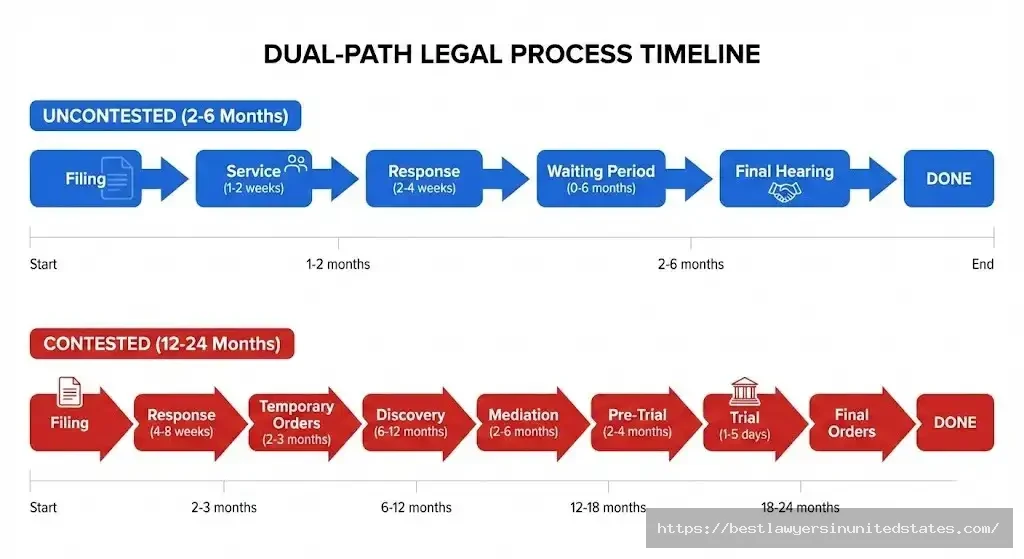
Uncontested divorces take 2 to 6 months on average. Some states finalize uncontested cases in as little as 30 days. Others require mandatory waiting periods that extend the timeline.
Typical uncontested divorce timeline:
| Stage | Timeframe | What Happens |
|---|---|---|
| Preparation | 1-4 weeks | Gather documents, draft agreement |
| Filing | 1 day | Submit petition to court |
| Service | 1-2 weeks | Serve spouse with papers |
| Response | 2-4 weeks | Spouse signs acknowledgment |
| Waiting Period | 0-6 months | Mandatory state waiting period |
| Final Hearing | 1 day | Judge approves agreement |
| Total | 2-6 months | Varies by state |
State waiting periods affect uncontested divorce timelines:
- California: 6 months minimum (longest in nation)
- Texas: 60 days minimum
- Florida: No waiting period
- New York: No waiting period
- Georgia: 31 days if no children, 46 days with children
- Virginia: 6-12 months depending on separation agreement
The divorce process moves faster when both parties cooperate. Delays happen when spouses don’t respond promptly or judges have scheduling backlogs.
Contested Divorce Timeline (What to Expect)
Contested divorces take 12 to 24 months on average. Complex cases stretch to 3 years or longer. Cases that go to trial add 6 to 12 months to the process.
Typical contested divorce timeline:
| Stage | Timeframe | What Happens |
|---|---|---|
| Filing & Service | 2-4 weeks | Petition filed and served |
| Response & Counter | 4-8 weeks | Spouse responds, may counter-file |
| Temporary Orders | 2-3 months | Court sets interim rules |
| Discovery | 6-12 months | Exchange financial documents |
| Depositions | 2-4 months | Sworn testimony taken |
| Mediation | 2-6 months | Settlement attempts |
| Pre-Trial Motions | 2-4 months | Legal arguments filed |
| Trial | 1-5 days | Court decides disputed issues |
| Final Orders | 2-4 weeks | Judge signs divorce decree |
| Total | 12-36 months | Highly variable |
Discovery extends timelines significantly. Attorneys request documents, send interrogatories, and schedule depositions. Opposing counsel often delays responses to the maximum allowed time.
Court scheduling also creates delays. Judges handle hundreds of cases. Getting a trial date can take 12 to 18 months in busy jurisdictions.
Factors That Delay Both Types of Divorce
Several factors slow down even simple divorces. Understanding these helps you avoid preventable delays.
Common delay causes:
✅ Spouse doesn’t respond to paperwork (adds 2-3 months)
✅ Incorrect or incomplete forms filed (adds 2-4 weeks per rejection)
✅ Court backlog and scheduling conflicts (adds 1-3 months)
✅ Attorney scheduling conflicts (adds 2-6 weeks)
✅ Discovery disputes requiring court intervention (adds 2-4 months)
✅ One party moves out of state (adds 1-2 months)
✅ Changes in circumstances requiring new agreements (adds 1-3 months)
Stay responsive to your attorney’s requests. Provide documents quickly. Attend all scheduled meetings and hearings. Small delays compound into major problems.
If your spouse disappears or refuses to participate, you can request a default divorce. This adds time initially but eventually lets you proceed without their cooperation.
Contested vs Uncontested Divorce: Process Differences
The process for contested and uncontested divorces differs substantially. Uncontested cases follow a simple path. Contested cases involve complex legal procedures and court intervention.
The Uncontested Divorce Process (Step-by-Step)
Uncontested divorces follow a straightforward sequence. Most couples complete the process without trial or extensive legal work.
Step 1: Reach Complete Agreement
Both spouses must agree on all divorce terms. Discuss property division, custody, support, and debts. Write down your agreements in detail. If you can’t agree on everything, your divorce is contested.
Step 2: Prepare Divorce Documents
File a divorce petition in your county court. Include your marital settlement agreement detailing all agreed terms. Many states provide divorce forms online at no cost.
Step 3: File and Pay Filing Fees
Submit your petition and agreement to the court clerk. Pay filing fees, which range from $200 to $450 depending on your state. Filing fees vary by state and sometimes by county.
Step 4: Serve Your Spouse
Legally notify your spouse of the divorce filing. Use a process server, sheriff, or certified mail depending on state rules. Your spouse must sign an acknowledgment accepting the papers.
Step 5: Wait Out Mandatory Period
Comply with your state’s waiting period. This cooling-off period prevents impulsive divorces. Use this time to ensure your agreement covers everything properly.
Step 6: Attend Final Hearing
Appear before a judge for final approval. The hearing typically lasts 15 to 30 minutes. The judge reviews your agreement, asks basic questions, and signs the divorce decree.
Your divorce becomes final when the judge signs. You receive certified copies of your divorce decree within a few weeks.
The Contested Divorce Process (Full Breakdown)
Contested divorces involve multiple phases. Each phase requires attorney involvement and generates significant costs.
Phase 1: Filing and Initial Response
One spouse (petitioner) files for divorce. The other spouse (respondent) has 20 to 30 days to respond. Responses often include counter-petitions requesting different terms.
Phase 2: Temporary Orders
Courts issue temporary orders for interim arrangements. These cover child custody, support payments, who stays in the home, and bill payment. Temporary orders remain in effect until final divorce.
Phase 3: Discovery
Both sides exchange financial information through formal discovery. This includes:
- Interrogatories (written questions under oath)
- Requests for production (documents and records)
- Requests for admission (facts to admit or deny)
- Depositions (sworn testimony before attorneys)
- Subpoenas (third-party document requests)
Discovery reveals hidden assets, income sources, and financial details. It’s expensive but necessary for fair property division.
Phase 4: Negotiation and Mediation
Most courts require mediation before trial. A neutral mediator helps spouses negotiate settlements. Mediation costs less than trial but still requires preparation.
Settlement conferences with judges also encourage resolution. Judges pressure both sides to compromise rather than go to trial.
Phase 5: Pre-Trial Motions
Attorneys file motions requesting court decisions on specific issues. Common motions include requests for temporary support, custody changes, or financial disclosures. Each motion requires a hearing and legal fees.
Phase 6: Trial
If settlement fails, your case goes to trial. Divorce trials last 1 to 5 days depending on complexity. Each side presents evidence, examines witnesses, and makes legal arguments. The judge decides all disputed issues.
Trials are expensive. Attorney preparation costs $5,000 to $20,000 or more. Expert witness fees add thousands more.
Phase 7: Final Orders and Appeals
The judge issues final orders dividing property and setting support. Either party can appeal if they believe the judge made legal errors. Appeals add 12 to 24 months and $10,000+ in costs.
Mediation as a Bridge Between Both Types
Mediation converts many contested divorces into uncontested ones. A neutral mediator helps you negotiate without a judge deciding for you.
How mediation works:
- Both spouses meet with a trained mediator
- Each side explains their position on disputed issues
- Mediator suggests compromise solutions
- You control the outcome instead of a judge
- Agreements reached become your settlement terms
Mediation costs $100 to $400 per hour. Most divorces need 3 to 10 hours of mediation time. This totals $1,000 to $4,000, far less than trial costs.
Many states require mediation before allowing trials. Even when optional, mediation makes financial sense. You save money on trial preparation while maintaining control over outcomes.
Successful mediation converts your contested divorce into an uncontested one. You file your settlement agreement with the court and avoid trial completely.
When to Choose Uncontested vs Contested Divorce
The right divorce type depends on your circumstances. Not every divorce can be uncontested. Knowing when each type applies saves time and money.
Requirements for Uncontested Divorce (Complete Checklist)
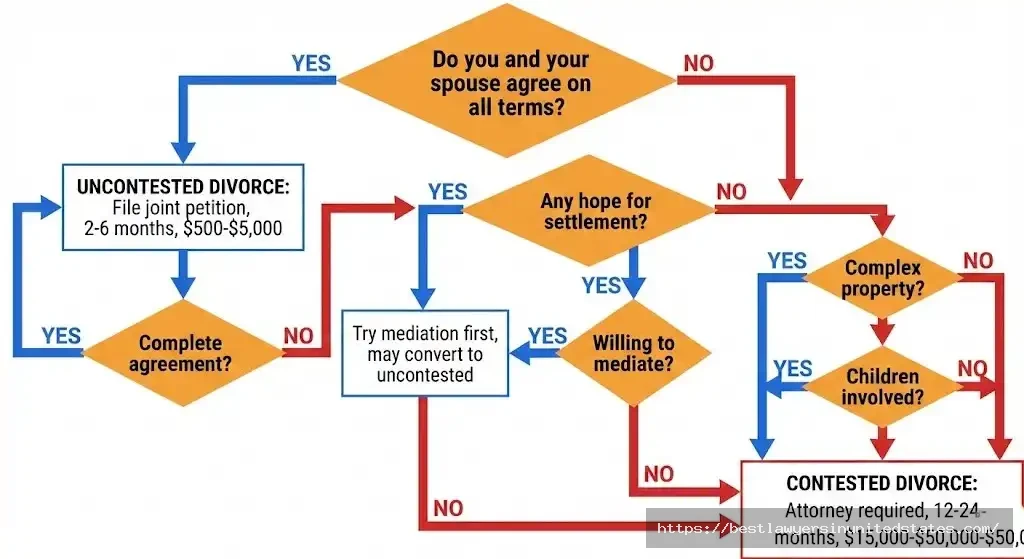
Uncontested divorce requires meeting specific criteria. If you check every box below, you likely qualify for uncontested divorce.
Uncontested divorce checklist:
✅ Both spouses agree to divorce
✅ No disputes about property division
✅ Agreement on all debt responsibility
✅ Child custody and visitation schedule agreed
✅ Child support amounts agreed
✅ Spousal support terms agreed (if applicable)
✅ Both willing to sign settlement agreement
✅ No domestic violence or safety concerns
✅ No hidden assets or financial deception
✅ Reasonable communication between spouses
✅ Both parties acting in good faith
What you must agree on:
All divorce issues need resolution for uncontested filing. You cannot leave major decisions for the judge while claiming an uncontested divorce.
Property Division Agreement
List every asset and debt. Decide who gets what. Include homes, cars, bank accounts, retirement funds, credit card debt, and personal property. Put everything in writing.
Child Custody & Support Arrangement
Create a detailed parenting plan. Specify physical custody percentages, holiday schedules, and decision-making authority. Calculate child support using your state’s guidelines. Address healthcare, education, and activity costs.
Spousal Support/Alimony Terms
Determine if either spouse receives alimony. Specify monthly amounts, payment duration, and termination conditions. Some states require alimony calculations based on income and marriage length.
When Contested Divorce Is Necessary
Some situations make contested divorce unavoidable. Forcing an uncontested divorce when real disputes exist leads to unfair outcomes and potential legal challenges later.
Contested divorce is necessary when:
Complex Property Division
High-value assets require professional valuation. Businesses, investment portfolios, stock options, and real estate holdings need expert analysis. You cannot divide these fairly without discovery and potentially trial.
Multiple properties across different states complicate division. Retirement accounts with different vesting schedules need careful calculation. Professional guidance protects your financial interests.
Child Custody Disputes
When parents disagree about custody arrangements, judges must decide. Courts apply “best interests of the child” standards. Custody evaluations, home studies, and expert testimony may be needed.
Safety concerns require contested proceedings. Abuse allegations, substance abuse, or mental health issues need formal investigation and court protection.
Hidden Assets or Financial Disagreements
If you suspect your spouse hides money or assets, you need discovery. Forensic accountants trace hidden income and undisclosed accounts. Contested proceedings include tools to uncover financial deception.
Disagreements about asset values also require contested divorce. One spouse claims the house is worth $300,000 while the other says $400,000. Formal appraisals and court decisions resolve these disputes.
Domestic Violence or Safety Concerns
Abuse survivors should not negotiate directly with abusers. Contested divorce with attorney representation provides protection. Courts can issue restraining orders and supervised visitation.
Never agree to unfair terms because of intimidation. Contested divorce gives you legal protection and advocacy.
Self-Assessment: Can Your Divorce Be Uncontested?
Answer these questions honestly to determine if uncontested divorce fits your situation.
Question 1: Can you communicate civilly with your spouse?
Uncontested divorce requires cooperation. If every conversation becomes a fight, you probably need attorneys to negotiate for you.
Question 2: Do you trust your spouse’s financial disclosures?
Hidden assets destroy trust. If you suspect deception, choose contested divorce with formal discovery.
Question 3: Can you agree on child custody without court involvement?
Parents who put children first often reach custody agreements. If neither will compromise, a judge must decide.
Question 4: Are your finances relatively simple?
One home, two cars, basic retirement accounts, and manageable debt allow easy division. Complex finances need professional analysis.
Question 5: Is the power dynamic balanced?
Uncontested divorce fails when one spouse dominates or intimidates. Equal negotiating power is essential for fair agreements.
Question 6: Are you both committed to fair outcomes?
Good-faith negotiation enables settlement. If one spouse wants to “win” at all costs, you need contested proceedings.
If you answered “no” to two or more questions, contested divorce likely suits your situation better.
Online Divorce Services for Contested & Uncontested Cases
Technology has transformed divorce filing. Online services now handle simple uncontested divorces for a fraction of traditional attorney costs. Understanding these options helps you decide the best approach.
Best Online Platforms for Uncontested Divorce
Online divorce services work well for straightforward uncontested cases. These platforms prepare your paperwork for court filing. Most charge $150 to $500 for document preparation.
What online divorce services provide:
✅ State-specific divorce forms
✅ Step-by-step questionnaires
✅ Document preparation and review
✅ Filing instructions for your county
✅ Customer support by phone or email
✅ Money-back guarantees if forms are rejected
Popular online divorce platforms include:
- CompleteCase ($299 average)
- It’s Over Easy ($750-$1,500 with mediation)
- DivorceWriter ($137-$297)
- 3StepDivorce ($299)
- Hello Divorce ($99-$599 plus optional services)
These services cannot provide legal advice. They prepare forms based on information you provide. You remain responsible for accuracy and completeness.
When online services work:
- Both spouses agree on all terms
- No complex property or business interests
- Simple custody arrangements
- No hidden assets or financial disputes
- You feel comfortable handling paperwork
- No attorneys needed for negotiation
Online Mediation Services for Contested Divorces
Virtual mediation helps resolve disputes without in-person meetings. Online mediators conduct sessions via video conference. This reduces costs while maintaining mediation effectiveness.
Benefits of online mediation:
✅ Lower costs than in-person sessions ($100-$250/hour vs $200-$400/hour)
✅ No travel time or expense
✅ Flexible scheduling including evenings
✅ Comfortable home environment
✅ Easy document sharing via screen sharing
✅ Recorded sessions for reference (with permission)
Wevorce, OurFamilyWizard, and Amicable offer online mediation services. Many local mediators now provide virtual sessions as well.
Online mediation cannot replace in-person sessions for high-conflict cases. Domestic violence situations require in-person safety protocols. Complex financial negotiations benefit from face-to-face interaction.
DIY Divorce: When It Works (And When It Doesn’t)
Do-it-yourself divorce saves money but requires time and attention to detail. Court clerks cannot provide legal advice. One mistake can delay your divorce or create unfair outcomes.
DIY divorce works when:
✅ Your divorce is uncontested
✅ No children or grown children only
✅ Limited marital property and debt
✅ Neither spouse has retirement accounts
✅ No spousal support needed
✅ Both spouses have similar incomes
✅ You can follow detailed instructions
✅ You understand legal terminology
DIY divorce doesn’t work when:
❌ Any disagreement on divorce terms
❌ Complex property division needed
❌ Children and custody issues involved
❌ Business ownership or stock options
❌ One spouse earns significantly more
❌ Retirement accounts require division
❌ Domestic violence or safety concerns
❌ Either spouse feels overwhelmed by paperwork
Most court websites provide free divorce forms and instructions. Use these resources if you choose the DIY route. Consider at least one attorney consultation to review your agreement before filing.
Cost Comparison: Online vs Traditional Lawyer
Cost differences between online services and traditional attorneys are substantial. Your choice depends on case complexity and comfort level with self-representation.
| Service Type | Cost Range | What’s Included | Best For |
|---|---|---|---|
| DIY (No Help) | $200-$500 | Filing fees and forms only | Very simple, fully agreed divorces |
| Online Service | $350-$800 | Document prep, instructions, support | Uncontested with some complexity |
| Online Service + Mediation | $1,500-$3,500 | Documents, mediation, filing | Mostly agreed with minor disputes |
| Flat-Fee Attorney | $1,500-$3,500 | Full representation, court appearance | Uncontested needing legal review |
| Traditional Attorney | $15,000-$50,000+ | Full contested representation | Contested with disputes |
Online services save money on straightforward cases. But attempting DIY divorce with real disputes creates problems. You might agree to unfair terms or make costly mistakes.
Consider a hybrid approach. Use online services for document preparation, then pay an attorney for limited review. This costs $500 to $1,500 total while providing professional oversight.
State-Specific Differences: Contested vs Uncontested Divorce
Divorce laws vary dramatically by state. What works in California differs from Texas procedures. Understanding your state’s rules prevents costly mistakes and delays.
Community Property States (9 States)
Nine states follow community property rules for divorce. Marital property splits 50/50 regardless of who earned more or whose name appears on titles.
Community property states:
- Arizona
- California
- Idaho
- Louisiana
- Nevada
- New Mexico
- Texas
- Washington
- Wisconsin
In these states, assets and debts acquired during marriage belong equally to both spouses. Separate property (owned before marriage or received as inheritance/gifts) stays with the original owner.
This creates simpler property division in uncontested divorces. Both spouses know they get half. But contested divorces still fight over what counts as community vs separate property.
Example: You bought a house before marriage in California. During marriage, you refinanced and added your spouse’s name. The original down payment remains your separate property. The appreciation and loan paydown during marriage is community property. Calculating each portion requires expert analysis.
Equitable Distribution States (41 States)
Most states use equitable distribution for property division. “Equitable” means fair, not necessarily equal. Judges consider multiple factors when dividing property.
Equitable distribution factors:
- Length of marriage
- Each spouse’s income and earning potential
- Age and health of each spouse
- Contributions to marital property
- Childcare and homemaking contributions
- Economic circumstances of each spouse
- Tax consequences of property division
These factors make contested divorces in equitable distribution states more complex. Attorneys argue why their client deserves more than 50%. Judges have broad discretion in final decisions.
State-specific differences affect costs and timelines significantly. Research your state’s laws before starting divorce proceedings.
States with Shortest Uncontested Divorce Timelines
Some states finalize uncontested divorces quickly. Others impose lengthy waiting periods regardless of agreement.
Fastest uncontested divorce states (2026):
| State | Minimum Timeline | Waiting Period | Notes |
|---|---|---|---|
| Alaska | 30 days | None | If uncontested and agreed |
| Nevada | 1-3 weeks | None | Fastest in nation |
| Wyoming | 20 days | 20 days | From service date |
| Idaho | 21 days | 21 days | From service date |
| South Dakota | 60 days | None | But court scheduling varies |
| Montana | 20 days | 20 days | If uncontested |
Slowest uncontested divorce states:
| State | Minimum Timeline | Waiting Period | Notes |
|---|---|---|---|
| California | 6 months | 6 months | Longest mandatory wait |
| Rhode Island | 5-6 months | 150 days | If uncontested |
| Arkansas | 30 days | 18 months separation required | For most divorces |
| Connecticut | 90 days | 90 days | From filing date |
| New Jersey | 35 days | None | But court backlog extends timeline |
Waiting periods cannot be waived even when both spouses agree. Budget extra time for court scheduling in addition to mandatory waits.
Most Expensive States for Contested Divorce
Attorney rates and court costs vary by location. High cost-of-living states generally have expensive divorce costs.
Most expensive states for contested divorce (2026 averages):
- California – $17,500 to $35,000 average (California divorce costs)
- New York – $20,000 to $40,000 average (New York divorce costs)
- Massachusetts – $18,000 to $38,000 average
- New Jersey – $16,000 to $32,000 average
- Connecticut – $16,000 to $34,000 average
Most affordable states for contested divorce:
- Wyoming – $8,000 to $15,000 average
- Montana – $7,000 to $14,000 average
- Arkansas – $7,500 to $13,000 average
- Idaho – $8,000 to $14,000 average
- Mississippi – $7,000 to $12,000 average
Location within states matters too. Urban attorneys charge more than rural ones. A contested divorce in San Francisco costs more than one in Fresno.
How to Convert a Contested Divorce to Uncontested
Most divorces start contested and become uncontested through settlement. Converting early saves substantial money and stress. Understanding settlement strategies helps you reach agreements faster.
Settlement Negotiation Strategies
Effective negotiation requires preparation and flexibility. Know what matters most to you and where you can compromise.
Negotiation preparation steps:
Step 1: Prioritize Your Goals
List must-haves vs nice-to-haves. Maybe keeping the house matters more than the retirement account. Perhaps equal custody time is non-negotiable but you’ll compromise on support amounts.
Step 2: Understand Your Financial Picture
Gather complete financial information. Know the value of all assets and debts. Calculate potential support obligations using state guidelines. Information is power in negotiations.
Step 3: Consider Tax Implications
Property division has tax consequences. Retirement account transfers need special orders. Understand tax impacts before agreeing to terms. An hour with a tax professional costs $200 but prevents $10,000+ mistakes.
Step 4: Focus on Interests, Not Positions
Your spouse wants the house. You want the house. This creates deadlock. Instead, explore underlying interests. Does one person need stability for kids? Does the other want liquid assets instead? Understanding interests creates solutions.
Step 5: Use Objective Standards
Base offers on fair market values, not emotions. Reference state child support guidelines. Cite comparable cases. Objective standards remove personal attacks from negotiations.
Step 6: Make Package Offers
Don’t negotiate item by item. Offer complete packages: “You keep the house and I keep my retirement account plus $20,000 from savings.” Package deals encourage overall fairness.
Using Mediation to Reach Agreement
Mediation provides structure for settlement discussions. A trained mediator facilitates negotiations without taking sides.
How to make mediation work:
Prepare thoroughly before sessions. Bring financial documents, proposals, and questions. Time is expensive in mediation. Preparation maximizes each session’s value.
Speak directly to your spouse through the mediator. Focus on issues, not blame. Explain your reasoning for each position. Listen when your spouse explains theirs.
Be ready to compromise. Mediation fails when both sides refuse to budge. Successful mediation requires give and take. You won’t get everything you want.
Take breaks when emotions run high. Mediators can pause sessions. Use breaks to consult your attorney or calm down. Never make important decisions while angry or upset.
Document agreements immediately. When you reach agreement on an issue, write it down. This prevents backtracking or misunderstandings later.
Most mediation resolves divorces within 3 to 10 hours of sessions. This costs $1,000 to $4,000 total, far less than continued litigation.
What Happens When You Settle Mid-Case
Settling after filing but before trial is common. Your contested divorce converts to uncontested through settlement agreement.
Settlement process steps:
- Attorneys draft marital settlement agreement covering all terms
- Both spouses review and sign the agreement
- Attorneys file the agreement with the court
- All pending motions and hearings are cancelled
- Court schedules final uncontested hearing
- Judge reviews and approves settlement
- Divorce becomes final
Some courts approve settlements without hearings. Others require brief appearances. Ask your attorney about local procedures.
You pay attorney fees for work already completed. But you stop paying for trial preparation, discovery completion, and court appearances. This typically saves $5,000 to $20,000+ in future costs.
Cost Savings of Early Settlement
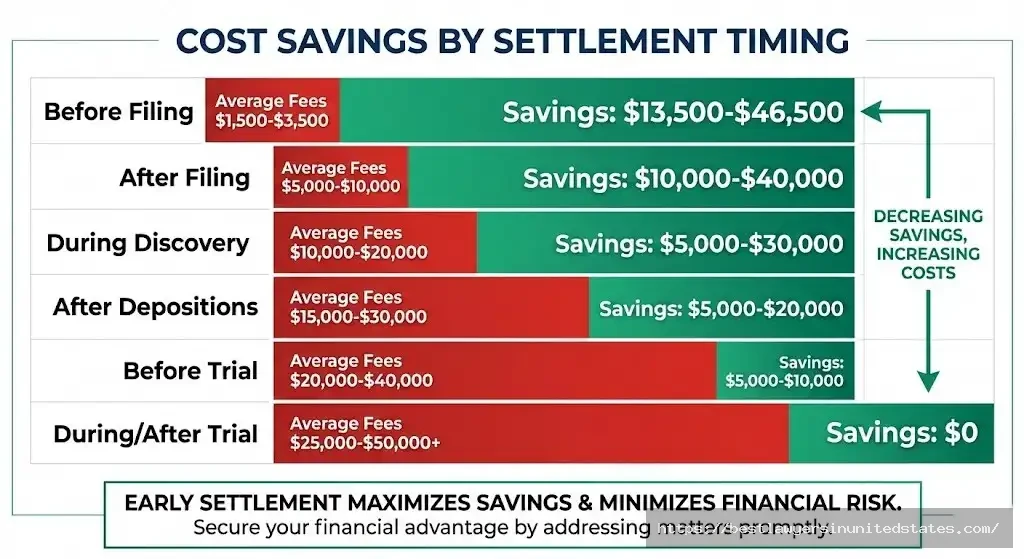
The earlier you settle, the more you save. Each phase of litigation adds costs.
Cost comparison by settlement timing:
| Settlement Point | Average Attorney Fees | Potential Savings |
|---|---|---|
| Before Filing | $1,500-$3,500 | Save $13,500-$46,500 |
| After Filing, Before Discovery | $5,000-$10,000 | Save $10,000-$40,000 |
| During Discovery | $10,000-$20,000 | Save $5,000-$30,000 |
| After Depositions | $15,000-$30,000 | Save $5,000-$20,000 |
| Before Trial | $20,000-$40,000 | Save $5,000-$10,000 |
| During/After Trial | $25,000-$50,000+ | No savings possible |
Settle before discovery starts if possible. Discovery generates massive attorney fees. Interrogatories, document requests, and depositions cost thousands of dollars each.
Settle before expert witnesses are hired. Custody evaluators cost $2,000 to $7,000. Business appraisers cost $5,000 to $25,000. Real estate appraisals cost $300 to $600 each. You pay these costs whether you win or lose.
Settle before trial preparation begins. Attorneys spend 20 to 40 hours preparing for trial. At $300 to $500 per hour, preparation alone costs $6,000 to $20,000.
Every month you delay settlement costs an average of $2,000 to $4,000 in attorney fees. Settling quickly protects your finances.
Common Myths About Contested vs Uncontested Divorce (Debunked)
Misconceptions about divorce types lead to poor decisions. Understanding the truth helps you choose the right path.
Myth 1: “Uncontested Means No Lawyers Needed”
Reality: Even uncontested divorces benefit from legal review. Online services prepare paperwork but don’t provide legal advice. Attorneys ensure your agreement is fair and legally sound.
One spouse may pressure the other to accept unfair terms. Having an attorney review your settlement agreement costs $500 to $1,500 but prevents costly mistakes. You might give up rights you don’t know you have.
Marital property includes less obvious assets. Retirement benefits, stock options, and business interests need careful valuation. Attorneys identify these assets and ensure proper division.
Myth 2: “Contested Always Means Going to Trial”
Reality: Only 5% of contested divorces reach trial. Most settle through negotiation or mediation. Filing a contested divorce doesn’t guarantee you’ll spend days in court.
Attorneys negotiate settlements throughout the process. As discovery reveals facts, positions become clearer. Reasonable people settle when they understand the likely trial outcomes.
Judges also pressure settlement. Pre-trial conferences push both sides to compromise. Courts prefer negotiated agreements over imposed judgments.
Myth 3: “Filing First Gives You an Advantage”
Reality: Filing first rarely provides meaningful advantages. Both spouses have equal rights regardless of who files the petition.
Minor advantages of filing first:
- Choose filing location if multiple counties qualify
- Present your version of facts first
- Slightly more control over timing
- May set initial tone of proceedings
These don’t matter much because:
- Respondent gets equal time to present their case
- Judges don’t favor petitioners
- Divorce outcomes depend on facts and law, not filing order
- Settlement negotiations ignore who filed first
Don’t rush to file out of fear. Take time to prepare properly and consult an attorney before starting proceedings.
Myth 4: “Uncontested Is Always Faster and Cheaper”
Reality: Uncontested divorces are usually faster and cheaper, but not always. Converting a contested case to uncontested after extensive discovery doesn’t save money on work already completed.
Uncontested divorces with complex assets may cost more than simple contested cases. Dividing multiple properties, businesses, and investments requires professional help even when spouses agree.
Some uncontested cases stall when spouses can’t agree on final details. Technically uncontested doesn’t mean quickly resolved. You still need complete agreement to finalize.
Divorce costs depend more on complexity than whether you initially filed contested or uncontested.
Pros and Cons: Contested Divorce
Contested divorce isn’t automatically bad. Some situations require formal legal proceedings to protect your interests.
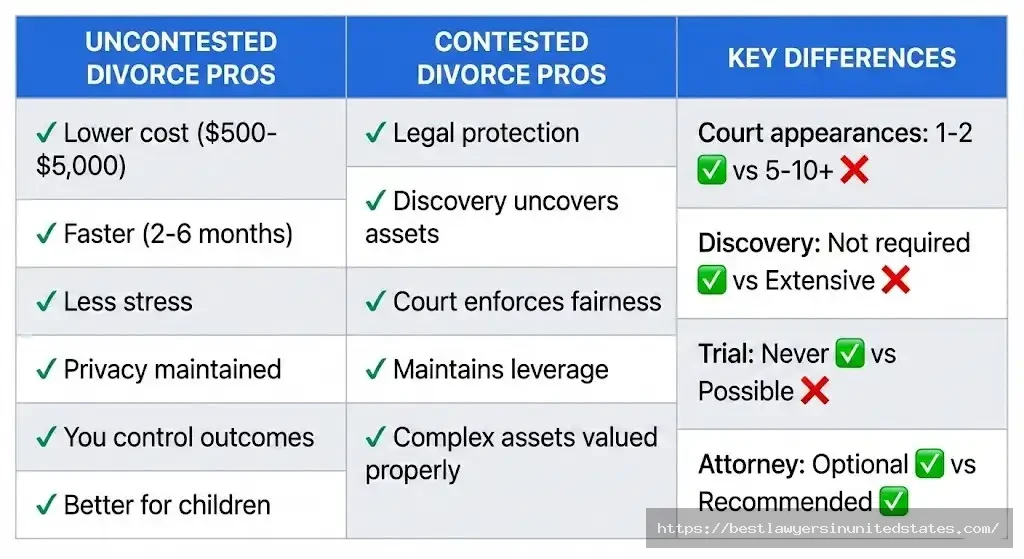
Advantages of Contested Divorce
You get legal protection. Attorney representation ensures your rights are protected. Lawyers understand complex property division laws and support calculations.
Discovery uncovers hidden information. Formal discovery tools force disclosure of financial information. Subpoenas reach third-party records your spouse won’t voluntarily provide.
Court can enforce fairness. Judges won’t approve grossly unfair agreements. If your spouse proposes unreasonable terms, a judge can impose fair outcomes instead.
You maintain leverage. The threat of trial motivates settlement. Many spouses settle reasonably once they face actual court dates and trial costs.
Domestic violence gets addressed. Restraining orders and supervised visitation protect abuse victims. Courts take safety concerns seriously in contested proceedings.
Complex assets get proper valuation. Business appraisers, real estate experts, and forensic accountants provide objective asset valuations. This prevents one spouse from hiding or undervaluing property.
Disadvantages and Costs
Expensive attorney fees. Contested divorce costs $15,000 to $50,000+ per spouse. Hourly billing adds up quickly across months or years of proceedings.
Long timeline. Contested cases take 12 to 36 months. The stress and uncertainty last years, not months.
Loss of control. Judges decide disputed issues. You might strongly disagree with the final judgment but have limited appeal options.
Emotional toll. Litigation is combative and stressful. Cross-examination and depositions feel invasive. The adversarial process damages any remaining cooperation.
Unpredictable outcomes. You don’t know what the judge will decide. Trial results sometimes surprise both sides.
Children suffer. Custody fights harm children. Evaluations and testimony about parenting create lasting damage to family relationships.
Public record. Court filings become public. Financial details and personal disputes end up in searchable records.
Contested divorce makes sense when necessary. But consider the real costs beyond money before choosing litigation over settlement.
Pros and Cons: Uncontested Divorce
Uncontested divorce offers clear advantages but isn’t right for every situation.
Advantages of Uncontested Divorce
Significantly lower costs. Uncontested divorce costs average $500 to $5,000, a fraction of contested divorce expenses.
Much faster resolution. Complete your divorce in 2 to 6 months instead of 12 to 36 months. Get closure and move forward sooner.
Less stress and conflict. Cooperation reduces emotional trauma. No depositions, trials, or adversarial confrontations.
Privacy maintained. Settlement agreements can remain private. You avoid public testimony about personal matters.
You control outcomes. Negotiate terms that work for your family. Don’t leave important decisions to a judge who doesn’t know you.
Children protected. Cooperative divorce causes less harm to children. You model problem-solving instead of conflict.
Preserves relationships. Especially important when co-parenting. Uncontested divorce makes future cooperation easier.
Flexible agreements. Courts approve reasonable agreements. You have flexibility judges might not allow in contested cases.
Disadvantages and Limitations
Requires trust. You must believe your spouse disclosed all assets honestly. No discovery to verify information.
Risk of unfair terms. Pressure to settle might result in accepting bad deals. Imbalanced power dynamics favor stronger spouses.
Complex assets need experts. Even in uncontested cases, business valuations and pension calculations need professional help. DIY division of complex assets often fails.
No court protection from bad agreements. Judges usually approve uncontested settlements without much review. You could sign away rights unknowingly.
Enforcement difficult if one spouse changes mind. While the agreement is enforceable, doing so requires going back to court.
Not possible with true disputes. If you genuinely disagree on custody or property, forcing an uncontested filing creates future problems.
Uncontested divorce works beautifully when both spouses act in good faith. But don’t sacrifice fair outcomes just to save money.
Frequently Asked Questions
Can a contested divorce be changed to uncontested?
Quick Answer: Yes, contested divorces convert to uncontested when spouses reach complete settlement agreements on all disputed issues.
Most contested divorces settle before trial. Once you agree on property, custody, and support, your attorneys file a marital settlement agreement. The court then finalizes your divorce as uncontested.
What happens if an uncontested divorce becomes contested?
Quick Answer: If either spouse withdraws agreement on any term, the uncontested divorce converts to contested and requires litigation to resolve disputes.
File an amended petition identifying the contested issues. The case proceeds through discovery and negotiation like any contested divorce. You’ll incur additional attorney fees and extended timelines.
Who pays for a contested divorce?
Quick Answer: Generally each spouse pays their own attorney fees, but courts can order one spouse to pay the other’s fees based on income disparity or bad faith conduct.
Fee awards depend on state law and case circumstances. Judges consider earning capacity, available assets, and whether one spouse caused unnecessary litigation. Request fee awards early in proceedings.
How much does an uncontested divorce cost compared to contested?
Quick Answer: Uncontested divorces cost $500 to $5,000 while contested divorces cost $15,000 to $50,000 or more per spouse.
The cost difference reflects attorney time and complexity. Uncontested cases need minimal legal work. Contested cases require discovery, motions, hearings, and possibly trial. Use our divorce cost calculator to estimate your specific situation.
How long does a contested divorce take?
Quick Answer: Contested divorces take 12 to 24 months on average, with complex cases extending to 3 years or longer depending on court schedules and settlement negotiations.
Timeline depends on case complexity, discovery extent, and court availability. Cases that settle during mediation resolve faster than those requiring trial. State waiting periods also affect minimum timelines.
What are the requirements for an uncontested divorce?
Quick Answer: Uncontested divorce requires complete agreement on property division, child custody, child support, spousal support, and debt division with both spouses signing the settlement agreement.
You cannot have any outstanding disputes. If you disagree on even one issue, your divorce is contested until you resolve it. Both spouses must participate willingly without coercion.
Is mediation required for contested divorce?
Quick Answer: Many states require mediation before allowing contested divorces to proceed to trial, but requirements vary by jurisdiction.
Check your local court rules. Some courts mandate mediation for all contested cases. Others require it only for custody disputes. A few states leave mediation optional. Ask your attorney about local requirements.
Can I do an uncontested divorce without a lawyer?
Quick Answer: Yes, you can file uncontested divorce without an attorney if you have simple finances, no children, and both spouses agree on all terms, but legal review is recommended.
Many people successfully complete DIY uncontested divorces using online services or court forms. However, having an attorney review your settlement agreement before filing costs $500 to $1,500 and prevents costly mistakes.
What is the difference between contested and uncontested divorce?
Quick Answer: Contested divorce involves disputes requiring court decisions while uncontested divorce means both spouses agree on all terms and file a joint settlement agreement.
The key difference is agreement level. Even one unresolved issue makes divorce contested. Complete agreement on property, custody, and support allows uncontested filing.
Do I need to go to court for uncontested divorce?
Quick Answer: Most uncontested divorces require one brief court appearance for final approval, though some states allow divorce finalization without appearing before a judge.
Court appearance requirements vary by state and county. Many jurisdictions need a 15 to 30 minute final hearing. The judge reviews your settlement, asks basic questions, and signs the divorce decree. Some states waive this requirement for simple uncontested cases.
How do online divorce services work?
Quick Answer: Online divorce services prepare state-specific divorce forms through guided questionnaires, charging $150 to $500 for document preparation and filing instructions.
You answer questions about your marriage, property, and children. The platform generates completed forms for your state. You review, print, and file with your local court. These services work best for simple uncontested divorces.
When should I hire an attorney instead of using online services?
Quick Answer: Hire an attorney if you have children, significant assets, retirement accounts, real property, business interests, or any disagreements with your spouse about divorce terms.
Attorney representation makes sense when stakes are high or issues are complex. Even for uncontested cases, consider at least a consultation to review your settlement agreement.
What happens during divorce mediation?
Quick Answer: During mediation, a neutral third party helps spouses negotiate disputed issues, typically meeting for 3 to 10 hours over several sessions until reaching settlement or declaring impasse.
Mediators don’t make decisions or provide legal advice. They facilitate discussion and suggest compromise options. You maintain control over all final decisions. Most mediation successfully resolves divorce disputes.
How are assets divided in contested vs uncontested divorce?
Quick Answer: Uncontested divorces divide assets per the spouses’ settlement agreement, while contested divorces follow state property division laws applied by a judge after trial.
Nine states use community property rules (50/50 split). Forty-one states use equitable distribution (fair but not necessarily equal). Judges consider multiple factors when dividing property in contested cases.
Can I get a divorce if my spouse won’t sign papers?
Quick Answer: Yes, you can obtain a default divorce if your spouse doesn’t respond within the required timeframe after being properly served with divorce papers.
Your spouse cannot prevent divorce by refusing to participate. After proper service and waiting the response period, you can request a default judgment. The court grants divorce based on your petition without spouse’s input.
Conclusion
Choosing between contested and uncontested divorce affects every aspect of your separation. Uncontested divorces offer speed, lower costs, and less conflict when both spouses cooperate. Contested divorces provide legal protection and court enforcement when disputes exist or trust is lacking.
Most people benefit from starting with settlement efforts. Use mediation and negotiation to resolve disputes before resorting to litigation. The earlier you settle, the more money you save and the faster you move forward.
Don’t sacrifice fairness for speed. Uncontested divorce only works when agreements are genuinely fair and complete. If you have concerns about hidden assets, complex property, or child safety, contested divorce with attorney representation protects your interests.
Use our divorce cost calculator to estimate your potential costs. Research divorce laws in your state to understand local requirements. Consult with family law attorneys before making final decisions about your approach.
Need legal help with your divorce? Contact divorce attorneys in your area for free consultations.
Email: [email protected]