
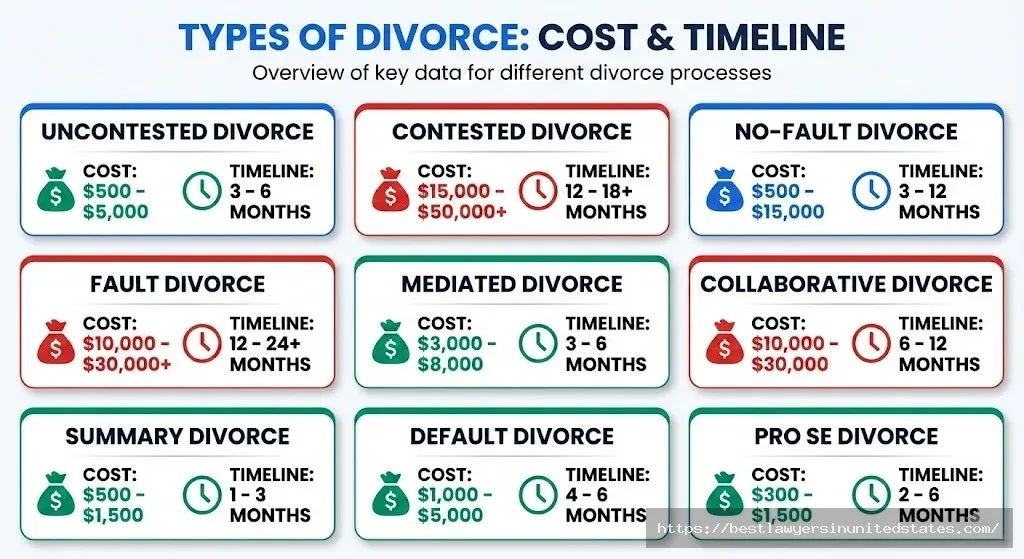
Choosing the right type of divorce can save you thousands of dollars and months of time. There are 9 main types of divorce in the United States: uncontested, contested, no-fault, fault, mediated, collaborative, summary, default, and pro se. Each type has different costs, timelines, and requirements.
The best divorce type for you depends on your agreement level with your spouse, case complexity, budget, and timeline needs. Understanding the average cost of divorce across different types helps you make informed decisions about your legal options.
The 9 Main Types of Divorce
Uncontested Divorce
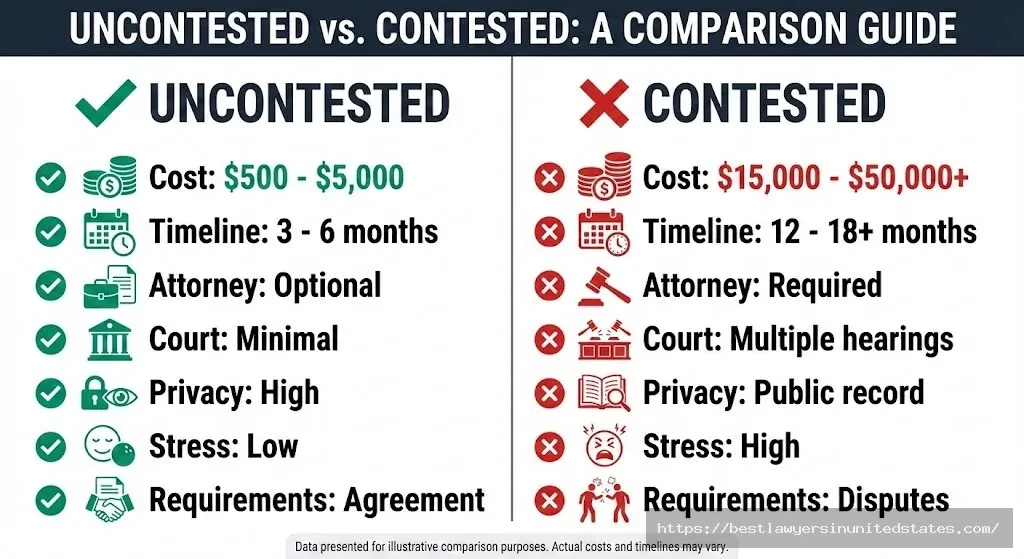
An uncontested divorce means both spouses agree on all major issues including property division, child custody, support, and alimony. This is the fastest and most affordable divorce type available in all 50 states.
Cost Range: $500 to $5,000 Timeline: 3 to 6 months Attorney Required: Optional
The uncontested divorce process requires both parties to sign a marital settlement agreement. You file this with your divorce petition and wait for the court’s approval. Many couples handle uncontested divorces without attorneys to save money.
Best for: Amicable couples with limited assets, no children, or complete agreement on custody and support.
Uncontested Divorce Requirements
| Requirement | Details |
|---|---|
| Agreement Level | Both parties must agree on all terms |
| Assets | Can be any amount if agreed |
| Children | Can have children if custody agreed |
| Attorney | Optional but recommended for complex cases |
| Timeline | Fastest divorce type available |
Use our divorce cost calculator to estimate your uncontested divorce expenses based on your state and situation.
Divorce Cost Calculator
Get an estimated cost for your divorce based on your specific situation
Your Estimated Divorce Cost
Cost Breakdown
📧 Get a Personalized Consultation
Have questions about your specific situation? Contact our legal experts for guidance tailored to your needs.
Contact Us via EmailContested Divorce
A contested divorce occurs when spouses cannot agree on one or more major issues. The court must decide disputed matters through hearings or trial. This is the most expensive and time-consuming divorce type.
Cost Range: $15,000 to $50,000+ Timeline: 12 to 18+ months Attorney Required: Yes (strongly recommended)
Contested divorces involve discovery, depositions, expert witnesses, and potentially a trial. Attorney fees accumulate quickly at $250 to $500 per hour. The complexity of contested divorce makes legal representation almost necessary.
Best for: High-conflict situations, complex assets, significant custody disputes, domestic violence cases, or when one spouse refuses to negotiate fairly.
Contested Divorce Cost Breakdown
| Cost Type | Low End | High End | Notes |
|---|---|---|---|
| Attorney Retainer | $5,000 | $10,000 | Initial deposit |
| Hourly Legal Fees | $10,000 | $30,000+ | Most expensive component |
| Filing & Court Fees | $300 | $500 | State dependent |
| Discovery Costs | $2,000 | $5,000 | Depositions, subpoenas |
| Expert Witnesses | $2,000 | $10,000 | Appraisers, evaluators |
| Total Average | $15,000 | $50,000+ | Can exceed $100,000 |
Learn more about managing contested divorce costs and what factors drive expenses higher.
No-Fault Divorce
No-fault divorce allows couples to end their marriage without proving wrongdoing. The most common ground is “irreconcilable differences” or “incompatibility.” All 50 states now offer no-fault divorce options.
Cost Range: $500 to $15,000 (depending on contested vs uncontested) Timeline: 3 to 12 months Attorney Required: Optional
No-fault divorce simplifies the process by removing blame. You don’t need to prove adultery, cruelty, or abandonment. The divorce proceeds based solely on the irretrievable breakdown of the marriage.
Best for: Couples who agree the marriage is over and want to avoid adversarial proceedings.
No-Fault vs Fault Divorce
| Feature | No-Fault | Fault |
|---|---|---|
| Proof Required | None | Must prove grounds |
| Timeline | Faster | Longer |
| Cost | Lower | Higher |
| Adversarial Level | Less | More |
| Available In | All 50 states | All 50 states (limited impact in some) |
Fault Divorce
Fault divorce requires one spouse to prove the other caused the marriage breakdown. Common grounds include adultery, cruelty, abandonment, substance abuse, or imprisonment. While all states allow fault grounds, many limit their impact on property division and support.
Cost Range: $10,000 to $30,000+ Timeline: 12 to 24+ months Attorney Required: Yes
Proving fault requires evidence, witnesses, and documentation. This increases legal fees and extends the timeline. Some states consider fault when determining alimony or property division, but many pure no-fault states do not.
Best for: Cases where proving misconduct may increase your share of assets or alimony, or when you need validation of wrongdoing.
Common Fault Grounds by State
| Ground | Description | States That Consider |
|---|---|---|
| Adultery | Extramarital affair | Most states, impacts alimony in some |
| Cruelty | Physical or mental abuse | All states, may affect custody |
| Abandonment | Spouse left for 1+ years | Most states, rarely impacts division |
| Addiction | Substance abuse | Most states, may affect custody |
| Imprisonment | Felony conviction | Most states, rarely significant impact |
Mediated Divorce
Mediated divorce uses a neutral third-party mediator to help couples negotiate agreements. The mediator cannot give legal advice but facilitates communication and compromise. This process costs less than litigation while providing professional guidance.
Cost Range: $3,000 to $8,000 Timeline: 3 to 6 months Attorney Required: Optional (many hire for review)
Divorce mediation sessions typically cost $100 to $300 per hour. Most couples complete mediation in 4 to 10 sessions. You can hire attorneys separately for advice while using mediation for negotiations.
Best for: Couples who can communicate civilly but need help reaching agreements on specific issues.
Compare divorce mediation costs across different complexity levels and see if mediation saves you money.
Mediation Cost Breakdown
| Service | Cost | Frequency |
|---|---|---|
| Mediator Fee | $150-$300/hr | 4-10 sessions |
| Attorney Review | $500-$1,500 | One-time |
| Filing Fees | $300-$500 | One-time |
| Total Average | $3,000-$8,000 | Complete process |
Collaborative Divorce
Collaborative divorce involves each spouse hiring an attorney who commits to settlement without going to court. If the process fails, both attorneys must withdraw and the couple needs new lawyers for litigation. This creates incentive for settlement.
Cost Range: $10,000 to $30,000 Timeline: 6 to 12 months Attorney Required: Yes (both spouses)
The collaborative team often includes financial advisors, child specialists, and mental health professionals. This team approach addresses all aspects of divorce holistically. Collaborative divorce works well for complex assets but requires cooperation.
Best for: Complex financial situations, business ownership, high-conflict co-parenting needs, or couples committed to avoiding court.
Learn about collaborative divorce costs and whether the team approach justifies the expense.
Summary Divorce (Simplified Divorce)
Summary divorce offers a streamlined process for simple cases meeting strict eligibility requirements. Also called simplified dissolution, this divorce type involves minimal paperwork and often no court hearings.
Cost Range: $500 to $1,500 Timeline: 1 to 3 months Attorney Required: No
Typical Eligibility Requirements:
- Married less than 5 years
- No children together (or wife not pregnant)
- Limited assets (typically under $50,000)
- Limited debts (typically under $6,000)
- Both agree on property division
- Neither seeks alimony
Available In: Arizona, California, Colorado, Florida, Illinois, Indiana, Montana, Nevada, Oregon, Washington, Wisconsin, and several other states.
Best for: Short marriages with minimal complexity and complete agreement.
Check our DIY divorce state-by-state guide to see if summary divorce is available in your state and what the eligibility requirements are.
Default Divorce
Default divorce occurs when one spouse files for divorce but the other doesn’t respond within the required timeframe. The court grants a default judgment allowing the divorce to proceed without the non-responding spouse’s participation.
Cost Range: $1,000 to $5,000 Timeline: 4 to 6 months Attorney Required: Recommended
You must prove proper service before requesting default judgment. The court typically grants what the filing spouse requested but may be less generous without the other party’s input.
Best for: When your spouse cannot be located, refuses to participate, or is unresponsive to divorce proceedings.
Default Divorce Process
| Step | Timeline | Requirements |
|---|---|---|
| File Petition | Day 1 | Pay filing fee, submit forms |
| Serve Spouse | 7-30 days | Legal service required |
| Wait for Response | 20-30 days | State-specific deadline |
| Request Default | 1-7 days | Affidavit of service required |
| Default Hearing | 30-60 days | May not be required |
| Final Judgment | Same day | Divorce granted |
Pro Se Divorce (Self-Represented)
Pro se divorce means representing yourself without an attorney. One or both spouses handle all paperwork, filings, and court appearances independently. This is the lowest-cost divorce option but requires research and attention to detail.
Cost Range: $300 to $1,500 (mainly court fees) Timeline: 2 to 6 months Attorney Required: No (by definition)
Pro se divorce works best for uncontested cases with agreement on all terms. Common mistakes include improper service, missed deadlines, incorrect forms, and unfavorable settlement terms. Consider at least consulting an attorney for review.
Best for: Uncontested divorces with limited assets, no children, and confidence in handling legal procedures.
Understanding divorce filing fees in your state helps you budget for pro se divorce accurately.
Alternative Resolution Methods
Arbitrated Divorce
Arbitrated divorce uses a private judge (arbitrator) to make binding decisions on disputed issues. This provides faster resolution than court while maintaining privacy. The arbitrator’s decision is final with very limited appeal options.
Cost Range: $8,000 to $20,000 Timeline: 4 to 8 months Best for: Couples who need third-party decisions but want privacy and faster resolution than traditional litigation.
Litigated Divorce
Litigated divorce is traditional court-based divorce where a judge decides all disputed issues through trial. This is essentially a contested divorce that goes to trial rather than settling through negotiation.
Cost Range: $20,000 to $50,000+ Timeline: 12 to 24+ months Best for: High-conflict situations where settlement proves impossible despite mediation or negotiation attempts.
Divorce Alternatives (Not Actually Divorce)
Legal Separation
Legal separation is a court-approved process where couples live apart while remaining legally married. The court divides property and addresses custody and support, but the marriage continues.
Cost Range: $5,000 to $15,000 Timeline: 3 to 8 months Best for: Religious reasons, maintaining health insurance benefits, Social Security considerations, or trial periods before divorce.
Trial Separation
Trial separation is an informal period where couples live apart without legal proceedings. No court involvement occurs, and the couple remains legally married with no formal agreements.
Cost: Free (unless creating separation agreement) Timeline: Variable Best for: Couples uncertain about divorce who need time apart to evaluate their relationship.
Annulment
Annulment is a legal declaration that a marriage was never valid. Unlike divorce, which ends a valid marriage, annulment treats the marriage as if it never existed.
Valid Grounds:
- Fraud or misrepresentation
- Bigamy
- Underage marriage
- Mental incapacity
- Force or duress
- Inability to consummate
Cost Range: $500 to $5,000 Timeline: 2 to 6 months Best for: Short marriages with valid legal grounds showing the marriage was never legally valid.
Religious & Cultural Divorce Types
Islamic Divorce (Muslim Law)
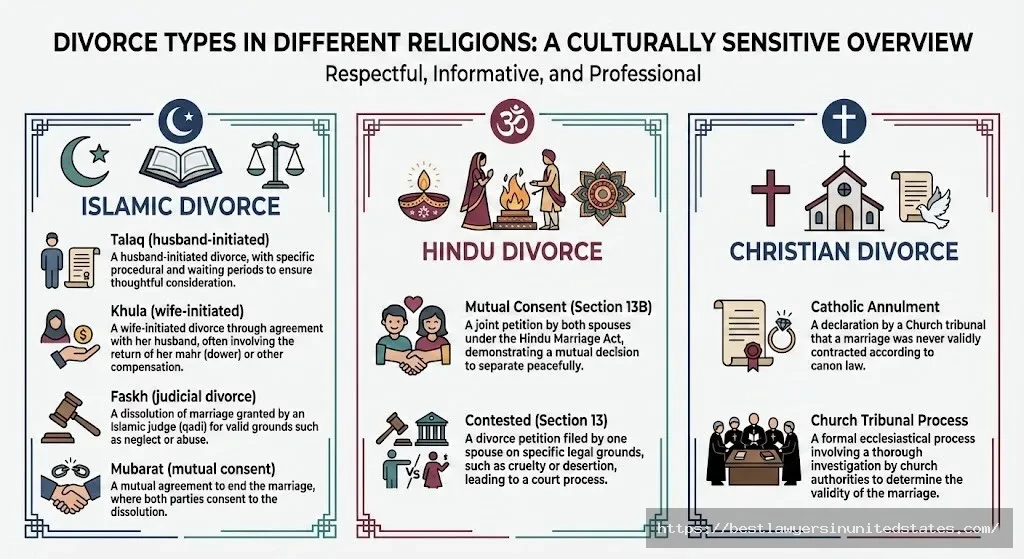
Islamic divorce operates under Sharia law principles. Four main types exist in Muslim law.
Talaq (Husband-Initiated)
The husband pronounces divorce by saying “I divorce you” three times. Three types of talaq exist:
- Talaq-e-Ahsan: Most approved form with pronouncement followed by iddah (waiting period)
- Talaq-e-Hasan: Three pronouncements over three months
- Talaq-e-Biddat: Triple talaq (instant divorce) – controversial and banned in many countries
Khula (Wife-Initiated)
The wife seeks divorce, typically returning her mahr (dowry) or providing compensation to the husband. This requires the husband’s consent or court approval.
Faskh (Judicial Divorce)
Either spouse can petition the court for divorce based on valid grounds including cruelty, abandonment, non-maintenance, imprisonment, or impotence.
Mubarat (Mutual Consent)
Both parties agree to end the marriage. This is similar to uncontested divorce in Western legal systems.
Hindu Divorce (India)
Hindu divorce follows the Hindu Marriage Act with two main types:
- Mutual Consent Divorce (Section 13B): Both parties agree after living separately for one year
- Contested Divorce (Section 13): Based on grounds including adultery, cruelty, desertion, conversion, mental disorder, or communicable disease
Christian Annulment
Catholic annulment through church tribunal operates separately from civil divorce. The tribunal investigates whether impediments prevented a valid marriage from occurring.
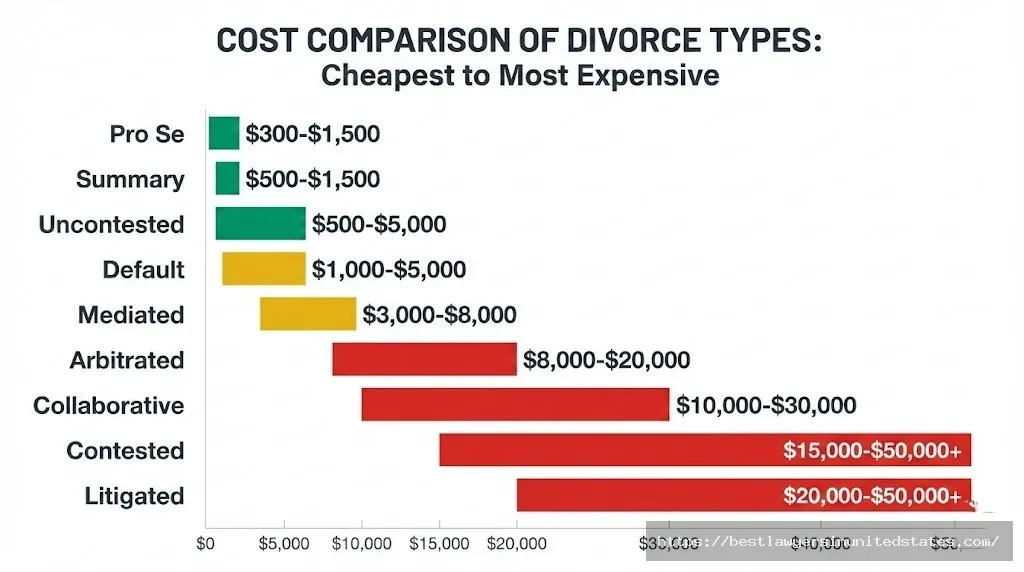
Cost Comparison Table: All Divorce Types
| Divorce Type | Average Cost | Timeline | Attorney Required? | Best For |
|---|---|---|---|---|
| Summary Divorce | $500-$1,500 | 1-3 months | No | Short marriage, no kids, minimal assets |
| Pro Se Divorce | $300-$1,500 | 2-6 months | No | Simple, agreed cases |
| Uncontested | $500-$5,000 | 3-6 months | Optional | Mutual agreement on all terms |
| Default | $1,000-$5,000 | 4-6 months | Recommended | Spouse won’t respond |
| Mediated | $3,000-$8,000 | 3-6 months | Optional | Can communicate, need help |
| Collaborative | $10,000-$30,000 | 6-12 months | Yes | Complex but cooperative |
| Arbitrated | $8,000-$20,000 | 4-8 months | Recommended | Want privacy, need decisions |
| Contested | $15,000-$50,000+ | 12-18+ months | Yes (strongly) | High conflict, complex |
| Litigated (Trial) | $20,000-$50,000+ | 12-24+ months | Yes (required) | Can’t settle, need judge |
Calculate your estimated divorce costs using our divorce cost calculator to see how different divorce types affect your total expenses.
Questions about your divorce or need legal help? Email: [email protected]
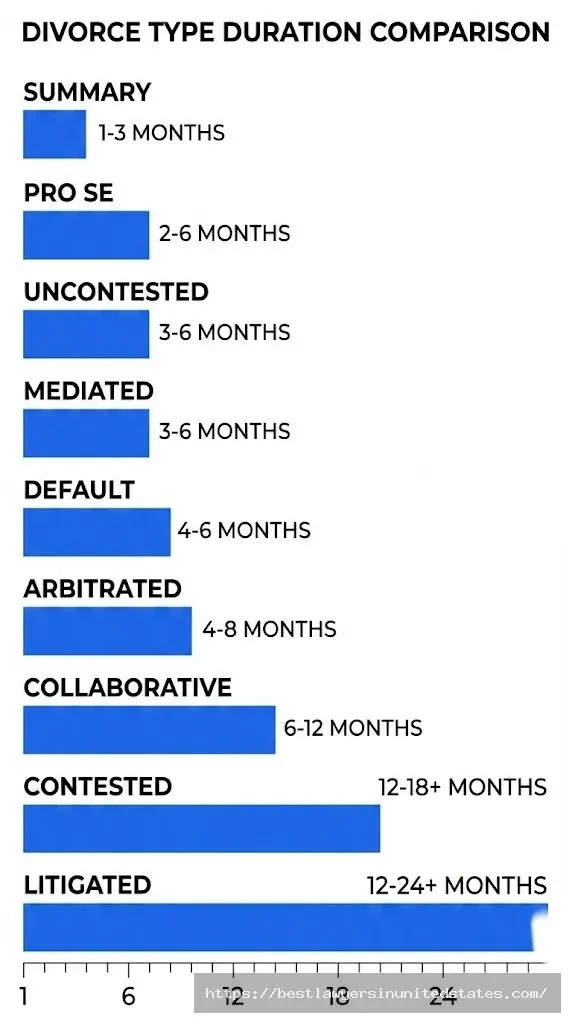
Timeline Comparison: How Long Each Type Takes
| Divorce Type | Minimum | Maximum | Average |
|---|---|---|---|
| Summary Divorce | 1 month | 3 months | 2 months |
| Pro Se | 2 months | 6 months | 4 months |
| Uncontested | 3 months | 6 months | 4 months |
| Mediated | 3 months | 6 months | 5 months |
| Default | 4 months | 6 months | 5 months |
| Arbitrated | 4 months | 8 months | 6 months |
| Collaborative | 6 months | 12 months | 9 months |
| Contested | 12 months | 18+ months | 15 months |
| Litigated (Trial) | 12 months | 24+ months | 18 months |
Timeline Extension Factors:
- Mandatory state waiting periods (30 days to 12 months)
- Court backlogs and scheduling delays
- Discovery disputes and document requests
- Child custody evaluations (2 to 6 months)
- Complex asset valuations
- Appeals (adds 6 to 18 months)
Learn more about how long the divorce process takes and what factors cause delays.
State-by-State Availability
Summary Divorce Available In:
Arizona, California, Colorado, Florida, Illinois, Indiana, Montana, Nevada, Oregon, Washington, Wisconsin (eligibility requirements vary by state)
All States Allow:
- No-fault divorce (all 50 states since 2010)
- Contested divorce
- Uncontested divorce
- Divorce mediation
Collaborative Divorce Laws:
Available in most states with formal collaborative law statutes in California, Texas, Ohio, North Carolina, and 20+ other states.
Pure No-Fault States:
California, Oregon, Washington, Nevada, Nebraska, Montana, Missouri, Kansas, Kentucky, Indiana, Iowa, Wisconsin, Michigan, Florida
These states offer no-fault divorce only. Fault grounds may exist but don’t impact property division or support.
How to Choose the Right Divorce Type: Decision Framework
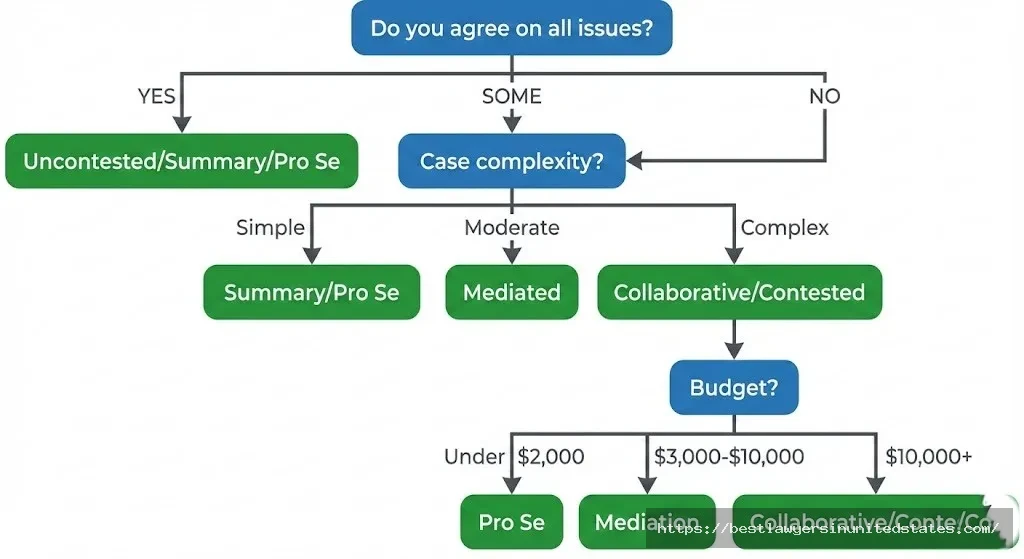
Step 1: Assess Your Agreement Level
High Agreement (Both want divorce, agree on terms) → Choose: Uncontested, Summary, or Pro Se → Cost: $300 to $5,000 → Timeline: 1 to 6 months
Moderate Agreement (Want divorce, some disagreements) → Choose: Mediated or Collaborative → Cost: $3,000 to $30,000 → Timeline: 3 to 12 months
Low/No Agreement (Can’t agree, high conflict) → Choose: Contested, Litigated, or Arbitrated → Cost: $8,000 to $50,000+ → Timeline: 4 to 24+ months
Step 2: Evaluate Complexity
Simple (Short marriage, no kids, few assets) → Summary Divorce or Pro Se
Moderate (Some assets, kids, need guidance) → Mediated or Uncontested with attorneys
Complex (High assets, business, custody battles) → Collaborative, Contested, or Litigated
Step 3: Consider Your Budget
Limited Budget ($0 to $2,000) → Pro Se or Summary → Fee waivers available for low-income filers
Moderate Budget ($3,000 to $10,000) → Uncontested with limited attorney help or Mediation
Higher Budget ($10,000+) → Collaborative or Full-Service Contested
Understanding divorce attorney fees helps you budget appropriately for your chosen divorce type.
Step 4: Timeline Priority
Need Fast (Under 6 months) → Summary, Pro Se, or Uncontested (requires cooperation)
Moderate (6 to 12 months acceptable) → Mediated or Collaborative
Long-Term (12+ months) → Contested or Litigated (when no other option works)
Step 5: Special Considerations
| Special Situation | Recommended Type | Notes |
|---|---|---|
| Religious Requirements | Parallel religious process | May need Islamic talaq, Jewish get, or Catholic annulment alongside civil divorce |
| Domestic Violence | Fault divorce with protective orders | Safety first – don’t use mediation |
| Spouse Missing | Default Divorce | Requires proof of service attempts |
| Military Service | Military-aware attorney | 10-10-10 rule for retirement benefits |
| Business Ownership | Collaborative or Contested | Need business valuation and protection |
Trending Divorce Terms Explained
What Is Grey Divorce?
Grey divorce refers to divorce after age 50. The grey divorce rate has doubled since 1990 as baby boomers end long marriages.
Unique Challenges:
- Retirement account division
- Social Security benefit calculations
- Medicare and health insurance concerns
- Long-term asset accumulation
- Adult children complications
Best Divorce Type: Collaborative or mediated divorce works well due to asset complexity and lower conflict levels typical in grey divorces.
What Is Silent Divorce?
Silent divorce describes couples who remain legally married but live emotionally detached, separate lives under the same roof. This is not a legal process but a relationship dynamic.
Characteristics:
- Minimal communication
- Separate activities and friend groups
- No physical intimacy
- Roommate-like existence
Silent divorce often leads to trial separation, legal separation, or eventual divorce.
What Is Ghost Divorce?
Ghost divorce describes gradual emotional withdrawal leading to divorce without a major triggering event. One or both spouses slowly disengage until the relationship ends.
Related Terms: Silent divorce, walkaway wife syndrome, emotional divorce
The 10-10-10 Rule for Divorce
The 10-10-10 rule applies specifically to military divorces. The service member must have:
- 10 years of marriage
- 10 years of overlapping military service during the marriage
This qualifies the ex-spouse for direct retirement payment from DFAS rather than receiving payments through the service member.
The 2-2-2 Rule for Marriage
The 2-2-2 rule is a marriage maintenance strategy, not a divorce concept:
- Date every 2 weeks
- Weekend away every 2 months
- Vacation every 2 years
This rule aims to prevent divorce through regular couple connection.
The Four C’s of Divorce
The Four C’s help determine which divorce type suits your situation:
- Conflict: How much disagreement exists (high conflict → contested)
- Communication: Ability to work together (good communication → mediation)
- Custody: Children’s living arrangements (complex → collaborative)
- Cost: Financial implications (limited budget → pro se/summary)
State Variations in Divorce Types
Community Property vs Equitable Distribution
Community Property States (50/50 asset split): Arizona, California, Idaho, Louisiana, Nevada, New Mexico, Texas, Washington, Wisconsin
Equitable Distribution States (Fair, not necessarily equal): All other 41 states
This affects uncontested divorce settlements and negotiation strategies in mediation.
Mandatory Waiting Periods by State
| Waiting Period | States |
|---|---|
| No Waiting | Alaska, Arizona, Nevada, Washington |
| 30-60 Days | California (6 months), Michigan, Oregon |
| 60-90 Days | Illinois, Maryland, Pennsylvania |
| 90+ Days | Arkansas (18 months separated), Louisiana, Nebraska |
| 1 Year+ | Rhode Island (for fault grounds), Vermont (6 months) |
Waiting periods affect all divorce types and extend minimum timelines.
Summary Divorce Eligibility Varies
California Requirements:
- Married less than 5 years
- No children together
- No real property owned
- Personal property under $45,000
- Debts under $6,000
Florida Requirements:
- No minor children
- Wife not pregnant
- Both agree on property division
- No alimony requested
- Both waive trial and appeals
Check divorce costs in your state to understand how location affects your chosen divorce type.
Pros and Cons Summary: Quick Reference
Uncontested Divorce
Pros:
- Fast (3 to 6 months)
- Affordable ($500 to $5,000)
- Private (minimal court involvement)
- Less stressful
Cons:
- Requires complete agreement
- Both must cooperate fully
Contested Divorce
Pros:
- Court protection and oversight
- Thorough asset discovery
- Formal custody evaluation
- Fair outcome when negotiation fails
Cons:
- Expensive ($15,000 to $50,000+)
- Lengthy (12 to 18+ months)
- Public record
- High stress level
Mediated Divorce
Pros:
- Less expensive than litigation
- Faster than contested
- Private process
- Preserves co-parenting relationship
Cons:
- Requires willingness to compromise
- Mediator cannot give legal advice
- May need attorneys separately
Collaborative Divorce
Pros:
- Team approach with experts
- Creative problem-solving
- Less adversarial than court
- Child-focused solutions
Cons:
- More expensive than mediation
- Must start over with new attorneys if process fails
Summary Divorce
Pros:
- Fastest option (1 to 3 months)
- Cheapest ($500 to $1,500)
- Simplest paperwork
Cons:
- Strict eligibility requirements
- Not available in all states
- Very limited asset/debt limits
Frequently Asked Questions
How many types of divorce are there?
Quick Answer: There are 9 main legal types of divorce: uncontested, contested, no-fault, fault, mediated, collaborative, summary, default, and pro se, plus alternatives like legal separation and annulment.
Religious divorce types (Islamic talaq/khula/faskh, Hindu divorce, Catholic annulment) may operate parallel to civil divorce depending on your religious requirements.
What’s the cheapest type of divorce?
Quick Answer: Pro se (DIY) divorce is cheapest at $300 to $1,500, followed by summary divorce at $500 to $1,500, then uncontested at $500 to $5,000.
The cheapest options require:
- Both spouses agree on all terms
- Simple assets and debts
- No children or agreed custody arrangements
- Willingness to handle paperwork yourself or with minimal attorney help
What’s the fastest type of divorce?
Quick Answer: Summary divorce is fastest at 1 to 3 months, followed by pro se uncontested at 2 to 4 months, then standard uncontested at 3 to 6 months.
Speed depends on:
- State mandatory waiting periods (30 days to 12 months)
- Court scheduling and backlogs
- Both parties’ cooperation level
- Complexity of assets or custody issues
Do I need a lawyer for every type of divorce?
Quick Answer: No. Pro se and summary divorce don’t require lawyers. Uncontested divorce makes lawyers optional. Contested, collaborative, and litigated divorces strongly recommend or require attorneys.
Lawyer recommendations by type:
- Not needed: Pro se, summary
- Optional but helpful: Uncontested, mediated
- Strongly recommended: Contested, arbitrated, default
- Required: Collaborative (by definition)
Can I change divorce types mid-process?
Quick Answer: Yes, you can switch divorce types mid-process. Common transitions include uncontested to contested (if agreement breaks down) or contested to mediated (if both want to try settlement).
Easy transitions:
- Uncontested → Contested
- Contested → Mediated
- Contested → Collaborative
Difficult transitions:
- Collaborative → Litigated (requires new attorneys)
- Summary → Regular (if you discover ineligibility)
What type of divorce is best for children?
Quick Answer: Collaborative divorce is best for children because it includes child specialists and focuses on co-parenting. Mediated divorce and uncontested divorce also minimize conflict exposure.
Divorce types ranked for children:
- Collaborative – child specialists involved
- Mediated – parents make decisions together
- Uncontested – minimal conflict
- Contested – should be avoided if possible
Exception: If domestic violence or abuse exists, contested litigation may be necessary for child safety despite the conflict.
Can I get divorced without going to court?
Quick Answer: Yes, summary divorce usually requires no hearing, uncontested often needs just one brief hearing (10 to 15 minutes), and collaborative divorce happens entirely outside court.
Court requirements by type:
- No court/minimal: Summary, collaborative
- Brief hearing: Uncontested (typically one 10-15 minute hearing)
- Multiple hearings: Contested, litigated, default
Most states require at least one brief court appearance for final decree approval, even in uncontested cases.
What are the 5 stages of divorce?
Quick Answer: The 5 emotional stages of divorce are denial, anger, bargaining, depression, and acceptance. These are emotional stages, not legal divorce types.
The 5 Stages:
- Denial: “This isn’t really happening”
- Anger: Blame, resentment, increased conflicts
- Bargaining: “Can we work this out?”
- Depression: Grief, sadness, mourning the loss
- Acceptance: Moving forward, creating new normal
Any legal divorce type involves these emotional stages.
What is the hardest stage of divorce?
Quick Answer: Most people report the depression/grief stage (stage 4) as hardest emotionally. Legally, discovery and negotiation in contested divorces prove most difficult.
Emotionally hardest: Depression stage (mourning loss of marriage, family, future plans) Legally hardest: Discovery phase in contested divorces (document production, depositions, financial disclosure) Financially hardest: Asset division and support determination negotiations
What are the 2 types of divorce?
Quick Answer: The 2 basic categories are contested (spouses disagree on issues) and uncontested (spouses agree on all terms). However, there are actually 9 distinct divorce types within these categories.
Basic division:
- Uncontested: Agreement exists (includes summary, pro se, mediated)
- Contested: Disagreement exists (includes litigated, arbitrated, collaborative)
Other important divisions:
- Fault vs No-Fault: Blame assigned or not
- Attorney vs Pro Se: Legal representation or not
What happens if we agree on everything?
Quick Answer: If you agree on everything, you file an uncontested divorce. This is the fastest and cheapest option, costing $500 to $5,000 and taking 3 to 6 months.
Uncontested divorce process:
- Both sign marital settlement agreement
- File agreement with divorce petition
- Complete mandatory waiting period
- Attend brief court hearing (often 10-15 minutes)
- Receive final divorce decree
You can handle uncontested divorce pro se (yourself), hire one attorney for paperwork, or each hire attorneys just for document review.
Can I file for divorce online?
Quick Answer: Yes, many states allow online divorce filing for uncontested cases. You complete forms online, file electronically, and serve documents through approved methods.
Online divorce works best for:
- Uncontested divorces
- Simple asset and debt situations
- No minor children or agreed custody
- Summary divorce eligible cases
Online services typically cost $150 to $500 plus state filing fees.
What divorce type allows same-day divorce?
Quick Answer: No U.S. state allows same-day divorce. All states have mandatory waiting periods ranging from 30 days to 12 months between filing and finalization.
Fastest realistic timeline:
- Summary divorce in Nevada: 1 to 2 months
- Uncontested in Alaska: 30 days minimum
- Pro se in Arizona: 60 days minimum
Even “quickie” divorce locations like Nevada require meeting residency requirements before filing.
What is fault divorce vs no-fault divorce?
Quick Answer: No-fault divorce requires no proof of wrongdoing (just irreconcilable differences). Fault divorce requires proving grounds like adultery, cruelty, abandonment, or addiction.
| Feature | No-Fault | Fault |
|---|---|---|
| Proof | None needed | Must prove grounds with evidence |
| Cost | $500-$15,000 | $10,000-$30,000+ |
| Timeline | 3-12 months | 12-24+ months |
| Difficulty | Easier | More difficult |
| Impact on Assets | Minimal/none in most states | May affect alimony in some states |
All 50 states offer no-fault divorce. Fault options exist in all states but have limited impact in many.
How do I know which divorce type to choose?
Quick Answer: Choose based on your agreement level, case complexity, budget, and timeline needs. Use the decision framework: High agreement → uncontested/summary; moderate → mediation; low agreement → contested.
Decision factors:
- Agreement level: Most important factor
- Asset complexity: Simple → pro se; complex → collaborative
- Budget: Under $2,000 → pro se; $3,000-$10,000 → mediation; $10,000+ → collaborative/contested
- Timeline: Need fast → summary/uncontested; time flexible → any type
- Special issues: Domestic violence → contested; business → collaborative
Consult a family law attorney for personalized recommendation based on your specific situation.
Next Steps After Choosing Your Divorce Type
Consult Professionals
- Divorce Attorney: Get case-specific legal advice
- Family Mediator: If considering mediation
- Financial Advisor: Understand tax and financial implications
- Therapist: Emotional support through the process
Gather Financial Documents
Documents needed:
- Bank statements (6 to 12 months)
- Tax returns (3 years)
- Property deeds and mortgage statements
- Retirement account statements
- Credit card and debt statements
- Pay stubs and income documentation
- Business valuations (if applicable)
Understand Your State’s Requirements
Review these state-specific requirements:
- Residency requirements (typically 6 to 12 months)
- Mandatory waiting periods
- Available divorce types
- Court locations and procedures
- Filing fee amounts
Check our comprehensive divorce process guide for step-by-step filing instructions specific to your situation.
Consider Using Online Tools
Available resources:
- Divorce Cost Calculators: Estimate total expenses
- Parenting Plan Templates: If children involved
- Asset Division Worksheets: Track marital property
- Budget Planners: Post-divorce financial planning
File or Schedule Consultation
For Pro Se/Summary Divorce:
- Download forms from your county court website
- Complete all required forms carefully
- File petition with court clerk and pay filing fee
- Serve your spouse according to state rules
- Follow court timeline for waiting period and hearings
For Attorney-Assisted Divorce:
- Schedule consultations with 2 to 3 divorce attorneys (most offer free initial consultations)
- Bring your financial documents
- Discuss divorce type options and costs
- Hire your chosen attorney
- Begin the divorce process according to your chosen type
Conclusion
Choosing the right type of divorce saves thousands of dollars, months of time, and significant emotional stress. The 9 main divorce types range from $500 summary divorces to $50,000+ litigated divorces.
Key Takeaways:
- Uncontested divorce is fastest and cheapest when both parties agree
- Mediation and collaborative divorce offer middle-ground options with professional help
- Contested litigation becomes necessary when agreement proves impossible
- Summary divorce and pro se options work for simple cases
- Religious divorce types may operate alongside civil divorce
The most important factor is your agreement level with your spouse. High agreement enables faster, cheaper options like uncontested or summary divorce. Low agreement requires court intervention through contested or litigated divorce.
Use our divorce cost calculator to get personalized cost estimates based on your state and divorce type. Then consult a qualified family law attorney to understand how these options apply to your specific case.
Compare costs across divorce types and find local divorce attorneys through our state guides. Learn about contested vs uncontested divorce processes and make informed decisions about your legal options.
Questions or need legal help? Email: [email protected]
Last Updated: January 2026