
Military divorce differs from civilian divorce in three major ways. Federal laws like the USFSPA and SCRA add layers of complexity beyond state divorce laws. Service members and spouses must understand military retirement division, survivor benefits, and healthcare rules that don’t apply to civilians.
This guide covers the 10/10 rule, 20/20/20 TRICARE eligibility, Survivor Benefit Plan (SBP) protections, and jurisdiction strategies. You’ll learn which benefits you’re entitled to and how to avoid costly mistakes. Whether you’re active duty, a veteran, or a military spouse, understanding these rules protects your financial future.
Military marriages face unique stressors that contribute to higher divorce rates. Deployments, frequent relocations, and career demands strain relationships. The divorce process itself becomes more complex when federal benefits and state laws intersect.
What Makes Military Divorce Different from Civilian Divorce?
Military divorce involves both federal and state law. Civilian divorces only deal with state family codes. Federal laws like the Uniformed Services Former Spouses’ Protection Act (USFSPA) govern how military retirement can be divided.
The Servicemembers Civil Relief Act (SCRA) allows deployed service members to pause divorce proceedings. This protection doesn’t exist for civilian divorces. State courts must honor SCRA requests when military duties prevent court participation.
Key differences in military divorce:
- Federal laws override some state rules
- Military retirement follows special division formulas
- Healthcare benefits depend on marriage length and service years
- Jurisdiction becomes more complex with frequent relocations
- Deployment can delay proceedings indefinitely
- Both spouses may have competing state residency claims
Federal Laws That Govern Military Divorce
USFSPA (10 U.S.C. § 1408) allows state courts to divide military retirement as property. This 1982 law made military pensions divisible in divorce. Before USFSPA, military retirement couldn’t be touched.
SCRA (50 U.S.C. §§ 3901-4043) protects service members from default judgments during deployment. Courts must grant stays when military duties prevent participation. This law prevents spouses from rushing through divorces while the service member is deployed.
TRICARE eligibility rules (10 U.S.C. § 1072) determine post-divorce healthcare. The 20/20/20 and 20/20/15 rules create bright-line tests for benefits. These federal minimums apply regardless of state law.
Military Benefits at Stake in Divorce
| Benefit Type | What It Is | Divisibility |
|---|---|---|
| Military Retirement | Monthly pension payments | Yes – under USFSPA |
| Survivor Benefit Plan (SBP) | 55% survivor annuity | Yes – must be in court order |
| TRICARE | Military health insurance | Conditional (20/20/20 or 20/20/15) |
| Thrift Savings Plan (TSP) | Federal 401(k)-style account | Yes – needs court order |
| VA Disability | Tax-free disability payments | No – not divisible |
| BAH (Housing Allowance) | Monthly housing stipend | Affects support calculations |
| Base Privileges | Commissary, PX access | Conditional on 20/20/20 |
The financial impact of military divorce often exceeds civilian divorces. A 20-year retirement pension, lifetime TRICARE, and SBP coverage can be worth over $1 million combined. Understanding how these benefits divide prevents leaving hundreds of thousands on the table.
The Three Critical Rules: 10/10, 20/20/20, and 20/20/15
These three rules govern different aspects of military divorce. Service members and spouses constantly confuse them. Each rule serves a distinct purpose and has different consequences.

The 10/10 rule determines payment method for retirement division. The 20/20/20 rule governs full healthcare and base benefits. The 20/20/15 rule provides transitional healthcare for one year.
The 10/10 Rule: Payment Method, Not Eligibility
Myth: “My spouse can’t get my pension because we weren’t married 10 years during my service.”
Reality: The 10/10 rule only determines HOW payments are made. It has nothing to do with whether the pension can be divided.
With 10/10 overlap (10 years marriage + 10 years service overlap), the Defense Finance and Accounting Service (DFAS) sends payments directly to the former spouse. Without 10/10 overlap, the retiree must pay the former spouse directly.
10/10 Rule Requirements:
- 10 years of marriage
- 10 years of creditable military service
- 10 years of overlap between marriage and service
A five-year marriage still entitles the former spouse to a share of the military retirement. The court calculates the marital share using state formulas. The retiree just pays directly instead of DFAS sending separate checks.
The 20/20/20 Rule: Full TRICARE for Life
The 20/20/20 rule provides lifetime TRICARE and full base privileges. All three 20s must be met:
- 20 years of marriage
- 20 years of creditable military service
- 20 years of overlap between marriage and service
Former spouses meeting 20/20/20 keep TRICARE for life. They maintain commissary and exchange privileges. These benefits don’t cost the service member anything extra.
Important: Remarriage before age 55 terminates these benefits permanently. Even if the second marriage ends, 20/20/20 benefits don’t return.
The 20/20/15 Rule: Transitional Healthcare
The 20/20/15 rule provides one year of transitional TRICARE. Requirements:
- 20 years of marriage
- 20 years of creditable military service
- 15 years of overlap (not 20)
This gives the former spouse one year to find alternative health insurance. After 12 months, TRICARE coverage ends permanently. There’s no extension or renewal option.
Strategic timing matters. Some couples delay divorce by several months or years to reach the 20-year marriage threshold. The healthcare benefits can be worth $5,000-$15,000 annually in premium savings.
Comparison of the Three Rules
| Rule | Purpose | Requirements | Benefit Duration |
|---|---|---|---|
| 10/10 Rule | Payment method for retirement | 10 years marriage during 10 years service | N/A – affects process only |
| 20/20/20 Rule | Full benefits | 20 years marriage during 20 years service | Lifetime |
| 20/20/15 Rule | Transitional healthcare | 20 years marriage during 15 years service | 1 year only |
Quick Answer Box: Can I get military benefits without 20/20/20? Yes for retirement division (any length marriage). Yes for transitional TRICARE (20/20/15). No for lifetime TRICARE and base privileges (requires 20/20/20).
How Military Retirement Is Divided in Divorce
The USFSPA allows state courts to treat military retirement as marital property. Federal law permits division but doesn’t require it. State courts decide whether to divide the pension and by how much.
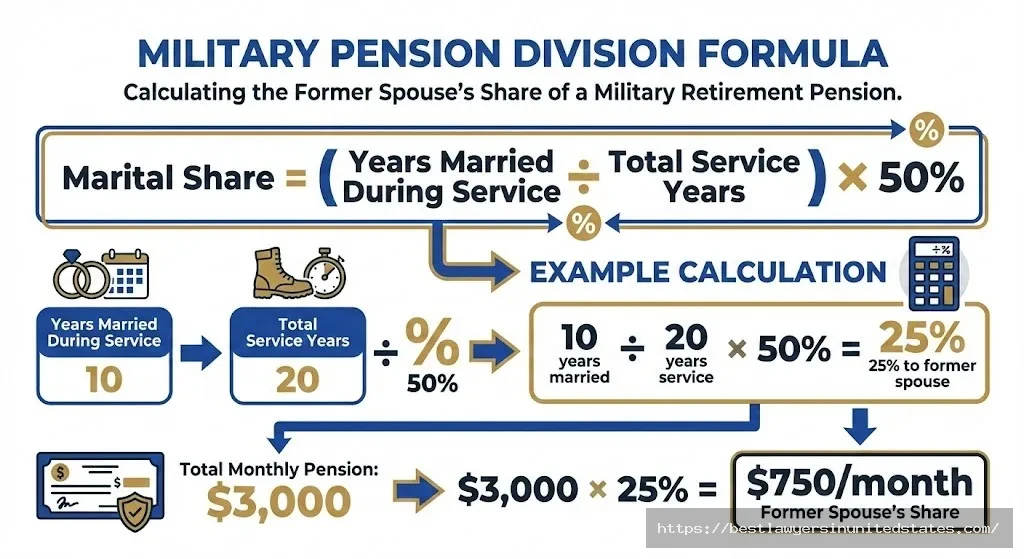
Military retirement can be divided even with short marriages. There’s no minimum marriage length under federal law. The 10/10 rule affects payment logistics, not eligibility to divide.
The Marital Share Formula
Most states use this formula to calculate the former spouse’s share:
Marital Share = (Years Married During Service ÷ Total Years of Service) × 50%
Example: 10-year marriage during 20-year military career
- Marital share = (10 ÷ 20) × 50% = 25% of retirement pay
- If retirement is $3,000/month, former spouse gets $750/month
The percentage varies by state. Some use 50% of the marital portion. Others use different percentages. California follows community property rules with a 50/50 split of marital assets, while other states use equitable distribution.
Disposable Retired Pay (DRP) vs. Gross Retired Pay
Gross retired pay means the full monthly pension amount. Disposable Retired Pay (DRP) subtracts certain deductions first:
- VA disability waiver amounts
- SBP premiums
- Certain forfeitures
DFAS divides DRP, not gross pay. This distinction costs former spouses thousands per year in some cases. A poorly worded court order that accepts “DRP” instead of “gross retired pay” can reduce payments by 30-50%.
Example of DRP impact:
- Gross retired pay: $3,000/month
- VA disability waiver: $800/month
- SBP premium: $195/month
- DRP: $2,005/month
- Former spouse’s 25% share of DRP: $501/month
- Former spouse’s 25% share of gross: $750/month
- Difference: $249/month lost = $2,988/year
How to Get Direct Payment from DFAS
Submit these documents to DFAS for direct garnishment:
- DD Form 2293 (Application for Former Spouse Payments)
- Certified divorce decree
- Court order dividing military retirement
- Settlement agreement (if incorporated into decree)
DFAS reviews orders for compliance with USFSPA. They reject orders with improper language or missing requirements. A specialized military divorce attorney can draft orders that DFAS will accept.
DFAS sends the former spouse’s share directly when 10/10 overlap exists. This happens automatically once DFAS processes the paperwork. The retiree’s check decreases by the amount going to the former spouse.
Calculate Your Military Retirement Share
Estimate your share of military retirement based on years married during service.
Divorce Cost Calculator
Get an estimated cost for your divorce based on your specific situation
Your Estimated Divorce Cost
Cost Breakdown
📧 Get a Personalized Consultation
Have questions about your specific situation? Contact our legal experts for guidance tailored to your needs.
Contact Us via EmailCalculator features:
- Marital share formula calculations
- State-specific division percentages
- Monthly payment estimates
- Lifetime value projections
- Impact of different retirement dates
Questions about military retirement division or need legal help? Email: [email protected]
Survivor Benefit Plan (SBP): The $500,000 Mistake
The Survivor Benefit Plan provides 55% of the selected base amount to a survivor after the retiree dies. For former spouses, SBP can be worth $200,000 to $500,000+ over a lifetime. Attorneys who miss SBP or blow deadlines commit malpractice.
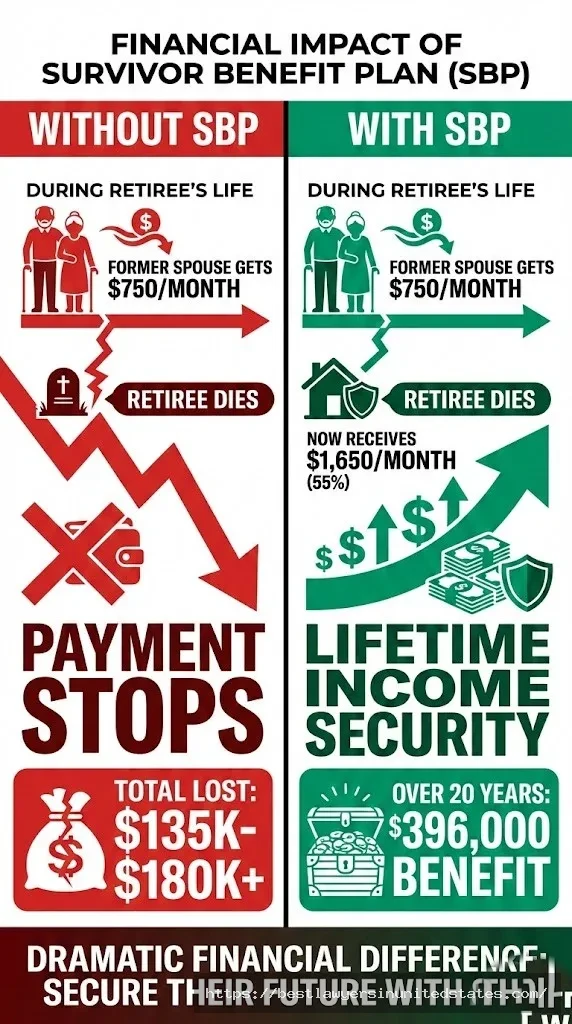
SBP costs 6.5% of the selected base amount. The retiree pays this premium, which comes off the top before calculating DRP. Without SBP, the former spouse’s share of retirement stops the moment the retiree dies.
Why SBP Matters More Than You Think
Scenario without SBP:
- Former spouse receives $750/month from retirement division
- Retiree dies at age 72
- Former spouse receives $0 for remaining 15-20 years of her life
- Total lost: $135,000 – $180,000+
Scenario with SBP:
- Former spouse receives $750/month during retiree’s life
- Retiree dies at age 72
- Former spouse now receives 55% of base amount for life
- If base amount was full retirement ($3,000), she receives $1,650/month
- Over 20 years: $396,000 total benefit
The difference between having SBP and not having it can exceed half a million dollars.
SBP Deadlines That Can’t Be Missed
Two different one-year deadlines exist for SBP:
Deadline #1 – Service Member/Retiree Submission:
- One year from date of divorce
- The SM or retiree must submit the order to DFAS
- If this deadline passes, the former spouse must use the deemed election
Deadline #2 – Former Spouse Deemed Election:
- One year from date of court order awarding SBP
- Former spouse submits deemed election request directly
- Requires specific “former spouse coverage” language in order
Missing both deadlines means permanent loss of SBP. No exceptions exist. No extensions are granted. This is why specialized military divorce attorneys cost more but save far more in the long run.
How Much Does SBP Cost?
The premium is 6.5% of the selected base amount. The base amount can be:
- Full retired pay (most expensive premium, highest benefit)
- A percentage of retired pay
- Any amount down to $300 minimum
SBP Premium Examples:
| Base Amount | Monthly Premium | Survivor Benefit |
|---|---|---|
| $3,000 (full pay) | $195 | $1,650/month |
| $2,000 | $130 | $1,100/month |
| $1,000 | $65 | $550/month |
| $300 (minimum) | $19.50 | $165/month |
Courts can specify the base amount in the divorce order. If no amount is stated, DFAS defaults to full retired pay. This maximizes the benefit but also maximizes the premium.
The SBP Remarriage Rule
SBP coverage terminates if the former spouse remarries before age 55. This termination is permanent. Even if the second marriage ends in divorce or death, SBP doesn’t restart.
Remarriage after age 55 does not affect SBP. The coverage continues for life regardless of subsequent marriages. This age-55 rule treats SBP like alimony, which makes no sense for a property division benefit.
TRICARE and Healthcare Benefits After Divorce
TRICARE eligibility after divorce depends on meeting specific time requirements. Healthcare costs for former spouses without TRICARE average $6,000-$15,000 per year. Understanding these rules prevents surprise loss of coverage.
Full TRICARE with 20/20/20
Meeting all three 20s provides lifetime TRICARE:
- TRICARE Prime or Select options
- Same coverage as during marriage
- No cost increase for the former spouse
- Survives the service member’s death
- Includes base hospital and pharmacy access
20/20/20 Requirements:
- Marriage lasted at least 20 years
- Service member served at least 20 years
- At least 20 years overlap between marriage and service
The service member’s retirement or divorce doesn’t affect 20/20/20 TRICARE. The former spouse keeps coverage independently. Remarriage before age 55 terminates benefits permanently.
Transitional TRICARE with 20/20/15
The 20/20/15 rule provides 12 months of TRICARE only:
- Same coverage level as 20/20/20
- Starts immediately after divorce
- Ends exactly 12 months later
- No renewal or extension option
- Former spouse must find alternative coverage
This one-year bridge helps former spouses transition to civilian health insurance. Many use this time to secure employment with health benefits or purchase individual market plans.
Without 20/20/20 or 20/20/15
Former spouses who don’t meet either threshold lose TRICARE immediately upon divorce. No transitional coverage exists. No grace period applies.
Alternatives without TRICARE:
- Employer-sponsored health insurance
- Healthcare.gov marketplace plans
- COBRA from previous employer (if eligible)
- Medicaid (if income-qualified)
- Direct purchase individual plans
Planning for this loss of coverage should start months before divorce finalization. Healthcare disruption affects prescription access, ongoing treatments, and specialist relationships.
VA Disability Waiver: When Retirement Payments Vanish
VA disability compensation isn’t divisible in divorce. When retirees waive military retirement to receive VA disability, the former spouse’s share can disappear overnight. This creates the single biggest post-divorce enforcement problem in military divorce.

How the VA Waiver Works
Retirees with service-connected disabilities can waive retired pay dollar-for-dollar to receive VA disability compensation. VA payments are:
- Tax-free (retirement pay is taxable)
- Not subject to garnishment for former spouse payments
- Not counted as income for some benefit calculations
- Generally higher after-tax than retirement pay
Example of VA waiver impact:
- Service member’s gross retired pay: $3,000/month
- Former spouse’s 25% share: $750/month
- Service member gets 80% VA disability rating: $1,800/month
- Service member waives $1,800 of retirement for VA payment
- New retired pay: $1,200/month
- Former spouse’s 25% of remaining $1,200: $300/month
- Former spouse loses $450/month = $5,400/year
Over 20 years, this lost $450/month equals $108,000. Many retirees wait until after divorce to apply for VA disability ratings specifically to reduce payments to former spouses.
The Indemnification Clause Solution
An indemnification clause (also called a VA waiver clause) protects the former spouse. This clause requires the retiree to:
- Hold the former spouse harmless from any VA waiver
- Pay the difference if retirement pay decreases
- Maintain the former spouse’s share as if no waiver occurred
Sample indemnification language: “If the service member/retiree elects to receive VA disability compensation which reduces the Disposable Retired Pay available for division, the service member/retiree shall pay the former spouse the difference, holding her harmless from any such reduction.”
State courts differ on enforcing indemnification clauses. Some states (California, Texas) generally enforce them. Other states (Virginia, North Carolina) have mixed case law. A knowledgeable military divorce attorney can draft enforceable protection.
Combat-Related Special Compensation (CRSC)
CRSC provides additional monthly payments to retirees with combat-related disabilities. Like VA disability, CRSC is not divisible with former spouses. However, CRSC doesn’t reduce retirement pay the same way VA disability does.
CRSC is paid in addition to reduced retirement pay. The former spouse’s share typically isn’t affected by CRSC elections. This makes CRSC more former-spouse-friendly than VA disability waivers.
Thrift Savings Plan (TSP): The Forgotten Asset
The Thrift Savings Plan functions like a 401(k) for federal employees and military members. TSP accounts can hold $50,000 to $300,000+ by retirement. Many divorce attorneys focus entirely on military pensions and completely overlook TSP.
TSP is marital property subject to division in divorce. The marital portion accumulated during the marriage can be split between spouses. This division happens via court order, similar to a Qualified Domestic Relations Order (QDRO).
How TSP Division Works
TSP requires a retirement benefits court order that specifically addresses the TSP account. The order must:
- Identify the TSP account holder
- Specify the dollar amount or percentage for the former spouse
- State whether division is immediate or deferred
- Meet TSP’s technical requirements (5 CFR Part 1653)
TSP will reject orders that don’t comply with federal regulations. The Federal Retirement Thrift Investment Board reviews all submitted orders. They provide specific guidance on acceptable order language.
TSP Division Methods
Method 1: Fixed Dollar Amount
- Award former spouse specific dollar amount ($50,000)
- Amount is taken from account balance as of transfer date
- Doesn’t share in future gains or losses after divorce
Method 2: Percentage Division
- Award former spouse percentage of account (50% of marital portion)
- Calculate marital portion using same formula as retirement
- Example: 50% × (120 months married during service ÷ 240 months total service) = 25%
Method 3: Marital Share Formula
- (Account balance on divorce date ÷ 2)
- Or other state-specific calculation
- Clearly define valuation date
The former spouse’s portion transfers to a separate TSP account in their name. They control investment choices going forward. The transfer happens tax-free if done pursuant to court order.
Tax Implications of TSP Division
Properly executed TSP division transfers are tax-free. Neither party pays taxes at the time of transfer. Each party pays their own taxes when they eventually withdraw funds from their respective TSP accounts.
Without a proper court order, early withdrawal penalties and taxes apply. A 10% early withdrawal penalty plus ordinary income tax can consume 30-40% of the account value. This is why court orders matter for TSP division.
Where Should You File for Military Divorce?
Jurisdiction determines which state’s laws govern your divorce. Military families face unique jurisdiction issues due to frequent relocations. The state where you file affects property division formulas, alimony rules, and timeline requirements.
Three Potential Filing Locations
Option 1: Service Member’s Legal Residence (Domicile)
- The state the SM considers their permanent home
- Often their Home of Record where they enlisted
- USFSPA guarantees jurisdiction here
- Safest choice for ensuring military pension division
Option 2: Service Member’s Current Station
- Where the SM is currently stationed
- Requires SM to consent to jurisdiction for pension division
- May not meet state residency requirements
- Risk of SM objecting and defeating jurisdiction
Option 3: Spouse’s Residence
- Where the non-military spouse lives
- Also requires SM consent for pension division
- Spouse may have stronger ties to this location
- SM can object and force litigation in their home state
The USFSPA guarantees jurisdiction for military pension division only in the SM’s legal residence state. All other states require either:
- SM’s consent to jurisdiction, OR
- Meeting USFSPA’s residency/domicile requirements
Strategic Jurisdiction Considerations
Different states offer advantages depending on your situation:
Community Property States (50/50 split of marital assets):
- California
- Texas
- Arizona, Idaho, Louisiana, Nevada, New Mexico, Washington, Wisconsin
Equitable Distribution States (fair but not necessarily equal):
Community property states generally split military pensions 50/50 of the marital portion. Equitable distribution states have more flexibility. Courts consider factors like marriage length, income disparity, and contributions to the military career.
Filing for Divorce While Stationed Overseas
Service members stationed in Germany, Japan, Korea, or other foreign countries can still file for divorce. The Status of Forces Agreement (SOFA) allows U.S. courts to maintain jurisdiction over service members abroad.
Overseas filing options:
- File in SM’s legal residence state (recommended)
- File in spouse’s residence state (if SM consents)
- File in last U.S. state where parties lived together
- Wait until returning to the U.S. for PCS or separation
State law still applies even when stationed overseas. German or Japanese law doesn’t govern the divorce. The applicable state is determined by domicile and USFSPA rules.
Serving divorce papers overseas requires special procedures. International mail, military postal service, and specific service methods vary by location. Check with a military legal assistance office or civilian attorney familiar with overseas divorces.
SCRA: When Service Members Can Pause Divorce
The Servicemembers Civil Relief Act (SCRA) allows service members to request a stay of legal proceedings. This powerful protection can delay divorce for months or years. Both service members and spouses need to understand when SCRA applies legitimately.
How SCRA Stays Work
A service member can request a stay when military duties prevent participation in court proceedings. The stay postpones:
- Hearings and trials
- Default judgments
- Final orders
- Discovery deadlines
- All court proceedings
Initial stay requirements:
- Letter from commanding officer confirming duties prevent participation
- Statement from SM explaining how duties materially affect ability to appear
- Specification of when SM will be available
Courts must grant the first stay request if properly documented. Additional stays are discretionary. Judges evaluate whether continued delay is justified or becomes a delay tactic.
Legitimate vs. Delay Tactics
Legitimate SCRA use:
- Deployed to combat zone
- Undergoing training that prevents leave
- On ship at sea for extended period
- TDY assignment in remote location
- Medical treatment preventing travel
Improper SCRA use:
- Stationed 30 minutes from courthouse
- Claiming duties prevent participation but posts vacation photos on social media
- Requesting stay after stay with no end date
- Using SCRA to drag out proceedings indefinitely
- Deployed but able to participate via phone/video (some courts allow remote participation)
Spouses can challenge improper SCRA requests. Evidence showing the SM could participate defeats the stay request. Many courts now allow remote testimony for military members who can’t physically appear but can participate electronically.
SCRA and Deployment
Deployment to Iraq, Afghanistan, or other combat zones almost always justifies an SCRA stay. Courts recognize that combat operations prevent meaningful participation in legal proceedings. Stays during deployment are routine and expected.
The stay typically lasts until:
- Deployment ends
- SM returns from theater
- SM is available for leave
- 90 days after deployment ends
Some proceedings can continue during deployment with the SM’s consent. Uncontested divorces where parties agree on all terms sometimes proceed with limited SM participation via power of attorney.
JAG vs. Civilian Attorney: What You Need to Know
Judge Advocate General (JAG) attorneys provide free legal assistance at military bases worldwide. This free service has significant limitations. Understanding what JAG can and cannot do prevents costly surprises.
What JAG CAN Do
Free legal services from JAG include:
- Initial consultations on divorce options
- Review of documents and paperwork
- Explanation of military benefits and rules
- Assistance with military-specific forms
- General legal advice and guidance
- Referrals to civilian attorneys
- Notary services for documents
JAG attorneys are knowledgeable about military benefits. They understand USFSPA, SCRA, SBP, and TRICARE rules. For basic questions and document review, JAG provides excellent free assistance.
What JAG CANNOT Do
JAG limitations include:
- Cannot represent you in court
- Cannot draft pleadings or motions
- Cannot negotiate with opposing counsel
- Cannot make court appearances
- Cannot file paperwork with courts
- Cannot provide ongoing representation
- Cannot handle contested litigation
JAG operates under ethical rules prohibiting representation in domestic relations cases. They can only provide limited legal assistance. When opposing parties both use JAG, conflicts of interest arise immediately.
When You Need a Civilian Attorney
Hire a specialized civilian attorney when:
- Divorce is contested with disagreements on major issues
- Military pension division involves complex calculations
- SBP coverage needs proper documentation
- Former spouse seeks substantial alimony
- Child custody disputes exist
- Property division exceeds $100,000
- Spouse has their own attorney
- 20/20/20 or substantial benefits are at stake
Military divorce attorneys specializing in USFSPA charge $250-$500 per hour. Total costs for contested military divorce range from $15,000 to $50,000. The specialized knowledge justifies higher fees when substantial benefits are involved.
The Co-Counsel Model
Some service members and spouses use both JAG and civilian attorneys together:
- JAG provides free consultations and document review
- Civilian attorney handles court appearances and negotiations
- JAG explains military benefit rules
- Civilian attorney applies those rules to state divorce law
This approach reduces costs while maintaining quality representation. The civilian attorney handles what JAG cannot do. JAG supplements the civilian attorney’s work with military-specific knowledge.
How Much Does Military Divorce Cost?
Military divorce costs more than civilian divorce. The average military divorce costs $15,000 to $50,000 compared to $7,000 to $15,000 for civilian divorces. Specialized legal knowledge and complex benefits drive costs higher.

Military Divorce Cost Breakdown
| Cost Category | Uncontested | Contested | Notes |
|---|---|---|---|
| Filing Fees | $200–$500 | $200–$500 | Varies by state |
| Attorney Fees | $2,500–$7,500 | $15,000–$50,000+ | Specialist rates higher |
| QDRO / Military Order | $500–$2,000 | $1,000–$3,000 | Required for TSP division |
| SBP Analysis | $500–$1,500 | $1,000–$2,500 | Actuarial valuations |
| Expert Witnesses | N/A | $2,000–$10,000 | Pension valuations |
| Mediation | $1,500–$5,000 | $3,000–$10,000 | If pursued |
| Court Costs | $500–$1,500 | $2,000–$5,000 | Hearings, filings |
| Total Average | $5,000–$15,000 | $20,000–$75,000+ | Highly variable |
Why Military Divorce Costs More
Specialized attorney knowledge: Few attorneys understand USFSPA, SBP, SCRA, and military benefits. Specialists charge premium rates. General family law attorneys often make costly mistakes with military divorces.
Complex calculations: Military retirement division requires marital share formulas. SBP needs actuarial analysis. TSP division demands separate orders. Each adds attorney time and cost.
Federal and state law intersection: Attorneys must know both federal military law and state family law. This dual specialization is rare and expensive.
Jurisdictional complications: Multiple state connections require analysis. Strategic filing location adds complexity and cost.
Enforcement issues: VA waivers, DFAS compliance, and post-divorce modifications create ongoing work.
Ways to Reduce Military Divorce Costs
Use JAG for free consultations before hiring civilian attorneys. Get basic questions answered at no cost.
Choose uncontested divorce when possible. Agree on major issues before filing. Uncontested divorce costs are 60-80% lower than contested cases.
Consider mediation to resolve disputes. Professional mediators cost $150-$400 per hour but prevent $50,000 litigation expenses.
Hire an attorney for limited scope representation. Pay for specific services like document review or court order drafting instead of full representation.
Educate yourself using military legal assistance resources. The more you understand, the less attorney time you need.
Calculate Your Military Divorce Costs
Estimate your total divorce costs based on your situation.
Calculator features:
- Military-specific cost factors
- Contested vs. uncontested comparison
- State-specific filing fees
- Attorney fee estimates
- Total cost projections
- Money-saving recommendations
Questions about military divorce costs or need legal help? Email: [email protected]
12 Costly Military Divorce Mistakes to Avoid
These errors cost service members and spouses tens of thousands of dollars. Specialized attorneys prevent these mistakes. DIY divorces and general family lawyers commonly miss these issues.
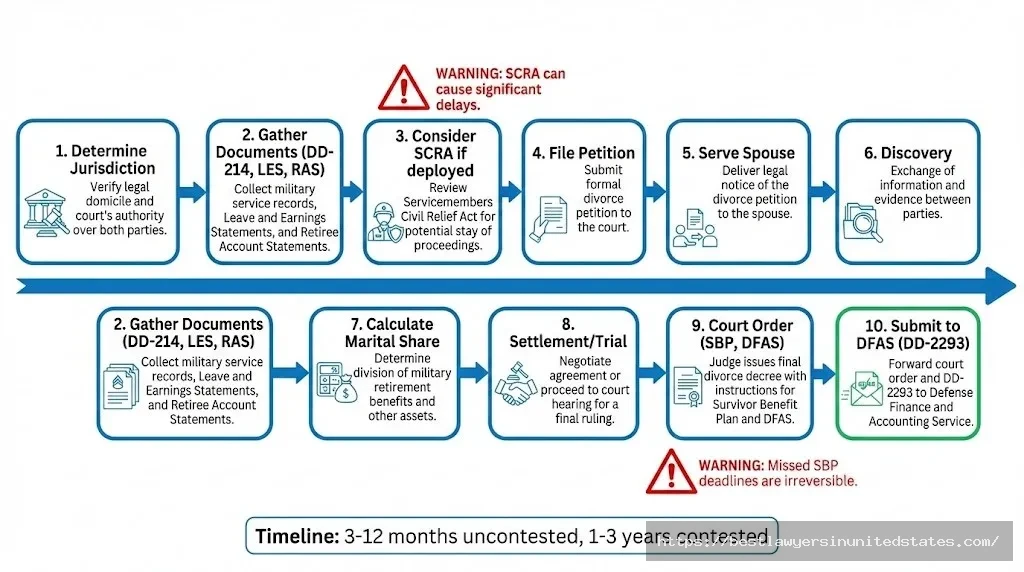
Mistake 1: Missing SBP Deadlines
The error: Not getting SBP in the court order or missing the one-year deadline.
The cost: $200,000-$500,000+ in lost survivor benefits.
The fix: Ensure the divorce decree specifically awards SBP to the former spouse. Submit the deemed election request within one year of the order date.
Mistake 2: Overlooking the TSP Account
The error: Dividing the pension but forgetting about the Thrift Savings Plan.
The cost: $50,000-$300,000 in forgotten marital assets.
The fix: Get a complete financial picture including TSP statements. Include TSP division in the property settlement. Prepare a separate TSP court order.
Mistake 3: No VA Waiver Protection
The error: Not including an indemnification clause for VA disability waivers.
The cost: $5,000-$15,000+ per year in lost retirement share.
The fix: Add language requiring the SM to hold the former spouse harmless from any VA waiver. Make it enforceable with specific payment obligations.
Mistake 4: Wrong Jurisdiction
The error: Filing in a state where the court lacks jurisdiction to divide military retirement.
The cost: Entire divorce may be invalid or pension division unenforceable.
The fix: File in the SM’s legal residence state, or ensure SM consents to jurisdiction. Don’t assume your current location has jurisdiction.
Mistake 5: Accepting Set Dollar Amount
The error: Court order awards fixed dollar amount instead of percentage.
The cost: Former spouse loses all future Cost of Living Adjustments (COLAs).
The fix: Use percentage or formula-based division. Share in annual COLA increases proportionately.
Mistake 6: Using Disposable Retired Pay
The error: Accepting “50% of Disposable Retired Pay” in a clarifying order when original order said “gross.”
The cost: $200-$500 per month reduction = $2,400-$6,000 annually.
The fix: Stick with original gross pay language. Don’t let DFAS “clarification” change the underlying agreement.
Mistake 7: Giving Away Too Much Pension
The error: Service member agrees to 50% of pension when only married 10 of 30 years.
The cost: Former spouse receives 50% instead of proper ~16% = $500-$1,000/month overpayment.
The fix: Calculate marital share properly. Only divide the marital portion accumulated during the marriage.
Mistake 8: Missing 20/20/20 by Months
The error: Finalizing divorce at 19 years, 8 months of marriage.
The cost: Loss of lifetime TRICARE worth $150,000+ over remaining lifetime.
The fix: Consider delaying divorce by several months to cross the 20-year threshold if close. Healthcare benefits may justify short delay.
Mistake 9: No Attorney for Military Divorce
The error: Using online divorce or general attorney unfamiliar with military benefits.
The cost: Cumulative mistakes that cost $100,000+ over a lifetime.
The fix: Hire an attorney who specializes in military divorce or has retired JAG experience. Membership in ABA Military Committee is a good sign.
Mistake 10: Believing JAG Will Handle Everything
The error: Assuming JAG will represent you in court and file paperwork.
The cost: Missing deadlines and court appearances when JAG can’t help.
The fix: Understand JAG limitations. Hire civilian attorney for court representation when needed.
Mistake 11: Not Understanding the 10/10 Rule
The error: Believing 10/10 means spouse can’t get pension.
The cost: Giving up rightful share of retirement or fighting about non-issue.
The fix: Understand 10/10 is about payment method only, not divisibility. Any length marriage may entitle spouse to marital share.
Mistake 12: Using SGLI as SBP Substitute
The error: Relying on life insurance instead of SBP for survivor protection.
The cost: SM can change beneficiary at any time per Ridgway v. Ridgway. Former spouse loses all protection.
The fix: Get SBP in the court order. It’s enforceable; SGLI designations are not.
Frequently Asked Questions About Military Divorce
Are military divorce rates higher than civilian?
Quick Answer: Yes. Military divorce rates run approximately 3-4% annually compared to 2-3% for civilians, though rates vary significantly by branch and rank.
Active duty military members face unique stressors including deployments, frequent relocations, and long separations. These factors contribute to higher divorce rates compared to civilian marriages. Officer marriages tend to be more stable than enlisted marriages.
Can JAG help with my divorce?
Quick Answer: JAG can provide free consultations and legal advice but cannot represent you in court or file paperwork for contested divorces.
JAG attorneys offer valuable free services for military divorce questions. They explain benefits, review documents, and provide general guidance. For contested divorces requiring court representation, you need a civilian attorney.
What is the 10/10 rule in military divorce?
Quick Answer: The 10/10 rule means 10 years of marriage overlapping with 10 years of military service allows DFAS to pay the former spouse directly rather than through the retiree.
This rule affects payment logistics only. It does not determine whether military retirement can be divided. Even a 5-year marriage entitles the former spouse to a share of retirement. The 10/10 rule just changes who sends the check.
What is the 20/20/20 rule for military divorce?
Quick Answer: The 20/20/20 rule requires 20 years of marriage, 20 years of service, and 20 years of overlap to qualify for lifetime TRICARE and full base privileges after divorce.
Meeting all three requirements provides former spouses with lifetime military healthcare and commissary access. These benefits don’t cost the service member anything extra. Remarriage before age 55 terminates these benefits permanently.
How much does military divorce cost?
Quick Answer: Military divorce costs range from $5,000-$15,000 for uncontested cases and $20,000-$75,000+ for contested divorces with complex military benefits.
Military divorce costs more than civilian divorce due to specialized legal knowledge required. Attorneys who understand USFSPA, SBP, SCRA, and military benefits charge premium rates. The complexity of federal and state law intersection drives costs higher.
How long does military divorce take?
Quick Answer: Uncontested military divorces take 3-12 months depending on state waiting periods. Contested military divorces take 1-3 years or longer with SCRA stays and deployments.
The divorce timeline varies dramatically based on several factors. SCRA stays during deployment can extend proceedings indefinitely. State waiting periods range from 30 days to 6 months after filing.
Where should I file for military divorce?
Quick Answer: File in the service member’s legal residence (domicile) state for guaranteed jurisdiction over military pension division. Other states require the SM’s consent.
The USFSPA guarantees that courts in the SM’s home state can divide military retirement. Filing elsewhere risks jurisdictional challenges. Strategic location choice affects property division rules and timeline. Consider whether your state follows community property or equitable distribution.
What is my spouse entitled to in a military divorce?
Quick Answer: Spouses may be entitled to a share of military retirement (any marriage length), lifetime TRICARE (20/20/20), SBP survivor benefits (if ordered), and TSP division (marital portion).
Entitlements depend on marriage length, service years, and court orders. The marital share formula typically awards the former spouse 50% of the retirement portion earned during marriage. SBP and TRICARE have specific eligibility requirements.
Does adultery matter in military divorce?
Quick Answer: Adultery is a UCMJ crime that can affect the service member’s career, rank, and security clearance. Impact on divorce outcome varies by state.
Military adultery carries criminal consequences under Article 134 of the UCMJ. Court-martial, reduction in rank, and security clearance loss are possible. In divorce, some states consider adultery for alimony and property division, while no-fault states ignore it.
Can I get their military pension?
Quick Answer: Yes. Any length marriage may entitle you to a share of the military retirement earned during the marriage. The 10/10 rule only affects payment method, not divisibility.
The USFSPA allows state courts to divide military retirement as property. Courts calculate the marital share based on years married during service divided by total service years. The former spouse’s percentage is typically 50% of this marital share.
How does SBP work in military divorce?
Quick Answer: SBP provides 55% of the selected base amount to the former spouse after the retiree dies. It must be awarded in the divorce order and submitted to DFAS within one year.
SBP costs 6.5% of the base amount in monthly premiums. This survivor annuity protects the former spouse from losing all retirement income when the retiree dies. Missing the one-year deadline results in permanent loss of SBP eligibility.
Will I lose TRICARE after divorce?
Quick Answer: You keep TRICARE if you meet 20/20/20 (lifetime) or 20/20/15 (one year transitional). Otherwise, TRICARE ends at divorce.
Former spouses with 20 years of marriage during 20 years of service keep full TRICARE benefits for life. Those with 15 years overlap get one year transitional coverage. Below these thresholds, TRICARE ends immediately upon divorce.
Can military help pay for my divorce?
Quick Answer: No. The military does not pay for divorce costs. JAG provides free legal consultations but not court representation. You pay your own attorney fees and court costs.
Military legal assistance offices offer free advice and document review through JAG attorneys. This doesn’t extend to paying civilian attorneys or court costs. Consider mediation or uncontested divorce to reduce expenses. Use our divorce cost calculator to estimate your total costs.
How do I file for divorce while my spouse is deployed?
Quick Answer: File in the service member’s legal residence state. Expect SCRA stay requests that will pause proceedings until after deployment. Some courts allow remote participation.
Service members can request an SCRA stay during deployment. Courts typically grant these requests and postpone proceedings until the SM returns. You can still file the initial paperwork, but hearings and trials will likely be delayed. Plan for extended timelines when deployment is involved.
What happens to BAH after military divorce?
Quick Answer: BAH typically drops from “with dependent” rate to “without dependent” rate, reducing income by $500-$1,000+ monthly. This affects child support calculations.
The service member’s housing allowance decreases when no longer supporting dependents. Courts may consider the higher BAH rate when calculating child support obligations. The reduction in BAH often requires adjusting financial arrangements post-divorce.
Last Updated: January 2026
Need specialized military divorce help? Military divorce involves complex federal and state law interactions. Mistakes with SBP deadlines, TSP division, or VA waiers cost tens of thousands of dollars. Consider consulting with an attorney experienced in military divorce or a retired JAG officer. Use our free calculators to understand your potential retirement share and costs.
Related Resources:
- Understanding the Divorce Process
- How to File for Divorce
- Divorce Attorney Fees Explained
- Types of Divorce
For specific questions about your military divorce situation: Email: [email protected]