
In 1969, California changed American divorce law forever. Governor Ronald Reagan signed the nation’s first no-fault divorce law. Couples could finally end their marriages without proving their spouse did something wrong.
Today, all 50 states recognize no-fault divorce. The process lets you cite irreconcilable differences instead of proving adultery or cruelty. But not all states work the same way. Some offer both fault and no-fault options, while others eliminated fault divorce completely.
Understanding the different types of divorce helps you make the right choice for your situation. This guide covers what no-fault divorce means, how it works in every state, and whether it’s right for you.
What Is No-Fault Divorce?
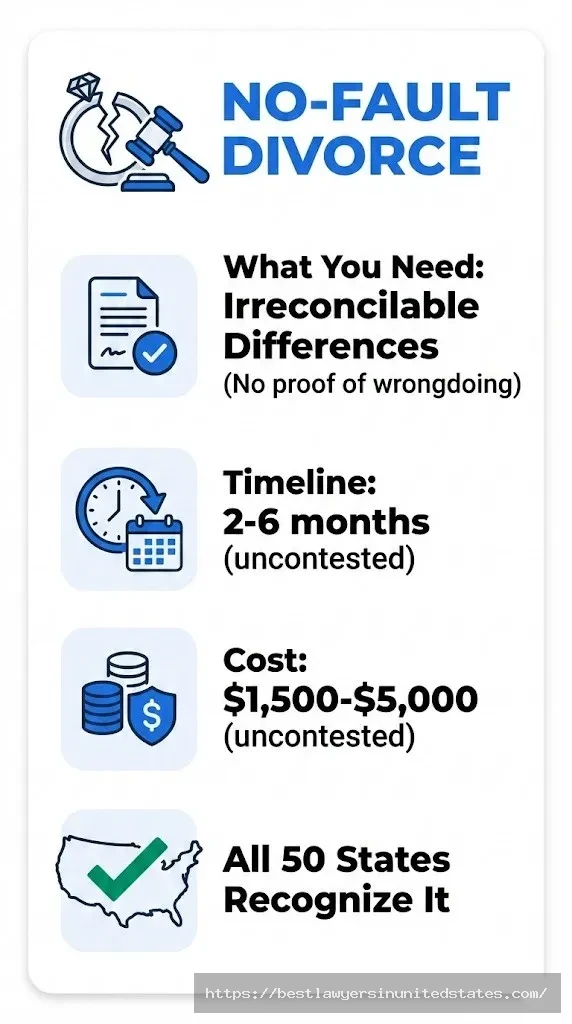
Quick Answer: No-fault divorce lets couples end their marriage without proving either spouse did something wrong. You only need to state the marriage can’t continue.
No-fault divorce changed how Americans dissolve marriages. Before 1969, someone filing for divorce had to prove their spouse committed wrongdoing. Common fault grounds included adultery, cruelty, abandonment, or substance abuse.
How No-Fault Divorce Works
You file a petition stating your marriage has broken down. The legal language varies by state. You might cite “irreconcilable differences,” “incompatibility,” or “irreparable breakdown of marriage.”
The key difference: you don’t need evidence of wrongdoing. You don’t need to testify about your spouse’s behavior. The court accepts that your marriage is over.
Common No-Fault Grounds by State
Irreconcilable Differences (Most common):
- California, Arizona, Nevada, Texas, Florida
- Means spouses can’t resolve their conflicts
Incompatibility:
- Oklahoma, New Mexico, Colorado
- Indicates personalities don’t mesh
Irreparable Breakdown:
- Connecticut, Massachusetts, Rhode Island
- Shows marriage can’t be saved
Living Separate and Apart:
- Virginia, North Carolina, Maryland
- Requires physical separation first
No-fault divorce doesn’t mean “uncontested.” Your spouse can still fight over property, custody, or support. The difference is they can’t stop the divorce by proving they weren’t at fault. Learn more about contested vs uncontested divorce to understand your options.
All 50 States: No-Fault Divorce Status
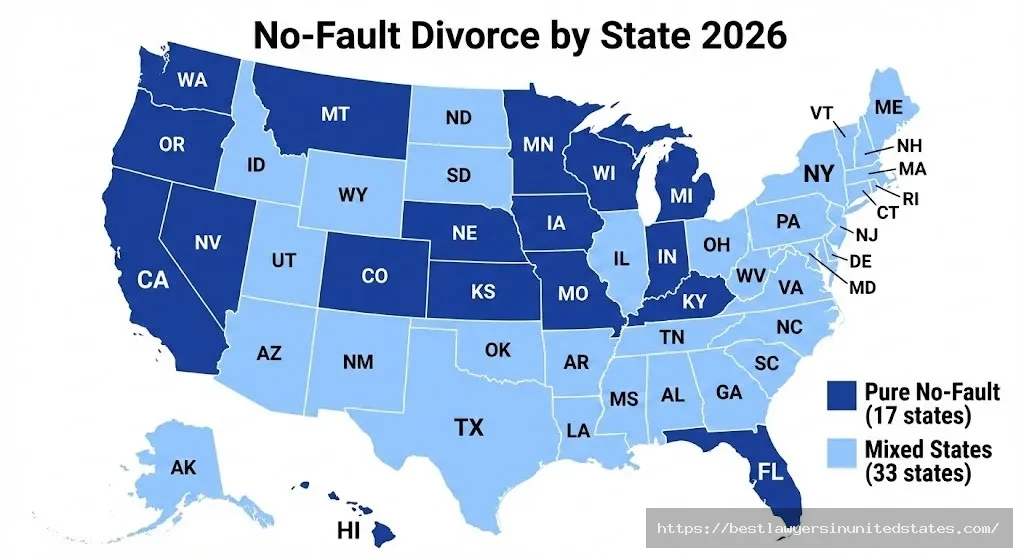
Quick Answer: All 50 states allow no-fault divorce. However, 17 states offer only no-fault (pure no-fault), while 33 states let you choose between fault and no-fault grounds.
Pure No-Fault States (17 States)
These states eliminated fault divorce completely. You can only file based on no-fault grounds.
| State | No-Fault Ground | Waiting Period |
|---|---|---|
| California | Irreconcilable differences | 6 months |
| Colorado | Irretrievable breakdown | 91 days |
| Florida | Irretrievably broken | None |
| Hawaii | Irretrievably broken | None |
| Indiana | Irretrievable breakdown | 60 days |
| Iowa | Irretrievable breakdown | 90 days |
| Kansas | Incompatibility | 60 days |
| Kentucky | Irretrievable breakdown | 60 days |
| Michigan | Breakdown of marriage | 6 months (with kids) / 60 days (without) |
| Minnesota | Irretrievable breakdown | None |
| Missouri | Irretrievable breakdown | 30 days |
| Montana | Irretrievable breakdown | 20 days |
| Nebraska | Irretrievable breakdown | 60 days |
| Nevada | Incompatibility / 1 year separation | None |
| Oregon | Irreconcilable differences | None |
| Washington | Irretrievably broken | 90 days |
| Wisconsin | Irretrievable breakdown | 120 days |
Mixed States (33 States)
These states offer both no-fault and fault grounds. You choose which to file.
Northeast Mixed States:
- Connecticut, Maine, Massachusetts, New Hampshire, New Jersey, New York, Pennsylvania, Rhode Island, Vermont
Southeast Mixed States:
- Alabama, Arkansas, Delaware, Georgia, Louisiana, Maryland, Mississippi, North Carolina, South Carolina, Tennessee, Virginia, West Virginia
Midwest Mixed States:
- Illinois, North Dakota, Ohio, South Dakota
Southwest Mixed States:
- Arizona, New Mexico, Oklahoma, Texas
West Mixed States:
- Alaska, Idaho, Utah, Wyoming
State-by-State Comparison Table
| State Type | Number of States | Can File Fault? | Average Timeline | Property Division |
|---|---|---|---|---|
| Pure No-Fault | 17 | No | 2-6 months | Varies by state |
| Mixed States | 33 | Yes | 3-12+ months | Varies by state |
Key State Differences:
New York (Last to adopt): Didn’t allow no-fault until 2010. Now offers both options.
South Dakota: Required mutual consent until recent reforms. Now allows unilateral no-fault filing.
North Carolina: Requires 1 year physical separation before no-fault divorce. One of the longest waiting periods in the country.
Virginia: Requires 6 months separation (no kids) or 12 months (with kids) for no-fault divorce.
If you’re considering divorce in a specific state, check our state-specific guides. For example, California divorce costs and New York divorce costs provide detailed local information.
How to File for No-Fault Divorce
Quick Answer: Filing for no-fault divorce involves meeting residency requirements, filing a petition, serving your spouse, and completing your state’s waiting period.
Step-by-Step Filing Process
Step 1: Meet Residency Requirements
Most states require you to live there for 6 months to 1 year before filing. Some states have shorter periods. Nevada requires only 6 weeks if you establish residency.
Step 2: Prepare Your Petition
Complete your state’s divorce forms. You’ll need:
- Petition for dissolution of marriage
- Summons
- Financial disclosures
- Child custody forms (if applicable)
Step 3: File With the Court
Submit your paperwork to the family court clerk. Pay the filing fee, which ranges from $100 to $450 depending on your state.
Step 4: Serve Your Spouse
Legally notify your spouse about the divorce. Most states require professional service by a sheriff or process server. Your spouse then has 20-30 days to respond.
Step 5: Complete Waiting Period
Most states require a waiting period between filing and finalization. This ranges from none (Florida, Oregon) to 6 months (California, Michigan with kids).
Step 6: Finalize Your Divorce
If uncontested, you may not need a hearing. Submit your settlement agreement for judge approval. If contested, you’ll go through discovery, negotiations, and possibly trial.
Required Documents Checklist
Financial Documents: ✅ Last 2 years of tax returns ✅ Pay stubs (3-6 months) ✅ Bank statements ✅ Investment account statements ✅ Retirement account statements ✅ Debt statements (credit cards, loans)
Property Documents: ✅ Mortgage statements ✅ Property deeds ✅ Vehicle titles ✅ Business ownership documents ✅ Valuable personal property appraisals
Child-Related Documents (if applicable): ✅ Birth certificates ✅ School records ✅ Medical records ✅ Childcare expense receipts
For detailed filing instructions, visit our comprehensive guide on how to file for divorce. You can also explore DIY divorce options by state if you’re considering self-filing.
No-Fault vs Fault Divorce: Key Differences
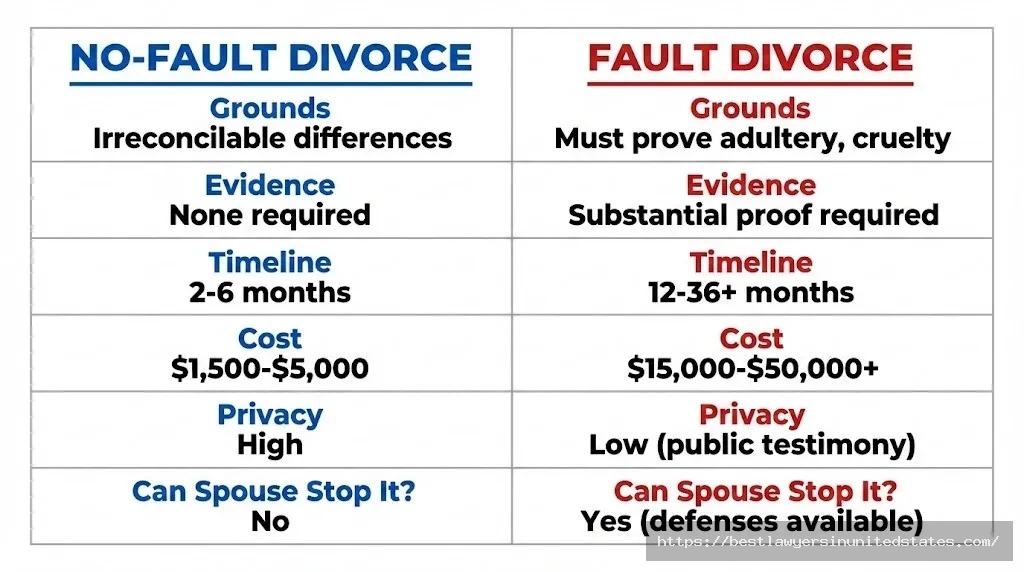
Quick Answer: No-fault divorce doesn’t require proving wrongdoing, while fault divorce demands evidence of spouse misconduct. No-fault is typically faster, cheaper, and more private.
Main Differences Comparison
| Factor | No-Fault Divorce | Fault Divorce |
|---|---|---|
| Grounds Required | Irreconcilable differences only | Must prove adultery, cruelty, abandonment, etc. |
| Evidence Needed | None | Substantial proof required |
| Timeline | 2-6 months (uncontested) | 12-36+ months (usually contested) |
| Average Cost | $1,500-$5,000 | $15,000-$50,000+ |
| Privacy | Minimal personal details public | Intimate marriage details become public record |
| Spouse Cooperation | Can proceed without agreement | Spouse can defend and delay |
| Court Hearings | Often none required | Multiple hearings likely |
| Success Rate | Nearly 100% (can’t be stopped) | Can be dismissed if proof insufficient |
When Fault Divorce Might Be Advantageous
Some states still let fault affect property division or alimony. You might consider fault divorce if:
Property Division Impact: States like South Carolina and North Carolina may award more property to the “innocent” spouse in fault divorces. If your spouse committed adultery or abuse, this could mean a larger share of assets.
Alimony Advantages: In some states, proving fault increases your alimony award or duration. Texas and Virginia courts consider adultery when determining spousal support.
No Waiting Period: Some states waive separation requirements for fault divorces. You might get divorced faster by proving fault rather than waiting 12 months apart.
Domestic Violence Protection: Fault grounds based on cruelty provide court documentation of abuse. This helps in custody cases and restraining order proceedings.
Strategic Considerations
Choose No-Fault If: ✅ You want privacy ✅ You want to minimize conflict ✅ You want to save money ✅ You want faster resolution ✅ You can’t prove fault grounds
Consider Fault If: ✅ You have strong evidence of misconduct ✅ Your state gives financial benefits to innocent spouse ✅ You want public vindication ✅ Fault grounds avoid waiting period ✅ You need abuse documented for custody
Most divorce attorneys recommend no-fault divorce unless you have compelling strategic reasons for fault grounds. The cost and time of proving fault rarely justify the benefits.
Understanding contested divorce costs versus uncontested divorce costs helps you make informed financial decisions.
No-Fault Divorce Cost by State
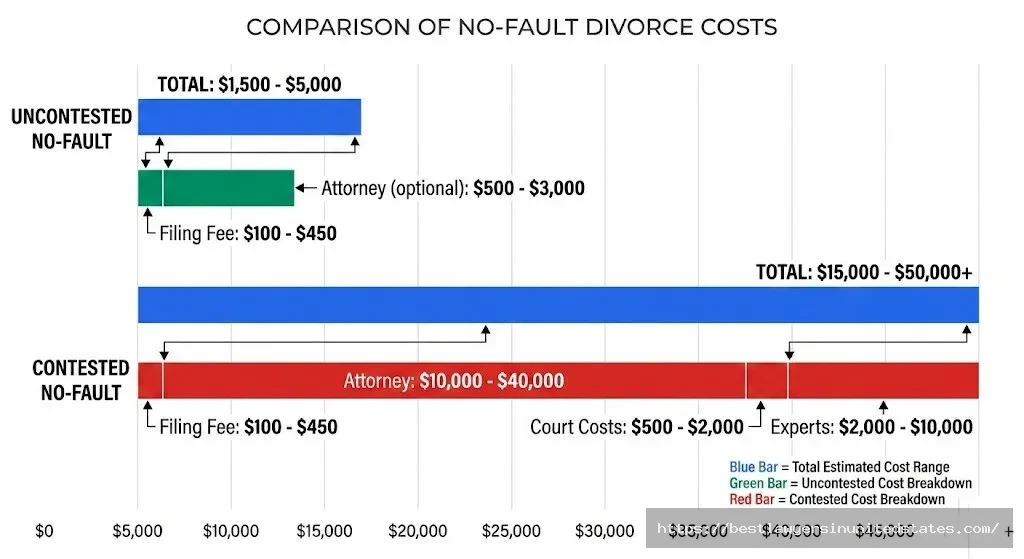
Quick Answer: No-fault divorce costs range from $500 to $5,000 for uncontested cases and $15,000 to $50,000+ for contested divorces. Costs vary significantly by state and complexity.
Average Cost Ranges by Divorce Type
| Divorce Type | Filing Fees | Attorney Fees | Total Average Cost |
|---|---|---|---|
| Uncontested No-Fault | $100-$450 | $500-$3,000 | $1,500-$5,000 |
| Contested No-Fault | $100-$450 | $10,000-$40,000+ | $15,000-$50,000+ |
| DIY No-Fault | $100-$450 | $0 | $200-$600 |
State Filing Fee Comparison
| State | Filing Fee | Response Fee | Total (Both File) |
|---|---|---|---|
| California | $435-$450 | $435-$450 | $870-$900 |
| Texas | $300-$350 | $300-$350 | $600-$700 |
| New York | $335-$350 | $335-$350 | $670-$700 |
| Florida | $400-$450 | $400-$450 | $800-$900 |
| Pennsylvania | $300-$350 | $300-$350 | $600-$700 |
| Illinois | $334-$388 | $334-$388 | $668-$776 |
| Ohio | $200-$350 | $200-$350 | $400-$700 |
| Georgia | $200-$400 | $200-$400 | $400-$800 |
| North Carolina | $225-$250 | $225-$250 | $450-$500 |
| Michigan | $230-$280 | $230-$280 | $460-$560 |
Cost Factors in No-Fault Divorce
Attorney Fee Variables:
- Hourly rates: $150-$500+ per hour depending on location and experience
- Flat fees: $1,500-$5,000 for simple uncontested cases
- Retainer requirements: $2,500-$10,000 upfront for contested cases
Additional Costs to Consider: ✅ Mediation: $100-$400 per hour ✅ Financial advisors: $200-$400 per hour ✅ Property appraisers: $300-$600 per appraisal ✅ Court reporter fees: $500-$2,000 for depositions ✅ Expert witnesses: $2,000-$10,000+ for custody evaluations ✅ Accounting services: $500-$3,000 for asset tracing
Calculate Your Divorce Costs
Planning a divorce? Use our free calculator to estimate your total costs based on your state’s filing fees, typical attorney rates, and whether your divorce is contested or uncontested.
[EMBED: DIVORCE COST CALCULATOR] Link: https://bestlawyersinunitedstates.com/divorce-cost-calculator/
Calculator features:
- State-specific filing fees
- Attorney cost estimates by complexity
- Contested vs uncontested comparison
- Total cost breakdown
- Money-saving tips based on your situation
Need help finding an affordable divorce attorney? Contact family law attorneys for free consultation. Email: [email protected]
For more detailed cost breakdowns, see our comprehensive divorce cost guide. We also have specific guides for divorce filing fees and divorce attorney fees.
History of No-Fault Divorce in America
Quick Answer: California passed America’s first no-fault divorce law in 1969. By 2010, when New York became the last state to adopt it, all 50 states recognized no-fault divorce.
The California Revolution (1969)
California Governor Ronald Reagan signed the Family Law Act in 1969. This created the nation’s first no-fault divorce option. Couples could cite “irreconcilable differences” instead of proving wrongdoing.
Reagan later called signing this law one of his biggest regrets. But the reform spread quickly to other states.
Pre-1969: The Fault-Only Era
Before no-fault divorce, couples faced difficult choices:
Required Proof of Fault:
- Adultery (needed evidence and witnesses)
- Physical cruelty (medical records, police reports)
- Abandonment (1+ years absence)
- Felony conviction
- Habitual drunkenness or drug addiction
Common Workarounds: Many couples committed fraud to get divorced:
- Staged adultery with hired “co-respondents”
- False testimony about abuse or abandonment
- Travel to Nevada or Mexico for easier divorces
- Collusion between spouses to manufacture fault grounds
State Adoption Timeline
1970s Adoption Wave:
- 1970: Iowa, California, Nevada, Colorado
- 1971-1975: 15 more states adopt no-fault
- 1977: Uniform Marriage and Divorce Act provides model law
- 1979: 45 states offer some no-fault option
Late Adopters:
- 1985: South Dakota (one of last states)
- 2010: New York (final state to adopt)
Impact on Divorce Rates
Common Misconception: No-fault divorce didn’t cause divorce rate spikes. Divorce rates were already rising before 1969.
Actual Impact:
- Reduced time couples stayed in unhappy marriages
- Decreased domestic violence in some studies
- Made divorce accessible to people without money for lawyers
- Reduced perjury and fraud in divorce proceedings
- Increased women’s ability to leave bad marriages
The Uniform Marriage and Divorce Act (1970)
The National Conference of Commissioners on Uniform State Laws created model legislation. Key provisions:
Section 302 established no-fault grounds:
- Irretrievable breakdown of marriage
- Living separate and apart for specified period
Section 305 addressed property division:
- Equitable distribution regardless of fault
- Consider marriage length, assets, earning capacity
Many states adopted versions of this model law throughout the 1970s and 1980s.
No-Fault Divorce Requirements & Waiting Periods
Quick Answer: No-fault divorce requirements include state residency (typically 6-12 months), filing fees ($100-$450), and waiting periods ranging from none to 12 months depending on your state.
State Residency Requirements
| Residency Period | States |
|---|---|
| No Residency Requirement | Alaska, South Dakota (if married in state) |
| 6 Weeks | Idaho, Nevada |
| 60 Days | Kansas, Washington |
| 90 Days | Alaska (if married in state) |
| 3 Months | Wyoming |
| 6 Months | California, Florida, Illinois, Maryland, Michigan, Minnesota, Montana, Nebraska, New Jersey, New Mexico, North Carolina, Ohio, Oklahoma, Oregon, Pennsylvania, Texas, Virginia, Wisconsin |
| 1 Year | Connecticut, Delaware, Iowa, Massachusetts, New Hampshire, New York, Rhode Island, West Virginia |
Important note: Some states require residency in the specific county for a shorter period (often 90 days) before you can file there.
Waiting Periods by State
No Waiting Period (Divorce can be finalized immediately after agreement):
- Alaska, Florida, Hawaii, Minnesota, Missouri, Nevada, New Hampshire, New Mexico, Oregon, South Dakota, Wyoming
Short Waiting Periods (Under 90 days):
- Kansas (60 days)
- Indiana (60 days)
- Kentucky (60 days)
- Montana (20 days)
- Missouri (30 days)
- Nebraska (60 days)
Medium Waiting Periods (90-180 days):
- Colorado (91 days)
- Washington (90 days)
- Iowa (90 days)
- Wisconsin (120 days)
Long Waiting Periods (6+ months):
- California (6 months)
- Michigan (6 months with children, 60 days without)
Separation Requirements
Some states require physical separation before filing no-fault divorce:
| State | Separation Period | Notes |
|---|---|---|
| North Carolina | 12 months | Must live separately and apart |
| Virginia | 6-12 months | 6 months without kids, 12 months with kids |
| Maryland | 12 months | Living separate and apart |
| South Carolina | 12 months | Continuous separation |
| Idaho | 5 years | Alternative to other grounds |
| Pennsylvania | 2 years | Alternative to mutual consent |
Living Separate and Apart: Most states allow separation under the same roof if you maintain separate lives. This means:
- Separate bedrooms
- No sexual relations
- Separate finances
- No shared meals or social activities
- Present as separated to others
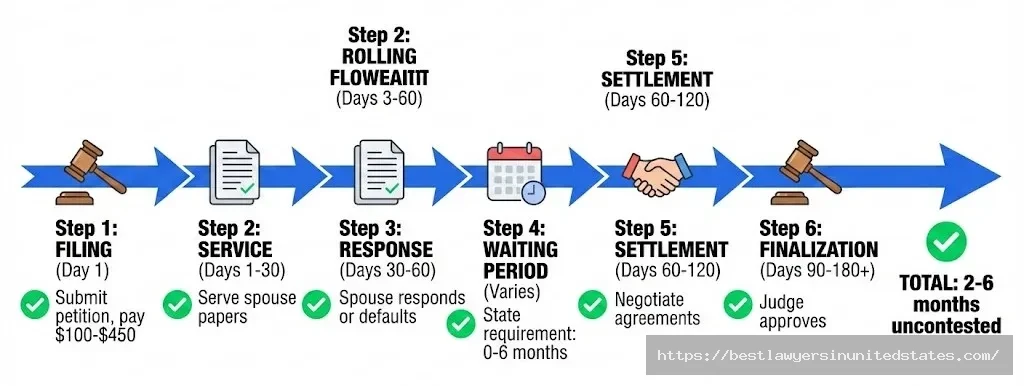
Timeline from Filing to Finalization
Uncontested No-Fault Timeline:
| Phase | Timeframe | Actions |
|---|---|---|
| Filing | Day 1 | Submit petition, pay fees |
| Service | Days 1-30 | Serve spouse papers |
| Response | Days 30-60 | Spouse files response (or defaults) |
| Waiting Period | Varies | State-mandated waiting time |
| Settlement | Days 60-120 | Negotiate agreements |
| Final Hearing | Days 90-180+ | Judge approves (or submit on papers) |
Total Time: 2-6 months for uncontested cases in most states.
Contested No-Fault Timeline:
| Phase | Timeframe | Actions |
|---|---|---|
| Filing through Service | Months 1-2 | Same as above |
| Discovery | Months 2-8 | Document exchange, depositions |
| Mediation Attempts | Months 6-10 | Court-ordered settlement negotiations |
| Pre-Trial Motions | Months 8-12 | Temporary orders, custody evaluations |
| Trial | Months 12-24+ | Court hearings, final trial |
Total Time: 12-36+ months for contested cases.
Learn more about how long divorce takes in different situations.
Common No-Fault Divorce Myths Debunked
Quick Answer: No-fault divorce is widely misunderstood. It doesn’t mean uncontested, doesn’t guarantee equal property splits, and doesn’t prevent alimony awards.

Myth 1: No-Fault Means Uncontested
The Myth: If you file no-fault, your divorce will be quick and easy.
The Reality: No-fault only describes the legal grounds for divorce. Your divorce can still be heavily contested over property, custody, and support.
No-fault = grounds for divorce (no wrongdoing needed) Uncontested = spouses agree on all terms
You can have:
- No-fault contested divorce (common)
- No-fault uncontested divorce (common)
- Fault uncontested divorce (rare but possible)
- Fault contested divorce (traditional contentious divorce)
Myth 2: No-Fault Means No Alimony
The Myth: You can’t get alimony in a no-fault divorce.
The Reality: Alimony has nothing to do with fault in most states. Courts award spousal support based on:
- Length of marriage
- Income disparity between spouses
- Standard of living during marriage
- Age and health of each spouse
- Earning capacity and education
- Contributions to spouse’s career
States Where Fault Can Affect Alimony:
- South Carolina
- North Carolina
- Georgia
- Virginia
- West Virginia
- Utah
- Mississippi
- Rhode Island
Even in these states, fault is just one factor among many.
Myth 3: No-Fault Means 50/50 Property Split
The Myth: All property gets divided equally in no-fault divorce.
The Reality: Property division depends on your state’s laws, not fault status.
Community Property States (50/50 split):
- California, Texas, Arizona, Nevada, Washington, Idaho, Wisconsin, Louisiana, New Mexico
Equitable Distribution States (Fair, not necessarily equal):
- All other 41 states
“Equitable” means fair based on:
- Length of marriage
- Each spouse’s income and assets
- Contributions to marriage (including homemaking)
- Economic circumstances after divorce
- Waste or dissipation of assets
Many equitable distribution divorces result in 60/40 or 70/30 splits.
Myth 4: No-Fault Means Easy or Quick
The Myth: No-fault divorce is always fast and simple.
The Reality: Timeline depends on whether you agree, not your grounds.
Factors That Slow Down No-Fault Divorce: ✅ Disagreements over child custody ✅ Complex property division (businesses, investments) ✅ Hidden assets requiring discovery ✅ Spousal support disputes ✅ High conflict between spouses ✅ Court backlog and delays ✅ Required separation periods
A no-fault divorce with significant assets and custody disputes can take 2-3 years. A fault divorce with full agreement can finalize in months.
Myth 5: You Don’t Need a Lawyer for No-Fault Divorce
The Myth: No-fault divorces are so simple you can handle them yourself.
The Reality: You might not need a lawyer for truly simple cases, but many no-fault divorces benefit from legal counsel.
When You Probably Need an Attorney:
- Children and custody disputes
- Assets over $100,000
- Retirement accounts to divide
- Business ownership
- Real estate beyond primary home
- Spousal support questions
- Spouse has an attorney
When DIY Might Work:
- Short marriage (under 5 years)
- No children
- Limited assets
- Both spouses agree on everything
- No real estate
- No retirement accounts
Even for DIY divorces, consider a consultation to review your agreement before filing.
For alternative approaches, explore divorce mediation costs or collaborative divorce costs.
The 2020s Debate: Will No-Fault Divorce Be Repealed?
Quick Answer: Some conservative lawmakers proposed eliminating no-fault divorce in 2024-2025. No states have successfully repealed it yet, but legislative efforts continue in several states.
Current Legislative Efforts
States with Active Proposals (2024-2026):
- Louisiana
- Oklahoma
- Nebraska
- Texas
Common Proposal Elements:
- Eliminate unilateral no-fault filing
- Require mutual consent for no-fault divorce
- Keep fault divorce as only unilateral option
- Extend mandatory separation periods
- Add marriage counseling requirements
Arguments Against No-Fault Divorce
Conservative Opposition Claims:
Marriage Stability: Critics argue no-fault divorce makes marriage “too easy to leave.” They claim it weakened the institution of marriage.
Financial Impact: Some argue that the filing spouse can leave without consequences, harming the other spouse financially.
Children’s Welfare: Opponents suggest easier divorce harms children by increasing family instability.
Religious Objections: Some faith communities view marriage as permanent except in cases of serious fault.
Arguments for Maintaining No-Fault Divorce
Women’s Safety Advocates: No-fault divorce provides escape from abusive marriages without proving abuse in court. Victims don’t need evidence, witnesses, or to relive trauma publicly.
Practical Considerations: Pre-1969 systems encouraged perjury, fraud, and collusion. Couples hired actors to stage adultery or lied under oath.
Legal Access: Proving fault requires money for attorneys, investigators, and expert witnesses. No-fault divorce allows lower-income people to leave bad marriages.
Privacy Protection: Fault divorces make intimate marriage details public record. No-fault divorce keeps private matters private.
Gender Equality: Women traditionally had fewer economic options to leave bad marriages. No-fault divorce provides equal exit rights.
What Repeal Would Mean
If No-Fault Divorce Were Eliminated:
Practical Effects:
- Divorce would require proof of adultery, cruelty, abandonment, or similar grounds
- Contested divorces would become default
- Litigation costs would increase dramatically
- Timeline would extend to 2-5 years for most divorces
- Perjury and fraud would likely return
- Abuse victims might stay trapped in dangerous marriages
Alternative Options People Might Use:
- Legal separation instead of divorce
- Living separate without divorce
- Moving to other states for divorce (if some states keep no-fault)
- Manufacturing fault grounds (return of pre-1969 tactics)
Current Legal Status
No states have repealed no-fault divorce. All proposals have either:
- Failed in committee
- Been voted down
- Stalled without action
Federal Government Role: Divorce law is state law. The federal government has no direct control. Any changes would need to happen state by state.
Public Opinion: Polls show 60-70% of Americans support keeping no-fault divorce available.
Should You Choose Fault or No-Fault Divorce?
Quick Answer: Choose no-fault divorce unless you have strong evidence of fault and your state provides significant financial benefits to the “innocent” spouse. Most divorces benefit from the speed, privacy, and lower cost of no-fault.
Decision Framework
Choose No-Fault If:
Privacy Matters: No-fault divorce keeps intimate details private. You don’t testify about your spouse’s behavior or present embarrassing evidence.
Speed Is Important: No-fault divorces finalize in 2-6 months when uncontested. Fault divorces take 12-36+ months even with good evidence.
Cost Is a Concern: No-fault divorces cost $1,500-$5,000 uncontested versus $15,000-$50,000+ for contested fault divorces.
You Want Less Conflict: No-fault reduces hostility. You don’t attack your spouse’s character or air dirty laundry.
You Can’t Prove Fault: Strong evidence is required for fault divorce. Suspicions or weak proof won’t succeed.
Consider Fault Divorce If
Your State Rewards the “Innocent” Spouse:
Some states give financial advantages to fault plaintiffs:
| State | Fault Benefit | Impact |
|---|---|---|
| South Carolina | Affects property division | Innocent spouse may get 60-70% of assets |
| North Carolina | Affects alimony | Adulterous spouse barred from alimony |
| Virginia | Affects alimony | Fault reduces or eliminates alimony |
| Georgia | Affects alimony | Adultery is absolute bar to alimony |
| Mississippi | Affects property division | Fault spouse may receive less property |
You Have Strong Evidence:
- Video/photo evidence of adultery
- Police reports of domestic violence
- Medical records of abuse injuries
- Criminal convictions
- Documented abandonment
It Avoids Separation Requirements: Some states waive the 12-month separation period if you prove fault. You might get divorced faster through fault grounds.
You Need Court Documentation of Abuse: Proving cruelty creates official records. This helps with:
- Child custody decisions
- Restraining orders
- Criminal proceedings
- Immigration cases (VAWA self-petitions)
Strategic Questions to Ask Yourself
Financial Analysis:
- Will proving fault get me significantly more property or alimony?
- Do I have evidence that will hold up in court?
- Can I afford the extra $10,000-$30,000 in legal fees?
- Is the potential financial gain worth the time and cost?
Emotional Considerations:
- Can I handle a public trial about my marriage?
- Will this increase conflict with my spouse?
- How will this affect my children?
- Do I need emotional vindication or closure?
Practical Factors:
- Does my state’s law actually benefit fault plaintiffs?
- Is my evidence strong enough to prove fault?
- Am I prepared for 12-36+ months of litigation?
- Will this harm custody negotiations?
Consult an Attorney
Get Professional Advice: State laws vary significantly. An experienced family law attorney in your state can:
- Explain your state’s specific fault benefits
- Evaluate your evidence strength
- Calculate likely outcomes under each option
- Estimate costs and timelines
- Develop the best strategy for your situation
Most attorneys offer free consultations. Bring your questions and any evidence you have.
For more guidance on the divorce process, visit our main divorce process guide.
Frequently Asked Questions About No-Fault Divorce
What does no-fault divorce mean?
Quick Answer: No-fault divorce means you can end your marriage without proving your spouse did something wrong. You only need to state the marriage has irretrievably broken down.
In a no-fault divorce, you cite grounds like “irreconcilable differences” or “incompatibility.” You don’t need evidence of adultery, cruelty, or abandonment. Your spouse cannot stop the divorce by proving innocence.
Which states are pure no-fault divorce states?
Quick Answer: 17 states allow only no-fault divorce: California, Colorado, Florida, Hawaii, Indiana, Iowa, Kansas, Kentucky, Michigan, Minnesota, Missouri, Montana, Nebraska, Nevada, Oregon, Washington, and Wisconsin.
These pure no-fault states eliminated fault divorce completely. You cannot file based on adultery or cruelty even if you want to. The remaining 33 states offer both fault and no-fault options.
How long does a no-fault divorce take?
Quick Answer: Uncontested no-fault divorces take 2-6 months in most states. Contested no-fault divorces take 12-36+ months depending on complexity and disagreements.
Timeline factors include:
- Your state’s mandatory waiting period (20 days to 6 months)
- Whether you agree on property and custody
- Court backlog in your county
- Discovery needs in contested cases
- Settlement negotiations
Does no-fault divorce mean no alimony?
Quick Answer: No. Alimony decisions are separate from fault status. You can receive spousal support in a no-fault divorce based on income disparity, marriage length, and other factors.
Courts award alimony based on:
- Length of marriage
- Income and earning capacity of each spouse
- Standard of living during marriage
- Age and health
- Contributions to spouse’s career
- Ability to be self-supporting
Only a few states let fault affect alimony. Even there, it’s one factor among many.
Can you contest a no-fault divorce?
Quick Answer: You cannot stop a no-fault divorce by proving you’re not at fault. However, you can contest property division, custody, alimony, and other terms.
In pure no-fault states, your spouse can get divorced even if you object. The court accepts that the marriage is over. You can still fight over:
- How to divide property and debts
- Child custody and visitation
- Spousal support amount and duration
- Child support calculations
Is no-fault divorce cheaper than fault divorce?
Quick Answer: Yes. No-fault divorce typically costs $1,500-$5,000 for uncontested cases. Fault divorces usually cost $15,000-$50,000+ because they require proving misconduct with evidence and testimony.
Fault divorce costs more because you need:
- More attorney time (discovery, depositions, trial prep)
- Private investigators ($50-$150/hour)
- Expert witnesses ($2,000-$10,000)
- Longer court proceedings (multiple hearings)
- Evidence gathering and documentation
What are valid grounds for no-fault divorce?
Quick Answer: Common no-fault grounds include irreconcilable differences, incompatibility, irreparable breakdown of marriage, and living separate and apart for a specified period.
State-specific grounds:
- Irreconcilable differences: California, Arizona, Nevada
- Incompatibility: Oklahoma, New Mexico
- Irreparable/irretrievable breakdown: Most northeastern states
- Living separate and apart: Virginia (6-12 months), North Carolina (1 year)
All mean essentially the same thing: the marriage cannot continue.
When did all 50 states allow no-fault divorce?
Quick Answer: By 2010, all 50 states recognized no-fault divorce. California was first in 1969. New York was last in 2010.
Key dates:
- 1969: California passes first no-fault law
- 1970s: Most states adopt no-fault options
- 1985: South Dakota adopts no-fault
- 2010: New York becomes final state
Who started no-fault divorce in America?
Quick Answer: California Governor Ronald Reagan signed America’s first no-fault divorce law in 1969. The California Family Law Act created the “irreconcilable differences” ground for divorce.
Reagan later expressed regret about signing the law. However, it revolutionized American divorce law and spread to all other states within 40 years.
Will no-fault divorce be banned?
Quick Answer: No states have successfully banned or repealed no-fault divorce as of 2026. Some conservative legislators proposed restrictions in 2024-2025, but no bills passed.
Current status:
- All 50 states still recognize no-fault divorce
- Some states have pending proposals (Louisiana, Oklahoma, Nebraska)
- Public opinion polls show 60-70% support keeping no-fault divorce
- Women’s safety advocates strongly oppose repeal efforts
What is the difference between no-fault and uncontested divorce?
Quick Answer: No-fault describes the legal grounds (no wrongdoing required). Uncontested describes agreement level (spouses agree on all terms). They’re independent concepts.
You can have:
- No-fault contested: File irreconcilable differences but fight over property/custody
- No-fault uncontested: File irreconcilable differences and agree on everything
- Fault uncontested: File adultery grounds but agree on settlement
- Fault contested: File cruelty and fight over everything
Most no-fault divorces are contested to some degree.
Do I need a lawyer for a no-fault divorce?
Quick Answer: You don’t legally need a lawyer, but you should consult one if you have children, significant assets (over $100,000), retirement accounts, real estate, or spousal support questions.
DIY works for:
- Short marriages (under 5 years)
- No children
- Limited assets
- Both spouses agree completely
- Simple financial situations
Hire an attorney if:
- Children and custody issues
- Assets over $100,000
- Business ownership
- Multiple properties
- Retirement accounts to divide
- Spouse has an attorney
- Complex financial situations
Can domestic violence victims use no-fault divorce?
Quick Answer: Yes. No-fault divorce is often the safest option for abuse victims because they don’t need to prove abuse or testify about violence in court.
Benefits for abuse victims:
- Don’t need to gather evidence of abuse
- Don’t testify about traumatic events
- Don’t risk provoking abuser with accusations
- Faster process with less contact
- More privacy about abuse details
However, you should still document abuse for custody proceedings and restraining orders.
What happens to property in a no-fault divorce?
Quick Answer: Property division depends on your state’s laws (community property or equitable distribution), not whether you filed fault or no-fault divorce.
Community property states (50/50 split): California, Texas, Arizona, Nevada, Washington, Idaho, Wisconsin, Louisiana, New Mexico
Equitable distribution states (fair split): All other 41 states divide property based on multiple factors like marriage length, income, contributions, and economic circumstances.
In most states, fault doesn’t affect property division at all.
Is separation required for no-fault divorce?
Quick Answer: Some states require physical separation before filing no-fault divorce. North Carolina requires 12 months, Virginia requires 6-12 months depending on children, and Maryland requires 12 months. Most states have no separation requirement.
States with separation requirements:
- North Carolina: 12 months
- Virginia: 6 months (no kids) or 12 months (with kids)
- Maryland: 12 months
- South Carolina: 12 months
- Pennsylvania: 2 years (or mutual consent with no waiting)
Most states let you file immediately based on irreconcilable differences.
Conclusion
No-fault divorce transformed American family law in 1969. Today all 50 states recognize it, though 17 states offer only no-fault while 33 allow both fault and no-fault options. The choice between fault and no-fault depends on your state’s specific laws, your evidence, your finances, and your goals.
For most people, no-fault divorce provides the best path forward. It’s faster, cheaper, more private, and less adversarial than fault divorce. You avoid proving misconduct, gathering evidence, and testifying about intimate marriage details.
However, some situations benefit from fault grounds. If your state rewards the “innocent” spouse financially, you have strong evidence, and you can afford the higher costs, fault divorce might make strategic sense.
Before deciding, consult an experienced family law attorney in your state. They’ll explain your specific options, evaluate your situation, and help you choose the best approach. Most offer free consultations.
Use our divorce cost calculator to estimate expenses for your situation:
Divorce Cost Calculator
Get an estimated cost for your divorce based on your specific situation
Your Estimated Divorce Cost
Cost Breakdown
📧 Get a Personalized Consultation
Have questions about your specific situation? Contact our legal experts for guidance tailored to your needs.
Contact Us via EmailQuestions about divorce or need legal help? Email: [email protected]
Related Resources:
- How to File for Divorce
- Divorce Cost Guide
- Types of Divorce
- Contested Divorce Guide
- Uncontested Divorce Guide