
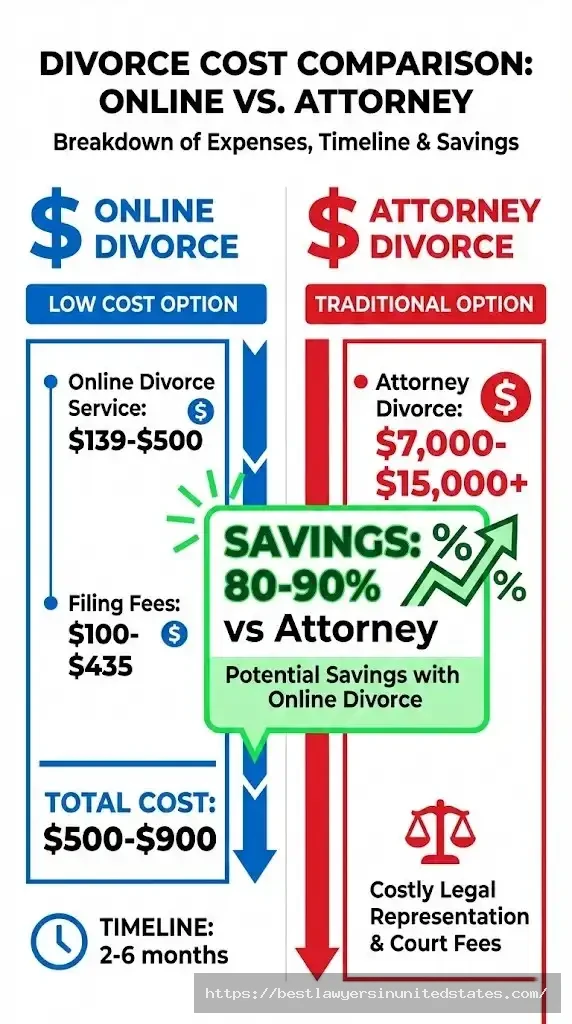
Online divorce services let you prepare and file divorce papers without hiring an attorney, saving thousands in legal fees. These platforms work for uncontested divorces where both spouses agree on major issues like property division, child custody, and support. Most online divorce services cost $139 to $500, compared to $7,000 to $15,000+ for traditional attorney representation.
This guide explains everything you need to know about filing for divorce online in 2026, from eligibility requirements to step-by-step filing instructions. You’ll learn which online divorce services work best, how much you’ll actually spend, and when hiring an attorney makes more sense than going the DIY route.
What is Online Divorce?
Online divorce refers to web-based services that help you prepare divorce paperwork without hiring a lawyer. These platforms use guided questionnaires to collect information about your marriage, assets, children, and desired outcomes. The service then generates state-specific divorce forms based on your answers.
Types of Online Divorce Services
Online divorce companies offer different levels of service. Document preparation services simply generate completed forms for you to file yourself. Full-service platforms handle everything from document preparation to filing with the court and serving your spouse. Some services include paralegal or attorney review, while others use software alone.
The key difference from traditional divorce: you don’t pay hourly attorney fees. Most online services charge a flat fee between $139 and $500. You still pay court filing fees separately, which range from $100 to $435 depending on your state.
How Online Divorce Works vs Traditional Attorney Divorce
Traditional divorce means each spouse hires their own attorney who bills by the hour. Your lawyer handles all paperwork, court filings, negotiations, and court appearances. This process works for contested divorces but costs $7,000 to $30,000+ on average.
Online divorce works differently. You answer questions on a website, review computer-generated documents, and either file them yourself or let the service file for you. This approach only works for uncontested divorces where both spouses agree on all major issues.
| Service Type | Average Cost | Best For | Timeline |
|---|---|---|---|
| Online Divorce | $139-$500 + filing fees | Uncontested, simple cases | 2-6 months |
| Attorney Divorce | $7,000-$15,000+ | Contested, complex cases | 6-18+ months |
| Mediation | $3,000-$8,000 | Cooperative but need help agreeing | 3-9 months |
| DIY Court Forms | Filing fees only ($100-$435) | Very simple, no assets/kids | 2-6 months |
Is Online Divorce Legal and Legitimate?
Yes, online divorce is completely legal and results in the same legally binding divorce decree as hiring an attorney. Courts don’t care who prepared your paperwork as long as the forms are correct and properly filed. Online divorce services simply help you prepare documents that you could technically complete yourself using free court forms.
The divorce decree you receive through an online service has identical legal weight to one obtained through an attorney. Both dissolve your marriage, divide assets, establish custody arrangements, and set support obligations. The difference is in how the paperwork gets prepared, not the final legal outcome.
Common Misconceptions About Online Divorce
Many people wrongly believe online divorce isn’t “real” divorce or won’t hold up in court. This confusion stems from mixing up divorce preparation services with sketchy “instant divorce” scams. Legitimate online divorce platforms use your state’s official court forms and follow the same legal process as attorney-prepared divorces.
Another myth: you can’t use online divorce if you have children. Most online services handle child custody, visitation schedules, and child support calculations. The requirement is agreement, not absence of children. As long as you and your spouse agree on parenting arrangements, online divorce works fine.
Some states allow full electronic filing while others require physical document submission. This varies by state and even by county. Online divorce services adapt to your jurisdiction’s specific requirements.
How Much Does Online Divorce Cost?
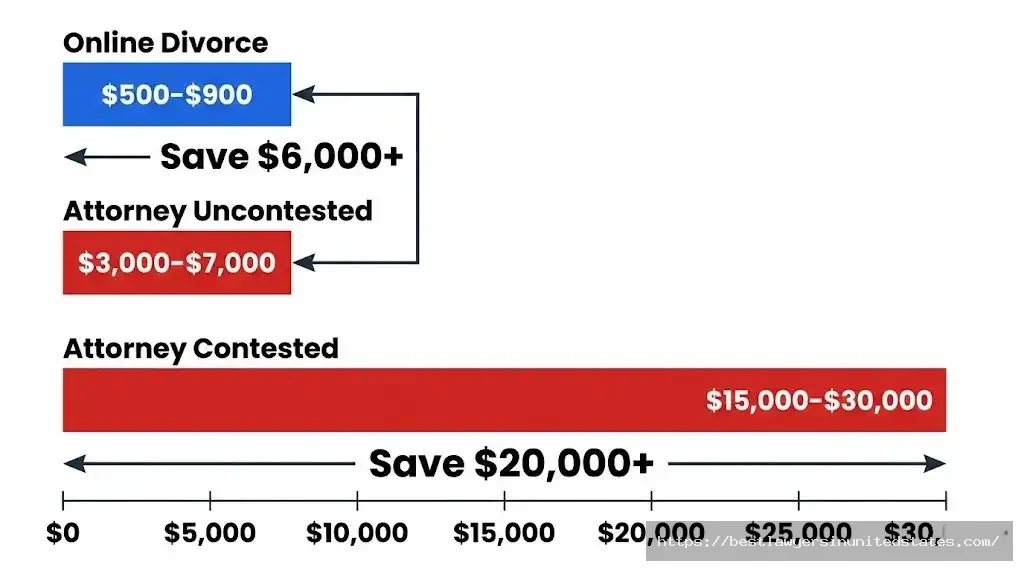
The average cost of divorce using online services ranges from $139 to $500 for the service fee, plus $100 to $435 in court filing fees. Your total out-of-pocket cost typically runs $500 to $900 for a simple uncontested divorce. This represents 80-90% savings compared to hiring an attorney.
Online Divorce Cost Breakdown
| Service Type | Service Fee | Filing Fees | Total Cost |
|---|---|---|---|
| Basic Document Preparation | $139-$299 | $100-$435 | $239-$734 |
| Full Service With Filing | $299-$500 | Included | $299-$500 |
| Attorney Review Add-On | $100-$300 extra | $100-$435 | $339-$1,235 |
| State Court Fees Only (DIY) | $0 | $100-$435 | $100-$435 |
Filing fees vary significantly by state. California divorce filing fees run $435-$450, while Texas filing fees cost around $300. Some states like Mississippi charge as little as $52, while others exceed $400.
Hidden Costs to Watch For
Many online divorce services advertise low prices but add fees later. Watch for charges for document revisions, expedited processing, customer support calls, or attorney consultations. Read the fine print before paying.
Service of process fees cost extra if you need a professional process server to deliver papers to your spouse. This typically runs $50 to $150. Some counties require certified copies of your final decree, adding another $15 to $50.
Calculate Your Divorce Costs
Planning a divorce? Use our free divorce cost calculator to estimate your total costs based on your state’s filing fees, typical attorney rates, and whether your divorce is contested or uncontested.
Calculator features:
- State-specific filing fees
- Attorney cost estimates by complexity
- Contested vs uncontested comparison
- Total cost breakdown
- Money-saving tips based on your situation
Questions about your divorce or need legal help? Find divorce lawyers in your state for free consultation.
Email: [email protected]
Who Qualifies for Online Divorce?
You qualify for online divorce if your case is uncontested, meaning you and your spouse agree on all major issues. Both parties must cooperate throughout the process and sign documents willingly. Most online services require mutual agreement on property division, debt allocation, child custody, child support, and spousal support before you start.

Basic Eligibility Requirements
Online divorce works best when:
- Both spouses want the divorce
- No one contests property division
- Child custody and support are agreed upon
- Neither spouse has complex business ownership
- Total marital assets are relatively straightforward
- Both parties will sign paperwork voluntarily
- No domestic violence protection orders exist
State residency requirements still apply. Most states require at least one spouse to have lived in the state for 3 to 12 months before filing. Check your state’s divorce laws for specific residency periods.
When You Can Use Online Divorce With Children
Having children doesn’t disqualify you from online divorce. The key is agreement. If you and your spouse have worked out a parenting plan that covers custody, visitation schedules, decision-making authority, and child support, online divorce works fine.
Most platforms include tools for creating parenting plans and calculating child support based on your state’s guidelines. They generate the same custody and support forms that attorneys prepare. The difference is you fill out the information instead of paying a lawyer $300+ per hour to do it.
When Online Divorce Won’t Work
Online divorce fails in contested situations where spouses disagree on major issues. If you can’t reach agreement on property division, custody, or support, you need either mediation or attorney representation. Don’t try to force an online divorce through when real disputes exist.
Situations Requiring an Attorney
Hire an attorney instead of using online divorce when:
- Your spouse contests the divorce or refuses to cooperate
- Significant assets include business ownership, multiple properties, or complex investments
- Custody disputes involve allegations of abuse or unfitness
- One spouse hides assets or income
- Prenuptial agreements need enforcement or challenge
- Domestic violence protection orders are in place
- Pension or retirement account division requires QDROs (Qualified Domestic Relations Orders)
Complex property division often requires professional valuation and negotiation. Divorce attorney fees average $250 to $500 per hour, but avoiding mistakes in asset division can save far more than attorney costs.
High-Conflict Divorces
High-conflict situations need attorney representation or at minimum, divorce mediation. When communication between spouses has broken down completely, online divorce won’t work. These services assume both parties can review documents together and sign off on agreements.
If your spouse threatens to fight everything, hire an attorney from the start. Trying online divorce first then switching to an attorney later just wastes time and money. The average contested divorce costs $15,000 to $30,000 and takes 12 to 18 months to complete.
How to File for Divorce Online: Step-by-Step Process
Filing for divorce online takes 2 to 6 months on average, depending on your state’s requirements and court processing times. The actual document preparation takes just 20 to 45 minutes. Most delays come from mandatory waiting periods and court backlogs, not the online service itself.

Step 1: Choose an Online Divorce Service
Research platforms before committing to one. Compare pricing, included services, customer reviews, and state availability. Look for BBB ratings and read Reddit threads about real user experiences. Watch for hidden fees or upsells during checkout.
Popular services include OnlineDivorce.com ($199), Divorce.com ($299-$599), and HelloDivorce ($99-$999). Each offers different service levels. Some only prepare documents while others handle filing, service of process, and court submissions for you.
Step 2: Complete the Questionnaire
Log into your chosen platform and answer questions about your marriage, assets, debts, children, and desired settlement terms. Be completely honest and accurate. Errors in this questionnaire lead to incorrect forms that courts will reject.
The questionnaire typically takes 20 to 45 minutes to complete. You’ll need:
- Marriage certificate details (date, location)
- Spouse’s current address for service
- List of all assets and their values
- All debts and account numbers
- Income information for both spouses
- Children’s names, birthdates, and current living arrangements
- Desired custody and visitation schedule
Most services let you save progress and return later. Don’t rush through this section. Accurate information here determines whether your forms get accepted by the court.
Step 3: Review Generated Documents
The service generates completed divorce papers based on your questionnaire answers. This typically takes 2 to 5 business days. Review every document carefully for errors before filing.
Common documents include:
- Petition for Dissolution of Marriage
- Summons
- Financial affidavits or income/expense declarations
- Marital settlement agreement
- Parenting plan (if children)
- Child support worksheets
- Final decree of divorce
Some services include paralegal or attorney review as part of the package. Others charge extra for this. If you’re uncertain about anything in your documents, pay for professional review. Fixing errors after filing costs more than getting it right the first time.
Step 4: File With the Court
Electronic filing (e-filing) availability varies by state and county. Some jurisdictions require physical paper filing at the courthouse. Your online divorce service should specify your options.
If e-filing is available, the service may file for you or give you instructions to file yourself. Divorce filing fees must be paid at this step, typically by credit card online or check at the courthouse.
If e-filing isn’t available, print your documents and take them to your county clerk’s office in person. Bring multiple copies (usually 3-4 sets). The clerk stamps them filed and returns copies for your records.
Step 5: Serve Your Spouse
Your spouse must receive official notice of the divorce filing. This process is called service of process. Most states require service by someone over 18 who isn’t you, or by a professional process server. Mailing documents yourself usually doesn’t count as proper service.
Service methods include:
- Professional process server ($50-$150)
- Sheriff’s deputy (fees vary by county)
- Certified mail with return receipt (if your state allows)
- Personal delivery by a friend or family member over 18
Your spouse then has 20 to 30 days (varies by state) to file a response with the court. In uncontested cases, they either don’t respond or file a waiver agreeing to everything.
Step 6: Wait Out Mandatory Waiting Periods
Most states impose waiting periods between filing and finalizing a divorce. California requires 6 months, while some states have no waiting period at all. This prevents rushed decisions and gives couples time to reconsider.
Waiting periods by state:
- California: 6 months
- Illinois: 6 months
- Maryland: 12 months (if contested)
- Nebraska: 60 days
- Texas: 60 days
- Wisconsin: 120 days
- Nevada: No waiting period
- Alaska: No waiting period
You can’t speed up mandatory waiting periods. Use this time to separate finances, find new housing if needed, and prepare for post-divorce life.
Step 7: Attend Hearing (If Required)
Many states allow uncontested divorces to finalize without a court hearing. The judge reviews paperwork, signs the decree, and you receive it by mail. Other states require brief hearings even for agreed-upon divorces.
If a hearing is required, it’s usually simple. The judge asks basic questions to confirm you both agree and understand the settlement terms. Dress appropriately and answer questions directly. These hearings rarely last more than 10 to 15 minutes.
Some states allow hearings by phone or video conference. Your online divorce service should explain your state’s requirements.
Step 8: Receive Final Decree
Once the judge signs your divorce decree, your marriage is legally dissolved. The court mails certified copies to both parties. This typically happens 1 to 4 weeks after the final hearing or paperwork review.
Order extra certified copies of your decree when requesting the final version. You’ll need them for updating:
- Social Security (name change)
- Driver’s license
- Bank accounts
- Insurance policies
- Retirement accounts
- Property titles and deeds
Certified copies cost $15 to $50 each depending on your county. Getting them later means additional trips to the courthouse or online ordering fees.
State-by-State Online Divorce Requirements
Online divorce availability and requirements vary significantly by state. Some states embrace electronic filing and streamlined processes. Others require in-person appearances or have lengthy waiting periods that extend your timeline regardless of how efficiently you prepare documents.
Which States Allow E-Filing
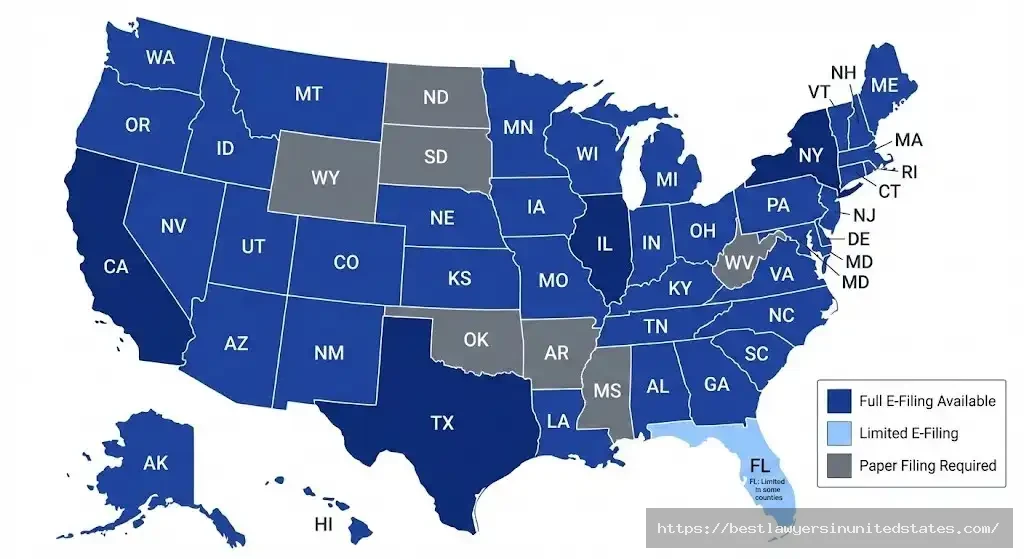
Most states now permit electronic filing for divorce cases, though county-level variations exist. Major states with widespread e-filing include:
Full E-Filing States:
- Arizona: All counties allow e-filing
- California: Required in most counties
- Florida: Available statewide
- Illinois: Available in most counties
- New York: Mandatory in many counties
- Texas: Available in most counties
- Washington: Statewide availability
Limited or No E-Filing:
- Arkansas: Very limited e-filing
- Louisiana: Most counties require paper filing
- Mississippi: Limited e-filing availability
- West Virginia: Paper filing in most counties
Check your specific county court website before assuming e-filing is available. Even in states that allow it, some rural counties still require physical paper filing.
Residency and Waiting Period Requirements
Every state requires at least one spouse to have lived there for a specific period before filing. Waiting periods between filing and finalization vary from zero to one year.
| State | Residency Requirement | Waiting Period | E-Filing |
|---|---|---|---|
| California | 6 months | 6 months | Yes |
| Texas | 6 months | 60 days | Yes |
| Florida | 6 months | No waiting period | Yes |
| New York | 1-2 years | No waiting period | Yes |
| Illinois | 90 days | 6 months | Yes |
| Pennsylvania | 6 months | 90 days | Limited |
| Ohio | 6 months | No waiting period | Yes |
| Georgia | 6 months | 31 days | Limited |
| North Carolina | 6 months | 1 year separation | Limited |
| Michigan | 180 days | 60 days (180 with kids) | Yes |
New York divorce costs average $335 in filing fees, while Florida divorce filing fees run around $409. These state-specific costs add to your online service fee.
States With Special Requirements
Some states impose unique requirements that complicate online divorce. North Carolina requires one year of physical separation before you can even file. Nevada has no waiting period but requires one spouse to have lived there for 6 weeks.
Special State Requirements:
- North Carolina: 1 year separation required before filing
- Maryland: 12-month separation for contested, 6 months for uncontested
- South Carolina: 1 year separation required
- Vermont: Requires separation agreement filed before divorce
- Rhode Island: Requires family court counseling in some cases
Some states mandate parenting classes for divorcing couples with children. Arizona divorce requirements include a 4-hour parenting class. California, Florida, and several other states have similar mandates. Online courses typically satisfy this requirement.
Best Online Divorce Services Compared
Choosing the right online divorce service affects your experience, timeline, and final cost. The cheapest option isn’t always the best value if you end up needing customer support or document revisions that cost extra. Compare what’s included before buying.
OnlineDivorce.com
Pricing: $199 (frequently advertised price)
Includes: Document preparation, step-by-step instructions, email/phone support
Does NOT Include: Filing with court, service of process
OnlineDivorce.com is one of the oldest online divorce platforms, operating since 2001. Their service focuses on document preparation only. You get completed forms and instructions for filing yourself. This works if you’re comfortable navigating courthouse procedures.
The platform supports all 50 states and offers a money-back guarantee if you’re not satisfied. Customer reviews are mixed, with complaints about upsells for services like rush processing or attorney review.
Divorce.com
Pricing: $299 for document preparation, $599 for full service
Includes: Document prep, case manager, filing support (full service), mediation available
Does NOT Include: Attorney representation
Divorce.com provides more hands-on support than basic document services. Their full-service package includes a case manager who guides you through the process and handles court filing. Mediation sessions cost extra but are available if you need help reaching agreement.
The platform works in all 50 states plus 5 Canadian provinces. User reviews highlight responsive customer service but note that mediation costs can add up quickly.
HelloDivorce
Pricing: $99-$999 depending on service level
Includes: Ranges from DIY document access to full-service with attorney support
Does NOT Include: Full attorney representation (available hourly)
HelloDivorce offers the widest range of service tiers. Their basic $99 plan gives you access to forms and instructions. Mid-tier plans add review and filing assistance. Top-tier packages include limited attorney consultations and mediation.
This flexibility helps you match service level to complexity. Simple cases work fine with basic plans. More complicated situations benefit from attorney review without paying full representation costs.
Feature Comparison Table
| Feature | OnlineDivorce | Divorce.com | HelloDivorce |
|---|---|---|---|
| Lowest Price | $199 | $299 | $99 |
| Document Prep | ✓ | ✓ | ✓ |
| Court Filing | Add-on | $599 plan | Mid-tier+ |
| Service of Process | No | $599 plan | Mid-tier+ |
| Attorney Review | Add-on | Add-on | Top-tier |
| Mediation | No | Add-on | Add-on |
| Money-Back Guarantee | Yes | Conditional | Yes |
| State Coverage | All 50 | All 50 + Canada | All 50 |
Red Flags to Watch For
Avoid online divorce services that:
- Hide final pricing until checkout
- Refuse refunds under all circumstances
- Have no customer service phone number
- Show poor BBB ratings with unresolved complaints
- Promise “same day” or “instant” divorce (impossible due to court requirements)
- Don’t specify which state’s forms they provide
- Require payment before showing you what’s included
Read recent customer reviews on independent sites like Trustpilot, BBB, and Reddit. Look for patterns in complaints about hidden fees, poor customer service, or rejected documents.
Online Divorce vs Hiring an Attorney
The choice between online divorce and hiring an attorney depends on your case complexity and budget. Online divorce saves thousands of dollars but only works for straightforward, uncontested cases. Contested divorces or complex asset situations require attorney expertise.
Cost Comparison
| Divorce Method | Average Total Cost | Timeline | Best For |
|---|---|---|---|
| Online DIY | $500-$900 | 2-6 months | Simple uncontested, no disagreements |
| Online Full Service | $700-$1,500 | 2-6 months | Uncontested, want filing help |
| Divorce Mediation | $3,000-$8,000 | 3-9 months | Need help agreeing, cooperative |
| Collaborative Divorce | $5,000-$15,000 | 6-12 months | Committed to avoiding court |
| Attorney (Uncontested) | $3,000-$7,000 | 4-8 months | Want legal advice, agreed on basics |
| Attorney (Contested) | $15,000-$30,000+ | 12-24 months | Major disagreements, complex assets |
Attorney billing typically runs $250 to $500 per hour. A contested divorce requiring 30 to 60 hours of attorney time costs $7,500 to $30,000 in legal fees alone. Add court costs, expert witnesses, and filing fees, and total expenses can exceed $40,000.
When Each Option Makes Sense
Choose online divorce when:
- Both spouses agree on all major issues
- Marital assets are straightforward (house, cars, bank accounts)
- No business ownership or complex investments exist
- Both parties have similar income levels
- Neither spouse is hiding assets
- Communication is functional enough to review documents together
- You’re comfortable reading and understanding legal forms
Choose an attorney when:
- Your spouse contests the divorce
- Significant assets include business ownership, multiple properties, or stock portfolios
- One spouse significantly out-earns the other (complex alimony)
- Custody disputes involve serious concerns about child safety
- You suspect hidden assets or income
- Domestic violence or protection orders are involved
- You don’t understand the paperwork even after reading it multiple times
Consider mediation when:
- You’re mostly in agreement but stuck on a few issues
- Both spouses want to avoid court and attorney costs
- You need a neutral third party to facilitate discussion
- Complex parenting arrangements need professional input
- You’re willing to compromise but need help structuring fair solutions
The DIY divorce state-by-state guide shows which states make self-representation easier and which require professional help for even simple cases.
How Long Does Online Divorce Take?

Online divorce typically takes 2 to 6 months from start to finish. The actual document preparation takes 20 to 45 minutes of your time. Most delays come from mandatory state waiting periods, court processing backlogs, and spouse response times.
Timeline Breakdown by Stage
| Stage | Time Required | Can You Speed It Up? |
|---|---|---|
| Online questionnaire | 20-45 minutes | No, must complete accurately |
| Document generation | 2-5 business days | Rush processing available ($) |
| Review and corrections | 1-3 days | No |
| Filing with court | Same day (e-file) or 1-2 days (in person) | E-file saves time |
| Service of process | 3-10 days | Professional process server is faster |
| Spouse response period | 20-30 days | If spouse waives, can skip |
| Mandatory waiting period | 0-6 months (state dependent) | Cannot speed up |
| Court processing | 2-8 weeks | No |
| Total | 2-6+ months | Limited options |
The mandatory waiting period is your biggest timeline factor. States with 6-month requirements (California, Illinois) add half a year regardless of how quickly you complete paperwork. States with no waiting period (Nevada, Alaska) can finalize in as little as 2 months.
What Slows Down Online Divorce
Common delays include:
- Incomplete questionnaires: Errors require starting over
- Missing spouse: Can’t serve papers at last known address
- Unresponsive spouse: Won’t sign acknowledgment or waiver
- Document errors: Court rejects forms, requiring corrections and refiling
- Court backlogs: Family courts in major cities have 4-8 week processing delays
- Missing financial information: Can’t complete property division without asset values
Mandatory waiting periods cannot be waived. Even if both spouses want a quick divorce and agree on everything, you must wait out your state’s required period. This prevents impulsive decisions during emotional turmoil.
Fastest States for Online Divorce
States with no mandatory waiting period and e-filing availability:
- Nevada: No waiting period, e-filing available
- Alaska: No waiting period, limited e-filing
- South Dakota: No waiting period, limited e-filing
- Wyoming: No waiting period, limited e-filing
States with short waiting periods:
- New York: No waiting period for uncontested
- Florida: No waiting period
- Georgia: 31-day waiting period
- Oregon: No waiting period
- Washington: 90 days
How long does divorce take varies dramatically by state law, court backlog, and case complexity. The fastest uncontested divorces finalize in 6 to 8 weeks in states with no waiting period. The slowest take 12+ months in states requiring long separations before filing.
Required Documents for Online Divorce
Every online divorce requires specific documents to complete your filing. Gathering these before you start speeds up the process. Missing information forces you to stop mid-questionnaire and return later.
Essential Documents You’ll Need
Marriage Information:
- Marriage certificate (original or certified copy)
- Marriage date and location
- Spouse’s current legal name and address
Financial Documents:
- Recent pay stubs or income statements (both spouses)
- Last two years of tax returns
- Bank account statements
- Investment and retirement account statements
- Property deeds and mortgage statements
- Vehicle titles and loan documents
- Credit card statements showing balances
Children (If Applicable):
- Children’s birth certificates
- Current school and childcare information
- Health insurance information
- Existing custody or support orders (if any)
Debts:
- Student loan statements
- Personal loan documents
- Credit card balances
- Auto loans
- Any other outstanding debts
Most online services let you estimate asset values if you don’t have exact figures. However, significant assets like real estate should be professionally appraised for accurate division.
State-Specific Form Requirements
Different states require different forms beyond the basic petition. Some states use “Petition for Dissolution,” others call it “Complaint for Divorce.” The legal effect is identical, but the forms vary.
Common state-specific requirements include:
- Financial affidavits (detailed income/expense statements)
- Parenting plans (custody and visitation schedules)
- Child support worksheets (calculated per state guidelines)
- Property division worksheets
- Health insurance coverage information
- Retirement account information and QDROs
Your online divorce service should automatically include the correct forms for your state. If it doesn’t specify which state’s forms it uses, that’s a red flag.
Online Divorce With Children
Having children doesn’t prevent online divorce, but it does add complexity. You must agree on custody arrangements, visitation schedules, decision-making authority, and child support. If you can’t reach agreement on these issues, online divorce won’t work.
Creating a Parenting Plan Online
Most online divorce platforms include parenting plan templates that meet your state’s requirements. These documents specify:
Physical Custody:
- Where children live during school year
- Weekend schedules
- Holiday rotation
- Summer vacation arrangements
- Transportation responsibilities
Legal Custody (Decision-Making):
- Education decisions
- Medical and dental care
- Religious upbringing
- Extracurricular activities
Communication:
- How parents will communicate about children
- Emergency contact protocols
- Information-sharing requirements
The parenting plan becomes part of your final divorce decree and is legally enforceable. Violating it can result in contempt of court charges.
Child Support Calculations
Every state uses specific formulas to calculate child support. Most follow the income shares model, considering:
- Both parents’ gross income
- Number of children
- Percentage of overnight stays with each parent
- Health insurance costs
- Childcare expenses
- Other children from prior relationships
Online divorce services include child support calculators that apply your state’s formula. The calculation generates a recommended payment amount that becomes part of your settlement agreement.
Calculate Child Support
Have children? Use our child support calculator to estimate payments based on your state’s child support guidelines.
Calculator features:
- State-specific child support formulas
- Income shares model calculations
- Custody time adjustments
- Additional expense estimates
Questions about custody or support? Find family law attorneys for free consultation.
Email: [email protected]
Custody Disputes and Online Divorce
If you disagree about custody, online divorce won’t work. These platforms assume you’ve already reached agreement and just need to document it properly. Custody battles require attorney representation or mediation at minimum.
Signs you need professional help instead of online divorce:
- One parent wants sole custody, the other wants joint
- Concerns about child safety or substance abuse exist
- Parents can’t agree on basic schedules
- One parent threatens to move out of state with children
- Previous domestic violence or protection orders
- Grandparent or third-party custody claims
Don’t try to force agreement just to use online divorce. Poorly structured custody arrangements cause years of conflict and expensive modification proceedings later. Get it right the first time.
Common Online Divorce Mistakes to Avoid
Small errors in online divorce questionnaires cause court rejections and delays. Courts return incorrectly prepared forms, requiring corrections and refiling. This wastes weeks and sometimes requires paying filing fees twice.
Mistake 1: Incomplete Financial Disclosure
Failing to disclose all assets and debts is the biggest mistake people make. Courts require complete financial transparency. “Forgetting” to mention a bank account or retirement fund can result in fraud allegations and reopening of the divorce later.
List everything you own, even if you think it’s yours alone:
- All bank accounts, even secret ones
- Retirement accounts from past employers
- Stock options or RSUs from work
- Cryptocurrency holdings
- Valuable collections (art, jewelry, vehicles)
- Business ownership or side hustle income
Hiding assets backfires. Ex-spouses discover hidden accounts during tax season or through subpoenas. Courts can reopen finalized divorces when fraud is proven, nullifying your settlement agreement.
Mistake 2: Rushing Through the Questionnaire
The online questionnaire determines what appears on your legal forms. Rushing through it leads to errors that courts catch. Take your time and double-check every answer before submitting.
Common questionnaire errors:
- Wrong county for filing
- Incorrect marriage date or location
- Misspelled legal names
- Wrong addresses for service
- Inaccurate asset values
- Missing children’s birthdates
- Incorrect income figures
Most services let you review and edit before finalizing. Use this feature. Have your spouse review everything too, even in uncontested cases.
Mistake 3: Using Online Divorce for Contested Situations
The worst mistake is trying to use online divorce when your case is actually contested. If your spouse disagrees on major issues, online divorce will fail. You’ll waste money on the service and still need to hire an attorney.
Red flags your case is contested:
- Spouse refuses to cooperate or sign papers
- Major disagreements on property division
- Fighting over custody or support amounts
- One party hiding income or assets
- Threats of court battles
- Domestic violence or protection orders
Be honest about whether you truly have agreement. “We’ll figure it out” isn’t agreement. Having actual written settlement terms before starting online divorce saves time and money.
Red Flags: How to Avoid Online Divorce Scams
Legitimate online divorce services help you prepare state-specific forms correctly. Scams take your money and provide worthless documents that courts reject. Learn to spot warning signs before paying.
Warning Signs of Scam Services
Red Flag #1: Promises “Instant” or “Same-Day” Divorce
No divorce is instant, even when both parties fully agree. Every state has processing times, service requirements, and often mandatory waiting periods. Services promising immediate divorce are lying.
Red Flag #2: No State-Specific Forms
Generic divorce forms that work in “all states” don’t exist. Each state has unique requirements and forms. If the service doesn’t specify which state’s forms you’ll receive, it’s likely a scam.
Red Flag #3: No Contact Information
Legitimate businesses provide phone numbers, physical addresses, and customer support. If you can only contact them through a web form or there’s no support contact at all, don’t trust them with your divorce.
Red Flag #4: Hidden Fees Everywhere
While some additional costs are normal, excessive hidden fees indicate a scam. Watch for charges for every small thing like downloading your documents, customer support calls, or “processing fees” beyond the advertised price.
Red Flag #5: No Refund Policy
Reputable services offer money-back guarantees if you’re not satisfied or if your forms are rejected by the court. No refund policy under any circumstances is a major red flag.
Verifying Legitimate Services
Before paying, check:
- Better Business Bureau rating and complaints
- Trustpilot or similar review sites
- Reddit threads about the service
- How long they’ve been in business
- Physical business address and phone number
- Clear refund and cancellation policies
- Attorney or paralegal review of documents (or clear disclosure of no review)
Legitimate services clearly state what’s included, what costs extra, and what they don’t do. They don’t promise outcomes beyond document preparation. They explain that courts make final decisions, not the online service.
Frequently Asked Questions
Can you really file for divorce online?
Quick Answer: Yes, you can prepare and file divorce papers online in every state through online divorce services or court websites, though some counties require physical submission of documents even if you prepare them electronically.
Online divorce services provide state-specific forms and filing instructions. Whether you can submit electronically depends on your county’s e-filing capabilities. All divorces still go through the same legal process regardless of how documents are prepared.
Is online divorce legal?
Quick Answer: Yes, online divorce is completely legal and produces the same legally binding divorce decree as divorces handled by attorneys.
Courts don’t care who prepared your forms as long as they’re correct and properly filed. Online services simply help you complete paperwork that you could theoretically do yourself using free court forms. The final divorce decree has identical legal weight whether prepared by an online service, an attorney, or yourself.
How much does online divorce cost?
Quick Answer: Online divorce services cost $139 to $500 for document preparation, plus $100 to $435 in court filing fees, totaling $239 to $935 for most uncontested divorces.
Full-service packages that include filing and service of process cost $299 to $599 on average. Compare divorce costs to attorney fees of $7,000 to $15,000+ to see the savings.
How long does online divorce take?
Quick Answer: Online divorce takes 2 to 6 months on average, with most time spent waiting out mandatory state waiting periods rather than document preparation.
Document preparation takes 20 to 45 minutes of your time. The service generates forms in 2 to 5 business days. The rest of your timeline depends on your state’s waiting period (0 to 6 months), court processing speed (2 to 8 weeks), and service of process (3 to 10 days).
What if my spouse doesn’t respond to divorce papers?
Quick Answer: If your spouse doesn’t respond within the required timeframe (typically 20 to 30 days), you can request a default judgment and the divorce proceeds without their input.
Non-response doesn’t stop your divorce. After the response deadline passes, file a request for default with the court. The judge reviews your proposed settlement and typically grants it since your spouse hasn’t objected. Your spouse loses the right to negotiate terms by not responding.
Can I file for divorce online if I have kids?
Quick Answer: Yes, you can file online divorce with children as long as you and your spouse agree on custody arrangements, visitation schedules, and child support amounts.
Having children doesn’t disqualify online divorce. Most platforms include parenting plan templates and child support calculators. The requirement is agreement, not absence of children. If custody is contested, you need mediation or an attorney instead.
Do I still need to go to court with online divorce?
Quick Answer: Some states allow uncontested divorces to finalize without court appearances, while others require brief hearings even when both parties agree.
Requirements vary by state and county. Many jurisdictions now process agreed-upon divorces entirely on paper, especially for couples without children or complex assets. If a hearing is required, it typically lasts 10 to 15 minutes with basic questions from the judge.
What states allow online divorce?
Quick Answer: All 50 states allow you to use online divorce services to prepare paperwork, but electronic filing availability varies by county.
Online divorce services operate nationwide. The difference is in filing methods. Some states require e-filing, others allow it optionally, and some require physical paper filing at the courthouse. Check your county court’s website or ask your online divorce service about your specific filing requirements.
Is online divorce legitimate or a scam?
Quick Answer: Legitimate online divorce services exist and work well for uncontested cases, but scams also exist that take money without providing valid documents.
Legitimate services clearly state what’s included, use your state’s official forms, and offer refunds if courts reject their documents. Scams promise “instant divorce,” use generic forms, hide fees, and refuse refunds. Check BBB ratings and customer reviews before paying.
Can I get online divorce if my spouse lives in another state?
Quick Answer: Yes, as long as you meet your state’s residency requirements (typically 3 to 12 months of living in the state), you can file for divorce there even if your spouse lives elsewhere.
You file in your state of residence and serve your spouse at their out-of-state address. Service rules may require using certified mail or a process server in your spouse’s state. Long-distance doesn’t prevent divorce, but it may affect jurisdiction over children if custody is disputed.
How do I calculate my divorce costs?
Quick Answer: Use a divorce cost calculator that factors in your state’s filing fees, whether your case is contested or uncontested, attorney fees (if applicable), and additional costs like mediation or appraisals.
Our divorce cost calculator provides estimates based on your specific situation. Input your state, case complexity, and whether you’re hiring an attorney to get a realistic cost range. Remember to add filing fees separately from service fees.
Divorce Cost Calculator
Get an estimated cost for your divorce based on your specific situation
Your Estimated Divorce Cost
Cost Breakdown
📧 Get a Personalized Consultation
Have questions about your specific situation? Contact our legal experts for guidance tailored to your needs.
Contact Us via EmailHow is child support determined in my state?
Quick Answer: Every state uses specific formulas to calculate child support based on both parents’ income, number of children, custody time, and additional expenses like health insurance and childcare.
Most states follow the income shares model that considers both parents’ combined income and allocates support proportionally. A few states use percentage-of-income models. Our child support calculator applies your state’s specific formula to estimate your payment amount.
Can I modify my divorce agreement later?
Quick Answer: Yes, you can request modifications to child support, custody, and sometimes alimony if circumstances change significantly, though property division is usually final.
File a modification petition showing substantial change in circumstances, such as job loss, relocation, or children’s changing needs. Courts won’t modify agreements for minor changes or buyer’s remorse. Property division is generally permanent except in cases of fraud or hidden assets.
What’s the difference between contested and uncontested divorce?
Quick Answer: Uncontested divorce means both spouses agree on all terms, while contested divorce involves disagreements requiring court intervention or extensive negotiation.
Online divorce only works for uncontested cases. Contested divorces require attorneys or mediation to resolve disputes about property, custody, or support. Compare contested vs uncontested costs and timelines to understand which applies to your situation.
Do I need a lawyer to review my online divorce documents?
Quick Answer: While not required, paying for attorney review of your online divorce documents helps catch errors and ensures you haven’t missed important issues, especially with significant assets or complex custody arrangements.
Most online services offer attorney review for $100 to $300 extra. This provides peace of mind without paying full representation costs. If your case involves business ownership, significant retirement accounts, or custody concerns, professional review prevents expensive mistakes.
Conclusion
Online divorce provides an affordable alternative to traditional attorney representation for couples who agree on major divorce terms. Services cost $139 to $500 plus filing fees, compared to $7,000 to $15,000+ for attorney divorces. The process works well for straightforward, uncontested cases without complex assets or custody disputes.
Success with online divorce requires honest assessment of your situation. If you and your spouse genuinely agree on property division, custody, and support, online services deliver the same legal outcome as attorney-prepared divorces. If significant disagreements exist, attempting online divorce wastes time and money better spent on mediation or attorney representation.
Use the resources throughout this guide to estimate your costs, determine eligibility, and understand your state’s specific requirements. Calculate your divorce costs, review your state’s filing fees and waiting periods, and choose a legitimate service that meets your needs. With proper preparation and realistic expectations, online divorce offers a practical path through an emotionally difficult process.
For personalized advice about your specific situation, consult with divorce attorneys in your state who can review your circumstances and recommend the best approach.