
Divorce papers are the legal documents required to start, process, and finalize a divorce. These include the initial petition, financial disclosure forms, temporary orders, settlement agreements, and the final decree that officially ends your marriage.
Understanding divorce paperwork can feel overwhelming. The average divorce involves 10 to 20 different forms depending on your situation. Filing the wrong documents or missing required forms can delay your case by months and cost you thousands in additional fees.
This guide breaks down every document you’ll encounter, when you need it, and how much it costs. You’ll learn which papers you must file, how to get them, and whether you can handle the paperwork yourself or need professional help.
What Are Divorce Papers?
Divorce papers are the official court documents that legally end a marriage. These forms tell the court who you are, why you want a divorce, and how you propose to divide assets, debts, and parenting responsibilities.
Every divorce starts with a petition (also called a complaint in some states). This document officially asks the court to dissolve your marriage. Your spouse then receives a summons, which notifies them about the divorce and gives them a deadline to respond.
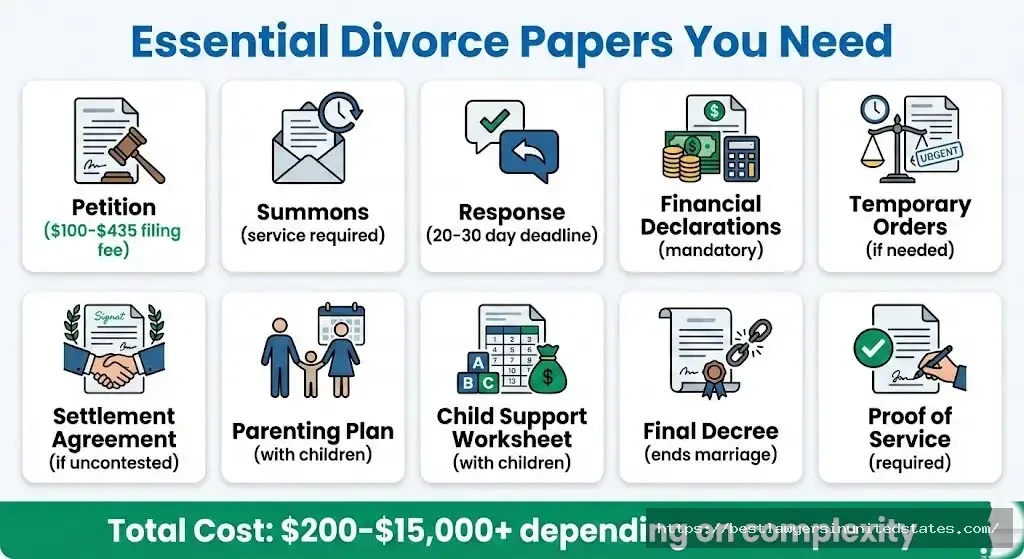
The divorce process requires different documents at each stage. Some forms are mandatory for all divorces. Others only apply if you have children, significant assets, or disputes that need court intervention.
Petition for Dissolution of Marriage
The petition is the first document filed to start a divorce. This form includes your names, marriage date, reason for divorce, and what you’re asking the court to order. You become the “petitioner” when you file this document.
Most states require basic information like residency requirements, grounds for divorce, and whether you have children. You’ll also state your requests for property division, spousal support, and child custody. The filing fee ranges from $100 to $435 depending on your location.
Key information in a petition:
- Full names and addresses of both spouses
- Date and place of marriage
- Children’s names and birthdates
- Grounds for divorce (usually “irreconcilable differences”)
- Requests for property division, support, and custody
- Statement that residency requirements are met
Summons
The summons is a legal notice that tells your spouse they’re being sued for divorce. This one-page document explains that divorce papers have been filed and gives your spouse a deadline to respond (typically 20-30 days).
A summons must be served according to your state’s rules. You cannot serve the summons yourself. Most people hire a process server or use the sheriff’s office. Proper service is required before the court will proceed with your case.
The summons includes the case number, court information, and a clear warning about what happens if your spouse doesn’t respond. If they miss the deadline, you can request a default judgment that grants everything you asked for in your petition.
Response or Answer
The response (also called an answer) is your spouse’s formal reply to your divorce petition. This document lets them agree with your requests, disagree, or make counter-requests. The respondent must file this within the deadline stated in the summons.
If your spouse agrees with everything, they file an “uncontested response.” This speeds up the divorce significantly. If they disagree, the response explains what they want instead and why. This creates a contested divorce that requires negotiation or trial.
Response options:
- Agree with all requests (uncontested)
- Disagree and state alternative requests (contested)
- File a counter-petition with their own demands
- Ignore the summons (leads to default judgment)
Financial Disclosure Forms
Financial declarations are mandatory in every divorce. Both spouses must complete detailed forms listing all income, assets, debts, and expenses. These forms are called different names in different states: Income and Expense Declaration, Financial Affidavit, or Statement of Net Worth.
You must disclose everything you own and owe, even separate property. This includes bank accounts, retirement accounts, real estate, vehicles, credit card debt, and monthly expenses. Hiding assets can result in serious penalties including having the divorce reopened years later.
Common financial documents required:
- Last 3 years of tax returns
- Recent pay stubs or proof of income
- Bank and investment account statements
- Retirement account statements
- Credit card and loan statements
- Property deeds and vehicle titles
- Business ownership documents (if applicable)
These documents must be exchanged within 30-60 days of filing in most states. The other side can request additional documentation during the discovery process if they suspect you’re hiding assets.
Temporary Orders
Temporary orders establish rules while your divorce is pending. These court orders address urgent issues that can’t wait months for the final decree. Common temporary orders cover child custody, child support, spousal support, and who stays in the family home.
You request temporary orders by filing a motion early in your case. The court usually schedules a hearing within 2-4 weeks. These orders remain in effect until your divorce is finalized or the court modifies them.
| Temporary Order Type | Purpose | Duration |
|---|---|---|
| Temporary Custody | Sets parenting time schedule | Until final decree |
| Temporary Support | Orders child/spousal support payments | Until final decree |
| Restraining Orders | Prevents harassment or financial misconduct | Until final decree or longer |
| Property Use | Determines who lives in home, uses vehicles | Until final decree |
| Financial Restraints | Prevents hiding or wasting marital assets | Until final decree |
Divorce Papers Timeline: When to File Each Document
Understanding when to file each form prevents costly delays. The typical divorce follows a clear sequence from filing through finalization. Missing a deadline or filing documents out of order can set your case back weeks or months.
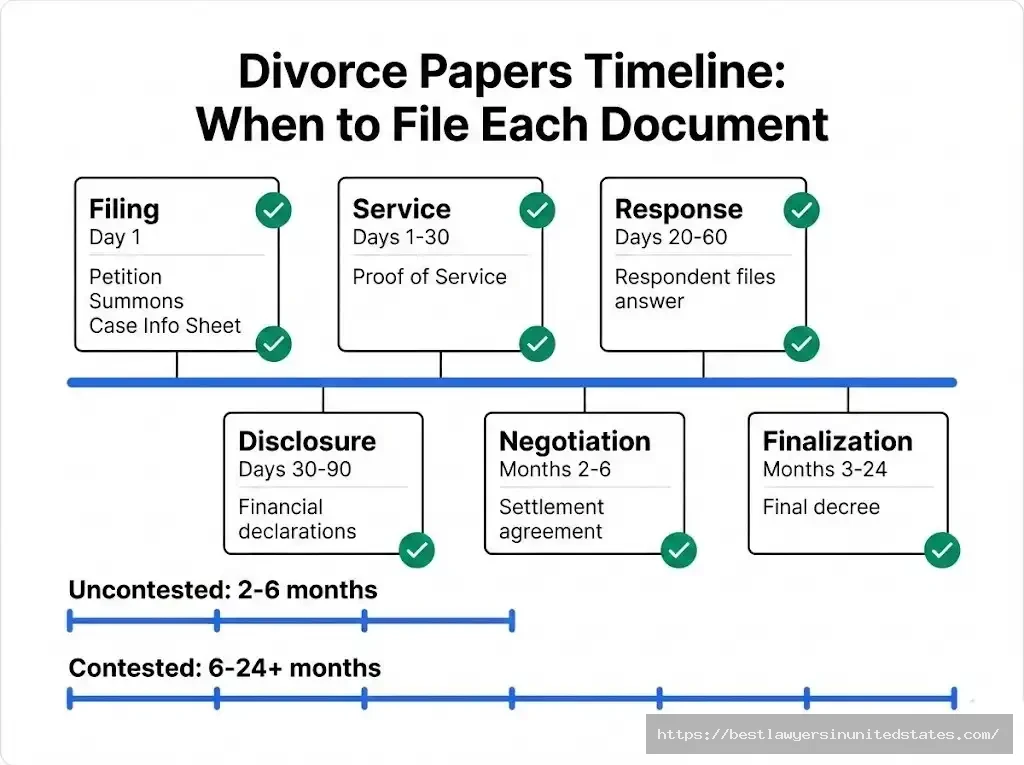
The timeline varies based on whether your divorce is contested or uncontested. Uncontested divorces move faster because both spouses agree on all terms. Contested divorces take longer due to negotiations, discovery, and potential trial.
Stage 1: Filing and Service (Days 1-30)
The filing spouse prepares and submits the petition to the court clerk. The court stamps the documents, assigns a case number, and charges a filing fee. You receive certified copies that must be served on your spouse.
Service must happen within a specific timeframe (usually 30-120 days depending on state). After your spouse is served, they have 20-30 days to file a response. The clock doesn’t start until service is complete and proven to the court.
Documents needed:
- Petition for Dissolution of Marriage
- Summons
- Case Information Sheet
- Filing fee payment
- Proof of Service (filed after spouse is served)
Stage 2: Financial Disclosure (Days 30-90)
Both parties exchange financial disclosure forms and supporting documents. Most states require this exchange within 30-60 days of the response being filed. Some states impose automatic deadlines of 45 or 60 days from the start of the case.
Complete and honest disclosure is mandatory. Courts take financial transparency seriously. Failing to disclose assets can result in penalties, sanctions, or having your divorce judgment set aside years later.
Stage 3: Temporary Orders (As Needed)
If you need temporary orders, file the motion as soon as possible after the initial filing. The court typically schedules a hearing within 2-4 weeks. Both sides present evidence and the judge issues temporary orders that stay in effect during the divorce.
Not every divorce needs temporary orders. If you and your spouse can agree on interim arrangements or if there are no urgent issues, you can skip this stage and move directly to settlement negotiations.
Stage 4: Negotiation and Settlement (Months 2-6)
Most divorces settle without going to trial. During this stage, you exchange settlement proposals, attend mediation, and negotiate the terms of your divorce. Once you reach an agreement, you document it in a Marital Settlement Agreement.
For couples pursuing an uncontested divorce, this stage is quick. You may reach an agreement before filing or within the first 30-60 days. Contested cases can take 6-12 months or longer to settle.
Stage 5: Finalization (Final Month)
The final stage requires submitting your settlement agreement (or trial orders) and the final decree to the court. The judge reviews all documents to make sure they’re complete and comply with state law. If everything is in order, the judge signs the final decree.
Most states have a mandatory waiting period before the divorce can be finalized. This ranges from 30 days to 6 months from the filing date. You must wait out this period even if you reach an agreement on day one.
| Divorce Stage | Uncontested Timeline | Contested Timeline |
|---|---|---|
| Filing & Service | Week 1-2 | Week 1-2 |
| Response | Week 3-4 | Week 3-4 |
| Financial Disclosure | Week 4-8 | Week 4-12 |
| Negotiation | Week 8-12 | Month 3-12+ |
| Waiting Period | State-specific | State-specific |
| Final Hearing | Month 3-6 | Month 6-24+ |
How to Get Divorce Papers
You have several options for obtaining divorce forms. The best choice depends on your budget, complexity of your case, and comfort level with legal paperwork. Each method has different costs, benefits, and limitations.
Most uncontested divorces can be handled with free court forms. Complex cases with significant assets, custody disputes, or disagreements usually benefit from professional assistance. How long your divorce takes often depends on how accurately you complete and file the initial paperwork.
Free Court Forms
Every state provides free divorce forms through court websites or clerk’s offices. These official forms are accepted by all courts in your state and cost nothing to download. You can print them at home or request copies at the courthouse.
Court websites usually include basic instructions for completing forms. Some states offer self-help centers where staff can answer procedural questions. However, they cannot give legal advice or tell you which forms you need for your specific situation.
Where to find free forms:
- State court system website (search “[your state] court forms divorce”)
- County clerk’s office at your local courthouse
- Law library at the courthouse
- State bar association website
- Legal aid organization websites
Free forms work best for simple, uncontested divorces without children or significant assets. You’re responsible for figuring out which forms to file and how to complete them correctly.
Online Divorce Services
Online divorce services guide you through the paperwork for a flat fee of $150-$500. These websites ask you questions and generate the appropriate forms based on your answers. They check for common errors and provide instructions for filing.
These services are significantly cheaper than hiring a lawyer but more helpful than doing everything yourself. You still file the papers yourself and appear in court if required. The service only prepares the documents.
What online divorce services provide:
- Step-by-step questionnaire
- Automated form completion
- Error checking
- Filing instructions
- Customer support
Popular services include state-specific options that tailor forms to your local courts. Make sure any service you use is specific to your state since divorce laws and forms vary significantly across states.
Lawyer-Prepared Documents
Hiring an attorney to prepare your divorce papers costs $1,000-$5,000+ depending on complexity. The lawyer handles all paperwork, makes sure nothing is missed, and can advise you on what to request. This is the most expensive option but provides the most protection.
Even in an uncontested divorce, divorce attorney fees for document preparation can be worthwhile if you have retirement accounts, real estate, or children. A lawyer can spot issues you might miss and structure agreements to avoid future problems.
When to hire a lawyer for paperwork:
- High-value assets or complex property
- Business ownership
- Retirement accounts requiring a QDRO
- Child custody disagreements
- Domestic violence concerns
- Spouse has hired an attorney
Some attorneys offer “unbundled services” where they only handle specific tasks like document preparation. This costs less than full representation while still providing professional help with forms.
| Method | Cost | Time Required | Best For |
|---|---|---|---|
| Free Court Forms | $0 | 5-10 hours | Simple, uncontested, no children |
| Online Service | $150-$500 | 2-4 hours | Uncontested, moderate assets |
| Limited Scope Attorney | $1,000-$2,500 | 1-2 hours | Document review, specific issues |
| Full Attorney | $3,000-$15,000+ | Minimal | Contested, complex finances |
How to Fill Out Divorce Papers
Completing divorce forms correctly is critical to avoiding delays and rejections. Courts return incomplete or incorrect forms, which sets your case back weeks. Take your time and double-check every section before filing.
Most divorce petitions ask for the same basic information regardless of state. You’ll need personal details, marriage information, children’s information, and your requests for the court. Gather all necessary documents before you start filling out forms.
Information You’ll Need
Collect these documents and details before starting your paperwork:
Personal Information:
- Full legal names (including maiden names)
- Current addresses
- Social Security numbers
- Dates of birth
- Contact information
Marriage Information:
- Date of marriage
- Place of marriage (city, county, state)
- Date of separation (if applicable)
Children’s Information:
- Full names and birthdates of all children
- Social Security numbers
- Current living arrangements
- School information
Financial Information:
- Employment information and income
- Bank account numbers
- Property addresses and values
- Vehicle information
- Debt account numbers and balances
- Tax returns for past 2-3 years
Step-by-Step: Completing Your Petition
Start with the caption at the top of every form. This includes the court name, county, case number (leave blank initially), and parties’ names. The petitioner (person filing) is listed first. The respondent (other spouse) is listed second.
Fill in each section completely. Don’t leave blanks unless a section doesn’t apply to your situation. If something doesn’t apply, write “N/A” or “None” so the court knows you didn’t simply skip it. Use black ink if completing by hand, or type directly into PDF forms when possible.
Common petition sections:
- Jurisdiction: State how long you’ve lived in the state/county
- Marriage Details: Date and place of marriage
- Grounds: Reason for divorce (usually “irreconcilable differences”)
- Children: Names, ages, custody requests
- Property: List major assets and division requests
- Support: Requests for spousal or child support
- Attorney Fees: Request for spouse to pay your fees (if applicable)
Read the instructions carefully for each form. Some courts provide detailed guides explaining every blank. Follow these instructions exactly as written.
Common Mistakes to Avoid
Filing incorrect or incomplete paperwork is the top cause of divorce delays. Courts reject forms with these common errors, forcing you to start over. Avoiding these mistakes saves time and frustration.
Critical errors to avoid:
- Incomplete forms: Every question must be answered or marked N/A
- Wrong jurisdiction: Filing in the wrong county or state
- Missing signatures: Unsigned forms are automatically rejected
- Incorrect dates: Double-check all dates for accuracy
- Math errors: Financial forms with calculation mistakes get returned
- Missing copies: Courts require multiple copies for service and records
- No proof of service: Must file proof that spouse received papers
- Wrong forms for your situation: Using “without children” forms when you have kids
Many courts require original signatures, not photocopies. Check your local court rules before filing. Some courts now accept e-signatures, while others require wet signatures in blue or black ink.
Before filing your divorce papers:
- ✅ Review every page for completeness
- ✅ Check all calculations twice
- ✅ Sign in the presence of a notary if required
- ✅ Make copies for yourself, spouse, and court
- ✅ Check filing fees and payment methods accepted
- ✅ Verify you’re filing in the correct courthouse
- ✅ Confirm you have all required supporting documents
Filing Divorce Papers: How to Submit to Court
Filing officially starts your divorce case. You submit your completed forms to the clerk of court in the county where you or your spouse live. The clerk reviews your documents, collects the filing fee, stamps the forms, and assigns a case number.
Filing fees vary significantly by state and county. Most courts charge $200-$435 to file a divorce petition. This fee covers the petition and initial documents. Additional fees apply for motions, responses, and other filings throughout the case.
Where to File
File your divorce in the county where you or your spouse currently live. Most states require you to have lived in the state for at least 6 months and in the county for at least 3 months before filing. Check your state’s residency requirements.
The correct courthouse is usually the Family Court, Family Division of Superior Court, or District Court. Large counties may have multiple courthouse locations. Call ahead to confirm you’re going to the right place.
What to bring to the courthouse:
- Original signed petition and all forms
- Copies for yourself, your spouse, and the court (usually 3-4 copies total)
- Valid photo ID
- Filing fee (cash, check, money order, or credit card – varies by court)
- Self-addressed stamped envelope (some courts mail certified copies back)
Court clerks can answer procedural questions but cannot give legal advice. They can tell you what forms to file but not what to write on them. They can explain the filing process but not whether you should file for divorce.
Filing Fees by State
Filing fees range from $100 to $435 depending on your state and county. Some states have uniform fees statewide. Others allow counties to set their own fees, creating variation within the same state.
| State | Filing Fee Range | Notes |
|---|---|---|
| California | $435-$450 | Varies by county |
| Texas | $250-$350 | County variation |
| Florida | $400-$450 | Additional for children |
| New York | $335-$350 | Plus indexing fee |
| Illinois | $337-$388 | Cook County highest |
| Pennsylvania | $300-$350 | County variation |
| Ohio | $200-$350 | Varies significantly |
| Georgia | $200-$400 | County variation |
| Arizona | $349-$375 | Plus parent info class |
| Washington | $280-$314 | County variation |
These fees are just for filing the petition. Additional fees apply for filing a response ($50-$300), motions ($20-$100 each), and certified copies ($5-$25 per copy). Factor these into your total budget when planning.
Filing Fee Waivers
If you can’t afford the filing fee, you can request a fee waiver. Courts grant waivers based on income and financial hardship. You must complete a form proving you qualify, usually by showing you receive public assistance or your income is below a certain threshold.
Fee waiver requirements vary by state. Most states grant waivers if your income is below 125-150% of the federal poverty level or if you receive means-tested benefits like food stamps, SSI, or Medicaid.
Documents needed for fee waiver:
- Completed fee waiver application
- Recent pay stubs or proof of income
- Proof of public assistance (if applicable)
- Bank statements
- Monthly expense documentation
The court may grant a full waiver (no fees), partial waiver (reduced fees), or defer payment (pay later). If your waiver is denied, you must pay the filing fee before your case can proceed.
E-Filing Systems
Many states now offer electronic filing for divorce papers. E-filing lets you submit documents through a court website instead of appearing in person. You upload PDFs, pay the filing fee online, and receive electronic confirmation.
E-filing systems vary by state and sometimes by county. Some courts require all filings to be electronic. Others make it optional. Check your court’s website to see if e-filing is available and whether it’s mandatory or voluntary.
E-filing benefits:
- File 24/7 from home
- Instant confirmation of filing
- Faster processing
- Automatic calculation of fees
- Digital case file access
You typically need to create an account with your court’s e-filing system. There may be a small additional fee ($5-$15) for electronic filing on top of the regular filing fee.
Serving Divorce Papers: Delivering to Your Spouse
Service of process is the legal requirement to notify your spouse about the divorce. Proper service gives the court jurisdiction over your spouse and allows the case to proceed. Without valid service, the court cannot issue orders affecting your spouse.
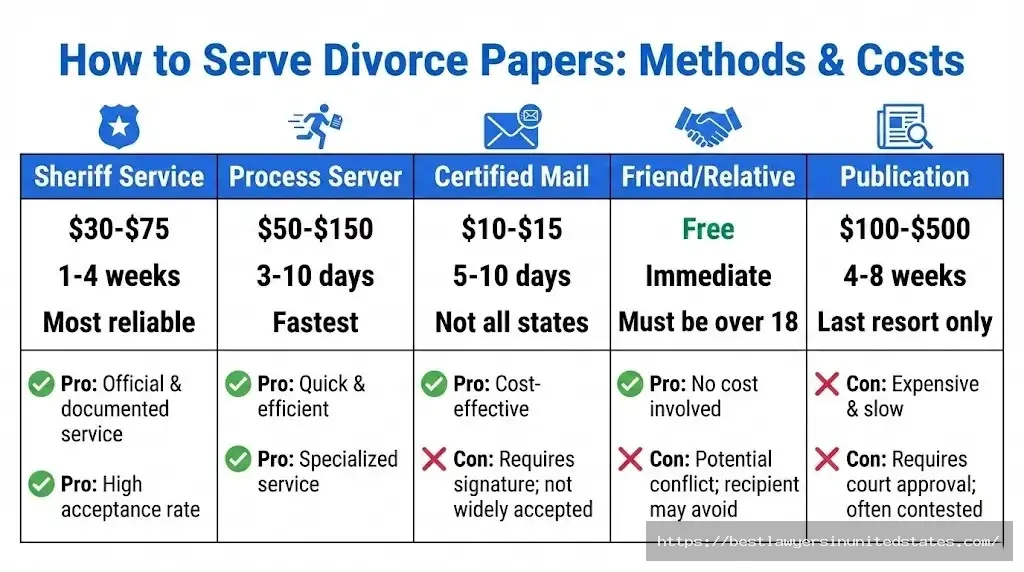
You cannot serve papers yourself. Most states prohibit the petitioner from personally serving the respondent. The law requires service by a neutral third party to make sure it happens correctly and can be proven to the court.
Who Can Serve Papers
State law specifies who is legally authorized to serve divorce papers. The most common options are sheriff’s deputies, professional process servers, or any adult not involved in the case. Each has different costs and effectiveness.
Authorized process servers:
- Sheriff or marshal: $30-$75, official and reliable, can be slow
- Private process server: $50-$150, faster, more flexible scheduling
- Adult friend/relative: Free, must be over 18 and not party to case
- Certified mail: $10-$15, only allowed in some states, requires spouse’s signature
Professional process servers usually work faster than sheriffs. They make multiple attempts at different times of day and can track down someone avoiding service. Sheriffs handle many tasks and may take 2-4 weeks to complete service.
Service Methods
Service must meet your state’s legal requirements to be valid. The most reliable method is personal service, where papers are handed directly to your spouse. Some states allow alternative methods if personal service fails after multiple attempts.
Service method options:
- Personal service: Hand-delivered to spouse in person
- Substitute service: Left with another adult at spouse’s home (after failed personal attempts)
- Certified mail: Mailed with return receipt (only if state allows)
- Service by publication: Newspaper notice (only if spouse cannot be located)
Personal service is almost always required for the initial divorce papers. Alternative methods like certified mail or publication are backup options that require court permission. You must prove you tried personal service first and couldn’t locate your spouse.
Proof of Service
After your spouse is served, the person who served them must complete a Proof of Service form. This sworn statement confirms when, where, and how service occurred. This document must be filed with the court to prove service happened.
The Proof of Service becomes part of your case file. It starts the clock for your spouse’s response deadline. Without this filed proof, the court will not move forward with your case, even if you know your spouse received the papers.
Information in Proof of Service:
- Name of person served
- Date, time, and location of service
- Method of service
- Description of person served
- Statement that papers were delivered
- Server’s signature and date
Sheriff’s deputies and professional process servers automatically complete this form. If you use a friend or relative, make sure they understand they must complete the Proof of Service accurately and file it promptly.
What If Your Spouse Can’t Be Found
If you can’t locate your spouse to serve them personally, you may qualify for service by publication. This means publishing a legal notice in a newspaper for several weeks. The court must approve this method before you can use it.
To get permission for service by publication, you must prove you made diligent efforts to find your spouse. This includes checking last known addresses, contacting relatives, searching public records, and hiring a skip tracer if possible.
Requirements for service by publication:
- File a motion requesting permission
- Provide affidavit detailing search efforts
- Publish notice in approved newspaper for 3-4 weeks
- Sometimes mail copies to last known address
- Pay publication costs ($100-$500)
Service by publication takes longer and costs more than personal service. Courts prefer direct service whenever possible. Publication is a last resort when someone has truly disappeared.
| Service Method | Cost | Timeline | Proof Required |
|---|---|---|---|
| Sheriff Personal Service | $30-$75 | 1-4 weeks | Sheriff’s return |
| Process Server | $50-$150 | 3-10 days | Affidavit of service |
| Certified Mail | $10-$15 | 5-10 days | Return receipt |
| Friend/Relative | Free | Immediate | Affidavit of service |
| Publication | $100-$500 | 4-8 weeks | Affidavit + publication proof |
Responding to Divorce Papers: If You’re Served
Receiving divorce papers can be shocking, especially if unexpected. Once served, you have a limited time to file a response. Missing this deadline can result in a default judgment that grants everything your spouse requested without your input.
The response deadline is usually printed on the summons. Most states give you 20-30 days from the date you were served (not the filing date). Mark this deadline on your calendar immediately. If the last day falls on a weekend or holiday, the deadline extends to the next business day.
Your Response Deadline
Count the days carefully from when you were personally served, not from when the petition was filed. If you were served on January 1, and your state allows 30 days, your response is due by January 31. Filing even one day late can result in a default.
If you need more time, you can usually file a motion requesting an extension before the deadline expires. Courts often grant 30-60 additional days if both parties agree or you show good cause. Never wait until after the deadline to ask for an extension.
Response timeline:
- Day 0: You’re served with divorce papers
- Days 1-20/30: Research options, gather information, prepare response
- Day 20/30: Response must be filed with court and mailed to spouse
- Day 21-30: Spouse receives your response
- Day 31+: Case proceeds based on whether response was filed
Response Options
You have four choices when served with divorce papers. Your decision depends on whether you agree with your spouse’s requests, need time to think, or want different terms.
Option 1: File an agreement (uncontested) If you agree with everything in the petition, file a response stating your agreement. This creates an uncontested divorce that moves quickly. You might still need to complete financial disclosures and attend a brief hearing, but there won’t be disputes to resolve.
Option 2: File a response/answer (contest terms) If you disagree with some or all of the requests, file a response explaining what you want instead. This creates a contested divorce requiring negotiation or trial. Be specific about what you disagree with and what you’re requesting.
Option 3: File a counter-petition In some states, you can file your own petition with your preferred terms. This puts you in an equal position rather than just responding to your spouse’s demands. Both petitions are considered together.
Option 4: Do nothing (default) If you ignore the divorce papers, the court will eventually grant a default judgment. This gives your spouse everything they asked for without your input. Default judgments can be extremely difficult and expensive to overturn later.
What If You Agree with Everything
If you agree with all the terms in the petition, the divorce can proceed quickly as uncontested. File a response confirming your agreement to speed things up. You’ll still need to complete financial disclosures and wait out any mandatory waiting period.
Some states offer simplified procedures for truly uncontested divorces. Both spouses may sign a marital settlement agreement upfront, eliminating the need for court hearings. Check if your state offers this option.
What If You Disagree
If you disagree with the custody arrangement, property division, support amounts, or other terms, your response must state your objections and alternative requests. Be specific about what you want and why.
A contested response starts the negotiation process. You’ll exchange financial information, discuss settlement options, and possibly attend mediation. If you can’t agree, the judge will decide contested issues at trial. The length of your divorce increases significantly when terms are disputed.
Divorce Papers Costs: Complete Fee Breakdown
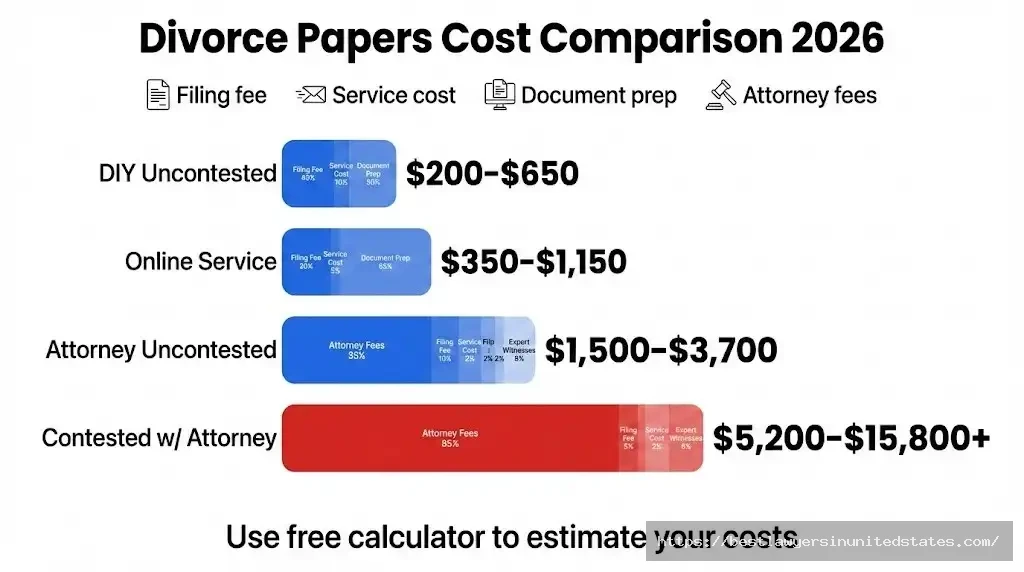
Understanding the total cost helps you budget for divorce. Paper-related expenses include court filing fees, service costs, notarization, certified copies, and potentially document preparation fees. Costs vary based on your location and whether you hire help.
Use our divorce cost calculator to estimate your total expenses including all paperwork and filing fees for your specific situation.
Divorce Cost Calculator
Get an estimated cost for your divorce based on your specific situation
Your Estimated Divorce Cost
Cost Breakdown
📧 Get a Personalized Consultation
Have questions about your specific situation? Contact our legal experts for guidance tailored to your needs.
Contact Us via EmailFiling and Court Fees
Court filing fees are the largest paperwork expense. The petitioner pays the filing fee when submitting the initial petition. The respondent pays a response fee if they file an answer. Additional fees apply for motions and other filings throughout the case.
Common court fees:
- Petition filing fee: $100-$435 (varies by state/county)
- Response filing fee: $50-$300 (if you’re the respondent)
- Motion filing fees: $20-$100 per motion
- Certified copies: $5-$25 per document
- Hearing fees: $25-$100 in some jurisdictions
- Subpoena fees: $30-$75 per subpoena
Total court costs for a simple uncontested divorce usually range from $200-$500. Contested divorces with multiple motions can rack up $1,000-$2,000 in court fees alone before considering attorney costs.
Service of Process Costs
Serving divorce papers costs $30-$150 depending on your service method. Sheriff service is usually cheapest at $30-$75, but can take weeks. Private process servers cost $50-$150 but work faster and make multiple attempts.
If personal service fails and you need service by publication, costs increase to $100-$500 for newspaper publication fees plus filing fees for the motion requesting permission.
Notarization Fees
Some divorce documents require notarization. Notary fees are capped by state law, typically $2-$15 per signature. You may need notarization for financial affidavits, certain motions, and sworn statements.
Many banks offer free notary services to account holders. Some libraries, UPS stores, and mobile notaries also provide notarization. Mobile notaries charge $25-$50 per visit for home or office service.
Document Preparation Costs
If you use an online divorce service to prepare your documents, expect to pay $150-$500. These services guide you through the paperwork and generate completed forms based on your answers. You still file the papers yourself.
Hiring an attorney to prepare documents costs $1,000-$5,000+ depending on complexity. Full representation for a contested divorce ranges from $5,000-$15,000 on average, with complex cases reaching $30,000 or more.
| Cost Category | DIY Uncontested | Online Service | Attorney-Assisted | Contested with Attorney |
|---|---|---|---|---|
| Filing Fee | $100-$435 | $100-$435 | $100-$435 | $100-$435 |
| Service of Process | $30-$75 | $30-$75 | $30-$150 | $50-$150 |
| Document Prep | $0 | $150-$500 | $1,000-$3,000 | $5,000-$15,000+ |
| Notary Fees | $0-$50 | $0-$50 | Included | Included |
| Certified Copies | $15-$50 | $15-$50 | $15-$50 | $25-$100 |
| Total Range | $200-$650 | $350-$1,150 | $1,200-$3,700 | $5,200-$15,800+ |
Total Cost Estimates
Your total divorce cost depends on whether it’s contested, your location, and whether you hire professional help. Here are realistic estimates for different scenarios:
Simple uncontested divorce (DIY):
- Filing fees: $200-$435
- Service: $30-$75
- Copies and notary: $20-$50
- Total: $250-$560
Uncontested with online service:
- Filing fees: $200-$435
- Service: $30-$75
- Online service: $150-$500
- Copies and notary: $20-$50
- Total: $400-$1,060
Uncontested with attorney:
- Filing fees: $200-$435
- Service: $30-$150
- Attorney flat fee: $1,500-$3,000
- Copies: $25-$100
- Total: $1,755-$3,685
Contested with attorney:
- Filing fees: $200-$435
- Service: $50-$150
- Attorney fees: $5,000-$15,000+
- Additional court costs: $500-$1,000
- Expert witnesses: $1,000-$5,000
- Total: $6,750-$21,585+
For more detailed cost information, see our comprehensive guide on divorce costs.
Divorce Papers by Divorce Type
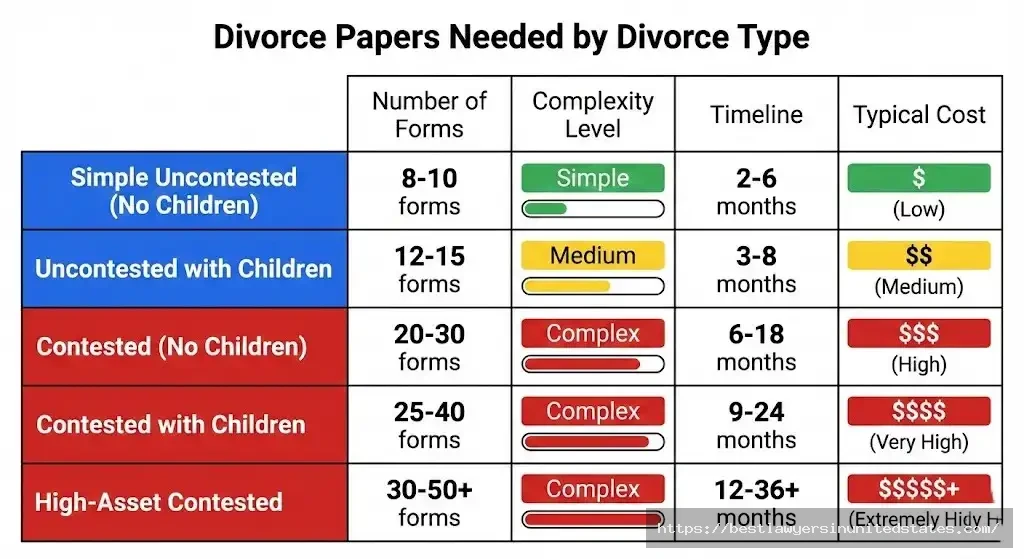
Different types of divorces require different paperwork. The complexity of your situation determines how many forms you need. Understanding your divorce type helps you gather the correct documents from the start.
Uncontested Divorce Papers
Uncontested divorces require the fewest forms. Both spouses agree on all terms, so you don’t need motions, discovery requests, or trial documents. The basic paperwork includes the petition, financial disclosures, marital settlement agreement, and final decree.
Required documents for uncontested divorce:
- Petition for Dissolution of Marriage
- Summons (for service)
- Response (spouse agrees)
- Financial declarations from both spouses
- Marital Settlement Agreement
- Parenting Plan (if you have children)
- Child Support Worksheet (if you have children)
- Final Decree of Dissolution
Most uncontested divorces can be completed with 8-12 forms total. Some states offer simplified procedures for uncontested cases with even fewer required documents.
Contested Divorce Papers
Contested divorces involve disputes that need court intervention. This requires additional paperwork for temporary orders, discovery, motions, and potentially trial. The number of forms can easily exceed 30-40 documents throughout the case.
Additional documents in contested divorce:
- Multiple motions for temporary orders, modifications, enforcement
- Discovery requests (interrogatories, requests for production)
- Subpoenas for records and witnesses
- Expert witness designations and reports
- Pretrial statements and trial briefs
- Witness lists and exhibit lists
Each motion requires a separate filing fee. Contested divorces generate significantly more paperwork and court costs than uncontested cases.
Divorce with Children Papers
Having children adds several mandatory forms. Courts require parenting plans detailing custody arrangements, visitation schedules, and decision-making authority. Child support worksheets calculate support based on state guidelines.
Additional forms for divorces with children:
- Parenting Plan or Custody Order
- Child Support Worksheet or Calculation
- Child Support Order
- Income Withholding Order (for wage garnishment)
- Parenting class certificate (required in many states)
- Child’s health insurance information
Some states require both parents to complete parenting classes before the divorce can be finalized. The certificate of completion must be filed with the court.
Divorce without Children Papers
Divorces without minor children are simpler. You skip all the custody, visitation, and child support paperwork. The case focuses only on property division and potentially spousal support.
Without children, you can often use simplified divorce procedures if your state offers them. These streamlined processes have fewer forms and faster timelines for qualifying couples.
High-Asset Divorce Papers
High-value divorces require extensive financial documentation. Beyond standard financial declarations, you may need business valuations, forensic accounting reports, and appraisals for property, art, or collectibles.
Additional documents for high-asset divorce:
- Business valuation reports
- Retirement account statements and valuations
- QDRO (Qualified Domestic Relations Order) for dividing retirement accounts
- Real estate appraisals
- Stock and investment portfolio statements
- Tax returns for past 3-5 years
- Expert witness reports on asset values
A QDRO is a special court order required to divide 401(k)s, pensions, and other retirement accounts without tax penalties. These complex documents usually require an attorney or QDRO specialist to prepare.
| Divorce Type | Approximate Forms | Complexity | Timeline |
|---|---|---|---|
| Simple Uncontested, No Children | 8-10 | Low | 2-6 months |
| Uncontested with Children | 12-15 | Medium | 3-8 months |
| Contested, No Children | 20-30 | High | 6-18 months |
| Contested with Children | 25-40 | Very High | 9-24 months |
| High-Asset Contested | 30-50+ | Very High | 12-36+ months |
After Papers Are Signed: What Happens Next
Signing divorce papers doesn’t immediately end your marriage. The court must review your documents, make sure all requirements are met, and issue a final decree. This process takes weeks to months depending on your state’s procedures and waiting periods.
The final decree is the only document that officially ends your marriage. Until the judge signs it and it’s filed with the court, you remain legally married. This matters for tax filing status, insurance, and your ability to remarry.
Court Review Process
After you submit your final documents, the court clerk reviews them for completeness. Incomplete submissions are rejected and returned for correction. This delays your case by several weeks.
If everything is in order, your file goes to a judge for review. The judge makes sure your agreement is fair, properly divides property, and protects any children’s interests. Most uncontested cases are approved without a hearing.
What the judge reviews:
- All required forms are present and complete
- Financial disclosures are thorough
- Property division is reasonable
- Child support meets state guidelines
- Parenting plan serves children’s best interests
- Waiting period has been satisfied
Some states require a brief final hearing even for uncontested divorces. The judge asks a few questions to confirm you understand and agree with the terms. This hearing typically lasts 10-20 minutes.
Mandatory Waiting Periods
Most states require a waiting period between filing and finalization. This gives both spouses time to reconsider and resolve any issues. Waiting periods range from 30 days to 6 months depending on your state.
You cannot finalize your divorce before this period expires, even if you’re in complete agreement and ready to proceed. The clock starts on the filing date (or service date in some states) and runs regardless of how quickly you complete paperwork.
Common waiting periods by state:
- California: 6 months from service
- Texas: 60 days from filing
- Florida: 20 days from filing
- Illinois: No waiting period
- Arizona: 60 days from service
- New York: No waiting period
States with longer waiting periods want to discourage impulsive divorces. Couples sometimes change their minds during this cooling-off period and dismiss the case.
Receiving Your Final Decree
The final decree (also called a judgment of dissolution) is the court order that ends your marriage. Once signed by the judge, the clerk files it in the court records. You should receive a file-stamped copy by mail or you can pick it up at the courthouse.
Keep multiple certified copies of your final decree in a safe place. You’ll need certified copies to change your name, update insurance, refinance property, divide retirement accounts, and potentially remarry. Most people get 3-5 certified copies at finalization since obtaining them later requires a special trip to the courthouse and additional fees.
The decree includes all the terms of your divorce. Property division, support orders, and custody arrangements. Both spouses must follow these orders. Violating the decree can result in contempt of court charges.
Getting Copies of Divorce Papers Later
You may need copies of your divorce decree years after your divorce. Common reasons include remarriage, name changes, refinancing property, applying for benefits, or proving marital status. Certified copies are required for official purposes.
Certified vs Regular Copies
A certified copy has an official seal and signature from the court clerk. This proves the document is a true copy of the court’s records. Government agencies, financial institutions, and courts require certified copies.
Regular photocopies don’t have legal weight. They’re fine for your personal records but won’t be accepted for official purposes like changing your name on a driver’s license or passport.
Certified copies cost $5-$25 per document depending on your state. Most people get 3-5 certified copies when their divorce is finalized. If you need more later, you can request them from the court clerk.
How to Request Copies from Court
Contact the clerk of court in the county where your divorce was finalized. You’ll need to provide your name, your ex-spouse’s name, the approximate date of divorce, and the case number if you know it.
Methods to request divorce records:
- In person at the courthouse (fastest)
- By mail with a written request and payment
- Online through some court websites
- By phone (limited availability)
Requests usually take 1-2 weeks by mail or 24-48 hours in person. Some modern courts offer online access to records and certified copies by mail. Check your county court’s website for specific procedures.
You’ll need to pay the certification fee and show identification. Some courts require you to complete a request form. If you can’t appear in person, most courts accept mail requests with payment by check or money order.
Cost of Copies
Most courts charge $5-$25 for a certified copy of your divorce decree. Some courts charge per page, while others charge a flat fee per document. Expect to pay $10-$50 total for 2-3 certified copies.
If you need multiple documents certified (decree, parenting plan, support orders), each is a separate charge. Plan to spend $25-$75 to get complete certified copies of all divorce orders.
Requesting Copies from Another State
If you’ve moved since your divorce, you can still request copies from the court where your divorce was finalized. The process is the same but must be done by mail or online since you’re no longer local.
Send a written request including:
- Your full name at the time of divorce
- Your ex-spouse’s full name
- Approximate date of divorce
- Case number (if known)
- Number of certified copies needed
- Return address
- Payment (check or money order made out to the county clerk)
Some states offer online requests through VitalChek or other vendors. These services charge additional fees ($10-$30) but may be more convenient for out-of-state requests.
Common Mistakes with Divorce Papers
Simple errors cause major delays in divorce cases. Courts reject incomplete or incorrect forms, setting your case back weeks. Learning common mistakes helps you avoid them and move your case forward smoothly.
Incomplete Financial Disclosures
Hiding assets or providing incomplete financial information is the most serious mistake. Courts require full disclosure of all income, assets, and debts. Failing to disclose everything can result in your divorce being reopened years later or criminal penalties for fraud.
List everything you own and owe, even if you think it’s separate property or insignificant. Include bank accounts, retirement accounts, real estate, vehicles, household items, collectibles, cryptocurrency, and any other assets. Disclose all debts including credit cards, student loans, car loans, and personal loans.
Commonly forgotten financial items:
- Small bank accounts or old accounts
- Retirement accounts from previous employers
- Stock options or restricted stock units
- Life insurance cash value
- Personal injury settlements
- Cryptocurrency or digital assets
- Collections (art, coins, etc.)
- Time shares or vacation property
- Debts to family members
Wrong Jurisdiction
Filing in the wrong county or state can get your entire case dismissed. Most states require you to have lived in the state for at least 6 months and in the county for at least 3 months before filing. Make sure you meet these requirements.
If you and your spouse live in different states, you can usually file where either of you lives. Check your state’s rules about jurisdiction over your spouse if you’re filing in a different state than where they live.
Improper Service
Service that doesn’t meet legal requirements is invalid. The most common error is the petitioner trying to serve papers themselves. This is prohibited in every state. Use a sheriff, process server, or other authorized person.
Proof of service must be filed with the court. Without this proof, your case cannot proceed even if you know your spouse received the papers. Make sure your process server completes the proof of service form and files it promptly.
Missing Signatures and Dates
Forms without signatures or dates are automatically rejected. Review every page before filing to make sure all required signatures are present. Some forms need both spouses to sign. Others need only the person filing.
Check whether signatures need to be notarized. Financial affidavits usually require notarization. Sign these forms in front of a notary, not beforehand. Signing before seeing the notary invalidates the notarization.
Using Wrong Forms
States update forms regularly. Using an outdated version can get your filing rejected. Always download forms fresh from the court website rather than using forms from several months or years ago.
Make sure you’re using the correct forms for your situation. “Petition for Dissolution with Children” forms are different from “without Children” versions. Using the wrong set wastes time and money.
| Common Mistake | Consequence | How to Avoid |
|---|---|---|
| Incomplete forms | Rejection, delay | Review every line before filing |
| Wrong jurisdiction | Case dismissed | Verify residency requirements |
| Petitioner serves papers | Invalid service | Hire process server or use sheriff |
| No proof of service filed | Case won’t proceed | Make sure server files proof |
| Missing signatures | Form rejected | Check every page for signature lines |
| Not notarized | Form rejected | Sign in front of notary when required |
| Outdated forms | Rejection | Download current forms each time |
| Math errors | Form rejected | Double-check all calculations |
| Wrong forms for situation | Rejection, delay | Verify correct forms for your case |
DIY Divorce Papers vs Hiring Help
Deciding whether to handle divorce paperwork yourself saves thousands of dollars if you can do it successfully. The wrong choice can cost you far more in mistakes, missed opportunities, or unfair agreements.
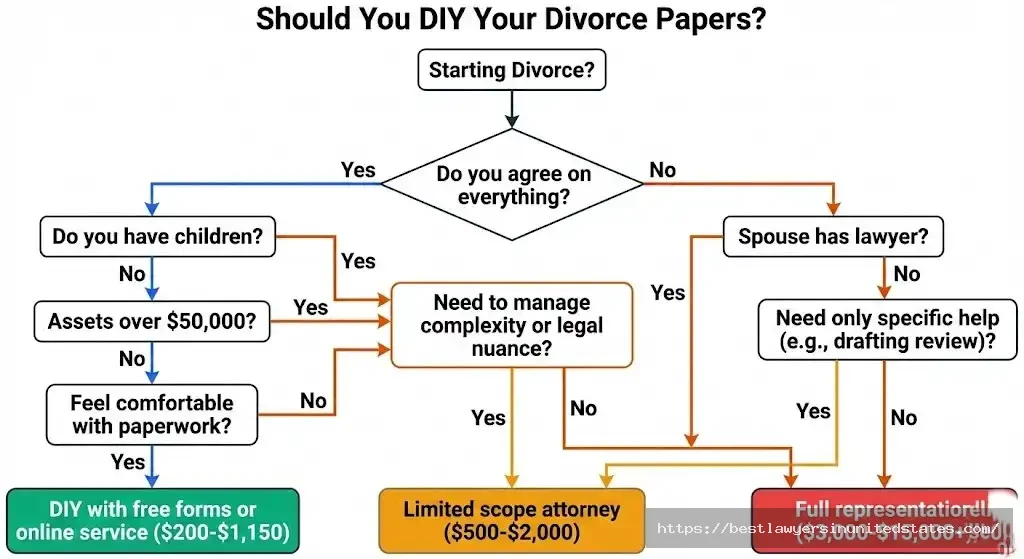
Simple, uncontested divorces with minimal assets are good candidates for DIY. Complex situations with children, significant property, or disagreements usually benefit from professional help. For a truly amicable split, consider our DIY divorce guide for state-specific instructions.
You Can Probably DIY If
Certain situations are safe to handle without a lawyer. If your divorce checks most of these boxes, you can likely manage the paperwork yourself or with an online service.
Good candidates for DIY divorce:
- ✅ Both spouses agree on all terms (uncontested)
- ✅ No minor children or custody is agreed
- ✅ Minimal assets (under $50,000 total)
- ✅ No real property or simple split
- ✅ Both spouses employed with similar income
- ✅ No significant debt disputes
- ✅ Neither spouse wants alimony
- ✅ Short marriage (under 5 years)
- ✅ Both spouses comfortable with paperwork
- ✅ No domestic violence or abuse
If your situation is simple and you’re organized, court-provided forms and instructions may be enough. An online divorce service can guide you through the process for a few hundred dollars if you want more help.
You Should Get Help If
Some situations are too complex or risky to handle alone. Even one major asset or custody dispute makes professional help worthwhile. The cost of a lawyer is usually far less than the cost of a bad agreement.
When to hire a lawyer:
- ❌ Contested divorce (any disagreements)
- ❌ Children with custody or support disputes
- ❌ Complex assets (business, investments, retirement accounts)
- ❌ Real estate or property over $100,000
- ❌ One spouse hiding or wasting assets
- ❌ Domestic violence or restraining orders
- ❌ Your spouse hired an attorney
- ❌ You’re overwhelmed by the paperwork
- ❌ Significant income disparity
- ❌ Long marriage (over 10 years)
Complex financial situations require expertise. Dividing retirement accounts incorrectly can cost thousands in taxes and penalties. Business valuations and asset division need professional guidance to protect your interests.
Help Options
You don’t have to choose between doing everything yourself or hiring full representation. Several options fall between these extremes.
Legal Aid: Free or low-cost help for people with low income. Most legal aid organizations help with divorce paperwork and advice. You must qualify based on income, usually below 125-150% of federal poverty level.
Limited Scope Representation: Also called unbundled services. A lawyer helps with specific tasks like reviewing documents or giving advice while you handle other parts. Costs $500-$2,000 depending on what you need.
Document Review: A lawyer reviews your completed forms before filing. This catches errors and makes sure you haven’t missed anything important. Typical cost is $300-$750 for document review.
Mediation: A neutral mediator helps you and your spouse reach agreement. The mediator doesn’t represent either spouse but guides negotiation. Costs $100-$300 per hour, with most divorces resolved in 3-8 sessions.
Online Divorce Services: Websites guide you through paperwork for $150-$500. These work well for uncontested divorces but don’t provide legal advice or court representation.
| Help Level | Cost | Best For | Limitations |
|---|---|---|---|
| DIY with Court Forms | $0 | Simple uncontested | No guidance or review |
| Online Divorce Service | $150-$500 | Uncontested | No legal advice |
| Legal Aid | Free-$50 | Low income | Income limits apply |
| Document Review | $300-$750 | DIY with verification | Limited scope |
| Limited Scope Attorney | $500-$2,000 | Specific issues | Doesn’t handle everything |
| Mediation | $900-$2,400 | Uncontested w/ issues | Doesn’t give legal advice |
| Full Representation | $3,000-$15,000+ | Contested or complex | Most expensive |
FAQs About Divorce Papers
How long does it take to get divorce papers?
Quick Answer: You can get free divorce forms immediately from court websites, or receive them by mail in 1-2 weeks from the courthouse. Lawyer-prepared documents typically take 1-2 weeks to draft.
The time to complete your entire divorce varies significantly. Uncontested divorces usually take 2-6 months from filing to final decree. Contested divorces take 6-24 months depending on complexity and court backlog.
Can I get divorce papers online?
Quick Answer: Yes, most states offer free downloadable divorce forms on court websites. Online divorce services ($150-$500) guide you through completing forms but don’t provide legal representation.
Download official forms directly from your state or county court website. These forms are free and accepted by courts. Online divorce services help you complete the forms correctly and provide instructions for filing.
Are divorce papers public record?
Quick Answer: Yes, divorce papers and final decrees are public records in most states. Anyone can request copies from the court clerk unless the case involves sensitive information like domestic violence or child abuse.
Your financial disclosures, settlement terms, and final decree are accessible to the public. Some states seal cases involving protected information. Parties can request to seal sensitive documents, but courts don’t automatically make divorce records confidential.
Do divorce papers need to be notarized?
Quick Answer: Some divorce documents require notarization, typically financial affidavits and sworn statements. The petition itself usually doesn’t need notarization, but check your state’s specific requirements.
Notarization proves you signed the document under oath. Many financial disclosure forms must be notarized. Affidavits and declarations need notarization. Review each form’s instructions to see if notarization is required before filing.
How much do divorce papers cost?
Quick Answer: Court filing fees range from $100-$435 depending on your state. Total divorce paperwork costs range from $200-$650 for DIY, $350-$1,150 with online services, or $1,500-$5,000+ with attorney preparation.
Additional costs include service of process ($30-$150), notarization ($0-$50), and certified copies ($5-$25 each). Use our divorce cost calculator to estimate your total expenses including all paperwork and filing fees.
Can I file divorce papers without a lawyer?
Quick Answer: Yes, you can file divorce papers yourself (called “pro se” or self-represented). Courts provide free forms and basic instructions for people filing without attorneys.
Most uncontested divorces can be completed without a lawyer if you’re comfortable with paperwork. Complex cases involving children, significant assets, or disagreements usually benefit from legal help. Court staff can answer procedural questions but cannot give legal advice.
What happens if I don’t sign divorce papers?
Quick Answer: If you don’t file a response within the deadline (usually 20-30 days), your spouse can request a default judgment granting everything they asked for without your input.
Ignoring divorce papers doesn’t stop the divorce. The court will proceed without you and grant your spouse’s requests. Default judgments are difficult and expensive to overturn. Always file a response by the deadline, even if you disagree with everything.
How are divorce papers served?
Quick Answer: Divorce papers must be personally delivered to your spouse by a neutral third party (sheriff, process server, or adult not involved in the case). You cannot serve papers yourself.
The most common service method is personal service where papers are handed directly to your spouse. Some states allow certified mail service or service by publication if personal service fails. Proof of service must be filed with the court.
Can divorce papers be mailed?
Quick Answer: Some states allow service by certified mail with return receipt, but most require personal service for initial divorce papers. Check your state’s rules before attempting mail service.
Even in states allowing mail service, personal service is usually required first. Mail service may be an option for subsequent documents like motions or modified orders. The respondent must sign the certified mail receipt for service to be valid.
What if my spouse won’t sign divorce papers?
Quick Answer: Your spouse doesn’t have to agree to get divorced. If they won’t sign or respond within the deadline, you can request a default judgment after proving proper service.
You don’t need your spouse’s permission or signature to get divorced. If they refuse to participate, the court proceeds without their input. This is called a divorce without spouse signature. The default judgment grants your requests from the petition.
How do I respond to divorce papers?
Quick Answer: File a response form with the court within the deadline stated in the summons (usually 20-30 days). The response states whether you agree or disagree with your spouse’s requests.
Get the response form from the court website or clerk’s office. Complete it fully, sign it, make copies, and file it with the court by the deadline. Mail a copy to your spouse or their attorney. Pay the response filing fee (typically $50-$300).
What do divorce papers look like?
Quick Answer: Divorce papers are standard court forms on 8.5″ x 11″ paper. They include a caption with court information, case number, party names, checkboxes, fill-in-the-blank sections, and signature lines.
Official court forms look professional and formal. They have numbered lines, specific formatting, and legal terminology. The petition is usually 3-8 pages. Financial disclosure forms can be 10-20 pages with detailed schedules for assets and debts.
Where can I get free divorce papers?
Quick Answer: Download free divorce forms from your state or county court website. You can also get paper copies at the courthouse clerk’s office at no charge.
All states provide free official divorce forms. Search “[your state] divorce forms” to find your court’s website. Many states also have law libraries at courthouses where you can get forms and use computers to complete them.
Do both spouses have to sign divorce papers?
Quick Answer: Only the petitioner signs the initial petition. The respondent signs their response if they file one. Both spouses usually sign the marital settlement agreement and final decree if the divorce is uncontested.
The person filing (petitioner) signs the petition alone. If the divorce is contested, each spouse signs their own documents separately. For uncontested divorces, both sign the settlement agreement showing their consent to the terms.
How long after signing divorce papers is it final?
Quick Answer: Signing papers doesn’t finalize your divorce. The judge must sign the final decree and file it with the court. This typically takes 2-8 weeks after you submit final paperwork, plus any mandatory waiting period.
Most states have waiting periods between filing and finalization (30 days to 6 months). Even after all papers are signed, the court must review them and issue the final decree. You’re officially divorced on the date the judge signs the decree, not when you sign papers.
Conclusion
Divorce papers can feel overwhelming, but understanding each document makes the process manageable. The key is knowing which forms you need, when to file them, and whether to handle paperwork yourself or get professional help.
Start by determining your divorce type. Uncontested divorces with minimal assets are straightforward enough for most people to handle with free court forms or an online service. Complex situations with children, significant property, or disagreements usually justify hiring a lawyer.
Take your time completing forms. Review everything twice before filing. Simple mistakes cause delays that cost time and money. When in doubt about which forms to use or how to complete them, get help from legal aid, a document review service, or an attorney consultation.
Your divorce is finalized only when the judge signs the final decree, not when you sign papers. Make sure to get multiple certified copies of your final decree for name changes, remarriage, and other future needs.
Questions about your divorce paperwork or need legal help? Contact us at [email protected] for assistance finding experienced divorce attorneys in your area.