
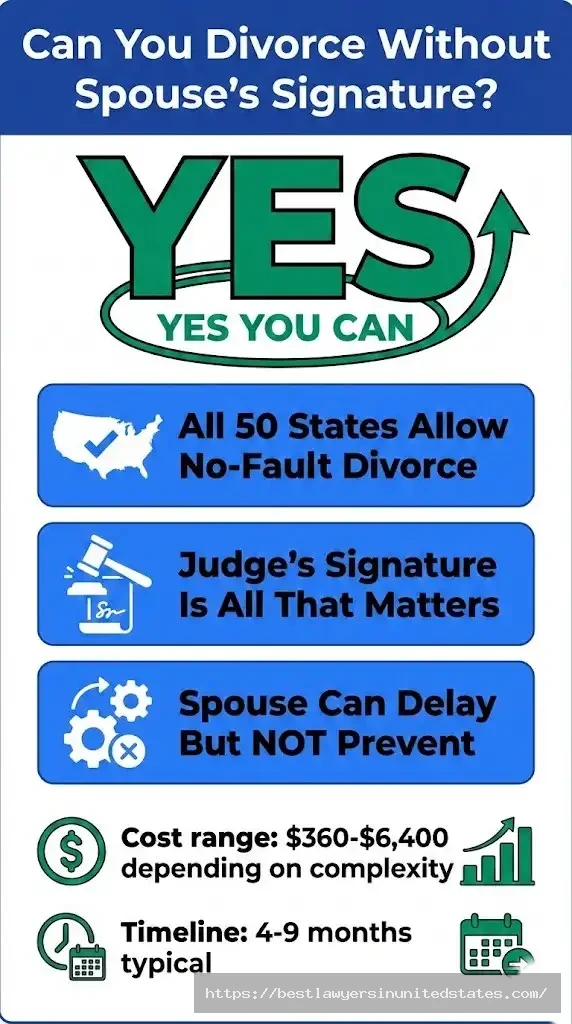
Yes, you can get a divorce without your spouse’s signature in all 50 U.S. states. The judge’s signature is the only one legally required to finalize a divorce. Your spouse cannot prevent the divorce by refusing to sign papers, though they may delay the process by several months.
All states now offer no-fault divorce, meaning one spouse’s decision to end the marriage is enough. You don’t need your spouse’s permission or consent. While an uncooperative spouse can slow things down, they cannot stop you from getting divorced.
This guide explains how to proceed when your spouse won’t sign divorce papers, including service by publication, default divorce procedures, costs, timelines, and state-specific requirements across the United States.
Can You Divorce Without Your Spouse’s Signature?
The Short Answer: Yes, Absolutely
You can divorce without your spouse’s signature. The only signature that matters is the judge’s on your final divorce decree. Your spouse’s refusal to sign papers creates delays but cannot block your divorce.
Every state in America allows no-fault divorce. This means one spouse can file for divorce based on irreconcilable differences without proving fault. The other spouse’s agreement is not required.
The confusion comes from mixing up two different things: serving divorce papers and getting signatures. You must serve your spouse with divorce papers (give them legal notice). But you don’t need them to sign or agree to the divorce terms.
Understanding No-Fault Divorce Laws
No-fault divorce became available nationwide over the past 50 years. The last state to adopt it was New York in 2010. This legal change means marriage is no longer a permanent trap.
Key differences between service and consent:
- Service: Legal delivery of divorce papers (required by law)
- Consent: Your spouse’s agreement to divorce (not required)
- Signature: Your spouse signing papers (not required)
- Response: Your spouse filing an answer (optional, creates contested divorce if disputing terms)
When your spouse refuses to sign, you proceed through default divorce. The court holds a hearing, reviews your proposed terms, and grants the divorce without your spouse’s input.
What “Without Signature” Really Means
“Divorce without signature” has three common scenarios. First, your spouse receives papers but refuses to sign or respond. Second, you cannot locate your spouse to serve papers. Third, your spouse actively evades service.
All three scenarios have legal solutions:
- Refusal to sign: Default divorce after waiting period
- Cannot locate spouse: Service by publication in newspaper
- Evading service: Alternative service methods through court order
The process takes longer than a cooperative divorce. You’ll spend more time on court procedures and documentation. But the end result is the same: a legally valid divorce decree.
How Divorce Works When Your Spouse Won’t Sign
Step 1: File Your Divorce Petition
Filing starts the legal divorce process. You submit a petition for dissolution of marriage to your county family court. This document states you want a divorce and outlines proposed terms for property division, support, and custody if applicable.
Where to file depends on residency requirements:
- Most states require 6-12 months residency before filing
- File in the county where you or your spouse lives
- Some states allow filing where you married if both parties agree
You’ll pay filing fees ranging from $100 to $450 depending on your state. California charges $435, Texas charges $300, and New York charges $335. Fee waivers exist for low-income filers.
Many people handle uncontested divorces themselves using court forms. Understanding the divorce process helps you decide if you need an attorney. Complex cases with children, property, or business assets typically need legal help.
Step 2: Serve Your Spouse Divorce Papers
Proper service is a constitutional due process right. Your spouse must receive notice they’re being sued for divorce. This gives them opportunity to respond before the court makes decisions affecting their rights.
Standard service methods include:
- Personal service by sheriff or process server ($40-$150)
- Certified mail with return receipt (allowed in some states)
- Service through your spouse’s attorney if they have one
- Hand delivery by any adult over 18 (not you)
Your spouse has 20-30 days to respond after service, depending on state law. The server completes an affidavit of service proving they delivered papers. This document becomes proof for the court.
If your spouse evades service or you can’t locate them, alternative methods exist. Courts allow service by publication or posting after you prove diligent search efforts.
Step 3: Waiting for Response
After service, your spouse has a deadline to file a response. This period ranges from 20 days in California to 30 days in Texas. Check your state’s rules for exact timelines.
Three possible outcomes:
- No response: Proceed with default divorce
- Response agreeing: Uncontested divorce moves forward
- Response disputing terms: Becomes contested divorce
Most spouses who refuse to sign simply don’t respond. They’re not contesting the divorce or the terms. They’re just being uncooperative or trying to delay proceedings.
Courts treat non-responses as acceptance of your proposed terms. Your spouse loses their right to negotiate if they miss the response deadline.
Step 4: Default Divorce Process
Default divorce happens when your spouse doesn’t respond. After the response period expires, you file for default judgment. This asks the court to grant your divorce based on your original petition.
Default divorce steps:
- File request for default after response deadline passes
- Wait 30-60 days for court to schedule default hearing
- Attend brief hearing (10-15 minutes typically)
- Judge reviews your proposed settlement terms
- Judge signs divorce decree if terms are reasonable
- Receive final decree 2-4 weeks after hearing
The judge ensures your proposed terms follow state law. They verify you’re not taking unfair advantage of your non-responding spouse. Child support and custody must meet state guidelines.
Default divorce still counts as uncontested because your spouse didn’t file opposition. Costs stay lower than contested divorce costs even though extra steps are involved.
When You Can’t Find Your Spouse to Serve Papers
Service by Publication Explained
Service by publication allows divorce when you cannot locate your spouse. You publish a legal notice in an approved newspaper for several weeks. This gives your spouse constructive notice through public posting.
Courts only allow this method after you prove extensive search efforts. You can’t use publication just because it’s easier. The law requires good faith attempts to find your spouse through normal means first.
When service by publication is allowed:
- Spouse’s location completely unknown
- Spouse has disappeared or abandoned family
- Years have passed with no contact
- Diligent search documented and unsuccessful
State laws vary on publication requirements. California requires weekly publication for four consecutive weeks. Texas requires publication once a week for three weeks. New York requires weekly publication for four weeks.
Requirements Before Publication
Courts require proof of diligent search before approving service by publication. You must document every attempt to locate your spouse over 30-60 days minimum.

Diligent search checklist:
✅ Mail to last known address (certified and regular)
✅ Contact spouse’s family members and friends
✅ Search social media (Facebook, LinkedIn, Instagram)
✅ Check with last known employer
✅ DMV records search for current address
✅ Voter registration records
✅ Online people finder services (Spokeo, WhitePages)
✅ Credit bureau address search
✅ Post office forwarding address inquiry
✅ Child support enforcement agency (if applicable)
Document each search attempt with dates, methods, and results. Save emails, letters, screenshots, and receipts. This evidence goes into your affidavit of diligent search filed with the court.
Your affidavit must state under oath that you made genuine efforts to find your spouse. False statements can result in perjury charges and case dismissal.
Publication Process Step-by-Step
Filing for service by publication adds several months to your divorce timeline. The process involves multiple court filings and waiting periods.
Complete publication process:
- File motion for service by publication with your court. Include your diligent search affidavit and proof of search efforts. Filing fee typically $50-$100.
- Court reviews your motion in 2-4 weeks. Judge determines if your search efforts were adequate. May request additional search attempts.
- Select approved newspaper from court’s list. Must be general circulation newspaper in county where you filed or where spouse last lived.
- Newspaper publishes notice once weekly for required period (3-6 weeks depending on state). Publication must include case information and response deadline.
- Newspaper provides proof of publication affidavit. Shows dates notice appeared and circulation numbers.
- File proof of publication with court. Gives evidence service was completed per court order.
- Wait for response period (30-60 days after final publication). Spouse has this time to respond.
- Proceed with default divorce if no response received. Court grants divorce at default hearing.
Service by publication satisfies due process requirements. Courts consider your spouse legally notified even if they never see the newspaper.
Service by Posting Alternative
Some courts allow service by posting as an alternative or supplement to publication. You post the divorce notice on the courthouse bulletin board for a specified period.
When posting is available:
- Publication costs exceed your ability to pay
- No suitable newspaper exists in the area
- Court specifically allows posting instead of publication
- Used together with publication in some states
Posting alone typically isn’t sufficient. Most states require newspaper publication unless you prove financial hardship. You may need to file an affidavit of indigency showing you cannot afford publication costs.
The notice stays posted at the courthouse entrance or clerk’s office for 30-60 days. A court employee certifies the posting dates and provides proof of posting for your file.
Costs of Service by Publication
Service by publication costs more than regular service. Newspaper legal notices charge by the word or column inch. Rates vary by newspaper circulation and location.
Typical publication costs by state:
| State | Publication Fee | Filing Fee | Total Cost |
|---|---|---|---|
| California | $400-$600 | $50-$100 | $450-$700 |
| Texas | $200-$400 | $75-$150 | $275-$550 |
| Florida | $250-$500 | $50-$100 | $300-$600 |
| New York | $300-$500 | $75-$125 | $375-$625 |
| Illinois | $200-$400 | $50-$100 | $250-$500 |
Major city newspapers charge more than small-town papers. Some states let you choose less expensive newspapers as long as they meet circulation requirements.
Legal aid organizations sometimes negotiate reduced publication rates. Ask your county clerk about fee waiver programs if cost is prohibitive.
Use our divorce cost calculator to estimate total expenses including publication fees for your state.
Divorce Cost Calculator
Get an estimated cost for your divorce based on your specific situation
Your Estimated Divorce Cost
Cost Breakdown
📧 Get a Personalized Consultation
Have questions about your specific situation? Contact our legal experts for guidance tailored to your needs.
Contact Us via EmailCalculate Your Divorce Costs Including Publication
Planning a divorce when you can’t locate your spouse? Our calculator estimates your total costs including publication fees, filing costs, and optional attorney fees based on your state’s requirements.
Questions about service by publication costs? Contact experienced divorce attorneys for free consultation.
Email: [email protected]
Timeline for Service by Publication
Service by publication adds 3-6 months to your divorce timeline. The extra time comes from diligent search requirements, court approval delays, publication periods, and extended response deadlines.
Complete timeline breakdown:
| Stage | Time Required | Notes |
|---|---|---|
| Diligent search | 1-2 months | Document all search attempts |
| Court approval | 2-4 weeks | Judge reviews motion |
| Publication period | 3-6 weeks | Varies by state (3-4 publications) |
| Response period | 30-60 days | After final publication |
| Default hearing | 30-60 days | Court schedules hearing |
| Total additional time | 3-6 months | Beyond standard divorce |
This timeline assumes no complications. Court backlogs or publication delays can extend the process. Some states have mandatory separation periods adding 6-18 months before filing.
Factor in your state’s waiting period between filing and finalization. California requires 6 months, many states require 60-90 days. Learn more about state-specific divorce timelines.
State-by-State Requirements for Divorce Without Signature

Publication Requirements by State
Each state has different rules for service by publication. Requirements vary for number of publications, approved newspapers, and waiting periods after publication.
Key state requirements:
| State | Publications | Frequency | Waiting After | Publication Cost |
|---|---|---|---|---|
| California | 4 | Once weekly | 30 days | $400-$600 |
| Texas | 3 | Once weekly | 30 days | $200-$400 |
| Florida | 4 | Once weekly | 30 days | $250-$500 |
| New York | 4 | Once weekly | 30 days | $300-$500 |
| Illinois | 3 | Once weekly | 30 days | $200-$400 |
| Pennsylvania | 3 | Once weekly | 20 days | $200-$400 |
| Ohio | 6 | Once weekly | 28 days | $250-$450 |
| Georgia | 4 | Once weekly | 60 days | $200-$400 |
| North Carolina | 3 | Once weekly | 30 days | $200-$350 |
| Michigan | 3 | Once weekly | 30 days | $200-$400 |
Research your specific state’s requirements at your county clerk’s office or state court website. Rules change periodically through legislation.
Divorce Without Spouse Signature in Major States
Different states have unique procedures when your spouse won’t sign. Here’s how the process works in states with the highest divorce rates.
California Divorce Without Spouse Signature
California allows no-fault divorce based on irreconcilable differences. After proper service, your spouse has 30 days to respond. Default divorce proceeds if they don’t respond.
California requires 6-month waiting period from service date to finalization. This means your divorce takes at least 6 months even if your spouse doesn’t respond. Filing fees are $435-$450 depending on county.
Service by publication requires four weekly publications in an approved newspaper. Publication costs $400-$600 in most California counties. Total default divorce costs range from $1,500-$3,000 with attorney help.
Visit the California divorce cost guide for complete cost breakdowns.
New York Divorce Without Spouse Signature
New York offers no-fault divorce with no waiting period between filing and finalization. Your divorce can be completed quickly once papers are served.
Default divorce in New York happens when your spouse doesn’t respond within 30 days. You file for default judgment and attend a brief inquest hearing. The judge reviews your case and signs the judgment of divorce.
Service by publication requires four weekly publications. Publication costs $300-$500 in most New York counties. Filing fees are $335. Learn more about New York divorce costs.
Florida Divorce Without Spouse Signature
Florida requires one spouse to be a Florida resident for at least 6 months before filing. After proper service, your spouse has 20 days to respond.
Default divorce in Florida follows when no response is filed. You attend a final hearing where you testify about grounds for divorce and proposed settlement. The judge signs final judgment.
Service by publication needs four weekly publications in an approved newspaper. Publication costs $250-$500. Filing fees range from $408-$450 depending on county. See the Florida divorce cost breakdown.
Texas Divorce Without Spouse Signature
Texas divorce requires 60-day waiting period from filing date to finalization. This cooling-off period applies even in default cases.
Your spouse has 20 days plus the Monday after 20 days to file a response. Service by publication requires three weekly publications at $200-$400 cost.
Texas default divorce hearings are brief. You testify about grounds (typically insupportability) and your proposed settlement. Texas divorce costs range from $1,500-$3,000 for default cases.
Georgia Divorce Without Spouse Signature
Georgia requires 31-day waiting period between service and default judgment. Your spouse has 30 days to respond after service.
Service by publication needs four weekly publications. Georgia has one unique requirement: 60-day waiting period after final publication before default judgment. This makes Georgia divorces by publication slower than most states.
Filing fees are $200-$250 in most Georgia counties. Publication costs run $200-$400. Check Georgia divorce costs for details.
Spousal Abandonment and Disappearance Cases
When Your Spouse Has Abandoned You
Spousal abandonment creates special grounds for divorce in many states. Abandonment means your spouse left the marital home without justification and hasn’t returned for a specified period.
Legal definition of abandonment typically includes:
- Physical departure from marital home
- Intent to end the marriage
- Refusal to return for 1-2 years
- No financial support provided
- No communication or contact
Abandonment makes divorce easier in some states. You may qualify for simplified procedures or shorter waiting periods. Courts recognize the absurdity of requiring abandoned spouses to wait years for divorce.
States vary on abandonment periods. Florida requires 1 year, New York requires 1 year, Virginia requires 1 year. Some states no longer use abandonment as grounds since no-fault divorce is available everywhere.
How to Divorce Someone You Haven’t Seen in Years
Divorcing someone you haven’t seen in years follows the service by publication process. The key difference is proof of abandonment or separation strengthens your case for publication.
Steps for divorcing a long-missing spouse:
- Document the separation period. Note the date your spouse left or last contact occurred. Gather evidence of attempts to locate them over the years.
- File your divorce petition. State grounds as abandonment (if your state recognizes it) or irreconcilable differences. Note in petition that spouse’s location is unknown.
- Conduct diligent search. Contact everyone who might know your spouse’s whereabouts. Check all public records and online databases.
- File motion for service by publication. Include affidavit stating you haven’t seen spouse in X years and your search efforts.
- Complete publication requirements. Publish notice according to state law requirements.
- Attend default hearing. Testify about separation period, efforts to locate spouse, and why divorce should be granted.
Many courts show sympathy for long-abandoned spouses. Judges often grant divorces quickly in these cases. The spouse who disappeared years ago is unlikely to suddenly appear and contest.
After certain separation periods, some states allow divorce without locating your spouse at all. Constructive abandonment provisions recognize marriages that ended in fact should end at law.
Does Refusing to Sign Make It a Contested Divorce?

Understanding Divorce Types
Confusion exists about what makes a divorce “contested” versus “uncontested.” Your spouse’s refusal to sign doesn’t automatically create a contested divorce.
Three divorce categories:
Uncontested divorce: Both parties agree on all terms including property division, support, and custody. Both sign settlement agreement. Fastest and cheapest option.
Default divorce: One party doesn’t respond after service. Court grants divorce based on filing party’s proposed terms. Still considered uncontested because no opposition was filed.
Contested divorce: Parties disagree on one or more major issues. Both file documents with court arguing different positions. Requires negotiation, discovery, possibly trial.
The critical factor is whether your spouse files a response disputing your proposed terms. No response means uncontested. Response agreeing means uncontested. Response disagreeing means contested.
The Truth About Signatures and Contest
Your spouse refusing to sign papers is frustrating but doesn’t make your divorce contested. They’re being uncooperative, not legally contesting the divorce.
What actually creates a contested divorce:
- Filing a response that disputes your proposed terms
- Seeking different custody arrangements than you proposed
- Demanding different property division
- Claiming they deserve support when you said no support
- Hiring an attorney who files opposition documents
Simply ignoring papers or saying “I won’t sign” doesn’t create legal opposition. The court sees non-response as acquiescence after the deadline passes.
Many people use “contested” to mean “difficult” or “uncooperative.” But legal definitions matter for costs and timelines. Courts track cases as contested only when both parties actively participate in opposing positions.
Compare costs and procedures between uncontested and contested divorce to understand the differences.
Cost and Timeline Impact
Default divorce costs more than fully cooperative divorce but far less than contested divorce. The extra expenses come from additional court filings and possible publication costs.
Cost comparison by divorce type:
| Divorce Type | DIY Cost | With Attorney | Timeline |
|---|---|---|---|
| Uncontested (cooperative) | $500-$1,500 | $1,500-$3,000 | 2-6 months |
| Default (uncooperative) | $1,000-$2,500 | $2,000-$5,000 | 4-9 months |
| Contested (disputed) | $5,000-$15,000 | $15,000-$50,000 | 12-24+ months |
Default divorce takes longer because of mandatory waiting periods after service and publication. Your spouse’s non-response doesn’t speed things up. Courts still require proof of proper service and waiting periods.
Most default divorces don’t need extensive attorney help. Many people file themselves using court forms and instructions. Complex cases with children, property, or business assets should involve attorneys.
Check divorce filing fees and attorney costs for your state to budget accurately.
Preparing for Divorce Without Your Spouse Knowing
When Preparation in Secret Is Necessary
Preparing for divorce without telling your spouse may be necessary for safety or strategic reasons. Domestic violence situations require careful planning to protect yourself and children.
Valid reasons for secret preparation:
- History of physical or emotional abuse
- Financial control or economic abuse
- Threats if you mention divorce
- Need to secure assets before spouse hides them
- Protecting children from hostile environment
Strategic advantage matters less than safety. Courts frown on hiding assets or scheming to gain unfair advantage. But protecting yourself from dangerous spouse is legitimate.
Never feel guilty about preparing safely. Your right to divorce doesn’t require you to endanger yourself by announcing intentions prematurely.
Financial Preparation Steps
Financial documentation is critical for fair property division. Gather copies of all financial records before your spouse knows you’re filing.
Essential documents to copy:
✅ Tax returns (past 3 years)
✅ Pay stubs (6 months for both spouses)
✅ Bank statements (all accounts, 12 months)
✅ Investment account statements
✅ Retirement account statements (401k, IRA, pension)
✅ Credit card statements (all cards, 12 months)
✅ Mortgage documents and home appraisal
✅ Vehicle titles and loan documents
✅ Business financial statements (if applicable)
✅ Life insurance policies
✅ Health insurance policies
✅ Property deeds
✅ Loan documents (all debts)
Store copies somewhere safe outside your home. Use a trusted friend’s house, work office, safety deposit box, or secure cloud storage. Don’t leave evidence on home computers or email accounts your spouse can access.
Open a separate bank account in your name only at a different bank. Start building an emergency fund for divorce costs and living expenses. Don’t drain joint accounts (illegal), but set aside money from your own income.
Legal Consultation Without Detection
Most divorce attorneys offer free initial consultations. Schedule several to find the right attorney and understand your options.
Tips for secret consultations:
- Use work email, not home email
- Use work phone or separate cell phone
- Schedule appointments during work hours
- Meet at attorney’s office, not near home
- Pay consultation fees with cash or separate account
- Have attorney mail documents to work address or P.O. box
- Clear browser history after researching online
Tell the attorney you’re consulting confidentially. They’ll understand and take precautions with communication. Good attorneys know domestic violence victims need discretion.
Free consultations let you understand the process without financial commitment. Ask about costs, timelines, and strategy. Get recommendations for next steps.
Strategic Considerations for Timing
When you file matters for taxes, insurance coverage, and legal strategy. Consider these factors before serving papers.
Timing considerations:
- Tax year: Filing before or after December 31 affects tax status
- Insurance: Maintain health insurance coverage during transition
- Employment: Secure job or income source first if financially dependent
- School year: Minimize disruption to children’s school year
- Support payments: Higher-earning spouse’s income at filing affects support calculations
- Property values: Market conditions affect asset division
Don’t delay indefinitely. Abusive situations require immediate action regardless of timing. Safety comes before financial optimization.
Your state’s residency requirements matter too. Some states require 6-12 months residency before filing. Plan accordingly if you need to establish residency.
What NOT to Do
Certain actions during preparation can hurt your divorce case. Courts punish spouses who hide assets, destroy evidence, or violate laws.
Prohibited actions:
❌ Don’t drain joint bank accounts
❌ Don’t hide assets (illegal and court will punish you)
❌ Don’t destroy financial documents
❌ Don’t record spouse without consent (illegal in many states)
❌ Don’t move out prematurely (may affect custody and property)
❌ Don’t badmouth spouse to children
❌ Don’t post about divorce on social media
❌ Don’t make large purchases or take on new debt
❌ Don’t transfer property to friends or family
❌ Don’t quit your job to avoid support obligations
Courts have seen every trick. Judges penalize spouses who try to cheat the system. Financial fraud during divorce can result in criminal charges beyond the divorce case.
Act honestly while protecting yourself. Copy documents but don’t destroy originals. Set aside your income but don’t touch joint accounts. Consult attorneys but don’t hide assets.
Alternative Paths When Spouse Won’t Sign
Divorce Mediation Option
Mediation involves a neutral third party helping you and your spouse reach agreement. This works when your spouse is uncooperative but willing to engage in the process.
When mediation makes sense:
- Spouse won’t sign but will attend meetings
- Disagreement exists on some terms but not all
- You want to avoid court costs
- Children’s interests require cooperation
- Both parties want faster resolution
Mediators don’t take sides. They facilitate discussion and help you find middle ground. Many mediators are attorneys or mental health professionals trained in conflict resolution.
Mediation costs $100-$300 per hour. Most divorces need 3-8 hours of mediation. Split the cost with your spouse for $150-$1,200 each total.
Even if your spouse won’t sign final agreements, mediation reduces contested issues. Courts look favorably on spouses who attempted mediation. Learn about divorce mediation costs.
Collaborative Divorce Limitations
Collaborative divorce requires both parties’ full participation. Each spouse hires a collaborative attorney and commits to settling without going to court.
This process doesn’t work when your spouse refuses to engage. Collaborative divorce requires written agreement to participate. Your spouse who won’t sign divorce papers certainly won’t sign collaborative participation agreements.
Skip collaborative divorce if your spouse is uncooperative. Move directly to traditional divorce proceedings through default judgment. Save time and money by not attempting processes requiring cooperation.
Collaborative divorce works beautifully for couples who want to divorce amicably. But it’s useless when one spouse won’t participate. Collaborative divorce costs are wasted money in non-cooperative situations.
DIY Divorce Without Spouse Cooperation
You can handle default divorce yourself in many situations. DIY divorce saves thousands in attorney fees for straightforward cases.
Good candidates for DIY default divorce:
- No minor children (or kids over 18)
- Limited marital property (under $50,000)
- No retirement accounts to divide
- No spousal support disputes
- No business ownership
- Both spouses have income
- Short marriage (under 5 years)
Courts provide free forms and instructions for self-represented parties. Many states have simplified procedures for uncontested divorces. Your spouse’s non-response makes the case uncontested.
DIY process steps:
- Get forms from court clerk or court website
- Complete petition with your proposed terms
- File petition and pay filing fees
- Serve spouse through sheriff or process server
- Wait for response period to expire
- File request for default
- Attend default hearing
- Receive signed decree from judge
State-specific guidance helps you complete forms correctly. Our DIY divorce state-by-state guide provides instructions for all 50 states.
When you need an attorney:
- Children and custody disputes
- Significant assets or property
- Retirement accounts or pensions
- Business ownership
- Complex debt situations
- Domestic violence concerns
- One spouse has much higher income
Don’t risk mistakes on important financial and custody issues. Attorney fees are worth it for complex cases. Many attorneys offer unbundled services (help with specific tasks) to reduce costs.
Costs of Divorcing Without Spouse Signature
Default divorce costs more than fully cooperative divorce but remains affordable for most people. Extra expenses come from additional court filings and possibly publication costs.
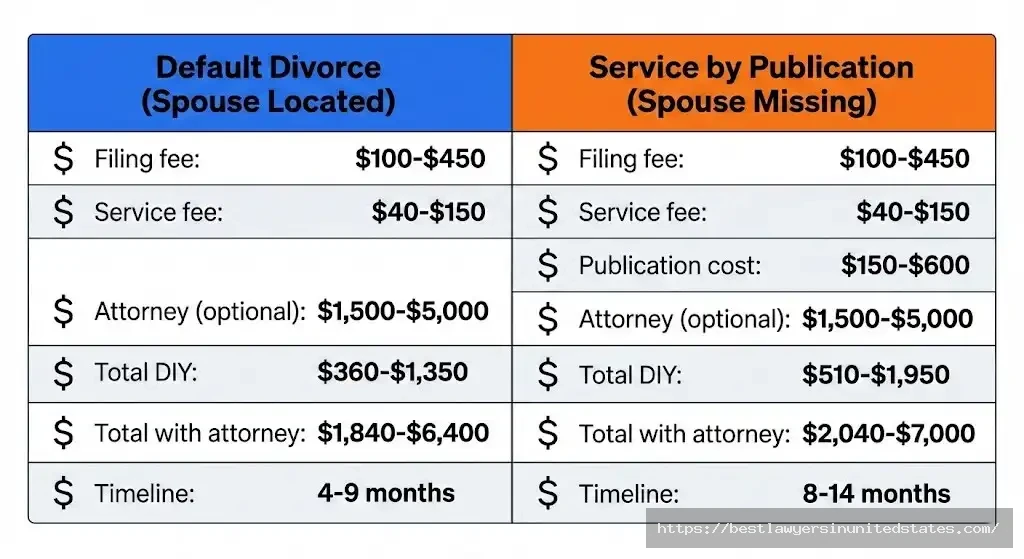
DIY Default Divorce Cost Breakdown
Handling default divorce yourself keeps costs under $2,000 in most states. You’ll pay court fees, service fees, and publication fees if needed.
Typical DIY costs:
| Cost Item | Amount | Notes |
|---|---|---|
| Filing fee | $100-$450 | Varies by state |
| Service fee | $40-$150 | Sheriff or process server |
| Publication (if needed) | $150-$600 | If spouse can’t be located |
| Copy fees | $20-$50 | Certified copies of decree |
| Miscellaneous | $50-$100 | Notary, postage, forms |
| Total DIY | $360-$1,350 | Without publication |
| Total with publication | $510-$1,950 | With publication |
Fee waivers reduce or eliminate filing fees for low-income filers. Most courts offer fee waiver applications. You’ll provide proof of income and expenses showing financial hardship.
Attorney-Assisted Default Divorce Costs
Hiring an attorney for default divorce costs $2,000-$7,000 depending on your state and case complexity. Attorneys handle all paperwork, service arrangements, and court appearances.
Attorney-assisted costs:
| Service | Cost | Details |
|---|---|---|
| Attorney fees | $1,500-$5,000 | Flat fee or hourly |
| Filing fee | $100-$450 | Court charges |
| Service fee | $40-$150 | Process server |
| Publication | $150-$600 | If needed |
| Miscellaneous | $50-$200 | Copies, postage |
| Total | $1,840-$6,400 | Complete cost |
Flat fee arrangements work best for default divorces. Many attorneys charge $2,500-$3,500 flat fee including all costs. This gives you certainty about total expenses.
Hourly billing costs $200-$400 per hour depending on your location. Default divorce might need 5-15 attorney hours. Smaller cities have lower rates than major metros.
Calculate Your Total Divorce Costs
Use our calculator to estimate costs based on your state, whether you’ll use an attorney, and if you need service by publication. Get personalized cost estimates with money-saving tips.
Questions about divorce costs or need attorney referrals? Contact us for guidance.
Email: [email protected]
Comparing Divorce Costs by Type
Understanding cost differences helps you budget and make decisions. Default divorce sits between cooperative uncontested and fully contested divorce.
Complete cost comparison:
| Divorce Type | DIY Cost | Attorney Cost | Timeline |
|---|---|---|---|
| Uncontested (both sign) | $500-$1,500 | $1,500-$3,000 | 2-6 months |
| Default (won’t sign) | $1,000-$2,500 | $2,000-$5,000 | 4-9 months |
| Contested (disputed) | $5,000-$15,000 | $15,000-$50,000 | 12-24+ months |
Default divorce costs 50-100% more than cooperative divorce but 70-90% less than contested divorce. The extra costs buy you freedom from an uncooperative spouse.
Publication adds $150-$600 to any divorce type. This one-time cost applies when you cannot locate your spouse for service.
Visit our complete divorce cost guide for detailed state-by-state breakdowns including all divorce types.
Timeline: How Long Does Divorce Take Without Signature?

Standard Divorce Timelines for Comparison
Cooperative divorces move fastest. Both parties sign agreements quickly and courts process uncontested cases on priority schedules.
Standard divorce timelines:
Uncontested with cooperation:
- File petition: Day 1
- Serve spouse: Days 2-7
- Spouse signs agreement: Days 10-30
- Court processes: 30-90 days
- Total: 2-6 months
Contested with disputes:
- File petition: Day 1
- Serve spouse: Days 2-7
- Spouse files response: Days 20-30
- Discovery period: 3-9 months
- Settlement negotiations: 3-12 months
- Trial (if no settlement): 12-24 months
- Total: 12-24+ months
These timelines don’t include mandatory waiting periods. Some states add 6-18 months regardless of cooperation level.
Default Divorce Timeline
Default divorce adds 2-4 months compared to cooperative uncontested divorce. Extra time comes from mandatory response periods and default hearing scheduling.
Complete default divorce timeline:
| Stage | Time | Details |
|---|---|---|
| File petition | Day 1 | Submit documents to court |
| Serve spouse | Days 2-7 | Sheriff or process server delivers |
| Response period | 20-30 days | Spouse has time to respond |
| File for default | Day 30-40 | After response period expires |
| Default hearing scheduled | 30-60 days | Court sets hearing date |
| Default hearing | Day 90-130 | 10-15 minute hearing |
| Decree issued | 7-30 days | After hearing |
| Total | 4-9 months | Without publication |
State mandatory waiting periods extend these timelines. California adds 6 months from service date. Texas adds 60 days from filing date. New York has no waiting period.
Service by Publication Timeline
Service by publication adds 3-6 months to standard divorce timelines. The process includes diligent search period, court approval time, publication period, and extended response deadline.
Publication process timeline:
| Stage | Time | Cumulative |
|---|---|---|
| Diligent search | 1-2 months | Months 1-2 |
| File motion for publication | 1 day | Month 2 |
| Court reviews motion | 2-4 weeks | Month 2-3 |
| Publication period | 3-6 weeks | Month 3-4 |
| Response period | 30-60 days | Month 4-6 |
| Default hearing | 30-60 days | Month 5-7 |
| Decree issued | 7-30 days | Month 6-8 |
| Total added time | 5-8 months | Beyond filing |
Combined with standard divorce timeline and state waiting periods, divorce by publication takes 8-14 months total. This assumes no complications or court backlogs.
Georgia takes longer due to 60-day waiting period after publication. California’s 6-month mandatory period applies regardless of publication timeline.
State-Specific Waiting Periods
Many states impose mandatory waiting periods between filing and finalization. These “cooling off” periods apply to all divorces, including default cases.
Waiting periods by state:
| State | Waiting Period | When It Starts |
|---|---|---|
| California | 6 months | Date of service |
| Texas | 60 days | Date of filing |
| Florida | 20 days | Date of filing |
| Illinois | 30 days | Date of filing |
| New York | None | N/A |
| Ohio | 30 days | Date of filing |
| Pennsylvania | 90 days | Date of filing (if uncontested) |
| Michigan | 60 days | Date of filing (no kids) |
| Virginia | None | N/A (if separated 1 year) |
| Washington | 90 days | Date of filing |
Some states like North Carolina require 1-year separation before filing. This adds 12 months before you can even start the process.
Waiting periods serve different purposes. Some aim to prevent impulsive divorces. Others give spouses time to reach agreements. Courts cannot waive most mandatory periods.
Special Situations When Spouse Won’t Sign
Military Spouse Won’t Sign
Active duty military spouses receive special protections under the Servicemembers Civil Relief Act (SCRA). These protections can delay or complicate your divorce.
SCRA protections include:
- Automatic stay of proceedings during active deployment
- Extended response periods (90 days instead of 30)
- Right to postpone court hearings
- Protection against default judgment during service
- Ability to reopen default judgments within 90 days
You must provide court with military status affidavit proving your spouse is or isn’t active duty. Courts can verify status through Defense Department databases.
If your spouse is deployed, courts often delay proceedings until they return. This prevents unfair default judgments when spouse cannot respond due to military duty.
Some states have additional protections for military families. California extends SCRA protections. Texas allows abbreviated procedures if spouse consents despite deployment.
Spouse in Prison
Divorcing an incarcerated spouse follows standard default procedures with special service requirements. You can serve papers to the prison where your spouse is housed.
Prison divorce procedures:
- Serve papers through prison mail system or in-person at facility
- Provide prison address as spouse’s current address
- Follow prison visitation and mail rules for service
- Expect response delays due to prison mail processing
- Court may appoint attorney for indigent imprisoned spouse
Incarceration alone doesn’t constitute abandonment. But long sentences combined with no contact may support abandonment grounds in some states.
Imprisoned spouses have the same rights as free spouses. Courts don’t grant divorces more easily just because someone is incarcerated. Your proposed terms must still be fair.
Spouse in Another Country
International service of divorce papers follows Hague Service Convention rules if the country is a member. Non-Hague countries have bilateral agreements or allow service through consulates.
International service options:
- Hague Convention service through central authority
- Service through U.S. consulate in spouse’s country
- Service by publication if location unknown
- Private process server in foreign country (if allowed)
International service costs $200-$1,000 depending on country and method. Translation requirements add expense. Some countries refuse to serve papers for religious or cultural reasons.
U.S. courts have jurisdiction for divorce if either spouse meets state residency requirements. Your spouse’s foreign residence doesn’t prevent your divorce. It just complicates service procedures.
Allow 6-12 months extra for international service. Service by publication becomes attractive option when foreign service is prohibitively expensive or impossible.
Spouse with Mental Incapacity
Divorcing someone with mental incapacity requires special court procedures. Courts appoint a guardian ad litem to protect the incompetent spouse’s interests.
Mental incapacity procedures:
- File petition explaining spouse’s condition
- Provide medical documentation of incapacity
- Court appoints guardian ad litem
- Guardian reviews proposed settlement
- Guardian represents spouse’s interests at hearing
- Court ensures settlement is fair given circumstances
Guardian ad litem fees range from $1,000-$5,000 and you usually pay these costs. Courts ensure incompetent spouses don’t lose rights due to inability to participate.
Mental incapacity doesn’t prevent divorce. But courts scrutinize settlements carefully. Judges protect vulnerable parties from unfair agreements.
Dementia, severe mental illness, intellectual disability, and traumatic brain injury cases all require guardian ad litem appointment. Temporary incapacity like coma may delay proceedings until recovery.
What Happens After Default Judgment
Finalizing Your Default Divorce
After winning default judgment, you receive a signed divorce decree from the judge. This legal document officially ends your marriage and outlines all terms.
Default hearing process:
Courts schedule brief hearings for default divorces. Most last 10-15 minutes. You testify under oath about basic facts.
Questions judge typically asks:
- Do you meet residency requirements?
- When and where did you marry?
- Are there minor children?
- Did you properly serve your spouse?
- Is your spouse in military service?
- Are the proposed terms fair and reasonable?
- Do you understand the settlement terms?
- Do you want this divorce?
Bring copies of all filed documents, proof of service, and any supporting evidence. Dress professionally. Answer questions directly and honestly.
The judge reviews your proposed settlement. They verify property division follows state law, child support meets guidelines, and custody arrangements serve children’s best interests.
Most judges sign decrees immediately or within days. Court clerks mail certified copies within 2-4 weeks. You’re officially divorced when the judge signs, not when you receive copies.
Obtaining Certified Copies
Get multiple certified copies of your divorce decree. You’ll need these to change your name, divide retirement accounts, transfer property, and update records.
Certified copies needed for:
- Social Security Administration (name change)
- DMV (name change on license)
- Passport office (name change)
- Banks and credit cards (name change, account changes)
- Employer (benefits, payroll, insurance)
- Retirement plan administrators (QDRO)
- Real estate transactions (property transfers)
- Court (enforcement actions if needed)
Order 5-10 certified copies initially. Additional copies cost $10-$25 each depending on your state. Ordering extras upfront saves time later.
Keep original certified copies in a safe place. Use photocopies for routine purposes. Some agencies require original certified copies while others accept photocopies.
Post-Divorce Actions
Several administrative tasks follow your divorce. Complete these promptly to avoid complications.
Name change procedures:
If you’re resuming maiden name, update documents in this order:
- Social Security Administration (get new Social Security card)
- DMV (new driver’s license)
- Passport (if applicable)
- Bank accounts
- Credit cards
- Insurance policies
- Employer payroll
- Voter registration
- Medical records
- Utility bills
Bring certified divorce decree to each agency. Most allow name changes based solely on the decree without additional court orders.
Property transfer procedures:
Real estate transfers require quit claim deed or warranty deed. Record the deed with county recorder’s office. Include divorce decree and signed deed.
Vehicle titles transfer at DMV. Bring decree, title, and transfer paperwork. Some states require court order specifically describing vehicle transfer.
Retirement account division:
401(k), IRA, and pension divisions need Qualified Domestic Relations Orders (QDROs). These court orders instruct plan administrators how to divide retirement accounts.
Hire attorney or QDRO specialist to draft these documents. Costs range from $500-$2,000 per account. Missing QDRO deadlines can forfeit your share of retirement assets.
Frequently Asked Questions
Can my spouse prevent my divorce by not signing papers?
Quick Answer: No. Your spouse can delay the process but cannot prevent divorce. After proper service and waiting periods, courts grant default divorces without your spouse’s signature.
All 50 states allow no-fault divorce based on one spouse’s decision. Your spouse’s consent is not required. The judge’s signature is the only one that legally matters.
How long can a spouse delay divorce by not responding?
Quick Answer: Typically 3-6 months beyond standard divorce timeline. Response periods (20-30 days), default hearing scheduling (30-60 days), and publication requirements (if needed) add time.
Your spouse cannot delay indefinitely. Once response periods expire, courts proceed with default judgment. Mandatory state waiting periods apply regardless of cooperation.
Do I need my spouse’s permission to get divorced?
Quick Answer: No. All U.S. states allow no-fault divorce, meaning one spouse’s decision to divorce is sufficient without the other’s permission or consent.
No-fault divorce laws mean marriage is not a permanent trap. You can file based on irreconcilable differences without proving fault. Courts grant divorces to any spouse who requests one.
Can I get divorced without my spouse knowing?
Quick Answer: No. You must legally serve your spouse with divorce papers, giving them notice. Service by publication is required if you cannot locate them.
Due process requires notice before court proceedings affect someone’s rights. “Surprise” divorces don’t exist legally. You must make genuine efforts to notify your spouse.
What if my spouse is hiding to avoid being served?
Quick Answer: Request alternative service methods including service by publication. Document your efforts to locate them, then ask court permission to serve by publication in a newspaper.
Courts allow alternative service after you prove diligent search efforts. Evading service doesn’t help your spouse. It just switches you to publication method.
How much does divorce by publication cost?
Quick Answer: $250-$1,000+ total including newspaper publication ($150-$600) plus court filing fees ($100-$435) depending on your state.
Publication costs vary by newspaper circulation and state requirements. Major city newspapers charge more. Your county clerk can provide a list of approved newspapers with pricing.
Can I get divorced if I don’t know where my spouse is?
Quick Answer: Yes, through service by publication after documenting diligent search efforts. Courts allow constructive service when spouse’s location is genuinely unknown.
You must prove you made reasonable efforts to find your spouse. Contact family, check public records, search online databases. Document everything for your affidavit.
What happens if my spouse never responds to divorce papers?
Quick Answer: The court proceeds with default divorce. Your proposed terms typically become the final judgment after a brief default hearing where you testify.
Non-response means your spouse accepts your proposed settlement. Courts review terms for fairness but generally approve reasonable settlements in default cases.
Is a default divorce still uncontested?
Quick Answer: Yes, if your spouse doesn’t file opposition. No response equals no contest. Default divorces are uncontested divorces with non-participating spouse.
Contested means both parties file competing documents with court. Default means one party doesn’t respond at all. Costs and complexity stay lower than truly contested cases.
Do I need a lawyer for default divorce?
Quick Answer: Not always. Many people handle default divorces themselves using court forms, especially without children or significant assets. Complex cases need attorneys.
Simple default divorces with limited property and no children work for DIY approach. Cases involving custody, substantial assets, businesses, or retirement accounts should involve attorneys. Attorney fees range from $1,500-$5,000 for default cases.
How do I file for divorce if my spouse won’t cooperate?
Quick Answer: File petition, serve spouse properly, wait for response period to expire, then request default judgment. Court grants divorce at default hearing.
Follow standard divorce procedures. Your spouse’s cooperation is helpful but not required. Default procedures exist specifically for uncooperative spouses.
Can I get divorced in California without my spouse’s signature?
Quick Answer: Yes. California allows no-fault divorce. After service, your spouse has 30 days to respond. Default divorce proceeds if no response filed. California requires 6-month waiting period regardless.
California’s 6-month waiting period from service date applies to all divorces. This means minimum timeline is 6 months even if your spouse doesn’t respond.
What if my spouse refuses to sign divorce papers in Texas?
Quick Answer: File for divorce, serve your spouse, wait 20 days plus next Monday for response. If no response, request default judgment. Texas requires 60-day minimum waiting period from filing.
Texas has 60-day cooling off period from filing date. No divorce can be finalized faster than 60 days regardless of cooperation.
How long does service by publication take?
Quick Answer: 3-6 months additional time including diligent search (1-2 months), publication period (3-6 weeks), and response period (30-60 days after final publication).
Publication timeline varies by state. Some require 3 weekly publications, others require 4. Response periods range from 30-60 days after final publication.
Can I use our divorce cost calculator if my spouse won’t sign?
Quick Answer: Yes. Our calculator estimates default divorce costs including service fees, publication costs (if needed), filing fees, and optional attorney costs based on your state.
The calculator helps you budget for all scenarios. Select “uncooperative spouse” option to see cost estimates for default divorce and service by publication.
Legal Disclaimer
This article provides general information about divorce without spouse signature. It is not legal advice. Laws vary significantly by state and individual circumstances.
Consult a licensed attorney in your state for advice about your specific situation. Statutes, court procedures, and requirements change periodically. Verify current law before making decisions.
State bar associations offer referral services connecting you with family law attorneys. Many attorneys offer free consultations. Legal aid organizations help low-income individuals with family law matters.
Conclusion
Getting a divorce without your spouse’s signature is possible in every U.S. state. Your spouse cannot prevent your divorce by refusing to sign papers. They can only delay the process by several months.
No-fault divorce laws mean one spouse’s decision to divorce is sufficient. Courts grant default divorces after proper service and waiting periods expire. Your spouse’s consent is not legally required.
The process takes longer and costs more than cooperative divorce. Service by publication adds 3-6 months if you cannot locate your spouse. Default divorce costs $1,000-$5,000 compared to $500-$3,000 for fully cooperative cases.
But the outcome is the same: a legally valid divorce decree ending your marriage. No one can force you to stay married against your will.
Take action by consulting a divorce attorney in your state. Many offer free initial consultations. Understand your state’s specific requirements and timeline. Begin the process with confidence knowing your spouse’s signature is not required.
Use our resources to estimate costs, understand procedures, and find qualified attorneys. Your new life begins with filing that first petition.
Additional Resources
Interactive Calculators:
- Divorce Cost Calculator – Estimate total costs by state and divorce type
- DUI Cost Calculator – Estimate DUI legal costs
- BAC Calculator – Blood alcohol content estimator
Divorce Process Guides:
- Complete Divorce Process Guide – Step-by-step divorce procedures
- How Long Does Divorce Take? – State timelines
- Contested vs Uncontested Divorce – Comparison guide
- How to File for Divorce – Filing instructions
Cost Information:
- How Much Does Divorce Cost? – Complete cost guide
- Divorce Filing Fees by State – State fee schedules
- Divorce Attorney Fees – Attorney cost guide
- Uncontested Divorce Cost – Uncontested divorce expenses
- Contested Divorce Cost – Contested divorce expenses
DIY Divorce:
- DIY Divorce State-by-State Guide – Instructions for all 50 states
State-Specific Guides:
Contact Information: Email: [email protected]
Website: https://bestlawyersinunitedstates.com