
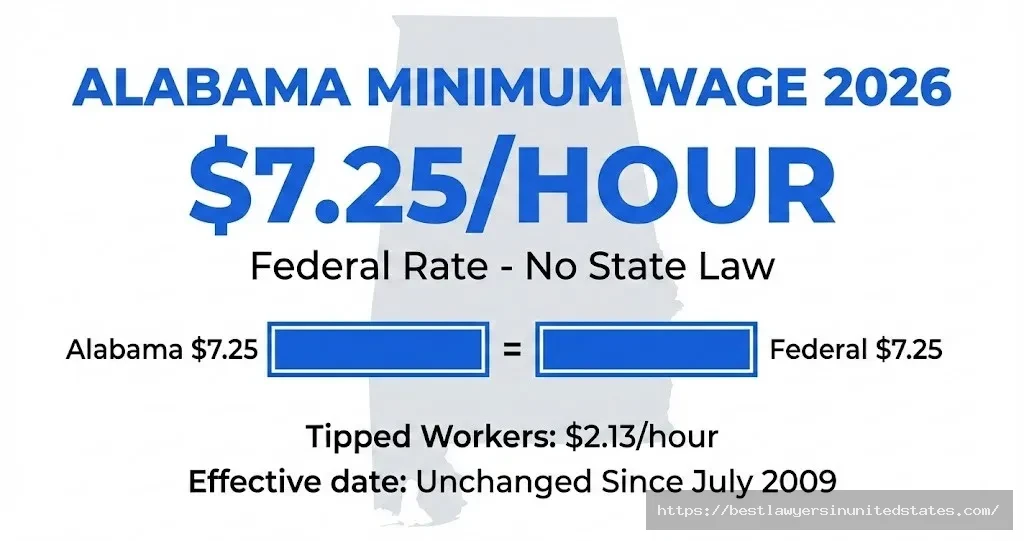
Alabama’s minimum wage is $7.25 per hour in 2026, matching the federal minimum wage. Unlike most states, Alabama has no state minimum wage law and relies entirely on federal standards under the Fair Labor Standards Act (FLSA). This means workers in Birmingham, Mobile, Huntsville, and Montgomery all earn the same federal rate with no scheduled increases.
The state hasn’t raised its minimum wage since 2009 when the federal government last increased it. Alabama is one of only five states without its own minimum wage legislation. When cities like Birmingham tried to establish higher local wages in 2016, the state legislature blocked those efforts through preemption laws.
This guide covers everything Alabama workers need to know about minimum wage in 2026, including tipped employee rules, overtime calculations, and what to do if you’re not being paid properly.
Calculate Your Earnings in Alabama
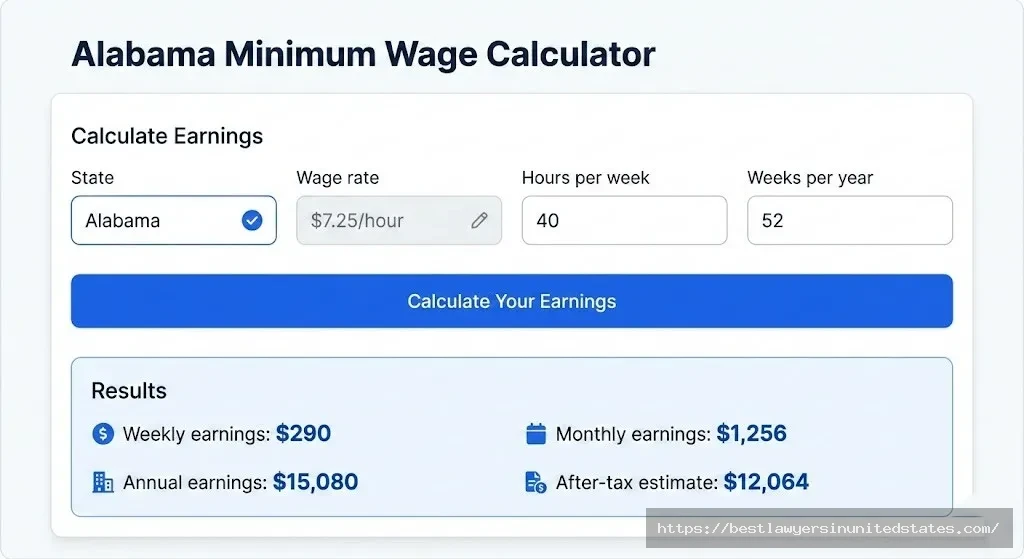
Want to know exactly how much you’ll earn at Alabama’s $7.25 minimum wage? Use our free calculator to estimate your weekly, monthly, and annual income based on your hours worked.
💰 Minimum Wage Earnings Calculator
Calculate your weekly, monthly, and annual earnings with overtime and tax estimates
📊 Your Earnings Breakdown
💰 Gross Earnings
Calculator features:
- Automatic Alabama wage rates for 2026
- Weekly, monthly, and annual earnings
- Overtime calculations
- Tax withholding estimates
- Take-home pay breakdown
Full calculator with all features: Calculate your minimum wage earnings
Questions about your wages or need legal help?
Email: [email protected]
What Is the Alabama Minimum Wage in 2026?
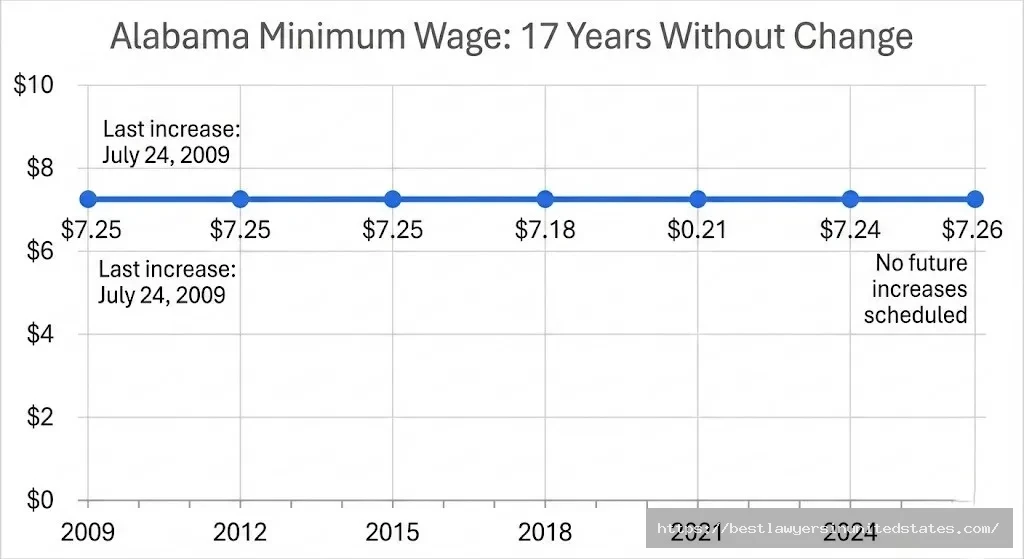
Alabama's minimum wage remains $7.25 per hour in 2026. This rate hasn't changed since July 24, 2009, when the federal government enacted the last federal minimum wage increase. Workers earning minimum wage in Alabama make approximately $15,080 per year before taxes if working full-time (40 hours per week, 52 weeks per year).
The state has no minimum wage law of its own. All Alabama workers fall under federal protection through the Fair Labor Standards Act (FLSA). This means the U.S. Department of Labor handles wage enforcement, not a state agency.
Alabama vs Federal Minimum Wage Breakdown
| Jurisdiction | Minimum Wage | Last Increase | Next Scheduled Increase |
|---|---|---|---|
| Alabama | $7.25/hour | July 2009 | None scheduled |
| Federal | $7.25/hour | July 2009 | None scheduled |
| Difference | $0.00 | Same | Same |
How Alabama Earnings Compare to Other States
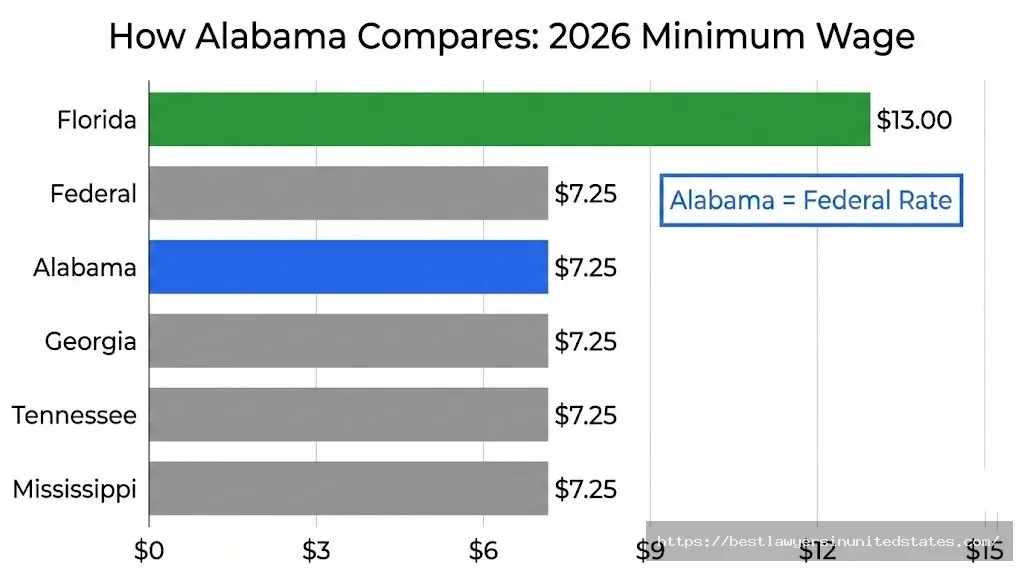
Alabama's $7.25 minimum wage places it among the lowest-paying states in the country. Here's how Alabama compares to neighboring states in 2026:
| State | Minimum Wage | Annual Earnings (Full-Time) | Difference from Alabama |
|---|---|---|---|
| Alabama | $7.25/hour | $15,080 | Baseline |
| Florida | $13.00/hour | $27,040 | +$11,960/year |
| Georgia | $7.25/hour* | $15,080 | $0 |
| Tennessee | $7.25/hour | $15,080 | $0 |
| Mississippi | $7.25/hour | $15,080 | $0 |
*Georgia's lower statutory rate of $5.15 doesn't apply to most workers covered by FLSA.
Key fact: A full-time Alabama minimum wage worker earns about $1,256 per month before taxes and deductions.
Why Alabama Has No State Minimum Wage Law
Alabama is one of only five states without its own minimum wage legislation. The others are Louisiana, Mississippi, South Carolina, and Tennessee. This unique situation means Alabama workers depend entirely on federal law for wage protections.
What Happened to Birmingham's $10.10 Minimum Wage?
In February 2016, the Birmingham City Council passed an ordinance to raise the city's minimum wage to $10.10 per hour. The increase was scheduled to take effect in phases, eventually reaching $10.10 by July 2017.
The Alabama Legislature responded within weeks by passing House Bill 174, a preemption law that banned all cities and counties from setting their own minimum wages. Governor Robert Bentley signed the bill on February 25, 2016, immediately blocking Birmingham's ordinance.
Timeline of events:
- February 2016: Birmingham passes $10.10 minimum wage ordinance
- February 25, 2016: Alabama Legislature passes HB 174 preemption law
- February 25, 2016: Governor signs law, blocking all local wage ordinances
- 2016-Present: No Alabama city can set minimum wage above federal level
This political conflict highlighted Alabama's resistance to minimum wage increases. Workers facing legal disputes about workplace pay have limited options under state law.
Will Alabama's Minimum Wage Increase in 2026?
No increases are scheduled for 2026 or any future year. Alabama has no automatic cost-of-living adjustments like states such as California, Washington, or Oregon. Any wage increase would require federal action since the state legislature has shown no interest in establishing state-level wage laws.
The federal minimum wage has remained at $7.25 since 2009, making it 17 years without an increase by 2026.
Alabama Tipped Minimum Wage for Servers and Bartenders
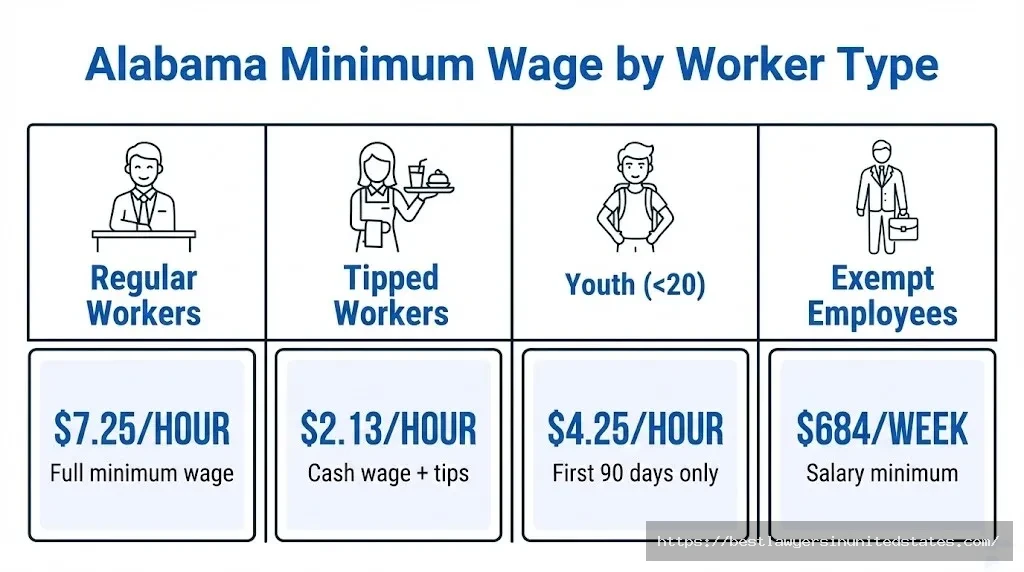
Tipped employees in Alabama can be paid as little as $2.13 per hour in direct wages. This is the federal tipped minimum wage, and Alabama follows it exactly since the state has no separate tipped wage law.
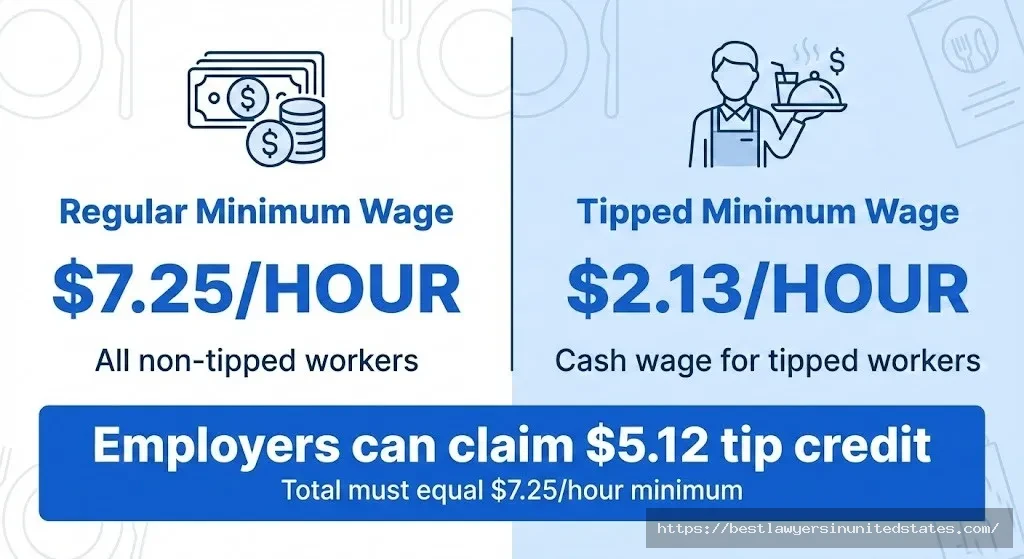
Employers can claim a tip credit of up to $5.12 per hour. This means if an employee's tips combined with the $2.13 cash wage don't equal $7.25 per hour, the employer must make up the difference.
How the Tip Credit Works
Here's a real example of how tip credits work in Alabama:
Scenario: You work as a server at a restaurant in Huntsville for 40 hours in one week.
Your wages:
- Cash wage from employer: $2.13/hour × 40 hours = $85.20
- Tips earned: $200
- Total compensation: $285.20
- Average hourly rate: $285.20 ÷ 40 = $7.13/hour
Problem: Your average hourly rate ($7.13) is below minimum wage ($7.25).
Employer's obligation: Must pay you an additional $4.80 to bring you up to minimum wage.
Tipped Employee Rights in Alabama
| Right | What It Means |
|---|---|
| Minimum guarantee | Must earn at least $7.25/hour (cash wages + tips combined) |
| Employer make-up pay | Employer pays difference if tips don't cover minimum wage |
| Tip ownership | You keep 100% of your tips |
| Tip pooling | Legal among service staff (not managers) |
| Notice requirement | Employer must inform you of tip credit system |
What to Do If Your Tips Don't Cover Minimum Wage
If your employer claims a tip credit but you consistently earn less than $7.25 per hour after combining wages and tips, you may have a wage theft claim. Many servers and bartenders don't realize their employer must track their tips and ensure they meet minimum wage thresholds.
Alabama tipped workers earning less than minimum wage should document their hours and tips carefully. Tools like our wage theft calculator can help you determine if you're owed back wages.
Important deadline: Under the FLSA, you typically have 2-3 years to file a wage claim depending on whether the violation was willful. Missing this deadline means losing your right to recovery, as explained in what happens when you miss the FLSA deadline.
Alabama Overtime Laws and Rates
Alabama follows federal overtime laws under the Fair Labor Standards Act. Workers must receive time-and-a-half pay (1.5 times their regular rate) for all hours worked over 40 in a workweek.
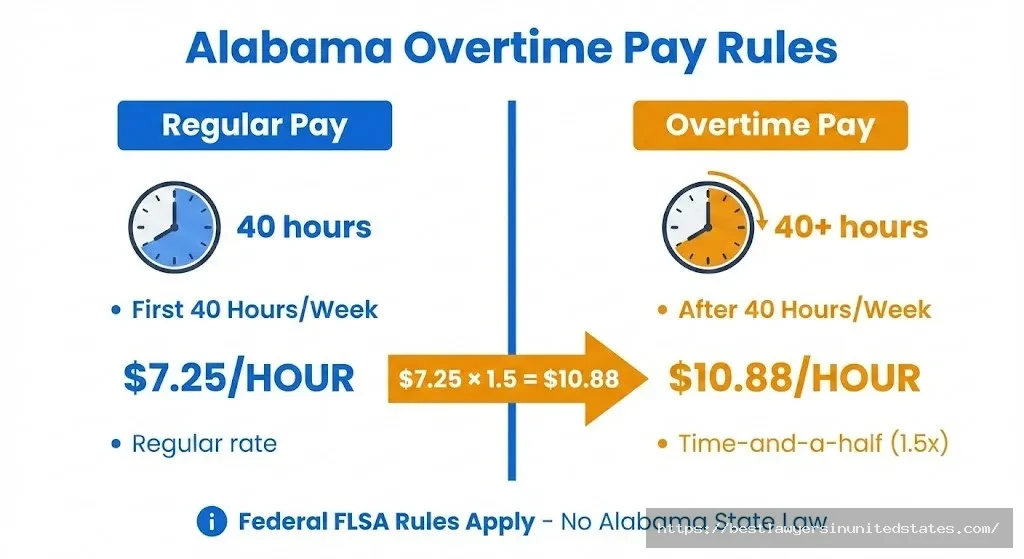
For minimum wage workers, the overtime rate is:
- Regular rate: $7.25/hour
- Overtime rate: $10.88/hour ($7.25 × 1.5)
Calculate Your Overtime Pay in Alabama
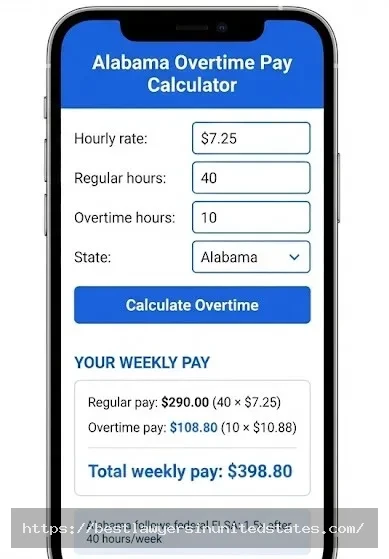
Working more than 40 hours per week? Calculate your overtime earnings based on Alabama's overtime laws. This calculator accounts for weekly overtime rules and shows your total pay including overtime premiums.
⏰ Overtime Pay Calculator
Calculate your overtime earnings based on your state's specific labor laws
📍 Select Your State
💰 Your Hourly Wage
📊 Calculation Method
📅 Weekly Hours
💵 Your Weekly Overtime Pay
📊 Earnings Breakdown
📅 Pay Period Estimates
⚖️ State vs Federal Comparison
Calculator features:
- Alabama-specific overtime rules
- Weekly overtime calculations
- Pay period breakdowns
- Comparison with regular pay
- Total earnings estimate
Full overtime calculator: Calculate your overtime pay
Questions about your wages or need legal help?
Email: [email protected]
Alabama Overtime Rules You Need to Know
Alabama does not have:
- Daily overtime requirements (no overtime for working more than 8 hours in one day)
- Double-time pay requirements
- State-specific overtime thresholds
Alabama follows federal rules:
- Overtime kicks in after 40 hours in a 7-day workweek
- Workweek is any consecutive 7-day period
- Each workweek stands alone (you can't average hours across weeks)
Who Is Exempt from Overtime in Alabama?
Not all workers qualify for overtime pay. The FLSA creates several exemptions based on job duties and salary levels. Understanding these exemptions helps workers know their rights.
White Collar Exemptions
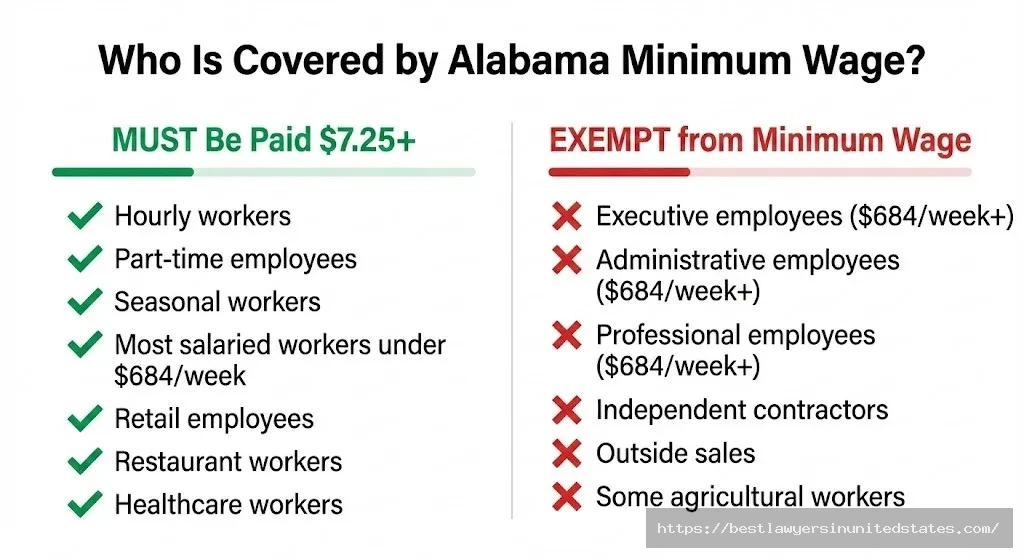
To be exempt from overtime, an employee generally must meet all three tests:
| Test Type | Requirement |
|---|---|
| Salary basis | Paid on a salary, not hourly |
| Salary level | At least $684 per week ($35,568/year) |
| Duties test | Primary duties must be executive, administrative, or professional |
Common exempt positions:
- Executive employees (managers who supervise 2+ people)
- Administrative employees (office work requiring independent judgment)
- Professional employees (doctors, lawyers, teachers, engineers)
- Computer employees (earning at least $27.63/hour or $684/week)
- Outside sales employees
Common Overtime Violations in Alabama
Many Alabama employers misclassify workers as exempt to avoid paying overtime. These violations are common:
1. The "Manager" Title Trick
- Giving someone a manager title doesn't make them exempt
- Must actually manage other employees and have hiring/firing authority
- Many "assistant managers" qualify for overtime
2. Salary Misclassification
- Paying someone a salary below $684/week doesn't make them exempt
- Low-paid salaried workers often qualify for overtime
3. Off-the-Clock Work
- Requiring work before clocking in or after clocking out
- Mandatory training time must be paid
- Work-related travel time often counts as hours worked
4. Averaging Hours Across Weeks
- Working 50 hours one week and 30 the next doesn't average out
- Each week must be calculated separately
If you believe you're misclassified or denied overtime pay, you can file a complaint with the U.S. Department of Labor Wage and Hour Division or contact an employment attorney who handles discrimination and wage cases.
Alabama Minimum Wage by City
Alabama law prohibits cities and counties from establishing their own minimum wages. Every worker in Alabama earns the same $7.25 federal minimum wage regardless of location.
Birmingham Minimum Wage
Birmingham's minimum wage is $7.25 per hour in 2026. The city attempted to establish a $10.10 minimum wage in 2016, but the Alabama Legislature blocked it through preemption legislation.
Birmingham economic context:
- Population: ~200,000 (metro area ~1.1 million)
- Cost of living: Below national average
- Major employers: Healthcare, banking, education
- Living wage estimate: $14-16/hour for single adult
Despite Birmingham's higher cost of living compared to rural Alabama, the federal minimum wage applies throughout Jefferson County.
Mobile Minimum Wage
Mobile's minimum wage is $7.25 per hour in 2026. As Alabama's only saltwater port, Mobile has a diverse economy but cannot set wages above the federal floor.
Mobile economic context:
- Population: ~187,000
- Major industries: Shipping, aerospace, manufacturing
- Cost of living: Slightly below national average
- Living wage estimate: $13-15/hour for single adult
Huntsville Minimum Wage
Huntsville's minimum wage is $7.25 per hour in 2026. Despite having one of Alabama's highest median incomes due to aerospace and defense industries, the city cannot establish its own minimum wage.
Huntsville economic context:
- Population: ~215,000 (fastest-growing Alabama city)
- Major employers: NASA, defense contractors, tech companies
- Cost of living: Near national average
- Median household income: Higher than state average
- Many jobs pay well above minimum wage
Montgomery Minimum Wage
Montgomery's minimum wage is $7.25 per hour in 2026. As Alabama's capital, Montgomery has significant government employment but follows the same federal wage floor.
Montgomery economic context:
- Population: ~200,000
- Major employers: State government, Air Force, healthcare
- Cost of living: Below national average
- Living wage estimate: $13-15/hour for single adult
Cost of Living Comparison Across Alabama Cities
| City | Minimum Wage | Estimated Living Wage (Single Adult) | Gap |
|---|---|---|---|
| Birmingham | $7.25/hour | $14-16/hour | -$6.75 to -$8.75 |
| Mobile | $7.25/hour | $13-15/hour | -$5.75 to -$7.75 |
| Huntsville | $7.25/hour | $14-16/hour | -$6.75 to -$8.75 |
| Montgomery | $7.25/hour | $13-15/hour | -$5.75 to -$7.75 |
The gap between minimum wage and living wage exists in every Alabama city. Workers can use our minimum wage calculator to see exactly how their earnings compare to their expenses.
Alabama Minimum Wage Exemptions and Special Cases
Several categories of workers in Alabama may be paid less than $7.25 per hour or are exempt from minimum wage requirements entirely. These exemptions come from federal law since Alabama has no state wage law.
Youth and Training Wages
Federal youth minimum wage: $4.25 per hour
Who qualifies:
- Workers under age 20
- First 90 consecutive calendar days of employment
- Applies to any employer, any industry
After 90 days: Must receive full minimum wage of $7.25/hour
Important: Employers cannot fire workers before 90 days to hire new workers at the youth wage. This is illegal under the FLSA.
Full-Time Students
Full-time students working in retail, service, agriculture, or colleges can be paid 85% of minimum wage ($6.16/hour) under special certificates from the Department of Labor.
Requirements:
- Student must be enrolled full-time
- Employer must obtain certification
- Limited to 8 hours per day, 20 hours per week during school
- No more than 40 hours per week during breaks
Workers with Disabilities
Employers with special certificates from the DOL can pay workers with disabilities less than minimum wage if the disability impairs their productivity. This is controversial and subject to reform efforts.
Other Exemptions
Independent contractors: Not covered by minimum wage laws
- Must meet strict IRS tests for independent contractor status
- Many workers are misclassified to avoid wage requirements
Agricultural workers: Special rules apply
- Small farm exemption exists
- Piece-rate pay allowed in some cases
Seasonal recreation workers: Limited exemption
- Must work at seasonal amusement or recreational establishments
Small business exemption: Businesses with less than $500,000 in annual revenue may be exempt
- Exception: Employees involved in interstate commerce still covered
- Most workers are covered even if employer is small
Understanding what employees should look for in employment agreements can help workers identify misclassification issues.
Wage Theft in Alabama: Know Your Rights
Wage theft occurs when employers fail to pay workers the full wages they've earned. It's one of the most common workplace violations in Alabama and across the country. Common forms include unpaid overtime, off-the-clock work, illegal tip deductions, and paying below minimum wage.
Alabama workers who experience wage theft must file complaints with the federal Department of Labor since the state has no wage enforcement agency. The good news is federal law provides strong protections and penalties for wage theft violations.
What Counts as Wage Theft?
Common wage theft violations:
- Not paying minimum wage ($7.25/hour in Alabama)
- Not paying overtime (time-and-a-half after 40 hours)
- Requiring off-the-clock work
- Making illegal deductions from paychecks
- Not paying tipped employees when tips don't reach minimum wage
- Stealing or withholding tips
- Misclassifying employees as independent contractors
- Misclassifying employees as exempt from overtime
Calculate Your Wage Theft Recovery in Alabama
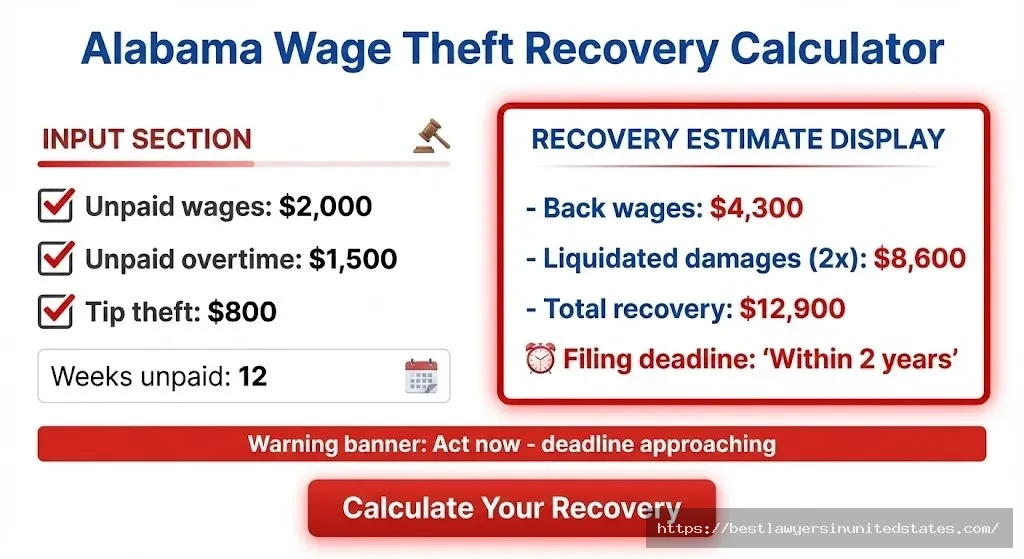
Think your employer owes you money? Use our wage theft calculator to estimate how much you could recover, including unpaid wages, penalties, and interest under federal law.
Wage Theft Recovery Calculator
Estimate how much you can recover in unpaid wages, penalties, and damages based on your state's laws
💵 Estimated Total Recovery
💰 Unpaid Wages
⚖️ Penalties & Damages
📋 Total Summary
Calculator features:
- Multiple violation types (unpaid wages, overtime, tips)
- Federal penalties and liquidated damages
- Filing deadline tracker
- Total recovery estimate
- Next steps guidance
Full wage theft calculator: Calculate your wage theft recovery
Questions about your wages or need legal help?
Email: [email protected]
How to File a Wage Complaint in Alabama
Since Alabama has no state Department of Labor, all wage complaints go to the federal Wage and Hour Division.
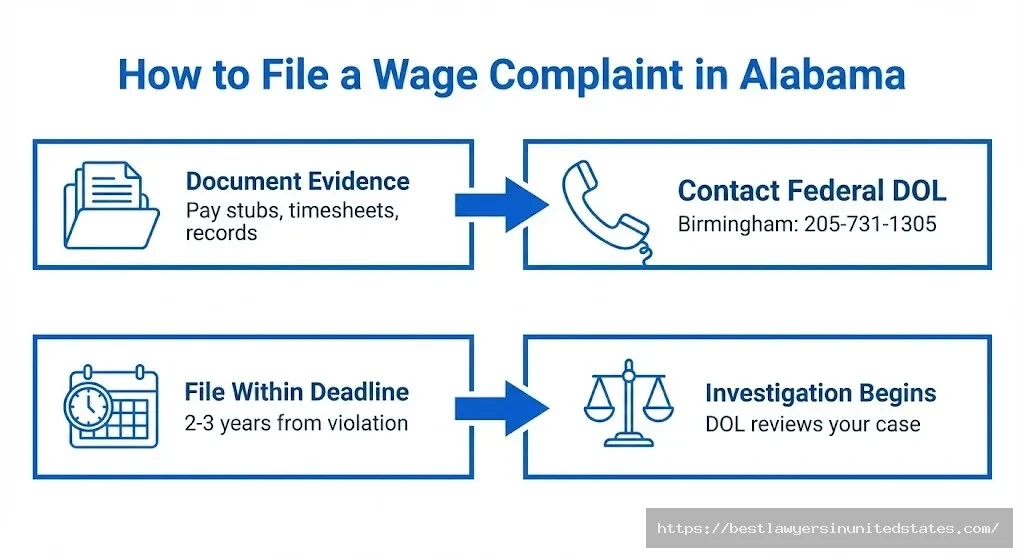
Step 1: Document everything
- Pay stubs showing all hours and wages
- Time records or personal time logs
- Written communications about pay
- Bank statements showing deposits
- Any employment contracts or handbooks
Step 2: Contact the U.S. Department of Labor
Wage and Hour Division Birmingham District Office:
- Address: 950 22nd Street North, Room 428, Birmingham, AL 35203
- Phone: 205-731-1305
- Online complaint: dol.gov/agencies/whd/contact/complaints
Step 3: File your complaint
- Can be filed online, by phone, or in person
- No cost to file
- Can file anonymously in some cases
- DOL will investigate employer
Step 4: Wait for investigation
- DOL investigates employer records
- May interview you and coworkers
- Process can take several months
- Employer cannot retaliate
Wage Theft Penalties and Recovery in Alabama
Federal law provides strong remedies for wage theft victims. Employers who violate the FLSA face significant penalties.
| Violation Type | Employee Recovery | Employer Penalty |
|---|---|---|
| Unpaid minimum wage | Full back pay | Liquidated damages (2× wages) |
| Unpaid overtime | Full back pay | Liquidated damages (2× wages) |
| Tip violations | Full tips owed | Liquidated damages (2× tips) |
| Retaliation | Job reinstatement + back pay | Additional damages |
| Willful violations | Back pay + damages | Up to $2,014 per violation |
| Repeat violations | Back pay + damages | Up to $4,028 per violation |
Liquidated damages mean you can recover double your unpaid wages. If you're owed $5,000 in unpaid overtime, you could recover $10,000 total.
Attorney fees: If you win, the employer must pay your attorney fees and court costs.
Statute of Limitations for Wage Claims
Time limits to file wage claims in Alabama:
- Regular violations: 2 years from violation date
- Willful violations: 3 years from violation date
"Willful" means: Employer knew or showed reckless disregard for whether conduct violated FLSA
Critical deadline: Don't wait to file. Each day that passes is one day closer to losing your claim rights. Workers sometimes face wage garnishment issues after unpaid wage disputes, making timely filing even more important.
Retaliation Protections
Your employer cannot fire, demote, reduce hours, or otherwise retaliate against you for:
- Filing a wage complaint
- Talking to DOL investigators
- Testifying in wage investigations
- Discussing wages with coworkers
- Asking questions about your pay
If your employer retaliates, you can file an additional complaint for retaliation. Retaliation claims have strong protections and penalties.
Living Wage vs Minimum Wage in Alabama
Alabama's $7.25 minimum wage falls far short of what most families need to cover basic expenses. The "living wage" is the hourly rate needed to meet basic needs like housing, food, healthcare, and transportation in a specific area.
What Is a Living Wage in Alabama?
Living wage varies by location and family size. A single adult in Birmingham needs more than someone in rural Alabama. A parent with children needs significantly more than a single adult.
Estimated living wages in Alabama (2026):
| Household Type | Living Wage (Hourly) | Annual Income Needed | Minimum Wage Gap |
|---|---|---|---|
| Single adult | $14.00 - $16.00 | $29,120 - $33,280 | -$6.75 to -$8.75 |
| Single adult + 1 child | $28.00 - $30.00 | $58,240 - $62,400 | -$20.75 to -$22.75 |
| 2 adults + 2 children | $20.00 - $22.00 per adult | $41,600 - $45,760 per adult | -$12.75 to -$14.75 |
| 2 working adults + 2 children | $16.00 - $18.00 per adult | $33,280 - $37,440 per adult | -$8.75 to -$10.75 |
Key findings:
- Minimum wage covers only about 45-52% of a single adult's living costs
- For families, the gap is even worse
- Two parents working full-time at minimum wage still fall short of family living wage
Alabama Minimum Wage vs Federal Poverty Line
The federal poverty line in 2026 is approximately $15,060 for a single person and $31,200 for a family of four.
Reality check:
- Full-time minimum wage in Alabama: $15,080/year
- Single person poverty line: $15,060/year
- Minimum wage barely keeps single worker above poverty line
- Family of four needs both parents working full-time just to reach poverty level
Cost of Living by Alabama City
Housing costs vary significantly across Alabama. Here's how minimum wage compares to average rent in major cities:
| City | Average 1BR Rent | Rent as % of Minimum Wage | Affordable Rent (30% of income)* |
|---|---|---|---|
| Birmingham | $900-1,100/month | 71-87% | $377/month |
| Mobile | $850-1,000/month | 67-79% | $377/month |
| Huntsville | $950-1,150/month | 75-91% | $377/month |
| Montgomery | $800-950/month | 63-75% | $377/month |
*Based on $7.25/hour, 40 hours/week = $1,256/month gross income. Affordable rent = 30% of gross income.
The housing crisis: Financial experts recommend spending no more than 30% of income on housing. At minimum wage, that's just $377 per month. No Alabama city has average rents that low.
What Can You Do If Minimum Wage Isn't Enough?
Options for Alabama workers:
- Seek higher-paying jobs: Many employers pay above minimum wage
- Build job skills: Training programs can lead to better-paying positions
- Work overtime: Time-and-a-half pay helps but has limits
- Know your rights: Make sure you're getting every dollar you're owed
- Use wage calculators: Plan your budget with accurate income estimates
For legal guidance on Alabama-specific legal matters or financial disputes, consulting with Alabama attorneys can help you understand your options.
Employer Compliance: Alabama Wage Law Requirements
Alabama employers must follow federal wage and hour laws even though the state has no minimum wage law. The U.S. Department of Labor enforces these requirements and conducts workplace investigations.
Federal Poster Requirements
All covered employers must display the federal minimum wage poster where employees can easily see it. The poster must include:
- Federal minimum wage rate
- Overtime pay requirements
- Child labor restrictions
- How to file complaints
Get the poster: Download free from dol.gov/agencies/whd/posters
Penalties: Up to $2,014 per violation for failing to display required posters
Recordkeeping Requirements
Employers must keep accurate records for at least 3 years including:
Required records:
- Employee's full name and Social Security number
- Address including zip code
- Birth date if under 19
- Gender and occupation
- Time and day when workweek begins
- Hours worked each day and each workweek
- Total daily or weekly straight-time earnings
- Regular hourly pay rate
- Total overtime earnings for the workweek
- All additions to or deductions from wages
- Total wages paid each pay period
- Date of payment and pay period covered
Time records: Must show exact time worked each day, not just "8 hours" or "40 hours"
Failure to keep records: Creates legal presumption in favor of employee in wage disputes
Common Wage Violations to Avoid
Alabama employers frequently violate federal wage laws, often unknowingly. Here are the most common mistakes:
1. Misclassifying employees as exempt
- Giving someone a "manager" title doesn't make them exempt
- Must meet salary level ($684/week) AND duties test
- Low-paid supervisors usually qualify for overtime
2. Not tracking all hours worked
- Off-the-clock work must be paid
- Meal breaks where employee isn't fully relieved of duty must be paid
- Short breaks (under 20 minutes) must be paid
- Travel time during workday must be paid
3. Improper deductions from wages
- Cannot deduct for uniforms if it brings pay below minimum wage
- Cannot deduct for cash register shortages or broken equipment
- Must pay for required training time
4. Illegal tip pooling
- Managers and supervisors cannot participate in tip pools
- Only employees who regularly receive tips can participate
- Employer cannot keep any portion of tips
5. Independent contractor misclassification
- Many "contractors" are really employees under IRS tests
- Misclassification denies workers minimum wage and overtime
- Heavy penalties for intentional misclassification
Penalties for Wage Violations
Federal penalties for wage violations include:
| Violation Type | Civil Penalty | Criminal Penalty |
|---|---|---|
| Minimum wage/overtime violations | Up to $2,014 per violation | Up to $10,000 fine |
| Child labor violations | Up to $15,138 per violation | Up to $10,000 fine |
| Repeat violations | Up to $4,028 per violation | Up to 6 months imprisonment |
| Willful violations causing death/injury | Up to $70,000 per violation | Possible imprisonment |
| Poster violations | Up to $2,014 per violation | None |
Plus: Employers must pay back wages, liquidated damages (double damages), attorney fees, and court costs.
Alabama Department of Labor vs Federal DOL
Alabama has no Department of Labor wage enforcement division. All wage complaints go to the federal Wage and Hour Division.
Common confusion: Some people call looking for "Alabama Department of Labor" for wage issues. That agency doesn't exist for wage enforcement purposes.
Correct agency: U.S. Department of Labor, Wage and Hour Division
- Birmingham office: 205-731-1305
- Online complaints: dol.gov/agencies/whd/contact/complaints
Frequently Asked Questions
What is the minimum wage in Alabama for 2026?
Quick Answer: Alabama's minimum wage is $7.25 per hour in 2026, matching the federal minimum wage.
Alabama has no state minimum wage law, so all workers are covered by the federal Fair Labor Standards Act (FLSA). This rate hasn't increased since 2009 and no future increases are scheduled.
Is Alabama's minimum wage going up in 2026?
Quick Answer: No. Alabama has no scheduled minimum wage increases for 2026 or any future year.
The state relies entirely on federal law, and Congress hasn't raised the federal minimum wage since 2009. Alabama's legislature has shown no interest in creating state wage laws and actually blocked cities from setting their own minimum wages in 2016.
What is Alabama's tipped minimum wage?
Quick Answer: Alabama's tipped minimum wage is $2.13 per hour in cash wages, with employers allowed to claim a tip credit of up to $5.12 per hour.
If your tips plus the $2.13 cash wage don't equal $7.25 per hour, your employer must pay you the difference. You must average at least $7.25 per hour including all tips.
How do I calculate my earnings at Alabama minimum wage?
Quick Answer: Use our minimum wage calculator to calculate your hourly, daily, weekly, monthly, and annual earnings at $7.25 per hour.
At 40 hours per week, you'll earn $290 per week, $1,256 per month, or $15,080 per year before taxes. The calculator also estimates your take-home pay after tax withholdings.
How much overtime pay am I entitled to in Alabama?
Quick Answer: You must receive time-and-a-half pay ($10.88 per hour for minimum wage workers) for all hours worked over 40 in a workweek.
Use our overtime calculator to calculate your exact overtime earnings. Alabama follows federal overtime laws with no daily overtime requirements.
Can Birmingham or other Alabama cities set their own minimum wage?
Quick Answer: No. Alabama law prohibits cities and counties from setting minimum wages higher than the federal rate.
In 2016, Birmingham passed a $10.10 minimum wage ordinance, but the state legislature immediately blocked it with a preemption law. All Alabama cities must follow the $7.25 federal minimum wage.
How do I file a wage complaint in Alabama?
Quick Answer: File a complaint with the U.S. Department of Labor Wage and Hour Division at 205-731-1305 (Birmingham office) or online at dol.gov/agencies/whd/contact/complaints.
Alabama has no state agency for wage enforcement. All complaints go through federal channels. You can file online, by phone, or in person with no fee.
How do I calculate wage theft recovery in Alabama?
Quick Answer: Use our wage theft calculator to estimate your recovery, which typically includes back pay plus liquidated damages (double your unpaid wages).
For example, if you're owed $3,000 in unpaid overtime, you could recover $6,000 total plus attorney fees. You generally have 2-3 years to file a wage claim under federal law.
What is the penalty for wage theft in Alabama?
Quick Answer: Employers who violate federal wage laws must pay back wages plus liquidated damages equal to double the unpaid amount, plus your attorney fees and court costs.
For willful or repeat violations, employers can face civil penalties up to $4,028 per violation and criminal penalties including fines up to $10,000 and possible imprisonment.
Is Alabama's minimum wage enough to live on?
Quick Answer: No. Alabama's $7.25 minimum wage ($15,080/year full-time) falls well below the estimated living wage of $14-16 per hour for a single adult.
At minimum wage, you'd earn just $1,256 per month before taxes. Financial experts recommend spending no more than 30% of income on rent ($377/month at minimum wage), but average rent in Alabama cities ranges from $800-1,150 per month.
Who is exempt from overtime in Alabama?
Quick Answer: Executive, administrative, professional, and some computer employees are exempt if they earn at least $684 per week ($35,568/year) and meet specific duties tests.
Outside sales employees, certain commissioned retail employees, and some seasonal workers are also exempt. Being salaried or having a "manager" title alone doesn't make you exempt.
What is the living wage in Alabama?
Quick Answer: The living wage in Alabama ranges from $14-16 per hour for a single adult and $20-30 per hour for families, depending on location and household size.
This is roughly double Alabama's $7.25 minimum wage. The gap shows why many minimum wage workers struggle to afford basic necessities like housing, food, healthcare, and transportation.
Key Takeaways: Alabama Minimum Wage in 2026
Alabama's minimum wage remains at $7.25 per hour in 2026 with no increases scheduled. As one of five states without its own minimum wage law, Alabama workers rely entirely on federal protections under the Fair Labor Standards Act.
Important facts to remember:
- Minimum wage: $7.25/hour (federal rate)
- Tipped minimum: $2.13/hour cash wage (employers can claim $5.12 tip credit)
- Overtime rate: $10.88/hour after 40 hours per week
- No state Department of Labor for wage enforcement
- All complaints go through federal Wage and Hour Division
- Cities cannot set higher local minimum wages
- File wage claims within 2-3 years of violation
What you can do:
- Use our wage calculators to track your earnings
- Document all hours worked and wages paid
- Know your rights under federal overtime laws
- File complaints if you're not being paid properly
- Contact the DOL or an employment attorney for wage violations
Alabama's static minimum wage since 2009 means workers must be extra vigilant about getting every dollar they've earned. Understanding your rights and using tools like wage calculators can help you identify problems early and take action to recover unpaid wages.
Need help with wage issues? Contact the U.S. Department of Labor Wage and Hour Division Birmingham office at 205-731-1305 or email [email protected] for legal assistance.
