
💰 Minimum Wage Earnings Calculator
Calculate your weekly, monthly, and annual earnings with overtime and tax estimates
📊 Your Earnings Breakdown
💰 Gross Earnings
Calculating your actual take-home pay at minimum wage is essential for budgeting, financial planning, and ensuring you're being paid correctly. Our comprehensive minimum wage calculator helps you determine your real earnings after taxes for all 50 states plus the District of Columbia.
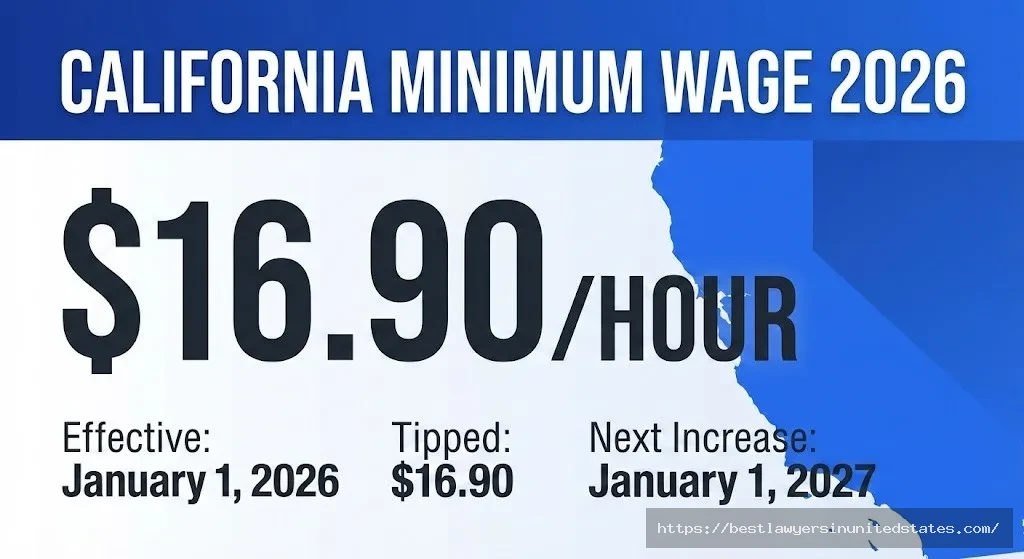
Whether you're earning the federal minimum wage of $7.25 per hour or your state's higher rate, understanding your gross versus net pay makes a significant difference. This calculator accounts for federal income tax, state income tax (where applicable), Social Security, Medicare, and overtime pay to give you accurate estimates of your weekly, bi-weekly, monthly, and annual earnings.
With approximately 1.3 million Americans earning at or below the federal minimum wage, knowing exactly what you'll take home is critical. Use this tool to compare wages across states, plan your budget, or verify your paychecks are accurate. All data is updated with 2025 minimum wage rates and tax brackets.
How to Use the Minimum Wage Calculator
Our minimum wage earnings calculator is designed to be simple yet comprehensive. Follow these steps to calculate your take-home pay:
Step 1: Select Your State
Choose your state from the dropdown menu. The calculator includes all 50 states plus Washington, D.C., each with current 2025 minimum wage rates pre-loaded. You'll see your state's minimum wage automatically populate in the hourly wage field.
If you earn more than your state's minimum wage, you can manually enter your custom hourly rate. The calculator works for any wage amount, making it useful for comparing different pay scenarios.
Step 2: Enter Your Work Hours
Input how many hours you work per week. The default is set to 40 hours for full-time employment, but you can adjust this for part-time positions or variable schedules.
Next, specify how many weeks per year you work. The standard is 52 weeks, but if you have unpaid time off or seasonal employment, adjust this number accordingly. For example, if you take two weeks of unpaid vacation, enter 50 weeks.
Step 3: Add Overtime (Optional)
Toggle the overtime option if you regularly work more than 40 hours per week. The calculator automatically computes time-and-a-half pay (1.5× your hourly rate) for overtime hours.
You can adjust the overtime threshold if your state has different rules. While federal law sets overtime at 40 hours per week, some states like California have daily overtime requirements. Set your threshold based on when you start earning overtime rates.
Step 4: Include Tax Withholding (Optional)
For the most accurate take-home pay estimate, enable tax calculations. Select your filing status from these options:
- Single: You file taxes as an individual
- Married Filing Jointly: You file jointly with your spouse
- Head of Household: You're unmarried and pay more than half of household expenses
The calculator computes federal income tax based on 2025 tax brackets, your state's income tax rate (if applicable), Social Security tax (6.2%), and Medicare tax (1.45%). Remember, these are estimates—consult a tax professional for precise calculations.
Step 5: View Your Results
Click "Calculate Earnings" to see your complete pay breakdown:
- Gross pay: Total earnings before any deductions
- Tax deductions: Federal tax, state tax, Social Security, and Medicare
- Net pay: Your actual take-home amount
- Multiple time periods: See weekly, bi-weekly, monthly, and annual figures
The results show both your regular pay and overtime pay separately, helping you understand exactly how your earnings are calculated.
2025 Minimum Wage Rates by State
Understanding minimum wage laws requires knowing that the United States operates under a dual system: federal and state minimum wages. The federal minimum wage, established by the Fair Labor Standards Act (FLSA), is currently $7.25 per hour—a rate that hasn't changed since July 24, 2009.
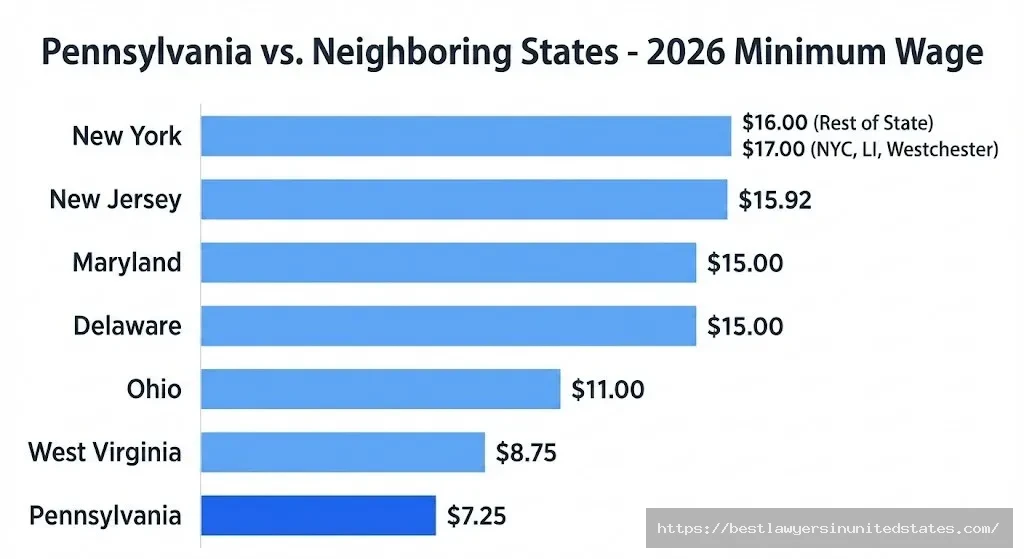
However, 30 states plus the District of Columbia have enacted higher state minimum wages. When federal and state minimum wages differ, employers must pay workers the higher of the two rates. Additionally, some cities and counties have enacted local ordinances setting even higher minimum wages than their state rates.
This means the minimum wage you're entitled to depends on three factors: where you work, your employer's size (in some jurisdictions), and your job classification. Always check federal, state, and local rates to ensure you're receiving the highest applicable minimum wage.
State-by-State Minimum Wage Comparison (2025)
| State | 2025 Minimum Wage | Tipped Minimum | Next Scheduled Increase | Notes |
|---|---|---|---|---|
| Alabama | $7.25 | $2.13 | None scheduled | Uses federal minimum |
| Alaska | $11.91 | $11.91 | Jan 2026: Inflation-adjusted | No tip credit allowed |
| Arizona | $14.70 | $11.70 | Jan 2026: CPI adjustment | Indexed to inflation |
| Arkansas | $11.00 | $2.63 | None scheduled | |
| California | $16.50 | $16.50 | Jan 2026: TBD | No tip credit; $20 for fast food |
| Colorado | $14.81 | $11.79 | Jan 2026: CPI adjustment | Adjusted annually |
| Connecticut | $15.69 | $6.38 | Jun 2025: $16.35 | Phased increases continue |
| Delaware | $13.25 | $2.23 | Jan 2026: TBD | |
| District of Columbia | $17.50 | $10.00 | Jul 2025: $17.75 | Adjusted annually |
| Florida | $13.00 | $8.98 | Sep 2025: $14.00 | Increasing to $15 by 2026 |
| Georgia | $7.25 | $2.13 | None scheduled | Uses federal minimum |
| Hawaii | $14.00 | $12.75 | Jan 2026: TBD | |
| Idaho | $7.25 | $3.35 | None scheduled | Uses federal minimum |
| Illinois | $14.00 | $8.40 | Jan 2026: TBD | |
| Indiana | $7.25 | $2.13 | None scheduled | Uses federal minimum |
| Iowa | $7.25 | $4.35 | None scheduled | Uses federal minimum |
| Kansas | $7.25 | $2.13 | None scheduled | Uses federal minimum |
| Kentucky | $7.25 | $2.13 | None scheduled | Uses federal minimum |
| Louisiana | $7.25 | $2.13 | None scheduled | No state minimum wage law |
| Maine | $14.15 | $7.08 | Jan 2026: CPI adjustment | Indexed to inflation |
| Maryland | $15.00 | $3.63 | Jan 2026: TBD | |
| Massachusetts | $15.00 | $6.75 | None scheduled | |
| Michigan | $10.33 | $3.93 | Jan 2026: TBD | |
| Minnesota | $10.85 | $10.85 | Jan 2026: Inflation-adjusted | No tip credit allowed |
| Mississippi | $7.25 | $2.13 | None scheduled | No state minimum wage law |
| Missouri | $12.30 | $6.15 | Jan 2026: CPI adjustment | Indexed to inflation |
| Montana | $10.30 | $10.30 | Jan 2026: CPI adjustment | No tip credit allowed |
| Nebraska | $12.00 | $2.13 | Jan 2026: TBD | |
| Nevada | $12.00 | $12.00 | Jul 2025: TBD | No tip credit allowed |
| New Hampshire | $7.25 | $3.27 | None scheduled | Uses federal minimum |
| New Jersey | $15.49 | $5.62 | Jan 2026: CPI adjustment | Indexed to inflation |
| New Mexico | $12.00 | $3.00 | None scheduled | |
| New York | $15.00-$16.50 | Varies | Dec 2025: Regional increases | Varies by region |
| North Carolina | $7.25 | $2.13 | None scheduled | Uses federal minimum |
| North Dakota | $7.25 | $4.86 | None scheduled | Uses federal minimum |
| Ohio | $10.45 | $5.25 | Jan 2026: CPI adjustment | Indexed to inflation |
| Oklahoma | $7.25 | $2.13 | None scheduled | Uses federal minimum |
| Oregon | $14.20 | $14.20 | Jul 2025: $14.70 | No tip credit; varies by region |
| Pennsylvania | $7.25 | $2.83 | None scheduled | Uses federal minimum |
| Rhode Island | $14.00 | $3.89 | Jan 2026: TBD | |
| South Carolina | $7.25 | $2.13 | None scheduled | No state minimum wage law |
| South Dakota | $11.20 | $5.60 | Jan 2026: CPI adjustment | Indexed to inflation |
| Tennessee | $7.25 | $2.13 | None scheduled | No state minimum wage law |
| Texas | $7.25 | $2.13 | None scheduled | Uses federal minimum |
| Utah | $7.25 | $2.13 | None scheduled | Uses federal minimum |
| Vermont | $13.67 | $6.84 | Jan 2026: CPI adjustment | Indexed to inflation |
| Virginia | $12.00 | $2.13 | None scheduled | |
| Washington | $16.66 | $16.66 | Jan 2026: CPI adjustment | No tip credit; highest state minimum |
| West Virginia | $8.75 | $2.62 | None scheduled | |
| Wisconsin | $7.25 | $2.33 | None scheduled | Uses federal minimum |
| Wyoming | $7.25 | $2.13 | None scheduled | Uses federal minimum |
Note: Many cities and counties have higher local minimum wages. Always check your local ordinances.
States with the Highest Minimum Wage (2025)
The top five jurisdictions with the highest minimum wage rates are:
- District of Columbia: $17.50/hour - The nation's capital leads with the highest minimum wage, adjusted annually for inflation. D.C. also has a robust tipped minimum wage of $10.00, requiring employers to make up any shortfall if tips don't bring workers to the full minimum.
- Washington: $16.66/hour - Washington state prohibits tip credits, meaning tipped workers receive the full $16.66 per hour plus tips. The rate adjusts annually based on the Consumer Price Index.
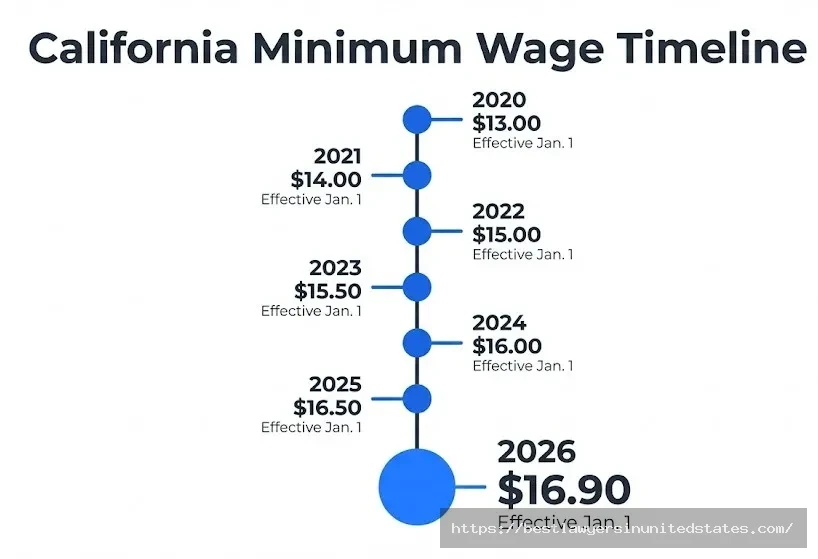
- California: $16.50/hour - California's statewide minimum applies to all workers, with no tip credit allowed. Fast food workers at chains with 60+ locations earn $20.00 per hour as of April 2024.
- Massachusetts: $15.00/hour - The Bay State reached its $15 minimum wage goal in 2023 and currently maintains this rate while considering future increases.
- Connecticut: $15.69/hour - Connecticut's minimum wage continues phased increases, reaching $16.35 in June 2025, with annual inflation adjustments thereafter.
States Still Using Federal Minimum Wage ($7.25)
Twenty states continue to use the federal minimum wage of $7.25 per hour, meaning workers in these states haven't seen a wage increase in over 15 years:
Alabama, Georgia, Idaho, Indiana, Iowa, Kansas, Kentucky, Louisiana, Mississippi, New Hampshire, North Carolina, North Dakota, Oklahoma, Pennsylvania, South Carolina, Tennessee, Texas, Utah, Wisconsin, and Wyoming.
Five of these states (Alabama, Louisiana, Mississippi, South Carolina, and Tennessee) don't have state minimum wage laws at all, relying entirely on federal law. However, some cities within these states have enacted higher local minimum wages—for example, Birmingham, Alabama, attempted to raise its minimum wage before being blocked by state legislation.
Future Scheduled Increases (2025-2027)
Several states have legislated automatic increases or scheduled adjustments:
Florida: Currently at $13.00, Florida's minimum wage increases to $14.00 on September 30, 2025, and reaches $15.00 on September 30, 2026. This follows voter approval of a constitutional amendment in 2020.
Connecticut: Increases to $16.35 on June 1, 2025, followed by annual inflation adjustments.
New York: Complex regional structure with New York City and surrounding counties at $16.50, while upstate regions are at $15.00 with scheduled increases toward parity by 2027.
Oregon: Standard rate increases to $14.70 on July 1, 2025, with higher rates in Portland metro ($15.95) and lower rates in non-urban counties ($13.70).
Inflation-Indexed States: Seventeen states automatically adjust their minimum wage annually based on inflation (CPI). These include Alaska, Arizona, Colorado, Maine, Minnesota, Missouri, Montana, New Jersey, Ohio, South Dakota, Vermont, Washington, and others. 2026 rates will be announced in late 2025.
Understanding Federal vs. State Minimum Wage
The interaction between federal and state minimum wage laws can be confusing. Here's how the system works:
How the Federal Minimum Wage Works
The Fair Labor Standards Act (FLSA), enacted in 1938, established the federal minimum wage. The FLSA is a federal law that sets baseline labor standards, including minimum wage, overtime pay, recordkeeping, and child labor provisions.
The current federal minimum wage of $7.25 per hour has been in effect since July 24, 2009—making it over 15 years without an increase, the longest period without a raise in the law's history. The FLSA covers approximately 143 million workers in the United States, though not all are entitled to minimum wage (certain exemptions apply).
Congress has the sole authority to change the federal minimum wage. Multiple bills have been proposed to raise it—most recently the "Raise the Wage Act of 2023," which would incrementally increase the federal minimum to $17 per hour by 2028—but none have passed both houses of Congress and been signed into law.
When State Law Supersedes Federal Law
When both federal and state minimum wage laws apply, employers must comply with the law that provides greater protection to workers. This is known as the "higher standard" rule.
If state minimum wage > federal minimum wage: Employers must pay the higher state rate.
Example: California's minimum wage is $16.50, while the federal minimum is $7.25. A California employer must pay at least $16.50 per hour.
If state minimum wage < federal minimum wage (or no state law exists): Employers must pay the federal minimum wage of $7.25.
Example: A state with no minimum wage law (like South Carolina) defaults to federal law, requiring employers to pay at least $7.25 per hour to covered employees.
If state has no minimum wage law: Federal law applies to employers covered by FLSA. However, employers not engaged in interstate commerce and with annual gross revenue under $500,000 may not be covered by FLSA, potentially leaving some workers without minimum wage protection.
Local Minimum Wage Ordinances
The complexity increases when cities or counties enact their own minimum wage laws. Local ordinances can set even higher minimum wages than state rates, creating a three-tier system in some locations.
Major cities with local minimum wages higher than their state:
New York City: $16.50/hour (vs. New York State: $15.00 upstate)
Seattle, Washington: $19.97/hour for large employers (251+ employees), $17.25 for small employers (vs. Washington State: $16.66)
San Francisco, California: $18.07/hour (vs. California State: $16.50)
Denver, Colorado: $18.29/hour (vs. Colorado State: $14.81)
Minneapolis, Minnesota: $15.57/hour for large employers (vs. Minnesota State: $10.85)
Some states have "preemption laws" that prohibit cities from setting their own minimum wages. For example, Alabama passed a law in 2016 blocking Birmingham from implementing its planned $10.10 minimum wage. Currently, 25 states have some form of preemption preventing local wage ordinances.
When working in a jurisdiction with local minimum wage ordinances, you're entitled to whichever rate is highest:
- Federal minimum wage, OR
- State minimum wage, OR
- Local (city/county) minimum wage
Who Sets Minimum Wage?
Federal Level: The U.S. Congress passes legislation to change the federal minimum wage. The President must sign the bill into law. The Department of Labor enforces federal wage laws through its Wage and Hour Division.
State Level: State legislatures pass laws setting state minimum wages. In some states, governors can veto these bills. Some states allow ballot initiatives, where voters directly decide minimum wage through referendums (Florida's $15 minimum wage was passed this way in 2020).
Local Level: City councils and county boards can pass ordinances (local laws) establishing minimum wages for their jurisdictions, unless prohibited by state preemption laws. Some require mayoral approval.
Automatic Adjustments: Many states and localities tie their minimum wage to inflation using the Consumer Price Index (CPI). These automatic annual adjustments don't require new legislation—the rate increases automatically based on a formula in the existing law.
Calculating Your Take-Home Pay
Understanding the difference between your gross pay and net pay is essential for budgeting and financial planning. Most minimum wage workers are surprised to learn that 20-30% of their earnings go toward taxes and mandatory deductions.
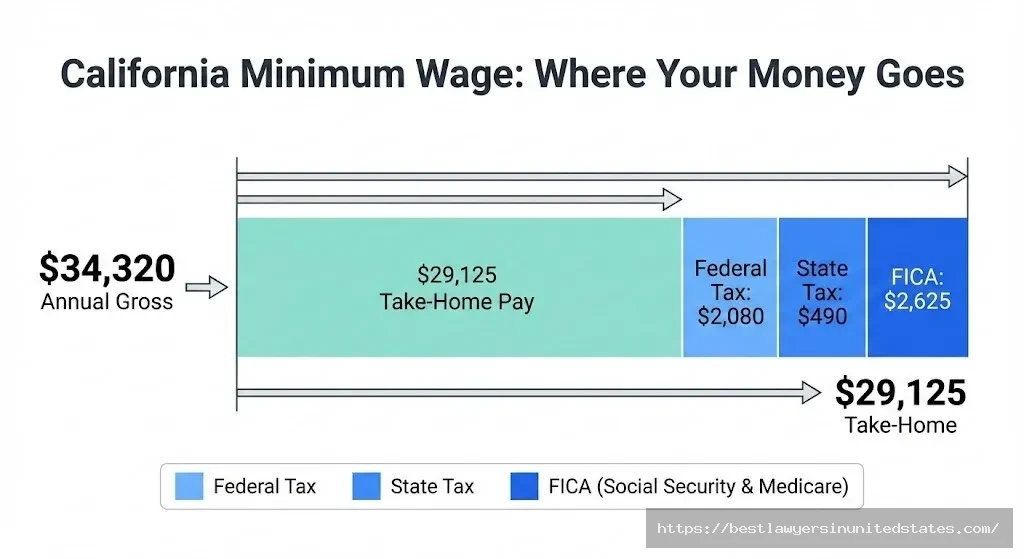
Gross Pay vs. Net Pay
Gross pay is your total earnings before any deductions. This is the amount your employer uses when advertising the job ("$15 per hour") and what appears on your pay stub as your total wages.
Net pay (also called "take-home pay") is what you actually receive after all mandatory deductions are subtracted from your gross pay. This is the amount deposited in your bank account or written on your paycheck.
Typical deductions from gross pay include:
- Federal income tax withholding
- State income tax withholding (in 41 states + D.C.)
- Social Security tax (FICA)
- Medicare tax (FICA)
- Any voluntary deductions (health insurance, retirement contributions, etc.)
For minimum wage workers, gross pay is typically 25-35% higher than net pay, depending on your state's tax rates and filing status.
Federal Tax Withholding
Federal income tax uses a progressive bracket system, meaning you pay higher rates on higher portions of your income. For 2025, the tax brackets are:
2025 Federal Income Tax Brackets (Single Filers):
| Taxable Income | Tax Rate |
|---|---|
| $0 - $11,600 | 10% |
| $11,601 - $47,150 | 12% |
| $47,151 - $100,525 | 22% |
| $100,526 - $191,950 | 24% |
| $191,951 - $243,725 | 32% |
| $243,726 - $609,350 | 35% |
| $609,351+ | 37% |
2025 Federal Income Tax Brackets (Married Filing Jointly):
| Taxable Income | Tax Rate |
|---|---|
| $0 - $23,200 | 10% |
| $23,201 - $94,300 | 12% |
| $94,301 - $201,050 | 22% |
| $201,051 - $383,900 | 24% |
| $383,901 - $487,450 | 32% |
| $487,451 - $731,200 | 35% |
| $731,201+ | 37% |
Standard Deduction: Before applying tax brackets, you can subtract the standard deduction from your gross income:
- Single: $14,600
- Married Filing Jointly: $29,200
- Head of Household: $21,900
Example Federal Tax Calculation:
Worker earning federal minimum wage ($7.25/hour):
- 40 hours/week × 52 weeks = 2,080 hours/year
- Annual gross income: $15,080
- Minus standard deduction: $15,080 - $14,600 = $480 taxable income
- Tax owed: $480 × 10% = $48
However, this worker would likely qualify for the Earned Income Tax Credit and other credits, potentially resulting in a net refund. For our calculator purposes, we estimate withholding based on standard tax tables, which may overestimate actual tax liability for very low earners.
State Income Tax
State income tax varies dramatically by state. Nine states have no income tax on wages:
States with NO income tax:
- Alaska
- Florida
- Nevada
- South Dakota
- Tennessee (ended wage tax in 2021)
- Texas
- Washington
- Wyoming
- New Hampshire (no tax on wages; only on interest/dividends)
States with the highest income tax rates:
- California: 13.3% top rate (1% - 13.3% progressive)
- Hawaii: 11% top rate (1.4% - 11% progressive)
- New York: 10.9% top rate (4% - 10.9% progressive)
- New Jersey: 10.75% top rate (1.4% - 10.75% progressive)
Most states use progressive tax brackets similar to the federal system. However, some states use a flat tax rate for all income levels:
- Colorado: 4.40%
- Illinois: 4.95%
- Indiana: 3.15%
- Massachusetts: 5.00%
- Michigan: 4.25%
- North Carolina: 4.50%
- Pennsylvania: 3.07%
- Utah: 4.65%
For minimum wage workers, state income tax typically ranges from 0% (no-tax states) to 5-7% in high-tax states. Our calculator uses approximate state tax rates based on typical minimum wage income levels.
FICA Taxes (Social Security & Medicare)
FICA (Federal Insurance Contributions Act) taxes are mandatory payroll taxes that fund Social Security and Medicare programs. Unlike income taxes, FICA taxes are applied to your gross wages with very few deductions.
Social Security Tax: 6.2% of gross wages up to $168,600 (2025 wage base limit)
- For minimum wage workers, all earnings are subject to this tax
- Your employer pays an additional matching 6.2%
- These contributions earn you Social Security retirement credits
Medicare Tax: 1.45% of all gross wages (no income limit)
- Applies to every dollar earned
- Your employer pays a matching 1.45%
- Additional 0.9% Medicare tax on earnings over $200,000 (single) or $250,000 (married) — not applicable to minimum wage workers
Combined FICA Rate: 7.65% of gross pay
FICA cannot be reduced or avoided (except for certain religious exemptions or student workers). This is a flat tax that applies equally to all wage earners.
FICA Example:
Worker earning $15,080/year:
- Social Security: $15,080 × 6.2% = $934.96
- Medicare: $15,080 × 1.45% = $218.66
- Total FICA: $1,153.62
This reduces annual take-home pay by about 7.65%, regardless of your income level or filing status.
Sample Take-Home Pay Calculations
Let's examine real scenarios at different wage levels and locations:
Example 1: Federal Minimum Wage - Texas (No State Income Tax)
- Hourly Rate: $7.25
- Hours: 40/week, 52 weeks/year
- Filing Status: Single
- Annual Gross: $15,080
| Deduction | Amount |
|---|---|
| Gross Pay | $15,080.00 |
| Federal Income Tax | -$48.00 |
| State Income Tax | $0.00 |
| Social Security | -$934.96 |
| Medicare | -$218.66 |
| Annual Net Pay | $13,878.38 |
| Monthly Net Pay | $1,156.53 |
| Weekly Net Pay | $266.89 |
Take-home percentage: 92% (8% withheld)
Example 2: California State Minimum Wage
- Hourly Rate: $16.50
- Hours: 40/week, 52 weeks/year
- Filing Status: Single
- Annual Gross: $34,320
| Deduction | Amount |
|---|---|
| Gross Pay | $34,320.00 |
| Federal Income Tax | -$2,286.00 |
| State Income Tax (CA) | -$687.20 |
| Social Security | -$2,127.84 |
| Medicare | -$497.64 |
| Annual Net Pay | $28,721.32 |
| Monthly Net Pay | $2,393.44 |
| Weekly Net Pay | $552.33 |
Take-home percentage: 84% (16% withheld)
Example 3: Washington D.C. Minimum Wage
- Hourly Rate: $17.50
- Hours: 40/week, 52 weeks/year
- Filing Status: Single
- Annual Gross: $36,400
| Deduction | Amount |
|---|---|
| Gross Pay | $36,400.00 |
| Federal Income Tax | -$2,616.00 |
| State Income Tax (D.C.) | -$1,674.00 |
| Social Security | -$2,256.80 |
| Medicare | -$527.80 |
| Annual Net Pay | $29,325.40 |
| Monthly Net Pay | $2,443.78 |
| Weekly Net Pay | $564.14 |
Take-home percentage: 81% (19% withheld)
These examples show that minimum wage workers in states without income tax keep more of their earnings, but even in no-tax states, federal income tax and FICA reduce gross pay by roughly 10-15%.
Overtime Pay Rules & Calculation
Understanding overtime pay is crucial for minimum wage workers who often work more than 40 hours per week. Federal and state laws mandate premium pay rates for overtime hours, significantly increasing your total earnings.
Federal Overtime Requirements (FLSA)
The Fair Labor Standards Act requires employers to pay non-exempt employees overtime at a rate of time-and-a-half (1.5× regular rate) for all hours worked over 40 in a workweek.
Key FLSA overtime provisions:
- Overtime trigger: Hours worked beyond 40 in a workweek
- Overtime rate: 1.5× your regular hourly rate
- Workweek definition: Any fixed, recurring 168-hour period (7 consecutive 24-hour days)
- No daily overtime: Federal law doesn't require overtime for long shifts, only weekly totals
- No weekend/holiday premium: FLSA doesn't require extra pay for weekends or holidays unless it results in overtime hours
Who is covered? The FLSA covers employees of enterprises with annual gross volume of sales of at least $500,000, or employees engaged in interstate commerce. In practice, this covers the vast majority of minimum wage workers.
Overtime calculation example:
Worker earning $7.25/hour who works 50 hours in a week:
- Regular pay: 40 hours × $7.25 = $290.00
- Overtime rate: $7.25 × 1.5 = $10.88/hour
- Overtime pay: 10 hours × $10.88 = $108.75
- Total weekly pay: $398.75
Without overtime protection, the worker would earn only $362.50 for 50 hours of work. Overtime rules add an extra $36.25 to weekly pay in this example.
State-Specific Overtime Laws
While most states follow federal overtime rules, some have enacted stronger protections for workers:
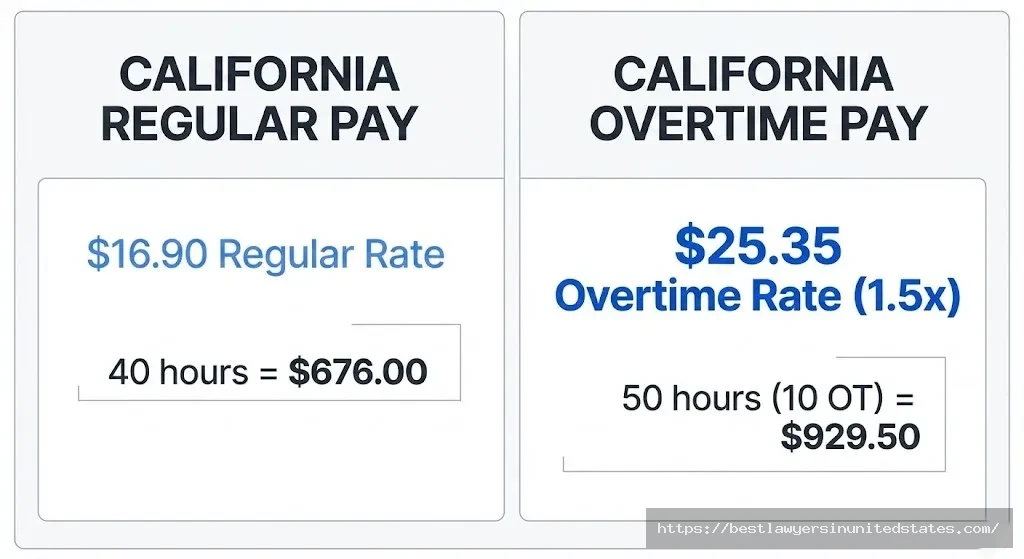
California:
- Daily overtime: Time-and-a-half after 8 hours in a workday, double-time after 12 hours
- Weekly overtime: Time-and-a-half after 40 hours in a workweek
- Seventh-day overtime: Time-and-a-half for first 8 hours on 7th consecutive workday, double-time thereafter
- Double-time rate: 2× regular rate applies in specific scenarios
Alaska:
- Daily overtime: Time-and-a-half after 8 hours in a workday
- Weekly overtime: Time-and-a-half after 40 hours in a workweek
Nevada:
- Daily overtime: Time-and-a-half after 8 hours in a workday (if earning less than 1.5× minimum wage)
- Weekly overtime: Time-and-a-half after 40 hours in a workweek
Colorado:
- Daily overtime: Time-and-a-half after 12 hours in a workday
- Weekly overtime: Time-and-a-half after 40 hours in a workweek
Most other states follow the federal standard (weekly overtime only, no daily overtime requirements).
Who Is Exempt from Overtime?
Not all employees are entitled to overtime pay. The FLSA provides several exemptions:
"White collar" exemptions (executive, administrative, professional):
- Must be paid on a salary basis
- Must earn at least $844 per week ($43,888 annually) as of July 1, 2024
- Must perform exempt job duties (management, professional work, etc.)
Other common exemptions:
- Outside sales employees
- Certain computer professionals
- Independent contractors (not employees)
- Certain seasonal/recreational workers
- Some agricultural workers
- Drivers and driver's helpers making interstate deliveries
Important: Minimum wage workers are almost always classified as non-exempt and entitled to overtime. If your employer claims you're "exempt," verify that you meet ALL three tests: salary basis, salary level, and duties. Job titles don't determine exemption—actual job duties and pay do.
If you regularly work over 40 hours and aren't receiving overtime pay, you may have a valid wage claim against your employer.
Overtime Calculation Examples
Example 1: Federal minimum wage, 45 hours/week
- Regular rate: $7.25/hour
- Overtime rate: $7.25 × 1.5 = $10.88/hour
- Regular pay: 40 hours × $7.25 = $290.00
- Overtime pay: 5 hours × $10.88 = $54.38
- Total weekly earnings: $344.38
- Monthly (4.33 weeks): $1,491.17
- Annual: $17,907.76
Example 2: California minimum wage, 50 hours/week
- Regular rate: $16.50/hour
- Overtime rate: $16.50 × 1.5 = $24.75/hour
- Regular pay: 40 hours × $16.50 = $660.00
- Overtime pay: 10 hours × $24.75 = $247.50
- Total weekly earnings: $907.50
- Monthly (4.33 weeks): $3,929.48
- Annual: $47,190.00
Example 3: California with daily overtime, 10-hour shifts, 5 days/week
- Regular rate: $16.50/hour
- Each shift: 8 hours regular + 2 hours overtime
- Weekly regular hours: 40 hours × $16.50 = $660.00
- Weekly overtime hours: 10 hours × $24.75 = $247.50
- Total weekly earnings: $907.50
- (Same as weekly-only overtime because total hours are 50)
California's daily overtime rules matter most when workers have irregular schedules. If you work 12 hours one day and 28 hours the rest of the week (40 total), you'd still earn 4 hours of overtime under California law (2 hours × 1.5× plus 2 hours × 2× for the hours over 12), even though you haven't exceeded 40 weekly hours.
Minimum Wage vs. Living Wage
One of the most significant challenges facing minimum wage workers is that in most parts of the United States, minimum wage falls far short of what's needed to cover basic living expenses. Understanding the gap between minimum wage and living wage is essential for financial planning and advocacy.
What Is a Living Wage?
A living wage is the minimum income necessary for a worker to meet their basic needs. This includes:
- Housing (rent/mortgage, utilities)
- Food (groceries, not dining out)
- Transportation (car payment, gas, insurance, or public transit)
- Healthcare (insurance premiums, out-of-pocket costs)
- Childcare (if applicable)
- Other essentials (clothing, household items, phone)
- Taxes (income, payroll, sales taxes)
Unlike minimum wage, which is a legal requirement set by legislation, living wage is an economic calculation that varies by location. The most widely cited living wage data comes from the MIT Living Wage Calculator, which computes required wages for every county in the United States based on local costs.
Key differences:
- Minimum wage: Legal minimum, same for everyone in a jurisdiction
- Living wage: Economic calculation, varies by family size and location
- Gap: Living wage typically 50-200% higher than minimum wage
Living Wage by State (2025 Estimates)
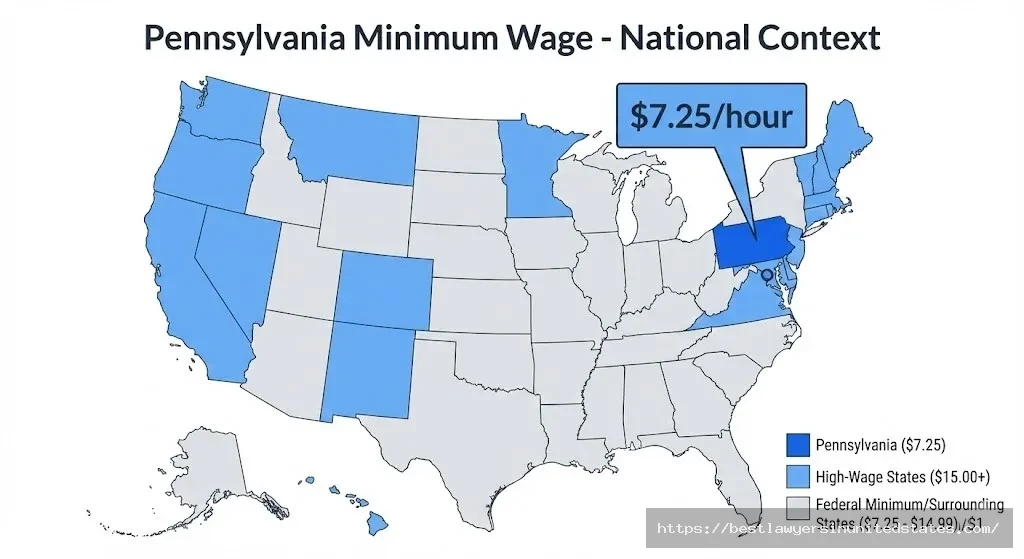
Based on MIT Living Wage Calculator data for a single adult with no children:
| State | State Minimum Wage | Living Wage (Single Adult) | Shortfall | Deficit % |
|---|---|---|---|---|
| Alabama | $7.25 | $16.74 | -$9.49 | -56.7% |
| California | $16.50 | $27.32 | -$10.82 | -39.6% |
| Colorado | $14.81 | $24.18 | -$9.37 | -38.8% |
| Florida | $13.00 | $20.61 | -$7.61 | -36.9% |
| Georgia | $7.25 | $18.03 | -$10.78 | -59.8% |
| Illinois | $14.00 | $21.49 | -$7.49 | -34.9% |
| Massachusetts | $15.00 | $28.51 | -$13.51 | -47.4% |
| New York | $15.00 | $25.71 | -$10.71 | -41.7% |
| Texas | $7.25 | $17.53 | -$10.28 | -58.6% |
| Washington | $16.66 | $24.83 | -$8.17 | -32.9% |
Observations:
- No state's minimum wage meets the living wage for a single adult
- Worst gaps: States using federal minimum wage have 55-60% shortfalls
- Best performance: Washington has the smallest gap (though still $8.17/hour short)
- High-cost states: California, Massachusetts, New York have large absolute gaps despite higher minimum wages
Can You Live on Minimum Wage?
The short answer: It depends on your location, family size, and access to assistance programs, but it's extremely difficult in most cases.
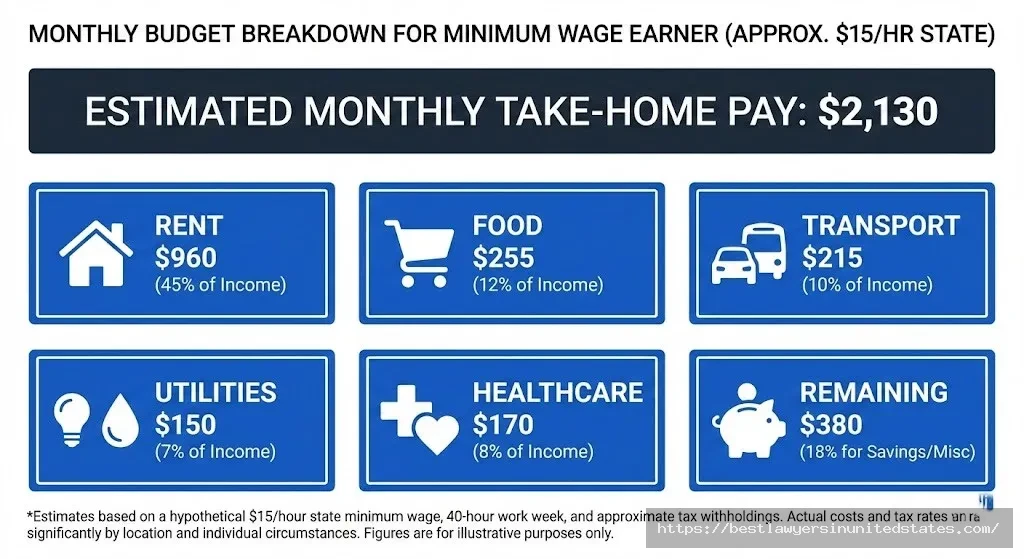
Federal Minimum Wage ($7.25/hour) Scenario:
- Annual gross income: $15,080 (40 hours/week, 52 weeks)
- Annual net income: ~$13,000 (after taxes)
- Federal poverty line (2024, single adult): $15,060
- Status: At or below poverty line
A single adult earning federal minimum wage is living at the poverty line. According to the U.S. Department of Health and Human Services, this qualifies for numerous assistance programs including SNAP (food stamps), Medicaid, and housing assistance.
Monthly budget at federal minimum wage (~$1,083 net):
| Expense Category | Amount | % of Income |
|---|---|---|
| Rent (shared housing) | $500 | 46% |
| Food (SNAP assistance) | $150 | 14% |
| Transportation (public transit) | $100 | 9% |
| Phone | $50 | 5% |
| Utilities (share) | $75 | 7% |
| Healthcare (Medicaid) | $0 | 0% |
| Clothing/personal | $50 | 5% |
| Remaining | $158 | 15% |
This budget requires:
- Shared housing (roommates)
- Government food assistance
- Public transportation (no car)
- Medicaid health coverage
- No entertainment, savings, or emergencies
- No student loans or debt payments
- No childcare needs
California Minimum Wage ($16.50/hour) Scenario:
- Annual gross income: $34,320
- Annual net income: ~$28,000 (after taxes)
- California living wage (single adult): $56,798
- Status: 51% below living wage
Monthly budget at CA minimum wage (~$2,333 net):
| Expense Category | Amount | % of Income |
|---|---|---|
| Rent (studio, shared) | $1,200 | 51% |
| Food | $400 | 17% |
| Transportation (car) | $350 | 15% |
| Phone | $60 | 3% |
| Utilities | $100 | 4% |
| Healthcare (ACA subsidy) | $100 | 4% |
| Clothing/personal | $75 | 3% |
| Remaining | $48 | 2% |
Even at nearly 2.3× the federal minimum wage, a California worker faces:
- 50%+ of income on housing
- Limited transportation options
- No emergency fund
- No retirement savings
- Constant financial stress
Family Scenarios: The Impact of Children
The living wage calculation changes dramatically when accounting for children:
Single Parent + 1 Child (Texas example):
- Living wage needed: $32.71/hour
- Texas minimum wage: $7.25/hour
- Hours needed at minimum wage: 4.5× full-time (180 hours/week - impossible)
This scenario is unsustainable on minimum wage alone. Single parents typically require:
- Second job or significant overtime
- Childcare subsidies
- SNAP and WIC benefits
- Medicaid/CHIP for children
- Housing assistance
- Family support (relatives helping)
Two Working Adults + 2 Children (National average):
- Combined living wage needed: ~$30-40/hour total ($15-20/hour each)
- Federal minimum wage (both working): $14.50/hour combined
- Shortfall: $15.50-25.50/hour
Even with both parents working full-time at minimum wage, most families fall short of the living wage. This is why:
- 60% of minimum wage workers rely on public assistance
- Many families need 2-3 jobs to make ends meet
- Affordable childcare is often unavailable
- Healthcare costs are a constant burden
Why the Gap Exists
Several factors contribute to the minimum wage - living wage gap:
1. Minimum wage stagnation: The federal minimum hasn't increased since 2009. Adjusted for inflation, it's worth about 29% less than in 1968.
2. Housing cost explosion: Rent has increased 40-60% in many markets over the past decade, far outpacing wage growth.
3. Healthcare costs: The U.S. has the highest healthcare costs in the developed world. Even with insurance, out-of-pocket expenses strain budgets.
4. Childcare crisis: Childcare costs rival or exceed college tuition in many states. Full-time care for an infant averages $10,000-$25,000 per year.
5. Transportation requirements: Most jobs require reliable transportation. Car ownership costs average $9,000-12,000 per year.
6. Regional variation: Living wages vary by 200-300% between the most expensive (San Francisco, New York) and least expensive (rural Mississippi, West Virginia) areas, but minimum wages don't account for this.
The living wage calculation provides a stark reality check: minimum wage is insufficient for financial security in virtually every American community.
Minimum Wage Through History
Understanding how minimum wage has evolved over time provides important context for today's debates about wage levels and purchasing power.
Federal Minimum Wage Timeline
1938 - The Beginning: President Franklin D. Roosevelt signed the Fair Labor Standards Act, establishing the first federal minimum wage at $0.25 per hour. This covered approximately 43% of the workforce and was designed to address Depression-era exploitation of workers.
1940s-1950s - Gradual Increases:
- 1945: $0.40/hour
- 1950: $0.75/hour
- 1956: $1.00/hour
1960s - Peak Purchasing Power:
- 1961: $1.15/hour
- 1963: $1.25/hour
- 1968: $1.60/hour - This represents the historical peak in purchasing power when adjusted for inflation
1970s-1980s - Trying to Keep Pace:
- 1974: $2.00/hour
- 1978: $2.65/hour
- 1980: $3.10/hour
- 1981: $3.35/hour (remained until 1990)
1990s-2000s - Irregular Increases:
- 1990: $3.80/hour
- 1991: $4.25/hour
- 1996: $4.75/hour
- 1997: $5.15/hour (remained until 2007)
- 2007: $5.85/hour
- 2008: $6.55/hour
2009-Present - Longest Stagnation:
- July 24, 2009: $7.25/hour - Current rate, unchanged for 15+ years, the longest period without an increase in the law's history
Inflation-Adjusted Comparison
When we adjust historical minimum wages for inflation to 2025 dollars, a troubling picture emerges:
| Year | Nominal Wage | 2025 Dollars | % of 1968 Peak |
|---|---|---|---|
| 1968 | $1.60 | $13.46 | 100% |
| 1980 | $3.10 | $11.23 | 83% |
| 1990 | $3.80 | $8.73 | 65% |
| 2000 | $5.15 | $8.93 | 66% |
| 2009 | $7.25 | $10.33 | 77% |
| 2025 | $7.25 | $7.25 | 54% |
Key insights:
1968 represented the peak: Adjusted for inflation, the 1968 minimum wage of $1.60 equals approximately $13.46 in 2025 dollars. This is 85% higher than today's $7.25 federal minimum wage.
Purchasing power lost: Today's minimum wage worker has 46% less purchasing power than their 1968 counterpart. Put another way, minimum wage would need to be $13.46 to match 1968's standard of living.
Erosion over time: Every period when minimum wage remained frozen (1981-1990, 1997-2007, 2009-present), inflation reduced workers' purchasing power. The current 15-year freeze has caused a 30% erosion in real value.
Why Hasn't Federal Minimum Wage Increased?
The federal minimum wage requires Congressional action to change. Since 2009, multiple attempts to raise it have failed:
Political gridlock: Increasing minimum wage has become a partisan issue. Democrats generally support increases; Republicans generally oppose them, citing potential job losses. Without bipartisan support, bills don't pass.
Economic concerns: Opponents argue that raising minimum wage could:
- Reduce employment (businesses might hire fewer workers)
- Increase prices for consumers
- Harm small businesses
- Reduce work hours for current employees
Competing evidence: Economists disagree on the employment effects. Some studies show minimal job losses; others project significant impacts. This debate has stalled legislative action.
State-level responses: As federal action stalled, 30 states took matters into their own hands, raising their minimum wages above $7.25. This reduced political pressure for federal action.
Filibuster requirements: Senate rules often require 60 votes to pass legislation. With close party divisions, reaching this threshold is difficult for minimum wage bills.
Current Legislative Proposals
Several bills have been proposed to raise the federal minimum wage:
Raise the Wage Act (2023):
- Increases federal minimum to $17.00/hour by 2028
- Gradual increases: $9.50 (2024), $11.00 (2025), $13.00 (2026), $15.00 (2027), $17.00 (2028)
- Eliminates tipped minimum wage by 2027
- Indexes to median wage growth after 2028
- Status: Introduced but not passed
Other proposals range from $10-$15/hour, with various phase-in periods and indexing mechanisms. However, none have gained sufficient support for passage as of December 2025.
Historical Context: What Minimum Wage Could Buy
To understand the real impact of wage stagnation, consider what minimum wage could purchase:
1968 (minimum wage = $1.60/hour):
- Gallon of gas: $0.34 (4.7 gallons/hour of work)
- Dozen eggs: $0.53 (3.0 dozen/hour)
- Movie ticket: $1.50 (1.1 tickets/hour)
- Average apartment rent: $130/month (81 hours of work)
2025 (minimum wage = $7.25/hour):
- Gallon of gas: $3.20 (2.3 gallons/hour) - 51% reduction
- Dozen eggs: $3.50 (2.1 dozen/hour) - 30% reduction
- Movie ticket: $12.00 (0.6 tickets/hour) - 45% reduction
- Average apartment rent: $1,700/month (234 hours of work) - 189% increase
The most dramatic impact is housing. In 1968, a minimum wage worker could afford average rent working 81 hours per month. Today, that same worker needs 234 hours—nearly triple the time.
This data illustrates why the living wage - minimum wage gap has widened so dramatically over the past five decades.
Special Minimum Wage Categories
While most workers are entitled to the standard minimum wage, federal and state laws create special categories with different wage rules. Understanding these exceptions is important if you work in affected industries.
Tipped Minimum Wage
The tipped minimum wage (also called "cash wage") allows employers to pay tipped workers less than the standard minimum wage, with the expectation that tips will make up the difference.
Federal Tipped Minimum Wage: $2.13/hour (unchanged since 1991)
How tip credits work:
- Employer pays "cash wage" (as low as $2.13/hour federally)
- Employee earns tips from customers
- Cash wage + tips must equal or exceed regular minimum wage ($7.25)
- If tips fall short, employer must make up the difference
Example:
Worker in a federal-minimum state earns $2.13/hour base wage:
- Works 8 hours
- Cash wage: 8 × $2.13 = $17.04
- Tips received: $40.00
- Total: $57.04
- Minimum required: 8 × $7.25 = $58.00
- Employer must add: $0.96 to meet minimum
If tips had been $60, employer owes nothing additional because $17.04 + $60.00 = $77.04 exceeds the $58.00 minimum.
State Tipped Minimum Wages Vary:
Seven states prohibit tip credits entirely, requiring employers to pay full minimum wage before tips:
- Alaska: $11.91/hour + tips
- California: $16.50/hour + tips
- Minnesota: $10.85/hour + tips
- Montana: $10.30/hour + tips
- Nevada: $12.00/hour + tips
- Oregon: $14.20/hour + tips
- Washington: $16.66/hour + tips
Other states set their own tipped minimums:
| State | Standard Minimum | Tipped Minimum | Max Tip Credit |
|---|---|---|---|
| Florida | $13.00 | $8.98 | $4.02 |
| New York | $15.00 | $10.00 | $5.00 |
| Massachusetts | $15.00 | $6.75 | $8.25 |
| Texas | $7.25 | $2.13 | $5.12 |
| Pennsylvania | $7.25 | $2.83 | $4.42 |
Important protections for tipped workers:
Tip ownership: Tips belong to the employee, not the employer. Employers cannot keep any portion (except valid tip pools among employees who customarily receive tips).
Tip pooling: Voluntary sharing of tips among servers, bartenders, bussers, etc. is allowed. Managers and supervisors cannot participate in tip pools.
Notice requirement: Employers must inform tipped employees about the tip credit before it's applied.
Record keeping: Employers must maintain records of tips received (employee reports required).
Service charges: Mandatory service charges (banquet fees, large party charges) are not tips unless voluntarily given to employees. These are employer revenue.
If tips don't cover minimum wage: The employer MUST pay the difference. Workers should track their earnings and report shortfalls immediately.
Youth/Training Wage
Federal law allows a special "youth minimum wage" for workers under 20 years old during their first 90 consecutive calendar days of employment.
Youth Minimum Wage: $4.25/hour (for first 90 days only)
Restrictions:
- Only applies to workers under age 20
- Limited to first 90 consecutive calendar days with the employer
- After 90 days, full minimum wage applies
- Cannot displace other workers to hire youth workers
- Separate 90-day periods with different employers are allowed
Reality: Very few employers use this provision. Most entry-level employers (retail, food service) pay standard minimum wage to all workers regardless of age to simplify payroll and avoid discrimination issues.
State variations:
- Many states prohibit youth wages or set them higher than federal
- Some states have no youth wage at all
Student Workers
Full-time students employed by their school or in certain work-study programs may be paid 85% of minimum wage under specific circumstances.
Student Minimum Wage: 85% of federal minimum wage = $6.16/hour
Qualifying programs:
- Full-time students at retail/service establishments
- Student learners in vocational education
- College work-study programs
Requirements:
- Employer must obtain certificate from Department of Labor
- Limited to part-time work (20 hours/week maximum when school is in session)
- Cannot exceed 40 hours/week when school is not in session
- Cannot displace regular employees
This provision is rarely used outside of college work-study programs.
Agricultural Workers
Agricultural workers are generally covered by minimum wage laws, with some significant exceptions.
Covered agricultural workers:
- Employees on large farms (used more than 500 "man-days" of labor in previous quarter)
- Workers earning piece-rate must average at least minimum wage per hour
- Entitled to overtime in some states (California, others)
Exempt agricultural workers:
- Small farm employees (under 500 man-days)
- Immediate family members of farm owners
- Range workers
- Local hand-harvest laborers earning piece-rate (in some cases)
- Workers on small farms
H-2A agricultural visa workers: Must be paid the higher of:
- Federal/state minimum wage
- Prevailing wage rate for the occupation
- Adverse Effect Wage Rate (AEWR) - typically $14-$18/hour depending on state
State variations:
- California extends overtime to agricultural workers (after 10 hours/day or 60 hours/week)
- Washington, Hawaii, and others have stricter protections
- Some states exclude agricultural workers entirely from state minimum wage laws
Other Special Categories
Delivery drivers: May be subject to different minimum wages if they use their own vehicles. Some states require mileage reimbursement on top of minimum wage.
Commissioned sales employees: Retail/service employees paid primarily on commission may be exempt from overtime (but not minimum wage) if they earn more than 1.5× minimum wage and over half their pay comes from commissions.
Computer professionals: Certain highly skilled computer workers can be exempt from minimum wage if paid at least $27.63/hour or $684/week salary.
Disabled workers: Section 14(c) of FLSA allows employers with special certificates to pay workers with disabilities less than minimum wage. This controversial provision is being phased out in many states.
Understanding your classification matters: If you believe you're misclassified or being paid less than the minimum wage you're entitled to, contact your state labor department or the U.S. Department of Labor immediately.
Your Rights as a Minimum Wage Worker
Knowing your rights as a minimum wage employee is essential to protecting yourself from wage theft and ensuring fair treatment. Unfortunately, wage violations are common—the Department of Labor recovers hundreds of millions in back wages annually.
What Is Wage Theft?
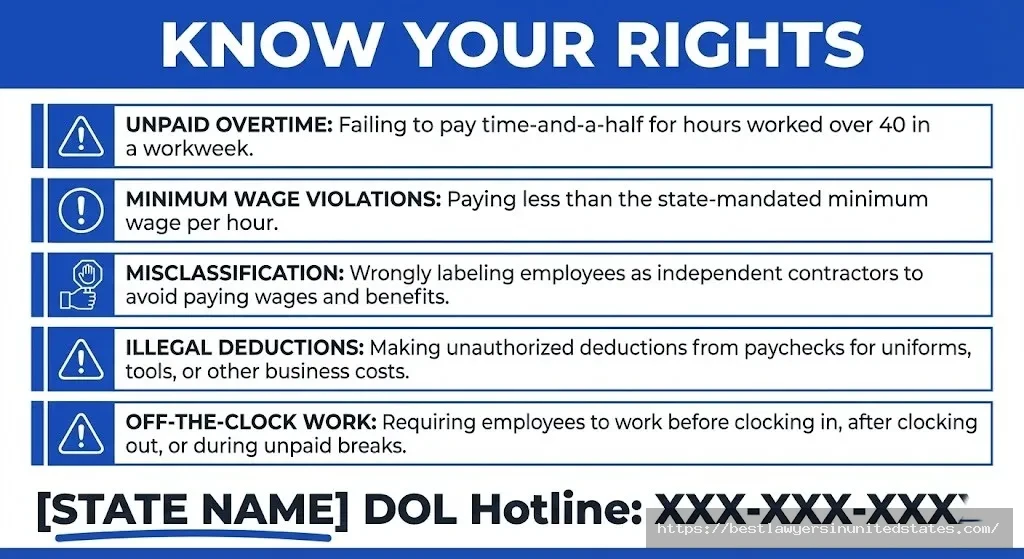
Wage theft occurs when employers fail to pay workers all wages they've legally earned. Common forms include:
1. Paying below minimum wage:
- Paying less than federal, state, or local minimum
- Illegal deductions that bring pay below minimum
- Not counting all hours worked
2. Unpaid overtime:
- Not paying time-and-a-half for hours over 40/week
- Misclassifying workers as "exempt" when they're not
- Off-the-clock work
3. Illegal deductions:
- Deducting for uniforms, tools, or cash register shortages
- Taking money for "training" or "orientation"
- Deductions that bring pay below minimum wage
4. Tip theft:
- Keeping any portion of employee tips
- Including managers in tip pools
- Taking credit card processing fees from tips
5. Time shaving:
- Automatically deducting break time whether taken or not
- Rounding down hours worked
- Not paying for pre-shift or post-shift duties
6. Misclassification:
- Calling employees "independent contractors" to avoid minimum wage
- Misclassifying non-exempt employees as exempt
- Treating employees as volunteers
7. Not paying final wages:
- Withholding final paycheck after quitting/being fired
- Deducting for "damages" or "mistakes"
- Requiring return of equipment before paying final wages
How to Spot Wage Violations
Warning signs of wage theft:
Missing or incomplete pay stubs:
- No documentation of hours worked
- No breakdown of deductions
- Missing rate of pay information
Paychecks that don't match hours worked:
- Worked 45 hours, paid for 40
- Overtime hours paid at regular rate
- Hours mysteriously "adjusted" down
Forced off-the-clock work:
- "Pre-shift" meetings not counted
- Required to arrive early or stay late without pay
- Working through unpaid breaks
Improper tip handling:
- Employer taking a cut of tips
- Managers in tip pools
- "House fees" deducted from tips
Misclassification red flags:
- Told you're "exempt" but you don't manage anyone
- Paid salary but make less than $43,888/year
- Called "independent contractor" but work set schedule with employer tools
Deductions that seem wrong:
- Charged for uniforms, tools, or training
- Deductions for register shortages
- Fees that reduce pay below minimum wage
If you notice these signs, you may have a valid wage claim.
Filing a Wage Complaint
If you believe your employer violated minimum wage laws, you have several options:
Federal Department of Labor (DOL) - Wage and Hour Division:
How to file:
- Online: Visit dol.gov/agencies/whd/contact/complaints
- Phone: Call 1-866-487-9243 (toll-free)
- In person: Visit your local Wage and Hour Division office
- Mail: Write to your regional WHD office
What happens:
- WHD investigates your complaint
- Can investigate your entire workplace, not just your individual case
- Can recover wages for all affected workers
- Can assess penalties against employer
- No cost to you
- Can remain anonymous (though investigation may reveal source)
Timeline: Investigations typically take 60-90 days but can take longer for complex cases.
State Labor Department:
Each state has its own labor agency that enforces state wage laws:
Examples:
- California: Labor Commissioner's Office (DIR)
- New York: Department of Labor, Division of Labor Standards
- Texas: Texas Workforce Commission
- Florida: Department of Economic Opportunity
To find your state agency: Search "[Your State] Department of Labor wage complaint"
Advantages of state complaints:
- May have stronger laws than federal (higher minimum wage, daily overtime, etc.)
- Often faster resolution
- May offer additional remedies
- Can pursue both state and federal complaints simultaneously
Private Lawsuit:
You can hire an employment attorney and sue your employer for wage violations.
Advantages:
- Can recover liquidated damages (double back wages)
- Can recover attorney's fees
- May have longer statute of limitations
- Personal control over the case
Disadvantages:
- May require upfront legal costs (though many attorneys work on contingency)
- Takes longer than administrative claims
- More adversarial process
To find an employment lawyer: Visit BestLawyersInUnitedStates.com/employment-lawyers for experienced attorneys in your state.
Statute of Limitations
You must file complaints within these timeframes:
Federal (FLSA):
- 2 years from violation (standard)
- 3 years if violation was "willful"
State laws vary:
- California: 3-4 years depending on violation type
- New York: 6 years
- Texas: 2 years
- Florida: 2 years
Don't wait: The longer you wait, the harder it is to prove violations and recover wages. File as soon as you discover the problem.
Retaliation Protection
It is ILLEGAL for employers to retaliate against workers for:
- Filing wage complaints
- Participating in investigations
- Discussing wages with coworkers
- Asserting minimum wage rights
Prohibited retaliation includes:
- Firing or threatening to fire
- Reducing hours or pay
- Demoting or transferring
- Changing work conditions negatively
- Immigration threats
If you experience retaliation:
- Document everything (dates, witnesses, what happened)
- File a separate retaliation complaint with DOL or state agency
- Consult an employment attorney immediately
Remedies for retaliation:
- Reinstatement to your job
- Back pay for lost wages
- Compensatory damages
- Punitive damages
- Attorney's fees
Retaliation claims are taken seriously. Many employers settle quickly rather than face federal investigations and lawsuits.
Don't let fear of retaliation stop you from reporting wage theft. You have strong legal protections, and employers face severe penalties for retaliating against workers who assert their rights.
Employer Compliance Guide
If you're an employer, understanding and complying with minimum wage laws is essential to avoid costly penalties and lawsuits. This section provides an overview of your obligations.
Posting Requirements
Federal Law Requires:
All employers covered by FLSA must display the official Department of Labor minimum wage poster in a conspicuous location where all employees can see it.
Poster requirements:
- Must be in English (and other languages if significant portion of workforce doesn't speak English)
- Must be clearly visible (break rooms, time clock areas, employee entrances)
- Must be current version
- Available free at dol.gov/agencies/whd/posters
Penalty for failure to post: Up to $100,000+ for repeat or willful violations
State Posters:
Most states require additional posters covering:
- State minimum wage
- Overtime rules
- Meal/rest break requirements
- Discrimination/harassment policies
- Workers' compensation
- Unemployment insurance
Check your state labor department website for required posters.
Where to post:
- Employee break rooms
- Near time clocks
- In areas where employees report to work
- Anywhere employees gather regularly
Electronic posting: Some states allow digital posting, but federal law still requires physical posters in most workplaces.
Record-Keeping Obligations
FLSA requires employers to maintain accurate records for all non-exempt employees:
Required records include:
- Personal information (name, address, SSN, occupation, birth date if under 19)
- Hours worked each workday and workweek
- Total hours worked per week
- Basis of pay (hourly rate, salary, piece-rate, etc.)
- Regular hourly rate
- Total daily or weekly straight-time earnings
- Total overtime earnings per week
- All additions to or deductions from wages
- Total wages paid each pay period
- Date of payment and pay period covered
Retention requirements:
- Payroll records: 3 years
- Time cards and wage computation records: 2 years
- Must be available for DOL inspection
Best practices:
- Use automated timekeeping systems
- Require employees to review and sign time records
- Maintain backups of all records
- Never alter or falsify time records
Penalties for inadequate records:
- Employer has burden to prove compliance
- If records are missing, employee testimony is credited
- Can result in presumption of violations
- Makes defending wage claims nearly impossible
Penalties for Minimum Wage Violations
Violating minimum wage laws can result in severe consequences:
Back Wages:
- Must pay all unpaid wages owed to employees
- Calculated from statute of limitations period (2-6 years depending on jurisdiction)
- Interest may accrue in some states
Liquidated Damages:
- Federal: Equal to back wages (double damages)
- State: Varies, often 2-3× back wages
Civil Money Penalties:
- Up to $2,074 per violation (adjusted annually)
- Repeated or willful violations: Up to $4,000+ per violation
- Youth employment violations: Up to $15,138 per worker
Criminal Penalties:
- Willful violations: Up to $10,000 fine
- Second conviction: Imprisonment possible
- Falsifying records: Additional criminal charges
Additional Consequences:
- Attorney's fees (employer pays employee's legal costs)
- Court costs
- Debarment from government contracts
- Negative publicity and reputation damage
- Class action lawsuits if violations affected multiple employees
Example cost of violation:
Small restaurant pays 10 employees $6.00/hour instead of $7.25 for two years:
- Back wages owed: 10 employees × $1.25/hour × 40 hours/week × 104 weeks = $52,000
- Liquidated damages (double): $52,000
- Civil penalties: $20,740 (10 workers × $2,074)
- Attorney's fees: $25,000-$50,000
- Total cost: $150,000-$175,000
All to save $52,000 in wages—a 300% loss on the "savings."
How to Ensure Compliance
Best practices for employers:
1. Audit your pay practices regularly:
- Review all employees' classifications (exempt vs. non-exempt)
- Verify minimum wage compliance in all jurisdictions
- Check overtime calculations
- Review all deductions for legality
2. Use automated systems:
- Electronic timekeeping prevents "time shaving" accusations
- Payroll software reduces calculation errors
- Automated alerts for overtime thresholds
- Digital record-keeping simplifies compliance
3. Train managers and supervisors:
- Educate on wage and hour laws
- Prohibit off-the-clock work
- Enforce meal/rest break policies
- Teach proper timekeeping procedures
4. Post all required notices:
- Federal minimum wage poster
- State-specific posters
- Update when laws change
- Check poster requirements annually
5. Classify employees correctly:
- Review exemptions carefully (executive, administrative, professional)
- Verify salary levels meet thresholds ($43,888+ annually)
- Apply duties tests honestly
- When in doubt, classify as non-exempt
6. Document everything:
- Keep detailed time records
- Document meal/rest breaks
- Maintain payroll records for required period
- Preserve records even after employee leaves
7. Conduct annual compliance reviews:
- Hire employment counsel or consultant
- Review classifications and pay practices
- Update policies as laws change
- Self-audit before government does
8. Respond to complaints promptly:
- Investigate internally when employee raises concerns
- Correct errors immediately
- Don't retaliate (illegal and expensive)
- Consider settling valid claims quickly
9. Stay updated on law changes:
- Subscribe to DOL updates
- Monitor state labor department announcements
- Track local ordinance changes
- Join employer associations for alerts
10. Consult employment counsel:
- Get legal advice for complex situations
- Have attorney review policies annually
- Seek guidance before making classification decisions
- Involve counsel when violations are discovered
Compliance is cheaper than violations. The cost of proper payroll systems, training, and legal counsel is a fraction of the penalties, damages, and legal fees from wage violations.
Frequently Asked Questions
How much is minimum wage per year?
At the federal minimum wage of $7.25 per hour, a full-time worker (40 hours/week, 52 weeks/year) earns $15,080 annually before taxes. After federal income tax, FICA (Social Security and Medicare), and any applicable state taxes, net annual income is approximately $13,000-$14,000 depending on filing status and state.
For workers in states with higher minimum wages:
- California ($16.50/hour): $34,320/year gross, ~$28,000 net
- Washington ($16.66/hour): $34,653/year gross, ~$28,500 net
- New York ($15.00/hour): $31,200/year gross, ~$25,500 net
What states have the highest minimum wage in 2025?
The top five states/jurisdictions with the highest minimum wage are:
- District of Columbia: $17.50/hour
- Washington: $16.66/hour
- California: $16.50/hour ($20/hour for fast food workers)
- Massachusetts: $15.00/hour
- Connecticut: $15.69/hour (increasing to $16.35 in June 2025)
Note that some cities within states have even higher local minimum wages. For example, Seattle's minimum wage is $19.97/hour for large employers, significantly higher than Washington's state minimum.
Can you live on minimum wage?
It depends on your location, family size, and access to assistance programs, but living on minimum wage alone is extremely challenging in most parts of the United States.
Federal minimum wage ($7.25/hour): Annual gross income of $15,080 places a single worker at or below the federal poverty line ($15,060 for 2024). This requires:
- Shared housing or subsidized housing
- Government assistance (SNAP, Medicaid)
- Public transportation (no car)
- No emergency savings
- No discretionary spending
Higher state minimum wages ($13-$17/hour): Even in states with higher minimums, wages typically fall 30-60% short of the living wage needed to cover basic expenses without assistance. Most minimum wage workers rely on:
- Multiple jobs or extensive overtime
- Public assistance programs
- Family support
- Shared living arrangements
For families with children, living on minimum wage is virtually impossible without significant government assistance and/or multiple income sources.
How much is $15 per hour annually?
$15 per hour for a full-time worker equals:
- Hourly: $15.00
- Weekly (40 hours): $600.00
- Bi-weekly: $1,200.00
- Monthly: $2,600.00
- Annual (2,080 hours): $31,200.00
After taxes, net pay varies by state:
- No income tax states (Texas, Florida, etc.): ~$26,500 annually
- Low income tax states: ~$25,500 annually
- High income tax states (California, New York): ~$24,500 annually
This assumes standard deductions and no dependents. Actual take-home pay depends on filing status, state of residence, and local taxes.
Do all states have to follow federal minimum wage?
Yes and no. All employers covered by the Fair Labor Standards Act (FLSA) must pay at least the federal minimum wage of $7.25/hour. However:
States can set higher minimums: 30 states plus D.C. have minimum wages above $7.25. When state and federal minimums differ, employers must pay the higher rate.
Some employers aren't covered by FLSA: Small businesses not engaged in interstate commerce and with gross annual sales under $500,000 may not be covered by federal law. However, most states have their own minimum wage laws that cover these employers.
Five states have no state minimum wage law: Alabama, Louisiana, Mississippi, South Carolina, and Tennessee. Employers in these states must follow federal law if covered by FLSA.
Employees are entitled to the highest applicable minimum wage whether it's federal, state, or local.
Is minimum wage going up in 2025?
Yes, in many states. Key changes for 2025 include:
States with scheduled increases:
- Florida: Increases to $14.00 on September 30, 2025
- Connecticut: Increases to $16.35 on June 1, 2025
- Oregon: Increases to $14.70 on July 1, 2025 (standard rate)
States with inflation-indexed increases (announced late 2024): Seventeen states automatically adjust minimum wage based on Consumer Price Index. 2025 rates include Alaska, Arizona, Colorado, Maine, Minnesota, Missouri, Montana, New Jersey, Nevada, Ohio, South Dakota, Vermont, and Washington.
Federal minimum wage: No increase scheduled. The $7.25 rate has been unchanged since 2009.
Check your state's Department of Labor website for specific dates and amounts.
What is the difference between gross and net pay?
Gross pay is your total earnings before any deductions. This is the amount your employer advertises when hiring ("$15 per hour") and what appears as your total wages on pay stubs.
Net pay (take-home pay) is the amount you actually receive after mandatory deductions:
- Federal income tax
- State income tax (in 41 states + D.C.)
- Social Security tax (6.2%)
- Medicare tax (1.45%)
- Any voluntary deductions (health insurance, retirement, etc.)
Example:
Gross pay: $2,600/month ($15/hour × 173.33 hours)
- Federal tax: -$195
- State tax: -$104 (varies by state)
- Social Security: -$161.20
- Medicare: -$37.70 Net pay: ~$2,102/month
For minimum wage workers, net pay is typically 75-85% of gross pay, depending on state tax rates.
How is overtime calculated?
Under federal law (FLSA), overtime is calculated as follows:
For hours over 40 in a workweek:
- Calculate your regular rate (hourly wage)
- Multiply by 1.5 to get overtime rate
- Pay overtime rate for all hours over 40
Example:
Worker earning $12/hour works 48 hours:
- Regular rate: $12/hour
- Overtime rate: $12 × 1.5 = $18/hour
- Regular pay: 40 hours × $12 = $480
- Overtime pay: 8 hours × $18 = $144
- Total weekly pay: $624
State variations:
- California: Overtime after 8 hours/day, double-time after 12 hours/day
- Alaska: Overtime after 8 hours/day
- Nevada: Overtime after 8 hours/day (for workers earning less than 1.5× minimum wage)
Always check your state's overtime rules, as they may be more generous than federal law.
Do tipped workers get minimum wage?
Yes, but the calculation is different. Federal law allows employers to pay tipped workers as little as $2.13/hour, using a "tip credit" system:
How it works:
- Employer pays "cash wage" (minimum $2.13/hour federal)
- Tips from customers count toward minimum wage
- Cash wage + tips must equal at least $7.25/hour
- If tips fall short, employer must make up the difference
Example:
Tipped worker in Texas (uses federal rates):
- Works 30 hours
- Cash wage: 30 × $2.13 = $63.90
- Tips received: $150
- Total: $213.90
- Minimum required: 30 × $7.25 = $217.50
- Employer must add: $3.60
Seven states prohibit tip credits and require full minimum wage before tips:
- Alaska, California, Minnesota, Montana, Nevada, Oregon, Washington
In these states, tipped workers receive the full state minimum wage ($11-$17/hour) PLUS all tips.
Your rights:
- Tips belong to you, not your employer
- Employer cannot keep any portion of your tips
- Must be paid full minimum wage when tips + cash wage are combined
- Can participate in valid tip pools with other tipped employees
Are salaried employees entitled to minimum wage?
Yes, if they are non-exempt. Being paid a salary doesn't automatically exempt you from minimum wage and overtime requirements.
To be exempt from minimum wage/overtime, you must meet ALL three tests:
- Salary basis: Paid a predetermined amount each pay period (not hourly)
- Salary level: At least $844/week ($43,888/year) as of July 1, 2024
- Duties test: Perform executive, administrative, or professional duties as defined by DOL
If you don't meet all three tests, you're entitled to:
- At least minimum wage for all hours worked
- Overtime (1.5× regular rate) for hours over 40/week
Common misclassification:
Employer pays $35,000 salary and claims you're "exempt":
- Problem: Doesn't meet salary level test ($43,888 minimum)
- Result: You're non-exempt and entitled to overtime
- If working 50 hours/week: You're owed significant back wages
Many employers incorrectly classify employees as exempt to avoid paying overtime. If you're salaried but earn less than $43,888/year OR don't perform genuine managerial/professional duties, you're likely misclassified.
Contact DOL or an employment attorney if you believe you're misclassified.
How do I report minimum wage violations?
You have several options to report wage violations:
1. U.S. Department of Labor (Federal complaints):
- Online: dol.gov/agencies/whd/contact/complaints
- Phone: 1-866-487-9243 (toll-free)
- In person: Visit local Wage and Hour Division office
- Free, confidential, no retaliation allowed
2. State Department of Labor (State complaints):
- Search "[Your State] Department of Labor wage complaint"
- File online or in person
- Often faster than federal claims
- May have stronger remedies
3. Private attorney:
- Find employment lawyers at BestLawyersInUnitedStates.com
- Can recover double damages (liquidated damages)
- Attorney's fees paid by employer if you win
- May work on contingency (no upfront cost)
What to prepare when filing:
- Employment dates
- Pay stubs (if you have them)
- Time records or personal log of hours worked
- Details of violations (unpaid overtime, below minimum wage, etc.)
- Employer's name, address, contact information
Don't delay: Statute of limitations is typically 2-3 years. File as soon as you discover violations.
What happens if my employer doesn't pay minimum wage?
If your employer fails to pay minimum wage, they face serious legal consequences:
Remedies available to you:
- Back wages: All unpaid wages owed to you
- Liquidated damages: Equal to back wages (double damages under federal law)
- Interest: Some states add interest to unpaid wages
- Attorney's fees: Employer pays your legal costs if you prevail
- Court costs: Employer pays litigation expenses
Penalties for employer:
- Civil money penalties: $2,074-$4,000+ per violation
- Criminal penalties: Up to $10,000 fine and imprisonment for willful violations
- Debarment from government contracts
- Class action lawsuits if multiple employees affected
What to do:
- Document everything: Keep pay stubs, time records, text messages, emails
- Calculate what you're owed: Use our calculator to determine correct wages
- Request payment in writing: Email or letter to employer explaining the underpayment
- File complaint if not resolved: DOL, state agency, or attorney
- Don't quit (if possible): Easier to prove ongoing violations while employed
- Know your rights: Employer cannot retaliate against you for filing complaints
Time is critical. The longer you wait, the harder it becomes to prove violations and recover wages. File complaints as soon as you discover the problem.
Is $7.25 still the federal minimum wage?
Yes. The federal minimum wage has been $7.25 per hour since July 24, 2009—over 15 years without an increase. This is the longest period in the history of the Fair Labor Standards Act (1938) without a raise.
Why hasn't it increased?
- Congressional gridlock (partisan disagreement)
- Concerns about economic impact
- State-level increases reduced political pressure
- Filibuster requirements in Senate
Proposals to increase: Multiple bills have been introduced to raise the federal minimum to $10-$17/hour, but none have passed as of December 2025.
State responses: 30 states plus D.C. have raised their minimum wages above $7.25, with rates ranging from $8.75 (West Virginia) to $17.50 (D.C.).
Purchasing power loss: Adjusted for inflation, today's $7.25 minimum wage is worth approximately 29% less than the $5.15 minimum wage of 2007 and 46% less than the 1968 minimum wage ($1.60, equivalent to $13.46 in 2025 dollars).
How much is minimum wage after taxes?
After-tax minimum wage varies significantly by state. Here are examples:
Federal minimum wage ($7.25/hour) in Texas (no state income tax):
- Annual gross: $15,080
- Federal income tax: ~$48
- FICA (Social Security + Medicare): ~$1,154
- Annual net: ~$13,878
- Monthly net: ~$1,157
- Effective tax rate: 8%
California minimum wage ($16.50/hour):
- Annual gross: $34,320
- Federal income tax: ~$2,286
- State income tax: ~$687
- FICA: ~$2,626
- Annual net: ~$28,721
- Monthly net: ~$2,393
- Effective tax rate: 16%
New York City minimum wage ($16.50/hour):
- Annual gross: $34,320
- Federal income tax: ~$2,286
- State income tax: ~$1,372
- City income tax: ~$412
- FICA: ~$2,626
- Annual net: ~$27,624
- Monthly net: ~$2,302
- Effective tax rate: 19%
Factors affecting take-home pay:
- State income tax rate (0% to 13.3%)
- Local income taxes (some cities add 1-4%)
- Filing status (single, married, dependents)
- Pre-tax deductions (health insurance, retirement)
- Tax credits (Earned Income Credit, Child Tax Credit)
Use our calculator above to see exact estimates for your situation.
Can I negotiate higher than minimum wage?
Absolutely! Minimum wage is the legal floor, not a ceiling. You should always negotiate based on:
1. Your skills and experience:
- Previous work in the industry
- Relevant certifications or training
- Specialized skills (bilingual, technical, etc.)
2. Market rates for your position:
- Research what competitors pay
- Check job listings for similar roles
- Ask about pay ranges during interviews
3. Your value to the employer:
- Unique qualifications you bring
- How you'll solve their problems
- Your reliability and work ethic
4. Cost of living in your area:
- Higher costs justify higher wages
- Use living wage calculators to support requests
- Compare to similar markets
5. Company size and profitability:
- Larger companies often pay more
- Profitable businesses can afford higher wages
- Chain stores vs. independent businesses
Negotiation tips:
- Do research before asking
- Request a specific amount (not a range)
- Explain your value proposition
- Be prepared to walk away
- Consider total compensation (benefits, schedule flexibility, etc.)
- Don't accept the first offer without asking for more
Many employers expect negotiation and budget for it. The worst they can say is no—you won't lose a job offer for negotiating professionally.
For minimum wage jobs: Even $1-2/hour more is significant ($2,000-4,000 more per year). Always ask!
Does minimum wage include benefits?
No. Minimum wage refers exclusively to cash compensation—your hourly rate or salary. Employers cannot count benefits toward minimum wage requirements with very limited exceptions.
Cannot be counted toward minimum wage:
- Health insurance
- Retirement contributions (401k, pension)
- Paid time off (vacation, sick leave)
- Uniforms provided
- Parking or transportation subsidies
- Employee discounts
- Training provided
- "Opportunity to earn tips" (tips count separately)
Very limited exceptions (must meet strict requirements):
- Employer-provided housing (agricultural workers, residential camps)
- Employer-provided meals (if voluntary and reasonable cost)
- These must be approved facilities/meals and documented
Tip credit: As discussed earlier, tips can count toward minimum wage in states that allow tip credits, but this is a specific legal provision, not a general benefit.
Illegal deductions:
Employers cannot make deductions that bring your pay below minimum wage for:
- Uniforms required for work
- Tools or equipment needed to do the job
- Cash register shortages or customer walkouts
- Training time
- Damage to company property (unless you agreed in writing)
Example of illegal deduction:
Worker earning $7.25/hour, 40 hours/week:
- Gross pay: $290
- Employer deducts $50 for required uniform
- Net pay: $240
- Hourly rate after deduction: $240 ÷ 40 hours = $6.00
- Violation: Pay fell below minimum wage
The employer must either:
- Pay for the uniform entirely, OR
- Reimburse the $50, bringing pay back to $290 ($7.25/hour)
Your minimum wage protection is absolute for cash wages. Benefits are additional, not substitutes.
Related Wage Calculators & Tools
Our comprehensive suite of wage calculators helps you understand your earnings, plan your budget, and protect your rights:
Overtime Pay Calculator
Calculate time-and-a-half and double-time pay for overtime hours worked. Includes federal and state-specific overtime rules, including California's daily overtime and double-time provisions.
Features:
- Weekly and daily overtime calculations
- Double-time scenarios
- State-specific rules
- Annual overtime earnings estimates
Wage Theft Recovery Calculator
Estimate how much you're owed in unpaid wages and damages. Calculate back wages, liquidated damages (double damages), and penalties for minimum wage violations, unpaid overtime, and illegal deductions.
Features:
- Multi-year calculations
- Federal and state remedies
- Liquidated damages computation
- Statute of limitations tracker
- Attorney fee estimates
Salary to Hourly Converter
Convert annual salary to hourly rate and vice versa. Essential for comparing job offers, understanding your true hourly value, and verifying overtime calculations.
Features:
- Salary to hourly conversion
- Hourly to annual salary
- Different work week scenarios (35, 40, 50 hours)
- Paid time off adjustments
- Gross vs. net comparisons
Living Wage Calculator
Discover what you actually need to earn to cover basic expenses in your location. Compare minimum wage to living wage for different family sizes and see the gap in your area.
Features:
- County-level living wage data
- Family size adjustments
- Expense breakdowns (housing, food, healthcare, etc.)
- Comparison to minimum wage
- Budget planning tools
Paycheck Tax Calculator
Get detailed estimates of federal and state tax withholding from your paychecks. Understand what's being deducted and why, and plan your budget accordingly.
Features:
- Federal income tax calculation
- State income tax (all 50 states)
- FICA (Social Security + Medicare)
- Filing status options
- Pre-tax deduction support
- Annual refund/liability estimates
State-Specific Minimum Wage Calculators
For detailed information including local ordinances, upcoming increases, and state-specific wage laws, visit our comprehensive state guides:
Browse by Region
Northeast: [Connecticut Minimum Wage Calculator] | [Maine] | [Massachusetts] | [New Hampshire] | [New Jersey] | [New York] | [Pennsylvania] | [Rhode Island] | [Vermont]
Southeast: [Alabama] | [Arkansas] | [Delaware] | [Florida] | [Georgia] | [Kentucky] | [Louisiana] | [Maryland] | [Mississippi] | [North Carolina] | [South Carolina] | [Tennessee] | [Virginia] | [West Virginia]
Midwest: [Illinois] | [Indiana] | [Iowa] | [Kansas] | [Michigan] | [Minnesota] | [Missouri] | [Nebraska] | [North Dakota] | [Ohio] | [South Dakota] | [Wisconsin]
Southwest: [Arizona] | [New Mexico] | [Oklahoma] | [Texas]
West: [Alaska] | [California] | [Colorado] | [Hawaii] | [Idaho] | [Montana] | [Nevada] | [Oregon] | [Utah] | [Washington] | [Wyoming]
Other: [District of Columbia]
Each state page includes:
- Current minimum wage rate and scheduled increases
- Tipped minimum wage
- Local ordinances (city/county rates)
- State-specific overtime rules
- Youth/training wage provisions
- Tax withholding estimates
- How to file wage complaints in your state
- Links to state labor department resources
- State-specific exemptions and special categories
Conclusion
Understanding your minimum wage earnings is fundamental to financial security, budgeting, and ensuring you're being paid fairly. This calculator provides accurate estimates for all 50 states, accounting for overtime, federal and state taxes, and FICA deductions to show your true take-home pay.
Key takeaways from this guide:
Know your rate: Whether you're earning the federal minimum of $7.25/hour or your state's higher rate (up to $17.50 in D.C.), you're entitled to the highest applicable minimum wage in your location.
Understand deductions: Gross pay and net pay can differ by 20-35%. Federal income tax, state income tax (in most states), Social Security (6.2%), and Medicare (1.45%) all reduce your take-home amount. Our calculator shows exactly what to expect.
Overtime matters: If you work more than 40 hours per week, you're entitled to time-and-a-half pay (1.5× your regular rate) for those extra hours. This can add hundreds or thousands to your annual earnings. Some states like California offer even stronger protections with daily overtime and double-time provisions.
Living wage gap: In every state, minimum wage falls significantly short of the living wage—the amount needed to cover basic expenses. This gap ranges from 30-60% depending on location. Understanding this helps you plan realistically and advocate for better wages.
Your rights are protected: Wage theft is illegal, and you have multiple avenues to recover unpaid wages. Whether through the Department of Labor, state agencies, or private attorneys, you can file complaints without cost and are protected from retaliation.
State-specific details matter: From tipped minimum wages to local ordinances to scheduled increases, each state has unique wage laws. For detailed information about your state's minimum wage, overtime rules, exemptions, and how to file complaints, visit your state's dedicated calculator page.
Employers have obligations: Proper record-keeping, required posters, correct classification of employees, and timely payment aren't optional—they're legal requirements with serious penalties for violations.
The federal minimum wage ($7.25) hasn't increased since 2009. Adjusted for inflation, it's lost 46% of its purchasing power since the 1968 peak. While Congress debates federal increases, 30 states plus D.C. have taken action, raising their minimums to better reflect local economic realities.
Take Action
If you're an employee:
- Use this calculator to verify your paychecks are correct
- Understand your overtime rights
- Know the minimum wage in your location (federal, state, AND local)
- Report violations immediately—don't wait
- Explore resources for budgeting on minimum wage
- Consider negotiating for higher pay
If you're an employer:
- Audit your pay practices quarterly
- Display required federal and state posters
- Maintain accurate time and payroll records
- Classify employees correctly (exempt vs. non-exempt)
- Stay updated on minimum wage changes in your jurisdiction
- Consult employment counsel for complex situations
If you're a job seeker:
- Compare wages across states and cities
- Understand your actual take-home pay when evaluating offers
- Research living wages in your target location
- Don't be afraid to negotiate—minimum wage is the floor, not the ceiling
Need Legal Help?
If you're facing wage violations, have been denied overtime pay, or need assistance with wage claims, experienced employment attorneys can help. Many work on contingency, meaning no upfront costs and fees paid by your employer if you win.
Find qualified employment lawyers in your state
Initial consultations are often free, and attorneys can evaluate whether you have a valid wage claim, estimate your potential recovery, and explain your legal options.
Disclaimer: This calculator provides estimates based on standard tax tables and current minimum wage laws. Actual withholding may vary based on your W-4 form, additional income, deductions, and credits. This tool is for informational purposes and does not constitute tax, legal, or financial advice. Consult a tax professional, employment attorney, or certified financial planner for personalized guidance.
For questions about wage laws, contact the U.S. Department of Labor at 1-866-487-9243 or your state's Department of Labor.