
Calculate your overtime pay Now:
⏰ Overtime Pay Calculator
Calculate your overtime earnings based on your state’s specific labor laws
📍 Select Your State
💰 Your Hourly Wage
📊 Calculation Method
📅 Weekly Hours
💵 Your Weekly Overtime Pay
📊 Earnings Breakdown
📅 Pay Period Estimates
⚖️ State vs Federal Comparison
Calculate your overtime pay accurately with our free overtime calculator that includes state-specific rules for all 50 states. Whether you’re an hourly worker tracking your earnings, an employer ensuring compliance, or someone working more than 40 hours per week, this overtime pay calculator gives you instant, accurate results. The quick answer: overtime pay is typically calculated at 1.5 times your regular hourly rate for hours worked over 40 in a week, but many states have additional protections that could earn you more.

Understanding overtime laws can be confusing because federal rules under the Fair Labor Standards Act (FLSA) set a baseline, but states like California, Alaska, Colorado, and Nevada have enacted stronger protections with daily overtime requirements and double-time pay provisions. Our overtime rate calculator automatically applies these state-specific rules so you don’t have to memorize complex regulations or worry about missing out on pay you’ve earned.
This calculator handles everything from simple weekly overtime to complex daily overtime scenarios, including California’s unique 7th consecutive day rules and double-time requirements after 12 hours in a day. You’ll see exactly how much you should earn in regular pay, time-and-a-half overtime, and double-time premium pay if applicable. Use it to verify your paychecks, plan your finances, or determine if your employer is paying you correctly.
How to Use the Overtime Pay Calculator
Our overtime wage calculator is designed to be simple and accurate, automatically adjusting for your state’s specific overtime laws. Whether your state follows basic federal rules or has complex daily overtime requirements, you’ll get precise calculations in seconds. Here’s how to use it step by step.
Step 1: Select Your State
Choose your state from the dropdown menu, and the calculator automatically loads that state’s overtime rules. This is crucial because overtime laws vary significantly by state. States like California, Alaska, Colorado, and Nevada have daily overtime requirements that trigger premium pay after 8 or 12 hours in a single day, even if you haven’t reached 40 hours for the week. The calculator knows these nuances and applies them correctly.
For example, if you select California, you’ll see input fields for daily hours Monday through Sunday because California requires overtime pay after 8 hours in a workday. If you select Texas or Florida, which follow federal rules, you’ll see simplified inputs for regular and overtime hours since those states don’t have daily overtime requirements.
Step 2: Enter Your Hourly Wage
Enter your regular hourly rate in the wage field. The overtime calculator will automatically compute your overtime rate at 1.5 times your regular pay (called “time-and-a-half”) and your double-time rate at 2 times your regular pay if your state requires it. For instance, if you earn $18 per hour, your overtime rate will be $27 per hour, and your double-time rate will be $36 per hour.
Step 3: Enter Hours Worked
How you enter your hours depends on your state’s overtime laws. For states with standard federal rules, simply enter your regular hours (up to 40) and any overtime hours worked beyond 40. The calculator does the rest.
For states with daily overtime laws like California, you’ll enter hours worked each day from Monday through Sunday. The calculator then analyzes each day individually to determine if you earned daily overtime (over 8 hours), daily double-time (over 12 hours), weekly overtime (over 40 hours total), or 7th consecutive day premium pay. This daily breakdown method ensures every hour is compensated at the correct rate.
Step 4: Select Pay Period
Choose your pay period to see your total earnings over different timeframes. The calculator shows your weekly pay based on the hours you entered, then multiplies appropriately to show bi-weekly, monthly (using 4.33 weeks per month), and annual earnings. This helps you budget and understand your total compensation over time.
Step 5: Review Your Results
Your results appear in a detailed breakdown showing regular pay, overtime pay at 1.5 times your rate, and double-time pay at 2 times your rate if applicable. You’ll see the total gross pay for the week, plus projections for bi-weekly, monthly, and annual earnings.
The calculator also compares your state’s rules with federal overtime standards. If your state provides better protections than federal law, you’ll see how much extra you earn thanks to your state’s stronger overtime requirements. This comparison is eye-opening for workers in states like California who might not realize how much more they earn compared to federal minimums.
Understanding Overtime Laws
Overtime laws exist to compensate workers fairly for long hours and discourage employers from overworking employees. Federal law sets a baseline through the Fair Labor Standards Act, but many states have enacted additional protections that go beyond federal requirements. Understanding both federal and state rules helps you know what you’re entitled to earn.
Federal Overtime Rules (FLSA)
The basic federal rule is straightforward: non-exempt employees must receive time-and-a-half pay (1.5 times their regular rate) for all hours worked over 40 in a workweek. A workweek is any fixed, recurring period of 168 hours (seven consecutive 24-hour periods), and it doesn’t have to match the calendar week. Your employer sets the workweek, but once established, it can only be changed if the change is intended to be permanent and not designed to evade overtime requirements.
Federal law focuses solely on weekly hours. There’s no federal requirement for daily overtime, which means working 12 hours in one day doesn’t trigger overtime under federal law unless it pushes you over 40 hours for the week. The overtime rate is calculated at 1.5 times your regular hourly wage. If you earn $16 per hour, your federal overtime rate is $24 per hour. This rate applies to every hour over 40 in the workweek.
Who federal overtime laws cover: The FLSA covers most hourly employees and some salaried workers. Generally, employees earning less than $58,656 per year (the 2026 salary threshold) are entitled to overtime unless they meet specific exemption criteria. Even some higher-paid employees receive overtime if their job duties don’t meet exemption tests for executive, administrative, or professional positions.
Who is exempt from federal overtime: Executive, administrative, and professional employees who meet both salary and duties tests are exempt. This includes managers who supervise two or more employees and have hiring/firing authority, administrative employees who exercise independent judgment on significant business matters, and professionals like doctors, lawyers, and engineers. Outside salespeople and certain computer professionals are also exempt. Simply having a “manager” title doesn’t make you exempt—you must meet strict legal criteria.
State Overtime Laws That Go Beyond Federal
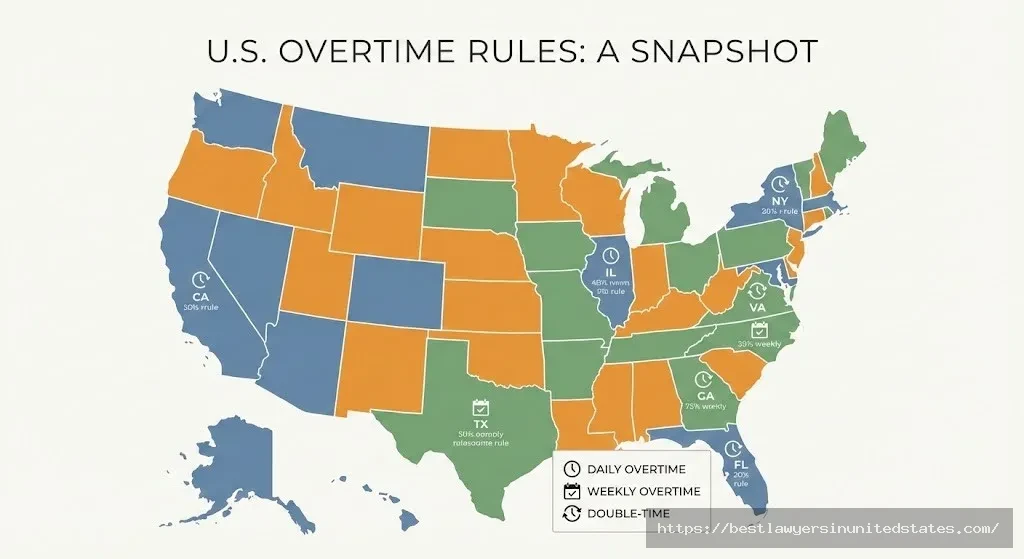
Many states offer stronger overtime protections than federal law requires. These state laws provide additional pay through daily overtime requirements, lower weekly thresholds, or special rules for consecutive workdays. When state and federal laws differ, employers must follow whichever law provides greater benefits to the employee.
California Overtime Rules
California has the most comprehensive overtime laws in the United States, offering multiple layers of protection that can significantly increase your earnings compared to federal standards. California workers benefit from daily overtime, weekly overtime, and special 7th consecutive day rules.
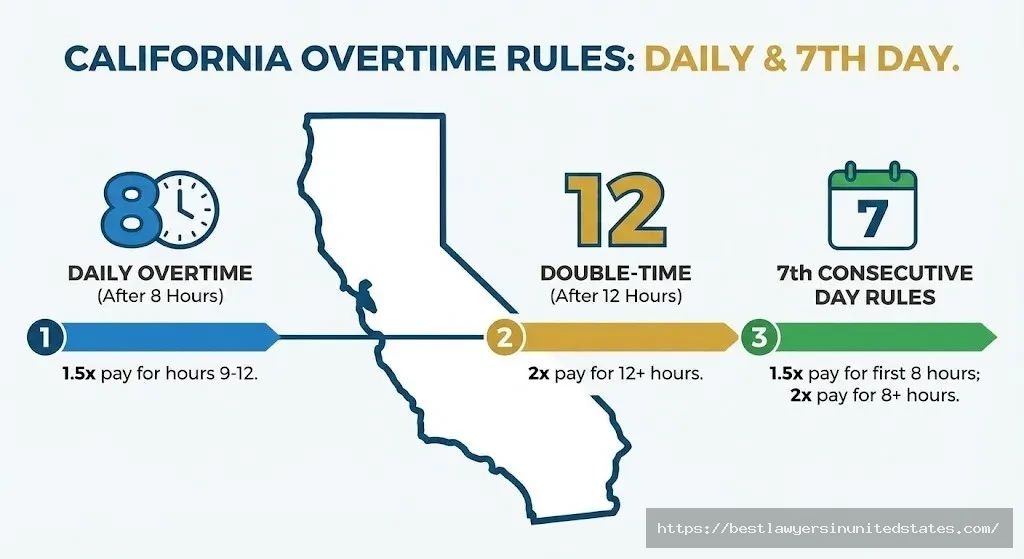
Daily overtime in California: You earn 1.5 times your regular rate after 8 hours in a workday and 2 times your regular rate after 12 hours in a workday. This means a 10-hour shift triggers 2 hours of overtime even if you only work three days that week. A 14-hour shift includes 4 hours at time-and-a-half (hours 9-12) and 2 hours at double-time (hours 13-14).
Weekly overtime in California: Beyond daily rules, you also earn 1.5 times your rate for all hours over 40 in a workweek. California law prevents “pyramiding” by not counting the same hours twice—hours already counted as daily overtime don’t count again toward the 40-hour weekly threshold.
7th consecutive day rules: When you work seven consecutive days in a workweek, California requires 1.5 times your rate for the first 8 hours on that 7th day and 2 times your rate for all hours beyond 8 on the 7th day. This provides premium pay even if you haven’t exceeded daily or weekly thresholds on previous days.
Example: You earn $20/hour and work Monday-Friday (8 hours each), Saturday (8 hours), and Sunday (10 hours). Total: 58 hours. You receive regular pay for 40 hours ($800), weekly overtime for 8 hours from Monday-Saturday ($240 at $30/hour), 7th day overtime for Sunday’s first 8 hours ($240 at $30/hour), and 7th day double-time for Sunday’s last 2 hours ($80 at $40/hour). Total weekly pay: $1,360.
Learn more: [California Minimum Wage & Overtime Laws]
Alaska Overtime Rules
Alaska requires both daily and weekly overtime, providing two opportunities to earn premium pay. This dual protection means you can earn overtime even during short work weeks if individual shifts are long enough.
Alaska’s daily overtime: You earn 1.5 times your regular rate for all hours over 8 in a workday. A single 10-hour shift earns you 2 hours of overtime regardless of your total weekly hours.
Alaska’s weekly overtime: You also earn 1.5 times your rate for all hours over 40 in a workweek, similar to federal law. Like California, Alaska prevents double-counting—hours paid as daily overtime don’t count again toward the 40-hour weekly threshold.
This combination means Alaska workers are well-protected whether they work long days on a compressed schedule or accumulate many hours throughout the week.
Learn more: [Alaska Minimum Wage & Overtime Laws]
Colorado Overtime Rules
Colorado provides daily overtime protection with a 12-hour threshold, offering premium pay for extremely long shifts while following federal standards for weekly overtime.
Colorado’s daily overtime: You earn 1.5 times your regular rate for all hours over 12 in a workday. While this threshold is higher than California or Alaska, it protects workers in industries with very long shifts, such as healthcare or emergency services where 14-16 hour shifts occasionally occur.
Colorado’s weekly overtime: You earn 1.5 times your rate for all hours over 40 in a workweek, following the federal standard. The daily overtime rule provides an additional layer of protection for consecutive long shifts.
Learn more: [Colorado Minimum Wage & Overtime Laws]
Nevada Overtime Rules
Nevada has unique overtime rules based on your wage rate, creating daily overtime requirements for lower-paid workers while maintaining weekly overtime for everyone.
Nevada’s wage-based daily overtime: If you earn less than $12 per hour (1.5 times the Nevada minimum wage), you’re entitled to 1.5 times your rate after 8 hours in a workday. This protects lower-wage workers from excessively long shifts without adequate compensation.
Nevada’s weekly overtime: All workers, regardless of wage rate, earn 1.5 times their rate for hours over 40 in a workweek. This ensures basic federal protections apply to everyone.
Nevada’s two-tiered approach recognizes that lower-paid workers need additional protection from long daily shifts, while all workers deserve fair compensation for long work weeks.
Learn more: [Nevada Minimum Wage & Overtime Laws]
Who Qualifies for Overtime Pay?
Understanding whether you qualify for overtime pay requires knowing the difference between “exempt” and “non-exempt” employee classifications. This distinction determines whether you’re legally entitled to overtime premiums for hours over 40 per week (or daily thresholds in certain states). Many workers are incorrectly classified as exempt, costing them thousands in unpaid overtime.
Non-Exempt Employees (Entitled to Overtime)
Non-exempt employees are protected by overtime laws and must receive premium pay for overtime hours. This classification covers most hourly workers and many salaried employees who don’t meet strict exemption criteria.
Characteristics of non-exempt employees: You’re typically paid hourly, though some salaried workers earning under $58,656 per year (2026 threshold) are also non-exempt. You must track your hours, receive at least minimum wage for all hours worked, and earn overtime premiums when you exceed 40 hours per week. Your employer can require you to work overtime, but they must pay you correctly for those hours.
Common non-exempt jobs include: retail sales associates, cashiers, restaurant servers and cooks, factory and warehouse workers, construction laborers, truck drivers, nursing assistants and home health aides, administrative assistants and clerical workers, customer service representatives, security guards, and janitors. If your job primarily involves manual labor, routine tasks following established procedures, or direct customer service without management responsibilities, you’re likely non-exempt.
Even if you’re salaried and earn a decent wage, you may still qualify as non-exempt if you don’t meet all three exemption tests. The salary threshold, salary basis, and duties test must all be satisfied for exemption to apply. Many employers misunderstand these rules and incorrectly classify employees as exempt.
Exempt Employees (Not Entitled to Overtime)
Exempt employees don’t receive overtime pay regardless of hours worked. However, this exemption status requires meeting strict legal criteria—it’s not simply the employer’s choice. To be properly classified as exempt, you must satisfy all three tests: salary basis, salary level, and duties.
The three exemption tests:
1. Salary Basis Test: You must be paid a predetermined, fixed salary that doesn’t change based on hours worked or quality of work. Your salary can’t be reduced for variations in work quality or quantity (though deductions are allowed for full-day absences for personal reasons or disciplinary suspensions).
2. Salary Level Test: You must earn at least $58,656 per year ($1,128 per week) in 2026. This threshold is adjusted periodically by the Department of Labor. If you earn less than this amount, you’re automatically non-exempt regardless of your job duties. Computer professionals have an alternative hourly threshold of $27.63/hour.
3. Duties Test: Your primary job duties must fall into executive, administrative, professional, computer professional, or outside sales categories. Having a fancy title isn’t enough—your actual day-to-day responsibilities must meet specific legal requirements.
Common exempt categories:
Executive exemption requires: Managing the enterprise or a recognized department/subdivision, regularly directing the work of two or more full-time employees, and having authority to hire/fire or having significant input into personnel decisions. A restaurant assistant manager who supervises a few employees and has input on hiring decisions might qualify, but a “team lead” who simply coordinates coworkers’ tasks without real supervisory authority does not.
Administrative exemption requires: Performing office or non-manual work directly related to management or general business operations (not production or sales), and exercising discretion and independent judgment on significant business matters. An HR specialist who designs company policies and makes decisions about benefits programs likely qualifies, but an HR assistant who processes paperwork following set procedures does not.
Professional exemption requires: Work requiring advanced knowledge in a field of science or learning, typically acquired through prolonged specialized intellectual instruction. Doctors, lawyers, engineers, architects, certified public accountants, and teachers generally qualify. The knowledge must be theoretical and specialized, not just skill gained through experience.
Computer professional exemption requires: Working as a systems analyst, programmer, software engineer, or similar role, earning either $58,656/year or $27.63/hour (2026), and performing specific duties like system analysis, program design, or creating software. General IT support or help desk positions don’t qualify.
Outside sales exemption requires: Your primary duty is making sales or obtaining orders/contracts for services, and you’re regularly engaged away from the employer’s place of business. Inside sales representatives, even highly paid ones, don’t qualify for this exemption.
Misclassification Issues
Misclassification of employees as exempt is one of the most common wage and hour violations. Employers sometimes misclassify workers to avoid paying overtime, either intentionally or through misunderstanding the complex exemption rules. This costs workers substantial money in unpaid overtime premiums.
Red flags you might be misclassified: You have a “manager” title but spend most of your time doing the same work as hourly employees with minimal supervisory duties. You’re classified as an independent contractor but work set hours at the employer’s location using their equipment and following their procedures. Your salary is below $58,656/year but you’re told you’re exempt from overtime. You’re called a “salaried” employee but your pay is docked for partial day absences. You do routine, manual work or follow detailed procedures without exercising real independent judgment.
If you believe you’re misclassified: You’re entitled to back pay for all unpaid overtime, typically going back 2-3 years depending on your state. Federal law allows recovery of double the unpaid wages as “liquidated damages” in addition to the overtime owed. Your employer cannot legally retaliate against you for questioning your classification or filing a wage claim—retaliation itself triggers additional penalties.
Calculate what you might be owed with our [Wage Theft Recovery Calculator] to estimate your potential recovery including back pay, liquidated damages, and interest.
How Overtime is Calculated: Step by Step
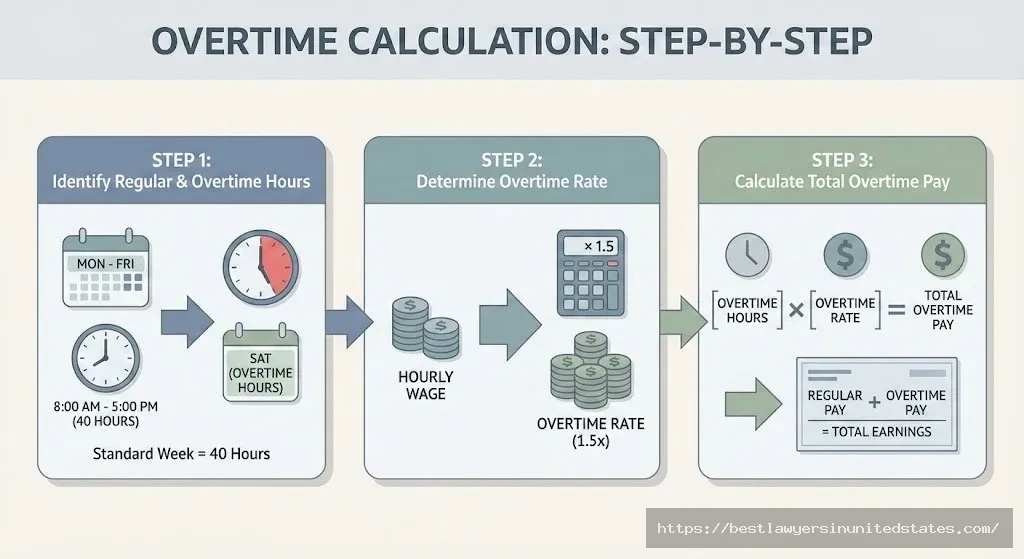
Understanding exactly how overtime is calculated helps you verify your paychecks and catch errors. The math varies depending on whether your state has daily overtime requirements, but the core concepts remain consistent: identify your regular rate, determine which hours qualify for premium pay, and multiply by the appropriate rate.
Basic Overtime Calculation (Federal/Most States)
Most states follow the federal calculation method, which is straightforward: regular pay for the first 40 hours, then time-and-a-half for everything beyond 40 in the workweek.
The formula: Overtime Rate = Regular Hourly Rate × 1.5
Step-by-step example: You earn $15 per hour and work 50 hours in a week.
- Calculate your overtime rate: $15 × 1.5 = $22.50 per hour
- Calculate regular pay for first 40 hours: 40 × $15 = $600
- Calculate overtime pay for hours 41-50: 10 × $22.50 = $225
- Total weekly gross pay: $600 + $225 = $825
This method applies in most states including Texas, Florida, New York, Pennsylvania, Illinois, Ohio, Georgia, North Carolina, Michigan, New Jersey, and 40 other states that follow federal overtime standards without additional daily requirements.
California Daily Overtime Calculation
California’s calculation is more complex because you must analyze each day individually to determine daily overtime, then apply weekly overtime rules to remaining hours. The key is understanding that daily overtime hours don’t count again toward the 40-hour weekly threshold.
Step-by-step example: You earn $20 per hour and work 10 hours each day Monday through Friday (50 total hours for the week).
- Identify daily overtime: Each day you worked 8 regular hours + 2 overtime hours (hours 9-10 at time-and-a-half)
- Calculate daily overtime across the week: 5 days × 2 hours = 10 hours of daily overtime
- Calculate regular hours: 40 hours (8 per day × 5 days)
- Check weekly overtime: Total hours (50) minus daily overtime hours already counted (10) = 40 hours. Since this doesn’t exceed 40, no additional weekly overtime applies.
- Calculate regular pay: 40 × $20 = $800
- Calculate daily overtime pay: 10 × $30 = $300
- Total weekly pay: $800 + $300 = $1,100
Compare this to federal rules where the same 50 hours would produce only $900 ($600 regular + $300 overtime). California’s daily overtime rules earned you $200 more for the exact same hours worked.
Why this matters: California’s daily overtime ensures you’re compensated fairly even if you work compressed schedules. Working four 10-hour days (40 total hours) still earns you 8 hours of overtime pay, whereas under federal law you’d receive straight time for all 40 hours.
California 7th Day Calculation
California’s 7th consecutive day rules add another layer of premium pay, protecting workers who don’t get adequate days off. This scenario combines daily, weekly, and 7th day overtime rules.
Complex example: You earn $20/hour. You work Monday through Saturday (8 hours each day = 48 hours), then Sunday (10 hours). Total: 58 hours across 7 consecutive days.
Calculation breakdown:
- Monday-Friday regular time: 5 days × 8 hours = 40 hours at $20 = $800
- Saturday (6th day) weekly overtime: 8 hours at $30 (time-and-a-half) = $240
- These 8 hours put you over the 40-hour weekly threshold
- Sunday (7th consecutive day), first 8 hours: 8 hours at $30 (7th day overtime) = $240
- Even though you’re already over 40 hours, the 7th day requires time-and-a-half for first 8 hours
- Sunday, hours 9-10: 2 hours at $40 (7th day double-time) = $80
- Over 8 hours on the 7th consecutive day triggers double-time
Total weekly pay: $800 + $240 + $240 + $80 = $1,360
Under federal law, the same 58 hours would only produce $1,140 ($800 regular for first 40 hours + $540 overtime for the remaining 18 hours). California’s laws earned you an extra $220 for the same work.
Double-Time Calculation
Double-time pay (2 times your regular rate) only applies in California and only under specific circumstances. Understanding when you qualify helps you ensure proper payment for your longest and most demanding shifts.
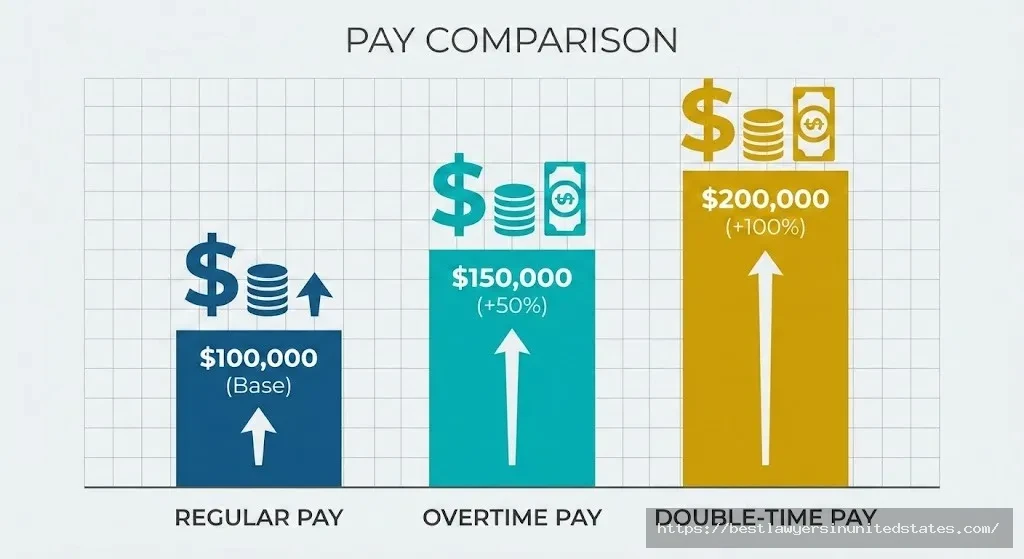
When California requires double-time:
- All hours over 12 in a single workday
- All hours over 8 on the 7th consecutive workday in a workweek
Example: You earn $16 per hour and work a 14-hour shift.
Breakdown:
- Hours 1-8: 8 × $16 = $128 (regular time)
- Hours 9-12: 4 × $24 = $96 (time-and-a-half overtime)
- Hours 13-14: 2 × $32 = $64 (double-time)
- Total for 14-hour shift: $128 + $96 + $64 = $288
Compare this to federal law where hours 1-8 would be $128 regular and hours 9-14 would be $144 overtime (6 hours × $24), totaling only $272 if you hadn’t exceeded 40 hours that week. California’s double-time rule earned you an extra $16 for those grueling final two hours.
Double-time serves as both compensation and deterrent—it fairly pays you for extremely long hours while incentivizing employers to limit shifts to reasonable lengths rather than working employees to exhaustion.
Common Overtime Mistakes by Employers
Many employers violate overtime laws, sometimes unknowingly but often to cut labor costs. Recognizing these common mistakes helps you identify when you’re not being paid correctly and take action to recover what you’re owed.

Averaging Hours Across Pay Periods
Some employers try to average your hours across multiple weeks to avoid overtime, claiming that if you worked 50 hours one week and 30 hours the next, it “averages out” to 40 hours each week. This practice is illegal under federal and state law.
The illegal practice: You work 50 hours in Week 1 and 30 hours in Week 2. Your employer pays you straight time for all 80 hours (40 hours × 2 weeks) and refuses to pay overtime for Week 1’s extra 10 hours. They claim the hours “even out” because Week 2 was short.
What the law requires: Each workweek stands alone for overtime purposes. Week 1’s 50 hours requires regular pay for 40 hours plus overtime pay for 10 hours. Week 2’s 30 hours is paid at regular time. You cannot average, combine, or offset weeks against each other. The FLSA is explicit: overtime is calculated weekly, period.
This violation is particularly common in industries with fluctuating schedules like retail, hospitality, and healthcare. If your employer uses this excuse, you’re owed back pay for every week where you exceeded 40 hours but didn’t receive proper overtime compensation.
Not Paying for “Off the Clock” Work
Employers must pay you for all hours you’re “suffered or permitted to work,” even if that work happens outside your scheduled shift. Many employers violate this rule by expecting or requiring work without proper compensation.
Common off-the-clock violations: You must arrive 15 minutes early for a pre-shift meeting or equipment setup, but your time clock doesn’t start until your scheduled shift begins. You’re required to answer emails, phone calls, or texts after hours. You attend mandatory training, staff meetings, or safety briefings without pay. You work through lunch breaks but your time is automatically deducted. You perform opening or closing duties before clocking in or after clocking out.
The legal rule: All time you spend on work-related activities controlled by your employer must be paid. This includes time “suffered or permitted to work”—if your employer knows or should know you’re working, they must pay you. If you send work emails at 9 PM because your workload requires it, those minutes count. If your boss expects you to answer customer calls during your commute, that’s work time.
Overtime impact: These unpaid minutes add up quickly. If off-the-clock work pushes you over 40 hours for the week, those hours should be paid at overtime rates. An employee who works an unpaid 30 minutes daily (15 minutes before and after shift) accumulates 2.5 hours per week—all potentially owed at time-and-a-half if already at 40 hours.
Comp Time Instead of Overtime Pay
“Comp time” (compensatory time off instead of overtime pay) is illegal for private-sector employers. If you work overtime, your employer must pay you in cash at the overtime rate—they cannot substitute time off, even if you prefer it.
The private sector rule: Private employers cannot offer comp time instead of overtime pay. If you work 50 hours this week, you must receive a paycheck with overtime pay for those 10 extra hours. Your employer can’t say “take Friday off next week instead” and pay you straight time for this week. This applies even if you agree to the arrangement—wage laws protect you from agreements that waive your right to overtime pay.
The public sector exception: Government employers (federal, state, and local) can offer comp time under specific rules established by the FLSA. Public employees may accrue comp time at 1.5 hours for each overtime hour worked, up to certain limits (240 hours for most employees, 480 for public safety workers). These rules don’t apply to private businesses.
Many workers prefer time off over extra money, but the law prohibits this arrangement in the private sector because it’s too easily abused. Employers could pressure employees to accept comp time, then never allow them to use it, or schedule it inconveniently. Cash payment ensures you actually receive the compensation you earned.
Misclassifying Workers as Exempt
Employee misclassification is the most common and costly overtime violation. Employers sometimes give workers “manager,” “supervisor,” or “administrator” titles, classify them as exempt, and refuse overtime pay—even though the employees don’t meet legal exemption criteria.
Common misclassification scenarios: An “assistant manager” at a retail store who spends 90% of their time stocking shelves and running registers with minimal actual supervisory duties. An “administrative coordinator” who performs routine clerical tasks following set procedures without exercising independent judgment. A worker earning $45,000/year (below the $58,656 threshold) but labeled exempt. Someone classified as an independent contractor who works set hours at the employer’s location using company equipment.
Why misclassification happens: Some employers genuinely misunderstand complex exemption rules. Others deliberately misclassify to avoid overtime costs. Either way, the result is the same: workers lose money they legally earned. A misclassified employee working 50 hours per week at $20/hour loses $300 weekly ($15,600 annually) in unpaid overtime.
Your rights if misclassified: You’re entitled to back pay for all unpaid overtime, typically recoverable for 2-3 years. You can also recover liquidated damages (often double your unpaid wages), attorney fees, and court costs. Your employer cannot retaliate against you for questioning your classification or filing a claim.
Not Including All Pay in Overtime Rate
Your overtime rate must be calculated using your complete “regular rate of pay,” which often includes more than just your base hourly wage. Employers sometimes calculate overtime using only base pay, shorting you on your true overtime rate.
What must be included in your regular rate: Your base hourly wage, shift differentials (extra pay for night/weekend shifts), non-discretionary bonuses (production bonuses, attendance bonuses, safety bonuses), piece-rate or commission earnings allocated across hours worked, and most other forms of compensation for work performed.
Common mistakes: You earn $15/hour base plus $2/hour night shift differential, working 50 hours on night shift. Your employer calculates overtime at $22.50 (base $15 × 1.5) instead of the correct $25.50 (total rate $17 × 1.5). This $3/hour error costs you $30 for 10 overtime hours. Over a year, this could mean thousands in unpaid overtime.
Bonus allocation example: You earn $20/hour and work 50 hours in a week. You also receive a $200 weekly production bonus. Your regular rate for that week is actually $24/hour ($1,000 base + $200 bonus ÷ 50 hours). Your overtime rate should be $36/hour (not $30/hour), significantly increasing your overtime pay.
Employers must recalculate your regular rate each week if you receive bonuses or other variable compensation, then apply the correct overtime multiplier. Failing to do so violates federal and state wage laws.
What to Do If You’re Not Being Paid Overtime
If you suspect your employer isn’t paying you correctly for overtime, you have legal options to recover unpaid wages. Acting quickly and documenting everything strengthens your case and helps you get the money you earned.
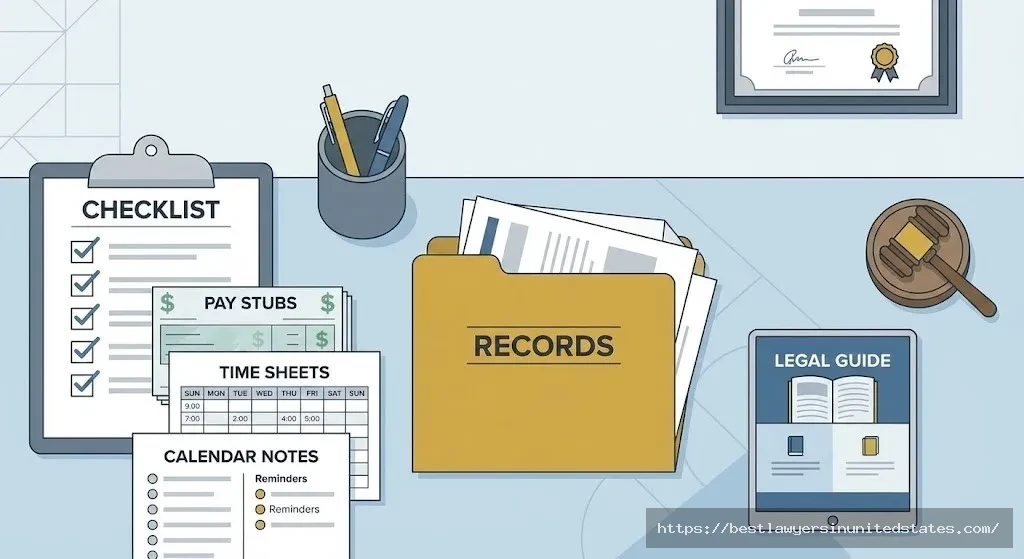
Document Everything
Strong documentation is crucial for proving unpaid overtime. Even if your employer doesn’t provide time records, you can create your own documentation that courts and labor departments will accept.
What to keep and record: Maintain your own time records showing daily start times, end times, meal breaks, and total hours worked. Keep every pay stub you receive, even if they seem incorrect. Save work schedules, shift assignment texts, and emails about your hours. Screenshot or save text messages from supervisors about working late, coming in early, or handling work tasks off-the-clock. Document conversations about overtime pay (dates, times, what was said). Gather witness statements from coworkers who can verify your hours or similar pay issues.
How to keep records: Use a simple notebook, phone app, or spreadsheet to track your hours daily. Note any discrepancies between your records and your paycheck. If your employer uses a time clock or digital system, photograph your punches or take screenshots of your hours before they’re processed. If you’re locked out of the system, request copies of your time records in writing—employers must provide these.
Even imperfect records help. If you can’t remember exact times for past weeks, estimate based on your typical schedule. Courts understand employees don’t always keep perfect records, and the burden shifts to employers to prove you wrong if they failed to maintain proper records themselves.
Calculate What You’re Owed
Understanding the potential value of your claim helps you decide whether to pursue it and what recovery you might expect. Overtime claims can be substantial, especially when liquidated damages and penalties apply.
Use our [Wage Theft Recovery Calculator] to estimate your total recovery including unpaid overtime wages, liquidated damages (often 2× the unpaid amount under federal law), interest on unpaid wages, and potential attorney fees and court costs. The calculator considers your state’s laws, which may provide additional penalties beyond federal requirements.
Example recovery: If you’re owed $10,000 in unpaid overtime from the past two years, federal liquidated damages could double that to $20,000. Add interest, attorney fees, and state-specific penalties, and your total recovery might exceed $25,000. This is why documenting everything and pursuing your claim is worth the effort.
File a Complaint with Your State Labor Department
Each state has a labor department that investigates wage claims and can force employers to pay unpaid wages. This process is free, doesn’t require a lawyer, and provides strong protections against retaliation.
How to file: Contact your state’s Department of Labor or Labor Commissioner’s office (search “[Your State] wage claim” for contact information). File your wage claim within your state’s statute of limitations, typically 2-3 years from when wages were due. Provide all documentation you’ve gathered: time records, pay stubs, work schedules, and evidence of overtime worked. Attend any required hearings or meetings—the labor department will investigate and may hold a formal hearing where you present your case.
What happens next: Investigators will contact your employer, review records, and determine if violations occurred. If they find in your favor, they’ll issue an order requiring payment. Your employer must comply or face additional penalties. The process typically takes several months depending on case complexity and department workload.
Retaliation protection: Federal and state laws prohibit employers from retaliating against employees who file wage claims. You cannot be fired, demoted, have hours reduced, or face other adverse actions for asserting your rights. If retaliation occurs, you have additional claims for damages and potential reinstatement.
Consult an Employment Attorney
While not always necessary, employment attorneys can handle complex cases, maximize your recovery, and protect you throughout the process. Many work on contingency, meaning you pay nothing upfront.

Benefits of legal representation: Attorneys specializing in wage and hour law understand nuances of overtime regulations, exemption rules, and calculation methods. They can handle cases involving misclassification, multiple violations, or employer retaliation. Attorneys often achieve higher settlements because employers take legal representation seriously. In most wage and hour cases, the employer pays your attorney fees if you win, as federal and state laws require.
How attorneys work on overtime cases: Most employment lawyers offer free initial consultations to evaluate your case. They often work on contingency (you pay only if you recover money, typically 30-40% of the recovery). Some cases are handled on an hourly basis if contingency isn’t appropriate. Attorneys can negotiate settlements or file lawsuits in court depending on what’s most effective.
When to consult an attorney: Cases involving complex exemption analysis, significant money (over $10,000), multiple legal violations, employer retaliation, or class action potential. If your state labor department investigation isn’t progressing or you need faster resolution. When you feel overwhelmed by the process or worried about employer intimidation.
Contact us: Email [email protected] for a referral to experienced employment attorneys in your state. Our network includes lawyers who specialize in overtime and wage theft cases and can evaluate your situation at no charge.
[Find Employment Lawyers by State]
Overtime Pay by Industry
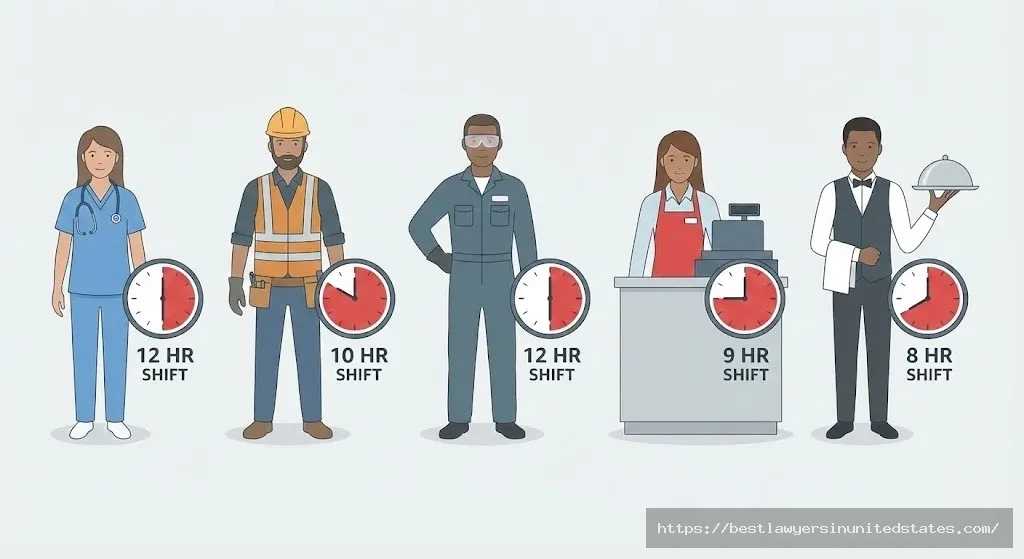
Overtime issues vary by industry based on work schedules, employer practices, and regulatory oversight. Understanding industry-specific patterns helps you recognize violations and know what to watch for in your field.
Healthcare Workers
Healthcare workers frequently work long shifts, creating numerous overtime pay issues. Twelve-hour shifts are common for nurses and support staff, and staffing shortages often lead to mandatory overtime.
Common issues: Mandatory overtime without proper premium pay, automatic meal break deductions even when breaks aren’t taken, misclassification of registered nurses as exempt (RNs are generally non-exempt unless they meet specific exemption criteria), and comp time arrangements that violate federal law. In states with daily overtime like California, 12-hour shifts trigger 4 hours of overtime pay plus potential double-time, making proper calculation essential.
What to watch: Verify that all hours over 40 per week are paid at time-and-a-half. In California and Alaska, ensure hours over 8 daily are paid as overtime. Check that meal break deductions match actual breaks taken. If you’re an RN earning under $58,656/year without management duties, you likely qualify for overtime despite what your employer claims.
Restaurant and Food Service
Restaurants have high rates of overtime violations, particularly regarding off-the-clock work and improper tip credit calculations. The combination of variable hours, tips, and young workers creates opportunities for wage theft.
Common issues: Required preparation or closing work off the clock, working through breaks without compensation, improper tip pooling that reduces overtime pay, misclassification of shift supervisors as exempt managers when they perform regular server or kitchen duties, and overtime calculated on reduced “tip credit” rate instead of full minimum wage.
What to watch: Ensure all prep work, side work, and closing duties are on the clock. Overtime should be calculated on the full minimum wage, not the reduced tip credit rate. Time spent in required meetings or training must be paid. If you’re called a “manager” but spend most of your time serving tables or cooking, you likely deserve overtime pay.
Retail Workers
Retail overtime violations often involve misclassification and off-the-clock work expectations, particularly during busy seasons when stores extend hours and increase staffing demands.
Common issues: “Assistant managers” or “team leads” misclassified as exempt despite minimal supervisory duties, unpaid time for opening/closing procedures, security bag checks, or store meetings, working through breaks during busy periods without compensation, and pressure to work off the clock to meet labor budget targets.
What to watch: If your title includes “manager” but you spend most time on the sales floor, stocking, or cashiering, you probably deserve overtime. All time spent on required duties (even if “voluntary”) must be paid. Seasonal overtime during holidays should be carefully tracked and properly compensated.
Construction
Construction workers commonly work overtime due to project deadlines, weather delays, and seasonal demands. The industry also has high rates of independent contractor misclassification.
Common issues: Misclassification as independent contractors when workers are actually employees, weekend and extended-hour work without overtime pay, travel time to job sites not counted as hours worked, and prevailing wage violations on government contracts that include specific overtime requirements.
What to watch: If you work for one company, use their tools and equipment, and follow their schedule and supervision, you’re likely an employee (not an independent contractor) entitled to overtime. Travel time beyond normal commuting may count as work time. On federal or state construction projects, prevailing wage laws may require overtime even for contractors.
Manufacturing
Manufacturing overtime issues often involve shift work, production bonuses, and complex pay structures that employers calculate incorrectly.
Common issues: Shift differentials not included in overtime rate calculations, production bonuses or piece-rate work excluded from regular rate when calculating overtime, mandatory overtime during high production periods without proper premium pay, and comp time arrangements that violate federal law.
What to watch: Overtime rates must be calculated using your full regular rate, including shift differentials and bonuses. If you receive a weekly production bonus, it must be divided by total hours worked to determine your true regular rate, then overtime recalculated at 1.5 times that rate. The math gets complex, but employers must do it correctly or they owe you money.
Frequently Asked Questions
How is overtime pay calculated?
Quick Answer: Overtime pay is calculated at 1.5 times your regular hourly rate for hours worked over 40 in a workweek under federal law. Some states have daily overtime requirements that trigger premium pay sooner.
Federal law requires time-and-a-half for all hours beyond 40 in a seven-day workweek. If you earn $18/hour, your overtime rate is $27/hour. States like California, Alaska, Colorado, and Nevada have additional rules requiring daily overtime or special 7th-day premium pay, which can increase your earnings beyond federal minimums.
What is time-and-a-half?
Quick Answer: Time-and-a-half means 1.5 times your regular hourly wage. If you earn $15/hour, your overtime rate is $22.50/hour.
This overtime premium compensates you fairly for long hours and discourages employers from overworking staff. Time-and-a-half is the standard overtime rate under federal law and most state laws. Some situations require double-time (2 times your rate), but time-and-a-half is the minimum for overtime hours in nearly all circumstances.
Do salaried employees get overtime?
Quick Answer: Some do, some don’t. Salaried employees earning under $58,656/year (2026 threshold) and not meeting exemption duties tests are entitled to overtime.
Being paid a salary doesn’t automatically make you exempt from overtime. You must meet three tests: salary basis (paid a fixed amount regardless of hours), salary level (at least $58,656/year in 2026), and duties test (executive, administrative, or professional job duties). Many salaried employees are actually entitled to overtime but don’t realize it because they’ve been misclassified as exempt.
Which states have daily overtime laws?
Quick Answer: California, Alaska, Colorado, and Nevada have daily overtime requirements. California has the most comprehensive rules with daily OT after 8 hours.
California requires 1.5x pay after 8 hours daily and 2x pay after 12 hours daily, plus special 7th consecutive day rules. Alaska requires 1.5x pay after 8 hours daily. Colorado requires 1.5x pay after 12 hours daily. Nevada requires 1.5x pay after 8 hours daily for workers earning under $12/hour. These state rules apply in addition to federal weekly overtime requirements.
Can my employer give me comp time instead of overtime pay?
Quick Answer: No, if you work for a private employer. Private employers must pay overtime in cash at 1.5x your regular rate. Only government employers can offer comp time under specific conditions.
Federal law prohibits private sector employers from offering compensatory time off instead of overtime pay, even if you prefer time off. You must receive a paycheck with overtime premiums included. Government employers (federal, state, local) can offer comp time under strict rules, but private businesses cannot. This protection prevents employers from pressuring workers to accept time off they may never be allowed to use.
What is double-time pay?
Quick Answer: Double-time is 2 times your regular hourly rate, required in California after 12 hours in a day or after 8 hours on the 7th consecutive workday.
California is the only state requiring double-time pay. It applies in two situations: working more than 12 hours in a single workday, or working more than 8 hours on the 7th consecutive day in a workweek. If you earn $20/hour, your double-time rate is $40/hour. This premium recognizes that extremely long shifts demand higher compensation and encourages reasonable work schedules.
Do I get overtime if I work weekends?
Quick Answer: Not automatically. Weekend work only requires overtime pay if it puts you over 40 hours for the week (or over daily thresholds in states with daily OT rules).
Working Saturday or Sunday doesn’t automatically trigger overtime pay under federal law. Overtime depends on total hours worked, not which days you work. If you work Monday-Friday (8 hours each = 40 hours), then work Saturday (8 hours), those Saturday hours are overtime because you’re now at 48 hours total. But if you work Tuesday-Saturday (8 hours each = 40 hours), no overtime is owed under federal law even though you worked Saturday.
How long do I have to file an overtime claim?
Quick Answer: Typically 2-3 years depending on your state. The federal FLSA allows 2 years for most claims, 3 years for willful violations.
Federal law provides a 2-year statute of limitations for overtime claims, extended to 3 years if the violation was willful (the employer knew or showed reckless disregard for whether their conduct violated the law). State laws vary—some states allow longer recovery periods. You should file as soon as you discover unpaid overtime because evidence disappears and witnesses’ memories fade. Don’t wait until the deadline approaches.
Can my employer fire me for asking about overtime pay?
Quick Answer: No. Retaliation for asking about wages or filing a wage claim is illegal under federal and state laws. You’re protected even if your claim is ultimately unsuccessful.
The FLSA and state wage laws prohibit employers from retaliating against employees who inquire about overtime pay, file wage claims, or participate in investigations. Retaliation includes firing, demotion, reducing hours, giving poor evaluations, or any adverse action because you asserted your rights. If retaliation occurs, you have additional claims for damages, potential reinstatement, and attorney fees on top of your overtime claim.
Does overtime count toward the 40-hour threshold?
Quick Answer: No. Only actual hours worked count toward the 40-hour threshold. Paid time off, holidays, and sick leave don’t count as hours worked for overtime purposes.
Overtime is based on hours actually worked, not hours paid. If you work 32 hours and take 8 hours of vacation, you have 40 paid hours but only 32 worked hours—no overtime is owed even if you work an additional 8-hour day. However, time spent in required training, meetings, or travel for work counts as hours worked. The distinction matters: “paid time” includes vacation and holidays; “hours worked” only includes time spent performing work duties.
Related Calculators and Tools
Minimum Wage Calculator
Calculate your total earnings based on your state’s minimum wage, including weekly, monthly, and annual income projections. This calculator helps you understand your baseline pay before overtime kicks in.
Wage Theft Recovery Calculator
Estimate how much you can recover for unpaid overtime, including back pay, liquidated damages, interest, and attorney fees. Get a clear picture of your potential claim value.
Wage Theft Recovery Calculator
State-Specific Overtime Laws
Detailed guides for all 50 states with state-specific overtime rules, filing procedures, and labor department contact information.
States with special overtime rules:
- California Minimum Wage & Overtime Laws
- Alaska Minimum Wage & Overtime Laws
- Colorado Minimum Wage & Overtime Laws
- Nevada Minimum Wage & Overtime Laws
Additional state resources:
- New York Minimum Wage & Overtime Laws
- Texas Minimum Wage & Overtime Laws
- Florida Minimum Wage & Overtime Laws
- Pennsylvania Minimum Wage & Overtime Laws
- Illinois Minimum Wage & Overtime Laws
- Ohio Minimum Wage & Overtime Laws
- Georgia Minimum Wage & Overtime Laws
- Washington Minimum Wage & Overtime Laws
State Overtime Law Resources
Every state enforces overtime laws through their labor department, and many states provide additional worker protections beyond federal requirements. Understanding your state’s specific rules helps you know exactly what you’re entitled to earn.
States with daily overtime laws offer the strongest worker protections through requirements that premium pay kicks in after 8 or 12 hours in a single day. These rules protect workers on compressed schedules who might not exceed 40 hours weekly but work extremely long individual shifts.
California’s comprehensive overtime framework includes daily overtime after 8 hours, daily double-time after 12 hours, weekly overtime after 40 hours, and special 7th consecutive day rules. California workers have some of the strongest overtime protections in the nation. Learn more: California Minimum Wage & Overtime Laws
Alaska’s dual overtime system provides both daily overtime (after 8 hours) and weekly overtime (after 40 hours), giving workers two opportunities to earn premium pay. This is particularly valuable for workers in industries with irregular schedules. Learn more: Alaska Minimum Wage & Overtime Laws
Colorado’s 12-hour threshold protects workers from extremely long shifts by requiring overtime pay after 12 hours in a workday, in addition to the standard 40-hour weekly requirement. Learn more: Colorado Minimum Wage & Overtime Laws
Nevada’s wage-based daily overtime creates a two-tier system where workers earning under $12/hour get daily overtime protection after 8 hours, while all workers receive weekly overtime after 40 hours. Learn more: Nevada Minimum Wage & Overtime Laws
States following federal standards include Texas, Florida, New York, Pennsylvania, Illinois, Ohio, Georgia, North Carolina, Michigan, New Jersey, Virginia, Washington, Arizona, Massachusetts, Tennessee, Indiana, Missouri, Maryland, Wisconsin, Minnesota, and 30 others. While these states follow the federal 40-hour weekly threshold, they may have other worker protections like higher minimum wages or stronger retaliation penalties.
Access detailed information for your state:
- New York Minimum Wage & Overtime Laws
- Texas Minimum Wage & Overtime Laws
- Florida Minimum Wage & Overtime Laws
- Pennsylvania Minimum Wage & Overtime Laws
- Illinois Minimum Wage & Overtime Laws
- Ohio Minimum Wage & Overtime Laws
- Michigan Minimum Wage & Overtime Laws
- Georgia Minimum Wage & Overtime Laws
Get Legal Help with Unpaid Overtime
Missing overtime pay from your paychecks? Been told you’re exempt when you suspect you’re not? Required to work off the clock or through meal breaks? These are serious wage violations that cost you money you’ve rightfully earned.
You may be entitled to substantial recovery including:
Full back pay for all unpaid overtime, typically going back 2-3 years depending on your state’s statute of limitations. If you’ve been shorted on overtime for years, this alone can amount to tens of thousands of dollars.
Liquidated damages often equal to double your unpaid wages under federal law. This means if you’re owed $15,000 in unpaid overtime, liquidated damages could add another $15,000 to your recovery, totaling $30,000.
Attorney fees and court costs paid by your employer if you win. Federal and state wage laws require employers to pay your legal fees, which means you can hire an experienced attorney without upfront costs or worry about legal bills.
Protection from retaliation with additional damages if your employer fires, demotes, or otherwise punishes you for asserting your rights. Retaliation is illegal and triggers separate penalties on top of your wage claim.
Free Legal Consultation: Don’t let unpaid overtime go uncollected. Contact experienced employment attorneys who specialize in wage and hour law to evaluate your case at no charge.
Email: [email protected]
Find Employment Lawyers by State – Free Consultation
Most overtime cases are handled on contingency, meaning you pay nothing unless you recover money. The employer pays attorney fees if you win, making it risk-free to pursue the wages you’ve earned. Time limits apply to wage claims, so don’t wait—contact an attorney today to protect your rights.
Disclaimer
This overtime pay calculator provides estimates based on federal and state overtime laws as of 2026. Actual overtime pay depends on your specific situation, including your job classification, employer policies, state laws, industry-specific regulations, and collective bargaining agreements if applicable. Exemption status requires detailed analysis of both salary level and actual job duties performed, which this calculator cannot assess.
This calculator and the information provided are for informational and educational purposes only and do not constitute legal advice. Overtime calculations can be complex, particularly in states with daily overtime requirements or when bonuses and other compensation must be included in the regular rate. For advice about your specific employment situation, overtime entitlement, or potential wage claims, consult with a qualified employment attorney in your state.
The calculator assumes accurate input of hours worked and wages. It cannot account for all possible pay structures, industry-specific rules, or individual employment contracts. Results should be verified against actual pay stubs and state labor department guidance.
