
Colorado’s minimum wage will reach $15.02 per hour on January 1, 2026, based on the state’s constitutional inflation adjustment formula. Denver maintains a higher rate at $19.29 per hour. This makes Colorado one of the highest minimum wage states in the nation, significantly above the federal minimum of $7.25.
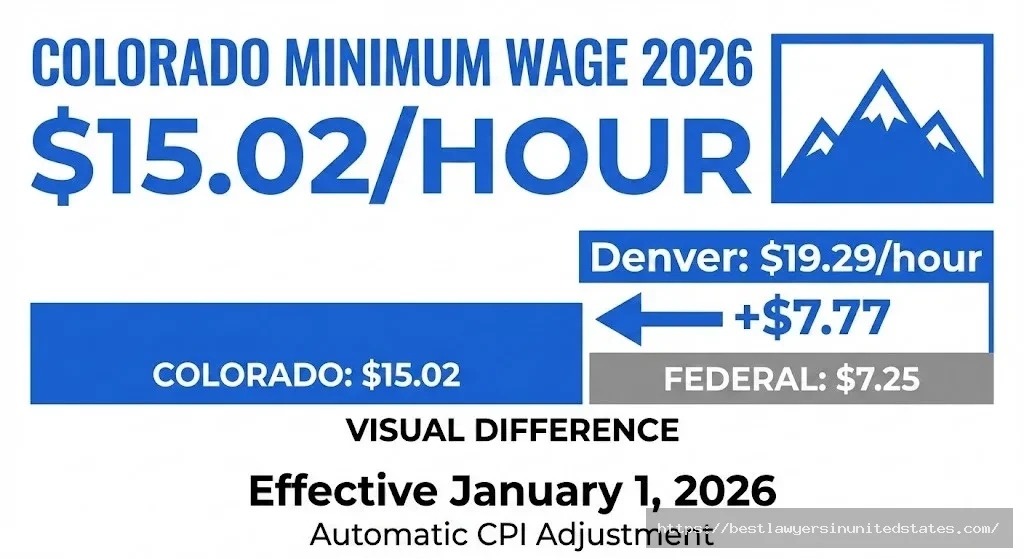
Unlike most states, Colorado’s minimum wage increases automatically each year. The Colorado Constitution requires annual adjustments based on the Denver-Aurora-Lakewood Consumer Price Index. Employers must also follow Colorado’s unique overtime rules, which require payment for work exceeding 40 hours per week, 12 hours in one day, or 12 consecutive hours.
Quick facts for 2026:
- State minimum wage: $15.02/hour
- Denver minimum wage: $19.29/hour
- Tipped minimum wage: $11.98/hour (state)
- Overtime triggers: 3 different thresholds
- Next increase: January 1, 2027 (amount TBD)
Calculate Your Earnings in Colorado
Want to know exactly how much you’ll earn at Colorado’s $15.02 minimum wage? Our minimum wage calculator helps you estimate your weekly, monthly, and annual income based on your hours worked.
💰 Minimum Wage Earnings Calculator
Calculate your weekly, monthly, and annual earnings with overtime and tax estimates
📊 Your Earnings Breakdown
💰 Gross Earnings
Calculator features:
- Automatic Colorado wage rates for 2026
- Weekly, monthly, and annual earnings
- Overtime calculations
- Tax withholding estimates
- Take-home pay breakdown
Full calculator with all features: Calculate your minimum wage earnings here
Questions about your wages or need legal help?
Email: [email protected]
Current Minimum Wage Rates in Colorado (2026)
Statewide Minimum Wage
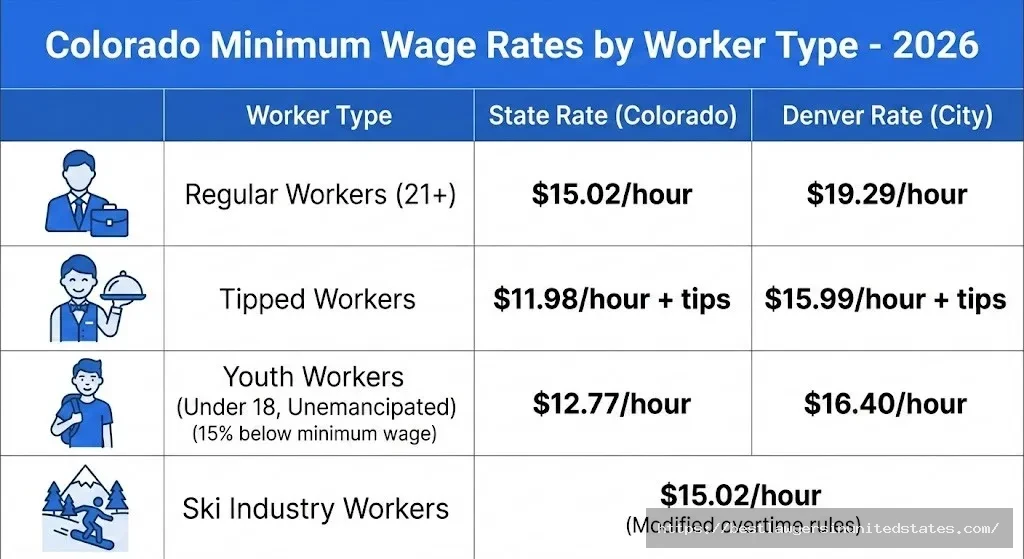
Colorado's minimum wage for 2026 is $15.02 per hour. This represents a 1.4% increase from the 2025 rate of $14.81. The increase follows the state constitution's requirement to adjust wages annually based on inflation.
All employers in Colorado must pay at least this rate. The only exceptions are specific job categories listed in Colorado Minimum Wage Order Number 35.
Annual salary equivalent: A full-time worker earning $15.02/hour makes $31,241.60 per year (based on 2,080 hours).
Denver Minimum Wage (Higher Than State)
Denver sets its own minimum wage through city ordinance. For 2026, Denver's rate is $19.29 per hour. This is $4.27 higher than the state minimum.
If you work within Denver city limits, your employer must pay the Denver rate. This applies even if the business is based outside Denver.
Key difference: Working the same job pays differently based on location. A server in Denver earns $19.29/hour minimum, while the same position in Colorado Springs earns $15.02/hour.
Tipped Employee Minimum Wage
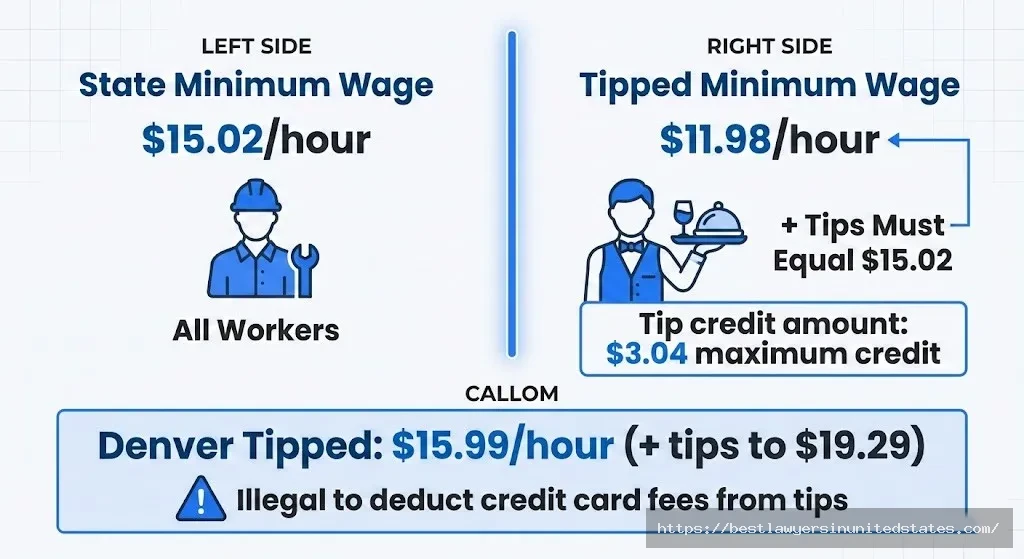
Colorado allows employers to pay tipped workers a lower base wage. For 2026:
- State tipped wage: $11.98 per hour (cash wage) + tips
- Denver tipped wage: $15.99 per hour (cash wage) + tips
Your total earnings (cash wage + tips) must equal or exceed the full minimum wage. If your tips fall short, your employer must make up the difference.
Important: Colorado law prohibits employers from taking more than $3.04 per hour in tip credits (2026 state rate). Denver's tip credit is $3.30 per hour.
City-by-City Minimum Wage Breakdown
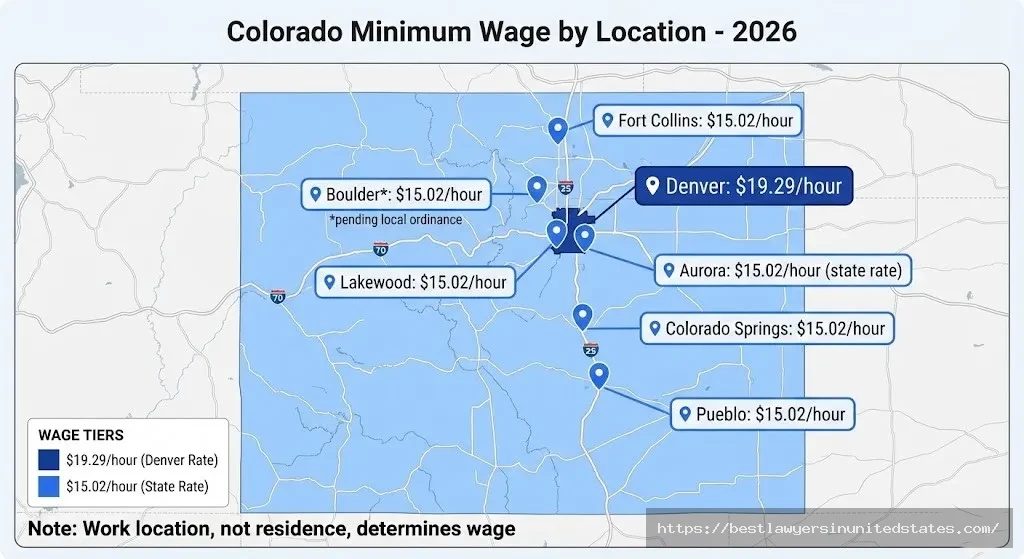
| City | 2026 Minimum Wage | Tipped Wage | Notes |
|---|---|---|---|
| Denver | $19.29 | $15.99 | City ordinance |
| Colorado Springs | $15.02 | $11.98 | State rate |
| Aurora | $15.02 | $11.98 | State rate |
| Boulder | $15.02* | $11.98 | *Pending local ordinance |
| Fort Collins | $15.02 | $11.98 | State rate |
| Lakewood | $15.02 | $11.98 | State rate |
| Thornton | $15.02 | $11.98 | State rate |
| Arvada | $15.02 | $11.98 | State rate |
| Pueblo | $15.02 | $11.98 | State rate |
| Centennial | $15.02 | $11.98 | State rate |
Note: Boulder County has proposed a local minimum wage ordinance. Check current status if you work in Boulder.
Which Minimum Wage Applies to You?
Workers in Denver City Limits
You must receive Denver's minimum wage ($19.29) if you physically perform work within Denver city limits. Your employer's location doesn't matter. Only your work location determines the applicable rate.
Example: You live in Aurora but work at a restaurant in downtown Denver. You earn $19.29/hour, not Aurora's $15.02 rate.
Remote Workers
Remote work creates complexity. If your employer is based in Colorado and you work from home in Colorado, you typically receive Colorado's state minimum wage ($15.02).
Denver-based employers may need to pay the Denver rate to remote workers. This depends on employment agreement details and company policy.
Multi-City Workers
Workers who travel between cities must be paid based on where they perform work each day. Employers must track daily work locations.
Example: A plumber works in Denver on Monday through Wednesday. He works in Colorado Springs Thursday and Friday. His employer must pay:
- Monday-Wednesday: $19.29/hour (Denver rate)
- Thursday-Friday: $15.02/hour (state rate)
Colorado Minimum Wage History and Projected Increases
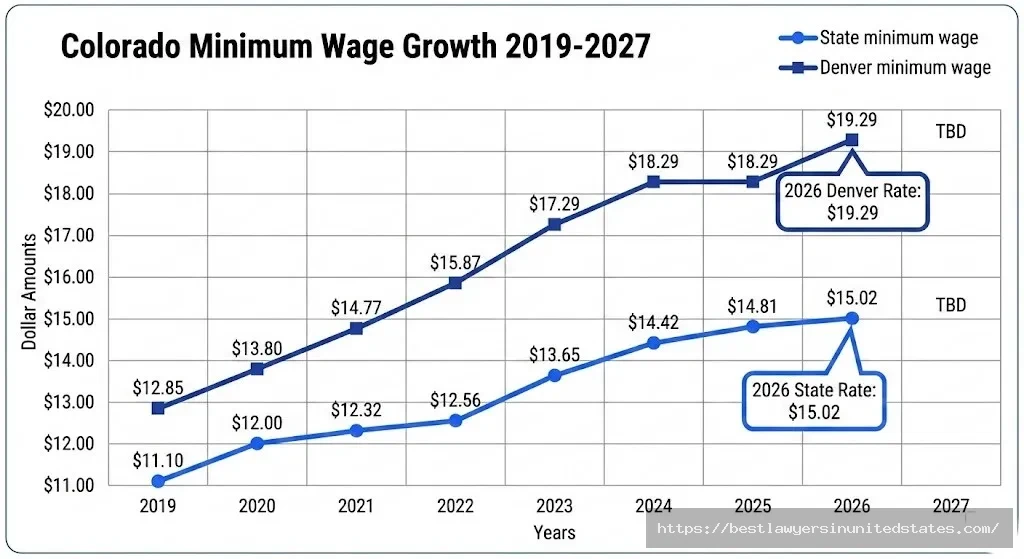
Historical Wage Progression
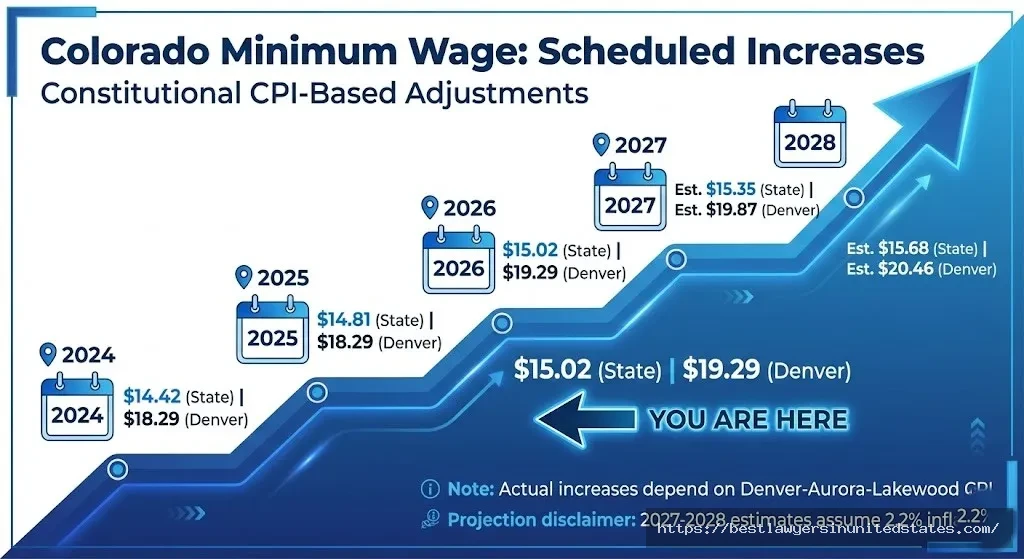
Colorado's minimum wage has increased steadily since 2019. The state constitution mandates these increases based on the Consumer Price Index for Denver-Aurora-Lakewood.
| Year | State Minimum Wage | Denver Minimum Wage | Tipped Wage (State) |
|---|---|---|---|
| 2019 | $11.10 | $12.85 | $8.08 |
| 2020 | $12.00 | $13.80 | $8.98 |
| 2021 | $12.32 | $14.77 | $9.30 |
| 2022 | $12.56 | $15.87 | $9.54 |
| 2023 | $13.65 | $17.29 | $10.63 |
| 2024 | $14.42 | $18.29 | $11.40 |
| 2025 | $14.81 | $18.29 | $11.79 |
| 2026 | $15.02 | $19.29 | $11.98 |
| 2027 | TBD | TBD | TBD |
Why Colorado's Wage Increases Automatically
Article XVIII, Section 15 of the Colorado Constitution requires automatic annual adjustments. The Colorado Department of Labor and Employment calculates the increase each year based on CPI data.
If the Denver-Aurora-Lakewood CPI increases by 2.5%, the minimum wage increases by 2.5%. The department rounds the result to the nearest cent.
Future projections: If inflation averages 2-3% annually, Colorado's minimum wage could reach $15.50-$16.00 by 2028.
Colorado vs. Federal Minimum Wage
| Jurisdiction | Minimum Wage | Tipped Wage | Difference |
|---|---|---|---|
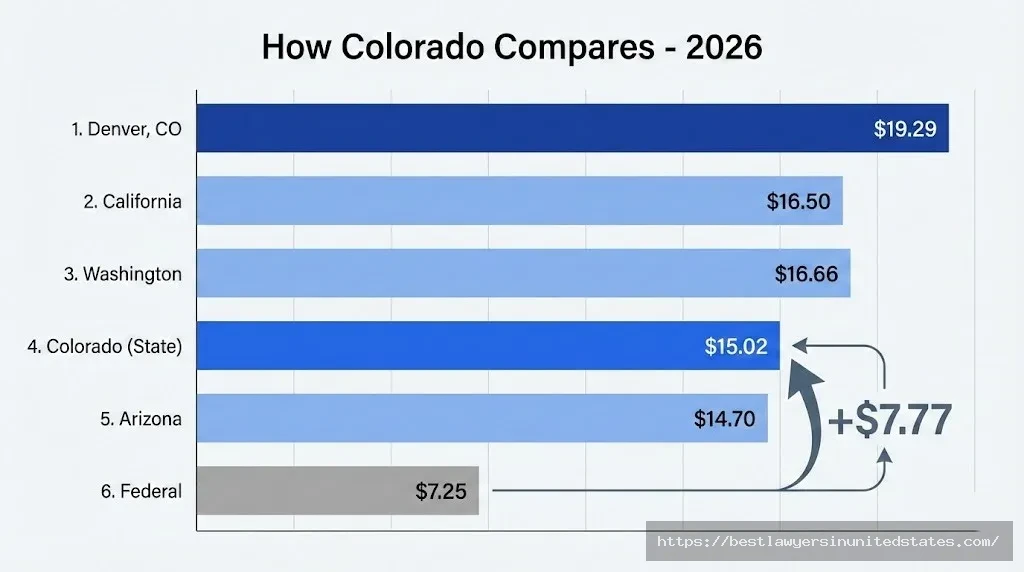
| Colorado | $15.02 | $11.98 | Baseline |
| Federal | $7.25 | $2.13 | -$7.77 |
| Difference | +$7.77 | +$9.85 | Colorado higher |
Colorado workers earn $7.77 more per hour than the federal minimum. For tipped workers, the difference is even larger at $9.85 per hour.
States like California and Arizona also maintain minimum wages above federal levels through similar automatic adjustment mechanisms.
Overtime Rules in Colorado (Unique Triple Trigger)
Colorado's Three Overtime Triggers
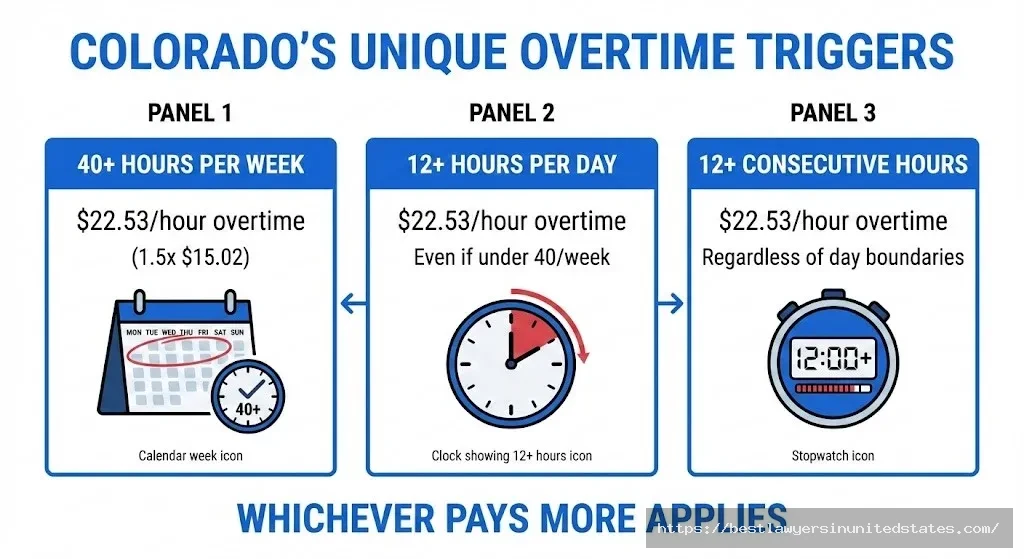
Colorado requires overtime pay when ANY of these conditions occur. Employers must use whichever calculation results in higher pay to the employee.
Trigger 1: Over 40 hours in a workweek
- Standard federal overtime rule
- Time-and-a-half for hours 41 and above
- Most common overtime trigger
Trigger 2: Over 12 hours in a single workday
- Unique to Colorado
- Time-and-a-half for hour 13 and above
- Applies even if weekly hours are under 40
Trigger 3: Over 12 consecutive hours worked
- Unique to Colorado
- Regardless of workday start/end times
- Example: 6 AM to 7 PM shift (13 hours) = 1 hour overtime
Use our overtime pay calculator to determine exactly what you're owed under Colorado's complex overtime system.
Calculate Your Overtime Pay in Colorado
Working more than 40 hours per week? Calculate your overtime earnings based on Colorado's overtime laws. This calculator accounts for Colorado's specific overtime rules including daily overtime, weekly overtime, and consecutive hour requirements.
⏰ Overtime Pay Calculator
Calculate your overtime earnings based on your state's specific labor laws
📍 Select Your State
💰 Your Hourly Wage
📊 Calculation Method
📅 Weekly Hours
💵 Your Weekly Overtime Pay
📊 Earnings Breakdown
📅 Pay Period Estimates
⚖️ State vs Federal Comparison
Calculator features:
- Colorado-specific overtime rules
- Daily and weekly overtime calculations
- Pay period breakdowns
- Comparison with federal law
- Triple-trigger analysis
Full overtime calculator: Calculate your overtime pay here
Questions about your wages or need legal help?
Email: [email protected]
Overtime Rate Calculation
Colorado overtime is calculated at 1.5 times your regular hourly rate. For tipped employees, overtime is calculated on the full minimum wage, not the tipped wage.
Example for regular employee:
- Regular rate: $15.02/hour
- Overtime rate: $22.53/hour ($15.02 × 1.5)
Example for tipped employee:
- Tipped base wage: $11.98/hour
- Full minimum wage: $15.02/hour
- Overtime rate: $22.53/hour (calculated on $15.02, not $11.98)
Real-World Overtime Scenarios
Scenario 1: Daily overtime trigger
- Monday: 13 hours worked
- Tuesday-Friday: 8 hours each (32 hours)
- Total weekly: 45 hours
- Overtime owed: 5 hours (uses weekly trigger, which pays more than 1-hour daily trigger)
Scenario 2: Consecutive hours trigger
- Double shift: 7 AM to 9 PM (14 hours with 1-hour meal break = 13 hours worked)
- Overtime owed: 1 hour (13th hour)
- Applies even if this is the only shift that week
Scenario 3: No overtime
- Monday-Friday: 8 hours each = 40 total
- No single day exceeds 12 hours
- No consecutive stretch exceeds 12 hours
- Overtime owed: $0
Tipped Employee Rules and Protections
Tipped Minimum Wage Explained
Colorado defines a tipped employee as anyone who regularly receives more than $30 per month in tips. This includes servers, bartenders, valets, delivery drivers, and hairstylists.
State requirements:
- Employer pays at least $11.98/hour cash wage (2026)
- Employee receives tips
- Cash wage + tips must equal or exceed $15.02/hour
Denver requirements:
- Employer pays at least $15.99/hour cash wage (2026)
- Employee receives tips
- Cash wage + tips must equal or exceed $19.29/hour
If your tips don't bring you to the full minimum wage, your employer must pay the difference.
Illegal Tip Practices
Colorado law protects tipped employees from employer abuse. Your employer loses the tip credit and must pay you full minimum wage if they engage in any of these practices:
Illegal Practice 1: Tip sharing with non-tipped staff
- Managers, supervisors, cooks, dishwashers cannot participate in tip pools
- Only employees who regularly receive tips can share in pools
- Violation = employer must pay full minimum wage retroactively
Illegal Practice 2: Deducting credit card fees from tips
- Customer leaves $10 tip on credit card
- Credit card company charges 3% fee ($0.30)
- Employer gives you $9.70
- This is ILLEGAL in Colorado
- You must receive the full $10
Illegal Practice 3: Using tips for business expenses
- Broken dishes, customer walk-outs, cash register shortages
- Cannot be deducted from your tips
- Employer must absorb these costs
Tip Credit Nullification
When your employer violates tip credit rules, they lose the right to pay the lower tipped wage. They must pay you the full minimum wage ($15.02 state, $19.29 Denver) for all hours worked, plus you keep all your tips.
You can file a complaint with the Colorado Division of Labor Standards and Statistics to recover back wages. Understanding your rights under workplace dispute laws helps you take appropriate action.
Exemptions from Minimum Wage and Overtime
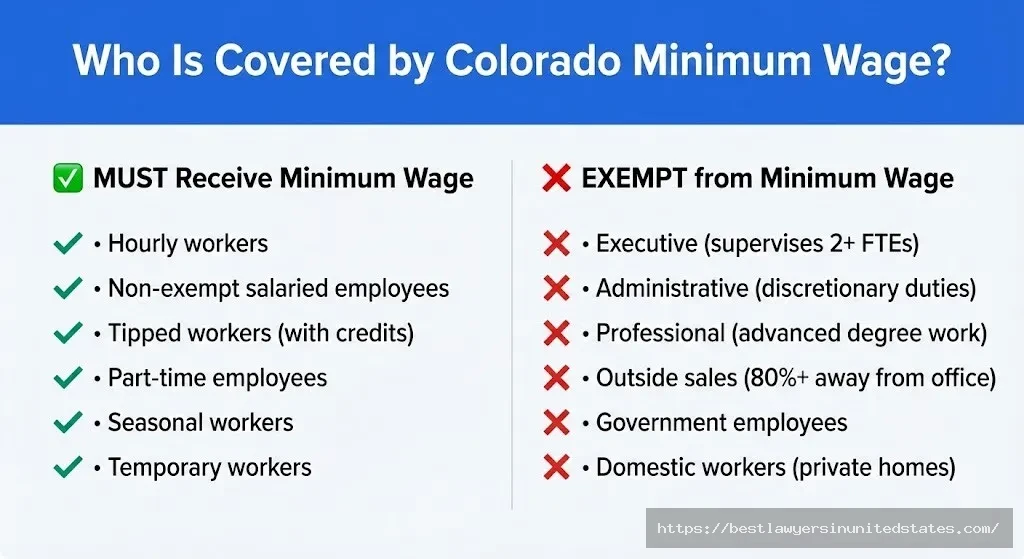
Employees Exempt from Minimum Wage
Executive/Administrative/Professional Exemptions
These employees must meet three requirements:
- Paid on salary basis (not hourly)
- Earn above the salary threshold
- Perform specific exempt duties
Executive exemption:
- Supervise 2+ full-time employees
- Have hire/fire authority or effective recommendation power
- Spend 50%+ of time on supervisory duties
Administrative exemption:
- Perform office or non-manual work
- Exercise discretion on significant matters
- Directly serve executive management
Professional exemption:
- Hold advanced knowledge in specialized field
- Knowledge acquired through prolonged study
- Work in field of training
Salary threshold 2026: Colorado ties exempt salary minimums to the state minimum wage. Exempt employees must earn enough to exceed minimum wage for all hours worked.
Youth Workers Under Age 18
Unemancipated minors (under 18) can be paid 15% below minimum wage:
- State rate: $12.77/hour (15% below $15.02)
- Denver rate: $16.40/hour (15% below $19.29)
Unemancipated means:
- Lives with parent or guardian
- Not financially independent
- Not married
- Parent has primary support responsibility
Emancipated minors must receive full minimum wage.
Industry-Specific Overtime Exemptions
Ski Industry Exemption
Employees at ski resorts performing duties directly related to downhill skiing or snowboarding operations are exempt from the 40-hour weekly overtime requirement. They still receive overtime for:
- Hours exceeding 12 in a single day
- Hours exceeding 12 consecutive hours
Who qualifies: Lift operators, ski patrol, rental shop staff, instructors, food/beverage workers at on-mountain locations.
Who doesn't qualify: Lodging employees at ski resorts (front desk, housekeeping at base lodges).
Medical Transportation (24-Hour Shifts)
EMTs, paramedics, and ambulance staff scheduled for 24-hour shifts are exempt from the 12-hour daily overtime requirement. They receive overtime only for hours exceeding 40 per week.
Sleep time (up to 8 hours) can be excluded from compensation if sleeping facilities are provided and at least 5 hours of uninterrupted sleep is possible.
Retail Commission Sales
Sales employees paid primarily by commission are exempt from weekly overtime if:
- 50%+ of total pay comes from commissions
- Regular rate of pay is at least 1.5× minimum wage ($22.53+ in 2026)
- Employer derives 75%+ of revenue from retail/service sales
Employee Rights and Wage Violation Remedies
Your Rights Under Colorado Law
Colorado workers have specific protections under state law. These rights cannot be waived by employment contracts or employer policies.
Right 1: Minimum wage for every hour worked
- Every hour must be compensated at minimum wage or higher
- No agreement to work for less is legally valid
- Applies to all time under employer's control
Right 2: Overtime pay at 1.5× regular rate
- For hours over 40/week, 12/day, or 12 consecutive
- Cannot be waived or bargained away
- Calculated on full minimum wage for tipped employees
Right 3: Meal and rest breaks
- 30-minute unpaid, duty-free meal break after 5 hours
- 10-minute paid rest break every 4 hours
- Cannot be deducted from pay or forced to work through
Right 4: All tips belong to you
- Tips cannot go to managers or supervisors
- Cannot be used for business expenses
- Employer cannot take more than allowed tip credit
Right 5: Protection from retaliation
- Cannot be fired for filing wage complaints
- Cannot be demoted for asking about wages
- Cannot be threatened for participating in investigations
If your employer denies these rights, you may need to consult with an attorney who handles workplace discrimination and retaliation.
Common Wage Violations in Colorado
Violation 1: Not paying overtime for 12-hour days
Many employers only pay overtime after 40 weekly hours. They forget Colorado requires overtime for any day exceeding 12 hours, even if the week totals under 40.
Violation 2: Misclassifying employees as exempt
Employers call someone a "manager" but the employee doesn't supervise 2+ people or have hire/fire authority. The employee works 50 hours per week with no overtime pay.
Violation 3: Illegal tip pooling
Restaurants force servers to share tips with kitchen staff or managers. This nullifies the tip credit. The employer must pay full minimum wage retroactively.
Violation 4: Not paying for "off the clock" work
Employers require employees to arrive 15 minutes early for unpaid setup or stay late for unpaid cleaning. All time under employer's control must be compensated.
Violation 5: Deducting for uniforms or cash register shortages
Deductions that bring an employee below minimum wage are illegal under Colorado law. Employers must absorb these costs.
Calculate Your Wage Theft Recovery in Colorado
Think your employer owes you money? Use our wage theft calculator to estimate how much you could recover, including unpaid wages, penalties, and interest under Colorado law.
Wage Theft Recovery Calculator
Estimate how much you can recover in unpaid wages, penalties, and damages based on your state's laws
💵 Estimated Total Recovery
💰 Unpaid Wages
⚖️ Penalties & Damages
📋 Total Summary
Calculator features:
- Multiple violation types (unpaid wages, overtime, tips)
- Colorado-specific penalties and damages
- Filing deadline tracker
- Total recovery estimate
- Next steps guidance
Full wage theft calculator: Calculate your wage theft recovery here
Need help with unpaid wages? Contact Colorado Department of Labor or consult with an employment attorney. Learn more about wage garnishment protections if your employer threatens your paycheck.
Questions about your wages or need legal help?
Email: [email protected]
How to File a Wage Complaint in Colorado
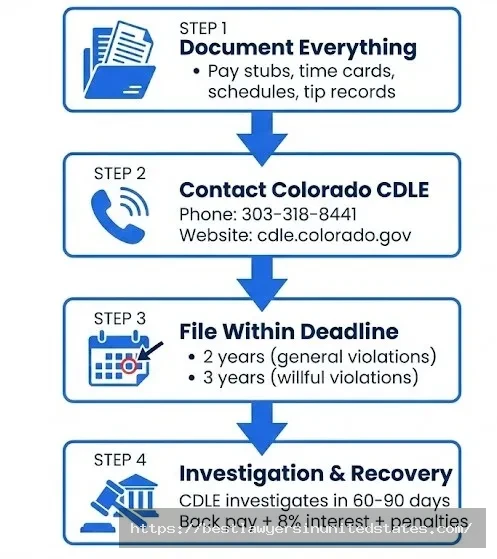
Step 1: Document Everything
Gather all evidence before filing your complaint:
- Pay stubs showing wages paid
- Time cards or schedules showing hours worked
- Written records of actual hours if employer doesn't track
- Text messages or emails about pay
- Tip records (if applicable)
- Employment contract or agreement
Step 2: Contact Colorado CDLE
Colorado Division of Labor Standards and Statistics:
- Phone: 303-318-8441
- Address: 633 17th Street, Suite 600, Denver, CO 80202
- Website: cdle.colorado.gov
- Office hours: Monday-Friday, 8:00 AM - 5:00 PM
Step 3: File Your Complaint
Filing deadlines:
- General violations: 2 years from violation date
- Willful violations: 3 years from violation date
Don't miss these critical deadlines. Understanding FLSA filing deadlines helps protect your rights to recovery.
Information needed:
- Your name and contact information
- Employer name and address
- Description of violation (unpaid wages, overtime, tips)
- Dates of work and violation
- Amount you believe is owed
Step 4: CDLE Investigation Process
A CDLE investigator will contact your employer within 30-60 days. The employer has the opportunity to respond with their records and explanation.
The investigator reviews both sides and issues a determination, typically within 60-90 days of filing.
Step 5: Recovery Options
If CDLE finds a violation:
- Employer ordered to pay back wages
- Interest accrues at 8% per year
- Penalties may apply for willful violations
- Employer has 15 days to comply
If employer doesn't comply:
- CDLE can file lawsuit on your behalf
- You can file private lawsuit in court
- You may recover attorney fees and court costs
Private Lawsuit Alternative
You can sue directly in court instead of filing with CDLE. This option allows you to recover:
- Unpaid wages
- Interest at 8% per year
- Attorney fees (employer pays your lawyer)
- Court costs
Example recovery calculation:
- Unpaid wages: $5,000
- Interest (1 year at 8%): $400
- Attorney fees: $3,000
- Total employer owes: $8,400
Employer Compliance Requirements
Required Workplace Postings
Colorado employers must display the Colorado Minimum Wage Order poster in areas frequented by employees. The poster must be easily readable during the workday.
Where to obtain:
- Colorado Department of Labor website
- Updated annually (check for 2026 version)
- Free download available
- Must be posted in English and Spanish if applicable
Record Keeping Requirements (3 Years)
Employers must maintain records for at least 3 years:
- Employee name, address, SSN, occupation, hire date
- Birth date (if employee is under 18)
- Daily hours worked
- Rate of pay, gross wages, deductions, net pay
- Tip declarations (for tipped employees)
Records must be available at the workplace or the employer's Colorado headquarters.
Itemized Pay Stub Requirements
Each pay period, employers must provide itemized statements showing:
- Hours worked
- Rate of pay
- Gross wages
- All deductions (taxes, benefits, garnishments)
- Net pay
- Tip credit taken (if applicable)
Penalties for Violations
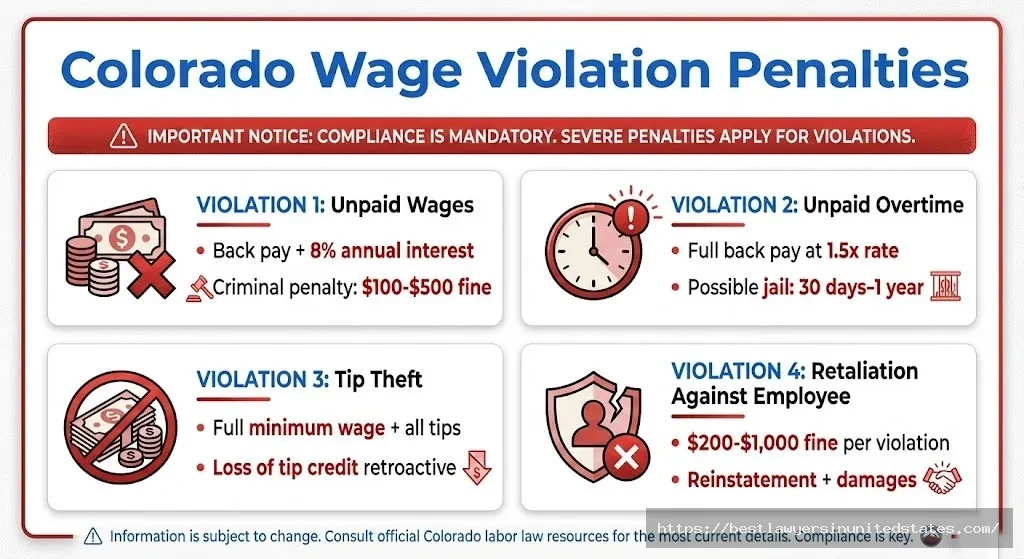
Civil penalties:
- Back wages owed to employee
- Interest at 8% per year
- Attorney fees if employee sues
- Court costs
Criminal penalties:
- Misdemeanor charge
- Fine: $100-$500
- Jail: 30 days to 1 year
- Or both fine and jail
Retaliation penalties:
- Fine: $200-$1,000 per violation
- Possible reinstatement of employee
- Additional damages in lawsuit
Salary Conversion Tables
Annual Salary to Hourly Rate
Based on 2,080 hours per year (40 hours/week × 52 weeks):
| Annual Salary | Hourly Rate | Above CO Minimum? | Above Denver Minimum? |
|---|---|---|---|
| $20,000 | $9.62 | No | No |
| $25,000 | $12.02 | No | No |
| $30,000 | $14.42 | No | No |
| $31,242 | $15.02 | Equal | No |
| $35,000 | $16.83 | Yes | No |
| $40,000 | $19.23 | Yes | Equal (Denver) |
| $45,000 | $21.63 | Yes | Yes |
| $50,000 | $24.04 | Yes | Yes |
| $60,000 | $28.85 | Yes | Yes |
| $70,000 | $33.65 | Yes | Yes |
| $80,000 | $38.46 | Yes | Yes |
| $90,000 | $43.27 | Yes | Yes |
| $100,000 | $48.08 | Yes | Yes |
Hourly Rate to Annual Salary
Full-time calculation (40 hours/week × 52 weeks = 2,080 hours/year):
| Hourly Rate | Annual Salary | Monthly (Before Tax) | Weekly |
|---|---|---|---|
| $12.00 | $24,960 | $2,080 | $480 |
| $15.02 (CO Min) | $31,241.60 | $2,603 | $601 |
| $15.00 | $31,200 | $2,600 | $600 |
| $19.29 (Denver Min) | $40,123.20 | $3,344 | $772 |
| $20.00 | $41,600 | $3,467 | $800 |
| $25.00 | $52,000 | $4,333 | $1,000 |
| $30.00 | $62,400 | $5,200 | $1,200 |
| $35.00 | $72,800 | $6,067 | $1,400 |
| $40.00 | $83,200 | $6,933 | $1,600 |
Colorado Cost of Living Context
Income Brackets in Colorado (2026)
Poverty level (federal guidelines):
- Single person: $15,060/year ($7.24/hour)
- Family of 4: $31,200/year
Low income:
- Single person: $30,000-$45,000/year
- Family of 4: $60,000-$90,000/year
Middle class:
- Single person: $45,000-$120,000/year
- Family of 4: $90,000-$240,000/year
Upper middle class:
- Single person: $120,000-$250,000/year
- Family of 4: $240,000-$500,000/year
Living Wage vs. Minimum Wage
Minimum wage doesn't always equal a living wage. A living wage covers basic necessities like rent, food, healthcare, and transportation.
Denver:
- Minimum wage: $19.29/hour ($40,123/year full-time)
- Living wage (single adult): ~$23.00/hour ($47,840/year)
- Gap: -$3.71/hour (-$7,717/year)
Colorado Springs:
- Minimum wage: $15.02/hour ($31,242/year full-time)
- Living wage (single adult): ~$19.50/hour ($40,560/year)
- Gap: -$4.48/hour (-$9,318/year)
A single adult earning minimum wage in Denver faces a monthly budget shortfall of approximately $643. In Colorado Springs, the shortfall is roughly $776 per month.
Hourly Wage Livability Assessment
| Hourly Rate | Annual (Full-Time) | Livability in Colorado |
|---|---|---|
| $15.02 (CO min) | $31,242 | Difficult; requires roommates, strict budget |
| $19.29 (Denver min) | $40,123 | Challenging in Denver; manageable in smaller cities |
| $20.00 | $41,600 | Below living wage in Denver; adequate elsewhere |
| $25.00 | $52,000 | Comfortable for single person in most CO cities |
| $30.00 | $62,400 | Solid middle class; family possible with dual income |
| $40.00 | $83,200 | Comfortable family income (single earner) |
Frequently Asked Questions
What is Colorado's minimum wage in 2026?
Quick Answer: Colorado's minimum wage is $15.02 per hour as of January 1, 2026, which is $7.77 higher than the federal minimum wage of $7.25.
Denver has a higher minimum wage of $19.29 per hour. If you work within Denver city limits, you must receive the Denver rate.
Will Colorado's minimum wage increase in 2027?
Quick Answer: Yes. Colorado's Constitution requires annual increases based on the Denver-Aurora-Lakewood Consumer Price Index. The 2027 rate will be announced in fall 2026.
The Colorado Department of Labor and Employment calculates the increase each September based on CPI data from the previous year.
Do I get overtime after 8 hours in Colorado?
Quick Answer: No. Colorado overtime triggers are 40+ hours per week, 12+ hours per day, or 12+ consecutive hours. There is no 8-hour daily overtime requirement.
Colorado's overtime rules are more generous than federal law in some ways (daily overtime) but don't include the 8-hour threshold some workers expect.
Can my employer pay me less than minimum wage if I get tips?
Quick Answer: Your employer can pay a lower cash wage ($11.98 in 2026 for state, $15.99 for Denver), but your tips plus cash wage must equal at least the full minimum wage.
If your tips don't bring you to $15.02/hour (state) or $19.29/hour (Denver), your employer must make up the difference in cash.
How do I calculate my earnings at Colorado minimum wage?
Quick Answer: Use our minimum wage calculator to instantly calculate your daily, weekly, monthly, and annual earnings at Colorado's $15.02 minimum wage.
The calculator accounts for Colorado's 2026 rates and provides estimates for both pre-tax and take-home pay based on your hours worked.
How much overtime pay am I entitled to in Colorado?
Quick Answer: Colorado requires time-and-a-half pay (1.5× your regular rate) for hours exceeding 40 per week, 12 per day, or 12 consecutive hours. Use our overtime calculator to determine your exact amount.
The calculator applies Colorado's unique triple-trigger system and calculates whichever method pays you more.
Can my boss make me share tips with kitchen staff?
Quick Answer: No. If your employer requires tip sharing with non-tipped employees like cooks, dishwashers, or managers, they lose the tip credit and must pay you full minimum wage ($15.02 state, $19.29 Denver).
Only employees who regularly receive tips can participate in tip pools under Colorado law.
I work in Denver but live in Colorado Springs. Which minimum wage applies?
Quick Answer: Denver's minimum wage ($19.29) applies because you perform work within Denver city limits. Your residence location doesn't matter.
Your employer must pay based on where you physically work, not where the business is located or where you live.
Can I be paid less than minimum wage if I'm under 18?
Quick Answer: Only if you're "unemancipated" (live with parents, financially dependent). Unemancipated minors can be paid 15% below minimum wage: $12.77/hour (state) or $16.40/hour (Denver).
Emancipated minors (married, financially independent, or living away from parents) must receive full minimum wage.
How do I calculate wage theft recovery in Colorado?
Quick Answer: Use our wage theft calculator to estimate unpaid wages, penalties, interest at 8% per year, and potential attorney fees under Colorado law.
The calculator accounts for different violation types including unpaid wages, overtime, and tip theft.
My employer says I'm "exempt." Do I still get overtime?
Quick Answer: True exempt employees don't get overtime, but you must meet three requirements: paid on salary (not hourly), earn above the salary threshold, and perform exempt duties.
If you don't meet all three, you're likely misclassified and owed overtime. Many employers incorrectly classify employees as exempt.
I work 13 hours on Saturday but only 27 hours total for the week. Do I get overtime?
Quick Answer: Yes. Colorado requires overtime for any day exceeding 12 hours. You'd receive 1 hour of overtime for Saturday (the 13th hour), even though your weekly total is under 40.
This is unique to Colorado. Federal law doesn't require daily overtime.
Can my employer deduct credit card fees from my tips?
Quick Answer: No. This is illegal in Colorado. You must receive the full tip amount.
If a customer leaves a $10 tip on a credit card and the credit card company charges a 3% fee ($0.30), your employer cannot give you only $9.70. You're entitled to the full $10.
What's the difference between "living wage" and "minimum wage"?
Quick Answer: Minimum wage ($15.02) is the legal minimum employers must pay. Living wage (~$19.50-$23.00 depending on location) is the amount needed to afford basic necessities like rent, food, and healthcare.
In Colorado, minimum wage falls short of living wage in most cities, particularly Denver and Boulder.
How do I file a complaint if my employer isn't paying me correctly?
Quick Answer: Contact the Colorado Division of Labor Standards and Statistics at 303-318-8441 or file online at cdle.colorado.gov. You have 2 years from the violation date to file (3 years for willful violations).
Document everything before filing: pay stubs, time records, and any communication about wages.
Can I be fired for asking about minimum wage or filing a complaint?
Quick Answer: No. Retaliation is illegal in Colorado. If your employer fires, demotes, or threatens you for exercising your wage rights, they can be fined $200-$1,000 and you can sue for damages.
Colorado law specifically prohibits retaliation against employees who file wage complaints or participate in investigations.
Summary and Key Takeaways
Colorado's 2026 minimum wage of $15.02 per hour (state) and $19.29 per hour (Denver) provides workers with significantly higher earnings than the federal minimum. The state's automatic annual adjustments based on inflation help wages keep pace with cost of living.
Critical points to remember:
- Minimum wage increases automatically each January 1
- Denver's rate is $4.27 higher than state rate
- Three different overtime triggers (40/week, 12/day, 12 consecutive)
- Tipped workers must receive full minimum wage when tips don't cover difference
- Strong retaliation protections for workers who file complaints
- 2-year filing deadline for wage claims (3 years if willful)
Resources:
- Colorado CDLE: 303-318-8441
- Address: 633 17th Street, Suite 600, Denver, CO 80202
- Website: cdle.colorado.gov
Need help with wage issues?
Email: [email protected]
