
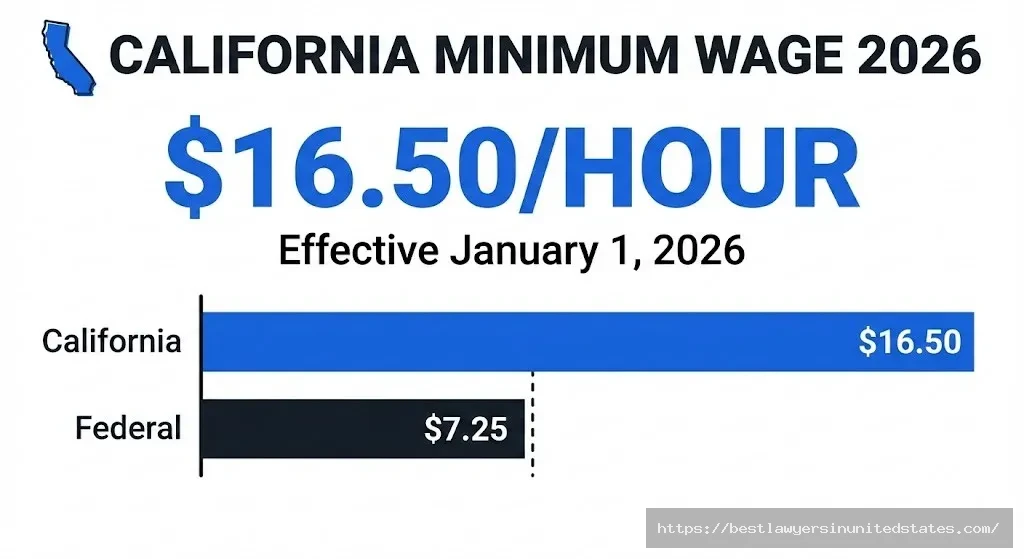
California’s minimum wage increases to $16.50 per hour on January 1, 2026, up from $16.00 in 2025. This rate is more than double the federal minimum wage of $7.25 per hour. Some California cities have even higher local minimum wages, with Los Angeles at $17.81 and San Francisco at $18.07 per hour.
This guide covers everything you need to know about California’s 2026 minimum wage laws, including industry-specific rates for fast food workers ($20/hour) and healthcare workers ($25/hour). We’ve included three free calculators to help you estimate your earnings, calculate overtime pay, and determine wage theft recovery amounts.
California stands out among states with its strict overtime rules, no tip credit policy, and strong worker protections. Whether you’re an employee checking your pay or an employer ensuring compliance, this guide provides the specific information you need.
What Is the Minimum Wage in California?
Quick Answer: California’s minimum wage is $16.50 per hour as of January 1, 2026, which applies to all workers regardless of employer size.
This rate is $9.25 higher than the federal minimum wage of $7.25 per hour. All California employers must pay at least this amount, with some cities and industries requiring even higher wages. The state eliminated its two-tier wage system in 2023, so all employers now follow the same rate regardless of company size.
A full-time worker earning California’s minimum wage makes $34,320 per year before taxes. Part-time workers earning $16.50 per hour for 20 hours weekly make $17,160 annually.
California Minimum Wage 2026 Key Stats:
| Metric | Amount |
|---|---|
| Hourly Rate | $16.50 |
| Weekly (40 hours) | $660 |
| Monthly | $2,860 |
| Annual (full-time) | $34,320 |
| Effective Date | January 1, 2026 |
Some California cities have higher local minimum wages that override the state rate. Employees must be paid whichever rate is higher between state, city, and county requirements.
Calculate Your Earnings in California
Want to know exactly how much you’ll earn at California’s $16.50 minimum wage? Use our free calculator to estimate your weekly, monthly, and annual income based on your hours worked.
💰 Minimum Wage Earnings Calculator
Calculate your weekly, monthly, and annual earnings with overtime and tax estimates
📊 Your Earnings Breakdown
💰 Gross Earnings
Calculator features:
- Automatic California wage rates for 2026
- Weekly, monthly, and annual earnings
- Overtime calculations
- Tax withholding estimates
- Take-home pay breakdown
Full calculator with all features: Use our minimum wage calculator to calculate earnings for any state and compare different wage rates.
Questions about your wages or need legal help? Find Employment Lawyers in California - Free Consultation Email: [email protected]
California Minimum Wage History (2020-2027)
California has steadily increased its minimum wage over the past seven years. The state eliminated its two-tier system in 2023, which previously had different rates for employers with 25 or fewer employees versus 26 or more employees.
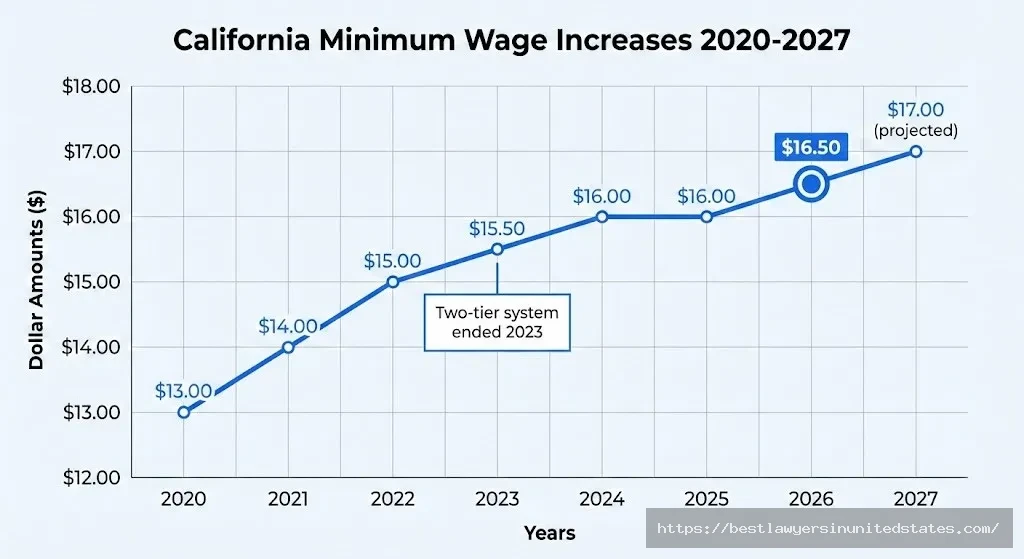
California Minimum Wage Historical Progression:
| Effective Date | All Employers | Notes |
|---|---|---|
| Jan 1, 2020 | $13.00 ($12.00 for <25 employees) | Two-tier system |
| Jan 1, 2021 | $14.00 ($13.00 for <25 employees) | Two-tier system |
| Jan 1, 2022 | $15.00 | Unified rate for all employers |
| Jan 1, 2023 | $15.50 | CPI adjustment |
| Jan 1, 2024 | $16.00 | CPI adjustment |
| Jan 1, 2025 | $16.00 | No increase |
| Jan 1, 2026 | $16.50 | Current rate |
| Jan 1, 2027 | $17.00+ (projected) | CPI-based adjustment |
The 2026 increase represents a 3.1% raise from 2025. California ties its minimum wage to the Consumer Price Index for Urban Wage Earners, which means automatic annual adjustments continue beyond 2026.
Industry-Specific Minimum Wages in California
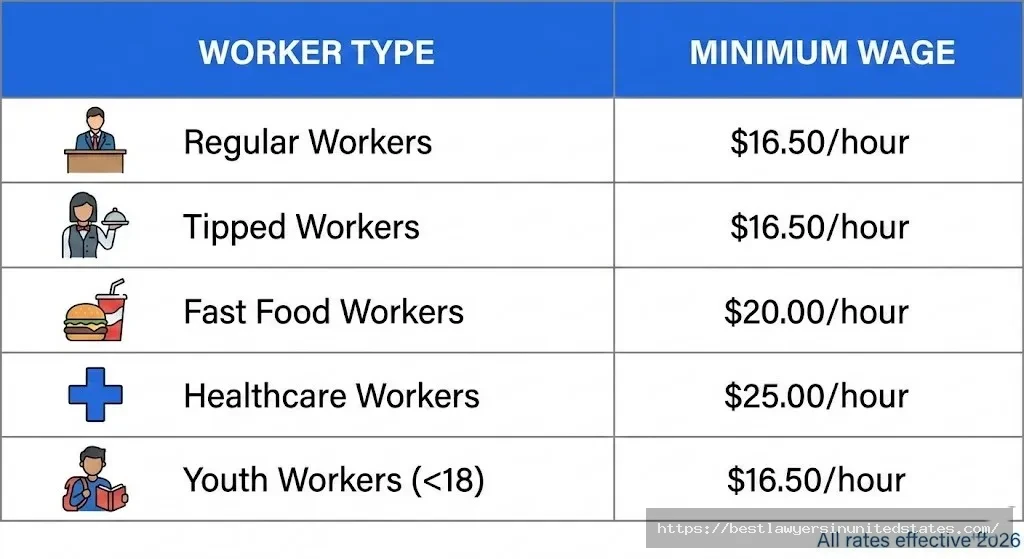
California has separate minimum wages for specific industries that exceed the statewide rate. Fast food workers and healthcare employees benefit from these higher wage floors.
Fast Food Workers - $20/Hour
Fast food chain employees in California earn a minimum of $20.00 per hour as of April 1, 2024. This rate applies to fast food restaurants with 60 or more locations nationally under California Assembly Bill 1228.
Who qualifies for the $20 fast food minimum wage:
- McDonald's employees ✅
- Taco Bell employees ✅
- Chick-fil-A employees ✅
- Domino's Pizza employees (chains with 60+ locations) ✅
- In-N-Out employees ✅
- Starbucks employees ❌ (coffee shops excluded)
- Independent restaurants ❌ (not part of national chains)
Key exemptions from the $20 fast food wage:
- Bakeries that produce and sell bread on-site
- Restaurants located inside grocery stores
- Airport concession restaurants
- Independent restaurants not part of chains
Similar to workers in states with lower minimum wages like Alabama where the rate follows federal law at $7.25, California fast food workers now earn nearly three times that amount.
Healthcare Workers - $25/Hour
Healthcare facility employees earn a minimum of $25.00 per hour under California Senate Bill 525. The law phases in this wage based on facility size, with full implementation by 2028.
Healthcare minimum wage phase-in schedule:
| Facility Type | 2024 Rate | 2026 Rate | 2028 Rate |
|---|---|---|---|
| Large facilities (10,000+ beds) | $25.00 | $25.00 | $25.00 |
| Medium facilities (100-9,999 beds) | $24.00 | $25.00 | $25.00 |
| Small facilities (<100 beds) | $23.00 | $24.00 | $25.00 |
| Dialysis clinics | $24.00 | $25.00 | $25.00 |
This wage applies to certified nursing assistants, medical assistants, janitorial staff, food service workers, and other healthcare support employees. Unlike workers in Alaska who earn $11.91 per hour, California healthcare workers receive significantly higher compensation.
Local Minimum Wages in California (City-by-City)
California has more than 40 cities and counties with minimum wages higher than the $16.50 state rate. Employers must pay employees the highest applicable rate among state, city, and county requirements.
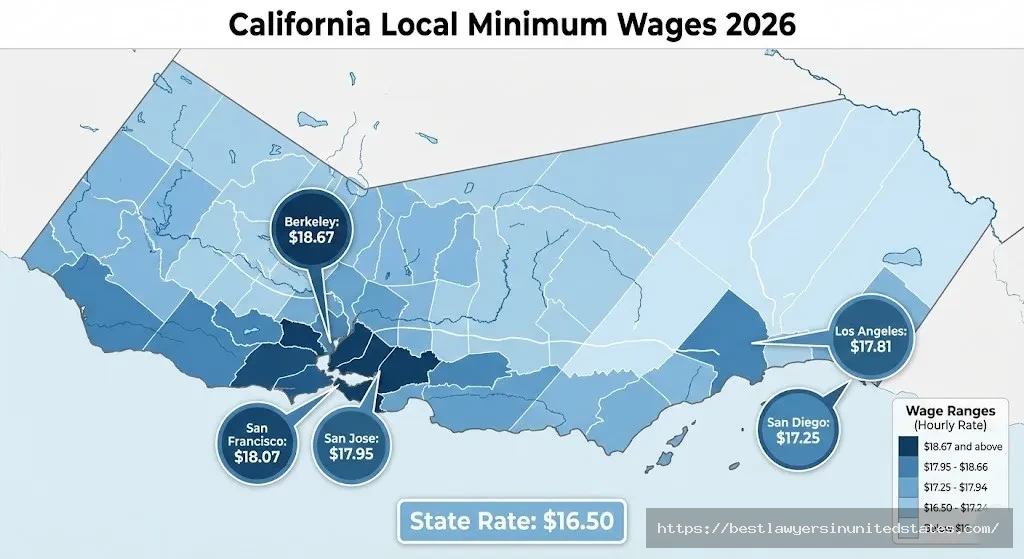
Major California Cities with Higher Minimum Wages
2026 local minimum wage rates:
| City/County | 2026 Minimum Wage | Effective Date | Difference from State |
|---|---|---|---|
| Berkeley | $18.67 | Oct 1, 2024 | +$2.17 |
| San Francisco | $18.07 | Jul 1, 2025 | +$1.57 |
| Los Angeles | $17.81 | Jul 1, 2025 | +$1.31 |
| San Jose | $17.95 | Jan 1, 2026 | +$1.45 |
| Pasadena | $17.50 | Jul 1, 2025 | +$1.00 |
| San Diego | $17.25 | Jan 1, 2026 | +$0.75 |
| Long Beach | $17.00 | Jan 1, 2026 | +$0.50 |
| Oakland | $16.52 | Jan 1, 2026 | +$0.02 |
County unincorporated area rates:
- Los Angeles County (unincorporated): $17.81/hour
- Santa Clara County (unincorporated): $17.75/hour
Los Angeles city leaders are considering a proposal to increase the minimum wage to $30 per hour by 2028, which would make it the highest local minimum wage in the nation. This represents the same trend seen in other high-wage states, though workers in Arizona currently earn $14.70 per hour.
How to Determine Which Wage Applies
Follow this hierarchy:
- Check if your city has a local minimum wage
- Check if your county (unincorporated area) has a minimum wage
- Compare all applicable rates
- Your employer must pay the highest rate
A worker in Berkeley must be paid $18.67 per hour, not the state rate of $16.50. A worker in rural California outside city limits receives the state rate of $16.50 unless county ordinances apply.
Tipped Employees in California
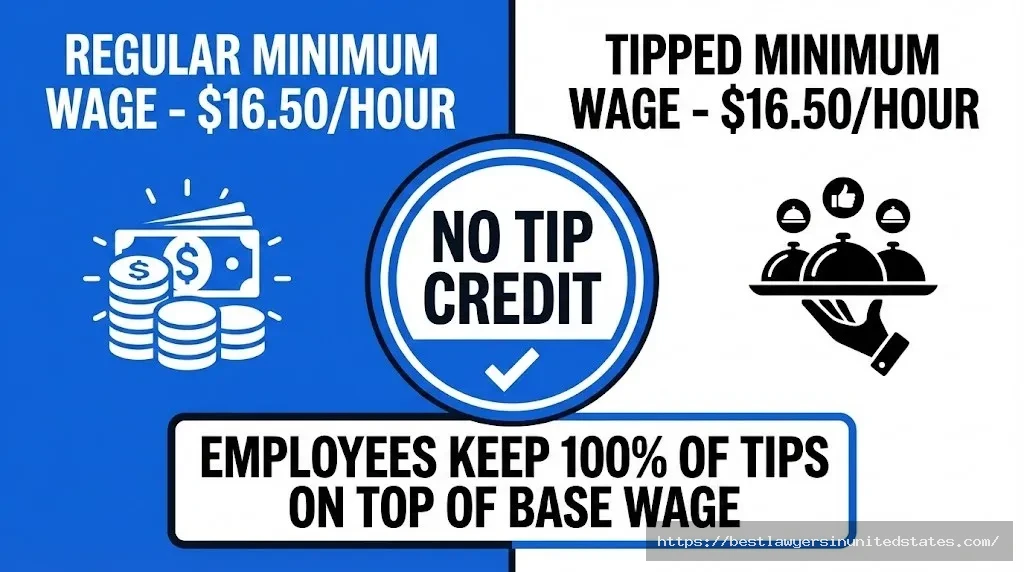
California does not allow employers to take tip credits against minimum wage. This makes California one of only seven states requiring full minimum wage payment to tipped employees.
What Is California's Tipped Minimum Wage?
Quick Answer: California's tipped minimum wage is $16.50 per hour in 2026, the same as the regular minimum wage. Employees keep 100% of their tips on top of this base wage.
Comparison of tipped wages across jurisdictions:
| Jurisdiction | Allows Tip Credit? | Tipped Minimum Wage | Tips |
|---|---|---|---|
| California | ❌ No | $16.50/hour | Keep 100% |
| Federal | ✅ Yes | $2.13/hour | Must reach $7.25 with tips |
| New York | ✅ Yes | $10.65/hour | Must reach $15.00 with tips |
| Texas | ✅ Yes | $2.13/hour | Must reach $7.25 with tips |
This policy means California servers, bartenders, and other tipped workers earn significantly more than their counterparts in states like Arkansas where tipped workers can be paid as little as $2.63 per hour plus tips.
California Tip Pooling Rules
What California law allows:
- ✅ Mandatory tip pooling among front-of-house staff (servers, bartenders, bussers)
- ✅ Voluntary tip sharing with back-of-house staff (cooks, dishwashers)
- ✅ Tips distributed based on hours worked or point system
What California law prohibits:
- ❌ Managers or supervisors participating in tip pools
- ❌ Employers taking any portion of tips
- ❌ Forcing employees to share tips with employers or managers
- ❌ Using tips to meet minimum wage requirements
Tip theft consequences: Employers who take employee tips face criminal charges, civil penalties up to $1,000 per employee, and must return all stolen tips with interest. If you've experienced tip theft, understanding your legal options for workplace disputes can help you recover what you're owed.
Overtime Pay Requirements in California
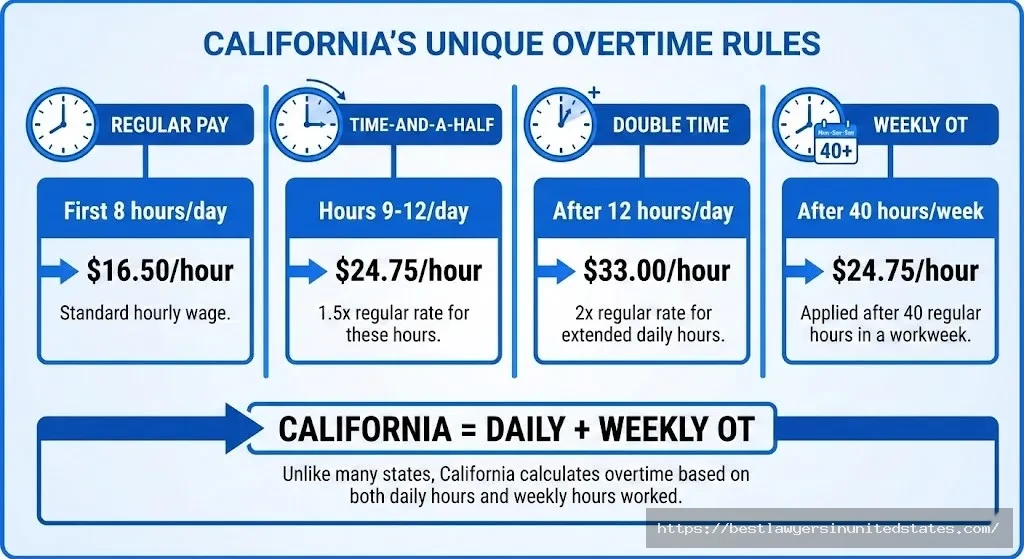
California has the strictest overtime laws in the nation. The state requires both daily and weekly overtime, plus double-time pay in certain situations.
Daily Overtime Rules
California requires overtime pay after 8 hours in a single workday:
- Hours 1-8: Regular rate ($16.50/hour at minimum wage)
- Hours 9-12: Time-and-a-half ($24.75/hour at minimum wage)
- Hours 13+: Double time ($33.00/hour at minimum wage)
Weekly Overtime Rules
California requires overtime after 40 hours in one week:
- First 40 hours: Regular rate
- Hours 41+: Time-and-a-half (unless already paid at overtime or double-time rate)
Seventh Consecutive Day Rules
Working seven days in a row triggers special overtime:
- Hours 1-8 on 7th day: Time-and-a-half
- Hours 9+ on 7th day: Double time
Example overtime calculations at $16.50/hour:
| Scenario | Hours Breakdown | Total Daily Pay |
|---|---|---|
| 10-hour workday | 8 hours × $16.50 + 2 hours × $24.75 | $181.50 |
| 13-hour workday | 8 hours × $16.50 + 4 hours × $24.75 + 1 hour × $33.00 | $264.00 |
| 10 hours on 7th day | 8 hours × $24.75 + 2 hours × $33.00 | $264.00 |
| 45-hour work week | 40 hours × $16.50 + 5 hours × $24.75 | $783.75 |
These rules are more generous than federal overtime requirements, which only mandate time-and-a-half after 40 hours per week. Workers who aren't receiving proper overtime pay should consider using our wage theft recovery tools to calculate what they're owed.
Calculate Your Overtime Pay in California
Working more than 40 hours per week? Calculate your overtime earnings based on California's overtime laws. This calculator accounts for California's specific overtime rules including daily overtime and double-time requirements.
⏰ Overtime Pay Calculator
Calculate your overtime earnings based on your state's specific labor laws
📍 Select Your State
💰 Your Hourly Wage
📊 Calculation Method
📅 Weekly Hours
💵 Your Weekly Overtime Pay
📊 Earnings Breakdown
📅 Pay Period Estimates
⚖️ State vs Federal Comparison
Calculator features:
- California-specific overtime rules
- Daily and weekly overtime calculations
- Double-time calculations
- Pay period breakdowns
- Comparison with federal law
Full overtime calculator: Use our overtime pay calculator to calculate overtime for any state and compare different overtime rules.
Questions about your wages or need legal help? Find Employment Lawyers in California - Free Consultation Email: [email protected]
Special Minimum Wage Categories in California
California applies its minimum wage uniformly across most worker categories. Unlike some states, California does not have youth subminimum wages or training wages.
Youth Workers (Minors Under 18)
Minimum wage for minors: $16.50/hour (same as adults)
California does not allow employers to pay youth workers less than the standard minimum wage. A 16-year-old cashier must be paid the same $16.50 per hour as an adult cashier performing identical work.
Work hour restrictions for minors:
- Ages 14-15: Maximum 3 hours on school days, 8 hours on non-school days
- Ages 16-17: Maximum 4 hours on school days, 8 hours on non-school days
- All minors: No work before 5 AM or after 10 PM on school nights
Agricultural Workers
Minimum wage for agricultural workers: $16.50/hour (same as other workers)
California agriculture employees receive the same minimum wage as other workers. However, overtime rules differ for agricultural workers under specific circumstances.
Agricultural overtime rules:
- Daily: Time-and-a-half after 10 hours (not 8 hours like other workers)
- Weekly: Time-and-a-half after 40 hours
- Seventh day: Time-and-a-half for all hours
Independent Contractors
Minimum wage for independent contractors: Not applicable
Independent contractors are not covered by minimum wage laws. However, California uses the strict "ABC test" under Assembly Bill 5 to determine worker classification.
ABC test requirements (all three must be met): A. Worker is free from control of hiring entity B. Worker performs work outside usual course of hiring entity's business C. Worker is customarily engaged in independently established trade
Misclassification penalties: Employers who wrongly classify employees as independent contractors face $5,000-$25,000 per violation plus payment of all wages, benefits, and penalties owed.
Who Is Exempt from California Minimum Wage?
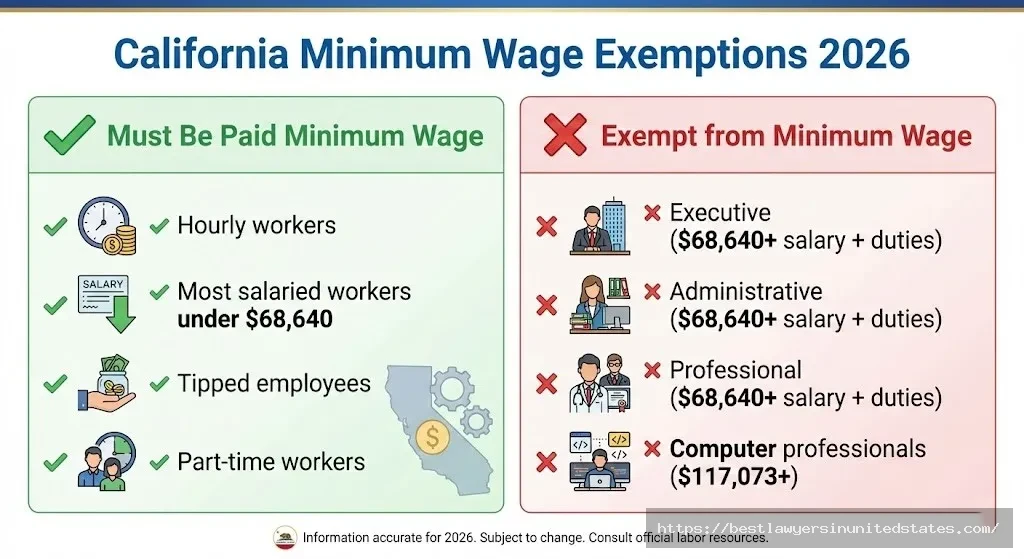
Certain employees are exempt from minimum wage and overtime requirements if they meet specific criteria. California's exemption rules are stricter than federal law.
Exempt Employee Requirements
To be exempt, ALL three conditions must be met:
| Requirement | Standard |
|---|---|
| Salary Basis | Fixed salary, not hourly |
| Salary Threshold | Minimum $68,640/year ($5,720/month) in 2026 |
| Duties Test | Executive, administrative, or professional duties |
Exempt Categories Explained
Executive exemption:
- Manages two or more employees
- Has authority to hire/fire or make recommendations
- Exercises discretion and independent judgment
Administrative exemption:
- Performs office or non-manual work
- Work directly relates to management or general business operations
- Exercises discretion and independent judgment on significant matters
Professional exemption:
- Work requires advanced knowledge in field of science or learning
- Knowledge customarily acquired through prolonged specialized study
- Examples: lawyers, doctors, engineers, teachers
Computer professional exemption:
- Minimum pay: $56.39/hour or $117,073.60/year in 2026
- Duties: Systems analysis, programming, software engineering
Common exemption misconceptions:
- ❌ "I'm paid salary, so I'm exempt" (must also meet salary threshold and duties test)
- ❌ "My job title is Manager, so I'm exempt" (title alone doesn't determine exemption)
- ❌ "I earn commission, so I'm exempt" (most commissioned workers still get minimum wage)
If you believe you've been misclassified as exempt and denied overtime pay, an attorney for discrimination at work can help you understand your rights and recover unpaid wages.
California-Specific Wage Laws
California enforces several unique wage and hour laws that go beyond federal requirements. These rules provide additional protections for workers.
Meal and Rest Break Requirements
Meal break rules:
- First meal break: 30 minutes unpaid after 5 hours of work
- Second meal break: 30 minutes unpaid after 10 hours of work
- Employee can waive first meal break if shift is 6 hours or less
- Employee can waive second meal break if shift is 12 hours or less and first break was taken
Rest break rules:
- 10 minutes paid rest for every 4 hours worked
- Rest break in middle of work period when practical
- One rest break for shifts 3.5-6 hours, two breaks for shifts 6-10 hours
Penalty for violations: $16.50 for each day a meal or rest break is denied. An employee denied lunch breaks for 100 workdays can recover $1,650 in meal break premiums alone.
Split Shift Premium
What qualifies as a split shift: A workday interrupted by unpaid non-working time exceeding one hour (not including meal breaks).
Premium amount: One hour of minimum wage ($16.50) minus any compensation received during the gap between shifts.
Example: An employee works 9 AM to 1 PM, has a four-hour unpaid break, then works 5 PM to 9 PM. The employer must pay the regular wages plus a $16.50 split shift premium (or less if some compensation was provided during the gap).
4-Hour Reporting Time Pay
When it applies: Employee reports to work but is given less than half their scheduled shift.
Payment requirement:
- Minimum: 2 hours of pay at regular rate
- Maximum: 4 hours of pay at regular rate
Example: An employee scheduled for an 8-hour shift reports to work but is sent home after 2 hours. The employer must pay for 4 hours ($66 at minimum wage) even though the employee only worked 2 hours.
Exception: Reporting time pay doesn't apply if operations cannot begin or continue due to threats to employees or property, civil authorities recommend work stoppage, or public utilities fail.
Alternative Workweek Schedules
What they allow: Employees can work 10-hour days without daily overtime if schedule is properly adopted.
Requirements for implementation:
- Two-thirds employee vote approving schedule
- Written disclosure to employees before vote
- Labor Commissioner notification within 30 days
- Schedule cannot exceed 10 hours per day or 40 hours per week
Common alternative schedules:
- Four 10-hour days (4/10 schedule)
- Nine 9-hour days plus one 8-hour day over two weeks (9/80 schedule)
Healthcare facilities, police departments, and fire stations commonly use alternative workweek schedules.
How Does California Compare to Other States?
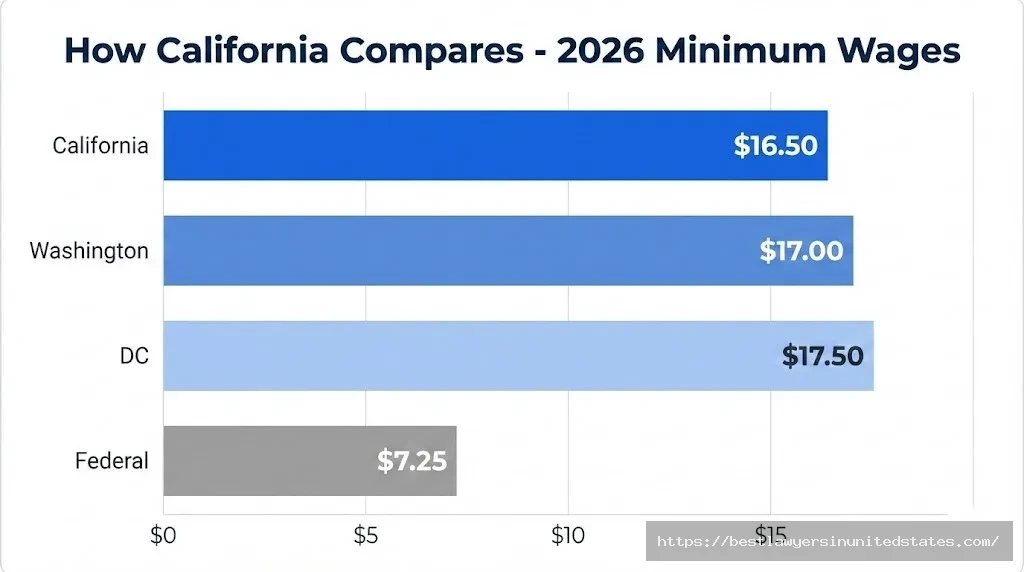
California ranks among the top three states for minimum wage, alongside Washington and the District of Columbia. The state's wage significantly exceeds both federal law and most other states.
Top 10 Highest State Minimum Wages (2026)
| Rank | State/Territory | Minimum Wage | Difference from Federal |
|---|---|---|---|
| 1 | Washington D.C. | $17.50 | +$10.25 |
| 2 | Washington | $17.00 | +$9.75 |
| 3 | California | $16.50 | +$9.25 |
| 4 | Connecticut | $16.35 | +$9.10 |
| 5 | Massachusetts | $16.00 | +$8.75 |
| 6 | New York | $16.50 (NYC) | +$9.25 |
| 7 | Oregon | $15.95 | +$8.70 |
| 8 | Colorado | $15.35 | +$8.10 |
| 9 | Arizona | $15.00 | +$7.75 |
| 10 | Maine | $14.65 | +$7.40 |
Federal minimum wage: $7.25/hour (unchanged since July 24, 2009)
California's Unique Advantages
What sets California apart:
- ✅ No tip credit (tipped workers get full minimum wage)
- ✅ Daily overtime after 8 hours
- ✅ Double-time pay after 12 hours or 7th consecutive day
- ✅ Split shift premiums
- ✅ 4-hour reporting time pay
- ✅ Strong enforcement with liquidated damages
States with NO state minimum wage: Alabama, Louisiana, Mississippi, South Carolina, Tennessee (all default to federal $7.25)
California's minimum wage is 127% higher than the federal rate. A full-time worker earning California minimum wage makes $19,008 more per year than a worker earning federal minimum wage.
Future Minimum Wage Increases in California
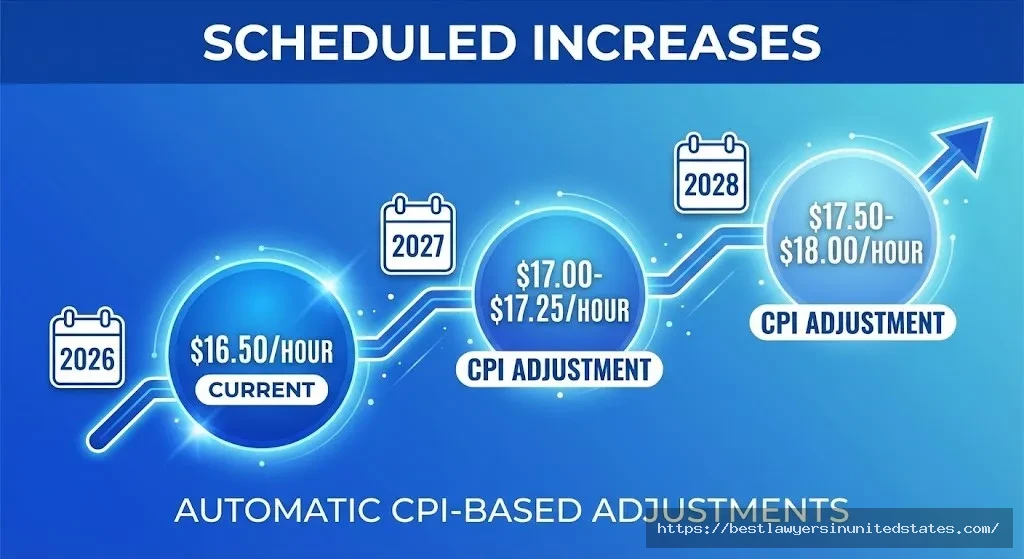
California ties its minimum wage to the Consumer Price Index for Urban Wage Earners and Clerical Workers (CPI-W). This creates automatic annual adjustments based on inflation.
Scheduled and Projected Increases
Known and estimated California minimum wage rates:
| Effective Date | Minimum Wage | Expected Increase | Method |
|---|---|---|---|
| Jan 1, 2026 | $16.50 | $0.50 (3.1%) | Confirmed |
| Jan 1, 2027 | $17.00-$17.25 (est.) | $0.50-$0.75 | CPI adjustment |
| Jan 1, 2028 | $17.50-$18.00 (est.) | $0.50-$0.75 | CPI adjustment |
How Increases Are Determined
CPI adjustment process:
- California Department of Finance calculates CPI-W change from prior year
- If CPI-W increases, minimum wage increases by same percentage
- Increase rounded to nearest $0.05
- California DIR announces new rate by August 1 for following January
No decrease provision: If CPI-W decreases, the minimum wage stays the same (it cannot go down).
Potential Legislative Changes
Los Angeles $30/hour proposal: City leaders are considering raising Los Angeles minimum wage to $30/hour by 2028. If passed, this would be the highest local minimum wage in the nation.
Fast food wage adjustments: The $20 fast food minimum wage may increase based on CPI, though the specific formula differs from the statewide wage calculation.
Healthcare wage phase-in: Healthcare facilities continue implementing SB 525 increases through 2028, with all facilities reaching $25/hour minimum by that date.
Wage Violations and Penalties in California
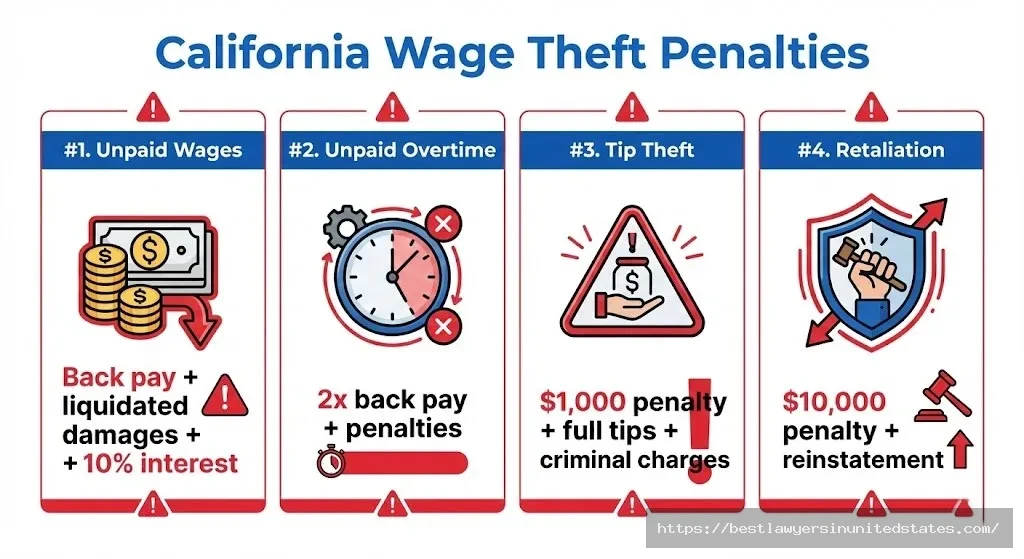
California enforces wage and hour laws through civil penalties, criminal charges, and private lawsuits. The state has stronger penalties than federal law.
Unpaid Minimum Wage Penalties
What employees can recover:
| Recovery Type | Amount |
|---|---|
| Back pay | Full amount of unpaid wages |
| Liquidated damages | Equal to back pay (doubles recovery) |
| Interest | 10% per year on unpaid wages |
| Waiting time penalty | Up to 30 days of wages for late payment on termination |
| Attorney fees | Reasonable fees if employee wins |
Example calculation: An employee worked 40 hours per week for 6 months at $12/hour instead of $16.50/hour minimum wage.
- Unpaid wages: 1,040 hours × $4.50 = $4,680
- Liquidated damages: $4,680
- Interest (10% for 6 months): $234
- Total recovery: $9,594
Unpaid Overtime Penalties
Overtime violation recovery:
- Back pay for all unpaid overtime hours
- Liquidated damages equal to unpaid overtime
- Interest at 10% per year
- Waiting time penalty if not paid promptly on termination
Example: An employee worked 10 hours of overtime weekly for one year at straight time instead of time-and-a-half.
- Unpaid overtime premium: 520 hours × $8.25 (half the overtime rate) = $4,290
- Liquidated damages: $4,290
- Total recovery: $8,580 (plus interest and potential waiting time penalty)
Meal and Rest Break Violation Penalties
Premium payment: One additional hour of pay at employee's regular rate for each day a break is denied.
At minimum wage, this equals $16.50 per day per violation. An employee denied lunch breaks for 200 workdays can recover $3,300 in meal break premiums.
Employer Penalties Paid to State
California Labor Commissioner penalties:
| Violation Type | First Offense | Subsequent Offenses |
|---|---|---|
| Failure to pay minimum wage | $100 per employee | $200 per employee + 25% of unpaid wages |
| Failure to pay overtime | $100 per employee | $200 per employee + 25% of unpaid wages |
| Misclassification (independent contractor) | $5,000-$15,000 per violation | $10,000-$25,000 per violation |
| Retaliation | Up to $10,000 | Additional civil penalties |
Criminal penalties: Willful wage theft can result in misdemeanor charges with up to one year in county jail and fines up to $1,000 per violation.
Employees who suspect wage violations can consult a wage garnishment lawyer to understand their options for recovering unpaid wages and stopping further violations.
Calculate Your Wage Theft Recovery in California
Think your employer owes you money? Use our wage theft calculator to estimate how much you could recover, including unpaid wages, penalties, and interest under California law.
Wage Theft Recovery Calculator
Estimate how much you can recover in unpaid wages, penalties, and damages based on your state's laws
💵 Estimated Total Recovery
💰 Unpaid Wages
⚖️ Penalties & Damages
📋 Total Summary
Calculator features:
- Multiple violation types (unpaid wages, overtime, tips)
- California-specific penalties and damages
- Filing deadline tracker
- Total recovery estimate
- Next steps guidance
Full wage theft calculator: Use our wage theft recovery calculator to estimate recovery amounts for unpaid wages in any state.
Need help with unpaid wages? Contact California Department of Labor or consult with an employment attorney.
Questions about your wages or need legal help? Find Employment Lawyers in California - Free Consultation Email: [email protected]
How to File a Wage Complaint in California
California workers can file wage claims with the Division of Labor Standards Enforcement (DLSE) for free. The process typically takes 6-12 months from filing to resolution.
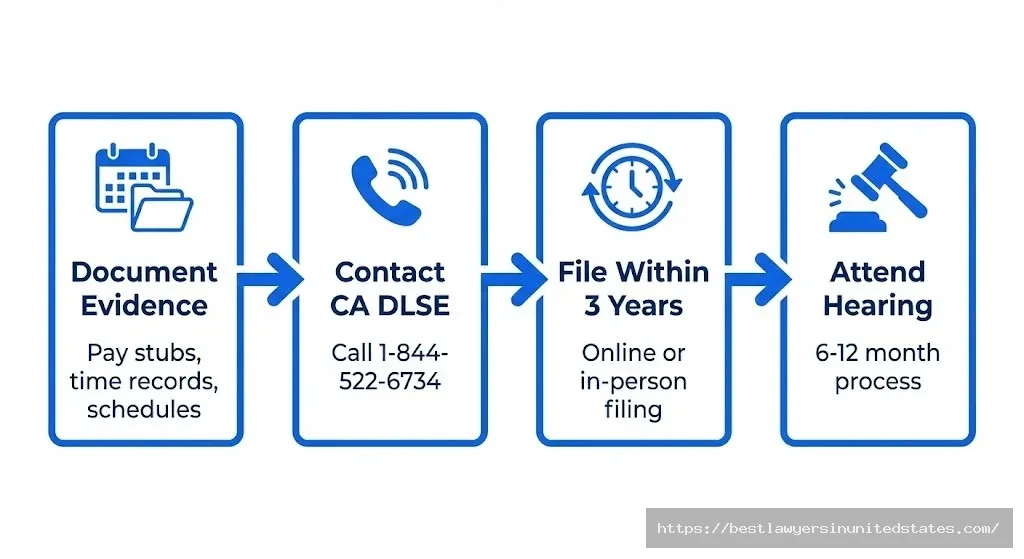
Step 1: Document Your Evidence
Gather these documents:
- Pay stubs showing hours and rates
- Time records or personal time logs
- Work schedules or shift confirmations
- Text messages or emails about work hours
- Bank deposits showing payment amounts
- Coworker contact information as witnesses
Create a timeline: Write down dates you worked, hours worked, wages paid, and wages owed for each pay period.
Step 2: Calculate What You're Owed
Use the wage theft recovery calculator above to estimate:
- Unpaid regular wages at $16.50/hour minimum
- Unpaid overtime at time-and-a-half or double-time
- Meal and rest break premiums
- Split shift premiums
- Liquidated damages
- Interest
- Waiting time penalties
Step 3: File with California DLSE
Online filing (recommended):
- Visit dir.ca.gov/dlse
- Create an account in the online portal
- Complete the wage claim form electronically
- Upload supporting documents (pay stubs, time records)
- Submit claim and receive confirmation number
In-person or mail filing:
- Download Form DLSE-1 (Initial Report or Claim)
- Complete all sections with detailed information
- Attach copies (not originals) of supporting documents
- Mail to or visit nearest DLSE office
DLSE regional office locations:
- Los Angeles: 320 W. 4th Street, Suite 600, Los Angeles, CA 90013
- San Francisco: 455 Golden Gate Ave, 10th Floor, San Francisco, CA 94102
- San Diego: 7575 Metropolitan Dr, Suite 210, San Diego, CA 92108
- Sacramento: 2031 Howe Avenue, Suite 100, Sacramento, CA 95825
- Oakland: 1515 Clay Street, Suite 801, Oakland, CA 94612
Step 4: DLSE Investigation and Hearing Process
Timeline and process:
| Stage | Timeframe | What Happens |
|---|---|---|
| Initial review | 2-4 weeks | DLSE reviews claim for completeness |
| Investigation | 1-2 months | DLSE contacts employer and requests records |
| Settlement conference | 3-6 months | DLSE attempts to settle claim |
| Hearing | 6-12 months | Deputy Labor Commissioner holds hearing if no settlement |
| Decision | 2-4 weeks after hearing | Written decision issued |
| Payment | 10 days after decision | Employer must pay or file appeal |
What to expect at hearing:
- Informal proceeding (not court)
- Present your evidence and testimony
- Employer presents their case
- Deputy Labor Commissioner asks questions
- Decision typically within 2-4 weeks
Filing Deadlines (Statute of Limitations)
California wage claim deadlines:
| Claim Type | Filing Deadline |
|---|---|
| Unpaid minimum wage | 3 years |
| Unpaid overtime | 3 years |
| Written employment contract violations | 4 years |
| Meal/rest break premiums | 3 years |
| Waiting time penalties | 3 years |
No retaliation protection: California law prohibits employers from firing, demoting, or otherwise punishing employees for filing wage claims or cooperating with DLSE investigations. Retaliation violations carry penalties up to $10,000.
How to Contact California Department of Labor
California's Division of Labor Standards Enforcement handles minimum wage complaints, overtime violations, and wage theft claims.
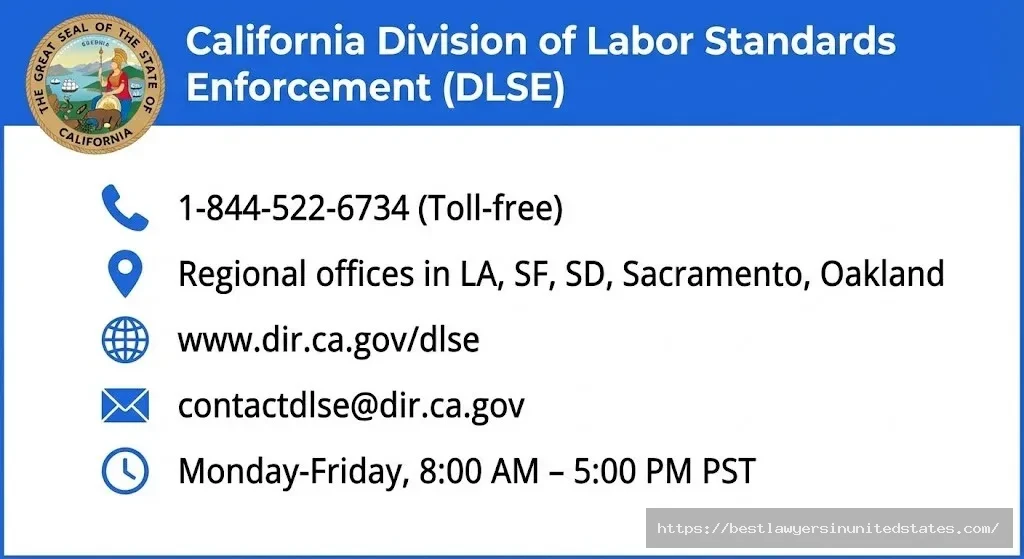
California Division of Labor Standards Enforcement (DLSE):
- Website: www.dir.ca.gov/dlse
- Phone: 1-844-522-6734 (toll-free)
- Hours: Monday-Friday, 8:00 AM - 5:00 PM Pacific
Labor Commissioner's Office Complaint Line:
- Phone: (833) 526-4636
- Email: [email protected]
Online resources:
- Wage claim forms
- Minimum wage posters (required workplace postings)
- Frequently asked questions
- Know your rights materials in multiple languages (English, Spanish, Chinese, Vietnamese, Korean, Tagalog, Armenian)
Regional office locations:
- Los Angeles: 320 W. 4th Street, Suite 600, Los Angeles, CA 90013, (213) 620-6330
- San Francisco: 455 Golden Gate Ave, 10th Floor, San Francisco, CA 94102, (415) 703-5300
- San Diego: 7575 Metropolitan Dr, Suite 210, San Diego, CA 92108, (619) 220-5451
- Sacramento: 2031 Howe Avenue, Suite 100, Sacramento, CA 95825, (916) 263-1811
- Oakland: 1515 Clay Street, Suite 801, Oakland, CA 94612, (510) 622-3273
Employer Obligations in California
California employers must comply with minimum wage laws, posting requirements, and record-keeping rules. Violations can result in significant penalties.
Required Workplace Postings
Mandatory posters at every workplace:
- Minimum wage notice (updated annually by California DIR)
- Wage theft prevention notice
- Discrimination and harassment policies
- Cal/OSHA safety and health protection notice
- Workers' compensation information
- Paid sick leave notice
- Industrial Welfare Commission wage order for industry
Languages required: Postings must be in English and any language spoken by at least 10% of the workforce. Spanish, Chinese, Vietnamese, Korean, Tagalog, and Armenian translations are commonly required.
Penalty for failure to post: $100 per employee per pay period for missing required notices.
Payroll and Record-Keeping Requirements
Itemized wage statements (pay stubs) must show:
- Employee name and last four digits of SSN or employee ID
- Dates of pay period
- Hours worked (for non-exempt employees)
- Hourly rate(s) paid
- Gross wages earned
- All deductions
- Net wages earned
- Pay period start and end dates
- Employer name, address, and phone number
Record retention requirements:
- Time records: 3 years
- Wage records: 4 years
- Personnel files: 3 years after termination
- Records must be available for employee inspection
Penalties for violations:
- Initial violation: $50 per employee per pay period
- Subsequent violations: $100 per employee per pay period
- Maximum: $4,000 per employee
Annual Wage Theft Prevention Notice
Employers must provide written notice to employees:
- At time of hire
- Within seven days of any wage rate change
- Annually in writing
Notice must include:
- Rate of pay
- Overtime rate
- Basis of wage payment (hourly, salary, piece rate, commission)
- Regular payday
- Employer name, address, and phone number
- Any allowances claimed (meals, lodging)
Frequently Asked Questions
Is the Minimum Wage Going Up in California in 2026?
Quick Answer: Yes, California's minimum wage increases to $16.50 per hour on January 1, 2026, up from $16.00 in 2025.
This represents a $0.50 increase or 3.1% raise. Some California cities have higher local minimum wages that also increase in 2026, including Los Angeles ($17.81), San Francisco ($18.07), and Berkeley ($18.67).
What Is the Fast Food Minimum Wage in California?
Quick Answer: Fast food workers at chains with 60 or more locations nationally earn $20.00 per hour as of April 1, 2024.
This rate applies specifically to fast food restaurants under Assembly Bill 1228. Exemptions include bakeries that produce and sell bread on-site, restaurants inside grocery stores, and independent restaurants not part of national chains.
Does California Have a Tipped Minimum Wage?
Quick Answer: No, California requires employers to pay tipped employees the full $16.50 per hour minimum wage in 2026. Employees keep 100% of their tips on top of this base wage.
California does not allow tip credits like most other states. This means a server in California earns $16.50 per hour plus tips, while a server in a state that allows tip credits might earn only $2.13 per hour plus tips.
How Do I Calculate My Earnings at California Minimum Wage?
Quick Answer: Use our minimum wage earnings calculator to estimate your weekly, monthly, and annual income based on hours worked at $16.50 per hour.
For quick calculations: multiply your weekly hours by $16.50, then multiply by 52 for annual earnings. A full-time worker (40 hours/week) earns $34,320 per year at California minimum wage before taxes.
How Much Overtime Pay Do I Get in California?
Quick Answer: California requires time-and-a-half ($24.75/hour at minimum wage) after 8 hours in one day or 40 hours in one week, and double time ($33.00/hour) after 12 hours in one day.
Use our overtime pay calculator to calculate your exact overtime earnings based on California's daily and weekly overtime rules. California's overtime laws are more generous than federal law.
What Is the Exempt Salary Threshold in California for 2026?
Quick Answer: Employees must earn at least $68,640 per year ($5,720 per month) in 2026 to be exempt from overtime, and they must also meet duties tests for executive, administrative, or professional work.
Salary alone does not make someone exempt. The employee must be paid on a salary basis, earn at least the threshold amount, and perform exempt duties that involve discretion and independent judgment.
Can My Employer Pay Me Less Than Minimum Wage in California?
Quick Answer: No, all employees must receive at least the California minimum wage ($16.50/hour statewide in 2026, or higher if a local ordinance applies) with very limited exceptions.
The only exceptions are certain student learners, disabled workers in sheltered workshops (with special permits), and specific agricultural exemptions. Independent contractors are not covered, but California strictly enforces worker classification rules under AB 5.
What Happens If My Employer Doesn't Pay Me Minimum Wage?
Quick Answer: You can file a wage claim with the California Labor Commissioner (DLSE) for free and may recover unpaid wages plus liquidated damages, interest, and waiting time penalties.
Use our wage theft recovery calculator to estimate what you're owed. You have 3 years to file a claim for unpaid minimum wage or overtime.
How Long Do I Have to File a Wage Claim in California?
Quick Answer: You have 3 years to file a claim for unpaid minimum wage or overtime, or 4 years if you have a written employment contract.
Waiting time penalties must be claimed within 3 years. These deadlines are longer than federal law and most other states. File as soon as possible to preserve evidence and witness testimony.
Does California Have Double Time Pay?
Quick Answer: Yes, California requires double time pay ($33.00/hour at minimum wage) after 12 hours in one workday or after 8 hours on the 7th consecutive day of work.
California is one of few states requiring double-time pay. Federal law only requires time-and-a-half after 40 hours per week and has no double-time requirement.
What Cities in California Have a Higher Minimum Wage Than the State?
Quick Answer: More than 40 California cities have local minimum wages higher than $16.50/hour, including Berkeley ($18.67), San Francisco ($18.07), Los Angeles ($17.81), San Jose ($17.95), and San Diego ($17.25).
Employees must be paid the highest applicable rate among federal, state, city, and county minimum wages. Check your city's official website for current local minimum wage rates.
Conclusion
California maintains one of the highest minimum wages in the nation at $16.50 per hour in 2026. The state's worker protections extend beyond basic minimum wage through industry-specific rates ($20 for fast food, $25 for healthcare), strict daily overtime rules, and prohibition of tip credits. Local ordinances in more than 40 California cities create even higher wage floors for workers in those areas.
Use the three calculators embedded in this guide to estimate your earnings, calculate overtime pay, and determine wage theft recovery amounts. These tools provide immediate calculations based on California's specific wage laws and help you understand exactly what you should be earning.
If you've experienced wage violations, California law provides strong remedies including liquidated damages that double your recovery. File a wage claim with the California Division of Labor Standards Enforcement within the 3-year statute of limitations. The state's enforcement mechanisms make it possible to recover unpaid wages without hiring an attorney, though complex cases may benefit from legal representation.
Calculate your exact earnings using our free tools above, and if you believe you've been underpaid, contact the California Labor Commissioner or consult with an employment attorney today.
