
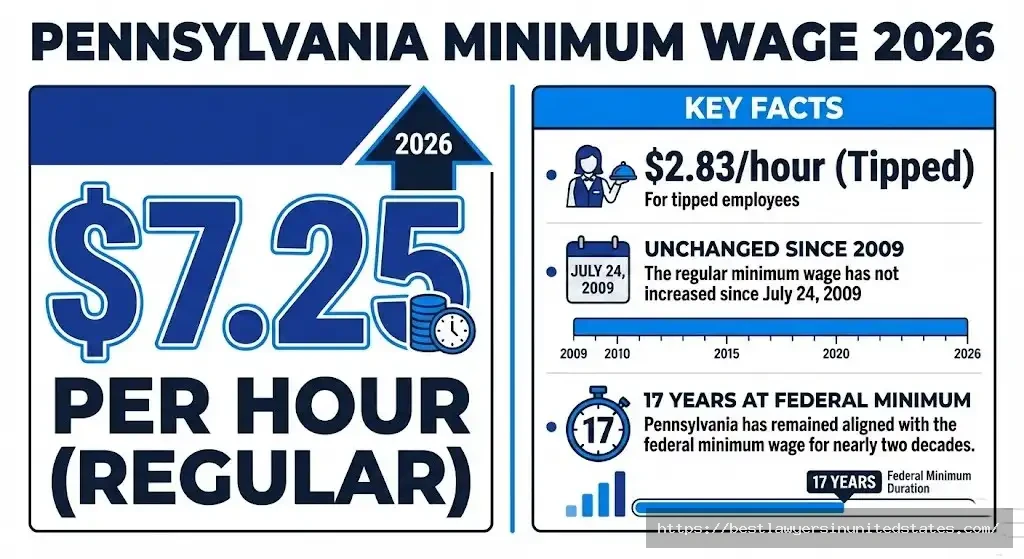
Quick Answer: Pennsylvania’s minimum wage is $7.25 per hour in 2026, the same as the federal minimum wage. The tipped minimum wage is $2.83 per hour. Pennsylvania has not raised its minimum wage since July 24, 2009, making it one of 20 states still at the federal floor.
Calculate Your Earnings in Pennsylvania
Want to know exactly how much you’ll earn at Pennsylvania’s $7.25 minimum wage? Use our free calculator to estimate your weekly, monthly, and annual income based on your hours worked.
💰 Minimum Wage Earnings Calculator
Calculate your weekly, monthly, and annual earnings with overtime and tax estimates
📊 Your Earnings Breakdown
💰 Gross Earnings
Calculator features:
- Automatic Pennsylvania wage rates for 2026
- Weekly, monthly, and annual earnings
- Overtime calculations
- Tax withholding estimates
- Take-home pay breakdown
Full calculator with all features: Calculate your exact earnings with our Pennsylvania minimum wage calculator
Questions about your wages or need legal help?
Email: [email protected]
Current Pennsylvania Minimum Wage (2026)
What Is the Minimum Wage in Pennsylvania?
Pennsylvania's minimum wage is $7.25 per hour as of January 1, 2026. This rate has not changed since July 24, 2009, when it aligned with the federal minimum wage.
The Pennsylvania Minimum Wage Act (43 P.S. § 333.101) governs wage requirements. The Pennsylvania Department of Labor & Industry enforces these laws through the Bureau of Labor Law Compliance.
Key facts about Pennsylvania's 2026 minimum wage:
- Effective since: July 24, 2009 (unchanged for 17 years)
- Applies to: All non-exempt employees
- Enforcement: PA Department of Labor & Industry
- Statute: 43 P.S. § 333.101 et seq.
Is Pennsylvania's Minimum Wage Increasing in 2026?
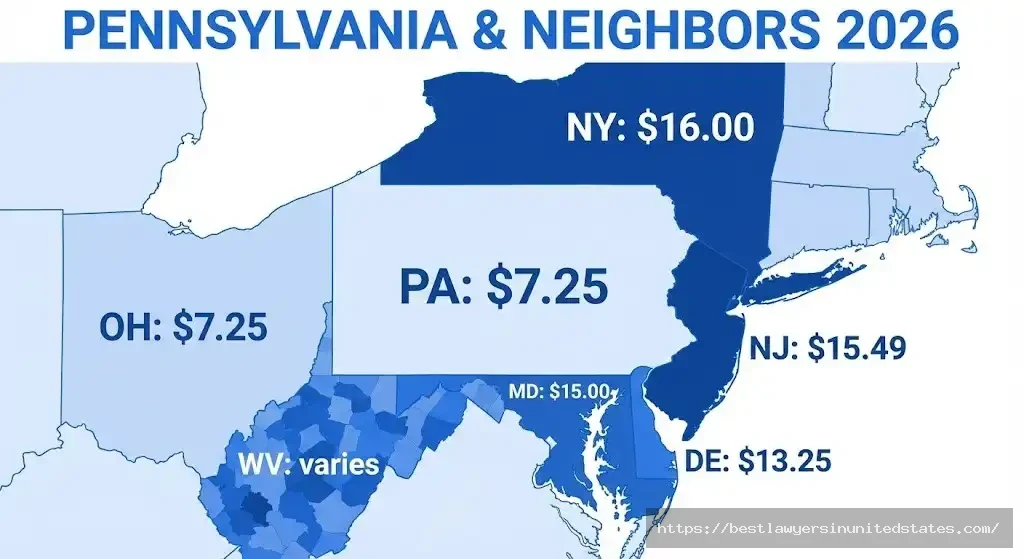
No increase is scheduled for 2026. Pennsylvania's minimum wage remains $7.25/hour unless new legislation passes. Unlike neighboring states such as New Jersey, which raised its minimum wage to $15.49, or New York, which increased to $16.00, Pennsylvania has not adjusted its wage floor in nearly two decades.
| Effective Date | Regular Minimum Wage | Tipped Minimum Wage | Status |
|---|---|---|---|
| July 24, 2009 | $7.25 | $2.83 | Last increase |
| January 1, 2026 | $7.25 | $2.83 | Current |
| January 1, 2027 | $7.25 | $2.83 | No change scheduled |
Pennsylvania Tipped Minimum Wage
What Do Tipped Employees Earn in Pennsylvania?
Tipped employees in Pennsylvania earn a base wage of $2.83 per hour. Employers can claim a tip credit of up to $4.42 to meet the $7.25 minimum wage requirement.
How the tip credit works:
- Employer pays: $2.83 base wage
- Maximum tip credit: $4.42
- Required total: $7.25/hour minimum
- If tips fall short: Employer must pay the difference
This differs significantly from states like California, where employers must pay the full minimum wage regardless of tips.
The 80/20 Rule for Tipped Workers
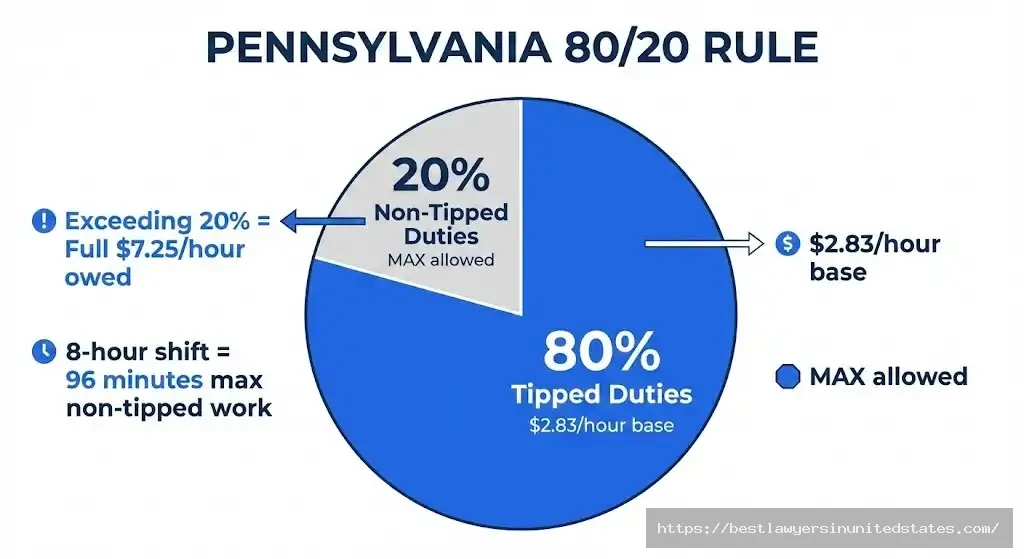
Pennsylvania follows the federal 80/20 rule under Title 34 Pa. Code § 231.111. Employers can only claim the tip credit when employees spend at least 80% of their time on tipped duties.
What this means:
- Tipped duties: Taking orders, serving food, bartending
- Non-tipped duties: Cleaning, food prep, dishwashing
- Maximum non-tipped time: 20% of shift
Example for an 8-hour shift:
- Total shift: 480 minutes
- Maximum non-tipped work: 96 minutes (20%)
- If exceeded: Employer owes full $7.25/hour for that time
Tip Pooling vs. Tip Theft
Pennsylvania law allows voluntary tip pooling among service staff. However, managers and owners cannot participate or take any portion of employee tips.
Legal tip pooling:
- Among servers, bartenders, bussers
- Must be voluntary or clearly disclosed
- Cannot include managers or owners
Illegal practices:
- Managers taking tips
- Deducting credit card fees from tips
- Keeping service charges (unless disclosed as non-tip)
- Forcing participation in tip pools
If your employer violates these rules, you can file a wage claim with the Pennsylvania Department of Labor & Industry. Pennsylvania's Wage Payment and Collection Law (43 P.S. § 260.1) provides strong protections for tip theft victims.
Pennsylvania Overtime Laws
What Is the Overtime Rate in Pennsylvania?
Pennsylvania requires overtime pay at 1.5 times your regular hourly rate after 40 hours in a workweek. This follows the federal Fair Labor Standards Act (FLSA) standard.
Pennsylvania overtime rules:
- Rate: 1.5x regular hourly wage
- Threshold: 40 hours per week
- No daily overtime (unlike California's 8-hour rule)
- Workweek: Any consecutive 7-day period
Unlike Maryland, which has additional overtime protections, Pennsylvania does not require daily overtime or premium pay for weekends or holidays.
Who Is Exempt from Overtime?
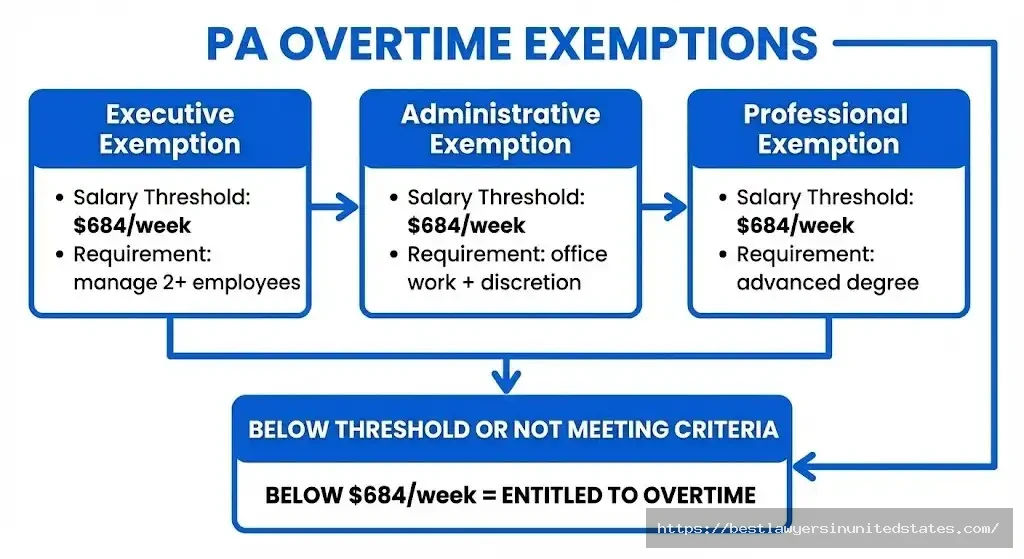
You may be exempt from overtime if you meet specific criteria under 34 Pa. Code § 231.81. The most common exemptions apply to executive, administrative, and professional employees.
| Exemption Type | Requirements | Minimum Salary |
|---|---|---|
| Executive | Manage 2+ employees, hiring/firing authority | $684/week ($35,568/year) |
| Administrative | Office work, independent judgment | $684/week ($35,568/year) |
| Professional | Advanced knowledge, degree required | $684/week ($35,568/year) |
| Outside Sales | Regular work outside employer's location | No minimum |
Common misclassifications:
- Job title alone doesn't determine exemption
- Salary under $684/week means non-exempt
- "Independent contractor" label doesn't override employee status
Calculate Your Overtime Pay in Pennsylvania
Working more than 40 hours per week? Calculate your overtime earnings based on Pennsylvania's overtime laws. This calculator accounts for Pennsylvania's weekly overtime threshold.
⏰ Overtime Pay Calculator
Calculate your overtime earnings based on your state's specific labor laws
📍 Select Your State
💰 Your Hourly Wage
📊 Calculation Method
📅 Weekly Hours
💵 Your Weekly Overtime Pay
📊 Earnings Breakdown
📅 Pay Period Estimates
⚖️ State vs Federal Comparison
Calculator features:
- Pennsylvania-specific overtime rules
- Weekly overtime calculations
- Pay period breakdowns
- Comparison with regular earnings
Full overtime calculator: Get detailed overtime calculations for Pennsylvania
Questions about your wages or need legal help?
Email: [email protected]
Overtime Calculation Examples
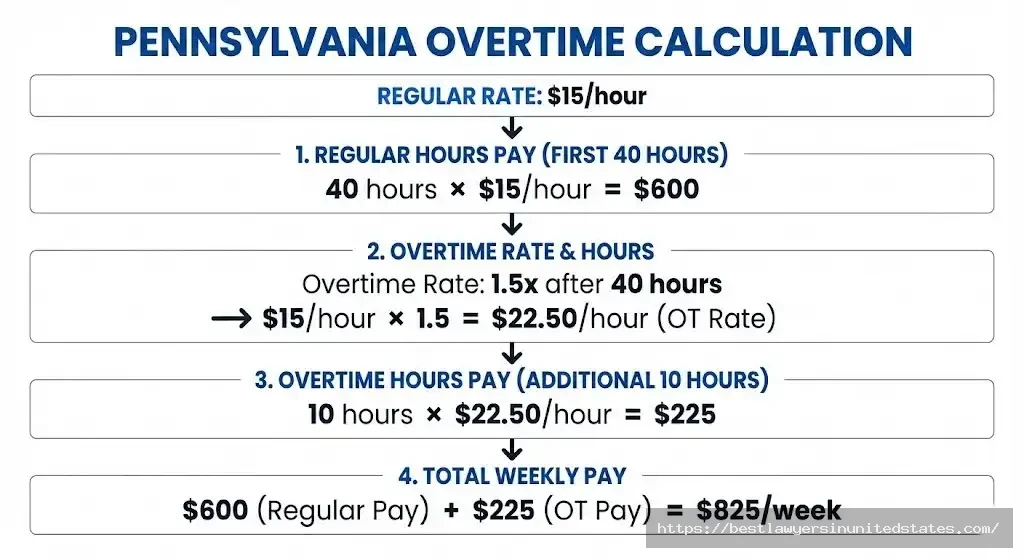
Example 1: Regular hourly worker at $15/hour
- Regular hours (40): 40 × $15 = $600
- Overtime hours (10): 10 × $22.50 = $225
- Total weekly pay: $825
Example 2: Tipped worker earning $12/hour with tips
- Regular hours (40): 40 × $12 = $480
- Overtime hours (10): 10 × $18 = $180
- Total weekly pay: $660 (plus tips)
- Employer must ensure tips bring total to at least minimum wage
Is Pennsylvania Raising Minimum Wage to $15?
Current Legislative Status
Pennsylvania's House of Representatives passed a bill proposing a tiered minimum wage increase in 2024. However, the Republican-controlled Senate has not advanced the legislation.
Proposed changes:
- Large counties (population >250,000): $15/hour
- Smaller counties: $12/hour
- Phase-in period: 3-5 years
- Status: Stalled in Senate
Why the Delay?
Governor Josh Shapiro supports raising the minimum wage. The Democratic-controlled House passed the increase. But the Republican Senate majority opposes the measure, citing concerns from business groups.
Political roadblocks:
- Governor: Supports $15/hour increase
- House: Passed tiered proposal
- Senate: Republican opposition blocks passage
- Business lobby: Actively campaigns against increase
Timeline for Potential Increase
Realistic scenarios:
- 2026: Unlikely without Senate change
- 2027-2028: Possible if political composition shifts
- Current status: No movement expected in 2026
While Pennsylvania debates these changes, neighboring states have already acted. Ohio maintains the $7.25 federal minimum like Pennsylvania, but Delaware increased to $13.25.
| State | 2026 Minimum Wage | Increase from 2025 | Legislative Status |
|---|---|---|---|
| Pennsylvania | $7.25 | $0 | Stalled |
| New Jersey | $15.49 | Annual CPI increase | Active increases |
| New York | $16.00 | $0.50 | Scheduled increases |
| Ohio | $7.25 | $0 | No activity |
Pennsylvania vs. Federal Minimum Wage
How Does Pennsylvania Compare?
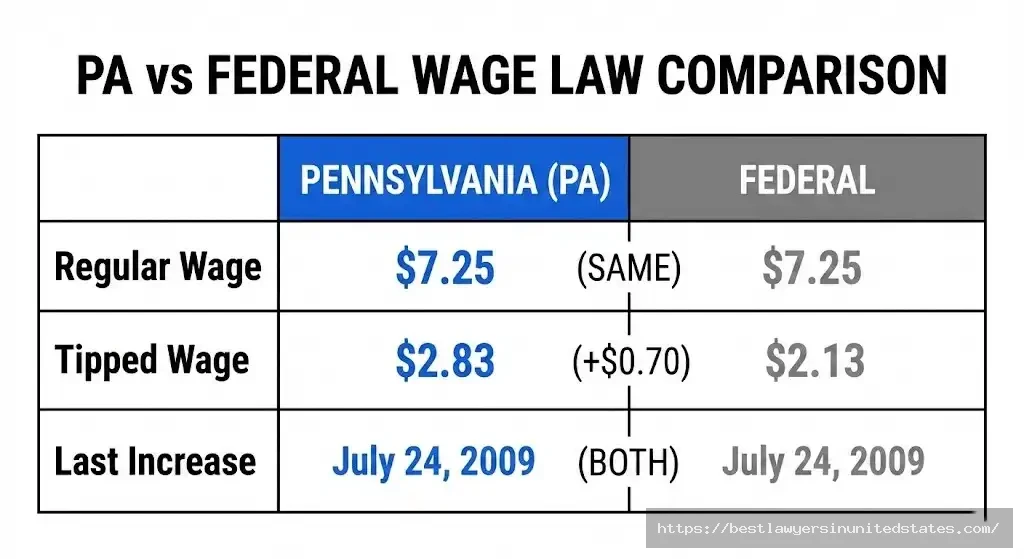
Pennsylvania's minimum wage matches the federal rate of $7.25 per hour. However, Pennsylvania's tipped minimum wage of $2.83 is $0.70 higher than the federal tipped minimum of $2.13.
| Jurisdiction | Regular Minimum | Tipped Minimum | Last Increase |
|---|---|---|---|
| Pennsylvania | $7.25 | $2.83 | July 24, 2009 |
| Federal | $7.25 | $2.13 | July 24, 2009 |
| Difference | Same | +$0.70 | Same date |
States Still at $7.25
Pennsylvania is one of 20 states that follow the federal minimum wage with no state-level increase. These states include Alabama, Georgia, Indiana, Kentucky, Louisiana, Mississippi, North Carolina, South Carolina, Tennessee, Texas, Virginia, Wisconsin, and Wyoming.
Higher Minimum Wage States
Many states have significantly higher minimum wages than Pennsylvania:
Top 5 state minimum wages for 2026:
- Washington, D.C.: $17.50
- Washington State: $16.66
- California: $16.50
- New York: $16.00 (NYC), $15.00 (upstate)
- New Jersey: $15.49
If Pennsylvania adopted New York's minimum wage, a full-time worker would earn $33,280 annually instead of $15,080.
Local Minimum Wages: Philadelphia, Pittsburgh, Montgomery County
Can Pennsylvania Cities Set Their Own Minimum Wage?
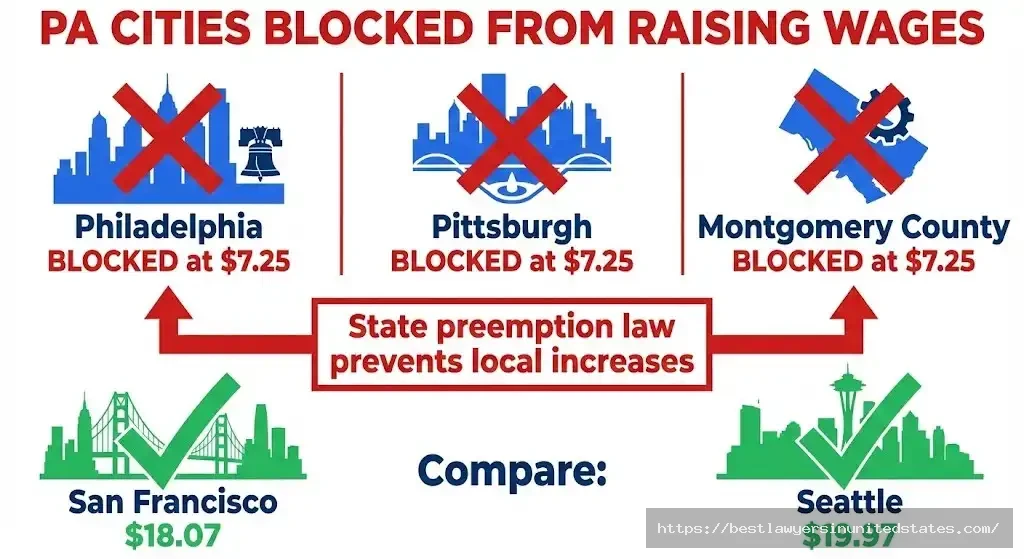
No. Pennsylvania state law prohibits local governments from establishing minimum wages higher than the state or federal rate. This preemption prevents cities like Philadelphia and Pittsburgh from following the model of high-wage cities in California or New York.
Why Philadelphia and Pittsburgh are stuck at $7.25:
- State preemption law blocks local ordinances
- Courts have upheld this prohibition
- Requires state legislative action to change
Failed Local Attempts
Montgomery County (2021):
- Proposed: $15/hour county minimum
- Result: Blocked by state courts citing preemption law
- Current rate: $7.25/hour (state minimum)
Philadelphia City Council:
- Multiple proposals for $15/hour since 2015
- All blocked by state preemption law
- Cannot act without state permission
Pittsburgh Fair Workweek:
- Focus: Predictive scheduling (not wages)
- Status: Limited success with scheduling ordinances
- Wages: Still $7.25/hour
Comparison to Other Major Cities
| City | Minimum Wage | State Preemption? | Notes |
|---|---|---|---|
| Philadelphia, PA | $7.25 | Yes | Cannot set local rate |
| Pittsburgh, PA | $7.25 | Yes | Cannot set local rate |
| San Francisco, CA | $18.07 | No | Local control allowed |
| Seattle, WA | $19.97 | No | Local control allowed |
| New York City, NY | $16.00 | No | State allows variation |
Living Wage vs. Minimum Wage in Pennsylvania
What Is a Living Wage?
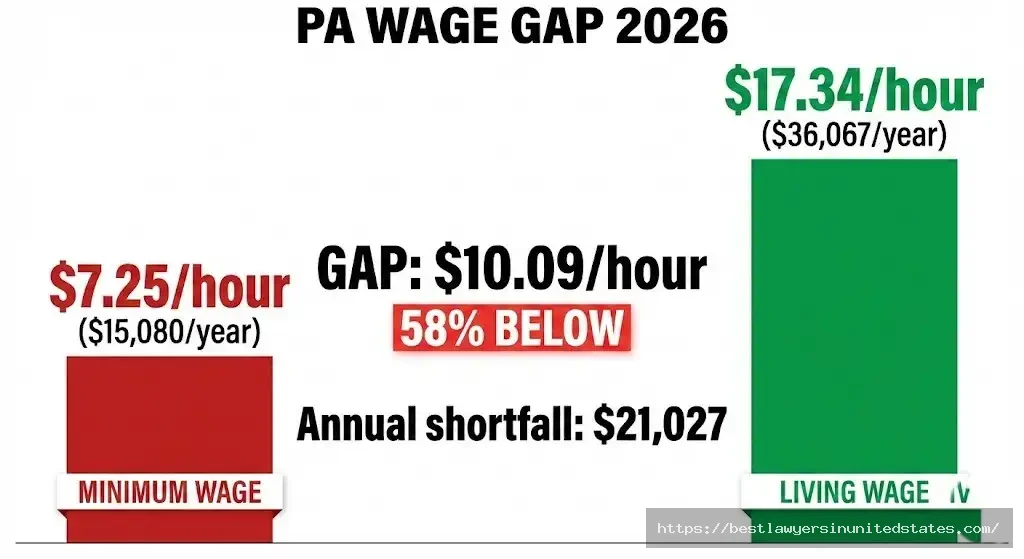
A living wage represents the hourly rate needed to cover basic expenses like housing, food, transportation, and healthcare. According to MIT's Living Wage Calculator, a single adult in Pennsylvania needs $17.34 per hour to meet basic needs.
MIT Living Wage data for Pennsylvania (2026):
| Household Type | Living Wage | Annual (Full-Time) |
|---|---|---|
| Single Adult | $17.34/hour | $36,067 |
| Single Adult + 1 Child | $33.39/hour | $69,451 |
| 2 Adults (1 working) + 2 Children | $32.97/hour | $68,578 |
| 2 Adults (both working) + 2 Children | $24.53/hour each | $51,022 each |
The Gap Between Minimum and Living Wage
Pennsylvania's minimum wage falls $10.09 per hour short of the living wage for a single adult. This represents a 58% gap between what workers earn and what they need.
The reality of living on $7.25/hour:
- Minimum wage: $7.25/hour
- Living wage: $17.34/hour
- Shortfall: $10.09/hour
- Annual gap: $21,027 per year (full-time)
Can You Afford Basic Expenses on Minimum Wage?
Annual income at Pennsylvania minimum wage (full-time): $15,080
Basic expenses for single adult in Pennsylvania:
- Rent (1-bedroom apartment): $900/month = $10,800/year
- Food: $300/month = $3,600/year
- Transportation: $200/month = $2,400/year
- Healthcare: $250/month = $3,000/year
- Utilities: $150/month = $1,800/year
- Total annual expenses: $21,600
- Annual shortfall: -$6,520
The federal poverty line for a single adult in 2026 is $15,060. A full-time minimum wage worker in Pennsylvania earns just $20 more than the poverty threshold.
Pennsylvania Minimum Wage History (1968-2026)
Historical Timeline
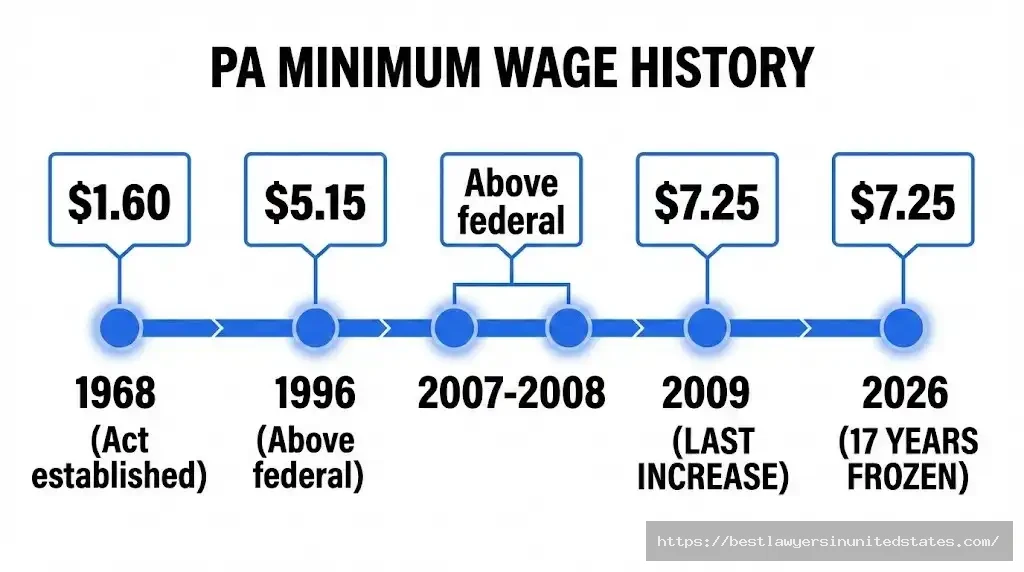
Pennsylvania established its Minimum Wage Act in 1968. For decades, the state often set rates above the federal minimum. That changed in 2009.
| Year | PA Minimum Wage | Federal Minimum | Notes |
|---|---|---|---|
| 1968 | $1.60 | $1.60 | PA Minimum Wage Act established |
| 1980 | $3.10 | $3.10 | Kept pace with federal |
| 1996 | $5.15 | $4.75 | PA exceeded federal by $0.40 |
| 2007 | $6.25 | $5.85 | PA above federal |
| 2008 | $7.15 | $6.55 | PA above federal |
| 2009 | $7.25 | $7.25 | Last increase |
| 2026 | $7.25 | $7.25 | No change in 17 years |
Purchasing Power Decline
The $7.25 minimum wage from 2009 would need to be $10.47 in 2026 to maintain the same purchasing power (adjusted for inflation).
What this means:
- 2009 minimum wage: $7.25
- Inflation-adjusted 2026 value: $10.47
- Actual 2026 minimum wage: $7.25
- Purchasing power loss: 30.8%
Why Pennsylvania Hasn't Increased Minimum Wage
Four main factors keep Pennsylvania's minimum wage frozen:
- Federal stagnation: No federal increase since 2009
- Legislative gridlock: Republican Senate blocks Democratic House proposals
- Business opposition: Trade groups lobby against increases
- Preemption laws: Cities cannot act independently
This contrasts with states like Massachusetts, which raised its minimum wage to $15 through legislative action.
Wage Theft & Recovery in Pennsylvania
What Is Wage Theft?
Wage theft occurs when employers fail to pay workers what they legally owe. Pennsylvania's Wage Payment and Collection Law (43 P.S. § 260.1) provides strong protections against these violations.
Common wage theft examples:
- Unpaid overtime after 40 hours
- Forcing off-the-clock work
- Withholding final paychecks
- Managers taking employee tips
- Misclassifying employees as exempt
- Paying below minimum wage
Pennsylvania Wage Theft Penalties
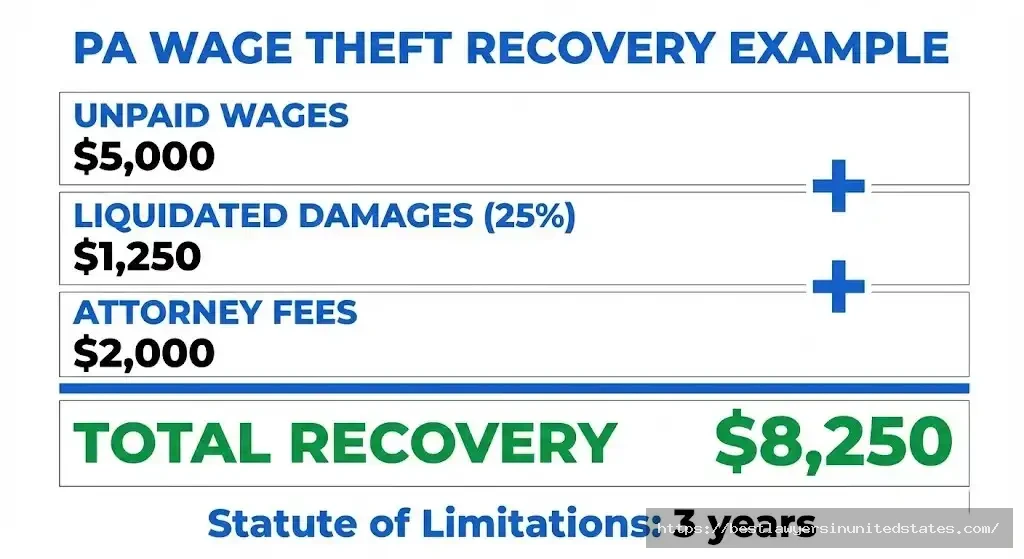
The Wage Payment and Collection Law allows employees to recover unpaid wages plus 25% liquidated damages. Pennsylvania also awards attorney fees to successful claimants.
Recovery structure:
- Unpaid wages: Full back pay
- Liquidated damages: 25% of unpaid amount
- Attorney fees: Recoverable if you win
- Statute of limitations: 3 years
Example recovery calculation:
- Unpaid wages: $5,000
- Liquidated damages (25%): $1,250
- Attorney fees: $2,000 (example)
- Total potential recovery: $8,250
Calculate Your Wage Theft Recovery in Pennsylvania
Think your employer owes you money? Use our wage theft calculator to estimate how much you could recover, including unpaid wages, penalties, and interest under Pennsylvania law.
Wage Theft Recovery Calculator
Estimate how much you can recover in unpaid wages, penalties, and damages based on your state's laws
💵 Estimated Total Recovery
💰 Unpaid Wages
⚖️ Penalties & Damages
📋 Total Summary
Calculator features:
- Multiple violation types (unpaid wages, overtime, tips)
- Pennsylvania-specific penalties and damages
- Filing deadline tracker
- Total recovery estimate
- Next steps guidance
Full wage theft calculator: Calculate your potential wage theft recovery
Questions about your wages or need legal help?
Email: [email protected]
How to File a Wage Claim in Pennsylvania
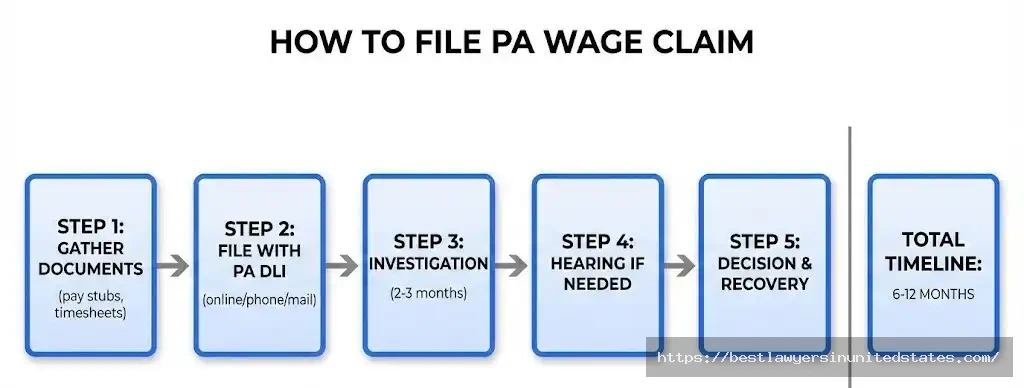
Step 1: Gather documentation
- Pay stubs and timesheets
- Work schedules and shift records
- Employment contract or offer letter
- Emails or texts about wages
- Photos of time clocks or records
Step 2: File with Pennsylvania Department of Labor & Industry
- Online: Bureau of Labor Law Compliance portal
- Phone: 1-800-932-0665
- Mail: Pennsylvania Department of Labor & Industry, Bureau of Labor Law Compliance, Harrisburg, PA
Step 3: Investigation process
- DLI investigates your claim (30-90 days)
- Employer receives notice and must respond
- Both parties submit evidence
- Hearing scheduled if dispute continues
Step 4: Decision and collection
- DLI issues decision
- Employer ordered to pay if you win
- Court enforcement if employer refuses
- Possible criminal penalties for willful violations
Filing Deadlines
| Claim Type | Filing Deadline | Statute of Limitations |
|---|---|---|
| Unpaid Wages | 3 years | 3 years from violation |
| Overtime Violations | 3 years | 3 years from violation |
| Tip Theft | 3 years | 3 years from violation |
| Retaliation | 180 days | 3 years from violation |
Timeline expectations:
- Filing to investigation: 2-4 weeks
- Investigation period: 2-3 months
- Hearing (if needed): 4-6 months
- Total process: 6-12 months typical
Similar wage theft protections exist in neighboring states, though recovery amounts vary. Florida's wage theft laws also provide for liquidated damages.
Exemptions & Special Cases
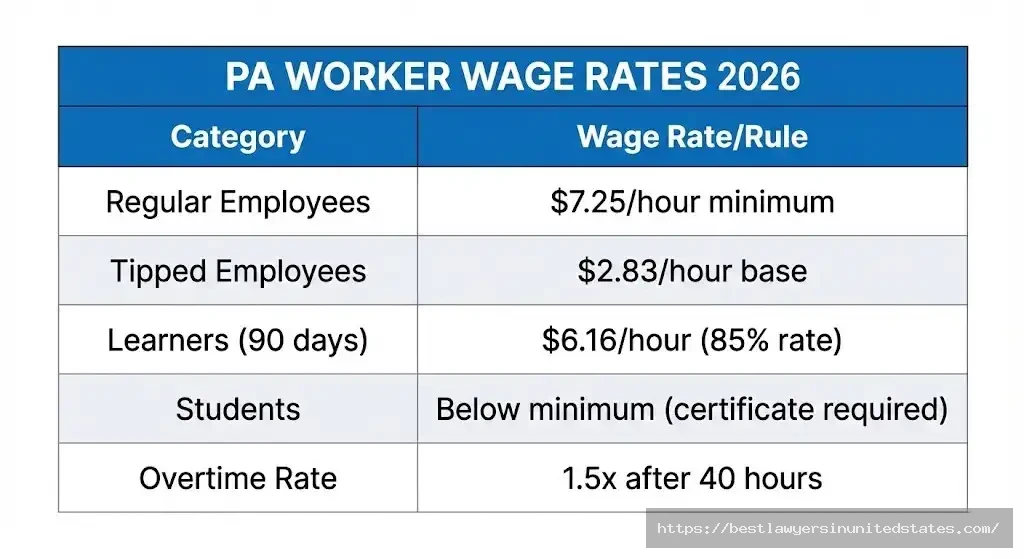
Subminimum Wage Certificates
Pennsylvania allows employers to pay below minimum wage in limited circumstances. These require special certificates from the Department of Labor & Industry.
Learner certificates (85% of minimum wage):
- Rate: $6.16/hour (85% of $7.25)
- Duration: First 90 days of employment
- Requirements: Employer must obtain certificate from PA DLI
- Restrictions: Limited to certain industries and occupations
Student employment certificates:
- Rate: Can be below minimum wage
- Eligibility: Full-time high school or college students
- Hours: Limited to part-time (20 hours/week during school)
- Application: Employer must apply and receive approval
Workers with disabilities (commensurate wage):
- Rate: Based on productivity compared to non-disabled workers
- Requirements: Section 14(c) certificate from U.S. Department of Labor
- Controversy: Being phased out in many states
- Pennsylvania status: Still allowed but heavily regulated
Who Is Exempt from Minimum Wage?
Federal exemptions under the Fair Labor Standards Act apply in Pennsylvania. These include specific job categories and industries.
Common exemptions:
- Executive, administrative, and professional employees (salary ≥$684/week)
- Outside sales representatives
- Certain computer professionals (≥$684/week or ≥$27.63/hour)
- Seasonal and recreational establishment employees
- Some agricultural workers
- Independent contractors (if properly classified)
Misclassification warnings:
- Job title alone doesn't create exemption
- Salary below $684/week means non-exempt status
- "Independent contractor" label requires legal test
- "Manager" title doesn't automatically exempt
If you believe you've been misclassified, you may be owed back wages and overtime. Pennsylvania employment lawyers can help determine if your classification is correct, similar to how Pennsylvania DUI lawyers assist with criminal defense matters.
FAQ: Pennsylvania Minimum Wage 2026
What is the minimum wage in Pennsylvania for 2026?
Quick Answer: Pennsylvania's minimum wage is $7.25 per hour in 2026, matching the federal minimum wage. This rate has not changed since July 24, 2009.
This applies to all non-exempt employees. Some workers, like tipped employees, have different base rates but must still earn at least $7.25 per hour including tips.
What is the tipped minimum wage in Pennsylvania?
Quick Answer: The tipped minimum wage in Pennsylvania is $2.83 per hour. Employers must ensure total earnings (wages plus tips) reach $7.25 per hour.
If tips don't bring an employee's hourly rate to $7.25, the employer must pay the difference. This is $0.70 higher than the federal tipped minimum of $2.13.
Will Pennsylvania raise the minimum wage in 2026?
Quick Answer: No increase is scheduled for 2026. Pennsylvania's minimum wage will remain $7.25 per hour unless new legislation passes.
A bill proposing $15 per hour in large counties and $12 per hour in smaller counties passed the House but remains stalled in the Senate.
How do I calculate my earnings at Pennsylvania minimum wage?
Quick Answer: Use our free Pennsylvania minimum wage calculator to calculate your weekly, monthly, and annual earnings based on hours worked.
The calculator accounts for Pennsylvania's $7.25 hourly rate, overtime calculations, and provides tax estimates for take-home pay.
What is overtime pay in Pennsylvania?
Quick Answer: Overtime pay in Pennsylvania is 1.5 times your regular hourly rate for hours worked over 40 in a workweek.
For example, if you earn $15 per hour, your overtime rate is $22.50 per hour. Pennsylvania does not require daily overtime or premium pay for weekends.
How much overtime pay am I entitled to in Pennsylvania?
Quick Answer: Calculate your exact overtime pay with our Pennsylvania overtime calculator, which shows your regular pay, overtime premium, and total weekly earnings.
Overtime kicks in after 40 hours per week. Part-time workers who never exceed 40 hours per week do not receive overtime pay.
Can Philadelphia or Pittsburgh set their own minimum wage?
Quick Answer: No. Pennsylvania state law prohibits cities from establishing minimum wages higher than the state rate of $7.25 per hour.
Montgomery County, Philadelphia, and Pittsburgh have all attempted local minimum wage increases, but state preemption law blocks these efforts.
What is the living wage in Pennsylvania?
Quick Answer: The living wage for a single adult in Pennsylvania is $17.34 per hour according to MIT's Living Wage Calculator, which is $10.09 higher than the $7.25 minimum wage.
This represents a 58% gap between minimum wage and what's needed to afford basic expenses like housing, food, and healthcare.
How long has Pennsylvania's minimum wage been $7.25?
Quick Answer: Pennsylvania's minimum wage has been $7.25 per hour since July 24, 2009—unchanged for 17 years.
This makes Pennsylvania one of 20 states that still follow the federal minimum wage with no state-level increase.
How do I calculate wage theft recovery in Pennsylvania?
Quick Answer: Use our Pennsylvania wage theft calculator to estimate your recovery, including unpaid wages, 25% liquidated damages, and potential attorney fees.
Pennsylvania's Wage Payment and Collection Law provides strong protections. You have 3 years to file a claim from the date of violation.
How do I file a wage claim in Pennsylvania?
Quick Answer: File a wage claim with the Pennsylvania Department of Labor & Industry online, by phone at 1-800-932-0665, or by mail to the Bureau of Labor Law Compliance in Harrisburg.
You need pay stubs, timesheets, and evidence of unpaid wages. The investigation typically takes 2-3 months.
What is the 80/20 rule for tipped employees in Pennsylvania?
Quick Answer: Tipped workers must spend at least 80% of their time on tipped duties. If more than 20% is spent on non-tipped work, employers owe the full $7.25 minimum wage for that time.
This rule prevents employers from using the $2.83 tipped wage for extensive cleaning, prep work, or other non-service duties.
Does Pennsylvania require paid lunch breaks?
Quick Answer: No. Pennsylvania does not require employers to provide lunch breaks or any breaks for adult workers (18 and older).
Minors under 18 must receive a 30-minute break after 5 consecutive hours of work. If employers voluntarily provide breaks under 20 minutes, those breaks must be paid.
What is the penalty for not paying minimum wage in Pennsylvania?
Quick Answer: Employers who violate Pennsylvania wage laws face 25% liquidated damages on unpaid wages, back pay requirements, and attorney fees. Willful violations can result in criminal penalties.
The Wage Payment and Collection Law (43 P.S. § 260.1) gives employees strong recovery rights for up to 3 years of violations.
Is $20 per hour good in Pennsylvania?
Quick Answer: Yes. $20 per hour ($41,600 annually) exceeds Pennsylvania's living wage of $17.34 per hour and is 176% higher than the minimum wage.
This hourly rate allows a single adult to afford basic expenses with some discretionary income in most Pennsylvania cities.
Are salaried employees entitled to overtime in Pennsylvania?
Quick Answer: Not automatically. Salaried employees earning less than $684 per week ($35,568 annually) are entitled to overtime. Those above this threshold may be exempt if they perform executive, administrative, or professional duties.
Job title doesn't determine exemption status. Duties and salary level both matter under Pennsylvania and federal law.
Can you live on $7.25 per hour in Pennsylvania?
Quick Answer: No. A full-time minimum wage worker earns $15,080 annually, which is barely above the $15,060 poverty line and $21,027 below the living wage needed for basic expenses.
Even with full-time hours, minimum wage workers cannot afford average rent, food, transportation, and healthcare costs in Pennsylvania.
How does Pennsylvania's minimum wage compare to neighboring states?
Quick Answer: Pennsylvania's $7.25 minimum wage is lower than New Jersey ($15.49), New York ($16.00), Maryland ($15.00), and Delaware ($13.25). Only Ohio matches Pennsylvania at $7.25.
If Pennsylvania adopted New Jersey's rate, full-time workers would earn $17,139 more annually.
What states have a $15 minimum wage?
Quick Answer: California, Connecticut, Massachusetts, New Jersey, New York (varies by region), Washington D.C., and parts of Illinois, Maryland, and Washington have minimum wages of $15 or higher.
Pennsylvania's $7.25 rate is $7.75 to $10.25 lower than these jurisdictions.
Is 32 hours full-time in Pennsylvania?
Quick Answer: Pennsylvania employment law does not define full-time hours. The Affordable Care Act considers 30+ hours full-time for health insurance purposes, but employers typically set their own thresholds between 35-40 hours.
Overtime requirements begin at 40 hours per week regardless of how employers classify full-time status.
Last updated: January 2026
Legal statute: Pennsylvania Minimum Wage Act (43 P.S. § 333.101)
Enforcement: Pennsylvania Department of Labor & Industry, Bureau of Labor Law Compliance
Need help with wage issues? Pennsylvania employment lawyers can help you recover unpaid wages and fight wage theft. Similar to how residents seek help with Pennsylvania divorce costs, wage disputes often require legal expertise.
Email: [email protected]
