
Quick Answer: Illinois minimum wage is $15 per hour in 2026 for most workers, which is more than double the federal rate. Chicago has a higher minimum wage of $16.60 per hour as of July 1, 2025. Tipped workers must receive at least $9 per hour base pay in Illinois, or $12.62 in Chicago.

The state reached its final scheduled increase in 2025 after six years of gradual raises. No additional increase is planned for 2026 under current law, though Chicago may adjust its rate based on inflation.
Calculate Your Earnings in Illinois
Want to know exactly how much you’ll earn at Illinois minimum wage? Use our free calculator to estimate your weekly, monthly, and annual income based on your hours worked.
💰 Minimum Wage Earnings Calculator
Calculate your weekly, monthly, and annual earnings with overtime and tax estimates
📊 Your Earnings Breakdown
💰 Gross Earnings
Calculator features:
- Automatic Illinois wage rates for 2026
- Weekly, monthly, and annual earnings
- Overtime calculations
- Tax withholding estimates
- Take-home pay breakdown
Full calculator with all features: Calculate your Illinois minimum wage earnings
Questions about your wages or need legal help? Email: [email protected]
What Is Illinois Minimum Wage in 2026?
Quick Answer: Illinois minimum wage is $15.00 per hour for most workers in 2026. This rate took effect January 1, 2025, and continues through 2026 with no scheduled increase.
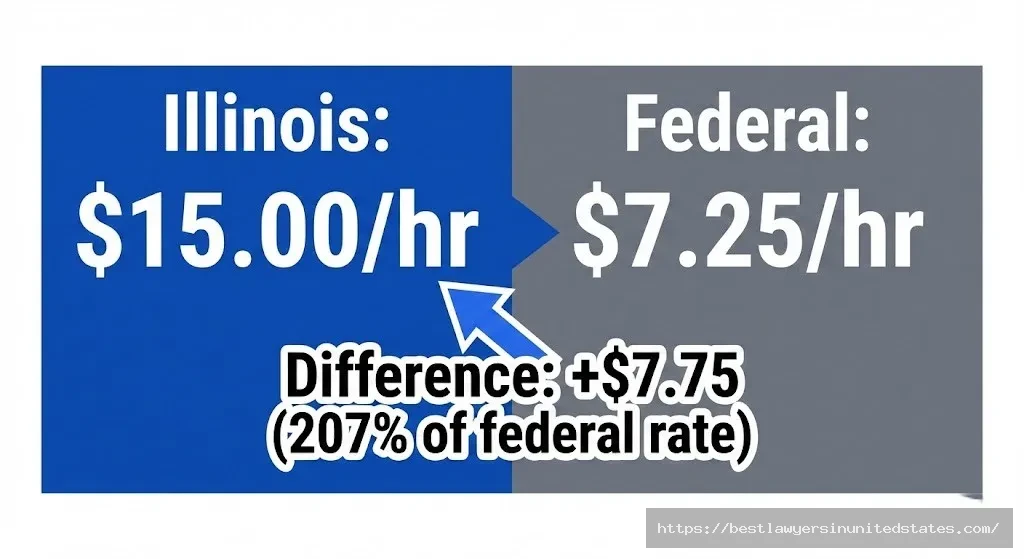
The state rate applies to nearly all employers in Illinois. Federal minimum wage ($7.25) only matters if you work for a company that falls under specific federal-only jurisdiction, which is rare in Illinois.
Standard Minimum Wage Rates
Illinois state minimum wage: $15.00/hour
This rate applies to all workers age 18 and older. Workers under 18 who work more than 650 hours in a calendar year also receive this rate.
The full-time annual salary at $15/hour equals $31,200 per year (40 hours × 52 weeks).
How Illinois Compares to Other States
Illinois ranks among states with higher minimum wages. Unlike neighboring Indiana, which follows the federal $7.25 rate, Illinois has maintained steady increases since 2019.
California's $16.50 minimum wage is slightly higher than Illinois. Colorado's progressive wage policy includes annual inflation adjustments, while Illinois keeps rates stable after reaching $15.
| State | 2026 Minimum Wage | vs Illinois |
|---|---|---|
| Illinois | $15.00 | Base |
| Indiana | $7.25 | -$7.75 |
| California | $16.50 | +$1.50 |
| Colorado | $14.42* | -$0.58 |
| Federal | $7.25 | -$7.75 |
*Colorado adjusts annually for inflation
Tipped Employee Minimum Wage
Illinois tipped minimum wage: $9.00/hour
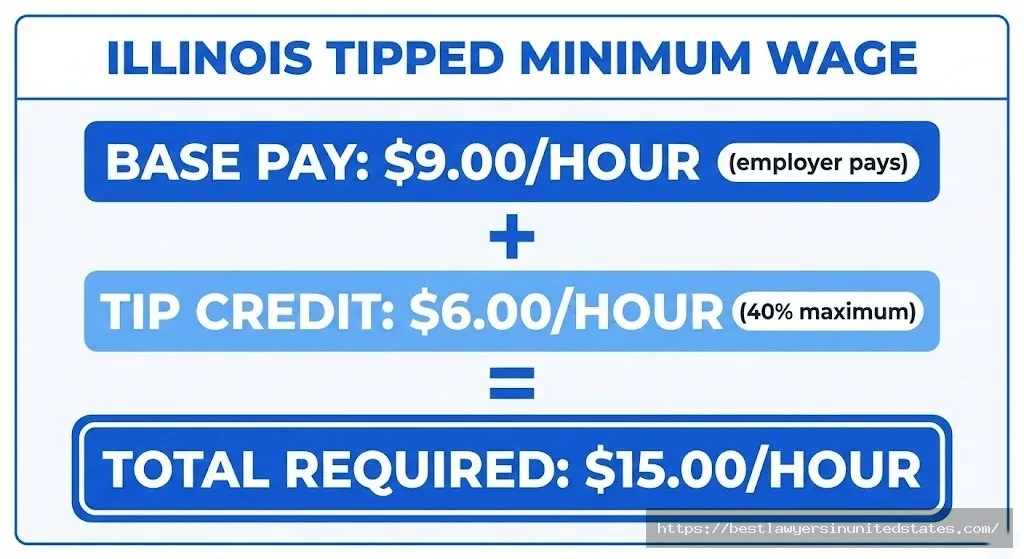
Employers can take a 40% tip credit ($6.00/hour). Your total earnings must reach $15/hour when base pay plus tips combine. If tips fall short, your employer must make up the difference.
Example calculation:
- Base pay: $9/hour × 30 hours = $270
- Tips received: $180
- Total: $450
- Required minimum: $15 × 30 = $450 ✓
If you only received $120 in tips, your employer owes you an additional $60 to reach the $450 minimum.
Youth Minimum Wage (Under 18)
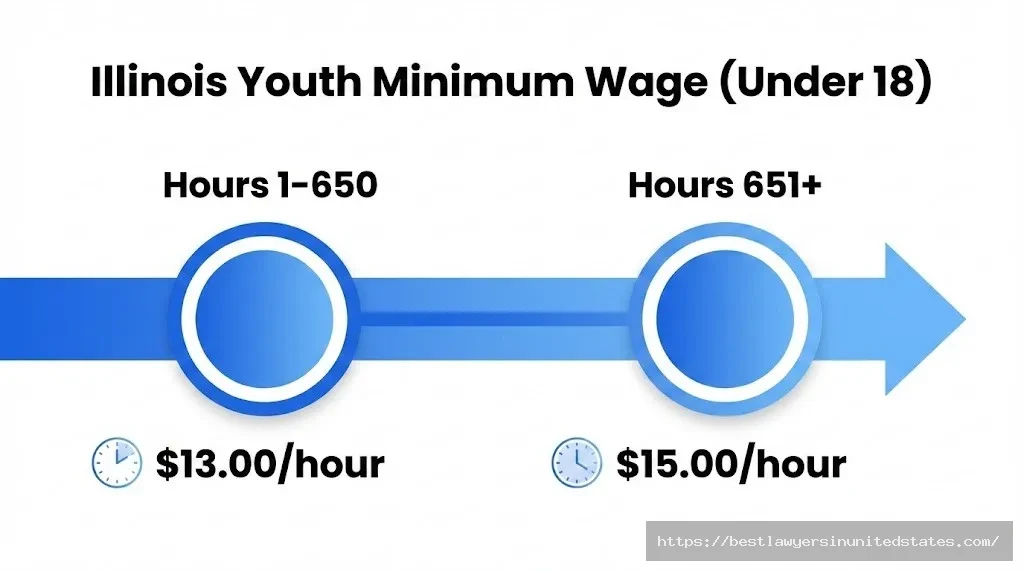
Workers under 18: $13.00/hour for first 650 hours per year
Once you work 650 hours in the same calendar year, your rate jumps to $15/hour for all remaining hours that year. On January 1, the counter resets.
Tracking example:
- January-June: 400 hours at $13/hr = $5,200
- July: Hit 650 hours total
- July-December: 200 hours at $15/hr = $3,000
- Total earnings: $8,200
Employers must track cumulative hours and switch rates automatically when you cross the 650-hour threshold.
Is Illinois Minimum Wage Going Up in 2026?
Quick Answer: No. Illinois minimum wage stays at $15 per hour in 2026. The state reached its final scheduled increase on January 1, 2025.
The 2019 Raise Illinois Minimum Wage Act created a six-year schedule of increases from $8.25 (2019) to $15 (2025). That schedule ended in 2025. Future increases would require new legislation from the Illinois General Assembly.
Illinois Minimum Wage History
| Effective Date | Minimum Wage | Annual Increase |
|---|---|---|
| Jan 1, 2019 | $8.25 | Base year |
| Jan 1, 2020 | $9.25 | +$1.00 |
| Jan 1, 2021 | $11.00 | +$1.75 |
| Jan 1, 2022 | $12.00 | +$1.00 |
| Jan 1, 2023 | $13.00 | +$1.00 |
| Jan 1, 2024 | $14.00 | +$1.00 |
| Jan 1, 2025 | $15.00 | +$1.00 |
| Jan 1, 2026 | $15.00 | No change |
What About Chicago?
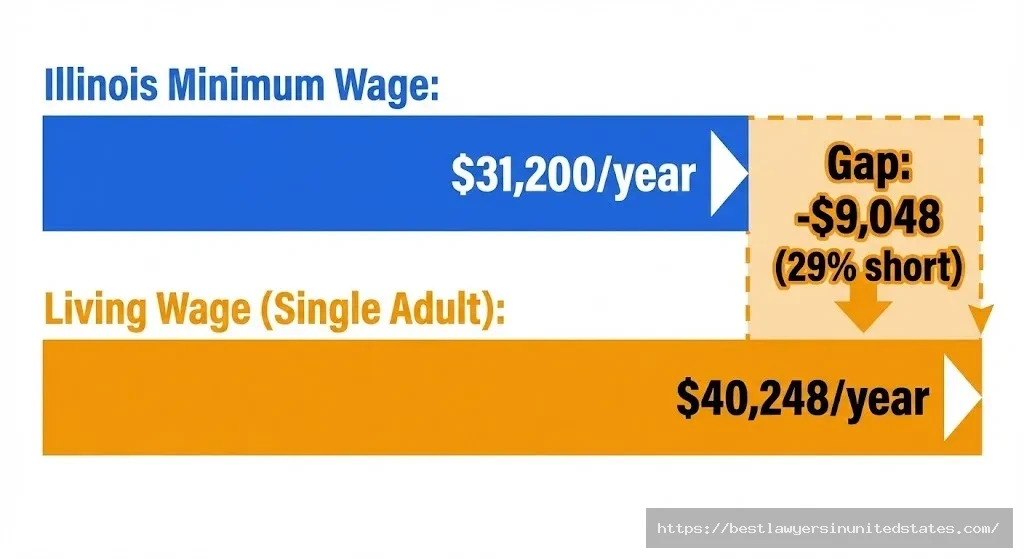
Chicago's minimum wage may increase July 1, 2026. The city indexes its rate to the Consumer Price Index (CPI). Check Chicago.gov in June 2026 for the official announcement.
Current Chicago rates (as of July 1, 2025):
- Regular workers: $16.60/hour
- Tipped workers: $12.62/hour
- Youth workers: $16.50/hour
Will Illinois Raise Minimum Wage in 2027?
No increases are scheduled for 2027 or beyond. The Illinois General Assembly would need to pass new legislation to create future increases.
Some advocacy groups push for indexing the minimum wage to inflation, similar to states like Florida. No such proposals have passed as of December 2025.
How Much Is $15/Hour Annually in Illinois?
Quick Answer: $15/hour equals $31,200 per year at full-time hours (40 hours/week). After taxes, expect take-home pay around $23,500-$24,500 per year.
Gross Income by Hours Worked
| Hours/Week | Weekly Gross | Monthly Gross | Annual Gross |
|---|---|---|---|
| 20 (Part-time) | $300 | $1,300 | $15,600 |
| 30 | $450 | $1,950 | $23,400 |
| 40 (Full-time) | $600 | $2,600 | $31,200 |
| 50 (with OT) | $825* | $3,575* | $42,900* |
*Assumes 10 hours overtime at time-and-a-half ($22.50/hr)
Tax Withholding Breakdown
Full-time annual earnings: $31,200
Estimated deductions:
- Federal income tax: ~10-12% ($3,120-$3,744)
- Illinois state tax: 4.95% ($1,544)
- Social Security: 6.2% ($1,934)
- Medicare: 1.45% ($453)
Total take-home: $23,500-$24,500/year
These numbers assume standard withholding and no additional deductions. Your actual take-home may differ based on filing status and exemptions.
Monthly Budget at $15/Hour
Monthly take-home (full-time): ~$1,960-$2,040
Typical expenses in Illinois:
- Rent (1BR apartment): $700-$1,500 (varies by location)
- Utilities: $100-$150
- Groceries: $250-$350
- Transportation: $150-$300
- Healthcare: $100-$200
Total basic expenses: $1,300-$2,500/month
The math: Minimum wage covers basic needs in lower-cost Illinois areas but leaves little margin in Chicago or suburbs.
Can You Live on Minimum Wage in Illinois?
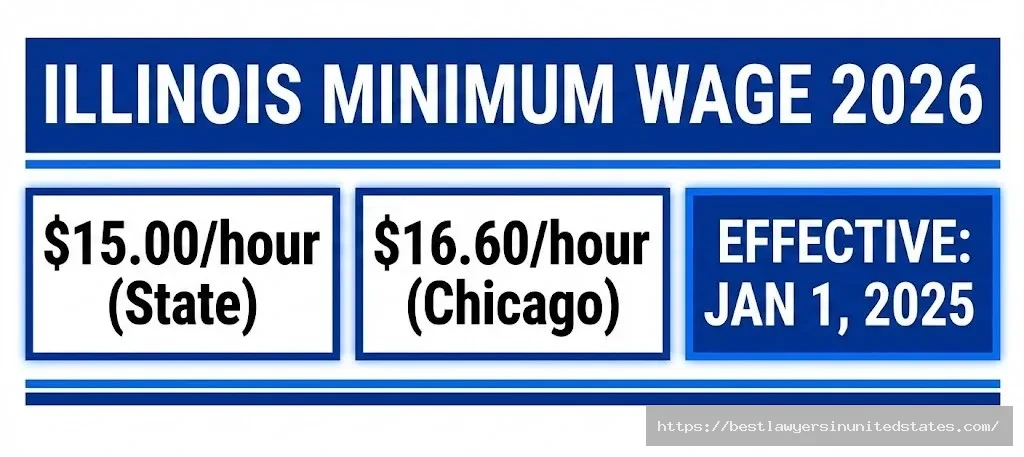
Quick Answer: A single adult can meet basic survival needs on minimum wage in rural Illinois but falls significantly short of a living wage in urban areas. MIT Living Wage Calculator estimates $40,248/year needed for basic expenses, leaving a $9,048 gap.
Living Wage vs Minimum Wage
| Household Type | Living Wage (Annual) | Minimum Wage (Annual) | Gap |
|---|---|---|---|
| Single Adult | $40,248 | $31,200 | -$9,048 (29% short) |
| Single + 1 Child | $74,820 | $31,200 | -$43,620 (58% short) |
| 2 Adults (1 working) | $58,428 | $31,200 | -$27,228 (47% short) |
| 2 Adults (both working) | $62,400 | $62,400 | Meets minimum |
Source: MIT Living Wage Calculator (2026 estimates)
Cost of Living by Illinois Region
Chicago (high cost):
- 1BR apartment: $1,200-$1,800/month
- Minimum wage covers 50-60% of living costs for single adults
- Two earners can meet basic needs
Rockford/Peoria (moderate cost):
- 1BR apartment: $600-$900/month
- Minimum wage covers 70-80% of living costs
- Single earners manage with careful budgeting
Rural Illinois (lower cost):
- 1BR apartment: $500-$700/month
- Minimum wage meets basic survival needs
- Little cushion for emergencies or savings
Real-World Impact
Financial challenges at $15/hour:
- Saving for emergencies: Difficult with minimal margin
- Healthcare costs: Even with insurance, copays strain budgets
- Transportation: Car ownership possible but maintenance challenging
- Education: Limited funds for skill development
Where minimum wage works better:
- Shared housing situations
- Dual-income households
- Areas with lower rent
- Workers with limited expenses
Illinois Tipped Minimum Wage Explained
Quick Answer: Illinois tipped workers must receive $9.00/hour base pay from employers. With the 40% tip credit, employers can count up to $6/hour in tips toward the $15 minimum. If tips plus base pay don't reach $15/hour, employers must make up the difference.
How Tip Credits Work in Illinois
The basic formula:
- Employer pays: $9.00/hour (required base)
- Tip credit: Up to $6.00/hour (40% of $15)
- Your tips must equal or exceed: $6.00/hour
- Total guaranteed: $15.00/hour
Illinois tipped wage vs other states: California requires full minimum wage with no tip credit, meaning servers earn $16.50/hour base plus tips. Illinois protects tipped workers better than federal law (which allows $2.13 base pay) but still permits the tip credit system.
Server Pay Example
Scenario: Restaurant server in Springfield works 30 hours
Week 1 (good tips):
- Base pay: $9/hr × 30 hrs = $270
- Tips reported: $250
- Total: $520
- Effective rate: $17.33/hour ✓ (exceeds $15 minimum)
Week 2 (slow week):
- Base pay: $9/hr × 30 hrs = $270
- Tips reported: $120
- Shortfall: $450 required - $390 actual = $60
- Employer must add: $60 to paycheck
Employer Obligations
Illinois employers must:
- Pay $9/hour base minimum for all tipped workers
- Track tips accurately through reporting or POS systems
- Make up shortfalls within the same pay period
- Notify employees of tip credit policy in writing
- Cannot claim credit for credit card processing fees
Violation penalties: Employers who fail to make up tip shortfalls face wage theft claims, including back pay plus 2% monthly interest and potential liquidated damages.
Who Qualifies as a Tipped Employee?
Illinois law defines tipped employees as workers who:
- Customarily receive tips
- Regularly earn more than $20/month in tips
- Work in service positions (servers, bartenders, valets, etc.)
Not tipped employees: Cooks, dishwashers, and other back-of-house staff cannot have tip credits applied, even if they occasionally receive tips.
Tip Pooling Rules
Legal tip pooling in Illinois:
- ✓ Servers can pool with bartenders, bussers, hosts
- ✓ Must be customary and reasonable split
- ✓ Participants must regularly receive tips
Illegal practices:
- ✗ Managers/owners in tip pools
- ✗ Employers keeping any portion of tips
- ✗ Forcing workers to share with non-service staff
Illinois Youth Minimum Wage (Under 18)
Quick Answer: Workers under 18 earn $13.00/hour for their first 650 hours worked in a calendar year. After 650 hours, they must receive the full $15.00/hour for all remaining hours that year.
The 650-Hour Threshold Rule
How it works:
- January 1: Counter starts at 0 hours
- Hours 1-650: Paid $13/hour
- Hour 651+: Paid $15/hour
- December 31: Counter resets
Exception: Workers under 18 who worked 650+ hours in the previous year start the new year at $15/hour immediately.
Real-World Example
Maria, age 17, works part-time at a retail store:
January-May: Works 15 hours/week
- Total: 300 hours
- Rate: $13/hour
- Earnings: $3,900
June: Works 20 hours/week, crosses 650-hour threshold in Week 3
- Hours 301-650: 350 hours at $13/hr = $4,550
- Hours 651-680: 30 hours at $15/hr = $450
July-December: Works 20 hours/week
- Total: ~500 hours
- Rate: $15/hour (above threshold)
- Earnings: $7,500
Total annual earnings: $16,400 (850 hours mixed rate)
Employer Recordkeeping Requirements
Illinois employers must:
- Track cumulative hours for each worker under 18
- Switch rates automatically at 650 hours
- Maintain accurate time records for 3 years
- Document birth dates to verify age eligibility
Common mistake: Some employers fail to track cumulative hours across pay periods. If you've worked 640 hours by late November, your next 10 hours should be at $13, then $15 for the rest of the year.
When Youth Workers Get $15 from Day One
Full $15/hour applies immediately if:
- Worker is 18 or older (no youth rate)
- Worker under 18 worked 650+ hours previous year
- Employer chooses to pay full rate (allowed but not required)
Chicago Minimum Wage 2026: What's Different?
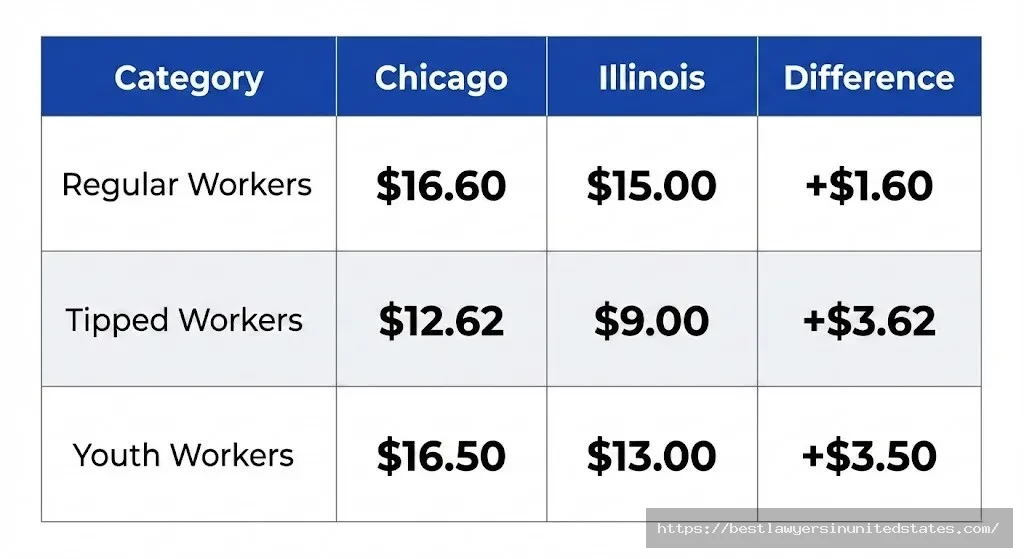
Quick Answer: Chicago's minimum wage is $16.60/hour as of July 1, 2025, which is $1.60 higher than Illinois state minimum. Tipped workers in Chicago earn $12.62/hour base pay. Small businesses with fewer than 4 employees may pay less.
Chicago vs Illinois Comparison
| Category | Chicago | Rest of Illinois | Difference |
|---|---|---|---|
| Regular wage | $16.60 | $15.00 | +$1.60 |
| Tipped wage | $12.62 (76%) | $9.00 (60%) | +$3.62 |
| Youth wage | $16.50 | $13.00* | +$3.50 |
| Effective date | July 1 | January 1 | 6-month gap |
| Small business rule | <4 employees exempt | No exemption | Chicago only |
*Youth rate for <650 hours/year
Chicago-Specific Rules
Small employer exemption: Businesses with 3 or fewer employees can pay less than $16.60. They must still meet Illinois state minimum ($15) but aren't required to follow Chicago's higher rate.
Youth minimum wage: Chicago sets a separate youth rate at $16.50/hour, only $0.10 less than the adult rate. This applies regardless of hours worked (no 650-hour threshold like state law).
2026 Rate Adjustment
July 1, 2026 update: Chicago indexes its minimum wage to the Consumer Price Index (CPI). If inflation increases costs by 3%, the rate could rise to approximately $17.10/hour.
Check Chicago.gov/BACP in June 2026 for the official announcement.
Filing Complaints in Chicago
For Chicago minimum wage violations:
- Call 311 or use the CHI 311 mobile app
- Visit Chicago.gov/BACP to file online
- Email: [email protected]
Chicago Department of Business Affairs and Consumer Protection (BACP) investigates:
- Minimum wage violations
- Tip theft
- Unpaid overtime (when related to Chicago ordinance)
Penalties: Up to $1,000 per violation plus full back wages owed.
Calculate Your Overtime Pay in Illinois
Working more than 40 hours per week? Calculate your overtime earnings based on Illinois overtime laws. This calculator accounts for the state's time-and-a-half requirement after 40 hours.
⏰ Overtime Pay Calculator
Calculate your overtime earnings based on your state's specific labor laws
📍 Select Your State
💰 Your Hourly Wage
📊 Calculation Method
📅 Weekly Hours
💵 Your Weekly Overtime Pay
📊 Earnings Breakdown
📅 Pay Period Estimates
⚖️ State vs Federal Comparison
Calculator features:
- Illinois-specific overtime rules
- Weekly overtime calculations
- Pay period breakdowns
- Comparison with straight-time pay
Full overtime calculator: Calculate your Illinois overtime pay
Questions about your wages or need legal help? Email: [email protected]
Illinois Overtime Laws: What You Need to Know
Quick Answer: Illinois requires time-and-a-half pay (1.5× your regular rate) for hours worked over 40 in a workweek. Unlike some states, Illinois has no daily overtime requirement.
Basic Overtime Rules
Overtime threshold: 40 hours per week
Your employer must pay 1.5× your regular hourly rate for each hour beyond 40 in a single workweek. Illinois defines a workweek as any fixed, regularly recurring 168-hour period.
Illinois vs other states: California requires daily overtime after 8 hours in a day. Illinois only counts weekly hours, so working four 12-hour shifts (48 hours) triggers 8 hours of overtime, but working five 8-hour shifts (40 hours) triggers none.
Overtime Calculation Example
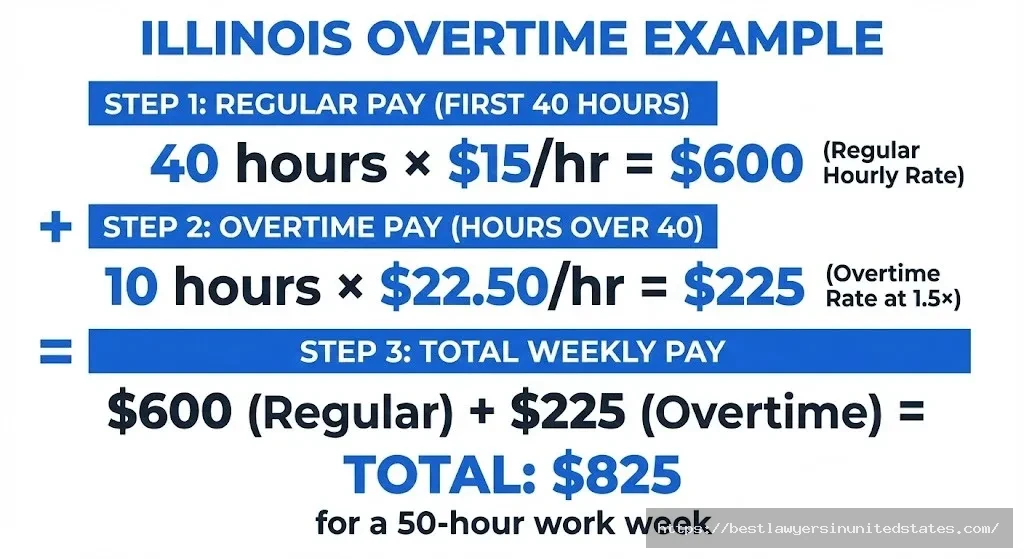
Worker earning $15/hour works 50 hours:
Regular time:
- 40 hours × $15/hour = $600
Overtime:
- 10 hours × $22.50/hour (1.5 × $15) = $225
Total pay: $825
Common mistake: Some employers try to pay straight time for all hours or average the rate across the week. This violates Illinois law.
Who Gets Overtime in Illinois?
Covered workers:
- ✓ Hourly employees
- ✓ Some salaried workers under $684/week ($35,568/year)
- ✓ Tipped employees (OT at 1.5× tipped rate + tips)
- ✓ Part-time and full-time workers
Exempt workers (no OT required):
- ✗ Executive, administrative, professional employees earning $684+/week
- ✗ Outside salespeople
- ✗ Some computer professionals
- ✗ Independent contractors
Exempt vs Non-Exempt
To be overtime-exempt, you must meet BOTH tests:
Salary test:
- Paid at least $684/week ($35,568/year)
- Paid on a salary basis (not hourly)
Duties test:
- Executive: Manage 2+ employees, direct work
- Administrative: Office work, independent judgment
- Professional: Advanced knowledge, specialized degree
Most minimum wage workers are non-exempt because they don't meet the $684/week threshold. Your employer cannot avoid overtime simply by calling you "salaried."
Tipped Employee Overtime
Tipped workers get overtime too:
Base calculation:
- Regular hours: 40 × $9 = $360
- Overtime: 10 × $13.50 (1.5 × $9) = $135
- Overtime pay: $495 base
Plus tips: Your tips must bring total pay to at least $15/hr regular + $22.50/hr overtime. If they don't, your employer makes up the difference.
Illinois Minimum Wage Exemptions
Quick Answer: Most Illinois workers must receive at least minimum wage. Exemptions include certain agricultural workers, outside salespeople, independent contractors, and some workers with disabilities (phasing out by 2029).
Workers Exempt from Illinois Minimum Wage
| Worker Type | Exempt? | Minimum Rate | Notes |
|---|---|---|---|
| Regular employees | No | $15.00/hr | Must be paid minimum |
| Tipped employees | Partially | $9.00/hr + tips | Must reach $15 total |
| Youth (<18, <650 hrs) | Partially | $13.00/hr | Reduced rate |
| Agricultural workers | Varies | Federal rules | Complex exemptions |
| Outside salespeople | Yes | No minimum | Commission-based |
| Independent contractors | Yes | No minimum | Not employees |
The Dignity in Pay Act
Phasing out disability wage exemptions
Illinois passed the Dignity in Pay Act in 2025. This law eliminates the practice of paying workers with disabilities less than minimum wage.
Timeline:
- Before 2025: Employers could apply for 14(c) certificates to pay sub-minimum wages
- 2025-2029: Phase-out period
- After December 31, 2029: All workers must receive full minimum wage regardless of disability status
Impact: Approximately 2,500 Illinois workers with disabilities currently earn less than minimum wage under special certificates. By 2030, all will receive at least $15/hour.
What this means: If you have a disability, your employer cannot use that as a reason to pay below minimum wage after 2029.
Agricultural Worker Exemptions
Farm and ranch workers may be exempt if:
- Employer uses fewer than 500 "man-days" of labor per quarter
- Farm is small family operation
- Worker is immediate family member
Most agricultural workers ARE covered by Illinois minimum wage law. The exemptions are narrow and require specific conditions.
Independent Contractors vs Employees
True independent contractors:
- Set their own hours
- Use their own tools/equipment
- Work for multiple clients
- Control how work is performed
Misclassified employees: Some employers wrongly classify workers as contractors to avoid minimum wage. If you're told when to work, where to work, and how to do the job, you're likely an employee entitled to minimum wage.
Red flag: Your employer calls you a contractor but controls your schedule, requires you to work at their location, and provides all materials. This is likely misclassification.
How to Report Minimum Wage Violations in Illinois
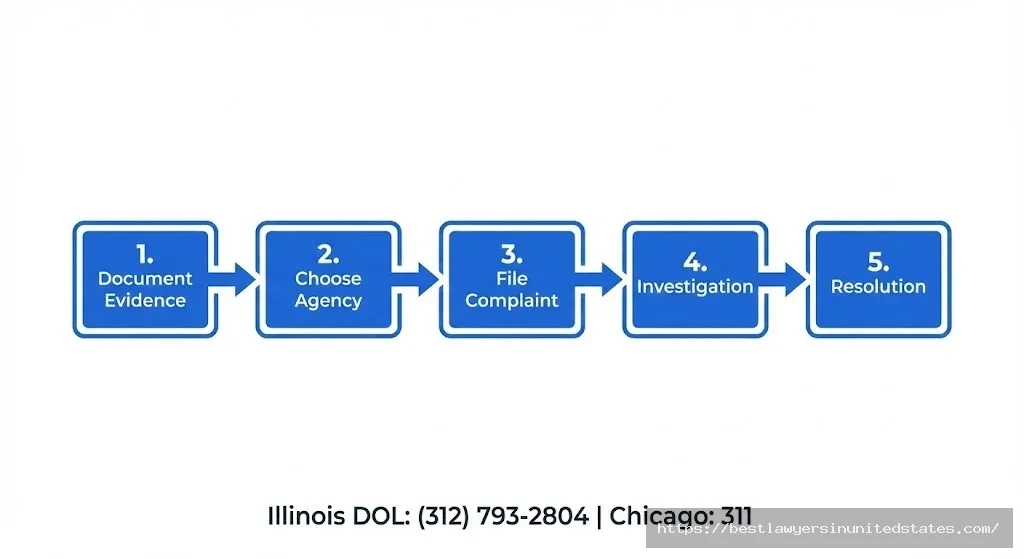
Quick Answer: Report unpaid wages to the Illinois Department of Labor at (312) 793-2804 or file online at IDOL.Illinois.gov. You have 3 years to file most wage claims in Illinois.
When facing wage violations, understanding your legal options for workplace disputes helps you take the right action. For violations involving discrimination or retaliation, you may also need to contact an attorney who specializes in workplace discrimination.
Step 1: Document Your Evidence
Gather these materials before filing:
- ✓ Pay stubs from all pay periods
- ✓ Time sheets or hour records
- ✓ Written work schedules
- ✓ Text/email communications about hours or pay
- ✓ Tip records (if applicable)
- ✓ Any written employment agreements
Take photos or make copies. Don't rely on accessing company records later.
Step 2: Choose the Right Agency
| Agency | Best For | Contact |
|---|---|---|
| Illinois Department of Labor (IDOL) | State minimum wage violations, unpaid wages, tip theft | (312) 793-2804<br>IDOL.Illinois.gov |
| U.S. Department of Labor (DOL) | Federal FLSA violations, overtime issues | (866) 487-9243<br>DOL.gov/agencies/whd |
| Chicago BACP | Chicago minimum wage violations only | 311<br>Chicago.gov/BACP |
| Cook County | Cook County wage violations | (312) 603-6398 |
Which to choose? If you work in Chicago, file with BACP for Chicago-specific violations. For statewide issues, start with Illinois DOL. For overtime or federal claims, contact U.S. DOL.
Step 3: File Your Complaint
Illinois Department of Labor filing:
- Visit IDOL.Illinois.gov and find the wage claim form
- Complete the online form or download PDF to mail
- Attach documentation (pay stubs, time records)
- Submit within 3 years of the violation
No fee to file. IDOL provides free investigation and enforcement.
Chicago BACP filing:
- Call 311 to report the violation
- Use CHI 311 app for online submission
- Visit Chicago.gov/BACP for complaint form
Step 4: Investigation Process
What happens after you file:
Week 1-2: IDOL acknowledges your claim and assigns an investigator.
Weeks 2-8: Investigator contacts your employer, requests records, and reviews evidence.
Weeks 8-12: IDOL determines if violations occurred and orders remedies.
Timeline varies based on case complexity. Simple unpaid wage cases resolve faster than complicated overtime disputes.
Step 5: Potential Outcomes
If IDOL finds violations:
- ✓ Back wages ordered: Full unpaid amount
- ✓ Interest added: 2% per month on unpaid wages
- ✓ Penalties assessed: $250-$1,000 per violation against employer
- ✓ Liquidated damages: Up to 2× unpaid wages in some cases
If employer doesn't comply: IDOL can file a lawsuit on your behalf or refer the case for criminal prosecution.
Your Right to Sue Privately
You can also file a lawsuit in Illinois court without going through IDOL first.
Benefits of private lawsuit:
- Potentially faster resolution
- Attorney can recover damages beyond back wages
- Employer pays your attorney fees if you win
Statute of limitations: 3 years for willful violations, 2 years for non-willful violations.
Consider consulting an employment attorney if your claim involves substantial wages, retaliation, or legal complexity.
Retaliation Protections
Your employer CANNOT:
- ✗ Fire you for filing a wage complaint
- ✗ Reduce your hours in retaliation
- ✗ Demote or transfer you to worse position
- ✗ Threaten immigration consequences
Illinois law protects workers who report wage violations. If retaliated against, file a separate retaliation complaint with IDOL or the Illinois Department of Human Rights.
Calculate Your Wage Theft Recovery in Illinois
Think your employer owes you money? Use our wage theft calculator to estimate how much you could recover, including unpaid wages, penalties, and interest under Illinois law.
Wage Theft Recovery Calculator
Estimate how much you can recover in unpaid wages, penalties, and damages based on your state's laws
💵 Estimated Total Recovery
💰 Unpaid Wages
⚖️ Penalties & Damages
📋 Total Summary
Calculator features:
- Multiple violation types (unpaid wages, overtime, tips)
- Illinois-specific penalties and damages
- Filing deadline tracker
- Total recovery estimate
- Next steps guidance
Full wage theft calculator: Calculate your Illinois wage theft recovery
Need help with unpaid wages? Contact Illinois Department of Labor or consult with an employment attorney.
Email: [email protected]
If you're dealing with unpaid wages or other payment issues, you may need to understand how wage garnishment protections work in Illinois.
Illinois Wage Theft Penalties & What You Can Recover
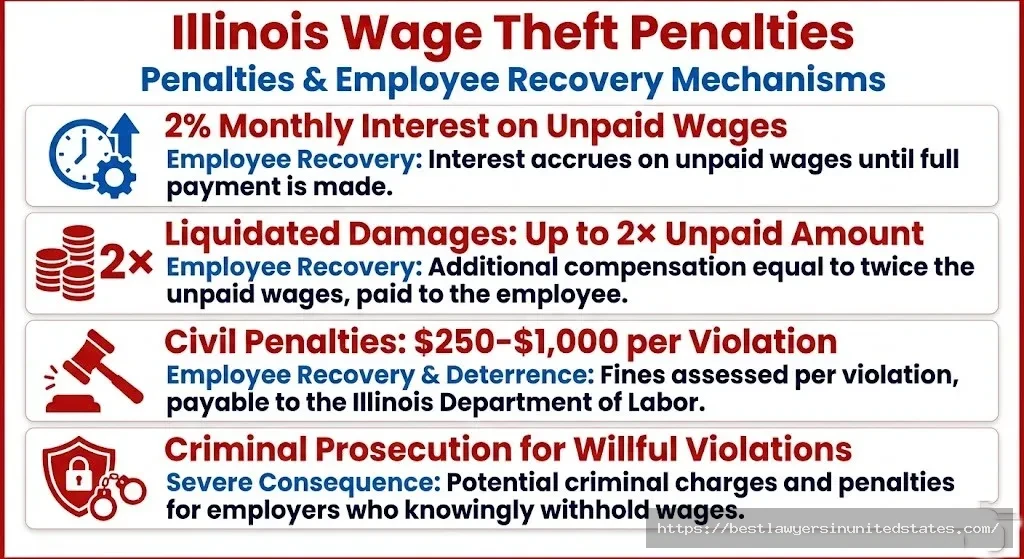
Quick Answer: Illinois employers who violate wage laws face 2% monthly interest on unpaid wages, liquidated damages up to 2× the unpaid amount, and civil penalties of $250-$1,000 per violation. Workers can recover all unpaid wages plus additional damages.
Penalties for Employers
Illinois Wage Payment and Collection Act penalties:
| Violation Type | Employer Penalty | Employee Recovery |
|---|---|---|
| Unpaid regular wages | $250-$1,000 per violation | Full back pay + 2% monthly interest |
| Unpaid overtime | $250-$1,000 per violation | Back pay + liquidated damages (2×) |
| Tip theft | $500-$1,000 per violation | Full tips + damages |
| Retaliation | $1,000+ per violation | Reinstatement + back pay + damages |
| Failure to post | $500 per violation | N/A (civil penalty) |
How Illinois Interest Works
2% monthly interest on unpaid wages
Interest accrues from the date wages were due, not from when you file a claim.
Example:
- Unpaid wages: $2,000
- Time unpaid: 6 months
- Interest calculation: $2,000 × 2% × 6 = $240
- Total owed: $2,240
Liquidated Damages (Double Pay)
Illinois courts can award liquidated damages equal to the full amount of unpaid wages. This effectively doubles your recovery.
Example wage theft recovery:
- Unpaid overtime: $3,000
- 2% monthly interest: $180 (3 months)
- Liquidated damages: $6,000 (2× unpaid wages)
- Total recovery: $9,180
When are liquidated damages awarded?
- Willful violations (employer knew they were breaking the law)
- Repeated violations
- Employer refused to comply after notice
Not automatic. Courts have discretion, but Illinois judges frequently award liquidated damages in clear wage theft cases.
Attorney Fees
Winner takes all approach:
If you win your wage claim, your employer must pay your attorney fees and court costs. This makes it financially feasible to hire an attorney even for moderate wage theft claims.
No fee unless you recover: Many employment attorneys work on contingency for wage cases.
Criminal Penalties
Willful wage theft can be prosecuted criminally under Illinois theft statutes.
Felony charges possible for:
- Stealing more than $500 in wages
- Repeated wage theft
- Retaliating against workers who complain
Reality: Criminal prosecution is rare but does happen in egregious cases involving multiple victims or substantial amounts.
Illinois Employer Compliance Requirements
Quick Answer: Illinois employers must display the "Your Rights Under Illinois Employment Laws" poster, maintain accurate time and pay records for 3 years, and pay employees at least semi-monthly.
Poster Requirements
Required workplace posting:
- Title: "Your Rights Under Illinois Employment Laws"
- Content: Minimum wage rates, overtime rules, how to file complaints
- Location: Visible area where all employees can see
- Language: English and Spanish (if workforce includes Spanish speakers)
Download free: IDOL.Illinois.gov/posters
Remote workers: Employers must email the poster or post it on company website/intranet where remote employees can access it.
Penalty for failure: $500 fine per violation.
Recordkeeping Obligations
Employers must maintain for 3 years:
Time records:
- ✓ Daily hours worked
- ✓ Start and end times
- ✓ Break periods
- ✓ Total hours per week
Pay records:
- ✓ Wages paid per pay period
- ✓ Deductions taken
- ✓ Dates of payment
- ✓ Pay rate (hourly or salary)
Tip records (for tipped employees):
- ✓ Tips reported daily
- ✓ Tip credit amounts taken
- ✓ Proof tips + base = minimum wage
Storage: Electronic or paper records acceptable. Must be accessible for inspection by Illinois DOL.
Pay Frequency Requirements
Illinois requires payment at least twice monthly:
- ✓ Semi-monthly (1st and 15th, or similar)
- ✓ Bi-weekly (every 2 weeks)
- ✓ Weekly (every week)
Not allowed: Monthly pay periods violate Illinois law.
Final paycheck timing:
- Terminated employees: Next scheduled payday
- Resigned employees: Next scheduled payday
- Exception: Some collective bargaining agreements have different rules
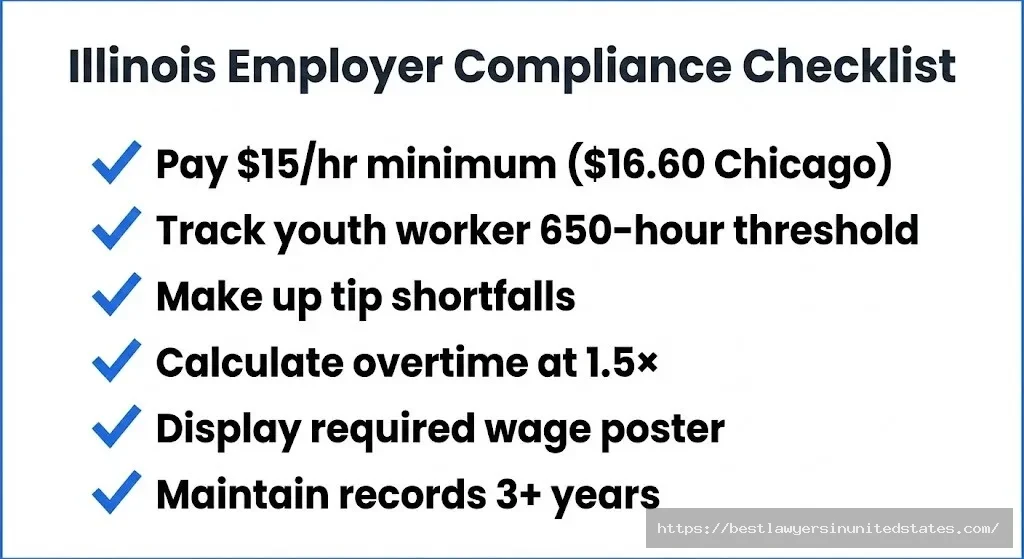
Employer Compliance Checklist
✓ Wage payment:
- [ ] Pay at least $15/hr ($16.60 in Chicago)
- [ ] Track youth workers' hours for 650-hour threshold
- [ ] Make up tip shortfalls same pay period
- [ ] Calculate overtime at 1.5× after 40 hours
- [ ] Pay at least semi-monthly
✓ Documentation:
- [ ] Display current wage poster
- [ ] Keep time records 3+ years
- [ ] Maintain accurate pay records
- [ ] Document tip credits and tip totals
✓ Reporting:
- [ ] File quarterly wage reports with IDES
- [ ] Report new hires to Illinois New Hire Registry
- [ ] Maintain workers' compensation insurance
Common violations to avoid:
- ❌ Paying youth workers $13/hr after 650 hours
- ❌ Taking more than 40% tip credit
- ❌ Failing to pay overtime for hours over 40
- ❌ Averaging hours across multiple weeks
- ❌ Misclassifying employees as contractors
- ❌ Deducting uniforms/tools that drop pay below minimum
- ❌ Requiring off-the-clock work
Frequently Asked Questions
Is the minimum wage in Illinois $15 an hour in 2026?
Quick Answer: Yes. Illinois minimum wage is $15 per hour in 2026 for most workers. This rate has been in effect since January 1, 2025, with no increase scheduled for 2026.
Chicago's minimum wage is higher at $16.60 per hour as of July 1, 2025.
Is Illinois minimum wage going up in 2026?
Quick Answer: No. Illinois minimum wage stays at $15 per hour throughout 2026. The state completed its scheduled increases in 2025.
Chicago may adjust its rate on July 1, 2026, based on the Consumer Price Index. Check Chicago.gov in June 2026 for updates.
What is the minimum wage for tipped employees in Illinois?
Quick Answer: Tipped workers in Illinois must receive $9.00 per hour base pay. Employers can take a 40% tip credit, but total pay (base + tips) must equal at least $15 per hour.
Chicago tipped workers earn $12.62 per hour base pay.
What is the minimum wage for 16 year olds in Illinois?
Quick Answer: Workers under 18 earn $13 per hour for their first 650 hours worked in a calendar year. After 650 hours, they receive the full $15 per hour.
Workers 18 and older always earn $15 per hour regardless of hours.
How do I calculate my earnings at Illinois minimum wage?
Quick Answer: Multiply your hourly rate ($15) by hours worked. For full-time work: $15 × 40 hours × 52 weeks = $31,200 per year.
Use our Illinois minimum wage calculator for precise calculations including overtime and taxes.
How much overtime pay am I entitled to in Illinois?
Quick Answer: Illinois requires time-and-a-half (1.5× your regular rate) for hours worked over 40 in a week. A $15/hour worker earns $22.50/hour for overtime hours.
Calculate your exact overtime pay with our Illinois overtime calculator.
Can you live on minimum wage in Illinois?
Quick Answer: A single adult can meet basic survival needs in rural Illinois but struggles in urban areas. MIT Living Wage Calculator shows minimum wage ($31,200/year) falls $9,048 short of living wage ($40,248/year) for single adults.
Two minimum wage earners can better meet household needs.
What is the minimum wage in Chicago vs Illinois?
Quick Answer: Chicago minimum wage is $16.60 per hour, which is $1.60 higher than Illinois state minimum of $15 per hour. Chicago tipped workers earn $12.62/hour base compared to $9/hour in the rest of Illinois.
How do I report minimum wage violations in Illinois?
Quick Answer: Contact Illinois Department of Labor at (312) 793-2804 or file online at IDOL.Illinois.gov. Chicago violations can be reported by calling 311 or visiting Chicago.gov/BACP.
You have 3 years to file most wage claims in Illinois.
What is the penalty for paying less than minimum wage in Illinois?
Quick Answer: Employers face 2% monthly interest on unpaid wages, liquidated damages up to 2× unpaid wages, and civil penalties of $250-$1,000 per violation.
Employees can recover full back pay plus additional damages. Calculate your potential recovery with our wage theft calculator.
Do servers get paid minimum wage in Illinois?
Quick Answer: Yes. Servers must receive at least $9/hour base pay plus tips. If tips plus base pay don't reach $15/hour, employers must make up the difference.
Chicago servers earn $12.62/hour base pay.
What jobs are exempt from minimum wage in Illinois?
Quick Answer: Most workers must receive minimum wage. Exemptions include certain agricultural workers, outside salespeople, independent contractors, and some workers with disabilities (phasing out by 2029).
Salaried employees earning $684+/week in executive, administrative, or professional roles may be exempt from overtime but still receive minimum wage.
Does Illinois have different minimum wages for part-time workers?
Quick Answer: No. Part-time and full-time workers receive the same minimum wage ($15/hour). Illinois bases minimum wage on hourly rate, not employment status.
Overtime rules apply after 40 hours per week regardless of part-time or full-time classification.
When does minimum wage go up in Illinois?
Quick Answer: Illinois minimum wage increased to $15 on January 1, 2025, and remains at that rate in 2026. No state increases are scheduled.
Chicago may increase its rate on July 1, 2026, if adjusted for inflation.
What is the minimum wage in Cook County vs Chicago?
Quick Answer: Cook County minimum wage is $15 per hour, matching the state rate. Chicago has its own higher minimum wage of $16.60 per hour as of July 1, 2025.
Cook County's ordinance excludes the City of Chicago, which has separate laws.
Can my employer fire me for asking about minimum wage?
Quick Answer: No. Illinois law protects workers who ask about wages or file complaints. Employers cannot fire, demote, reduce hours, or retaliate in any way.
If retaliated against, file a complaint with Illinois Department of Labor or consult an employment attorney.
How is overtime calculated in Illinois?
Quick Answer: Overtime is 1.5× your regular hourly rate for hours over 40 per week. Example: $15/hour worker earns $22.50/hour for overtime hours.
For a 50-hour week: (40 × $15) + (10 × $22.50) = $825 total.
What is the Dignity in Pay Act in Illinois?
Quick Answer: The Dignity in Pay Act (2025) phases out sub-minimum wage certificates for workers with disabilities by December 31, 2029.
After 2029, all Illinois workers must receive at least minimum wage regardless of disability status. About 2,500 workers with disabilities currently earn less than minimum wage under special certificates.
Will minimum wage go up in Illinois in 2027?
Quick Answer: No increases are scheduled for 2027. The state reached its $15 target in 2025. Future increases would require new legislation from the Illinois General Assembly.
Chicago may adjust its rate annually based on the Consumer Price Index.
How do I calculate wage theft recovery in Illinois?
Quick Answer: Add unpaid wages + 2% monthly interest + potential liquidated damages (2× unpaid wages). Illinois workers often recover 2-3× the unpaid amount.
Use our Illinois wage theft recovery calculator for a detailed estimate based on your situation.
Key Takeaways: Illinois Minimum Wage 2026
Illinois minimum wage is $15 per hour in 2026 with no increase from 2025. The state reached its final scheduled rate January 1, 2025.
Chicago pays more: $16.60/hour as of July 1, 2025, with potential inflation adjustment July 1, 2026.
Tipped workers earn $9/hour base pay ($12.62 in Chicago) plus tips. Employers must make up shortfalls.
Youth workers under 18 earn $13/hour for first 650 hours per year, then $15/hour.
Overtime is required at time-and-a-half for hours over 40 per week. No daily overtime requirement.
Report violations to Illinois Department of Labor at (312) 793-2804 or IDOL.Illinois.gov. Chicago violations: call 311.
Employers face penalties including 2% monthly interest, liquidated damages up to 2×, and $250-$1,000 fines per violation.
Living wage gap: Minimum wage ($31,200/year) falls 29% short of living wage for single adults in Illinois.
Use our calculators to estimate your earnings, overtime pay, and potential wage theft recovery. All calculations are free and Illinois-specific.
No 2026 state increase scheduled. Chicago may adjust based on inflation. Check official sources for updates.
