Michigan’s minimum wage is $14.97 per hour as of January 1, 2026. This is $7.72 higher than the federal minimum wage of $7.25 per hour. Tipped workers must receive at least $5.99 per hour plus tips in 2026.

Michigan’s wage increases follow a court-ordered schedule through 2029. The Michigan Supreme Court’s July 2024 ruling restored the original Improved Workforce Opportunity Wage Act. This created the fastest minimum wage growth in Michigan history.
Calculate Your Earnings in Michigan
Want to know exactly how much you’ll earn at Michigan’s $14.97 minimum wage? Use our free calculator to estimate your weekly, monthly, and annual income based on your hours worked.
💰 Minimum Wage Earnings Calculator
Calculate your weekly, monthly, and annual earnings with overtime and tax estimates
📊 Your Earnings Breakdown
💰 Gross Earnings
Calculator features:
- Automatic Michigan wage rates for 2026
- Weekly, monthly, and annual earnings
- Overtime calculations
- Tax withholding estimates
- Take-home pay breakdown
Full calculator with all features: Michigan Minimum Wage Calculator
Questions about your wages or need legal help?
Email: [email protected]
What Is Michigan's Minimum Wage in 2026?
Quick Answer: Michigan's minimum wage is $14.97 per hour as of January 1, 2026. This applies to all non-exempt employees regardless of employer size.
The state rate is nearly double the federal minimum wage. When state and federal laws differ, Michigan workers receive the higher rate. The Michigan Department of Labor and Economic Opportunity (LEO) enforces these wage standards under MCL 408.934.
Michigan Minimum Wage by Worker Type (2026)
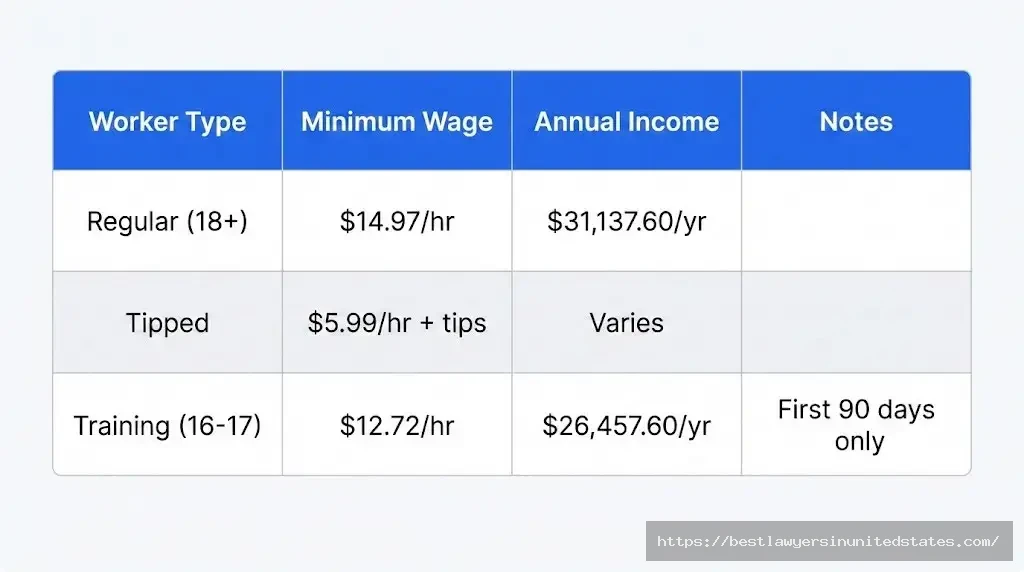
Different worker categories have specific wage rates in Michigan. Here's the complete breakdown:
| Worker Type | Minimum Wage | Annual Income (Full-Time) | Notes |
|---|---|---|---|
| Regular (18+) | $14.97/hour | $31,137.60 | Standard rate |
| Tipped Employees | $5.99/hour + tips | Varies | Must earn $14.97 with tips |
| Training Wage (16-17) | $12.72/hour | $26,457.60 | First 90 days only |
| Agricultural (hand harvest) | $14.97/hour | $31,137.60 | Some exemptions apply |
Key point: Michigan does not have a separate youth minimum wage. Workers under 18 receive the full minimum wage unless they qualify for the training wage program.
How Michigan's Minimum Wage Compares to Federal Law
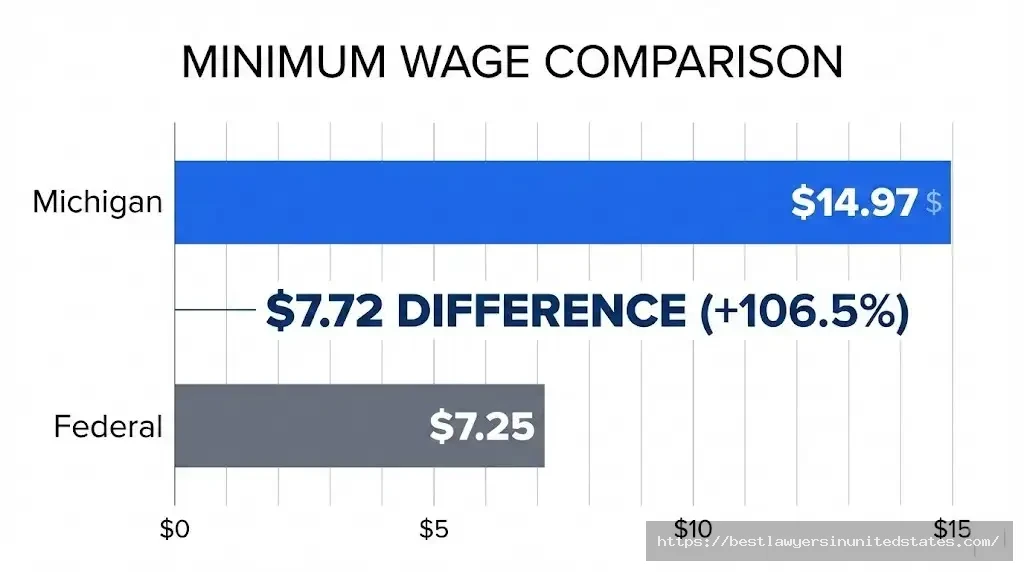
Michigan's wage laws provide stronger protections than federal standards. The Fair Labor Standards Act (FLSA) sets the federal minimum at $7.25 per hour. This rate hasn't changed since 2009.
| Jurisdiction | Minimum Wage | Tipped Wage | Difference from Federal |
|---|---|---|---|
| Michigan | $14.97 | $5.99 | +$7.72 (+106.5%) |
| Federal | $7.25 | $2.13 | Baseline |
Workers always receive the higher of the two rates. Michigan employers cannot pay less than state minimum wage even if federal law allows it. While Michigan's $14.97 rate is substantial, neighboring Illinois has reached a $15 minimum wage, creating competition for workers across state lines.
When Will Michigan's Minimum Wage Increase Next?
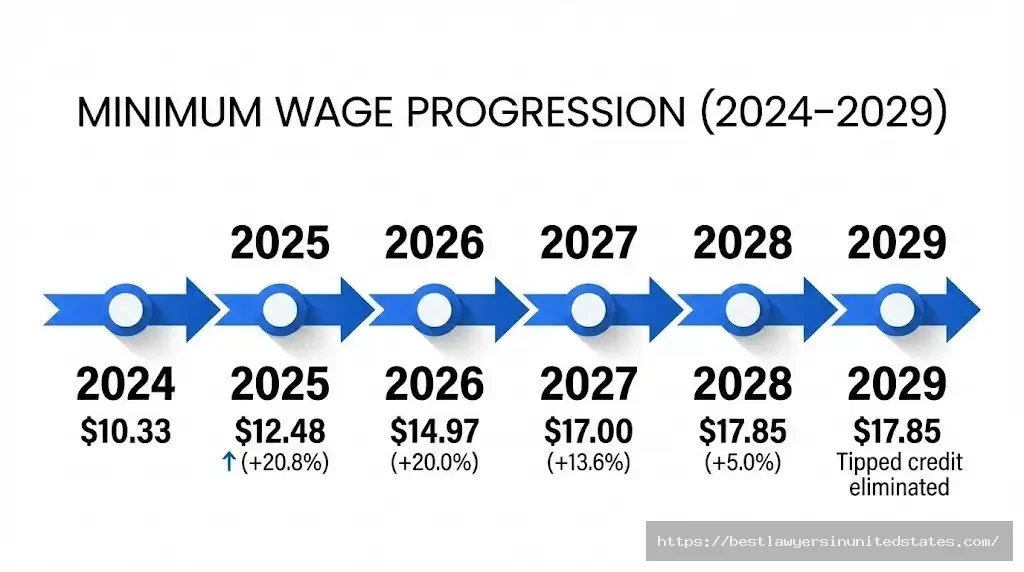
Michigan has scheduled annual increases through 2029. These increases stem from the 2024 Supreme Court ruling in Mothering Justice v. Attorney General.
Michigan Minimum Wage Increase Schedule
The state follows a preset escalation plan tied to inflation. Each January 1st brings a new rate increase.
| Effective Date | Minimum Wage | Tipped Wage | Increase Amount |
|---|---|---|---|
| Jan 1, 2024 | $10.33 | $3.93 | - |
| Feb 21, 2025 | $12.48 | $4.87 | +$2.15 (+20.8%) |
| Jan 1, 2026 | $14.97 | $5.99 | +$2.49 (+20.0%) |
| Jan 1, 2027 | $17.00 | $7.14 | +$2.03 (+13.6%) |
| Jan 1, 2028 | $17.85 | $8.93 | +$0.85 (+5.0%) |
| Jan 1, 2029 | $17.85 | $17.85 | Tipped credit eliminated |
Critical date: By 2029, Michigan will eliminate the tipped wage system entirely. Tipped workers will receive the full minimum wage plus tips.
The Supreme Court Ruling That Changed Everything
Michigan's rapid wage increases follow a landmark Supreme Court decision. In July 2024, the Court invalidated 2018 legislative changes that had slowed minimum wage growth.
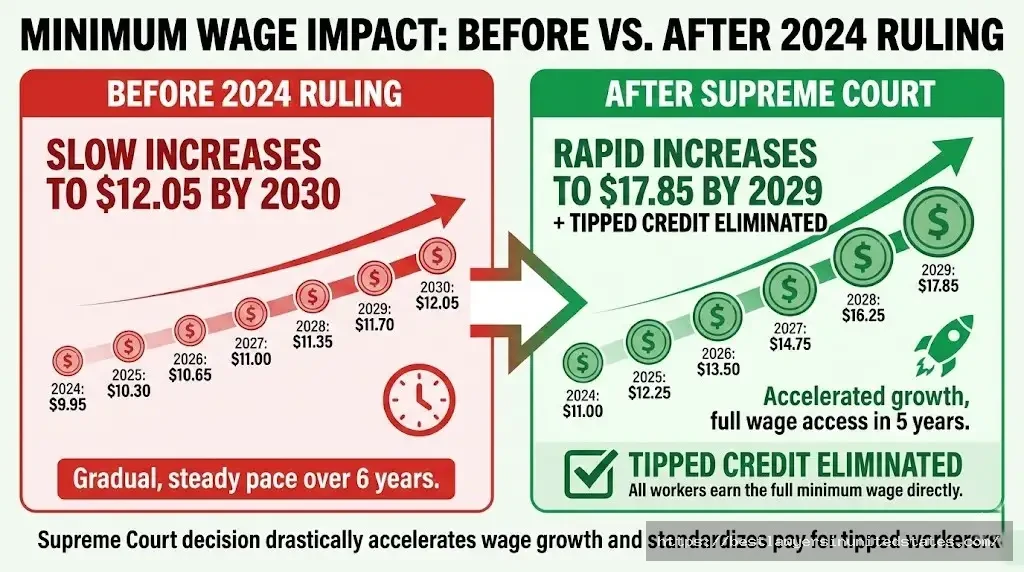
What happened:
- 2018: Michigan Legislature used "adopt and amend" to weaken a voter initiative
- 2024: Supreme Court ruled this violated Michigan's Constitution
- Result: Original wage increase schedule restored with accelerated timeline
The Mothering Justice decision affects two major laws:
- Improved Workforce Opportunity Wage Act (minimum wage)
- Earned Sick Time Act (paid sick leave)
Legal citation: Mothering Justice v. Attorney General, Nos. 164416 & 164241 (Mich. July 31, 2024)
This ruling created the steepest wage growth curve in Michigan history. The state jumped from $10.33 to $14.97 in just 21 months.
Michigan Tipped Minimum Wage 2026
Servers, bartenders, and other tipped workers have special wage rules in Michigan. The 2026 tipped minimum is $5.99 per hour plus tips.
How the Tipped Wage System Works
Michigan allows employers to pay a lower base wage if workers receive tips. This is called a "tip credit." The employer pays $5.99 per hour, and tips make up the difference to reach $14.97.
Example calculation:
- Base tipped wage: $5.99/hour
- Tip credit allowed: $8.98/hour
- Required total with tips: $14.97/hour
If tips don't bring earnings to $14.97 per hour, the employer must pay the difference. Workers cannot earn less than the full minimum wage when combining base pay and tips.
Who Qualifies as a Tipped Employee in Michigan?
Not every worker who receives tips qualifies for the tipped wage. Michigan law sets specific criteria under MCL 408.934a.
Requirements:
- ✅ Regularly receives more than $135 per month in tips
- ✅ Works in an occupation where tipping is customary
- ✅ Employer claims the tip credit and provides notice
Covered occupations:
- Restaurant servers and waitstaff
- Bartenders and barbacks
- Hotel bellhops and valets
- Hair stylists and barbers
- Food delivery drivers (in some cases)
Not covered:
- Fast food counter workers
- Retail employees
- Kitchen staff and cooks
- Managers and supervisors
Tip Pooling and Sharing Rules
Michigan law allows mandatory tip pooling among eligible employees. Employers cannot participate in tip pools or keep any portion of tips.
Legal tip pooling:
- ✅ Servers pool tips with other servers
- ✅ Bartenders share with barbacks
- ✅ Wait staff shares with bussers
Illegal practices:
- ❌ Managers taking tips from pool
- ❌ Owners keeping any tip amount
- ❌ Forcing servers to tip out kitchen staff
Violations of tip pooling rules can result in treble damages under Michigan's Payment of Wages and Fringe Benefits Act (MCL 408.471 et seq.).
The Tipped Credit Phase-Out (2025-2029)
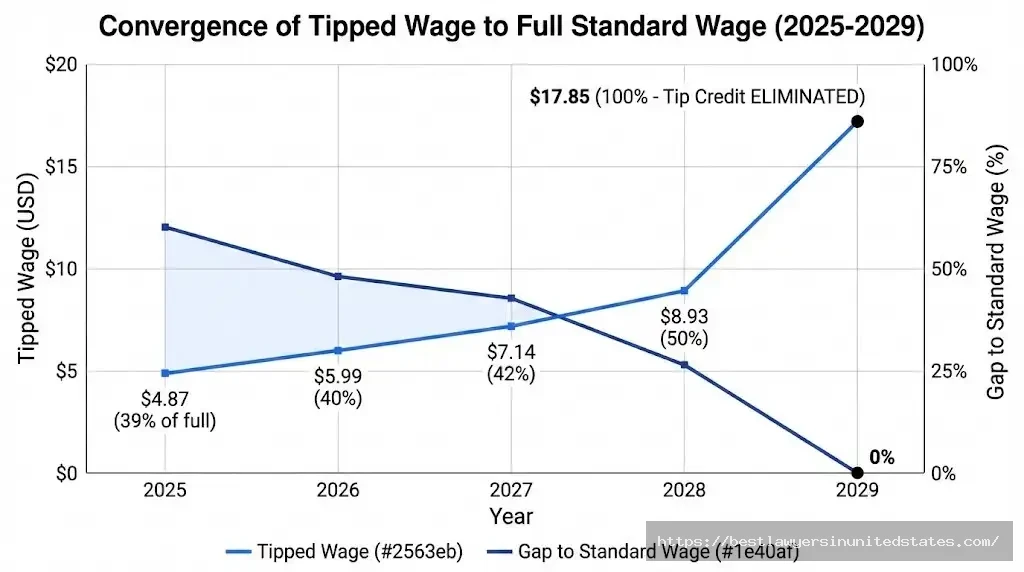
Michigan is one of few states eliminating its tipped wage system. By 2029, all workers will receive the full minimum wage regardless of tips.
| Year | Tipped Base Wage | Gap to Standard Wage | % of Full Wage |
|---|---|---|---|
| 2025 | $4.87 | $7.61 | 39% |
| 2026 | $5.99 | $8.98 | 40% |
| 2027 | $7.14 | $9.86 | 42% |
| 2028 | $8.93 | $8.92 | 50% |
| 2029 | $17.85 | $0 | 100% |
This change has sparked debate in Michigan's restaurant industry. Some restaurant owners worry about increased labor costs. Worker advocates argue it provides income stability.
Minimum Wage for Minors in Michigan
Michigan does not have a separate youth minimum wage for most teen workers. Workers under 18 receive the full $14.97 per hour in most cases.
The Training Wage Exception
Michigan offers one wage exception for young workers. The "training wage" applies to workers ages 16-17 in their first 90 days of employment.
Training wage rate: $12.72 per hour (85% of standard minimum)
Requirements:
- Worker must be age 16 or 17
- Must be first 90 days with that employer
- Employer must not previously claim training wage for that worker
- Limited to certain types of businesses
After 90 days, the employer must pay the full $14.97 minimum wage. Employers cannot repeatedly hire and fire young workers to avoid the standard rate.
Youth Employment Standards Act (YESA) Limits
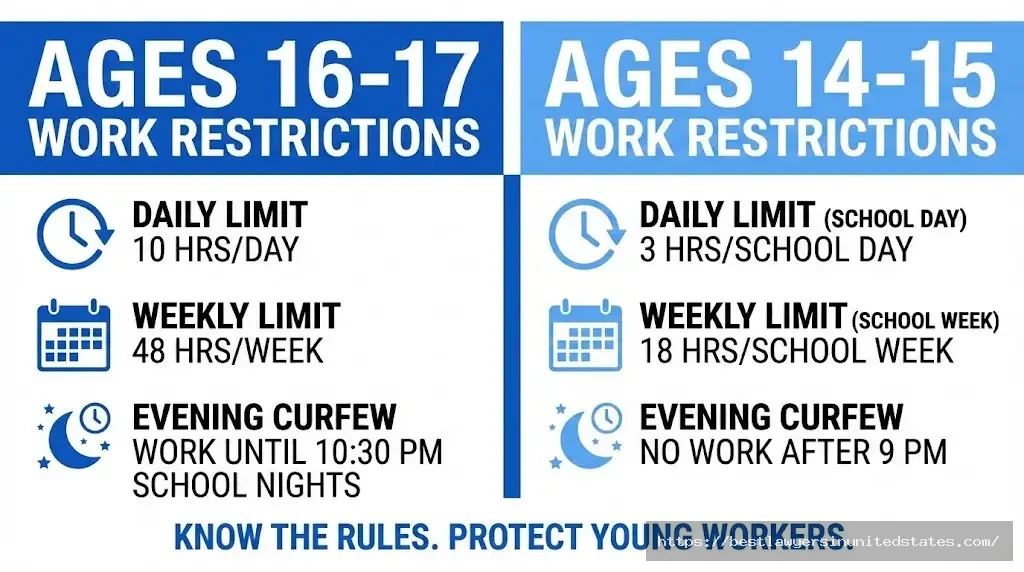
Michigan restricts when and how many hours minors can work. The Youth Employment Standards Act (MCL 408.414) sets these rules.
Maximum hours for 16-17 year olds during school:
- 10 hours per day
- 48 hours per week
- Work permitted until 10:30 PM on school nights
- Work permitted until 11:30 PM on non-school nights
Maximum hours for 14-15 year olds:
- 3 hours per school day (8 hours on non-school days)
- 18 hours per school week (40 hours during summer)
- No work during school hours
- No work after 9:00 PM (7:00 PM in summer)
Work Permits and Documentation
All Michigan workers under 18 need a work permit. These protect young workers from exploitation.
How to get a work permit:
- Student obtains: CA-6 form from school
- Employer provides: Job offer with hours and wage rate
- Parent/guardian signs: Consent section
- School issues: Permit after reviewing terms
Work permits ensure teens don't work excessive hours that harm their education. Employers face penalties for hiring minors without valid permits.
How Overtime Works in Michigan
Michigan follows federal overtime standards under the Fair Labor Standards Act. Most workers earn 1.5 times their regular rate for hours over 40 per week.
Michigan Overtime Pay Rules
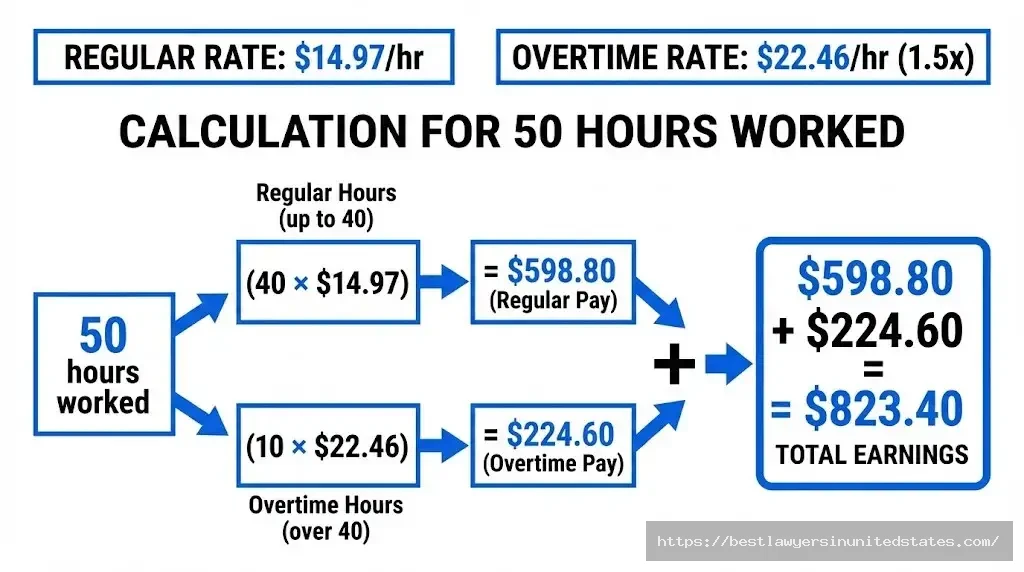
Quick Answer: Michigan requires time-and-a-half pay for hours worked over 40 in a single workweek. The state does not require daily overtime like California or Colorado.
Calculation method:
- Regular hours (1-40): Standard wage rate
- Overtime hours (41+): 1.5x wage rate
- No daily overtime trigger
- No double-time requirement
Example for minimum wage worker:
- Regular rate: $14.97/hour
- Overtime rate: $22.46/hour (1.5 x $14.97)
- 50 hours worked = (40 x $14.97) + (10 x $22.46) = $823.40
Calculate Your Overtime Pay in Michigan
Working more than 40 hours per week? Calculate your overtime earnings based on Michigan's overtime laws. This calculator accounts for Michigan's weekly overtime threshold and time-and-a-half requirements.
⏰ Overtime Pay Calculator
Calculate your overtime earnings based on your state's specific labor laws
📍 Select Your State
💰 Your Hourly Wage
📊 Calculation Method
📅 Weekly Hours
💵 Your Weekly Overtime Pay
📊 Earnings Breakdown
📅 Pay Period Estimates
⚖️ State vs Federal Comparison
Calculator features:
- Michigan-specific overtime rules
- Weekly overtime calculations
- Time-and-a-half calculations
- Pay period breakdowns
- Comparison with federal law
Full overtime calculator: Michigan Overtime Pay Calculator
Questions about your wages or need legal help?
Email: [email protected]
Who Is Exempt from Overtime in Michigan?
Not all workers qualify for overtime pay. Federal and state law creates "exempt" employee categories.
Common exempt categories:
- Executive employees: Manage 2+ employees, salary over $684/week
- Administrative employees: Office work, discretion on significant matters
- Professional employees: Advanced knowledge, typically degree required
- Computer employees: System analysts, programmers (salary or $27.63/hour+)
- Outside sales: Regular sales work outside employer's place of business
2026 salary threshold: Most white-collar exemptions require salary of at least $844 per week ($43,888 annually) as of July 1, 2024.
Common Overtime Violations in Michigan
Michigan workers frequently experience these overtime violations:
1. Misclassification as exempt Employers label workers as "managers" to avoid overtime. True exemptions require specific duties, not just a title.
2. Off-the-clock work Requiring work before clocking in or after clocking out violates overtime laws. This includes:
- Mandatory pre-shift meetings
- Post-shift cleaning or closing duties
- Answering work emails from home
- Traveling between job sites
3. Averaging hours across pay periods Employers cannot average a 50-hour week and a 30-hour week to avoid overtime. Each workweek stands alone.
4. Compensatory time instead of overtime pay Private sector employers cannot offer "comp time" instead of overtime pay. This violates the FLSA. For workers dealing with legal options for workplace disputes like unpaid overtime, Michigan law provides strong protections and recovery options.
Michigan Payment of Wages Laws
Michigan's Payment of Wages and Fringe Benefits Act (MCL 408.471 et seq.) governs how and when employers must pay workers. These rules protect workers from wage theft.
When Must Employers Pay Wages?
Quick Answer: Michigan requires employers to pay wages at least twice per month. Payment must occur within certain timeframes after the end of a pay period.
Standard payment rules:
- Bi-monthly schedule: Required for most workers
- Payment timing: Within a reasonable time after end of pay period
- Final paycheck: Next regular payday after termination
Michigan does not require immediate payment of final wages upon termination. Unlike California or Massachusetts, terminated workers receive their last check on the next scheduled payday.
The 7-Minute Rule in Michigan
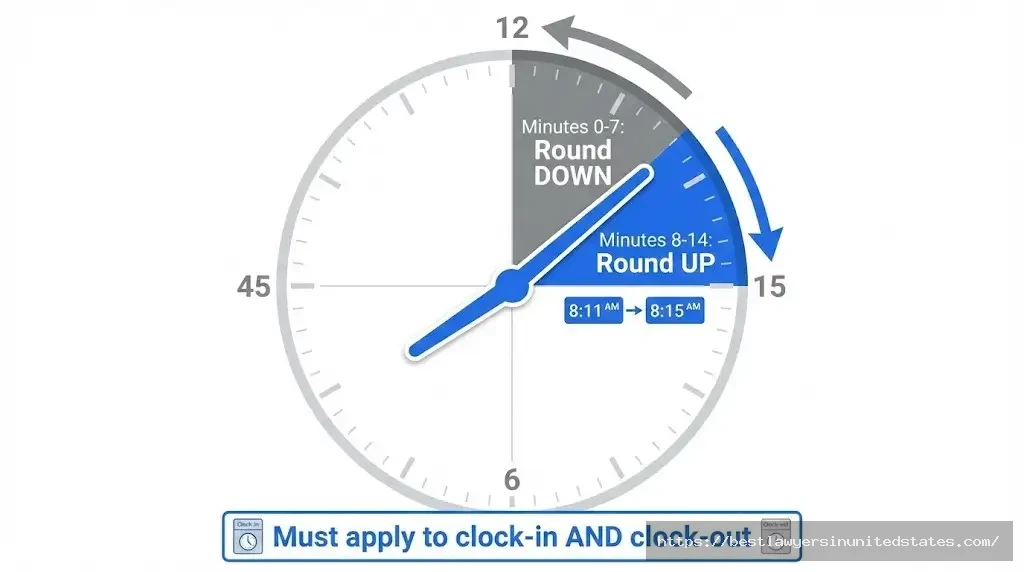
Michigan employers often use the "7-minute rule" for time clock rounding. This practice is legal when applied neutrally.
How it works:
- Clock-ins from 0-7 minutes: Round down to the hour
- Clock-ins from 8-14 minutes: Round up to 15 minutes
- Pattern repeats every 15 minutes
Example:
- Employee clocks in at 8:53 AM → Rounds to 9:00 AM
- Employee clocks in at 8:52 AM → Rounds to 8:45 AM
- Employee clocks out at 5:07 PM → Rounds to 5:00 PM
- Employee clocks out at 5:08 PM → Rounds to 5:15 PM
Legal requirements:
- ✅ Must round both up and down (not just down)
- ✅ Must apply same rule to all employees
- ✅ Cannot systematically favor employer
- ❌ Cannot round only in employer's favor
Improper rounding practices constitute wage theft. The Michigan Department of Labor investigates rounding complaints.
What Deductions Are Legal in Michigan?
Employers can only make specific deductions from paychecks. MCL 408.475 strictly limits permissible deductions.
Always legal (no consent needed):
- Federal and state income taxes
- Social Security and Medicare (FICA)
- Court-ordered garnishments
- Union dues (if union contract)
Legal with written consent:
- Health insurance premiums
- Retirement plan contributions
- Charitable contributions
- Uniform purchases (if above minimum wage)
Never legal:
- Cash register shortages
- Broken equipment or inventory
- Customer walkouts or theft
- Training costs for mandatory training
- Uniforms required for work
If deductions drop a worker's pay below $14.97 per hour, the employer violates minimum wage law. Exceptions exist for court-ordered wage garnishments, but even these have limits under Michigan law.
Who Is Exempt from Michigan Minimum Wage?
Several worker categories don't receive Michigan's standard minimum wage. These exemptions serve specific purposes under MCL 408.934.
Small Business Exemptions
Very small businesses may qualify for exemptions. However, Michigan's threshold is low.
Exemption criteria:
- Gross annual sales under $500,000
- Fewer than 2 employees at any time
- No interstate commerce
Most businesses don't meet these requirements. Any business with $500,000+ in sales must pay Michigan minimum wage.
Agricultural Worker Exemptions
Michigan treats farm workers differently than other employees. Partial exemptions exist under certain conditions.
Who qualifies for exemptions:
- Hand harvest laborers paid piece-rate
- Workers on small farms (500 or fewer man-days per quarter)
- Family farm employees
- Migrant agricultural workers (some protections apply)
What agricultural workers receive:
- Minimum wage still applies to most
- Some overtime exemptions
- Special housing and transportation rules
- Migrant worker protections under separate laws
Agricultural workers face unique challenges. Michigan provides some protections but not the same level as other industries.
Seasonal and Recreational Establishments
Amusement parks and seasonal businesses get limited exemptions. This applies to operations less than 7 months per year.
Exempt establishments:
- Seasonal amusement parks
- Summer camps
- Seasonal recreation facilities
- Holiday seasonal businesses
Workers at year-round facilities don't qualify. The business must truly operate seasonally.
Nonprofit and Religious Organizations
Some nonprofit organizations qualify for exemptions. Religious organizations have broader exemptions.
Exempt nonprofits:
- Religious organizations for religious work
- Youth summer camps (non-profit)
- Some charitable organizations
- Volunteer positions (no compensation)
Most nonprofits still must pay minimum wage. The exemption is narrow and applies mainly to religious organizations' religious activities.
Local Minimum Wage Laws in Michigan
Some Michigan cities have higher minimum wages than the state rate. These apply to specific workers, not all employees in the city.
Ann Arbor Living Wage Ordinance
Ann Arbor requires higher wages for certain workers. This living wage ordinance applies only to city contractors and some recipients of city financial assistance.
Ann Arbor living wage (2025-2026):
- With health benefits: $16.25/hour
- Without health benefits: $17.25/hour
- Applies to: City contractors with contracts over $10,000
- Applies to: Businesses receiving $100,000+ in city assistance
Who must pay Ann Arbor living wage:
- Construction contractors on city projects
- Service providers with city contracts
- Businesses receiving economic development funds
Who this does NOT cover:
- Regular private sector employers
- Small city contracts under $10,000
- Retail businesses not receiving city funds
Ann Arbor's ordinance doesn't create a citywide minimum wage. Most Ann Arbor workers receive the state minimum of $14.97.
Detroit Living Wage Ordinance
Detroit has similar requirements for city contractors. The Detroit living wage applies to large city contracts and subsidy recipients.
Detroit living wage (2025-2026):
- With health benefits: $15.59/hour
- Without health benefits: $17.04/hour
- Applies to: Service contracts over $50,000
- Applies to: Recipients of city economic development assistance
These local ordinances focus on workers whose salaries connect to taxpayer dollars. They don't affect the broader Detroit or Ann Arbor labor markets.
What If You're Not Being Paid Properly?
Michigan workers have strong legal protections against wage theft. The state provides multiple ways to recover unpaid wages.
What Is Wage Theft in Michigan?
Quick Answer: Wage theft occurs when employers don't pay earned wages. This includes unpaid regular wages, unpaid overtime, illegal tip deductions, or paying below minimum wage.
Common wage theft types:
- Paying less than $14.97 per hour
- Not paying overtime after 40 hours
- Making illegal deductions
- Not paying for all hours worked
- Keeping employee tips
- Misclassifying workers as independent contractors
- Forcing off-the-clock work
Michigan treats wage theft seriously. Employers face penalties up to three times the unpaid amount.
Calculate Your Wage Theft Recovery in Michigan
Think your employer owes you money? Use our wage theft calculator to estimate how much you could recover, including unpaid wages, penalties, and interest under Michigan law.
Wage Theft Recovery Calculator
Estimate how much you can recover in unpaid wages, penalties, and damages based on your state's laws
💵 Estimated Total Recovery
💰 Unpaid Wages
⚖️ Penalties & Damages
📋 Total Summary
Calculator features:
- Multiple violation types (unpaid wages, overtime, tips)
- Michigan-specific penalties and damages
- Filing deadline tracker
- Total recovery estimate
- Next steps guidance
Full wage theft calculator: Michigan Wage Theft Recovery Calculator
Need help with unpaid wages? Contact Michigan Department of Labor or consult with an attorney for discrimination at work who can also handle wage theft cases.
How to File a Wage Complaint in Michigan
Workers can file complaints with the Michigan Department of Labor and Economic Opportunity (LEO). The Wage and Hour Division investigates complaints.
Step-by-step filing process:
1. Gather documentation
- Pay stubs showing underpayment
- Time records or personal time logs
- Employment contracts or offer letters
- Any written communications about wages
- Evidence of hours worked
2. Contact Michigan LEO
- Online: Michigan.gov/LEO complaint portal
- Phone: (855) 464-9243
- In person: LEO district offices statewide
- Mail: Wage and Hour Division complaint form
3. Submit your complaint Required information:
- Your name and contact information
- Employer's name and address
- Description of wage violation
- Dates of employment
- Amount you believe is owed
- Supporting documentation
4. LEO investigation timeline
- Initial review: 2-4 weeks
- Investigation: 30-90 days
- Resolution: Varies by case complexity
- Appeal: Available if dissatisfied
5. Alternative legal options If LEO doesn't resolve your case:
- File lawsuit in circuit court (for large claims)
- File in small claims court (claims under $6,500)
- Hire private employment attorney
- File federal complaint with U.S. Department of Labor
Penalties for Wage Violations in Michigan
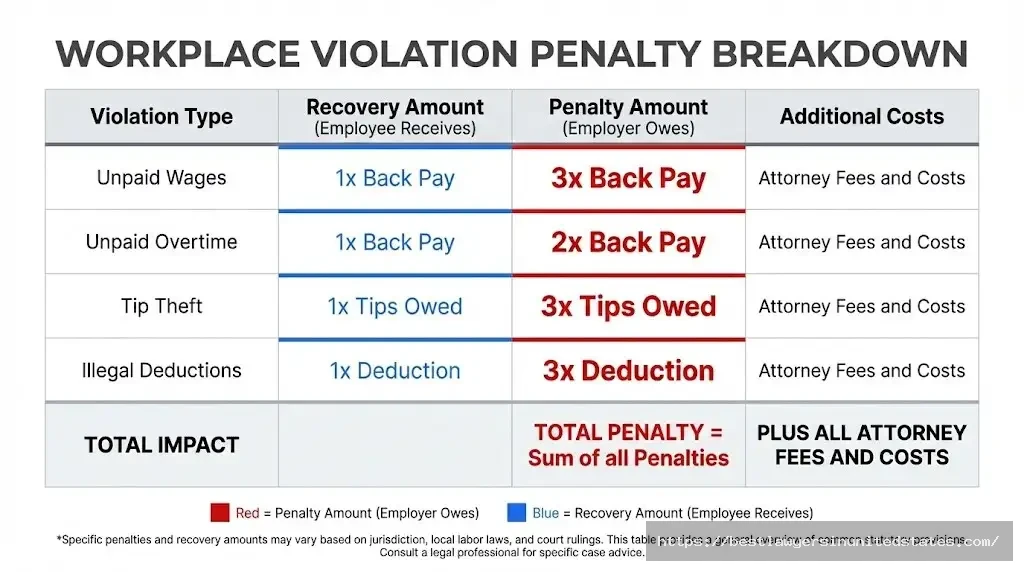
Michigan imposes serious penalties on employers who violate wage laws. These penalties help deter wage theft.
| Violation Type | Employee Recovery | Employer Penalty | Legal Basis |
|---|---|---|---|
| Unpaid regular wages | Full back pay + interest | Up to 3x wages owed | MCL 408.482 |
| Unpaid overtime | Back pay + liquidated damages | Up to 2x wages owed | FLSA § 216(b) |
| Tip theft | Full tips + damages | 3x tip amount | MCL 408.482 |
| Illegal deductions | Refund + damages | 3x deduction amount | MCL 408.475 |
| Retaliation | Reinstatement + back pay | Separate civil penalties | MCL 408.483a |
Treble damages: Michigan's Payment of Wages Act allows courts to award three times the unpaid amount. This applies when employers willfully violate the law.
Attorney fees: Winning employees recover attorney fees and court costs. This allows workers to find lawyers who take cases on contingency.
Filing Deadlines in Michigan
Wage theft claims have time limits. Missing these deadlines can bar your claim entirely.
| Claim Type | Michigan Deadline | Federal Deadline | Which Applies |
|---|---|---|---|
| Unpaid wages | 6 years | 3 years | Longer period |
| FLSA violations | N/A | 2-3 years | FLSA only |
| Contract violations | 6 years | N/A | Michigan |
| Fraud claims | 6 years | N/A | Michigan |
Michigan's advantage: MCL 600.5807 provides a 6-year statute of limitations for wage claims. This is twice as long as the federal 3-year FLSA period.
File complaints as soon as possible. Evidence disappears over time. Witnesses forget details. Acting quickly improves your chances of recovery.
Michigan vs Neighboring States
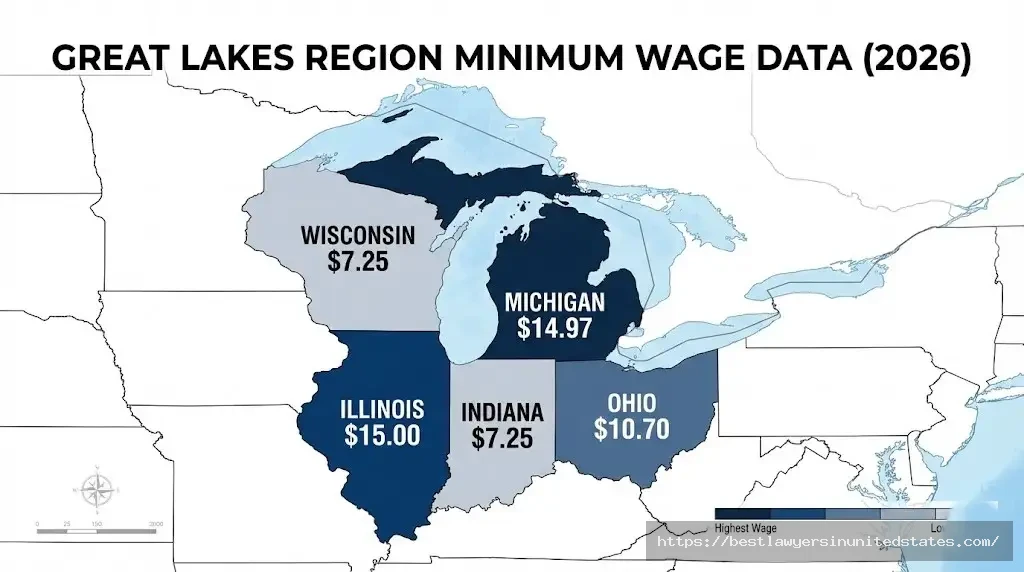
Michigan's $14.97 minimum wage sits in the middle compared to bordering states. Regional differences affect worker mobility and employer competition.
How Michigan Compares to Nearby States (2026)
| State | Minimum Wage | Tipped Wage | Annual (Full-Time) | Difference from Michigan |
|---|---|---|---|---|
| Michigan | $14.97 | $5.99 | $31,137.60 | Baseline |
| Illinois | $15.00 | $9.00 | $31,200.00 | +$0.03/hr (+0.2%) |
| Ohio | $10.70 | $5.35 | $22,256.00 | -$4.27/hr (-28.5%) |
| Indiana | $7.25 | $2.13 | $15,080.00 | -$7.72/hr (-51.6%) |
| Wisconsin | $7.25 | $2.33 | $15,080.00 | -$7.72/hr (-51.6%) |
Michigan significantly outpaces Ohio, Indiana, and Wisconsin. However, Illinois edges ahead slightly at $15.00 per hour.
Cross-Border Employment Considerations
Workers living near state borders face choices about where to work. The wage rate can influence these decisions.
Which state's law applies?
- Work location determines minimum wage
- State where work is performed controls
- Remote workers: Employer's location typically applies
- Multi-state employers: Pay rate of work location
Example scenarios:
Scenario 1: Detroit resident works in Windsor, Ontario
- Canadian minimum wage applies (C$17.20 in Ontario)
- Michigan minimum wage doesn't apply
- Worker must meet Canadian work permit requirements
Scenario 2: Toledo, Ohio resident works in Monroe, Michigan
- Michigan minimum wage applies ($14.97)
- Worker earns $4.27/hour more than Ohio rate
- Commute may be worth wage difference
Scenario 3: Hammond, Indiana resident works in Chicago, Illinois
- Illinois minimum wage applies ($15.00)
- Worker earns $7.75/hour more than Indiana rate
- Significant wage advantage for border commuters
Border region dynamics create competition for workers. Michigan employers near Ohio borders have recruiting advantages. Those near Illinois face disadvantages.
Michigan Minimum Wage History
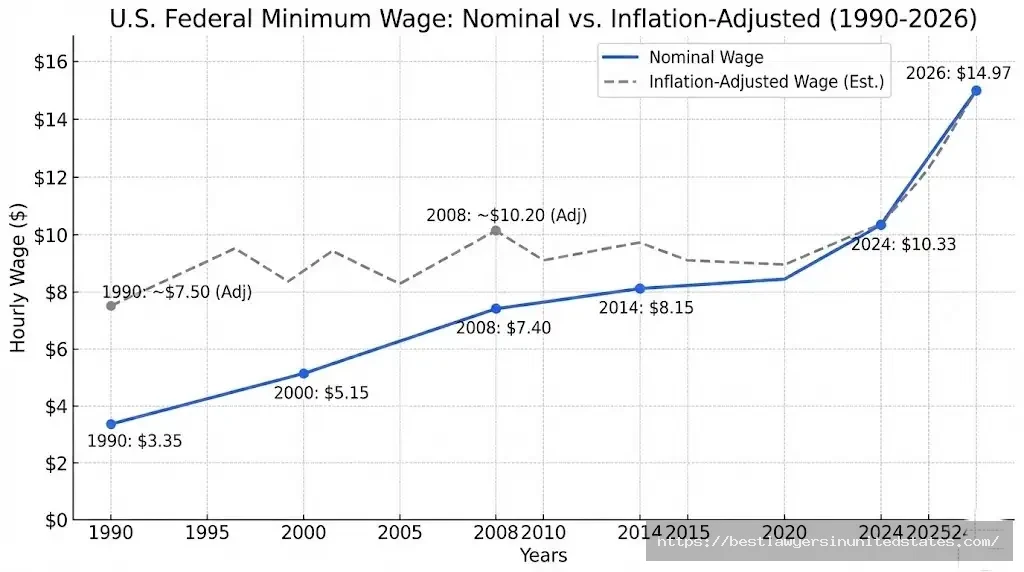
Michigan's minimum wage has grown significantly since 1990. Understanding this history provides context for current rates.
Historical Wage Rates (1990-2026)
| Year | Minimum Wage | Tipped Wage | % Change | Inflation-Adjusted (2026 $) |
|---|---|---|---|---|
| 1990 | $3.35 | $1.27 | - | $7.96 |
| 1995 | $4.25 | $1.61 | +26.9% | $8.76 |
| 2000 | $5.15 | $1.95 | +21.2% | $9.23 |
| 2005 | $5.15 | $1.95 | 0% | $8.26 |
| 2008 | $7.40 | $2.65 | +43.7% | $10.72 |
| 2014 | $8.15 | $3.10 | +10.1% | $10.54 |
| 2018 | $9.25 | $3.52 | +13.5% | $11.34 |
| 2024 | $10.33 | $3.93 | +11.7% | $10.33 |
| 2025 | $12.48 | $4.87 | +20.8% | $12.35 |
| 2026 | $14.97 | $5.99 | +20.0% | $14.97 |
Real wage analysis: Michigan's 2026 minimum wage of $14.97 provides more purchasing power than any previous year. The 1990 rate of $3.35 equals about $7.96 in 2026 dollars.
Key Historical Milestones
1990s: Federal law controlled Michigan's minimum wage matched federal rates. No state-specific increases occurred. Workers saw purchasing power decline due to inflation.
2007-2008: State act passed Michigan passed its own minimum wage law. The state rate rose faster than federal law. This separated Michigan from federal minimum wage stagnation.
2014: Voter initiative filed Advocacy groups filed ballot initiative to raise minimum wage to $9.25. Legislature preemptively passed law to prevent vote. This set stage for later controversy.
2018: "Adopt and amend" controversy New ballot initiatives proposed $12 minimum wage and earned sick time. Legislature used "adopt and amend" tactic:
- Adopted initiatives to remove from ballot
- Immediately amended to weaken provisions
- Slowed wage increases and limited sick time
2024: Supreme Court intervention Michigan Supreme Court ruled "adopt and amend" violated Constitution. Original stronger provisions restored. This created current accelerated increase schedule.
2025: Historic jump February 21, 2025 brought largest single increase in Michigan history. The $2.15 jump (20.8%) from $10.33 to $12.48 exceeded all previous increases.
Employer Compliance Requirements
Michigan employers must follow specific posting and record-keeping rules. Violations can result in fines and penalties.
Michigan Minimum Wage Posting Requirements
Quick Answer: Michigan employers must display the official minimum wage poster in a conspicuous location where all employees can see it. Failure to post can result in a $1,000 fine.
Posting requirements:
- Display official LEO poster
- Post in employee break room or common area
- Update poster when rates change
- Provide in English (additional languages if needed)
- Keep poster visible and legible
Where to get posters:
- Download free from Michigan.gov/LEO
- Request printed copy from LEO district office
- Purchase from private vendors (optional)
Poster includes:
- Current minimum wage rate
- Tipped employee wage rate
- Youth and training wage information
- Contact information for complaints
- Employee rights summary
Employer Record-Keeping Requirements
Michigan requires employers to maintain detailed wage records. These records must be available for inspection.
Required records (3-year retention):
- Employee names and addresses
- Birth dates (if under 19)
- Hours worked each day
- Total hours worked each week
- Hourly pay rate
- Gross wages earned
- Deductions from wages
- Net wages paid
- Payment dates
Record format:
- Can be paper or electronic
- Must be organized and accessible
- LEO inspectors can review on demand
- Employees can request their own records
Employers who fail to maintain proper records face penalties. Poor records make defending against wage claims difficult.
New Hire Notification Requirements
Michigan employers must provide wage information when hiring workers. This ensures employees understand their pay structure. Understanding what employees should look for in employment agreements helps workers protect their rights from the start.
Required notifications:
- Regular hourly wage rate or salary
- Designated pay day
- Overtime rate (if applicable)
- For tipped workers: Base wage and tip credit notice
- For training wage: Duration and conditions
Timing: Notifications must occur before work begins or at hiring. Employers should provide written confirmation.
Frequently Asked Questions
What is Michigan's minimum wage in 2026?
Quick Answer: Michigan's minimum wage is $14.97 per hour as of January 1, 2026, which is $7.72 higher than the federal minimum wage of $7.25.
This rate applies to all non-exempt employees regardless of employer size. Tipped employees receive $5.99 per hour plus tips, which must total at least $14.97 per hour.
When will Michigan's minimum wage increase next?
Quick Answer: Michigan's minimum wage will increase to $17.00 per hour on January 1, 2027, representing a $2.03 increase from the 2026 rate.
The state follows a court-mandated schedule through 2029. Annual increases will continue each January 1st based on the restored Improved Workforce Opportunity Wage Act.
How much do servers make in Michigan?
Quick Answer: Michigan servers must receive at least $5.99 per hour in base pay plus tips in 2026. With tips, total earnings must equal or exceed $14.97 per hour.
If tips don't bring a server's total to $14.97 per hour, the employer must pay the difference. Employers cannot keep any portion of tips.
What is the minimum wage for 16-year-olds in Michigan?
Quick Answer: Most 16-year-olds in Michigan receive the full minimum wage of $14.97 per hour. A training wage of $12.72 per hour applies only for the first 90 days with a new employer.
After the 90-day training period, employers must pay the full minimum wage. Michigan has no separate youth minimum wage for ongoing employment.
Does Michigan have daily overtime?
Quick Answer: No. Michigan requires overtime pay only for hours over 40 in a workweek. The state does not require premium pay for hours over 8 in a single day.
Michigan follows federal overtime rules under the Fair Labor Standards Act. Only weekly hours matter for overtime calculations.
How do I file a wage complaint in Michigan?
Quick Answer: File a complaint with the Michigan Department of Labor and Economic Opportunity (LEO) online at Michigan.gov/LEO, by phone at (855) 464-9243, or at any LEO district office.
You'll need to provide your employment information, documentation of the wage violation, and evidence of unpaid wages. LEO investigates complaints and can order employers to pay back wages.
What is the 7-minute rule in Michigan?
Quick Answer: The 7-minute rule allows employers to round time clock punches to the nearest 15 minutes if it rounds both up and down fairly. Punches 1-7 minutes round down, while 8-14 minutes round up.
This practice is legal only when applied neutrally. Employers cannot systematically round in their favor. Improper rounding constitutes wage theft.
Can my employer pay me less than minimum wage?
Quick Answer: No. Michigan employers must pay at least $14.97 per hour to all non-exempt employees. Limited exceptions exist only for tipped workers ($5.99 plus tips) and training wages ($12.72 for first 90 days).
No deductions can drop your effective wage below minimum wage. Violations allow you to recover unpaid wages plus penalties.
What is the training wage in Michigan?
Quick Answer: Michigan's training wage is $12.72 per hour in 2026, which is 85% of the standard minimum wage. It applies only to workers ages 16-17 during their first 90 days with an employer.
After 90 days, the employer must pay the full $14.97 minimum wage. Employers cannot repeatedly hire and fire young workers to avoid the standard rate.
How does Michigan's minimum wage compare to the federal minimum?
Quick Answer: Michigan's minimum wage ($14.97) is $7.72 higher than the federal minimum wage ($7.25), representing a 106.5% increase over federal standards.
When state and federal laws differ, workers receive the higher rate. Michigan workers benefit from the state's higher minimum wage.
Are agricultural workers covered by minimum wage in Michigan?
Quick Answer: Yes, most Michigan agricultural workers must receive the $14.97 minimum wage. Limited exemptions apply only to hand harvest piece-rate workers and employees of very small farms.
Even exempt agricultural workers receive some wage protections. Michigan provides additional protections for migrant agricultural workers.
What are the penalties for wage theft in Michigan?
Quick Answer: Michigan employers who commit wage theft can be ordered to pay up to three times (treble damages) the unpaid amount plus attorney fees and costs under MCL 408.482.
Additional penalties include criminal charges for willful violations and civil fines up to $1,000 per violation. Employees can recover full back pay, interest, and damages.
When does the tipped credit end in Michigan?
Quick Answer: Michigan will eliminate the tipped wage system on January 1, 2029. After that date, all tipped employees must receive the full minimum wage plus tips.
The tipped wage gradually increases until 2029 when it equals the standard minimum wage. This makes Michigan one of the few states without a tipped wage system.
What is Ann Arbor's minimum wage?
Quick Answer: Ann Arbor does not have a citywide minimum wage. The city's living wage ordinance requires $16.25-$17.25 per hour only for city contractors and businesses receiving significant city financial assistance.
Most Ann Arbor workers receive Michigan's state minimum wage of $14.97. The living wage applies to a limited subset of workers.
How many days in a row can I work in Michigan?
Quick Answer: Michigan law does not limit consecutive work days for adults. However, federal FLSA requires overtime pay for hours over 40 per week regardless of days worked.
Working 7+ consecutive days means at least one day includes overtime hours. Employers must pay time-and-a-half for hours over 40 in the workweek.
How do I calculate my earnings at Michigan minimum wage?
Quick Answer: Multiply your hourly wage ($14.97) by hours worked per week, then multiply by weeks worked per year. Full-time (40 hours/week) equals $31,137.60 annually.
Use our free Michigan minimum wage calculator for detailed breakdowns including overtime, taxes, and take-home pay.
How much overtime pay am I entitled to in Michigan?
Quick Answer: Michigan overtime is 1.5 times your regular wage for hours over 40 per week. At minimum wage ($14.97), overtime rate is $22.46 per hour.
Calculate your overtime with our Michigan overtime calculator that accounts for your specific wage rate and hours worked.
How do I calculate wage theft recovery in Michigan?
Quick Answer: Calculate unpaid wages, then multiply by three for potential treble damages. Add attorney fees and interest to determine total potential recovery.
Use our Michigan wage theft calculator to estimate your claim value and understand filing deadlines based on your specific situation.
Additional Michigan Wage Resources
Official Government Resources
Michigan Department of Labor and Economic Opportunity (LEO)
- Website: Michigan.gov/LEO
- Wage and Hour Division: (855) 464-9243
- Email: [email protected]
LEO District Offices:
- Detroit: 3024 W. Grand Blvd., Cadillac Place, Detroit, MI 48202
- Grand Rapids: 3215 Plainfield Ave. NE, Grand Rapids, MI 49525
- Lansing: 2801 Jolly Rd., Suite 100, Okemos, MI 48864
- Saginaw: 515 N. Washington Ave., 3rd Floor, Saginaw, MI 48607
U.S. Department of Labor
- Detroit District Office: (313) 456-6030
- Website: DOL.gov/agencies/whd
- National helpline: 1-866-4-US-WAGE
Legal Assistance
Michigan Legal Help Website: MichiganLegalHelp.org Free legal information for Michigan residents
Legal Services Organizations:
- Legal Aid of Michigan: (888) 783-8190
- Michigan State Bar Lawyer Referral Service: (800) 968-1442
- Employment Law Clinics at Michigan law schools
Worker Advocacy Organizations
Restaurant Opportunities Centers United (ROC Michigan) Focus: Restaurant worker rights and tipped wage issues Website: ROCUnited.org/michigan
Michigan AFL-CIO Focus: Union worker rights and wage advocacy Website: MiAFLCIO.org
One Fair Wage Michigan Focus: Eliminating tipped wage system Website: OneFairWage.site
Key Takeaways for Michigan Workers
Michigan's $14.97 minimum wage in 2026 provides significantly higher pay than federal standards. The Supreme Court's 2024 ruling accelerated increases that will reach $17.85 by 2029.
Remember these critical points:
- All non-exempt workers receive at least $14.97/hour
- Tipped workers receive $5.99 base plus tips (must total $14.97)
- Overtime is 1.5x pay for hours over 40 per week
- Training wage ($12.72) applies only to 16-17 year olds for 90 days
- You can file wage complaints with LEO for unpaid wages
- Michigan allows up to 3x damages for wage theft
- You have 6 years to file wage violation claims
Use the interactive calculators throughout this guide to estimate your earnings, overtime pay, and potential wage theft recovery. These tools provide personalized calculations based on Michigan's 2026 wage laws.
If your employer violates wage laws, document everything and file a complaint immediately. Michigan's strong worker protection laws give you the power to recover unpaid wages plus penalties.