
Minnesota’s minimum wage increases to $11.41 per hour for large employers and $9.31 per hour for small employers on January 1, 2026. Minneapolis has the highest rate at $16.50 per hour, while Saint Paul uses a four-tier system based on business size. Unlike most states, Minnesota does not allow tip credits, meaning servers and tipped workers earn the full minimum wage plus tips.
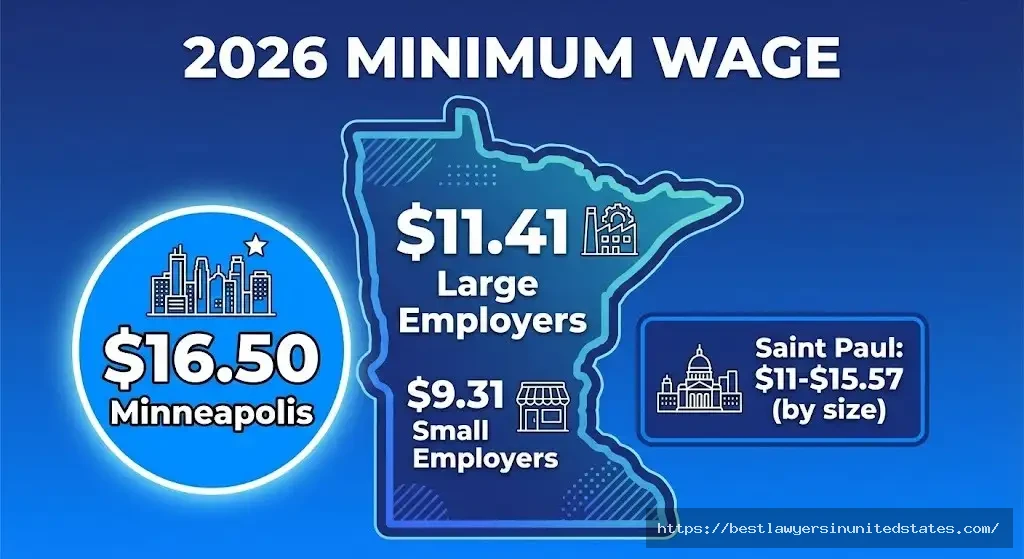
This guide covers everything you need to know about Minnesota’s three-tier minimum wage system for 2026, including how to determine which rate applies to you, overtime rules, youth worker provisions, and what to do if you’re not being paid correctly.
Calculate Your Earnings in Minnesota
Want to know exactly how much you’ll earn at Minnesota’s minimum wage? Use our free calculator to estimate your weekly, monthly, and annual income based on your hours worked.
💰 Minimum Wage Earnings Calculator
Calculate your weekly, monthly, and annual earnings with overtime and tax estimates
📊 Your Earnings Breakdown
💰 Gross Earnings
Calculator features:
- Automatic Minnesota wage rates for 2026
- Weekly, monthly, and annual earnings
- Overtime calculations
- Tax withholding estimates
- Take-home pay breakdown
Full calculator with all features: Minnesota Minimum Wage Calculator
Questions about your wages or need legal help? Email: [email protected]
What Is Minnesota's Minimum Wage for 2026?
Minnesota operates a three-tier minimum wage system that varies by employer size and location. The state minimum wage adjusted for inflation on January 1, 2026, but some cities have their own higher rates.
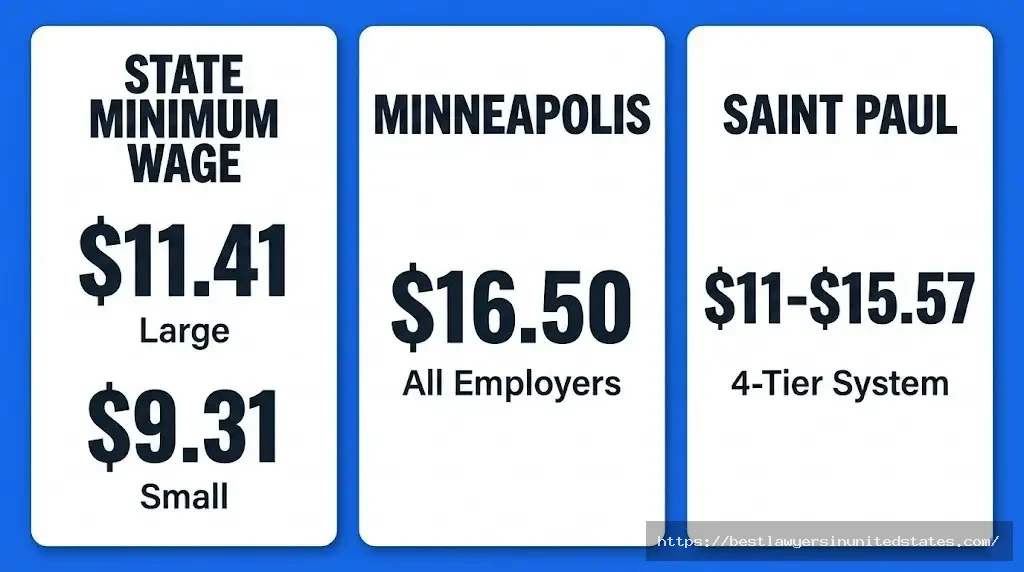
Statewide Minimum Wage Rates
Large employers (gross annual revenue of $500,000 or more) must pay $11.41 per hour as of January 1, 2026. This represents a 2.51% increase from the 2025 rate of $11.13.
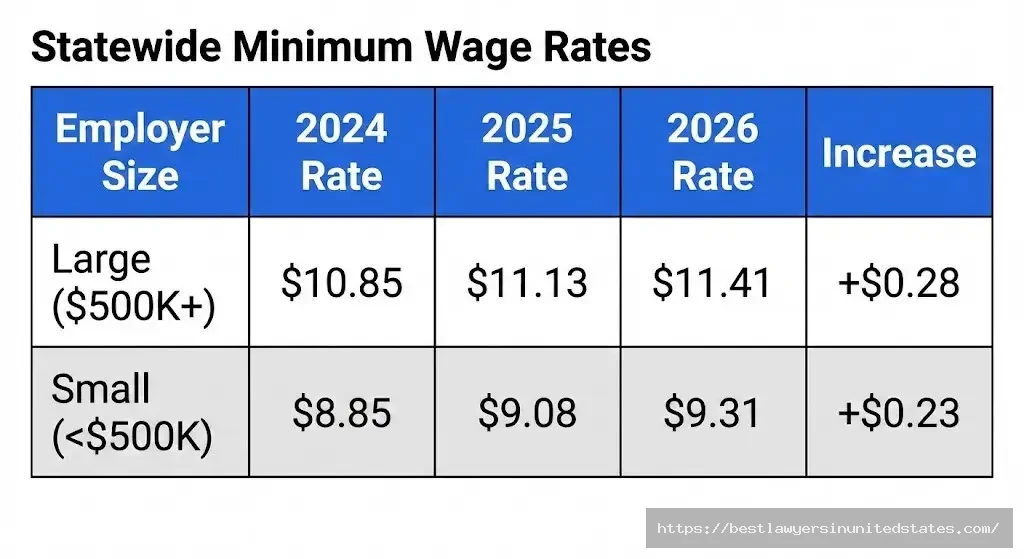
Small employers (gross annual revenue under $500,000) must pay $9.31 per hour in 2026. This increased from $9.08 in 2025.
The Minnesota Department of Labor and Industry (DLI) adjusts these rates annually based on the Consumer Price Index for Urban Wage Earners and Clerical Workers (CPI-W) for the Minneapolis-St. Paul-Bloomington metropolitan area.
| Employer Size | 2024 Rate | 2025 Rate | 2026 Rate | Increase |
|---|---|---|---|---|
| Large ($500K+ revenue) | $10.85 | $11.13 | $11.41 | +$0.28 |
| Small (Under $500K) | $8.85 | $9.08 | $9.31 | +$0.23 |
Minneapolis Minimum Wage 2026
Minneapolis has the highest minimum wage in Minnesota at $16.50 per hour effective January 1, 2026. This rate applies to all employers regardless of size.
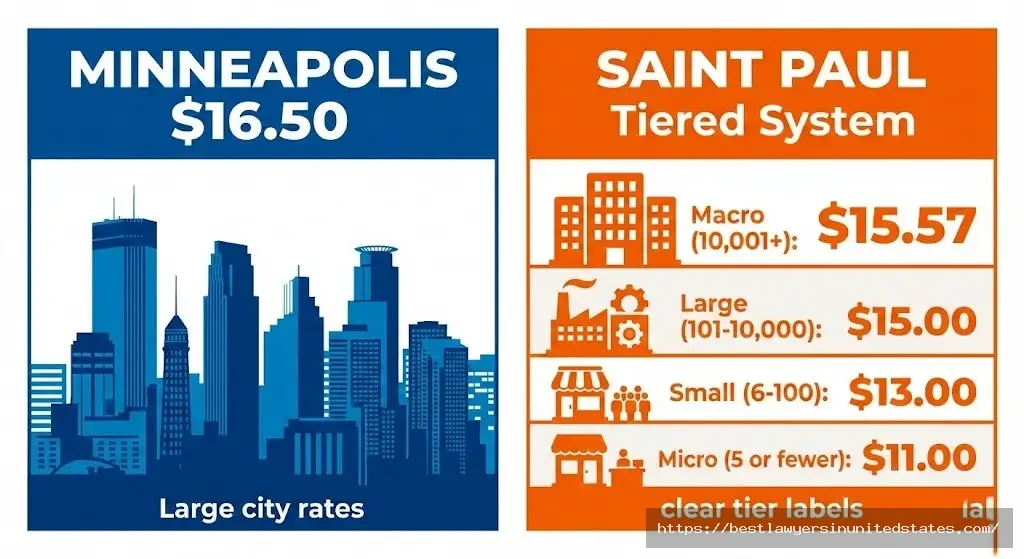
The Minneapolis minimum wage ordinance (Chapter 40 of City Code) determines rates based on where the work is performed, not where the business is headquartered. If you work within Minneapolis city limits, you must receive the Minneapolis rate even if your employer is based elsewhere.
Saint Paul Minimum Wage 2026
Saint Paul uses a four-tier system based on business size measured by employee count:
| Business Size | 2026 Rate | Definition |
|---|---|---|
| Macro (10,001+ employees) | $15.57 | Same as City of St. Paul |
| Large (101-10,000 employees) | $15.00 | Most medium businesses |
| Small (6-100 employees) | $13.00 | Small businesses |
| Micro (5 or fewer employees) | $11.00 | Very small businesses |
Youth workers under 18 may be paid 85% of the applicable rate for the first 90 days of employment.
How to Know Which Rate Applies to You
Your minimum wage depends on where you physically perform your work, not where you live or where your employer's headquarters is located. Check these factors:
Work location: If you work in Minneapolis, you get Minneapolis rates. If you work in Saint Paul, you get Saint Paul rates based on your employer's size. All other Minnesota locations follow state rates.
Employer size: For state rates, your employer's gross annual revenue determines if they're large or small. For Minneapolis and Saint Paul, employee count matters more than revenue.
Multiple locations: If you work in different cities during the same pay period, your employer must pay you the highest applicable rate for hours worked in each location.
Minnesota vs Federal Minimum Wage
Minnesota's minimum wage exceeds the federal minimum wage of $7.25 per hour set by the Fair Labor Standards Act (FLSA). When state and federal laws differ, employers must follow whichever law provides greater protection to workers.
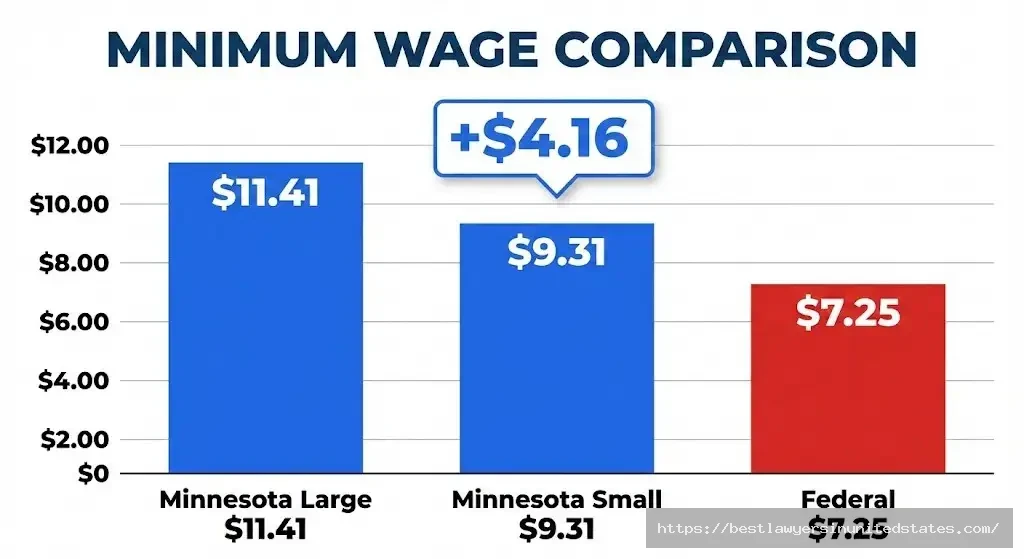
Key difference: Minnesota's $11.41 minimum wage for large employers is $4.16 higher than federal law. Even small employers in Minnesota must pay $9.31, which is $2.06 above the federal rate.
| Jurisdiction | Regular Minimum Wage | Tipped Minimum Wage | Overtime Threshold |
|---|---|---|---|
| Minnesota (Large) | $11.41 | $11.41 (no credit) | 48 hours |
| Minnesota (Small) | $9.31 | $9.31 (no credit) | 48 hours |
| Federal (FLSA) | $7.25 | $2.13 | 40 hours |
| Difference | +$4.16 | +$9.28 | +8 hours |
Minnesota is one of only seven states that prohibits tip credits entirely. This means tipped workers like servers and bartenders must receive the full minimum wage before tips.
Large vs Small Employer: How to Calculate Business Size
Understanding whether your employer qualifies as large or small determines which minimum wage rate applies. Minnesota uses different methods at the state and city levels.
State Definition: Gross Revenue Method
The Minnesota Department of Labor and Industry defines employer size based on annual gross sales or business done:
Large employer: Annual gross revenue of $500,000 or more during the previous calendar year. Must pay $11.41/hour minimum wage in 2026.
Small employer: Annual gross revenue under $500,000 during the previous calendar year. Must pay $9.31/hour minimum wage in 2026.
Gross revenue calculation includes:
- All sales and receipts from all business operations
- Income from all locations and divisions
- Revenue from affiliate companies under common ownership
- Interstate and intrastate commerce
Minneapolis and Saint Paul: Employee Count Method
Minneapolis and Saint Paul determine business size by counting employees, not revenue:
Minneapolis: All employers must pay $16.50 regardless of size. The city eliminated size-based tiers in 2024.
Saint Paul: Business size categories based on total employees across all locations:
- Macro: 10,001 or more employees
- Large: 101 to 10,000 employees
- Small: 6 to 100 employees
- Micro: 5 or fewer employees
Special Rules for Franchises and Chain Restaurants
Franchise operations often count as large employers even if individual locations have limited revenue. Minnesota law considers the franchise parent company's total revenue when determining size.
Chain restaurants: If your restaurant is part of a multi-location chain or franchise system, you typically qualify as a large employer and must pay the higher rate.
Joint ventures: Businesses operating as joint ventures or under common ownership must combine their revenue and employee counts.
Tipped Employees in Minnesota: No Tip Credit Allowed
Minnesota is one of only seven states that does not allow employers to take a tip credit against minimum wage obligations. This makes Minnesota an especially favorable state for restaurant workers, servers, and other tipped employees.
What Is a Tip Credit?
A tip credit allows employers in most states to pay tipped workers less than minimum wage, with tips making up the difference. The federal tipped minimum wage is just $2.13 per hour.
Example in most states: A server earning the federal tipped minimum of $2.13/hour must receive at least $5.12/hour in tips to reach the $7.25 federal minimum wage. If tips fall short, the employer must make up the difference.
Minnesota's Full Wage Requirement
Under Minn. Stat. § 177.24, Minnesota employers must pay tipped workers the full minimum wage before tips. Tips are considered additional compensation above the base wage.
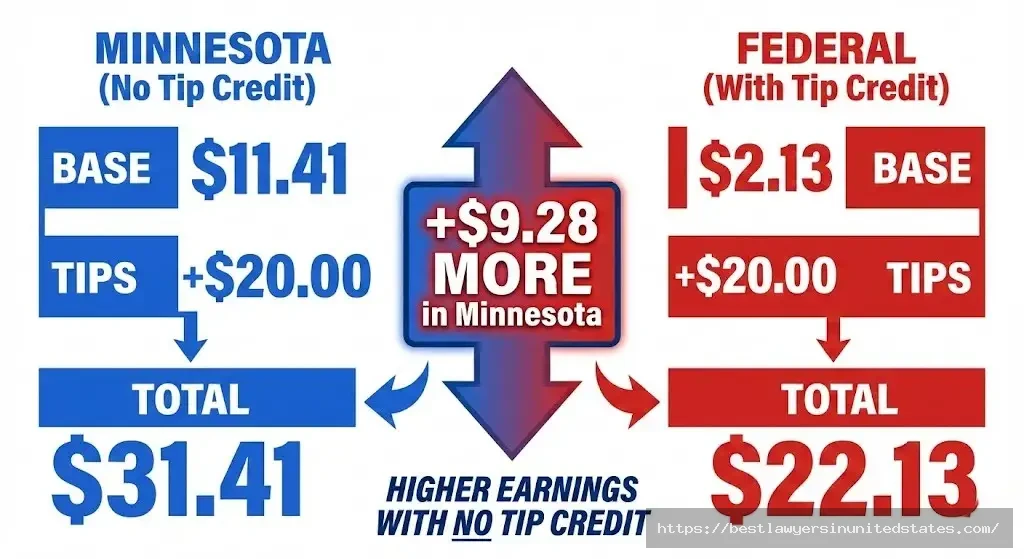
Minnesota server example: A server at a large employer restaurant in Minnesota earns $11.41/hour base wage (or $16.50 in Minneapolis) plus 100% of their tips. If they receive $20/hour in tips, their total earnings are $31.41/hour (or $36.50 in Minneapolis).
| State | Base Wage for Tipped Workers | Tips | Total Hourly Earnings |
|---|---|---|---|
| Minnesota (state) | $11.41 | +$20.00 | $31.41 |
| Minnesota (Minneapolis) | $16.50 | +$20.00 | $36.50 |
| Federal minimum | $2.13 | +$20.00 | $22.13 |
| Difference | +$9.28 to +$14.37 | Same tips | +$9.28 to +$14.37 |
What This Means for Restaurant Workers
Minnesota's no-tip-credit policy provides significant income security for tipped workers. You're guaranteed a living wage even during slow shifts when tips are minimal.
Your rights as a tipped employee:
- Full minimum wage ($11.41 or higher depending on location)
- 100% of your tips on top of base wage
- Protection from tip theft by managers or owners
- Voluntary tip pooling with other service staff
- Overtime at 1.5x your full base wage (not tipped wage)
Similar protections exist in California's minimum wage system, which also prohibits tip credits entirely.
Youth Workers and Training Wages
Minnesota law allows employers to pay reduced wages to workers under age 18 during an initial training period. These provisions help young workers gain experience while maintaining wage protections.
90-Day Training Wage for Minors
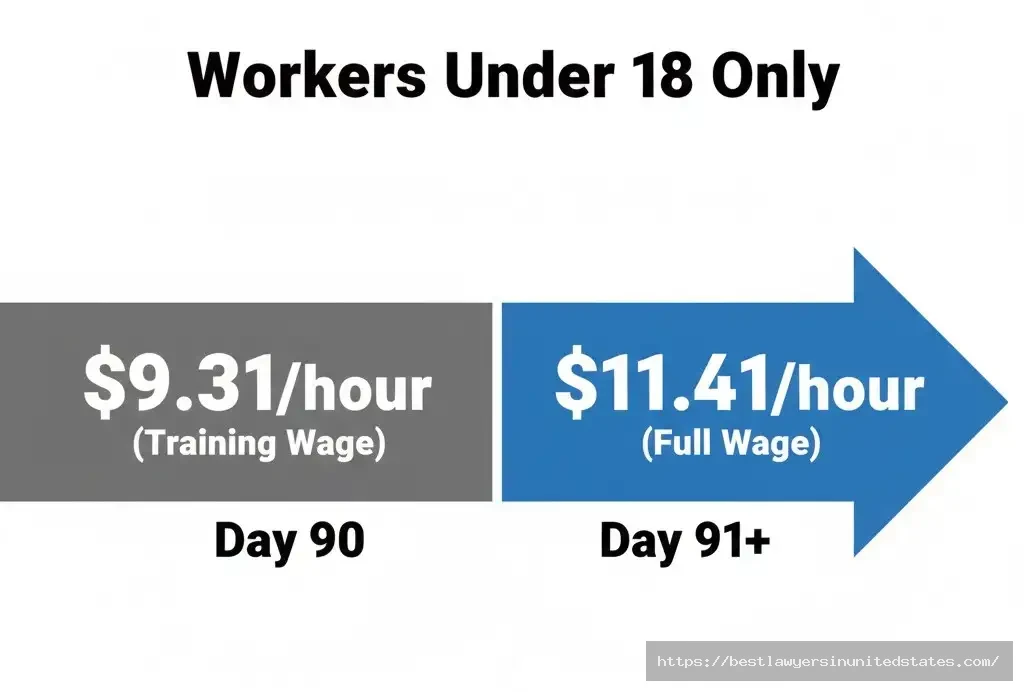
Employers may pay workers under age 18 a training wage of $9.31 per hour (85% of the large employer minimum wage) for the first 90 consecutive days of employment. This applies regardless of whether the employer is large or small.
After 90 days: The employer must increase the minor's wage to the full minimum wage applicable to that business (either $11.41 for large employers or $9.31 for small employers statewide).
Important limits:
- Training wage applies only to first 90 days with each employer
- Cannot restart the 90-day period by rehiring after termination
- Must pay full minimum wage if minor turns 18 during employment
- Does not apply to 18-year-olds or older workers
Age Restrictions and Hour Limitations
Minnesota restricts when and how long minors can work under Minn. Stat. § 181A:
Ages 14-15:
- Maximum 8 hours per day
- Maximum 40 hours per week
- Cannot work during school hours
- Cannot work before 7 AM or after 9 PM (7 PM during school year)
- Cannot work more than 3 hours on school days
Ages 16-17:
- No daily hour limits
- No weekly hour limits during summer
- Cannot work during school hours on school days
- Cannot work before 5 AM or after 11 PM on school nights
Prohibited Occupations for Minors
Federal and Minnesota law prohibit minors from working in hazardous occupations including:
- Operating power-driven machinery
- Mining, logging, or excavation work
- Working with explosives
- Driving motor vehicles (with exceptions for 17-year-olds)
- Roofing operations
- Meatpacking or processing
- Working in places serving alcohol (with exceptions)
Overtime Rules in Minnesota
Minnesota follows both state and federal overtime laws. Employers must comply with whichever law provides greater benefits to employees.
When Overtime Kicks In
Under Minn. Stat. § 177.25, most Minnesota employees earn overtime at 1.5 times their regular rate for:
State law: Hours worked over 48 hours per week
Federal law (FLSA): Hours worked over 40 hours per week
Which applies? Employers must follow federal law since it's more protective (40-hour threshold vs 48-hour threshold). Most Minnesota workers get overtime after 40 hours per week.
No daily overtime: Unlike some states, Minnesota does not require overtime pay for working more than 8 hours in a single day. Only weekly totals matter.
Overtime Rate Calculations
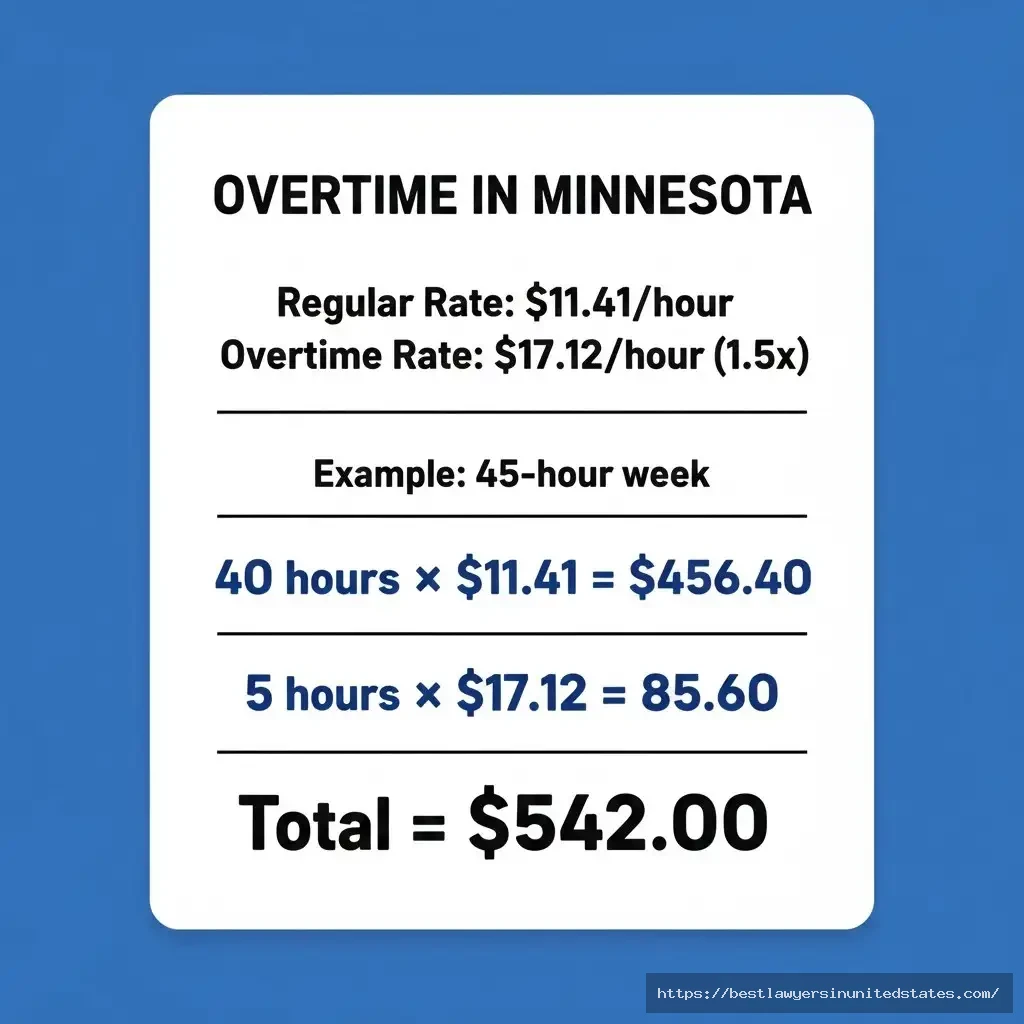
Your overtime rate is 1.5 times your regular hourly rate, not 1.5 times minimum wage.
Examples:
| Regular Hourly Rate | Overtime Rate (1.5x) | 45-Hour Week Total Pay |
|---|---|---|
| $11.41 (state min) | $17.12 | $542 |
| $16.50 (Minneapolis min) | $24.75 | $785.50 |
| $20.00 | $30.00 | $950 |
Calculate your overtime: Regular rate × 40 hours, plus overtime rate × overtime hours.
Calculate Your Overtime Pay in Minnesota
Working more than 40 hours per week? Calculate your overtime earnings based on Minnesota's overtime laws using our free calculator.
⏰ Overtime Pay Calculator
Calculate your overtime earnings based on your state's specific labor laws
📍 Select Your State
💰 Your Hourly Wage
📊 Calculation Method
📅 Weekly Hours
💵 Your Weekly Overtime Pay
📊 Earnings Breakdown
📅 Pay Period Estimates
⚖️ State vs Federal Comparison
Calculator features:
- Minnesota-specific overtime rules
- Weekly overtime calculations (40+ hours)
- Pay period breakdowns
- Comparison with federal law
- Total earnings estimate
Full overtime calculator: Minnesota Overtime Pay Calculator
Questions about your wages or need legal help? Email: [email protected]
Exempt vs Non-Exempt Employees
Not all employees qualify for overtime pay. Minnesota and federal law exempt certain workers based on salary level and job duties.
Salary threshold for exemption (2026):
- Must earn at least $844 per week ($43,888 annually) under federal law
- Must perform executive, administrative, or professional duties
- Must exercise independent judgment and discretion
Common exemptions:
- Executive managers with supervisory duties
- Administrative employees with office responsibilities
- Professional employees requiring advanced knowledge
- Outside sales representatives
- Certain computer professionals
Key point: Simply paying someone a salary doesn't make them exempt. The job duties must meet specific tests under the Fair Labor Standards Act. Misclassification of employees as exempt is a common wage violation.
If you're uncertain about your classification, legal options for workplace disputes can help clarify your rights.
Special Wage Provisions and Exemptions
Minnesota law includes several special provisions for specific types of workers and industries.
J-1 Visa Workers in Resort and Lodging Industries
Employers in the resort and hotel industry may pay J-1 visa holders 85% of the applicable minimum wage under certain conditions:
- Worker must hold a valid J-1 visa for cultural exchange
- Employer must provide lodging to the worker
- Limited to seasonal resort and hotel positions
- Does not apply to other visa categories or U.S. workers
2026 rate for J-1 workers: Large employers can pay $9.70/hour (85% of $11.41) when providing housing.
Independent Contractors
Workers classified as independent contractors are not covered by minimum wage laws. However, misclassification is a serious issue.
True independent contractors:
- Control how and when they perform work
- Provide their own tools and equipment
- Work for multiple clients
- Can accept or refuse assignments
- Bear financial risk of the work
Employee indicators:
- Employer controls work schedule and methods
- Employer provides tools and training
- Works exclusively or primarily for one employer
- Receives employee benefits
Many workers misclassified as independent contractors should legally be employees entitled to minimum wage and overtime protections.
Agricultural Workers
Agricultural workers in Minnesota are entitled to minimum wage but have different overtime rules:
- Must receive at least state minimum wage ($11.41 for large operations)
- No overtime required under state law for agricultural workers
- Federal overtime may apply to large agricultural operations
- Hand harvest workers have specific seasonal provisions
New 2026 Meal and Rest Break Requirements
Minnesota significantly enhanced its meal and rest break laws effective January 1, 2026. These changes provide stronger protections for workers.
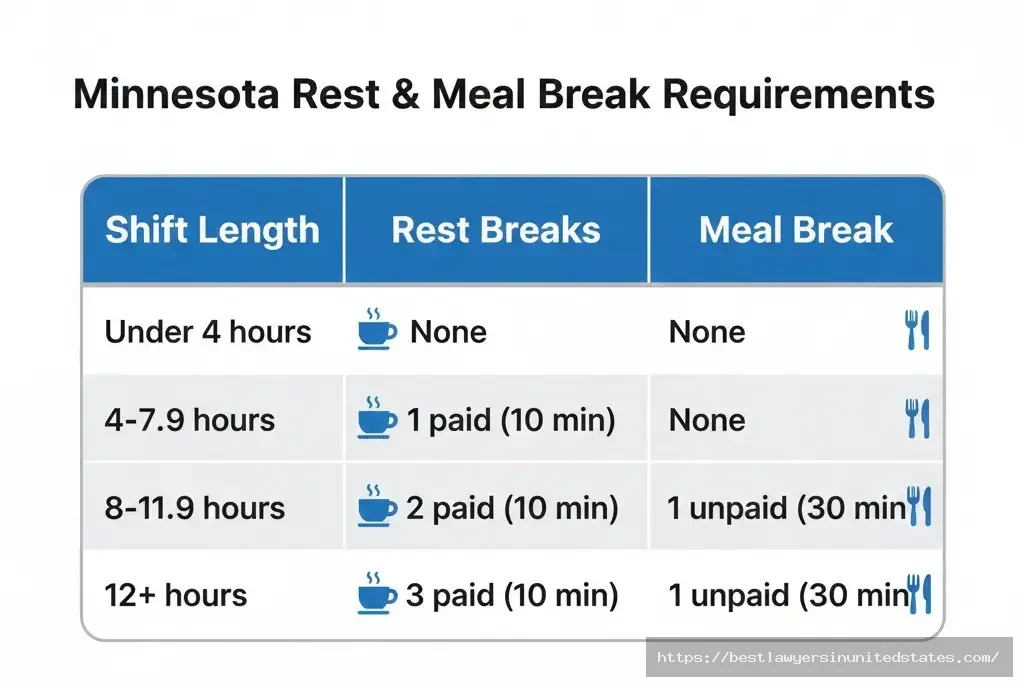
What Changed on January 1, 2026
Rest breaks: Employers must provide paid rest breaks of at least 10 minutes for every 4 hours worked. Previously, rest breaks were recommended but not required.
Meal breaks: Employers must provide at least 30 minutes for meal breaks when employees work 8 or more consecutive hours. This time may be unpaid if the employee is completely relieved of duties.
Shorter shifts: Employees working 4-7.9 hours must receive at least one paid 10-minute rest break.
| Shift Length | Required Rest Breaks | Required Meal Break |
|---|---|---|
| Under 4 hours | None required | None required |
| 4-7.9 hours | 1 paid (10 min) | None required |
| 8-11.9 hours | 2 paid (10 min each) | 1 unpaid (30 min) |
| 12+ hours | 3 paid (10 min each) | 1 unpaid (30 min) |
Break Requirements by Industry
Office workers: Must receive breaks at reasonable intervals, ideally mid-shift.
Retail and service: Breaks should occur during natural lulls when possible but cannot be denied due to customer volume.
Healthcare: Additional breaks may apply based on professional licensing requirements.
Manufacturing: Breaks must align with safety requirements and cannot be skipped to leave early.
Penalties for Non-Compliance
The Minnesota Department of Labor and Industry can assess penalties for employers who deny required breaks:
First violation: Warning and required compliance plan
Subsequent violations:
- $500 to $1,000 per violation
- Employees may recover one hour of pay for each day breaks were denied
- Patterns of violations can result in enhanced penalties
Employees who don't receive required breaks should document incidents and contact the Minnesota DLI at (651) 284-5075.
Employer Compliance Requirements
Minnesota employers must follow specific posting, recordkeeping, and reporting requirements to comply with minimum wage laws.
Wage Poster Requirements
Under Minn. Stat. § 177.30, employers must display current Minnesota minimum wage posters in a prominent and accessible location where employees can easily read them.
Posting requirements:
- Display the official 2026 Minnesota DLI minimum wage poster
- Post in all languages spoken by 10% or more of workforce
- Update annually when rates change (every January 1)
- Place in break rooms, time clock areas, or other common spaces
- Make available to remote workers electronically
Download 2026 posters:
- Minnesota DLI official poster: dli.mn.gov
- Minneapolis poster (if applicable): minneapolismn.gov/labor
- Saint Paul poster (if applicable): stpaul.gov/humanrights
Penalty for non-posting: $500 to $1,000 per violation
Recordkeeping Requirements
Employers must maintain accurate payroll records for three years under Minnesota law (Minn. Stat. § 177.30):
Required records:
- Employee name, address, and Social Security number
- Hours worked each day and week
- Wage rate and basis (hourly, salary, piece rate)
- Total wages paid each pay period
- Deductions and net pay
- Date of payment
Federal requirements: The IRS requires keeping payroll records for seven years for tax purposes. Employers should follow the longer retention period.
Employee access: Workers have the right to review their own payroll records. Employers must provide access within five business days of a written request.
Reporting Requirements for Minneapolis Employers
Minneapolis requires certain employers to submit annual wage data reports under the city's minimum wage ordinance:
Who must report: Employers with 25 or more employees working in Minneapolis
What to report:
- Total number of employees
- Average hourly wages by job classification
- Total hours worked by all employees
- Compliance with minimum wage requirements
Deadline: Annual reports due by March 31 each year for the previous calendar year
Penalty for non-reporting: $500 per month until submitted
What If You're Not Being Paid Minimum Wage?
If your employer isn't paying you the correct minimum wage, you have legal options to recover unpaid wages.
Signs of Common Wage Violations
Watch for these red flags that might indicate wage theft:
Off-the-clock work:
- Arriving early or staying late without pay
- Working through lunch breaks
- Taking work home without compensation
- Mandatory pre-shift or post-shift activities
Tip violations:
- Managers participating in tip pools
- Employer keeping portion of credit card tips
- Forcing you to pay for customer walkouts or breakage
- Tip pooling with back-of-house staff who don't serve customers
Overtime violations:
- Not receiving 1.5x pay for hours over 40 per week
- Misclassified as exempt when you should be non-exempt
- Comp time instead of overtime pay
- Calculated overtime rate based on minimum wage instead of actual wage
Training wage abuse:
- Paying youth training wage beyond first 90 days
- Paying training wage to workers 18 or older
- Resetting the 90-day clock after temporary layoff
How to Document Wage Issues
Keep detailed records to support your wage claim:
Track your hours:
- Personal log of clock-in and clock-out times
- Photos of time cards or digital time records
- Text messages or emails about work schedules
- Proof of off-the-clock work
Keep pay records:
- All pay stubs
- Bank statements showing direct deposits
- W-2 forms
- Any written communications about pay rates
Document violations:
- Dates and times of each incident
- Names of supervisors or managers involved
- Witnesses who can verify your account
- Photos or screenshots of evidence
Filing a Complaint with Minnesota DLI
The Minnesota Department of Labor and Industry handles wage complaints through several methods:
Step 1: Contact DLI
- Phone: (651) 284-5075 or 1-800-342-5354
- Online complaint form: dli.mn.gov
- Mail: Minnesota Department of Labor and Industry, 443 Lafayette Road N., St. Paul, MN 55155
Step 2: Provide documentation
- Completed wage claim form
- Pay stubs and time records
- Any written employment agreements
- Your personal work logs
- Calculated amount owed
Step 3: DLI investigation
- DLI reviews your claim (typically 2-4 weeks)
- May contact your employer for their records
- Attempts to resolve through mediation
- Issues finding if wage violation occurred
Step 4: Recovery or legal action
- If employer pays: Case closed
- If employer refuses: DLI may pursue enforcement
- You can file lawsuit if DLI cannot resolve
Statute of limitations: You must file within two years of the wage violation under Minn. Stat. § 177.27. Understanding what FLSA deadlines mean for your claim can help you avoid missing critical filing deadlines.
Calculate Your Wage Theft Recovery in Minnesota
Think your employer owes you money? Use our wage theft calculator to estimate how much you could recover, including unpaid wages, penalties, and interest under Minnesota law.
Wage Theft Recovery Calculator
Estimate how much you can recover in unpaid wages, penalties, and damages based on your state's laws
💵 Estimated Total Recovery
💰 Unpaid Wages
⚖️ Penalties & Damages
📋 Total Summary
Calculator features:
- Multiple violation types (unpaid wages, overtime, tips)
- Minnesota-specific penalties and damages
- Filing deadline tracker
- Total recovery estimate
- Next steps guidance
Full wage theft calculator: Minnesota Wage Theft Recovery Calculator
Questions about your wages or need legal help? Email: [email protected]
Wage Theft Recovery Process
Minnesota has some of the strongest wage theft laws in the nation. The Minnesota Wage Theft Law (Minn. Stat. § 609.52) makes wage theft a crime punishable by fines and even jail time for employers.
What you can recover:
| Violation Type | Employee Recovery | Employer Penalty |
|---|---|---|
| Unpaid minimum wage | Full back pay owed | Up to $10,000 fine |
| Unpaid overtime | Double the amount owed | Up to $10,000 fine |
| Stolen tips | Full tips + equal amount as damages | Up to $10,000 fine |
| Retaliation for complaint | Reinstatement + back pay | Up to $10,000 fine |
Criminal penalties: Employers who intentionally fail to pay wages can face:
- Misdemeanor for wages under $1,000
- Gross misdemeanor for wages $1,000 to $35,000
- Felony for wages over $35,000
Interest: Unpaid wages accrue interest at a rate set by Minnesota statute.
Minnesota's Attorney General's Office actively prosecutes wage theft cases. Workers may also have options through wage garnishment procedures if an employer refuses to pay a judgment.
Retaliation Protections
Minnesota law strictly prohibits employer retaliation against workers who file wage complaints or report violations.
Protected activities:
- Filing a wage claim with DLI
- Participating in a wage investigation
- Testifying in wage theft proceedings
- Complaining to employer about wage violations
- Discussing wages with coworkers
Illegal retaliation includes:
- Firing or demotion
- Reducing hours or pay
- Unfavorable schedule changes
- Harassment or hostile treatment
- Threats of deportation or police involvement
Penalty for retaliation: Employers face additional fines up to $10,000 and must reinstate the employee with full back pay.
Minnesota Minimum Wage History
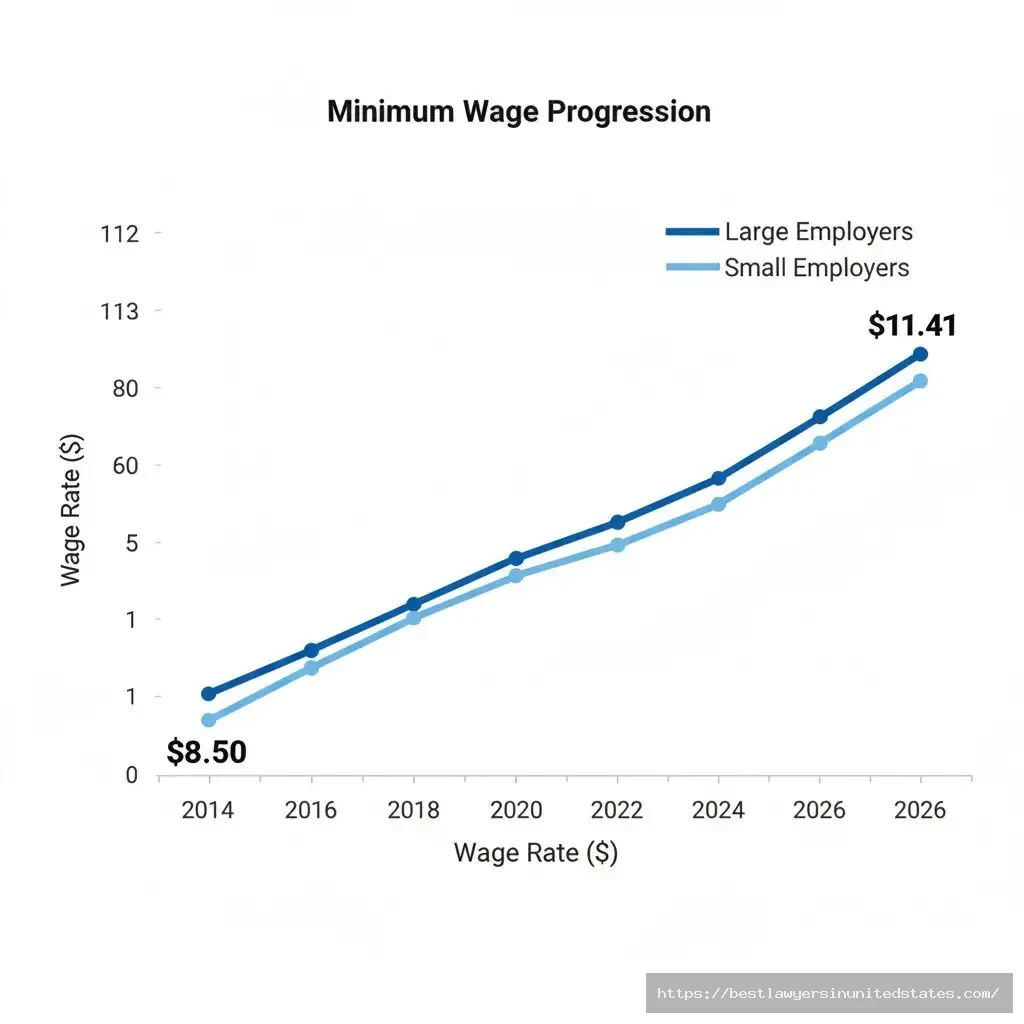
Minnesota's minimum wage has increased steadily since the state established rates above the federal minimum in 2014.
Historical Minimum Wage Progression
| Effective Date | Large Employer Rate | Small Employer Rate | % Increase | CPI Adjustment |
|---|---|---|---|---|
| Aug 1, 2014 | $8.00 | $6.50 | N/A | Initial |
| Jan 1, 2015 | $9.00 | $7.25 | 12.5% | Scheduled |
| Jan 1, 2016 | $9.50 | $7.75 | 5.6% | Scheduled |
| Jan 1, 2017 | $9.50 | $7.75 | 0% | None |
| Jan 1, 2018 | $9.65 | $7.87 | 1.6% | CPI |
| Jan 1, 2019 | $9.86 | $8.04 | 2.2% | CPI |
| Jan 1, 2020 | $10.00 | $8.15 | 1.4% | CPI |
| Jan 1, 2021 | $10.08 | $8.21 | 0.8% | CPI |
| Jan 1, 2022 | $10.33 | $8.42 | 2.5% | CPI |
| Jan 1, 2023 | $10.59 | $8.63 | 2.5% | CPI |
| Jan 1, 2024 | $10.85 | $8.85 | 2.5% | CPI |
| Jan 1, 2025 | $11.13 | $9.08 | 2.6% | CPI |
| Jan 1, 2026 | $11.41 | $9.31 | 2.51% | CPI |
2014-2026 total increase: Large employers saw a 42.6% increase ($3.41) while small employers saw a 43.2% increase ($2.81) over 12 years.
Why Minnesota Raises Minimum Wage Annually
Minnesota tied its minimum wage to inflation in 2014 through Minn. Stat. § 177.24. The Minnesota Department of Labor and Industry calculates the annual adjustment using the Consumer Price Index for Urban Wage Earners and Clerical Workers (CPI-W) for the Minneapolis-St. Paul-Bloomington metropolitan area.
Benefits of CPI-based increases:
- Predictable annual adjustments
- Maintains purchasing power as costs rise
- Prevents large sudden jumps
- Helps employers plan for wage increases
- Reduces need for legislative action each year
The adjustment typically occurs each January 1 and applies to the entire calendar year.
Minnesota vs Neighboring States
Minnesota's minimum wage is significantly higher than its neighboring states, creating wage disparities for workers near state borders.
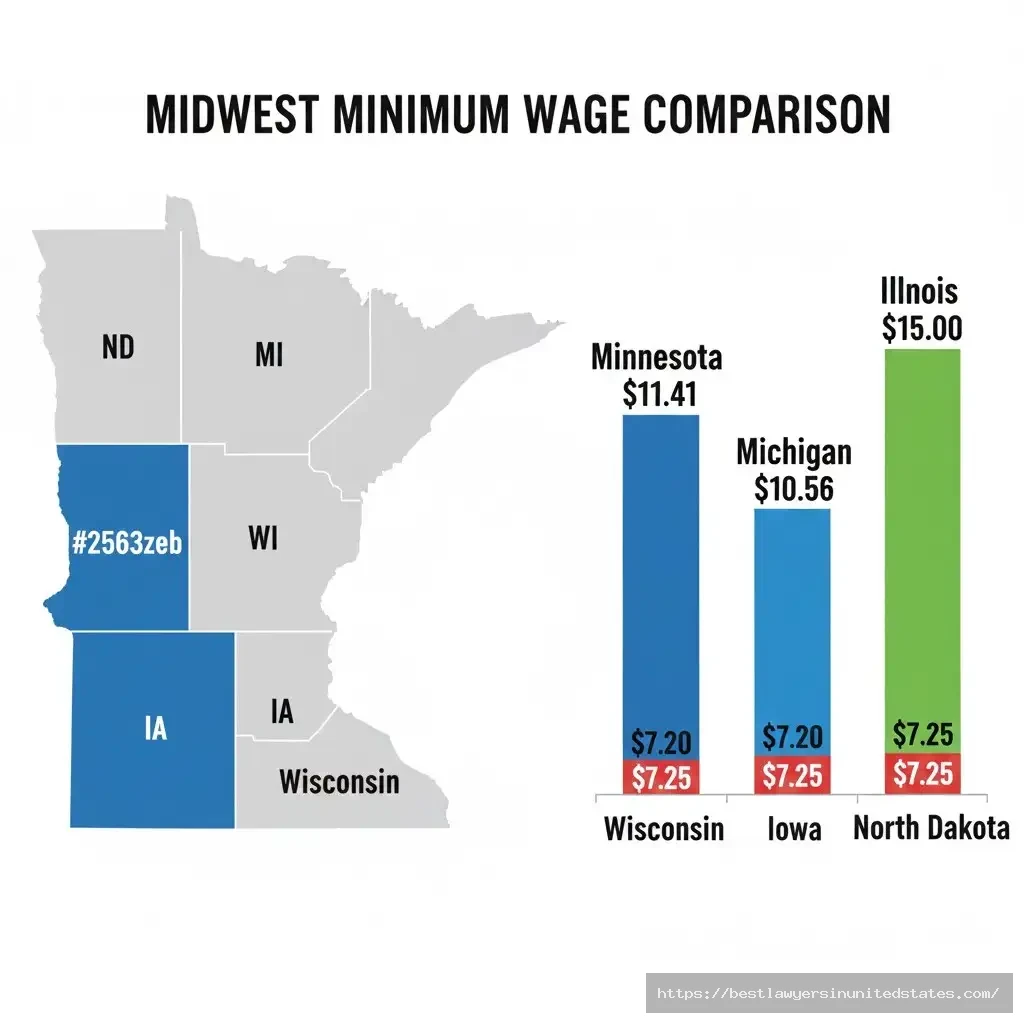
Border State Comparison
| State | 2026 Minimum Wage | Tipped Wage | vs Minnesota | Tip Credit Allowed? |
|---|---|---|---|---|
| Minnesota | $11.41 | $11.41 | Base | ❌ No |
| Wisconsin | $7.25 | $2.33 | -$4.16 | ✅ Yes |
| Iowa | $7.25 | $4.35 | -$4.16 | ✅ Yes |
| North Dakota | $7.25 | $4.86 | -$4.16 | ✅ Yes |
| South Dakota | $11.20 | $5.60 | -$0.21 | ✅ Yes |
| Michigan | $10.56 | $4.01 | -$0.85 | ✅ Yes |
| Illinois | $15.00 | $9.00 | +$3.59 | ✅ Yes |
Key findings:
- Iowa's minimum wage and Wisconsin remain at the federal $7.25, making Minnesota's rate 57% higher
- Illinois minimum wage exceeds Minnesota by $3.59 per hour
- Michigan's minimum wage is slightly lower but closer to Minnesota's rate
- All neighboring states except Minnesota and Nevada allow tip credits
Why Minnesota's Rate Is Higher
Several factors contribute to Minnesota's higher minimum wage:
Cost of living: The Minneapolis-St. Paul metropolitan area has higher housing, transportation, and general living costs compared to surrounding rural areas and neighboring states.
Political climate: Minnesota's legislature has prioritized raising the minimum wage through both scheduled increases and CPI adjustments.
Economic strength: Minnesota's diverse economy and low unemployment rate support higher wage floors.
Public support: Polls consistently show Minnesota voters support minimum wage increases tied to inflation.
Living Wage vs Minimum Wage in Minnesota
While Minnesota's minimum wage exceeds the federal rate, many workers struggle to afford basic necessities at these wage levels.
Can You Live on Minnesota Minimum Wage?
A full-time worker earning Minnesota's large employer minimum wage of $11.41/hour earns $23,732.80 annually (based on 2,080 hours per year). This is significantly below what researchers consider a living wage for the Twin Cities metro area.
Annual earnings at different rates:
| Rate | Full-Time Annual Income (2,080 hours) | Monthly Income |
|---|---|---|
| $9.31 (small employer) | $19,364.80 | $1,613.73 |
| $11.41 (large employer) | $23,732.80 | $1,977.73 |
| $16.50 (Minneapolis) | $34,320.00 | $2,860.00 |
Living wage estimates for Minneapolis-St. Paul (2026):
- Single adult: $17.89/hour
- Single parent with one child: $37.93/hour
- Two adults with two children: $26.74/hour per adult
Housing affordability: The Minneapolis-St. Paul metro area has a median rent of approximately $1,450 for a one-bedroom apartment. At $11.41/hour, a worker would spend 73% of their income on rent alone, far exceeding the recommended 30% threshold.
Minneapolis and Saint Paul Living Wage Ordinances
Both Minneapolis and Saint Paul established higher minimum wages partly in response to living wage advocacy:
Minneapolis: The city's $16.50 minimum wage for 2026 gets closer to a living wage for single adults but still falls short for families.
Saint Paul: The tiered system allows smaller businesses to phase in higher wages while larger employers pay rates closer to living wage standards.
Living wage movement: Local advocacy groups continue pushing for $20+ minimum wages to better match the true cost of living in the Twin Cities metro area.
Common Minimum Wage Violations in Minnesota
Understanding common violations helps workers identify when their rights are being violated.
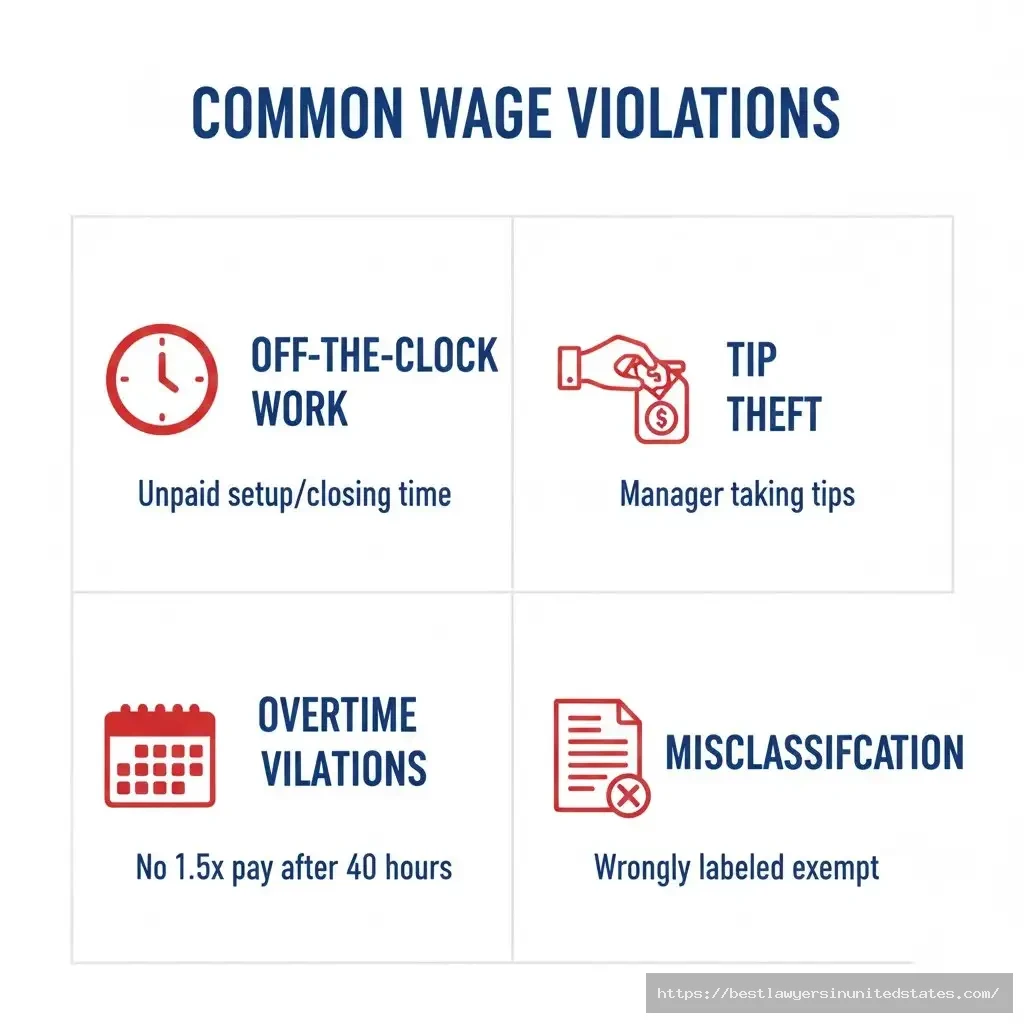
Off-the-Clock Work
What it is: Any time you perform work-related tasks without compensation.
Examples:
- Arriving 15 minutes early to set up your workstation
- Staying after your shift to close out the register
- Attending mandatory meetings without pay
- Taking work home on evenings or weekends
- Putting on specialized uniforms or safety equipment before clocking in
Minnesota law: All time you're required to be present or perform duties must be paid at least minimum wage. "Donating" time is illegal.
How to prove it: Keep a personal log of all work-related activities with start and end times. Take photos of work you complete off-the-clock.
Tip Pooling and Tip Theft
Legal tip pooling: Servers, bartenders, bussers, and other service staff may voluntarily pool tips and divide them according to an agreed formula.
Illegal tip practices:
- Managers or supervisors participating in tip pools
- Employers taking any percentage of tips
- Forcing back-of-house staff (cooks, dishwashers) into tip pools
- Charging "processing fees" on credit card tips
- Making servers pay for customer walkouts from their tips
Your rights: Under Minn. Stat. § 177.24, you keep 100% of your tips. Employers cannot require you to share tips with non-service workers or management.
Criminal tip theft: Taking employee tips can result in theft charges against the employer.
Misclassification as Exempt
The problem: Employers often misclassify employees as exempt from overtime to avoid paying time-and-a-half.
Common scenarios:
- Giving someone a "manager" title but no real supervisory authority
- Paying a salary below the $43,888 threshold and claiming exemption
- Claiming administrative exemption for clerical workers
- Treating all salaried workers as exempt regardless of duties
Three-part test for exemption:
- Salary basis: Must earn at least $844/week ($43,888/year)
- Salary level: Must be paid same amount regardless of hours or quality
- Duties test: Must perform executive, administrative, or professional work
If misclassified: You may be owed years of back overtime pay. Contact the Minnesota DLI or an employment attorney.
Paying Training Wage Beyond 90 Days
The violation: Employers continuing to pay workers under 18 the training wage of $9.31/hour after their first 90 days of employment.
Minnesota law: Minn. Stat. § 177.24 limits the training wage to the first 90 consecutive days with each employer. After that, the full minimum wage applies.
How to prove it: Keep your hire date and pay stubs showing when your wage should have increased. Calculate 90 days from your first day of work.
Recovery: You can claim the difference between training wage ($9.31) and full minimum wage ($11.41 or higher) for every hour worked after the 90-day period.
Frequently Asked Questions
Does Minnesota Have a $15 Minimum Wage?
Quick Answer: No, Minnesota's statewide minimum wage is $11.41 for large employers and $9.31 for small employers in 2026. However, Minneapolis ($16.50) and some Saint Paul employers ($15.57) have minimum wages at or above $15.
The Minnesota legislature has not enacted a statewide $15 minimum wage. Local municipalities can set higher rates within their boundaries.
What Is Minimum Wage in Minnesota for 16 Year Olds?
Quick Answer: 16-year-olds in Minnesota earn $9.31 per hour during their first 90 days of employment (training wage), then $11.41 per hour (or higher in Minneapolis/St. Paul) afterward.
The training wage applies regardless of whether the employer is large or small. After 90 days, the employer's size determines the full minimum wage rate.
What Is Minimum Wage in Minnesota for 14 Year Olds?
Quick Answer: 14-year-olds earn the same rates as 16-year-olds: $9.31/hour for the first 90 days, then $11.41+ depending on employer size and location.
Age does not affect the training wage amount. All workers under 18 follow the same 90-day training wage rules under Minn. Stat. § 177.24.
Do Servers Get Minimum Wage in Minnesota?
Quick Answer: Yes, servers and all tipped employees in Minnesota must receive the full minimum wage ($11.41 or higher) before tips. Minnesota does not allow tip credits.
Minnesota is one of only seven states with no tip credit. Servers earn significantly more base pay than the federal tipped minimum of $2.13/hour. Tips are additional income on top of the base wage.
When Does Minimum Wage Go Up in Minnesota?
Quick Answer: Minnesota's minimum wage increases every January 1 based on inflation. The 2026 rates took effect on January 1, 2026.
The Minnesota Department of Labor and Industry announces the new rates each fall (typically October) for the following January. Rates are tied to the Consumer Price Index for the Minneapolis-St. Paul area.
What Is Minimum Wage in Minneapolis vs Saint Paul?
Quick Answer: Minneapolis minimum wage is $16.50 per hour for all employers in 2026. Saint Paul uses a four-tier system ranging from $11.00 (micro businesses) to $15.57 (macro businesses and the city itself).
Minneapolis has the highest minimum wage in Minnesota. Saint Paul's rate depends on employer size based on total employee count.
How Do I Calculate If I'm a Large or Small Employer?
Quick Answer: Large employers have annual gross revenue of $500,000 or more. Small employers have gross revenue under $500,000. This includes revenue from all locations and affiliated businesses.
Use your total gross sales from the previous calendar year. Include all income from all divisions, locations, and commonly-owned entities. If your revenue is close to $500,000, consult the Minnesota DLI guidelines.
What Happens If My Employer Doesn't Pay Minimum Wage?
Quick Answer: File a wage complaint with the Minnesota Department of Labor and Industry at (651) 284-5075 or online at dli.mn.gov. You can recover back pay, penalties, and interest.
Minnesota has strong wage theft laws. Employers who fail to pay minimum wage face fines up to $10,000 and criminal charges. You have two years from the date of the violation to file a claim.
Does Minnesota Minimum Wage Apply to Remote Workers?
Quick Answer: If you work remotely for a Minnesota employer or perform work that benefits a Minnesota business, you're generally entitled to Minnesota minimum wage rates.
The key factors are the employer's location and where the work is performed or controlled from. Consult the Minnesota DLI if you're a remote worker with questions about which state's laws apply.
Can Tips Count Toward Minimum Wage in Minnesota?
Quick Answer: No, tips cannot count toward minimum wage obligations in Minnesota. Employers must pay the full minimum wage regardless of tips received.
Unlike federal law and most states, Minnesota prohibits tip credits entirely. Your base wage must be at least $11.41 (or higher in Minneapolis/St. Paul) before any tips you receive.
How Much Is Overtime Pay in Minnesota?
Quick Answer: Overtime pay is 1.5 times your regular hourly rate for all hours worked over 40 in a workweek. If you earn $11.41/hour, overtime is $17.12/hour.
Minnesota follows federal overtime thresholds (40 hours) rather than the state threshold (48 hours) because it's more protective of workers. Use our overtime calculator to estimate your earnings.
What Is the Penalty for Not Paying Minimum Wage in Minnesota?
Quick Answer: Employers face fines up to $10,000 per violation, must pay double the wages owed for intentional violations, and can face criminal charges including felonies for wage theft over $35,000.
Minnesota's wage theft law (Minn. Stat. § 609.52) makes intentional non-payment of wages a crime. Employees can recover full back pay plus penalties through the Minnesota DLI.
Do I Get Overtime for Working 7 Days in a Row?
Quick Answer: Not automatically. Minnesota requires overtime for hours worked over 40 in a week, not for working consecutive days. However, if working 7 days pushes you over 40 hours, those excess hours are overtime.
Calculate your weekly hours (Sunday through Saturday). Any hours over 40 in that week earn overtime regardless of how many consecutive days you worked.
Can My Employer Pay Me Under Minimum Wage During Training?
Quick Answer: Only if you're under 18 years old. Employers can pay workers under 18 a training wage of $9.31/hour for the first 90 days. Adult workers must always receive full minimum wage from day one.
The training wage does not apply to workers 18 and older, regardless of whether they're learning a new job or receiving training.
Are Agricultural Workers Entitled to Minimum Wage in Minnesota?
Quick Answer: Yes, agricultural workers must receive at least Minnesota's minimum wage. However, they are exempt from state overtime requirements under Minn. Stat. § 177.23.
Large agricultural operations with over $500,000 in annual revenue must pay $11.41/hour. Smaller operations pay $9.31/hour. Federal overtime rules may apply to larger farms.
What Should I Do If My Employer Retaliates After I File a Wage Claim?
Quick Answer: Contact the Minnesota Department of Labor and Industry immediately. Retaliation is illegal and can result in additional penalties of up to $10,000 for the employer plus your reinstatement and back pay.
Document the retaliation with dates, witnesses, and any written communications. You have additional legal claims beyond your original wage complaint.
How Long Do Employers Have to Keep Payroll Records in Minnesota?
Quick Answer: Three years under Minnesota law, but seven years for federal tax purposes. Employers should keep payroll records for the longer period (seven years).
Records must include hours worked, wages paid, deductions, and employee information. Employees can request to review their own records with five business days' notice.
Can My Employer Round My Time Clock to the Nearest 15 Minutes?
Quick Answer: Yes, if the rounding is neutral (sometimes favors employee, sometimes employer). However, systematic rounding that reduces your hours is illegal.
Under federal Department of Labor guidelines, rounding to the nearest 15 minutes, 6 minutes, or even 5 minutes is acceptable if it doesn't consistently shortchange workers.
What Is the Minneapolis Minimum Wage for 2027?
Quick Answer: The 2027 Minneapolis minimum wage has not been announced yet. The city typically announces rates in fall 2026 for the following January.
Minneapolis adjusts its minimum wage annually based on inflation. Check minneapolismn.gov/labor in October 2026 for the 2027 rate.
How Do I Calculate My Annual Salary at Minnesota Minimum Wage?
Quick Answer: Multiply your hourly rate by 2,080 hours (40 hours/week × 52 weeks). At $11.41/hour, you earn $23,732.80 annually. Use our wage calculator for exact figures including overtime.
Full-time employment is typically defined as 40 hours per week. Part-time workers earn proportionally less based on their actual hours worked.
Resources and Contact Information
Official Minnesota Resources
Minnesota Department of Labor and Industry (DLI)
- Website: www.dli.mn.gov
- Phone: (651) 284-5075 or 1-800-342-5354
- Address: 443 Lafayette Road N., St. Paul, MN 55155
- Wage claim online form: dli.mn.gov/wages
Minneapolis Department of Civil Rights
- Website: www.minneapolismn.gov/labor
- Phone: (612) 673-3012
- Email: [email protected]
- Address: 350 S. 5th St., Room M1, Minneapolis, MN 55415
Saint Paul Department of Human Rights and Equal Economic Opportunity
- Website: www.stpaul.gov/humanrights
- Phone: (651) 266-8900
- Email: [email protected]
- Address: 15 W. Kellogg Blvd., Suite 280, St. Paul, MN 55102
Download Minimum Wage Posters
2026 Minnesota State Posters:
- English: dli.mn.gov/minimum-wage-poster
- Spanish: dli.mn.gov/minimum-wage-poster-spanish
- Hmong, Somali, and other languages available at DLI website
Minneapolis 2026 Poster:
- Download: minneapolismn.gov/labor-standards/posters
Saint Paul 2026 Poster:
- Download: stpaul.gov/minimum-wage-posters
Additional Support
Legal Aid Services:
- Southern Minnesota Regional Legal Services: (651) 222-4731
- Legal Services State Support: 1-877-696-6529
- Minnesota State Bar Association Lawyer Referral: (612) 333-1183
Workers' Rights Organizations:
- Minnesota AFL-CIO: (651) 227-7647
- Centro de Trabajadores Unidos en la Lucha (CTUL): (612) 332-3087
- ROC Twin Cities: (612) 345-1405
Conclusion
Minnesota's minimum wage for 2026 is $11.41 per hour for large employers and $9.31 for small employers, with Minneapolis at $16.50 and Saint Paul using a four-tier system. The state's prohibition on tip credits means tipped workers earn significantly more than in most other states.
Understanding which rate applies to you depends on your work location and your employer's size. Workers in Minneapolis earn 45% more per hour than the state minimum, making work location a critical factor in total earnings.
If you believe your employer is violating minimum wage laws, document everything and contact the Minnesota Department of Labor and Industry. You have two years to file a wage claim and may recover not only back pay but also penalties and damages.
Minnesota's minimum wage will continue increasing annually based on inflation. Check back each fall for the next year's rates, or use our minimum wage calculator to estimate your earnings throughout 2026.
Need legal help with wage issues? Email: [email protected]
