
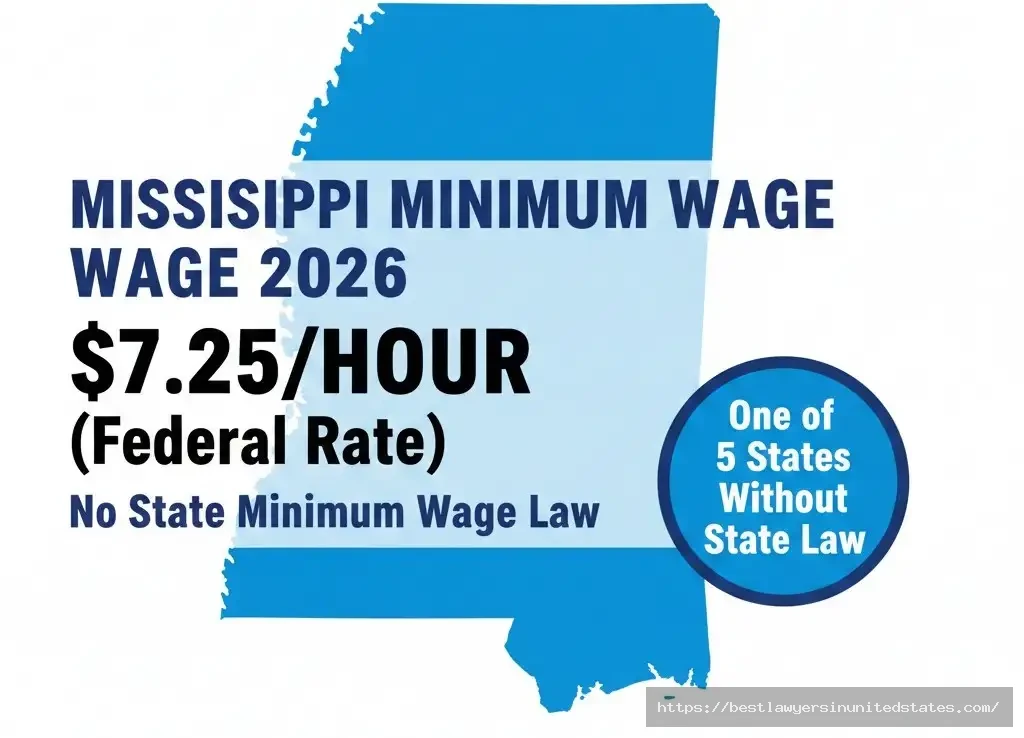
Quick Answer: Mississippi has no state minimum wage law in 2026. Workers earn the federal minimum wage of $7.25 per hour. Senate Bill 2440 proposes changing this to $12/hour starting January 1, 2026, rising to $15/hour by 2028.
Mississippi stands as one of only five states without its own minimum wage law. This means all workers covered by the Fair Labor Standards Act earn $7.25 per hour, the federal rate that has not increased since 2009. The proposed legislation would make Mississippi’s first state minimum wage law in history.
This guide covers everything you need to know about Mississippi wage laws, including current rates, proposed changes, tipped employee rules, overtime requirements, and how to file a wage complaint. Whether you’re an employee checking if you’re paid correctly or an employer preparing for potential changes, you’ll find state-specific information and tools to calculate your earnings.
Calculate Your Earnings in Mississippi
Want to know exactly how much you’ll earn at Mississippi’s current or proposed minimum wage? Use our free calculator to estimate your weekly, monthly, and annual income based on your hours worked.
💰 Minimum Wage Earnings Calculator
Calculate your weekly, monthly, and annual earnings with overtime and tax estimates
📊 Your Earnings Breakdown
💰 Gross Earnings
Calculator features:
- Current federal rate ($7.25) and proposed Mississippi rates ($12-$15)
- Weekly, monthly, and annual earnings
- Overtime calculations
- Take-home pay estimates
- Comparison mode for wage increases
Full calculator with all features: https://bestlawyersinunitedstates.com/minimum-wage-calculator/
Questions about your wages or need legal help?
Find Employment Lawyers in Mississippi - Free Consultation
Email: [email protected]
Senate Bill 2440: Mississippi's First State Minimum Wage Law Proposed
What Is Senate Bill 2440?
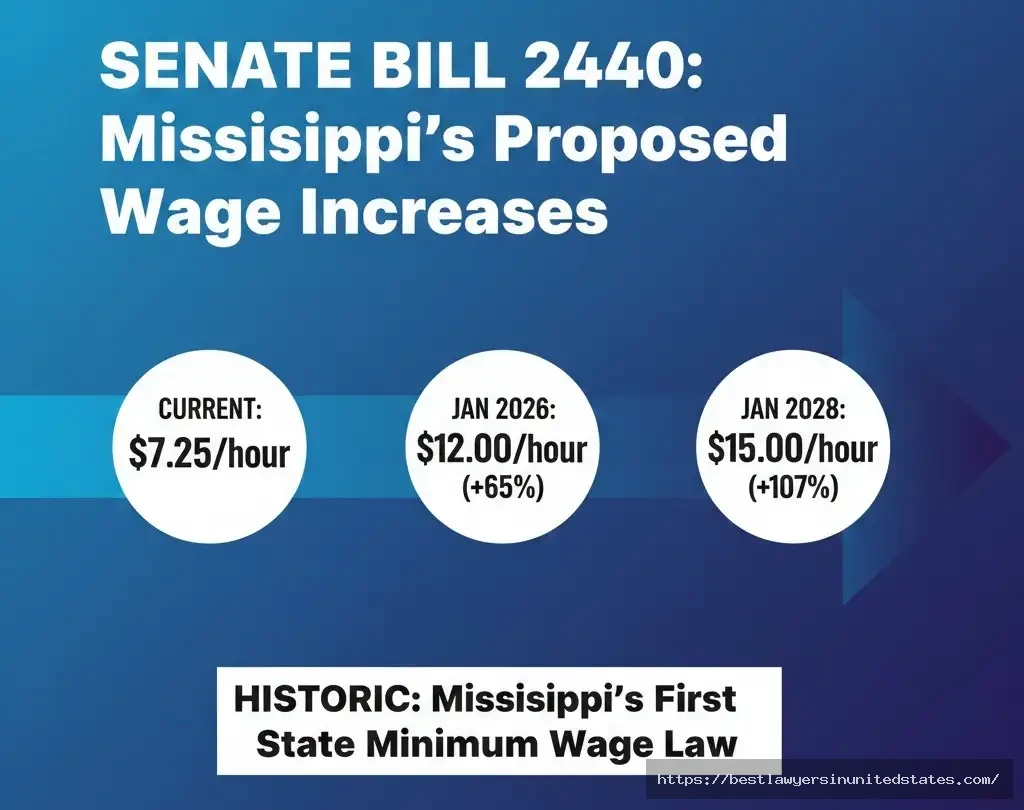
Senate Bill 2440, introduced in the 2025 Mississippi Legislative Regular Session, proposes the Mississippi Minimum Wage Act. This would create the state's first-ever minimum wage law. The bill establishes a phased approach to wage increases over three years.
The legislation comes after decades of Mississippi relying solely on federal wage standards. If passed, it would make Mississippi competitive with neighboring states that have already raised their minimum wages above federal levels.
Timeline: $12 in 2026, $15 by 2028
| Effective Date | Proposed Rate | Increase from Current |
|---|---|---|
| Current (2026) | $7.25 | Baseline |
| January 1, 2026 | $12.00 | +$4.75 (+65%) |
| January 1, 2028 | $15.00 | +$7.75 (+107%) |
Key detail: The law includes an automatic adjustment. If federal minimum wage increases above $15, Mississippi's rate would automatically rise to federal minimum plus 0.5%.
What This Means for Mississippi Workers
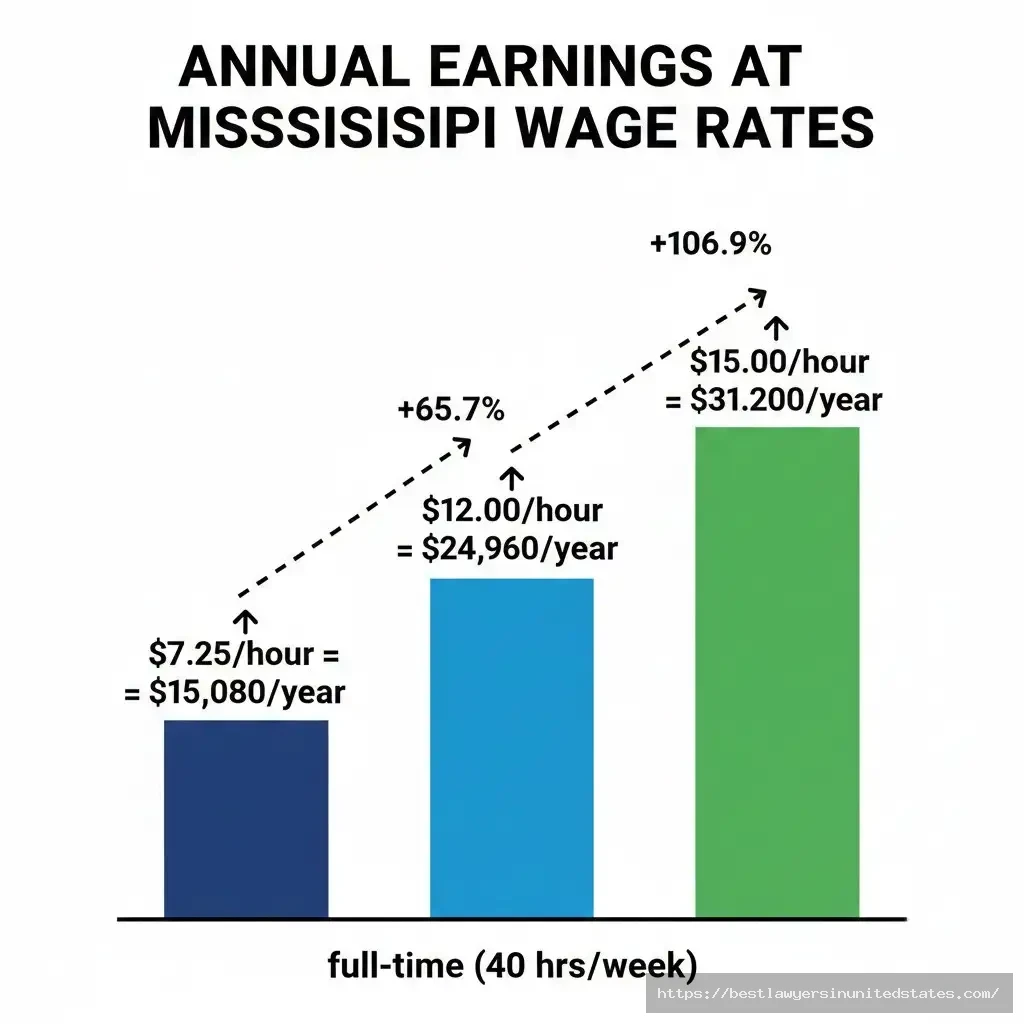
The proposed law affects most private sector employees. A worker earning $7.25/hour for 40 hours per week currently makes $15,080 annually. At $12/hour, that increases to $24,960. At $15/hour, it reaches $31,200.
Workers NOT covered by proposed law:
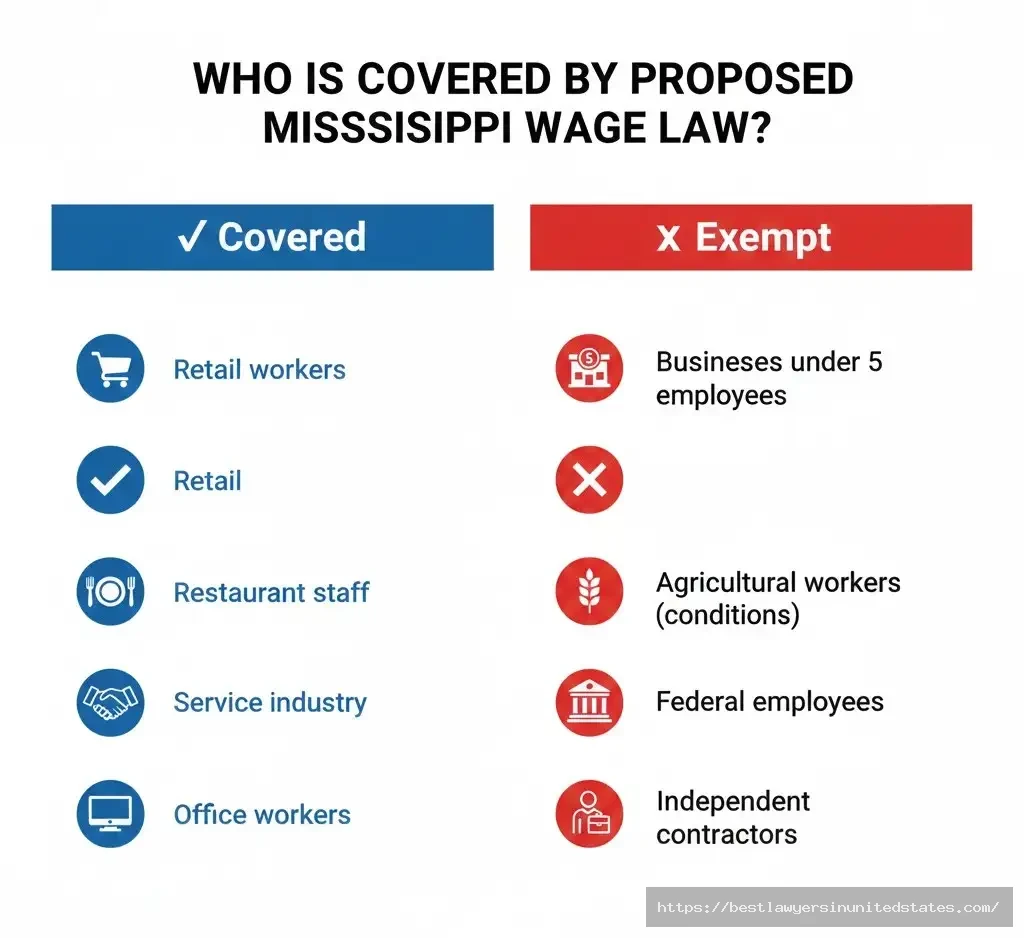
- Employees at businesses with fewer than 5 workers
- Federal government employees
- State and local government workers (except public schools)
- Agricultural workers meeting specific exemptions
- Independent contractors
The Mississippi Department of Employment Security would enforce the law. Penalties for violations include criminal charges for serious wage theft and civil remedies for affected workers.
What Is the Minimum Wage in Mississippi in 2026?
Federal Minimum Wage: $7.25/Hour
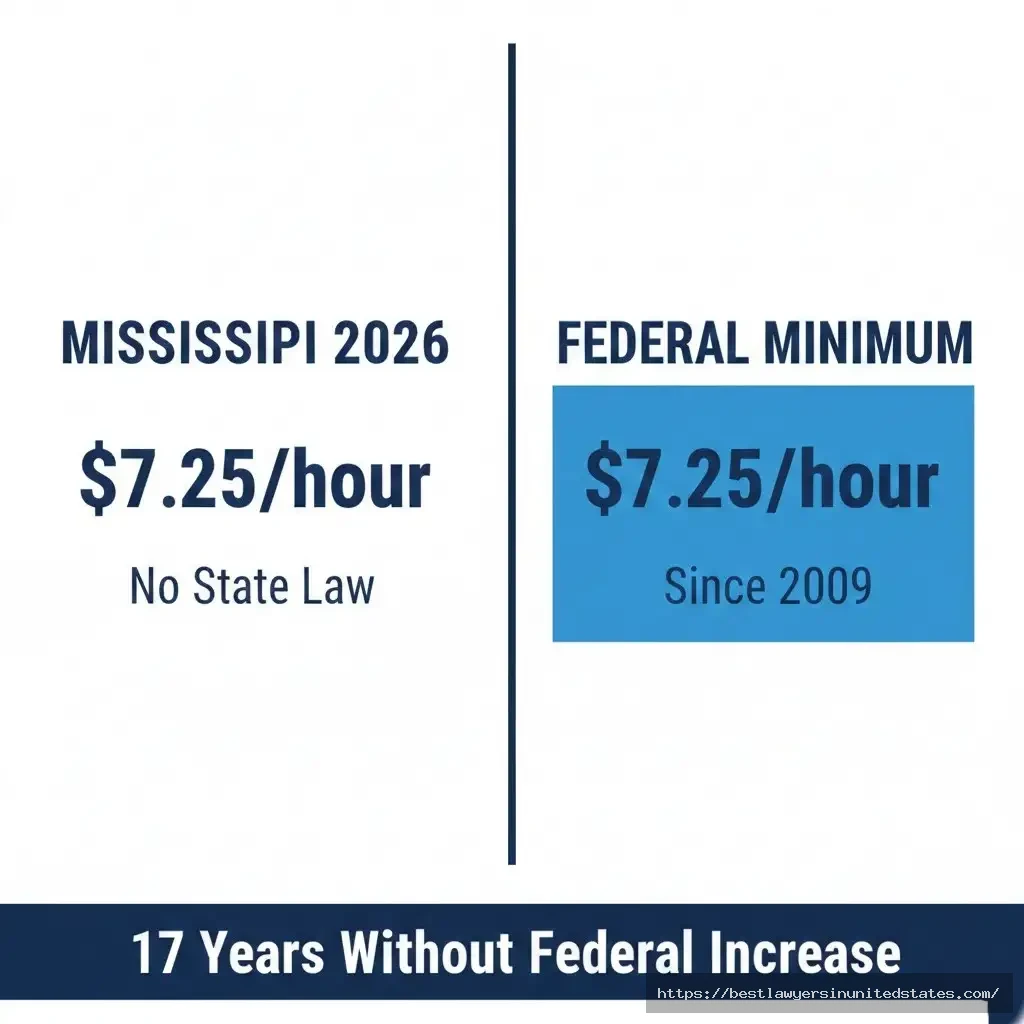
Mississippi currently has no state minimum wage law. This makes it one of only five states (along with Alabama, Louisiana, South Carolina, and Tennessee) without state wage standards. Workers covered by the Fair Labor Standards Act earn the federal minimum of $7.25 per hour.
Current wage breakdown:
- Hourly: $7.25
- Weekly (40 hours): $290
- Monthly: $1,256.67
- Annually: $15,080
This rate has remained unchanged since July 24, 2009, when the last federal increase took effect. Over those 17 years, inflation has reduced the real purchasing power of minimum wage by approximately 30%.
Why Mississippi Has No State Minimum Wage Law
Mississippi historically opposed state-level wage mandates. The state's economic philosophy favors federal standards without additional state requirements. This approach aimed to reduce regulatory burden on businesses, particularly small employers in the state's large agricultural sector.
Political and economic factors:
- Strong agricultural economy with seasonal labor needs
- High percentage of small businesses (under 5 employees)
- Historical preference for federal vs. state regulation
- Concerns about competitive disadvantage vs. neighboring states
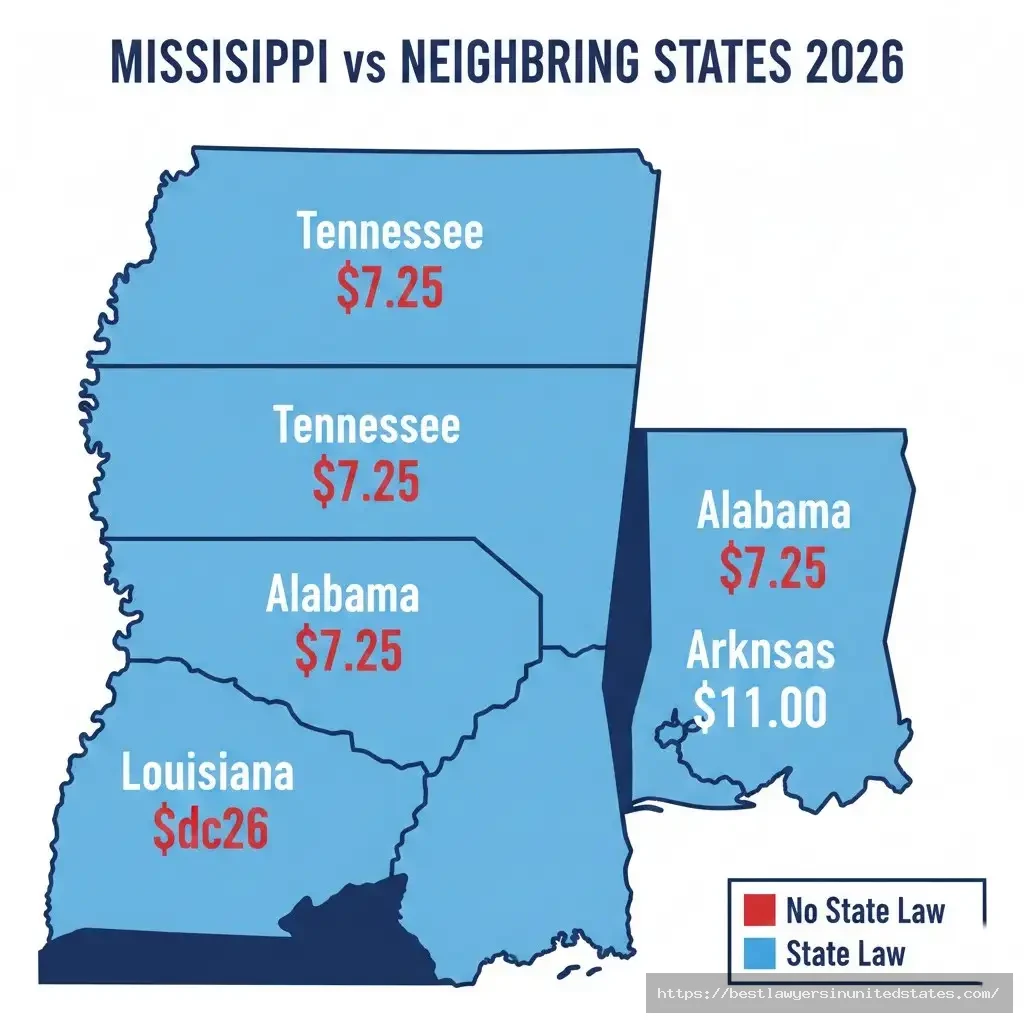
However, unlike Alabama and Louisiana which also lack state laws, Arkansas raised its minimum wage to $11.00 in 2021. This has created pressure for Mississippi to act.
Mississippi vs. the Nation: Wage Comparison
| State | 2026 Minimum Wage | Difference from Federal | Has State Law |
|---|---|---|---|
| Mississippi | $7.25 | $0.00 | ❌ No |
| Alabama | $7.25 | $0.00 | ❌ No |
| Louisiana | $7.25 | $0.00 | ❌ No |
| Tennessee | $7.25 | $0.00 | ❌ No |
| Arkansas | $11.00 | +$3.75 | ✅ Yes |
| Florida | $13.00 | +$5.75 | ✅ Yes |
| California | $16.50 | +$9.25 | ✅ Yes |
| Federal | $7.25 | Baseline | ✅ Yes |
Critical gap: Mississippi workers earn $3.75 less per hour than Arkansas workers just across the state line. This wage difference totals $7,800 annually for full-time workers.
Workers who believe they're not receiving proper wages should explore their legal options for workplace disputes to understand their rights.
Mississippi Tipped Employee Minimum Wage 2026
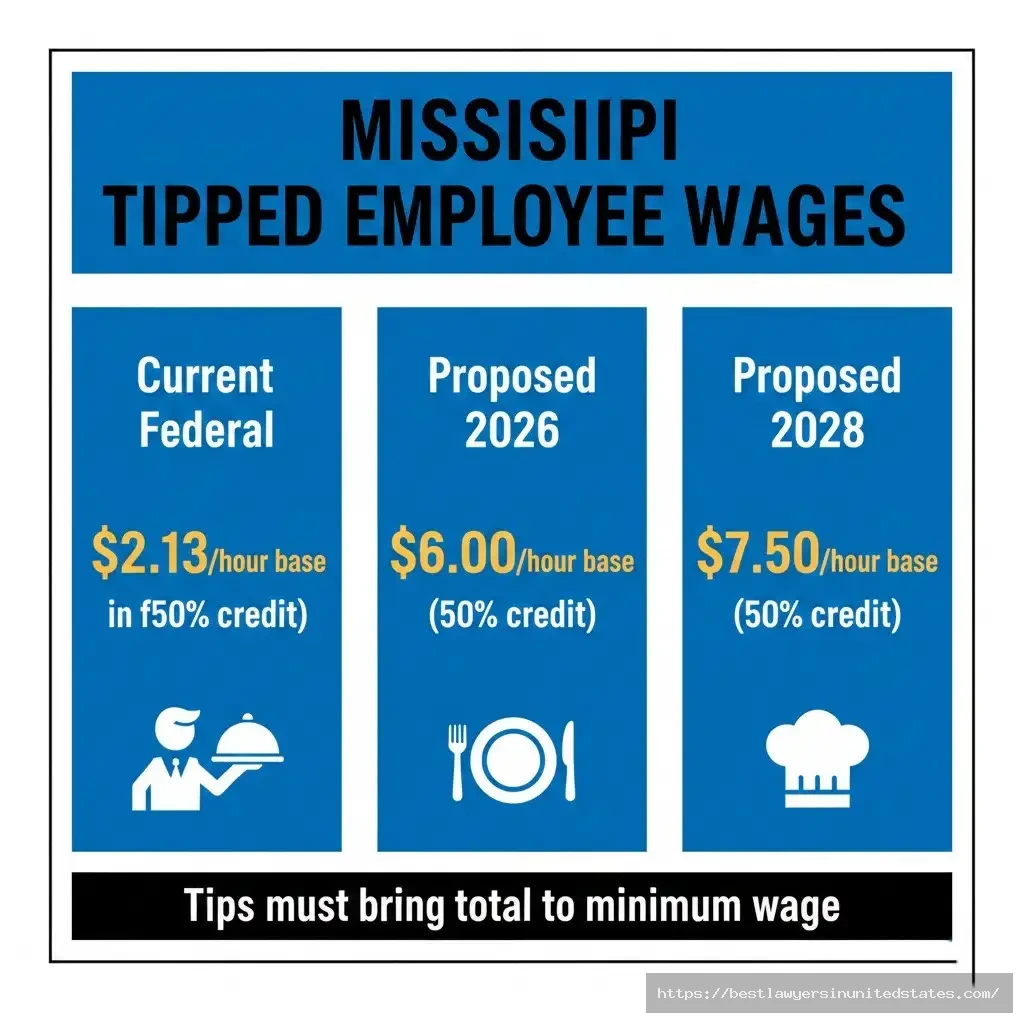
Current Federal Tipped Wage: $2.13/Hour
Mississippi uses the federal tipped minimum wage of $2.13 per hour for employees who regularly receive more than $30 per month in tips. This applies to servers, bartenders, delivery drivers, and other tipped workers.
Federal tip credit system:
- Base wage: $2.13/hour
- Tips must bring total to: $7.25/hour
- Employer makes up difference if tips fall short
If a tipped employee's hourly rate (base wage plus tips) doesn't equal at least $7.25, the employer must pay the difference. This is called "topping up" under FLSA regulations.
Proposed Mississippi Tipped Wage (50% Tip Credit)
Senate Bill 2440 allows employers to take a 50% tip credit. This means employers could pay half the minimum wage as base pay, with tips making up the rest.
Under proposed $12 minimum wage:
- Base wage: $6.00/hour (50% of $12)
- Tips must bring total to: $12.00/hour
- Employer pays difference if needed
Under proposed $15 minimum wage:
- Base wage: $7.50/hour (50% of $15)
- Tips must bring total to: $15.00/hour
- Employer pays difference if needed
| Rate Structure | Current Federal | Proposed MS ($12) | Proposed MS ($15) |
|---|---|---|---|
| Base Wage | $2.13 | $6.00 | $7.50 |
| Required Total | $7.25 | $12.00 | $15.00 |
| Tip Credit | $5.12 | $6.00 | $7.50 |
Important: Unlike California and other states that prohibit tip credits entirely, Mississippi's proposed law maintains the tip credit system but at more favorable rates than current federal law.
How Restaurants Calculate Server Pay
Restaurants must track all tips received. At the end of each shift or pay period, they calculate whether tips plus base wage equal the required minimum.
Example calculation for current law:
- Server works 8-hour shift at $2.13/hour base
- Base pay: $17.04
- Tips received: $62.00
- Total hourly rate: ($17.04 + $62.00) ÷ 8 = $9.88/hour
- Result: Exceeds $7.25 minimum, no top-up needed
Example calculation under proposed $12 law:
- Server works 8-hour shift at $6.00/hour base
- Base pay: $48.00
- Tips received: $40.00
- Total hourly rate: ($48.00 + $40.00) ÷ 8 = $11.00/hour
- Result: Falls short of $12, employer owes $8.00
Common violations in tipped wage situations:
- Employer doesn't track tips accurately
- Employer keeps portion of tips (illegal under federal law)
- Employer doesn't top up when tips fall short
- Tip pooling includes managers or owners
Servers concerned about tip violations can use our wage theft calculator to estimate potential recovery amounts.
Understanding Senate Bill 2440 Requirements
Who Is Covered Under the Proposed Law?
The Mississippi Minimum Wage Act would cover most private sector employees. Coverage extends to anyone employed by a business with five or more employees in a regular employment relationship.
Covered workers include:
- Retail employees
- Restaurant workers (with tip credit)
- Service industry workers
- Healthcare workers (private sector)
- Manufacturing employees
- Construction workers
- Office and administrative staff
Definition of "employ": The law defines this broadly as "to suffer or permit to work," matching federal FLSA language.
Small Business Exemption (5 Employees)
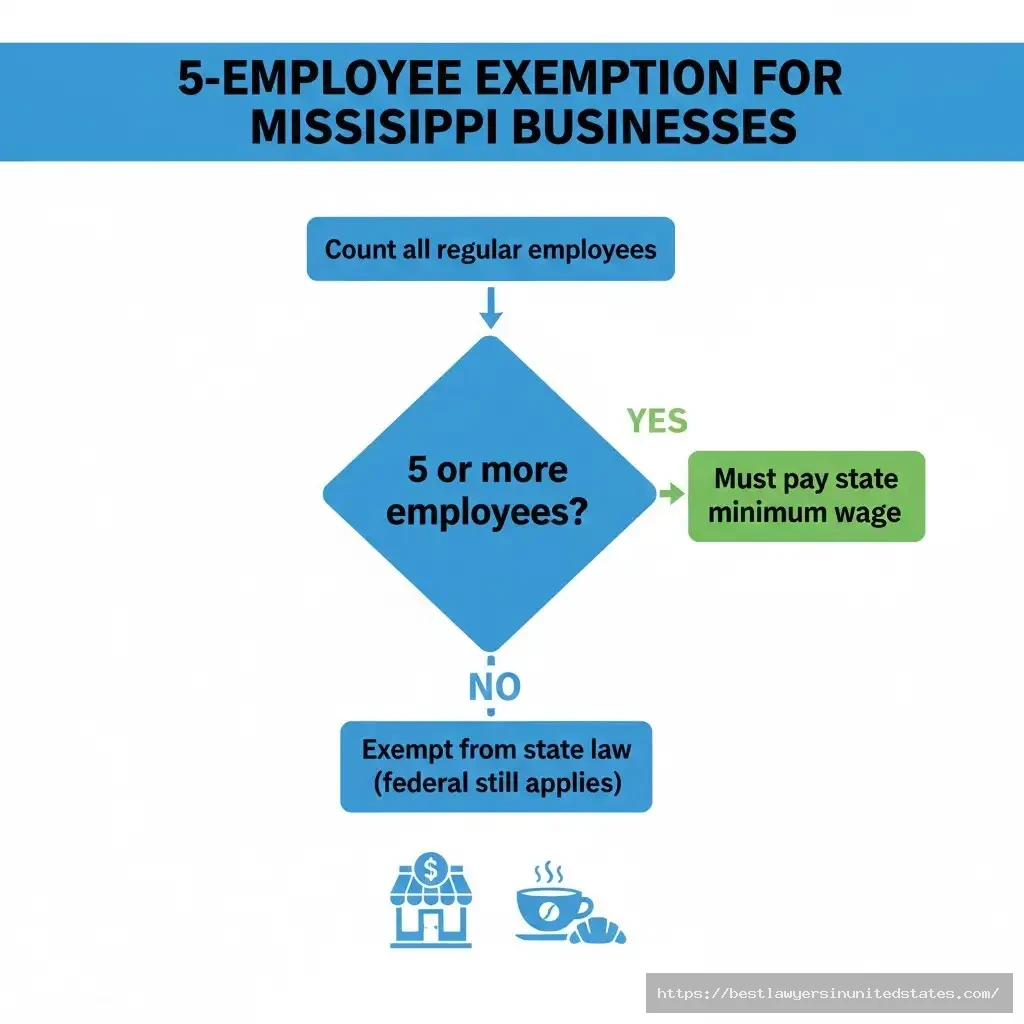
Businesses with fewer than five employees would not have to follow state minimum wage. They would continue using federal standards only.
How the count works:
- Count regular employees in employment relationship
- Count full-time and part-time together
- Don't count independent contractors
- Calculate based on typical staffing levels
Example scenarios:
| Business Type | Typical Staff | Covered by Proposed Law? |
|---|---|---|
| Family restaurant | 3 servers, 1 cook, owner | ❌ No (4 employees) |
| Small retail shop | 6 part-time workers | ✅ Yes (6 employees) |
| Farm operation | 2 year-round, 10 seasonal | Varies by exemptions |
| Law office | 2 attorneys, 3 staff | ✅ Yes (5 employees) |
Critical detail: This threshold applies to total employees, not just those earning minimum wage. A business with 6 employees where 2 earn above minimum must still pay proposed rates to the other 4.
Agricultural Worker Exemptions
The proposed law includes extensive exemptions for agricultural workers. These reflect the unique nature of farm labor in Mississippi's economy.
Agricultural workers exempt if:
- Employed by farm using 500 or fewer "man-days" of labor in any calendar quarter
- Immediate family members of the agricultural employer
- Hand-harvest laborers paid piece-rate who commute daily and worked less than 13 weeks in agriculture during prior year
- Migrant hand-harvest laborers age 16 or under working on same farm as parents at same piece rate
"Man-day" definition: Any day during which an employee performs any agricultural labor. Used to measure farm operation size.
Forestry exemptions: Employees in forestry or lumbering where employer has 8 or fewer forestry workers are also exempt.
Youth Worker Provisions (85% Rate)
Workers under age 18 would earn 85% of minimum wage for their first 200 hours of employment. After 200 hours, they receive full minimum wage.
Youth wage calculation:
| Standard Rate | Youth Rate (85%) | After 200 Hours |
|---|---|---|
| $12.00/hour | $10.20/hour | $12.00/hour |
| $15.00/hour | $12.75/hour | $15.00/hour |
200-hour timeline:
- Working 20 hours/week: 10 weeks
- Working 30 hours/week: 6.7 weeks
- Working 40 hours/week: 5 weeks
Restrictions on youth employment: Mississippi law already requires work permits for minors and restricts hours during school terms under Mississippi Code § 71-1-19. Employers must comply with both wage and hour restrictions.
Tipped Employee Tip Credit (50%)
As detailed above, employers of tipped workers could pay base wage equal to 50% of minimum wage. Tips must bring total to full minimum wage.
Gratuity requirements under proposed law:
- Tips must be voluntary from customers
- Employee must actually receive the tip amount
- Employer cannot keep any portion of tips
- Tip pooling allowed among service staff only
- Managers and owners cannot participate in pools
Documentation required:
- Daily tip reports from employees
- Pay stubs showing base wage and estimated tips
- Records proving total compensation met minimum
- Three-year retention of all wage records
Enforcement and Penalties Under Senate Bill 2440
Mississippi Department of Employment Security Role
The Mississippi Department of Employment Security (MDES) would enforce the new law. This state agency already handles unemployment insurance and job placement services.
MDES enforcement powers:
- Investigate wage complaints
- Inspect employer records
- Enter workplaces for compliance checks
- Issue citations for violations
- Refer criminal cases to prosecutors
- Assist workers in filing civil lawsuits
MDES contact information:
- Website: mdes.ms.gov
- Phone: (601) 321-6000
- Locations in Jackson, Gulfport, Hattiesburg, Tupelo, and other major cities
Workers can file complaints online, by phone, or in person at any MDES office. The agency must keep complainant identity confidential during investigations.
Criminal Penalties for Wage Theft (Felony Provisions)
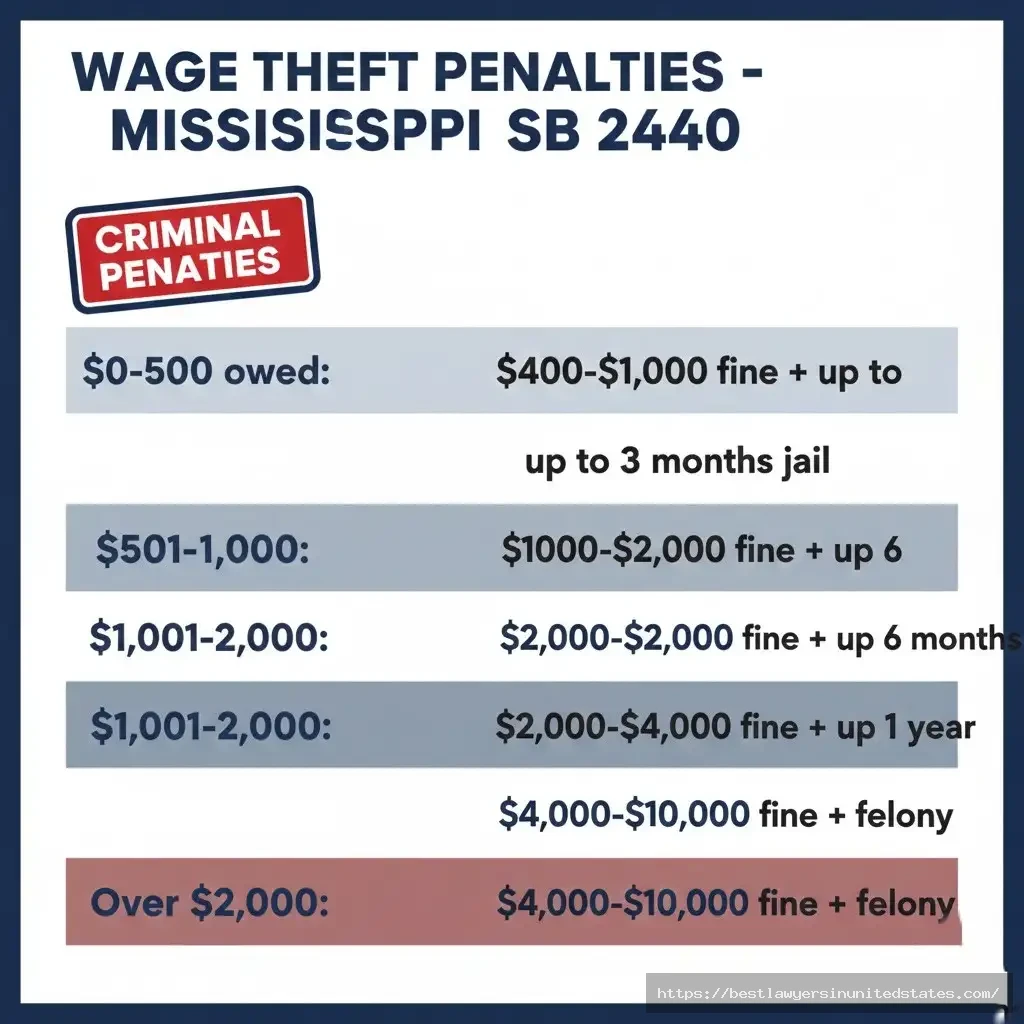
Senate Bill 2440 includes some of the nation's strictest wage theft penalties. Employers who knowingly underpay workers face criminal prosecution.
Criminal penalty structure:
| Unpaid Amount | Criminal Charge | Fines | Potential Jail Time |
|---|---|---|---|
| Over $2,000 | Felony | $4,000 - $10,000 | Not specified |
| $1,001 - $2,000 | Felony | $2,000 - $4,000 | Up to 1 year |
| $501 - $1,000 | Felony | $1,000 - $2,000 | Up to 6 months |
| Up to $500 | Felony | $400 - $1,000 | Up to 3 months |
"Willfully" requirement: Criminal penalties only apply when employer knowingly violates the law. Honest mistakes or good-faith errors typically don't trigger criminal charges.
Additional criminal violations:
- Hindering MDES investigators: $100 - $400 fine
- Refusing workplace access: $100 - $400 fine
- Failing to keep required records: $100 - $400 fine
- Retaliating against workers who complain: Up to $100 fine
Employee Civil Remedies
Workers can sue employers directly for unpaid minimum wages. These civil lawsuits don't require going through MDES first.
What employees can recover:
- Full amount of unpaid wages
- Costs of filing lawsuit
- Reasonable attorney fees
- No waiting for criminal prosecution
Filing requirements:
- File in circuit court where work was performed
- No agreement to accept less than minimum wage is valid
- Employer cannot force arbitration for minimum wage claims
Statute of limitations: Under federal FLSA, workers have 2 years to file wage claims (3 years if employer's violation was willful). Proposed Mississippi law would likely follow similar timeframes.
Workplace Posting Requirements
Employers must post a summary of the Mississippi Minimum Wage Act in a place visible to all employees. MDES would provide these posters free upon request.
Required posting information:
- Current minimum wage rate
- Tipped employee base wage
- Youth worker provisions
- How to file complaints with MDES
- Employee rights under the law
Penalty for not posting: $100 - $400 fine per violation. Each day without proper posting could count as separate violation.
Mississippi Overtime Laws and Regulations
Federal FLSA Overtime Requirements (1.5x After 40 Hours)
Mississippi has no state overtime law. Workers follow federal Fair Labor Standards Act rules. These require time-and-a-half pay for hours worked over 40 in a workweek.
Overtime basics:
- Regular rate: Employee's hourly wage
- Overtime rate: Regular rate × 1.5
- Threshold: 40 hours in a workweek
- Workweek: Any fixed 168-hour period
Overtime calculation example:
- Regular wage: $7.25/hour
- Overtime rate: $10.88/hour
- Works 45 hours in a week
- Pay: (40 × $7.25) + (5 × $10.88) = $344.40
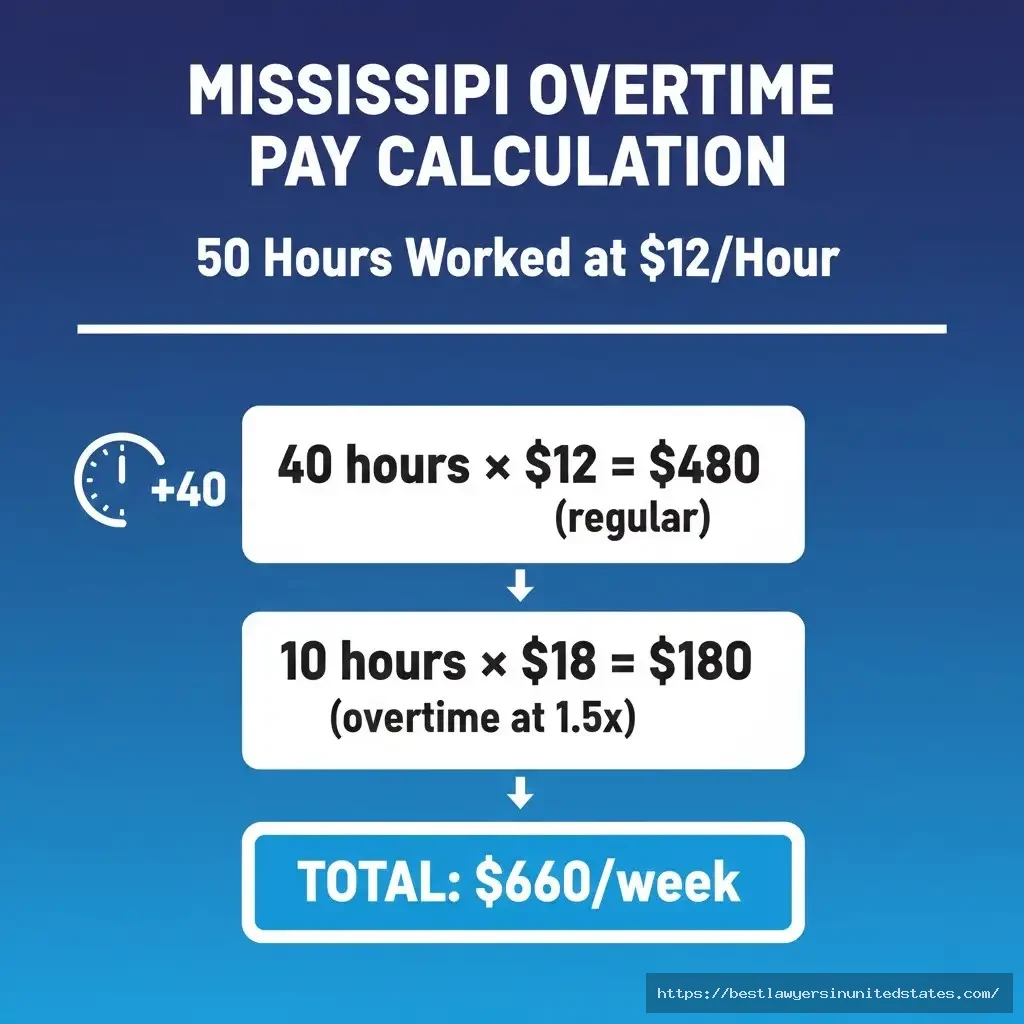
Under proposed $12 minimum wage:
- Regular wage: $12.00/hour
- Overtime rate: $18.00/hour
- Works 45 hours
- Pay: (40 × $12) + (5 × $18) = $570.00
Senate Bill 2440 maintains the 40-hour overtime threshold. The proposed law explicitly states that overtime provisions do NOT apply to agricultural employees, matching current federal exemptions.
Calculate Your Overtime Pay in Mississippi
Working more than 40 hours per week? Calculate your overtime earnings based on Mississippi's overtime laws. This calculator accounts for current federal rules and proposed state minimum wage rates.
⏰ Overtime Pay Calculator
Calculate your overtime earnings based on your state's specific labor laws
📍 Select Your State
💰 Your Hourly Wage
📊 Calculation Method
📅 Weekly Hours
💵 Your Weekly Overtime Pay
📊 Earnings Breakdown
📅 Pay Period Estimates
⚖️ State vs Federal Comparison
Calculator features:
- Current and proposed Mississippi wage rates
- Weekly overtime calculations
- Regular vs. overtime hour breakdown
- Total earnings comparison
- Tax withholding estimates
Full overtime calculator: https://bestlawyersinunitedstates.com/overtime-pay-calculator/
Questions about your wages or need legal help?
Find Employment Lawyers in Mississippi - Free Consultation
Email: [email protected]
Who Is Exempt from Overtime in Mississippi?
Not all employees qualify for overtime pay. Federal law creates several exemptions that Mississippi follows.
"White collar" exemptions (must meet salary and duty tests):
- Executive employees
- Administrative employees
- Professional employees (learned and creative)
- Computer employees earning over $27.63/hour
- Outside sales employees
Other exempt categories:
- Agricultural workers
- Seasonal amusement/recreation employees
- Certain commissioned retail employees
- Small newspaper employees
- Seamen on vessels
- Casual babysitters
- Companions for elderly/disabled
Salary threshold for exemptions (2024): $844 per week ($43,888 annually) under federal regulations. Mississippi would follow federal thresholds unless it establishes different standards.
Common misclassification: Many employers incorrectly classify workers as exempt. Simply calling someone a "manager" or paying a salary doesn't automatically exempt them. The job duties must meet strict legal tests.
Agricultural Overtime Exemptions
Farm workers in Mississippi generally don't receive overtime pay. Federal law exempts most agricultural employees from overtime requirements.
Agricultural exemption requirements:
- Employed by operation using 500 or fewer man-days in any quarter
- Immediate family members of farm owner
- Hand-harvest workers meeting specific criteria
- Range livestock workers
What counts as "agricultural":
- Cultivation and tillage of soil
- Production, cultivation, and harvesting of crops
- Raising livestock, bees, fur-bearing animals, poultry
- Forestry and lumbering operations (separate exemptions)
What doesn't count:
- Food processing beyond farm operations
- Marketing and distribution
- Manufacturing agricultural products
Workers in agricultural processing facilities may qualify for overtime even though field workers don't.
Special Wage Categories in Mississippi
Youth Workers (Under 18)
Mississippi law sets minimum age at 14 for most employment under Mississippi Code § 71-1-19. Younger teens face additional restrictions.
Current federal youth wage: $4.25/hour for first 90 consecutive calendar days for workers under 20. After 90 days, regular minimum wage applies.
Proposed Mississippi youth wage: 85% of state minimum for first 200 hours only. This would actually provide higher wages than current federal youth provisions.
Youth employment restrictions:
- Work permits required from school district
- Hour limits during school year
- Prohibited hazardous occupations
- Cannot displace adult workers
Agricultural and Farm Workers
Agricultural workers face unique wage rules. Many are exempt from both minimum wage and overtime requirements.
Exemption categories:
- Small farm exemption: Farms using 500 or fewer man-days of labor
- Family members: Immediate family of farm owner
- Hand-harvest workers: Meeting specific commuting and experience requirements
- Piece-rate workers: Paid by amount harvested, not hours worked
Workers who MUST receive minimum wage:
- Employees of large farm operations (over 500 man-days)
- Non-family workers on large farms
- Year-round farm employees not meeting exemptions
Mississippi's large agricultural sector employs thousands in forestry, livestock, and crop production. Understanding these exemptions affects many rural workers.
Independent Contractors vs. Employees
The proposed law explicitly excludes independent contractors from minimum wage coverage. But classification disputes are common.
Mississippi's proposed definition: "Any individual who contracts to perform certain work away from employer's premises, uses own methods, and is subject to control only as to result."
Federal "ABC test" for FLSA coverage:
- A: Worker is free from control
- B: Work is outside usual business of employer
- C: Worker has independent trade/business
Misclassification warning: Employers sometimes incorrectly label employees as contractors to avoid wage laws. True test depends on actual working relationship, not what contract says.
Red flags for misclassification:
- Employer sets work hours
- Employer provides tools and equipment
- Worker cannot refuse assignments
- Relationship is permanent, not project-based
- Worker performs core business functions
Learners and Apprentices
The proposed law gives MDES director authority to exempt "institutional training programs" from minimum wage. This would allow formal apprenticeship and vocational programs to pay training wages.
Federal rules for learners/apprentices:
- Formal apprenticeship registered with U.S. Department of Labor
- Progressive wage scale as skills increase
- Cannot displace regular employees
- Limited duration of subminimum wage period
Most legitimate apprenticeships in skilled trades (electrician, plumber, carpenter) already pay well above minimum wage, even for entry-level apprentices.
Employee Rights Under Mississippi Wage Laws
What to Do If You're Not Paid Minimum Wage
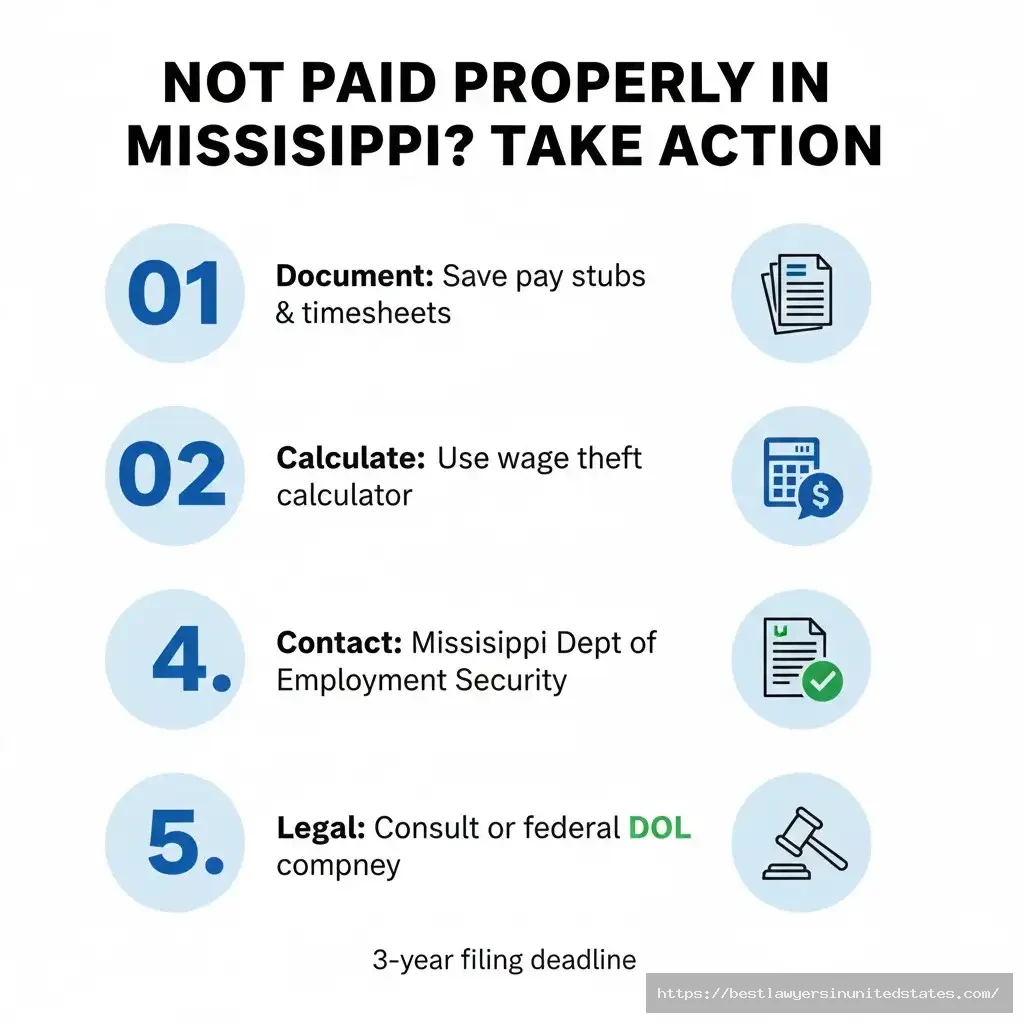
Discovering you're underpaid can be frustrating. Mississippi law (if Senate Bill 2440 passes) and federal law give you several options.
Immediate steps:
- Document everything: Save pay stubs, timesheets, work schedules
- Calculate what you're owed: Track actual hours vs. pay received
- Check your classification: Confirm you're not exempt from minimum wage
- Review tip records: Tipped workers should verify tip credit calculations
Before filing formal complaint:
- Talk to employer if comfortable doing so
- Mistakes sometimes happen with payroll errors
- Keep written record of any conversations
- Give employer chance to fix voluntary compliance
If problem continues: File complaints with both MDES (state) and U.S. Department of Labor (federal) for maximum protection.
Filing a Complaint with MDES
Under the proposed law, MDES would handle state minimum wage complaints. The process would likely mirror their current unemployment insurance claim procedures.
Expected complaint process:
- Submit complaint online or at MDES office
- Provide documentation (pay stubs, employment records)
- MDES investigates employer
- Agency makes determination of violations
- MDES can order back pay and penalties
- Agency refers criminal cases if warranted
Retaliation protection: Employers cannot fire, demote, or punish workers for filing wage complaints. Retaliation is separately illegal with its own penalties.
Confidentiality: MDES must keep complainant identity confidential during investigation when possible.
Federal DOL Complaint Process
Federal complaints go to the U.S. Department of Labor's Wage and Hour Division. This option exists now and would continue even with state law.
Federal complaint advantages:
- Established enforcement system
- Covers all FLSA violations
- Investigators have extensive experience
- No cost to worker
- Can investigate multiple employers
How to file federal complaint:
- Contact WHD office (Jackson, MS location or online)
- Complete intake questionnaire
- Provide employment documentation
- WHD investigates independently
- WHD can assess back wages and liquidated damages
File both state and federal: Workers can pursue both simultaneously for best results. Different agencies may find different violations.
Pursuing a Civil Lawsuit for Unpaid Wages
Workers can sue employers directly in Mississippi circuit court. This option provides fastest recovery in many cases.
Civil lawsuit advantages:
- Don't wait for agency investigation
- Attorney handles case
- Court can order full back pay
- Employer pays your attorney fees if you win
- Faster than agency process
What courts can award:
- All unpaid minimum wages
- All unpaid overtime
- Liquidated damages (double amount owed)
- Attorney fees
- Court costs
Finding an attorney: Many employment lawyers take wage cases on contingency (no fee unless you win). Employer must pay your attorney fees if you prevail.
Venue: File in circuit court of county where you performed work. Convenient access to local courts throughout Mississippi.
Calculate Your Wage Theft Recovery in Mississippi
Think your employer owes you money? Use our wage theft calculator to estimate how much you could recover, including unpaid wages, penalties, and interest under Mississippi and federal law.
Wage Theft Recovery Calculator
Estimate how much you can recover in unpaid wages, penalties, and damages based on your state's laws
💵 Estimated Total Recovery
💰 Unpaid Wages
⚖️ Penalties & Damages
📋 Total Summary
Calculator features:
- Multiple violation types (minimum wage, overtime, tips)
- Federal and proposed Mississippi penalties
- Liquidated damages calculation
- Filing deadline tracker
- Total recovery estimate including attorney fees
Full wage theft calculator: https://bestlawyersinunitedstates.com/wage-theft-calculator/
Need help with unpaid wages? Contact Mississippi Department of Employment Security at (601) 321-6000 or consult with an employment attorney.
Questions about your wages or need legal help?
Find Employment Lawyers in Mississippi - Free Consultation
Email: [email protected]
Mississippi Wage Theft: What Workers Need to Know
Definition of Wage Theft Under Proposed Law
Wage theft means employers don't pay workers all wages owed. Senate Bill 2440 makes serious wage theft a criminal felony.
Common types of wage theft:
- Paying less than minimum wage
- Not paying overtime for over 40 hours
- Keeping employee tips
- Making illegal deductions from paychecks
- Not paying for all hours worked
- Forcing off-the-clock work
"Willful" violations: Criminal penalties require employer knowingly violated the law. Accidental payroll errors usually don't qualify as criminal wage theft.
Common Wage Violations
Mississippi workers experience these frequent wage law violations:
Time clock violations:
- Employer rounds time down systematically
- Unpaid time before/after shifts
- Working through meal breaks without pay
- Forced off-the-clock work
Misclassification violations:
- Calling employees "contractors" to avoid wage laws
- Misclassifying workers as "exempt" from overtime
- Using improper job titles to justify no overtime
Tip violations:
- Restaurant keeps portion of tips
- Invalid tip pooling including managers
- Not making up difference when tips fall short
- Taking illegal deductions from tips
Record violations:
- Not keeping accurate time records
- Failing to provide pay stubs
- Not posting required wage notices
Criminal vs. Civil Remedies
Workers have two paths to recover unpaid wages: criminal prosecution (handled by MDES and prosecutors) and civil lawsuits (you hire lawyer).
Criminal prosecution (proposed law):
- MDES investigates
- Prosecutor files charges
- Criminal penalties to employer
- Worker may still need civil suit for back pay
- State brings case, not worker
Civil lawsuit:
- Worker hires attorney
- Sue for back wages and damages
- Court orders employer to pay
- Faster recovery in most cases
- Worker controls the case
Which is better? Most workers benefit from civil lawsuits because they recover money faster. Criminal prosecutions punish employers but don't automatically pay back wages to workers.
Attorney Fees and Court Costs Recovery
One of the strongest parts of wage law: employers must pay your attorney fees if you win.
What employers pay when they lose:
- All unpaid wages
- Liquidated damages (equal to unpaid wages)
- Your attorney's fees (their hourly rates)
- Court filing costs and litigation expenses
Example recovery:
- Unpaid wages: $5,000
- Liquidated damages: $5,000
- Attorney fees: $8,000
- Total paid by employer: $18,000
- You receive: $10,000 (plus case costs)
This "fee-shifting" provision allows workers to hire good attorneys even without money upfront. Lawyers know they'll get paid if they win.
Employer Compliance Guide for Mississippi Businesses
Current Federal Requirements (FLSA)
Mississippi employers must follow federal Fair Labor Standards Act now, regardless of whether Senate Bill 2440 passes.
Current federal obligations:
- Pay minimum $7.25/hour
- Pay overtime at 1.5x for over 40 hours/week
- Maintain accurate time and pay records
- Post FLSA workplace notices
- Properly classify employees vs. contractors
- Follow child labor laws
Businesses covered by FLSA:
- Annual gross sales over $500,000
- Engaged in interstate commerce (most businesses)
- Healthcare, schools, government agencies (regardless of sales)
Recordkeeping requirements:
- Employee's full name and Social Security number
- Hours worked each workday and total each workweek
- Basis for pay rate (hourly, piece rate, salary)
- Total daily or weekly straight-time earnings
- Overtime earnings
- Deductions and additions to wages
- Total wages paid each period
- Pay period dates
- Payment date
Retention period: Keep all records at least 3 years. Keep payroll computation records at least 2 years.
Preparing for Potential State Minimum Wage Law
Smart employers should prepare now for Senate Bill 2440, even though it's still pending.
Preparation checklist:
Financial planning:
- Calculate wage increase costs per employee
- Model total payroll increase from $7.25 to $12 (65% increase)
- Plan for $15/hour by 2028
- Adjust pricing or operations to accommodate higher labor costs
- Consider applying for small business exemption if under 5 employees
Payroll system updates:
- Ensure system can handle multiple wage rates
- Program in January 2026 and January 2028 increases
- Update tip credit calculations to 50% method
- Verify overtime calculations use new base rates
- Test youth worker 85%/200-hour provisions
Employment classification review:
- Audit all exempt employee classifications
- Review independent contractor relationships
- Document exemption justifications
- Correct any misclassifications before law takes effect
- Train managers on new requirements
Recordkeeping Requirements (3-Year Rule)
The proposed Mississippi law requires 3-year record retention, matching federal standards.
Records to keep:
- Name, address, occupation of each employee
- Rate of pay and amount paid each period
- Time and day workweek begins
- Hours worked each day and each workweek
- Basis for wages (hourly, salary, piece rate)
- Total wages paid each period
- Any deductions or additions to wages
- For tipped employees: Daily or weekly tip reports
Where to keep records: On or about the premises where employees work. Must be accessible to MDES investigators upon request.
Penalty for poor records: $100 - $400 fine per violation. Can make defending against wage claims much harder.
E-Verify Mandate in Mississippi
All Mississippi employers must use E-Verify to verify employment eligibility of new hires. This is separate from minimum wage but part of overall labor law compliance.
Mississippi Employment Protection Act (Miss. Code § 71-11-3):
- Use E-Verify for all newly hired employees
- Complete verification within 3 business days of hire
- Keep E-Verify confirmation for 3 years
- Applies to all employers (no size threshold)
Penalties for non-compliance:
- Cancellation of state contracts
- Ineligibility for state contracts up to 3 years
- Loss of business licenses for up to 1 year
- Fines from $1,000 - $10,000
E-Verify vs. minimum wage: These are separate requirements. Complying with E-Verify doesn't exempt you from wage laws.
Workplace Poster and Notice Requirements
Current federal law requires workplace posters. Proposed Mississippi law would add state poster requirements.
Required federal posters:
- Fair Labor Standards Act minimum wage notice
- OSHA workplace safety notices
- Equal Employment Opportunity notice
- Family and Medical Leave Act (if 50+ employees)
Proposed Mississippi poster:
- Mississippi Minimum Wage Act summary
- Current minimum wage rate
- How to contact MDES to file complaints
- Employee rights under state law
Where to post: In conspicuous and accessible location where all employees can see. Break rooms, time clock areas, and employee entrances work well.
Free posters: Both U.S. Department of Labor and MDES provide free posters upon request or download from their websites.
How to Calculate Payroll Under Mississippi Laws
Regular Hourly Wages
Basic payroll calculation multiplies hours worked by hourly rate. Sounds simple, but details matter for legal compliance.
Current calculation:
- Regular rate: $7.25/hour (or higher if employer pays above minimum)
- Hours worked: Actual time employee worked
- Weekly gross: Hours × Rate
Under proposed $12 minimum (2026):
- Regular rate: $12.00/hour minimum
- Hours worked: Must track accurately
- Weekly gross: Hours × Rate (min $12)
Pay frequency: Mississippi has no law requiring specific pay frequency. Employers can pay weekly, bi-weekly, semi-monthly, or monthly. Whatever frequency chosen must be consistent and clearly communicated.
Rounding time: If using time clocks that round, rounding must be neutral (rounds both up and down). Systematic rounding down violates wage laws.
Tipped Employee Payroll
Tipped employee payroll requires more complex tracking and calculations.
Current federal method:
- Base wage: $2.13/hour minimum
- Track all tips received
- Calculate hourly equivalent: (Base wages + Tips) ÷ Hours
- If under $7.25/hour, employer pays difference
Proposed Mississippi method (50% tip credit):
- Base wage: 50% of minimum ($6 under $12 min, $7.50 under $15 min)
- Track all tips received
- Calculate hourly equivalent: (Base wages + Tips) ÷ Hours
- If under minimum wage, employer pays difference
Tip reporting: Employers must have system for employees to accurately report tips daily. Written tip reports, electronic POS systems, or tip declaration forms all work.
Tip pooling: If using tip pools, document how tips are distributed. Only service employees can participate. Keep records showing pool calculations.
Overtime Calculations
Overtime adds another layer of calculation complexity.
Standard overtime:
- Regular rate × 1.5 = Overtime rate
- First 40 hours at regular rate
- Hours over 40 at overtime rate
Example with current $7.25:
- Works 50 hours in week
- Regular rate: $7.25
- Overtime rate: $10.88 ($7.25 × 1.5)
- Pay: (40 × $7.25) + (10 × $10.88) = $398.80
Example with proposed $12:
- Works 50 hours in week
- Regular rate: $12.00
- Overtime rate: $18.00 ($12 × 1.5)
- Pay: (40 × $12) + (10 × $18) = $660.00
Overtime for tipped employees:
- Calculate overtime rate from full minimum wage (not base wage)
- Apply tip credit to both regular and overtime hours
- Ensure total compensation meets overtime requirements
Common overtime errors:
- Calculating overtime from base tipped wage instead of full minimum
- Not including bonuses or commissions in regular rate
- Averaging wages across two workweeks
- Comp time instead of overtime pay (illegal for private employers)
Deductions and Allowances
Not all deductions are legal. Mississippi and federal law limit what employers can take from paychecks.
Always legal deductions:
- Federal income tax withholding
- Social Security and Medicare (FICA)
- State income tax (Mississippi has income tax)
- Court-ordered garnishments
- Employee-authorized 401(k) contributions
- Employee-authorized health insurance premiums
Sometimes legal deductions:
- Uniforms (only if doesn't reduce wages below minimum)
- Cash register shortages (only if not below minimum, and only if employee had sole access)
- Equipment breakage (only if not below minimum and employee was negligent)
Never legal deductions:
- Business operating costs (merchant fees, rent, supplies)
- Customer walkouts or bad checks
- Required uniforms that reduce pay below minimum
- Training costs
- Job application costs
Critical rule: No deduction can reduce an employee's hourly rate below minimum wage for hours worked.
Mississippi Minimum Wage vs. Neighboring States
Tennessee Minimum Wage ($7.25 - No State Law)
Tennessee, like Mississippi, has no state minimum wage law. Workers earn federal minimum of $7.25/hour.
Tennessee vs. Mississippi comparison:
| Factor | Tennessee | Mississippi (Current) | Mississippi (Proposed 2026) |
|---|---|---|---|
| State minimum wage law | ❌ No | ❌ No | ✅ Yes |
| Minimum wage | $7.25 | $7.25 | $12.00 |
| Tipped wage | $2.13 | $2.13 | $6.00 (50% credit) |
| Overtime threshold | 40 hours | 40 hours | 40 hours |
Both states rely entirely on federal FLSA standards. Tennessee's minimum wage situation mirrors Mississippi's current status.
Impact of Mississippi increase: If Senate Bill 2440 passes, Mississippi would offer $4.75/hour more than Tennessee. This could attract workers from Memphis area and other border regions.
Alabama Minimum Wage ($7.25 - No State Law)
Alabama also lacks state minimum wage law. Like Mississippi and Tennessee, it uses federal $7.25 rate.
Alabama specifics:
- No state labor department handling wage complaints
- Federal DOL enforces all wage standards
- No local minimum wage ordinances
- Birmingham and Mobile follow federal law
Alabama's wage laws show the Deep South pattern of relying on federal standards. Mississippi's proposed law would break from this regional approach.
Regional worker movement: Higher Mississippi wages could draw workers from Alabama's western border counties like Pickens and Sumter.
Louisiana Minimum Wage ($7.25 - No State Law)
Louisiana rounds out the states without minimum wage laws. The state has no labor department specifically for wage enforcement.
Louisiana minimum wage situation:
- No state minimum wage statute
- Federal $7.25 applies
- Louisiana Workforce Commission handles some labor issues
- New Orleans has no local minimum wage despite efforts
Louisiana maintains the federal-only approach that Mississippi would abandon if Senate Bill 2440 passes.
Economic impact: Proposed Mississippi rates would exceed Louisiana by $4.75, potentially affecting labor markets in border parishes.
Arkansas Minimum Wage ($11.00)
Arkansas stands out among Mississippi's neighbors with its $11.00 state minimum wage. Arkansas voters approved increases through ballot measure.
Arkansas vs. Mississippi:
| Factor | Arkansas | Mississippi (Proposed) |
|---|---|---|
| Minimum wage | $11.00 | $12.00 (2026) → $15.00 (2028) |
| How established | Ballot initiative | Legislation |
| Tipped wage | $2.63 | $6.00 (2026) → $7.50 (2028) |
| Small business exemption | None | Under 5 employees exempt |
Key difference: Arkansas's higher minimum wage currently exceeds Mississippi's proposed 2026 rate but falls short of the $15 goal for 2028.
Border county effects: Mississippi's DeSoto County (Southaven/Olive Branch area near Memphis) competes with Arkansas for workers. Wage parity would help Mississippi businesses recruit.
States With No Minimum Wage Laws
Only five states lack their own minimum wage statutes:
- Alabama
- Louisiana
- Mississippi
- South Carolina
- Tennessee
Why so few: Most states established minimum wages during 1960s-1980s labor movements. These five Southern states resisted state-level regulation, preferring federal standards.
Economic theories:
- States argue: Lower wage requirements attract businesses, create more jobs
- Critics argue: Workers struggle with low pay, require public assistance, reducing tax revenue
- Research shows: Studies find mixed effects depending on regional economic factors
If Mississippi passes Senate Bill 2440, only four states would lack state minimum wage laws.
Living Wage vs. Minimum Wage in Mississippi
What Is a Living Wage in Mississippi?
A living wage covers basic needs: housing, food, healthcare, transportation, and other necessities. It differs from minimum wage, which is the legal minimum employers can pay.
Mississippi living wage estimates (single adult, 2026):
- Hourly: $16.75 - $18.50
- Monthly: $2,906 - $3,207
- Annually: $34,867 - $38,480
These calculations come from MIT Living Wage Calculator and similar research accounting for Mississippi's specific costs.
For families, living wage increases:
- Single adult: $16.75/hour
- Single adult, 1 child: $32.50/hour
- Single adult, 2 children: $42.00/hour
- Two adults (1 working), 2 children: $42.00/hour
- Two adults (both working), 2 children: $24.00/hour each
Income inequality: Living wage estimates show that even Mississippi's proposed $15 minimum falls short of true living wage for families with children.
Cost of Living Considerations
Mississippi has one of the nation's lowest costs of living. This affects wage adequacy.
Mississippi vs. national average costs:
| Expense Category | MS Cost Index | National Average |
|---|---|---|
| Housing | 30% below | 100 |
| Food | 8% below | 100 |
| Healthcare | 10% below | 100 |
| Transportation | 5% below | 100 |
| Overall | 15% below | 100 |
Why lower costs matter: $15/hour in Mississippi provides similar purchasing power to $17-18/hour in average-cost states. However, it still falls short of covering basic family needs.
Regional variations within Mississippi:
- Jackson metro: Higher housing costs
- Coastal regions (Gulfport/Biloxi): Higher costs due to tourism economy
- Rural areas: Lower costs but fewer job opportunities
- Northern counties: Influenced by Memphis market
Gap Between Minimum and Living Wage
The gap between legal minimum and actual living wage represents financial hardship for workers.
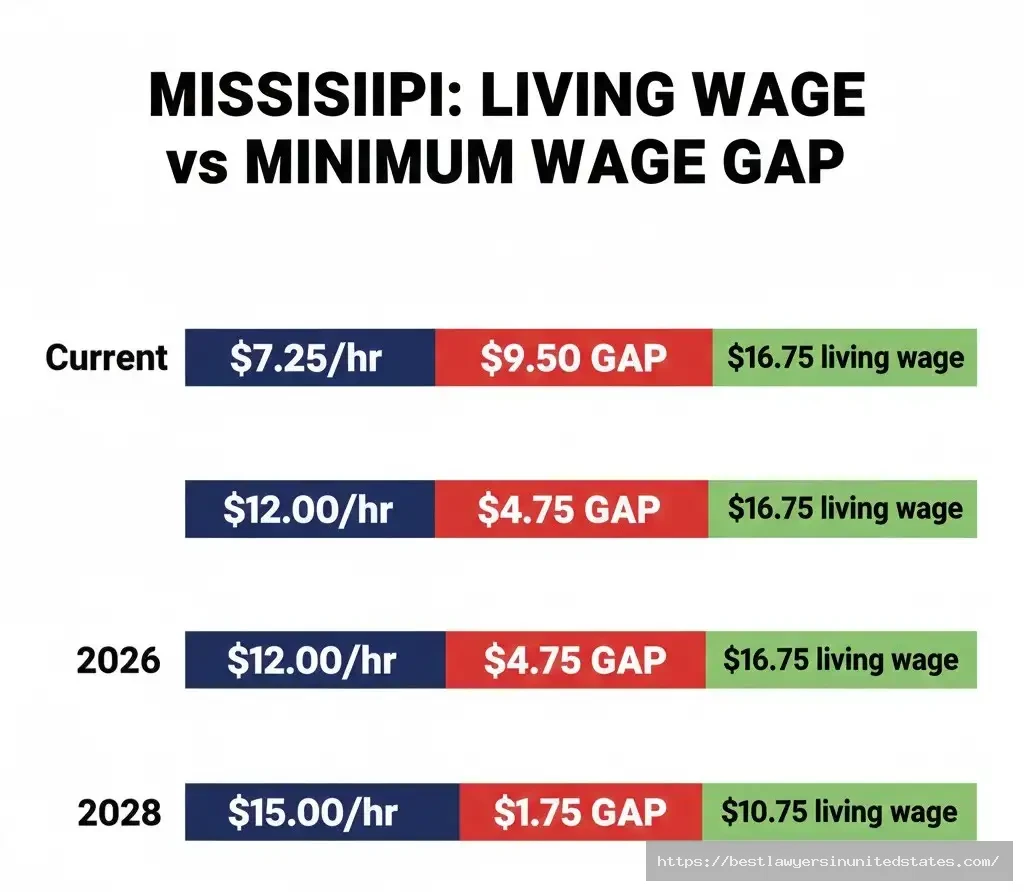
Current gap (single adult):
- Federal minimum wage: $7.25/hour ($15,080/year)
- Living wage: $16.75/hour ($34,860/year)
- Gap: $9.50/hour ($19,780/year shortfall)
Gap under proposed $12 minimum (2026):
- Proposed minimum: $12.00/hour ($24,960/year)
- Living wage: $16.75/hour ($34,860/year)
- Gap: $4.75/hour ($9,900/year shortfall)
Gap under proposed $15 minimum (2028):
- Proposed minimum: $15.00/hour ($31,200/year)
- Living wage: $16.75/hour ($34,860/year)
- Gap: $1.75/hour ($3,660/year shortfall)
Progress but not parity: Even $15 minimum would leave single adults earning less than living wage, though the gap closes to 10% instead of 57%.
Income Needed for Common Expenses
Breaking down typical Mississippi expenses shows where minimum wage falls short.
Monthly budget for single adult (2026 estimates):
| Expense | Monthly Cost | Annual Cost | Hours at $7.25 | Hours at $12 | Hours at $15 |
|---|---|---|---|---|---|
| Housing | $750 | $9,000 | 1,241 | 750 | 600 |
| Food | $300 | $3,600 | 497 | 300 | 240 |
| Transportation | $400 | $4,800 | 662 | 400 | 320 |
| Healthcare | $250 | $3,000 | 414 | 250 | 200 |
| Other necessities | $400 | $4,800 | 662 | 400 | 320 |
| Total | $2,100 | $25,200 | 3,476 | 2,100 | 1,680 |
Reality check: At current $7.25 minimum, a full-time worker (2,080 hours/year) earns only $15,080 - not even enough for basic necessities. At proposed $15, the same worker earns $31,200, covering basics but leaving little for emergencies or savings.
Comparison with higher-wage states: California's $16.50 minimum wage and Florida's $13.00 rate show that even higher minimums often fall short of full living wage in those states due to higher costs.
History of Minimum Wage in Mississippi
Why Mississippi Never Established State Minimum Wage
Mississippi's approach to wage regulation reflects its political philosophy and economic structure.
Historical factors:
- Agricultural economy: Large farming sector opposed wage mandates for seasonal workers
- Small business prevalence: High percentage of small employers (under 10 workers) feared compliance costs
- States' rights philosophy: Preference for federal vs. state regulation
- Anti-union history: Weak organized labor movement provided little pressure for state laws
- Economic development strategy: Positioned as low-cost alternative to higher-wage states
Political landscape: Mississippi legislature historically had conservative supermajority opposed to state-level wage mandates. Even when Democrats controlled state politics, they often took conservative positions on economic regulation.
Federal sufficiency argument: Supporters of no state law argued federal minimum wage adequately protected workers while preserving Mississippi's competitive advantage.
Previous Legislative Attempts
Senate Bill 2440 isn't Mississippi's first attempt at state minimum wage law.
Past proposals:
- 1990s efforts: Multiple bills introduced but died in committee
- 2007-2008 recession: Renewed interest during economic crisis, no success
- 2014: Bill proposed $10 minimum, failed in committee
- 2019: $15 minimum wage proposal, no committee vote
- 2021: Post-COVID proposal, failed to gain traction
- 2025: Senate Bill 2440 currently pending
Why previous attempts failed:
- Republican legislative control since 2010s
- Business lobby opposition
- Rural legislator concerns about agricultural impact
- No popular ballot measure process (unlike Arkansas)
What changed in 2025: Growing wage gap with Arkansas, worker shortages post-COVID, and increased awareness of poverty wages have shifted some political support.
Federal Minimum Wage History (1960-2026)
The federal minimum wage has changed 22 times since 1938. Mississippi workers saw these rate changes:
Key federal minimum wage dates:
| Effective Date | Rate | Annual Earnings (Full-Time) |
|---|---|---|
| Jan 1, 1960 | $1.00 | $2,080 |
| Jan 1, 1970 | $1.60 | $3,328 |
| Jan 1, 1980 | $3.10 | $6,448 |
| Jan 1, 1990 | $3.80 | $7,904 |
| Sep 1, 1997 | $5.15 | $10,712 |
| Jul 24, 2007 | $5.85 | $12,168 |
| Jul 24, 2008 | $6.55 | $13,624 |
| Jul 24, 2009 | $7.25 | $15,080 |
| 2010-2026 | $7.25 | $15,080 |
The 17-year freeze: Federal minimum wage has not increased since 2009, the longest period without increase in program history. Adjusted for inflation, $7.25 today has less purchasing power than $5.15 had in the 1990s.
Congressional gridlock: Multiple proposals to raise federal minimum to $10, $12, or $15 have failed to pass Congress. Partisan divisions prevent agreement on new rate.
Senate Bill 2440: A Historic Shift?
If passed, Senate Bill 2440 would mark Mississippi's first state minimum wage law ever.
Historic significance:
- First state wage law in 247 years of Mississippi history
- Removes Mississippi from "Big Five" states without wage laws
- 65% increase in entry-level wages overnight
- Establishes state authority over wage standards
Legislative process:
- Bill introduced in 2025 Regular Session
- Referred to Labor Committee and Accountability Committee
- Committee hearings (public testimony)
- Committee vote to advance or kill bill
- If advanced, full Senate vote needed
- If passes Senate, moves to House
- House committee and floor votes
- If passes both chambers, Governor signs or vetoes
- Takes effect July 1, 2025 if signed
Current status (as of 2026): Bill remains in committee. Passage uncertain given Republican legislative supermajority and business community opposition.
Factors supporting passage:
- Worker shortages
- Competition with Arkansas wages
- Growing poverty awareness
- Public support in polling
Factors opposing passage:
- Business lobby resistance
- Small business compliance concerns
- Agricultural sector opposition
- Conservative legislative majority
Minimum Wage by Industry in Mississippi
Restaurant and Hospitality Workers
Mississippi's service industry employs thousands in restaurants, hotels, casinos, and tourism venues.
Current situation:
- Servers typically earn $2.13/hour base plus tips
- Casino workers often earn above minimum due to market competition
- Hotel housekeepers usually earn $7.25-9.00/hour
- Kitchen staff (cooks, dishwashers) earn $8-12/hour
Under proposed $12 minimum:
- Server base wage increases to $6/hour
- Tips must still bring total to $12/hour
- Non-tipped staff like cooks get 65% raise
- Housekeepers earn minimum $12/hour
Coastal tourism impact: Gulfport and Biloxi casino/resort workers would see significant increases. Gulf Coast tourism economy could absorb higher wages through room rates and restaurant prices.
Small restaurant concerns: Family-owned restaurants in rural areas worry about affording 65% labor cost increases. The small business exemption (under 5 employees) helps smallest operations.
Retail and Service Industry
Retail stores, gas stations, convenience stores, and personal services employ many minimum wage workers.
Common retail positions:
- Cashiers: $7.25-8.50/hour currently
- Stock clerks: $7.25-9.00/hour currently
- Sales associates: $7.25-10.00/hour currently
- Assistant managers: $10-14/hour currently
Big box advantage: Large retailers like Walmart already pay $12-15/hour minimum in Mississippi to compete for workers. Proposed law would level playing field for smaller competitors.
Small retail challenge: Independent stores and gas stations operating on thin margins face pressure from 65% wage increase. Some may reduce hours or automate cashier functions.
Agricultural and Farm Labor
Mississippi's agricultural sector includes row crops, livestock, poultry, forestry, and catfish farming.
Current farm worker wages:
- Field workers: $8-12/hour (above minimum to attract workers)
- Livestock workers: $9-13/hour
- Equipment operators: $12-16/hour
- Seasonal harvest workers: Piece-rate or hourly
Exemptions under proposed law:
- Farms with 500 or fewer man-days exempt
- Family farm workers exempt
- Hand-harvest workers meeting criteria exempt
- Many Mississippi farms fall under exemption thresholds
Impact varies by operation:
- Large commercial farms must comply
- Small family farms remain exempt
- Poultry processing plants (not considered agricultural) must comply
- Equipment-intensive operations less affected than labor-intensive crops
Healthcare Workers
Healthcare employs significant numbers at various wage levels.
Entry-level healthcare positions:
- Certified nursing assistants (CNAs): $11-14/hour currently
- Home health aides: $9-12/hour currently
- Medical assistants: $12-15/hour currently
- Dietary/housekeeping staff: $7.25-10/hour currently
Proposed law impact:
- Lowest-paid healthcare workers see raises
- CNAs already above $12 minimum less affected
- Home health agencies face cost pressures
- Hospitals and large facilities can absorb increases
Medicare/Medicaid funding: Healthcare facilities receiving federal funding must already meet certain wage standards. State minimum wage increase could require Medicaid reimbursement rate adjustments.
Small Business Employees (Under 5 Workers)
The 5-employee exemption protects Mississippi's smallest businesses.
Who qualifies for exemption:
- 4 or fewer regular employees
- Count all employees (full-time and part-time)
- Owner doesn't count as employee
- Independent contractors don't count
Small businesses that might qualify:
- Family restaurants with owner and 3-4 workers
- Small retail shops
- Professional offices (lawyers, accountants with small staffs)
- Auto repair shops
- Beauty salons and barbershops
Strategic considerations:
- Business at exactly 5 employees might stay at 4 to avoid requirements
- Could discourage hiring and business growth
- Exemption allows smallest businesses time to adapt
- Federal minimum still applies to exempt businesses
Mississippi Wage Calculators and Tools
Use these three essential calculators to understand your earnings and rights under Mississippi wage laws.
Minimum Wage Calculator (Hourly to Annual)
Calculate exactly how much you'll earn at Mississippi's current $7.25 federal minimum or proposed $12-15 state minimum wage.
What this calculator shows:
- Hourly rate input
- Weekly earnings (40 hours)
- Monthly earnings
- Annual earnings
- Comparison between wage rates
Try it yourself: https://bestlawyersinunitedstates.com/minimum-wage-calculator/
Sample calculations:
| Hourly Wage | Weekly (40 hrs) | Monthly | Annually |
|---|---|---|---|
| $7.25 (current) | $290 | $1,257 | $15,080 |
| $12.00 (proposed 2026) | $480 | $2,080 | $24,960 |
| $15.00 (proposed 2028) | $600 | $2,600 | $31,200 |
Overtime Pay Calculator
Working more than 40 hours? Calculate your overtime earnings with time-and-a-half pay rates.
Calculator features:
- Regular hourly rate input
- Total hours worked per week
- Automatic overtime calculation
- Weekly gross pay
- Annual projection
Access the calculator: https://bestlawyersinunitedstates.com/overtime-pay-calculator/
Example overtime calculation:
- Regular rate: $12/hour
- Hours worked: 50
- Regular pay (40 hours): $480
- Overtime rate: $18/hour
- Overtime pay (10 hours): $180
- Total weekly pay: $660
Tipped Employee Earnings Calculator
Servers and tipped workers need special calculations combining base wage and tips.
What this calculator determines:
- Base tipped wage
- Tips received
- Total effective hourly rate
- Whether employer must "top up"
- Weekly and monthly earnings
How to use:
- Enter base wage ($2.13 federal or $6 proposed MS)
- Enter tips received per shift
- Enter hours worked
- Calculator shows if total meets minimum wage
Example for proposed Mississippi tipped wage:
- Base wage: $6/hour
- 8-hour shift: $48 base pay
- Tips received: $50
- Total: $98 for 8 hours = $12.25/hour
- Result: Exceeds $12 minimum, employer owes no additional money
Wage Theft Recovery Estimator
Think your employer owes you money? Estimate your potential recovery including damages and penalties.
What you can calculate:
- Unpaid regular wages
- Unpaid overtime
- Stolen tips
- Liquidated damages (doubles recovery)
- Total potential recovery
- Filing deadline status
Access the wage theft calculator: https://bestlawyersinunitedstates.com/wage-theft-calculator/
Example wage theft recovery:
- Unpaid wages: $3,000
- Liquidated damages: $3,000
- Attorney fees: $6,000 (paid by employer)
- Total employer owes: $12,000
- You receive: $6,000
Mississippi Minimum Wage FAQ
What is the minimum wage in Mississippi right now?
Quick Answer: Mississippi has no state minimum wage law, so workers earn the federal minimum wage of $7.25 per hour in 2026.
This has been the rate since July 24, 2009, when the last federal increase took effect. Mississippi relies entirely on federal Fair Labor Standards Act standards for wage protection.
Will Mississippi get a $15 minimum wage?
Quick Answer: Senate Bill 2440 proposes Mississippi's first state minimum wage of $12/hour starting January 1, 2026, increasing to $15/hour by January 1, 2028, but the bill's passage is uncertain.
The legislation remains in committee as of 2026. If passed and signed by the Governor, it would take effect July 1, 2025, with the $12 rate starting January 1, 2026.
When would Senate Bill 2440 take effect?
Quick Answer: If passed, the law takes effect July 1, 2025, but the $12 minimum wage rate wouldn't start until January 1, 2026, with the $15 rate following on January 1, 2028.
This phased approach gives businesses time to prepare for wage increases. The law includes automatic adjustment provisions if federal minimum exceeds Mississippi's rate.
Do tipped workers make less than minimum wage in Mississippi?
Quick Answer: Yes, Mississippi uses the federal tipped minimum wage of $2.13 per hour, but tips must bring total earnings to at least $7.25 per hour, or the employer must pay the difference.
Under proposed Senate Bill 2440, tipped workers' base wage would increase to 50% of minimum wage ($6/hour at $12 minimum, $7.50/hour at $15 minimum). Total earnings including tips must still meet full minimum wage.
What is the minimum wage for 16-year-olds in Mississippi?
Quick Answer: Currently, 16-year-olds earn the same $7.25 federal minimum wage as adults in Mississippi. Under proposed Senate Bill 2440, workers under 18 would earn 85% of minimum wage ($10.20 at $12 rate) for their first 200 hours only.
After working 200 hours, youth workers would receive full minimum wage. Federal law also allows $4.25/hour for first 90 days for workers under 20, but few Mississippi employers use this provision.
Can employers pay less than $7.25 in Mississippi?
Quick Answer: No, employers covered by federal Fair Labor Standards Act must pay at least $7.25 per hour, with limited exceptions for tipped workers ($2.13 base), youth workers (in first 90 days), and certain categories like students and disabled workers with special certificates.
Paying below minimum wage without proper authorization is wage theft and violates federal law. Workers can file complaints with U.S. Department of Labor or sue employers directly.
Who enforces minimum wage laws in Mississippi?
Quick Answer: Currently, the U.S. Department of Labor's Wage and Hour Division enforces federal minimum wage in Mississippi. If Senate Bill 2440 passes, the Mississippi Department of Employment Security would enforce state minimum wage.
Federal enforcement would continue even with state law. Workers could file complaints with both agencies simultaneously for maximum protection.
What are the penalties for not paying minimum wage?
Quick Answer: Under proposed Senate Bill 2440, employers who willfully pay less than minimum wage face felony charges with fines from $400-$10,000 and potential jail time depending on the amount owed. Workers can also sue to recover unpaid wages plus equal amount as damages.
Federal penalties include fines up to $1,000 per violation for minimum wage violations and $10,000 for repeated violations. Civil lawsuits allow workers to recover double the unpaid wages plus attorney fees.
Are agricultural workers covered by minimum wage?
Quick Answer: It depends. Large farm operations must pay minimum wage, but farms using 500 or fewer "man-days" of labor per quarter are exempt, along with immediate family members, and certain hand-harvest workers meeting specific criteria.
This exemption under both federal law and proposed Senate Bill 2440 reflects the seasonal nature of agricultural work. Workers at large commercial farms, food processing facilities, and year-round operations generally must receive minimum wage.
Can cities in Mississippi set their own minimum wage?
Quick Answer: Currently no, but Senate Bill 2440 would allow Mississippi cities and counties to establish minimum wages HIGHER than the state rate (but not lower).
This provision (amending Mississippi Code § 17-1-51) would let cities like Jackson, Gulfport, or Oxford set higher local minimums to address their specific cost of living. However, the state minimum would serve as the floor.
Is Mississippi raising its minimum wage in 2025?
Quick Answer: Not yet. Senate Bill 2440 proposes raising minimum wage to $12/hour starting January 1, 2026 (not 2025), but the bill hasn't passed as of 2026.
The legislation remains pending in committee. Until it passes both legislative chambers and receives the Governor's signature, Mississippi continues using only the federal $7.25 minimum wage.
What is the tipped minimum wage in Mississippi?
Quick Answer: Mississippi currently uses the federal tipped minimum of $2.13 per hour. Under proposed Senate Bill 2440, this would increase to $6/hour (50% of $12 minimum) starting in 2026, and $7.50/hour when minimum reaches $15.
Employers must ensure tips plus base wage equal full minimum wage. If not, they must pay the difference. The proposed 50% tip credit is more generous to workers than current federal $2.13 base.
How do I file a wage complaint in Mississippi?
Quick Answer: File federal complaints with the U.S. Department of Labor's Wage and Hour Division by calling 1-866-487-9243 or visiting www.dol.gov/agencies/whd. If Senate Bill 2440 passes, file state complaints with Mississippi Department of Employment Security at (601) 321-6000.
You can file with both agencies simultaneously. You also have the right to hire a lawyer and sue your employer directly in circuit court for unpaid wages.
Are small businesses exempt from minimum wage?
Quick Answer: Under proposed Senate Bill 2440, businesses with fewer than 5 employees would be exempt from state minimum wage (but still must follow federal $7.25). Federal minimum wage applies to businesses with annual sales over $500,000 or engaged in interstate commerce.
Most businesses meet the federal interstate commerce test (accepting credit cards, making phone calls, or using internet often qualifies). Very few businesses avoid both federal and proposed state requirements.
Does Mississippi require overtime pay?
Quick Answer: Mississippi has no state overtime law, so federal Fair Labor Standards Act applies: time-and-a-half pay for hours over 40 in a workweek for non-exempt employees.
Senate Bill 2440 maintains the 40-hour threshold. Agricultural workers remain exempt from overtime under both federal and proposed state law. Calculate your overtime using our overtime pay calculator for accurate earnings.
How do I calculate my earnings at Mississippi minimum wage?
Quick Answer: Use our minimum wage calculator to instantly calculate weekly, monthly, and annual earnings based on your hourly rate and hours worked.
Simply enter your wage rate and hours per week. The calculator shows current earnings at $7.25, proposed earnings at $12 and $15, and the difference. Perfect for comparing job offers or planning budgets.
How much overtime pay am I entitled to in Mississippi?
Quick Answer: For hours over 40 per week, you earn 1.5 times your regular hourly rate. Use our overtime calculator to calculate exact overtime pay based on your wage and hours.
Example: At $12/hour, your overtime rate is $18/hour. Working 50 hours means 40 at regular rate ($480) plus 10 at overtime rate ($180) for total weekly pay of $660.
How do I calculate wage theft recovery in Mississippi?
Quick Answer: Use our wage theft calculator to estimate recovery including unpaid wages, liquidated damages (double damages), and attorney fees that employers must pay if you win.
Enter the amount owed, violation type (minimum wage, overtime, tips), and duration. The calculator estimates total recovery under federal and proposed Mississippi law, plus tracks filing deadlines.
Mississippi Wage Law Resources
Mississippi Department of Employment Security Contact
Main office: Mississippi Department of Employment Security 1235 Echelon Parkway Jackson, MS 39213 Phone: (601) 321-6000 Website: mdes.ms.gov
Regional offices:
- Gulfport: (228) 896-7937
- Hattiesburg: (601) 582-3091
- Tupelo: (662) 842-7543
- Meridian: (601) 482-7205
- Greenville: (662) 334-2157
Online services:
- File unemployment claims
- Job search assistance
- Employer services
- Labor market information
If Senate Bill 2440 passes, MDES would handle state minimum wage enforcement and complaint filing.
U.S. Department of Labor Wage and Hour Division
Federal wage enforcement: U.S. Department of Labor Wage and Hour Division Phone: 1-866-487-9243 (toll-free) Website: www.dol.gov/agencies/whd
Mississippi district office: (Covers MS, AL, and parts of LA) Phone: (404) 893-4600
What WHD handles:
- Minimum wage violations
- Overtime disputes
- Tipped employee complaints
- Child labor violations
- Record-keeping requirements
- FLSA coverage questions
How to file complaint:
- Call toll-free number or visit website
- Complete online intake form
- Provide employment documentation
- WHD investigates independently
- Agency pursues back wages on your behalf
Mississippi Employment Lawyers
For individual legal representation, consider consulting employment attorneys who handle wage and hour cases.
When to hire attorney:
- Employer owes significant back wages
- Retaliation after complaining about wages
- Class action involving multiple workers
- Complex exemption or classification disputes
- Employer refuses to cooperate with agencies
Most employment lawyers offer:
- Free initial consultations
- Contingency fee arrangements (no fee unless you win)
- Attorney fees paid by employer if you prevail
- Faster resolution than agency complaints
Legal Aid Organizations in Mississippi
Free legal help available for low-income workers through nonprofit organizations.
Southeast Mississippi Legal Services:
- Phone: (601) 545-2950
- Serves southeast Mississippi counties
- Free civil legal services for eligible clients
Mississippi Center for Justice:
- Phone: (601) 352-2269
- Focuses on economic justice and worker rights
- Advocacy and policy work on wage issues
Mississippi Volunteer Lawyers Project:
- Connects low-income residents with volunteer attorneys
- Civil matters including employment law
North Mississippi Rural Legal Services:
- Phone: (662) 234-8731
- Serves northern Mississippi counties
- Free legal aid for qualifying individuals
Official Government Links
Federal resources:
- U.S. DOL Wage and Hour Division: www.dol.gov/agencies/whd
- Federal minimum wage information: www.dol.gov/general/topic/wages/minimumwage
- FLSA overtime calculator: www.dol.gov/elaws/esa/flsa/overtime/cr1.htm
- File FLSA complaint: webapps.dol.gov/contactwhd/complaint.do
Mississippi state resources:
- MS Department of Employment Security: mdes.ms.gov
- MS Legislature bill tracking: billstatus.ls.state.ms.us
- Senate Bill 2440 status: (search bill number on legislature website)
- MS labor law information: www.mdes.ms.gov
Additional resources:
- National Employment Law Project: www.nelp.org
- Economic Policy Institute wage data: www.epi.org
- MIT Living Wage Calculator: livingwage.mit.edu
Related Mississippi Employment Laws
Mississippi Workers' Compensation
Employers with 5 or more employees must carry workers' compensation insurance under Mississippi Code § 71-3-1 et seq.
Coverage includes:
- Medical treatment for workplace injuries
- Wage replacement during recovery
- Permanent disability benefits
- Vocational rehabilitation
How it relates to wages: Wage replacement benefits calculate based on average weekly wage, making accurate wage records essential. Workers earning minimum wage receive benefits at proportionally lower rates than higher earners.
Mississippi Break and Meal Period Laws
Mississippi has no state law requiring meal breaks or rest periods for private employers.
Federal rules: FLSA doesn't require breaks but says if employer provides short breaks (5-20 minutes), they must be paid. Meal periods (30+ minutes) where employee is completely relieved of duties can be unpaid.
Practical reality: Most Mississippi employers provide unpaid 30-minute meal breaks and paid 10-15 minute rest breaks as industry standard, though not legally required.
Mississippi Final Paycheck Requirements
Mississippi has no specific law governing when employers must pay final paychecks after termination.
Best practice: Pay final wages by next regular payday. Federal law prohibits deductions that reduce final pay below minimum wage for hours worked.
Unpaid vacation: Mississippi doesn't require vacation pay, so employers can have "use it or lose it" policies for accrued vacation unless employment contract specifies otherwise.
Mississippi Unemployment Insurance
Unemployed workers may qualify for benefits through MDES if they lost work through no fault of their own.
Weekly benefit amount: Calculated based on wages during base period (first 4 of last 5 completed calendar quarters before filing).
Maximum weekly benefit (2026): $235 per week
Duration: Up to 26 weeks
How it connects: Workers earning minimum wage receive lower unemployment benefits than higher-wage workers. Proposed minimum wage increases would proportionally increase future unemployment benefits for low-wage workers.
Mississippi At-Will Employment Doctrine
Mississippi is an at-will employment state under Mississippi Code and court precedents.
What at-will means:
- Either employer or employee can end employment at any time
- No reason or notice required (with exceptions)
- Applies unless specific employment contract exists
Exceptions to at-will:
- Cannot fire for illegal reasons (race, sex, age discrimination under federal law)
- Cannot fire for reporting employer's illegal activities (whistleblower exception)
- Cannot fire in violation of express employment contract
- Cannot fire for refusing to participate in illegal activities
Wage connection: At-will status doesn't exempt employers from wage laws. Even if employer can fire employee at any time, they must pay all wages owed for time worked.
Final note on Mississippi minimum wage: Mississippi's wage situation will change significantly if Senate Bill 2440 passes. Workers should monitor the legislation's progress through 2025-2026 and prepare for potential increases. Employers should begin planning now for possible $12 minimum wage starting January 2026.
Until state law changes, all workers and employers must follow federal Fair Labor Standards Act requirements, including the $7.25 federal minimum wage, $2.13 tipped minimum, and overtime rules. Document your hours carefully, keep records, and don't hesitate to file complaints if you're not paid properly.
Questions about your wages or need legal help?
Find Employment Lawyers in Mississippi - Free Consultation
Email: [email protected]
