
Missouri’s minimum wage increases to $15.00 per hour on January 1, 2026. This marks a $1.25 jump from 2025’s rate of $13.75 per hour. Tipped employees will earn $7.50 per hour plus tips.
Voter-approved Proposition A makes Missouri one of the fastest states to reach $15 minimum wage. The law also adds paid sick leave requirements for all employees. However, Governor Mike Kehoe signed legislation ending automatic inflation adjustments after 2026, meaning the wage will stay at $15 indefinitely unless new laws pass.
This guide covers everything Missouri workers and employers need to know about the 2026 minimum wage increase, including tipped employee rules, exemptions, overtime calculations, and enforcement options.
Calculate Your Earnings in Missouri
Want to know exactly how much you’ll earn at Missouri’s $15 minimum wage? Use our free calculator to estimate your weekly, monthly, and annual income based on your hours worked.
💰 Minimum Wage Earnings Calculator
Calculate your weekly, monthly, and annual earnings with overtime and tax estimates
📊 Your Earnings Breakdown
💰 Gross Earnings
Calculator features:
- Automatic Missouri wage rates for 2026
- Weekly, monthly, and annual earnings
- Overtime calculations
- Tax withholding estimates
- Take-home pay breakdown
Full calculator with all features: Missouri Minimum Wage Calculator
Questions about your wages or need legal help?
Email: [email protected]
Missouri Minimum Wage Rate for 2026
Missouri's minimum wage reaches $15.00 per hour on January 1, 2026. This applies to all private employers except those meeting specific exemptions. The $15 rate is $7.75 higher than the federal minimum wage of $7.25.
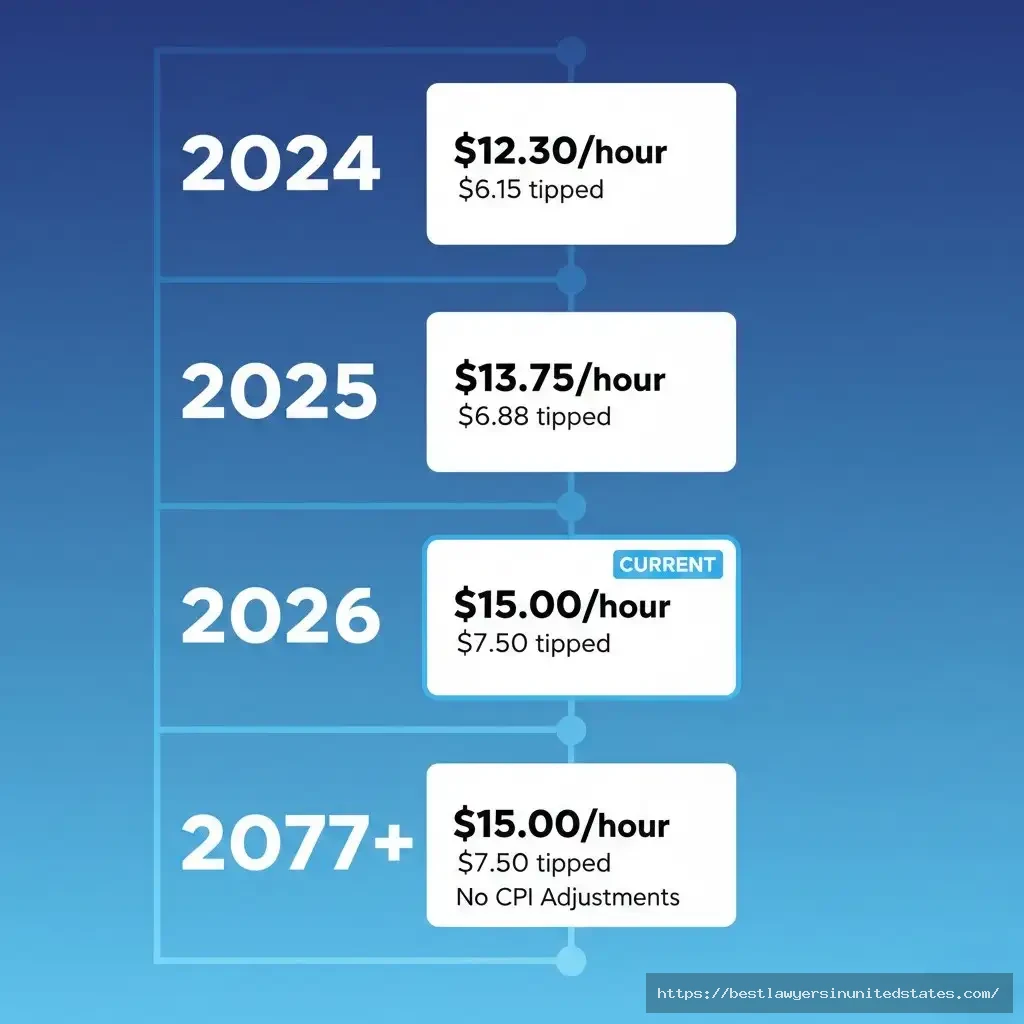
Historical Rates and Future Outlook
| Year | Standard Minimum Wage | Tipped Employee Wage | Annual Salary (Full-Time) |
|---|---|---|---|
| 2024 | $12.30/hour | $6.15/hour | $25,584/year |
| 2025 | $13.75/hour | $6.88/hour | $28,600/year |
| 2026 | $15.00/hour | $7.50/hour | $31,200/year |
| 2027+ | $15.00/hour | $7.50/hour | $31,200/year |
Key details:
- Effective date: January 1, 2026
- Legal authority: Proposition A (Missouri Constitution amendment)
- Increase amount: $1.25 per hour from 2025
- Future increases: None scheduled (CPI adjustments ended)
Full-time workers earning $15 per hour will make $31,200 annually before taxes. This assumes 40 hours per week for 52 weeks.
How Missouri Compares to Federal Law
Missouri law supersedes federal law when state rates are higher. Employers must pay the higher of the two rates. The Fair Labor Standards Act (FLSA) sets federal minimum wage at $7.25 per hour, but Missouri's $15 rate takes precedence for non-exempt workers.
| Jurisdiction | Minimum Wage | Tipped Wage | Overtime Threshold |
|---|---|---|---|
| Missouri | $15.00 | $7.50 | 40 hours/week |
| Federal | $7.25 | $2.13 | 40 hours/week |
| Difference | +$7.75 | +$5.37 | Same |
What is Proposition A?
Proposition A is a voter-approved constitutional amendment passed in November 2024. Missouri voters added this measure to the state constitution, making it harder to repeal than a standard statute. The amendment contains two major provisions that take effect January 1, 2026.
Two Key Changes in Proposition A
Provision 1: Minimum Wage Increase
- Raises minimum wage to $15.00 per hour
- Fastest single-year increase in Missouri history
- Tipped wage rises to $7.50 per hour (50% of standard minimum)
Provision 2: Earned Sick Time
- Requires 1 hour of sick time per 30 hours worked
- Annual caps: 56 hours (15+ employees) or 40 hours (<15 employees)
- Same effective date as wage increase
Why the Constitutional Amendment Matters
Constitutional amendments require another voter referendum to change. This makes Proposition A more permanent than a legislative statute. The Missouri legislature cannot simply vote to repeal or modify these provisions without returning to voters.
Legal challenges from industry groups are pending. Several business associations argue the measure violates state constitutional procedures. Courts have not yet ruled on these challenges as of late 2025.
What Ends After 2026
Governor Mike Kehoe signed legislation ending automatic Consumer Price Index (CPI) adjustments after 2026. Previous Missouri law required annual inflation-based increases. The $15 minimum wage will now remain fixed unless new legislation passes.
Impact of ending CPI adjustments:
- Wage stays at $15/hour indefinitely
- Inflation will erode purchasing power over time
- Workers need new ballot measure for future increases
- Illinois minimum wage will likely surpass Missouri's after 2026 due to continued CPI adjustments
Missouri Tipped Employee Minimum Wage 2026
Missouri requires employers to pay tipped employees $7.50 per hour starting January 1, 2026. This base wage represents 50% of the standard $15 minimum wage. Tips must bring total compensation to at least $15 per hour.
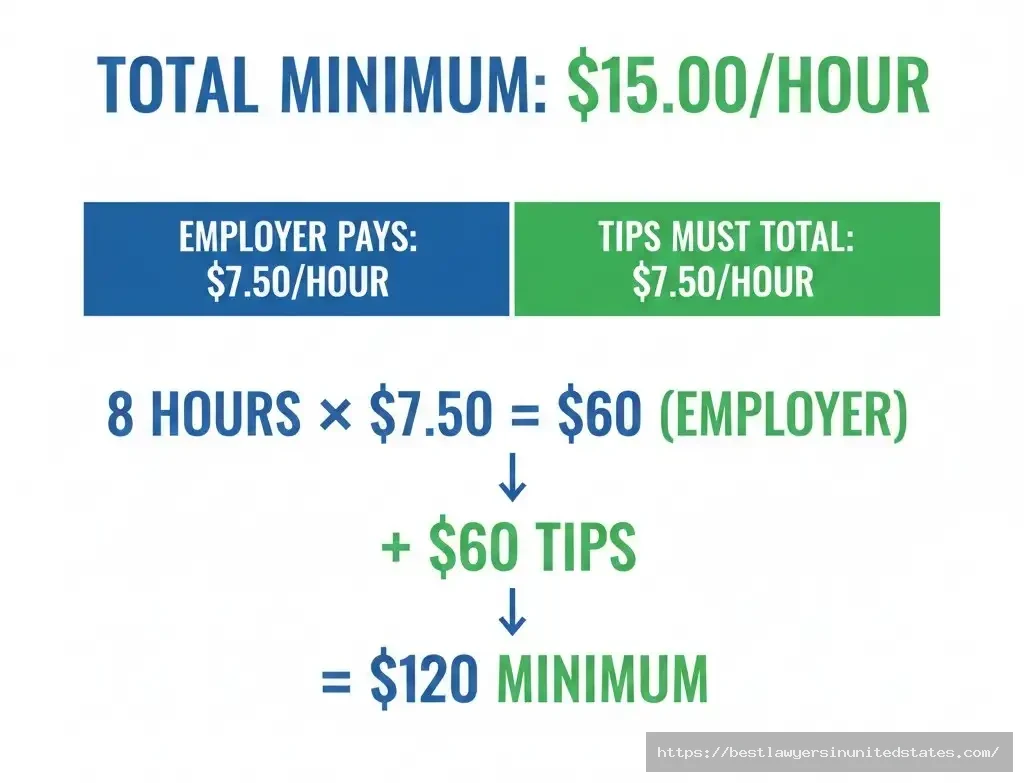
How the 50% Rule Works
Employers calculate tipped wages differently than in most states. Missouri uses a 50% calculation instead of the federal tip credit system.
Step-by-step calculation:
- Employer pays $7.50 per hour direct wages
- Employee receives tips from customers
- Tips + direct wages must equal $15 per hour minimum
- If tips fall short, employer pays the difference
Example: Server works 8 hours and earns $40 in tips.
- Direct wages: 8 hours × $7.50 = $60
- Tips received: $40
- Total compensation: $100
- Minimum required: 8 hours × $15 = $120
- Employer owes additional: $20
Who Qualifies as a Tipped Employee
Missouri law defines tipped employees as workers who customarily and regularly receive more than $30 per month in tips. This includes:
Covered positions:
- Servers, waiters, waitresses
- Bartenders
- Food runners and bussers (if customarily tipped)
- Hotel bellhops and valets
- Delivery drivers who receive tips
Not covered:
- Kitchen staff (cooks, dishwashers)
- Retail workers
- Workers who pool tips but don't directly receive them from customers
Missouri vs. Federal Tipped Wage Comparison
Missouri's tipped wage rules are more generous than federal law. The FLSA allows employers to pay just $2.13 per hour to tipped workers, with tips making up the difference to reach $7.25 total.
| Jurisdiction | Tipped Base Wage | Required Total | Tip Credit Allowed |
|---|---|---|---|
| Missouri 2026 | $7.50/hour | $15.00/hour | $7.50/hour |
| Federal | $2.13/hour | $7.25/hour | $5.12/hour |
| Difference | +$5.37/hour | +$7.75/hour | +$2.38/hour |
Missouri's 50% requirement means tipped workers always earn at least half the minimum wage before tips. This provides more income stability than the federal $2.13 base rate.
What Happens to Tips
Missouri law protects employee tips under Section 290.500, RSMo. Employers cannot take any portion of tips received by employees. Managers and supervisors cannot participate in tip pools.
Tip pooling rules:
- ✅ Allowed among customarily tipped employees
- ✅ Servers can share with bussers and bartenders
- ❌ Managers cannot receive pooled tips
- ❌ Kitchen staff cannot be required to participate
- ❌ Employers cannot take administrative fees from tips
Overtime Pay Rules in Missouri 2026
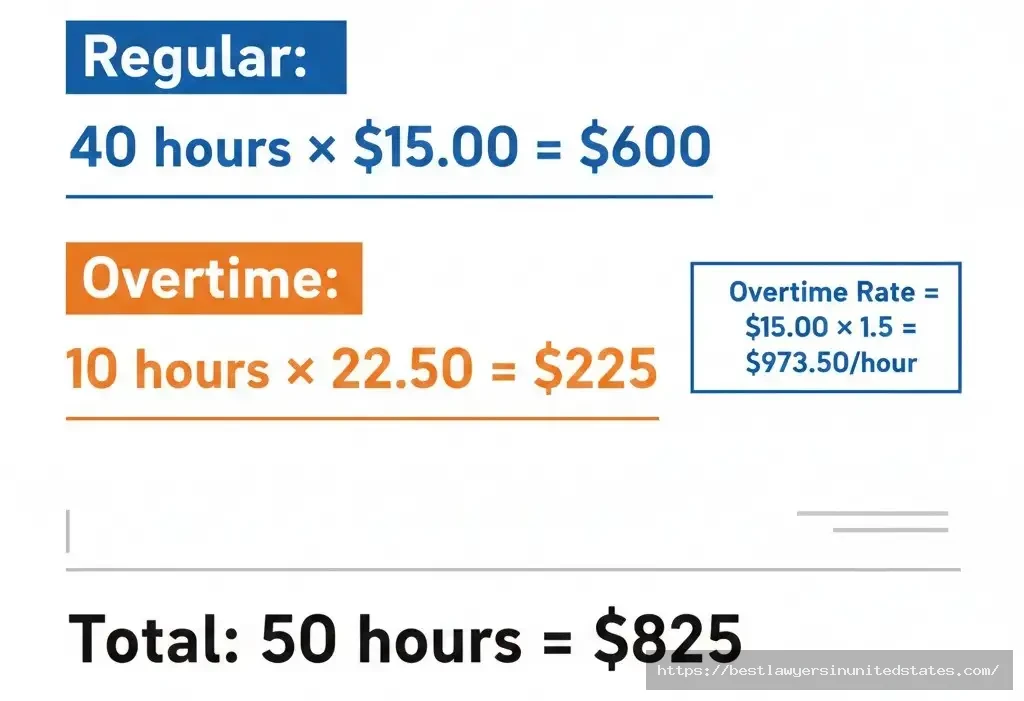
Missouri follows federal overtime standards under the FLSA. Workers earn 1.5 times their regular rate for all hours worked over 40 in a workweek. The overtime rate for minimum wage workers is $22.50 per hour in 2026.
Calculate Your Overtime Pay in Missouri
Working more than 40 hours per week? Calculate your overtime earnings based on Missouri's overtime laws. This calculator accounts for Missouri's specific overtime rules and minimum wage rates.
⏰ Overtime Pay Calculator
Calculate your overtime earnings based on your state's specific labor laws
📍 Select Your State
💰 Your Hourly Wage
📊 Calculation Method
📅 Weekly Hours
💵 Your Weekly Overtime Pay
📊 Earnings Breakdown
📅 Pay Period Estimates
⚖️ State vs Federal Comparison
Calculator features:
- Missouri-specific overtime rules
- Weekly overtime calculations
- Time-and-a-half calculations
- Pay period breakdowns
- Comparison with federal law
Full overtime calculator: Missouri Overtime Calculator
Questions about your wages or need legal help?
Email: [email protected]
Calculating Overtime for Different Worker Types
Standard minimum wage workers:
- Regular rate: $15.00/hour
- Overtime rate: $22.50/hour (1.5 × $15)
- Example: 50 hours worked = (40 × $15) + (10 × $22.50) = $825
Tipped employees:
- Regular rate: $7.50 base + tips
- Overtime rate: $11.25 base + tips (1.5 × $7.50)
- Employer must ensure total compensation meets overtime minimum
Higher-paid workers:
- Overtime rate = regular hourly rate × 1.5
- Example: $20/hour regular becomes $30/hour overtime
Who Gets Overtime Pay
Not all workers qualify for overtime. Missouri uses federal FLSA exemptions to determine which employees must receive overtime pay.
Non-exempt workers (must receive overtime):
- Hourly employees
- Salaried workers earning less than $844 per week ($43,888 annually)
- Blue-collar workers regardless of salary
- First responders (police, firefighters, paramedics)
Exempt workers (no overtime required):
- Executive employees earning $844+ per week
- Administrative employees earning $844+ per week
- Professional employees (lawyers, doctors, teachers)
- Outside sales representatives
- Certain computer employees
Weekly vs. Daily Overtime
Missouri does not require daily overtime. Some states like California minimum wage laws mandate overtime after 8 hours in a single day. Missouri only counts hours exceeding 40 in a workweek.
Missouri rules:
- Workweek = 7 consecutive 24-hour periods
- Employer defines when workweek starts
- Hours cannot be averaged across multiple weeks
- Each workweek stands alone for overtime calculation
If you believe your employer is not paying proper overtime, you have rights under Missouri labor law. Workers can file complaints with the Missouri Division of Labor Standards or pursue legal options for workplace disputes.
Missouri Minimum Wage Exemptions
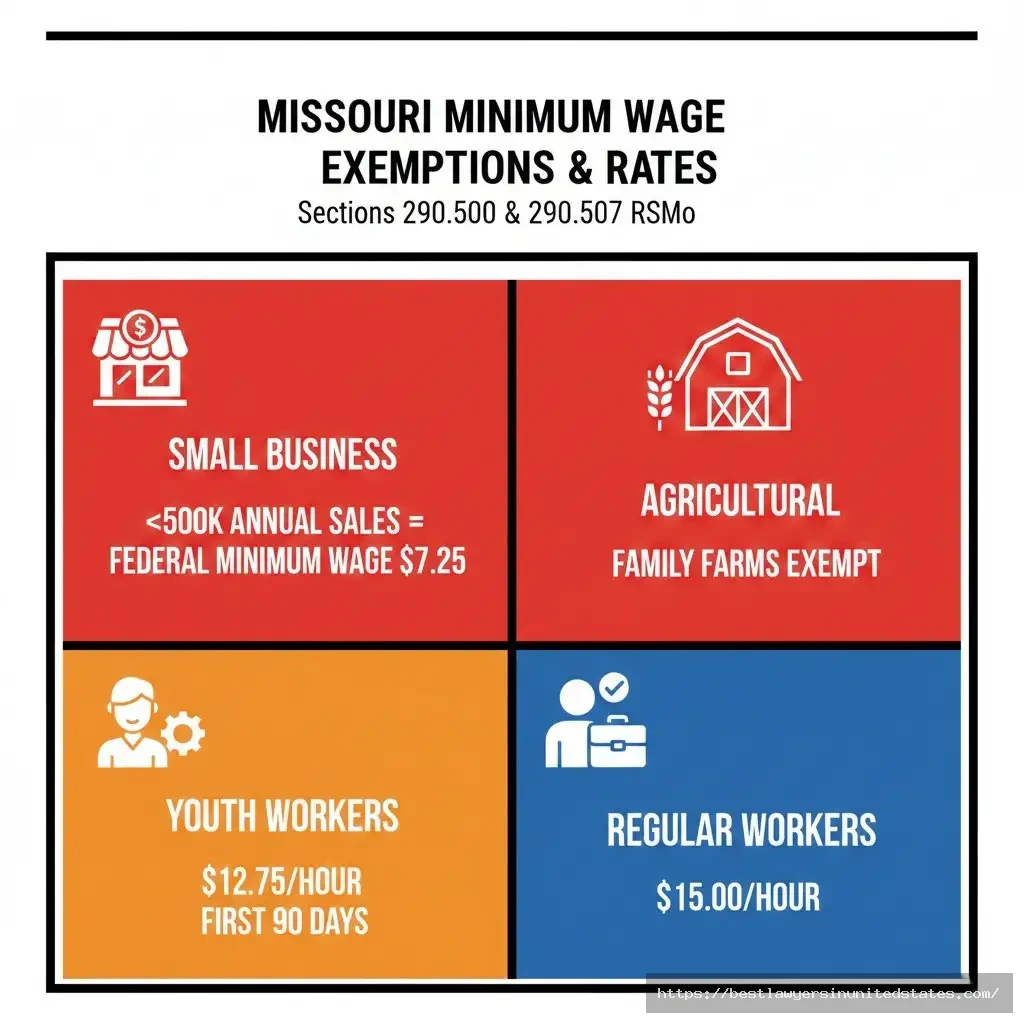
Not all Missouri workers are covered by the state's $15 minimum wage. Several exemptions exist under Missouri law. The most significant is the small business exemption for retail and service companies.
Small Business Exemption
Section 290.500(3), RSMo creates an exemption for small retail and service businesses. Companies with less than $500,000 in gross annual sales can pay the federal minimum wage of $7.25 per hour instead of Missouri's $15 rate.
Exemption criteria:
- Applies only to retail or service businesses
- Based on gross annual sales (not profits)
- All revenue counts toward $500,000 threshold
- Must be recalculated annually
Example: A small retail shop with $450,000 in annual sales can legally pay $7.25 per hour. If sales increase to $525,000 the next year, they must pay $15 per hour.
Agricultural Worker Exemptions
Section 290.507, RSMo exempts most agricultural workers from Missouri minimum wage law. This is one of Missouri's most significant exemptions.
Exempt agricultural workers:
- Immediate family members working on family farms
- Seasonal agricultural labor meeting certain conditions
- Hand harvest workers paid on piece-rate basis
- Range production of livestock workers
Not exempt:
- Year-round farm employees (unless family)
- Agricultural processing plant workers
- Nursery and greenhouse workers (some exceptions apply)
Missouri's agricultural exemptions are broader than Iowa minimum wage exemptions, which cover fewer farm workers.
Youth Worker Training Wage
Missouri allows employers to pay workers under age 20 a training wage of $12.75 per hour for their first 90 consecutive calendar days of employment. This equals 85% of the $15 minimum wage.
Training wage rules:
- Applies only to workers under 20 years old
- Limited to first 90 consecutive calendar days
- Counts from first day of employment
- Cannot displace regular employees to hire youth workers
- After 90 days, full $15/hour minimum applies
Example: A 19-year-old starts work on January 15, 2026. Their employer can pay $12.75/hour through April 14, 2026 (90 days). On April 15, the wage must increase to $15.00/hour.
Other Exempt Categories
Independent contractors:
- Not covered by minimum wage laws
- Must meet strict IRS independent contractor tests
- Misclassification can result in penalties
Professional employees:
- Lawyers, doctors, teachers, accountants
- Must earn at least $844 per week on salary basis
- Primary duties must be professional in nature
Executive and administrative employees:
- Must earn at least $844 per week salary
- Must have management or administrative duties
- Cannot perform routine manual work
Outside sales representatives:
- Primary duty is making sales away from employer's place of business
- No minimum salary requirement
- Commission-based compensation typical
Public Sector Exemption
Missouri's state minimum wage law does not apply to public employers. Government agencies at state, county, and municipal levels follow federal minimum wage standards under the FLSA.
Impact of public employer exemption:
- State employees follow state personnel policies (typically above minimum wage)
- County and city employees follow local policies
- Federal minimum wage ($7.25) is legal minimum for government workers
- Many public sector collective bargaining agreements set higher rates
Determining whether you qualify for an exemption can be complex. Review your specific situation with the Missouri Department of Labor and Industrial Relations or consult what employees should look for in employment agreements.
Missouri Sick Leave Law Under Proposition A
Proposition A creates a new earned sick time requirement starting January 1, 2026. This provision applies to all Missouri employers, with limited exemptions. Employees accrue sick time based on hours worked.
Sick Leave Accrual Rates
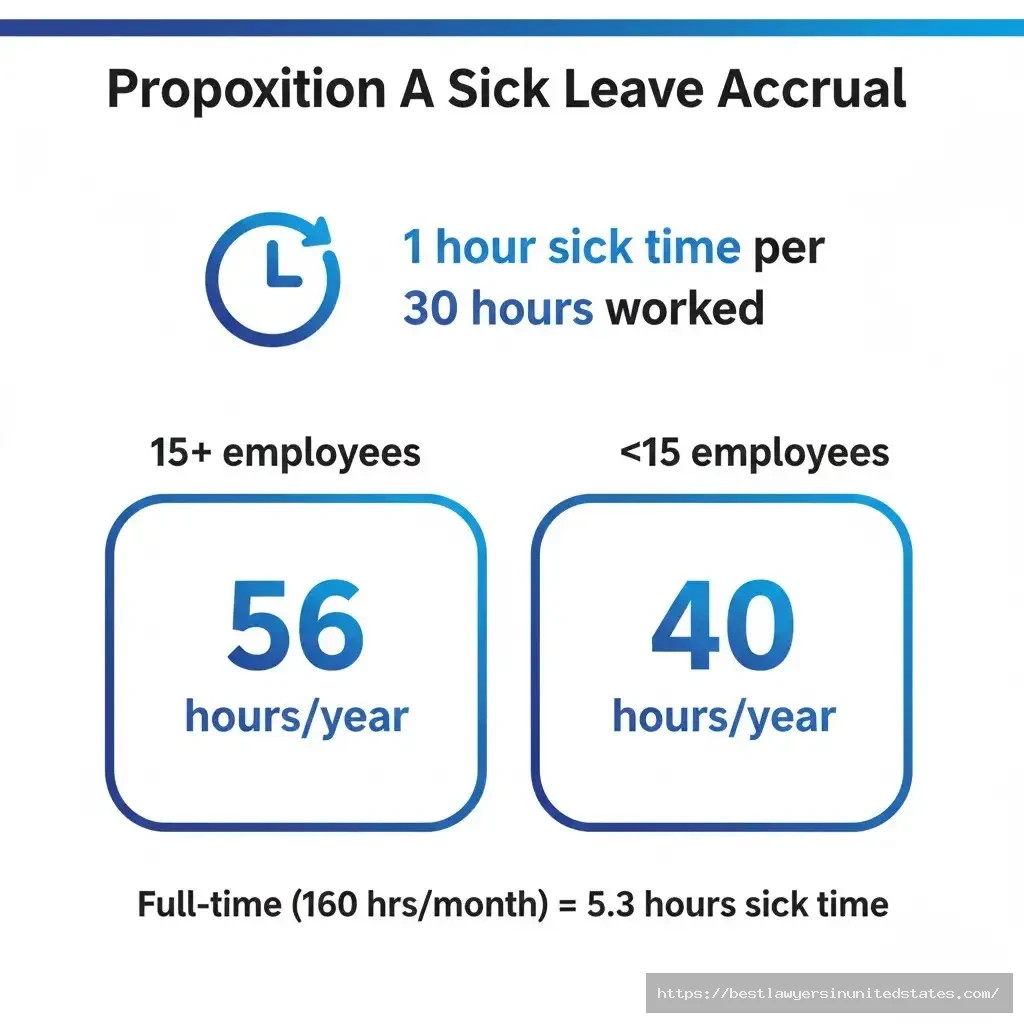
Accrual formula: 1 hour of sick time for every 30 hours worked
Employees begin accruing sick time on their first day of employment or January 1, 2026, whichever is later. Accrual happens continuously as employees work.
Annual caps by employer size:
| Employer Size | Maximum Annual Accrual | Maximum Bank |
|---|---|---|
| 15+ employees | 56 hours per year | 80 hours |
| Fewer than 15 employees | 40 hours per year | 64 hours |
Employees can carry over unused sick time to the next year, up to the maximum bank amounts. Employers are not required to pay out unused sick time upon termination.
Allowed Uses for Sick Time
Missouri law permits employees to use earned sick time for several purposes beyond personal illness.
Approved sick time uses:
- Personal physical or mental illness or injury
- Caring for family member with illness or injury
- Medical diagnosis, treatment, or preventive care
- Domestic violence, sexual assault, or stalking situations (for self or family member)
- Closure of workplace or child's school due to public health emergency
Definition of family member:
- Child (biological, adopted, foster, stepchild, legal ward)
- Parent (biological, adoptive, foster, stepparent, legal guardian)
- Spouse or domestic partner
- Grandparent
- Grandchild
- Sibling
Notice and Documentation Requirements
Employers can require reasonable notice when sick time use is foreseeable. For unforeseeable situations, employees must provide notice as soon as practicable.
Documentation rules:
- Employers can require documentation for absences exceeding 3 consecutive days
- Cannot require disclosure of health information beyond verifying legitimate use
- Cannot require doctor's note for absences of 3 days or less
- Employee is responsible for costs of obtaining documentation
Employer Prohibited Actions
Missouri law prohibits retaliation against employees who use or request earned sick time.
Prohibited employer actions:
- Denying use of earned sick time
- Disciplining employees for using sick time
- Requiring employee to find replacement worker
- Counting sick time use as absence under no-fault attendance policy
- Retaliating against employees who file complaints
Violations can result in penalties and damages payable to affected employees. Workers facing retaliation may need to consult an attorney for discrimination at work.
Exemptions from Sick Leave Law
Limited exemptions exist for specific workers and employers.
Exempt workers:
- Employees covered by collective bargaining agreement providing comparable sick leave
- Construction industry workers covered by union agreements
- Federal government employees
- Certain healthcare workers with alternative arrangements
Employer safe harbor: Employers with existing sick leave or paid time off (PTO) policies do not need to provide additional sick time if their policy meets or exceeds Proposition A requirements.
Will the Minimum Wage Increase After 2026?
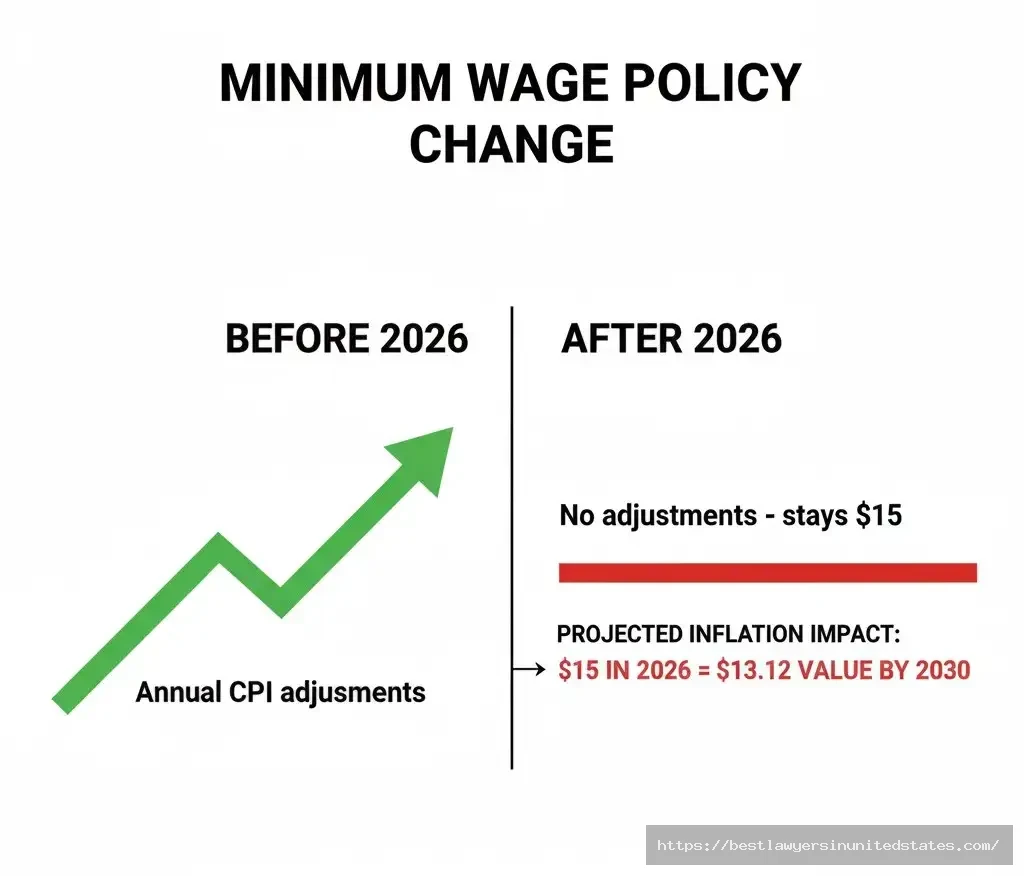
Missouri's minimum wage will not automatically increase after January 1, 2026. Governor Mike Kehoe signed legislation ending the automatic Consumer Price Index (CPI) adjustment mechanism that previously provided annual increases.
How CPI Adjustments Previously Worked
Before Proposition A, Missouri law required annual minimum wage adjustments based on inflation. The Department of Labor calculated CPI increases each year and announced new rates by October 1 for implementation the following January.
Previous process:
- U.S. Department of Labor releases annual CPI data
- Missouri calculates percentage increase
- New minimum wage announced by October 1
- Increase takes effect January 1 of next year
This system worked from 2019 through 2025, producing gradual annual increases that tracked inflation.
What Changed in 2025
The Missouri legislature passed and Governor Kehoe signed a bill specifically ending CPI adjustments after the $15 minimum wage takes effect. This was a compromise with business groups opposing Proposition A.
Key points of the change:
- Last CPI-adjusted increase: January 1, 2026 ($15.00)
- No automatic increases scheduled after 2026
- Wage remains at $15/hour unless new legislation passes
- Tipped wage remains at $7.50/hour
- Future changes require new ballot measure or legislative action
Impact on Purchasing Power
Without inflation adjustments, Missouri's $15 minimum wage will lose purchasing power over time. The table below projects this erosion assuming 3% average annual inflation.
| Year | Missouri Wage (No Adjustment) | Inflation-Adjusted Equivalent | Real Value Loss |
|---|---|---|---|
| 2026 | $15.00/hour | $15.00/hour | $0 (baseline) |
| 2027 | $15.00/hour | $15.45/hour | -$0.45/hour |
| 2028 | $15.00/hour | $15.91/hour | -$0.91/hour |
| 2029 | $15.00/hour | $16.39/hour | -$1.39/hour |
| 2030 | $15.00/hour | $16.88/hour | -$1.88/hour |
After five years without adjustment, the $15 wage would have roughly the same purchasing power as $13.12 in 2026 dollars.
How Missouri Could Increase Wages in the Future
Three pathways exist for future Missouri minimum wage increases:
Legislative action:
- State legislature passes new minimum wage bill
- Governor signs into law
- Requires political support in both chambers
- Can be overturned by future legislatures
Ballot initiative:
- Citizens gather signatures (percentage of voters required)
- Question appears on statewide ballot
- Voters approve wage increase
- Becomes constitutional amendment (harder to overturn)
- Same process used for Proposition A
Local ordinances: Currently prohibited. Missouri law preempts local minimum wage laws. Cities like Kansas City and St. Louis cannot set their own minimum wages higher than state law.
Neighboring states like Illinois continue using CPI adjustments, which will likely result in their minimum wages surpassing Missouri's within a few years.
Missouri vs. Neighboring States Minimum Wage Comparison
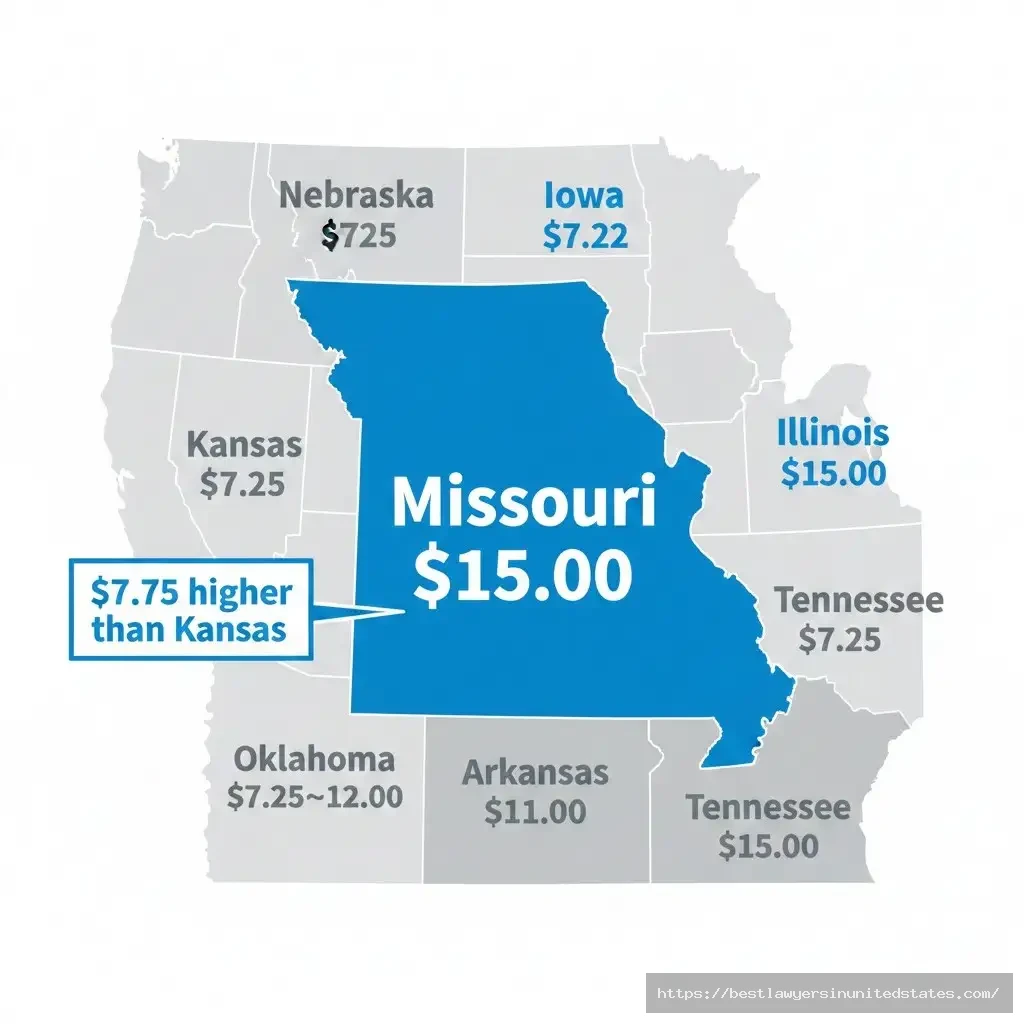
Missouri's $15 minimum wage in 2026 will be higher than most neighboring states, but this advantage may not last. Different policies on inflation adjustments and scheduled increases mean Missouri could fall behind within a few years.
Complete Border State Comparison
| State | 2026 Minimum Wage | Tipped Wage | Future Increases? | Method |
|---|---|---|---|---|
| Missouri | $15.00/hour | $7.50/hour | ❌ No | None after 2026 |
| Kansas | $7.25/hour | $2.13/hour | ❌ No | Federal minimum |
| Illinois | $15.00/hour | $9.00/hour | ✅ Yes | CPI-adjusted |
| Iowa | $7.25/hour | $4.35/hour | ❌ No | Federal minimum |
| Arkansas | $11.00/hour | $2.63/hour | ✅ Yes | Scheduled increases |
| Oklahoma | $7.25/hour | $2.13/hour | ❌ No | Federal minimum |
| Nebraska | $12.00/hour | $2.13/hour | ✅ Yes | CPI-adjusted |
| Tennessee | $7.25/hour | $2.13/hour | ❌ No | Federal minimum |
| Kentucky | $7.25/hour | $2.13/hour | ❌ No | Federal minimum |
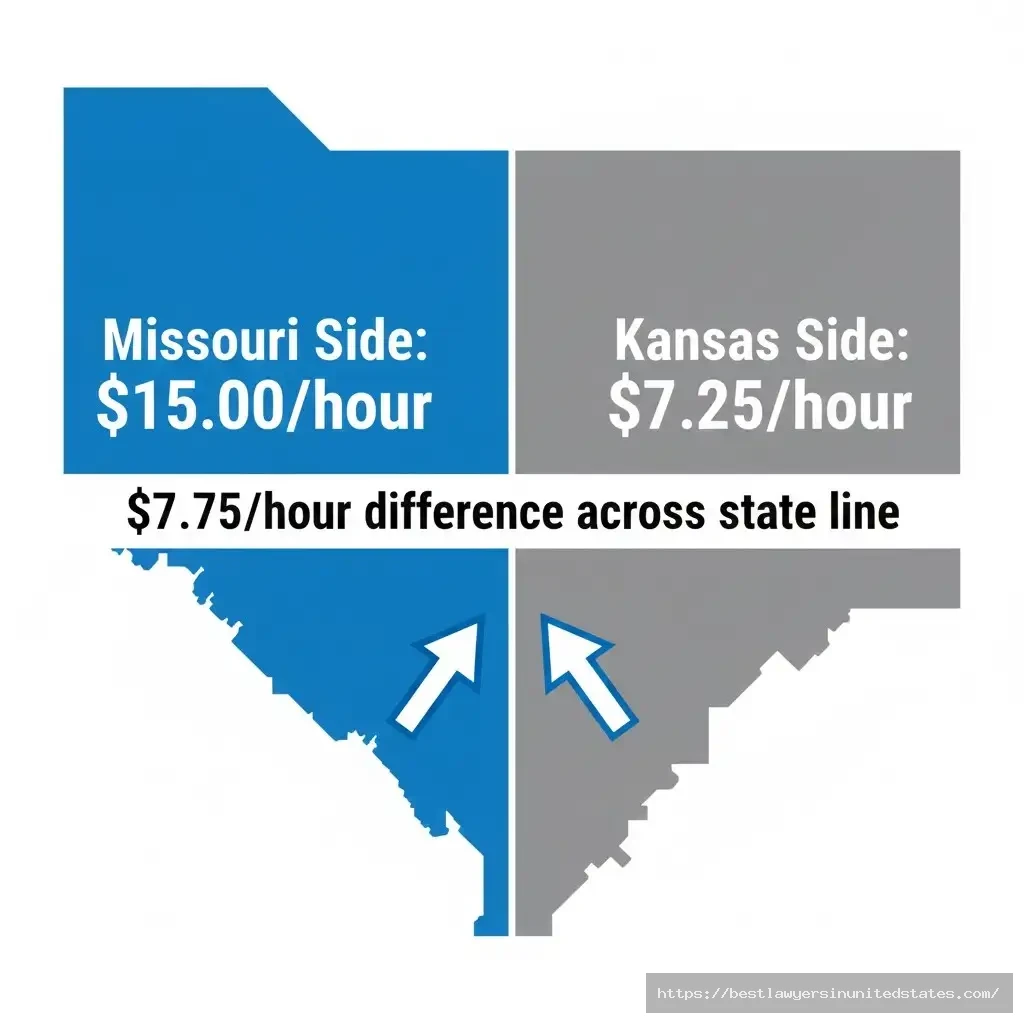
Kansas City Metro Wage Divide
Kansas City straddles the Missouri-Kansas border, creating an unusual situation where workers on different sides of State Line Road face vastly different wage standards.
Missouri side (Kansas City, MO):
- Minimum wage: $15.00/hour
- Tipped wage: $7.50/hour
- Covers most of Kansas City's urban core
Kansas side (Kansas City, KS and suburbs):
- Minimum wage: $7.25/hour (federal)
- Tipped wage: $2.13/hour (federal)
- Covers Wyandotte County and Johnson County suburbs
Wage gap: $7.75/hour difference across state line
This creates potential "wage shopping" where workers prefer Missouri-side jobs and employers may face pressure to remain competitive. Some Kansas employers near the state line may voluntarily increase wages to attract workers.
Why Illinois Will Likely Surpass Missouri
Illinois maintains CPI adjustment provisions that Missouri eliminated. Both states reach $15/hour in 2025-2026, but Illinois will continue increasing while Missouri stays flat.
Projected comparison (assuming 3% annual inflation):
| Year | Missouri | Illinois (with CPI) | Difference |
|---|---|---|---|
| 2026 | $15.00 | $15.00 | $0 |
| 2027 | $15.00 | $15.45 | -$0.45 |
| 2028 | $15.00 | $15.91 | -$0.91 |
| 2029 | $15.00 | $16.39 | -$1.39 |
| 2030 | $15.00 | $16.88 | -$1.88 |
By 2030, Illinois workers would earn nearly $2 more per hour than Missouri workers despite starting at the same point.
Kansas City and St. Louis Local Wage History
Missouri's two largest cities both attempted to implement local minimum wages higher than state standards. State legislation blocked both efforts, establishing that Missouri's statewide minimum wage supersedes all local ordinances.
Kansas City's $15 Minimum Wage Attempt (2015)
Kansas City, Missouri passed a local ordinance in August 2015 raising the city's minimum wage to $15 per hour. The increase was scheduled to phase in gradually through 2020.
Timeline of Kansas City ordinance:
- August 2015: City Council passes $15 minimum wage ordinance
- January 2016: First increase to $10/hour scheduled to take effect
- September 2015: Missouri legislature passes HB 722 preempting local wage laws
- January 2016: Kansas City ordinance blocked before implementation
The state preemption law prevented Kansas City's wage increase from ever taking effect. Supporters filed legal challenges, but courts upheld the state's authority to set uniform wage standards.
St. Louis $10 Minimum Wage (2017-2018)
St. Louis had a brief period with a local minimum wage of $10 per hour before state action rolled it back. This remains Missouri's only example of a city successfully implementing a higher local wage, albeit temporarily.
Complete timeline:
- 2015: St. Louis Board of Aldermen passes $10 minimum wage ordinance
- May 2017: $10 minimum wage takes effect in St. Louis
- June 2017: Missouri legislature passes SB 19 banning local wage ordinances
- August 2017: Governor signs SB 19 into law
- August 28, 2017: St. Louis wage rolls back to state minimum ($7.70 at the time)
Workers received $10/hour for only 3 months. The sudden rollback to $7.70 represented a significant pay cut for affected workers. Some employers voluntarily maintained the $10 rate, but most reverted to state minimums.
Current State Preemption Law
Missouri Revised Statute Section 285.055 explicitly prohibits local governments from setting minimum wages different from state standards.
Key provisions:
- Cities cannot establish minimum wage higher than state rate
- Counties cannot establish separate wage rates
- Local ordinances on wages are void and unenforceable
- State minimum wage applies uniformly across Missouri
This contrasts with states that allow local control. Some states let cities set higher minimums to address higher costs of living in urban areas.
2026 Impact on Kansas City and St. Louis
When Missouri's $15 state minimum takes effect in 2026, both Kansas City and St. Louis will follow the statewide rate. Neither city can increase wages above $15 without changes to state preemption law.
Current status:
- Kansas City minimum wage: $15.00/hour (state law)
- St. Louis minimum wage: $15.00/hour (state law)
- Both cities must follow state rate
- No local ordinances can override state standards
Residents who supported higher local wages advocated for Proposition A as the only path to increasing Missouri's minimum wage. The statewide ballot measure succeeded where local efforts failed.
What Employers Must Do Before January 1, 2026
Missouri employers have specific legal obligations before the $15 minimum wage takes effect. Failing to comply can result in penalties, back pay liability, and legal action from employees.
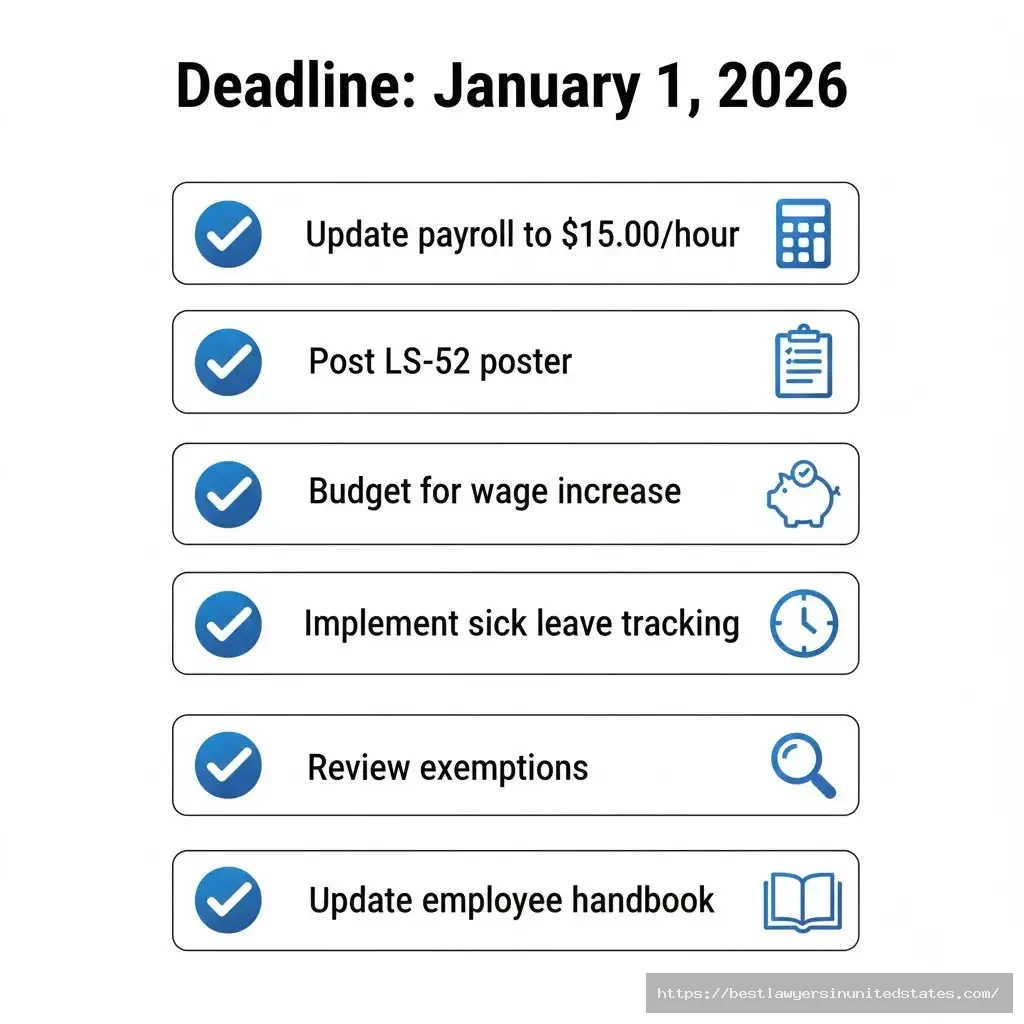
Update Payroll Systems
Required actions by December 31, 2025:
1. Adjust base pay rates
- Increase all employees earning less than $15/hour to $15/hour
- Increase tipped employee base wage to $7.50/hour
- Verify all pay rates in payroll software
- Run test payroll before January 1, 2026
2. Recalculate overtime rates
- New overtime rate: $22.50/hour (1.5 × $15)
- Tipped employee overtime: $11.25 base + tips
- Update overtime calculation formulas
- Train payroll staff on new calculations
3. Review salaried employees
- Verify exempt employee salaries meet $844/week threshold ($43,888/year)
- Reclassify employees who fall below threshold
- Determine if salary increases or reclassification to hourly makes more sense
Post Required Labor Law Posters
Missouri requires employers to display the official 2026 minimum wage poster (LS-52) in a conspicuous location where all employees can see it.
Poster requirements:
- Display LS-52 poster (2026 version)
- Post in employee common area (break room, time clock area)
- Must be visible to all employees
- Available in English (Spanish version recommended for bilingual workplaces)
- Download free from labor.mo.gov/DLS/MinimumWage
Penalties for not posting:
- Fines up to $500 per location
- Presumption against employer in wage disputes
- Evidence of willful violation in enforcement actions
Calculate Budget Impact
Employers should project increased labor costs before 2026 arrives. This allows time for budget adjustments, price changes, or operational modifications.
Sample calculation for small restaurant:
- 10 employees at current $13.75/hour
- Each works 30 hours per week average
- Wage increase: $1.25/hour
- Annual cost increase: 10 employees × 30 hours/week × 52 weeks × $1.25 = $19,500
Considerations for budget planning:
- Direct wage cost increases
- Additional payroll taxes (Social Security, Medicare)
- Workers' compensation insurance rate impacts
- Unemployment insurance tax adjustments
- Potential price increases to offset costs
Implement Sick Leave Tracking
Proposition A requires earned sick time tracking starting January 1, 2026. Employers need systems in place before the effective date.
Required systems:
- Track hours worked for each employee
- Calculate accrual (1 hour per 30 hours worked)
- Monitor annual caps (40 or 56 hours depending on employer size)
- Track sick time used
- Maintain records for 3 years
- Provide statements showing accrued and available sick time
Technology options:
- Payroll software with sick time tracking
- Time and attendance systems
- Manual tracking spreadsheets (small employers)
- Cloud-based HR platforms
Review Employee Classifications
Misclassifying employees can result in significant back pay liability. Review all worker classifications before 2026.
Independent contractors:
- Verify workers meet IRS independent contractor test
- Review degree of control employer exercises
- Analyze whether workers are in business for themselves
- Misclassified contractors may be entitled to back wages and overtime
Exempt vs. non-exempt employees:
- Verify exempt employees earn at least $844/week salary
- Confirm job duties meet exemption requirements
- Reclassify employees who don't meet both tests
- Document classification decisions
Tipped employees:
- Verify employees receive more than $30/month in tips
- Confirm tip credit calculations are correct
- Ensure employees receive at least $15/hour total compensation
- Maintain tip records for 3 years
Update Employee Handbook
Employee handbooks must reflect 2026 changes to wage and sick leave policies.
Required handbook updates:
- Minimum wage rates ($15 standard, $7.50 tipped)
- Overtime calculation methods
- Sick leave policy with accrual rates
- Allowed uses for sick time
- Notice requirements for sick time use
- Anti-retaliation policy
- Complaint procedure for wage violations
Distribute updated handbooks to all employees by January 1, 2026. Obtain signed acknowledgment forms confirming employees received the new policies.
Communicate Changes to Employees
Clear communication prevents confusion and demonstrates good faith compliance.
Communication checklist:
- Written notice of new wage rates (provide by December 2025)
- Explanation of sick leave benefits
- Information about how to request sick time
- Complaint procedure for wage issues
- Contact information for Missouri Department of Labor
- New pay stubs showing updated rates
Sample communication topics:
- "Your wages are increasing to $15/hour on January 1, 2026"
- "You will now earn 1 hour of sick time for every 30 hours worked"
- "Your first paycheck in 2026 will reflect the new rate"
How to File a Minimum Wage Complaint in Missouri
Workers who believe their employer is violating Missouri's minimum wage law can file a complaint with the Missouri Division of Labor Standards or pursue a private lawsuit. Both options are available under Missouri law.
Calculate Your Wage Theft Recovery in Missouri
Think your employer owes you money? Use our wage theft calculator to estimate how much you could recover, including unpaid wages, penalties, and interest under Missouri law.
Wage Theft Recovery Calculator
Estimate how much you can recover in unpaid wages, penalties, and damages based on your state's laws
💵 Estimated Total Recovery
💰 Unpaid Wages
⚖️ Penalties & Damages
📋 Total Summary
Calculator features:
- Multiple violation types (unpaid wages, overtime, tips)
- Missouri-specific penalties and damages
- Filing deadline tracker
- Total recovery estimate
- Next steps guidance
Full wage theft calculator: Missouri Wage Theft Calculator
Need help with unpaid wages? Contact Missouri Department of Labor or consult with an employment attorney.
Email: [email protected]
Document Your Case
Strong documentation is critical for wage complaints. Gather evidence before contacting authorities.
Essential documentation:
- Pay stubs (all periods with violations)
- Timesheets or work schedules
- Time clock records or sign-in sheets
- Employment contract or offer letter
- Employee handbook
- Written communications about wages
- Bank statements showing direct deposits
- Photos of posted schedules
- Text messages or emails about hours worked
Create a timeline:
- Dates you worked
- Hours worked each day
- Wages paid vs. wages owed
- Dates of conversations with employer about pay issues
- Any retaliation or threats received
Contact Your Employer First
Missouri law does not require employees to confront employers before filing complaints, but internal resolution may be faster.
Steps for internal resolution:
1. Request meeting with supervisor or HR
- Explain the wage discrepancy
- Bring documentation showing hours and pay
- Request correction and back pay
- Take notes during meeting
2. Submit written request
- Send email or letter documenting the issue
- Specify exact amounts owed
- Request response within specific timeframe (7-14 days reasonable)
- Keep copies of all correspondence
3. Escalate if necessary
- Contact higher management or company owner
- Reference Missouri minimum wage law requirements
- Mention Section 290.500, RSMo
- Set deadline for resolution
Some employers fix wage issues quickly when notified. Others refuse or retaliate. If internal resolution fails, proceed to formal complaint.
File with Missouri Division of Labor Standards
The Missouri Division of Labor Standards enforces state minimum wage law. Filing a complaint is free and does not require an attorney.
Contact information:
- Website: labor.mo.gov/DLS/MinimumWage
- Phone: 573-751-3403
- Mail: Missouri Division of Labor Standards, 421 East Dunklin Street, P.O. Box 449, Jefferson City, MO 65102-0449
- Email: [email protected]
Information to include in complaint:
- Your name and contact information
- Employer's legal name and business address
- Employer's phone number
- Dates of employment
- Your job title and duties
- Regular hourly rate or salary
- Hours worked (include overtime hours)
- Wages paid vs. wages owed
- Any supporting documentation
- Whether you still work for employer
What happens after filing:
1. Initial review (2-4 weeks)
- Division reviews complaint for completeness
- May request additional information
- Assigns investigator to case
2. Investigation (4-12 weeks)
- Investigator contacts employer
- Employer must provide payroll records
- Division reviews evidence from both parties
- May request interviews
3. Determination
- Division issues findings
- If violation found, orders employer to pay back wages
- Employer has right to appeal determination
4. Enforcement
- If employer doesn't pay voluntarily, Division can pursue legal action
- Division may file suit on behalf of employee
- Criminal penalties possible for willful violations
File a Private Lawsuit
Missouri law allows employees to sue employers directly for wage violations. This is called a "private right of action" under Section 290.527, RSMo.
Advantages of private lawsuit:
- Can recover liquidated damages (double back pay)
- Employer pays your attorney fees if you win
- Faster resolution than administrative process
- Can include state law and FLSA claims together
What you can recover:
- Back wages: Full amount of unpaid wages
- Liquidated damages: Additional amount equal to back wages (total = 2x back pay)
- Attorney fees: Employer pays your lawyer's fees
- Court costs: Filing fees and other litigation expenses
- Interest: On unpaid wages from due date
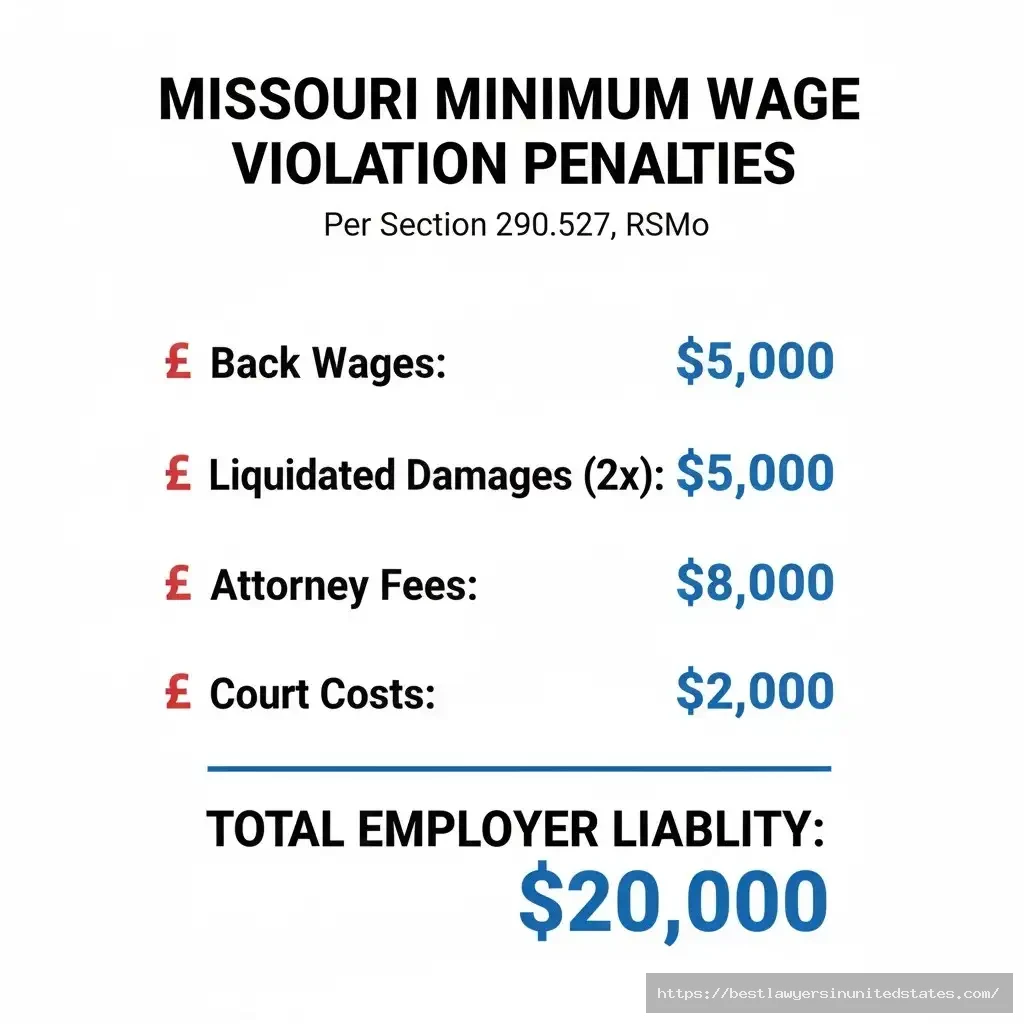
Example calculation:
- Unpaid wages: $5,000
- Liquidated damages: $5,000 (2x rule)
- Attorney fees: $8,000
- Total employer liability: $18,000+
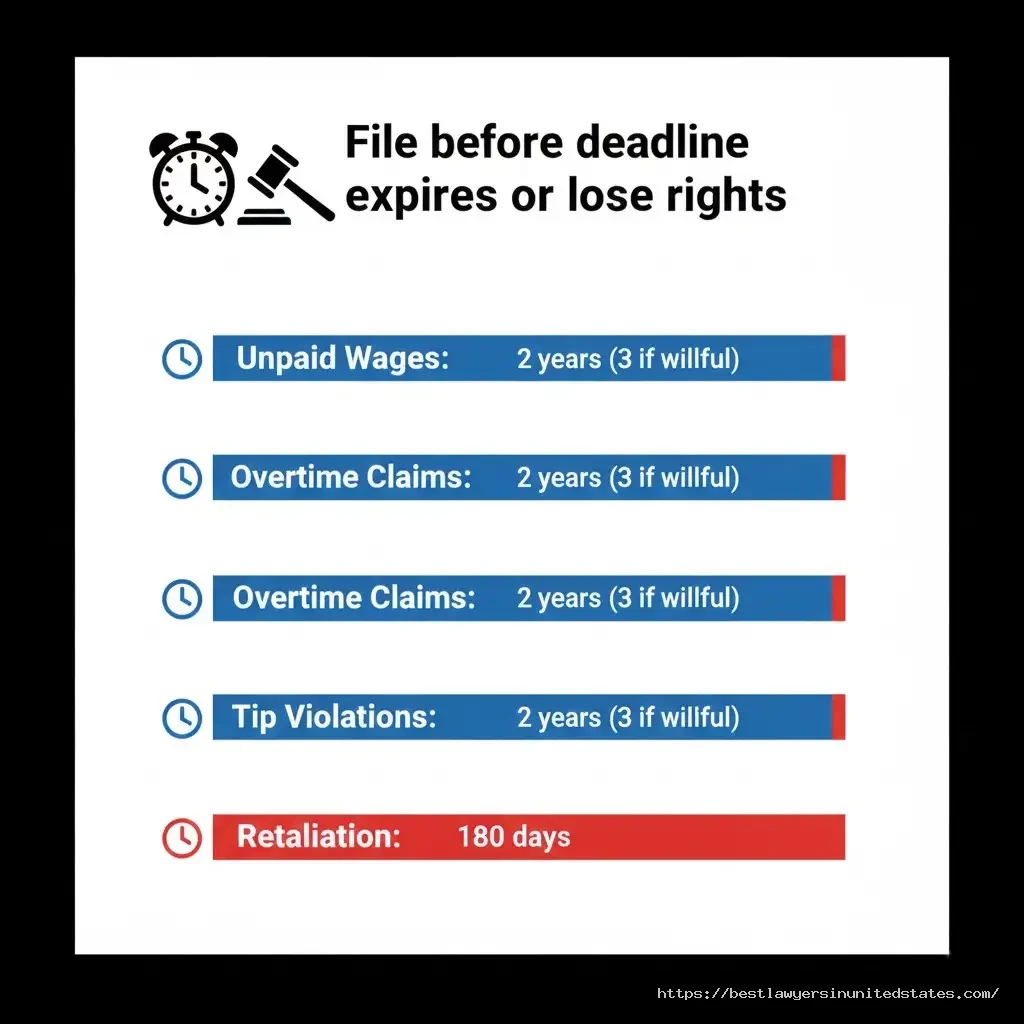
Time limits for filing:
- Missouri state law: 2 years from violation (3 years if willful)
- Federal FLSA: 2 years (3 years if willful)
- File before deadline expires or lose right to sue
Consult an employment attorney to evaluate whether filing a lawsuit makes sense for your situation. Many employment lawyers offer free consultations for wage cases.
What If You Face Retaliation
Missouri law prohibits employer retaliation against workers who assert wage rights. Retaliation is a separate violation that can result in additional damages.
Prohibited retaliation includes:
- Termination or demotion
- Reduction in hours or pay
- Unfavorable schedule changes
- Hostile work environment
- Threats or intimidation
- Blacklisting or negative references
If you experience retaliation:
- Document all retaliatory actions
- Report retaliation in your wage complaint
- Consider consulting employment attorney
- May have separate claim for retaliation damages
Missouri's retaliation protections apply whether you file a complaint with the Division of Labor Standards or pursue a private lawsuit.
Penalties for Missouri Minimum Wage Violations
Missouri law imposes significant penalties on employers who violate minimum wage requirements. Both civil and criminal penalties are possible depending on the severity and willfulness of violations.
Civil Penalties and Employee Recovery
Employee remedies under Section 290.527, RSMo:
1. Back wages
- Full amount of unpaid wages owed
- Calculated from date wages were due
- Includes difference between amount paid and amount owed
2. Liquidated damages
- Amount equal to back wages (essentially doubles recovery)
- Automatic unless employer proves good faith and reasonable grounds for violation
- Example: $3,000 back wages = $3,000 liquidated damages = $6,000 total
3. Attorney fees
- Employer pays employee's attorney fees
- Applies if employee prevails in lawsuit
- Can exceed the amount of back wages in complex cases
- Encourages attorneys to take wage cases
4. Court costs
- Filing fees
- Deposition costs
- Expert witness fees
- Other litigation expenses
Real example: An employee owed $8,000 in unpaid wages sues employer. Employee wins case. Employer must pay:
- Back wages: $8,000
- Liquidated damages: $8,000
- Attorney fees: $12,000
- Court costs: $2,000
- Total: $30,000
Administrative Penalties
The Missouri Division of Labor Standards can impose penalties independent of employee recovery.
Division penalties:
- Up to $500 per violation for first offense
- Up to $1,000 per violation for repeat offenses
- Each pay period can constitute separate violation
- Additional penalties for failure to post required notices
- Penalties payable to state, not employee
Criminal Penalties
Willful minimum wage violations can result in criminal charges under Missouri law.
Criminal sanctions:
- Class C misdemeanor for willful violations
- Fines up to $1,000 per violation
- Possible jail time up to 15 days for repeat offenders
- Criminal record consequences for owners/managers
"Willful" defined:
- Knowing violation of law
- Reckless disregard of requirements
- Pattern of violations after notice
- Deliberate misclassification of employees
Criminal charges are rare but possible in egregious cases involving systematic wage theft affecting many workers.
Business Consequences Beyond Legal Penalties
Wage violations create risks beyond direct legal liability.
Reputational damage:
- News coverage of wage theft cases
- Social media criticism
- Difficulty attracting quality employees
- Lost customers due to negative publicity
Regulatory consequences:
- Department of Labor investigations of all business practices
- Increased scrutiny of tax filings
- Workers' compensation audits
- OSHA inspections triggered by wage complaints
Class action risk:
- Multiple employees joining single lawsuit
- Exponentially higher damages
- Legal fees for defending class action
- Settlement pressure due to aggregate exposure
Example: Restaurant underpaying 30 tipped employees by $2/hour for 2 years.
- Per employee back wages: $8,000
- 30 employees × $8,000 = $240,000 back wages
- Liquidated damages: $240,000
- Attorney fees: $150,000
- Total exposure: $630,000+
Statute of Limitations
Missouri employees have time limits for filing wage claims. Missing these deadlines eliminates legal remedies.
| Claim Type | Missouri Statute | Federal FLSA | Notes |
|---|---|---|---|
| Unpaid minimum wage | 2 years | 2 years | 3 years if willful |
| Unpaid overtime | 2 years | 2 years | 3 years if willful |
| Tip violations | 2 years | 2 years | 3 years if willful |
| Retaliation | 180 days to EEOC | N/A | Different process |
"Willful" violations extend limitations:
- Knowing violation of law
- Increases filing period to 3 years
- Employee must prove willfulness
- Higher damages but harder to prove
File claims before deadlines expire. Consult employment attorney if deadline is approaching.
Frequently Asked Questions
What Is Missouri's Minimum Wage in 2026?
Quick answer: Missouri's minimum wage is $15.00 per hour starting January 1, 2026, which is $7.75 higher than the federal minimum wage of $7.25.
This rate applies to all private employers except those meeting specific exemptions. Tipped employees must receive $7.50 per hour plus tips totaling $15.00 per hour.
When Does the $15 Minimum Wage Start in Missouri?
Quick answer: The $15.00 per hour minimum wage takes effect January 1, 2026 at 12:00 AM.
Employers must begin paying the new rate with the first pay period starting on or after January 1, 2026. Most employees will see the increase in their first paycheck of 2026.
What Is the Tipped Minimum Wage in Missouri for 2026?
Quick answer: Tipped employees in Missouri must receive $7.50 per hour in direct wages starting January 1, 2026, plus tips bringing total compensation to at least $15.00 per hour.
Missouri requires employers to pay tipped workers 50% of the standard minimum wage. If tips don't bring total compensation to $15 per hour, employers must make up the difference.
Will Missouri's Minimum Wage Increase After 2026?
Quick answer: No. Missouri's minimum wage will remain at $15.00 per hour after 2026 unless new legislation passes, because Governor Mike Kehoe ended automatic inflation adjustments.
Previously, Missouri adjusted minimum wage annually based on the Consumer Price Index. That mechanism ends after the 2026 increase takes effect.
Do Small Businesses Have to Pay $15 Minimum Wage?
Quick answer: Retail and service businesses with less than $500,000 in gross annual sales can pay the federal minimum wage of $7.25 per hour instead of Missouri's $15.00 rate.
This exemption under Section 290.500(3), RSMo applies only to small retail and service businesses. Calculate gross sales annually to determine if your business qualifies.
How Much Is $15 Per Hour Annually?
Quick answer: An employee earning $15.00 per hour working full-time (40 hours per week for 52 weeks) makes $31,200 per year before taxes.
Part-time calculations: 20 hours/week = $15,600/year; 30 hours/week = $23,400/year; 35 hours/week = $27,300/year.
Does Missouri's $15 Minimum Wage Apply to Kansas City?
Quick answer: Yes, Missouri's $15.00 per hour minimum wage applies to Kansas City, Missouri, but NOT to Kansas City, Kansas, which follows federal minimum wage of $7.25 per hour.
State law supersedes all local ordinances. The Kansas side of Kansas City follows Kansas minimum wage laws, while the Missouri side follows Missouri law.
Can Employers Pay Less Than Minimum Wage in Missouri?
Quick answer: Only if specific exemptions apply: small businesses under $500,000 sales, agricultural workers under Section 290.507 RSMo, or youth workers in first 90 days.
Independent contractors and certain professional employees are also exempt. Misclassifying employees to avoid minimum wage is illegal and can result in penalties.
What Is Missouri's New Sick Leave Law?
Quick answer: Proposition A requires employers to provide 1 hour of earned sick time for every 30 hours worked, with annual caps of 40-56 hours depending on employer size, effective January 1, 2026.
Employees can use sick time for personal illness, caring for sick family members, medical appointments, or situations involving domestic violence or sexual assault.
How Do I Report Minimum Wage Violations in Missouri?
Quick answer: File a complaint with Missouri Division of Labor Standards at labor.mo.gov/DLS/MinimumWage or call 573-751-3403. You can also hire an attorney to file a private lawsuit.
Employees have 2 years to file wage claims (3 years for willful violations). Employers cannot retaliate against workers who file complaints.
How Do I Calculate My Earnings at Missouri Minimum Wage?
Quick answer: Use our minimum wage calculator to instantly calculate weekly, monthly, and annual earnings based on hours worked at $15 per hour.
The calculator automatically applies Missouri's 2026 rates and includes overtime calculations for hours exceeding 40 per week.
How Much Overtime Pay Am I Entitled to in Missouri?
Quick answer: Missouri overtime rate is 1.5 times your regular rate for all hours over 40 per week. At minimum wage, overtime is $22.50 per hour in 2026.
Use our overtime calculator to calculate exact overtime earnings based on your regular rate and hours worked.
How Do I Calculate Wage Theft Recovery in Missouri?
Quick answer: Use our wage theft calculator to estimate total recovery including unpaid wages, liquidated damages (2x back pay), and potential attorney fees.
Missouri law allows employees to recover double their back wages plus attorney fees when employers violate minimum wage or overtime requirements.
Final Thoughts on Missouri's 2026 Minimum Wage
Missouri's jump to $15 per hour represents one of the fastest minimum wage increases in state history. Proposition A's passage shows strong voter support for higher wages, even as the end of CPI adjustments creates uncertainty about future increases.
Both workers and employers face significant changes on January 1, 2026. Employees should verify they receive correct wages and earned sick time. Employers must update systems, post required notices, and comply with both wage and sick leave provisions.
The wage gap between Missouri and neighboring states like Kansas and Iowa will widen dramatically in 2026. However, states like Illinois that maintain inflation adjustments may eventually surpass Missouri's fixed $15 rate.
Questions about Missouri's minimum wage law should be directed to the Missouri Department of Labor and Industrial Relations. Workers experiencing wage violations can file complaints with the Division of Labor Standards or consult employment attorneys.
Missouri Department of Labor Resources:
- Website: labor.mo.gov/DLS/MinimumWage
- Phone: 573-751-3403
- Email: [email protected]
- Address: 421 East Dunklin Street, P.O. Box 449, Jefferson City, MO 65102-0449
For legal assistance with wage issues, contact: [email protected]