
Kentucky’s minimum wage is $7.25 per hour in 2026, matching the federal minimum wage. The state has no separate minimum wage law, so all workers receive the federal rate. This guide explains Kentucky’s wage laws, tipped worker rules, overtime requirements, and your rights as an employee.
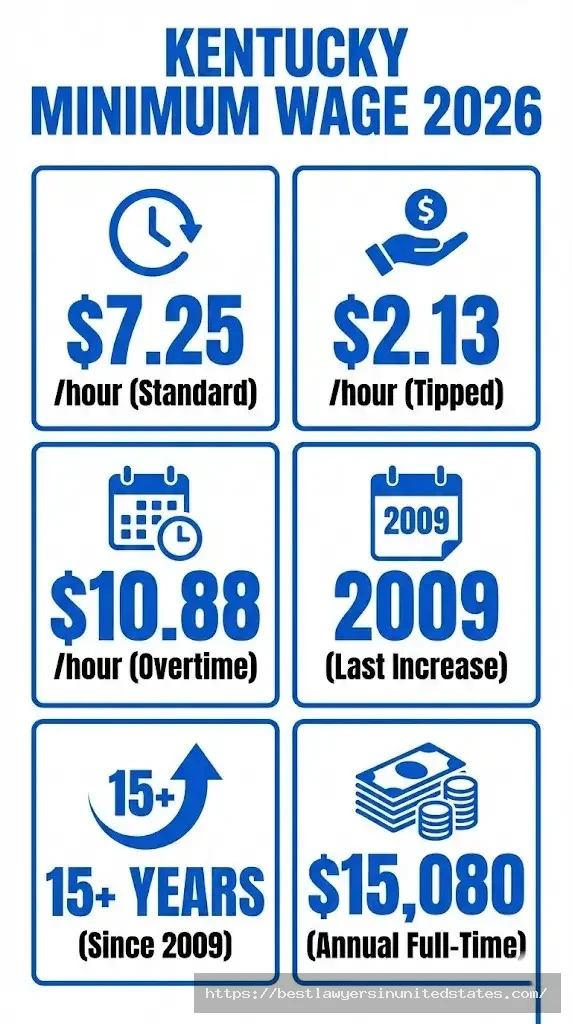
Quick Facts: Kentucky Minimum Wage 2026
| Category | Rate | Notes |
|---|---|---|
| Minimum Wage | $7.25/hour | Follows federal rate |
| Tipped Minimum | $2.13/hour | Plus tips to reach $7.25 |
| Overtime Rate | $10.88/hour | 1.5x after 40 hours/week |
| Annual Salary (Full-Time) | $15,080/year | 40 hours/week × 52 weeks |
| Last Increase | July 24, 2009 | 15+ years ago |
| 2026 Increase | None scheduled | No change planned |
Calculate Your Earnings in Kentucky
Want to know exactly how much you’ll earn at Kentucky’s $7.25 minimum wage? Use our free calculator to estimate your weekly, monthly, and annual income based on your hours worked.
💰 Minimum Wage Earnings Calculator
Calculate your weekly, monthly, and annual earnings with overtime and tax estimates
📊 Your Earnings Breakdown
💰 Gross Earnings
Calculator features:
- Automatic Kentucky wage rates for 2026
- Weekly, monthly, and annual earnings
- Overtime calculations
- Tax withholding estimates
- Take-home pay breakdown
Questions about your wages or need legal help?
Email: [email protected]
What Is the Minimum Wage in Kentucky?
Quick Answer: Kentucky's minimum wage is $7.25 per hour in 2026, the same as the federal minimum wage.
Kentucky does not have a state-specific minimum wage law. Under Kentucky Revised Statutes (KRS) Chapter 337, workers receive the federal minimum wage established by the Fair Labor Standards Act (FLSA). This applies to all employers with two or more employees.
Why Kentucky Follows Federal Minimum Wage
Kentucky's labor laws default to federal standards under KRS 337.010. The state legislature has not passed separate minimum wage legislation. This means Kentucky workers have received the same $7.25 hourly rate since July 24, 2009.
Key point: If you work in Kentucky, your employer must pay at least $7.25 per hour. No exceptions exist for small businesses or training periods.
Full-Time Annual Earnings at Kentucky Minimum Wage
A full-time worker earning Kentucky's minimum wage makes:
- Weekly: $290 (40 hours × $7.25)
- Monthly: $1,257 (4.33 weeks × $290)
- Annually: $15,080 (52 weeks × $290)
This annual income falls below the federal poverty guideline of $15,060 for a single person and well below the $20,440 threshold for a two-person household. Many Kentucky workers struggle to cover basic expenses like rent, food, and healthcare on minimum wage alone.
Recent analysis: A LEX 18 investigation found that Kentucky's minimum wage now sits below the federal poverty line when adjusted for inflation, creating financial hardship for thousands of workers across the state.
Kentucky Tipped Minimum Wage for Servers and Restaurant Workers
Quick Answer: Kentucky's tipped minimum wage is $2.13 per hour, but employers must ensure tips plus base pay equal at least $7.25 per hour.
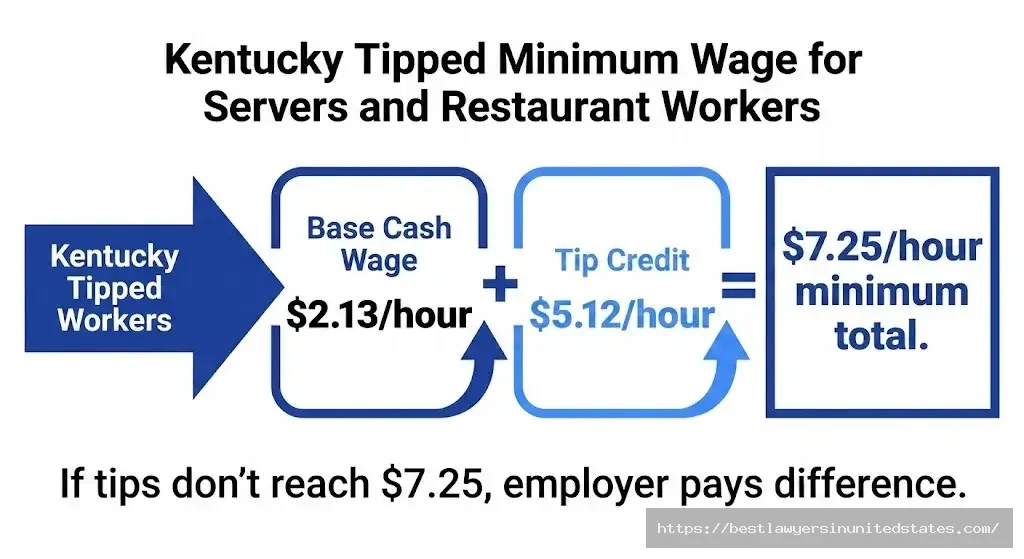
Kentucky follows federal tipped employee rules under the FLSA. Restaurant servers, bartenders, and other tipped workers can be paid a lower base wage if tips make up the difference.
How Kentucky's Tip Credit System Works
Kentucky employers can claim a tip credit of up to $5.12 per hour. This means:
| Component | Amount |
|---|---|
| Base Cash Wage | $2.13/hour (minimum) |
| Tip Credit | $5.12/hour (maximum) |
| Total Minimum | $7.25/hour |
Your employer must track your tips. If your tips plus $2.13 base wage don't reach $7.25 per hour, your employer must pay the difference.
Who Qualifies as a Tipped Employee in Kentucky?
Kentucky law defines tipped employees as workers who regularly receive more than $30 per month in tips. This includes:
- Restaurant servers and waitstaff
- Bartenders
- Food delivery drivers
- Hotel bellhops and valets
- Hair stylists and barbers
- Casino dealers
Common Tipped Worker Violations in Kentucky
Watch for these illegal practices:
- ❌ Paying only $2.13 without making up shortfalls
- ❌ Requiring tip pooling with managers or kitchen staff
- ❌ Taking any portion of employee tips
- ❌ Not informing workers about tip credit rules
- ❌ Counting non-tipped duties toward tip credit hours
If you work more than 20% of your time on non-tipped tasks (like cleaning or prep work), your employer cannot claim the full tip credit for those hours.
Tip Pooling Rules in Kentucky
Kentucky allows voluntary tip pooling among tipped employees. Legal tip sharing:
- ✅ Servers can share tips with bartenders
- ✅ Busser and host staff can participate
- ✅ Food runners can receive pooled tips
Illegal tip sharing:
- ❌ Managers and supervisors cannot participate
- ❌ Kitchen staff cannot share tips (unless no tip credit claimed)
- ❌ Employers cannot take any tips for "house"
Questions about your wages or need legal help?
Email: [email protected]
Kentucky Overtime Laws and Pay Requirements
Quick Answer: Kentucky requires overtime pay at 1.5 times your regular rate for hours worked over 40 in a workweek.
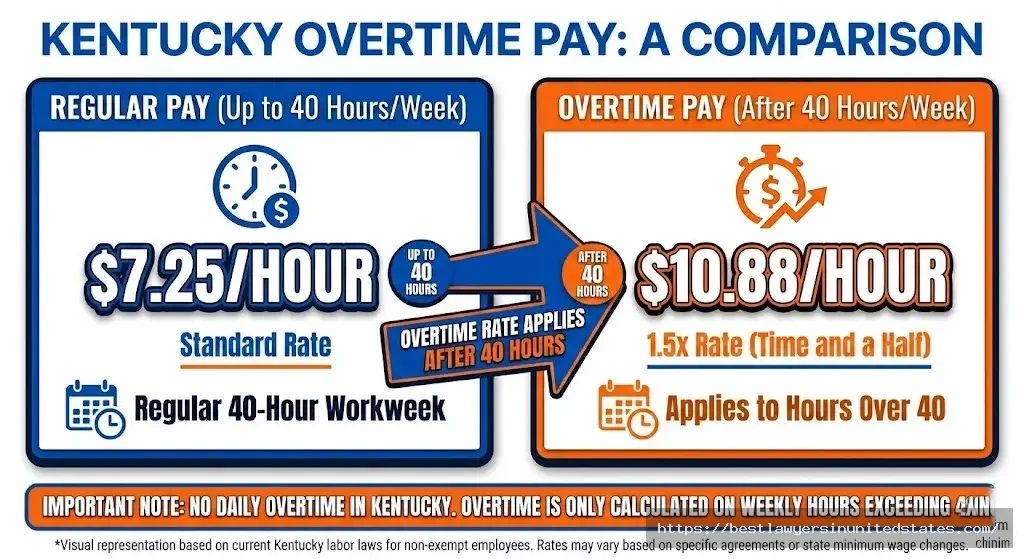
Kentucky follows federal overtime rules under the FLSA and KRS 337.285. There is no daily overtime requirement in Kentucky, only weekly.
Kentucky Overtime Rate Calculation
For minimum wage workers:
- Regular rate: $7.25/hour
- Overtime rate: $10.88/hour (1.5 × $7.25)
For tipped workers:
- Regular rate: $7.25/hour (including tips)
- Overtime rate: $10.88/hour (1.5 × $7.25)
Your overtime calculation uses your full minimum wage, not just the $2.13 base rate.
When Does Overtime Apply in Kentucky?
You earn overtime pay when you work:
- More than 40 hours in a single workweek
- A workweek runs seven consecutive 24-hour periods
Kentucky does NOT require overtime for:
- Working more than 8 hours in a single day
- Working weekends or holidays
- Working a 7th consecutive day (unless over 40 hours total)
| Hours Worked | Regular Pay | Overtime Pay | Total Weekly Pay |
|---|---|---|---|
| 40 hours | $290.00 | $0 | $290.00 |
| 45 hours | $290.00 | $54.40 | $344.40 |
| 50 hours | $290.00 | $108.80 | $398.80 |
| 60 hours | $290.00 | $217.60 | $507.60 |
Calculate Your Overtime Pay in Kentucky
Working more than 40 hours per week? Calculate your overtime earnings based on Kentucky's overtime laws.
⏰ Overtime Pay Calculator
Calculate your overtime earnings based on your state's specific labor laws
📍 Select Your State
💰 Your Hourly Wage
📊 Calculation Method
📅 Weekly Hours
💵 Your Weekly Overtime Pay
📊 Earnings Breakdown
📅 Pay Period Estimates
⚖️ State vs Federal Comparison
Calculator features:
- Kentucky-specific overtime rules
- Weekly overtime calculations
- Pay period breakdowns
- Comparison with federal law
Who Is Exempt from Kentucky Overtime Laws?
Not all workers qualify for overtime pay. Common exemptions include:
Executive Exemption:
- Primary duty: Managing the business or a department
- Supervises at least two full-time employees
- Has authority to hire/fire or make recommendations
- Earns at least $684 per week ($35,568 annually)
Administrative Exemption:
- Performs office or non-manual work
- Exercises independent judgment on significant matters
- Earns at least $684 per week
Professional Exemption:
- Work requires advanced knowledge in a field of science or learning
- Knowledge acquired through prolonged specialized education
- Earns at least $684 per week
Other exempt categories:
- Outside sales employees
- Certain computer professionals earning $684/week or $27.63/hour
- Highly compensated employees earning over $107,432 annually
Compensatory Time for Government Employees
Kentucky government employers can offer compensatory time off instead of overtime pay under KRS 337.285. Rules for comp time:
- Must be at 1.5 hours for each overtime hour worked
- Maximum 240 hours accrual (160 for public safety)
- Employee can request cash payout
- Not available for private sector workers
Questions about your wages or need legal help?
Email: [email protected]
Is Kentucky's Minimum Wage a Livable Wage?
Quick Answer: No. Kentucky's $7.25 minimum wage falls far short of a livable wage, which experts estimate at $15-18 per hour depending on location.
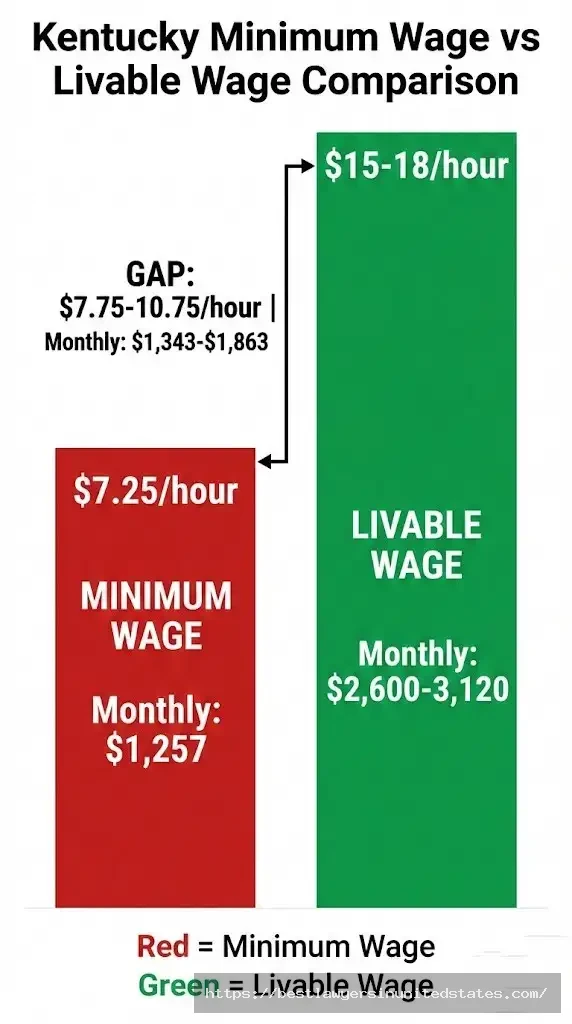
A full-time minimum wage worker in Kentucky earns $15,080 annually before taxes. This income level creates significant financial strain for individuals and families across the state.
Cost of Living Reality in Kentucky
Monthly expenses for a single adult in Kentucky (2026):
| Expense Category | Monthly Cost |
|---|---|
| Rent (1-bedroom) | $700-900 |
| Utilities | $150-200 |
| Food | $300-400 |
| Transportation | $200-300 |
| Healthcare | $150-250 |
| Other Essentials | $200-300 |
| Total | $1,700-2,350 |
Monthly income at minimum wage: $1,257 (before taxes)
The math doesn't work. Even for a single person with no dependents, Kentucky's minimum wage leaves workers unable to afford basic necessities.
Livable Wage Estimates by Kentucky City
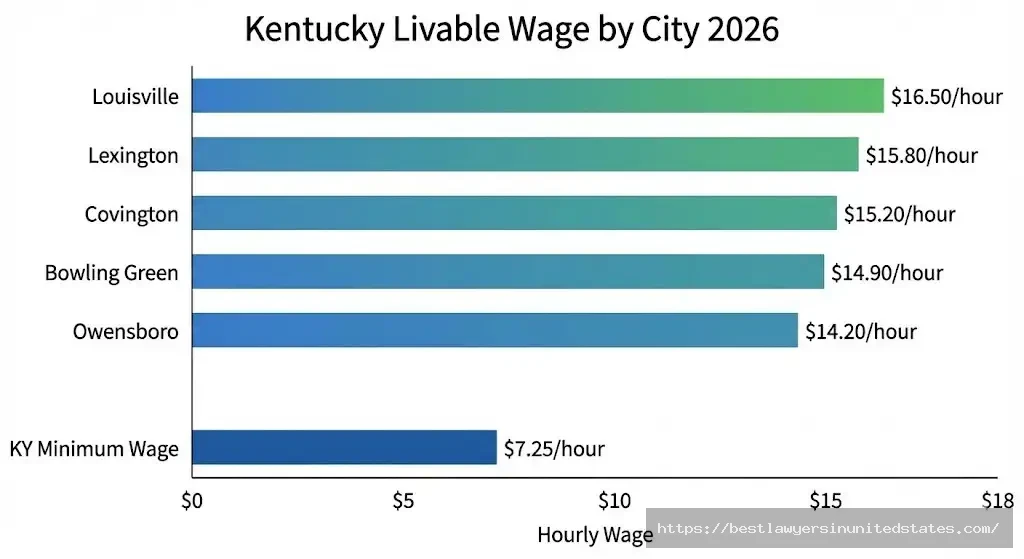
What you actually need to earn in major Kentucky cities:
| City | Livable Wage (Single Adult) | Livable Wage (Adult + 1 Child) |
|---|---|---|
| Louisville | $16.50/hour | $32.40/hour |
| Lexington | $15.80/hour | $30.60/hour |
| Bowling Green | $14.90/hour | $28.80/hour |
| Covington | $15.20/hour | $29.50/hour |
| Owensboro | $14.20/hour | $27.40/hour |
The gap is massive. Even in Kentucky's most affordable cities, workers need more than double the current minimum wage to cover basic expenses.
Comparing Kentucky to the Federal Poverty Line
The federal poverty guideline for 2026 sets the threshold at $15,060 for one person and $20,440 for two people. A full-time minimum wage worker in Kentucky:
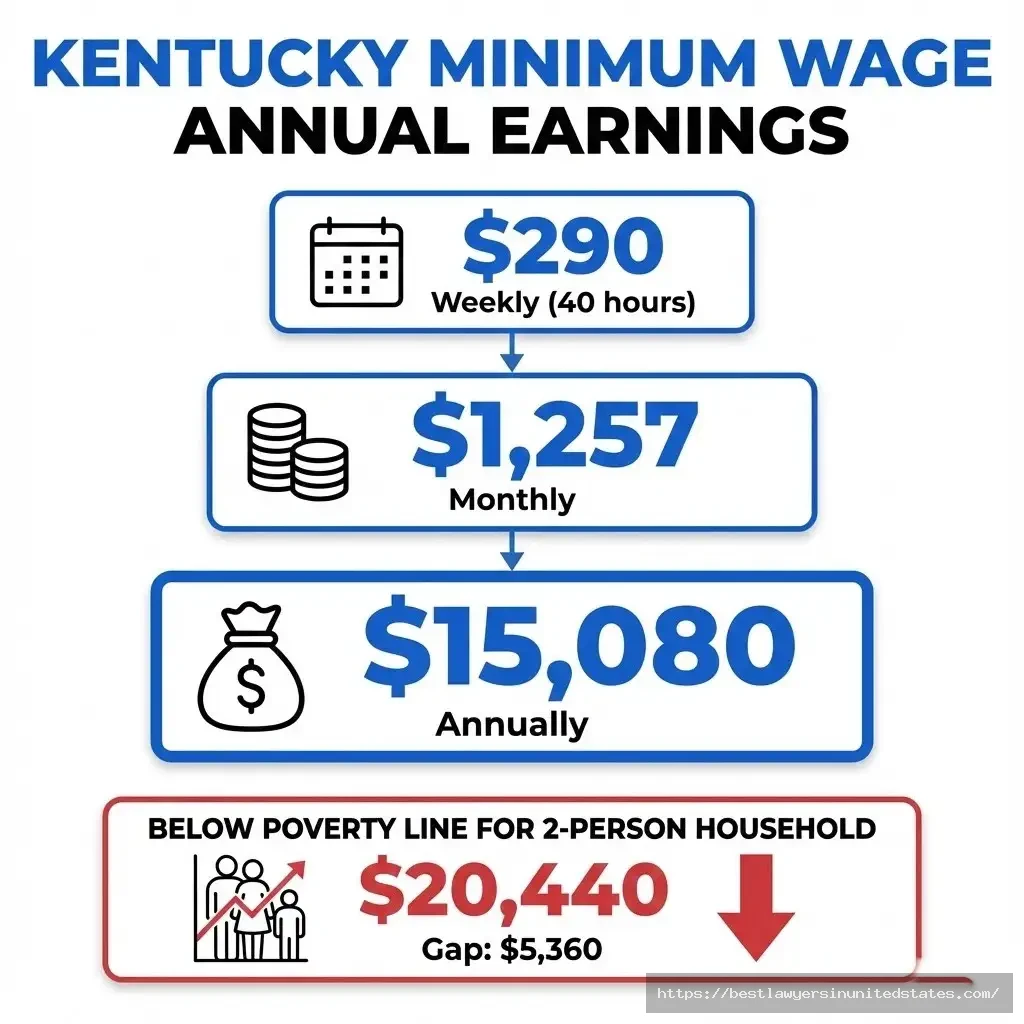
- Earns $15,080 annually
- Barely exceeds the poverty line for one person
- Falls $5,360 below the poverty line for a household of two
If you have any dependents, minimum wage automatically puts you below the poverty line. This affects housing assistance, food stamps, Medicaid eligibility, and other support programs.
Middle Class Income in Kentucky
What qualifies as middle class in Kentucky?
- Single adult: $35,000-70,000 annually
- Family of four: $65,000-130,000 annually
At minimum wage, you would need to work 4.8 jobs simultaneously to reach middle class status. This highlights the stark disconnect between Kentucky's wage floor and economic reality.
Perspective: Workers in Illinois earn $15 per hour minimum wage, more than double Kentucky's rate. Many Kentucky residents near the border consider crossing state lines for better-paying work.
Kentucky Minimum Wage History: Why It Hasn't Changed Since 2009
Quick Answer: Kentucky's minimum wage has remained at $7.25 since July 24, 2009, when the last federal increase took effect.
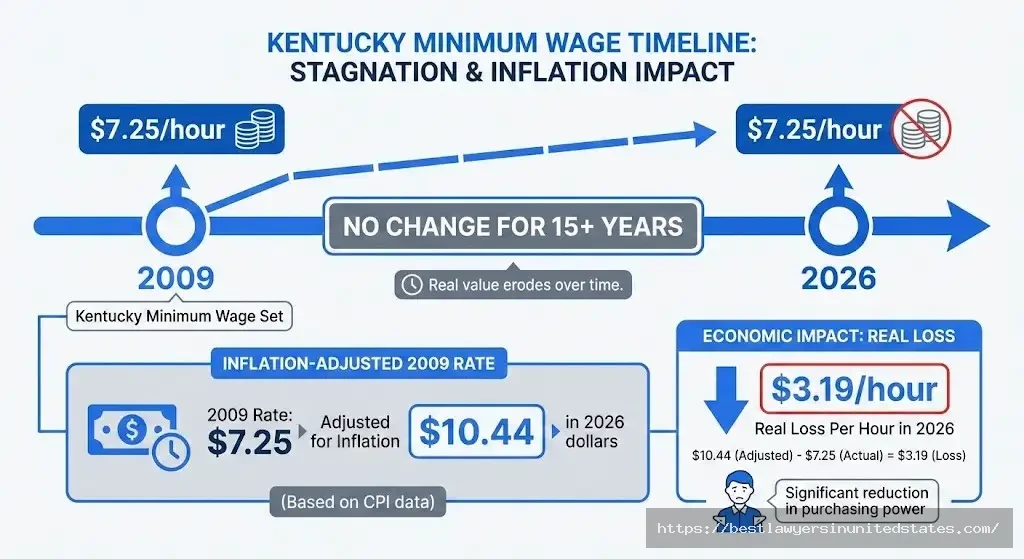
Kentucky has gone 15 years without a minimum wage increase. This extended freeze has significant economic consequences for workers across the state.
Timeline: Kentucky Minimum Wage 1980-2026
| Year | Minimum Wage | Equivalent 2026 Value (Inflation-Adjusted) |
|---|---|---|
| 1980 | $3.10 | $11.52 |
| 1990 | $3.80 | $8.94 |
| 2000 | $5.15 | $9.15 |
| 2007 | $5.85 | $8.63 |
| 2008 | $6.55 | $9.34 |
| 2009 | $7.25 | $10.44 |
| 2026 | $7.25 | $7.25 (current) |
What this shows: In real purchasing power, Kentucky's minimum wage has lost $3.19 per hour since 2009 when adjusted for inflation.
Why Kentucky Hasn't Raised Its Minimum Wage
Legislative attempts have failed repeatedly:
2019: Kentucky General Assembly considered House Bill 248 to raise minimum wage to $15 by 2024. The bill died in committee.
2021: Another proposal to increase minimum wage to $10.50 stalled in the Senate.
2023: Advocates pushed for $12 minimum wage by 2025. No vote reached the floor.
2024-2025: Multiple bills proposed increases ranging from $10-15 per hour. All remain in committee as of early 2026.
Political Landscape in Kentucky
Opposition comes from:
- Business lobby groups arguing increased labor costs hurt small businesses
- Republican legislative majority resisting wage mandates
- Concerns about job losses and reduced hours
Support comes from:
- Labor unions and worker advocacy organizations
- Democratic lawmakers representing urban districts
- Faith-based groups addressing poverty
Public opinion: Polls show 60-65% of Kentuckians support raising the minimum wage, but political will hasn't matched public sentiment.
What Happened in Other States
While Kentucky's wage remained frozen, neighboring states took action. Workers just across state borders earn significantly more for the same work. This has created workforce challenges for Kentucky border businesses competing for talent.
Kentucky vs. Neighboring States: Minimum Wage Comparison 2026
Quick Answer: Kentucky has one of the lowest minimum wages in its region, matching only Tennessee and Indiana at $7.25 per hour.
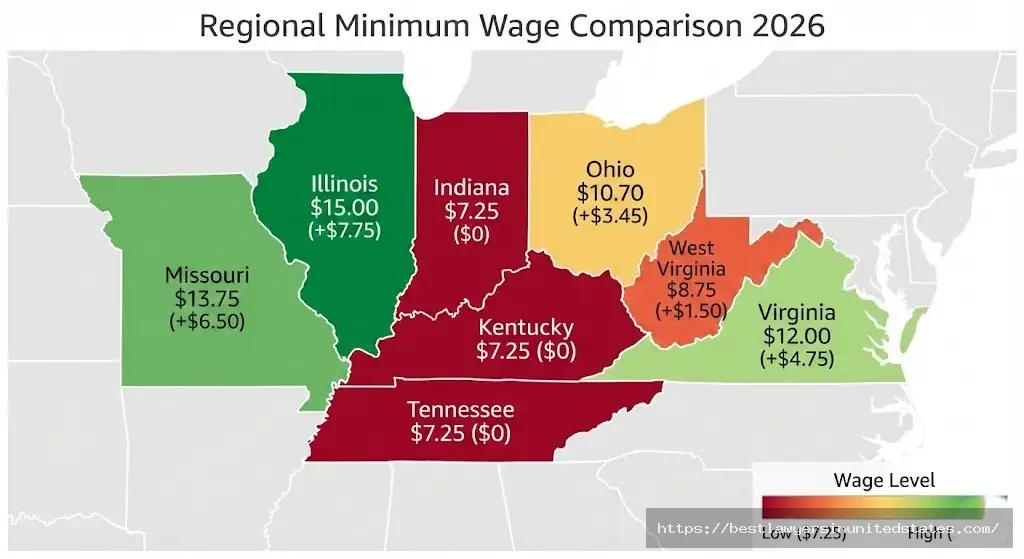
Regional comparison table:
| State | Minimum Wage 2026 | Tipped Minimum | Annual Earnings | Difference from Kentucky |
|---|---|---|---|---|
| Kentucky | $7.25/hour | $2.13/hour | $15,080 | — |
| Illinois | $15.00/hour | $9.00/hour | $31,200 | +$16,120 |
| Ohio | $10.70/hour | $5.35/hour | $22,256 | +$7,176 |
| Missouri | $13.75/hour | $6.88/hour | $28,600 | +$13,520 |
| West Virginia | $8.75/hour | $2.63/hour | $18,200 | +$3,120 |
| Virginia | $12.00/hour | $2.13/hour | $24,960 | +$9,880 |
| Indiana | $7.25/hour | $2.13/hour | $15,080 | $0 |
| Tennessee | $7.25/hour | $2.13/hour | $15,080 | $0 |
Key takeaway: A minimum wage worker in Illinois earns $16,120 more per year than someone doing the same job in Kentucky.
What This Means for Border Workers
If you live in Kentucky but work in a neighboring state:
- You receive that state's minimum wage
- Higher wages in Illinois and Ohio attract Kentucky workers
- Commuting costs may offset some wage gains
- You file taxes in both states
If you live in a neighboring state but work in Kentucky:
- You receive Kentucky's $7.25 minimum wage
- Your home state's higher wage doesn't apply
- Few workers cross borders into Kentucky for work
Border counties see significant workforce migration. Kentucky counties adjacent to Illinois and Ohio report difficulty retaining workers in minimum wage positions.
Impact on Kentucky's Economy
The wage gap creates challenges:
- Retail and service businesses near borders struggle to hire
- Young workers leave Kentucky for better opportunities
- Tax revenue shifts to neighboring states
- Economic development becomes harder
Business owners face pressure. Many voluntarily pay above minimum wage to compete, but not all can afford higher rates.
Who Is Exempt from Kentucky Minimum Wage Laws?
Quick Answer: Kentucky exempts specific categories including executive, administrative, and professional employees, plus certain agricultural and seasonal workers.
Kentucky follows FLSA exemption rules under KRS 337.010. If you're exempt, your employer doesn't have to pay minimum wage or overtime.
Executive Employees
You're exempt if you meet ALL these tests:
- Primary duty is managing the enterprise or a department
- Regularly direct work of at least two full-time employees
- Have authority to hire or fire, or your recommendations carry weight
- Earn at least $684 per week on a salary basis
Example: A restaurant manager who schedules staff, handles ordering, and makes hiring decisions likely qualifies as exempt.
Administrative Employees
You're exempt if you meet ALL these tests:
- Primary duty is office or non-manual work directly related to management
- Exercise discretion and independent judgment on significant matters
- Earn at least $684 per week on a salary basis
Example: A human resources coordinator who develops company policies and handles employee relations likely qualifies as exempt.
Professional Employees
You're exempt if you meet ALL these tests:
- Work requires advanced knowledge in a field of science or learning
- Knowledge is customarily acquired through prolonged specialized education
- Earn at least $684 per week on a salary basis
Examples: Doctors, lawyers, engineers, accountants, teachers
Other Exempt Categories in Kentucky
Additional workers not covered by minimum wage:
| Category | Details |
|---|---|
| Outside Sales | Primary duty is making sales away from employer's place of business |
| Computer Professionals | Certain IT roles earning $684/week or $27.63/hour |
| Seasonal/Recreational | Employees of seasonal amusement or recreation businesses |
| Small Farm Workers | Agricultural employees on small farms |
| Newspaper Delivery | Newspaper delivery workers under certain conditions |
| Casual Babysitters | Babysitters employed on a casual basis |
| Live-In Domestics | Certain domestic service employees who reside on premises |
How to Know If You're Truly Exempt
Red flags that suggest misclassification:
- You're paid hourly, not salary
- Your weekly salary is below $684 ($35,568 annually)
- You don't supervise anyone or make independent decisions
- Your employer calls you a "manager" but you do the same work as hourly staff
- You work in retail or food service doing front-line customer work
Misclassification is common. Many Kentucky employers incorrectly label workers as exempt to avoid paying overtime. If you believe you're misclassified, contact the Kentucky Labor Cabinet or consult with an employment attorney.
Questions about your wages or need legal help?
Email: [email protected]
Kentucky Child Labor Laws and Youth Wages
Quick Answer: Kentucky has strict child labor laws under KRS 339, but youth workers receive the same $7.25 minimum wage as adults.
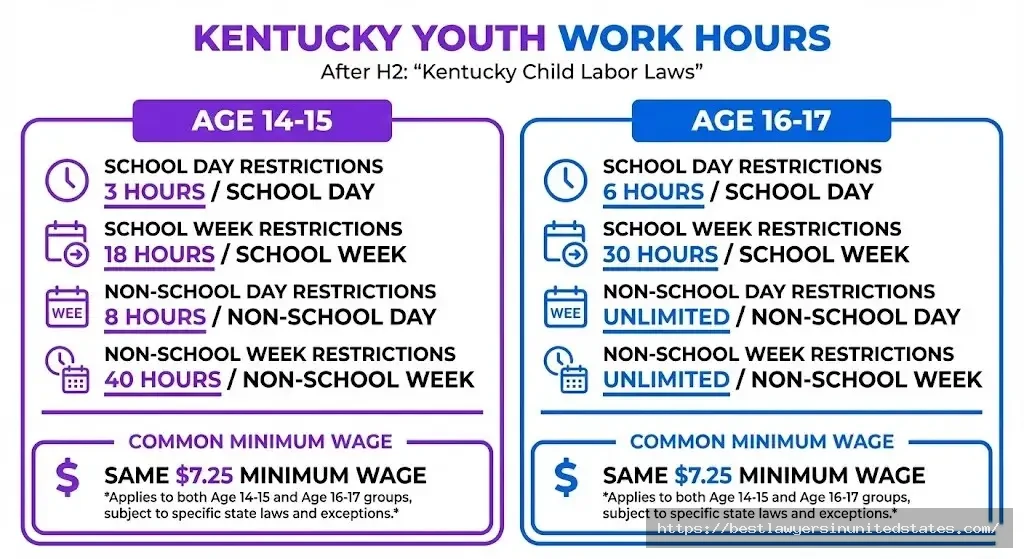
Unlike some states, Kentucky does NOT have a lower youth minimum wage. All workers age 14 and older must receive at least $7.25 per hour.
Age Restrictions for Young Workers in Kentucky
Workers age 14-15:
- May work limited hours during school year
- Maximum 3 hours on school days
- Maximum 18 hours per school week
- Maximum 8 hours on non-school days
- Maximum 40 hours per non-school week
- Cannot work before 7 AM or after 7 PM (9 PM June-Labor Day)
Workers age 16-17:
- May work unlimited hours if not in school
- If in school, limited to 6 hours on school days
- Maximum 30 hours per school week
- No time-of-day restrictions
Kentucky Work Permit Requirements
All minors under 18 must have a work permit before starting employment. The permit process requires:
Step 1: Student obtains "Certificate of Age" from school or Kentucky Labor Cabinet Step 2: Employer completes work permit application Step 3: Parent or guardian provides written consent Step 4: School official or Labor Cabinet issues permit
Cost: Free Where to get one: Local school district office or Kentucky Department of Workplace Standards
Prohibited Occupations for Minors
Kentucky law bans workers under 18 from hazardous jobs:
Prohibited industries:
- Manufacturing or storing explosives
- Motor vehicle driving (with exceptions)
- Coal mining operations
- Logging and sawmill operations
- Power-driven machinery operation
- Roofing and excavation work
- Meat processing and slaughtering
- Exposure to radioactive substances
Restaurant exceptions: Minors can perform most restaurant tasks except operating power-driven machinery, handling sharp equipment, or working with hazardous chemicals.
Enforcement and Penalties for Child Labor Violations
Kentucky takes child labor violations seriously:
| Violation Type | Employer Penalty |
|---|---|
| Employing minor without permit | $100-1,000 per violation |
| Violating hour restrictions | $250-1,000 per violation |
| Hazardous occupation | $500-3,000 per violation |
| Repeat violations | Up to $10,000 + criminal charges |
Parents can also face penalties for allowing minors to work illegally.
If you're a young worker in Kentucky, know your rights. Your employer cannot:
- Pay you less than $7.25 per hour
- Require you to work prohibited hours
- Assign you to hazardous tasks
- Retaliate against you for refusing illegal work
How to File a Wage Complaint in Kentucky
Quick Answer: Report wage violations to the Kentucky Labor Cabinet's Division of Employment Standards or the U.S. Department of Labor.
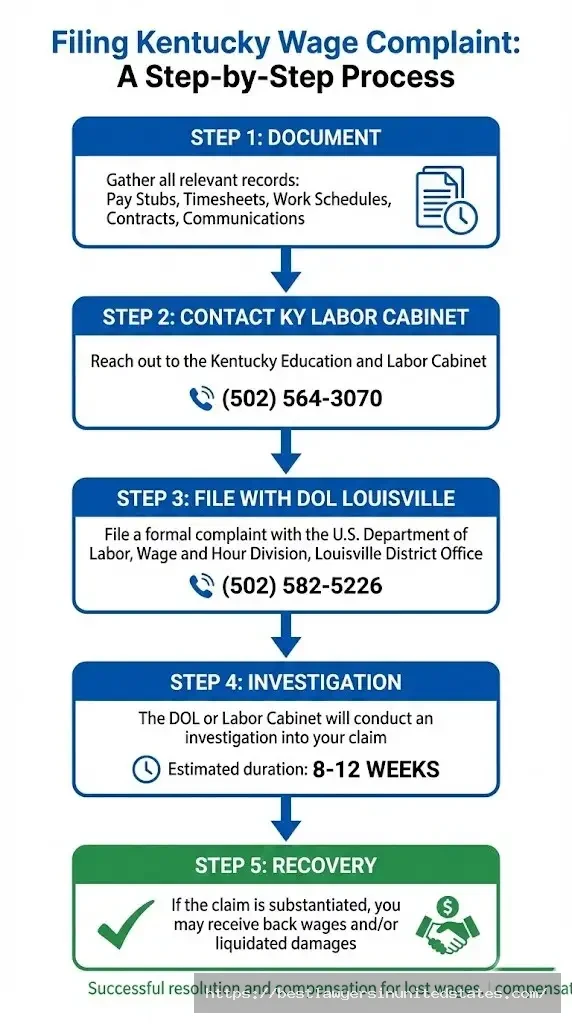
Kentucky workers have multiple options for recovering unpaid wages. You typically have two years to file a claim under federal law, or three years for willful violations.
Step 1: Document Everything
Gather this evidence before filing:
- Pay stubs showing hours worked and wages paid
- Timesheets or time clock records
- Work schedules
- Written communications about your pay
- Witness statements from coworkers
- Employment contract or offer letter
Keep your own records. Don't rely solely on your employer's documentation.
Step 2: Contact Kentucky Labor Cabinet
Kentucky Labor Cabinet - Division of Employment Standards
Mailing Address: 1047 US Highway 127 S, Suite 4 Frankfort, KY 40601
Phone: (502) 564-3070
Online: Visit labor.ky.gov
What they handle:
- Minimum wage violations
- Unpaid overtime
- Final paycheck disputes
- Tip theft complaints
- Recordkeeping violations
Step 3: File with U.S. Department of Labor
Alternative or additional option:
Wage and Hour Division - Louisville Office
Address: 600 Dr. Martin Luther King Jr. Place, Suite 268 Louisville, KY 40202
Phone: (502) 582-5226
Cincinnati Office (covers Northern Kentucky):
Address: 550 Main St., Room 7028 Cincinnati, OH 45202
Phone: (513) 684-2942
What they handle:
- FLSA violations
- Federal minimum wage and overtime
- Tipped employee complaints
- Child labor violations
Step 4: The Investigation Process
What happens after you file:
Week 1-2: Agency reviews your complaint and requests additional information
Week 3-4: Investigator contacts your employer for records
Week 5-8: Investigation proceeds with document review and interviews
Week 9-12: Agency determines if violations occurred
Week 13+: Employer receives notice to pay back wages or faces enforcement action
Timeline varies based on case complexity and agency workload.
Calculate Your Wage Theft Recovery in Kentucky
Think your employer owes you money? Use our wage theft calculator to estimate how much you could recover, including unpaid wages, penalties, and interest under Kentucky law.
Wage Theft Recovery Calculator
Estimate how much you can recover in unpaid wages, penalties, and damages based on your state's laws
💵 Estimated Total Recovery
💰 Unpaid Wages
⚖️ Penalties & Damages
📋 Total Summary
Calculator features:
- Multiple violation types (unpaid wages, overtime, tips)
- Kentucky-specific penalties and damages
- Filing deadline tracker
- Total recovery estimate
- Next steps guidance
Legal Resources for Unpaid Wages
If agency action doesn't resolve your case, consider:
Private lawsuit: You can sue your employer in Kentucky court for unpaid wages plus damages
Class action: If multiple workers experienced similar violations, group legal action may be appropriate
Legal Aid: Kentucky Legal Aid provides free legal help to qualifying low-income workers
- Phone: 1-800-782-8529
- Website: klaid.org
Workers facing significant wage violations may benefit from exploring legal options for workplace disputes, particularly if employer retaliation is a concern.
Questions about your wages or need legal help?
Email: [email protected]
Employer Penalties for Minimum Wage Violations in Kentucky
Quick Answer: Kentucky employers who violate wage laws face back pay liability, liquidated damages up to double the unpaid amount, civil penalties, and potential criminal prosecution.
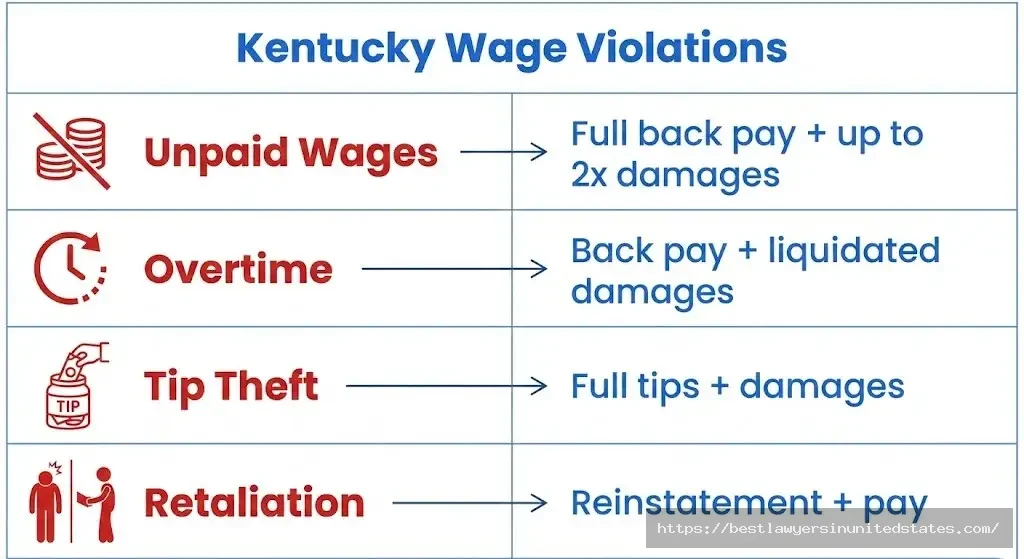
Wage theft is serious business in Kentucky. The state has multiple enforcement mechanisms to ensure workers receive proper compensation.
Back Pay and Liquidated Damages
What you can recover:
| Violation Type | Recovery Amount |
|---|---|
| Unpaid Minimum Wage | Full back pay for hours worked |
| Unpaid Overtime | Back pay at 1.5x rate |
| Liquidated Damages | Additional amount equal to back pay (up to 2x total) |
| Stolen Tips | Full tip amount plus damages |
| Attorney Fees | If you win, employer pays your legal costs |
Example: If your employer owes you $5,000 in unpaid overtime, you could recover:
- $5,000 in back wages
- $5,000 in liquidated damages
- Total: $10,000 plus attorney fees
Civil Penalties and Fines
Kentucky Labor Cabinet can assess penalties:
First offense:
- $250-1,000 per violation
- Required payment plan for back wages
- Mandatory compliance training
Repeat offenses:
- $1,000-5,000 per violation
- Enhanced monitoring
- Public disclosure of violations
Willful violations:
- Up to $10,000 per violation
- Referral for criminal prosecution
- Business license suspension possible
Criminal Penalties
Willful wage theft can result in criminal charges:
Misdemeanor (under $500 stolen):
- Up to 90 days in jail
- Fines up to $250
Felony (over $500 stolen):
- 1-5 years in prison
- Fines up to $10,000
- Restitution to affected workers
Criminal prosecution is rare but happens in egregious cases involving systematic wage theft affecting multiple workers.
Retaliation Protections
It's illegal for employers to retaliate against workers who:
- File wage complaints with Kentucky Labor Cabinet
- Participate in wage investigations
- Testify about wage violations
- Refuse to work without proper pay
Retaliation includes:
- Firing or threatening to fire
- Reducing hours or pay
- Demoting or transferring to worse positions
- Creating hostile work environment
- Reporting to immigration authorities
Penalties for retaliation:
- Additional damages for lost wages
- Reinstatement to previous position
- Emotional distress damages
- Punitive damages in severe cases
Workers dealing with wage violations that also involve wage garnishment issues may need specialized legal advice to protect their earnings from creditors while pursuing employer claims.
Questions about your wages or need legal help?
Email: [email protected]
Kentucky Payroll and Recordkeeping Requirements
Quick Answer: Kentucky employers must maintain detailed payroll records for at least three years under KRS 337.320 and display required labor law posters.
Proper recordkeeping protects both employers and employees. If records don't exist, courts typically rule in favor of the employee.
Required Payroll Records
Employers must keep these records for each employee:
| Record Type | Retention Period | Details |
|---|---|---|
| Personal Information | 3 years | Name, address, SSN, birth date (if under 19) |
| Hours Worked | 3 years | Daily and weekly hours, including start/stop times |
| Wages Paid | 3 years | Rate of pay, regular and overtime earnings |
| Deductions | 3 years | All withholdings and deductions with explanations |
| Pay Period | 3 years | Work period covered by each payment |
| Payment Date | 3 years | Date each payment was made |
Employee Wage Statement Requirements
Kentucky requires employers to provide wage statements showing:
- Pay period start and end dates
- Hours worked (regular and overtime)
- Rate of pay
- Gross wages earned
- All deductions itemized
- Net pay amount
Format: Written statement (paper or electronic) provided each pay period
Timing: At time of payment or within 3 business days
Final Paycheck Rules in Kentucky
When you must receive your final pay depends on how employment ended:
If you're fired or laid off:
- Next regular payday
- Mailed to last known address if requested
If you quit:
- Next regular payday
- Mailed to last known address if requested
If you quit with at least 7 days notice:
- Next regular payday
- Immediate payment not required
Your final check must include:
- All wages earned through last day worked
- Accrued vacation pay (if company policy provides it)
- Unreimbursed business expenses
- Any commissions or bonuses earned
Kentucky does NOT require payout of:
- Unused sick time (unless company policy states otherwise)
- Future vacation time not yet accrued
Permissible Wage Deductions in Kentucky
Employers can deduct from your wages for:
Required by law:
- Federal income tax
- Social Security and Medicare (FICA)
- Court-ordered wage garnishments
- Child support withholding
With written authorization:
- Health insurance premiums
- Retirement contributions
- Union dues
- Voluntary benefits (dental, life insurance)
- Direct deposit fees
- Loan repayments
Prohibited Wage Deductions
Employers CANNOT deduct for:
Without consent:
- Uniforms or tools required for the job
- Cash register shortages or customer walkouts
- Damaged or lost equipment
- Business operating expenses
- Mandatory training costs
Even with consent:
- Deductions that reduce your pay below minimum wage
- Deductions as punishment for poor performance
- Tips or gratuities
- Deductions for "breakage" without proof you caused it
Example of illegal deduction: Your employer cannot deduct $50 from your check for a customer who dined and dashed if it drops your hourly rate below $7.25.
Required Workplace Posters in Kentucky
Kentucky employers must display these posters where employees can see them:
- Kentucky minimum wage notice
- FLSA minimum wage poster
- Equal Employment Opportunity notice
- Kentucky workers' compensation notice
- Unemployment insurance information
- OSHA safety and health protection notice
- Kentucky wage and hour division contact information
Free posters available at: Kentucky Labor Cabinet website (labor.ky.gov)
Will Kentucky Raise Its Minimum Wage in 2026?
Quick Answer: No minimum wage increase is scheduled for 2026, and legislative proposals face uncertain prospects in Kentucky's Republican-controlled General Assembly.
Kentucky's minimum wage will remain at $7.25 per hour throughout 2026. No automatic adjustments exist for inflation or cost of living increases.
Current Legislative Proposals
Bills introduced in 2025 legislative session:
House Bill 217 (Democratic proposal):
- Increase to $10.00 by January 1, 2026
- Reach $15.00 by January 1, 2028
- Annual adjustments for inflation after 2028
- Status: Stalled in committee, unlikely to advance
House Bill 334 (Progressive caucus):
- Immediate increase to $12.00 in 2026
- Reach $18.00 by 2030
- Eliminate tipped minimum wage by 2027
- Status: No hearing scheduled
Senate Bill 98 (Moderate proposal):
- Gradual increase to $9.50 by 2027
- Keep tipped minimum wage at $2.13
- Exemptions for small businesses under 15 employees
- Status: Under committee review
Political Landscape in 2026
Republican majority opposes mandates:
- 75 of 100 House seats held by Republicans
- 31 of 38 Senate seats held by Republicans
- Governor supports "market-based wages" over mandates
- Business lobby remains influential
Democratic minority pushes for increases:
- Urban legislators from Louisville and Lexington lead efforts
- Labor unions provide grassroots support
- Coalition includes faith leaders and anti-poverty advocates
Prospects for 2026: Very unlikely any bill reaches the Governor's desk this year.
Public Opinion on Minimum Wage in Kentucky
Recent polling shows:
- 63% of Kentuckians support raising minimum wage to $12 or higher
- 47% support $15 per hour
- Support crosses party lines (72% Democrats, 58% Independents, 48% Republicans)
- 71% agree current minimum wage is insufficient for basic needs
Despite public support, political gridlock persists.
What Other States Are Doing
While Kentucky debates, neighboring states act:
Illinois: Automatic increases continue through 2029 to reach $15.40
Ohio: Inflation adjustments built into law (currently $10.70)
Missouri: Voter initiative approved increases to $15 by 2026
Virginia: Stalled at $12 but higher than Kentucky
Regional trend: Kentucky increasingly an outlier with wages frozen since 2009.
Alternatives to State Action
Without state legislation, some local efforts emerge:
Louisville Metro: Advocates push for local living wage ordinance covering city contractors and agencies. Legal challenges expected if passed.
Lexington-Fayette: Similar proposals face state preemption concerns. Kentucky law limits local government wage mandates.
Private sector: Some major employers voluntarily raise starting wages:
- Amazon distribution centers: $15-17/hour
- UPS facilities: $14-16/hour
- Healthcare systems: $12-15/hour starting
- Retail chains: $10-13/hour
Market pressure works where legislation hasn't. Competition for workers drives some wage gains even without legal requirements.
Timeline for Potential Changes
Most realistic scenario:
2026: No action (current session ends with no bill passage)
2027: Renewed push after 2026 elections (entire House up for reelection)
2028: Possible compromise at $9-10 minimum if Democrats gain seats
2030+: Sustained advocacy needed for meaningful increases
Frequently Asked Questions About Kentucky Minimum Wage
What is the minimum wage in Kentucky for 2026?
Quick Answer: Kentucky's minimum wage is $7.25 per hour in 2026, following the federal minimum wage with no state-specific increases scheduled.
This rate applies to all covered employers with two or more employees. Kentucky has not established a separate state minimum wage, so federal law controls.
Does Kentucky have a state minimum wage law?
Quick Answer: No, Kentucky does not have an independent state minimum wage law and instead follows federal minimum wage standards under the FLSA.
KRS 337.010 directs Kentucky employers to pay the federal minimum wage. If federal minimum wage increases, Kentucky's rate automatically rises too.
What is the tipped minimum wage in Kentucky?
Quick Answer: Kentucky's tipped minimum wage is $2.13 per hour, but employers must ensure tips plus base pay equal at least $7.25 per hour total.
The tip credit system allows employers to pay a lower base wage if employee tips make up the difference. If tips don't reach $7.25 hourly, employers must pay additional wages.
How much does a server make in Kentucky?
Quick Answer: Servers in Kentucky earn a base wage of $2.13 per hour plus tips, with actual income varying widely by establishment type and location.
Average server earnings in Kentucky:
- Fast casual: $12-15/hour total with tips
- Mid-tier restaurants: $15-20/hour total with tips
- Fine dining: $20-30/hour total with tips
- Bars and nightlife: $15-25/hour total with tips
Actual earnings fluctuate based on shift times, customer volume, and tipping patterns.
Is there overtime pay in Kentucky?
Quick Answer: Yes, Kentucky requires overtime pay at 1.5 times your regular rate for hours worked over 40 in a workweek.
The overtime rate for minimum wage workers is $10.88 per hour. There is no daily overtime in Kentucky—only weekly calculations matter.
How do I calculate my earnings at Kentucky minimum wage?
Quick Answer: Multiply your hours worked by $7.25 per hour for regular time and $10.88 for overtime hours beyond 40 per week.
Use the Kentucky minimum wage calculator to estimate your weekly, monthly, and annual earnings based on your work schedule.
How much overtime pay am I entitled to in Kentucky?
Quick Answer: You receive 1.5 times your regular hourly rate for all hours worked over 40 in a workweek.
Calculate your overtime earnings with the Kentucky overtime calculator, which accounts for your base wage and hours worked.
How do I calculate wage theft recovery in Kentucky?
Quick Answer: Add your unpaid wages plus liquidated damages (up to 2x the unpaid amount) plus any statutory penalties and attorney fees.
The Kentucky wage theft calculator estimates your potential recovery including back pay, damages, interest, and penalties.
How do I file a wage complaint in Kentucky?
Quick Answer: Contact the Kentucky Labor Cabinet at (502) 564-3070 or the U.S. Department of Labor's Wage and Hour Division in Louisville at (502) 582-5226.
File within two years of the violation (three years for willful violations). Gather pay stubs, timesheets, and documentation before filing.
What is a livable wage in Kentucky?
Quick Answer: A livable wage in Kentucky ranges from $14-18 per hour for a single adult depending on location, significantly higher than the $7.25 minimum wage.
Major cities require higher wages due to housing costs. Louisville needs $16.50/hour, while smaller towns may support basic needs at $14-15/hour.
When was the last minimum wage increase in Kentucky?
Quick Answer: July 24, 2009, when the federal minimum wage rose from $6.55 to $7.25 per hour.
Kentucky has gone 15+ years without an increase. Adjusted for inflation, the current minimum wage has lost significant purchasing power since 2009.
Are there any cities in Kentucky with higher minimum wages?
Quick Answer: No, Kentucky currently has no local minimum wage ordinances, and state law limits cities' ability to set their own wage floors.
Some cities have considered living wage requirements for government contractors, but comprehensive local minimum wage laws don't exist in Kentucky.
What happens if my employer doesn't pay me minimum wage?
Quick Answer: File a complaint with Kentucky Labor Cabinet, and you may recover full back pay plus liquidated damages up to double the unpaid amount.
Your employer also faces civil penalties, potential criminal charges for willful violations, and liability for your attorney fees if you sue.
Can employers in Kentucky pay less than minimum wage?
Quick Answer: No, except for specific exemptions including tipped employees ($2.13 base plus tips), certain agricultural workers, and properly classified exempt employees.
All other workers must receive at least $7.25 per hour. Youth workers receive the same minimum wage as adults in Kentucky.
Do minors get paid less in Kentucky?
Quick Answer: No, Kentucky does not have a youth minimum wage, so workers age 14 and up must receive the full $7.25 per hour.
However, minors face strict hour restrictions and work permit requirements under Kentucky child labor laws (KRS Chapter 339).
How does Kentucky's minimum wage compare to neighboring states?
Quick Answer: Kentucky ties with Tennessee and Indiana for the lowest in the region at $7.25, while Illinois ($15), Ohio ($10.70), and Missouri ($13.75) pay significantly more.
Workers doing identical jobs across state borders can earn $8,000-16,000 more annually in higher-wage states.
Does Kentucky minimum wage apply to agricultural workers?
Quick Answer: Kentucky minimum wage covers most agricultural workers, but small farms with limited quarterly payrolls may qualify for exemptions under federal law.
Specific exemptions exist for immediate family members and certain hand-harvest workers paid by piece rate.
What are Kentucky's overtime exemptions?
Quick Answer: Executive, administrative, and professional employees earning at least $684 per week on salary basis are exempt from Kentucky overtime requirements.
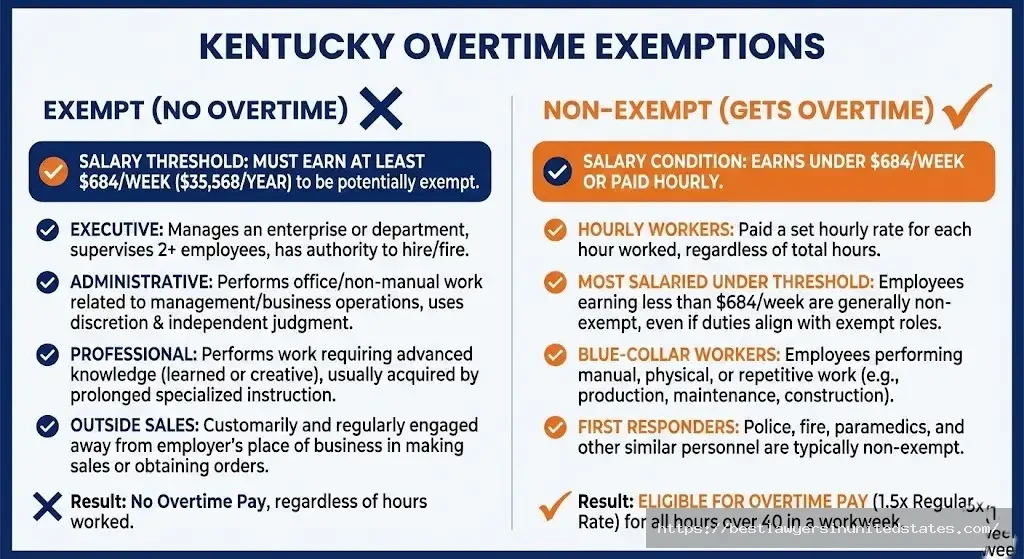
Additional exemptions include outside salespeople, certain computer professionals, and highly compensated employees over $107,432 annually.
Can Kentucky employers require unpaid training?
Quick Answer: No, employers must pay at least minimum wage for all training time that benefits the employer, even for orientation and onboarding.
The only exception is volunteer work for nonprofits or training that's purely for the employee's benefit with no direct work value.
Does Kentucky require meal breaks?
Quick Answer: Kentucky does not require meal or rest breaks for adult workers, but federal law requires paid breaks under 20 minutes if provided.
Unpaid meal breaks of 30+ minutes must be completely free from work duties. Many employers provide breaks as a competitive benefit even without legal requirements.
Related Kentucky Employment and Legal Resources
Understanding minimum wage is just one aspect of employment law. Kentucky workers face various legal challenges in the workplace that may require additional guidance.
Employment consequences extend beyond wage issues. For example, workers with Kentucky DUI convictions often face job loss and financial strain that makes earning minimum wage even more challenging. Understanding your rights across different legal areas helps protect your livelihood.
Financial planning matters when wages are tight. Kentucky residents may need information about divorce costs in Kentucky if family financial stress from low wages contributes to relationship challenges.
Compare Kentucky to regional wages:
- Illinois minimum wage currently more than doubles Kentucky's rate
- Indiana minimum wage matches Kentucky at federal level
- Iowa minimum wage provides modest increases over federal
- Kansas minimum wage follows federal standards like Kentucky
Free wage calculation tools:
- Kentucky minimum wage calculator for earnings estimates
- Kentucky overtime calculator for overtime calculations
- Kentucky wage theft calculator for recovery estimates
Take Action: Protect Your Wages in Kentucky
Kentucky's minimum wage laws may be straightforward, but violations remain common. You have rights as a worker, and resources exist to help enforce them.
If you're not receiving proper wages:
- Document everything immediately
- Calculate what you're owed using our free tools
- Contact Kentucky Labor Cabinet or U.S. Department of Labor
- Consider legal representation for serious violations
Free resources available:
- Kentucky Labor Cabinet: (502) 564-3070
- U.S. DOL Louisville Office: (502) 582-5226
- Kentucky Legal Aid: 1-800-782-8529
Use our interactive calculators:
Questions about your specific situation?
Email: [email protected]
