
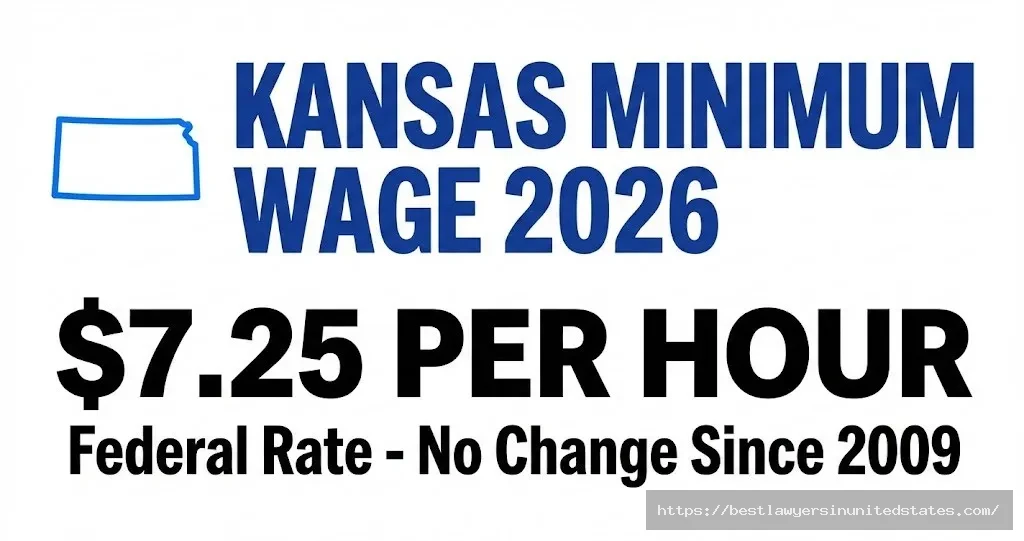
Kansas minimum wage remains $7.25 per hour in 2026, matching the federal rate with no scheduled increases. This rate has not changed since 2009, making Kansas one of 20 states still tied to the federal minimum wage. Workers in Kansas City face a unique situation where the Missouri side pays $13.75 per hour while the Kansas side stays at $7.25.
Kansas follows federal labor laws under the Fair Labor Standards Act (FLSA) for most wage and hour regulations. The Kansas Department of Labor enforces state wage laws under the Kansas Wage Payment Act (K.S.A. 44-313) and Kansas Minimum Wage Law (K.S.A. 44-1202). Tipped employees earn a base wage of $2.13 per hour plus tips, and youth workers under 20 can be paid $4.25 per hour for their first 90 days.
This guide covers everything Kansas workers and employers need to know about minimum wage laws, overtime rules, tipped employee regulations, wage theft recovery, and your rights under state and federal law.
Calculate Your Earnings in Kansas
Want to know exactly how much you’ll earn at Kansas’s $7.25 minimum wage? Use our free calculator to estimate your weekly, monthly, and annual income based on your hours worked.
💰 Minimum Wage Earnings Calculator
Calculate your weekly, monthly, and annual earnings with overtime and tax estimates
📊 Your Earnings Breakdown
💰 Gross Earnings
Calculator features:
- Automatic Kansas wage rates for 2026
- Weekly, monthly, and annual earnings
- Overtime calculations
- Tax withholding estimates
- Take-home pay breakdown
Full calculator with all features: https://bestlawyersinunitedstates.com/minimum-wage-calculator/
Questions about your wages or need legal help? Email: [email protected]
What Is Kansas Minimum Wage in 2026?
Quick Answer: Kansas minimum wage is $7.25 per hour as of January 1, 2026, which matches the federal minimum wage. This rate applies to all non-exempt workers and has remained unchanged since 2009.
Kansas does not have its own separate state minimum wage law that exceeds federal requirements. When state and federal minimum wage differ, employers must pay the higher rate. Since Kansas's rate matches federal law at $7.25, workers receive the federal minimum.
The Kansas Minimum Wage and Maximum Hours Law (K.S.A. 44-1202) adopts the federal Fair Labor Standards Act standards. This means Kansas workers are protected by federal wage laws, but the state has not enacted higher wage requirements like many neighboring states have.
Kansas vs Federal Minimum Wage
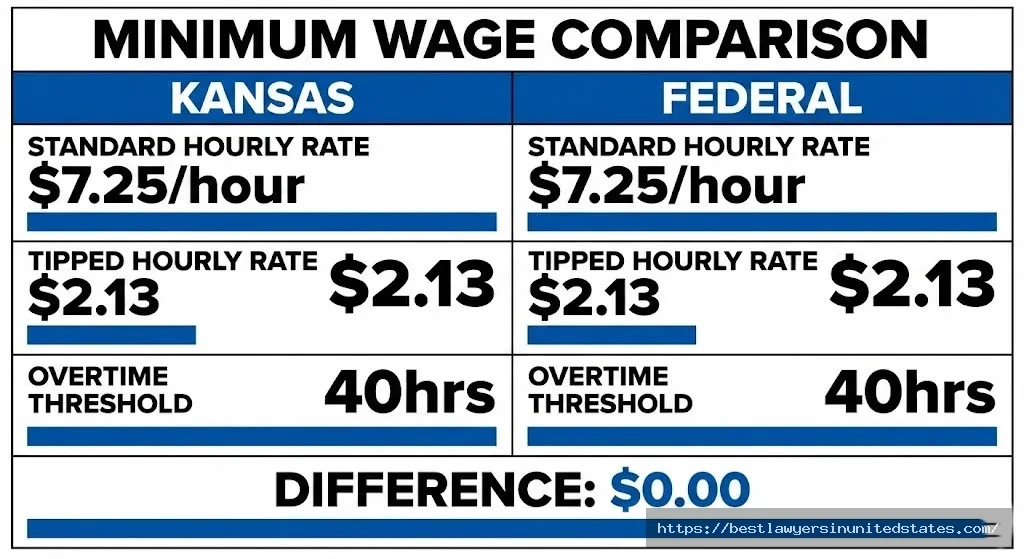
| Jurisdiction | Minimum Wage | Tipped Wage | Overtime Threshold |
|---|---|---|---|
| Kansas | $7.25 | $2.13 | 40 hours/week |
| Federal | $7.25 | $2.13 | 40 hours/week |
| Difference | $0.00 | $0.00 | Same |
Key fact: Kansas has not raised its minimum wage since July 24, 2009, when the federal rate increased to $7.25.
Is Kansas Minimum Wage Going Up in 2026?
No scheduled increases exist for Kansas minimum wage in 2026 or beyond. The Kansas legislature has not passed any bills to raise the state minimum wage above the federal rate. Democratic lawmakers have proposed increasing the minimum wage to $15 per hour, but these proposals have consistently failed in the Republican-controlled legislature.
Recent legislative proposals in 2025 tied minimum wage increases to eliminating taxes on tips, but these efforts did not advance. Workers should not expect any state-level minimum wage increases without significant political changes in Kansas.
Kansas City Metro: The $6.50 Wage Gap Problem
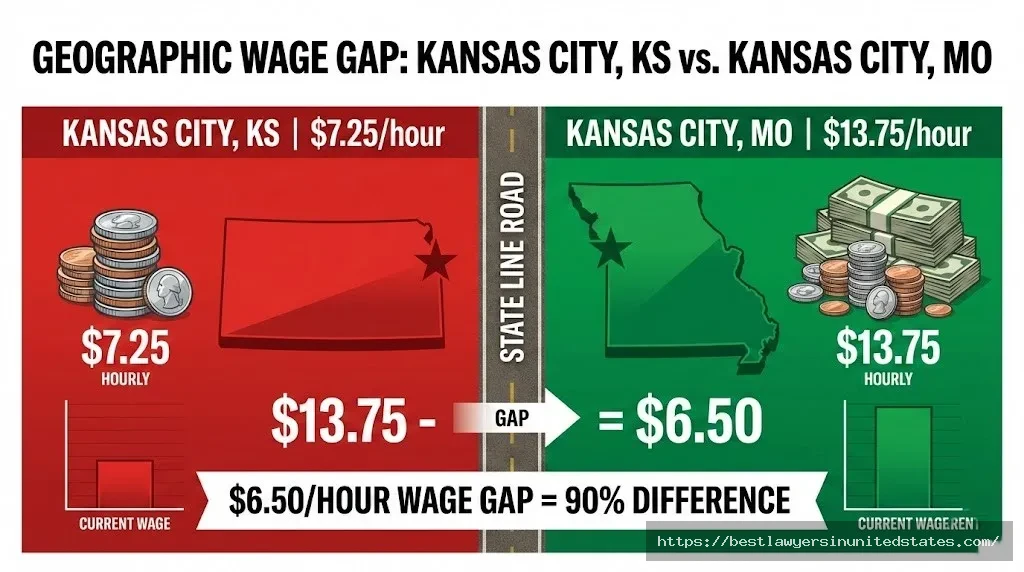
Quick Answer: Kansas City spans the Kansas-Missouri state line, creating a $6.50 per hour wage gap. The Missouri side pays $13.75 in 2026, while the Kansas side remains at $7.25.
Understanding the Border Wage Difference
Kansas City workers face a unique situation where their wage depends on which side of State Line Road they work. Businesses on the Missouri side must pay $13.75 per hour, while identical businesses across the street in Kansas only pay $7.25.
This wage gap creates several real-world challenges for workers and employers:
For workers:
- Same job, dramatically different pay based on location
- Incentive to seek employment on Missouri side
- Transportation costs may offset wage benefits
- Competition for Missouri-side jobs increases
For employers:
- Kansas businesses struggle to compete for workers
- Higher turnover on Kansas side
- Difficulty filling entry-level positions
- Pressure to offer above-minimum wages
Kansas City Minimum Wage Comparison
| Location | 2026 Minimum Wage | Monthly Earnings (160 hrs) | Annual Earnings (2,080 hrs) |
|---|---|---|---|
| Kansas City, Missouri | $13.75/hour | $2,200 | $28,600 |
| Kansas City, Kansas | $7.25/hour | $1,160 | $15,080 |
| Wage Gap | $6.50/hour | $1,040/month | $13,520/year |
Critical detail: This wage gap represents a 90% pay difference for the exact same work in the same metro area.
Making Employment Decisions Across State Lines
Workers in the Kansas City metro should consider several factors when choosing where to work:
Missouri advantages:
- 90% higher wages
- Annual earnings $13,520 higher
- Stronger wage growth potential
- Better competitive position for raises
Kansas considerations:
- Shorter commute if you live in Kansas
- Lower fuel and transportation costs
- Some employers offer above-minimum wages to compete
- State income tax rates differ between states
Many Kansas City workers already cross state lines for employment. The wage gap has accelerated this trend, with Kansas residents increasingly seeking Missouri-side jobs despite longer commutes or transportation costs. For detailed information on how neighboring states' minimum wages affect Kansas workers, see our guides on Illinois minimum wage and Iowa minimum wage.
Kansas Minimum Wage History and Future Outlook
Historical Wage Progression
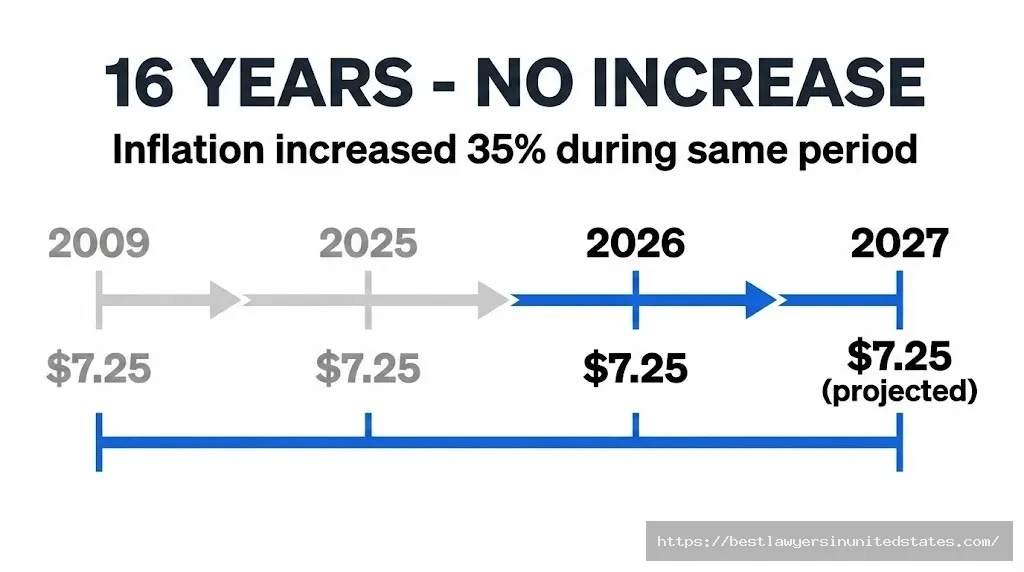
Kansas has followed federal minimum wage since 2009 with no state increases. The state previously set its own minimum wage but eliminated that requirement when federal law matched it.
| Effective Date | Kansas Minimum Wage | Federal Minimum Wage | Notes |
|---|---|---|---|
| July 24, 2009 | $7.25 | $7.25 | Last federal increase |
| Jan 1, 2025 | $7.25 | $7.25 | No change (16 years) |
| Jan 1, 2026 | $7.25 | $7.25 | Current rate |
| Jan 1, 2027 | $7.25 | $7.25 | No scheduled increase |
Key fact: Kansas minimum wage has been stagnant for 16 years while inflation has increased the cost of living by approximately 35% during the same period.
Why Hasn't Kansas Raised Minimum Wage?
Political gridlock prevents minimum wage increases in Kansas. The Republican-controlled legislature opposes mandatory wage increases, citing concerns about small business costs and job losses. Democratic lawmakers consistently propose $15 per hour minimum wage bills, but these measures fail to advance past committee votes.
Recent legislative efforts in 2025 included proposals to increase minimum wage in exchange for eliminating taxes on tips. These compromise attempts also failed to gain sufficient support. Without significant changes in the Kansas legislature's composition, state-level minimum wage increases remain unlikely.
Neighboring States Have Left Kansas Behind
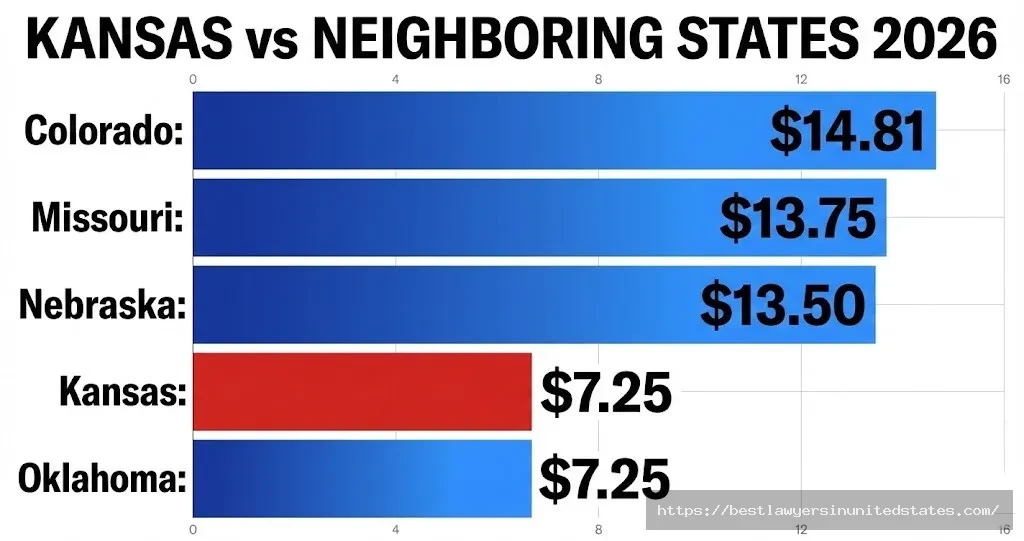
Kansas now has the lowest minimum wage among its immediate neighbors, creating economic pressure on workers and businesses.
| State | 2026 Minimum Wage | Increase from Kansas |
|---|---|---|
| Missouri | $13.75 | +$6.50 (90%) |
| Colorado | $14.81 | +$7.56 (104%) |
| Nebraska | $13.50 | +$6.25 (86%) |
| Oklahoma | $7.25 | $0.00 (same) |
Impact: Kansas workers can earn nearly double by crossing into neighboring states for employment. Detailed comparisons are available in our Colorado minimum wage guide.
Who Must Be Paid Kansas Minimum Wage?
Quick Answer: Kansas minimum wage applies to all employees except those specifically exempted under federal or state law. Most workers must receive at least $7.25 per hour.
Covered Workers
The Kansas Minimum Wage Law covers nearly all employees who work in Kansas. This includes:
Standard employees:
- Retail and service workers
- Restaurant staff (except tipped employees have different base rates)
- Office workers
- Healthcare workers
- Manufacturing employees
- Construction workers
- Most hourly employees
Part-time and full-time workers receive the same minimum wage protections. Your employer cannot pay you less than minimum wage regardless of how many hours you work per week.
Common Exemptions From Minimum Wage
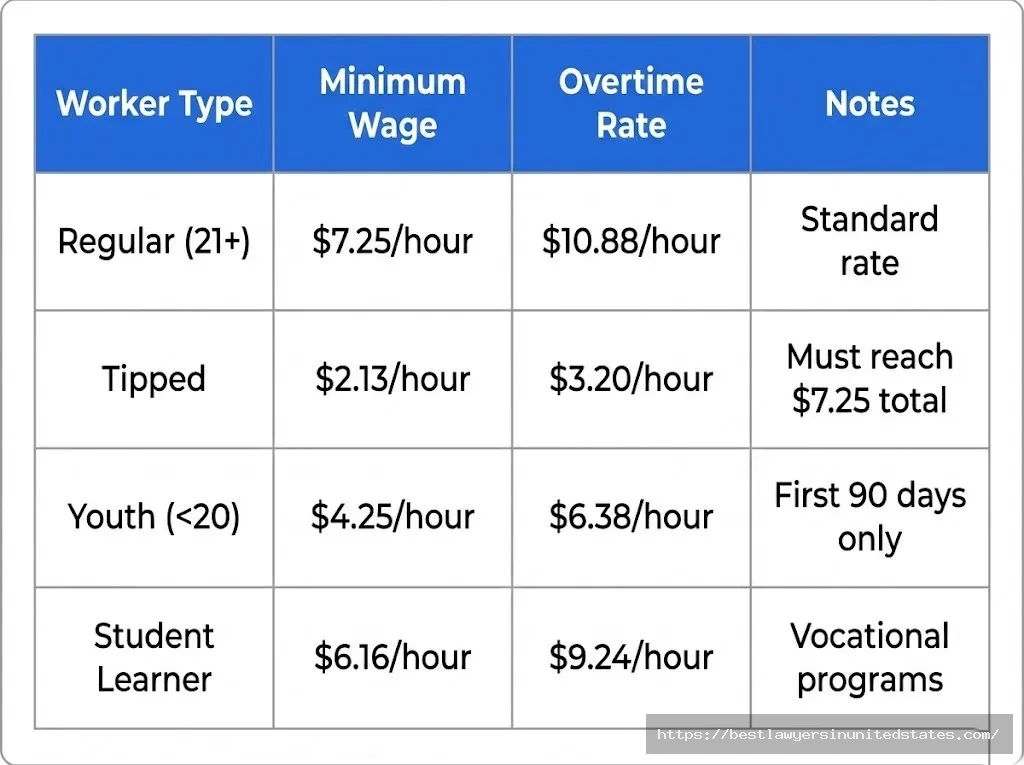
Kansas follows federal FLSA exemptions for certain worker categories. These exemptions apply under specific conditions:
| Worker Category | Minimum Wage Rate | Special Conditions |
|---|---|---|
| Tipped Employees | $2.13/hour base + tips | Tips must bring total to $7.25/hour |
| Youth Workers (under 20) | $4.25/hour | First 90 consecutive days only |
| Student Learners | $6.16/hour (85% of minimum) | Vocational education programs |
| Full-time Students | $6.16/hour (85% of minimum) | Retail/service, limited hours |
| Agricultural Workers | Varies | Small farm exemptions apply |
Executive, Administrative, and Professional Exemptions
Salaried employees in executive, administrative, or professional roles may be exempt from both minimum wage and overtime requirements. To qualify for exemption, employees must meet strict federal tests:
Salary threshold: Employees must earn at least $844 per week ($43,888 annually) as of 2026 to qualify for exemption under federal rules.
Duties test: Job duties must primarily involve:
- Managing the business or a department (executive)
- Office or non-manual work directly related to management (administrative)
- Work requiring advanced knowledge in a field of science or learning (professional)
Many employers incorrectly classify workers as exempt to avoid paying overtime. If you are paid a salary but do not meet the duties test, your employer must still pay you minimum wage and overtime for all hours worked.
Kansas Tipped Employee Wage Laws
Quick Answer: Kansas tipped employees must receive a $2.13 per hour cash wage from employers. When tips are added, total compensation must reach at least $7.25 per hour, or employers must make up the difference.
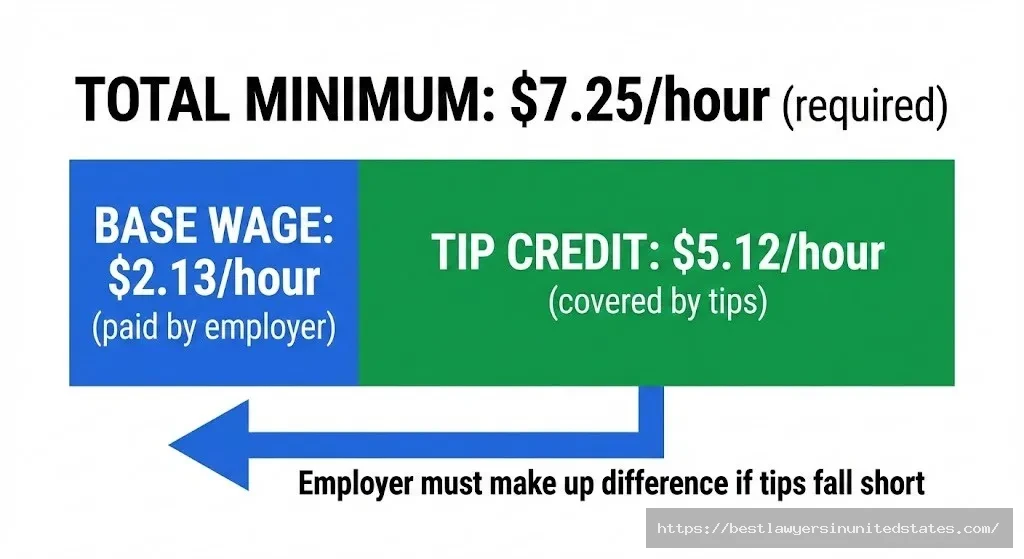
How Kansas Tip Credit Works
Kansas allows employers to use a "tip credit" to satisfy minimum wage requirements for tipped employees. This means employers can pay a lower direct wage if workers receive enough tips to reach the full minimum wage.
The calculation works like this:
- Base cash wage: $2.13/hour (paid by employer)
- Tip credit: $5.12/hour (covered by tips)
- Total minimum: $7.25/hour (required)
Example scenario:
- You work 8 hours and receive $2.13/hour = $17.04 from employer
- You must earn at least $40.96 in tips (8 hours × $5.12)
- Total compensation: $58.00 (8 hours × $7.25)
If your tips do not bring you to $7.25 per hour, your employer must pay the difference. You should never earn less than $7.25 per hour for any workweek when combining wages and tips.
Who Qualifies as a Tipped Employee?
Kansas law defines tipped employees as workers who regularly receive more than $30 per month in tips. This includes:
Common tipped positions:
- Servers and waitstaff
- Bartenders
- Bussers and food runners
- Hotel housekeeping staff
- Bellhops and valets
- Hairstylists and barbers
- Delivery drivers who receive tips
Important requirement: Employers can only use the tip credit for hours when employees actually perform tipped duties. If a server spends significant time on non-tipped work like cleaning or food prep, employers may need to pay full minimum wage for those hours under the "80/20 rule."
Tip Pooling and Tip Sharing
Kansas allows tip pooling arrangements where tipped employees share their tips. However, strict rules govern who can participate in tip pools:
✅ Can participate in tip pools:
- Servers and waitstaff
- Bartenders
- Bussers
- Food runners
- Other customarily tipped employees
❌ Cannot participate in tip pools:
- Managers and supervisors
- Owners
- Cooks (in most cases)
- Dishwashers
- Cashiers
Employers who take a tip credit cannot require tipped employees to share tips with non-tipped staff. Managers and owners can never take any portion of employee tips, regardless of tip credit usage.
What If Tips Don't Cover Minimum Wage?
Your employer must monitor your total compensation each pay period. If your base wage ($2.13/hour) plus tips do not average at least $7.25 per hour, your employer must pay additional wages to make up the shortfall.
Employer responsibilities:
- Track all tips received by each employee
- Calculate average hourly rate including tips
- Pay additional wages if total falls below $7.25/hour
- Notify employees about tip credit policy in writing
- Maintain accurate tip records
Many employers violate these requirements by failing to make up the difference when tips are slow. This is wage theft, and you have the right to recover unpaid wages. Workers facing wage violations should document all hours worked and tips received for potential wage theft claims.
Kansas Overtime Laws Explained
Quick Answer: Kansas overtime laws require employers to pay 1.5 times your regular rate for all hours worked over 40 in a workweek. This overtime premium applies to non-exempt employees under the Fair Labor Standards Act.
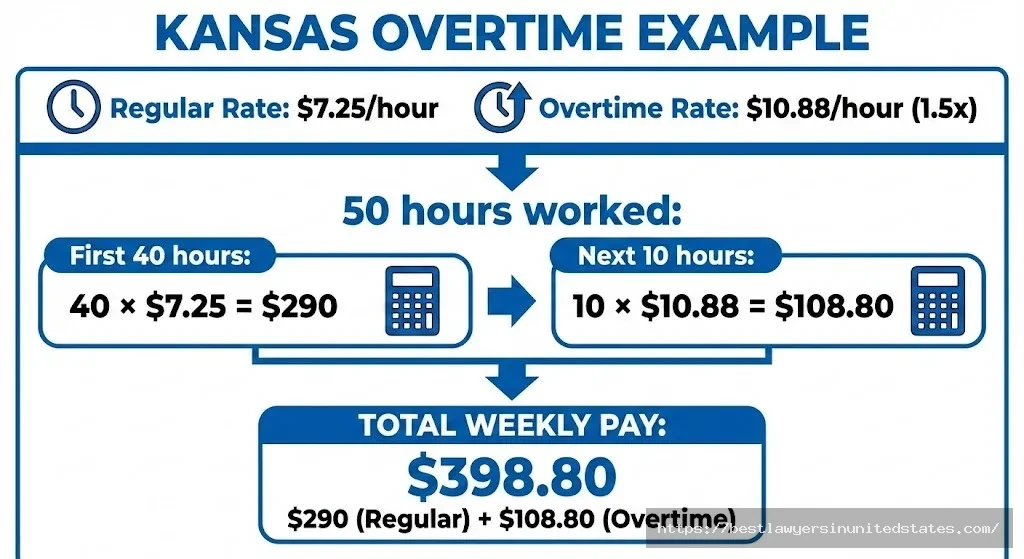
Standard Overtime Requirements
Kansas follows federal FLSA overtime rules without additional state requirements. Employees must receive overtime pay for any hours exceeding 40 in a single workweek.
Basic overtime calculation:
- Regular rate: $7.25/hour (minimum wage)
- Overtime rate: $10.88/hour (1.5 × $7.25)
- Trigger point: 40 hours in a workweek
Example overtime scenario:
- You work 50 hours in one week at $7.25/hour
- First 40 hours: 40 × $7.25 = $290.00
- Overtime hours: 10 × $10.88 = $108.80
- Total weekly pay: $398.80
What Counts as a Workweek?
A workweek is any fixed and recurring period of 168 hours (seven consecutive 24-hour periods). Your employer can set the workweek to begin on any day and at any hour, but it must remain consistent.
Workweek rules:
- Cannot average hours over multiple weeks
- Each workweek stands alone for overtime calculation
- Working 50 hours one week and 30 hours the next does not average to 40 hours per week
- You must receive overtime for the 50-hour week regardless of the 30-hour week
Daily Overtime Rules in Kansas
Kansas does NOT require daily overtime pay. Unlike some states that mandate overtime after 8 hours in a day, Kansas only requires overtime after 40 hours in a workweek.
This means:
- You can work 12 hours in one day at regular pay
- No overtime owed unless you exceed 40 hours in the week
- Consecutive days worked do not trigger overtime
- Working 7 days in a row does not automatically earn overtime
This differs significantly from states like California, where workers earn overtime after 8 hours per day. Kansas workers should track their total weekly hours to ensure proper overtime payment. For more information about calculating your overtime earnings, visit our overtime pay calculator.
Calculate Your Overtime Pay in Kansas
Working more than 40 hours per week? Calculate your overtime earnings based on Kansas's overtime laws. This calculator accounts for Kansas's specific overtime rules including weekly overtime calculations and time-and-a-half pay.
⏰ Overtime Pay Calculator
Calculate your overtime earnings based on your state's specific labor laws
📍 Select Your State
💰 Your Hourly Wage
📊 Calculation Method
📅 Weekly Hours
💵 Your Weekly Overtime Pay
📊 Earnings Breakdown
📅 Pay Period Estimates
⚖️ State vs Federal Comparison
Calculator features:
- Kansas-specific overtime rules
- Weekly overtime calculations
- Pay period breakdowns
- Comparison with federal law
- Multiple pay rate options
Full overtime calculator: https://bestlawyersinunitedstates.com/overtime-pay-calculator/
Questions about your wages or need legal help? Email: [email protected]
Who Is Exempt From Overtime?
Certain employee categories are exempt from overtime requirements under the FLSA. These exemptions are based on job duties and salary levels, not job titles.
Common overtime exemptions:
| Exemption Category | Requirements | 2026 Salary Threshold |
|---|---|---|
| Executive | Manages 2+ employees, hiring/firing authority | $844/week ($43,888/year) |
| Administrative | Office work, discretion on significant matters | $844/week ($43,888/year) |
| Professional | Advanced knowledge, artistic/creative work | $844/week ($43,888/year) |
| Computer Employee | Systems analysis, programming, software engineering | $844/week or $27.63/hour |
| Outside Sales | Makes sales away from employer's location | No salary minimum |
Critical detail: Being paid a salary does not automatically make you exempt from overtime. You must meet both the salary threshold AND the duties test for your specific exemption category.
Common Overtime Violations in Kansas
Many Kansas employers incorrectly deny overtime pay to workers. Watch for these common violations:
Frequent overtime violations:
- Misclassifying employees as exempt
- Requiring off-the-clock work
- Failing to pay for all hours worked
- Averaging hours over multiple weeks
- Not including bonuses in overtime calculations
- Paying straight time for overtime hours
If your employer commits any of these violations, you may be entitled to back wages plus penalties. Kansas workers can file complaints with the Kansas Department of Labor or the U.S. Department of Labor Wage and Hour Division.
Youth and Training Wages in Kansas
Quick Answer: Kansas allows employers to pay workers under age 20 a youth minimum wage of $4.25 per hour for their first 90 consecutive calendar days of employment. After 90 days, these workers must receive the full $7.25 minimum wage.
Youth Wage Regulations
The federal FLSA permits a lower minimum wage for young workers during an initial employment period. Kansas follows this federal provision without additional state restrictions.
Youth wage details:
- Rate: $4.25 per hour
- Duration: First 90 consecutive calendar days only
- Age limit: Applies only to workers under age 20
- Automatic increase: Must rise to $7.25 after 90 days
Important restrictions:
- Employers cannot displace existing workers to hire youth wage workers
- Cannot reduce hours, wages, or employment benefits of other employees
- Cannot fire workers to replace them with youth wage workers
- Must still pay overtime at 1.5 times the youth wage rate
When Youth Wage Ends
The youth wage period ends on the 90th consecutive calendar day of employment OR when the employee turns 20, whichever comes first.
Example scenario:
- 19-year-old starts job on January 1
- Can be paid $4.25/hour through March 31 (90 days)
- Must receive $7.25/hour starting April 1
- Birthday in May does not affect this timeline
Second example:
- 19-year-old starts job on January 1
- Turns 20 on February 15
- Must receive $7.25/hour starting February 15
- Does not get full 90 days at youth wage
Student Learner Certificates
Full-time students in vocational education programs may work at 75% of minimum wage ($6.16/hour) under special student learner certificates issued by the U.S. Department of Labor.
Student learner requirements:
- Enrolled in vocational education program
- Work-study arrangement with school
- Employer obtains certificate from DOL
- Limited to certain occupations and industries
This provision helps students gain work experience in their field of study while maintaining educational focus. Employers must apply for and receive approval before paying the reduced rate.
Kansas Living Wage vs Minimum Wage
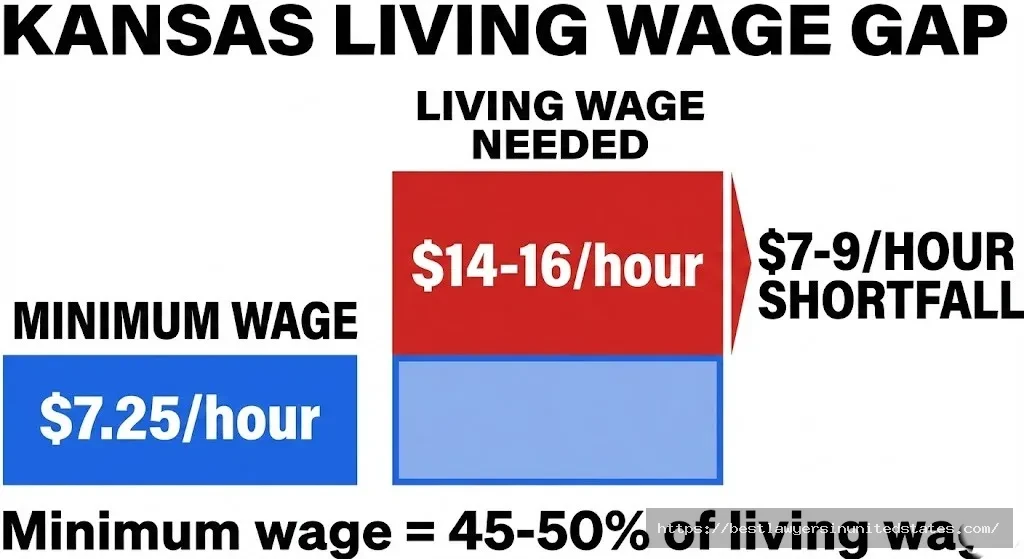
Quick Answer: A living wage in Kansas ranges from $14 to $16 per hour for a single adult, depending on location. At $7.25 per hour, Kansas minimum wage provides only 45-50% of what workers need to cover basic living expenses.
The Living Wage Gap
The MIT Living Wage Calculator estimates the hourly wage needed to cover basic expenses like housing, food, transportation, healthcare, and other necessities without government assistance.
Living wage requirements in Kansas (2026 estimates):
| Location | Single Adult | Single Adult + 1 Child | 2 Adults (1 Working) + 2 Children |
|---|---|---|---|
| Wichita | $14.25/hour | $30.50/hour | $32.75/hour |
| Kansas City Metro | $15.75/hour | $33.25/hour | $35.50/hour |
| Topeka | $13.50/hour | $28.75/hour | $31.00/hour |
| Rural Kansas | $12.75/hour | $27.50/hour | $29.75/hour |
Minimum wage shortfall:
- Single adult needs $14-16/hour to meet basic needs
- Kansas minimum wage: $7.25/hour
- Annual income gap: $14,000-$18,000 per year
- Workers must earn nearly double minimum wage to afford basic living expenses
What Can You Afford on Kansas Minimum Wage?
A full-time minimum wage worker in Kansas earns $15,080 per year before taxes (2,080 hours × $7.25). This income falls below the federal poverty guideline for a family of two ($19,720 in 2026).
Reality check for minimum wage workers:
| Expense Category | Monthly Cost | % of Take-Home Pay |
|---|---|---|
| Housing (1BR apartment) | $650-850 | 52-68% |
| Food | $250-300 | 20-24% |
| Transportation | $200-300 | 16-24% |
| Healthcare | $150-200 | 12-16% |
| Utilities | $100-150 | 8-12% |
| Total Basic Expenses | $1,350-1,800 | 108-144% |
Critical finding: Basic living expenses exceed 100% of take-home pay on minimum wage, meaning workers cannot afford essentials without additional income sources or government assistance.
How Kansas Workers Cope With Low Wages
Minimum wage workers in Kansas employ various strategies to make ends meet:
Common coping mechanisms:
- Working multiple jobs (60-70+ hours per week)
- Relying on government assistance programs (SNAP, Medicaid)
- Living with family or roommates to split costs
- Skipping healthcare and other necessities
- Accumulating debt to cover expenses
- Seeking employment in higher-wage neighboring states
Many Kansas minimum wage workers qualify for public assistance despite working full-time. This effectively transfers the cost of inadequate wages to taxpayers through government benefit programs. For workers facing workplace disputes over wages or benefits, reviewing legal options for workplace disputes may help address these challenges.
What If You're Not Being Paid Properly?
Quick Answer: If your employer violates Kansas wage laws, you can file a complaint with the Kansas Department of Labor or the U.S. Department of Labor. You have up to two years to file for unpaid wages, or three years if the violation was willful.
Recognizing Wage Theft
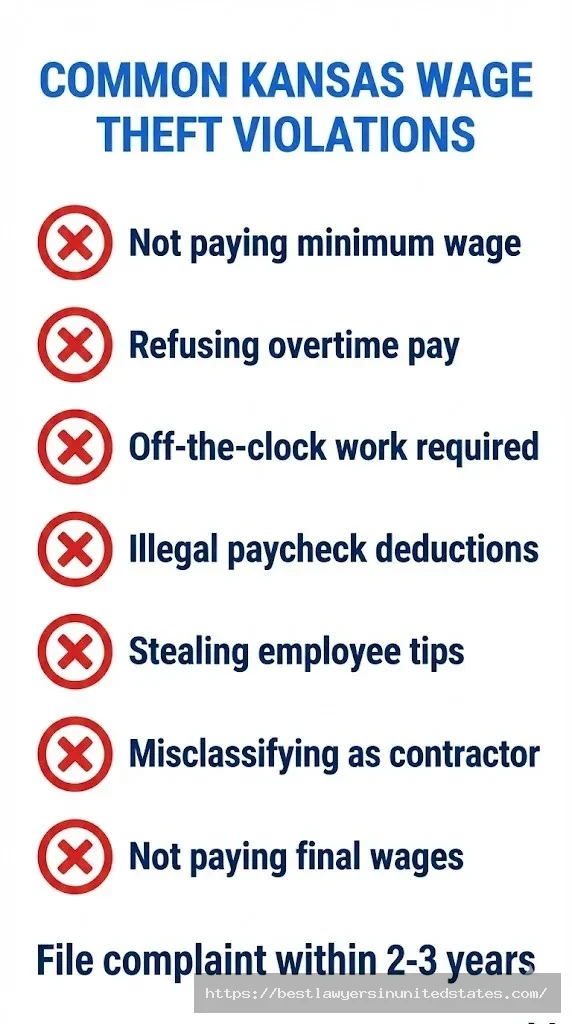
Wage theft occurs when employers fail to pay workers the full wages they have earned. This is one of the most common violations of labor law.
Common types of wage theft:
- Not paying minimum wage
- Refusing to pay overtime
- Requiring off-the-clock work
- Taking illegal deductions from paychecks
- Not compensating for all hours worked
- Stealing tips from tipped employees
- Misclassifying employees as independent contractors
- Failing to pay final wages after termination
Red flags that may indicate wage theft:
- Paychecks that seem too low for hours worked
- Employer requires work before clocking in or after clocking out
- No overtime pay despite working over 40 hours
- Deductions from pay that you did not authorize
- Tips are pooled with managers or owners
- Paid as independent contractor but treated as employee
How to File a Wage Claim in Kansas
Kansas workers have two options for filing wage complaints: state or federal enforcement agencies.
Option 1: Kansas Department of Labor
- Handles violations of Kansas Wage Payment Act
- Focuses on unpaid wages, not overtime
- File online at www.dol.ks.gov
- Call: (785) 296-5000
- Office locations: Topeka, Wichita, Kansas City
Option 2: U.S. Department of Labor (Wage and Hour Division)
- Handles FLSA violations including minimum wage and overtime
- Stronger enforcement authority
- File online at www.dol.gov/whd
- Kansas City Regional Office: (816) 502-9615
- Wichita Area Office: (316) 681-2481
Filing deadlines:
- Standard violations: 2 years from date of violation
- Willful violations: 3 years from date of violation
- Time limit applies to each unpaid wage, not when you discovered the theft
Required Documentation for Wage Claims
Strong documentation increases your chances of recovering unpaid wages. Gather as much evidence as possible before filing your complaint.
Essential documents:
- Pay stubs showing rate and hours
- Time sheets or time clock records
- Work schedules
- Bank statements showing direct deposits
- Text messages or emails about work hours
- Written job description
- Employee handbook or wage policies
- Any written communications about pay
If employer did not provide records:
- Your own log of hours worked
- Calendar notations of shifts
- Photos or screenshots of schedules
- Witness statements from coworkers
- Any available documentation
What Happens After You File?
The enforcement agency investigates your complaint and determines if violations occurred. This process typically takes several months.
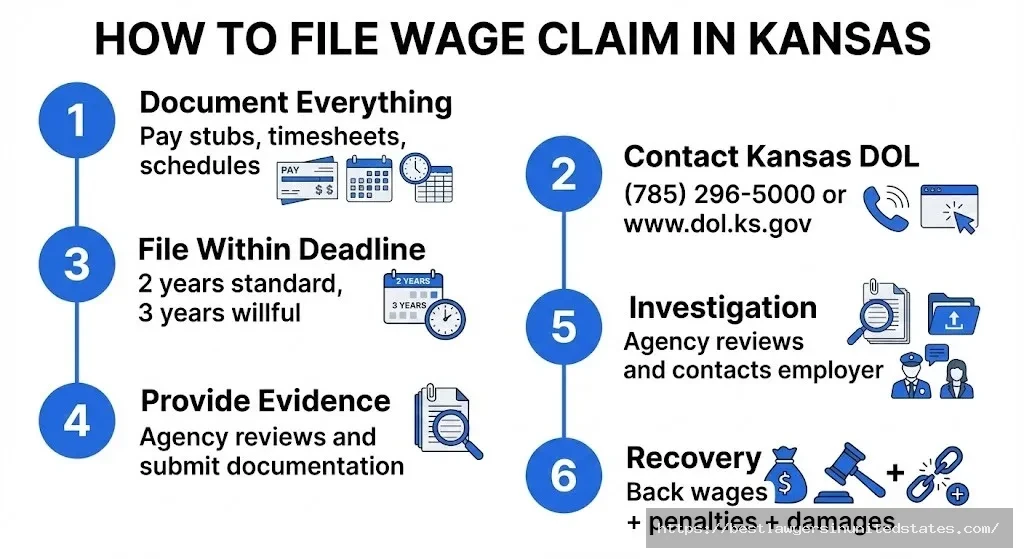
Investigation steps:
- Initial review: Agency reviews your complaint and documentation
- Employer notice: Agency contacts employer and requests records
- Evidence gathering: Agency examines payroll records and interviews parties
- Determination: Agency decides if violations occurred
- Resolution: If violations found, agency orders employer to pay back wages
Possible outcomes:
- Back wages paid directly to you
- Civil penalties assessed against employer
- Liquidated damages (additional penalty equal to unpaid wages)
- Criminal prosecution for egregious violations
- No violation found (you may still pursue private lawsuit)
Calculate Your Wage Theft Recovery in Kansas
Think your employer owes you money? Use our wage theft calculator to estimate how much you could recover, including unpaid wages, penalties, and interest under Kansas law.
Wage Theft Recovery Calculator
Estimate how much you can recover in unpaid wages, penalties, and damages based on your state's laws
💵 Estimated Total Recovery
💰 Unpaid Wages
⚖️ Penalties & Damages
📋 Total Summary
Calculator features:
- Multiple violation types (unpaid wages, overtime, tips)
- Kansas-specific penalties and damages
- Filing deadline tracker
- Total recovery estimate
- Next steps guidance
Full wage theft calculator: https://bestlawyersinunitedstates.com/wage-theft-calculator/
Need help with unpaid wages? Contact Kansas Department of Labor or consult with an employment attorney. Understanding your rights under Kansas's legal framework can help protect your interests.
Email: [email protected]
Penalties for Kansas Wage Violations
Employers who violate wage laws face significant penalties designed to discourage wage theft and compensate workers.
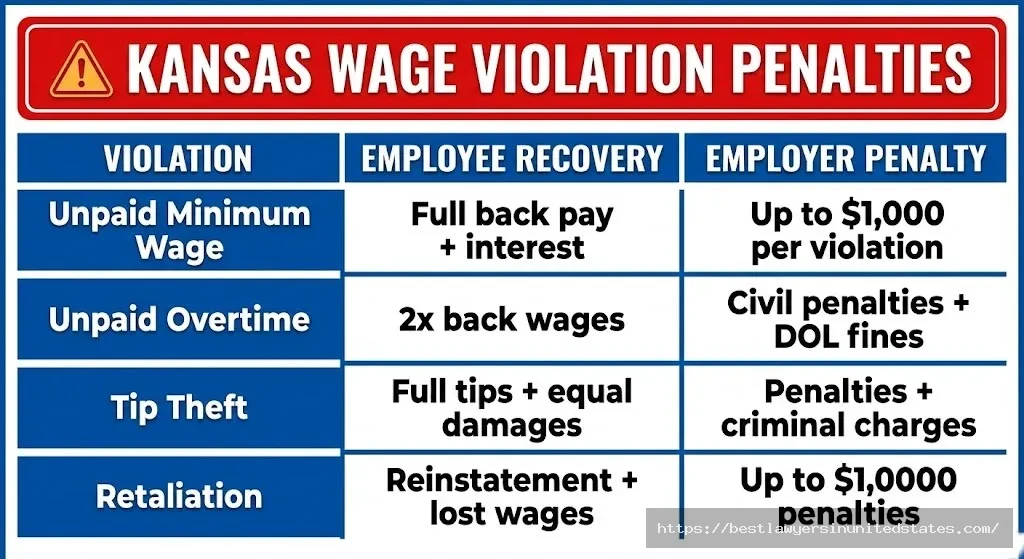
Kansas penalties for wage violations:
| Violation Type | Employee Recovery | Employer Penalty |
|---|---|---|
| Unpaid Minimum Wage | Full back wages + interest | Civil penalties up to $1,000 per violation |
| Unpaid Overtime | 2x back wages (liquidated damages) | Civil penalties + DOL fines |
| Tip Theft | Full tips + equal amount as liquidated damages | Civil penalties + criminal charges possible |
| Retaliation | Reinstatement + lost wages + damages | Additional penalties up to $10,000 |
Liquidated damages: For FLSA violations, workers can recover not just unpaid wages but an additional equal amount as penalty damages. This means if your employer owes you $5,000 in unpaid overtime, you may recover $10,000 total.
Employer Retaliation Is Illegal
Kansas and federal law prohibit employers from retaliating against workers who file wage complaints or ask questions about wages.
Illegal retaliation includes:
- Firing or threatening to fire
- Reducing hours or wages
- Demotion or undesirable schedule changes
- Intimidation or harassment
- Reporting immigration status in response to wage complaint
If your employer retaliates, you can file an additional complaint and may be entitled to reinstatement, back pay, and additional damages. Workers facing potential retaliation should document all interactions and consider consulting an attorney. Resources for addressing wage garnishment issues may also prove helpful in certain circumstances.
Kansas Employer Compliance Requirements
Quick Answer: Kansas employers must display an official minimum wage poster, maintain accurate payroll records for at least three years, pay employees at least monthly, and follow strict rules about wage deductions.
Mandatory Workplace Postings
Kansas employers must display current labor law posters in a conspicuous location where all employees can easily see them. The Kansas Department of Labor provides free posters covering required topics.
Required Kansas posters:
- Kansas Minimum Wage and Maximum Hours Law
- Workers Compensation notice
- Unemployment Insurance notice
- Equal Employment Opportunity information
- OSHA workplace safety information
- Fair Labor Standards Act (federal)
Posting requirements:
- Must be posted in English and Spanish if needed
- Must be visible to all employees
- Must be current (not outdated versions)
- Must be posted at each work location
Employers can download free posters at www.dol.ks.gov or order physical copies from the Kansas Department of Labor. Failure to display required posters can result in fines of up to $1,000 per violation.
Recordkeeping Requirements
Kansas employers must maintain detailed payroll records for each employee. These records must be preserved for at least three years after the employee's termination.
Required payroll records:
- Employee's full name and social security number
- Address and date of birth (if under 19)
- Occupation and job title
- Time and day of week when workweek begins
- Hours worked each day and total hours each workweek
- Basis of pay (hourly, salary, piece rate)
- Regular hourly rate
- Total daily or weekly straight-time earnings
- Total overtime earnings for the workweek
- All additions to or deductions from wages
- Total wages paid each pay period
- Date of payment and pay period covered
Additional records for tipped employees:
- Amount of tips received each workweek
- Notice to employee about tip credit taken
- Tip pooling arrangements
Payment Frequency and Final Wages
Kansas law requires employers to pay employees at least once per month. Many employers pay more frequently (weekly, biweekly, or semi-monthly), but monthly is the minimum.
Pay frequency rules:
- Must establish regular payday
- Cannot be later than 15 days after end of pay period
- Must pay in U.S. currency, check, or direct deposit
- Cannot require specific bank or check cashing location
Final wages after termination:
- If employee quits: Next regular payday
- If employee is fired: Next regular payday
- No special deadline for final paycheck in Kansas
Wage Deduction Restrictions
Kansas law strictly limits what employers can deduct from employee wages. Employers cannot make deductions that reduce wages below minimum wage except for legally required items.
Permitted deductions:
- Federal and state income tax withholding
- Social Security and Medicare taxes
- Court-ordered garnishments
- Employee-authorized retirement contributions
- Employee-authorized health insurance premiums
- Employee-authorized union dues
Prohibited or restricted deductions:
- Cash register shortages (unless employee authorized in writing)
- Damaged or lost equipment (unless employee authorized)
- Uniforms or tools required for work
- Training costs or education expenses
- Customer walkouts or unpaid bills
- Any deduction that reduces pay below minimum wage
Employers who make illegal deductions commit wage theft and must repay the full amount to employees. Workers should review every pay stub to verify all deductions are proper and authorized.
Frequently Asked Questions About Kansas Minimum Wage
What Is the Minimum Wage in Kansas for 2026?
Quick Answer: The minimum wage in Kansas is $7.25 per hour as of January 1, 2026, which matches the federal minimum wage and has not changed since 2009.
This rate applies to all non-exempt employees in Kansas. The state has not passed any legislation to increase minimum wage above the federal level.
Does Kansas Have a Higher Minimum Wage Than Federal?
Quick Answer: No. Kansas minimum wage is exactly the same as federal minimum wage at $7.25 per hour. Kansas has not enacted a state minimum wage higher than federal requirements.
When state and federal minimum wage laws differ, employers must pay the higher rate. Since Kansas matches federal law, workers receive $7.25 per hour under both state and federal requirements.
Is Kansas Minimum Wage Going Up in 2026 or 2027?
Quick Answer: No scheduled increases exist for Kansas minimum wage in 2026, 2027, or beyond. The legislature has not passed any bills to raise the state minimum wage.
Kansas minimum wage will remain $7.25 per hour unless the federal government raises the federal minimum wage or the Kansas legislature passes new state legislation. Neither action appears likely in the near future.
What Is the Tipped Minimum Wage in Kansas?
Quick Answer: Kansas tipped minimum wage is $2.13 per hour, plus tips. Employers must ensure total compensation (wages plus tips) reaches at least $7.25 per hour, or pay the difference.
This is the federal tipped minimum wage, which Kansas follows without additional state requirements. Employers can claim a tip credit of up to $5.12 per hour if employees regularly receive tips. For workers experiencing tip-related wage issues, exploring legal options for workplace disputes may be beneficial.
How Does Kansas City Minimum Wage Work?
Quick Answer: Kansas City minimum wage depends on which state you work in. The Missouri side pays $13.75 per hour in 2026, while the Kansas side pays $7.25 per hour, creating a $6.50 wage gap.
Kansas City spans the Kansas-Missouri border. Workers on the Missouri side of State Line Road are covered by Missouri's higher minimum wage, while workers on the Kansas side receive Kansas's $7.25 rate. This creates significant wage differences for identical jobs in the same metro area.
Can Kansas Cities Set Their Own Minimum Wage?
Quick Answer: No. Kansas law prohibits cities and counties from establishing local minimum wages higher than the state minimum. Only the state legislature can raise Kansas minimum wage.
This differs from states like Missouri, where cities can set higher local minimums. Kansas maintains preemption authority that prevents local governments from enacting wage laws.
How Do I Calculate My Earnings at Kansas Minimum Wage?
Quick Answer: Use our minimum wage calculator to calculate your exact earnings. At $7.25/hour, you earn $290 per 40-hour week, $1,257 per month, or $15,080 per year before taxes.
The calculator automatically accounts for Kansas's 2026 minimum wage and provides breakdowns for different work schedules, including part-time and overtime scenarios.
How Much Overtime Pay Am I Entitled to in Kansas?
Quick Answer: Kansas overtime is 1.5 times your regular rate for hours over 40 per week. At minimum wage, overtime rate is $10.88 per hour. Calculate your exact overtime with our overtime calculator.
Kansas follows federal FLSA overtime rules. You earn time-and-a-half for any hours exceeding 40 in a workweek, but Kansas does not require daily overtime like some states.
How Do I Calculate Wage Theft Recovery in Kansas?
Quick Answer: Use our wage theft calculator to estimate unpaid wages, penalties, and liquidated damages. You may recover double the unpaid amount for FLSA violations.
The calculator helps you track unpaid minimum wage, overtime violations, tip theft, and other wage violations. It accounts for Kansas and federal penalties to give you an estimated recovery amount.
How Do I Report Wage Theft in Kansas?
Quick Answer: File a complaint with the Kansas Department of Labor at (785) 296-5000 or online at www.dol.ks.gov, or contact the U.S. Department of Labor Wage and Hour Division at (816) 502-9615 for federal violations.
You have up to two years (or three years for willful violations) to file a wage claim. Gather documentation like pay stubs, time records, and work schedules before filing.
What Is a Livable Wage in Kansas?
Quick Answer: A livable wage in Kansas ranges from $14 to $16 per hour for a single adult, depending on location. Kansas minimum wage of $7.25 provides only 45-50% of what workers need to cover basic living expenses.
The MIT Living Wage Calculator estimates costs for housing, food, transportation, healthcare, and other necessities. Minimum wage workers in Kansas typically cannot afford basic living expenses without additional income or assistance.
What Are Kansas Minimum Wage Exemptions?
Quick Answer: Kansas minimum wage exemptions include tipped employees ($2.13/hour base), youth workers under 20 ($4.25/hour for 90 days), executive/administrative/professional employees earning $844+ per week, and certain agricultural workers.
These exemptions follow federal FLSA standards. Employees must meet strict criteria to be exempt. Being paid a salary alone does not make you exempt from minimum wage or overtime requirements.
Can My Employer Pay Me Less Than Minimum Wage?
Quick Answer: No, except for specific legal exemptions. Your employer must pay at least $7.25 per hour unless you qualify as a tipped employee, youth worker, or other legally exempt category.
Employers cannot pay below minimum wage by claiming you are an independent contractor, intern, or trainee unless very specific legal criteria are met. Misclassification is illegal and you can file a wage complaint.
What Happens If I'm Paid Under Minimum Wage?
Quick Answer: You can file a wage complaint with the Kansas Department of Labor or U.S. Department of Labor. You may recover unpaid wages, liquidated damages (double the amount owed), and penalties.
The filing deadline is two years for standard violations or three years for willful violations. Your employer cannot retaliate against you for filing a complaint.
Are Tips Included in Kansas Minimum Wage?
Quick Answer: Yes, for tipped employees only. Employers can pay $2.13 per hour base wage and count tips toward the $7.25 minimum wage requirement. If tips don't reach $7.25/hour, employers must pay the difference.
For non-tipped employees, tips are extra income above the full $7.25 minimum wage. Employers cannot use tips to offset regular minimum wage for non-tipped workers.
Understanding Your Rights as a Kansas Worker
Kansas workers are protected by both state and federal wage laws. The Kansas Wage Payment Act and the federal Fair Labor Standards Act provide minimum standards for wages, overtime, and payment practices.
Your basic rights include:
- Minimum wage of at least $7.25 per hour
- Overtime pay at 1.5 times regular rate for hours over 40 per week
- Tipped employees must earn at least $7.25/hour including tips
- Protection from retaliation for asking about wages or filing complaints
- Access to your payroll records
- Payment at least once per month
- Right to file wage complaint within 2-3 years
Employer responsibilities include:
- Paying at least minimum wage for all hours worked
- Tracking and paying overtime properly
- Maintaining accurate payroll records for three years
- Displaying required labor law posters
- Following wage deduction restrictions
- Making up tip shortfalls when needed
- Not retaliating against workers who assert their rights
Kansas workers should know their rights and speak up when employers violate wage laws. Wage theft costs U.S. workers billions of dollars every year. By understanding your rights and using available resources, you can protect yourself and ensure you receive fair payment for your work.
Resources for Kansas Workers
Kansas Department of Labor
- Website: www.dol.ks.gov
- Phone: (785) 296-5000
- Locations: Topeka, Wichita, Kansas City
- Services: Wage complaints, workplace posters, employment laws
U.S. Department of Labor - Wage and Hour Division
- Website: www.dol.gov/whd
- Kansas City Regional Office: (816) 502-9615
- Wichita Area Office: (316) 681-2481
- Services: FLSA complaints, minimum wage and overtime enforcement
Kansas Legal Services
- Website: www.kansaslegalservices.org
- Phone: (785) 233-2068
- Services: Free legal help for low-income Kansans
Additional support for Kansas workers may include comparing employment conditions with neighboring states. For workers near state borders, reviewing information about Indiana minimum wage can provide helpful context for wage comparisons.
Conclusion: Kansas Minimum Wage in 2026
Kansas minimum wage remains at $7.25 per hour in 2026 with no scheduled increases on the horizon. This rate has been stagnant since 2009 while neighboring states have raised their minimum wages significantly. Missouri workers earn $13.75 per hour, Nebraska workers earn $13.50, and Colorado workers earn $14.81, all substantially higher than Kansas.
The Kansas City metro area exemplifies this challenge, with a $6.50 per hour wage gap between the Missouri and Kansas sides of the same city. Kansas workers face difficult choices about where to work and whether crossing state lines for better wages justifies the additional commute and costs.
For workers earning Kansas minimum wage, basic living expenses exceed take-home pay. The estimated living wage for a single adult in Kansas ranges from $14 to $16 per hour, meaning minimum wage provides only about half of what workers need to afford housing, food, transportation, and other necessities without government assistance.
Kansas workers should understand their rights, use the interactive calculators provided in this guide to verify proper payment, and file complaints if employers violate wage laws. While the political landscape makes state-level minimum wage increases unlikely in the near future, workers can still protect themselves by knowing the law and holding employers accountable for violations.
Email: [email protected]
