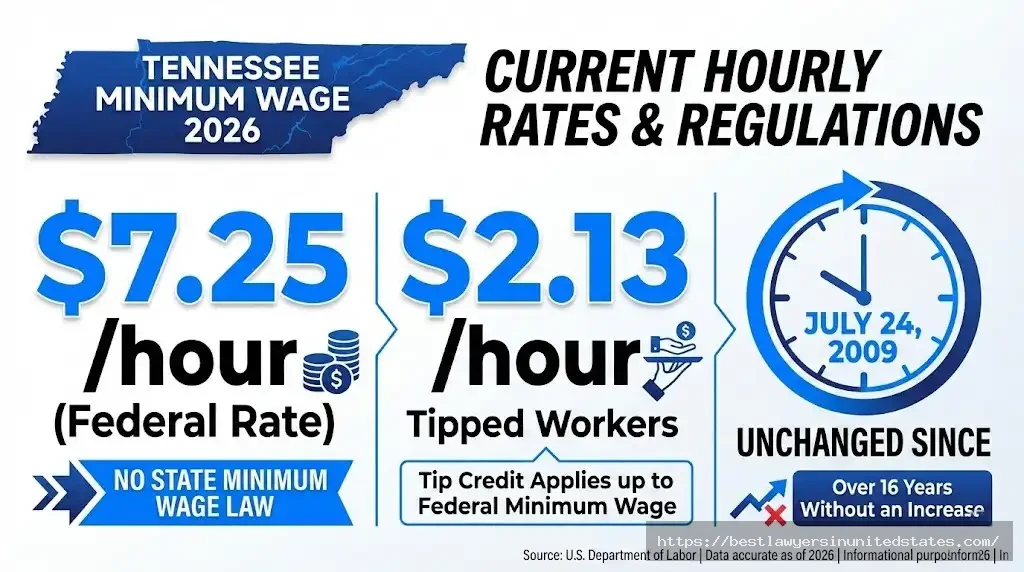
Tennessee’s minimum wage is $7.25 per hour in 2026, which follows the federal minimum wage. Tennessee has no state-level minimum wage law, so all workers are covered by the Fair Labor Standards Act (FLSA). This rate has not changed since July 24, 2009.
The state’s tipped minimum wage is $2.13 per hour for servers and other tipped employees, though total earnings including tips must reach $7.25 per hour. Tennessee is one of only five states without its own minimum wage law, putting it among the lowest-paying states in the country.
While a $20 minimum wage bill has been proposed in the Tennessee General Assembly, the legislation faces significant opposition in the Senate committee. Workers earning minimum wage in Tennessee make just $15,080 per year working full-time, far below the living wage of $15-18 per hour needed in most Tennessee counties.
Calculate Your Earnings in Tennessee
Want to know exactly how much you’ll earn at Tennessee’s $7.25 minimum wage? Use our free calculator to estimate your weekly, monthly, and annual income based on your hours worked.
💰 Minimum Wage Earnings Calculator
Calculate your weekly, monthly, and annual earnings with overtime and tax estimates
📊 Your Earnings Breakdown
💰 Gross Earnings
Calculator features:
- Automatic Tennessee wage rates for 2026
- Weekly, monthly, and annual earnings
- Overtime calculations
- Tax withholding estimates (Tennessee has no state income tax)
- Take-home pay breakdown
Full calculator with all features: Tennessee Minimum Wage Calculator
Questions about your wages or need legal help?
Email: [email protected]
What Is the Minimum Wage in Tennessee for 2026?
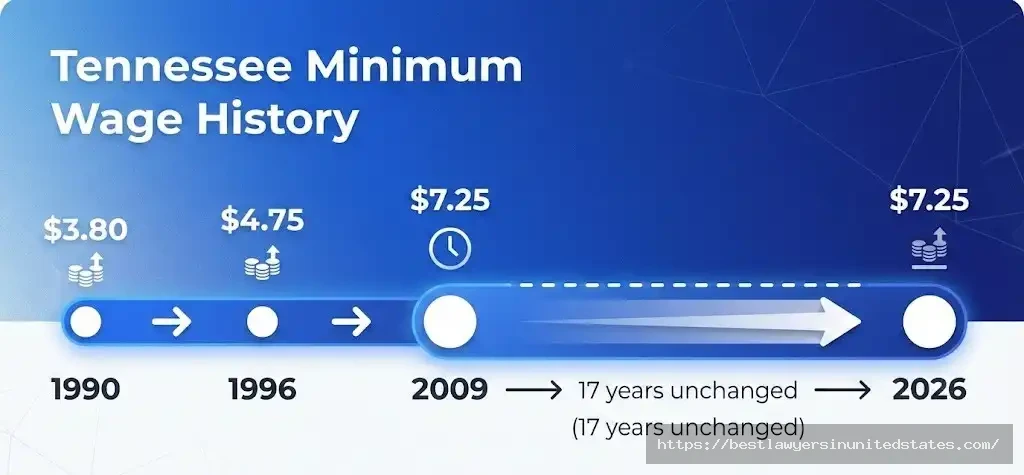
Tennessee's minimum wage remains $7.25 per hour in 2026. This rate has been unchanged since 2009 when the federal government last increased the minimum wage. Tennessee does not have its own state minimum wage law, so all workers fall under federal jurisdiction.
The annual salary for a full-time minimum wage worker in Tennessee equals $15,080 per year. This breaks down to $1,256.67 per month, $290 per week, or $58 per day for an 8-hour shift.
Why Tennessee Has No State Minimum Wage
Tennessee is one of five states (along with Alabama, Louisiana, Mississippi, and South Carolina) that has never established a state minimum wage. The state relies entirely on the federal Fair Labor Standards Act to set wage floors for workers.
States without minimum wage laws:
- Tennessee
- Alabama
- Louisiana
- Mississippi
- South Carolina
This means Tennessee workers cannot benefit from state-level wage increases that have lifted pay in 45 other states. While Missouri minimum wage increased to $13.75 in 2025 and will reach $15.00 in 2026, Tennessee workers remain stuck at the 2009 federal rate.
Tennessee Minimum Wage History
| Effective Date | Minimum Wage | Tipped Wage | Notes |
|---|---|---|---|
| 1990 | $3.80 | $1.52 | Historical rate |
| 1996 | $4.75 | $1.90 | Federal increase |
| July 24, 2007 | $5.85 | $2.13 | FLSA increase |
| July 24, 2008 | $6.55 | $2.13 | FLSA increase |
| July 24, 2009 | $7.25 | $2.13 | Current rate |
| 2026 | $7.25 | $2.13 | No change for 17 years |
The $7.25 rate has lost significant purchasing power since 2009. Adjusted for inflation, today's minimum wage should be approximately $10.50 to match the 2009 value.
Is Tennessee Raising the Minimum Wage in 2026?
No. Tennessee has no scheduled minimum wage increases for 2026 or any future year. Unlike 22 states that are raising their minimum wages in 2026, Tennessee remains at the federal $7.25 rate with no legislative momentum for change.
The $20 Minimum Wage Bill Status
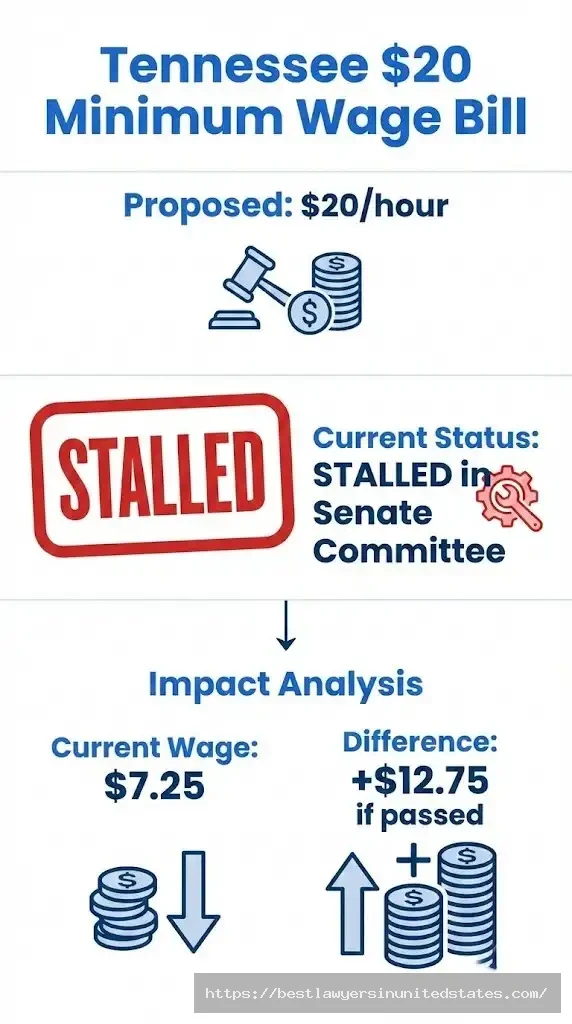
State Senator introduced a bill to raise Tennessee's minimum wage to $20 per hour in 2024. The proposed legislation would:
- Establish Tennessee's first state minimum wage
- Set the rate at $20 per hour
- Apply to all workers except federally exempt categories
Current status: The bill remains stalled in the Senate Commerce and Labor Committee. Republican lawmakers have expressed strong opposition, citing concerns about small business costs and potential job losses.
Why Tennessee Resists Wage Increases
The Tennessee General Assembly has historically opposed minimum wage increases for several reasons:
Legislative opposition arguments:
- Business cost concerns
- Fear of job losses
- Claims that market forces should set wages
- Opposition to government wage mandates
- Preference for federal-only regulation
This political climate makes any state minimum wage increase unlikely in the near future. Workers seeking higher pay often look to neighboring states like Arkansas minimum wage, which reached $12.00 in 2025 and continues to rise.
Comparison: States Raising Minimum Wage in 2026
| State | 2026 Minimum Wage | Increase from 2025 |
|---|---|---|
| Missouri | $15.00 | +$1.25 |
| Arkansas | $13.00 | +$1.00 |
| Virginia | $12.41 | +$0.41 |
| Tennessee | $7.25 | $0.00 |
Tennessee falls further behind each year as neighboring states implement gradual increases.
Tennessee Tipped Minimum Wage for Servers and Restaurant Workers
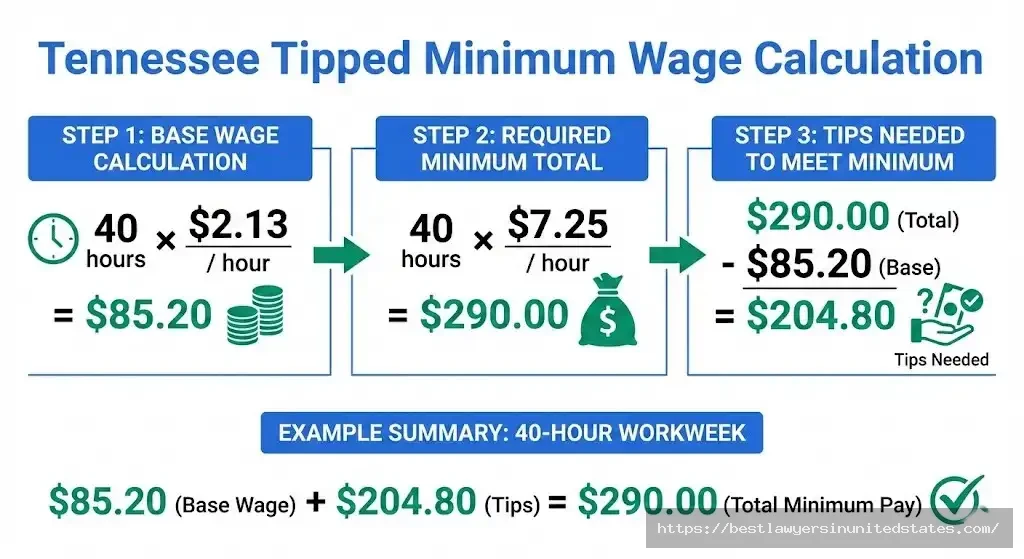
Tennessee follows the federal tipped minimum wage of $2.13 per hour for servers, bartenders, and other tipped employees. Employers can claim a tip credit, paying as little as $2.13 per hour as long as the employee's tips bring their total earnings to at least $7.25 per hour.
How the Tip Credit Works in Tennessee
Calculation example:
- Server works 40 hours at $2.13/hour = $85.20
- Server earns $400 in tips during the week
- Total compensation = $485.20 ($12.13/hour average)
- Employer meets minimum wage requirement
If tips fall short, the employer must make up the difference. A server earning only $100 in tips on a 40-hour week would need an additional $190 from the employer to reach the $290 minimum ($7.25 × 40 hours).
What Happens If Tips Don't Reach Minimum Wage?
Employers must track tips and pay the difference when tip earnings fall below minimum wage. This is a federal requirement under the FLSA.
Employee responsibilities:
- Report all tips to employer (cash and credit)
- Keep daily tip records
- Report tips on IRS Form 4070 monthly
Employer responsibilities:
- Track reported tips
- Calculate total hourly earnings (wage + tips)
- Pay additional wages if total falls below $7.25/hour
- Maintain accurate payroll records
Tennessee Tip Pooling Rules
Tip pooling is legal in Tennessee under federal guidelines. Employers can require tipped employees to share tips with other service staff, but strict rules apply.
Legal tip pooling:
- Servers can share tips with bussers, hosts, bartenders
- Must include only traditionally tipped employees
- Employer cannot participate in tip pool
- Managers and supervisors cannot take tips
Illegal tip pooling:
- Management taking any portion of tips
- Forcing servers to tip out kitchen staff (non-tipped positions)
- Employer keeping credit card processing fees from tips
- Tip pools that reduce wages below minimum wage
Important: Tennessee employers who violate tip credit rules face penalties including back pay, liquidated damages (double pay), and civil fines up to $1,100 per violation.
Tennessee Living Wage vs. Minimum Wage: The Reality Gap
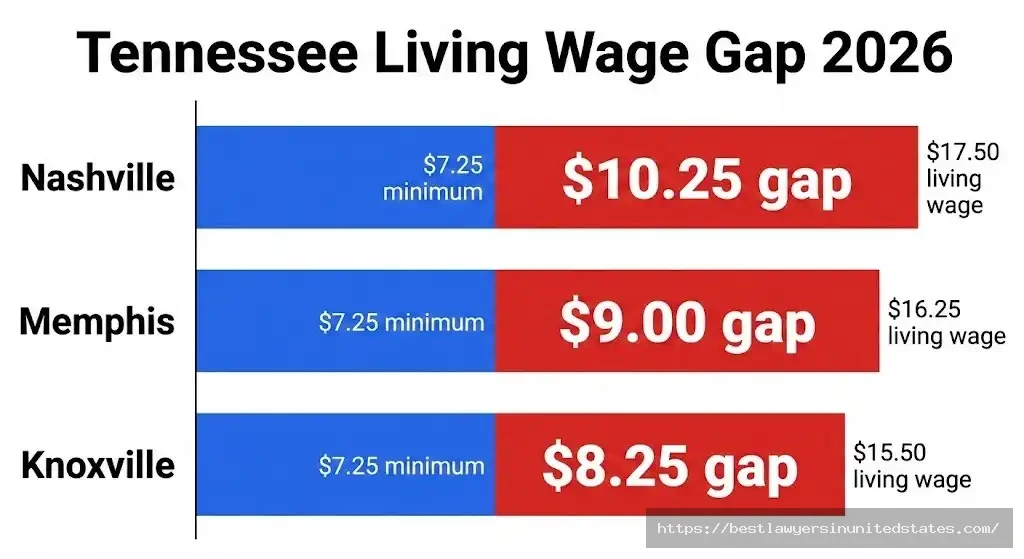
Tennessee's $7.25 minimum wage falls far short of the living wage needed to afford basic expenses. The gap between survival and actual wages has widened dramatically since 2009.
Living Wage by Tennessee County
| County/City | Living Wage (Single Adult) | Minimum Wage | Monthly Shortfall |
|---|---|---|---|
| Davidson (Nashville) | $17.50/hour | $7.25/hour | $1,773/month |
| Shelby (Memphis) | $16.25/hour | $7.25/hour | $1,560/month |
| Knox (Knoxville) | $15.50/hour | $7.25/hour | $1,430/month |
| Hamilton (Chattanooga) | $15.75/hour | $7.25/hour | $1,473/month |
| Rural Tennessee | $14.50/hour | $7.25/hour | $1,257/month |
These calculations assume full-time work (40 hours/week) and include rent, food, transportation, healthcare, and basic utilities.
Can You Afford Rent on Tennessee Minimum Wage?
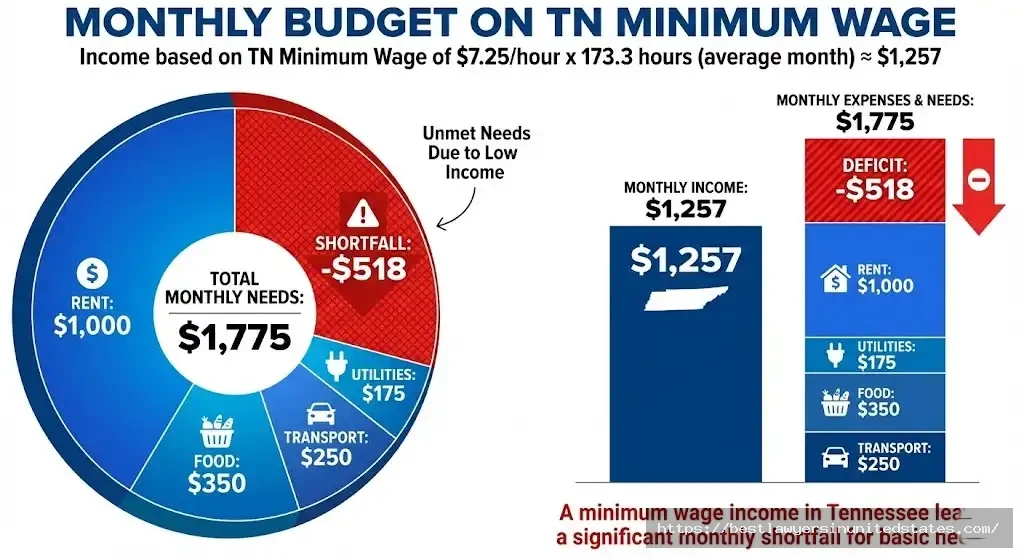
Quick Answer: No. Full-time minimum wage income ($1,257/month) cannot cover average Tennessee rent ($900-1,500/month) plus other expenses.
Monthly budget on minimum wage ($1,257):
- Rent (1-bedroom apartment): $850-1,200
- Utilities: $150-200
- Food: $300-400
- Transportation: $200-300
- Healthcare: $100-200
- Phone/Internet: $100
- Total needed: $1,700-2,500
The math simply doesn't work. A minimum wage worker would need to work 60-80 hours per week to afford basic housing in most Tennessee cities.
Real-World Affordability Scenarios
Scenario 1: Single adult in Nashville
- Minimum wage income: $1,257/month
- 1-bedroom apartment average: $1,350/month
- Shortfall: $93 before any other expenses
Scenario 2: Single parent with one child
- Minimum wage income: $1,257/month
- Required living wage: $28.50/hour ($4,940/month)
- Shortfall: $3,683/month
Scenario 3: Two adults working minimum wage
- Combined income: $2,514/month
- Required for two adults: $24.50/hour combined ($4,247/month)
- Shortfall: $1,733/month
These gaps explain why many Tennessee minimum wage workers hold multiple jobs or rely on government assistance programs.
Tennessee Overtime Laws and Overtime Pay Calculator
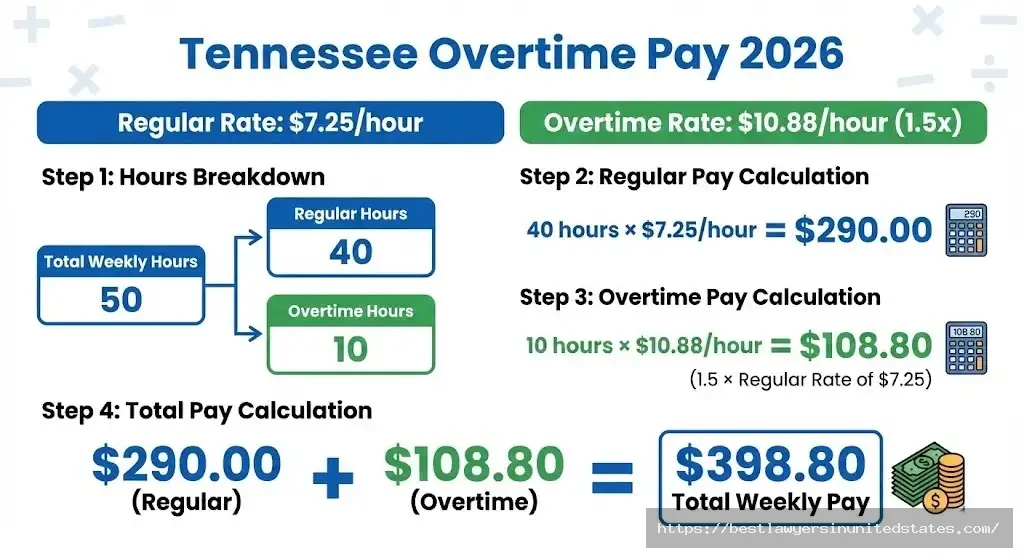
Tennessee follows federal overtime laws under the FLSA. Workers must receive 1.5 times their regular hourly rate for any hours worked over 40 in a single workweek.
How Tennessee Overtime Works
Overtime rate calculation:
- Regular minimum wage: $7.25/hour
- Overtime rate: $10.88/hour (7.25 × 1.5)
For tipped employees:
- Regular rate: $2.13/hour base wage
- Overtime rate: $3.20/hour base wage (2.13 × 1.5)
- Tips must still bring total to minimum wage for overtime hours
Tennessee-Specific Overtime Rules
Tennessee has no daily overtime requirement. Workers only receive overtime pay after exceeding 40 hours per week, not 8 hours per day. This differs from states like California minimum wage laws, which require overtime after 8 hours daily.
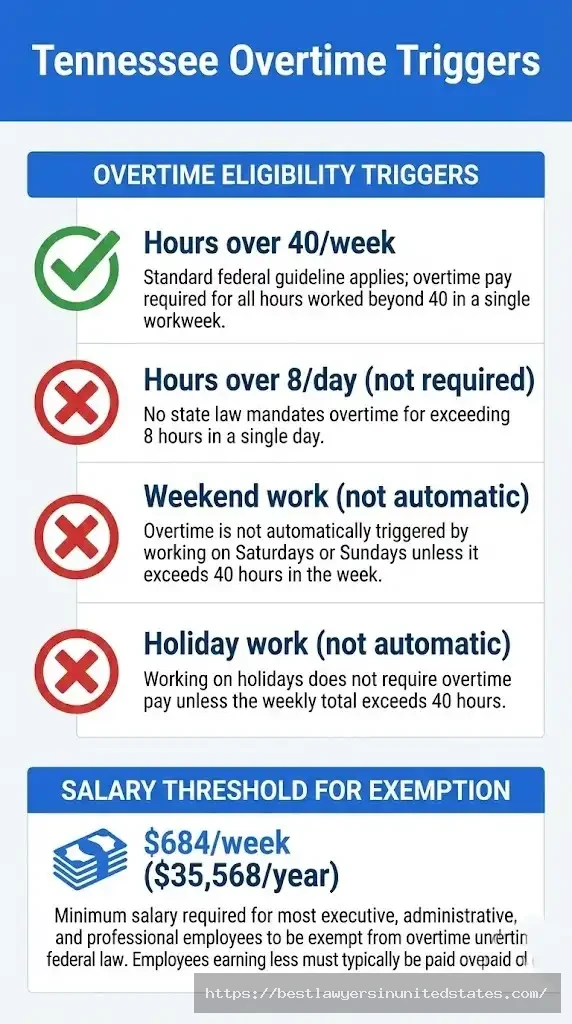
Tennessee overtime triggers:
- ✅ Hours over 40 in a workweek
- ❌ Hours over 8 in a single day (not required)
- ❌ Weekend work (not automatic overtime)
- ❌ Holiday work (not automatic overtime)
Who Is Exempt from Tennessee Overtime?
Certain employee categories are exempt from overtime requirements under federal law. These exemptions apply in Tennessee:
Common overtime exemptions:
- Executive employees (salary minimum $684/week, $35,568/year)
- Administrative employees (salary minimum $684/week)
- Professional employees (salary minimum $684/week)
- Computer employees (salary minimum $684/week or $27.63/hour)
- Outside sales employees
- Certain commissioned retail employees
- Some agricultural workers
- Certain transportation workers
Critical point: Simply being paid a salary does NOT automatically exempt an employee from overtime. The position must meet specific federal "duties tests" regarding job responsibilities and decision-making authority.
Calculate Your Overtime Pay in Tennessee
Working more than 40 hours per week? Calculate your overtime earnings based on Tennessee's overtime laws. This calculator accounts for Tennessee's specific overtime rules including weekly overtime thresholds.
⏰ Overtime Pay Calculator
Calculate your overtime earnings based on your state's specific labor laws
📍 Select Your State
💰 Your Hourly Wage
📊 Calculation Method
📅 Weekly Hours
💵 Your Weekly Overtime Pay
📊 Earnings Breakdown
📅 Pay Period Estimates
⚖️ State vs Federal Comparison
Calculator features:
- Tennessee-specific overtime rules
- Weekly overtime calculations (40+ hours)
- Pay period breakdowns
- Comparison with federal law
- Tipped employee overtime calculations
Full overtime calculator: Tennessee Overtime Calculator
Questions about your wages or need legal help?
Email: [email protected]
Common Tennessee Overtime Violations
Illegal employer practices:
- Paying straight time for overtime hours
- Classifying employees as exempt when they don't qualify
- Averaging hours across two weeks (each week stands alone)
- Requiring off-the-clock work
- Compensatory time off instead of overtime pay (private sector)
- Misclassifying employees as independent contractors
Workers who suspect overtime violations should document their hours and contact the U.S. Department of Labor Wage and Hour Division, as Tennessee has minimal state-level wage enforcement.
Tennessee Minimum Wage by City: Nashville, Memphis, Knoxville, Chattanooga
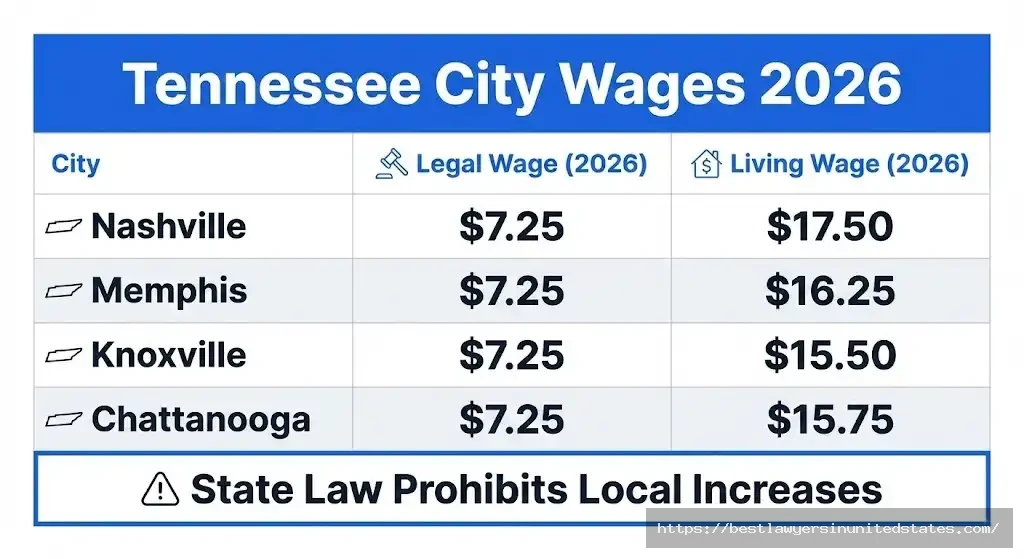
Tennessee state law preempts local minimum wage ordinances. No Tennessee city can establish a minimum wage higher than the state/federal rate of $7.25 per hour, even in high-cost areas like Nashville.
Nashville Minimum Wage
Nashville follows the $7.25 federal minimum wage despite having one of the highest costs of living in Tennessee. The Nashville Metropolitan Council has discussed local wage ordinances but lacks legal authority under state law.
Nashville wage reality:
- Legal minimum wage: $7.25/hour
- Living wage needed: $17.50/hour
- Average entry-level wages: $12-14/hour
- Major employers (Amazon, FedEx): $15-18/hour
Many Nashville employers voluntarily pay above minimum wage due to competitive labor markets and high living costs. The city's tourism and healthcare sectors typically start workers at $10-15/hour.
Memphis Minimum Wage
Memphis also follows the $7.25 federal rate. Worker advocacy groups have pushed for local wage increases, but Tennessee Code § 50-2-107 prohibits cities from setting their own minimum wages.
Memphis wage landscape:
- Legal minimum wage: $7.25/hour
- Living wage needed: $16.25/hour
- Unemployment rate: ~5.5%
- Major employers (FedEx, AutoZone): $13-16/hour starting
Memphis has a large population of minimum wage workers in retail and food service. The city's lower cost of living compared to Nashville makes the $7.25 wage slightly more viable, though still below living wage standards.
Knoxville and Chattanooga Minimum Wage
Both Knoxville and Chattanooga are bound by the same $7.25 federal minimum wage.
| City | Minimum Wage | Living Wage | Major Employers Starting Pay |
|---|---|---|---|
| Nashville | $7.25 | $17.50 | $15-18/hour |
| Memphis | $7.25 | $16.25 | $13-16/hour |
| Knoxville | $7.25 | $15.50 | $12-15/hour |
| Chattanooga | $7.25 | $15.75 | $12-15/hour |
Why Tennessee Cities Cannot Raise Minimum Wage
Tennessee Code § 50-2-107 explicitly prohibits municipalities from establishing minimum wages. This state preemption law prevents cities from responding to local economic conditions with higher wage requirements.
Legal barrier: Any city ordinance attempting to set a higher minimum wage would be void under state law. This contrasts with states that allow local control, where cities like Seattle ($19.97) and San Francisco ($18.07) have set substantially higher rates.
Tennessee Wage Theft: How to Recover Unpaid Wages
Wage theft affects thousands of Tennessee workers annually. Common violations include unpaid minimum wage, unpaid overtime, illegal tip deductions, and off-the-clock work requirements.
What Counts as Wage Theft in Tennessee?
Common wage theft examples:
- Paying below $7.25/hour minimum wage
- Not paying time-and-a-half for overtime hours
- Requiring off-the-clock work (arriving early, working through breaks)
- Illegal tip pooling or tip confiscation
- Misclassifying employees as independent contractors
- Not paying for all hours worked
- Making illegal wage deductions
- Failing to pay final wages after termination
How to File a Wage Complaint in Tennessee
Tennessee has limited state-level wage enforcement. Workers must file complaints with the federal Department of Labor Wage and Hour Division.
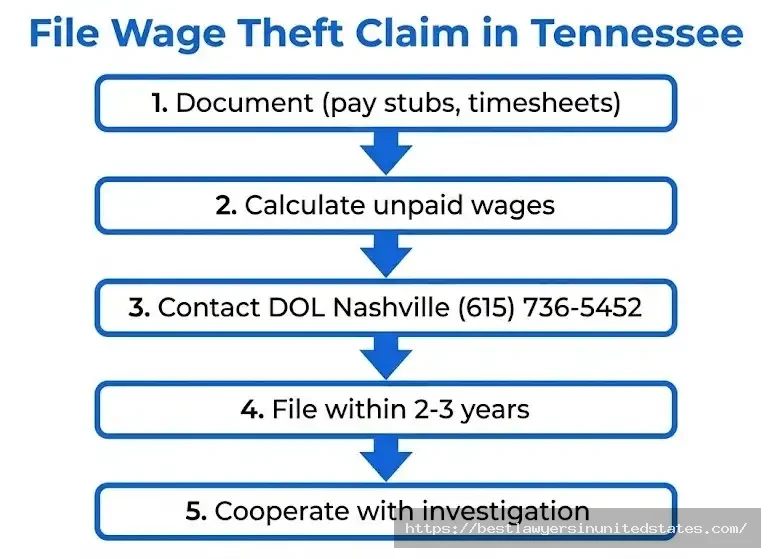
Step-by-step filing process:
- Document everything
- Pay stubs showing hourly rate and hours worked
- Time sheets or personal time records
- Work schedules
- Written communications about wages
- Bank statements showing deposits
- Calculate unpaid wages
- Use our wage theft calculator (below) to estimate amounts owed
- Include regular wages, overtime, and penalties
- Contact U.S. Department of Labor
- Nashville office: 230 Great Circle Road, Suite 308, Nashville, TN 37228
- Phone: (615) 736-5452
- Online complaint: www.dol.gov/agencies/whd/contact/complaints
- Memphis office: 1407 Union Avenue, Suite 500, Memphis, TN 38104
- File within statute of limitations
- 2 years for unintentional violations
- 3 years for willful violations
- Cooperate with investigation
- Provide requested documentation
- Respond to investigator questions
- Attend interviews if required
Calculate Your Wage Theft Recovery in Tennessee
Think your employer owes you money? Use our wage theft calculator to estimate how much you could recover, including unpaid wages, penalties, and interest under federal law.
Wage Theft Recovery Calculator
Estimate how much you can recover in unpaid wages, penalties, and damages based on your state's laws
💵 Estimated Total Recovery
💰 Unpaid Wages
⚖️ Penalties & Damages
📋 Total Summary
Calculator features:
- Multiple violation types (unpaid wages, overtime, tips)
- Federal penalties and damages (Tennessee has no state penalties)
- Filing deadline tracker
- Total recovery estimate
- Next steps guidance
Full wage theft calculator: Tennessee Wage Theft Calculator
Need help with unpaid wages?
Email: [email protected]
Tennessee Wage Theft Penalties and Recovery
Workers who win wage theft claims can recover:
| Violation Type | Employee Recovery | Employer Penalty |
|---|---|---|
| Unpaid minimum wage | Full back pay | Up to $1,100 per violation |
| Unpaid overtime | Back pay + equal amount (liquidated damages) | Up to $1,100 per violation |
| Tip violations | Full tips owed + equal amount | Up to $1,100 per violation |
| Retaliation | Reinstatement + back pay + damages | Civil penalties |
Important: Tennessee law provides no additional state-level penalties beyond federal FLSA remedies. This gives Tennessee one of the weakest wage enforcement systems in the country, similar to Mississippi minimum wage and Alabama minimum wage enforcement.
Statute of Limitations for Tennessee Wage Claims
Filing deadlines:
- 2 years for non-willful violations
- 3 years for willful violations
- Count from each paycheck violation, not when employment ended
A "willful" violation means the employer knew or showed reckless disregard for whether their conduct violated the FLSA. Courts apply this standard case-by-case.
Tennessee Employer Wage Compliance Requirements
Tennessee employers must comply with federal wage and hour laws. While the state provides minimal oversight, federal requirements remain strict.
Tennessee Wage Payment Laws
Tennessee Code § 50-2-103 requires employers to pay wages at regular intervals. The law mandates:
Pay frequency requirements:
- Semi-monthly (at least twice per month), OR
- Monthly (once per month)
Final paycheck timing:
- Next regular payday
- No specific deadline (unlike states requiring immediate payment)
Tennessee Labor Law Poster Requirements
All Tennessee employers must display required labor law posters in a location accessible to all employees.
Required federal posters:
- Federal Minimum Wage (FLSA)
- Employee Rights under FLSA
- Equal Employment Opportunity (EEO)
- Occupational Safety and Health Act (OSHA)
- Family and Medical Leave Act (FMLA) if 50+ employees
Tennessee state posters:
- Tennessee Occupational Safety and Health Act
- Workers' Compensation Notice
- Unemployment Insurance Notice
- Child Labor Law (if employing minors)
Free posters available from Tennessee Department of Labor and Workforce Development: https://www.tn.gov/workforce/general-resources/compliance-unit.html
Recordkeeping Requirements for Tennessee Employers
Federal law requires Tennessee employers to maintain payroll records for 3 years minimum.
Required records:
- Full name, address, birth date (if under 19)
- Sex and occupation
- Time and day of week workweek begins
- Hours worked each day and workweek
- Regular hourly pay rate
- Total daily or weekly straight-time earnings
- Total overtime earnings for workweek
- All additions to or deductions from wages
- Total wages paid each pay period
- Date of payment and pay period covered
Tennessee vs. Neighboring States: Minimum Wage Comparison 2026
Tennessee's $7.25 minimum wage is among the lowest in its region. All neighboring states except Kentucky minimum wage have either higher rates or scheduled increases.
Regional Wage Comparison
| State | 2026 Minimum Wage | Change from Federal | Indexed to Inflation |
|---|---|---|---|
| Tennessee | $7.25 | +$0.00 | No |
| Missouri | $15.00 | +$7.75 | Yes |
| Arkansas | $13.00 | +$5.75 | No |
| Virginia | $12.41 | +$5.16 | Yes |
| Kentucky | $7.25 | +$0.00 | No |
| Mississippi | $7.25 (federal) | +$0.00 | No |
| Alabama | $7.25 (federal) | +$0.00 | No |
| Georgia | $7.25 (federal) | +$0.00 | No |
| North Carolina | $7.25 | +$0.00 | No |
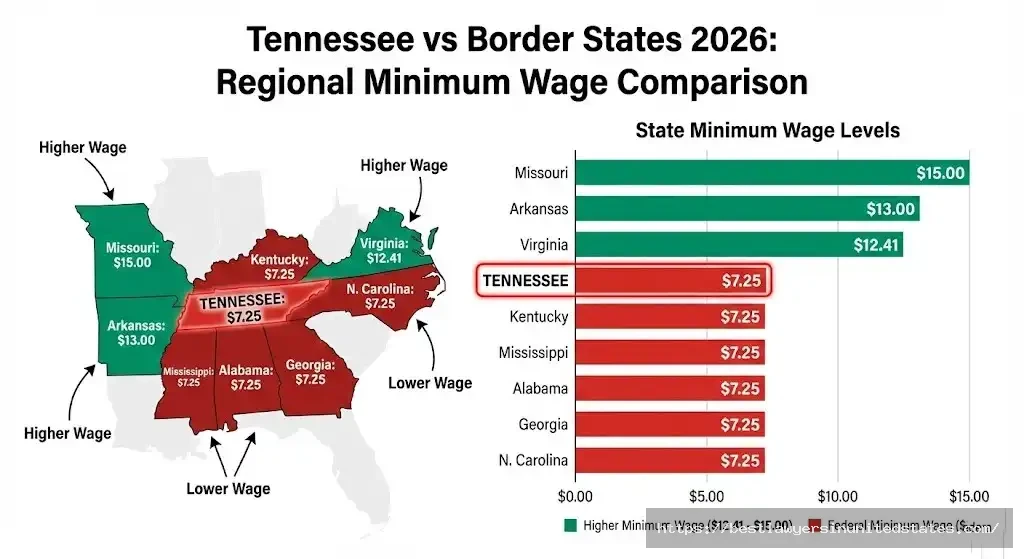
Why Neighboring States Are Pulling Ahead
Missouri voters passed Proposition A in November 2024, raising the minimum wage to $13.75 in 2025, $15.00 in 2026, and indexing it to inflation thereafter. This voter-driven initiative bypassed legislative opposition.
Arkansas minimum wage has risen through a combination of ballot measures and legislative action. The state's minimum wage increased from $11.00 in 2024 to $12.00 in 2025, with another $1.00 increase to $13.00 in 2026.
Virginia implemented gradual increases through legislative action, reaching $12.00 in 2024 and continuing with inflation-adjusted increases.
Tennessee's disadvantage: Without ballot initiative rights for minimum wage and a legislature opposed to increases, Tennessee workers have no mechanism to raise wages without federal action.
Who Is Exempt from Tennessee Minimum Wage Laws?
Certain categories of workers are exempt from minimum wage requirements under federal FLSA exemptions that apply in Tennessee.
Executive, Administrative, and Professional Exemptions
Requirements for exemption:
- Salary minimum: $684 per week ($35,568 per year)
- Primary duties must be executive, administrative, or professional
- Must meet specific "duties tests" for each category
Executive exemption criteria:
- Primary duty is managing enterprise or recognized department
- Regularly directs work of at least 2 full-time employees
- Has authority to hire/fire or make recommendations given weight
Administrative exemption criteria:
- Primary duty is office or non-manual work directly related to management
- Primary duty includes discretion and independent judgment on significant matters
Professional exemption criteria:
- Work requires advanced knowledge in field of science or learning
- Advanced knowledge acquired by prolonged specialized instruction
Simply paying an employee a salary does not create an exemption. The position must meet both salary and duties tests.
Other Common Exemptions
Additional FLSA exemptions:
- Outside sales employees (no minimum salary required)
- Computer employees earning $684/week or $27.63/hour
- Certain commissioned employees (retail/service establishments)
- Seasonal amusement/recreation employees
- Some agricultural workers
- Casual babysitters
- Newspaper delivery workers
- Fishing industry workers
Tennessee Youth and Training Wages
Federal law allows a youth minimum wage of $4.25 per hour for employees under 20 years old during their first 90 consecutive calendar days of employment.
Youth wage restrictions:
- Applies only to workers under age 20
- Limited to first 90 consecutive days
- Cannot displace other workers
- After 90 days, must receive full minimum wage
Tennessee has no separate youth wage provisions beyond federal law.
Frequently Asked Questions About Tennessee Minimum Wage
What is the minimum wage in Tennessee for 2026?
Quick Answer: Tennessee's minimum wage is $7.25 per hour in 2026, following the federal minimum wage rate that has been unchanged since July 24, 2009.
This applies to all employees except those in federally exempt categories. Tennessee has no state minimum wage law.
Is Tennessee raising the minimum wage?
Quick Answer: No. Tennessee has no scheduled minimum wage increases for 2026 or beyond. A proposed $20 minimum wage bill remains stalled in the state Senate committee.
Unlike 22 states raising their minimum wages in 2026, Tennessee continues to follow the federal $7.25 rate.
What is the tipped minimum wage in Tennessee?
Quick Answer: Tennessee's tipped minimum wage is $2.13 per hour for servers and other tipped employees, but total earnings including tips must reach at least $7.25 per hour.
If tips don't bring total pay to $7.25/hour, employers must make up the difference.
Can Tennessee cities set their own minimum wage?
Quick Answer: No. Tennessee Code § 50-2-107 prohibits cities and counties from establishing minimum wages higher than the state/federal rate.
Nashville, Memphis, Knoxville, and Chattanooga all follow the $7.25 federal minimum despite higher costs of living.
How do I calculate my earnings at Tennessee minimum wage?
Quick Answer: Use our minimum wage calculator to instantly calculate your weekly, monthly, and annual earnings based on hours worked at Tennessee's $7.25 rate.
The calculator includes overtime calculations and tax withholding estimates for accurate take-home pay projections.
How much overtime pay am I entitled to in Tennessee?
Quick Answer: Tennessee requires 1.5 times your regular hourly rate for all hours worked over 40 in a workweek. At minimum wage, overtime rate is $10.88/hour.
Calculate your exact overtime earnings with our overtime calculator designed for Tennessee's specific overtime rules.
What is a living wage in Tennessee?
Quick Answer: Tennessee's living wage ranges from $14.50 to $17.50 per hour depending on the county, which is $7.25 to $10.25 higher than the current minimum wage.
Nashville requires approximately $17.50/hour, Memphis needs $16.25/hour, and rural areas need around $14.50/hour for basic expenses.
When was Tennessee's minimum wage last raised?
Quick Answer: Tennessee's minimum wage last increased on July 24, 2009, when the federal minimum wage rose to $7.25 per hour. It has been unchanged for 17 years.
This 17-year stagnation represents the longest period without a federal minimum wage increase since the FLSA was enacted in 1938.
How do I report wage theft in Tennessee?
Quick Answer: File a complaint with the U.S. Department of Labor Wage and Hour Division in Nashville (615-736-5452) or Memphis (901-544-0445). Tennessee has minimal state-level wage enforcement.
You have 2-3 years from the violation to file, depending on whether it was willful. Use our wage theft calculator to estimate your recovery.
Do all Tennessee workers get overtime pay?
Quick Answer: No. Workers classified as executive, administrative, or professional employees earning at least $684/week ($35,568/year) are exempt from overtime if they meet specific duties tests.
However, simply being paid a salary does not automatically exempt someone from overtime. The position must meet both salary and duties requirements.
What happens if my employer pays me less than minimum wage?
Quick Answer: Contact the U.S. Department of Labor immediately. You can recover all unpaid wages plus an equal amount in liquidated damages (double pay), and your employer faces civil penalties up to $1,100 per violation.
Tennessee provides no additional state remedies beyond federal FLSA protections.
Can my employer deduct uniforms or equipment from my paycheck?
Quick Answer: Yes, but deductions cannot reduce your pay below $7.25/hour. If uniform costs would drop you below minimum wage, the employer must cover the full cost.
All deductions must be authorized in writing, and they cannot include cash register shortages or damaged property without employee consent.
What is the difference between Tennessee and federal minimum wage?
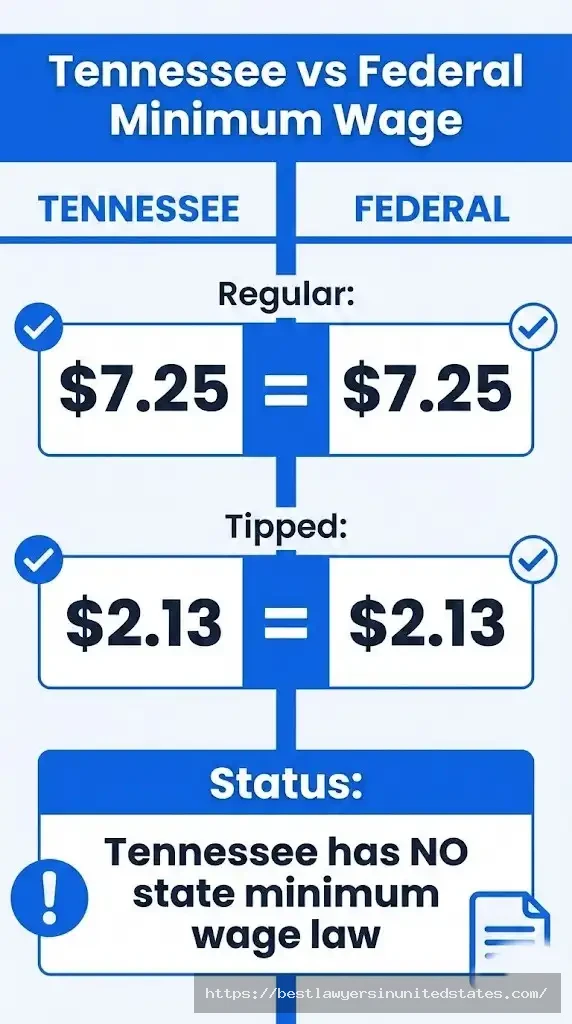
Quick Answer: There is no difference. Tennessee has no state minimum wage law, so the federal minimum wage of $7.25/hour applies to all Tennessee workers.
This makes Tennessee one of only five states without state-level minimum wage protection.
Is $15 an hour good in Tennessee?
Quick Answer: $15/hour ($31,200/year) is near the living wage threshold for most Tennessee counties and represents decent pay for basic needs, though still modest in expensive areas like Nashville.
This rate is more than double Tennessee's minimum wage and matches what major employers like Amazon and Target pay starting workers.
How much do servers make in Tennessee?
Quick Answer: Servers earn $2.13/hour base wage plus tips. Average server income ranges from $10-18/hour total depending on restaurant type and location.
High-end Nashville restaurants may yield $20-30/hour with tips, while rural diners typically result in $8-12/hour total.
Why is Tennessee's minimum wage so low?
Quick Answer: Tennessee has no state minimum wage law and relies on the federal rate, which hasn't increased since 2009. The state legislature opposes wage increases, and Tennessee has no ballot initiative process for voters to directly raise wages.
This political structure, combined with no state wage law, keeps Tennessee at the federal floor.
Tennessee Minimum Wage 2026: What Workers Need to Know
Tennessee's $7.25 minimum wage represents one of the lowest wage floors in the United States. Workers face a significant gap between legal minimum pay and the living wage needed to afford basic expenses like housing, food, and transportation.
The proposed $20 minimum wage bill faces steep political opposition with no clear path to passage. Without state action or federal intervention, Tennessee's minimum wage will likely remain at $7.25 for the foreseeable future.
Key takeaways for Tennessee workers:
- Minimum wage is $7.25/hour (unchanged since 2009)
- Tipped minimum wage is $2.13/hour plus tips
- Overtime pay is 1.5x regular rate after 40 hours/week
- No Tennessee cities can set higher local minimum wages
- File wage theft claims with federal DOL, not state agencies
- Living wage is $15-18/hour, double the minimum wage
Workers who believe their employer has violated wage laws should document all hours worked, save pay stubs, and contact the U.S. Department of Labor Wage and Hour Division. Federal protections remain available even without strong state enforcement.
Use the calculators throughout this guide to determine your exact earnings, overtime pay, and potential wage theft recovery. These tools provide Tennessee-specific calculations based on current federal minimum wage laws.
For legal assistance with wage disputes or questions about your rights:
Email: [email protected]