
Quick Answer: Washington’s minimum wage increases to $17.13 per hour on January 1, 2026. This is the highest state minimum wage in the nation and applies to all workers statewide, though some cities like Seattle have even higher rates.
Washington workers will see a $0.47 increase from the 2025 rate of $16.66 per hour. The state uses automatic annual adjustments based on the Seattle-Tacoma-Bellevue Consumer Price Index, so no legislative vote is needed for these increases.
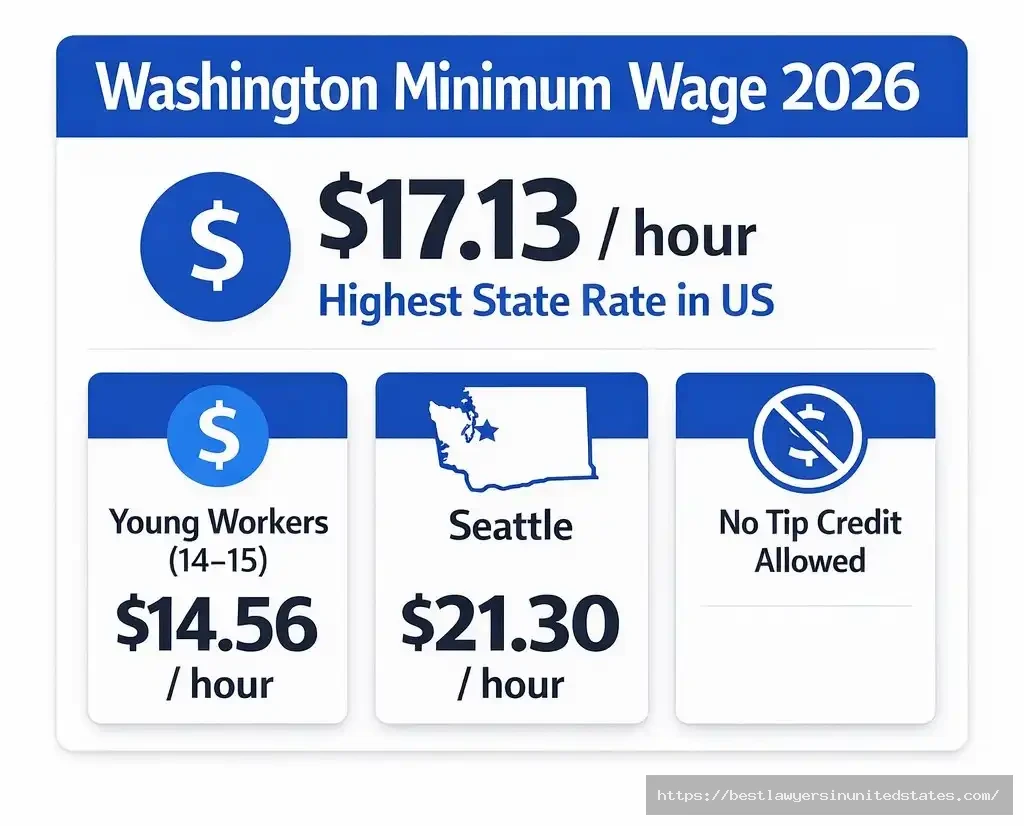
Unlike states that follow the federal minimum wage of $7.25 per hour, Washington provides significantly higher wages for all workers. The state also does not allow tip credits, meaning tipped employees receive the full minimum wage plus their tips.
Calculate Your Earnings in Washington
Want to know exactly how much you’ll earn at Washington’s $17.13 minimum wage? Use our free calculator to estimate your weekly, monthly, and annual income based on your hours worked.
💰 Minimum Wage Earnings Calculator
Calculate your weekly, monthly, and annual earnings with overtime and tax estimates
📊 Your Earnings Breakdown
💰 Gross Earnings
Calculator features:
- Automatic Washington wage rates for 2026
- Weekly, monthly, and annual earnings
- Overtime calculations
- Tax withholding estimates
- Take-home pay breakdown
Full calculator with all features: Calculate your exact earnings with our minimum wage calculator
Questions about your wages or need legal help? Find Employment Lawyers in Washington - Free Consultation Email: [email protected]
What Is Washington's Minimum Wage for 2026?
Washington State's minimum wage is $17.13 per hour starting January 1, 2026. This rate applies to all employers regardless of company size and covers nearly all workers in the state.
The Washington State Department of Labor & Industries (L&I) announces the new rate each September based on CPI calculations. The 2026 increase of $0.47 reflects inflation adjustments from the previous year.
How Washington's Rate Compares to Federal Law
Washington's minimum wage far exceeds the federal standard. Here's the comparison:
| Jurisdiction | 2026 Minimum Wage | Difference from Federal |
|---|---|---|
| Washington State | $17.13/hour | +$9.88/hour |
| Federal | $7.25/hour | Base rate |
Key difference: Washington employers must pay the higher state rate. Federal law sets the floor, but states can require more.
Historical Wage Increases in Washington
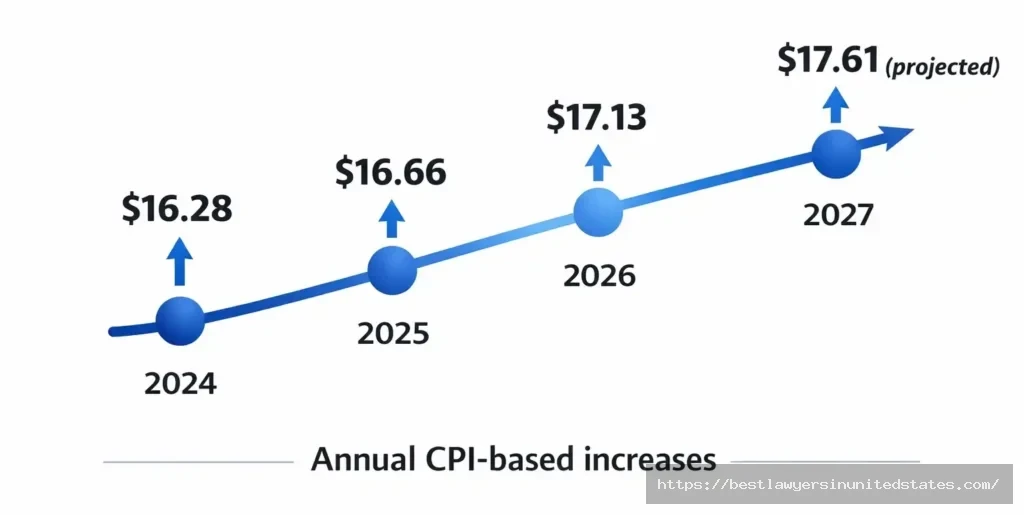
Washington has consistently increased its minimum wage through voter-approved initiatives. Initiative 1433, passed in 2016, established the CPI-based annual adjustment system that drives today's increases.
| Effective Date | Minimum Wage | Annual Increase |
|---|---|---|
| January 1, 2024 | $16.28/hour | +$0.66 |
| January 1, 2025 | $16.66/hour | +$0.38 |
| January 1, 2026 | $17.13/hour | +$0.47 |
| January 1, 2027 | $17.61/hour (projected) | +$0.48 (estimated) |
City and County Minimum Wages in Washington
Several Washington cities have established their own minimum wage rates that exceed the state requirement. Workers receive whichever rate is highest: federal, state, or local.
Seattle Minimum Wage 2026
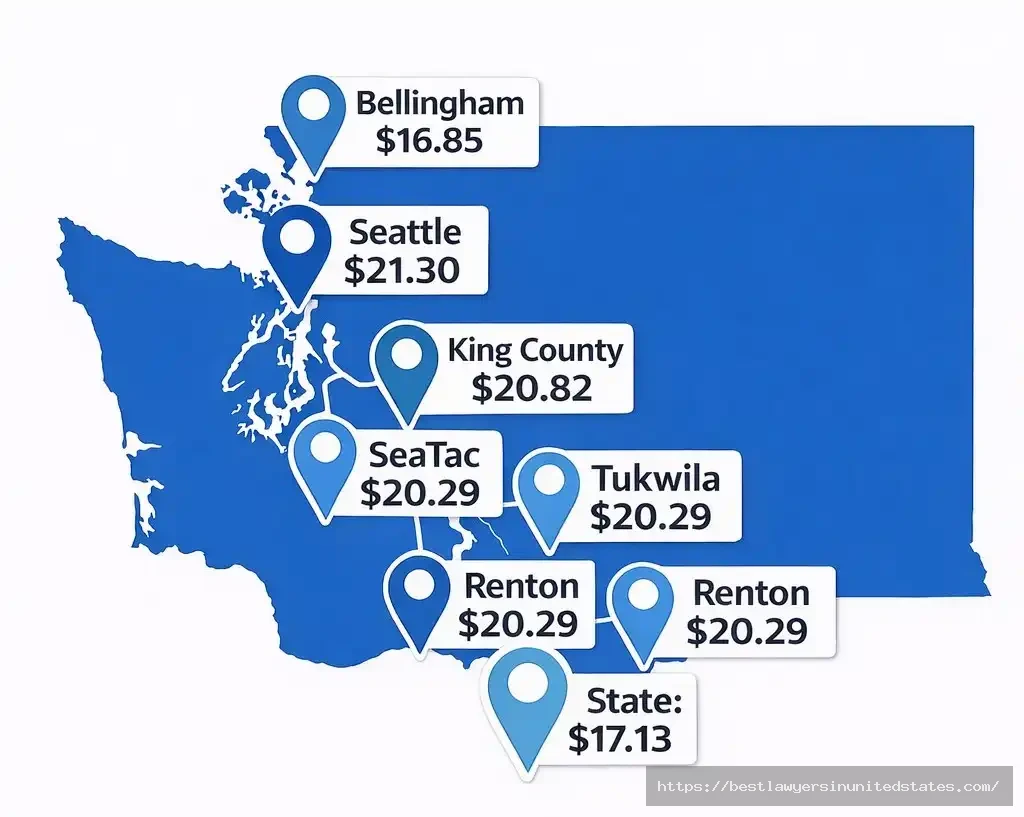
Seattle has the highest minimum wage in Washington at $21.30 per hour for large employers with 501 or more employees. The city uses a tiered system based on employer size.
| Employer Size | 2026 Rate | Notes |
|---|---|---|
| Large (501+ employees) | $21.30/hour | Highest tier |
| Medium (51-500 employees) | $21.30/hour | With medical benefits |
| Small (1-50 employees) | $19.97/hour | No benefits required |
Seattle's Office of Labor Standards enforces these rates. Employers must display the correct poster based on their size category.
King County Unincorporated Areas
Workers in unincorporated King County receive $20.82 per hour if they work for large employers. This rate applies only to areas outside city limits.
How to know if you're in unincorporated King County: Check your address on the King County website or look for your city's incorporation status. Areas like Skykomish, Vashon Island, and parts of Snoqualmie Valley fall under county jurisdiction.
Other Washington Cities with Local Minimum Wages
| City | 2026 Rate | Applies To |
|---|---|---|
| SeaTac | $20.29/hour | Hospitality and transportation workers |
| Bellingham | $16.85/hour | All employers |
| Tukwila | $20.29/hour | Large retail and hospitality |
| Renton | $20.29/hour | Large employers |
These rates reflect different local cost-of-living calculations. Workers should verify which rate applies to their specific location and employer.
Washington's Exempt Salary Thresholds for 2026
Washington uses a unique multiplier system to determine who qualifies as exempt from overtime. Unlike the federal system, Washington ties exempt thresholds directly to the minimum wage.
2026 Exempt Salary Requirements
To classify an employee as exempt from overtime under RCW 49.46.130, employers must meet both the salary test and the duties test. For 2026, the salary threshold is:
$80,168.40 per year ($1,541.70 per week)
This applies to both small employers (1-50 employees) and large employers (51+ employees). The multiplier for 2026 is 2.25 times the state minimum wage.
| Year | Small Employer Threshold | Large Employer Threshold | Multiplier |
|---|---|---|---|
| 2025 | $69,305.60/year | $77,968.80/year | 2.0x (small), 2.25x (large) |
| 2026 | $80,168.40/year | $80,168.40/year | 2.25x (both) |
| 2027 | $82,321.20/year (projected) | $91,468.00/year (projected) | 2.25x (small), 2.5x (large) |
Computer Professional Exemption
Computer professionals paid hourly have a different threshold. For 2026, the rate is $59.96 per hour (3.5 times the minimum wage).
This higher multiplier reflects the specialized nature of computer work. The exemption applies only to employees performing specific duties outlined in WAC 296-128-530.
Does Salary Alone Make You Exempt?
No. Meeting the salary threshold is only half the test. Employees must also perform executive, administrative, or professional duties as defined by Washington law.
Both tests required:
- Salary threshold: Earn at least $80,168.40/year in 2026
- Duties test: Perform exempt job functions
Employers who misclassify employees as exempt face significant penalties under Washington's wage laws. Similar issues arise in employment law disputes across various states.
Washington Overtime Laws and Calculations
Washington requires overtime pay for hours worked beyond 40 in a workweek. The overtime rate is 1.5 times your regular hourly wage.
How Overtime Works in Washington
Washington follows federal overtime rules under the Fair Labor Standards Act (FLSA) but applies them to the higher state minimum wage. Non-exempt employees must receive overtime for all hours over 40 per week.
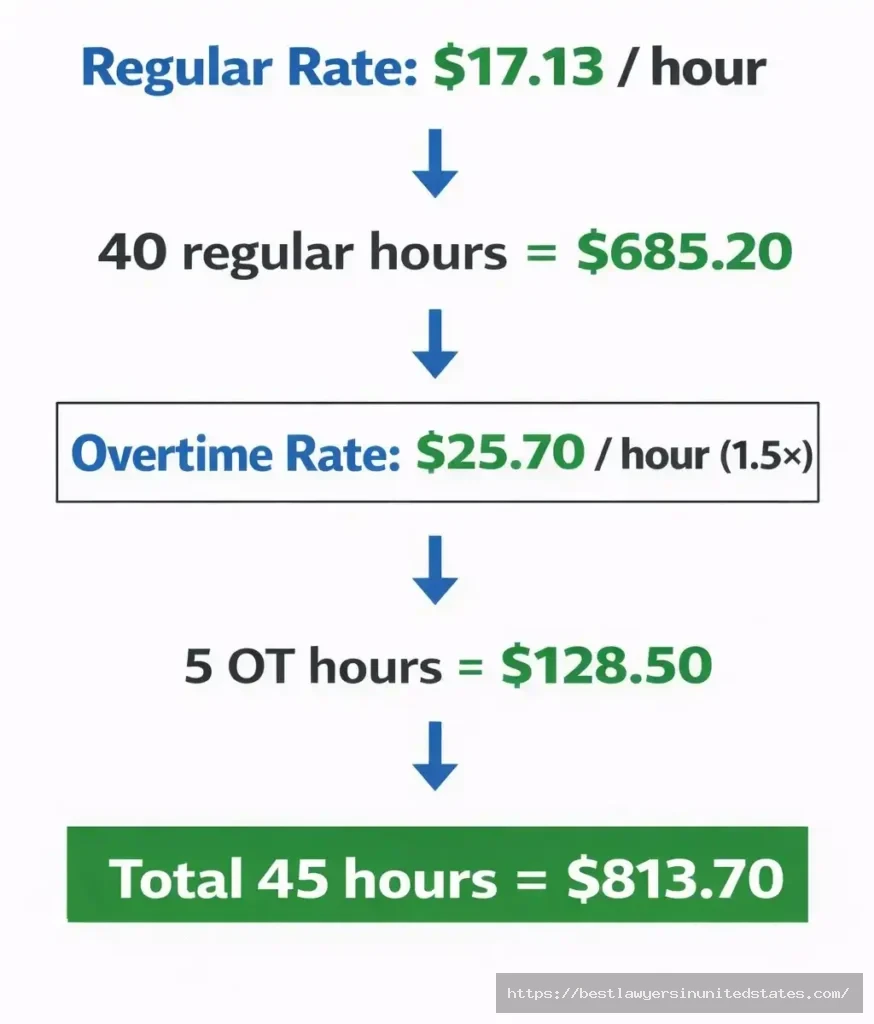
Overtime calculation example:
- Regular rate: $17.13/hour (minimum wage)
- Overtime rate: $25.70/hour (1.5 × $17.13)
- If you work 45 hours: (40 × $17.13) + (5 × $25.70) = $685.20 + $128.50 = $813.70
Calculate Your Overtime Pay in Washington
Working more than 40 hours per week? Calculate your overtime earnings based on Washington's overtime laws. This calculator accounts for Washington's specific overtime rules and higher minimum wage.
⏰ Overtime Pay Calculator
Calculate your overtime earnings based on your state's specific labor laws
📍 Select Your State
💰 Your Hourly Wage
📊 Calculation Method
📅 Weekly Hours
💵 Your Weekly Overtime Pay
📊 Earnings Breakdown
📅 Pay Period Estimates
⚖️ State vs Federal Comparison
Calculator features:
- Washington-specific overtime rules
- Daily and weekly overtime calculations
- Pay period breakdowns
- Comparison with federal law
- Accurate time-and-a-half rates
Full overtime calculator: Calculate your exact overtime pay here
Questions about your wages or need legal help? Find Employment Lawyers in Washington - Free Consultation Email: [email protected]
Does Washington Have Daily Overtime?
No. Washington does not require daily overtime like California's strict wage laws. Only weekly overtime (over 40 hours) is mandatory under state law.
Some union contracts or employer policies may provide daily overtime, but state law does not require it. Workers should check their employment agreement for additional overtime provisions.
Special Worker Categories in Washington
Washington provides different minimum wage rates for certain worker categories. These exceptions reflect age, job type, and working conditions.
Young Workers (Ages 14-15)
Workers aged 14 or 15 receive $14.56 per hour in 2026. This represents 85% of the standard minimum wage under RCW 49.12.
| Worker Age | 2026 Rate | Percentage of Standard |
|---|---|---|
| 16 and older | $17.13/hour | 100% |
| 14-15 years old | $14.56/hour | 85% |
Once a worker turns 16, they must receive the full minimum wage. Employers cannot pay the reduced rate after an employee's 16th birthday.
Tipped Employees in Washington
Washington does not allow tip credits. Tipped employees receive the full $17.13 minimum wage plus all tips they earn.
This differs significantly from states that permit lower tipped wages. For comparison, Oregon's tiered system allows different approaches to tipped workers.
Key rule: Employers cannot reduce wages based on tip income. Servers, bartenders, and other tipped workers get full minimum wage regardless of tips received.
Who Keeps the Tips?
Washington law under RCW 49.46.020 gives employees full ownership of their tips. Employers cannot take any portion of employee tips.
Tip ownership rules:
- Employees keep 100% of customer tips
- Tip pooling allowed among service staff
- Managers cannot participate in tip pools
- Employers cannot use tips toward minimum wage
Rideshare Drivers in Seattle
Seattle has special minimum wage requirements for rideshare drivers working for companies like Uber and Lyft. Drivers receive:
- $1.38 per mile (minimum)
- $0.59 per minute (minimum)
These rates ensure drivers earn at least the Seattle minimum wage after accounting for expenses. The requirements apply only within Seattle city limits.
The 7-Minute Rule in Washington
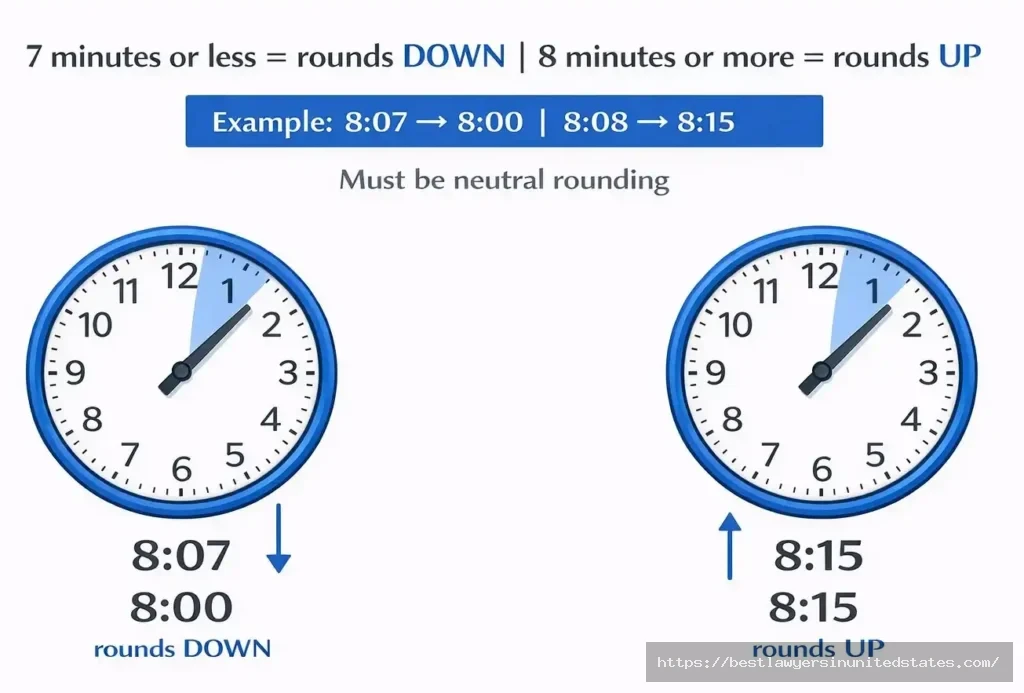
Washington allows employers to round employee work time to the nearest quarter-hour using what's commonly called the "7-minute rule." This practice appears in Washington Administrative Code (WAC) 296-126.
How the 7-Minute Rule Works
Employers can round time clock punches to the nearest 15-minute increment if the rounding is neutral. This means the system must round both up and down fairly.
Rounding examples:
- Clock in at 8:07 AM → Rounds to 8:00 AM (down)
- Clock in at 8:08 AM → Rounds to 8:15 AM (up)
- Clock out at 5:07 PM → Rounds to 5:00 PM (down)
- Clock out at 5:08 PM → Rounds to 5:15 PM (up)
The key requirement is neutrality. Rounding cannot systematically favor the employer by consistently reducing employee hours.
Does the 7-Minute Rule Affect Overtime?
Yes. Time rounding can impact overtime calculations when hours worked fall near the 40-hour threshold. Employers must apply the same rounding rules to all employees consistently.
Example scenario:
- Employee works 40 hours and 7 minutes (rounds to 40 hours)
- No overtime owed
- Employee works 40 hours and 8 minutes (rounds to 40.25 hours)
- Overtime owed for 0.25 hours
Is the 7-Minute Rule Legal?
The practice is legal under both Washington and federal law if applied neutrally. However, employers who consistently round in their favor violate wage laws.
Washington L&I can investigate complaints about improper time rounding. Employees who believe their employer misuses rounding should document their actual work times and filed start and end times.
Wage Theft and Employee Rights in Washington
Washington has strong wage theft protections under RCW 49.52. Employers who fail to pay proper wages face significant penalties.
What Counts as Wage Theft in Washington?
Wage theft occurs when employers fail to pay earned wages. Common violations include:
- Paying below minimum wage
- Not paying overtime for hours over 40 per week
- Taking employee tips
- Misclassifying employees as exempt
- Requiring off-the-clock work
- Making illegal wage deductions
- Not paying final wages on time
Washington treats intentional wage theft as a crime. Employers can face both civil and criminal penalties for violations.
Calculate Your Wage Theft Recovery in Washington
Think your employer owes you money? Use our wage theft calculator to estimate how much you could recover, including unpaid wages, penalties, and interest under Washington law.
Wage Theft Recovery Calculator
Estimate how much you can recover in unpaid wages, penalties, and damages based on your state's laws
💵 Estimated Total Recovery
💰 Unpaid Wages
⚖️ Penalties & Damages
📋 Total Summary
Calculator features:
- Multiple violation types (unpaid wages, overtime, tips)
- Washington-specific penalties and damages
- Filing deadline tracker
- Total recovery estimate
- Next steps guidance
Full wage theft calculator: Estimate your wage theft recovery amount
Need help with unpaid wages? Contact Washington Department of Labor & Industries or consult with an employment attorney.
Questions about your wages or need legal help? Find Employment Lawyers in Washington - Free Consultation Email: [email protected]
Washington's Wage Theft Penalties
Washington law provides significant damages for wage theft victims. Employees can recover more than just their unpaid wages.
| Violation Type | Employee Recovery | Employer Penalty |
|---|---|---|
| Unpaid minimum wage | Full back pay + interest | $1,000 per violation |
| Unpaid overtime | Double damages | $1,000 per violation |
| Tip theft | Full tips + damages | $1,000 per violation |
| Illegal deductions | Full amount + damages | Civil penalties |
The state also awards attorney fees to successful claimants. This ensures workers can afford legal representation without upfront costs.
How to File a Wage Claim in Washington
Workers have three years from the violation date to file a wage claim with L&I. The process involves several steps.
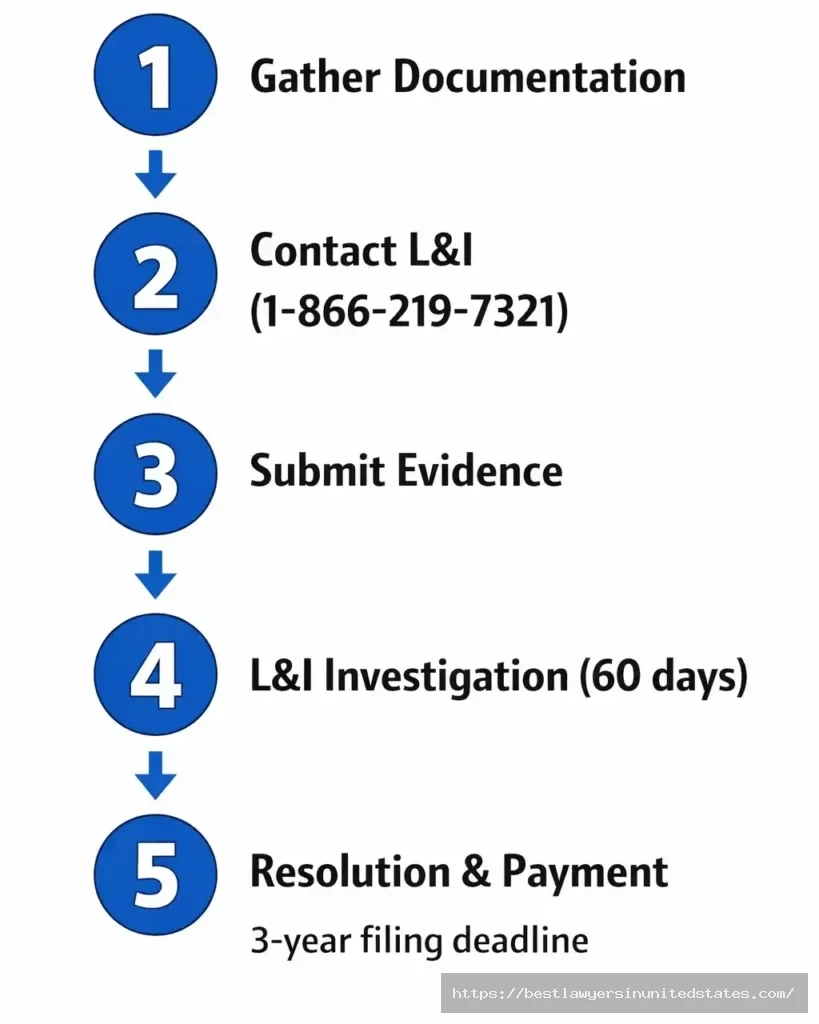
Filing process:
- Gather documentation: Collect pay stubs, timesheets, work schedules, and employment agreements
- Contact L&I: Call 1-866-219-7321 or visit lni.wa.gov to file online
- Submit evidence: Provide all documentation supporting your claim
- L&I investigation: The agency reviews your case within 60 days
- Resolution: L&I may order your employer to pay owed wages plus penalties
Workers can also file a private lawsuit in addition to or instead of an L&I claim. Many choose to work with an employment attorney who understands wage disputes.
Protection from Retaliation
Washington law prohibits employer retaliation under RCW 49.48.030. Employers cannot fire, demote, or otherwise punish workers for:
- Filing wage claims
- Asking about wages
- Discussing pay with coworkers
- Reporting violations to L&I
- Participating in wage investigations
Retaliation victims can sue for reinstatement, back pay, and damages. These protections apply even if the underlying wage claim is unsuccessful.
Future Minimum Wage Projections for Washington
Washington's minimum wage will continue rising annually through at least 2028. The increases follow CPI calculations announced each September by L&I.
Projected Rates Through 2028
| Year | Projected Minimum Wage | Projected Increase |
|---|---|---|
| 2026 | $17.13/hour | +$0.47 |
| 2027 | $17.61/hour | +$0.48 (estimated) |
| 2028 | $18.00/hour | +$0.39 (estimated) |
These projections assume moderate inflation rates. Actual rates depend on CPI changes and will be announced officially by L&I each September.
How Washington Calculates Annual Increases
Washington uses the Seattle-Tacoma-Bellevue Consumer Price Index (CPI-W) to determine annual minimum wage increases. L&I calculates the percentage change from August to August each year.
Calculation process:
- L&I measures CPI-W change from August to August
- The percentage increase applies to the current minimum wage
- The new rate rounds to the nearest cent
- L&I announces the rate by September 30
- The new rate takes effect January 1
This automatic system ensures workers' wages keep pace with inflation. No legislative action is needed for annual increases.
Will Washington's Rate Remain the Highest?
Washington currently has the highest state minimum wage at $17.13 for 2026. However, some states may surpass Washington in future years.
States with scheduled increases that could exceed Washington include:
- California's city-specific rates in areas like San Francisco
- New York's tiered system in New York City
- Individual city ordinances in other states
Washington's CPI-based system ensures steady growth, but other jurisdictions may implement larger one-time increases.
Employer Compliance Requirements for 2026
Washington employers must take specific actions before January 1, 2026 to comply with the new minimum wage. L&I conducts enforcement investigations and can penalize non-compliant businesses.
Required Updates for 2026
Employer checklist:
- Update payroll systems to reflect $17.13 minimum wage
- Verify if higher city or county rates apply
- Review exempt employee salaries (must meet $80,168.40 threshold)
- Reclassify employees who fall below exempt threshold
- Post updated minimum wage posters
- Update employment agreements and offer letters
- Train managers on new rates and exemption rules
Failure to complete these updates can result in wage claims, penalties, and L&I investigations.
Where to Get Required Posters
Washington law requires employers to display minimum wage posters in conspicuous locations. L&I provides free posters in multiple languages.
How to obtain posters:
- Download from lni.wa.gov (Publication F700-074-000)
- Order free printed copies from L&I
- Available in English, Spanish, Russian, Vietnamese, and other languages
- Must be posted where all employees can see them
Employers who fail to post required notices face penalties up to $1,000. The posters must reflect current 2026 rates.
Small Business Resources
Small businesses can access free compliance assistance through L&I's consultation program. The agency offers:
- Phone consultations (1-800-547-8367)
- On-site workplace visits
- Written guidance on wage laws
- Industry-specific compliance resources
- Payroll system recommendations
These consultations do not result in penalties or citations. L&I separates its consultation and enforcement divisions.
Frequently Asked Questions
What Is the Minimum Wage in Washington for 2026?
Quick Answer: Washington's minimum wage is $17.13 per hour starting January 1, 2026, which is $9.88 higher than the federal minimum wage of $7.25.
This rate applies to all workers 16 and older regardless of employer size. Young workers ages 14-15 receive $14.56 per hour (85% of the standard rate).
Does Seattle Have a Different Minimum Wage?
Quick Answer: Yes. Seattle's minimum wage is $21.30 per hour for large employers with 501+ employees, $21.30 for medium employers with medical benefits, and $19.97 for small employers.
Seattle workers receive whichever rate is higher: Seattle's local rate or Washington's state rate. The Seattle Office of Labor Standards enforces these requirements.
How Do I Calculate My Earnings at Washington Minimum Wage?
Quick Answer: Use our minimum wage calculator to calculate your exact earnings based on hours worked at Washington's $17.13 rate.
Enter your weekly hours and the calculator provides weekly, monthly, and annual earnings. It also accounts for overtime if you work more than 40 hours per week.
What Is the Exempt Salary Threshold in Washington for 2026?
Quick Answer: Employees must earn at least $80,168.40 per year ($1,541.70 per week) to qualify as exempt from overtime in 2026.
This applies to both small and large employers. Employees also must perform executive, administrative, or professional duties to be exempt. Salary alone does not determine exempt status.
Do Tipped Employees Get Paid Less in Washington?
Quick Answer: No. Washington does not allow tip credits, so tipped employees receive the full $17.13 minimum wage plus all tips they earn.
Employers cannot reduce wages based on tip income. This makes Washington different from many states that permit lower tipped minimum wages.
How Much Overtime Pay Am I Entitled to in Washington?
Quick Answer: You receive 1.5 times your regular hourly rate for all hours over 40 per week. Use our overtime calculator to calculate exact amounts.
For example, at $17.13 minimum wage, your overtime rate is $25.70 per hour. Washington does not require daily overtime like some other states.
How Do I Calculate Wage Theft Recovery in Washington?
Quick Answer: Our wage theft calculator estimates your potential recovery including unpaid wages, double damages, penalties, and interest under Washington law.
Washington allows victims to recover more than just unpaid wages. You may receive double damages for overtime violations plus attorney fees.
What Is the 7-Minute Rule in Washington?
Quick Answer: The 7-minute rule allows employers to round time clock entries to the nearest 15 minutes if the system rounds both up and down fairly.
Clock-ins 7 minutes or less round down, while 8 minutes or more round up. The rounding must be neutral and cannot systematically reduce employee hours.
How Long Do I Have to File a Wage Claim in Washington?
Quick Answer: You have three years from the wage violation date to file a claim with the Washington Department of Labor & Industries.
Contact L&I at 1-866-219-7321 or visit lni.wa.gov to file online. Keep documentation of all unpaid wages, including pay stubs and work schedules.
Can My Employer Fire Me for Filing a Wage Claim?
Quick Answer: No. Washington law prohibits employer retaliation for filing wage claims or reporting violations to L&I.
Employers who retaliate face additional penalties including reinstatement orders and damages. You can file a retaliation complaint separately from your wage claim.
Does King County Have Its Own Minimum Wage?
Quick Answer: Yes. Unincorporated King County requires large employers to pay $20.82 per hour in 2026 for workers in areas outside city limits.
This applies only to unincorporated areas like Vashon Island and parts of Snoqualmie Valley. Incorporated cities within King County follow their own rates or the state rate.
What Happens If I'm Paid Below Minimum Wage?
Quick Answer: File a wage claim with L&I or consult an employment attorney. You can recover unpaid wages plus penalties and interest.
Washington treats wage theft seriously. The state can order your employer to pay back wages, penalties of up to $1,000 per violation, and your attorney fees. Those facing employment law issues may benefit from understanding their legal options for workplace disputes.
Will Washington's Minimum Wage Increase in 2027?
Quick Answer: Yes. Washington's minimum wage is projected to increase to approximately $17.61 per hour in 2027 based on CPI calculations.
L&I will announce the official 2027 rate by September 30, 2026. The increase depends on inflation rates measured by the Seattle-Tacoma-Bellevue Consumer Price Index.
Key Contacts and Resources
Washington Department of Labor & Industries (L&I)
Main contact information:
- Phone: 1-866-219-7321 (toll-free)
- TDD: 1-800-547-8367
- Website: lni.wa.gov
- Wage Complaint Portal: secure.lni.wa.gov/wagecomplaint
Office locations: L&I maintains offices throughout Washington for in-person assistance. Visit lni.wa.gov for location-specific addresses and hours.
Seattle Office of Labor Standards
Contact for Seattle-specific questions:
- Phone: (206) 256-5297
- Website: seattle.gov/laborstandards
- Email: [email protected]
The Seattle office handles complaints about Seattle minimum wage violations and provides compliance assistance.
Legal Assistance
Free legal aid resources:
- Northwest Justice Project: nwjustice.org
- Washington State Bar Association Lawyer Referral: 1-800-945-9722
- Employment Law Project: (206) 274-9830
Many employment attorneys offer free initial consultations for wage claims. Contact our network for referrals to experienced Washington employment lawyers.
Questions about your wages or need legal help? Find Employment Lawyers in Washington - Free Consultation Email: [email protected]
Additional Washington Employment Resources
Workers navigating minimum wage issues may also need information about related employment topics. Washington's employment law framework includes protections beyond just wage requirements.
For workers dealing with DUI charges that could affect employment, understanding the legal implications is important. Similarly, understanding wage garnishment protections helps workers protect their earnings.
Washington's high cost of living, particularly in Seattle and surrounding areas, makes the state's minimum wage especially important. Those considering divorce in Washington should understand how wage calculations affect support payments and financial planning.
