
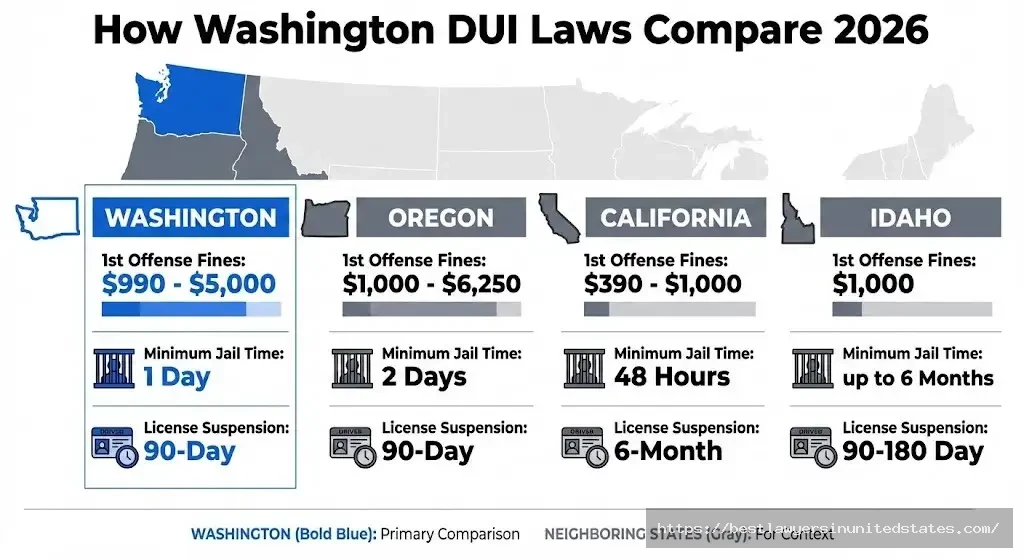
Washington State DUI laws carry serious penalties under RCW 46.61.502 and RCW 46.61.5055. A first offense DUI in Washington brings mandatory jail time (1 day to 364 days), fines ($990.50 to $5,000), and license suspension (90 days to 2 years). Your BAC determines your exact penalties through Washington’s mandatory sentencing grid.
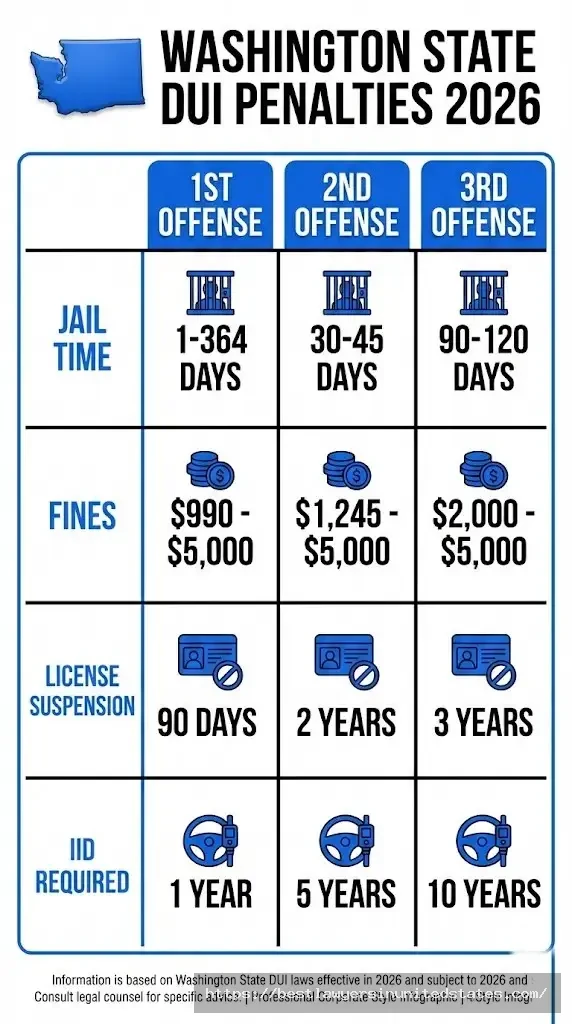
Fourth DUI offenses within 10 years become felonies with prison time up to 5 years. Washington uses specialized Target Zero Teams for DUI enforcement and offers unique alternatives like the 24/7 Sobriety Program. This guide covers everything you need to know about Washington DUI laws in 2026, including new legislative changes, defense strategies, and total costs.
Washington DUI Laws Overview: What’s New in 2026
Washington prosecutes DUI cases under two main statutes. RCW 46.61.502 defines driving under the influence. RCW 46.61.5055 creates the mandatory sentencing grid that judges must follow.
Key Changes in 2026 Legislation
Washington updated several DUI provisions effective January 2026. The ignition interlock device (IID) requirements now apply to all DUI convictions, including first offenses. Previous laws allowed judges discretion on first-time offenders.
The Department of Licensing (DOL) extended administrative hearing timelines from 20 to 30 days. Drivers now have more time to request hearings challenging license suspensions.
Major 2026 updates:
- Mandatory IID on ALL DUI convictions (no exceptions)
- Extended DOL hearing request period (30 days)
- Enhanced penalties for refusing breath tests
- Expanded 24/7 Sobriety Program eligibility
How Washington Defines DUI
You commit DUI in Washington under two circumstances. First, driving with a BAC of 0.08% or higher (per se DUI). Second, driving while “affected by” alcohol or drugs to an “appreciable degree.”
Prosecutors can charge you even if your BAC falls below 0.08%. They use officer observations, field sobriety test results, and driving behavior as evidence. Washington courts define “affected by” as noticeable impairment in judgment, coordination, or reaction time.
Critical point: You can face DUI charges for being in “actual physical control” of a vehicle while impaired. This means sitting in the driver’s seat with keys accessible, even if the car never moved.
BAC Limits and Testing Requirements in Washington
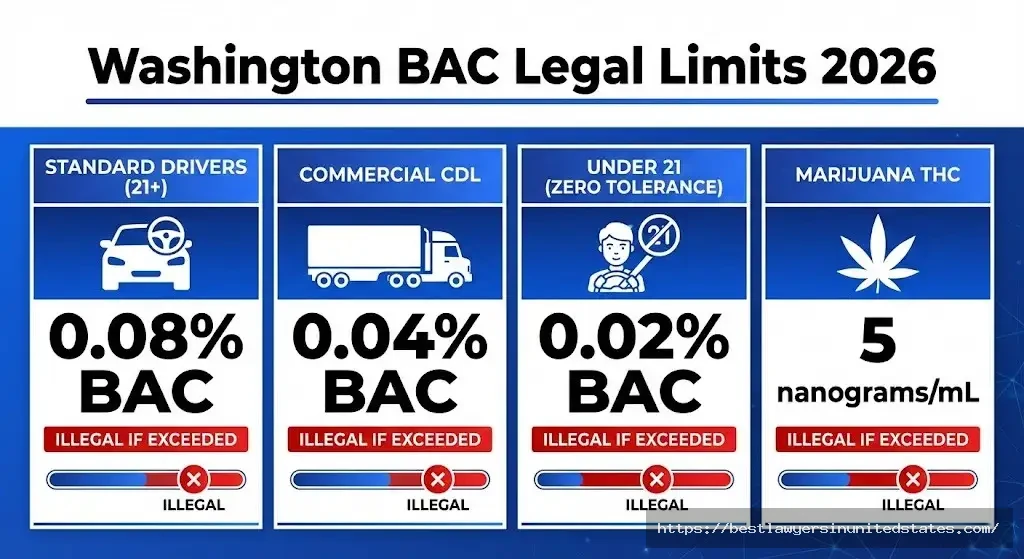
Washington sets different BAC thresholds based on driver type. Standard drivers face arrest at 0.08% or higher. The state uses implied consent laws requiring chemical testing after DUI arrests.
Washington’s BAC Legal Limits
| Driver Type | Legal BAC Limit | Violation Type |
|---|---|---|
| Standard (21+) | 0.08% | Misdemeanor/Felony |
| Commercial (CDL) | 0.04% | Federal violation |
| Under 21 | 0.02% | Zero tolerance |
| Marijuana (THC) | 5 nanograms/mL | Impaired driving |
Important distinction: Commercial drivers lose CDL privileges at 0.04% even when driving personal vehicles. Federal regulations impose harsher standards than Washington state law.
Washington’s marijuana DUI limit sits at 5 nanograms of active THC per milliliter of blood. Police typically require blood tests to measure THC levels, unlike breath tests for alcohol.
Check Your BAC Level
Not sure if you’re over Washington’s 0.08% legal limit? Understanding your BAC helps you make informed decisions. Weight, gender, food intake, and drinking speed all affect your blood alcohol concentration levels.
BAC Calculator
Estimate your Blood Alcohol Content
• Commercial Driver (CDL): 0.04% BAC
• Drivers Under 21: 0.00-0.02% BAC (Zero Tolerance)
• Enhanced Penalties: 0.15% BAC or higher in most states
Different factors influence how quickly alcohol enters your bloodstream. Two beers might put one person at 0.06% but another at 0.09%. Use our calculator to estimate your BAC based on your specific circumstances.
Washington’s Implied Consent Law
Every Washington driver automatically consents to chemical testing when accepting their license. RCW 46.20.308 requires breath or blood tests after lawful DUI arrests.
Officers must read the implied consent warning before requesting tests. The warning explains refusal triggers automatic license suspension separate from criminal charges.
What happens if you refuse:
- First refusal: 1-year license revocation
- Second refusal: 2-year license revocation
- Third refusal: 3-year license revocation
Critical difference: Refusing costs you more suspension time than failing the test. First-time test failure brings 90-day suspension. First refusal brings 365-day revocation.
Can Police Force You to Take Tests?
Police cannot physically force breath tests without your consent. However, they can obtain search warrants for blood draws in serious cases involving injuries or deaths.
Washington State Patrol increasingly seeks warrants after refusals. Judges grant these warrants within hours through electronic systems. You have limited ability to refuse warranted blood draws.
Exception: You can request independent testing at your own expense after completing official tests. Some defendants use private lab results to challenge state evidence.
How Breath and Blood Tests Work
Washington uses Draeger Alcotest 9510 breathalyzers at police stations. These machines analyze deep lung air for alcohol content. Officers must observe you for 15 minutes before testing to prevent mouth alcohol interference.
Blood tests require trained phlebotomists following specific protocols. Washington crime labs analyze blood samples for alcohol percentage and THC nanogram levels. Results typically take 4-6 weeks.
Testing timeline:
- Arrest: Officer suspects impairment
- Warning: Implied consent advisory read
- Testing: Breath test at station or blood draw at hospital
- Results: BAC determines charges and penalties
Washington DUI Penalty Chart: RCW 46.61.5055 Sentencing Grid
Washington uses a mandatory sentencing grid under RCW 46.61.5055. Judges have limited discretion on penalties. Your sentence depends on prior offenses, BAC level, and whether you refused testing.
Understanding the 7-Year Look-Back Period
Washington counts prior DUI convictions within the past 7 years for misdemeanor sentencing. The look-back extends to 10 years when determining felony DUI charges.
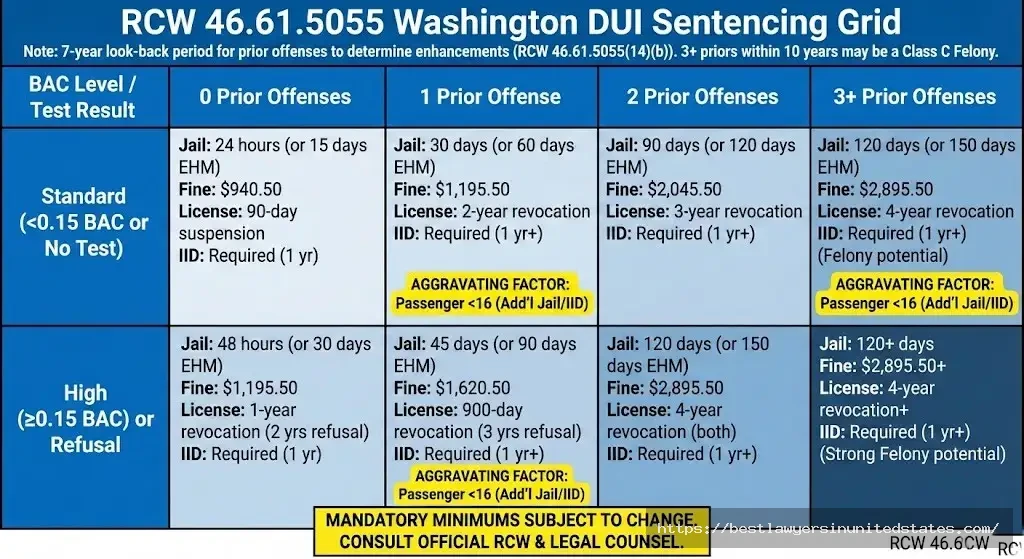
This differs from many states using 10-year look-backs for all offenses. Virginia’s DUI laws use lifetime look-backs, while Texas DWI laws apply 10-year periods.
Example: A 2019 DUI conviction counts toward sentencing in 2026. It won’t count for a 2027 arrest (more than 7 years). However, it permanently counts toward felony determinations.
Washington DUI Penalties for First Offense
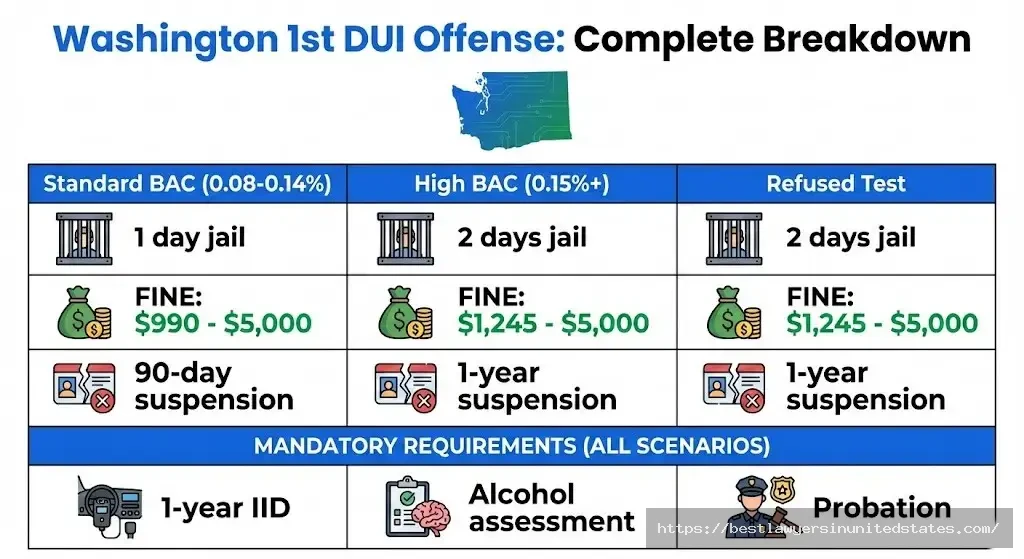
| BAC Level | Jail Time | Fines | License Suspension | IID Required |
|---|---|---|---|---|
| 0.08-0.14% | 1 day minimum | $990.50-$5,000 | 90 days | 1 year |
| 0.15%+ (high BAC) | 2 days minimum | $1,245-$5,000 | 1 year | 1 year |
| Refused test | 2 days minimum | $1,245-$5,000 | 1 year | 1 year |
All first offenses include:
- Alcohol/drug assessment ($150-300)
- 15-day home detention possible instead of jail
- Probation up to 5 years
- $100 victim panel fee
- SR-22 insurance filing
Washington DUI Penalties for Second Offense
| BAC Level | Jail Time | Fines | License Suspension | IID Required |
|---|---|---|---|---|
| 0.08-0.14% | 30 days minimum | $1,245-$5,000 | 2 years | 5 years |
| 0.15%+ (high BAC) | 45 days minimum | $1,495-$5,000 | 900 days | 10 years |
| Refused test | 45 days minimum | $1,495-$5,000 | 2 years | 10 years |
Enhanced requirements:
- 60-day home detention option
- 5-year mandatory IID minimum
- Treatment program completion
- Extended probation supervision
Washington DUI Penalties for Third Offense
| BAC Level | Jail Time | Fines | License Suspension | IID Required |
|---|---|---|---|---|
| 0.08-0.14% | 90 days minimum | $2,000-$5,000 | 3 years | 10 years |
| 0.15%+ (high BAC) | 120 days minimum | $3,000-$5,000 | 4 years | 10 years |
| Refused test | 120 days minimum | $3,000-$5,000 | 4 years | 10 years |
Critical escalation: Third offenses within 7 years bring mandatory 90-120 days actual jail time. Courts rarely grant home detention. Some counties allow work release programs instead.
Aggravating Factors That Increase Penalties
Washington law adds penalties for aggravating circumstances. These factors push sentences toward maximum ranges:
Aggravating factors:
- BAC of 0.15% or higher (automatic enhancement)
- Refusing breath or blood test
- Child under 16 in vehicle (add 6 months jail, $1,000-$5,000 fine)
- Causing property damage
- Reckless driving during arrest
- Prior felony DUI conviction
Example: A first offense at 0.18% BAC with a child passenger means 2 days base jail time plus 6 months additional. That’s 182 days minimum jail.
First Offense DUI in Washington: What to Expect
First-time offenders face serious consequences even without prior records. Washington requires minimum jail time for all DUI convictions. You cannot avoid penalties through plea bargaining to non-alcohol offenses without prosecutor agreement.
Will You Go to Jail for Your First DUI?
Yes. Washington mandates at least 1 day jail for first offenses. High BAC (0.15%+) or test refusal increases minimum to 2 days.
Most King County and Pierce County courts allow 15-day home detention instead of jail. You wear an ankle monitor and stay home except for approved activities. Snohomish County requires actual jail time more frequently.
Jail alternatives available:
- 15-day home detention (electronic monitoring)
- Work release programs (selected counties)
- Weekend jail sentences (spread over 2-3 weekends)
- Good time credit (reduces sentence by 33% for good behavior)
Deferred Prosecution Option
Washington offers deferred prosecution under RCW 10.05.020. This 5-year treatment program lets you avoid conviction. You plead guilty but the court defers judgment pending program completion.
Requirements for deferred prosecution:
- No prior DUIs in past 7 years
- No prior deferred prosecutions
- Enter 2-year inpatient or outpatient treatment
- Complete 5 years probation
- Maintain ignition interlock device
Success means: Charges dismissed after 5 years. Your record shows an arrest but no conviction.
Failure means: Automatic conviction with enhanced penalties. Judges sentence to maximum terms when defendants violate deferred prosecution.
This program suits defendants with genuine alcohol dependency. Courts require extensive treatment proof. Simple first-time arrests without addiction history rarely qualify.
License Suspension Timeline
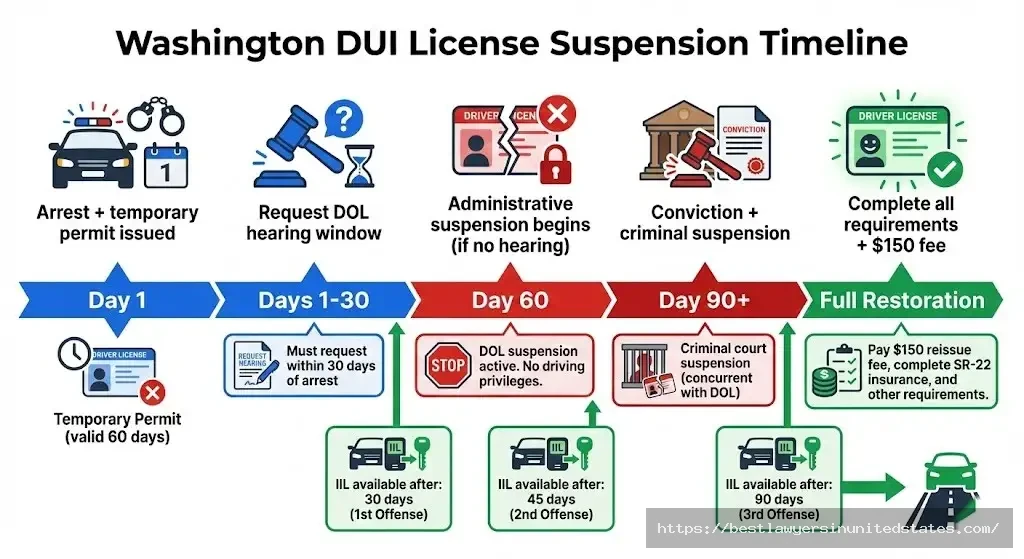
Washington imposes two separate license suspensions: administrative (through DOL) and criminal (through court).
| Suspension Type | First Offense Duration | When It Starts |
|---|---|---|
| Administrative (DOL) | 90 days | 60 days after arrest |
| Criminal (Court) | 90 days | Upon conviction |
| Both combined | 90 days total | Run concurrently |
Critical deadline: Request DOL administrative hearing within 30 days of arrest. Miss this deadline and you lose your right to challenge the administrative suspension.
Repeat DUI Offenses: Second, Third, and Fourth DUIs
Washington imposes dramatically harsher penalties for repeat offenders. Each subsequent DUI within 7 years multiplies jail time, fines, and license suspensions.
Second DUI Within 7 Years
Your second DUI conviction brings 30-45 days minimum jail time. High BAC or refusal pushes this to 45 days minimum. Most counties require actual incarceration rather than home detention.
Mandatory penalties:
- 30-45 days jail (no substitutions)
- $1,245-$5,000 fines
- 2-year license suspension
- 5-10 year IID requirement
- 2-year treatment program
Pierce County allows work release programs for second offenses. You sleep in jail but work during the day. King County requires actual custody for the first 30 days.
Cost comparison: Second DUI offenses cost $8,000-$15,000 total. This includes attorney fees ($2,500-$5,000), treatment ($2,000), IID costs ($1,500-$2,000), and insurance increases ($3,000-$6,000 over 3 years).
Third DUI Within 7 Years
Third offenses bring felony-level jail time despite remaining misdemeanors. Washington requires 90-120 days actual incarceration. Courts deny home detention and work release.
Enhanced consequences:
- 90-120 days mandatory jail
- $2,000-$5,000 fines
- 3-4 year license suspension
- 10-year IID requirement
- Intensive outpatient treatment
- 5-year probation
Employment impact: 90-120 days jail means job loss for most defendants. Spokane County reports 73% of third-time offenders lose employment during incarceration. Consider this when evaluating defense strategies versus quick plea bargains.
When Does DUI Become a Felony?
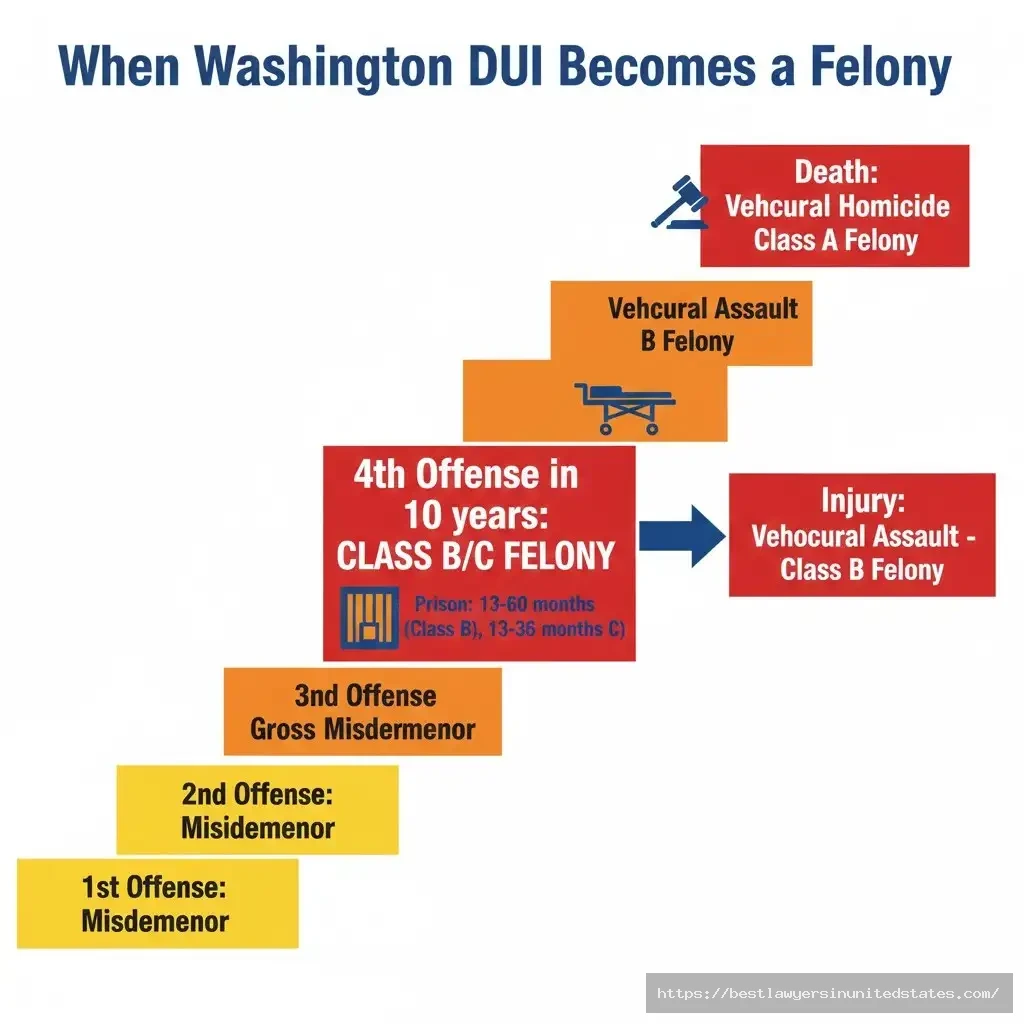
Your fourth DUI within 10 years becomes a Class B or C felony under RCW 46.61.5055(4). Washington also charges felony DUI for vehicular assault or vehicular homicide involving impairment.
Felony thresholds:
- 4 or more DUI convictions within 10 years
- DUI causing substantial bodily harm (vehicular assault)
- DUI causing death (vehicular homicide)
Felony DUI brings 13-60 months prison time. You serve actual prison, not county jail. The state Department of Corrections supervises your sentence.
Unlike states such as California’s DUI laws where third offenses can be felonies, Washington requires four convictions. Florida DUI laws similarly require multiple offenses for felony charges.
Felony DUI in Washington: Class B and Class C Charges
Washington prosecutes serious impaired driving as felony-level offenses. These crimes bring prison sentences rather than county jail time. Your criminal record permanently shows felony convictions.
Fourth Offense Felony DUI
Four or more DUI convictions within 10 years trigger automatic Class B or C felony charges. Prosecutors decide between Class B (more serious) and Class C based on circumstances.
| Felony Class | Prison Time | Fines | License Revocation | Supervision |
|---|---|---|---|---|
| Class B | 13-60 months | $20,000 | 4 years | 2 years |
| Class C | 13-36 months | $10,000 | 3 years | 18 months |
Additional requirements:
- Lifetime IID restriction
- Intensive treatment programs
- Community custody supervision
- Felony conviction on permanent record
Vehicular Assault and Vehicular Homicide
DUI causing substantial bodily harm becomes vehicular assault under RCW 46.61.522. DUI causing death becomes vehicular homicide under RCW 46.61.520.
Vehicular assault penalties:
- Class B felony
- 31-120 months prison
- $20,000 fine
- 4-year license revocation
Vehicular homicide penalties:
- Class A felony
- 51-120 months prison
- $50,000 fine
- 4-year license revocation
Washington State Patrol treats DUI injury/death cases as top priority investigations. They use accident reconstruction specialists and obtain mandatory blood warrants. These cases proceed to trial more often than standard DUIs.
Felony DUI and Employment
Felony convictions permanently affect employment. Most employers conduct background checks showing felony records. Certain professions prohibit hiring felons entirely:
Jobs typically closed to felons:
- State and federal government positions
- Teaching and childcare
- Healthcare and nursing
- Commercial driving (CDL)
- Financial services and banking
- Security and law enforcement
Some counties offer felony DUI offenders early release programs. You serve 50-60% of prison time with good behavior and treatment completion.
License Suspension and Ignition Interlock Requirements
Washington separates license sanctions into two processes. The DOL handles administrative suspensions. Criminal courts handle conviction-based suspensions. Both can run simultaneously but usually overlap.
Administrative License Suspension Process
The DOL automatically suspends or revokes licenses after DUI arrests. This happens before any criminal conviction. You have 30 days to request a hearing challenging the suspension.
DOL suspension timeline:
- Day 1: Officer confiscates physical license at arrest
- Days 1-30: Temporary driving permit valid
- Day 31: Suspension begins if no hearing requested
- Day 61: Suspension takes effect if hearing requested but lost
Administrative suspension lengths:
| Offense | Failed Test | Refused Test |
|---|---|---|
| First | 90 days | 1 year |
| Second | 2 years | 2 years |
| Third+ | 3 years | 3 years |
Criminal Court Suspensions
Judges impose separate suspensions upon conviction. These run concurrently with administrative suspensions in most cases.
Example: You get arrested and DOL suspends your license for 90 days. Three months later you’re convicted and the judge orders 90-day suspension. Both suspensions overlap, so you serve 90 days total, not 180 days.
Exception: If you delay your criminal case beyond the administrative suspension period, you face additional suspension time.
Ignition Interlock Driver’s License (IIL)
Washington allows restricted driving with ignition interlock devices during suspensions. You apply for an IIL through the DOL. The device connects to your vehicle’s ignition system and prevents starting if you’ve consumed alcohol.
IIL requirements:
- Pass breath test to start vehicle (usually 0.00% BAC required)
- Random rolling retests while driving
- Monthly monitoring and calibration ($70-90)
- Installation fee ($150-200)
IIL eligibility: You can apply immediately after suspension begins. Most first offenders qualify after 30 days. Second offenders wait 45 days. Third offenders wait 90 days.
You must maintain IIL for court-ordered periods:
| Offense | Minimum IID Period |
|---|---|
| First (standard BAC) | 1 year |
| First (high BAC/refusal) | 1 year |
| Second | 5 years |
| Third | 10 years |
| Fourth+ (felony) | Lifetime |
Important limitation: IIL lets you drive to/from work, medical appointments, and treatment. You cannot drive for pleasure or during restricted hours (varies by county).
Getting Your License Fully Restored
Full license restoration requires completing all suspension time and meeting DOL requirements. You cannot skip steps or shorten timelines.
Restoration checklist:
- ✅ Complete entire suspension period
- ✅ Maintain IID for required years
- ✅ Complete alcohol treatment program
- ✅ Pay $150 reinstatement fee
- ✅ File SR-22 insurance proof
- ✅ Pass written and driving tests (if revoked)
- ✅ Clear all outstanding warrants or tickets
Expect 4-6 weeks processing time after submitting restoration paperwork. Plan ahead if your IID requirement expires during your suspension. You must keep the device until both periods end.
Washington-Specific DUI Programs and Alternatives
Washington offers unique programs not found in most states. These alternatives provide options beyond standard jail sentences. Understanding program eligibility helps defendants make informed decisions.
24/7 Sobriety Program
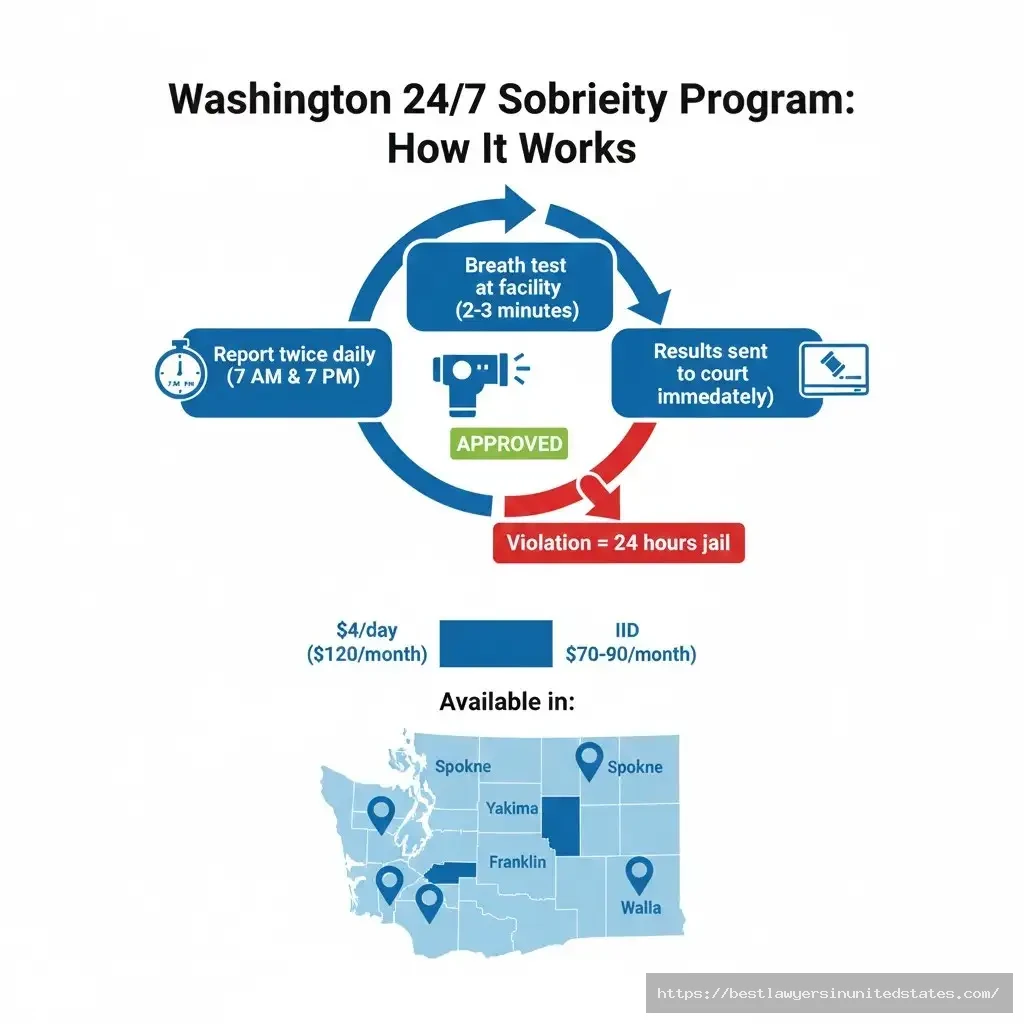
Washington’s 24/7 Sobriety Program requires twice-daily breath testing instead of jail time or IID installation. You report to designated testing locations at 7 AM and 7 PM daily. Each test takes 2-3 minutes.
How it works:
- Court orders 24/7 Program participation
- You report twice daily to testing facility
- Breathe into portable device
- Results immediately sent to court
- Any positive test triggers immediate sanctions
Available in these counties:
- Spokane County
- Yakima County
- Grant County
- Franklin County
- Walla Walla County
Program costs: $4 per day ($120/month), significantly cheaper than IID monthly fees ($70-90 plus installation). Most defendants complete 90-day to 1-year program terms.
Failure consequences: Missing tests or positive results bring swift sanctions. Judges typically impose 24 hours jail per violation. Three violations terminate program eligibility and impose original jail sentences.
Deferred Prosecution Program
Washington’s deferred prosecution lets first-time offenders avoid conviction through successful treatment completion. RCW 10.05 creates this 5-year program for defendants with genuine dependency issues.
Eligibility requirements:
- First DUI or no priors within 7 years
- Never used deferred prosecution before
- Demonstrate alcohol or drug dependency
- Complete 2-year treatment program
- Maintain 5 years probation
Treatment program includes:
- Inpatient (21-28 days) OR intensive outpatient (9+ months)
- Weekly group therapy sessions
- Individual counseling
- Random urinalysis testing
- Family involvement requirements
Success rate: Washington courts report 67% completion rates. Successful completion results in charges dismissed. Your record shows arrest but no conviction.
If you violate: Automatic conviction with enhanced maximum penalties. Judges show little mercy for failed deferred prosecution. Expect upper-range sentences.
Work Release Programs
Selected Washington counties offer work release for DUI offenders. You report to jail facilities evening and weekends but work during daytime hours. This lets defendants maintain employment while serving sentences.
Counties offering work release:
- King County (Seattle)
- Pierce County (Tacoma)
- Snohomish County (Everett)
- Spokane County
Eligibility requirements:
- Verified full-time employment
- Employer letter confirming schedule
- Pass background check
- Pay program fees ($20-30 per day)
- No prior failures to appear
Restrictions: Work release prohibits second and third offenses in some counties. Call your county jail for specific eligibility. Most programs require 30-45 day advance applications.
Earned Early Release (“Good Time Credit”)
Washington reduces jail sentences by 33% for good behavior and program participation. You earn 1 day credit for every 2 days served.
Example: 90-day sentence = 60 days actual time with good time credit. Violating jail rules forfeits your earned time.
Activities earning credit:
- Attending AA/NA meetings in jail
- Work crew participation
- Educational classes
- Drug treatment programs
- Following all jail rules
Cannot reduce: Mandatory minimums don’t qualify for good time. Your 90-day third offense sentence cannot drop below 60 days.
Target Zero Teams
Washington State Patrol operates Target Zero Teams in high-DUI areas. These specialized units conduct enhanced enforcement during peak impaired driving times:
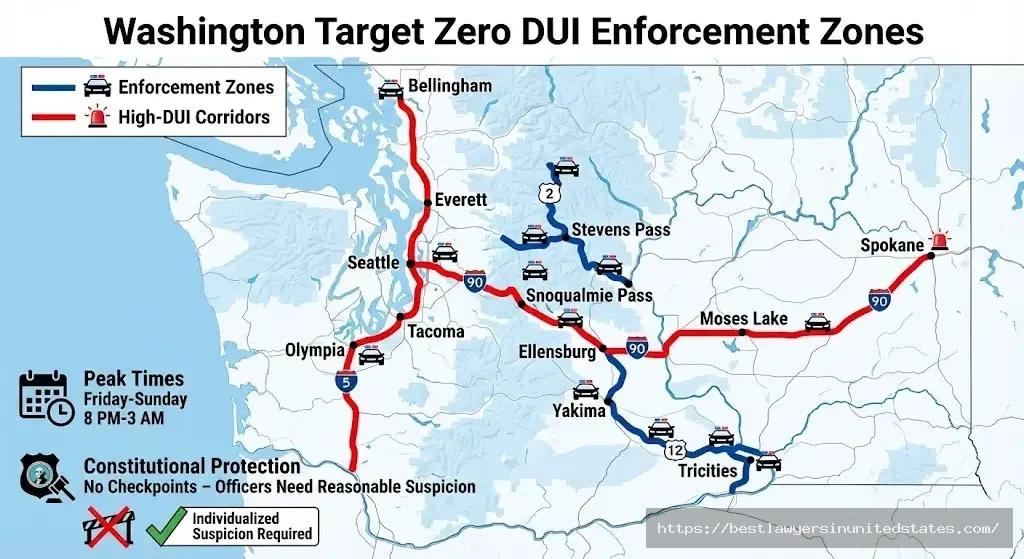
Peak enforcement periods:
- Friday-Sunday nights (8 PM-3 AM)
- Holiday weekends (Thanksgiving, Christmas, New Year’s, 4th of July)
- Major sporting events
- Concert venues
Target Zero locations:
- I-5 corridor (Seattle to Everett)
- I-90 (Seattle to Spokane)
- Highway 2 (Stevens Pass area)
- Highway 12 (Yakima area)
These teams use advanced field sobriety training and immediate breath testing. They process arrests faster than regular patrol officers, typically booking suspects within 2-3 hours.
The DUI Arrest and Court Process in Washington
Washington follows a structured process from arrest through sentencing. Understanding each stage helps you prepare and protect your rights. Missing critical deadlines permanently damages your case.
What Happens During a DUI Arrest
Officers must follow specific procedures during Washington DUI arrests. Violations of these protocols create defense opportunities.
Typical arrest sequence:
- Traffic stop: Officer needs reasonable suspicion (weaving, speeding, equipment violation)
- Initial contact: Officer observes signs of impairment (odor, slurred speech, bloodshot eyes)
- Field sobriety tests: Three standardized tests (horizontal gaze nystagmus, walk-and-turn, one-leg stand)
- Preliminary breath test: Portable roadside device (results inadmissible in court)
- Arrest: Probable cause established
- Implied consent warning: Officer reads your testing rights
- Chemical test: Breath test at station or blood draw at hospital
- Booking: Fingerprints, photos, paperwork
- Release: Bond or personal recognizance
Critical rights during arrest:
- You must provide license, registration, and insurance
- You can politely decline field sobriety tests (no direct penalty)
- You can decline preliminary breath test (no direct penalty)
- You cannot decline post-arrest breath/blood test without 1-year license revocation
- You have right to attorney after arrest (not during investigation)
Administrative Hearing vs. Criminal Court
Washington runs two parallel processes. Understanding the difference prevents confusion and missed deadlines.
| Process | Administrative (DOL) | Criminal (Court) |
|---|---|---|
| Purpose | License suspension | Criminal conviction |
| Timeline | 30-60 days | 6-12 months |
| Burden of proof | Preponderance of evidence | Beyond reasonable doubt |
| Penalties | License suspension only | Jail, fines, probation |
| Request deadline | 30 days from arrest | None (automatic) |
Administrative hearing issues:
- Did officer have reasonable grounds for arrest?
- Were you properly advised of implied consent?
- Did you refuse testing or test above legal limit?
- Were machines properly maintained?
Winning administrative hearing: Prevents DOL suspension but doesn’t affect criminal charges. You can win the DOL hearing but still face criminal conviction.
Losing administrative hearing: License suspended per schedule. You can still fight criminal charges separately.
Criminal Court Timeline
Month 1: Arraignment
Your first court appearance happens within 30-45 days of arrest. The judge reads charges, you enter a plea (usually “not guilty”), and court sets future dates.
What to bring:
- Citation and paperwork from arrest
- Attorney if hired
- Proof of IID installation (if driving)
- Valid photo ID
Months 2-3: Pretrial Conferences
Your attorney meets with prosecutors discussing evidence and potential plea offers. Most DUI cases have 2-4 pretrial conferences. Prosecutors review police reports, videos, and breath test results.
Typical plea offers:
- First offense: Plead guilty to reduced charge (reckless driving) with lighter penalties
- High BAC: Plead as charged with standard penalties
- Weak evidence: Prosecutors may dismiss or offer deferred prosecution
Months 4-6: Motion Hearings
Your attorney files motions challenging evidence. Common motions include:
- Motion to suppress breath test results (machine malfunction)
- Motion to suppress statements (Miranda violation)
- Motion to suppress evidence (illegal stop)
- Motion to suppress field sobriety tests (improper administration)
Judges rule on motions 2-4 weeks before trial. Successful motions weaken prosecution cases and improve plea offers.
Months 7-12: Trial or Plea
Most DUI cases resolve through plea agreements. Only 5-10% proceed to trial. Trials last 1-3 days and involve:
Prosecution evidence:
- Officer testimony about stop and arrest
- Video from patrol car and body camera
- Breath test results and machine maintenance logs
- Expert testimony on alcohol impairment
Defense evidence:
- Defendant testimony (optional)
- Expert testimony challenging tests
- Witness testimony contradicting officer observations
- Evidence of proper driving before stop
Jury trials require unanimous 12-person verdicts. Bench trials involve judge-only decisions. Most DUI defendants choose jury trials for better acquittal odds.
Sentencing Hearing
Judges sentence defendants 2-4 weeks after conviction or plea. You must appear in person. The judge considers:
Factors affecting sentence:
- Criminal history
- BAC level
- Cooperation with police
- Remorse shown
- Treatment progress started
- Employment situation
- Family circumstances
Bring letters of support from employers, family, and community members. Judges appreciate defendants who start treatment before sentencing.
At sentencing you receive:
- Jail time or home detention order
- Fine payment schedule
- Probation terms and conditions
- Treatment program assignment
- IID installation order
- License suspension paperwork
Report to jail within 2-3 days unless given specific reporting date. Failure to report generates arrest warrants.
Washington DUI Defense Strategies
Strong defense strategies challenge prosecution evidence at multiple points. Washington law provides several avenues for fighting DUI charges. Skilled attorneys identify weaknesses in police procedures and testing.
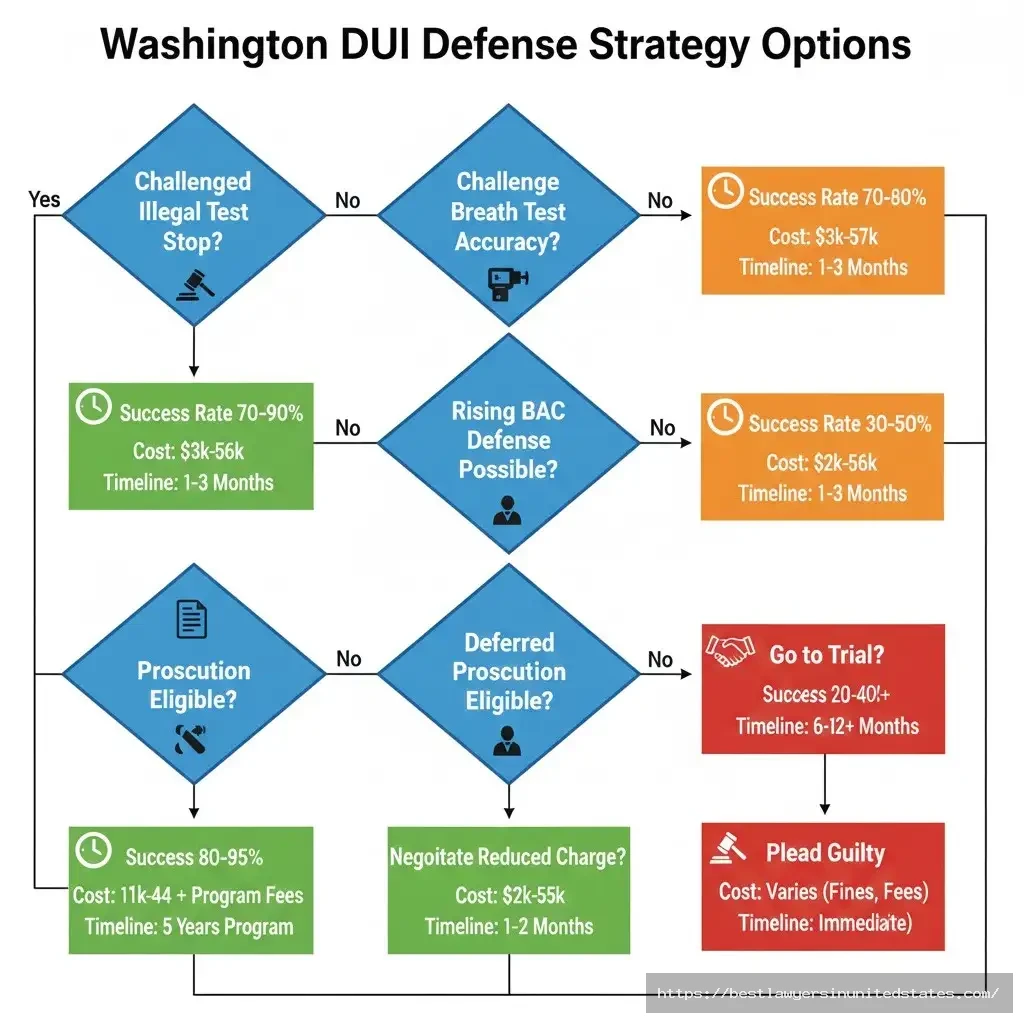
Challenging the Traffic Stop
Officers need reasonable suspicion to stop your vehicle. They cannot pull you over without observing traffic violations or suspicious driving. Common valid reasons include:
Legal stop reasons:
- Weaving within lane or crossing center line
- Speeding or driving too slowly
- Equipment violations (broken taillight, expired tabs)
- Cell phone use while driving
Invalid stop reasons:
- Anonymous tip without officer observation
- Leaving bar parking lot (not suspicious alone)
- Driving in high-crime area
- Officer “hunch” or instinct
Your attorney files motions to suppress evidence from illegal stops. Successful motions eliminate breath test results and officer observations. Prosecutors often dismiss cases after losing suppression motions.
Attacking Field Sobriety Tests
Washington officers use three standardized field sobriety tests (SFSTs). These tests follow National Highway Traffic Safety Administration (NHTSA) protocols. Improper administration invalidates results.
Common FST administration errors:
- Conducting tests on uneven surfaces or poor lighting
- Inadequate instructions or demonstrations
- Weather interference (rain, wind, cold)
- Not accounting for age, weight, or injuries
- Rushing through 15-minute observation period
- Officer bias affecting scoring
Medical conditions affecting FSTs:
- Inner ear problems (balance issues)
- Knee or ankle injuries
- Back problems
- Vision impairments
- Neurological conditions
- Age over 65 or weight over 300 pounds
NHTSA studies show FSTs detect impairment only 65-77% accurately under ideal conditions. Real-world accuracy drops significantly. Defense attorneys use this data to challenge test validity.
Rising BAC Defense
Your BAC continues rising 30-90 minutes after your last drink. You might be below 0.08% while driving but above the limit when tested 60-90 minutes later at the police station.
How rising BAC works:
| Time | Activity | BAC Level |
|---|---|---|
| 11:00 PM | Last drink consumed | 0.06% |
| 11:15 PM | Stopped by police | 0.07% |
| 11:45 PM | Arrive at station | 0.08% |
| 12:00 AM | Breath test given | 0.09% |
Legal standard: RCW 46.61.502 requires proof you drove while above 0.08%. If you only reached 0.08% after driving stopped, you aren’t guilty of per se DUI.
Defense experts testify about alcohol absorption rates. They calculate your BAC at time of driving using:
- Number and type of drinks
- Drinking timeline
- Food consumption
- Body weight and gender
- Time between driving and testing
This defense works best when testing occurs 60+ minutes after driving stopped.
Challenging Breathalyzer Accuracy
Washington uses Draeger Alcotest 9510 machines. These devices require strict maintenance and calibration protocols. Errors in machine operation create defense opportunities.
Required maintenance:
- Weekly accuracy checks
- Monthly calibrations
- Annual certifications
- Logs documenting all maintenance
Defense attorneys subpoena machine maintenance records. Missing calibrations or failed accuracy checks invalidate test results.
Factors affecting breath test accuracy:
- Mouth alcohol from burping or GERD
- Dental work trapping alcohol
- Recent use of mouthwash or breath spray
- Diabetes producing acetone (reads as alcohol)
- Radio frequency interference (cell phones, radios)
- Operator error entering data
Officers must observe you for 15 minutes before testing. This prevents mouth alcohol contamination. If officers fail to properly observe, defense attorneys move to suppress results.
Mouth Alcohol and Medical Conditions
Certain medical conditions produce false positive breath tests:
Conditions causing false readings:
- GERD (acid reflux) bringing stomach alcohol to mouth
- Diabetes producing acetone breath
- Hypoglycemia mimicking intoxication symptoms
- Keto diet creating ketones reading as alcohol
Defense attorneys present medical records proving these conditions existed. Expert testimony explains how conditions affected test results.
When Can DUI Be Reduced to Reckless Driving?
Washington prosecutors sometimes reduce DUI charges to reckless driving under RCW 46.61.500. This “wet reckless” plea avoids DUI conviction but acknowledges alcohol involvement.
Factors favoring reduction:
- BAC below 0.10%
- No accident or property damage
- Cooperative with police
- No prior DUI history
- Weak evidence (no breath test, failed FST due to medical condition)
- First offense with clean record
Reckless driving penalties:
- Up to 364 days jail (rarely imposed)
- $500-$5,000 fine
- 30-day license suspension
- No mandatory IID requirement
- Probation 1-2 years
Comparison: Reckless driving carries fewer long-term consequences. Insurance companies treat it less harshly. Employment background checks show reckless driving, not DUI.
However, reckless driving counts as a prior offense if you get another DUI within 7 years. Washington treats “wet reckless” identically to DUI for enhancement purposes.
Similar to how Oregon DUII laws handle charge reductions, prosecutors evaluate case strength before offering alternative pleas.
Special DUI Cases in Washington
Washington imposes different rules for specific driver categories. Understanding these special circumstances helps defendants navigate unique penalties. Each category carries distinct legal standards.
Under-21 DUI: Zero Tolerance Law
Washington enforces strict zero tolerance for underage drinking and driving. Drivers under 21 face charges at just 0.02% BAC under RCW 46.61.503.
Under-21 penalties:
| BAC Level | Charge Type | License Suspension | Other Penalties |
|---|---|---|---|
| 0.02-0.07% | Minor DUI | 90 days-1 year | $250-$1,000 fine |
| 0.08%+ | Standard DUI | Same as adult | Same as adult |
Critical difference: Police charge minors with regular DUI at 0.08% or higher. Below 0.08%, they charge the lesser offense of driving under the influence by a person under 21.
Additional consequences for minors:
- School notification in some districts
- Suspension from school activities
- Loss of vehicle access (parents’ discretion)
- Delayed graduation from Graduated Driver License program
Parents don’t receive automatic notification, but court proceedings become public record. Most schools learn about charges through normal processes.
Marijuana DUI Enforcement
Washington legalized recreational marijuana but maintains strict impaired driving laws. The state sets a 5-nanogram per milliliter THC limit under RCW 69.50.4013.
How police test for marijuana:
- Officer observes signs of marijuana impairment
- Drug recognition expert (DRE) evaluates you
- Blood draw required (no breath test for marijuana)
- State crime lab analyzes blood for THC levels
Challenges with marijuana DUI:
- THC remains in blood weeks after use
- Active THC vs. inactive metabolites (only active counts)
- Blood draw happens 1-3 hours after arrest
- No roadside testing available
Defense strategy: THC levels don’t correlate directly with impairment. Heavy users maintain higher baseline levels while functioning normally. Light users show impairment at lower levels.
Defense experts testify about THC metabolism. They explain how frequent users develop tolerance. This differs from alcohol where BAC directly relates to impairment.
CDL Drivers and Commercial DUI
Commercial driver’s license (CDL) holders face federal regulations stricter than Washington state law. You lose CDL privileges at 0.04% BAC even when driving personal vehicles.
CDL DUI consequences:
| Situation | BAC Level | Result |
|---|---|---|
| Driving commercial vehicle | 0.04% | 1-year CDL suspension |
| Driving personal vehicle | 0.04% | 1-year CDL suspension |
| Carrying hazmat | 0.04% | 3-year CDL suspension |
| Second offense | Any level | Lifetime CDL suspension |
No hardship licenses: Federal law prohibits CDL hardship or occupational licenses. You lose all commercial driving privileges immediately. This typically means job loss.
Employment impact: Most trucking companies fire drivers after DUI arrests, even before conviction. Insurance companies refuse to cover drivers with pending DUI charges.
Consider these stakes when deciding whether to fight charges or accept plea deals. Quick resolution may help with employment if you plan to switch to non-CDL work.
Out-of-State Drivers Arrested in Washington
Washington DUI arrests affect your home state license through the Interstate Driver’s License Compact. Your state receives notification and imposes its own penalties on top of Washington’s sanctions.
How it works:
- Washington DOL suspends your license in Washington
- Washington reports conviction to your home state
- Your home state suspends your license under its laws
- You face penalties in both states
Example: New York DWI laws suspend licenses for out-of-state DUI convictions. If you’re a New York resident arrested in Washington, expect suspensions in both states.
Cannot avoid: Some defendants think avoiding Washington means avoiding penalties. Your home state will find out and impose its own sanctions. You cannot renew your home state license until resolving Washington charges.
Physical Control While Under the Influence
Washington prosecutes “physical control” under RCW 46.61.504. You don’t need to be driving. Police charge physical control when you’re in a vehicle with the ability to start it.
Physical control elements:
- Intoxicated person in vehicle
- Keys within reach
- Vehicle capable of being operated (not disabled)
Common scenarios:
- Sleeping in driver’s seat with keys in pocket
- Sitting in driver’s seat while vehicle warms up
- Pulled over napping with engine off but keys in ignition
Defense strategy: Move to passenger seat if you must sleep in your car. Put keys in trunk or have passenger hold them. These actions prevent physical control charges even if you’re intoxicated.
Physical control carries identical penalties to DUI. Prosecutors use this charge when witnesses see you get in the car but no one saw you actually drive.
DUI Costs in Washington State
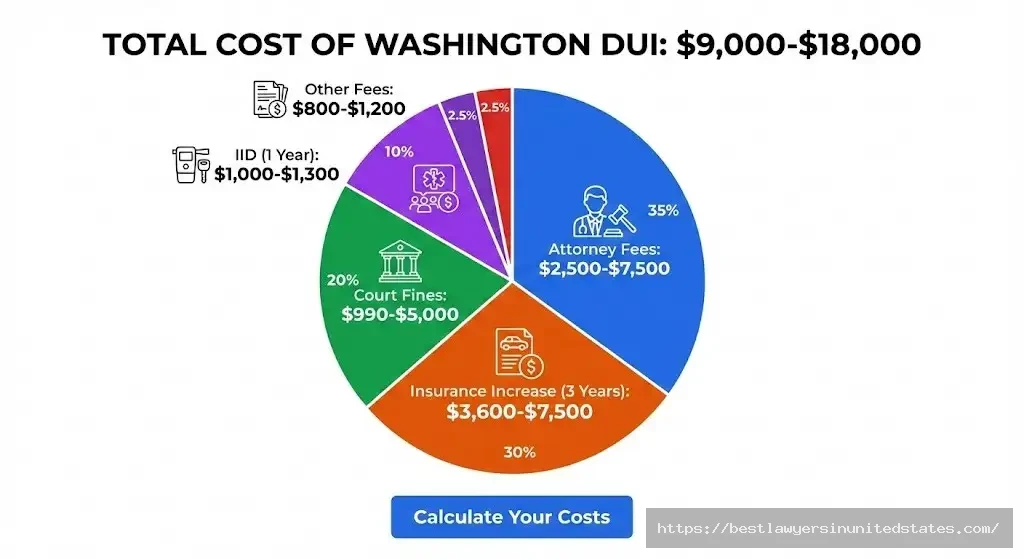
Washington DUI convictions cost far more than court-imposed fines. Hidden expenses multiply over months and years. Understanding total costs helps you make informed decisions about defense strategy and plea offers.
Complete First Offense Cost Breakdown
| Cost Category | Amount Range | When Due |
|---|---|---|
| Court fines | $990-$5,000 | At sentencing |
| Court costs/fees | $500-$800 | At sentencing |
| Attorney fees | $2,500-$7,500 | Throughout case |
| DUI evaluation | $150-$300 | Before sentencing |
| Treatment program | $500-$2,000 | 6-12 months |
| Victim impact panel | $75-$150 | During probation |
| Jail alternative (home detention) | $15-25/day x 15 days | During sentence |
| IID installation | $150-$250 | Before driving |
| IID monthly fees | $70-$90/month x 12 | Throughout year |
| License reinstatement | $150 | After suspension |
| SR-22 insurance filing | $25/year | 3 years |
| Insurance increase | $1,200-$2,500/year | 3-5 years |
| Total First Offense | $9,000-$18,000 | Over 1-3 years |
These estimates assume standard first offense without aggravating factors. High BAC or accidents increase costs significantly.
Second and Third Offense Costs
Repeat offenses multiply expenses. Longer IID requirements and treatment programs cost substantially more.
Second offense total: $15,000-$30,000
- Higher fines ($1,245-$5,000)
- More expensive attorneys ($3,500-$10,000)
- Extended treatment (2 years @ $2,000-$4,000)
- Five-year IID ($5,000-$7,000)
- Jail work release fees ($600-$1,350 for 30-45 days)
- Insurance increases ($3,000-$8,000)
Third offense total: $20,000-$40,000
- Maximum fines ($2,000-$5,000)
- Specialized defense attorneys ($5,000-$15,000)
- Intensive treatment programs ($4,000-$8,000)
- Ten-year IID ($10,000-$15,000)
- Lost wages from 90-120 days jail (potentially $15,000-$30,000)
- Insurance increases ($5,000-$12,000)
Calculate Your Total DUI Costs
Every case differs based on BAC level, prior offenses, and county. Our comprehensive cost calculator helps you estimate your specific situation. Enter your BAC, offense number, and county to receive personalized totals including attorney fees, fines, and long-term insurance impacts.
The calculator breaks down costs by category so you understand where money goes. Many defendants don’t realize insurance increases alone exceed $5,000 over three years.
DUI Cost Calculator
Estimate total DUI expenses by state and offense
Detailed Cost Breakdown
Payment Timeline
Bail bond, towing fees, car impound, attorney retainer
Initial court fines, DMV fees, DUI school enrollment, ignition interlock installation
Monthly probation fees, ignition interlock fees, DUI school payments, attorney balance
Insurance premium increases, license reinstatement, SR-22 filing fees
- Lost wages from missed work (court dates, jail time, DUI school) – $2,000-$10,000
- Job loss or difficulty finding employment – Varies
- Professional license suspension (doctors, lawyers, nurses, pilots) – Career ending
- Rideshare and transportation costs during suspension – $1,500-$5,000
- Travel restrictions and visa denials – Varies
- Security clearance loss – Career impact
- Child custody implications – Legal costs
- Rental car restrictions – Varies
- Personal relationships and mental health costs – Priceless
Hidden Costs Often Overlooked
Beyond obvious expenses, DUI convictions create indirect costs:
Employment impact:
- Time off for court appearances ($500-$2,000 lost wages)
- Job loss from incarceration (variable, potentially $30,000+)
- Career limitations from criminal record (lifetime impact)
Transportation alternatives:
- Uber/Lyft during suspension ($200-$500/month)
- Public transit passes ($100-$150/month)
- Relying on friends/family (relationship strain)
Family costs:
- Childcare during jail/court ($500-$2,000)
- Relationship counseling ($100-$200/session)
- Divorce proceedings if marriage fails ($5,000-$20,000)
Total hidden costs: $3,000-$10,000+ for most defendants, with job loss potentially adding $30,000-$60,000.
Bail and Pretrial Costs
Most first-time DUI defendants get released on personal recognizance (no bail). Judges set bail for repeat offenders or defendants with failure-to-appear history.
Typical bail amounts:
- First offense: $0-$5,000
- Second offense: $5,000-$10,000
- Third offense: $10,000-$25,000
- Felony DUI: $25,000-$100,000
Bail bondsmen charge 10% non-refundable fees. $10,000 bail costs you $1,000 even if charges get dismissed.
Is Fighting Your DUI Worth the Cost?
Compare defense costs against conviction consequences. Quick guilty pleas save attorney fees but maximize penalties.
Cost-benefit analysis:
| Scenario | Attorney Cost | Total Penalty Cost | Outcome |
|---|---|---|---|
| Plead guilty immediately | $0-$1,500 | $9,000-$15,000 | Conviction |
| Hire attorney, negotiate | $2,500-$5,000 | $7,000-$12,000 | Reduced charge |
| Full trial defense | $5,000-$10,000 | $6,000-$9,000 OR $0 | Dismissal/acquittal |
Strong cases justify expensive defense. Weak cases benefit from quick plea negotiations. Consult attorneys offering free consultations to evaluate your specific situation.
Are DUI Checkpoints Legal in Washington?
Washington courts ruled sobriety checkpoints unconstitutional under Article 1, Section 7 of the Washington Constitution. Police cannot randomly stop vehicles without individualized suspicion. This makes Washington different from most states allowing checkpoints.
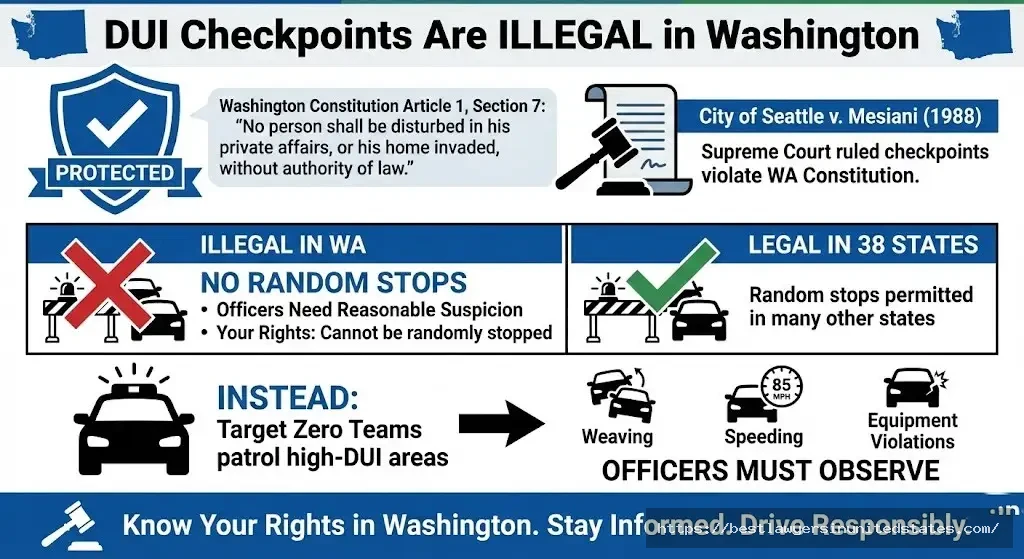
Washington’s Constitutional Protection
Washington’s constitution provides stronger privacy protections than the U.S. Constitution. State courts determined suspicionless stops violate citizens’ rights even when serving legitimate government interests.
City of Seattle v. Mesiani (1988): Washington Supreme Court held DUI checkpoints violate the state constitution. Officers need specific reasonable suspicion before stopping vehicles.
This ruling protects Washington drivers from random stops. Officers must observe actual driving violations or suspicious behavior before initiating traffic stops.
Compare this to Ohio DUI laws and Pennsylvania DUI laws where sobriety checkpoints operate regularly during holidays and weekends.
How Target Zero Teams Operate Instead
Without checkpoint authority, Washington State Patrol uses “Target Zero Teams” for enhanced DUI enforcement. These specialized units conduct high-visibility patrols in areas with elevated DUI rates.
Target Zero strategy:
- Increased patrol presence during peak times (Friday-Saturday 9 PM-3 AM)
- Focused enforcement on high-DUI corridors
- Immediate processing reducing arrest-to-booking time
- Coordination between agencies for maximum coverage
Major Target Zero zones:
- I-5 corridor through Seattle, Everett, Tacoma
- Highway 2 (Stevens Pass area)
- I-90 Spokane to Seattle route
- Highway 12 Yakima Valley
- Downtown entertainment districts (Pioneer Square, Belltown)
Officers still need reasonable suspicion for stops. However, Target Zero Teams watch specifically for impaired driving indicators:
Common observations leading to stops:
- Weaving within lane or crossing lines
- Driving 10+ mph below speed limit
- Wide turns or drifting
- Stopping too far back or ahead at lights
- Delayed acceleration after light changes
- Nearly striking objects or vehicles
Your Rights During DUI Stops
Washington’s constitutional protections give you specific rights during traffic stops. Understanding these rights helps protect your interests.
During the stop you must:
- Provide driver’s license, registration, and insurance
- Exit vehicle if requested
- Answer basic identification questions
You can politely decline:
- Field sobriety tests (no automatic penalty)
- Preliminary breath test (no automatic penalty)
- Answering questions about drinking (“Where are you coming from?” “Have you been drinking?”)
- Consenting to vehicle searches
After arrest you must:
- Provide breath or blood test or face 1-year license revocation
- Submit to booking procedures
- Provide identification information
Exercise rights professionally: “Officer, I don’t wish to answer questions without my attorney present. I understand my rights.” This protects you without antagonizing officers.
Life After a DUI in Washington
Washington DUI convictions create lasting consequences beyond immediate penalties. Understanding long-term impacts helps you prepare for challenges ahead. Most consequences gradually diminish over 5-10 years.
How Long Does DUI Stay on Your Record?
Washington DUI convictions remain on your criminal record permanently. They don’t automatically disappear after 7 or 10 years unlike some states.
Record timeline:
| Record Type | Duration | Who Can See It |
|---|---|---|
| Criminal conviction | Permanent | Employers, landlords, public |
| License record | 15 years minimum | Insurance companies, DOL |
| Prior offense (for enhancements) | 7 years misdemeanor, 10 years felony | Prosecutors, judges |
| Background checks | Permanent | Anyone running check |
Vacation of conviction: Washington allows limited record sealing under RCW 9.96.060. You must complete all requirements:
- Complete entire sentence including probation
- Wait 5 years after completion (10 years for felonies)
- Pay all fines and restitution
- No new criminal charges
- Petition court for vacation order
Successful vacation doesn’t erase the conviction but limits who can see it. Employers conducting background checks won’t see vacated convictions. Law enforcement and prosecutors still access records.
Employment Consequences
Most Washington employers conduct criminal background checks. DUI convictions appear in these checks and affect hiring decisions.
Jobs often closed after DUI:
- Commercial driving (CDL required)
- School employees and childcare workers
- Healthcare and nursing positions
- Government jobs requiring security clearance
- Financial services and banking
- Taxi/Uber/Lyft drivers
Jobs usually available:
- Private sector general employment
- Construction and trades
- Retail and hospitality
- Self-employment and contractors
Washington law prohibits employers from asking about arrests without conviction. However, convictions remain fair game for consideration. Some employers automatically reject DUI applicants within the past 3-5 years.
What to tell employers: Be honest if asked directly about criminal history. Explain the situation briefly, emphasize what you learned, and highlight your rehabilitation. Many employers appreciate honesty over discovering convictions through background checks.
Insurance Impact and SR-22 Requirements
DUI convictions dramatically increase car insurance premiums. Washington requires SR-22 certificates proving you carry minimum liability coverage.
Average insurance increases:
- First DUI: 60-80% increase ($1,200-$2,500/year added)
- Second DUI: 100-150% increase ($2,000-$4,000/year added)
- Third DUI: 200%+ increase ($4,000-$8,000/year added)
These increases last 3-5 years. You cannot shop for better rates until the conviction drops from your insurance record after 5 years.
SR-22 requirements:
- File with Washington DOL
- Maintain for 3 years minimum
- Insurance company sends DOL proof of coverage
- Lapsed coverage triggers immediate license suspension
- Costs $25-50 filing fee plus higher premiums
High-risk insurance pools: Some defendants cannot find standard insurance. They enter state-assigned high-risk pools with premiums 200-300% above normal rates. Expect $400-600/month for minimum coverage.
Immigration Consequences
DUI convictions create serious immigration issues for non-citizens. Multiple DUIs or aggravated circumstances can trigger deportation proceedings.
Potential immigration impacts:
- Green card renewal denials
- Citizenship application denials
- Visa extension problems
- Removal/deportation proceedings (multiple DUIs)
- Inability to re-enter U.S. after international travel
Aggravating factors for immigration:
- BAC 0.15% or higher
- Child endangerment
- Multiple offenses
- Accidents causing injury
- Felony DUI
Non-citizens facing DUI charges should consult immigration attorneys before accepting any plea deals. Some outcomes seem minor criminally but trigger immigration consequences. Standard DUI penalties might be worth fighting to avoid deportation.
Moving to Another State
Washington convictions follow you through the Interstate Driver’s License Compact. Your new state learns about the DUI and imposes its own penalties on top of Washington’s requirements.
What happens when you move:
- New state DMV requests your complete driving record
- They see Washington DUI conviction(s)
- Your new state imposes its suspension periods
- You must complete new state’s requirements
- Insurance increases continue in new state
Cannot escape: Some defendants move thinking they’ll get fresh starts. The Interstate Compact ensures your record transfers. You face penalties in your new state even if you completed Washington’s requirements.
Exception: Washington IID requirements don’t automatically transfer. Your new state may waive IID if you’ve already completed Washington’s minimum period. However, insurance increases and license restrictions typically continue.
Washington DUI FAQs
Do You Lose Your License Immediately After DUI?
Quick Answer: No. Officers issue a temporary driving permit valid for 30 days. Your actual suspension begins 60 days after arrest if you don’t request a DOL hearing, or on the hearing decision date if you do request one.
The 30-day temporary permit lets you drive normally while arranging an IIL or preparing for suspension. Use this time to request your administrative hearing, hire an attorney, and apply for ignition interlock devices.
Will I Go to Jail for First DUI in Washington?
Quick Answer: Yes. Washington mandates minimum 1 day jail for first DUI (2 days for high BAC or refusal). Most courts allow 15-day home detention instead of actual jail.
Judges rarely waive jail time entirely. However, they convert jail sentences to home detention with electronic monitoring in King, Pierce, and most other counties. You stay home except for approved activities (work, treatment, medical appointments).
Can DUI Charges Be Dismissed in Washington?
Quick Answer: Yes, but rarely. Prosecutors dismiss cases with serious evidence problems, such as illegal stops, inaccurate breath tests, or missing police reports. About 5-10% of Washington DUI cases get dismissed.
Common dismissal grounds include:
- Unlawful traffic stop (no reasonable suspicion)
- Breath test machine not properly maintained
- Officer failed to follow implied consent procedures
- Key witness unavailable (officer transferred, retired)
- Blood draw without warrant or consent
Strong defense requires experienced attorneys filing appropriate motions. Don’t expect dismissals from minor technicalities.
What Is the 6-Month Rule in Washington?
Quick Answer: Washington’s “6-month rule” for new drivers under the Graduated Driver License (GDL) program prohibits driving with passengers under 20 (except family) for the first 6 months after getting a license.
This restriction applies to drivers under 18 when they first receive intermediate licenses. DUI convictions restart the 6-month restriction period, meaning young drivers lose passenger privileges again.
Second meaning: Some defendants refer to the 6-month period for requesting license reinstatement hearings after suspension. Context determines which “6-month rule” applies.
Can You Refuse a Breathalyzer Test?
Quick Answer: Yes, but refusal triggers automatic 1-year license revocation (worse than the 90-day suspension for failing the test). Refusal also provides evidence of “consciousness of guilt” that prosecutors use at trial.
Pre-arrest: You can refuse preliminary roadside breath tests without direct penalty. However, refusal gives officers additional probable cause for arrest.
Post-arrest: You can refuse official breath tests at the station, but Washington’s implied consent law imposes harsh revocation. Judges and juries view refusal negatively.
Best practice: Most attorneys recommend taking the breath test. Test results create concrete defense opportunities through machine maintenance challenges and rising BAC defenses.
How Much Is Bail for DUI in Washington?
Quick Answer: Most first-time DUI defendants get released on personal recognizance (no bail). Repeat offenders face $5,000-$25,000 bail depending on prior history and case circumstances.
Bail factors:
- Criminal history
- Prior failures to appear
- Out-of-state residence
- Seriousness of offense (injury accident, felony)
- Ties to community
King County and Pierce County rarely set bail for first-time misdemeanor DUIs unless defendants have outstanding warrants or extensive criminal histories.
How Long Does a DUI Case Take?
Quick Answer: Standard DUI cases resolve in 6-12 months from arrest to final disposition. Complex cases involving accidents, injuries, or multiple charges take 12-18 months. Trial cases extend beyond 18 months.
Timeline breakdown:
- Arrest to arraignment: 30-45 days
- Pretrial conferences: 2-4 months
- Motion hearings: 1-2 months
- Trial preparation: 2-3 months
- Trial: 1-3 days
- Sentencing: 2-4 weeks after conviction
You can expedite cases by accepting quick plea offers. However, rushing limits defense investigation time. Most defendants benefit from thorough case development.
Can You Get a DUI Expunged in Washington?
Quick Answer: Washington doesn’t offer true expungement but allows “vacation” of convictions after completing all requirements and waiting 5 years (10 years for felonies). Vacated convictions remain visible to law enforcement but not most employers.
Vacation requires:
- Complete all sentences, fines, and probation
- Wait 5 years for misdemeanors (10 for felonies)
- No new criminal charges during waiting period
- File petition with sentencing court
- Attend vacation hearing
Successful vacation removes convictions from most background checks. However, licensing agencies and law enforcement still see records. Subsequent DUI charges count vacated convictions as priors for enhancement purposes.
Find a Washington DUI Attorney
Experienced DUI attorneys substantially improve case outcomes. They identify defense opportunities, negotiate better plea deals, and challenge evidence effectively. Washington has strict DUI laws requiring specialized knowledge.
When to Hire an Attorney
Hire an attorney immediately after arrest. Early involvement helps preserve evidence, meet critical deadlines, and protect your rights.
Critical deadlines:
- 30 days to request DOL administrative hearing
- 24-48 hours for police reports (before officers forget details)
- Immediate action for blood preservation orders
- Quick investigation while witnesses remember events
Waiting weeks or months before hiring attorneys puts you at serious disadvantage. Officers’ memories fade. Video evidence gets overwritten. Witnesses become unavailable.
What to Look for in DUI Defense
Essential attorney qualifications:
- Practices primarily DUI defense (not general criminal law)
- Certified in NHTSA field sobriety test administration
- Understands breathalyzer machine maintenance and operation
- Trial experience (not just plea bargaining)
- Relationships with local prosecutors and judges
- Clear fee structure and realistic expectations
Warning signs:
- Guarantees specific outcomes (ethical violation)
- Extremely low fees ($500-$1,000 for complex DUI)
- No trial experience
- Practices all areas of law (not specialized)
- Pressure to plead guilty immediately
Free consultations help you evaluate attorneys. Prepare questions about their experience handling cases similar to yours in your specific county.
Average Attorney Costs in Washington
| Service Level | Cost Range | What You Get |
|---|---|---|
| Guilty plea only | $1,500-$2,500 | Court appearances, sentencing negotiation |
| Negotiated settlement | $2,500-$5,000 | Pretrial motions, plea negotiations, DMV hearing |
| Full trial preparation | $5,000-$10,000 | All pretrial work, trial preparation, trial |
| Complex felony trial | $10,000-$25,000+ | Expert witnesses, extensive investigation, trial |
Payment plans help manage costs. Many attorneys accept installments over 3-6 months. Some accept credit cards despite high fees.
Public defenders: If you qualify financially, Washington provides free public defenders. Income limits vary by county. King County limit is approximately $20,000 annual income for single person.
Contact a Washington DUI Lawyer Today
Early action dramatically improves DUI defense outcomes. Don’t wait weeks trying to handle charges alone. Free consultations help you understand options and costs without commitment.
Find experienced DUI attorneys in Washington:
📧 Email: [email protected]
📱 Free Consultation: Available 24/7
Washington DUI laws impose serious mandatory penalties. Experienced attorneys identify defenses, challenge evidence, and negotiate better outcomes. Your consultation explains case-specific strategies and realistic expectations.
Take action now:
- Request your free DUI case evaluation
- Discuss defense strategies with specialists
- Understand your actual costs and options
- Protect your license, freedom, and future
