
DUI laws vary significantly across the United States. What counts as a misdemeanor in one state could be a felony in another. Your penalties, fines, and jail time depend entirely on where you get arrested.
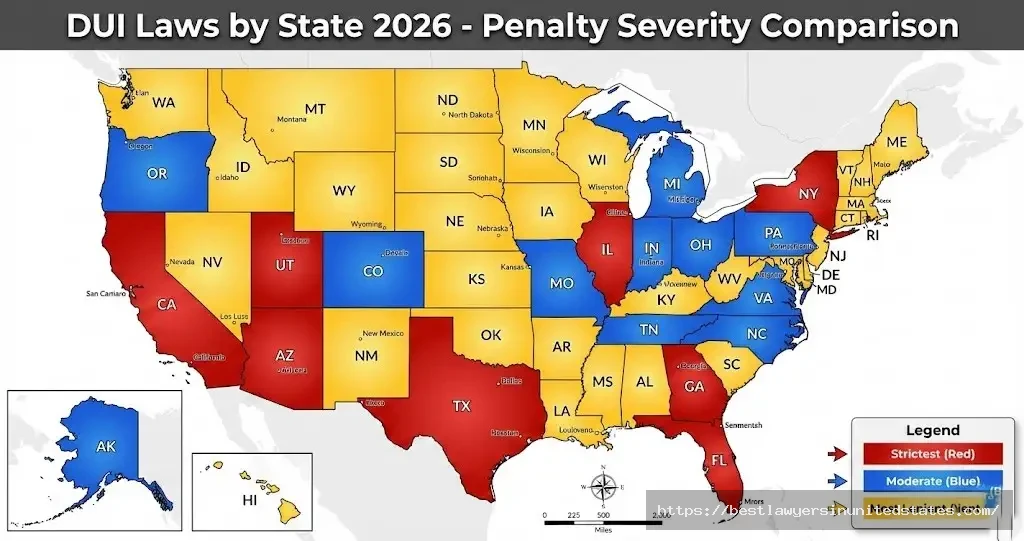
Every state sets its own DUI penalties within federal guidelines. The standard blood alcohol concentration (BAC) limit is 0.08% nationwide, but punishments differ dramatically. First-offense fines range from $300 in some states to over $2,000 in others. License suspensions span from 30 days to one year. Some states mandate jail time for first offenses, while others offer diversion programs.
Key Variations Across States:
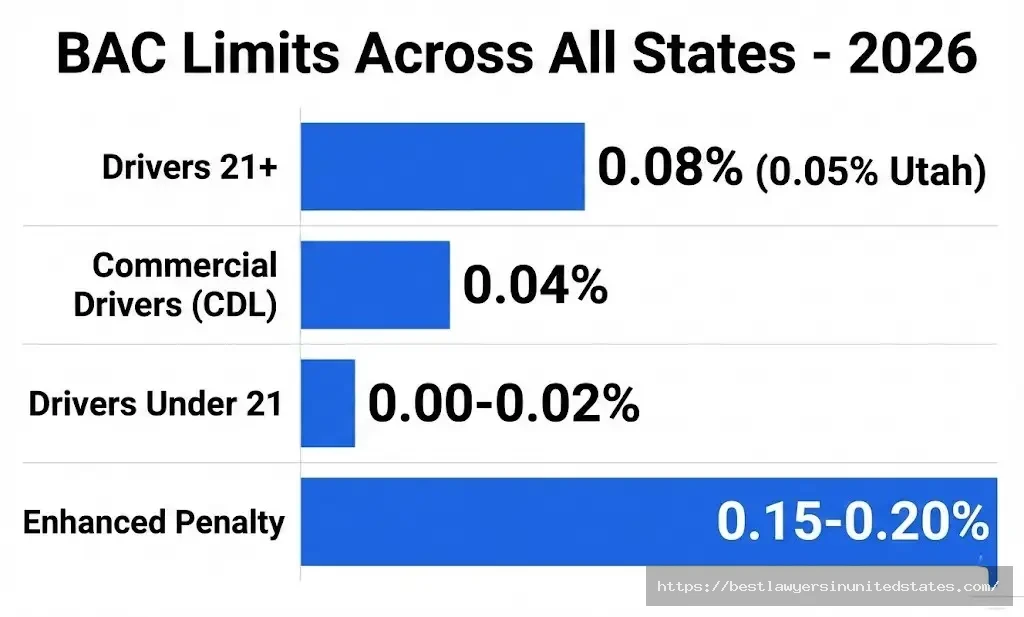
- BAC limits: 0.08% for drivers 21+, 0.04% for commercial drivers, 0.00-0.02% for minors
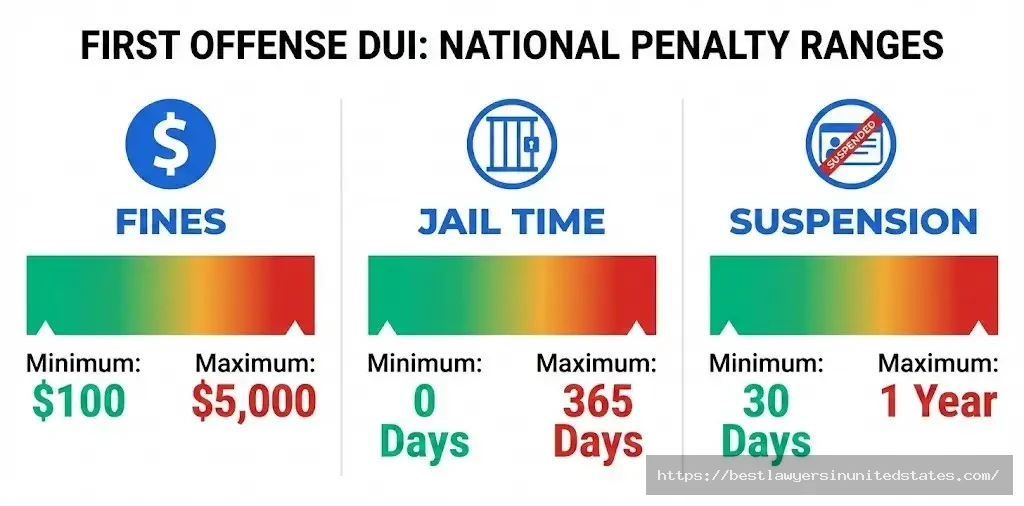
- First offense fines: $300 to $2,100+ depending on state
- License suspensions: 30 days to 1 year for first offense
- Jail time: 0 days in lenient states, up to 1 year in strict states
- Lookback periods: 5 years to lifetime (determines repeat offense status)
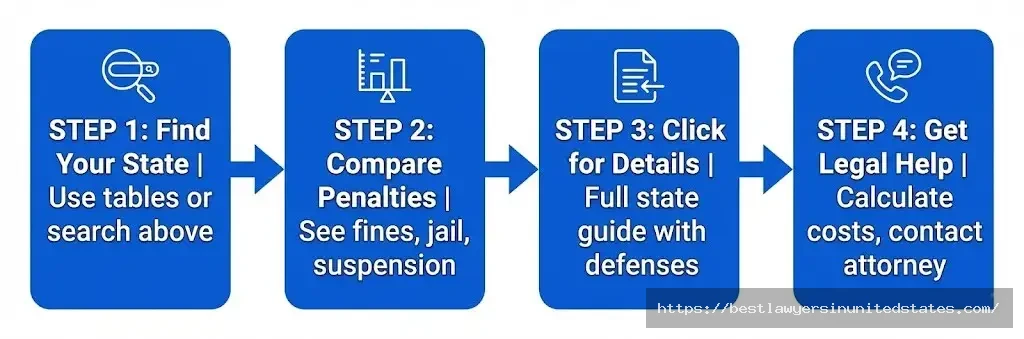
This guide compares DUI laws across all 50 states. Find your state in the tables below, then click its name for complete details on penalties, defenses, and local court procedures.
Check Your Blood Alcohol Level
Wondering if you’re over the 0.08% limit? State laws penalize drivers differently based on BAC levels. Some states impose enhanced penalties at 0.15% BAC or higher.
Use our BAC Calculator to estimate your blood alcohol concentration based on drinks consumed, body weight, and time elapsed.
BAC Calculator
Estimate your Blood Alcohol Content
• Commercial Driver (CDL): 0.04% BAC
• Drivers Under 21: 0.00-0.02% BAC (Zero Tolerance)
• Enhanced Penalties: 0.15% BAC or higher in most states
All 50 States: DUI Penalties Quick Reference
Each state name links to detailed laws, defenses, courthouse locations, and local attorney resources for that state.
| State | BAC Limit | 1st Offense Fine | 1st Suspension | Jail Time (1st) |
|---|---|---|---|---|
| Alabama | 0.08% | $600-$2,100 | 90 days | Up to 1 year |
| Alaska | 0.08% | $1,500+ | 90 days | 3 days min |
| Arizona | 0.08% | $1,250+ | 90 days | 10 days min |
| Arkansas | 0.08% | $150-$1,000 | 6 months | Up to 1 year |
| California | 0.08% | $390-$1,000 | 4 months | Up to 6 months |
| Colorado | 0.08% | $600-$1,000 | 9 months | 5 days-1 year |
| Connecticut | 0.08% | $500-$1,000 | 45 days | Up to 6 months |
| Delaware | 0.08% | $500-$1,500 | 3-12 months | Up to 1 year |
| Florida | 0.08% | $500-$1,000 | 6 months | Up to 6 months |
| Georgia | 0.08% | $300-$1,000 | 1 year | 10 days-1 year |
| Hawaii | 0.08% | $150-$1,000 | 1 year | Up to 5 days |
| Idaho | 0.08% | Up to $1,000 | 90-210 days | Up to 6 months |
| Illinois | 0.08% | Up to $2,500 | 1 year | Up to 1 year |
| Indiana | 0.08% | Up to $5,000 | 180 days | Up to 60 days |
| Iowa | 0.08% | $625-$1,250 | 180 days | 48 hours-1 year |
| Kansas | 0.08% | $750-$1,000 | 30 days | 48 hours-6 months |
| Kentucky | 0.08% | $200-$500 | 30-120 days | 48 hours-30 days |
| Louisiana | 0.08% | $300-$1,000 | 90 days | Up to 6 months |
| Maine | 0.08% | $500 | 150 days | Up to 48 hours |
| Maryland | 0.08% | Up to $1,000 | 45 days | Up to 1 year |
| Massachusetts | 0.08% | $500-$5,000 | 1 year | Up to 2.5 years |
| Michigan | 0.08% | Up to $500 | 180 days | Up to 93 days |
| Minnesota | 0.08% | Up to $1,000 | 90 days | Up to 90 days |
| Mississippi | 0.08% | $250-$1,000 | 90 days | Up to 48 hours |
| Missouri | 0.08% | Up to $500 | 30 days | Up to 6 months |
| Montana | 0.08% | $600-$1,000 | 6 months | 24 hours-6 months |
| Nebraska | 0.08% | $400 | 6 months | 7-60 days |
| Nevada | 0.08% | $400-$1,000 | 185 days | 2 days-6 months |
| New Hampshire | 0.08% | $500-$1,200 | 9 months | Up to 1 year |
| New Jersey | 0.08% | $250-$400 | 3 months | Up to 30 days |
| New Mexico | 0.08% | Up to $500 | 90 days-1 year | Up to 90 days |
| New York | 0.08% | $300-$500 | 6 months | Up to 1 year |
| North Carolina | 0.08% | $200+ | 1 year | 24 hours-2 years |
| North Dakota | 0.08% | $500 | 91 days | 2 days |
| Ohio | 0.08% | $375-$1,075 | 6 months-3 years | 3 days-6 months |
| Oklahoma | 0.08% | Up to $1,000 | 180 days | 10 days-1 year |
| Oregon | 0.08% | $1,000-$6,250 | 90 days-1 year | 48 hours-1 year |
| Pennsylvania | 0.08% | $300-$5,000 | 12 months | 48 hours-6 months |
| Rhode Island | 0.08% | $100-$300 | 3-18 months | Up to 1 year |
| South Carolina | 0.08% | $400 | 6 months | 48 hours-30 days |
| South Dakota | 0.08% | Up to $1,000 | 30 days | Up to 1 year |
| Tennessee | 0.08% | $350-$1,500 | 1 year | 48 hours-11 months |
| Texas | 0.08% | Up to $2,000 | 90 days-1 year | 3 days-180 days |
| Utah | 0.05% | Up to $1,000 | 120 days | Up to 6 months |
| Vermont | 0.08% | $300-$750 | 90 days | Up to 2 years |
| Virginia | 0.08% | $250-$2,500 | 1 year | Up to 1 year |
| Washington | 0.08% | $350-$5,000 | 90 days | 1 day-1 year |
| West Virginia | 0.08% | $100-$500 | 15-45 days | 1 day-6 months |
| Wisconsin | 0.08% | $150-$300 | 6-9 months | Up to 6 months |
| Wyoming | 0.08% | $200-$750 | 90 days | Up to 6 months |
Note: Utah is the only state with a 0.05% BAC limit for all drivers. Penalties increase significantly for BAC levels above 0.15% in most states.
How DUI Laws Vary Across the United States
The federal government sets basic DUI standards, but states control actual enforcement and penalties. Congress incentivized the 0.08% BAC limit in 2000 by threatening to withhold highway funding from non-compliant states. All 50 states adopted this standard by 2004, with Utah lowering its limit to 0.05% in 2018.
States differ on how they classify and punish DUI offenses. Some treat first offenses as traffic violations. Others classify them as misdemeanors or felonies from the start. Your charges depend on BAC level, prior convictions, and whether anyone was injured.
Interstate Driver’s License Compact ensures DUI violations follow you across state lines. If you get a DUI in Florida, your home state of Ohio will be notified. Both states can suspend your license.
Federal Standards vs State Implementation
The National Highway Traffic Safety Administration (NHTSA) recommends DUI policies but cannot mandate them. Federal law only controls commercial drivers and interstate commerce. States implement their own administrative procedures, court processes, and penalty structures.
Zero tolerance laws for underage drivers are federally encouraged but state-enforced. Drivers under 21 face license suspension at 0.00% to 0.02% BAC in all states. This exists separately from the adult 0.08% threshold.
Understanding BAC Limits in Every State
Blood alcohol concentration measures the percentage of alcohol in your bloodstream. A BAC of 0.08% means 0.08 grams of alcohol per 100 milliliters of blood. This standard applies to all states except Utah, which uses 0.05%.
Use our BAC Calculator to estimate your level before driving.
Standard BAC Limits
| Driver Type | BAC Limit | Notes |
|---|---|---|
| Drivers 21+ | 0.08% (0.05% in Utah) | Per se violation – no impairment proof needed |
| Commercial drivers (CDL) | 0.04% | Federal regulation, all states |
| Drivers under 21 | 0.00-0.02% | Zero tolerance laws, varies by state |
| Enhanced penalty threshold | 0.15-0.20% | Aggravated DUI in most states |
Zero Tolerance Laws for Minors
Every state enforces zero tolerance policies for drivers under 21. Most states use a 0.02% threshold to account for mouthwash or medication. Others enforce absolute 0.00% limits. Penalties include automatic license suspension, fines, and mandatory alcohol education programs.
California, Florida, and Texas impose separate administrative penalties for underage drinking and driving. These happen before criminal court proceedings begin.
First Offense DUI Penalties: State-by-State Comparison
First-time offenders face varying consequences depending on where they’re arrested. Some states offer diversion programs that keep charges off your record. Others mandate minimum jail sentences even for first offenses.
Fines and Financial Penalties
| Severity Level | States | Fine Range |
|---|---|---|
| Lowest fines | Rhode Island, New Jersey, Kentucky | $100-$500 |
| Moderate fines | Most states | $300-$1,000 |
| Highest fines | Alaska, Arizona, Texas, Illinois | $1,000-$2,500+ |
Fines represent only part of total DUI costs. Court fees, attorney fees, license reinstatement fees, and increased insurance premiums add thousands more. Total first-offense costs typically range from $5,000 to $15,000.
Calculate total DUI costs: Use our DUI Cost Calculator to estimate expenses including fines, legal fees, insurance increases, and treatment programs in your state.
Jail Time Requirements
| Jail Policy | States |
|---|---|
| Mandatory minimum jail | Arizona (10 days), Alaska (3 days), Georgia (10 days) |
| Jail possible but not required | California, Florida, Pennsylvania |
| Suspended sentence common | New Jersey, Rhode Island |
First-time offenders in strict states face jail time regardless of circumstances. Arizona mandates 10 consecutive days in jail with no early release. Georgia requires at least 10 days, though judges may suspend part of the sentence.
License Suspension Periods
License suspensions begin immediately in most states through administrative license suspension (ALS) programs. This happens before your criminal case resolves. Criminal convictions trigger additional suspension periods.
| Suspension Length | States |
|---|---|
| 30-90 days | Missouri, South Dakota, Kansas |
| 6 months | Florida, Montana, Nebraska |
| 1 year | Georgia, Illinois, Tennessee, Virginia |
Many states offer hardship licenses or ignition interlock devices (IIDs) that allow restricted driving during suspension periods. Arizona requires IIDs for all DUI offenders. Florida allows business-purposes-only licenses after 30 days.
Which States Have the Strictest DUI Laws?
Several states earned reputations for aggressive DUI enforcement. These states impose mandatory minimum sentences, refuse plea bargaining, and maintain lifetime lookback periods for prior convictions.
Top 10 Strictest DUI States
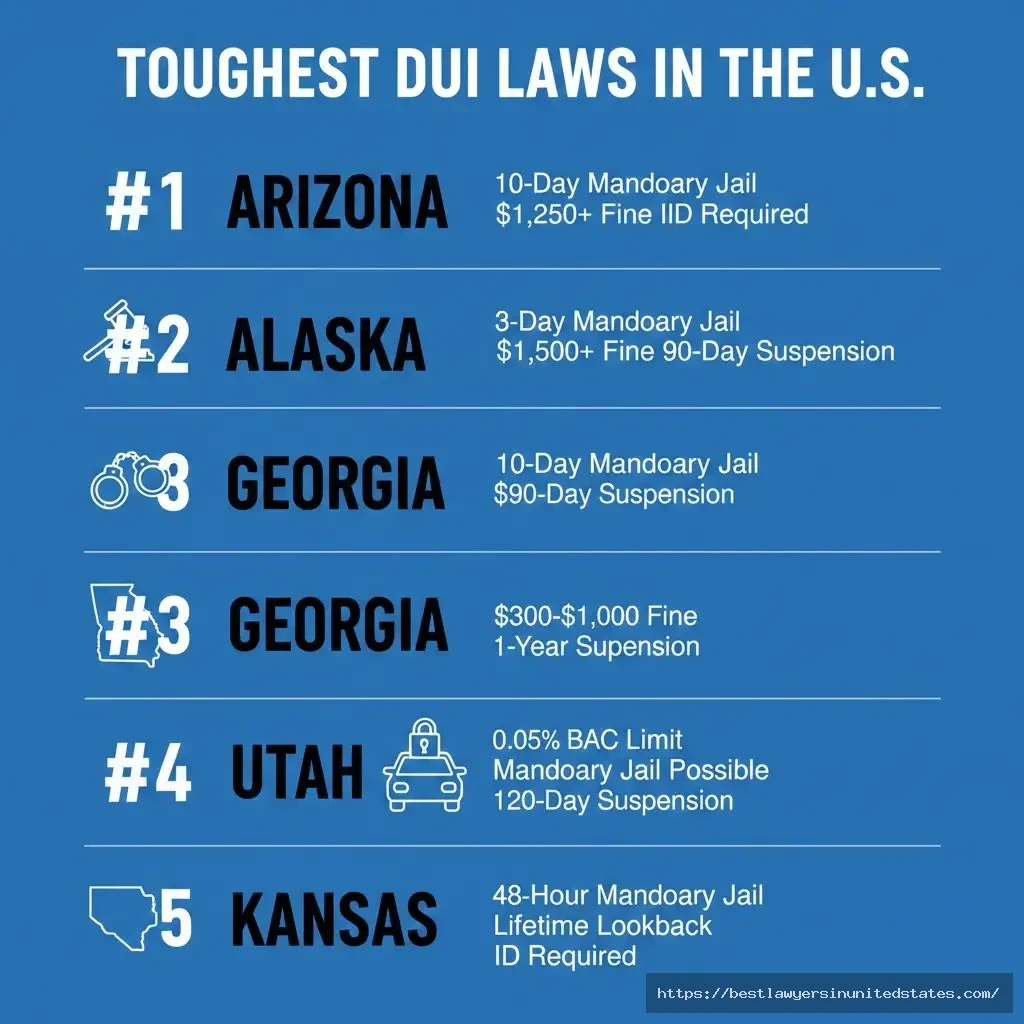
- Arizona – Mandatory 10-day jail sentence, no early release, strict IID requirements
- Alaska – $1,500 minimum fine, 3-day mandatory jail, lifetime lookback period
- Georgia – 10-day mandatory minimum, clinical evaluation required, no plea bargaining
- Utah – Only state with 0.05% BAC limit, mandatory jail time possible
- Connecticut – High fines, mandatory IID, strict repeat offender penalties
- Kansas – Mandatory 48-hour jail, lifetime lookback for repeat offenses
- Oklahoma – 10-day mandatory minimum jail, felony on second offense
- Oregon – High fines ($1,000-$6,250), mandatory diversion program
- Virginia – Mandatory minimum sentences, high maximum penalties
- Tennessee – 48-hour mandatory jail, mandatory substance abuse treatment
States with Mandatory Jail Time (First Offense)
These states require jail time for all first-time DUI convictions:
- Arizona: 10 days (consecutive, no early release)
- Alaska: 3 days minimum
- Georgia: 10 days minimum (partial suspension possible)
- Kansas: 48 hours minimum
- Oklahoma: 10 days minimum
Most Lenient DUI States
Some states impose lighter penalties for first offenses or offer diversion programs that avoid criminal convictions:
- South Dakota – Lower fines, shorter suspensions, first offense often reduced
- Pennsylvania – ARD program available (avoids conviction if completed)
- North Dakota – Minimum 2-day jail, lower fines
- Rhode Island – $100-$300 fines (lowest in nation)
- Wisconsin – First offense treated as traffic citation, not criminal charge
Regional Patterns and Differences
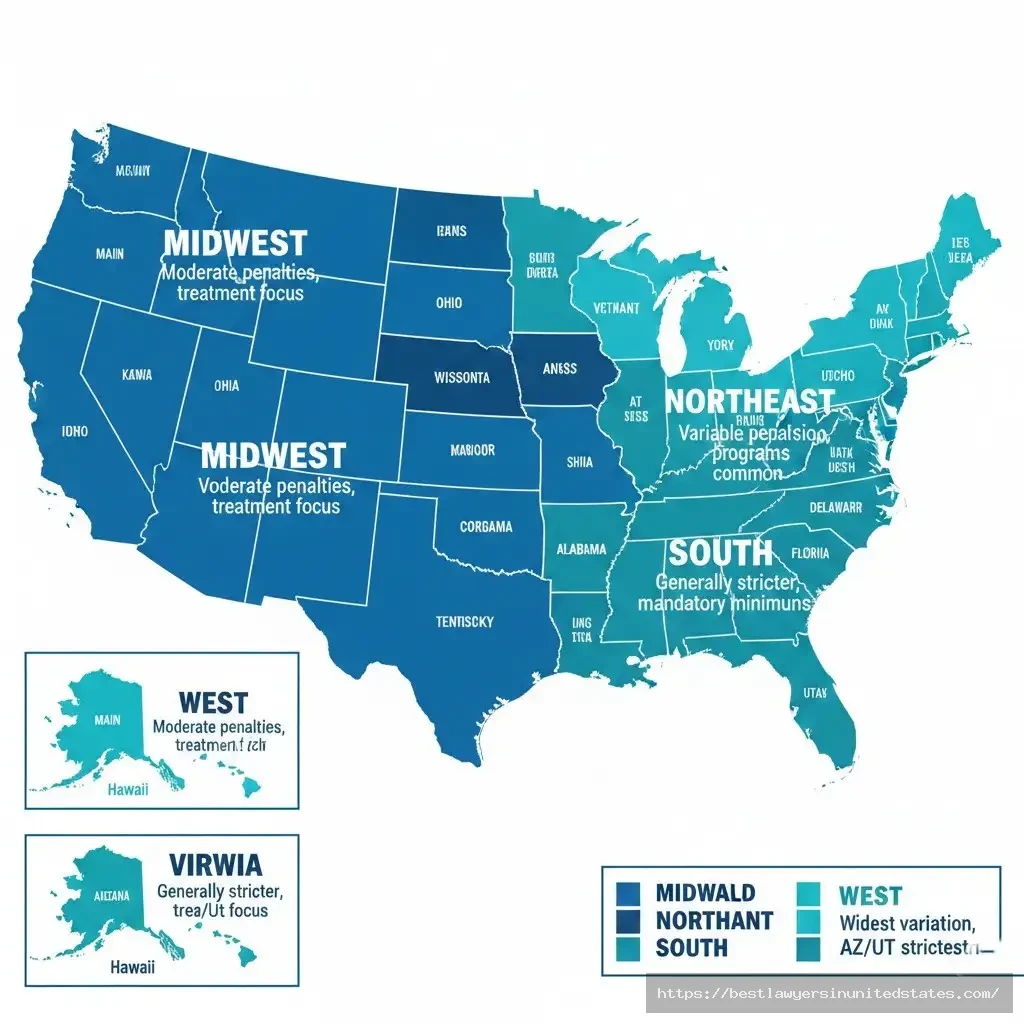
Geographic location influences DUI law severity. Regional cultural attitudes toward alcohol consumption and driving shape legislative approaches.
Northeast Region
Northeastern states show mixed approaches. Connecticut and Massachusetts impose strict penalties. Pennsylvania offers lenient diversion programs. Rhode Island has the nation’s lowest fines.
Most northeastern states use tiered BAC systems. Penalties increase significantly for BAC levels above 0.15%. New York distinguishes between DWAI (0.05-0.07%), DWI (0.08%+), and Aggravated DWI (0.18%+).
Southern States
Southern states generally enforce stricter DUI laws. Georgia, Tennessee, and Virginia mandate minimum jail sentences. Alabama imposes high fines starting at $600.
Texas uses the term DWI instead of DUI. The state allows fines up to $2,000 for first offenses. Florida requires installation of ignition interlock devices for convictions with BAC above 0.15%.
Western States
Western states show the widest variation. Arizona and Utah lead in strictness. Montana maintains moderate penalties. California balances punishment with rehabilitation programs.
Oregon calls DUI “DUII” (Driving Under the Influence of Intoxicants). The state imposes high fines but emphasizes treatment over incarceration. Nevada requires substance abuse screening for all offenders.
Midwest
Midwestern states favor moderate penalties with treatment options. Illinois and Ohio impose standard fines and suspensions. Iowa uses the term OWI (Operating While Intoxicated) instead of DUI.
Wisconsin treats first DUI offenses as traffic violations, not criminal charges. This makes Wisconsin unique among all states. Minnesota and Michigan offer diversion programs for qualifying first-time offenders.
Understanding Lookback Periods by State
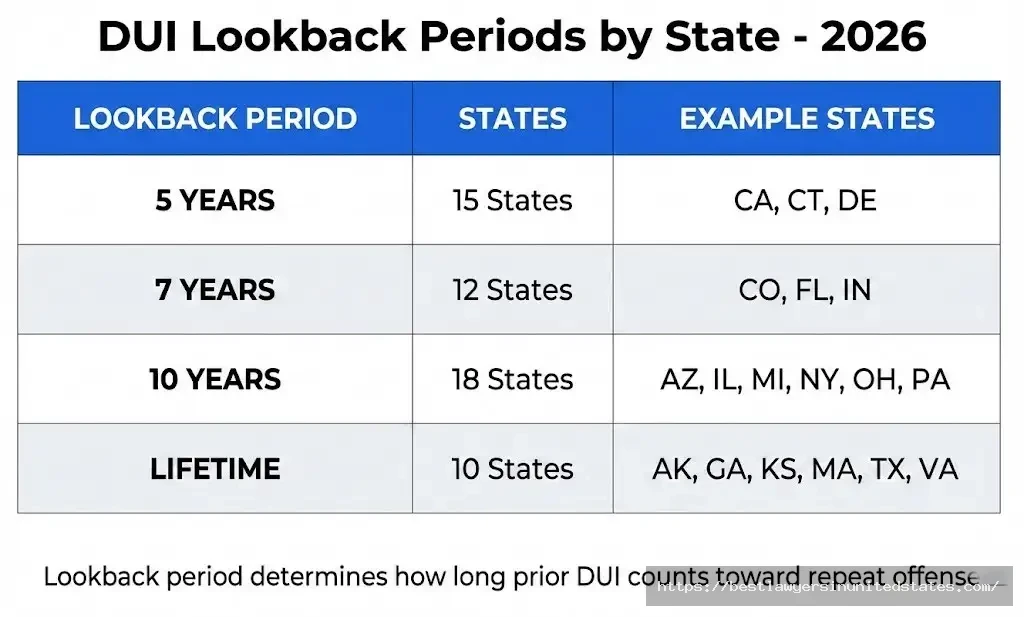
Lookback periods determine how long prior DUI convictions count toward enhanced penalties. States vary from 5 years to lifetime tracking.
| Lookback Period | States |
|---|---|
| 5 years | California, Connecticut, Delaware |
| 7 years | Colorado, Florida, Indiana |
| 10 years | Arizona, Illinois, Michigan, New York, Ohio, Pennsylvania |
| Lifetime | Alaska, Georgia, Kansas, Massachusetts, Texas, Virginia |
Lifetime lookback states count all prior convictions regardless of how long ago they occurred. A DUI from 20 years ago still counts as a first offense when calculating penalties for a new arrest. States with shorter lookback periods wipe prior convictions from consideration after the specified timeframe.
Ignition Interlock Device Requirements
Ignition interlock devices (IIDs) prevent vehicles from starting if the driver’s breath shows alcohol. States increasingly require IIDs for all DUI offenders, including first-time offenders.
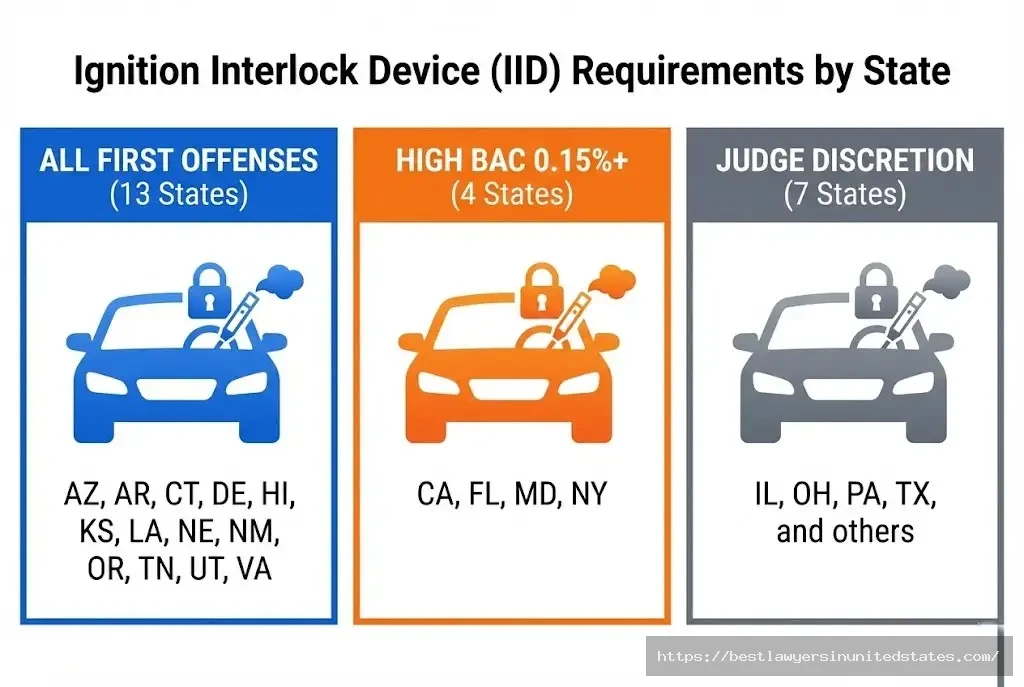
States Requiring IIDs for First Offense
| Requirement Type | States |
|---|---|
| All first offenses | Arizona, Arkansas, Connecticut, Delaware, Hawaii, Kansas, Louisiana, Nebraska, New Mexico, Oregon, Tennessee, Utah, Virginia |
| High BAC (0.15%+) | California, Florida, Maryland, New York |
| Judge discretion | Illinois, Ohio, Pennsylvania, Texas |
IID installation costs typically range from $70-$150, with monthly monitoring fees of $60-$80. Offenders pay all costs. Devices require breath samples before starting the vehicle and randomly while driving.
States with DUI Diversion Programs
Diversion programs allow first-time offenders to avoid criminal convictions. Participants complete alcohol education, treatment, and community service. Successful completion results in dismissed charges.
Notable Diversion Programs by State
- Pennsylvania: Accelerated Rehabilitative Disposition (ARD) – Most generous program, available for almost all first offenses
- California: Wet reckless plea option reduces DUI to reckless driving with alcohol involvement
- Florida: Pretrial diversion available in some counties for BAC under 0.15%
- Michigan: Holmes Youthful Trainee Act for offenders under 24
- Minnesota: Stay of adjudication allows conditional dismissal
- Ohio: Intervention in lieu of conviction available for first-time offenders
- Oregon: Mandatory DUII diversion program for first offenses (not optional)
States without plea bargaining – including Georgia and Alaska – do not offer diversion programs. Offenders in these states face full criminal prosecution.
What Happens If You Get a DUI in Another State?
DUI arrests in states other than your home state create complex legal situations. Both states can punish you. Your home state will learn about out-of-state violations through interstate information sharing.
Interstate License Compact
The Driver License Compact (DLC) connects 45 states plus Washington D.C. Member states share information about traffic violations, including DUI arrests and convictions. When you get a DUI in another state, officials notify your home state within 30 days.
Your home state treats out-of-state DUIs as if they occurred locally. If you live in Texas and get arrested in Louisiana, Texas will suspend your license. You face penalties in both states.
Non-DLC states: Georgia, Massachusetts, Michigan, Tennessee, Wisconsin
License Suspension Reciprocity
Most states honor license suspensions from other states. If California suspends your license for a DUI, you cannot drive legally in Nevada or Arizona either.
The Non-Resident Violator Compact (NRVC) requires you to appear in court or pay fines in the state where you were arrested. Failure to comply results in license suspension in your home state. Most states participate in the NRVC except Alaska, California, Michigan, Montana, Oregon, and Wisconsin.
Impact on Future DUI Charges
Prior out-of-state DUI convictions count toward repeat offender penalties in your home state. A DUI from Florida counts as a first offense when determining penalties for a new arrest in North Carolina, subject to that state’s lookback period.
Commercial Driver License (CDL) Implications
Commercial drivers face stricter standards. A DUI in any state triggers nationwide CDL suspension. The Federal Motor Carrier Safety Administration requires states to disqualify CDL holders for one year after a first DUI. Second offenses result in lifetime disqualification.
CDL holders arrested in Ohio while driving personal vehicles still lose their commercial driving privileges nationwide. BAC limits for CDL holders drop to 0.04% in all states.
Calculate DUI Costs in Your State
Financial consequences extend far beyond court fines. Total DUI costs include legal fees, license reinstatement, increased insurance premiums, alcohol treatment programs, and lost income from jail time or license suspension.
Use our DUI Cost Calculator to estimate total expenses including:
DUI Cost Calculator
Estimate total DUI expenses by state and offense
Detailed Cost Breakdown
Payment Timeline
Bail bond, towing fees, car impound, attorney retainer
Initial court fines, DMV fees, DUI school enrollment, ignition interlock installation
Monthly probation fees, ignition interlock fees, DUI school payments, attorney balance
Insurance premium increases, license reinstatement, SR-22 filing fees
- Lost wages from missed work (court dates, jail time, DUI school) – $2,000-$10,000
- Job loss or difficulty finding employment – Varies
- Professional license suspension (doctors, lawyers, nurses, pilots) – Career ending
- Rideshare and transportation costs during suspension – $1,500-$5,000
- Travel restrictions and visa denials – Varies
- Security clearance loss – Career impact
- Child custody implications – Legal costs
- Rental car restrictions – Varies
- Personal relationships and mental health costs – Priceless
- Court fines and fees
- Attorney costs
- License reinstatement fees
- SR-22 insurance requirements
- Alcohol treatment programs
- Ignition interlock device costs
- Lost wages and employment impact
Average Total Costs by Region
| Region | First Offense Total Cost |
|---|---|
| Northeast | $7,000-$12,000 |
| South | $6,000-$11,000 |
| Midwest | $5,000-$9,000 |
| West | $8,000-$15,000 |
Insurance premiums increase by 50-100% after a DUI conviction. This continues for 3-5 years depending on your state. High-risk SR-22 insurance adds $300-$800 annually in most states.
Frequently Asked Questions
Which state has the strictest DUI laws?
Arizona has the nation’s strictest DUI laws. First offenders face mandatory 10-day jail sentences with no early release, $1,250+ fines, and required ignition interlock devices. Alaska and Georgia also rank among the toughest states for DUI enforcement.
What state has the lowest DUI penalties?
Rhode Island imposes the lowest fines ($100-$300 for first offense). South Dakota also has relatively lenient penalties. Wisconsin treats first DUI offenses as traffic violations rather than criminal charges.
Do all states have 0.08% BAC limits?
All states except Utah use 0.08% BAC as the legal limit for drivers 21 and older. Utah lowered its limit to 0.05% in 2018. Commercial drivers face 0.04% limits nationwide. Drivers under 21 face 0.00-0.02% limits under zero tolerance laws.
How long does a DUI stay on your record?
This varies by state. Some states allow expungement after 5-10 years. Others keep DUI convictions on your record permanently. California allows expungement after probation completion. Georgia does not allow DUI expungement under any circumstances.
Can you refuse a breathalyzer test?
All states have implied consent laws. Driving on public roads constitutes automatic consent to chemical testing. Refusing a breathalyzer results in automatic license suspension, typically longer than suspension for DUI conviction. California suspends licenses for 1 year for first refusal. Florida suspends for 1 year on first refusal, 18 months for subsequent refusals.
What happens if you get a DUI while visiting from another state?
The state where you were arrested prosecutes your case. Your home state receives notification through the Driver License Compact. Both states can suspend your license. Prior DUI convictions from your home state may increase penalties in the state where you were arrested, depending on lookback periods.
Do you need a lawyer for a first DUI?
Penalties for first-offense DUI vary significantly by state. Arizona and Alaska mandate jail time even for first offenses. States with diversion programs like Pennsylvania and Michigan may allow avoided convictions. An attorney helps assess eligibility for these programs.
Will a DUI affect car insurance?
Yes. Insurance premiums increase 50-100% after DUI conviction. This continues for 3-5 years depending on your state and insurer. Some insurers drop DUI offenders entirely. Many states require SR-22 certificates proving you carry minimum liability insurance. SR-22 filings add $300-$800 annually to insurance costs.
Can you get a DUI on private property?
Most states allow DUI arrests on private property if it’s accessible to the public. Parking lots, driveways to businesses, and apartment complexes qualify. Texas and Florida specifically allow DUI charges on any property where the public has access. Completely private driveways on residential property generally don’t qualify.
How many DUIs until it becomes a felony?
This varies by state. Oklahoma charges second offenses as felonies. Most states charge third offenses as felonies. Georgia, Tennessee, and Texas charge fourth offenses as felonies. DUI causing injury or death qualifies as felony DUI in all states regardless of prior record.
Get State-Specific DUI Help
This guide provides comparison information across all states. For detailed information about your state’s laws, click your state name in the tables above. State pages include:
- Complete penalty breakdowns for first, second, and third offenses
- Administrative license suspension procedures and timelines
- Available defenses and plea bargaining options
- Local courthouse locations and contact information
- DUI attorney recommendations in your area
Need to calculate potential consequences?
- BAC Calculator – Estimate your blood alcohol concentration based on drinks consumed
- DUI Cost Calculator – Calculate total financial impact including fines, fees, and insurance
DUI laws change frequently. States adjust penalties, BAC limits, and enforcement procedures regularly. Check your state’s current statutes or consult a local DUI attorney for the most current information.
Have questions about DUI laws in your state? Email us at [email protected] for guidance on state-specific resources and local attorney referrals.
