
Wisconsin calls it “OWI” (Operating While Intoxicated), not DUI. A first offense is a civil violation in Wisconsin, not a criminal charge. You face fines of $150-$300, a 6-9 month license revocation, and ignition interlock requirements, but no criminal record unless you cause injury or have a child passenger under 16.
Wisconsin uses unique terminology and legal procedures that differ from most states. This guide explains Wisconsin’s OWI laws, penalties by offense level, BAC limits, the critical 10-day deadline after arrest, and how the state’s civil first offense status affects your future.
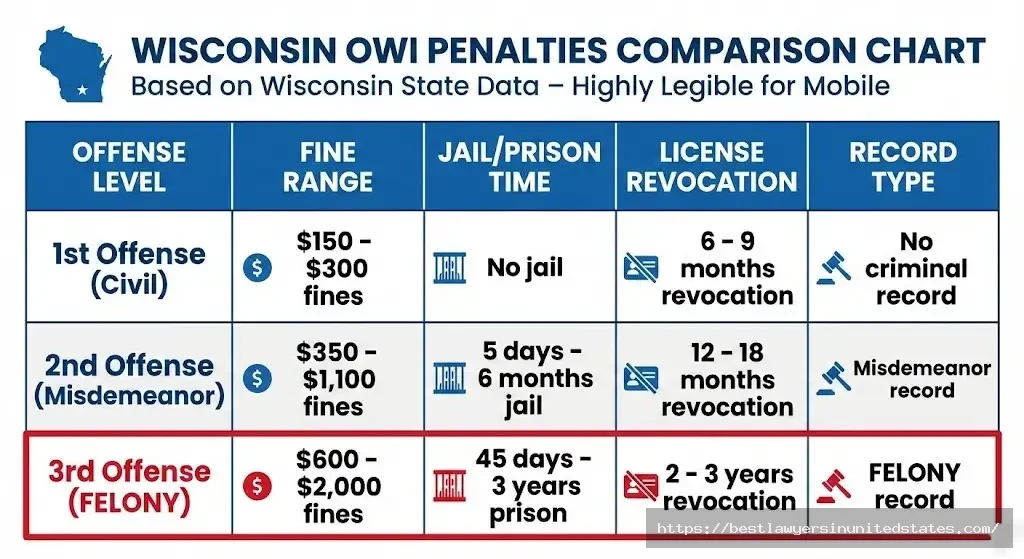
Critical fact: Wisconsin ranks among the most lenient states for drunk driving laws, yet repeat offenses escalate quickly to felony charges.
What Is OWI in Wisconsin? Understanding the Terminology
Wisconsin uses “OWI” (Operating While Intoxicated) instead of “DUI” or “DWI.” The legal definition under Wis. Stat. § 346.63 means operating a motor vehicle while under the influence of alcohol, controlled substances, or any drug that impairs your ability to drive safely.
This creates search confusion. People look for “Wisconsin DUI laws” but the state’s official term is OWI. Both terms describe the same offense.
What Vehicles Does Wisconsin OWI Law Cover?
Wisconsin OWI laws apply to:
- Motor vehicles: Cars, trucks, motorcycles
- Commercial vehicles: Semi-trucks, delivery vehicles
- Recreational vehicles: ATVs, UTVs, snowmobiles
- Motorboats: Watercraft with engines
Key point: You can get an OWI on private property in Wisconsin. The law doesn’t require public roads.
OWI vs DUI: Is There a Difference?
Quick Answer: No legal difference exists. Wisconsin simply uses different terminology than most states.
| Term | States That Use It | Legal Meaning |
|---|---|---|
| OWI | Wisconsin, Iowa, Indiana, Michigan | Operating While Intoxicated |
| DUI | California, Texas, 30+ other states | Driving Under the Influence |
| DWI | New York, Texas, North Carolina | Driving While Intoxicated |
All three terms describe impaired driving offenses. Wisconsin chose “OWI” because you don’t have to be “driving” – just operating or in physical control of a vehicle.
Wisconsin OWI BAC Limits and Legal Standards
Wisconsin sets different BAC (Blood Alcohol Concentration) limits based on driver type. The standard limit is 0.08%, but stricter limits apply to commercial drivers and minors.
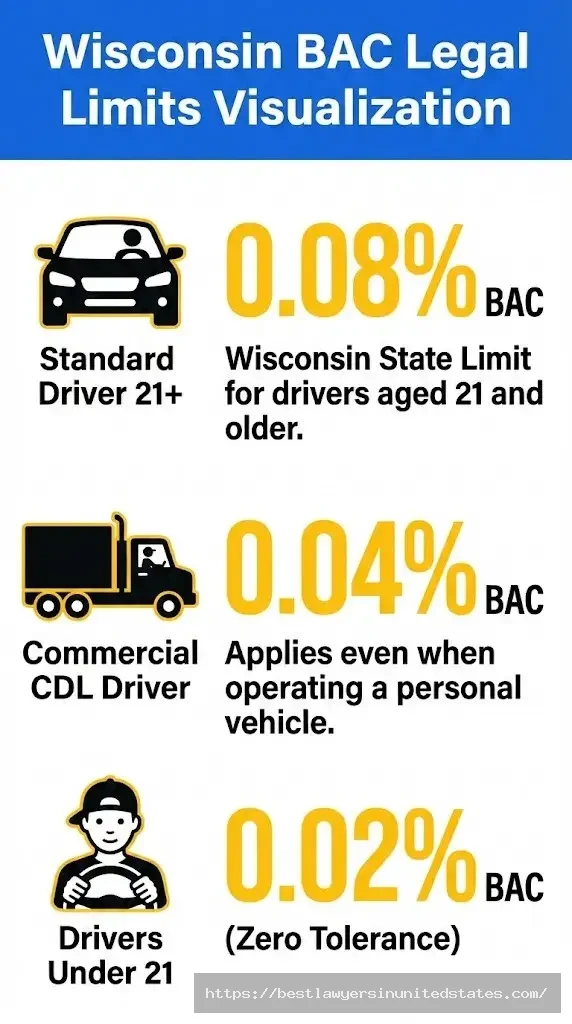
Want to check if you’re over the limit? Understanding BAC levels helps you make safer decisions. Wisconsin law presumes impairment at 0.08%, but you can face OWI charges below that threshold if you show signs of impairment.
| Driver Type | BAC Limit | Statute Reference |
|---|---|---|
| Standard drivers (21+) | 0.08% | Wis. Stat. § 346.63(1)(a) |
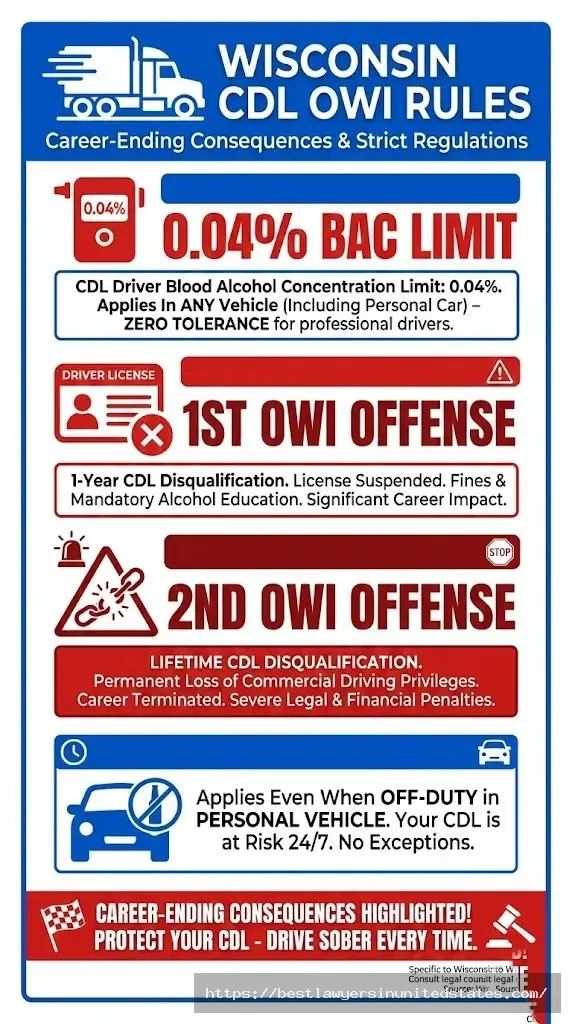
| Commercial drivers (CDL) | 0.04% | Even in personal vehicles |
| Drivers under 21 | 0.02% | Zero tolerance policy |
The Three-Hour Rule for Chemical Testing
Wisconsin has a unique “three-hour rule” under Wis. Stat. § 346.63(1)(b). Chemical tests must occur within three hours of driving to establish a statutory presumption of your BAC while operating the vehicle.
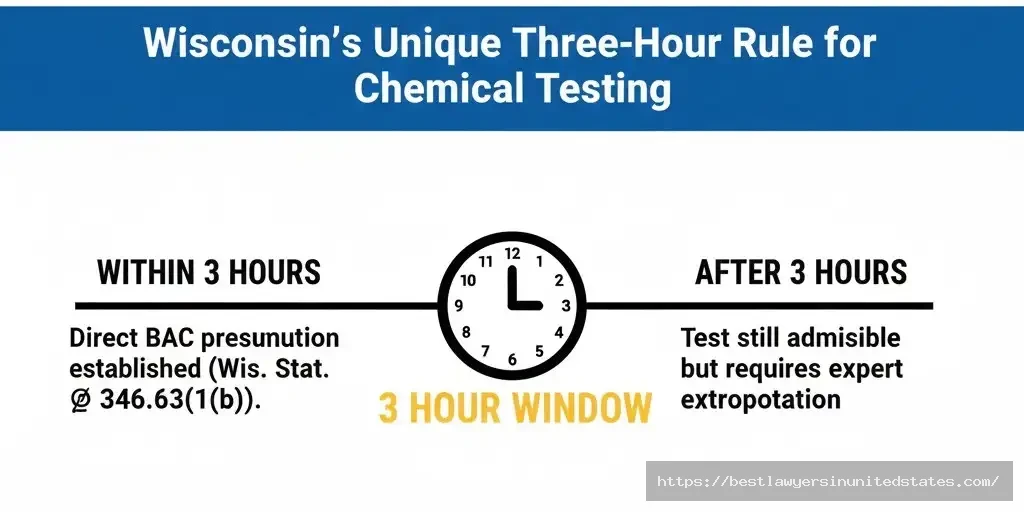
What happens after three hours?
- Test results are still admissible in court
- Prosecutors must use expert testimony to extrapolate back to your BAC while driving
- Defense attorneys can challenge the accuracy of retrograde extrapolation
Critical timing: The three-hour window starts when you stop operating the vehicle, not when police arrive.
How Many Drinks Equal 0.08 BAC?
BAC levels depend on weight, gender, food intake, and time period. General estimates for reaching 0.08%:
For men (180 lbs): Approximately 4 standard drinks in 2 hours
For women (140 lbs): Approximately 3 standard drinks in 2 hours
These are rough estimates only. Many factors affect your actual BAC level. Use our BAC calculator to estimate your blood alcohol level based on your specific circumstances.
BAC Calculator
Estimate your Blood Alcohol Content
• Commercial Driver (CDL): 0.04% BAC
• Drivers Under 21: 0.00-0.02% BAC (Zero Tolerance)
• Enhanced Penalties: 0.15% BAC or higher in most states
Wisconsin OWI Penalties by Offense (2026)
Wisconsin penalties escalate dramatically with each offense. The first offense stands out as a civil violation, making Wisconsin unique among U.S. states.
First Offense OWI Wisconsin
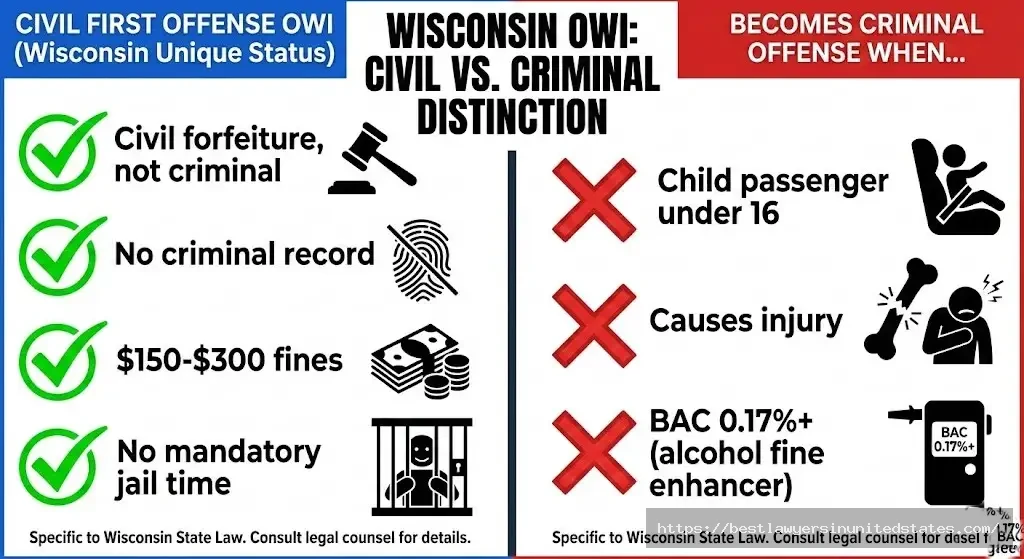
Quick Answer: A first OWI in Wisconsin is a civil forfeiture, not a criminal charge. You face fines and license revocation but no criminal record.
| Penalty Type | First Offense Details |
|---|---|
| Classification | Civil forfeiture (non-criminal) |
| Fines | $150-$300 base fine |
| Jail Time | None (unless aggravating factors) |
| License Revocation | 6-9 months |
| Ignition Interlock | Required for license reinstatement |
| Criminal Record | No criminal conviction |
Exception: Your first offense becomes criminal if you:
- Cause injury to another person
- Have a passenger under 16 years old
- Refuse chemical testing with prior refusals
- Have a BAC of 0.17% or higher (alcohol fine enhancer applies)
When Does a First Offense Become Criminal?
The civil status of Wisconsin’s first OWI changes under specific circumstances:
- Child endangerment: Passenger under 16 = criminal misdemeanor charge
- OWI causing injury: Any injury to another person = criminal charge
- High BAC: 0.17% or higher triggers alcohol fine enhancer (additional $365 fee)
Employment impact: Even though a civil first offense isn’t a criminal conviction, it still appears on your driving record. Some employers check driving records during background checks.
Second Offense OWI Wisconsin
A second OWI within your lifetime becomes a criminal misdemeanor. Penalties increase significantly compared to a first offense.
| Penalty Type | Second Offense Details |
|---|---|
| Classification | Class H misdemeanor (criminal) |
| Fines | $350-$1,100 |
| Jail Time | 5 days to 6 months mandatory |
| License Revocation | 12-18 months |
| Ignition Interlock | 12-18 months required |
| Criminal Record | Yes – misdemeanor conviction |
Cannot avoid jail time: Wisconsin law requires a minimum 5-day jail sentence for second OWI. However, you may qualify for the Safe Streets Option (discussed below).
Time factor doesn’t matter: Wisconsin counts all prior OWI offenses in your lifetime, regardless of how long ago they occurred.
Third Offense OWI Wisconsin (Felony)
Quick Answer: A third OWI in Wisconsin is a Class G felony with mandatory jail time and potential prison sentences.
| Penalty Type | Third Offense Details |
|---|---|
| Classification | Class G felony (criminal) |
| Jail Time | 45 days minimum (county jail) |
| Prison | 6 months to 3 years (alternative to jail) |
| Fines | $600-$2,000 |
| License Revocation | 2-3 years |
| Ignition Interlock | 18-36 months required |
| Felony Record | Yes – permanent felony conviction |
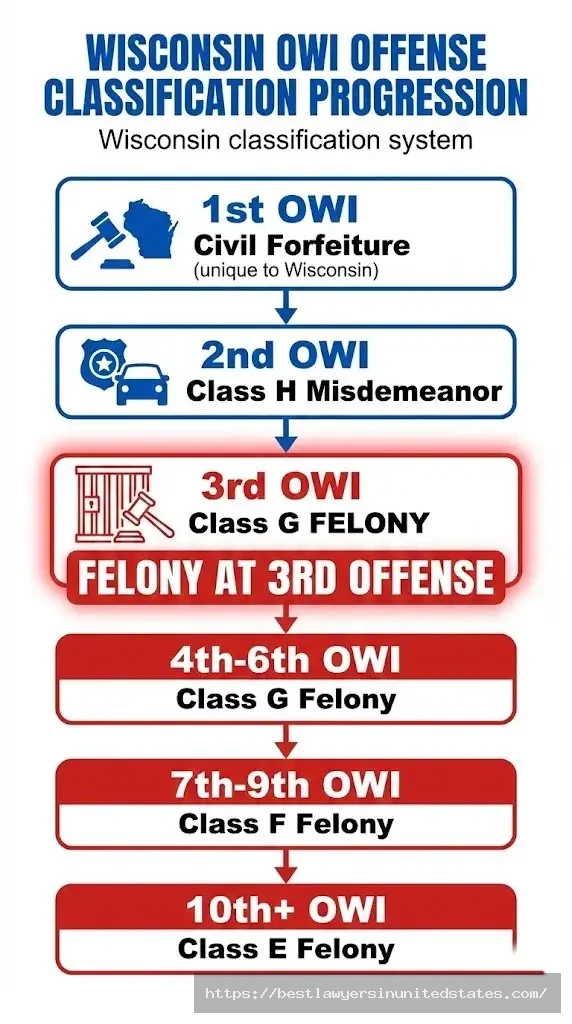
Felony threshold: Most states require 4th or 5th offenses before felony charges. Wisconsin’s threshold is lower at just three offenses.
Employment consequences: Felony convictions create significant barriers to employment, housing, voting rights, and firearm ownership.
Fourth Offense and Beyond
Wisconsin penalties continue escalating with each subsequent offense:
| Offense Level | Classification | Maximum Prison | Maximum Fine |
|---|---|---|---|
| 4th-6th | Class G Felony | 3 years | $25,000 |
| 7th-9th | Class F Felony | 12.5 years | $25,000 |
| 10th+ | Class E Felony | 15 years | $50,000 |
Aggravating Factors That Increase Wisconsin OWI Penalties
Certain circumstances increase the severity of OWI penalties beyond the base offense level. Wisconsin law treats these aggravating factors seriously.
High BAC: The Alcohol Fine Enhancer
Quick Answer: A BAC of 0.17% or higher adds an extra $365 fine to any OWI offense in Wisconsin.
Wisconsin’s “alcohol fine enhancer” under Wis. Stat. § 346.65(2j) applies when your BAC is more than double the legal limit. This enhancement applies to all offense levels, including first offenses.
Example: First OWI with 0.18% BAC = $150-$300 base fine + $365 enhancer = $515-$665 total fine
Child Passenger Under 16
Having a passenger under 16 years old converts a civil first offense to a criminal charge. This enhancement applies regardless of your relationship to the child.
Additional penalties for child endangerment:
- Criminal misdemeanor charge (first offense becomes criminal)
- Enhanced fines and penalties
- Potential child protective services involvement
- Separate child endangerment charges possible
OWI Causing Injury
OWI causing injury is a separate charge under Wis. Stat. § 346.63(2). Penalties depend on the severity of injuries:
| Injury Level | Classification | Maximum Prison | Maximum Fine |
|---|---|---|---|
| Injury | Class H Felony | 3 years | $10,000 |
| Great Bodily Harm | Class F Felony | 12.5 years | $25,000 |
“Great bodily harm” means serious injury creating substantial risk of death, serious disfigurement, or prolonged loss of function of any body part.
Homicide by Intoxicated Use of Motor Vehicle
Wisconsin’s most serious OWI-related charge is homicide by intoxicated use of a motor vehicle under Wis. Stat. § 940.09.
Penalties:
- Class D Felony
- Up to 25 years in prison
- Up to $100,000 in fines
- Applies even on first OWI if death occurs
Wisconsin Implied Consent Law
Every driver in Wisconsin automatically agrees to chemical testing when they accept their driver’s license. This “implied consent” under Wis. Stat. § 343.305 activates when an officer arrests you for suspected OWI.
Officers must read you the implied consent warning before requesting a breath, blood, or urine test. The warning explains that refusing the test triggers automatic license revocation.
What Happens If You Refuse Chemical Testing?
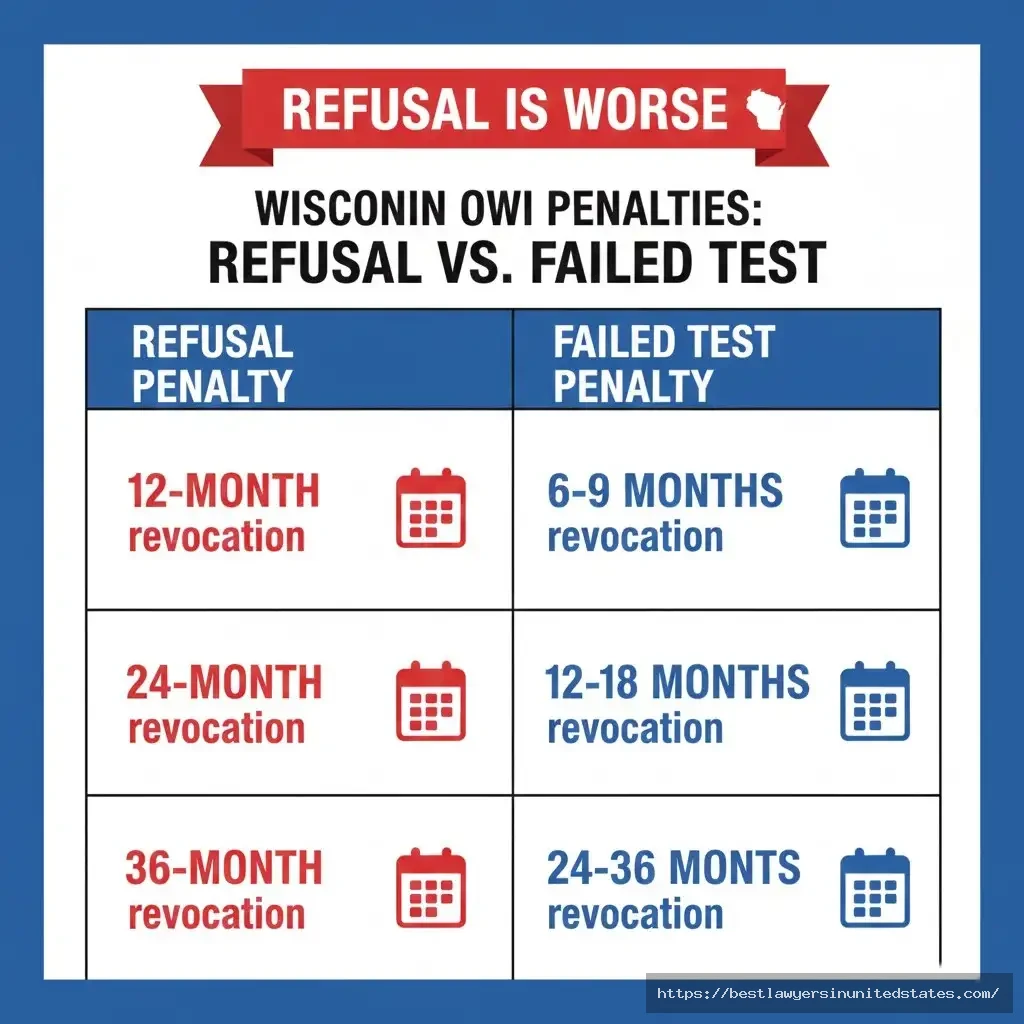
Quick Answer: Refusal carries harsher license penalties than failing the test in Wisconsin.
| Offense | Refusal Penalty | Failed Test Penalty |
|---|---|---|
| 1st refusal | 12-month revocation | 6-9 month revocation |
| 2nd refusal | 24-month revocation | 12-18 month revocation |
| 3rd+ refusal | 36-month revocation | 24-36 month revocation |
Critical point: The refusal revocation runs separately from any criminal court penalties. Even if a judge dismisses your OWI charge, the Wisconsin DMV revocation remains in effect.
Can Police Force You to Take a Test?
You cannot be physically forced to provide a breath or blood sample without a warrant in Wisconsin. However, officers increasingly obtain search warrants for blood draws in cases involving:
- Serious accidents
- Injuries to other parties
- Suspected drugged driving (where breath tests don’t detect impairment)
Independent testing right: Wisconsin law allows you to request additional testing at your own expense after completing the official test. Some defendants use independent lab results to challenge the state’s evidence.
The Critical 10-Day Deadline After Wisconsin OWI Arrest
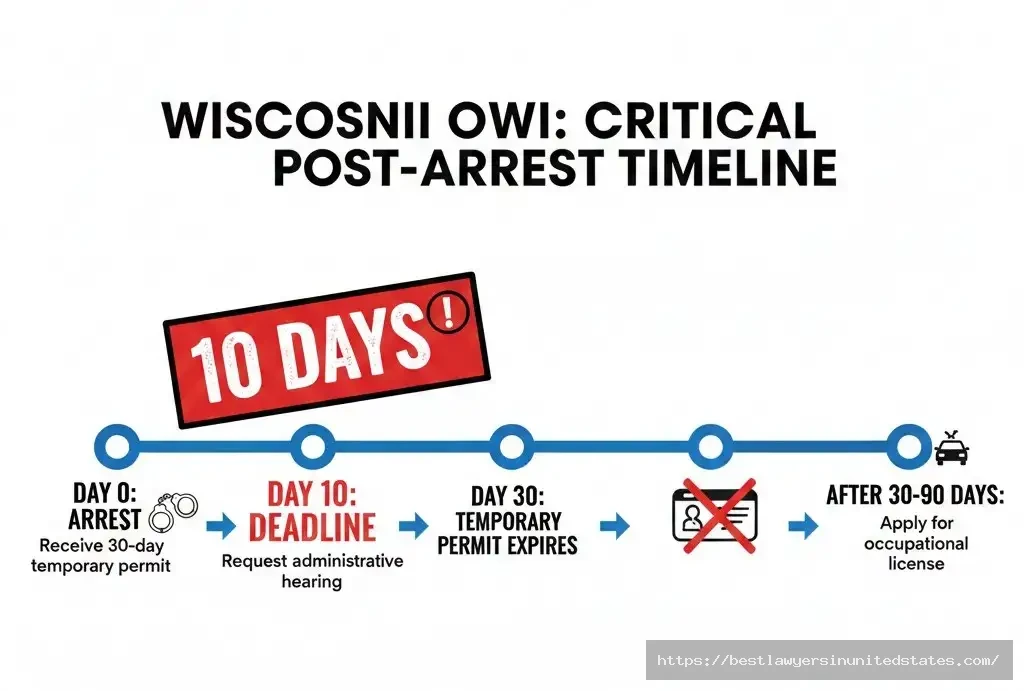
Quick Answer: You have only 10 days from your arrest to request an administrative hearing with WisDOT to contest your license revocation.
Wisconsin operates two parallel systems after an OWI arrest:
- Criminal court case: Handles the OWI criminal charges (2nd offense and beyond) or civil forfeiture (1st offense)
- Administrative license action: Wisconsin Department of Transportation handles license revocation separately
Notice of Intent to Suspend or Revoke
When arrested for OWI in Wisconsin, the officer confiscates your driver’s license and issues a “Notice of Intent to Suspend or Revoke.” This notice serves as a temporary driving permit valid for 30 days.
What the notice tells you:
- Your license will be automatically revoked in 30 days
- You have 10 days to request an administrative hearing
- The hearing is your only chance to contest the administrative revocation
- Missing this deadline means automatic revocation with no hearing
How to Request an Administrative Hearing
Steps to preserve your driving rights:
- Within 10 days: Submit written request to Wisconsin DOT
- Include: $200 hearing fee (refunded if you win)
- Send to: Wisconsin Division of Motor Vehicles, P.O. Box 7917, Madison, WI 53707-7917
- Result: Hearing scheduled within 30 days of your request
If you miss the 10-day deadline: Your license revokes automatically after the 30-day temporary permit expires. You cannot contest the revocation later.
What Happens at the Administrative Hearing?
The hearing focuses on four narrow issues:
- ✅ Did the officer have reasonable suspicion to stop you?
- ✅ Did the officer have probable cause to arrest you?
- ✅ Were you properly read the implied consent warning?
- ✅ Did you refuse testing or have a BAC over the legal limit?
Winning your hearing: If you prevail, your license is not revoked administratively. However, you still face the separate criminal or civil court case for the OWI charge itself.
Driver’s License Consequences of Wisconsin OWI
Wisconsin’s license revocation system differs from suspension used in many states. Understanding this distinction matters for reinstating your driving privileges.
Suspension vs Revocation: What’s the Difference?
Suspension: Temporary removal of driving privileges for a set period. Automatically reinstates when the period ends (after paying reinstatement fee).
Revocation: Complete termination of driving privileges. Does not automatically reinstate – you must reapply, meet eligibility requirements, and pass all tests.
Wisconsin uses revocation for OWI offenses, making the process more complex than simple suspension.
Occupational License Eligibility and Waiting Periods
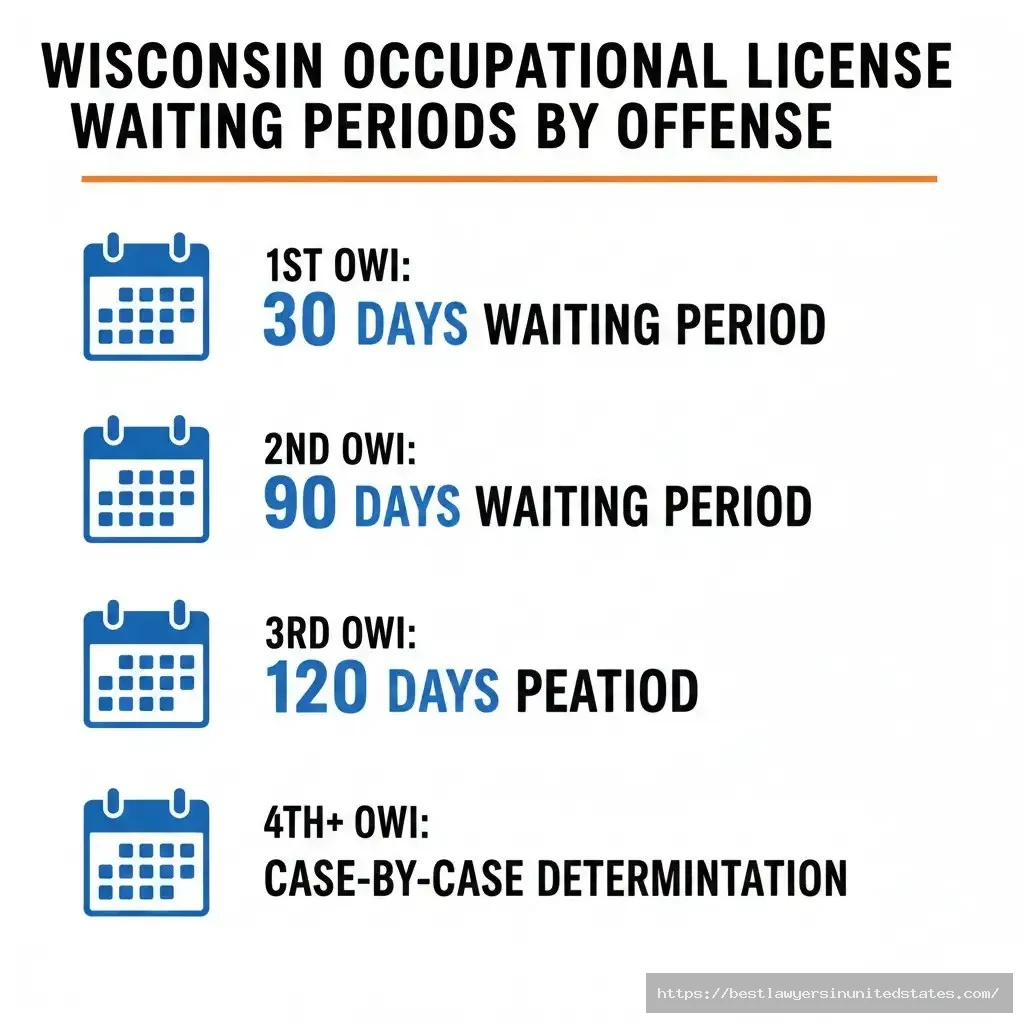
Wisconsin allows occupational licenses (also called restricted licenses) during your revocation period. However, you must wait a specific period before applying.
| Offense | Waiting Period | Occupational License Duration |
|---|---|---|
| 1st OWI | 30 days | Remainder of revocation period |
| 2nd OWI | 90 days | Remainder of revocation period |
| 3rd OWI | 120 days | Remainder of revocation period |
| 4th+ OWI | Case-by-case determination | Varies |
What an occupational license allows:
- Travel to/from work
- Work-related travel during employment
- Travel to/from school
- Travel for medical appointments
- Travel for court-ordered obligations
- Essential household activities (groceries, child care)
What occupational licenses prohibit:
- ❌ Social or recreational driving
- ❌ Driving outside specified times
- ❌ Driving outside specified routes
- ❌ Any alcohol in your system while driving
Cost to Get an Occupational License in Wisconsin
Application requirements and fees:
- Court petition: $50-$100 filing fee (varies by county)
- SR-22 insurance: $15-$25 filing fee plus increased premiums
- Ignition interlock device: Required for most OWI occupational licenses
- Attorney fees: $500-$1,500 for occupational license petition
Total cost: Expect $2,000-$4,000 for occupational license application, ignition interlock installation, and increased insurance for the first year.
Ignition Interlock Device (IID) Requirements in Wisconsin
An ignition interlock device (IID) is a breathalyzer installed in your vehicle that prevents the engine from starting if you have alcohol in your system. Wisconsin requires IIDs for most OWI offenses.
When Wisconsin Requires an IID
| Offense | IID Requirement | Duration |
|---|---|---|
| 1st OWI | Required for license reinstatement | 12 months minimum |
| 2nd OWI | Required | 12-18 months |
| 3rd OWI | Required | 18-36 months |
| 4th+ OWI | Required | 24-60 months |
First offense IID rule: While a first OWI doesn’t mandate IID installation, you cannot reinstate your license after the revocation period without agreeing to IID installation for 12 months.
How Much Does an IID Cost in Wisconsin?
IID costs in Wisconsin:
- Installation: $75-$150
- Monthly monitoring: $75-$100
- Calibration (every 30-60 days): $50-$75 per visit
- Removal: $50-$100
Annual total: Approximately $1,100-$1,500 for one year of IID use
Compare this to similar requirements in Illinois DUI cases where IID costs run slightly higher but with similar duration requirements.
Safe Streets Option: Alternative to Jail
Wisconsin offers a unique “Safe Streets Option” under Wis. Stat. § 346.65(2)(f) for second and third OWI offenses. This program allows you to serve your jail sentence through home detention while using an ignition interlock device.
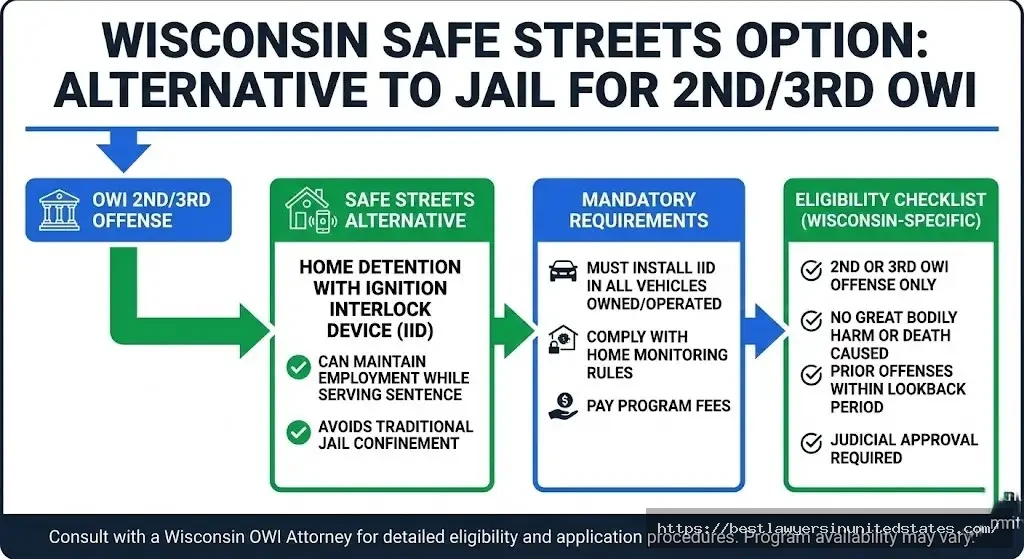
Eligibility requirements:
- ✅ Must be eligible for occupational license
- ✅ Must install IID in all vehicles you own or operate
- ✅ Must agree to continuous alcohol monitoring
- ✅ Cannot have caused injury or death
- ✅ Judge must approve participation
How it works:
- Install IID in all vehicles
- Serve jail sentence on home detention
- Can drive for work and essential activities with IID
- Must maintain IID for entire revocation period
Cost comparison: Safe Streets Option costs approximately $2,000-$3,000 more than serving jail time, but allows you to maintain employment during your sentence.
Total Cost of Wisconsin OWI (2026 Breakdown)
The financial impact of an OWI in Wisconsin extends far beyond court fines. Hidden costs accumulate quickly across attorney fees, insurance increases, and license reinstatement.
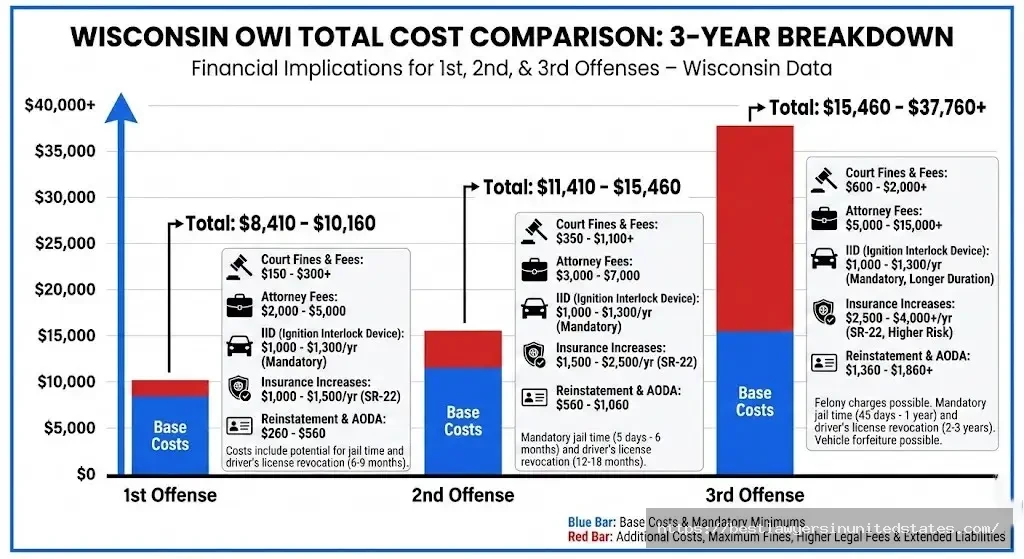
Wondering what an OWI will really cost you? Use our Wisconsin DUI cost calculator to estimate your total expenses based on your specific offense level and circumstances.
DUI Cost Calculator
Estimate total DUI expenses by state and offense
Detailed Cost Breakdown
Payment Timeline
Bail bond, towing fees, car impound, attorney retainer
Initial court fines, DMV fees, DUI school enrollment, ignition interlock installation
Monthly probation fees, ignition interlock fees, DUI school payments, attorney balance
Insurance premium increases, license reinstatement, SR-22 filing fees
- Lost wages from missed work (court dates, jail time, DUI school) – $2,000-$10,000
- Job loss or difficulty finding employment – Varies
- Professional license suspension (doctors, lawyers, nurses, pilots) – Career ending
- Rideshare and transportation costs during suspension – $1,500-$5,000
- Travel restrictions and visa denials – Varies
- Security clearance loss – Career impact
- Child custody implications – Legal costs
- Rental car restrictions – Varies
- Personal relationships and mental health costs – Priceless
Complete Wisconsin OWI Cost Breakdown
| Cost Category | 1st Offense | 2nd Offense | 3rd Offense (Felony) |
|---|---|---|---|
| Court fines | $150-$300 | $350-$1,100 | $600-$2,000 |
| Court costs | $435 | $435 | $435 |
| Attorney fees | $1,000-$2,500 | $2,500-$5,000 | $5,000-$15,000+ |
| License reinstatement | $200 | $200 | $200 |
| IID (1 year) | $1,200 | $1,200 | $1,800 |
| Alcohol assessment | $150-$300 | $150-$300 | $150-$300 |
| DUI school | $250-$400 | $250-$400 | $250-$400 |
| SR-22 filing | $25/year | $25/year | $25/year |
| Insurance increase | +$1,500/year | +$2,000/year | +$2,500/year |
| TOTAL (3 years) | $8,410-$10,160 | $11,410-$15,460 | $15,460-$37,760 |
Hidden costs not shown above:
- Lost wages during court appearances or jail time
- Uber/taxi costs while license is revoked
- Potential job loss (especially for CDL holders)
- Professional license consequences (doctors, lawyers, teachers)
- Security clearance impacts for government employees
How Insurance Costs Increase After Wisconsin OWI
Wisconsin requires SR-22 insurance certification after most OWI convictions. This proves you carry minimum liability coverage and notifies the state if your policy lapses.
Average insurance increases in Wisconsin:
- First OWI: 40-60% increase ($1,200-$1,800 per year extra)
- Second OWI: 60-80% increase ($1,800-$2,400 per year extra)
- Third OWI: 80-100% increase ($2,400-$3,000 per year extra)
How long increases last: Most insurers maintain higher rates for 3-5 years after an OWI conviction. Some carriers refuse to insure drivers with multiple OWIs.
Wisconsin OWI Arrest and Legal Process
Understanding what happens after a Wisconsin OWI arrest helps you protect your rights and make informed decisions. The process involves multiple stages across both administrative and criminal proceedings.
Traffic Stop and Field Sobriety Tests
Wisconsin law requires officers to have “reasonable suspicion” to stop your vehicle. Common reasons include:
- Weaving or crossing lane markers
- Speeding or driving too slowly
- Equipment violations (broken taillight, etc.)
- DUI checkpoint (must be announced publicly)
Field sobriety tests in Wisconsin:
- Horizontal Gaze Nystagmus (HGN): Officer checks eye movement
- Walk-and-Turn: Walk heel-to-toe in a straight line
- One-Leg Stand: Balance on one foot while counting
Your rights: You can refuse field sobriety tests in Wisconsin with no penalty. Only chemical tests (breath, blood, urine) trigger refusal penalties under implied consent.
Arrest and Chemical Testing
After failing field sobriety tests or refusing them, officers typically arrest you for OWI. At this point, Wisconsin’s implied consent law requires you to submit to a chemical test.
Testing options in Wisconsin:
- Breath test: Most common, results available immediately
- Blood test: More accurate, required for drug-impaired driving
- Urine test: Least common, used when breath/blood unavailable
Remember the three-hour rule: Chemical tests must occur within three hours of operating the vehicle to establish a direct BAC presumption under Wis. Stat. § 346.63(1)(b).
Initial Appearance and Arraignment
Timeline for first court appearance:
- 1st offense (civil): Citation issued, court date set for 4-8 weeks
- 2nd+ offense (criminal): Must appear within 48-72 hours for initial appearance
What happens at initial appearance:
- Judge informs you of charges
- Sets bail conditions (2nd+ offenses)
- Appoints attorney if you qualify financially
- Sets next court date (usually pretrial conference)
Municipal Court vs Circuit Court Jurisdiction
Wisconsin handles OWI cases in different courts based on offense level:
| Court Type | Jurisdiction | What They Handle |
|---|---|---|
| Municipal Court | Local city/village/town | 1st offense OWI (civil) |
| Circuit Court | County-level criminal court | 2nd+ offense (criminal), all felonies |
Key difference: Municipal court proceedings are civil forfeitures, not criminal cases. No jury trials, no criminal record for first offense (unless aggravating factors present).
Plea Bargaining Restrictions in Wisconsin
Unlike many states, Wisconsin severely restricts plea bargaining in OWI cases. Wis. Stat. § 346.65(2)(d) prohibits amending OWI charges to lesser offenses like reckless driving.
What this means:
- ❌ Cannot plead down to reckless driving
- ❌ Cannot amend to “wet reckless” (common in California DUI cases)
- ✅ Can negotiate reduced BAC level on report
- ✅ Can negotiate dismissal if evidence is weak
Your only options:
- Plead guilty/no contest to OWI charge as written
- Take case to trial
- Negotiate for charge dismissal (rare)
Defending Against Wisconsin OWI Charges
While Wisconsin’s plea bargaining restrictions limit negotiation options, strong defenses can result in charge dismissal or case victories at trial. Several legal strategies attack different aspects of the prosecution’s case.
Challenging Reasonable Suspicion
Officers must have reasonable suspicion that you violated a traffic law or drove impaired before stopping your vehicle. Common challenges:
Weak traffic violations:
- Briefly touching lane marker once
- “Driving too carefully” (not a violation)
- Following too closely without measuring distance
Checkpoint stops:
- Checkpoint not publicly announced
- No written procedures followed
- Random stops instead of every vehicle
If reasonable suspicion fails: All evidence obtained after the illegal stop gets suppressed, including chemical test results.
Challenging Probable Cause for Arrest
After stopping you, officers need “probable cause” to arrest you for OWI. This requires more evidence than reasonable suspicion.
Common probable cause challenges:
- Field sobriety tests improperly administered
- Medical conditions affecting balance (inner ear, knee injury)
- Officer didn’t consider weather/road conditions
- Horizontal Gaze Nystagmus affected by medical conditions
- No odor of alcohol or other impairment signs
Attacking Chemical Test Accuracy
Wisconsin’s three-hour rule opens unique defense opportunities not available in most states:
Test timing issues:
- Test occurred after three-hour window (requires extrapolation)
- Rising BAC defense (alcohol still absorbing during test)
- Mouth alcohol contamination (recent drinking, GERD, belching)
Equipment and procedure errors:
- Breathalyzer not calibrated properly
- Blood sample chain of custody broken
- Lab technician certification expired
- Blood draw not performed by qualified person
Independent test statute: Wisconsin law (Wis. Stat. § 343.305(5)(d)) gives you the right to request independent testing at your expense. If police deny this request, courts may suppress their test results.
When OWI Cases Get Dismissed
Realistic expectations: Complete dismissals occur in approximately 5-10% of Wisconsin OWI cases, typically when:
- Illegal traffic stop (no reasonable suspicion)
- Illegal arrest (no probable cause)
- Critical evidence suppressed (test results excluded)
- Prosecution unable to prove case beyond reasonable doubt
More common outcomes:
- Reduction in BAC level on report
- Dismissal of aggravating charges (child endangerment)
- Acquittal at trial due to weak evidence
Special Wisconsin OWI Situations
Certain drivers face unique OWI rules and enhanced penalties beyond standard offenses. Understanding these special situations helps you recognize increased legal risks.
OWI for Commercial Drivers (CDL)
Commercial drivers in Wisconsin face stricter BAC limits and harsher career consequences than standard drivers.
| Driver Type | BAC Limit | Where It Applies |
|---|---|---|
| CDL holder in commercial vehicle | 0.04% | While operating commercial vehicle |
| CDL holder in personal vehicle | 0.04% | Any vehicle, even off-duty |
| Standard driver | 0.08% | Non-commercial operation |
CDL disqualification periods:
- First OWI: 1-year CDL disqualification (3 years if transporting hazmat)
- Second OWI: Lifetime CDL disqualification
- Reduced BAC failure (0.04-0.079%): 1-year disqualification for CDL holders
Career impact: Most trucking companies refuse to hire drivers with any OWI on their record, making CDL disqualification effectively permanent employment loss.
Compare these penalties to Michigan’s CDL OWI rules, which impose similar lifetime disqualifications for second offenses.
UTV/ATV OWI Laws in Wisconsin
Wisconsin’s OWI statute applies to all-terrain vehicles (ATVs) and utility terrain vehicles (UTVs) under Wis. Stat. § 346.63. The same BAC limits and penalties apply as motor vehicles.
Where UTV/ATV OWIs happen:
- County and state trails
- Private property (yes, even your own land)
- Forest roads and recreational areas
- Any location where you operate the vehicle
Unique ATV/UTV factors:
- Wisconsin DNR (Department of Natural Resources) enforces OWI laws on trails
- Local sheriff departments patrol private property
- Penalties identical to motor vehicle OWI
Separate charges possible: Operating an unregistered ATV while intoxicated adds additional violations beyond the OWI itself.
Out-of-State Drivers in Wisconsin
If you’re arrested for OWI in Wisconsin with an out-of-state license, Wisconsin still prosecutes you under Wisconsin law. However, consequences extend to your home state through interstate license compacts.
What happens to your home state license:
- Wisconsin notifies your home state DMV of the OWI
- Your home state typically suspends your license under their laws
- You face two separate suspensions (Wisconsin and home state)
Interstate Driver’s License Compact: 45 states share conviction information. If Wisconsin convicts you of OWI, your home state treats it as if you were convicted there.
Wisconsin Drivers with Out-of-State OWI
Wisconsin counts out-of-state OWI convictions when determining your offense level. A prior OWI in Minnesota or Iowa counts as a prior offense for Wisconsin sentencing.
Lifetime lookback period: Wisconsin never erases prior OWI convictions from your record. An OWI from 20 years ago still counts toward your current offense level.
How Wisconsin OWI Laws Compare to Other States
Wisconsin consistently ranks among the most lenient states for drunk driving laws. This reputation stems from several unique legal features that reduce penalties compared to neighboring states.
What Makes Wisconsin More Lenient?
First offense as civil violation: Wisconsin is the only state where a first OWI is civil, not criminal. Every other state treats even first DUI offenses as criminal misdemeanors.
| State | First Offense Status | Criminal Record? |
|---|---|---|
| Wisconsin | Civil forfeiture | No |
| Minnesota | Misdemeanor | Yes |
| Illinois | Class A Misdemeanor | Yes |
| Michigan | Misdemeanor | Yes |
| Iowa | Serious Misdemeanor | Yes |
No mandatory jail for first offense: Wisconsin is one of only a few states with zero mandatory jail time for first OWI (unless aggravating factors exist).
Lower base fines: Wisconsin’s $150-$300 first offense fine is significantly lower than neighboring states:
- Minnesota: $1,000 minimum
- Illinois: Up to $2,500
- Michigan: Up to $500
- Iowa: $1,250 minimum
Cultural and Legislative Context
Wisconsin’s lenient OWI laws reflect cultural attitudes toward alcohol consumption. The state leads the nation in bars per capita and has strong tavern industry lobbying.
Legislative reform efforts: Several bills introduced in recent years attempted to make first OWI a criminal offense. All failed to pass the Wisconsin Legislature.
2025-2026 pending legislation:
- Assembly Bill 318: Would criminalize first OWI (status: committee)
- Senate Bill 184: Increased penalties for repeat offenders (status: pending)
Wisconsin OWI Statistics (2026)
Understanding Wisconsin’s drunk driving problem provides context for why reform efforts continue despite the state’s lenient legal framework.
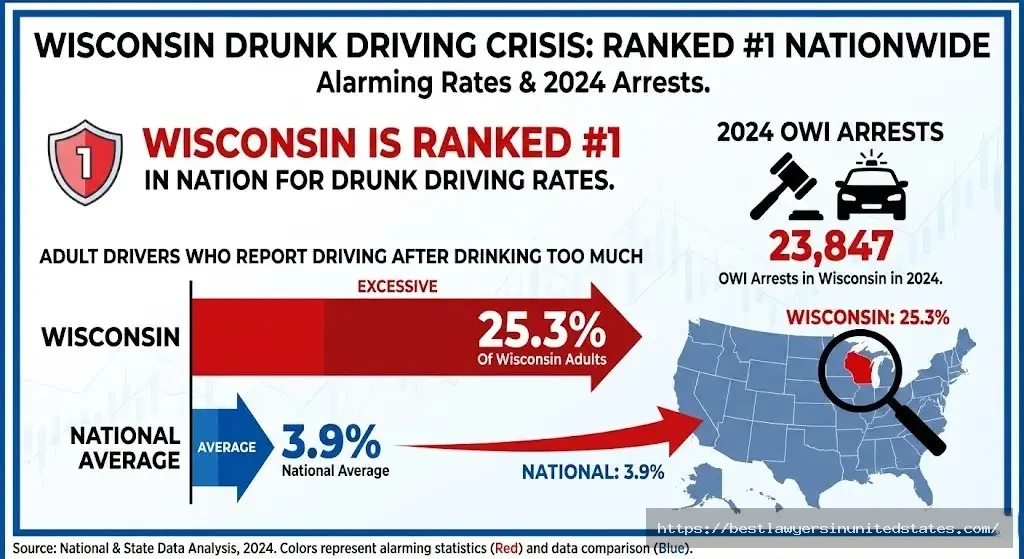
Drunk Driving Rates in Wisconsin
Wisconsin ranks #1 nationally for drunk driving rates:
- 25.3% of Wisconsin adults report driving after drinking too much (CDC data)
- National average: 3.9%
- Wisconsin rate is 6.5 times the national average
OWI arrests and convictions (2024 data):
- 23,847 OWI arrests statewide
- 1st offense: 16,892 (71%)
- 2nd offense: 4,769 (20%)
- 3rd+ offense: 2,186 (9%)
Repeat Offender Statistics
Wisconsin has a significant repeat offender problem:
- 29% of arrested drivers have prior OWI convictions
- Average number of prior OWIs for repeat offenders: 2.3
- 847 drivers arrested with 5+ prior OWI convictions in 2024
Record holders:
- Most OWIs on record in Wisconsin: 14 convictions
- Several drivers with 10+ OWI convictions still on Wisconsin roads
Fatal Alcohol-Involved Crashes
Wisconsin alcohol-related traffic deaths (2024):
- 162 fatalities in alcohol-involved crashes
- 35% of all traffic deaths involved alcohol
- National average: 28% of traffic deaths involve alcohol
High-risk times and locations:
- Weekend nights (Friday-Saturday 10 PM – 3 AM): 58% of fatal OWI crashes
- Rural roads: 67% of fatal OWI crashes
- Summer months (June-August): 42% of annual fatal OWI crashes
New Wisconsin OWI Laws for 2025-2026
Several legislative proposals aim to toughen Wisconsin’s OWI laws, though none have passed as of early 2026. Understanding pending changes helps you stay informed about potential future impacts.
Recent Legislative Changes (2021-2024)
What actually changed:
- 2021 Act 215: Increased penalties for 5th and 6th OWI offenses from Class G to Class F felonies
- 2023 Act 47: Extended IID requirements for first offense from 1 year minimum to 12-18 months
- 2024 Act 89: Enhanced penalties for OWI causing injury with BAC over 0.15%
What didn’t change: First offense OWI remains civil, not criminal (multiple bills proposed, all failed).
Bills Pending in Wisconsin Legislature (2025-2026)
Assembly Bill 318 – Criminalize First OWI:
- Status: In Assembly Judiciary Committee
- Proposal: Make all OWI offenses criminal, including first
- Opposition: Wisconsin Tavern League, rural legislators
- Support: Mothers Against Drunk Driving (MADD), law enforcement
Senate Bill 184 – Enhanced Repeat Offender Penalties:
- Status: Pending floor vote
- Proposal: 4th OWI becomes Class F felony (currently Class G)
- Proposal: Mandatory minimum prison sentences for 4th+ offenses
Assembly Bill 402 – Ignition Interlock Expansion:
- Status: Passed Assembly, pending Senate vote
- Proposal: Require IID before first conviction (upon arrest)
- Proposal: Extend IID periods for all offense levels
How to Stay Updated on Wisconsin OWI Law Changes
Official sources:
- Wisconsin Legislature website: legis.wisconsin.gov
- Wisconsin Department of Transportation: wisconsindot.gov
- Wisconsin State Bar Association: wisbar.org
Sign up for alerts: Wisconsin DOT offers email notifications when OWI laws change.
Frequently Asked Questions About Wisconsin OWI
Do You Lose Your License Immediately After OWI in Wisconsin?
Quick Answer: Not immediately. Your physical license is confiscated, but you receive a 30-day temporary permit allowing you to drive while waiting for the administrative process.
After 30 days, your license revokes unless you:
- Win your administrative hearing within 10 days
- Obtain an occupational license after the waiting period
Is 3rd OWI a Felony in Wisconsin?
Quick Answer: Yes. Third OWI in Wisconsin is a Class G felony with potential prison sentences of 6 months to 3 years.
Most states don’t reach felony status until 4th or 5th offense. Wisconsin’s lower threshold reflects the state’s attempt to address repeat offenders despite lenient first-offense laws.
How Long Does OWI Stay on Your Record in Wisconsin?
Quick Answer: Forever. Wisconsin never erases OWI convictions from your record.
Lifetime lookback period: All prior OWIs count toward your current offense level, regardless of how long ago they occurred. An OWI from 30 years ago still elevates a new arrest to second offense status.
Expungement not available: Wisconsin does not allow expungement of OWI convictions, even for first offenses.
Can You Get OWI Dismissed in Wisconsin?
Quick Answer: Dismissals occur in approximately 5-10% of cases when police violate constitutional rights or prosecution cannot prove their case.
Common dismissal reasons:
- Illegal traffic stop (no reasonable suspicion)
- Illegal arrest (no probable cause)
- Suppressed evidence (Fourth Amendment violations)
- Prosecution unable to meet burden of proof
Most cases do not result in dismissal. Hiring an experienced OWI attorney significantly improves your chances.
What Is Average Cost of OWI in Wisconsin?
Quick Answer: First offense costs $8,000-$10,000 total over three years including fines, attorney fees, IID, and increased insurance.
Use our DUI cost calculator to estimate your specific costs based on offense level and circumstances.
Cost breakdown summary:
- 1st offense: $8,410-$10,160 (3-year total)
- 2nd offense: $11,410-$15,460 (3-year total)
- 3rd offense: $15,460-$37,760+ (3-year total)
Why Is Wisconsin So Lenient on Drunk Driving?
Quick Answer: Cultural attitudes toward alcohol, strong tavern industry lobbying, and rural legislative representation contribute to Wisconsin’s lenient OWI laws.
Contributing factors:
- Wisconsin leads nation in bars per capita
- Strong opposition from Wisconsin Tavern League
- Rural areas view drunk driving enforcement as revenue generation
- Cultural acceptance of heavy drinking (“drinking culture” state)
- Legislative reform bills consistently fail to pass
Recent public pressure and MADD advocacy efforts push for stricter laws, but significant legislative changes remain unlikely in the near term.
How Many Drinks Is 0.08 BAC for a Man or Woman?
Quick Answer: For men (180 lbs), approximately 4 standard drinks in 2 hours. For women (140 lbs), approximately 3 standard drinks in 2 hours reach 0.08% BAC.
Factors affecting BAC:
- Body weight and composition
- Gender (women metabolize alcohol slower)
- Food consumption
- Drinking speed
- Individual metabolism
Use our BAC calculator for personalized estimates based on your weight, gender, and drinking pattern.
Can You Drive Before Court Date After Wisconsin OWI?
Quick Answer: Yes, for 30 days using the temporary permit issued at arrest. After 30 days, you need an occupational license to drive legally.
Timeline:
- Days 1-30: Drive on temporary permit
- Day 10 deadline: Request administrative hearing
- After 30 days: Temporary permit expires
- After waiting period: Apply for occupational license
Missing the 10-day deadline to request an administrative hearing significantly limits your ability to drive legally after the 30-day temporary permit expires.
Find Wisconsin OWI Defense Attorneys
Navigating Wisconsin’s complex OWI laws requires experienced legal representation. An attorney familiar with Wisconsin’s unique civil first offense status, three-hour rule, and administrative hearing deadlines can significantly impact your case outcome.
When to contact an attorney:
- ✅ Immediately after arrest (before the 10-day deadline)
- ✅ Before making any statements to police
- ✅ Before deciding whether to request administrative hearing
- ✅ Before any court appearances
What to look for in Wisconsin OWI attorneys:
- Experience with Wisconsin administrative hearings
- Knowledge of three-hour rule defenses
- Track record with Safe Streets Option applications
- Familiarity with local prosecutors and judges
Need legal guidance? Contact experienced Wisconsin OWI attorneys who understand the state’s unique laws and can fight for the best possible outcome in your case.
