
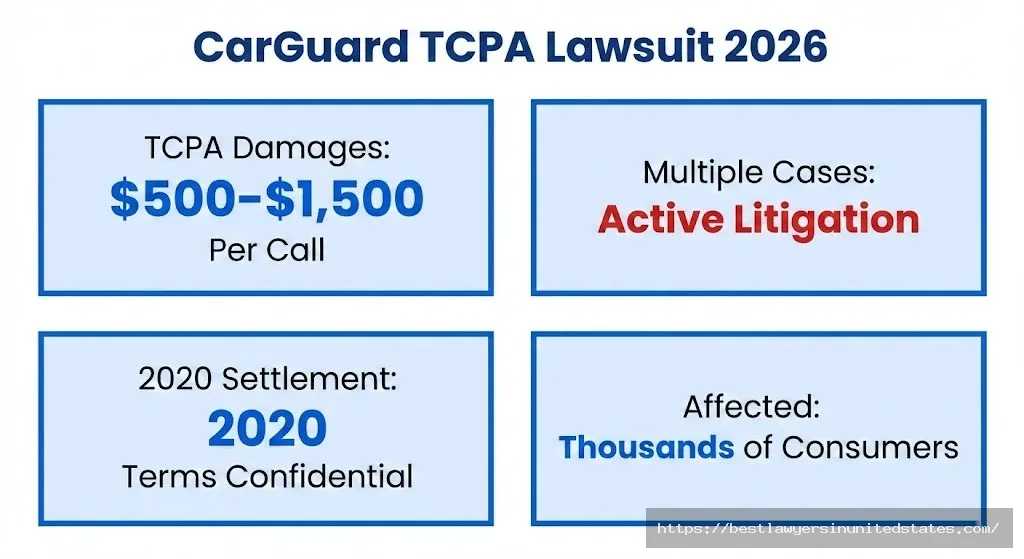
The CarGuard lawsuit involves multiple legal actions against CarGuard Administration, including class action cases over unauthorized robocalls and consumer complaints about misleading warranty contracts. If you received unwanted robocalls from CarGuard or faced denied claims on your vehicle service contract, you might qualify for compensation. Several lawsuits remain active as of 2026, with potential payouts ranging from $500 to $1,500 per illegal call under federal law. hawthorne residential partners lawsuit
Quick Answer: CarGuard Administration faces multiple lawsuits, including TCPA class actions for illegal robocalls and consumer complaints about deceptive marketing and claim denials. While a 2020 robocall case reached a tentative settlement, several other cases remain active. If you received unauthorized calls or experienced issues with your CarGuard contract, you may have legal options. Volkswagen Emissions Lawsuit
What Is the CarGuard Lawsuit About?
Background of the Lawsuits
CarGuard Administration, a Kansas-based company selling extended vehicle service contracts, has faced several legal challenges since 2020. The lawsuits fall into two main categories: federal TCPA violations for unauthorized robocalls, and consumer protection claims about misleading warranty marketing and denied claims.
These aren’t isolated incidents. Thousands of consumers reported receiving aggressive telemarketing calls about “expiring car warranties” even after registering on the National Do Not Call Registry. Others purchased what they believed was comprehensive coverage, only to face denied claims and unexpected exclusions.
The lawsuits highlight deeper issues in the extended warranty industry, where aggressive marketing tactics and complex contract terms often leave consumers frustrated and financially harmed.
Timeline of Key Events
Table: CarGuard Lawsuit Timeline
| Date | Event | Details |
|---|---|---|
| Early 2020 | First TCPA complaints | Consumers report unauthorized robocalls promoting CarGuard warranties |
| April 16, 2020 | Barrett & Silverman class action filed | Massachusetts District Court; alleged TCPA violations |
| June 5, 2020 | Tentative settlement reached | Barrett case settled privately; terms not publicly disclosed |
| June 2019 | NCWC business dispute begins | NCWC claims CarGuard interfered with exclusive marketing contracts |
| July 2021 | Legion Auto Protection lawsuit | New class action involving CarGuard’s sales practices |
| August 2022 | Baccari case dismissed | Federal court ruled CarGuard not liable for third-party marketer’s calls |
| 2024 | Fleming v. CarGuard filed | Virginia Western District Court; ongoing TCPA case |
| January 2026 | Regulatory reviews ongoing | State agencies examining CarGuard’s marketing practices |
| February 2026 | Multiple cases active | Several lawsuits remain in various stages of litigation |
Who Filed the Lawsuits?
Several parties have taken legal action against CarGuard:
TCPA Robocall Cases:
- Joseph Barrett and Matthew Silverman (2020) – Massachusetts residents who received multiple unauthorized calls despite being on the Do Not Call Registry
- Fleming (2024) – Virginia plaintiff claiming similar TCPA violations
- Legion Auto Protection plaintiffs (2021) – California class action over robocall practices
Business Disputes:
- NCWC Inc. – Competing warranty provider claiming tortious interference with business contracts
Consumer Complaints:
- Hundreds of individual consumers have filed complaints with state attorneys general and the Better Business Bureau about denied claims and misleading marketing.
The law firms handling these cases include consumer protection attorneys specializing in TCPA violations and warranty disputes.
What Are the Allegations?
The lawsuits make serious claims against CarGuard and its marketing partners:
TCPA Violations (Robocall Cases): ✅ Using automated dialing systems without consumer consent ✅ Calling numbers registered on the National Do Not Call Registry ✅ Continuing to call after consumers requested removal ✅ Using third-party telemarketers who violated federal law ✅ “Spoofing” local phone numbers to trick people into answering
Consumer Protection Claims: ✅ Misrepresenting coverage as “comprehensive” when many exclusions existed ✅ Failing to clearly disclose limitations and exclusions ✅ Denying legitimate repair claims without valid reasons ✅ Making it difficult for customers to get refunds during the “free look” period ✅ Using deceptive sales tactics to pressure consumers into purchases
Business Practices: ✅ Interfering with competitors’ exclusive marketing agreements ✅ Accepting business from unauthorized sales partners ✅ Inadequate oversight of third-party telemarketers
Who Qualifies for the CarGuard Lawsuit?
Quick Answer: You may qualify if you received unauthorized robocalls from CarGuard or its partners (especially if you’re on the Do Not Call Registry), or if you purchased a CarGuard warranty that was misrepresented or unfairly denied. Eligibility varies by specific lawsuit.
Eligibility Requirements for TCPA Cases
Table: TCPA Lawsuit Eligibility Checklist
| Requirement | Details | Documentation Needed |
|---|---|---|
| Received robocalls | Got automated or prerecorded calls about CarGuard warranties | Phone records showing dates/times of calls |
| National Do Not Call Registry | Your number was registered for at least 30 days | DNCR registration confirmation |
| No consent given | You never agreed to receive telemarketing calls | Proof you didn’t sign consent form |
| Multiple calls | Received more than one call within 12 months | Call logs or phone bills |
| Timeframe | Calls occurred within statute of limitations (typically 4 years) | Records from 2020-2026 for current cases |
If you meet these criteria, you could be eligible for $500 to $1,500 per illegal call under TCPA law.
Eligibility for Consumer Protection Claims
Table: Consumer Complaint Eligibility
| Criterion | Specific Details | What You Need |
|---|---|---|
| Purchased CarGuard warranty | Bought a vehicle service contract from CarGuard | Copy of your contract |
| Experienced harm | Claim denied, misleading sales, unexpected charges | Denial letters, sales recordings |
| Timeframe | Issues occurred recently (check state statutes) | Documentation of when issues started |
| Financial loss | You suffered monetary damages | Receipts, repair bills, payment records |
| State residency | Some state laws provide additional protections | Proof of where you live |
Who Does NOT Qualify?
You probably don’t have a case if:
❌ You provided written consent to receive marketing calls from CarGuard ❌ You’re calling about a different company – Similar names exist; confirm it was actually CarGuard ❌ Your claim denial was legitimate – If the repair truly wasn’t covered per your contract terms ❌ Too much time has passed – Statutes of limitations vary (1-4 years depending on claim type) ❌ You haven’t suffered damages – No financial harm or calls received
How to Prove Your Claim
Table: Required Documentation
| Document Type | Why It’s Needed | Where to Find It | Alternatives |
|---|---|---|---|
| Phone records | Prove you received calls | Your wireless carrier’s online portal | Request records from carrier |
| Do Not Call Registry proof | Show your number was protected | DNCRegistry.gov | Screenshot of registration |
| CarGuard contract | Show what you were promised | Your original paperwork | Request copy from CarGuard |
| Denied claim letters | Prove your claim was rejected | Your files or email | Request from repair facility |
| Sales recordings/emails | Evidence of misrepresentations | Your records | Subpoena during discovery |
| Repair estimates | Show the actual repair cost | Repair shop or dealer | Written estimates from mechanics |
| Payment records | Prove you paid for warranty | Bank statements, credit card bills | Payment confirmation emails |
How Much Money Can You Get from the CarGuard Lawsuit?
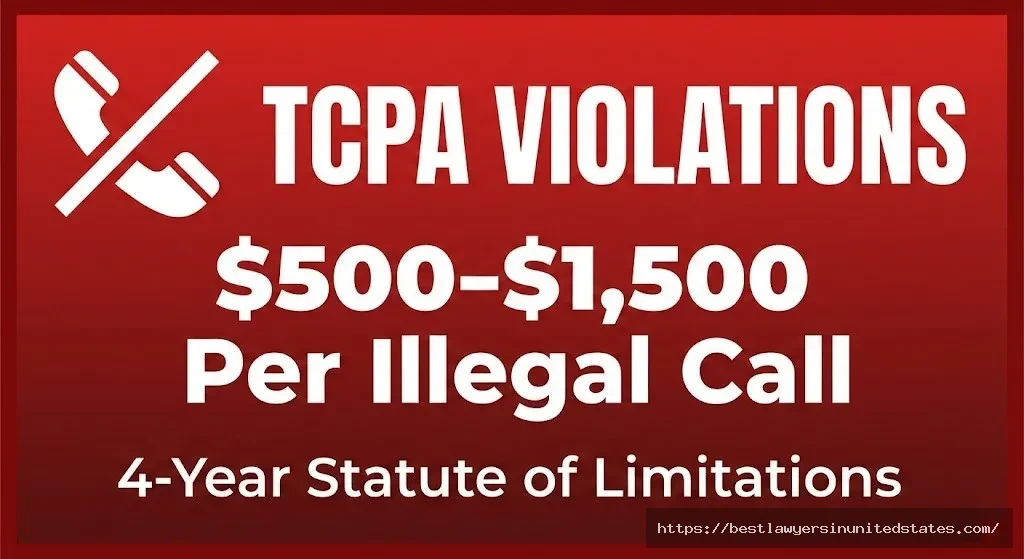
Quick Answer: For TCPA robocall violations, federal law allows $500 per call (up to $1,500 if willful). Consumer protection cases may result in refunds, reimbursements, or damages. Actual amounts depend on the specific lawsuit and settlement terms. GM Ignition Switch Lawsuit
TCPA Lawsuit Potential Payouts
Table: TCPA Compensation Structure
| Violation Type | Per-Call Amount | Requirements | Payment Form |
|---|---|---|---|
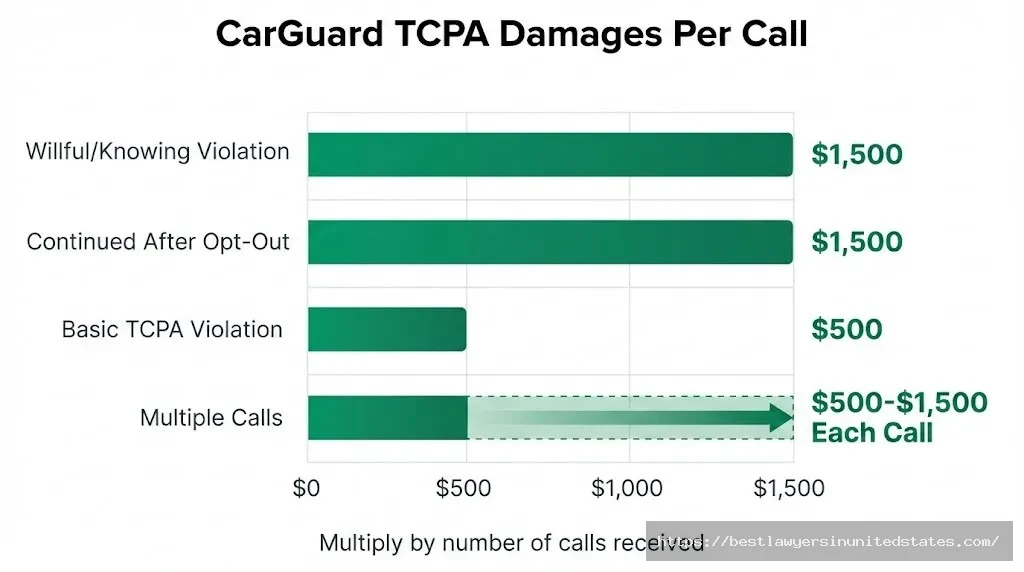
| Non-willful TCPA violation | $500 | Basic TCPA violation proven | Cash payment |
| Willful/knowing violation | $1,500 | Company knew calls were illegal | Treble damages (3x) |
| Multiple calls per day | $500-$1,500 each | Each call counts separately | Multiplied compensation |
| Continued calls after opt-out | $1,500 (typically willful) | You requested removal, calls continued | Enhanced damages |
For example, if you received 10 unauthorized robocalls from CarGuard, you could potentially recover $5,000 to $15,000.
2020 Settlement (Barrett & Silverman Case)
Table: Barrett Case Settlement Information
| Category | Information |
|---|---|
| Case Status | Tentatively settled June 2020 |
| Settlement Amount | Not publicly disclosed |
| Payout Structure | Confidential settlement terms |
| Class Members Paid | Unknown – settlement was private |
| Current Status | Case dismissed, settlement finalized |
Unfortunately, because this settlement was reached privately, the specific amounts paid to class members aren’t public. This is common in early settlements.
Consumer Protection Case Potential Recovery
Table: Consumer Claim Compensation Types
| Claim Category | Possible Recovery | Basis for Award |
|---|---|---|
| Contract refund | Full or partial refund of premium paid | Misrepresentation or breach of contract |
| Denied claim reimbursement | Cost of repairs that should’ve been covered | Wrongful denial |
| Out-of-pocket expenses | Towing, rental car, related costs | Consequential damages |
| Statutory damages | Varies by state ($500-$10,000+) | State consumer protection laws |
Factors That Affect Your Payout
Your actual compensation depends on several variables:
- Number of calls received – More calls = higher TCPA damages
- Whether violations were willful – Knowing violations pay 3x more
- Type of harm suffered – Denied claims vs. misleading sales
- Your actual damages – Contract cost, repair bills, related expenses
- State of residence – Some states have stricter consumer protection laws
- Strength of your evidence – Better documentation = stronger case
- Settlement vs. verdict – Settlements typically pay less but faster
When Will You Receive Payment?
Table: Expected Payment Timeline
| Stage | Timeframe | What Happens |
|---|---|---|
| Active litigation | Current | Multiple cases still pending |
| Settlement negotiations | Months to years | Parties discuss resolution |
| Settlement approval | 60-90 days after agreement | Court reviews and approves settlement |
| Claim filing period | 90-180 days typically | You submit your claim form |
| Claims processing | 60-120 days | Administrator reviews claims |
| Payment distribution | 30-60 days after approval | Checks or electronic payments sent |
Important: The 2020 Barrett case settled quickly (within 2 months), but most TCPA class actions take 1-3 years to fully resolve. Individual cases may move faster.
How to Join or File a Claim
For Active Class Action Lawsuits
You typically don’t need to “join” a class action when it’s first filed. If you fit the class definition, you’re automatically included unless you opt out.
Step 1: Monitor for Settlement Announcements
Check these resources regularly:
- ClassAction.org – Covers new settlements
- TopClassActions.com – Settlement news and deadlines
- Court dockets – PACER system for federal cases
- Your mail – If you’re identified as a class member, you’ll receive notice
Step 2: Verify You’re a Class Member
When a settlement is announced, review the class definition carefully. For example, the Barrett case covered:
- People who received robocalls from CarGuard, Vehicle Protection Specialists, or Auto Protehct
- Calls made during specific dates (early 2020)
- Calls to phone numbers on the Do Not Call Registry
Step 3: File Your Claim Form
Once a settlement is approved:
- Visit the official settlement website (announced in notices)
- Complete the claim form with your contact information
- Provide details about calls you received (dates, times, frequency)
- Submit documentation (phone records if required)
- Keep your confirmation number
Step 4: Wait for Your Payment
The settlement administrator will review claims and issue payments according to the approved distribution plan.
For Individual TCPA Claims
If you want to pursue your own case rather than wait for a class action:
Option 1: Hire an Attorney
TCPA attorneys often work on contingency (they only get paid if you win). Look for lawyers who specialize in TCPA cases.
Benefits:
- Professional handling of your case
- Potentially higher recovery
- Attorneys handle all paperwork and court filings
Option 2: Small Claims Court
You can file your own TCPA claim in small claims court in many states.
Process:
- Calculate your damages ($500-$1,500 per call)
- File a small claims complaint in your local court
- Serve CarGuard with the complaint
- Present your evidence at the hearing
- Collect your judgment if you win
Limits: Small claims courts typically have maximum amounts ($5,000-$10,000 depending on state), so this works best if you received fewer calls.
Filing Consumer Protection Complaints
Even if you don’t join a lawsuit, you can take these actions:
Step 1: Contact Your State Attorney General
Every state has a consumer protection division. File a complaint about:
- Denied warranty claims
- Misleading sales practices
- Unauthorized charges
Step 2: File with the FTC
Report deceptive business practices at ReportFraud.ftc.gov
Step 3: File with the Better Business Bureau
Document your complaint at BBB.org
Step 4: Contact Your State Department of Insurance
If CarGuard operates as an insurance product in your state, file a complaint with insurance regulators.
Common Filing Mistakes to Avoid
Don’t sabotage your claim:
❌ Waiting too long – Statutes of limitations are strict ❌ Losing evidence – Save all phone records, contracts, emails ❌ Not documenting calls – Keep detailed logs of dates/times/content ❌ Accepting early settlements – Companies may offer lowball amounts before lawsuit ❌ Providing inconsistent information – Make sure all your forms match ❌ Missing deadlines – Mark all important dates in your calendar ❌ Not reading the settlement notice – You might need to opt out to preserve individual rights
Current Lawsuit Status & Latest Updates
Active Cases as of February 2026
Table: CarGuard Lawsuits Current Status
| Case Name | Court | Filing Date | Current Status | Next Steps |
|---|---|---|---|---|
| Fleming v. CarGuard | Virginia W.D. | 2024 | Active litigation | Discovery ongoing |
| NCWC Inc. v. CarGuard | Arizona D.C. | 2020 | Active litigation | Motion for summary judgment denied |
| Various consumer complaints | State courts | Ongoing | Multiple cases | Varied stages |
| Regulatory investigations | State agencies | 2025-2026 | Under review | Pending findings |
Recent Developments (2025-2026)
January 2026: State regulatory agencies intensified their review of CarGuard’s business practices, examining whether marketing materials accurately describe coverage terms and whether the company complies with consumer protection regulations.
Late 2025: Consumer complaints to the Better Business Bureau increased, with customers reporting continued issues with claim denials and customer service. CarGuard maintains a BBB accreditation but faces ongoing complaints.
2024: New TCPA lawsuits filed as consumers continue to report unauthorized warranty robocalls. CarGuard’s position remains that it prohibits third-party sellers from using telemarketing, but plaintiffs argue the company bears responsibility under vicarious liability principles.
Key Development: Unlike the 2020 case that settled quickly, recent lawsuits have faced more aggressive defense strategies from CarGuard, which has successfully defended against some claims (like the Baccari case in 2022).
What Happens Next?
Expected upcoming events based on typical litigation timelines:
2026 First Quarter:
- Discovery continues in Fleming case
- Potential additional TCPA lawsuits filed
- Regulatory review findings may be released
2026 Second Quarter:
- Possible settlement negotiations in pending cases
- Class certification hearings if additional class actions move forward
2026 Second Half:
- Trial dates may be set for cases that don’t settle
- More regulatory enforcement actions possible
How to Stay Updated
Monitor these sources for breaking news:
- Court dockets: Check PACER.gov for federal case updates
- ClassAction.org: Subscribe to email alerts for CarGuard news
- State attorney general websites: Consumer protection updates
- CarGuard’s website: Company may post settlement information
- Legal news sites: TCPAWorld.com covers telemarketing law
CarGuard Lawsuit vs. Similar Cases
How CarGuard Cases Compare to Other Extended Warranty Lawsuits
Table: Comparison with Similar Vehicle Warranty Lawsuits
| Company/Lawsuit | Settlement Amount | Affected Parties | Type of Violations | Status |
|---|---|---|---|---|
| CarGuard (2020 Barrett case) | Undisclosed | Unknown | TCPA robocalls | Settled privately |
| Dish Network TCPA | $61 million | Millions nationwide | Robocalls/Do Not Call violations | Settled 2017 |
| Capital One TCPA | $75.5 million | 6.5 million | Unauthorized autodialed calls | Settled 2014 |
| Time Warner Cable TCPA | $229,500 | Individual plaintiff (153 calls) | Robocalls after opt-out | Verdict 2015 |
| Extended warranty robocalls (general) | Varies | Thousands per case | TCPA violations | Ongoing industry issue |
What Makes the CarGuard Lawsuit Unique?
Several factors distinguish CarGuard’s legal situation:
Different Defense Strategy: Unlike many warranty companies that settle TCPA cases quickly, CarGuard has fought some cases aggressively. The company successfully dismissed the Baccari case by proving it specifically prohibited sellers from using robocalls.
Third-Party Marketer Issues: CarGuard’s contracts with sales agents like Vehicle Protection Specialists and Auto Protehct created complex liability questions. Courts must decide whether CarGuard bears responsibility for violations by independent contractors.
Multiple Legal Fronts: CarGuard faces both consumer TCPA cases AND business disputes (like NCWC), showing different types of legal vulnerability.
Industry-Wide Problem: The cases highlight broader issues with extended warranty telemarketing that affect many companies, not just CarGuard.
Do You Need a Lawyer to File a Claim?
Quick Answer: No, you don’t need a lawyer to file a claim in a class action settlement – you can submit claim forms yourself. However, for individual TCPA cases or complex consumer disputes, an attorney can significantly increase your potential recovery.
Filing Without a Lawyer
When you can handle it yourself:
Class action settlements are designed for consumers to file claims directly without legal representation. You’ll simply:
- Fill out a straightforward claim form
- Provide basic information (name, address, phone number)
- Submit any requested documentation
- Wait for your payment
This process is intentionally simple because attorneys already represent the class. Your only job is to prove you’re a class member and submit your claim before the deadline.
When Legal Help Might Be Useful
Consider consulting an attorney if:
- You received many robocalls – If you got 20+ calls, your potential recovery ($10,000-$30,000) justifies attorney fees
- You have strong evidence of willful violations – Lawyers can maximize treble damages
- Your warranty claim is complex – If you suffered significant financial harm from denied claims
- You want to file an individual lawsuit – TCPA cases require understanding of technical legal requirements
- The class settlement seems too low – Lawyers can advise whether to opt out and pursue individual claims
- You’re unsure about eligibility – Attorneys can evaluate whether you have a viable case
How TCPA Lawyers Get Paid
Contingency fees: Most TCPA attorneys work on contingency, meaning:
- You pay nothing upfront
- The lawyer gets a percentage (typically 33-40%) only if you win
- If you lose, you owe nothing
Fee-shifting provisions: TCPA law allows winners to recover attorney fees from defendants, so you might get your full damages even after paying your lawyer.
Free Legal Consultation
Get free help from attorneys experienced with warranty and TCPA cases:
- Consumer protection attorneys in your state bar association
- TCPA specialist firms – Many offer free case evaluations
- Legal aid organizations – For low-income consumers
Contact [email protected] for attorney referrals specializing in CarGuard and extended warranty litigation.
Before hiring anyone: ✅ Verify they specialize in TCPA or consumer protection law ✅ Check their track record with similar cases ✅ Get the fee agreement in writing ✅ Understand what percentage they’ll take ✅ Confirm you won’t pay if you lose Roundup Cancer Lawsuit
Frequently Asked Questions
What is the CarGuard lawsuit about?
Quick Answer: CarGuard faces multiple lawsuits alleging illegal robocalls violating the TCPA and consumer protection claims about misleading warranty contracts and denied claims.
The primary lawsuit involves allegations that CarGuard and its marketing partners made unauthorized robocalls to consumers on the Do Not Call Registry. Other cases involve consumers who claim they were misled about coverage or had legitimate warranty claims denied.
Who is eligible for the CarGuard lawsuit?
Quick Answer: You may be eligible if you received unauthorized robocalls from CarGuard or its partners (especially if you’re on the Do Not Call Registry), or if you purchased a CarGuard warranty that was misrepresented.
Eligibility depends on which lawsuit you’re joining. For TCPA cases, you typically need to have received multiple robocalls without consent. For consumer cases, you need to have purchased a CarGuard warranty and experienced misrepresentation or wrongful claim denial.
How much money will I receive from the CarGuard settlement?
Quick Answer: TCPA violations allow $500-$1,500 per illegal call. The 2020 settlement amount wasn’t publicly disclosed, and other cases remain pending.
If you received 5 unauthorized calls, you could potentially recover $2,500 to $7,500 in an individual case. Class action settlements typically pay less per person but require less effort. Consumer protection cases vary widely based on your actual damages.
Is there a deadline to file a claim?
Quick Answer: Deadlines vary by case. The 2020 Barrett settlement has closed. For new cases, watch for settlement announcements. For individual claims, you typically have 1-4 years from when the violation occurred.
TCPA claims generally have a 4-year statute of limitations. Consumer protection claims vary by state (1-4 years typically). If a new settlement is reached, you’ll have a specific claim filing period (usually 90-180 days after settlement approval).
How do I file a claim in the CarGuard lawsuit?
Quick Answer: For active class actions, wait for settlement announcements at ClassAction.org or in your mail, then submit a claim form at the official settlement website. For individual claims, contact a TCPA attorney or file in small claims court.
Class action claims are filed online through a settlement administrator’s website. You’ll provide your contact information, details about calls you received, and any requested documentation. Keep your confirmation number as proof of filing.
Do I need a lawyer to file a claim?
Quick Answer: No, class action claims can be filed yourself. However, for individual TCPA cases or complex warranty disputes, a lawyer can help maximize your recovery.
Class action settlements are designed for self-filing. But if you received many calls (15+) or have a particularly strong case, consulting an attorney might result in higher compensation through an individual lawsuit.
What documents do I need to file a claim?
Quick Answer: For TCPA claims: phone records showing dates/times of calls, proof you’re on the Do Not Call Registry. For warranty claims: your contract, denial letters, repair estimates, and payment records.
The more documentation you have, the stronger your claim. At minimum, you need proof that you received calls or owned a CarGuard warranty. Detailed records significantly increase your chances of approval and higher payouts.
What if I don’t have phone records anymore?
Quick Answer: You can request records from your wireless carrier (they typically keep them for 1-2 years) or provide sworn statements about calls you remember receiving.
Many class action settlements allow claims based on sworn declarations if you don’t have phone records. However, having actual documentation significantly strengthens your claim and may result in higher compensation.
When will I receive my payment?
Quick Answer: For class actions, payments typically arrive 6-18 months after settlement approval. Individual lawsuit recoveries can take 1-3 years depending on whether the case settles or goes to trial.
The process includes settlement approval, claim filing period, claims review, and payment distribution. The 2020 Barrett settlement moved quickly, but most cases take longer. Mark your calendar to check status regularly.
How will I receive my payment?
Quick Answer: Most class action settlements pay by check mailed to your address. Some offer electronic payment options. Individual lawsuit recoveries are typically paid by check.
You’ll need to cash your settlement check within a specified time (usually 90-180 days). If checks go uncashed, the money may be distributed to cy pres recipients (charities) or to other class members.
What was the CarGuard settlement amount?
Quick Answer: The 2020 Barrett & Silverman class action reached a confidential settlement with terms not publicly disclosed. Other cases remain pending with no settlement yet.
Private settlements often keep amounts confidential to protect both parties. If new settlements are reached, the amounts may be public depending on court approval requirements.
Has the CarGuard settlement been approved by the court?
Quick Answer: The 2020 Barrett case was approved and finalized. Other current lawsuits are still in litigation with no settlements yet approved as of February 2026.
Court approval is required for class action settlements. Once approved, the settlement administrator begins the claims process. Current cases like Fleming v. CarGuard haven’t reached the settlement stage yet.
Can I opt out of the class action settlement?
Quick Answer: Yes, when a class action settlement is reached, you’ll have the right to opt out if you want to pursue your own individual lawsuit instead.
Opting out makes sense if you received many calls and your individual damages would exceed the class action payout. You’ll need to decide before the opt-out deadline (typically 60-90 days after settlement notice).
What if I already sold my car or threw away my contract?
Quick Answer: For TCPA cases, you don’t need the car – just proof of the calls. For warranty disputes, request a copy of your contract from CarGuard at (888) 907-0870.
TCPA cases are about the illegal calls, not the car itself. Even if you never bought a warranty or no longer own the vehicle, you can still recover for the robocall violations.
Do I have to give up my right to sue separately?
Quick Answer: If you file a claim in a class action settlement, yes – you release your claims against CarGuard. To preserve individual lawsuit rights, you must opt out before the deadline.
This is standard in class actions. You can’t both collect from the class settlement AND file your own lawsuit. Choose the option that maximizes your potential recovery.
What if I missed the deadline?
Quick Answer: If you missed a settlement claim deadline, you generally cannot file a claim in that settlement. However, you may still be able to file an individual lawsuit if you’re within the statute of limitations.
Settlement deadlines are strict. But if you’re within the 4-year TCPA statute of limitations, you can still pursue an individual case. Contact an attorney immediately to discuss your options.
How do I check my claim status?
Quick Answer: Once a settlement is active, the settlement administrator will provide a website or phone number to check claim status using your confirmation number.
Settlement websites typically allow you to log in and see whether your claim is approved, denied, or under review. You can also call the toll-free number provided in settlement notices.
What if my claim is denied?
Quick Answer: You’ll receive an explanation for the denial. You may have an opportunity to appeal or provide additional documentation. Check the settlement’s appeals process in the claim notice.
Common denial reasons include: missing documentation, not meeting class definition, filing after deadline, or duplicate claims. Appeals processes vary but typically allow 30-60 days to respond.
Will this settlement affect my taxes?
Quick Answer: Settlement payments may be taxable income. Amounts for actual damages (contract refunds, repair costs) typically aren’t taxable, but statutory damages (TCPA penalties) usually are. Consult a tax professional.
You should receive a 1099 form if your settlement payment exceeds $600. Keep records of any actual out-of-pocket expenses that offset the payment.
Where can I find the official CarGuard claim form?
Quick Answer: When a new settlement is approved, the official website will be announced in legal notices and on ClassAction.org. Beware of scam websites – always verify the settlement administrator.
Never pay to file a class action claim. Official settlement websites are free. If someone asks for payment, it’s a scam.
Can I still use my CarGuard warranty if I join the lawsuit?
Quick Answer: Filing a TCPA claim about robocalls doesn’t affect your warranty. However, suing CarGuard over warranty issues might complicate your ability to use that warranty going forward.
For robocall cases, you’re suing about illegal marketing, not disputing your contract. You can still make warranty claims. For warranty dispute lawsuits, consult an attorney about how litigation affects your coverage.
What is CarGuard’s response to these lawsuits?
Quick Answer: CarGuard denies wrongdoing and maintains it complies with all laws. The company claims it prohibits third-party marketers from using robocalls and that some cases involve unauthorized conduct by independent agents.
In court filings, CarGuard has argued it shouldn’t be liable for violations by third-party telemarketers it didn’t authorize or control. Some courts have agreed (dismissing the Baccari case), while others have denied CarGuard’s motions.
Are there other lawsuits against extended warranty companies?
Quick Answer: Yes, TCPA lawsuits against extended warranty companies are common. Similar cases have been filed against dozens of warranty providers for illegal robocalls.
The extended warranty industry has been a major target of TCPA enforcement. If you’ve received calls from multiple companies, you may have claims against several defendants. Track all unwanted warranty calls carefully.
How is CarGuard different from other warranty companies?
Quick Answer: CarGuard is a legitimate warranty administrator, unlike many scam companies. However, it faces allegations about its marketing practices and oversight of third-party sellers.
CarGuard itself administers warranties and pays claims (though consumers dispute many denials). The legal issues involve how the company’s products are marketed and sold, not whether CarGuard is entirely fraudulent.
What should I do if I’m still receiving CarGuard robocalls?
Quick Answer: Document every call (date, time, phone number), verbally request removal, register on the National Do Not Call Registry, and contact an attorney if calls continue.
Each call is a separate violation worth $500-$1,500. The more calls you document, the higher your potential recovery. Don’t just block the number – you want evidence of ongoing violations.
Take Action Now
If you received unwanted robocalls from CarGuard or experienced issues with a CarGuard warranty:
- Document everything – Save phone records, contracts, emails, and denial letters
- Register on the National Do Not Call Registry – Protect yourself from future calls at DoNotCall.gov
- Monitor for settlements – Check ClassAction.org regularly for updates
- Consider consulting an attorney – Especially if you received many calls or suffered significant financial harm
- File complaints – Report to your state attorney general, FTC, and BBB
- Stay informed – Bookmark this page and check back for updates
For legal referrals or questions: Contact [email protected]
The CarGuard lawsuits represent broader accountability in the extended warranty industry. Whether through class actions or individual claims, consumers have legal options to fight back against unauthorized robocalls and misleading warranty sales practices. Your participation in these cases helps protect other consumers from similar experiences.
This article is for informational purposes only and does not constitute legal advice. Consult with a qualified attorney for advice about your specific situation.

Comments