
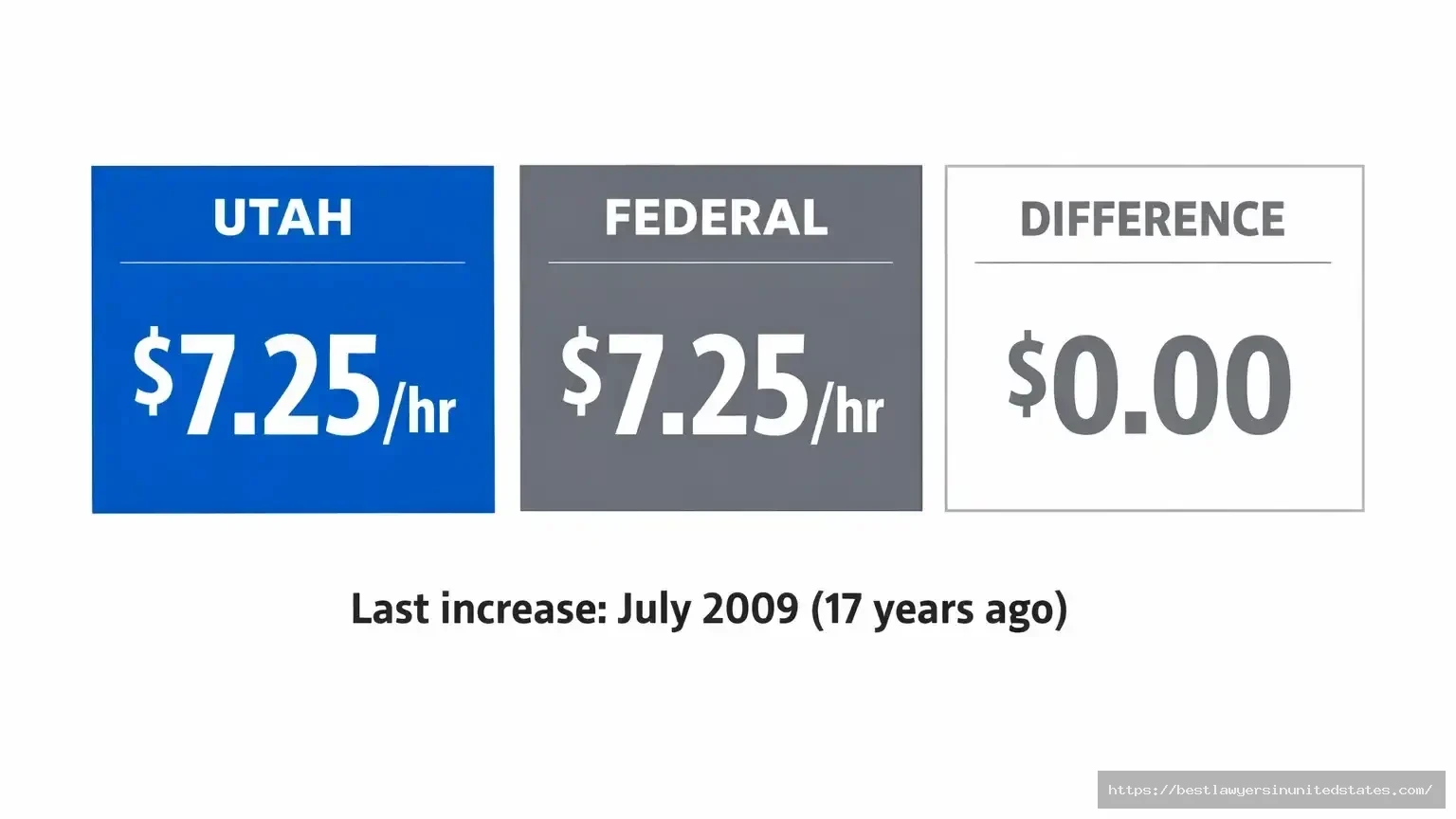
Utah’s minimum wage is $7.25 per hour in 2026, matching the federal rate. This hasn’t changed since 2009, making Utah one of 15 states with no wage increases above federal law. Unlike neighboring states, Utah has no scheduled increases for 2027 or beyond.
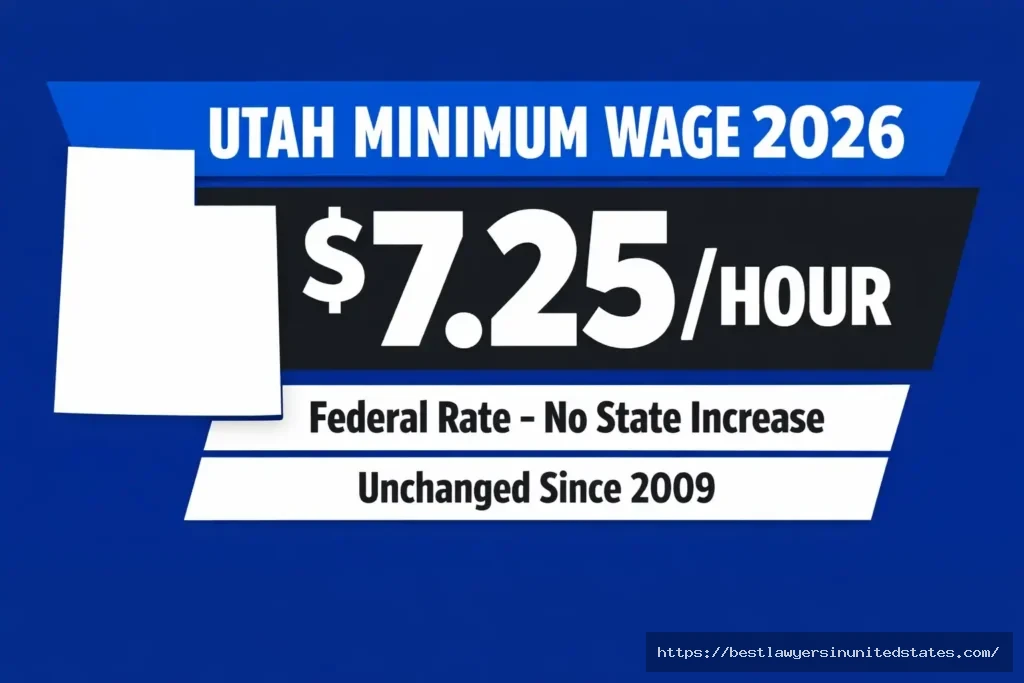
Workers earning minimum wage in Utah face significant financial challenges. A full-time minimum wage worker earns just $15,080 annually before taxes, while the living wage for a single adult is $17.32 per hour. This creates a gap of over $20,000 per year between minimum wage and actual living costs.
Calculate Your Earnings in Utah
Want to know exactly how much you’ll earn at Utah’s $7.25 minimum wage? Use our free calculator to estimate your weekly, monthly, and annual income based on your hours worked.
💰 Minimum Wage Earnings Calculator
Calculate your weekly, monthly, and annual earnings with overtime and tax estimates
📊 Your Earnings Breakdown
💰 Gross Earnings
Calculator features:
- Automatic Utah wage rates for 2026
- Weekly, monthly, and annual earnings
- Overtime calculations
- Tax withholding estimates
- Take-home pay breakdown
Full calculator with all features: https://bestlawyersinunitedstates.com/minimum-wage-calculator/
Questions about your wages or need legal help? Email: [email protected]
What Is Utah's Minimum Wage in 2026?
Utah's minimum wage is $7.25 per hour as of January 1, 2026. This rate applies to all workers unless they fall under specific exemptions like tipped employees, youth workers, or certain agricultural positions.
Why Utah Follows Federal Minimum Wage
Utah has no state minimum wage law above the federal level. The state defers to the Fair Labor Standards Act (FLSA), which sets the baseline at $7.25 per hour. This puts Utah behind many neighboring states that have implemented higher wages.
The table below shows how Utah compares to federal standards:
| Jurisdiction | Minimum Wage | Tipped Wage | Last Increase |
|---|---|---|---|
| Utah | $7.25 | $2.13 | Never (follows federal) |
| Federal | $7.25 | $2.13 | July 2009 |
| Difference | $0.00 | $0.00 | 17 years unchanged |
Annual Salary on Utah Minimum Wage
A full-time worker (40 hours per week) earning Utah's minimum wage makes:
- Weekly: $290 before taxes
- Monthly: $1,257 before taxes
- Annually: $15,080 before taxes
Part-time workers (20 hours per week) earn:
- Weekly: $145 before taxes
- Monthly: $628 before taxes
- Annually: $7,540 before taxes
Key fact: These figures don't account for taxes, which reduce take-home pay by approximately 15-20% for minimum wage workers.
Utah Minimum Wage History: No Changes Since 1993
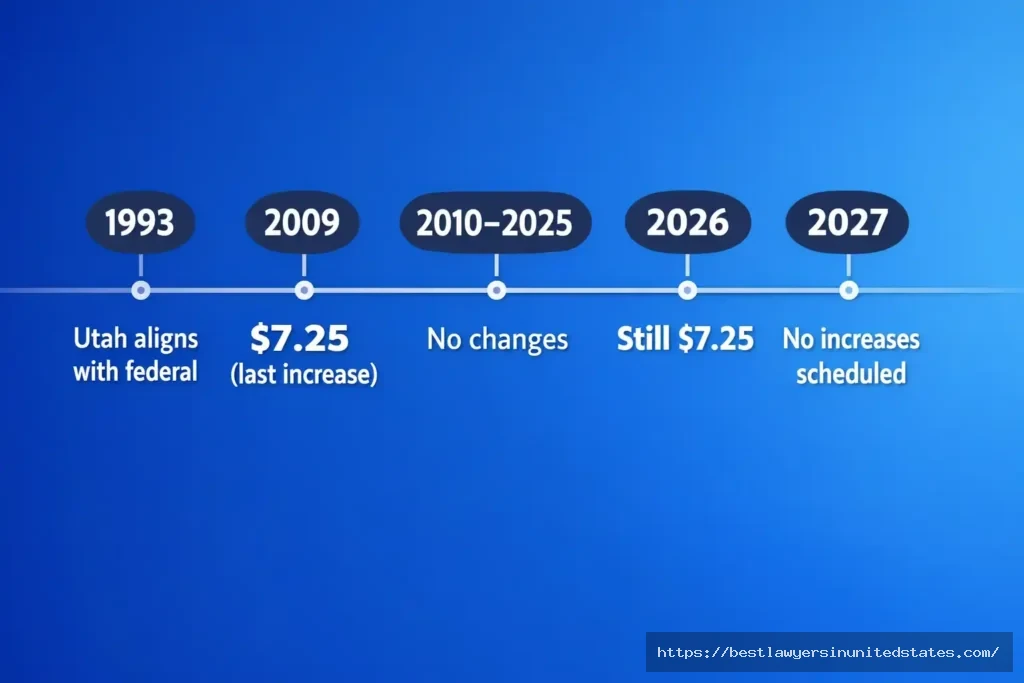
Utah has maintained a $7.25 minimum wage longer than almost any state. The wage hasn't increased because Utah law ties the state minimum to federal law, and Congress last raised the federal minimum in 2009.
Timeline of Utah Minimum Wage
| Effective Date | Minimum Wage | Notes |
|---|---|---|
| 1993 | Varies | Utah aligns with federal law |
| July 24, 2009 | $7.25 | Federal increase (current rate) |
| 2010-2025 | $7.25 | No changes |
| Jan 1, 2026 | $7.25 | Still unchanged |
| 2027+ | $7.25 | No increases scheduled |
Why No Increases Since 1993?
Utah's legislature has rejected multiple attempts to raise the minimum wage. The state's Republican-controlled government argues that market forces should determine wages, not legislative mandates. Recent failed proposals include:
- 2023: Bill to raise minimum wage to $15/hour (rejected)
- 2021: Proposal for $12/hour minimum (failed in committee)
- 2019: Initiative for $10/hour minimum (didn't advance)
Inflation impact: $7.25 in 2009 had the same purchasing power as approximately $10.50 in 2026 dollars. This means minimum wage workers have lost about 31% of their buying power since the last increase.
Utah Tipped Employee Minimum Wage
Utah allows employers to pay tipped workers as little as $2.13 per hour, provided tips bring total compensation to at least $7.25 per hour. This is called the "tip credit system."
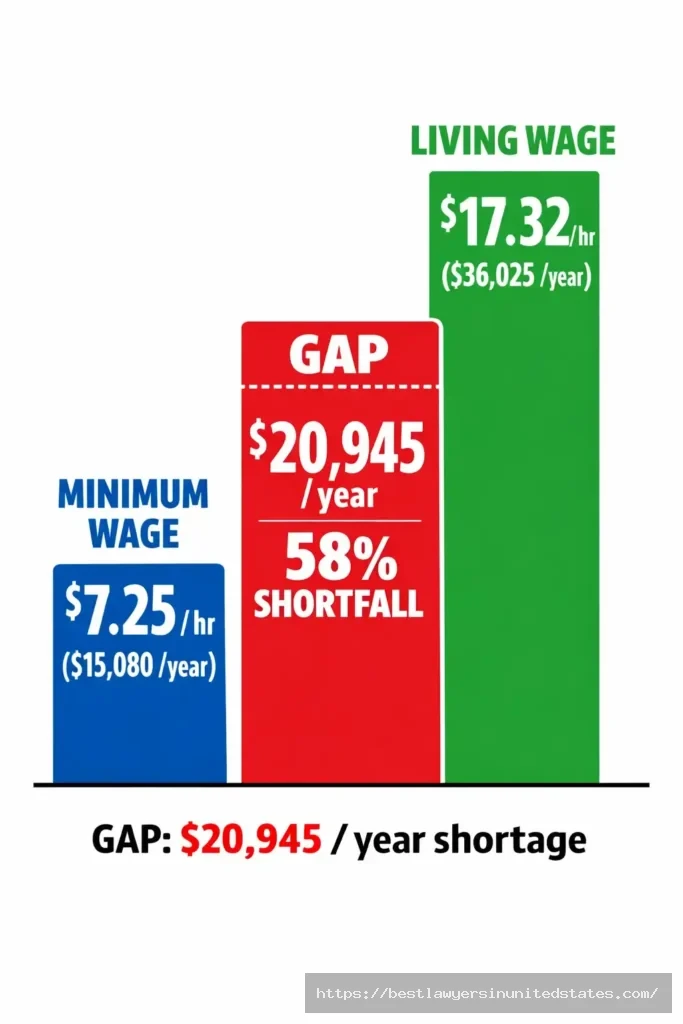
How Tip Credits Work in Utah
Base cash wage: $2.13/hour Maximum tip credit: $5.12/hour Required total: $7.25/hour minimum
If a server's tips don't bring them to $7.25 per hour, the employer must make up the difference. However, many tipped workers report violations where employers fail to meet this obligation.
Who Qualifies as a Tipped Employee?
Utah law defines tipped employees as workers who regularly receive more than $30 per month in tips. This includes:
- Restaurant servers and bartenders
- Delivery drivers who receive tips
- Valets and parking attendants
- Hotel bellhops and housekeepers who receive tips
- Barbers and hairstylists who receive tips
Tipped Wage Violations in Utah
Common employer violations:
- Not making up the difference when tips fall short of $7.25/hour
- Including managers or supervisors in tip pools
- Taking a portion of tips for "house fees"
- Applying tip credits to non-tipped work (like cleaning or food prep)
Your rights: If your employer violates tip credit rules, you can file a wage claim with the Utah Labor Commission. You may recover unpaid wages plus penalties.
State comparison: Unlike states such as California and Nevada, which prohibit tip credits entirely, Utah follows the federal model allowing employers to pay $2.13 base wage.
Calculate Your Overtime Pay in Utah
Working more than 40 hours per week? Calculate your overtime earnings based on Utah's overtime laws. Utah follows federal FLSA overtime rules requiring time-and-a-half for hours over 40 per week.
⏰ Overtime Pay Calculator
Calculate your overtime earnings based on your state's specific labor laws
📍 Select Your State
💰 Your Hourly Wage
📊 Calculation Method
📅 Weekly Hours
💵 Your Weekly Overtime Pay
📊 Earnings Breakdown
📅 Pay Period Estimates
⚖️ State vs Federal Comparison
Calculator features:
- Utah-specific overtime rules
- Weekly overtime calculations
- Pay period breakdowns
- Comparison with federal law
Full overtime calculator: https://bestlawyersinunitedstates.com/overtime-pay-calculator/
Questions about your wages or need legal help? Email: [email protected]
Utah Overtime Laws: When You're Entitled to Time-and-a-Half
Utah follows the federal Fair Labor Standards Act for overtime pay. Non-exempt employees must receive 1.5 times their regular hourly rate for all hours worked over 40 in a workweek.
Overtime Rate Calculation
For minimum wage workers:
- Regular rate: $7.25/hour
- Overtime rate: $10.88/hour (1.5 × $7.25)
Example: If you work 50 hours in one week at minimum wage:
- Regular pay: 40 hours × $7.25 = $290
- Overtime pay: 10 hours × $10.88 = $108.80
- Total weekly pay: $398.80
Who Is Exempt from Overtime?
Not all workers qualify for overtime. Utah follows federal exemptions for:
Executive employees:
- Manage a business or department
- Supervise at least two employees
- Earn at least $684/week salary ($35,568/year)
Administrative employees:
- Perform office work related to business operations
- Exercise independent judgment
- Earn at least $684/week salary
Professional employees:
- Work requiring advanced knowledge/education
- Includes doctors, lawyers, teachers, engineers
- Earn at least $684/week salary
Common misclassification: Many employers incorrectly classify workers as "salary" to avoid overtime. Just receiving a salary doesn't make you exempt. You must meet specific duties tests and earn above the threshold.
Utah vs Other States on Overtime
| State | Overtime Trigger | Daily Overtime | Special Rules |
|---|---|---|---|
| Utah | 40 hours/week | No | Follows federal FLSA |
| California | 40 hours/week | Yes (8 hrs/day) | Double-time after 12 hrs |
| Colorado | 40 hours/week | Yes (12 hrs/day) | Industry-specific rules |
| Federal | 40 hours/week | No | Baseline standard |
Key difference: Unlike California and Colorado, Utah has no daily overtime requirements. You only earn overtime after exceeding 40 hours in a seven-day workweek.
Living Wage vs Minimum Wage in Utah
Utah's minimum wage falls dramatically short of what workers need to cover basic living expenses. According to MIT's Living Wage Calculator, a single adult needs $17.32 per hour to afford housing, food, transportation, and healthcare in Utah.
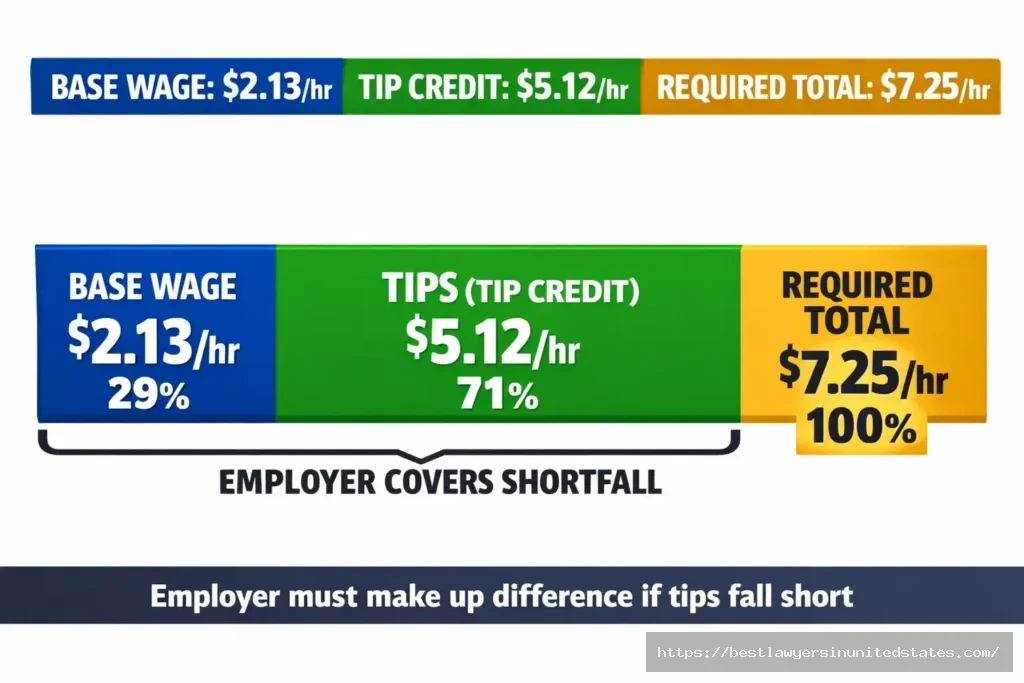
The Utah Wage Gap
Minimum wage: $7.25/hour ($15,080/year) Living wage (single adult): $17.32/hour ($36,025/year) Annual shortage: $20,945
This means a full-time minimum wage worker in Utah earns 58% less than the amount needed for basic necessities.
Living Wage by Family Size
| Family Composition | Living Wage (Hourly) | Annual Salary Needed | Gap from Min Wage |
|---|---|---|---|
| 1 Adult | $17.32 | $36,025 | -$20,945 |
| 1 Adult + 1 Child | $34.18 | $71,094 | -$56,014 |
| 2 Adults (both working) | $13.89 each | $28,891 each | -$13,811 each |
| 2 Adults + 2 Children | $25.79 each | $53,643 each | -$38,563 each |
Utah Housing Affordability Crisis
Median rent in Salt Lake City: $1,450/month Minimum wage take-home: ~$967/month after taxes Percentage of income to rent: 150%
A minimum wage worker would need to work 156 hours per week (more than double full-time) to afford the average apartment in Utah while following the standard "30% of income on housing" guideline.
Comparison to higher-wage states: In California, where minimum wage is $16.50, workers still face affordability challenges but the gap is smaller. A California minimum wage worker earns 127% more than a Utah minimum wage worker.
Utah Minimum Wage by City: No Local Ordinances
Unlike many states, Utah does not allow cities to set their own minimum wages above the state level. All cities follow the state and federal minimum of $7.25 per hour.
Major Utah Cities Minimum Wage
| City | Minimum Wage | Local Ordinance? | Cost of Living Index |
|---|---|---|---|
| Salt Lake City | $7.25 | No | 110.8 (national avg = 100) |
| Provo | $7.25 | No | 101.2 |
| Ogden | $7.25 | No | 94.7 |
| Logan | $7.25 | No | 96.3 |
| St. George | $7.25 | No | 103.4 |
Why Utah Has No Local Minimum Wages
Utah Code prohibits municipalities from establishing minimum wages different from state law. This creates statewide uniformity but prevents cities with higher costs of living from adjusting wages accordingly.
Compare to other states: Cities in Arizona (Flagstaff: $17.40) and Colorado (Denver: $18.29) have implemented local minimum wages significantly higher than state rates.
Cost of Living Variations Across Utah
While minimum wage stays constant, living costs vary significantly:
Salt Lake City:
- Median rent: $1,450/month
- Food costs: 105% of national average
- Transportation: 110% of national average
Provo:
- Median rent: $1,200/month
- Food costs: 98% of national average
- Transportation: 95% of national average
St. George:
- Median rent: $1,350/month
- Food costs: 102% of national average
- Transportation: 105% of national average
Youth Employment & Training Wages in Utah
Utah allows employers to pay reduced wages to certain young workers. These provisions follow federal FLSA guidelines for youth employment.
Training Wage for Workers Under 20
Employers can pay a training wage of $4.25 per hour to employees under 20 years old during their first 90 consecutive calendar days of employment. After 90 days, the worker must receive at least $7.25 per hour.
Training wage restrictions:
- Cannot displace other workers to hire training wage employees
- Must be a new hire, not a rehire
- 90-day period doesn't restart if employee changes positions
- Cannot extend beyond 90 days under any circumstances
Utah Minor Employment Rules
Workers under 18 face different wage and hour restrictions based on age:
Ages 16-17:
- Can work unlimited hours outside school hours
- Must receive at least $7.25/hour (no youth minimum wage)
- Can work in most non-hazardous jobs
- Need work permits in some cases
Ages 14-15:
- Cannot work during school hours (7am-4pm on school days)
- Maximum 3 hours per school day, 18 hours per school week
- Maximum 8 hours per non-school day, 40 hours per non-school week
- Cannot work before 7am or after 7pm (9pm June-Labor Day)
- Must receive at least $7.25/hour
Under 14:
- Extremely limited employment options
- Generally restricted to family businesses, entertainment, or newspaper delivery
- Strict hour limitations and permit requirements
Work Permit Requirements
Utah requires work permits (Certificate to Employ Minor) for workers under 18 in certain situations. Employers obtain these through:
- Utah Labor Commission
- School districts
- Online application systems
Violation penalties: Employers who violate youth employment laws face fines up to $10,000 per violation.
What Major Employers Pay in Utah
While Utah's minimum wage remains at $7.25, many major employers pay significantly higher starting wages due to market competition and labor shortages.
2026 Starting Wages at Major Utah Employers
| Company | Starting Wage | Position Type | Benefits |
|---|---|---|---|
| Walmart | $14-$19/hour | Retail, warehouse | Health, 401k |
| Target | $15-$24/hour | Retail, fulfillment | Health, education assistance |
| Amazon | $17-$21/hour | Fulfillment center | Health, tuition |
| Costco | $18-$25/hour | Warehouse, retail | Health, strong benefits |
| McDonald's | $11-$14/hour | Crew member | Varies by franchise |
| Chick-fil-A | $13-$16/hour | Team member | Scholarships |
| Smith's (Kroger) | $12-$16/hour | Retail, deli | Union benefits |
| Harmons | $13-$17/hour | Grocery | Employee ownership |
Why Companies Pay Above Minimum Wage
Labor market competition: With unemployment below 3% in Utah, employers must offer competitive wages to attract workers.
Employee retention: Higher wages reduce turnover costs. Training a new employee costs approximately $3,000-$5,000 for entry-level positions.
Public pressure: Consumer expectations push companies to offer "living wages" even without legal requirements.
Corporate policy: Many national chains set minimum starting wages above state requirements to maintain consistent standards.
Industry standards: Certain industries like healthcare, technology, and skilled trades naturally pay higher than minimum wage due to skill requirements.
Calculate Your Wage Theft Recovery in Utah
Think your employer owes you money? Use our wage theft calculator to estimate how much you could recover, including unpaid wages, penalties, and interest under Utah law.
Wage Theft Recovery Calculator
Estimate how much you can recover in unpaid wages, penalties, and damages based on your state's laws
💵 Estimated Total Recovery
💰 Unpaid Wages
⚖️ Penalties & Damages
📋 Total Summary
Calculator features:
- Multiple violation types (unpaid wages, overtime, tips)
- Utah-specific penalties and damages
- Filing deadline tracker
- Total recovery estimate
- Next steps guidance
Full wage theft calculator: https://bestlawyersinunitedstates.com/wage-theft-calculator/
Need help with unpaid wages? Contact Utah Labor Commission or consult with an employment attorney.
Questions about your wages or need legal help? Email: [email protected]
Utah Wage Theft: How to Recover Unpaid Wages
Wage theft costs Utah workers millions annually. Common violations include unpaid overtime, off-the-clock work, illegal tip deductions, and misclassification as independent contractors.
What Qualifies as Wage Theft in Utah?
Common violations:
- Not paying minimum wage ($7.25/hour)
- Refusing to pay overtime (time-and-a-half over 40 hours)
- Making employees work off the clock
- Not providing final paychecks on time
- Taking illegal deductions from wages
- Withholding tips from tipped employees
- Misclassifying employees as independent contractors
- Not paying for required training time
- Averaging hours across pay periods to avoid overtime
Filing a Wage Claim with Utah Labor Commission
Step 1: Gather documentation
- Pay stubs showing wages paid
- Timesheets or work schedules
- Employment contract or offer letter
- Text messages or emails about hours worked
- Bank statements showing direct deposits
Step 2: Contact your employer Utah law doesn't require this, but informal resolution can save time. Send a written request for unpaid wages via certified mail.
Step 3: File with Utah Labor Commission Submit a wage claim to the Antidiscrimination and Labor Division (UALD):
- Online: Through Utah Labor Commission website
- Mail: 160 East 300 South, 3rd Floor, Salt Lake City, UT 84114
- Phone: (801) 530-6801
Step 4: Mediation UALD schedules mediation between you and your employer. Most cases resolve at this stage.
Step 5: Hearing If mediation fails, UALD holds a formal hearing where both sides present evidence.
Step 6: Appeal Either party can appeal the decision to Utah Labor Commission Appeals Board.
Utah Wage Claim Deadlines
| Claim Type | Filing Deadline | Statute of Limitations |
|---|---|---|
| Unpaid regular wages | 3 years | 3 years from violation |
| Unpaid overtime | 2 years (3 if willful) | Federal FLSA timeline |
| Tip violations | 3 years | 3 years from violation |
| Final paycheck | 180 days | 180 days from separation |
Critical deadline: You have 3 years from when wages were due to file most wage claims in Utah. Missing this deadline forfeits your right to recovery.
What You Can Recover
Unpaid wages: Full amount owed plus interest
Liquidated damages: Up to double the unpaid wages for willful violations
Penalties: Utah law allows additional penalties for certain violations
Attorney fees: If you hire an attorney and win, employer may pay legal costs
Retaliation damages: If employer fires or punishes you for filing a claim
Example recovery: If your employer owes you $5,000 in unpaid overtime, you could recover:
- $5,000 in unpaid wages
- $5,000 in liquidated damages
- Additional penalties and interest
- Total potential recovery: $10,000+
Similar to Texas, Utah doesn't have a state-specific penalty system as robust as California, which offers waiting time penalties for late final paychecks.
Utah Employer Compliance Requirements
Utah employers must follow federal and state wage and hour laws. Violations can result in significant penalties and legal liability.
Required Labor Law Posters
Federal posters (required for all employers):
- Fair Labor Standards Act (FLSA) minimum wage poster
- Employee Polygraph Protection Act
- Family and Medical Leave Act (if 50+ employees)
- OSHA workplace safety poster
- Equal Employment Opportunity poster
Utah state posters:
- Utah minimum wage poster (same as federal)
- Utah workers' compensation notice
- Utah unemployment insurance notice
- Utah safety and health protection poster
Where to obtain: Download free posters from:
- Utah Labor Commission: laborcommission.utah.gov
- U.S. Department of Labor: dol.gov/agencies/whd/posters
Posting requirements: Display in conspicuous location where all employees can easily read them (break room, time clock area, main office).
Recordkeeping Requirements
Utah employers must maintain accurate records for 3 years:
Required records:
- Employee's full name and Social Security number
- Address and date of birth (if under 19)
- Sex and occupation
- Time and day when workweek begins
- Hours worked each workday and total hours each workweek
- Basis of wage payment (hourly, weekly, piecework)
- Regular hourly rate of pay
- Total daily or weekly straight-time earnings
- Total overtime earnings for the workweek
- All additions to or deductions from wages
- Total wages paid each pay period
- Date of payment and pay period covered
Penalties for poor recordkeeping: Employers who fail to maintain proper records face:
- Presumption that employee's testimony about hours worked is correct
- Fines up to $1,000 per violation
- Liability for unpaid wages even if records don't exist
Will Utah's Minimum Wage Increase in 2026 or 2027?
No. Utah has no scheduled minimum wage increases for 2026 or beyond. Any change would require legislative action, which has repeatedly failed in recent years.
Utah vs States With Scheduled Increases
While 19 states raised minimum wage on January 1, 2026, Utah was not among them. The state remains tied to the federal minimum of $7.25.
States increasing wages in 2026:
- California: $16.50 (from $16.00)
- Colorado: $14.81 (indexed to inflation)
- Arizona: $14.70 (indexed to inflation)
- Florida: $13.00 (path to $15 by 2026)
- Nevada: $12.00 (unified rate)
States with Utah's wage ($7.25):
- Wyoming: $7.25 (follows federal)
- Idaho: $7.25 (follows federal)
- Texas: $7.25 (follows federal)
- Pennsylvania: $7.25 (follows federal)
- Georgia: $7.25 state wage (federal $7.25 applies)
Why Utah Hasn't Raised Minimum Wage
Legislative opposition: Utah's Republican-controlled legislature has consistently opposed minimum wage increases, arguing:
- Market forces should set wages, not government
- Higher wages could reduce jobs
- Small businesses would face financial strain
- Current wage is sufficient with Utah's lower cost of living
Failed proposals:
- 2023: HB 15 (raise to $15/hour) died in committee
- 2021: HB 210 (raise to $12/hour) failed 23-50 vote
- 2019: Ballot initiative (raise to $10/hour) didn't gather signatures
Federal action unlikely: Congress hasn't raised the federal minimum wage since 2009. The Raise the Wage Act of 2023, which would increase federal minimum to $17 by 2028, has stalled in Congress.
Future Outlook for Utah
Likely scenario (2027-2030):
- Utah minimum wage stays at $7.25 without federal action
- Neighboring states continue increasing wages
- Market pressure forces Utah employers to pay above minimum
- Growing wage gap between Utah and surrounding states
Potential triggers for change:
- Federal minimum wage increase
- Successful ballot initiative
- Major shift in state legislature composition
- Sustained public pressure from advocacy groups
Utah vs Neighboring States: Minimum Wage Comparison 2026
Utah's $7.25 minimum wage lags significantly behind neighboring states, creating challenges for worker retention and economic competitiveness.
Regional Comparison Table
| State | Minimum Wage | Tipped Minimum | Annual Increase? | 2027 Scheduled |
|---|---|---|---|---|
| Utah | $7.25 | $2.13 | No | None |
| Colorado | $14.81 | $11.79 | Yes (CPI) | $15.29 est. |
| Nevada | $12.00 | $12.00 | No | $12.00 |
| Arizona | $14.70 | $11.70 | Yes (CPI) | $15.18 est. |
| Wyoming | $7.25 | $2.13 | No | None |
| Idaho | $7.25 | $3.35 | No | None |
| New Mexico | $12.00 | $3.00 | Yes | $12.00 |
Cost of Living Adjusted Wages
When accounting for cost of living differences, Utah's minimum wage offers even less buying power:
Real wage comparison (adjusted for COL):
- Colorado: $14.81 actual / $13.20 adjusted = $13.20 real wage
- Arizona: $14.70 actual / $13.89 adjusted = $13.89 real wage
- Utah: $7.25 actual / $7.54 adjusted = $7.54 real wage
Even after adjusting for Utah's slightly lower cost of living compared to Colorado, Utah minimum wage workers earn 43% less in real terms.
Border Effect on Utah Workers
Many Utah workers living near state borders face strategic decisions:
Utah/Nevada border (Wendover area):
- Nevada minimum: $12.00
- Utah minimum: $7.25
- Difference: $4.75/hour more in Nevada
Utah/Colorado border (Dinosaur/Vernal area):
- Colorado minimum: $14.81
- Utah minimum: $7.25
- Difference: $7.56/hour more in Colorado
Workers commuting across state lines to work in higher-wage states create labor shortages in border communities like Wendover and Vernal.
How to Calculate Your Take-Home Pay in Utah
Gross wages (what you earn) and net wages (what you take home) differ significantly due to taxes and deductions. Understanding this helps you budget accurately.
Utah Paycheck Deductions
Federal taxes:
- Federal income tax: Varies by W-4 withholding (typically 10-12% for minimum wage)
- Social Security tax: 6.2% of gross wages
- Medicare tax: 1.45% of gross wages
State taxes:
- Utah income tax: 4.65% flat rate (no brackets)
Optional deductions:
- Health insurance premiums
- 401(k) or retirement contributions
- Wage garnishments (court-ordered)
- Union dues (if applicable)
Example Take-Home Pay Calculation
Scenario: Full-time minimum wage worker ($7.25/hour, 40 hours/week)
Gross weekly pay: $290.00
Deductions:
- Federal income tax (10%): -$29.00
- Social Security (6.2%): -$17.98
- Medicare (1.45%): -$4.21
- Utah income tax (4.65%): -$13.49 Total deductions: -$64.68
Net weekly pay: $225.32
Monthly take-home: $976.39 (4.33 weeks average)
Annual take-home: $11,716
This means a minimum wage worker in Utah loses $3,364 per year to taxes, reducing their $15,080 gross annual salary to just $11,716 take-home.
Gross vs Net Wage Comparison
| Pay Period | Gross Wages | After Taxes | Effective Rate |
|---|---|---|---|
| Per hour | $7.25 | $5.63 | $5.63/hour |
| Per day (8 hrs) | $58.00 | $45.04 | 77.7% |
| Per week (40 hrs) | $290.00 | $225.32 | 77.7% |
| Per month | $1,257 | $976.39 | 77.7% |
| Per year | $15,080 | $11,716 | 77.7% |
Key insight: After taxes, Utah minimum wage workers effectively earn $5.63 per hour in spendable income, well below any reasonable living wage.
Exemptions from Utah Minimum Wage
Not all workers are covered by minimum wage laws. Utah follows federal FLSA exemptions for certain employee categories.
Who Is Exempt from Utah Minimum Wage?
Executive exemption:
- Primary duty is managing the business or a department
- Regularly supervises at least two full-time employees
- Has authority to hire/fire or makes recommendations on employment decisions
- Earns at least $684/week salary ($35,568/year)
Administrative exemption:
- Performs office or non-manual work related to business operations
- Exercises discretion and independent judgment on significant matters
- Earns at least $684/week salary
Professional exemption:
- Work requires advanced knowledge in a field of science or learning
- Knowledge typically acquired through prolonged specialized education
- Includes doctors, lawyers, engineers, teachers
- Earns at least $684/week salary
Computer employee exemption:
- Computer systems analyst, programmer, software engineer
- Paid either $684/week salary OR $27.63/hour
- Performs specific computer-related duties
Outside sales exemption:
- Primary duty is making sales away from employer's place of business
- No minimum salary requirement
- Must regularly work away from employer's location
Other Workers Not Covered
Independent contractors:
- Not employees, therefore not covered by minimum wage laws
- Must meet IRS guidelines for contractor status
- Misclassification is common and illegal
Agricultural workers:
- Some exemptions for small farms
- Must be paid minimum wage if farm uses more than 500 man-days of labor
Seasonal/recreational workers:
- Employees of seasonal amusement or recreational establishments
- Limited operations during year
Student workers:
- Full-time students in retail, service, or agriculture
- Can be paid 85% of minimum wage ($6.16) with certificate
- Limited to 20 hours/week when school is in session
Employees with disabilities:
- Can be paid below minimum with special certificate from Department of Labor
- Wage must be commensurate with productivity
Misclassification Issues
Common employer mistakes:
- Calling someone "salary" doesn't make them exempt
- Job titles don't determine exemption status
- Must meet BOTH salary threshold AND duties test
- Many "managers" don't qualify for exemption
If misclassified: You may be entitled to unpaid overtime for all hours over 40 per week. File a claim with Utah Labor Commission or contact an employment attorney.
Utah Payment of Wages Act: Final Paycheck Rules
Utah Code § 34-28-5 governs when employers must provide final paychecks after employment ends. Violations can result in penalties and legal action.
When Is Final Paycheck Due in Utah?
If terminated (fired):
- Employer must pay within 24 hours of employee's demand
- Payment can be mailed or made available at usual pay location
- Includes all wages earned through last day worked
If you quit with notice:
- Final check due on next regular payday
- At least 72 hours advance notice of resignation required
- Delivered through normal payroll process
If you quit without notice:
- Employer can wait until next regular payday OR
- Pay within 24 hours if employee demands payment
- Same rules as termination apply
What Must Be Included in Final Paycheck
Required payments:
- All regular wages through last day worked
- All earned overtime pay
- Accrued vacation pay (if company policy requires payout)
- Earned commissions and bonuses
- Expense reimbursements owed
Not required in Utah:
- Accrued sick leave (unless policy states otherwise)
- Severance pay (unless contractually agreed)
- Pro-rated PTO for current year
Illegal Paycheck Deductions
Utah employers cannot deduct from final paychecks for:
Prohibited deductions:
- Cash register shortages (unless written agreement)
- Damaged equipment (unless willful or grossly negligent)
- Uniforms required for work
- Tools needed to perform job
- Customer walkouts (at restaurants)
- Acceptance of bad checks
Legal deductions:
- Court-ordered wage garnishments
- Authorized retirement contributions
- Health insurance premiums (if agreed)
- Repayment of salary advances (if agreed in writing)
Penalties for Late Final Paycheck
Employee remedies:
- File wage claim with Utah Labor Commission
- Recover unpaid wages
- Potentially receive penalties for employer's willful violation
- May pursue private lawsuit
Employer consequences:
- Back pay owed in full
- Potential liquidated damages
- Attorney fees if employee wins
- State penalties for violations
Example: If your employer withholds your $800 final paycheck for three weeks, you can file a claim and potentially recover the $800 plus penalties and interest.
Frequently Asked Questions
What is Utah's minimum wage in 2026?
Quick Answer: Utah's minimum wage is $7.25 per hour in 2026, the same as the federal minimum wage.
This rate applies to all employers and most workers, though exemptions exist for tipped employees, youth workers, and certain other categories. Utah has no state minimum wage above federal law.
Will Utah's minimum wage increase in 2027?
Quick Answer: No. Utah has no scheduled minimum wage increases for 2027 or beyond.
Utah ties its minimum wage to federal law, and Congress hasn't raised the federal rate since 2009. Any change would require either federal action or new Utah legislation.
What is the tipped minimum wage in Utah?
Quick Answer: Tipped workers in Utah can be paid $2.13 per hour base wage, provided tips bring total compensation to at least $7.25 per hour.
If tips don't reach $7.25/hour, employers must make up the difference. This is called the tip credit system.
Does Salt Lake City have a higher minimum wage than the state?
Quick Answer: No. Salt Lake City follows Utah's $7.25/hour minimum wage.
Utah law prohibits cities from setting minimum wages above the state level, unlike states such as California or Arizona where cities can establish higher local rates.
How do I calculate my earnings at Utah minimum wage?
Quick Answer: Use our free minimum wage calculator at https://bestlawyersinunitedstates.com/minimum-wage-calculator/
At $7.25/hour full-time, you'll earn $290/week, $1,257/month, or $15,080/year before taxes. After taxes, expect about $11,716 annually.
How much overtime pay am I entitled to in Utah?
Quick Answer: Utah requires 1.5 times your regular rate for hours over 40 per week.
For minimum wage workers, overtime pays $10.88/hour. Calculate your overtime at https://bestlawyersinunitedstates.com/overtime-pay-calculator/
How do I calculate wage theft recovery in Utah?
Quick Answer: Use our wage theft calculator at https://bestlawyersinunitedstates.com/wage-theft-calculator/
You can recover unpaid wages plus potentially double damages for willful violations. Utah allows recovery for up to 3 years of unpaid wages.
Can employers pay workers under 18 less than minimum wage?
Quick Answer: Workers under 20 can be paid $4.25/hour training wage for their first 90 days only.
After 90 days, or if worker is 20+, full $7.25/hour minimum applies. Workers 16-17 generally must receive full minimum wage.
How long do I have to file a wage claim in Utah?
Quick Answer: You have 3 years from when wages were due to file most wage claims in Utah.
File with Utah Labor Commission's Antidiscrimination and Labor Division. Waiting too long forfeits your right to recovery.
What is a living wage in Utah?
Quick Answer: A single adult needs $17.32/hour ($36,025/year) for basic necessities in Utah.
This is $10.07 more than minimum wage, creating a gap of $20,945 annually. Families need even higher wages to cover living expenses.
When must employers give me my final paycheck in Utah?
Quick Answer: Within 24 hours if you're fired or demand payment; next regular payday if you quit with notice.
Utah law requires employers to include all earned wages, overtime, and accrued vacation in final paychecks.
Can I work for tips only in Utah?
Quick Answer: No. Employers must pay at least $2.13/hour base wage, and tips must bring you to $7.25/hour total.
If your tips fall short, your employer must make up the difference. Working for "tips only" with no base wage is illegal.
Need help with unpaid wages or minimum wage violations? Email: [email protected]
Use our free calculators:
- Wage Calculator: https://bestlawyersinunitedstates.com/minimum-wage-calculator/
- Overtime Calculator: https://bestlawyersinunitedstates.com/overtime-pay-calculator/
- Wage Theft Calculator: https://bestlawyersinunitedstates.com/wage-theft-calculator/
Official Resources:
- Utah Labor Commission: laborcommission.utah.gov
- File Wage Claim: laborcommission.utah.gov/divisions/UALD
- U.S. Department of Labor: dol.gov/agencies/whd
