
Ohio calls drunk driving “OVI” (Operating a Vehicle Impaired), not DUI. Getting charged with OVI in Ohio means facing jail time, fines up to $10,500, and license suspension from 6 months to life. The state uses a strict penalty system under Ohio Revised Code § 4511.19 that increases punishment with each offense.
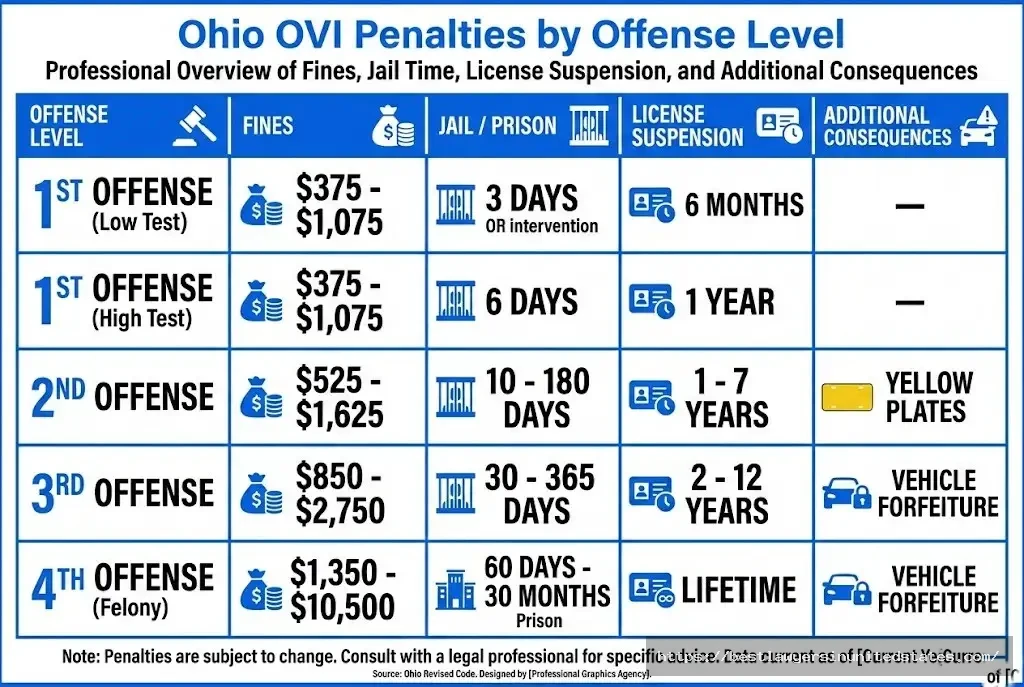
New laws took effect April 9, 2025, introducing oral fluid testing and higher fines. Fourth-time offenders now face felony charges with prison time up to 30 months.
What is an OVI in Ohio? (OVI vs. DUI Explained)
Ohio law uses “Operating a Vehicle Impaired” instead of DUI. The term covers both alcohol and drug impairment under ORC § 4511.19. Police can charge you with OVI even if your vehicle isn’t moving.
Key difference: Ohio prosecutors don’t need to prove you were “driving.” They only need to show you had “actual physical control” of a vehicle while impaired. Sitting in a parked car with keys in the ignition can trigger OVI charges.
Three Types of OVI Charges in Ohio
Per Se OVI: Your blood alcohol concentration (BAC) exceeds legal limits. Officers don’t need to prove visible impairment. Standard limit is .08%, high test is .17% or above. Testing over these thresholds automatically violates Ohio law.
Impairment OVI: Police observe signs of impairment regardless of BAC level. Failed field sobriety tests, erratic driving, or slurred speech support these charges. Prosecutors can charge you even with BAC under .08% if they prove impairment.
Drug OVI: Operating under the influence of controlled substances. Ohio sets specific thresholds for marijuana, cocaine, and other drugs. The state can charge you based on metabolites (drug breakdown products) in your system days after use.
Ohio OVI Penalties Chart 2026
Ohio divides first offenses into “low test” (.08-.169 BAC) and “high test” (.17+ BAC). Refusal to submit to testing carries the same penalties as high test results.
First Offense OVI Penalties
| Penalty Type | Low Test (.08-.169) | High Test (.17+) or Refusal |
|---|---|---|
| Jail Time | 3 days or 3-day intervention program | 6 days (3 mandatory) |
| Fines | $375-$1,075 | $375-$1,075 |
| License Suspension | 6 months to 3 years | 1-3 years |
| Restricted Plates | No | No |
| Points | 6 | 6 |
Critical deadline: You have 10 days from arrest to request an Administrative License Suspension (ALS) hearing with the Ohio BMV.
First-time offenders can attend a 3-day Driver Intervention Program instead of serving jail time for low test offenses. This residential program costs $350-$550 depending on the facility.
Second Offense OVI Penalties (Within 10 Years)
| Penalty Type | Low Test | High Test or Refusal |
|---|---|---|
| Jail Time | 10-180 days (10 mandatory) | 20-180 days (20 mandatory) |
| Fines | $525-$1,625 | $525-$1,625 |
| License Suspension | 1-7 years | 1-7 years |
| Restricted Plates | Yes (mandatory) | Yes (mandatory) |
| Vehicle Action | Immobilization 90 days OR forfeiture | Immobilization 90 days OR forfeiture |
| Points | 6 | 6 |
Yellow plates required: Ohio mandates distinctive yellow license plates with red lettering for all second and subsequent offenses. Courts can order vehicle immobilization for 90 days or complete forfeiture.
Third Offense OVI Penalties (Within 10 Years)
| Penalty Type | Low Test | High Test or Refusal |
|---|---|---|
| Jail Time | 30-365 days (30 mandatory) | 60-365 days (60 mandatory) |
| Fines | $850-$2,750 | $850-$2,750 |
| License Suspension | 2-12 years | 2-12 years |
| Restricted Plates | Yes (mandatory) | Yes (mandatory) |
| Vehicle Action | Forfeiture (mandatory) | Forfeiture (mandatory) |
| Points | 6 | 6 |
Permanent forfeiture: Third offenses trigger automatic vehicle forfeiture. The state seizes and sells your car regardless of who owns it.
Fourth Offense OVI (Felony)
Four or more OVI convictions within 20 years escalates to a fourth-degree felony (F4). This brings prison time instead of county jail.
| Penalty Type | Amount |
|---|---|
| Prison Time | 60 days to 30 months |
| Fines | $1,350-$10,500 |
| License Suspension | 3 years to lifetime |
| Restricted Plates | Yes (mandatory) |
| Vehicle Forfeiture | Mandatory |
| Felony Record | Permanent |
No expungement: Felony OVI convictions cannot be sealed or expunged in Ohio. This creates permanent barriers to employment, housing, and professional licensing.
Wondering how these penalties affect your finances? Calculate your total costs including fines, attorney fees, and insurance increases with our DUI cost calculator.
DUI Cost Calculator
Estimate total DUI expenses by state and offense
Detailed Cost Breakdown
Payment Timeline
Bail bond, towing fees, car impound, attorney retainer
Initial court fines, DMV fees, DUI school enrollment, ignition interlock installation
Monthly probation fees, ignition interlock fees, DUI school payments, attorney balance
Insurance premium increases, license reinstatement, SR-22 filing fees
- Lost wages from missed work (court dates, jail time, DUI school) – $2,000-$10,000
- Job loss or difficulty finding employment – Varies
- Professional license suspension (doctors, lawyers, nurses, pilots) – Career ending
- Rideshare and transportation costs during suspension – $1,500-$5,000
- Travel restrictions and visa denials – Varies
- Security clearance loss – Career impact
- Child custody implications – Legal costs
- Rental car restrictions – Varies
- Personal relationships and mental health costs – Priceless
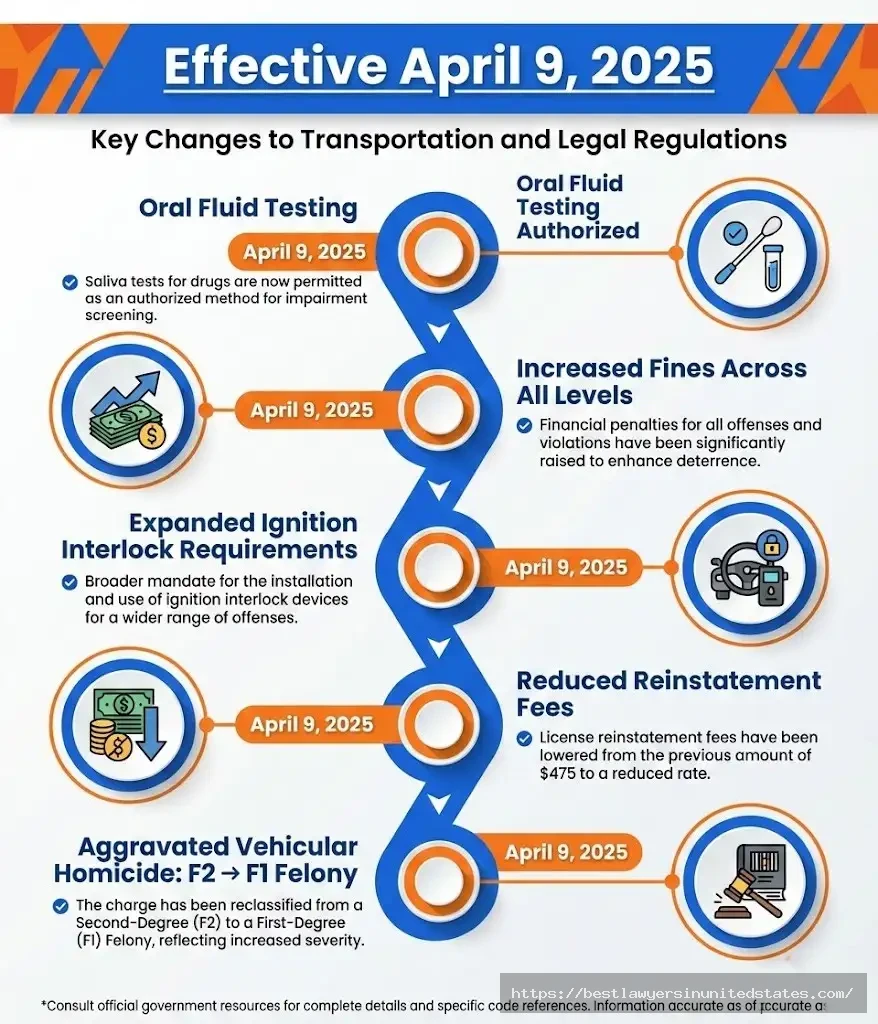
New Ohio OVI Laws Effective April 9, 2025
Ohio implemented significant changes to OVI enforcement and penalties in 2025. These updates affect testing procedures, fines, and license reinstatement requirements.
Oral Fluid Testing Explained
Ohio now authorizes roadside oral fluid (saliva) testing for drug detection. Law enforcement uses FDA-approved devices that analyze saliva for marijuana, cocaine, amphetamines, and opioids.
How it works:
- Officer swabs inside of your cheek
- Device produces results in 5-10 minutes
- Positive results trigger arrest and blood test confirmation
- Results admissible in court with proper chain of custody
The Alere DDS2 device detects THC levels as low as 25 ng/mL. This means marijuana users can test positive days after consumption, even without current impairment.
Legal challenges: Defense attorneys question the accuracy of oral fluid testing. The devices show higher false positive rates than blood tests. Courts haven’t fully established reliability standards for admissibility.
Updated Fines and Penalties
All OVI offense levels saw fine increases starting April 9, 2025:
| Offense | Old Fine Range | New Fine Range | Increase |
|---|---|---|---|
| 1st | $375-$1,075 | $375-$1,075 | No change |
| 2nd | $525-$1,625 | $525-$1,625 | No change |
| 3rd | $850-$2,750 | $850-$2,750 | No change |
| 4th+ (Felony) | $1,350-$10,500 | $1,350-$10,500 | No change |
Court costs separate: These fines don’t include mandatory court costs of $150-$300 or specialized docket fees. Total costs typically run $800-$1,200 higher than base fines.
Ignition Interlock Changes
Ohio expanded ignition interlock device (IID) requirements. First-time offenders can now install IIDs to qualify for limited driving privileges during their suspension period.
New requirements:
- IID mandatory for all “high test” offenses (.17+ BAC)
- Installation required within 15 days of court order
- Monthly monitoring fee $75-$100
- Removal requires BMV approval after suspension ends
The device prevents your vehicle from starting if you blow over .025 BAC. Random rolling retests occur while driving. Failed tests trigger engine shutdown after you safely pull over.
Aggravated Vehicular Homicide Penalties
OVI crashes causing death now carry enhanced penalties. Aggravated vehicular homicide jumped from a second-degree felony (F2) to a first-degree felony (F1) when OVI is the underlying cause.
| Old Penalty (F2) | New Penalty (F1) |
|---|---|
| 2-8 years prison | 3-11 years prison |
| $10,000 fine | $20,000 fine |
| Discretionary license suspension | Lifetime suspension |
Mandatory prison time: Courts must impose prison sentences for aggravated vehicular homicide. Probation isn’t an option.
Ohio BAC Limits and Testing Requirements
Ohio sets different BAC thresholds based on driver type and age. Understanding these limits helps you know when you’re over the legal threshold.
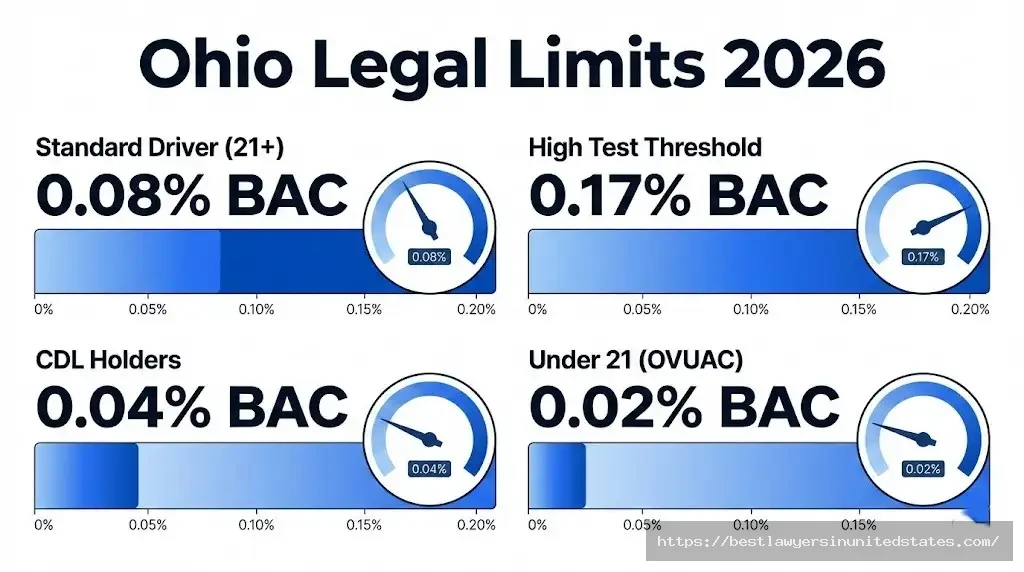
Standard BAC Limit (.08)
Drivers age 21 and older face OVI charges at .08 BAC or higher. This “per se” limit means prosecutors don’t need additional evidence of impairment. Use our BAC calculator to estimate your blood alcohol level based on drinks consumed, weight, and time elapsed.
BAC Calculator
Estimate your Blood Alcohol Content
• Commercial Driver (CDL): 0.04% BAC
• Drivers Under 21: 0.00-0.02% BAC (Zero Tolerance)
• Enhanced Penalties: 0.15% BAC or higher in most states
How BAC is calculated:
- Weight and gender affect alcohol absorption
- One standard drink typically raises BAC .02%
- Liver metabolizes alcohol at .015% per hour
- Food in stomach slows absorption
Police measure BAC through breath, blood, or urine tests. Breath tests (Intoxilyzer machines) are most common at police stations. Blood tests occur at hospitals after accidents or when breath testing isn’t available.
High Test BAC (.17+)
Ohio doubles penalties for “high test” offenses at .17 BAC or above. This triggers mandatory jail time instead of intervention program options.
Penalty differences:
| Offense | Standard (.08-.169) | High Test (.17+) |
|---|---|---|
| 1st | 3 days jail OR intervention | 6 days jail (3 mandatory) |
| 2nd | 10 days jail (10 mandatory) | 20 days jail (20 mandatory) |
| 3rd | 30 days jail (30 mandatory) | 60 days jail (60 mandatory) |
Enhanced suspensions: High test results extend license suspension periods. First offenses bring 1-3 year suspensions instead of 6 months to 3 years.
Underage BAC Limit (.02)
Drivers under 21 face Ohio’s “zero tolerance” law under ORC § 4511.191. Any BAC above .02% triggers Operating a Vehicle Under Age Consumption (OVUAC) charges.
OVUAC penalties differ from adult OVI:
| Penalty | 1st OVUAC | 1st OVI (Adult) |
|---|---|---|
| Suspension | 90 days to 2 years | 6 months to 3 years |
| Jail Time | None (civil violation) | 3-6 days |
| Fines | $250 | $375-$1,075 |
| Points | 4 | 6 |
Crossover threshold: Underage drivers who blow .08 or higher get charged with standard OVI, not OVUAC. This brings full adult penalties including mandatory jail time.
CDL Holders (.04)
Commercial driver’s license (CDL) holders face stricter limits. Operating a commercial vehicle with .04 BAC or higher violates federal regulations under 49 CFR § 383.51.
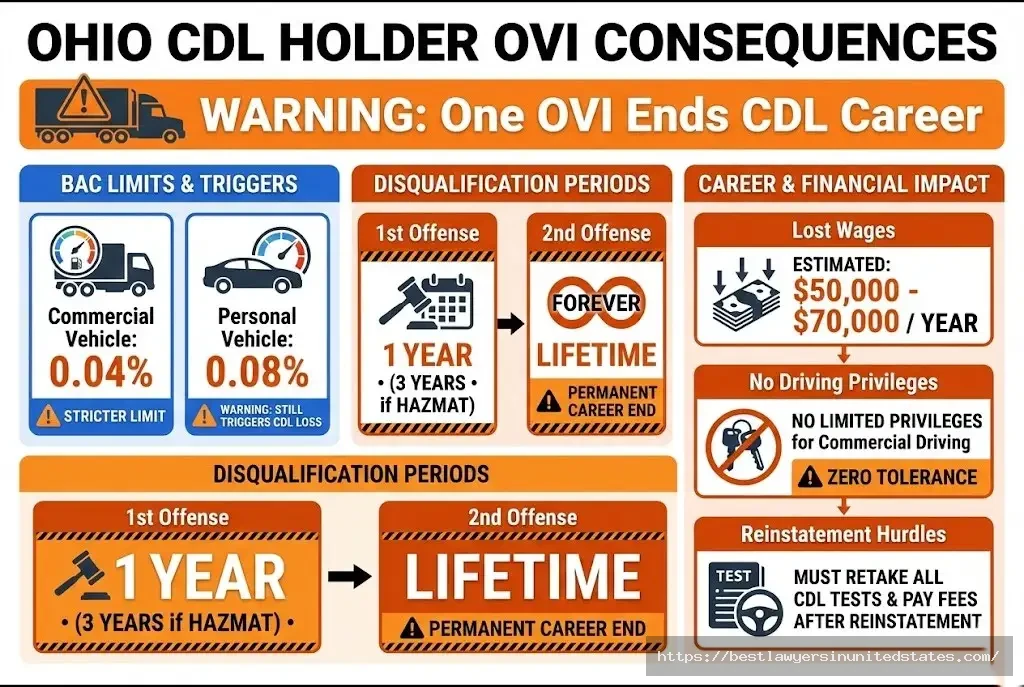
CDL disqualification periods:
| Offense | Disqualification | Notes |
|---|---|---|
| 1st .04+ BAC | 1 year | 3 years if carrying hazmat |
| 2nd .04+ BAC | Lifetime | No exceptions |
| Refusal | 1 year | Same as .04+ test |
Personal vehicle violations: Getting OVI in your personal car also triggers CDL disqualification. You don’t need to be driving commercially when arrested.
No limited privileges: Ohio doesn’t grant limited driving privileges for commercial vehicles during CDL disqualification periods. Truck drivers lose their livelihood entirely.
What Happens When You Get Arrested for OVI in Ohio?
OVI arrests follow predictable procedures from initial stop through booking. Understanding each step helps you protect your rights.
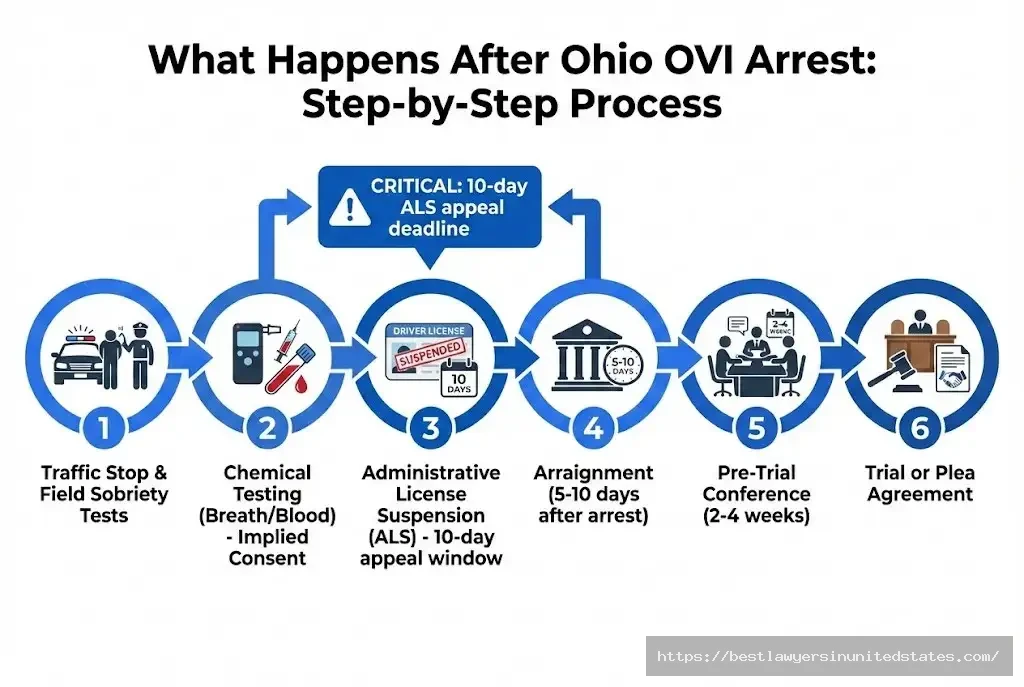
The Traffic Stop and Field Sobriety Tests
Officers need reasonable suspicion to pull you over. Common reasons include weaving, speeding, running red lights, or equipment violations like broken taillights.
What officers look for:
- Bloodshot or glassy eyes
- Smell of alcohol
- Slurred speech
- Open containers in vehicle
- Admission of drinking
Police then ask you to perform standardized field sobriety tests (SFSTs). Ohio uses three tests validated by the National Highway Traffic Safety Administration (NHTSA):
Walk-and-turn test: Walk nine steps heel-to-toe along a line, turn, and return. Officers watch for balance issues, starting before instructions end, or stepping off the line.
One-leg stand test: Stand on one foot while counting aloud for 30 seconds. Swaying, hopping, or putting your foot down indicates impairment.
Horizontal gaze nystagmus test: Follow a pen or flashlight with your eyes. Officers look for involuntary eye jerking that alcohol causes.
Critical point: Field sobriety tests are voluntary in Ohio. You can refuse without automatic penalties. Police use refusal as evidence of guilt, but poor performance on tests also harms your case.
Chemical Testing and Implied Consent
Ohio’s implied consent law under ORC § 4511.191 requires chemical testing after lawful arrest. Accepting an Ohio driver’s license means agreeing to submit breath, blood, or urine samples when arrested for OVI.
Testing timeline:
- Officer reads implied consent warning
- You choose test type (breath, blood, or urine)
- Testing occurs at police station or hospital
- Results available within 30 minutes (breath) or 2-3 weeks (blood)
Refusal consequences:
| Offense | Refusal Suspension | Test Failure Suspension |
|---|---|---|
| 1st | 1 year | 6 months |
| 2nd | 2 years | 1 year |
| 3rd+ | 3 years | 2 years |
Refusing chemical testing triggers longer suspensions than failing the test. Officers document refusals in arrest reports. Prosecutors present refusal as “consciousness of guilt” at trial.
Blood test warrants: Police can obtain warrants for forced blood draws. This commonly happens after accidents involving injuries or property damage. You cannot refuse a court-ordered blood test.
Administrative License Suspension (ALS)
The Ohio BMV automatically suspends your license when you fail or refuse chemical testing. This administrative action happens separate from criminal court proceedings.
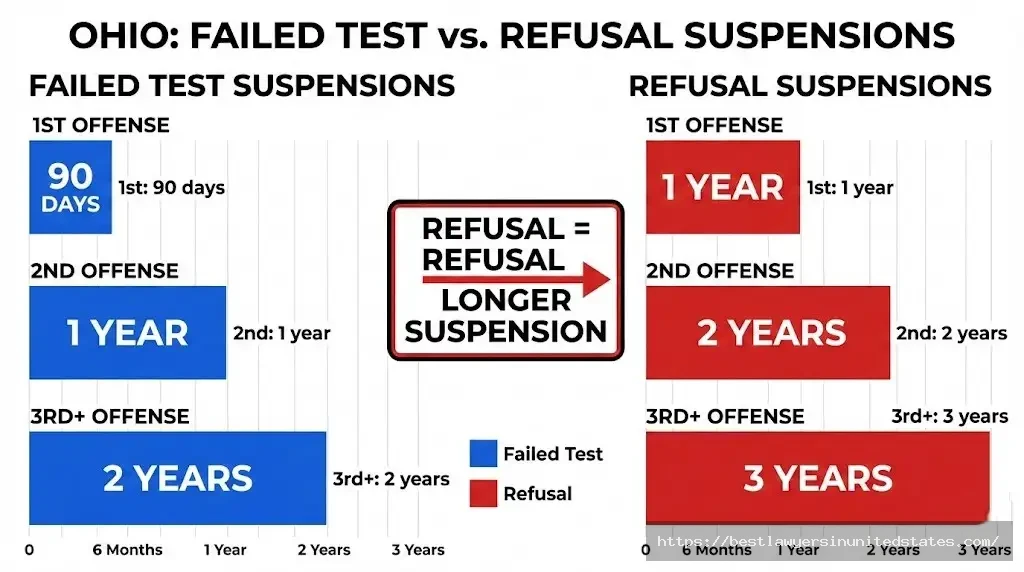
Suspension lengths:
| Test Result | 1st Offense | 2nd Offense | 3rd+ Offense |
|---|---|---|---|
| Failed test | 90 days | 1 year | 2 years |
| Refusal | 1 year | 2 years | 3 years |
Immediate effect: ALS begins the day of arrest. Officers confiscate your physical license and issue a temporary driving permit valid 30 days.
Hard suspension period: The first 15 days (failed test) or 30 days (refusal) is a “hard suspension.” You cannot drive at all during this period. No exceptions exist for work, medical appointments, or family emergencies.
The 10-Day ALS Appeal Window
You have exactly 10 days from arrest to request an ALS hearing with the Ohio BMV. Missing this deadline means automatic suspension with no chance to contest it.
Critical steps:
Day 1-3: Contact an OVI attorney. They file the appeal request with proper BMV forms.
Day 4-6: BMV schedules hearing date, typically 2-4 weeks out.
Day 7-10: Attorney prepares evidence challenging the stop, arrest, or test procedures.
Hearing location: ALS hearings occur at BMV Driver Intervention Centers, not criminal courts. Find your nearest location:
- Columbus: 1970 W Broad St, Columbus, OH 43223
- Cleveland: 14000 Brookpark Rd, Cleveland, OH 44135
- Cincinnati: 2855 West Fork Rd, Cincinnati, OH 45247
What the hearing decides: The BMV examiner reviews whether police had probable cause for arrest and whether you were properly warned about implied consent. They don’t determine guilt on the OVI charge itself.
Winning the hearing: If the BMV rules in your favor, your license stays valid. You still face criminal OVI charges in court, but you can drive legally while your case proceeds.
Ohio OVI Court Process
Criminal OVI cases move through municipal or county courts. The process typically takes 2-6 months from arrest to final disposition.
Arraignment
Your first court appearance happens within 5-10 days of arrest. Judges read charges, explain maximum penalties, and set bail conditions.
What to expect:
- Appearance lasts 5-15 minutes
- Judge asks if you understand charges
- You enter initial plea (guilty, not guilty, no contest)
- Court sets future hearing dates
Bail considerations: First-time offenders usually get released on personal recognizance (no money required). High BAC levels or accident cases may require cash bail of $500-$2,500.
Critical decision: Most attorneys advise pleading “not guilty” at arraignment. This preserves all defense options and forces prosecutors to prove their case.
Pre-Trial Conference
Pre-trial meetings occur 2-4 weeks after arraignment. Prosecutors and defense attorneys negotiate possible plea agreements.
Discovery review: Your attorney receives police reports, breath test results, dashboard camera footage, and witness statements. This evidence determines case strength.
Plea bargain options:
| Original Charge | Possible Reduction | Typical Requirements |
|---|---|---|
| OVI (.08-.11 BAC) | Reckless operation | Clean record, no accident |
| OVI (.12-.16 BAC) | Physical control | Attend intervention program |
| OVI (.17+ BAC) | Standard OVI | Usually no reduction offered |
Geographic differences: Michigan DUI laws and Indiana DUI laws allow different plea options. Ohio prosecutors rarely reduce charges below reckless operation.
Trial or Plea Agreement
Cases not resolved through plea negotiations proceed to trial. Ohio gives defendants choice between bench trials (judge decides) or jury trials (6 jurors decide).
Trial timeline:
- Jury selection (half day)
- Prosecution presents evidence (1-2 days)
- Defense presents witnesses (1-2 days)
- Closing arguments (2-4 hours)
- Deliberation and verdict (2-8 hours)
Common prosecution evidence:
- Officer testimony about driving behavior
- Field sobriety test videos
- Breath or blood test results
- Accident reports or property damage photos
Defense strategies:
- Challenge traffic stop legality
- Question breath test accuracy and maintenance records
- Present medical conditions affecting field tests
- Show rising BAC defense (alcohol still absorbing during stop)
Conviction rates: Ohio courts convict roughly 70% of OVI defendants who proceed to trial. Plea agreements typically offer better outcomes than trial convictions.
License Suspension and Reinstatement in Ohio
Ohio imposes two separate suspensions for OVI: administrative (from BMV) and criminal (from court). Both run consecutively, not concurrently.
Hard Suspension Period
The initial suspension period allows no driving whatsoever. Length depends on whether you refused or failed testing.
| Test Result | Hard Suspension | Total Suspension |
|---|---|---|
| Failed (.08-.169) | 15 days | 6 months to 3 years |
| Failed (.17+) | 30 days | 1-3 years |
| Refusal | 30 days | 1 year minimum |
No exceptions: Courts cannot grant work permits or medical hardship licenses during hard suspension. Driving for any reason brings additional charges of Driving Under Suspension (DUS).
DUS penalties: First offense DUS carries 6 months to 3 years additional suspension plus $250-$1,000 fines. Second offense within 5 years is a misdemeanor with 10-180 days jail.
Limited Driving Privileges
After completing hard suspension, you can apply for limited driving privileges (LDP). These court-ordered permits allow driving for specific purposes.
Eligible activities:
- Work or business
- Medical appointments
- Court-ordered treatment or counseling
- Essential family obligations
- Education or training
Application process:
Step 1: File motion with criminal court (not BMV). Required documents include:
- Employment verification letter
- Proof of SR-22 insurance
- $40 filing fee
- Proposed driving schedule
Step 2: Attend hearing 2-4 weeks after filing. Judge reviews your need and decides whether to grant privileges.
Step 3: Install ignition interlock device (IID) if required. First offenses with .17+ BAC and all repeat offenses mandate IID.
Cost breakdown:
| Expense | Amount |
|---|---|
| IID installation | $75-$150 |
| Monthly monitoring | $75-$100 |
| LDP filing fee | $40 |
| SR-22 insurance increase | $300-$800/year |
Ignition Interlock Device Requirements
Ohio requires IID installation for high BAC offenses and all repeat violations. The device prevents engine start if you blow over .025 BAC.
How it works:
- Blow into device before starting engine
- Random rolling retests every 5-30 minutes while driving
- Failed retest triggers alarm and logs violation
- Engine shuts down after you safely pull over
Violation consequences: IID providers report violations to the BMV. Common violations include:
- Failed startup test
- Skipped rolling retest
- Tampering with device
- Having someone else blow into device
Each violation extends your IID requirement by 30-60 days. Three violations in one month trigger complete revocation of driving privileges.
Certified providers in Ohio:
- Smart Start (1-800-880-3394)
- LifeSafer (1-800-634-3077)
- Intoxalock (1-833-623-0200)
SR-22 Insurance
Ohio requires SR-22 certificates proving you carry minimum liability insurance. Your insurance company files this form directly with the BMV.
Minimum coverage requirements:
| Coverage Type | Minimum Amount |
|---|---|
| Bodily injury (per person) | $25,000 |
| Bodily injury (per accident) | $50,000 |
| Property damage | $25,000 |
Filing period: Courts typically require SR-22 for 3-5 years depending on offense severity. The BMV sends notice when filing period ends.
Cost impact: SR-22 filing adds $25-$50 annually. However, the OVI conviction itself raises premiums 40-80% for 3-5 years. Expect total increases of $1,500-$3,000 over the filing period.
Lapse consequences: Missing a single insurance payment triggers automatic license suspension. Insurance companies must notify the BMV within 10 days of policy cancellation.
Ohio Yellow License Plates for OVI Offenders
Ohio mandates distinctive yellow license plates with red lettering for repeat OVI offenders. These “party plates” under ORC § 4503.231 publicly identify drivers with multiple convictions.
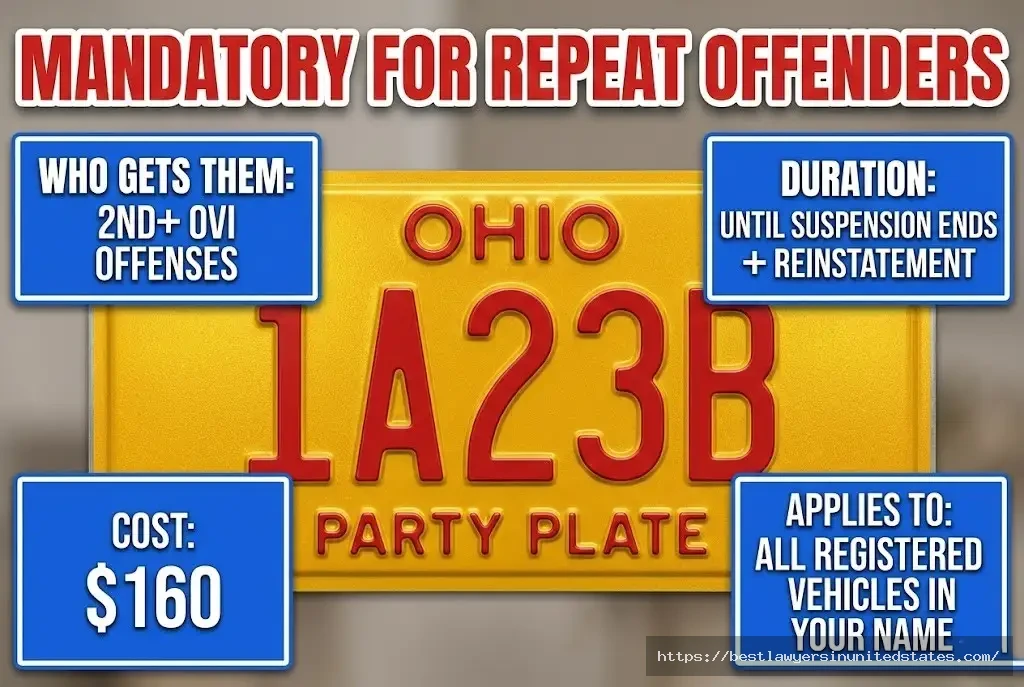
Who gets yellow plates:
- All second OVI offenses within 10 years
- All third and subsequent offenses
- First offense when combined with license suspension for prior violations
Duration requirements:
| Offense | Yellow Plate Period |
|---|---|
| 2nd within 10 years | Until suspension ends + limited privileges period |
| 3rd within 10 years | Until full license restoration |
| 4th+ | Lifetime in many cases |
How it works: Courts order yellow plates at sentencing. You have 10 days to surrender regular plates to the BMV and obtain yellow replacements at $160.
Exemptions: Employers can exempt company-owned vehicles from yellow plate requirements if you drive for work. You must obtain a waiver from the court showing business necessity.
Social impact: Yellow plates carry significant stigma. Employers often won’t hire drivers with visible OVI markers. Neighbors and community members identify you as a repeat offender. Some defendants report harassment and discrimination.
Vehicle ownership complications: Yellow plate orders apply to all vehicles registered in your name. Spouses or family members driving those vehicles must display yellow plates even though they weren’t convicted.
Can You Get an OVI Expunged in Ohio?
Ohio’s expungement laws changed significantly under the Clean Slate Act. However, OVI convictions face strict limitations on record sealing.
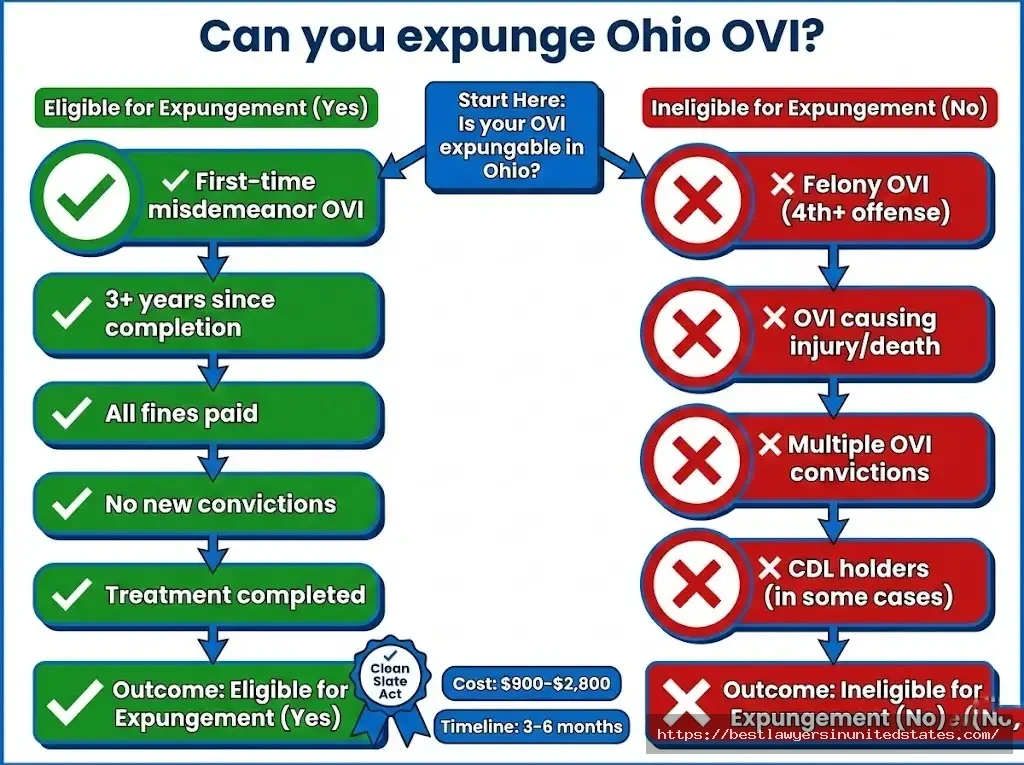
Clean Slate Act Eligibility
Most misdemeanor OVI convictions become eligible for expungement after 3 years. The Clean Slate Act automated sealing for many offenses, but OVI requires manual application.
Eligibility requirements:
- 3+ years since final discharge (end of probation/suspension)
- No new convictions during waiting period
- All fines and court costs paid in full
- Completion of all treatment programs
- No pending criminal charges
Ineligible offenses:
- Felony OVI (4th+ offense within 20 years)
- OVI causing serious physical harm
- OVI causing death
- Multiple OVI convictions (some courts allow sealing first offense only)
Expungement Timeline and Cost
The expungement process takes 3-6 months from petition filing to final order.
Step-by-step process:
Month 1: Gather documents including final judgment entry, proof of completion for all programs, and payment receipts. File application with court clerk.
Month 2: Pay filing fee ($50 state courts, up to $250 in some municipal courts). Prosecutor’s office receives notice and has 30 days to object.
Month 3-4: Attend hearing if prosecutor objects. Judge reviews your rehabilitation and decides whether to grant sealing.
Month 5-6: If approved, court sends sealing order to all law enforcement agencies and databases. Records removed from public access within 60 days.
Cost breakdown:
| Expense | Amount |
|---|---|
| Court filing fee | $50-$250 |
| Attorney fees | $800-$2,500 |
| Background check | $50 |
| Certified copies | $2-$5 per copy |
| Total | $900-$2,800 |
Which Offenses Qualify
Ohio courts disagree on sealing multiple OVI convictions. Some counties seal first offenses only. Others allow sealing any single conviction if 10+ years passed with no new violations.
Generally sealable:
- First OVI misdemeanor (no aggravating factors)
- OVUAC (underage consumption)
- Physical control violations reduced from OVI
Never sealable:
- Felony OVI (F4 or higher)
- Aggravated vehicular assault
- Aggravated vehicular homicide
- OVI within commercial vehicle (CDL holders)
Employment impact: Sealed OVI records don’t appear on standard background checks. However, professional licensing boards can still access sealed convictions. This affects CDL holders, teachers, nurses, and attorneys seeking licensure.
Total Cost of an OVI in Ohio
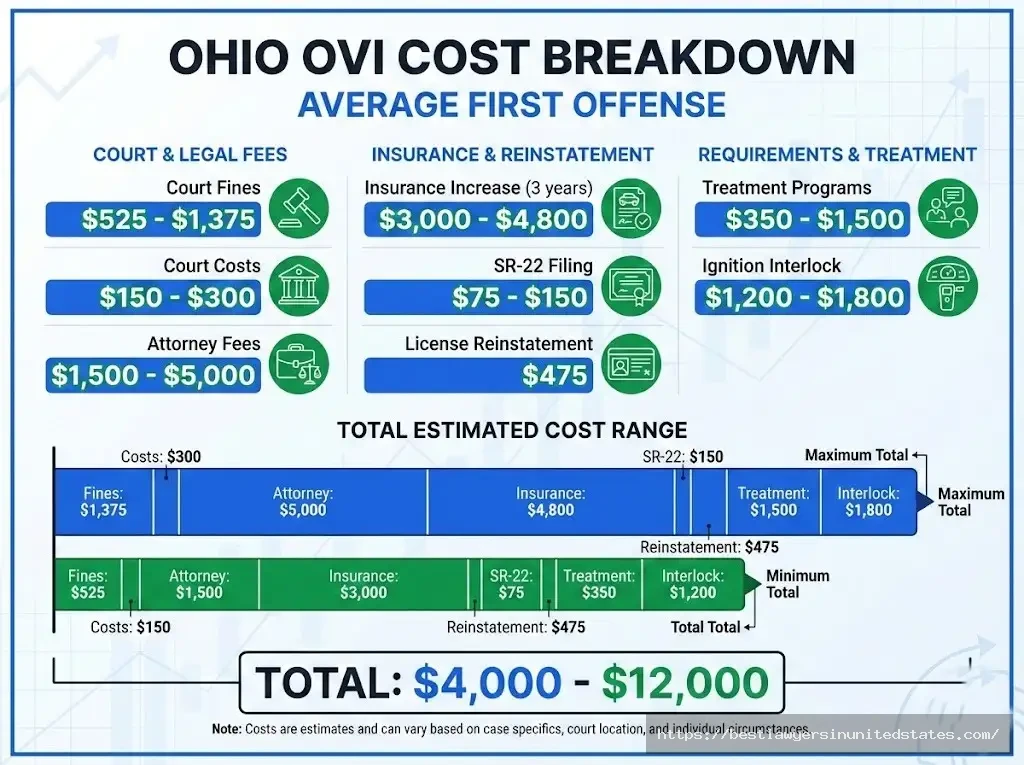
OVI convictions create financial burdens far exceeding court fines. Most first-time offenders spend $4,000-$12,000 when including all expenses over 3 years.
Fines and Court Fees
Courts impose separate fines and mandatory costs at sentencing.
Fine structure:
| Offense | Base Fine | Mandatory Costs | Total |
|---|---|---|---|
| 1st (low test) | $375-$1,075 | $150-$300 | $525-$1,375 |
| 1st (high test) | $375-$1,075 | $150-$300 | $525-$1,375 |
| 2nd | $525-$1,625 | $200-$400 | $725-$2,025 |
| 3rd | $850-$2,750 | $250-$500 | $1,100-$3,250 |
Additional fees:
- Specialized docket fee: $50-$200 (depends on county)
- Driver intervention fund: $30
- Victim assistance fund: $25-$50
- Electronic monitoring (if ordered): $10-$15 per day
Many courts offer payment plans over 6-12 months. Monthly payments typically start at $100 minimum.
Attorney Costs
Private OVI attorneys charge $1,500-$7,500 depending on case complexity and location.
Fee structures:
| Service Level | Typical Cost | What’s Included |
|---|---|---|
| Plea only | $1,500-$2,500 | Arraignment, 1-2 pre-trials, negotiate plea |
| Trial preparation | $3,000-$5,000 | Above + motions, discovery review, suppress evidence |
| Jury trial | $5,000-$7,500 | Full representation through verdict |
| Administrative hearing | $500-$1,500 | BMV ALS hearing only |
What affects cost:
- Prior criminal record (clean vs. multiple violations)
- BAC level (.08 vs. .20+)
- Accident involvement
- Injury to others
- Commercial driver’s license holders
Public defenders serve defendants who can’t afford private counsel. You must prove income below 125% of federal poverty line ($15,000 for individuals, $30,000 for families of four).
Insurance Rate Increases
OVI convictions raise auto insurance premiums dramatically. Ohio drivers see average increases of 50-80% lasting 3-5 years.
Sample rate impacts:
| Current Premium | Post-OVI Premium | Annual Increase | 5-Year Total |
|---|---|---|---|
| $1,200/year | $1,800-$2,160/year | $600-$960 | $3,000-$4,800 |
| $1,800/year | $2,700-$3,240/year | $900-$1,440 | $4,500-$7,200 |
| $2,400/year | $3,600-$4,320/year | $1,200-$1,920 | $6,000-$9,600 |
Rating factors:
- Your insurance company (some penalize OVI less than others)
- Years with current insurer
- Overall driving record
- Credit score (in states where allowed)
- Coverage levels and deductibles
Some insurers drop OVI drivers entirely. This forces you into high-risk insurance pools charging 2-3 times standard rates.
SR-22 filing requirements add $25-$50 annually. The conviction itself drives premium increases, not the SR-22 form.
Treatment Program Costs
Courts mandate completion of intervention programs at defendant expense.
Common program costs:
| Program Type | Length | Cost |
|---|---|---|
| Driver Intervention Program | 3 days (residential) | $350-$550 |
| Outpatient counseling | 12-26 weeks | $800-$1,500 |
| Intensive outpatient | 90 days | $2,500-$4,000 |
| Residential treatment | 30-90 days | $5,000-$15,000 |
Additional expenses:
- Drug/alcohol assessment: $150-$250
- Random drug testing: $25-$50 per test
- Victim impact panel: $25-$50
- Transportation to treatment (if suspended): varies
Courts order treatment intensity based on assessment scores. Higher BAC levels, prior violations, and evidence of alcohol dependency trigger more intensive (expensive) programs.
Other Hidden Costs
Many expenses don’t appear on court paperwork but add up quickly:
Transportation costs: Suspended drivers spend $1,500-$3,000 annually on rideshare, taxis, or family members driving them. This continues throughout suspension periods of 6 months to 3 years.
Employment loss: 10-15% of OVI defendants lose jobs due to license suspension or inability to drive company vehicles. Lost wages far exceed direct OVI costs.
Professional licensing: Teachers, nurses, real estate agents, and other licensed professionals face discipline. Some lose licenses entirely, ending careers.
Immigration consequences: Non-citizens face deportation risks from OVI convictions. Multiple offenses or high BAC levels trigger removal proceedings.
Calculate your specific costs including your county’s fees, insurance rates, and treatment requirements with our DUI cost calculator.
Actual Physical Control OVI Charges
Ohio charges OVI for having “actual physical control” of a vehicle while impaired. You don’t need to be driving or even have the engine running.
What courts consider:
Vehicle location: Sitting in driver’s seat creates presumption of control. Lying in back seat or sitting in passenger seat weakens prosecution’s case.
Key location: Keys in ignition establishes control. Keys in pocket or console is less clear. Keys outside vehicle usually defeats control element.
Engine status: Running engine proves operability. Non-running engine doesn’t prevent charges if vehicle is otherwise operable.
Defendant’s intent: Courts examine whether you intended to drive. Sleeping in parking lot to avoid driving drunk shows responsible behavior. Pulling over temporarily suggests you were driving.
Real case examples:
Conviction upheld: Defendant found asleep in driver’s seat, engine running, parked on highway shoulder at 2 AM. Keys in ignition, transmission in park. Court ruled defendant had actual physical control despite no observed driving. State v. Gill, 2018-Ohio-3789.
Charges dismissed: Defendant sleeping in passenger seat of parked car in apartment complex lot, engine off, keys under driver’s seat. Court found no actual physical control without more evidence of intent to drive. State v. Edwards, 2019-Ohio-5624.
Defense Strategies
Attorneys challenge actual physical control cases by questioning each element:
Necessity defense: You entered the vehicle for safety (weather emergency, danger in area). You had no intent to drive but needed shelter.
Duress: Someone else drove and abandoned you in the vehicle. You moved to driver’s seat temporarily without intent to operate.
No operability: Vehicle had mechanical problems preventing operation. Dead battery, flat tire, or empty gas tank negates control element.
Time of impairment: You became impaired after entering vehicle. Drinking while parked doesn’t prove you drove or intended to drive while impaired.
Witness testimony: Passengers or observers verify you never drove. Security camera footage shows vehicle parked throughout relevant time period.
Ohio DUI Checkpoint Laws: Your Rights
Sobriety checkpoints are legal in Ohio under both state and federal law. The Ohio Supreme Court approved checkpoints in State v. Orr (1990) when police follow specific guidelines.
Constitutional requirements:
Advance notice: Police must announce checkpoint locations and times through media or press releases. This gives drivers opportunity to avoid the area legally.
Neutral selection: Officers must stop vehicles according to predetermined pattern (every car, every third car, etc.). Individual officers can’t pick which vehicles to stop.
Minimal intrusion: Initial stops last 1-3 minutes maximum. Officers ask for license and registration, look for obvious impairment signs, then release drivers or conduct field sobriety tests.
Supervisor oversight: Command-level officers must approve checkpoint locations and procedures. Patrol officers can’t spontaneously set up checkpoints.
Safety measures: Checkpoints need proper lighting, signs, and traffic controls. Locations should minimize traffic disruption and danger.
What to Expect at Checkpoints
Typical sequence:
1. Approach: Signs warn “Sobriety Checkpoint Ahead.” Cones funnel traffic into single lane.
2. Initial stop: Officer approaches window, asks for license and registration. Requests typically include “Where are you coming from?” and “Have you been drinking tonight?”
3. Observation: Officer looks for bloodshot eyes, alcohol smell, slurred speech, or open containers.
4. Release or detention: Most drivers leave after 30-60 seconds. Suspected impaired drivers pull to secondary inspection area.
5. Field tests: Secondary area includes field sobriety tests and breathalyzer screening. Arrest occurs if you fail tests or refuse.
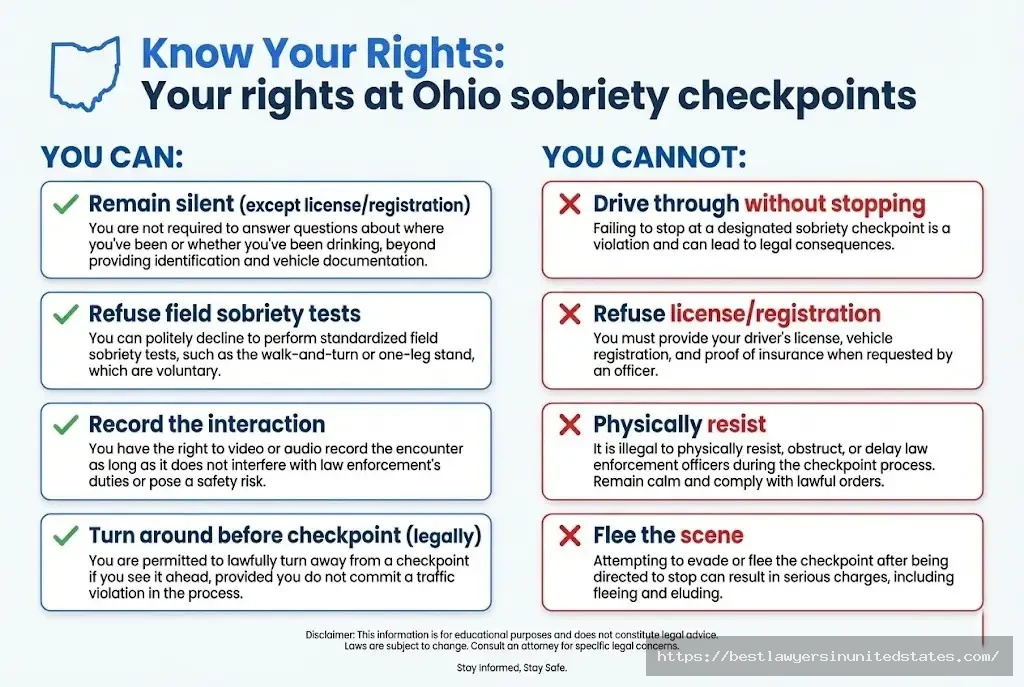
Your Legal Rights
Right to remain silent: You must provide license, registration, and proof of insurance. You don’t have to answer questions about drinking, where you’ve been, or where you’re going.
Right to refuse tests: Field sobriety tests are voluntary. You can refuse without automatic penalties. However, refusal gives officers additional suspicion justifying further investigation.
Right to turn around: You can legally avoid a checkpoint by turning before reaching it, assuming you follow all traffic laws. Illegal U-turns, running red lights, or turning into driveways give police reason to stop you.
Right to record: Ohio allows recording police during traffic stops. Keep phone visible, inform officer you’re recording, and don’t interfere with their duties.
What you can’t do:
- Drive through checkpoint without stopping
- Refuse to provide license/registration
- Physically resist detention
- Flee the scene
Recent checkpoint locations in Ohio:
- I-71 northbound near Polaris (Columbus)
- State Route 2 westbound (Cleveland suburbs)
- I-75 southbound (Dayton area)
- I-270 eastbound (Columbus outer belt)
Compare Ohio’s checkpoint procedures with neighboring states. Kentucky DUI laws and Pennsylvania DUI laws use similar checkpoint systems with minor procedural differences.
CDL Holders and OVI in Ohio
Commercial driver’s license holders face federal disqualification standards on top of Ohio state penalties. A single OVI conviction can end trucking careers.
Federal BAC limit: CDL holders violate federal law at .04 BAC when operating commercial vehicles. This is half the standard .08 limit for regular drivers.
Disqualification periods:
| Violation | First Offense | Second Offense |
|---|---|---|
| .04+ BAC in CMV | 1 year | Lifetime |
| .04+ BAC in CMV carrying hazmat | 3 years | Lifetime |
| OVI in personal vehicle | 1 year | Lifetime |
| Refusal (any vehicle) | 1 year | Lifetime |
Critical difference: Getting OVI in your personal car triggers CDL disqualification. You don’t need to be driving commercially when arrested.
Career Impact
Trucking and commercial driving jobs require valid CDLs. Disqualification means immediate job loss for most drivers.
Income loss scenarios:
Average truck driver: $50,000-$70,000 annual salary. One-year disqualification = $50,000-$70,000 lost wages.
Owner-operators: $80,000-$150,000 annual revenue. Business closure during disqualification period.
Bus drivers/delivery drivers: $35,000-$55,000 annual salary. Many school districts and delivery companies fire drivers after OVI arrests, before conviction.
No limited privileges: Ohio doesn’t grant occupational licenses for commercial driving. You cannot drive commercially during disqualification for any reason.
Reinstatement requirements:
- Complete disqualification period (1 year minimum)
- Pay $50 CDL reapplication fee
- Retake written and driving tests in some cases
- Provide employer certification letter
- Show proof of substance abuse treatment completion
Employer Notification
Federal law requires conviction reporting to employers within 30 days. Hiding OVI convictions violates 49 CFR § 383.31 and brings additional penalties.
What employers see:
- Arrest reports through background checks
- License status through FMCSA database
- Court disposition after conviction
- Disqualification periods and end dates
Most trucking companies terminate drivers immediately after OVI arrest. Company policies don’t wait for conviction before firing.
Underage OVI (OVUAC) in Ohio
Drivers under 21 face “zero tolerance” for alcohol. Operating a Vehicle Under Age Consumption (OVUAC) charges apply at just .02 BAC under ORC § 4511.191.
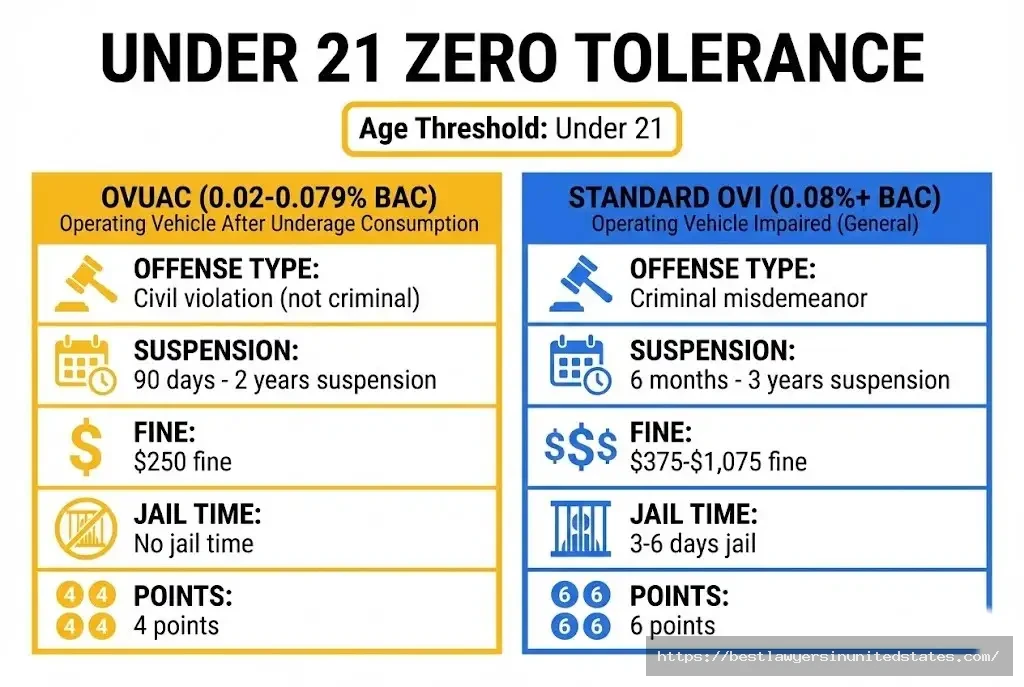
Penalty comparison:
| Penalty Type | OVUAC (.02-.08) | Standard OVI (.08+) |
|---|---|---|
| Classification | Civil violation | Criminal misdemeanor |
| Suspension | 90 days to 2 years | 6 months to 3 years |
| Jail Time | None | 3-6 days |
| Fines | $250 | $375-$1,075 |
| Points | 4 | 6 |
| Criminal Record | No | Yes |
Critical threshold: Underage drivers who blow .08 or higher get charged with standard OVI. This brings full adult penalties including jail time and criminal records.
OVUAC vs. Adult OVI
OVUAC is a civil “violation” rather than criminal “offense.” This creates different consequences:
No criminal record: OVUAC doesn’t create criminal history. Background checks won’t show conviction for employment, housing, or college applications.
No jail time: Courts cannot impose jail sentences for OVUAC. Maximum penalty is license suspension and fines.
Fewer points: Ohio assigns 4 points for OVUAC versus 6 points for OVI. However, 12 points in 2 years triggers automatic suspension regardless of source.
Limited sealing: OVUAC “violations” don’t require expungement. They’re not criminal records, so sealing isn’t available or necessary.
Special Consequences for Minors
Parent notification: Courts notify parents or guardians of all underage alcohol violations. This happens automatically at arraignment.
College impacts: Universities often impose separate discipline beyond court penalties. Many schools suspend students or revoke scholarships for OVUAC convictions.
Provisional license revocation: Drivers holding provisional or probationary licenses lose all privileges until age 18 plus original suspension period.
Treatment requirements: Judges commonly order substance abuse assessment and counseling for underage offenders. Parents typically pay these costs.
Work permit denial: Suspended minors cannot obtain occupational licenses for school or work. The restriction continues throughout suspension regardless of hardship.
Refusing a Breathalyzer in Ohio
Ohio’s implied consent law penalizes test refusal more harshly than failing the test. Understanding these consequences helps you make informed decisions during arrest.
Suspension comparison:
| Offense | Failed Test | Refusal |
|---|---|---|
| 1st | 90 days | 1 year |
| 2nd | 1 year | 2 years |
| 3rd+ | 2 years | 3 years |
Refusal suspension runs separate: Even if prosecutors dismiss your OVI charges, the BMV refusal suspension continues. You fight two different proceedings – criminal court and BMV hearing.
Consequences of Refusal
Administrative penalties:
- Immediate license confiscation
- 30-day temporary permit
- Extended suspension periods
- Mandatory ignition interlock for reinstatement
Criminal case impact:
- Prosecutors present refusal as evidence of guilt
- Juries view refusal negatively
- No test results for defense to challenge
- Higher penalties if convicted (same as “high test”)
Practical considerations:
- Refusal doesn’t prevent conviction
- Police can obtain warrant for forced blood draw
- Accident cases almost always result in warrants
- Medical personnel must comply with valid warrants
When Blood Tests Become Mandatory
Officers obtain search warrants for blood draws in serious cases. Warrants authorize forced testing over your objection.
Common warrant scenarios:
- Accidents causing injury
- Suspected felony OVI (4th offense)
- Death or serious physical harm
- Unconscious drivers
- Drivers requiring hospitalization
Judges issue warrants within 1-2 hours via phone or email. Police transport you to hospital where medical staff draws blood. You cannot legally refuse warrant-authorized testing.
Sample collection: Blood draws must follow Ohio Administrative Code protocols. These require:
- Licensed medical professional (nurse, phlebotomist, doctor)
- Sterile collection equipment
- Witness observation
- Proper labeling and sealing
- Chain of custody documentation
Defense attorneys challenge blood test procedures regularly. Common issues include contamination, improper storage, missing documentation, or expired certification of testing equipment.
OVI Defenses in Ohio
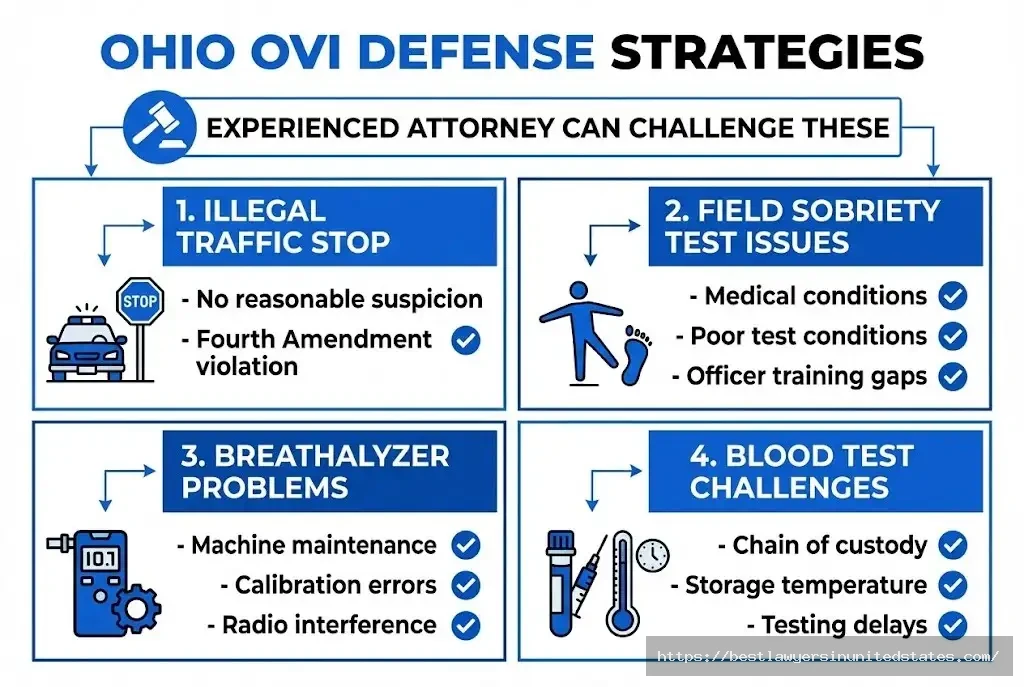
Experienced attorneys challenge OVI charges using dozens of potential defenses. Success depends on specific case facts and available evidence.
Challenging the Initial Traffic Stop
Police need reasonable suspicion of traffic violation or criminal activity to stop your vehicle. Stops without valid reason violate Fourth Amendment protections.
Common invalid stop reasons:
- Anonymous tip without corroboration
- Leaving bar parking lot (not illegal by itself)
- Driving in high-crime area
- Avoiding checkpoint legally
- Weaving within lane (may not be violation)
Valid stop reasons:
- Crossing lane markers
- Speeding or running red light
- Equipment violations (broken taillight, etc.)
- Observing dangerous driving
- Expired registration visible on plate
Motion to suppress: Your attorney files motion arguing illegal stop. If court agrees, all evidence gathered after the stop gets excluded. This usually results in case dismissal.
Contesting Field Sobriety Test Results
Field sobriety tests are subjective and affected by many factors beyond alcohol impairment.
Common challenge points:
Medical conditions: Inner ear problems, knee injuries, back pain, neurological conditions all affect balance. These make passing tests difficult regardless of sobriety.
Age and weight: People over 65 or 50+ pounds overweight struggle with physical tests. NHTSA acknowledges these factors affect test validity.
Test conditions: Uneven pavement, poor lighting, bad weather, tight clothing, and high-heeled shoes all skew results. Tests administered on highway shoulders or gravel lots lack reliability.
Officer training: Defense attorneys verify officer certification in standardized field sobriety tests. Missing certifications or expired training undermine test credibility.
Video review: Dashboard and body camera footage often contradicts officer testimony. Defense experts analyze videos showing proper test performance that officers scored as failures.
Disputing Chemical Test Reliability
Breath and blood tests require proper procedures. Technical errors create reasonable doubt.
Breath test challenges:
Machine maintenance: Intoxilyzer devices need weekly maintenance checks and annual certification. Missing logs void test results.
Observation period: Officers must observe you continuously for 15-20 minutes before testing. This prevents mouth alcohol from burping or regurgitation. Incomplete observation invalidates results.
Calibration issues: Breath machines use simulator solutions with known alcohol content. Tests showing incorrect simulator readings suggest machine malfunction.
Radio frequency interference: Cell phones, police radios, and other devices can affect breath test results. Defense experts testify about RFI impacts.
Blood test challenges:
Chain of custody: Blood samples pass through multiple handlers from collection to testing. Missing signatures or documentation gaps raise contamination concerns.
Storage temperature: Blood samples require refrigeration. Improper storage allows fermentation, artificially raising BAC readings.
Testing delays: Ohio law requires testing within “reasonable time.” Samples sitting weeks before analysis lose reliability.
Analyst qualifications: Lab technicians need proper certification. Expired credentials or training violations exclude test results.
How an OVI Attorney Can Help
Private attorneys provide services public defenders can’t match due to heavy caseloads. Specialized OVI lawyers handle 50-200 DUI cases annually versus public defenders managing 300-500 total cases.
What attorneys do:
File ALS appeal within 10 days: Missing this deadline means automatic suspension. Attorneys track deadlines and submit proper BMV paperwork.
Investigate police procedures: Attorneys obtain police reports, training records, dash cam footage, and maintenance logs. They identify procedural violations that support motions to suppress.
Challenge evidence: Scientific experts testify about breath test unreliability, blood sample contamination, or medical conditions affecting field tests.
Negotiate plea reductions: Attorneys leverage case weaknesses to obtain reckless operation or physical control charges instead of OVI.
Prepare trial strategy: If negotiation fails, attorneys develop defense theories, select witnesses, and prepare cross-examination questions.
Minimize penalties: Even with conviction, attorneys argue for minimum jail time, alternative sentencing, or intervention programs instead of incarceration.
Cost-benefit analysis:
| Scenario | Public Defender | Private Attorney |
|---|---|---|
| Cost | Free (if qualify) | $1,500-$7,500 |
| Caseload | 300+ cases | 50-200 DUI cases |
| Time with you | 1-2 hours total | 10-20 hours |
| DMV hearing | Usually no | Yes (included) |
| Plea reduction success | 30-40% | 50-70% |
| Trial preparation | Minimal | Extensive |
Find DUI Lawyers in Ohio – Free Consultation
Email: [email protected]
FAQ: Ohio OVI Laws
What happens if you get a DUI in Ohio?
Quick Answer: You face 3-180 days jail, $375-$2,750 fines, and 6 months to 3 years license suspension for first offense in Ohio.
Police arrest and book you at the station. The court process takes 2-6 months. Penalties depend on your BAC level and prior record. Most first-time offenders complete intervention programs instead of serving full jail sentences.
Is there a new DUI law in Ohio?
Quick Answer: Yes, Ohio implemented major OVI law changes effective April 9, 2025, including oral fluid testing and increased penalties.
The 2025 updates authorize roadside saliva testing for drugs. Fines increased across all offense levels. Courts now require ignition interlock devices for more cases. Aggravated vehicular homicide penalties jumped from F2 to F1 felonies.
Will I go to jail for my first DUI in Ohio?
Quick Answer: Most first-time offenders with low BAC (.08-.169) attend 3-day Driver Intervention Program instead of jail in Ohio.
Courts offer intervention programs as jail alternatives for first offenses without aggravating factors. High BAC (.17+) or refusal requires 6 days jail with 3 days mandatory. Accidents, injuries, or minors in vehicle eliminate program eligibility and mandate jail time.
How much does an OVI cost in Ohio?
Quick Answer: Total first OVI costs run $4,000-$12,000 including fines ($525-$1,375), attorney fees ($1,500-$5,000), insurance increases ($3,000-$4,800), and treatment programs ($350-$1,500).
Court fines represent just 10-15% of total expenses. Insurance premium increases over 3-5 years create the largest financial burden. Add ignition interlock costs ($1,200-$1,800 annually), SR-22 fees ($75-$150), and license reinstatement ($475).
Can you refuse a breathalyzer in Ohio?
Quick Answer: Yes, but refusal triggers automatic 1-year license suspension in Ohio, longer than the 90-day suspension for failing the test.
Ohio’s implied consent law penalizes refusal more harshly than test failure. First refusal = 1 year suspension versus 90 days for failed test. Second refusal = 2 years versus 1 year for failure. Police can obtain warrants for forced blood draws in serious cases.
What is the BAC limit in Ohio?
Quick Answer: Ohio’s BAC limit is .08% for drivers 21+, .04% for CDL holders, and .02% for drivers under 21.
Standard drivers face OVI charges at .08 BAC or higher. “High test” penalties apply at .17 BAC. Commercial drivers violate federal law at .04 in any vehicle. Underage drivers get OVUAC charges at .02 BAC.
How long does OVI stay on record in Ohio?
Quick Answer: OVI convictions remain on Ohio driving records permanently, visible to courts for sentencing purposes. Only misdemeanor OVIs may be sealed after 3+ years through expungement.
Criminal courts count prior OVI convictions forever when determining offense level. Four OVIs within 20 years = felony charges. However, you can petition to seal first-time misdemeanor OVI records 3 years after sentence completion. Felony OVIs never qualify for sealing.
What are yellow license plates for in Ohio?
Quick Answer: Ohio requires yellow plates with red lettering for drivers convicted of second or subsequent OVI offenses within 10 years.
Courts order yellow “party plates” at sentencing for repeat offenders. Plates cost $160 and must stay on all registered vehicles throughout suspension and limited privilege periods. First-time offenders don’t get yellow plates. Employers can waive requirement for company vehicles.
Can you get OVI expunged in Ohio?
Quick Answer: Yes, first-time misdemeanor OVI convictions become eligible for sealing 3 years after completing all penalties in Ohio.
The Clean Slate Act allows expungement of single OVI convictions. Requirements include: 3+ years since final discharge, no new convictions, all fines paid, treatment completed. Felony OVIs (4th+ offense) never qualify for sealing. Courts disagree on sealing multiple OVI convictions.
What is actual physical control in Ohio?
Quick Answer: Actual physical control means having capability to operate a vehicle while impaired, even without driving in Ohio.
Police charge OVI for sitting in driver’s seat with keys in ignition, even with engine off. Courts examine vehicle location, key position, engine status, and your intent. Sleeping in parked car can result in OVI charges. Successful defenses show you had no intention to drive.
