
Getting pulled over for suspected DUI in Oklahoma carries serious consequences, especially after November 1, 2025, when Senate Bill 54 took effect. First-time offenders now face potential felony charges under the new law. Oklahoma joins a small group of states where a single DUI can result in a felony conviction and up to five years in prison.
This guide explains everything you need to know about Oklahoma’s DUI laws in 2026, including penalties, costs, license suspension, and your legal rights.
What Qualifies as a DUI in Oklahoma?
Oklahoma law prohibits driving under the influence of alcohol, drugs, or any intoxicating substance. You can be charged with DUI in two ways under Oklahoma Statute § 47-11-902.
Per se DUI means driving with a blood alcohol concentration (BAC) at or above the legal limit. Impairment-based DUI means driving while actually impaired by any substance, regardless of your BAC level.
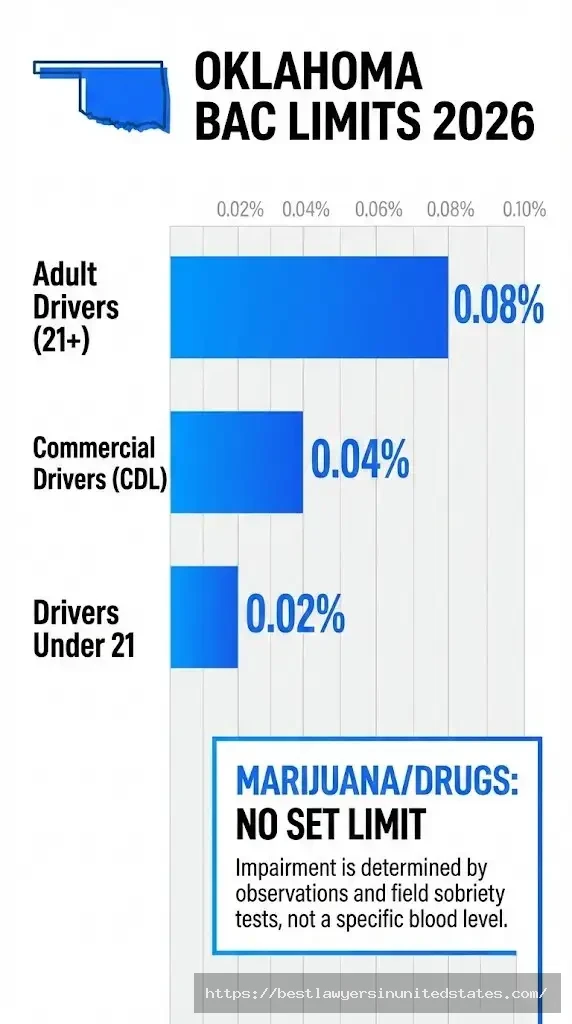
Oklahoma’s Legal BAC Limits
Different drivers face different legal limits in Oklahoma:
| Driver Type | Legal BAC Limit |
|---|---|
| Adult drivers (21+) | 0.08% |
| Commercial drivers (CDL) | 0.04% |
| Drivers under 21 | 0.02% (Zero Tolerance) |
| Marijuana/drugs | No set limit |
Not sure where you stand? Check your estimated BAC level with our BAC calculator based on your weight, drinks consumed, and time elapsed.
BAC Calculator
Estimate your Blood Alcohol Content
• Commercial Driver (CDL): 0.04% BAC
• Drivers Under 21: 0.00-0.02% BAC (Zero Tolerance)
• Enhanced Penalties: 0.15% BAC or higher in most states
DUI vs DWI in Oklahoma
Oklahoma uses both terms “DUI” and “DWI” in its statutes. DUI stands for Driving Under the Influence, while DWI means Driving While Impaired. Both terms refer to the same offense under Title 47 of Oklahoma Motor Vehicle laws. The terms are interchangeable in Oklahoma courts and law enforcement.
What Vehicles and Locations Are Covered?
Oklahoma Statute § 47-1-186 defines a motor vehicle as any self-propelled vehicle. This includes cars, trucks, motorcycles, ATVs, and even golf carts on public roads.
DUI laws apply on public roads, highways, parking lots, and some private property accessible to the public. You can be arrested for DUI in a parking lot or even on certain private roads.
BREAKING: Senate Bill 54 Changes Everything (Effective November 1, 2025)
Oklahoma’s Senate Bill 54 represents the most significant DUI law change in decades. The law took effect November 1, 2025, despite Governor Kevin Stitt’s veto. The Oklahoma Legislature overrode the veto, making first-offense felony DUI charges possible for the first time.
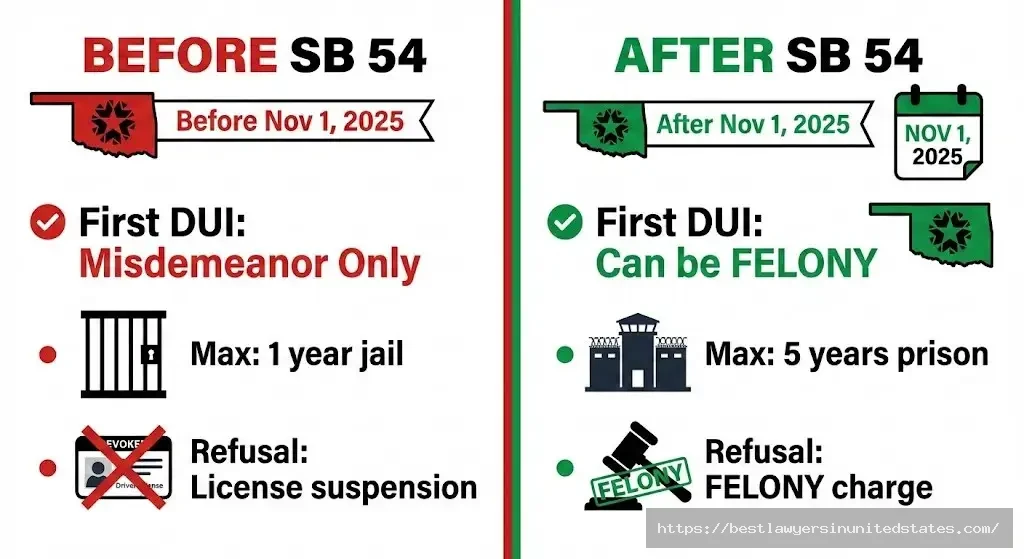
What Changed Under SB 54?
Before SB 54:
- First DUI = misdemeanor only
- Second DUI = possible felony with prior enhancement
- Aggravated DUI = still a misdemeanor
After SB 54 (November 1, 2025):
- First DUI = felony if “aggravated”
- Refusal to test = aggravating factor
- Enhanced penalties across the board
New Aggravated DUI Definition
SB 54 expanded what counts as “aggravated DUI” in Oklahoma. A first-offense DUI becomes aggravated (and therefore a felony) if any of these factors apply:
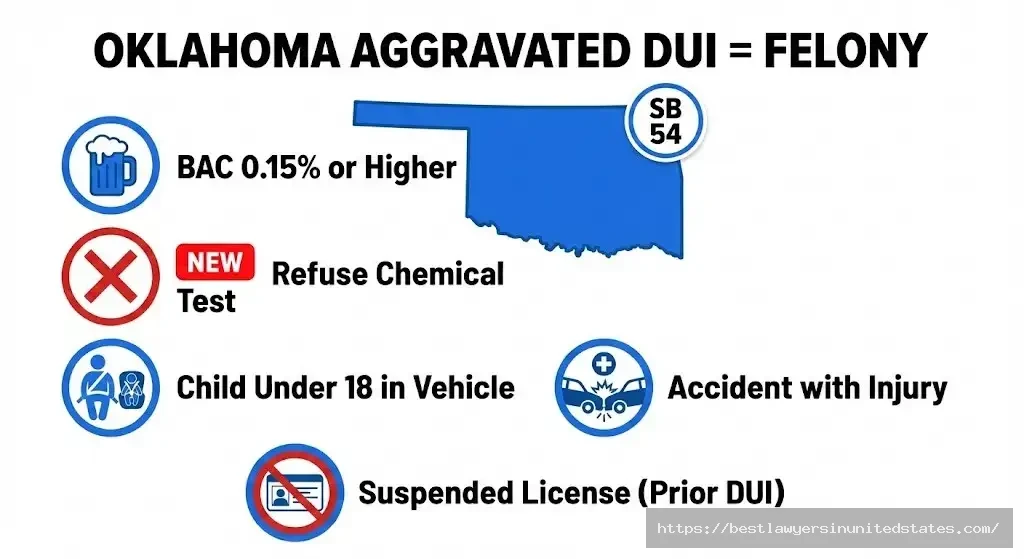
Aggravating factors under SB 54:
- BAC of 0.15% or higher
- Refusing chemical testing
- Child under 18 in the vehicle
- Causing an accident with great bodily injury
- Driving with a suspended license due to prior DUI
The most controversial change involves chemical test refusal. Refusing a breathalyzer or blood test now automatically elevates a first DUI to aggravated status, making it a felony charge.
First-Time Felony DUI Penalties
First-offense aggravated DUI in Oklahoma now carries:
| Penalty Type | Amount/Duration |
|---|---|
| Prison time | Up to 5 years state prison |
| Fines | Up to $5,000 |
| License revocation | 180 days minimum |
| Ignition interlock | Mandatory installation |
| DUI school | Mandatory completion |
Critical point: A felony conviction means losing voting rights, gun ownership rights, and facing severe employment consequences.
Why Refusal Is Now Extremely Risky
Before SB 54, refusing a breathalyzer meant license suspension but didn’t affect the criminal charge level. Now, refusal converts a potential misdemeanor into an automatic felony charge.
Pre-SB 54 refusal: 12-month license suspension, misdemeanor DUI charge Post-SB 54 refusal: 12-month license suspension, felony DUI charge with up to 5 years prison
This change puts Oklahoma drivers in a difficult position. Refusing the test to avoid evidence can result in much harsher criminal penalties than simply failing the test.
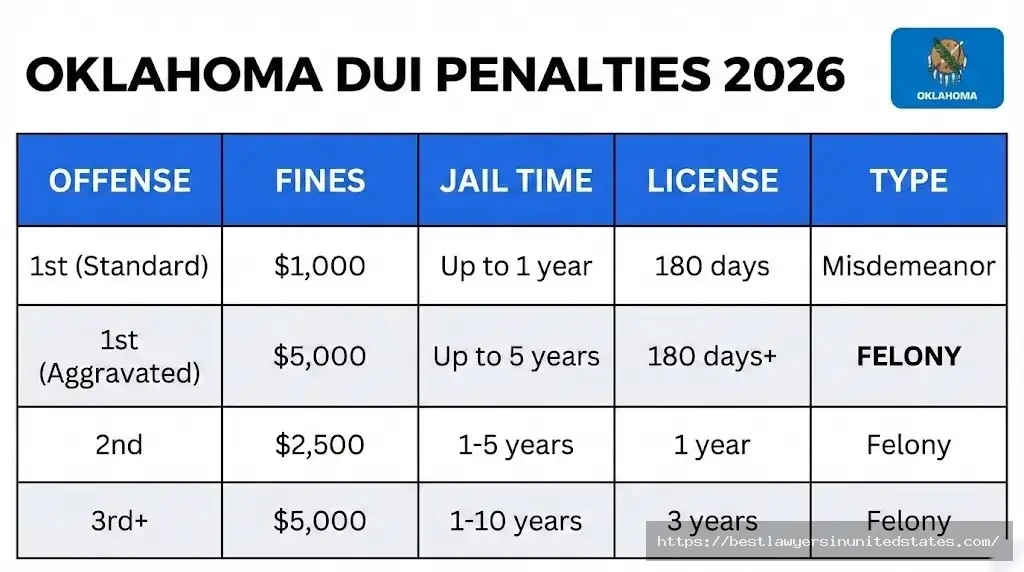
Oklahoma DUI Penalties by Offense
Oklahoma imposes increasingly severe penalties for repeat DUI offenses. The Erin Swezey Act governs license revocation periods, while criminal penalties come from Oklahoma Statute § 47-11-902.
First Offense DUI (Misdemeanor)
A standard first DUI in Oklahoma (not aggravated) remains a misdemeanor with these penalties:
Criminal penalties:
- Up to 1 year in county jail
- Fines up to $1,000
- 10 days to 1 year probation (common)
License consequences:
- 180-day suspension under Erin Swezey Act
- 30-day temporary driving permit
- Modified license possible after suspension period
Other requirements:
- Substance abuse evaluation ($150-$300)
- DUI school or treatment program ($500-$2,000)
- Victim Impact Panel ($50-$100)
- Possible ignition interlock device
Most first-time offenders receive probation rather than jail time. However, aggravating factors can change this outcome dramatically.
First Offense Aggravated DUI (Felony Under SB 54)
First-offense aggravated DUI became a felony on November 1, 2025. This applies to anyone with BAC of 0.15% or higher, test refusal, child endangerment, or accident causing injury.
| Penalty Category | Standard DUI | Aggravated DUI |
|---|---|---|
| Charge level | Misdemeanor | Felony |
| Max prison time | 1 year county jail | 5 years state prison |
| Max fine | $1,000 | $5,000 |
| License suspension | 180 days | 180 days minimum |
| Ignition interlock | Sometimes | Always mandatory |
| Felony record | No | Yes |
Example: Sarah blows a 0.16% BAC on her first DUI. Before November 2025, this would be a misdemeanor. After SB 54, she faces felony charges and up to 5 years in prison.
Second DUI Offense (Felony If Enhanced)
A second DUI within 10 years can be charged as a felony in Oklahoma if the prior conviction meets enhancement requirements.
Second DUI penalties:
- 1 to 5 years state prison
- Fines up to $2,500
- 1-year license revocation (Erin Swezey Act)
- Mandatory ignition interlock device
- Substance abuse treatment required
Critical deadline: Oklahoma uses a 10-year lookback period. A second DUI more than 10 years after the first may be treated as a first offense for sentencing purposes.
Third DUI Offense (Always a Felony)
Third and subsequent DUI offenses are always felonies in Oklahoma, regardless of the time between offenses.
Third DUI penalties:
- 1 to 10 years state prison
- Fines up to $5,000
- 3-year license revocation (Erin Swezey Act)
- Lifetime ignition interlock device in some cases
- Mandatory treatment and monitoring
Fourth and Subsequent DUI Offenses
Fourth DUI charges face enhanced sentencing under Oklahoma’s 85% Rule (explained below). Penalties include:
- Up to 20 years state prison (with prior felony DUI convictions)
- Permanent license revocation possible
- Mandatory 85% of sentence served before parole eligibility
- Intensive supervision upon release
Oklahoma has no limit on how many DUIs you can receive. Each subsequent offense brings increasingly severe consequences.
Oklahoma-Specific DUI Laws You Need to Know
Oklahoma has several unique DUI laws and provisions that don’t exist in other states. Understanding these Oklahoma-specific rules is critical if you’re facing charges.
The Erin Swezey Act (License Revocation)
The Erin Swezey Act establishes progressive license revocation periods for DUI offenses in Oklahoma. The act was named after an Oklahoma DUI victim and sets mandatory minimum suspension periods.
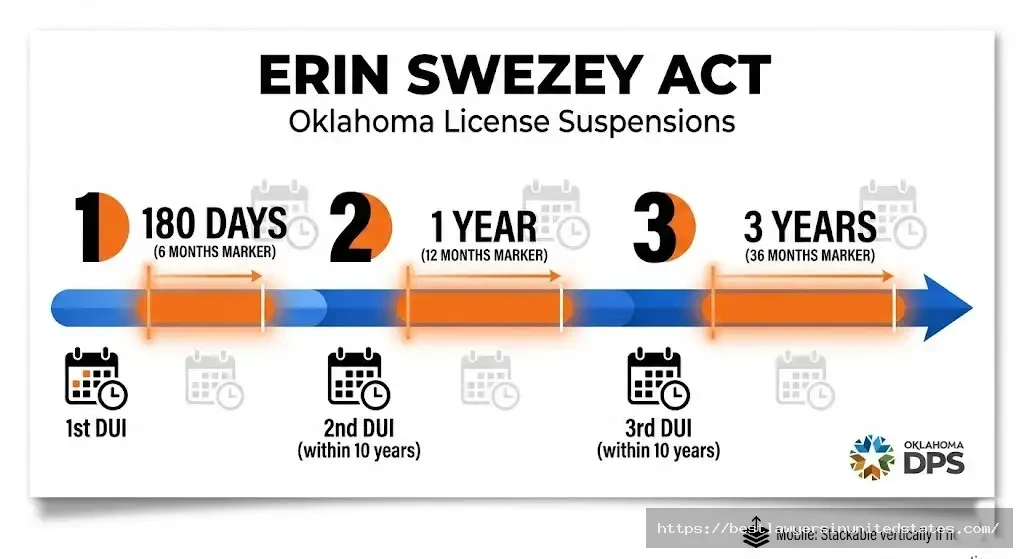
Erin Swezey Act suspension schedule:
| Offense | Suspension Period |
|---|---|
| First DUI | 180 days (6 months) |
| Second DUI (within 10 years) | 1 year |
| Third DUI (within 10 years) | 3 years |
These suspensions apply even if you receive probation or a deferred sentence. The Oklahoma Department of Public Safety (DPS) enforces these suspensions separately from criminal court penalties.
The 85% Rule (Oklahoma Sentencing)
Oklahoma’s 85% Rule requires certain felony offenders to serve at least 85% of their sentence before becoming eligible for parole. This rule applies to repeat DUI offenders with felony convictions.
How the 85% Rule works:
- Applies to second felony DUI and beyond
- Offender must serve 85% of sentence before parole consideration
- No early release programs available
- Good time credit limited
Example: John receives a 10-year sentence for his fourth DUI. Under the 85% Rule, he must serve 8.5 years before parole eligibility, compared to potentially 3-4 years under normal sentencing guidelines.
The 85% Rule makes repeat DUI convictions extremely serious in Oklahoma. Many other states allow parole at 50% or less of the sentence.
Oklahoma Clean Slate Bill (Expungement)
Oklahoma’s Clean Slate Bill, passed in recent years, expanded expungement eligibility for certain offenses. However, DUI expungement remains limited and requires specific waiting periods.
DUI expungement eligibility in Oklahoma:
| Offense Level | Waiting Period | Additional Requirements |
|---|---|---|
| Misdemeanor first DUI | 5 years | No subsequent convictions, all terms completed |
| Felony DUI | 10 years | Governor’s pardon may be required |
| Multiple DUIs | Generally not eligible | Exceptions rare |
Process and costs:
- Court filing fee: $150-$400
- Attorney fees: $1,500-$3,000
- Total process: 4-8 months
- Hearing required in most cases
Even with expungement, the DUI remains on your driving record for insurance and DMV purposes. Expungement only removes the criminal record from background checks.
Riley Rule and Other Oklahoma Procedures
The Riley Rule affects DUI cases in Oklahoma criminal courts. This procedural rule addresses motion practice and discovery deadlines in criminal cases, including DUI prosecutions.
Understanding these Oklahoma-specific procedures requires consultation with an attorney familiar with Oklahoma DUI law. Contact experienced Oklahoma DUI lawyers at [email protected] for a free consultation.
Oklahoma Marijuana and THC DUI Laws
Oklahoma legalized medical marijuana in 2018, but driving under the influence of marijuana remains illegal. The state has seen increased marijuana DUI arrests since legalization, and SB 54 didn’t change this.
Can You Get a DUI for Marijuana in Oklahoma?
Yes. Oklahoma law prohibits driving while impaired by any intoxicating substance, including marijuana. Having a medical marijuana card provides no defense to DUI charges.
Key facts about marijuana DUI:
- No set THC limit in Oklahoma (unlike alcohol’s 0.08%)
- Officer observation and field sobriety tests used
- Blood test measures THC metabolites
- Medical card is not a defense
How Oklahoma Tests for Marijuana Impairment
Oklahoma law enforcement uses several methods to detect marijuana impairment:
Testing methods:
- Officer observations – bloodshot eyes, marijuana odor, impaired speech
- Field sobriety tests – walk-and-turn, one-leg stand, HGN test
- Blood tests – detect THC and inactive metabolites
- Drug recognition experts – specially trained officers
The biggest challenge involves blood tests. THC metabolites remain detectable for days or weeks after use, even when you’re no longer impaired. Oklahoma courts struggle with this issue regularly.
Defenses for Marijuana DUI
Common defenses for marijuana DUI charges include:
- Metabolite vs. active THC – Inactive metabolites don’t prove current impairment
- Time since use – Blood tests can’t determine when you last consumed marijuana
- Medical conditions – Some conditions mimic marijuana impairment symptoms
- Testing errors – Blood sample collection and storage mistakes
An experienced Oklahoma DUI attorney can challenge THC test results and officer observations. These cases are more defensible than alcohol DUI cases due to testing limitations.
Underage DUI in Oklahoma (Zero Tolerance Law)
Oklahoma enforces strict zero tolerance laws for drivers under 21. The legal limit drops from 0.08% to 0.02% for underage drivers.
How Low Is 0.02% BAC?
A 0.02% BAC is extremely low and can result from a single drink depending on body weight:
| Body Weight | Drinks to Reach 0.02% |
|---|---|
| 100 lbs | Less than 1 drink |
| 120 lbs | Less than 1 drink |
| 150 lbs | About 1 drink |
| 180 lbs | About 1 drink |
| 200 lbs | 1-2 drinks |
Use our BAC calculator to estimate your BAC based on drinks, weight, and time.
Important: Some cold medications and mouthwashes can produce a 0.02% BAC reading. Always inform the officer of any medications before testing.
Penalties for Underage DUI
First-offense underage DUI penalties in Oklahoma include:
- License suspension until age 21 (minimum 6 months)
- Fines up to $500
- Alcohol education program mandatory
- Community service (20-200 hours)
- Possible detention in juvenile facility
These penalties apply in addition to any adult DUI charges if BAC exceeds 0.08%.
Social Host Liability in Oklahoma
Oklahoma law prohibits furnishing alcohol to minors. Parents and adults can face criminal charges for providing alcohol that leads to underage DUI.
Social host penalties:
- Misdemeanor charges
- Fines up to $2,500
- Up to 1 year jail time
- Civil liability for damages
Parents who host parties where minors drink alcohol face serious consequences, even if they didn’t directly provide the alcohol.
Oklahoma DUI Testing and Implied Consent Law
Oklahoma’s implied consent law, codified in Oklahoma Statute § 47-756, requires drivers to submit to chemical testing when arrested for DUI. However, SB 54 dramatically changed the consequences of refusing these tests.
What Is Implied Consent?
Implied consent means you automatically agree to chemical testing by accepting an Oklahoma driver’s license. This consent activates when an officer arrests you for suspected DUI.
Tests covered under implied consent:
- Breath tests (breathalyzer/intoxilyzer)
- Blood tests
- Urine tests
- Saliva tests (rarely used)
Officers must read you the implied consent warning before requesting a test. This warning explains that refusal triggers automatic license suspension and, after SB 54, makes your DUI an aggravated felony.
Chemical Test Requirements in Oklahoma
The Oklahoma Board of Tests sets strict requirements for administering and analyzing chemical tests. These regulations, found in Oklahoma Statute § 47-752, establish:
Breath test requirements:
- Officer must observe you 15 minutes before testing
- Machine must be certified and calibrated
- Officer must be certified to operate device
- Proper testing sequence must be followed
Blood test requirements:
- Medical professional must draw blood
- Proper sterilization and collection procedures
- Chain of custody documentation
- Analysis by certified laboratory
Violations of these requirements can invalidate test results. An experienced Oklahoma DUI attorney knows how to challenge improper testing procedures.
Field Sobriety Tests in Oklahoma
Field sobriety tests (FSTs) are voluntary in Oklahoma. You can refuse them without the same consequences as refusing chemical tests after arrest.
Standard field sobriety tests:
| Test | What Officers Look For |
|---|---|
| Horizontal Gaze Nystagmus (HGN) | Involuntary eye jerking |
| Walk-and-Turn | Balance, following instructions |
| One-Leg Stand | Balance, ability to follow directions |
Key point: Field sobriety tests are voluntary before arrest. You can politely decline without penalties. However, refusal may give officers probable cause to arrest you.
Refusing Chemical Tests After SB 54
The consequences of refusing chemical tests changed dramatically on November 1, 2025:
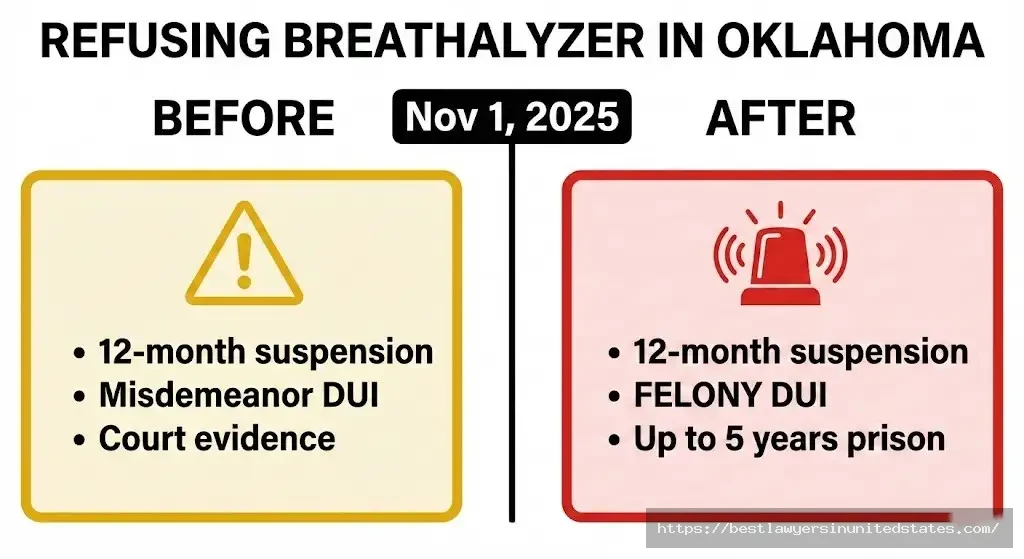
Pre-SB 54 (Before November 1, 2025):
- 12-month license suspension (first refusal)
- Refusal admissible in court
- Misdemeanor DUI charge only
Post-SB 54 (After November 1, 2025):
- 12-month license suspension (first refusal)
- Refusal admissible in court
- Automatic aggravated DUI (felony charge)
- Up to 5 years state prison
Refusal penalties by offense:
| Offense | License Suspension | Criminal Charge Enhancement |
|---|---|---|
| First refusal | 12 months | Felony (aggravated DUI) |
| Second refusal | 2 years | Felony enhancement |
| Third+ refusal | 3 years | Felony enhancement |
Refusing chemical tests is now one of the riskiest decisions you can make in an Oklahoma DUI case. The temporary benefit of avoiding BAC evidence creates a permanent felony charge.
When You Cannot Refuse (“Inability to Refuse”)
Oklahoma law recognizes situations where you cannot refuse chemical testing:
- Unconsciousness – Medical professionals can draw blood without consent
- Serious injury – Blood drawn as part of medical treatment can be used
- Search warrant – Judge-issued warrant allows forced blood draw
- Prior DUI with injury – Some cases allow warrantless blood draws
Police increasingly obtain search warrants for blood draws in refusal cases, especially when accidents or injuries occur.
Right to Independent Testing
Oklahoma law gives you the right to request independent testing at your own expense after completing the official test. This right is found in Oklahoma Statute § 47-756.
How to exercise this right:
- Inform the officer you want independent testing
- Officer must provide reasonable opportunity
- You pay all costs
- Results can be used in your defense
Independent testing can challenge official results, especially if conducted shortly after arrest. The independent test must follow the same scientific standards as official testing.
Oklahoma DUI Arrest Process and Timeline
Understanding what happens after a DUI arrest in Oklahoma helps you protect your rights and meet critical deadlines.
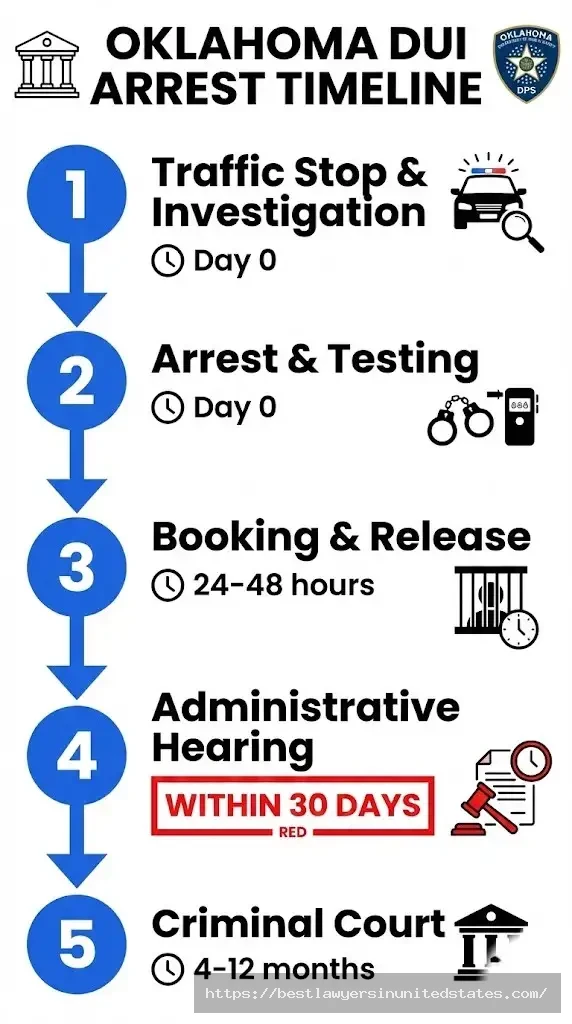
Step 1: Traffic Stop and Investigation
Officers need probable cause or reasonable suspicion to stop your vehicle. Common reasons include:
- Swerving or erratic driving
- Speeding or traffic violations
- Equipment violations (broken taillight, etc.)
- DUI checkpoints (legal in Oklahoma)
After the stop, officers look for signs of intoxication:
- Odor of alcohol
- Bloodshot or glassy eyes
- Slurred speech
- Open containers in vehicle
- Admission of drinking
Officers then request field sobriety tests (voluntary) and preliminary breath tests (voluntary).
Step 2: Arrest and Chemical Testing
If the officer develops probable cause for DUI, they arrest you and read the implied consent warning. You must then decide whether to submit to chemical testing.
After arrest:
- Miranda rights read (right to remain silent, right to attorney)
- Transport to police station or medical facility
- Chemical test administered (breath or blood)
- Booking and fingerprinting
Step 3: Booking and Release (First 24-48 Hours)
After arrest, you’re taken to county jail for processing. Typical Oklahoma DUI bail amounts range from $500 to $5,000 for first offenses.
What happens at booking:
- Personal property inventory
- Photograph and fingerprints
- Background check
- Bail determination
- License confiscation by DPS
The Oklahoma Department of Public Safety confiscates your physical license and issues a 30-day temporary driving permit. This permit expires 30 days after arrest unless you request an administrative hearing.
Step 4: Administrative Hearing (DPS)
Oklahoma’s administrative license suspension operates separately from criminal court. You have limited time to request a hearing.
Critical deadline: Request administrative hearing within 30 days of arrest to preserve your driving privileges.
What happens at the hearing:
- Held at Oklahoma DPS office
- Separate from criminal case
- Officer must prove lawful arrest and probable cause
- Test refusal or failure reviewed
- Can result in suspension or reinstatement
Missing the 30-day deadline means automatic license suspension with no hearing. This is one of the most common mistakes DUI defendants make.
Step 5: Criminal Court Process
The criminal case proceeds in either Oklahoma District Court or Municipal Court of Record, depending on the jurisdiction.
Court timeline:
| Event | Typical Timeframe |
|---|---|
| Arraignment | 10-30 days after arrest |
| Pre-trial conference | 30-90 days |
| Motion hearings | 60-120 days |
| Trial or plea | 4-12 months |
Arraignment: You appear before a judge, hear charges, enter plea (guilty, not guilty, no contest), and discuss bail.
Pre-trial: Your attorney negotiates with prosecutors, files motions, and gathers evidence.
Trial or plea: Most cases resolve through plea bargaining. About 10% go to trial.
Which Court Handles Your DUI?
Oklahoma has two court systems that handle DUI cases:
Oklahoma District Courts (state courts):
- Handle most DUI cases
- Felony and misdemeanor jurisdiction
- County-by-county system
- Found in every county
Municipal Criminal Courts of Record:
- Special municipal courts in certain cities
- Handle misdemeanors within city limits
- Limited to Oklahoma City, Tulsa, and other large municipalities
- Governed by 11 O.S. § 28-101
Jurisdiction depends on where the arrest occurred and the charge level. Felony DUI cases always go to District Court.
Total Cost of a DUI in Oklahoma
The financial impact of a DUI extends far beyond court fines. When calculating total costs, most Oklahomans face $8,000-$15,000 for a first offense, and much more for subsequent offenses.
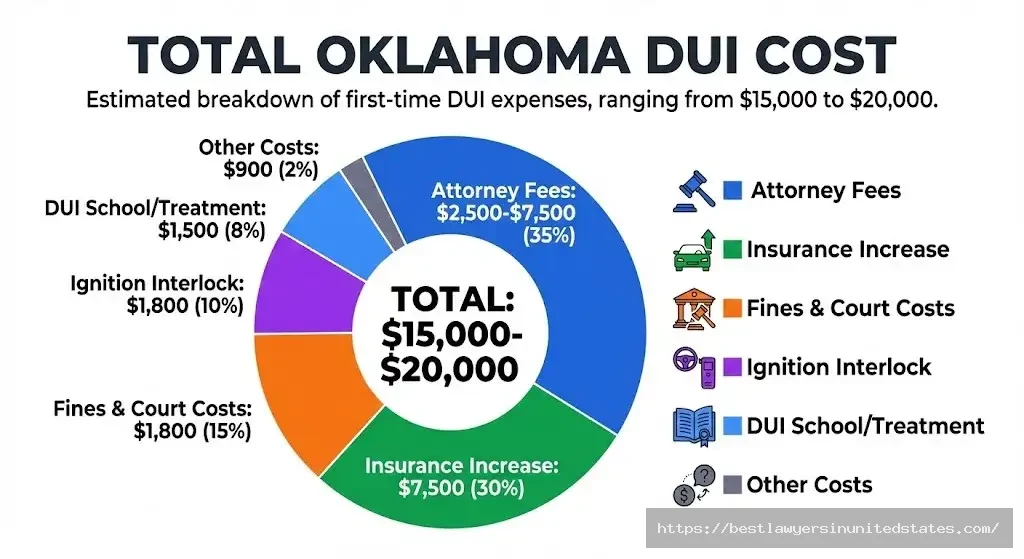
Use our DUI cost calculator to estimate your specific costs based on offense level and county.
DUI Cost Calculator
Estimate total DUI expenses by state and offense
Detailed Cost Breakdown
Payment Timeline
Bail bond, towing fees, car impound, attorney retainer
Initial court fines, DMV fees, DUI school enrollment, ignition interlock installation
Monthly probation fees, ignition interlock fees, DUI school payments, attorney balance
Insurance premium increases, license reinstatement, SR-22 filing fees
- Lost wages from missed work (court dates, jail time, DUI school) – $2,000-$10,000
- Job loss or difficulty finding employment – Varies
- Professional license suspension (doctors, lawyers, nurses, pilots) – Career ending
- Rideshare and transportation costs during suspension – $1,500-$5,000
- Travel restrictions and visa denials – Varies
- Security clearance loss – Career impact
- Child custody implications – Legal costs
- Rental car restrictions – Varies
- Personal relationships and mental health costs – Priceless
Direct Court Costs
| Cost Category | First Offense | Second Offense | Third+ Offense |
|---|---|---|---|
| Criminal fines | $1,000-$1,500 | $2,500-$3,500 | $5,000-$7,000 |
| Court costs/fees | $300-$800 | $500-$1,000 | $800-$1,500 |
| Victim Impact Panel | $50-$100 | $50-$100 | $50-$100 |
Court costs vary by county in Oklahoma. Oklahoma County and Tulsa County typically have higher fees than rural counties.
Attorney Fees in Oklahoma
Hiring an experienced Oklahoma DUI attorney significantly impacts your case outcome. Attorney fees vary based on case complexity and attorney experience.
Typical Oklahoma DUI attorney fees:
- First offense misdemeanor: $2,500-$7,500
- Aggravated/felony DUI: $7,500-$15,000+
- Trial representation: Add $5,000-$10,000
- Appeals: $3,000-$10,000+
Free consultations are available from most Oklahoma DUI attorneys. Contact [email protected] to connect with experienced local counsel.
License-Related Costs
Getting your license back involves several fees and requirements:
| Expense | Cost |
|---|---|
| DPS reinstatement fee | $200-$300 |
| Ignition interlock installation | $100-$200 |
| Monthly interlock fee | $75-$100 |
| Modified license application | $25 |
| SR-22 insurance filing | $25-$50 |
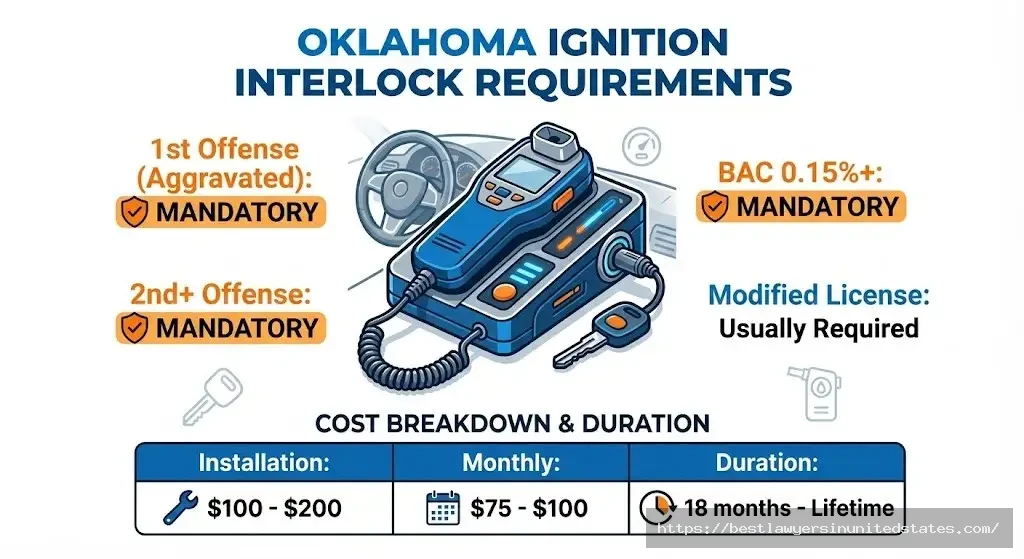
Ignition interlock devices must remain installed for 18 months (first offense) to lifetime (multiple offenses). At $75-$100 monthly, this adds $1,350-$1,800 to first-offense costs.
Substance Abuse and Education Costs
Oklahoma requires DUI offenders to complete substance abuse evaluation and education:
- Substance abuse evaluation: $150-$300
- DUI school (8-32 hours): $150-$500
- Outpatient treatment: $500-$2,000
- Inpatient treatment: $5,000-$20,000+
- Random UA testing: $25-$50 per test
Treatment requirements increase with each offense and depend on evaluation results.
Insurance Impact
DUI convictions cause dramatic insurance premium increases in Oklahoma. Most insurance companies require SR-22 certificates for 3-5 years after conviction.
Average Oklahoma insurance increases:
- Annual premium increase: 50-200%
- Dollar amount: $1,500-$3,000 per year
- Total over 5 years: $7,500-$15,000
Some insurance companies drop DUI offenders entirely, forcing them into high-risk pools with even higher rates.
Other Hidden Costs
Additional expenses many people overlook:
- Vehicle towing and impound: $200-$500
- Lost wages (court, jail, treatment): $1,000-$5,000+
- Employment loss or demotion: Variable, potentially devastating
- Professional license impact: Can end careers
- Security clearance issues: Federal employment affected
- Travel restrictions: Some countries deny entry with DUI conviction
Total Oklahoma DUI Cost Summary
| Offense Level | Low End | High End |
|---|---|---|
| First misdemeanor DUI | $8,000 | $15,000 |
| First aggravated DUI (felony) | $15,000 | $30,000+ |
| Second DUI | $15,000 | $35,000+ |
| Third+ DUI | $20,000 | $50,000+ |
These figures don’t include lost income from imprisonment or career destruction. For professional license holders, total costs can exceed $100,000 when including lost earning potential.
License Suspension and Reinstatement
Oklahoma imposes two separate license suspensions for DUI: administrative (DPS) and criminal (court-ordered). Understanding both is critical.
Administrative License Suspension
The Oklahoma Department of Public Safety automatically suspends your license upon DUI arrest if you:
- Fail chemical test (0.08% BAC or higher)
- Refuse chemical testing
Administrative suspension periods:
| Situation | First Offense | Second Offense | Third+ Offense |
|---|---|---|---|
| Test failure | 180 days | 1 year | 3 years |
| Test refusal | 12 months | 2 years | 3 years |
The suspension begins 30 days after arrest unless you request an administrative hearing. Your 30-day temporary permit expires, and you cannot drive at all during suspension unless you obtain a modified license.
Criminal License Revocation
Courts impose separate license revocation upon DUI conviction. These periods follow the Erin Swezey Act:
- First conviction: 180 days
- Second conviction (within 10 years): 1 year
- Third conviction (within 10 years): 3 years
Criminal and administrative suspensions may run concurrently or consecutively depending on case timing and outcome.
Modified License Eligibility
Oklahoma offers modified licenses allowing limited driving during suspension. Eligibility requirements include:
Modified license requirements:
- Complete portion of suspension period
- Proof of SR-22 insurance
- Ignition interlock device installed (if required)
- Substance abuse evaluation completed
- Pay all reinstatement fees
- Submit modified license application to DPS
Modified licenses typically allow driving to/from work, school, medical appointments, and court-ordered programs.
Ignition Interlock Device Requirements
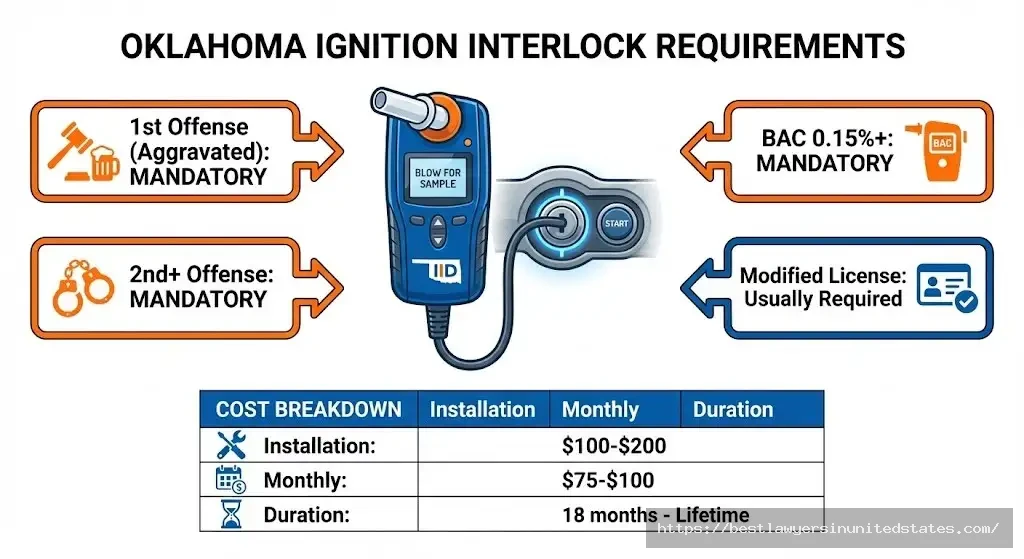
Oklahoma mandates ignition interlock devices for:
- All aggravated DUI convictions
- Second and subsequent DUI convictions
- First offense with BAC 0.15% or higher
- Modified license holders in many cases
Ignition interlock costs:
- Installation: $100-$200
- Monthly monitoring: $75-$100
- Removal fee: $50-$100
- Violation resets: Can extend requirement
Oklahoma-approved IID providers:
- LifeSafer
- Smart Start
- Intoxalock
- Monitech
Violations (failed tests, tampering, circumvention attempts) extend the required installation period and can result in license revocation.
Steps to Reinstate Your License
Full license reinstatement requires completing all requirements:
- Serve full suspension period
- Complete all court requirements (DUI school, treatment, probation)
- Pay all fines and fees
- Obtain SR-22 insurance
- Pass reinstatement requirements:
- Written knowledge test (sometimes)
- Driving skills test (for long suspensions)
- Vision screening
- Pay DPS reinstatement fee ($200-$300)
- Receive new license
Processing time varies but typically takes 2-4 weeks after submitting all documentation to Oklahoma DPS offices in Oklahoma City, Tulsa, or regional locations.
Defending Against Oklahoma DUI Charges
Several defense strategies can reduce or dismiss Oklahoma DUI charges. Success depends on case-specific facts and retaining an experienced Oklahoma DUI attorney.
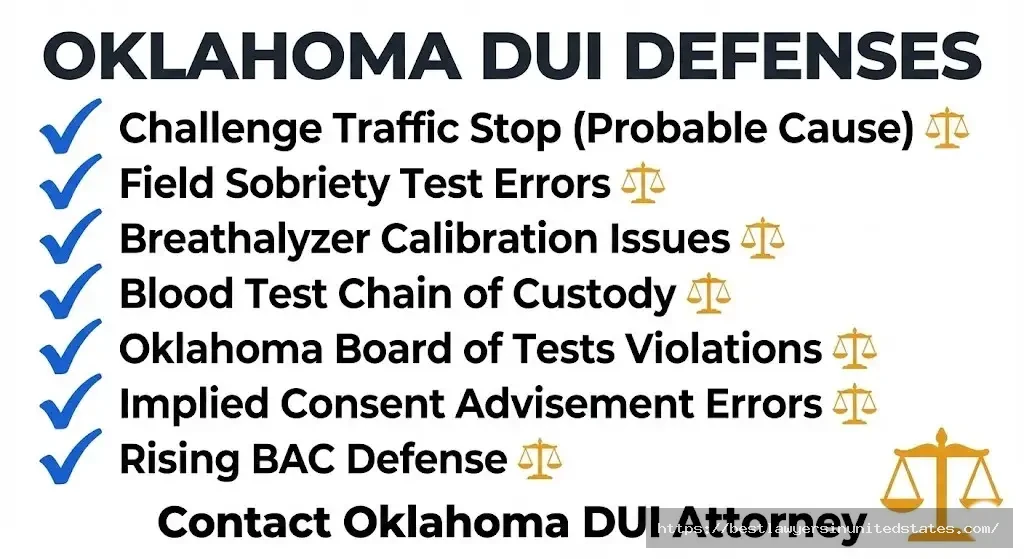
Challenging the Traffic Stop
Officers need reasonable suspicion to stop your vehicle. Common challengeable stops include:
- Stopping for “hunches” without articulable reasons
- Extending traffic stops beyond their purpose
- Illegal checkpoints not meeting constitutional requirements
- Mistaken observations (car issues mistaken for impairment)
Example: Officer stops you for “weaving within your lane.” Oklahoma courts may suppress evidence if the officer cannot articulate specific, dangerous driving behavior beyond normal lane position adjustments.
Challenging Field Sobriety Tests
Field sobriety tests have high error rates even for sober people. Successful challenges include:
Improper administration:
- Officer not following standardized procedures
- Wrong instructions given
- Environmental factors (uneven surface, poor lighting, weather)
- Medical conditions affecting performance (knee problems, inner ear issues, neurological conditions)
The Oklahoma Board of Tests requires specific training and certification. Officers who lack proper credentials or don’t follow protocols give you grounds to exclude FST results.
Challenging Chemical Test Results
Breathalyzer and blood tests frequently contain errors. Common challenges include:
Breath test issues:
- Machine calibration records incomplete
- Maintenance logs show problems
- Officer certification expired
- 15-minute observation period violated
- Mouth alcohol present (GERD, dental work, recent drinking)
- Rising BAC defense (alcohol still absorbing)
Blood test issues:
- Chain of custody breaks
- Improper storage or preservation
- Lab analyst errors or contamination
- Fermentation in sample
- Clotting or hemolysis
Your attorney can subpoena machine calibration records, maintenance logs, and analyst certifications. Gaps in documentation or procedure can invalidate test results.
Oklahoma-Specific Defense Strategies
Oklahoma law provides unique defense opportunities:
- Implied consent violations: Officer failed to read proper warning under § 47-756
- Oklahoma Board of Tests violations: Test administration didn’t follow state regulations
- Municipal court jurisdiction: Challenge whether municipal court has proper jurisdiction
- Modified driving defense: You were on private property not subject to DUI laws
When to Hire an Oklahoma DUI Attorney
Hiring an experienced Oklahoma DUI attorney dramatically improves your case outcome. Consider these factors:
When you absolutely need an attorney:
- Aggravated DUI or felony charges
- Second or subsequent DUI offense
- Accident involving injury or property damage
- Commercial driver’s license holder
- Professional license at risk
- Prior criminal record
What attorneys provide:
- Free initial consultation (most Oklahoma DUI attorneys)
- Administrative hearing representation
- Plea negotiation expertise
- Trial experience and jury selection
- Knowledge of Oklahoma judges and prosecutors
- Access to expert witnesses (toxicologists, forensic scientists)
Contact experienced Oklahoma DUI lawyers at [email protected] for free case evaluation. Early attorney involvement significantly impacts case outcomes.
Frequently Asked Questions About Oklahoma DUI
How long does a DUI stay on your record in Oklahoma?
Quick Answer: DUI convictions remain on your criminal record permanently in Oklahoma unless expunged, and stay on your driving record for 10 years.
For criminal record purposes, Oklahoma DUI convictions never expire unless you successfully petition for expungement. First-offense misdemeanor DUI can be expunged after 5 years. Felony DUI requires 10 years and often needs a governor’s pardon.
For driving purposes, Oklahoma uses a 10-year lookback period. Second DUI charges within 10 years of a first conviction face felony enhancement. After 10 years, a new DUI may be treated as a first offense for sentencing.
Can you refuse a breathalyzer in Oklahoma?
Quick Answer: Yes, but refusal now makes your first DUI an automatic felony charge under SB 54, plus 12-month license suspension.
Before November 1, 2025, refusal meant license suspension but didn’t affect the criminal charge. After SB 54, refusal is an aggravating factor that converts any DUI into aggravated DUI (felony). You face up to 5 years state prison instead of maximum 1 year county jail.
The administrative license suspension for refusal is also longer: 12 months for first refusal versus 180 days for failing the test.
Will you go to jail for first DUI in Oklahoma?
Quick Answer: Possible but not guaranteed for misdemeanor first DUI. Probation is common. Aggravated first DUI (felony) faces up to 5 years state prison.
First-offense misdemeanor DUI carries up to 1 year county jail, but most defendants receive suspended sentences and probation. Judges typically order probation, fines, DUI school, and community service rather than incarceration for first offenders with no aggravating factors.
Aggravated first DUI (felony under SB 54) faces 1-5 years state prison. While probation remains possible, felony charges substantially increase imprisonment likelihood.
Is a DUI a felony in Oklahoma?
Quick Answer: Yes, if it’s aggravated first offense (SB 54), second offense with enhancement, or third/subsequent offense.
Since November 1, 2025, DUI becomes a felony in these situations:
- First offense with BAC 0.15%+ (aggravated)
- First offense with test refusal (aggravated)
- First offense with child under 18 in vehicle (aggravated)
- First offense causing great bodily injury (aggravated)
- Second offense within 10 years of first (if prior meets enhancement requirements)
- Third and all subsequent offenses (always felony)
Standard first-offense DUI with BAC between 0.08-0.14% and no aggravating factors remains a misdemeanor.
Can you drive to work after DUI in Oklahoma?
Quick Answer: Not during suspension unless you obtain a modified license from Oklahoma DPS, which requires ignition interlock in most cases.
Your license suspends automatically 30 days after arrest (or immediately if you miss the administrative hearing deadline). During suspension, you cannot drive at all without a modified license.
Modified license requirements for work driving:
- Serve initial suspension period (varies by offense)
- Install ignition interlock device
- Obtain SR-22 insurance
- Pay modified license fees
- Restrict driving to approved purposes (work, school, medical, court-ordered programs)
What happens if you get a DUI in Oklahoma?
Quick Answer: Arrest, administrative hearing within 30 days, criminal court proceedings over 4-12 months, potential jail/prison, fines, license suspension, and mandatory programs.
The process follows this timeline:
- Arrest and booking (day 1)
- 30-day deadline to request DPS administrative hearing
- Arraignment within 10-30 days
- Administrative hearing at DPS office
- Pre-trial conferences (30-90 days)
- Trial or plea agreement (4-12 months)
- Sentencing and program completion
Total cost ranges $8,000-$15,000+ for first offense, including fines, attorney fees, insurance increases, and program costs.
How much does DUI expungement cost in Oklahoma?
Quick Answer: $150-$400 in court filing fees plus $1,500-$3,000 attorney fees, totaling approximately $2,000-$3,500.
Oklahoma DUI expungement requires:
- Court filing fees ($150-$400 depending on county)
- Attorney fees ($1,500-$3,000)
- Background check fees ($25-$50)
- Service of process fees ($50-$100)
Total timeline runs 4-8 months from filing to completion. Most expungements require a hearing before a judge. Success rates vary based on offense level, time elapsed, and subsequent criminal history.
Can medical marijuana users get DUI in Oklahoma?
Quick Answer: Yes. Medical marijuana cards provide no defense to DUI charges in Oklahoma.
Oklahoma law prohibits driving while impaired by any intoxicating substance, including medical marijuana. Having a valid medical marijuana card does not give you legal permission to drive while impaired.
Officers can arrest you for marijuana DUI based on:
- Observable impairment (field sobriety tests)
- Blood test showing THC presence
- Admission of recent marijuana use
- Physical signs (bloodshot eyes, marijuana odor)
The challenge in marijuana DUI cases involves proving current impairment since THC metabolites remain detectable long after effects wear off.
What is the new alcohol law in Oklahoma?
Quick Answer: Senate Bill 54, effective November 1, 2025, makes first-offense DUI a felony if aggravated (BAC 0.15%+, test refusal, child in vehicle, or injury accident).
SB 54 represents Oklahoma’s biggest DUI law change in decades. The law:
- Creates felony first-offense DUI for aggravated cases
- Makes test refusal an aggravating factor
- Increases maximum penalties across all offense levels
- Adds enhanced monitoring and treatment requirements
- Survived Governor’s veto through legislative override
Impact: First-time offenders with aggravating factors now face up to 5 years state prison instead of maximum 1 year county jail.
How many DUIs can you get in Oklahoma?
Quick Answer: No legal limit exists, but penalties increase dramatically with fourth DUI potentially resulting in 20 years prison under the 85% Rule.
Oklahoma law imposes no maximum number of DUI convictions. However, each subsequent offense brings harsher consequences:
- Third DUI: 1-10 years state prison
- Fourth DUI: Up to 20 years state prison with 85% Rule
- Fifth+ DUI: Enhanced sentencing, lifetime license revocation possible
After multiple felony DUI convictions, offenders face “habitual offender” sentencing enhancements that can result in life imprisonment.
What to Do After an Oklahoma DUI Arrest
Immediate action after a DUI arrest significantly impacts your case outcome. Follow these steps:
Within 24 Hours
1. Contact an Oklahoma DUI attorney immediately Most Oklahoma DUI attorneys offer free consultations. Early involvement allows your attorney to:
- Preserve evidence before it’s lost
- Interview witnesses while memories are fresh
- Request administrative hearing before deadline
- Begin building your defense strategy
2. Document everything about your arrest Write down detailed notes while memory is fresh:
- Exact time and location of stop
- Officer statements and behavior
- Field sobriety test instructions
- Chemical test procedures
- Witnesses present
- Weather and road conditions
3. Do not discuss your case Avoid talking about your arrest with anyone except your attorney:
- Don’t post on social media
- Don’t discuss with friends or family
- Don’t talk to police without attorney present
- Don’t make recorded statements
Within 30 Days
Request administrative hearing at Oklahoma DPS
This is your most critical deadline. Missing it means automatic license suspension with no opportunity to challenge it.
How to request hearing:
- Online through Oklahoma DPS website
- In person at DPS office
- By mail with return receipt
- Through your attorney (recommended)
Your attorney can appear at the hearing on your behalf and challenge the suspension.
Throughout Your Case
Comply with all court requirements:
- Attend all court dates (failure results in warrant)
- Complete bond conditions
- Begin substance abuse evaluation if ordered
- Maintain valid SR-22 insurance
- Follow all probation requirements
Gather supporting evidence:
- Character references
- Employment records
- Medical records (if relevant to field sobriety tests)
- Witness statements
- Photographs of arrest location
Oklahoma DUI Resources and Legal Help
Government Resources
Oklahoma Department of Public Safety:
- Administrative hearings
- License reinstatement
- Ignition interlock information
- Website: dps.ok.gov
Oklahoma State Courts Network (OSCN):
- Court records and case information
- Online docket search
- Legal forms and resources
- Website: oscn.net
Oklahoma Department of Mental Health and Substance Abuse Services:
- Approved treatment programs
- Substance abuse evaluations
- DUI education courses
- Counseling resources
Legal Assistance
Oklahoma DUI cases require experienced legal representation familiar with SB 54 changes and Oklahoma-specific procedures.
Find qualified Oklahoma DUI attorneys: Email: [email protected]
Most Oklahoma DUI attorneys offer:
- Free initial consultation
- Payment plans for legal fees
- Administrative hearing representation
- Criminal court defense
- License reinstatement assistance
Cost Estimation Tools
Planning for DUI expenses helps you prepare financially:
Estimate your total Oklahoma DUI costs: DUI Cost Calculator
Calculate costs including:
- Court fines and fees
- Attorney expenses
- License reinstatement
- Insurance increases
- Treatment programs
- Ignition interlock device
Calculate your BAC level: BAC Calculator
Understand how drinks affect your BAC based on:
- Body weight
- Number of drinks
- Time period
- Drink type
Understanding DUI Laws in Other States
Oklahoma’s DUI laws differ significantly from neighboring states. If you’re facing charges in multiple states or comparing state laws, these resources help:
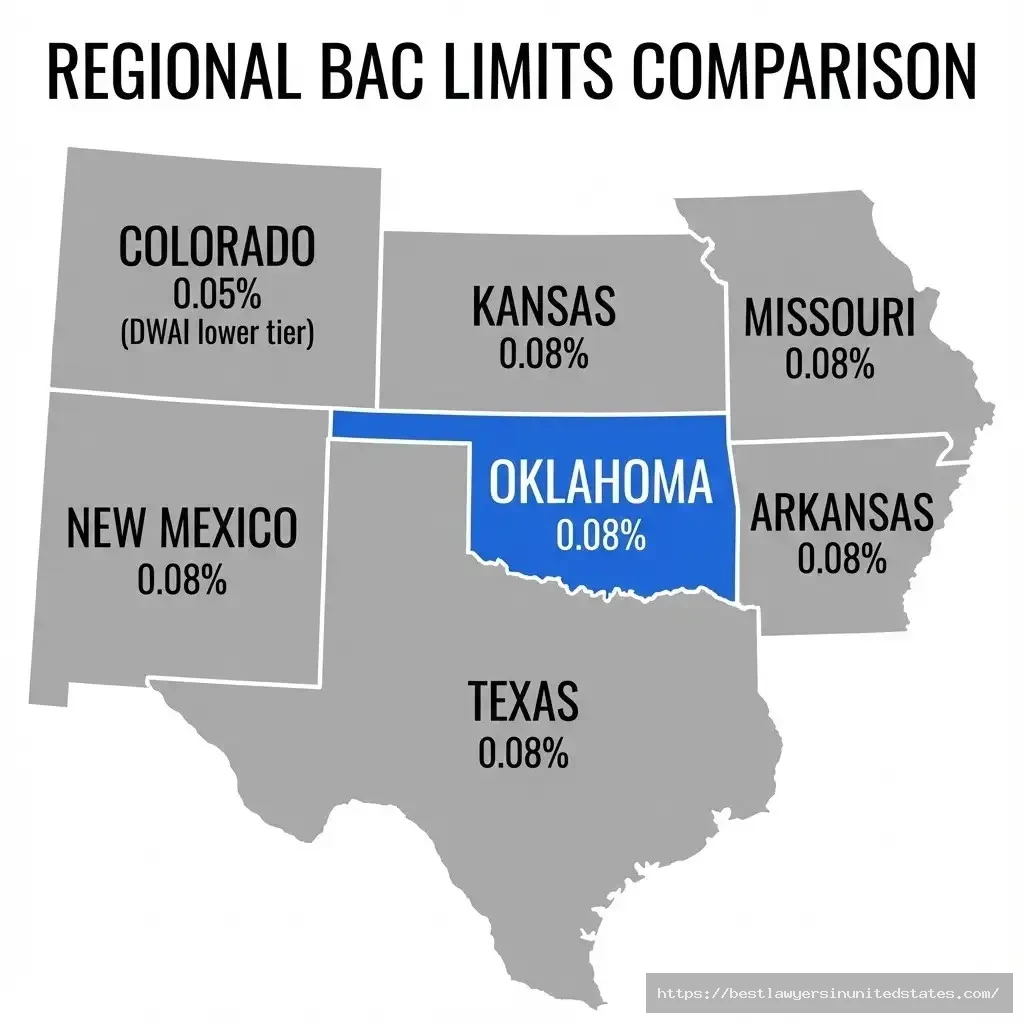
Neighboring state DUI laws:
- Texas DUI Laws – Different penalties and procedures
- Kansas DUI Laws – Compare to Oklahoma
- Missouri DUI Laws – Neighboring state differences
- Arkansas DUI Laws – Border state comparison
Other state comparisons:
- California DUI Laws – Strictest in nation
- Florida DUI Laws – Tourist state considerations
Understanding how Oklahoma compares to other states helps you appreciate the seriousness of Oklahoma’s new SB 54 provisions.
Conclusion
Oklahoma’s DUI laws became significantly harsher on November 1, 2025, when Senate Bill 54 took effect. First-time offenders with aggravating factors now face felony charges and up to five years in state prison. Test refusal, once a strategic option, now automatically elevates any DUI to felony status.
The total cost of an Oklahoma DUI ranges from $8,000 to $15,000 for a first offense, not including potential lost income from imprisonment or career damage. These costs multiply with each subsequent offense.
If you’re facing Oklahoma DUI charges, immediate action matters. Request your administrative hearing within 30 days to preserve driving privileges. Contact an experienced Oklahoma DUI attorney for a free consultation to discuss your specific situation and defense options.
Don’t let a DUI conviction derail your future. Understanding Oklahoma’s complex DUI laws and taking prompt action gives you the best chance at a favorable outcome.
For immediate legal help with Oklahoma DUI charges, contact [email protected] for a free consultation with experienced local attorneys.
