
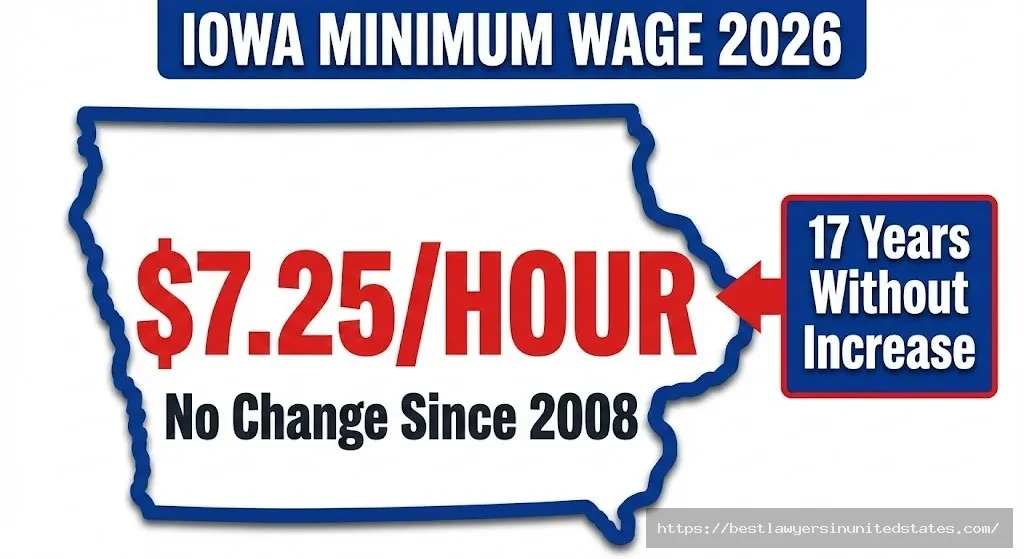
Iowa’s minimum wage is $7.25 per hour as of 2026, matching the federal minimum wage. This rate has not changed since 2008, making Iowa one of 20 states without a wage increase in over 17 years. Workers in Iowa earn the same base wage as federal law requires, with no scheduled increases planned for 2027 or beyond.
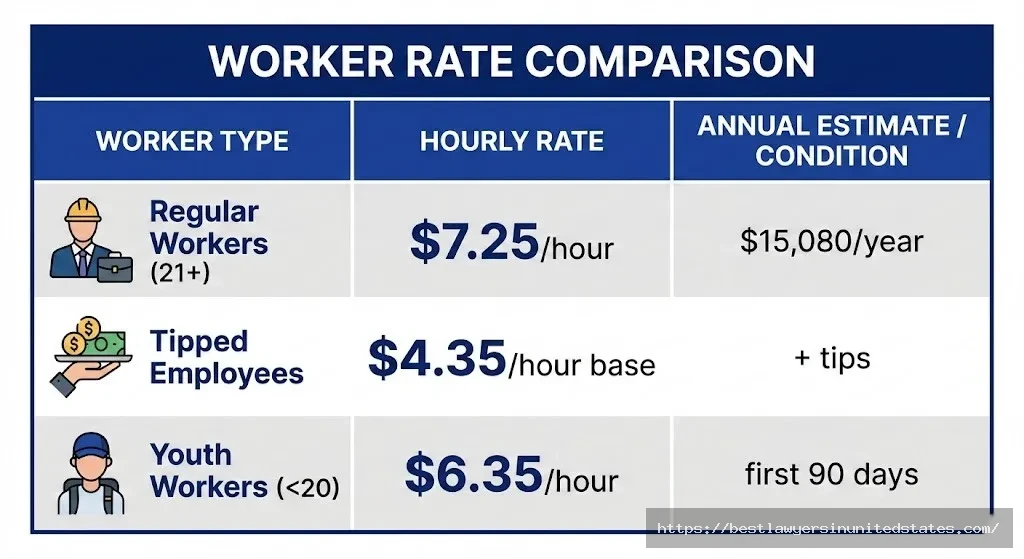
Iowa follows the federal minimum wage under Iowa Code Chapter 91D. The state’s minimum wage applies to employers with at least $300,000 in annual revenue, which is broader than the federal $500,000 threshold. Tipped workers can be paid as little as $4.35 per hour, and workers under age 20 may earn $6.35 per hour during their first 90 calendar days of employment.
The wage has remained stagnant while neighboring states have increased their rates significantly. Illinois now requires $15 per hour, Nebraska mandates $12 per hour, and Minnesota enforces $11.13 per hour. This wage gap has created economic challenges for Iowa workers, particularly in border communities where cost of living continues to rise.
Calculate Your Earnings in Iowa
Want to know exactly how much you’ll earn at Iowa’s $7.25 minimum wage? Use our free calculator to estimate your weekly, monthly, and annual income based on your hours worked.
💰 Minimum Wage Earnings Calculator
Calculate your weekly, monthly, and annual earnings with overtime and tax estimates
📊 Your Earnings Breakdown
💰 Gross Earnings
Calculator features:
- Automatic Iowa wage rates for 2026
- Weekly, monthly, and annual earnings
- Overtime calculations
- Tax withholding estimates
- Take-home pay breakdown
Full calculator with all features: Calculate your exact earnings with our comprehensive minimum wage calculator
Questions about your wages or need legal help?
Email: [email protected]
What Is Iowa's Minimum Wage in 2026?
Iowa's minimum wage is $7.25 per hour for 2026. This matches the federal minimum wage established by the Fair Labor Standards Act (FLSA). The rate applies to most workers across the state, with some exceptions for tipped employees and youth workers.
Current Wage Rates
| Worker Category | Hourly Rate | Annual Income (Full-Time) |
|---|---|---|
| Regular Workers (21+) | $7.25 | $15,080 |
| Tipped Employees | $4.35 | $9,048 (before tips) |
| Youth Workers (<20) | $6.35 | $13,208 (first 90 days) |
Key fact: Iowa's minimum wage has not increased since July 24, 2008. This represents 17 years without any adjustment for inflation or cost of living increases.
Who Sets Iowa's Minimum Wage?
Iowa Code Chapter 91D establishes the state's minimum wage law. The Iowa Division of Labor enforces these wage requirements across the state. When state and federal minimum wages differ, employers must pay the higher of the two rates. Since both are currently $7.25, there is no difference in 2026.
The state law covers employers with annual gross sales of at least $300,000. This threshold is lower than the federal requirement of $500,000, meaning more Iowa employers fall under state wage protections. Certain industries are covered regardless of revenue, including construction, healthcare facilities, schools, and public agencies.
Why Iowa's Minimum Wage Hasn't Changed Since 2008
Iowa's minimum wage has remained at $7.25 for 17 years because the state legislature has not passed any increases. Unlike 30 other states that have raised their minimum wages above federal law, Iowa follows only the federal baseline. The state's Republican-controlled legislature has consistently opposed minimum wage increases since 2008.
What This Means for Workers
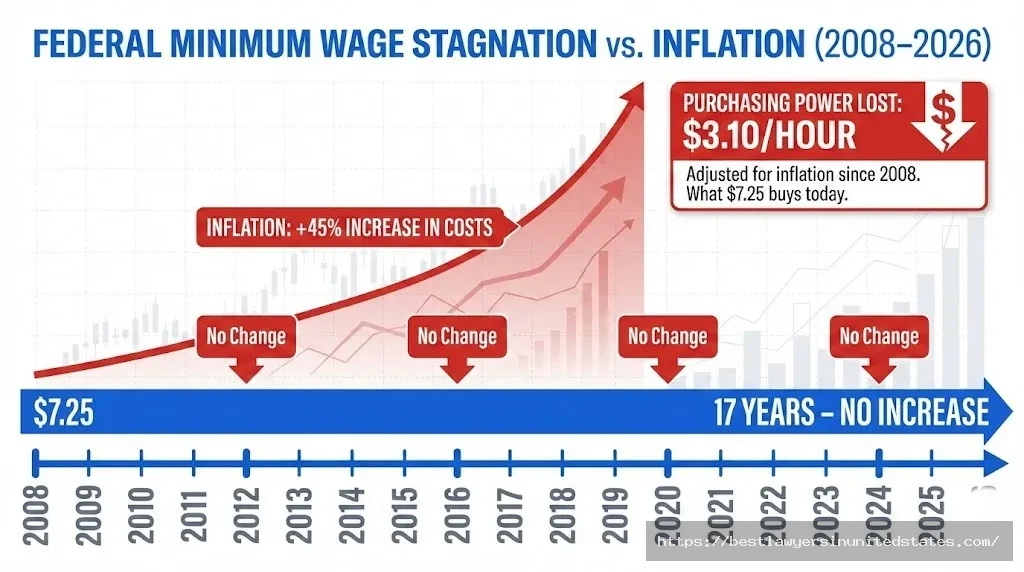
The lack of wage increases has significantly eroded purchasing power. A worker earning minimum wage in 2008 could afford more goods and services than a minimum wage worker in 2026. Inflation has increased costs for housing, food, healthcare, and transportation by approximately 45% since 2008, while wages have stayed flat.
Real-world impact:
- $7.25 in 2008 = approximately $10.35 in 2026 dollars
- Iowa workers have lost $3.10 per hour in purchasing power
- Annual loss: $6,448 for full-time workers
How Iowa Compares to Neighboring States
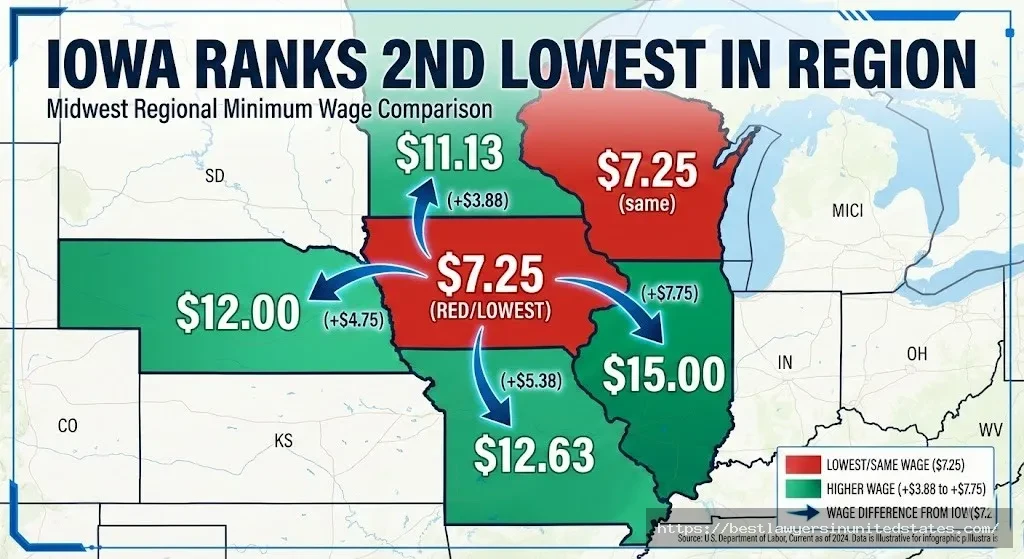
Iowa's wage stagnation becomes more apparent when compared to surrounding states. Workers in border cities often face the same cost of living but earn significantly different wages depending on which side of the state line they work.
| State | 2026 Minimum Wage | Difference from Iowa | Last Increase |
|---|---|---|---|
| Iowa | $7.25 | Baseline | 2008 |
| Illinois | $15.00 | +$7.75 | 2025 |
| Nebraska | $12.00 | +$4.75 | 2024 |
| Minnesota | $11.13 | +$3.88 | 2024 |
| Missouri | $12.63 | +$5.38 | 2024 |
| Wisconsin | $7.25 | $0.00 | 2008 |
Workers in the Quad Cities area (Iowa/Illinois border) experience the most significant disparity. An Illinois worker earns $15 per hour while an Iowa worker across the river earns $7.25 for similar work.
The 2017 Preemption Law: What Happened to Local Minimum Wages?
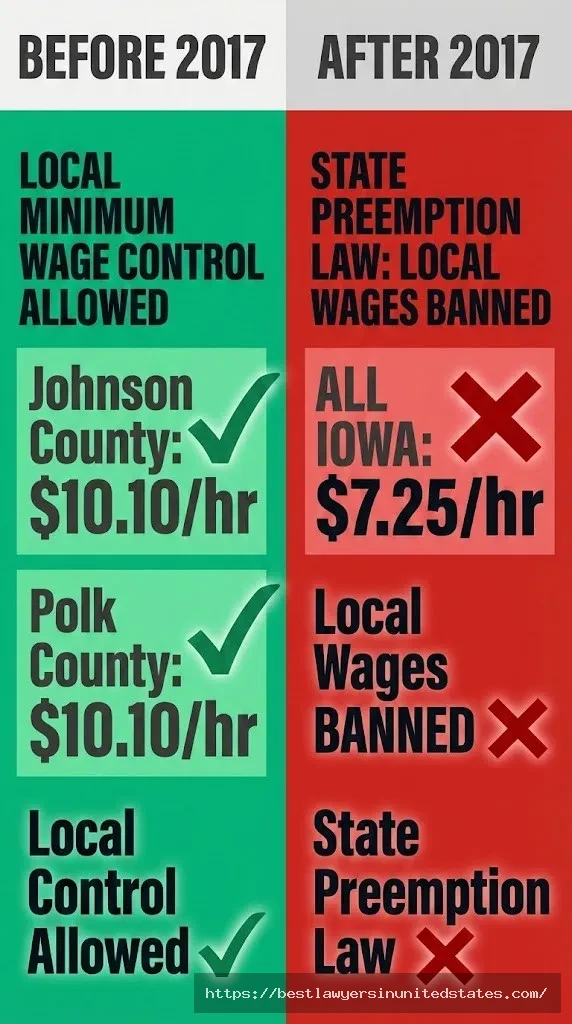
Iowa's minimum wage story includes a critical chapter that most people don't know. In 2017, the Iowa Legislature passed a law that banned cities and counties from setting their own minimum wage rates. This law rolled back existing local minimum wage ordinances that had already been implemented in several Iowa communities.
Johnson County and Polk County's Higher Wages
Before 2017, local governments in Iowa could set minimum wages higher than the state rate. Two counties took action:
Johnson County (Iowa City area):
- Passed a $10.10 minimum wage ordinance in 2015
- Effective April 1, 2017
- Covered approximately 90,000 workers
Polk County (Des Moines area):
- Passed a $10.10 minimum wage ordinance in 2016
- Set to phase in gradually
- Would have affected 150,000+ workers
Linn County (Cedar Rapids area):
- Considered but did not pass a local ordinance
- Would have covered 130,000 workers
The State Rollback
On March 30, 2017, Iowa Governor Terry Branstad signed HF 295 into law. This bill had two major provisions:
- Immediate preemption: Cities and counties could no longer set minimum wages higher than state law
- Rollback of existing ordinances: Local minimum wage laws already in effect were nullified
The law took effect April 1, 2017, the same day Johnson County's $10.10 minimum wage was scheduled to begin. Workers who expected raises saw their wages roll back to $7.25. Polk County's phased increase was also cancelled before implementation.
Why People Still Search for "Iowa City Minimum Wage"
Many people search for "Iowa City minimum wage" or "Des Moines minimum wage" because they remember the local ordinances or heard about them. However, there is no separate minimum wage for any Iowa city or county in 2026. All Iowa workers are covered by the same $7.25 state minimum wage, regardless of location.
Current status:
- Iowa City minimum wage: $7.25 (same as state)
- Des Moines minimum wage: $7.25 (same as state)
- Cedar Rapids minimum wage: $7.25 (same as state)
- All other Iowa cities: $7.25 (same as state)
This makes Iowa different from states like California, where cities such as San Francisco ($18.67) and Los Angeles ($17.28) have substantially higher local minimum wages.
Special Worker Categories and Exceptions
Iowa law allows employers to pay reduced minimum wages to certain categories of workers. These exceptions follow federal FLSA guidelines but are enforced by the Iowa Division of Labor under Iowa Code Chapter 91D.
Tipped Employees
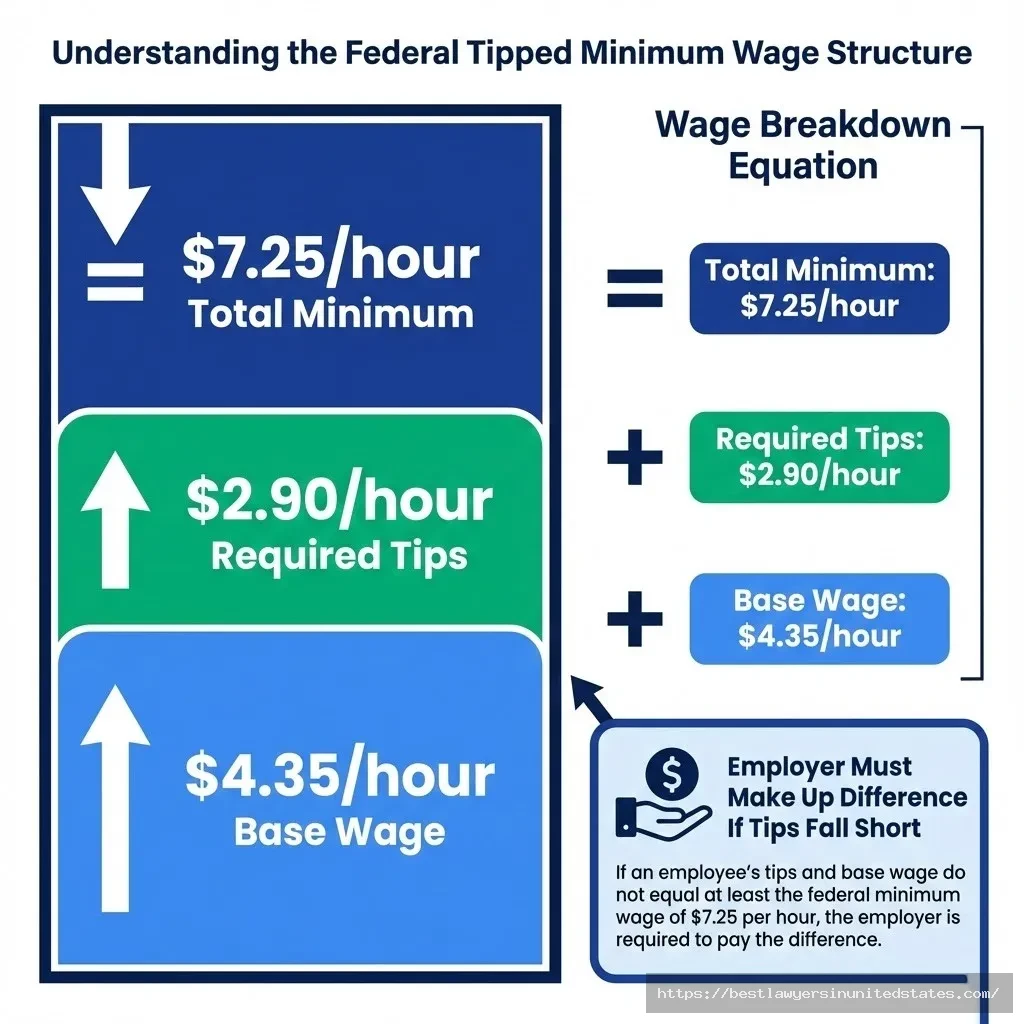
Iowa employers can pay tipped workers as little as $4.35 per hour as a base wage. This represents a tip credit of $2.90 per hour. However, if an employee's tips combined with the base wage do not equal at least $7.25 per hour, the employer must make up the difference.
Tip credit rules:
- Base wage: $4.35/hour minimum
- Tip credit: $2.90/hour maximum
- Total must equal: $7.25/hour minimum
- Tips belong to employee: 100%
| Wage Component | Amount |
|---|---|
| Cash wage from employer | $4.35/hour |
| Maximum tip credit | $2.90/hour |
| Employee must receive in tips | $2.90/hour |
| Total guaranteed minimum | $7.25/hour |
Who qualifies as a tipped employee:
- Workers who customarily receive more than $30 per month in tips
- Restaurant servers, bartenders, delivery drivers
- Bellhops, valets, hairstylists
- Any service worker who regularly receives tips
Youth and Training Wages
Workers under age 20 may be paid a training wage of $6.35 per hour during their first 90 consecutive calendar days of employment with any employer. After 90 days, or when the worker turns 20 (whichever comes first), the employer must pay the full $7.25 minimum wage.
Important restrictions:
- Applies only to the first 90 calendar days
- Cannot displace other workers to hire youth at lower wage
- Must still comply with all other labor laws
- Overtime still applies (1.5x the $6.35 rate)
Agricultural Workers
Agricultural workers in Iowa are generally covered by minimum wage laws, but some exceptions exist. Small farms with fewer than 500 "man-days" of agricultural labor in any calendar quarter of the preceding year may be exempt from minimum wage requirements.
Exempt Employees
Certain employees are exempt from minimum wage requirements under both state and federal law:
Common exemptions:
- Executive, administrative, and professional employees earning salary above threshold
- Outside sales employees
- Certain computer professionals
- Some seasonal and recreational establishment employees
- Newspaper delivery workers
Note: Just because an employer calls you "exempt" doesn't make it legal. Understanding your rights in workplace disputes can help protect you from misclassification.
Iowa vs Federal Minimum Wage: What You Need to Know
Iowa follows the federal minimum wage of $7.25 per hour. When state and federal minimum wages differ, employers must pay whichever rate is higher. Since both rates are identical in 2026, there is no practical difference for most workers.
Coverage Differences
While the wage rate is the same, Iowa law covers more employers than federal law:
| Jurisdiction | Coverage Threshold | Annual Revenue |
|---|---|---|
| Federal FLSA | $500,000+ annual revenue | $500,000 |
| Iowa Code 91D | $300,000+ annual revenue | $300,000 |
What this means: Some small businesses with $300,000-$499,000 in revenue must pay Iowa minimum wage but aren't covered by federal law. This gives Iowa workers broader protection.
Industries Always Covered
Both Iowa and federal law cover certain industries regardless of revenue:
- Hospitals and healthcare facilities
- Schools and educational institutions
- Construction companies
- Laundry and dry cleaning businesses
- Public agencies and government employers
- Daycare centers
Enforcement Agencies
For federal minimum wage violations:
- U.S. Department of Labor, Wage and Hour Division
- Des Moines District Office
- Federal Building, 210 Walnut Street, Room 643
- Des Moines, IA 50309-2407
- Phone: 515-284-4625
For Iowa state minimum wage violations:
- Iowa Division of Labor
- 1000 East Grand Ave
- Des Moines, IA 50319-0209
- Phone: 515-725-5619
- Website: iowadivisionoflabor.gov
Overtime Laws in Iowa
Iowa workers are entitled to overtime pay under both state and federal law. Most employees must receive time-and-a-half (1.5 times their regular rate) for hours worked beyond 40 in a workweek. This applies regardless of whether you're paid hourly, salary, commission, or piece rate.
Basic Overtime Requirements
Overtime threshold: 40 hours per workweek Overtime rate: 1.5x regular hourly rate Example: $7.25 minimum wage × 1.5 = $10.88 per overtime hour
Iowa follows federal FLSA overtime rules. There is no daily overtime requirement in Iowa. Unlike California, which requires overtime for work beyond 8 hours in a day, Iowa only requires overtime for work beyond 40 hours in a week.
Calculating Overtime on Minimum Wage
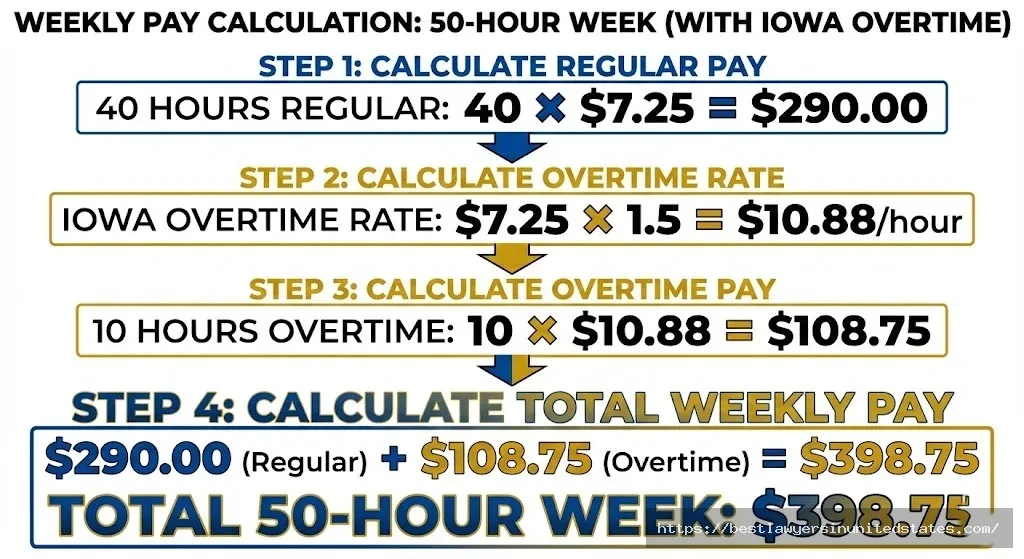
| Hours Worked | Regular Pay (40 hrs) | Overtime Hours | Overtime Pay | Total Weekly Pay |
|---|---|---|---|---|
| 40 hours | $290.00 | 0 | $0.00 | $290.00 |
| 45 hours | $290.00 | 5 | $54.38 | $344.38 |
| 50 hours | $290.00 | 10 | $108.75 | $398.75 |
| 60 hours | $290.00 | 20 | $217.50 | $507.50 |
Calculate Your Overtime Pay in Iowa
Working more than 40 hours per week? Calculate your overtime earnings based on Iowa's overtime laws. This calculator accounts for Iowa's weekly overtime rules and helps you verify your paycheck is correct.
⏰ Overtime Pay Calculator
Calculate your overtime earnings based on your state's specific labor laws
📍 Select Your State
💰 Your Hourly Wage
📊 Calculation Method
📅 Weekly Hours
💵 Your Weekly Overtime Pay
📊 Earnings Breakdown
📅 Pay Period Estimates
⚖️ State vs Federal Comparison
Calculator features:
- Iowa-specific overtime rules
- Weekly overtime calculations
- Pay period breakdowns
- Comparison with regular pay
- Printable results for records
Full overtime calculator: Calculate your exact overtime pay with our detailed overtime calculator
Questions about your wages or need legal help?
Email: [email protected]
Exempt vs Non-Exempt Employees
Not all workers are entitled to overtime. Exempt employees include:
Salary-based exemptions (must meet ALL criteria):
- Paid on a salary basis (not hourly)
- Earn at least $684 per week ($35,568 annually)
- Perform executive, administrative, or professional duties
Common non-exempt workers (entitled to overtime):
- Most hourly workers
- Retail employees
- Restaurant workers
- Healthcare workers
- Manual laborers
- Delivery drivers
Common Overtime Violations
Employers sometimes try to avoid paying overtime through illegal means:
Illegal practices:
- Calling employees "independent contractors" to avoid overtime
- Requiring off-the-clock work
- Averaging hours over two weeks instead of calculating weekly
- Providing comp time instead of overtime pay (illegal for private employers)
- Misclassifying employees as exempt when they don't meet criteria
If you're experiencing wage issues, understanding your options for addressing workplace discrimination and disputes can help you take appropriate action.
Can You Live on $7.25 Per Hour in Iowa?
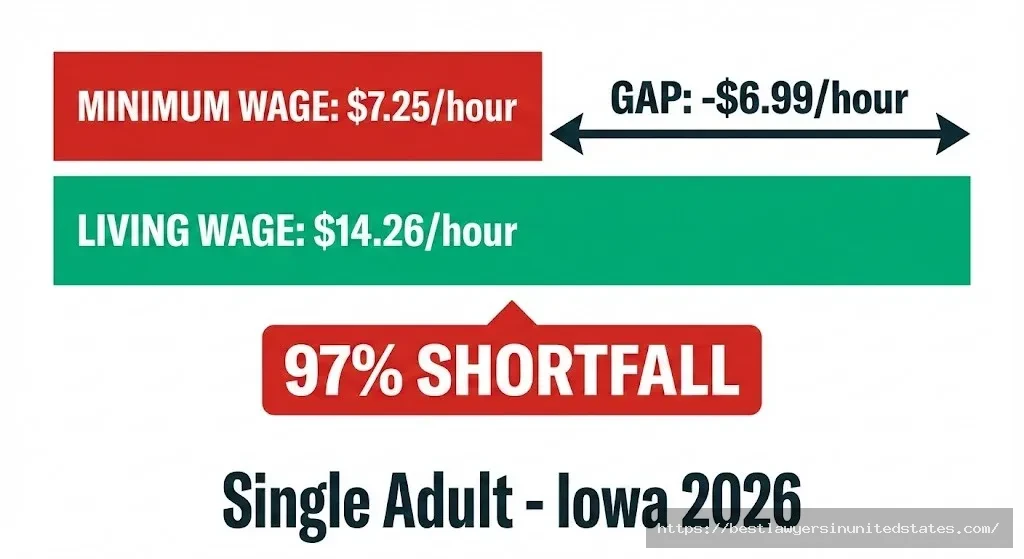
A single adult working full-time at Iowa's $7.25 minimum wage earns $15,080 per year before taxes. After federal and state taxes, take-home pay is approximately $13,320 annually, or $1,110 per month. This falls significantly below the living wage for even a single adult with no children.
Living Wage vs Minimum Wage in Iowa
According to MIT's Living Wage Calculator, the living wage for a single adult in Iowa is approximately $14.26 per hour, nearly double the minimum wage. A single parent with one child needs $31.39 per hour to meet basic needs.
| Household Type | Living Wage | Minimum Wage Gap |
|---|---|---|
| Single Adult | $14.26/hour | -$6.99/hour |
| Single Adult + 1 Child | $31.39/hour | -$24.14/hour |
| Two Adults (Both Working) | $11.43/hour each | -$4.18/hour |
| Two Adults + 2 Children | $18.03/hour each | -$10.78/hour |
Monthly Budget on Minimum Wage
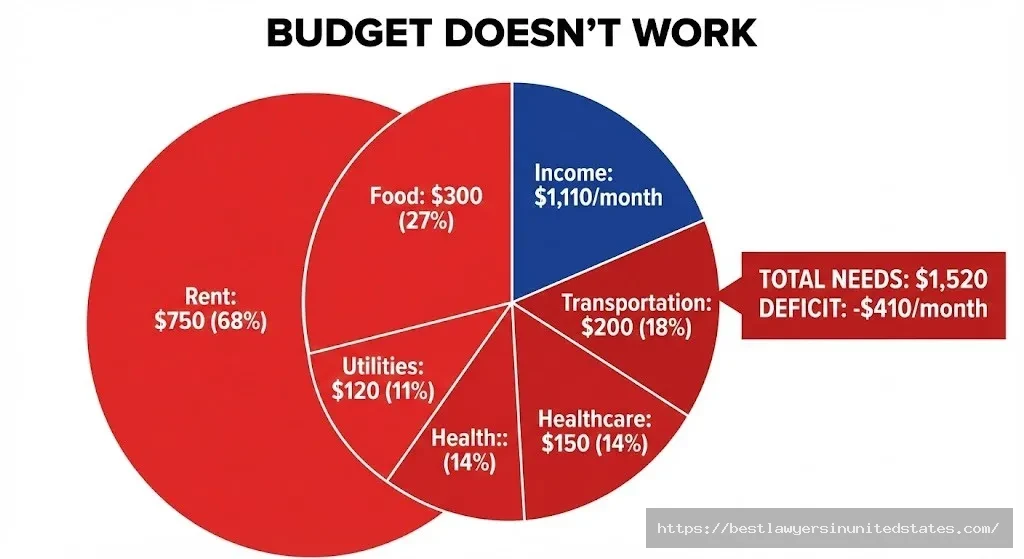
Here's what a monthly budget looks like for a single adult earning minimum wage in Iowa:
Monthly gross income: $1,256 (40 hours/week × 4.33 weeks × $7.25) Monthly net income: $1,110 (after taxes)
| Expense Category | Typical Cost | Percentage of Income |
|---|---|---|
| Rent (1-bedroom) | $750 | 68% |
| Utilities | $120 | 11% |
| Food | $300 | 27% |
| Transportation | $200 | 18% |
| Healthcare | $150 | 14% |
| Total Basic Needs | $1,520 | 137% |
The math doesn't work. A single adult needs $410 more per month than minimum wage provides just to cover basic expenses. This doesn't include clothing, entertainment, emergency savings, or unexpected costs.
Cost of Living by Iowa City
Housing costs vary significantly across Iowa. Here's how minimum wage compares to median rent in major cities:
| City | Median Rent (1BR) | Hours Needed at Min Wage | Affordable at Min Wage? |
|---|---|---|---|
| Des Moines | $850 | 117 hours/month | No |
| Iowa City | $950 | 131 hours/month | No |
| Cedar Rapids | $750 | 103 hours/month | No |
| Davenport | $650 | 90 hours/month | No |
| Sioux City | $600 | 83 hours/month | No |
Rule of thumb: Rent should not exceed 30% of gross income. At minimum wage, that's $377 per month, far below market rates anywhere in Iowa.
What Iowa Workers Actually Earn
While some workers earn minimum wage, many Iowa workers earn more. Understanding the full wage picture helps contextualize the minimum wage discussion:
Iowa wage statistics:
- Median hourly wage (all workers): $19.85/hour
- Average hourly wage (all workers): $24.37/hour
- Workers earning minimum wage or less: Approximately 2.5% of hourly workers
Industries with high minimum wage employment:
- Food service and restaurants: 15-20% of workers
- Retail trade: 8-12% of workers
- Personal care services: 10-15% of workers
Your Wage Payment Rights Under Iowa Law
Iowa Code Chapter 91A (Iowa Wage Payment Collection Act) provides strong protections for workers beyond just the minimum wage rate. These rules govern when and how you must be paid, what deductions are allowed, and what happens if your employer violates wage laws.
When Must You Be Paid?
Iowa law requires employers to pay workers in full within 12 days of the end of each payroll period, excluding Sundays and legal holidays. The payroll period must be established in advance, cannot exceed one month, and must occur at consistent intervals.
Payment timing rules:
- Weekly payroll: Paid within 12 days after week ends
- Bi-weekly payroll: Paid within 12 days after period ends
- Monthly payroll: Paid within 12 days after month ends
- Final paycheck (fired/quit): Next regular payday
Required Pay Stub Information
Every payday, your employer must provide a written statement showing:
- Hours worked during the pay period
- Wages earned (rate and total)
- All deductions taken from gross pay
- Net pay amount
Electronic pay stubs: If your employer only provides electronic pay stubs, they must give you free and unrestricted access to a printer at work. You cannot be required to have internet at home or a personal device to access your pay information.
What Can Be Deducted From Your Paycheck?
Iowa law strictly limits payroll deductions. Employers can only deduct money from your wages if:
- Required by law: Federal and state taxes, Social Security, Medicare, court-ordered garnishments
- Court ordered: Child support, wage garnishment for debts
- Written authorization for employee's benefit: Health insurance, 401(k) contributions, union dues
Illegal Deductions in Iowa
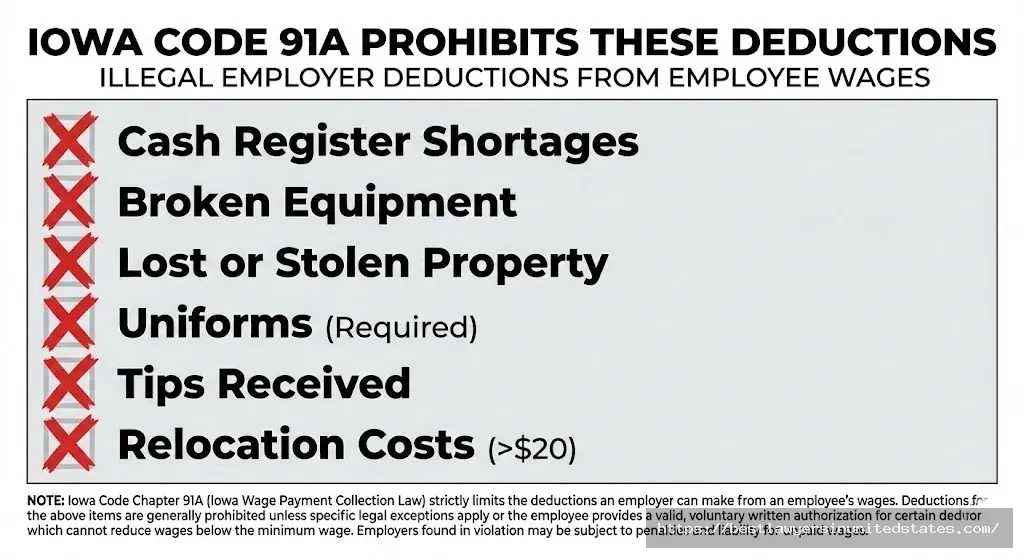
Employers CANNOT deduct money for:
- Cash register shortages
- Broken or damaged equipment
- Lost or stolen property
- Cost of uniforms (if required)
- Tips received by employee
- Personal protective equipment required for job
- Relocation costs over $20
If your employer is making illegal deductions from your paycheck, you may be experiencing wage theft. Sometimes these deductions are improperly characterized as wage garnishment, but legitimate garnishments must be court-ordered.
Payment Methods in Iowa
Employers must pay workers through one of these methods:
Legal payment methods:
- Cash
- Check
- Direct deposit into bank account of employee's choice
- Payroll card (if employee agrees in writing and meets requirements)
Payroll card requirements:
- Employee must agree in writing
- Funds must be available on payday
- Employee must have access to all wages without fees
- No forced use of specific bank or card
Illegal practices:
- Requiring direct deposit to specific bank
- Forcing use of payroll card as only option
- Charging fees to access wages on payday
- Delaying availability of funds beyond payday
What If You're Not Being Paid Properly?
Wage violations are common in Iowa. If your employer is not paying you correctly, you have legal rights to recover unpaid wages plus additional damages. Iowa law protects all workers who file wage claims, regardless of immigration status.
Common Wage Violations
Most frequent violations in Iowa:
- Not paying minimum wage ($7.25/hour)
- Refusing to pay overtime (1.5x after 40 hours)
- Making illegal payroll deductions
- Not paying for all hours worked
- Misclassifying employees as exempt or independent contractors
- Taking employee tips
- Not paying final paycheck on time
- Requiring off-the-clock work
Calculate Your Potential Recovery
Think your employer owes you money? Use our wage theft calculator to estimate how much you could recover, including unpaid wages, penalties, and interest under Iowa law.
Wage Theft Recovery Calculator
Estimate how much you can recover in unpaid wages, penalties, and damages based on your state's laws
💵 Estimated Total Recovery
💰 Unpaid Wages
⚖️ Penalties & Damages
📋 Total Summary
Calculator features:
- Multiple violation types (unpaid wages, overtime, tips)
- Iowa-specific penalties and damages
- Filing deadline tracker
- Total recovery estimate
- Next steps guidance
Full wage theft calculator: Calculate your complete wage theft recovery with our detailed calculator
Questions about your wages or need legal help?
Email: [email protected]
What You Can Recover
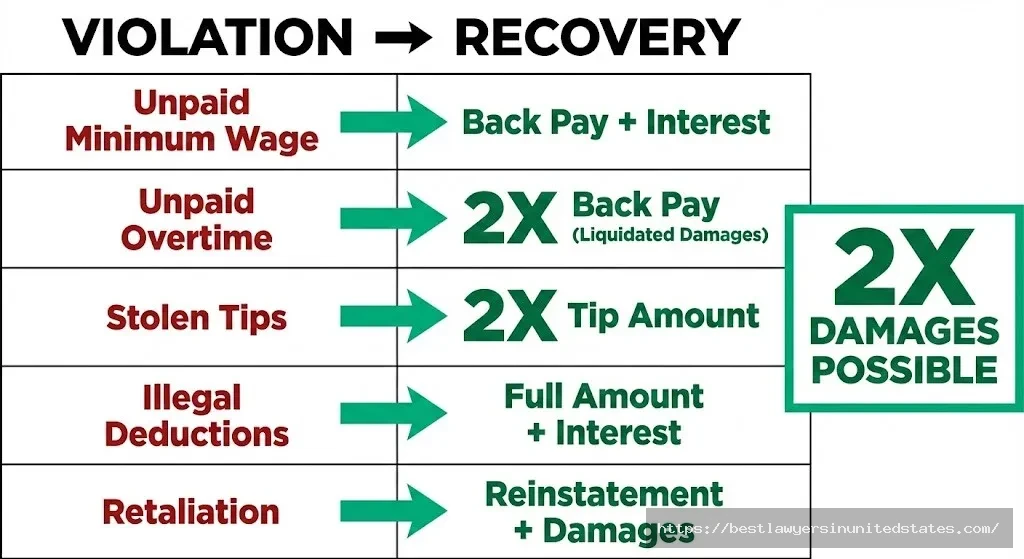
Iowa law allows workers to recover more than just unpaid wages. Depending on the violation type, you may be entitled to:
| Violation Type | What You Can Recover |
|---|---|
| Unpaid minimum wage | Back pay for difference + interest |
| Unpaid overtime | Back pay at 1.5x rate + equal amount in liquidated damages |
| Illegal deductions | Full amount deducted + interest |
| Stolen tips | Full tip amount + equal amount in liquidated damages |
| Unpaid wages (general) | Full unpaid amount + liquidated damages |
| Retaliation for filing claim | Reinstatement, back pay, and damages |
Liquidated damages means you can recover double the amount owed in many cases. If your employer owes you $5,000 in unpaid overtime, you may recover $10,000 total.
Time Limits for Filing Claims
Iowa has strict deadlines for wage claims. Missing these deadlines can permanently bar your recovery:
| Claim Type | Iowa State Law Deadline | Federal FLSA Deadline |
|---|---|---|
| Unpaid minimum wage | 2 years | 2 years (3 if willful) |
| Unpaid overtime | 2 years | 2 years (3 if willful) |
| Illegal deductions | 2 years | 2 years |
| General wage violations | 2 years | 2 years |
Start counting from: The date each paycheck should have been paid correctly, not from your last day of work.
How to File a Wage Claim in Iowa
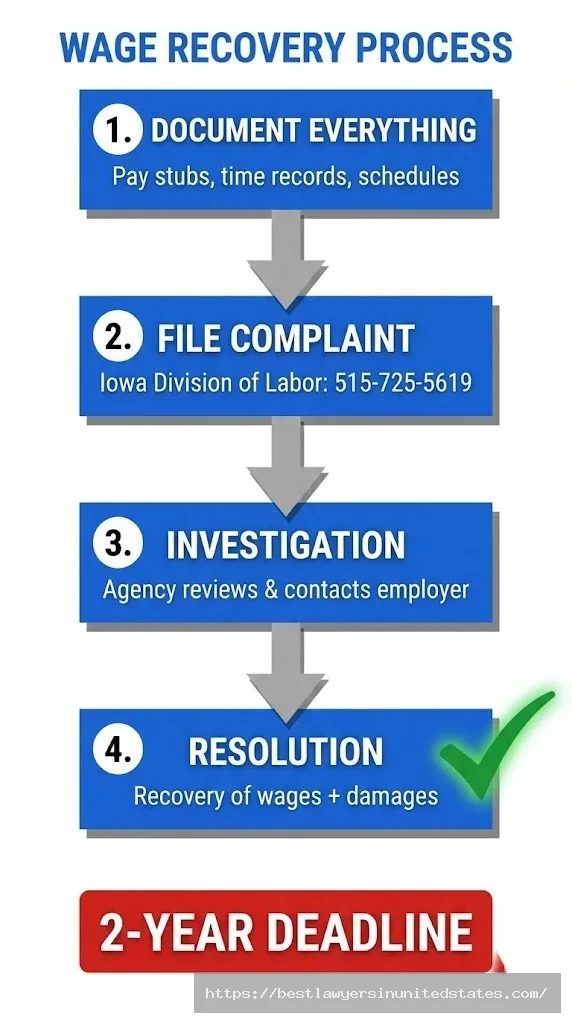
Filing a wage claim in Iowa involves reporting violations to the appropriate government agency. You can file with the Iowa Division of Labor for state law violations, or with the U.S. Department of Labor for federal FLSA violations. In many cases, filing with both agencies provides the most protection.
Step 1: Document Everything
Before filing a claim, gather all evidence of wage violations:
Essential documents:
- Pay stubs for entire employment period
- Time records or personal notes of hours worked
- Work schedules
- Employment contract or offer letter
- Any written policies about wages
- Text messages or emails about pay
- Photos of time clock entries
- Witness contact information
Create a timeline: Document dates, hours worked, wages paid, and violations for each pay period.
Step 2: Contact the Iowa Division of Labor
File online, by phone, or in person:
Iowa Division of Labor 1000 East Grand Ave Des Moines, IA 50319-0209 Phone: 515-725-5619 Website: iowadivisionoflabor.gov
What to include in your complaint:
- Your contact information
- Employer's name, address, and contact information
- Description of wage violation
- Dates of violation
- Amount of unpaid wages
- Supporting documentation
Step 3: File with U.S. Department of Labor (Optional but Recommended)
For violations of federal minimum wage or overtime laws, also file with the federal agency:
Wage and Hour Division, U.S. Department of Labor Des Moines District Office Federal Building 210 Walnut Street, Room 643 Des Moines, IA 50309-2407 Phone: 515-284-4625
Step 4: Consider a Private Attorney
For complex cases or large amounts of unpaid wages, consult with an employment attorney. Iowa law allows courts to order employers to pay your attorney fees if you win, meaning the attorney's cost comes from the employer, not your recovery.
When to get an attorney:
- Unpaid wages exceed $5,000
- You were fired after complaining about wages
- Employer claims you're an independent contractor
- Multiple wage violations occurred
- Employer refuses to cooperate with government investigation
What Happens After You File
Iowa Division of Labor process:
- Investigation: Agency reviews your complaint and may contact employer
- Employer response: Employer has opportunity to respond and provide records
- Determination: Agency decides if violation occurred
- Resolution: Agency attempts to resolve issue, may order payment
- Appeal: Either party can appeal the decision
Timeline: Most wage claims resolve within 3-6 months, though complex cases may take longer.
Protection From Retaliation
Iowa and federal law prohibit employers from retaliating against workers who file wage claims. Retaliation includes:
- Firing or threatening to fire
- Reducing hours or changing schedule
- Demoting or transferring to worse position
- Harassment or creating hostile work environment
- Reporting to immigration (for any worker, regardless of status)
If your employer retaliates, file an additional complaint immediately. You can recover additional damages for retaliation, including reinstatement and compensation for emotional distress.
Will Iowa Raise Its Minimum Wage?
There are no scheduled minimum wage increases for Iowa in 2026 or 2027. The Iowa Legislature has shown no indication of raising the wage above the federal $7.25 per hour. Any future increase would require new legislation, which faces significant political obstacles in the current legislative environment.
Political Landscape
Iowa's Republican-controlled legislature and Republican governor have consistently opposed minimum wage increases. Since taking full control in 2017, they have not only refused to raise the minimum wage but also passed the preemption law preventing local governments from setting higher wages.
Current political makeup (2026 Legislature):
- Iowa House: Republican majority
- Iowa Senate: Republican majority
- Governor: Republican (Kim Reynolds)
Recent legislative proposals:
- 2023: Democratic bill to raise wage to $15/hour (failed in committee)
- 2024: Democratic bill to raise wage to $12/hour (failed in committee)
- 2025: No minimum wage bills introduced
- 2026: No minimum wage proposals expected
What Would It Take to Raise the Wage?
Three possible paths exist for increasing Iowa's minimum wage:
Option 1: Legislative action
- Requires majority vote in both House and Senate
- Must be signed by Governor
- Current political makeup makes this unlikely
- Would need significant Democratic gains in elections
Option 2: Ballot initiative
- Iowa does not have ballot initiative process for statutory changes
- Would require constitutional amendment to create initiative process
- Not a viable option under current Iowa law
Option 3: Federal increase
- If federal minimum wage increases, Iowa would follow
- Requires Congressional action
- No federal increase expected in current Congress
- Would need Democratic control of Congress and presidency
Neighboring States' Actions
While Iowa's wage remains stagnant, surrounding states continue to raise their minimum wages:
Recent increases:
- Illinois: $15.00 in 2025 (from $14.00 in 2024)
- Nebraska: $12.00 in 2024 (voters approved $15 by 2026)
- Minnesota: $11.13 in 2024 (indexed to inflation)
- Missouri: $12.63 in 2024 (indexed to inflation)
This creates competitive pressure on Iowa employers, particularly in border regions. Some Iowa businesses voluntarily pay above minimum wage to attract workers who might otherwise work across state lines.
What Workers Can Do
Without legislative action likely, Iowa workers have limited options to increase their minimum wage:
Individual actions:
- Seek employment with employers paying above minimum wage
- Consider work in neighboring states with higher wages
- Negotiate higher starting wages
- Acquire skills that command higher pay
Collective actions:
- Support candidates who favor minimum wage increases
- Join worker advocacy groups
- Participate in union organizing (where applicable)
- Contact state legislators to express support for wage increases
Organizations advocating for higher wages:
- Iowa Federation of Labor (AFL-CIO)
- Iowa Citizens for Community Improvement
- University of Iowa Labor Center
Frequently Asked Questions About Iowa Minimum Wage
What is the minimum wage in Iowa for 2026?
Quick Answer: Iowa's minimum wage is $7.25 per hour in 2026, the same as the federal minimum wage. This rate has not changed since 2008.
Does Iowa have a higher minimum wage than federal law?
Quick Answer: No. Iowa's minimum wage matches the federal rate of $7.25 per hour. When state and federal rates are equal, there is no difference for workers.
What is the tipped minimum wage in Iowa?
Quick Answer: Iowa allows employers to pay tipped workers $4.35 per hour as a base wage. If tips plus base wage don't equal $7.25 per hour, the employer must make up the difference.
This applies to servers, bartenders, delivery drivers, and other workers who customarily receive more than $30 per month in tips.
What is the youth minimum wage in Iowa?
Quick Answer: Workers under age 20 can be paid $6.35 per hour during their first 90 consecutive calendar days with any employer. After 90 days or age 20, they must receive the full $7.25 minimum wage.
Is there a different minimum wage for Iowa City or Des Moines?
Quick Answer: No. All Iowa cities follow the state minimum wage of $7.25 per hour. The 2017 state preemption law prohibits cities and counties from setting their own minimum wages.
Johnson County (Iowa City) and Polk County (Des Moines) previously passed $10.10 minimum wage ordinances, but these were nullified by state law before taking full effect.
When was the last time Iowa raised its minimum wage?
Quick Answer: Iowa last raised its minimum wage on July 24, 2008, to $7.25 per hour. This represents 17 years without an increase.
Will Iowa raise minimum wage in 2027?
Quick Answer: No scheduled increases exist for 2027. The Iowa Legislature has not passed any future wage increases, and no proposals are currently under consideration.
How do I calculate my earnings at Iowa minimum wage?
Quick Answer: Multiply $7.25 by your hours worked. A full-time worker (40 hours/week) earns $290 per week, $1,257 per month, or $15,080 per year before taxes.
Use our minimum wage calculator to estimate your exact take-home pay after taxes and deductions.
What is overtime pay in Iowa?
Quick Answer: Iowa requires 1.5 times your regular rate for hours over 40 in a workweek. At minimum wage, overtime is $10.88 per hour ($7.25 × 1.5).
How much overtime pay am I entitled to in Iowa?
Quick Answer: You must receive time-and-a-half for every hour worked beyond 40 in a week. Calculate your exact overtime using our overtime pay calculator.
Can my employer make me work off the clock in Iowa?
Quick Answer: No. Iowa and federal law require employers to pay for all hours worked. Working off the clock is illegal and constitutes wage theft.
If your employer requires off-the-clock work, you can file a wage claim with the Iowa Division of Labor or U.S. Department of Labor.
What deductions can my employer take from my paycheck in Iowa?
Quick Answer: Only deductions required by law (taxes, garnishments) or authorized in writing by you for your benefit (insurance, 401k) are legal. Employers cannot deduct for cash shortages, broken equipment, uniforms, or property damage.
Iowa Code Chapter 91A lists all prohibited deductions. Illegal deductions constitute wage theft.
What is the living wage in Iowa?
Quick Answer: The living wage for a single adult in Iowa is approximately $14.26 per hour, nearly double the minimum wage. A single parent with one child needs $31.39 per hour to meet basic needs.
Minimum wage of $7.25 does not provide enough income to afford basic expenses like rent, food, and transportation in any Iowa county.
How do I file a wage claim in Iowa?
Quick Answer: Contact the Iowa Division of Labor at 515-725-5619 or visit iowadivisionoflabor.gov. You can also file with the U.S. Department of Labor's Des Moines office at 515-284-4625.
File within 2 years of when wages were owed. Gather pay stubs, time records, and evidence before filing.
How do I calculate wage theft recovery in Iowa?
Quick Answer: Add up all unpaid wages, then double that amount (liquidated damages). Use our wage theft calculator to estimate your total recovery including penalties and interest.
Can my employer pay me less than minimum wage?
Quick Answer: No, except for tipped workers ($4.35 base wage) and youth workers under 20 ($6.35 for first 90 days). All other workers must receive at least $7.25 per hour.
Do I get paid overtime if I'm salaried in Iowa?
Quick Answer: Maybe. Salary alone doesn't make you exempt from overtime. You must earn at least $684/week, receive a true salary (not subject to deductions), and perform executive/administrative/professional duties.
Most salaried workers under $35,568 annually are entitled to overtime.
What if my employer calls me an independent contractor?
Quick Answer: Job titles don't determine status. If your employer controls when, where, and how you work, you're likely an employee entitled to minimum wage and overtime. Misclassification is illegal.
The Iowa Division of Labor and U.S. Department of Labor can determine your proper classification.
Can I be fired for complaining about unpaid wages?
Quick Answer: No. Iowa and federal law prohibit retaliation for filing wage complaints. If you're fired, demoted, or harassed after filing a claim, you can file an additional retaliation complaint and recover additional damages.
Do undocumented workers have wage rights in Iowa?
Quick Answer: Yes. All workers in Iowa have the right to minimum wage and overtime regardless of immigration status. You can file wage claims without fear of immigration reporting.
Iowa Code Chapter 91A explicitly states wage rights apply to all workers. Employers cannot threaten immigration reporting to avoid paying wages.
What is Iowa Code Chapter 91D?
Quick Answer: Iowa Code Chapter 91D is the Iowa Minimum Wage Law. It sets the state minimum wage at $7.25 per hour and covers employers with at least $300,000 in annual revenue.
What is Iowa Code Chapter 91A?
Quick Answer: Iowa Code Chapter 91A is the Iowa Wage Payment Collection Act. It governs when wages must be paid, what deductions are allowed, required pay stub information, and enforcement of wage claims.
Where is the Iowa Division of Labor located?
Quick Answer: The Iowa Division of Labor main office is at 1000 East Grand Ave, Des Moines, IA 50319-0209. Phone: 515-725-5619. They handle wage complaints and enforce Iowa labor laws.
How does Iowa minimum wage compare to neighboring states?
Quick Answer: Iowa's $7.25 minimum wage is lower than most neighboring states. Illinois pays $15, Nebraska pays $12, Minnesota pays $11.13, and Missouri pays $12.63. Only Wisconsin matches Iowa's $7.25 rate.
Can I earn less than minimum wage during training?
Quick Answer: Only if you're under age 20, you can be paid $6.35/hour for your first 90 days. Otherwise, training time must be paid at least minimum wage. "Working for tips" or "training for free" is illegal for workers 20 and older.
Summary: Key Takeaways About Iowa Minimum Wage
Iowa's minimum wage of $7.25 per hour has remained unchanged for 17 years, making it one of the lowest in the region. Workers face significant challenges living on this wage, as it falls far below the actual living wage needed to afford basic expenses. The state's 2017 preemption law prevents cities like Iowa City and Des Moines from offering higher local minimum wages.
Critical numbers to remember:
- Standard minimum wage: $7.25/hour
- Tipped minimum wage: $4.35/hour (tips must bring total to $7.25)
- Youth training wage: $6.35/hour (first 90 days, under age 20)
- Overtime rate: $10.88/hour (1.5x minimum wage)
- Filing deadline: 2 years for most wage claims
Iowa workers have strong wage payment protections under Iowa Code Chapter 91A, including strict limits on payroll deductions and requirements for timely payment. If you're not being paid properly, you can file a wage claim with the Iowa Division of Labor or U.S. Department of Labor to recover unpaid wages plus damages.
Use the calculators provided throughout this guide to verify your pay is correct and estimate any potential recovery for wage violations. Remember that all workers have these rights regardless of immigration status, and employers cannot retaliate against workers who assert their wage rights.
For questions about Iowa labor laws or other legal matters, you can also learn about Iowa's OWI laws to understand your rights across different areas of state law.
Need help with a wage issue?
Email: [email protected]
