
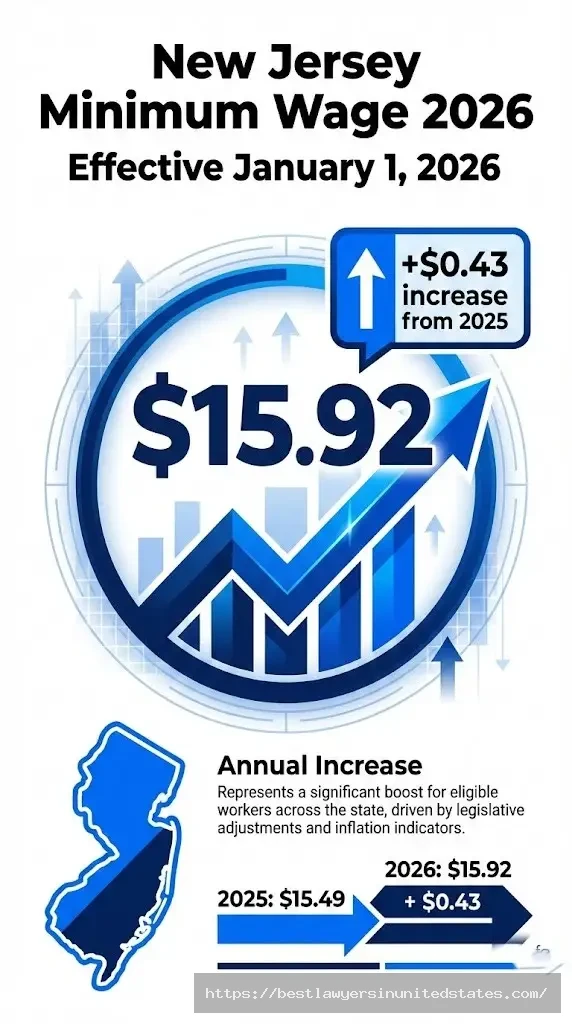
New Jersey’s minimum wage will increase to $15.92 per hour on January 1, 2026, up from $15.49 in 2025. This applies to most workers, while small businesses with fewer than 6 employees follow a different rate structure. Tipped employees must receive at least $5.36 per hour in cash wages plus tips.
The increase reflects New Jersey’s commitment to annual wage adjustments tied to the Consumer Price Index. Governor Phil Murphy signed the groundbreaking $15 minimum wage law in 2019, which established a path to reach $15 by 2024 and automatic cost-of-living increases thereafter.
Whether you’re an employee checking if you’re paid correctly or an employer preparing for the new rate, this guide covers everything you need to know about New Jersey’s 2026 minimum wage laws.
Calculate Your Earnings in New Jersey
Want to know exactly how much you’ll earn at New Jersey’s $15.92 minimum wage? Use our free calculator to estimate your weekly, monthly, and annual income based on your hours worked.
💰 Minimum Wage Earnings Calculator
Calculate your weekly, monthly, and annual earnings with overtime and tax estimates
📊 Your Earnings Breakdown
💰 Gross Earnings
Calculator features:
- Automatic New Jersey wage rates for 2026
- Weekly, monthly, and annual earnings
- Overtime calculations
- Tax withholding estimates
- Take-home pay breakdown
Full calculator with all features: https://bestlawyersinunitedstates.com/minimum-wage-calculator/
Questions about your wages or need legal help?
Email: [email protected]
What Is New Jersey's Minimum Wage for 2026?
New Jersey's minimum wage reaches $15.92 per hour on January 1, 2026. This represents a $0.43 increase from the 2025 rate of $15.49 per hour.
The rate applies to most workers in New Jersey. However, certain categories have different rates based on business size and worker classification.
Standard Minimum Wage Rate
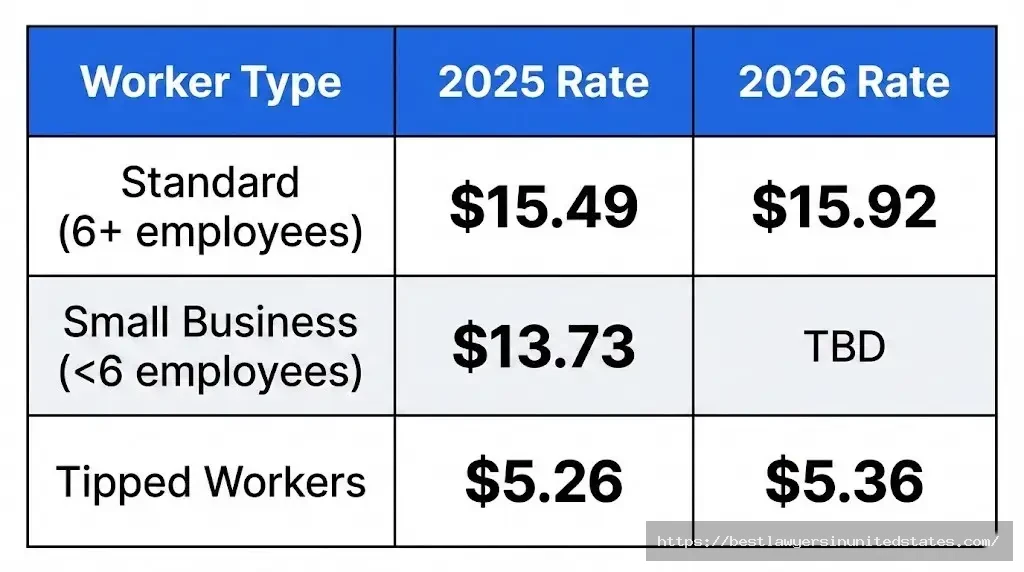
The $15.92 hourly rate applies to employees at businesses with 6 or more workers. This translates to:
- Weekly earnings (40 hours): $636.80
- Monthly earnings: $2,759.47
- Annual salary (full-time): $33,113.60
Small Business Minimum Wage
Businesses with fewer than 6 employees follow a different schedule. The 2026 rate for small businesses will be announced by the New Jersey Department of Labor and Workforce Development, based on CPI adjustments.
In 2025, small businesses paid $13.73 per hour while larger employers paid $15.49. The gap gradually narrows each year until small businesses reach parity with the standard rate.
Tipped Employee Minimum Wage
Tipped employees must receive at least $5.36 per hour in direct cash wages (projected for 2026). When combined with tips, total compensation must equal or exceed $15.92 per hour.
If tips don't bring wages up to the full minimum wage, employers must make up the difference. This requirement applies on a weekly basis.
| Worker Category | 2025 Rate | 2026 Rate | Increase |
|---|---|---|---|
| Standard (6+ employees) | $15.49 | $15.92 | +$0.43 |
| Small Business (<6 employees) | $13.73 | TBD | CPI-adjusted |
| Tipped Workers (cash wage) | $5.26 | $5.36 | +$0.10 |
How New Jersey Compares to Neighboring States
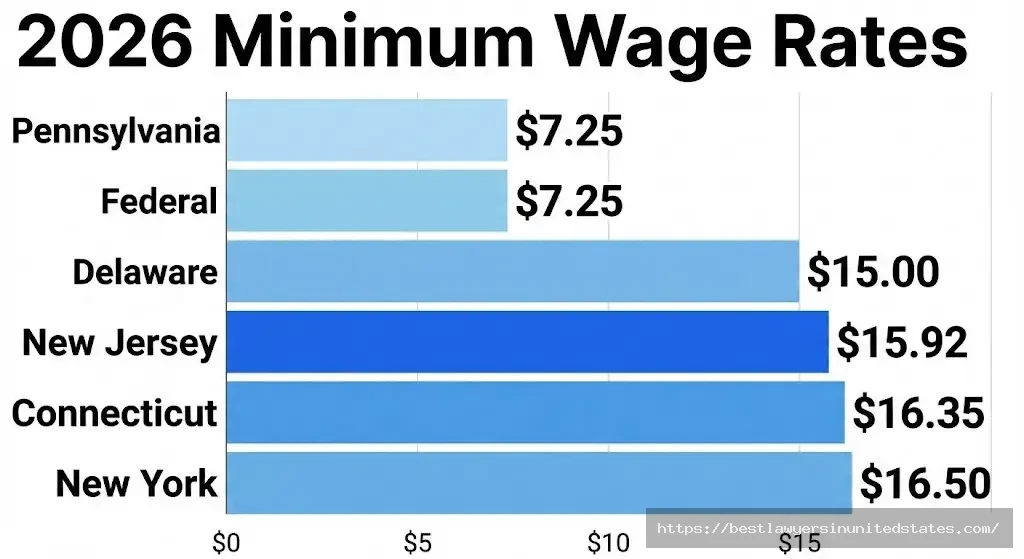
New Jersey's $15.92 minimum wage in 2026 ranks among the highest in the region. Understanding these differences matters if you live in one state but work in another.
Workers employed in New Jersey must receive New Jersey's minimum wage, regardless of where they live. The location of the workplace, not the employee's residence, determines which state's wage laws apply.
Regional Wage Comparison
New Jersey's wage significantly exceeds both the federal minimum and rates in neighboring Pennsylvania, which remains at the federal $7.25 per hour. Meanwhile, New York maintains a higher rate at $16.50 for most workers in 2026.
The northeastern states generally maintain higher minimum wages than the federal baseline. Connecticut and Massachusetts also exceed New Jersey's rate, while Delaware follows a similar annual adjustment model.
| State | 2026 Minimum Wage | Tipped Wage | Notes |
|---|---|---|---|
| New Jersey | $15.92 | $5.36 | CPI-adjusted annually |
| New York | $16.50 | $11.00 | NYC rate higher |
| Pennsylvania | $7.25 | $2.83 | Federal minimum |
| Connecticut | $16.35 | $8.23 | Annual increases |
| Delaware | $15.00 | $2.23 | Scheduled increases |
| Federal | $7.25 | $2.13 | Unchanged since 2009 |
Cross-Border Workers
Many New Jersey residents work in New York or Pennsylvania. The workplace state's minimum wage applies, not your home state.
Example: If you live in New Jersey but work in Pennsylvania, your employer must pay at least Pennsylvania's minimum wage ($7.25). However, if you work in New Jersey but live in Pennsylvania, you must receive New Jersey's $15.92 minimum wage.
New Jersey Minimum Wage History and Future Increases
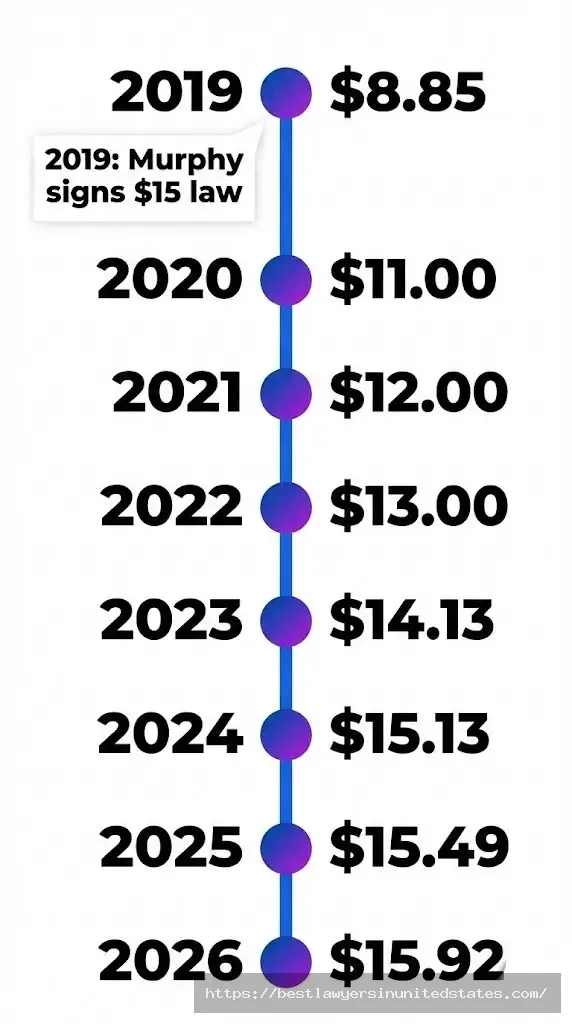
New Jersey's minimum wage has risen dramatically since 2019 when Governor Murphy signed legislation creating a path to $15. Understanding this history helps predict future changes.
Historical Wage Progression
Before 2019, New Jersey's minimum wage closely tracked the federal rate with occasional state increases. The 2019 law changed everything by establishing scheduled annual increases until reaching $15 in 2024.
| Effective Date | Minimum Wage | Annual Increase | Key Event |
|---|---|---|---|
| Jan 1, 2019 | $8.85 | Base year | Murphy signs $15 law |
| Jan 1, 2020 | $11.00 | +$2.15 | Scheduled increase |
| Jan 1, 2021 | $12.00 | +$1.00 | COVID-19 pandemic |
| Jan 1, 2022 | $13.00 | +$1.00 | Scheduled increase |
| Jan 1, 2023 | $14.13 | +$1.13 | Scheduled increase |
| Jan 1, 2024 | $15.13 | +$1.00 | $15 threshold reached |
| Jan 1, 2025 | $15.49 | +$0.36 | First CPI adjustment |
| Jan 1, 2026 | $15.92 | +$0.43 | CPI adjustment |
How CPI Adjustments Work
After reaching $15 in 2024, New Jersey's minimum wage now increases annually based on the Consumer Price Index for All Urban Consumers (CPI-U). The New Jersey Department of Labor calculates the adjustment each September.
The formula uses the percentage increase in CPI-U from August of the previous year to August of the current year. This percentage then applies to the current minimum wage, rounded to the nearest cent.
Future Projections
Based on recent inflation trends, New Jersey's minimum wage could reach:
- 2027: Approximately $16.30-$16.50 (estimated)
- 2028: Approximately $16.70-$17.00 (estimated)
- 2029: Approximately $17.10-$17.50 (estimated)
These are projections only. Actual rates depend on annual CPI measurements announced each September by the state Department of Labor.
Calculate Your Overtime Pay in New Jersey
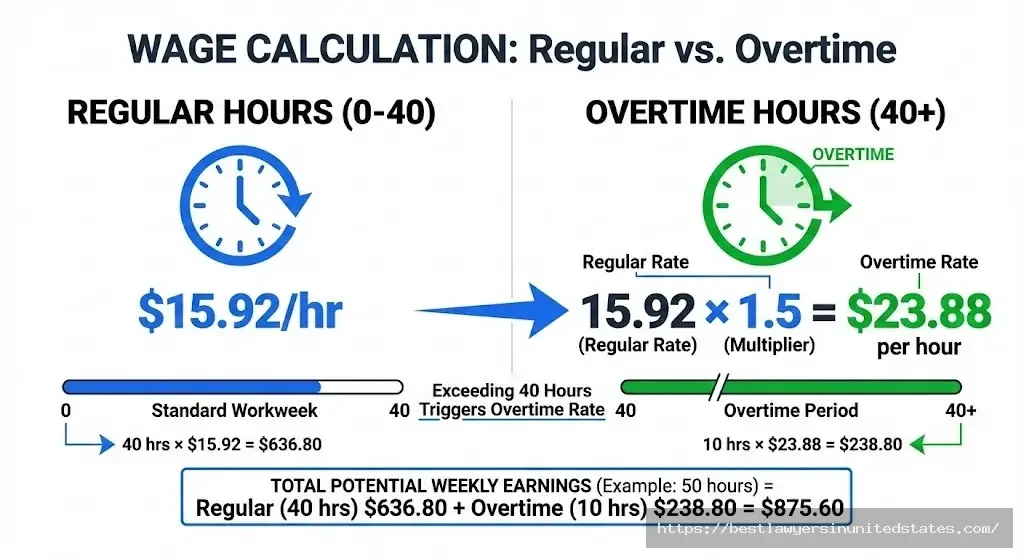
Working more than 40 hours per week? Calculate your overtime earnings based on New Jersey's overtime laws. This calculator accounts for New Jersey's specific overtime rules and time-and-a-half requirements.
⏰ Overtime Pay Calculator
Calculate your overtime earnings based on your state's specific labor laws
📍 Select Your State
💰 Your Hourly Wage
📊 Calculation Method
📅 Weekly Hours
💵 Your Weekly Overtime Pay
📊 Earnings Breakdown
📅 Pay Period Estimates
⚖️ State vs Federal Comparison
Calculator features:
- New Jersey-specific overtime rules
- Weekly overtime calculations
- Pay period breakdowns
- Comparison with federal law
- Real-time rate calculations
Full overtime calculator: https://bestlawyersinunitedstates.com/overtime-pay-calculator/
Questions about your wages or need legal help?
Email: [email protected]
Overtime Laws in New Jersey
New Jersey requires employers to pay time-and-a-half for hours worked over 40 in a workweek. The overtime rate at minimum wage equals $23.88 per hour in 2026 ($15.92 × 1.5).
When Overtime Applies
Overtime requirements kick in after 40 hours in a single workweek. New Jersey follows federal Fair Labor Standards Act (FLSA) rules for overtime, which means:
You receive overtime for:
- Hours over 40 in a workweek
- Work spanning multiple pay periods (if over 40 in any week)
You do NOT receive overtime for:
- Working weekends (unless over 40 hours that week)
- Working holidays (unless over 40 hours that week)
- Working split shifts
- Working more than 8 hours in a day (unless state law changes)
Unlike California minimum wage laws that require daily overtime after 8 hours, New Jersey bases overtime only on the 40-hour weekly threshold.
Overtime for Different Worker Types
Regular employees earn 1.5 times their regular rate for overtime hours. At minimum wage, this equals $23.88 per hour.
Tipped employees also receive overtime at 1.5 times the full minimum wage, not just the cash wage. The tip credit still applies to overtime hours.
Salaried employees may qualify for overtime unless they meet specific exemption criteria under state and federal law.
| Worker Type | Regular Rate | Overtime Rate (1.5x) |
|---|---|---|
| Minimum Wage Worker | $15.92 | $23.88 |
| Tipped Worker (full rate) | $15.92 | $23.88 |
| Worker Earning $20/hour | $20.00 | $30.00 |
| Worker Earning $25/hour | $25.00 | $37.50 |
Common Overtime Violations
Many employers violate overtime laws unknowingly or deliberately. Watch for these red flags:
Off-the-clock work occurs when employers require work before clocking in or after clocking out. All work time counts toward overtime calculations.
Compensatory time (comp time) is illegal in the private sector. Employers cannot offer time off instead of overtime pay.
Misclassification happens when employers wrongly classify workers as exempt from overtime. Most workers qualify for overtime regardless of job title.
Averaging hours across pay periods violates the law. Each workweek stands alone for overtime calculations.
Tipped Employees: New Jersey's Unique Rules
New Jersey allows employers to pay tipped employees a lower cash wage, but strict rules protect workers. The system differs significantly from federal law and requires careful compliance.
Cash Wage Requirements
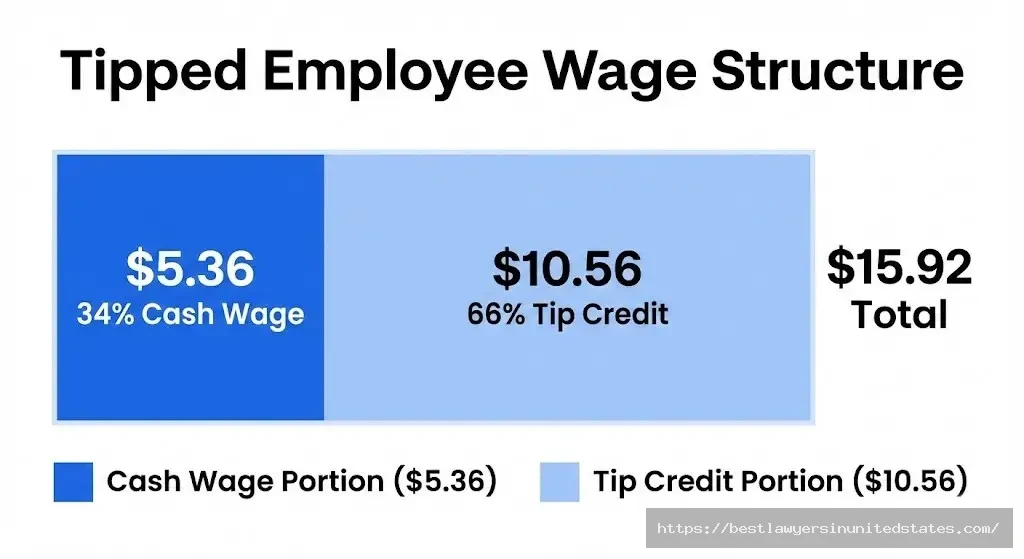
Tipped employees must receive at least $5.36 per hour in direct wages (2026 projected rate). This represents about 34% of the full minimum wage.
The remaining 66% can come from tips, but only if tips actually reach that level. Employers cannot assume tips will make up the difference without verification.
Tip Credit Explained
The "tip credit" represents the difference between the cash wage and full minimum wage. In 2026, this equals $10.56 per hour ($15.92 - $5.36).
Employers can only claim this tip credit if:
- They pay at least the required cash wage
- Employees receive enough tips to reach full minimum wage
- They notify employees of the tip credit system
- Tips actually received meet or exceed the tip credit amount
Important: If tips don't reach the full minimum wage in any workweek, employers must pay the difference.
What Counts as Tips
New Jersey law defines tips as voluntary payments from customers for service. Several factors affect what qualifies:
Voluntary tips include cash left on tables, credit card tips, and digital payment tips. These belong entirely to employees.
Service charges of 18% or more are NOT tips under New Jersey law. These are regular wages subject to minimum wage requirements.
Automatic gratuities added to bills (like 20% for large parties) may or may not count as tips depending on how they're handled. Many restaurants treat these as service charges to ensure compliance.
| Payment Type | Counts as Tips? | Who Keeps It? |
|---|---|---|
| Cash tips | ✅ Yes | Employee 100% |
| Credit card tips | ✅ Yes | Employee 100% (minus processing)* |
| Service charge | ❌ No | Split per policy |
| Automatic gratuity | Depends | Varies by establishment |
*Employers can deduct actual credit card processing fees (usually 2-3%) from tips paid by card.
Tip Pooling Rules
New Jersey permits tip pooling among employees who regularly receive tips. However, strict rules govern who can participate.
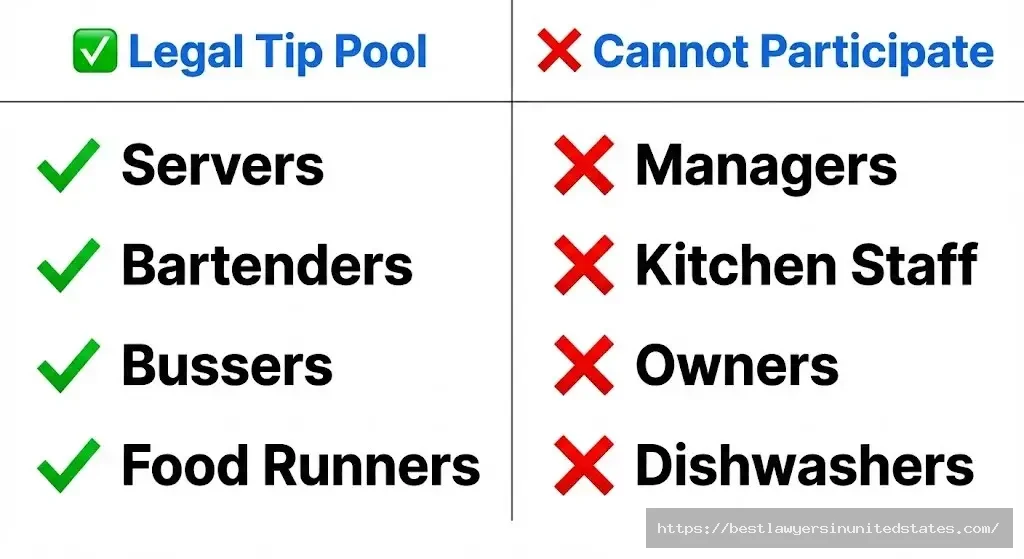
Legal tip pool participants:
- Servers and waitstaff
- Bartenders
- Bussers
- Food runners
- Host/hostess (if customer-facing)
Cannot participate in tip pools:
- Managers and supervisors
- Kitchen staff (in most cases)
- Dishwashers
- Cooks and chefs
- Owners
Mandatory tip-outs that reduce a worker's tips below minimum wage are illegal. Track your actual earnings to ensure compliance.
What If Tips Fall Short?
Employers must monitor weekly tip totals to ensure workers receive at least the full minimum wage. If tips don't reach that level, employers must add enough cash to make up the difference.
Example calculation:
- Hours worked: 30
- Cash wage received: $160.80 (30 × $5.36)
- Tips received: $300
- Total earned: $460.80
- Minimum wage requirement: $477.60 (30 × $15.92)
- Employer must pay additional: $16.80
This calculation must occur weekly. Employers cannot average tips across multiple weeks to determine compliance.
Calculate Your Wage Theft Recovery in New Jersey
Think your employer owes you money? Use our wage theft calculator to estimate how much you could recover, including unpaid wages, penalties, and interest under New Jersey law.
Wage Theft Recovery Calculator
Estimate how much you can recover in unpaid wages, penalties, and damages based on your state's laws
💵 Estimated Total Recovery
💰 Unpaid Wages
⚖️ Penalties & Damages
📋 Total Summary
Calculator features:
- Multiple violation types (unpaid wages, overtime, tips)
- New Jersey-specific penalties and damages
- Filing deadline tracker
- Total recovery estimate
- Treble damages calculation
Full wage theft calculator: https://bestlawyersinunitedstates.com/wage-theft-calculator/
Need help with unpaid wages? Contact the New Jersey Department of Labor or consult with an employment attorney.
Email: [email protected]
What If You're Not Being Paid Properly?
New Jersey provides strong protections for workers who don't receive proper wages. The state's Wage Theft Act (N.J.S.A. 34:11-4.13) allows employees to recover unpaid wages plus significant penalties.
New Jersey's Wage Theft Act
The Wage Theft Act strengthens worker protections beyond federal law. It treats serious wage violations as criminal offenses and provides enhanced remedies for employees.
Workers can recover treble damages (three times the unpaid wages) plus attorney fees and court costs. This powerful remedy encourages employers to comply with wage laws and compensates workers for the full impact of wage theft.
Types of Wage Violations
Unpaid minimum wage occurs when employers pay less than the legal minimum. This includes paying different rates to employees doing similar work.
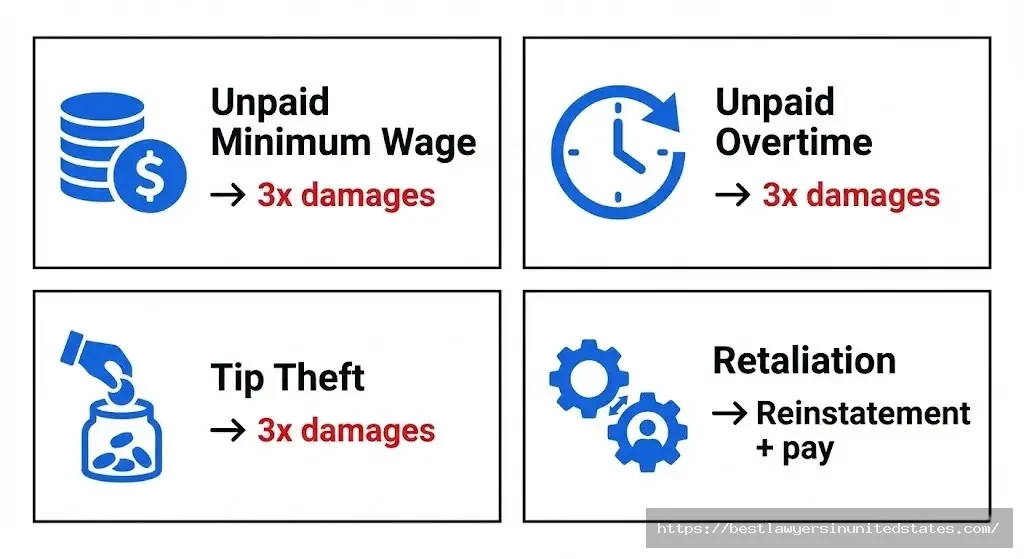
Unpaid overtime happens when workers don't receive time-and-a-half for hours over 40 per week.
Tip violations include keeping employee tips, requiring illegal tip pools, or not making up tip shortfalls.
Off-the-clock work means requiring work before clocking in, during unpaid breaks, or after clocking out.
Illegal deductions reduce pay below minimum wage for uniforms, cash register shortages, or broken equipment.
| Violation Type | Example | Potential Recovery |
|---|---|---|
| Unpaid Minimum Wage | Paid $12/hour instead of $15.92 | 3x difference + fees |
| Unpaid Overtime | No time-and-a-half after 40 hours | 3x unpaid overtime + fees |
| Tip Theft | Manager kept credit card tips | 3x stolen tips + fees |
| Illegal Deductions | Charged for uniform | 3x deduction amount + fees |
How to File a Wage Complaint
New Jersey workers have two main options for recovering unpaid wages: filing with the state Department of Labor or hiring a private attorney.
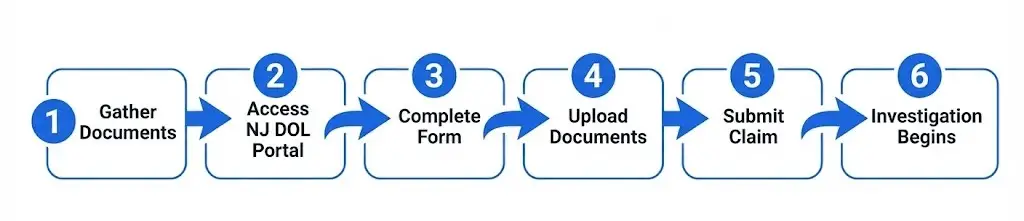
New Jersey Department of Labor complaint:
- Gather documentation (pay stubs, timesheets, work schedules)
- Visit nj.gov/labor and access the wage claim portal
- Complete the online complaint form
- Upload supporting documents
- Submit and receive confirmation number
- Wait 2-4 weeks for initial review
The Department of Labor investigates complaints at no cost to workers. The process typically takes 3-6 months from filing to resolution.
Private attorney:
- Handles larger claims (over $5,000)
- Files in court for treble damages
- Negotiates settlements
- Protects against retaliation
- Typically works on contingency (no upfront cost)
Filing Deadlines
New Jersey provides a 6-year statute of limitations for wage claims. This exceeds the federal 2-3 year limit under the FLSA.
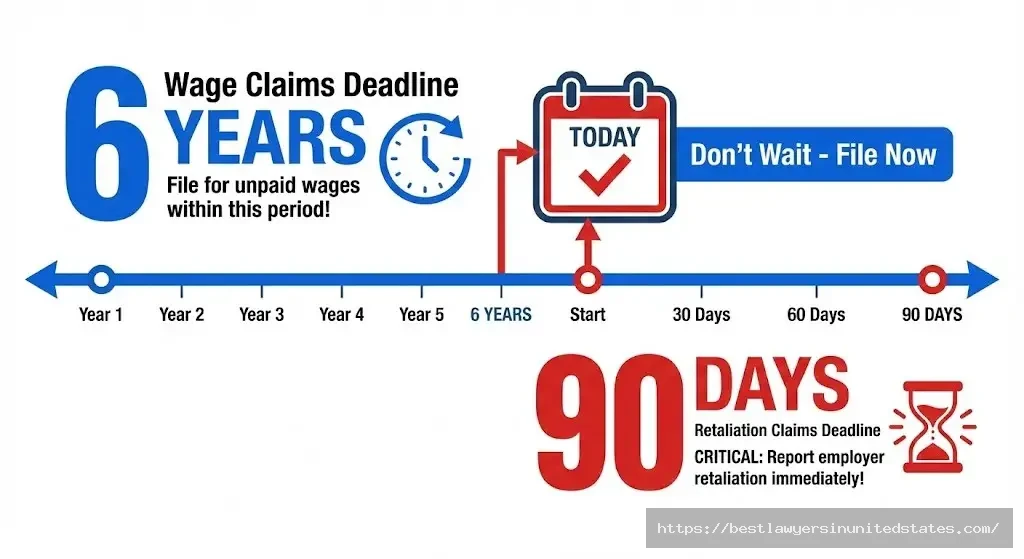
You can recover unpaid wages from the past six years, but don't wait. File as soon as you discover wage violations.
Time limits by violation type:
- Unpaid wages: 6 years
- Unpaid overtime: 6 years
- Tip violations: 6 years
- Retaliation claims: Must file within 90 days of adverse action
Protection Against Retaliation
New Jersey law prohibits employers from retaliating against workers who:
- File wage complaints
- Discuss wages with coworkers
- Participate in wage investigations
- Request pay stubs or wage information
- Refuse illegal pay practices
Retaliation includes firing, demotion, reduced hours, poor schedules, or harassment. If retaliation occurs, file an additional complaint immediately. Remedies include reinstatement, back pay, and additional damages.
Special Worker Categories in New Jersey
New Jersey's minimum wage applies to most workers, but some categories have special rules or exemptions. Understanding these distinctions helps ensure proper pay.
Youth Workers and Minors
New Jersey does NOT have a separate youth minimum wage. Workers under 18 receive the same $15.92 per hour as adults.
However, child labor laws restrict when and how long minors can work:
Ages 14-15:
- Maximum 3 hours per school day
- Maximum 18 hours per school week
- Cannot work before 7 AM or after 7 PM (9 PM in summer)
Ages 16-17:
- Maximum 6 hours per school day
- Maximum 30 hours per school week
- No restrictions on starting time
- Cannot work after 10 PM on school nights
All youth workers must obtain working papers from their school before starting employment.
Small Business Workers
Employees at businesses with fewer than 6 employees receive a different minimum wage rate. For 2026, the New Jersey Department of Labor will announce the small business rate based on CPI adjustments.
The "6 employee" threshold counts:
- Full-time employees
- Part-time employees (counted proportionally)
- Temporary workers
- Seasonal workers during their season
Independent contractors don't count toward this threshold.
Seasonal and Agricultural Workers
Seasonal workers at recreational establishments like camps, amusement parks, and conference centers may have different rates. The 2026 rate structure will be announced by the Department of Labor.
Agricultural workers must receive at least the higher of the state or federal minimum wage. New Jersey's $15.92 significantly exceeds federal minimums, so agricultural employers must pay the state rate.
Training Wages
New Jersey allows a 90-day training wage of 90% of minimum wage ($14.33 in 2026). This applies only to:
- Workers 18 years or older
- First 90 days in a new industry or occupation
- Must be genuinely training, not regular work
Employers cannot use training wages for:
- Seasonal workers
- Workers under 18
- Employees who previously worked in the same industry
- Regular work disguised as training
Exemptions from New Jersey Minimum Wage
Not all workers receive minimum wage protection. Federal and state law exempt certain categories based on job duties and compensation structure.
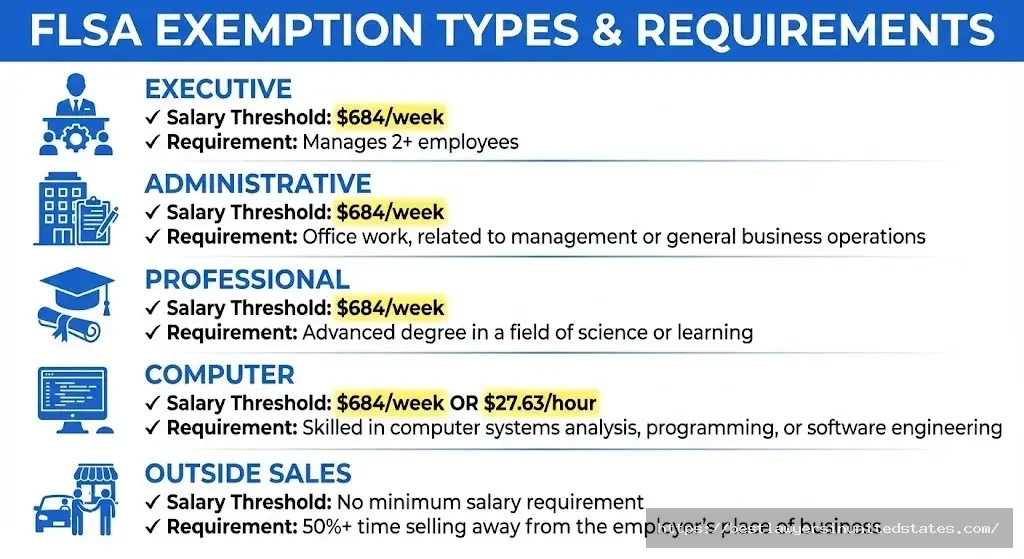
White Collar Exemptions
Executive employees must:
- Manage the enterprise or a recognized department
- Supervise at least two full-time employees
- Have authority to hire/fire or make recommendations about personnel
- Receive at least $684 per week ($35,568 annually)
Administrative employees must:
- Perform office or non-manual work
- Exercise discretion and independent judgment on significant matters
- Receive at least $684 per week ($35,568 annually)
Professional employees must:
- Perform work requiring advanced knowledge in a field of science or learning
- Acquire knowledge through prolonged specialized instruction
- Exercise discretion and judgment
- Receive at least $684 per week ($35,568 annually)
Other Common Exemptions
Outside sales employees spend more than 50% of working time selling away from the employer's place of business.
Computer employees paid at least $684 per week or $27.63 per hour who perform specific computer-related duties.
Highly compensated employees earning over $107,432 annually may be exempt if they perform at least one executive, administrative, or professional duty.
| Exemption Type | Minimum Salary | Key Requirements |
|---|---|---|
| Executive | $684/week | Manages 2+ employees |
| Administrative | $684/week | Office work, discretion |
| Professional | $684/week | Advanced degree field |
| Computer | $684/week or $27.63/hour | Software development |
| Outside Sales | None | 50%+ time selling outside office |
Common Misclassification Issues
Many employers wrongly classify workers as exempt. Job titles don't determine exemption status—actual job duties do.
Red flags for misclassification:
- Labeled "manager" but no hiring/firing authority
- Salaried but under $35,568 annually
- Performs same work as hourly employees
- Little discretion or independent judgment
- Primarily manual labor despite title
If you believe you're misclassified, document your actual job duties and consult with the New Jersey Department of Labor or an employment attorney.
Employer Requirements and Compliance
New Jersey employers must follow specific procedures to comply with minimum wage laws. Failure to meet these requirements can result in penalties and lawsuits.
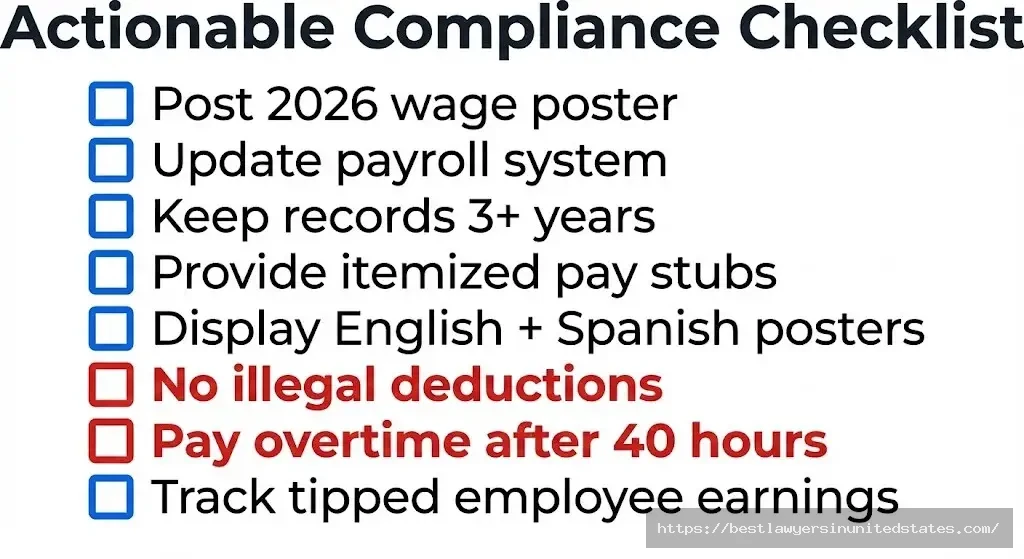
Mandatory Workplace Posters
All employers must display the official New Jersey minimum wage poster in a conspicuous location. The poster must be:
- Current for the 2026 rate
- Visible to all employees
- Posted in break rooms and near time clocks
- Available in English and Spanish if 10% or more of workers speak Spanish
Download free posters from the New Jersey Department of Labor website. Updated posters are released each December for the following year.
Recordkeeping Requirements
Employers must maintain accurate records for at least 3 years including:
- Employee names and addresses
- Hours worked each day and week
- Wages paid each pay period
- Deductions from wages
- Total wages paid
Digital or paper records are acceptable. Employees have the right to inspect their own records.
Pay Stub Requirements
Every pay stub must show:
- Pay period dates
- Hours worked (for hourly workers)
- Rate of pay
- Gross wages earned
- All deductions
- Net wages paid
- Employer name and address
Missing or inadequate pay stubs can result in penalties and support wage theft claims.
Penalty Structure
The New Jersey Department of Labor enforces minimum wage violations through:
First offense:
- Warning
- Order to pay back wages
- Additional penalties of $100-$1,000 per violation
Repeat violations:
- Higher fines
- Stop-work orders
- Debarment from public contracts
- Criminal prosecution for knowing violations
Wage Theft Act penalties:
- Treble damages (3x unpaid wages)
- Attorney fees
- Court costs
- Criminal charges: Disorderly persons offense (up to 6 months jail)
Frequently Asked Questions
What is New Jersey's minimum wage in 2026?
Quick Answer: New Jersey's minimum wage is $15.92 per hour as of January 1, 2026, which is $8.67 higher than the federal minimum wage of $7.25.
This rate applies to most workers at businesses with 6 or more employees. Small businesses with fewer than 6 employees follow a separate rate schedule announced by the state Department of Labor.
Do tipped employees get the full minimum wage?
Quick Answer: Tipped employees must receive at least $5.36 per hour in cash wages plus tips. Total compensation (cash wages + tips) must equal or exceed $15.92 per hour.
If tips don't bring total earnings to the full minimum wage, employers must pay the difference. This calculation occurs weekly—employers cannot average tips across multiple weeks.
Does New Jersey have overtime pay?
Quick Answer: Yes. New Jersey requires time-and-a-half pay (1.5x regular rate) for hours worked over 40 in a workweek. At minimum wage, overtime pays $23.88 per hour.
New Jersey follows federal FLSA overtime rules. Unlike some states, New Jersey does not require daily overtime after 8 hours—only weekly overtime after 40 hours.
How do I calculate my earnings at New Jersey minimum wage?
Quick Answer: Use our minimum wage calculator to instantly calculate weekly, monthly, and annual earnings at $15.92 per hour.
For manual calculation: multiply hours worked by $15.92, then multiply weekly earnings by 52 for annual salary. Full-time (40 hours/week) equals $33,113.60 annually.
How much overtime pay am I entitled to in New Jersey?
Quick Answer: Use our overtime calculator to calculate time-and-a-half pay for hours over 40 per week.
Overtime rate equals your regular hourly rate × 1.5. At minimum wage, this equals $23.88 per hour for overtime hours.
How do I calculate wage theft recovery in New Jersey?
Quick Answer: Use our wage theft calculator to estimate recovery including unpaid wages, treble damages, and penalties under New Jersey law.
New Jersey's Wage Theft Act allows workers to recover three times unpaid wages plus attorney fees and court costs for serious violations.
Is there a different minimum wage for part-time workers?
Quick Answer: No. Part-time workers receive the same $15.92 per hour minimum wage as full-time workers in New Jersey.
Hours per week don't affect the hourly rate. Part-time workers also qualify for overtime if they work more than 40 hours in any workweek.
What should I do if my employer isn't paying minimum wage?
Quick Answer: File a wage complaint with the New Jersey Department of Labor at nj.gov/labor or consult an employment attorney. You have 6 years to file a claim.
Document all wage violations with pay stubs, timesheets, and work schedules. New Jersey law prohibits retaliation against workers who report wage violations.
How does New Jersey minimum wage compare to Pennsylvania and New York?
Quick Answer: New Jersey's $15.92 exceeds Pennsylvania's $7.25 but falls below New York's $16.50 for 2026.
The workplace state's minimum wage applies to all workers, regardless of where they live. Cross-border workers receive the wage rate of the state where they physically work.
Are small businesses exempt from New Jersey minimum wage?
Quick Answer: No, but businesses with fewer than 6 employees follow a different minimum wage schedule that's lower than the standard rate.
The 2026 small business rate will be announced by the New Jersey Department of Labor based on CPI adjustments. Small businesses gradually reach parity with the standard rate over time.
Can my employer take money from my tips?
Quick Answer: No. Employers cannot keep any portion of your tips. All tips belong entirely to employees.
Employers can require tip pooling among eligible employees (servers, bartenders, bussers) but cannot include managers, owners, or most kitchen staff in tip pools.
When will New Jersey minimum wage increase next?
Quick Answer: New Jersey's minimum wage increases every January 1st based on Consumer Price Index adjustments. The 2027 rate will be announced in September 2026.
Since reaching $15 in 2024, New Jersey ties annual increases to inflation. This ensures workers maintain purchasing power as costs rise.
Do independent contractors get minimum wage?
Quick Answer: No. Minimum wage laws only apply to employees, not independent contractors.
Many employers misclassify employees as contractors to avoid paying minimum wage and overtime. If you're misclassified, contact the New Jersey Department of Labor or an employment attorney.
What is the penalty for employers who don't pay minimum wage?
Quick Answer: Employers face fines of $100-$1,000 per violation, must pay back wages, and can face criminal charges for knowing violations under New Jersey's Wage Theft Act.
Workers can recover three times unpaid wages (treble damages) plus attorney fees and court costs through civil lawsuits.
How long do I have to file a wage claim in New Jersey?
Quick Answer: You have 6 years from the date of wage violations to file a claim with the New Jersey Department of Labor or file a lawsuit.
This exceeds the federal 2-3 year statute of limitations. Don't wait—file as soon as you discover wage violations to maximize recovery.
Conclusion
New Jersey's $15.92 minimum wage in 2026 reflects the state's commitment to ensuring fair pay for all workers. The automatic annual adjustments tied to inflation help workers keep pace with rising costs.
Whether you're an employee verifying proper pay or an employer preparing for compliance, understanding these laws protects everyone. Use the calculators provided to estimate earnings, overtime, and potential recovery for wage violations.
If you believe your employer isn't following New Jersey minimum wage laws, document everything and file a complaint with the New Jersey Department of Labor. You have strong legal protections—use them.
For more information about minimum wage laws in other states, explore our guides on Maryland minimum wage, Florida minimum wage, and other states across the country.
Need legal assistance with wage issues?
Email: [email protected]
