
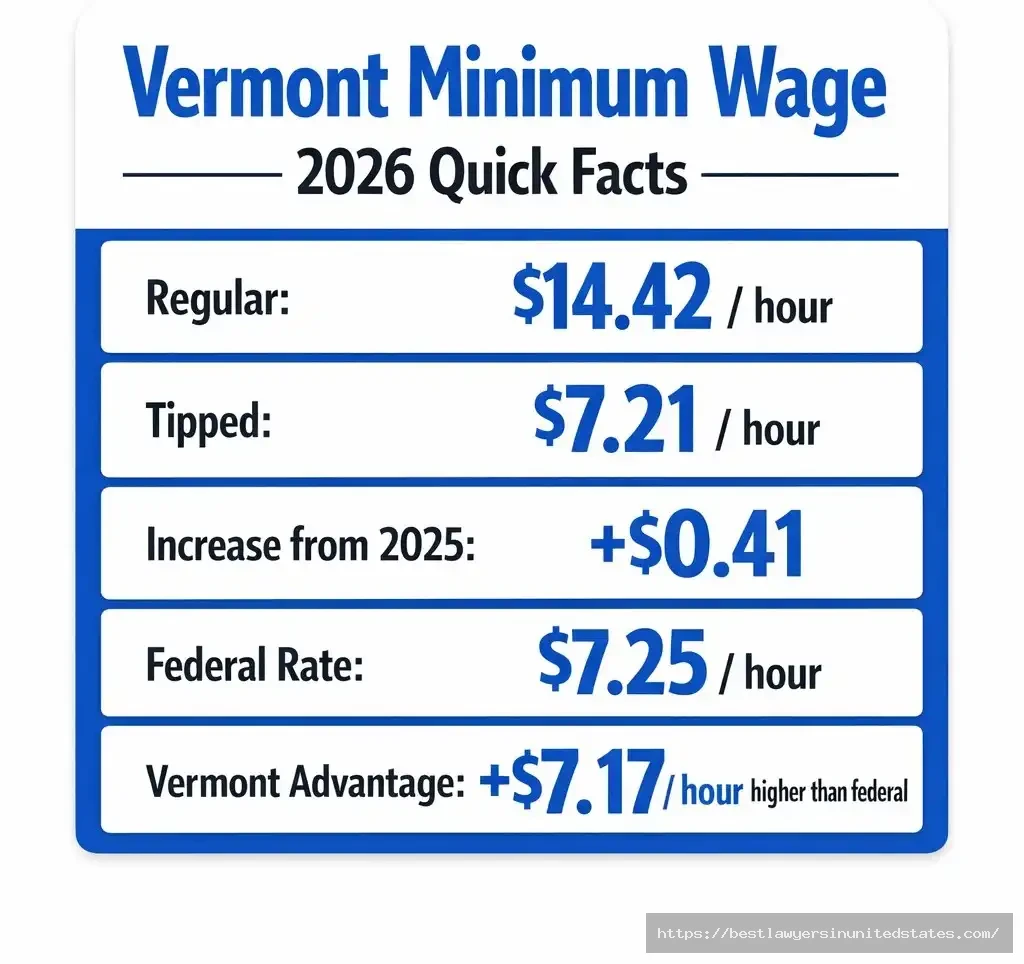
Vermont’s minimum wage will be $14.42 per hour starting January 1, 2026. This is a $0.41 increase from 2025’s rate of $14.01. Tipped employees will earn $7.21 per hour in 2026, exactly 50% of the regular minimum wage.
Vermont automatically raises its minimum wage every January 1st. The state uses whichever is greater: a 5% increase or the percentage change in the Consumer Price Index for Urban Consumers (CPI-U). No legislative vote is needed.
Quick Facts for 2026:
| Category | Rate | Change from 2025 |
|---|---|---|
| Regular Minimum Wage | $14.42/hour | +$0.41 |
| Tipped Minimum Wage | $7.21/hour | +$0.20 |
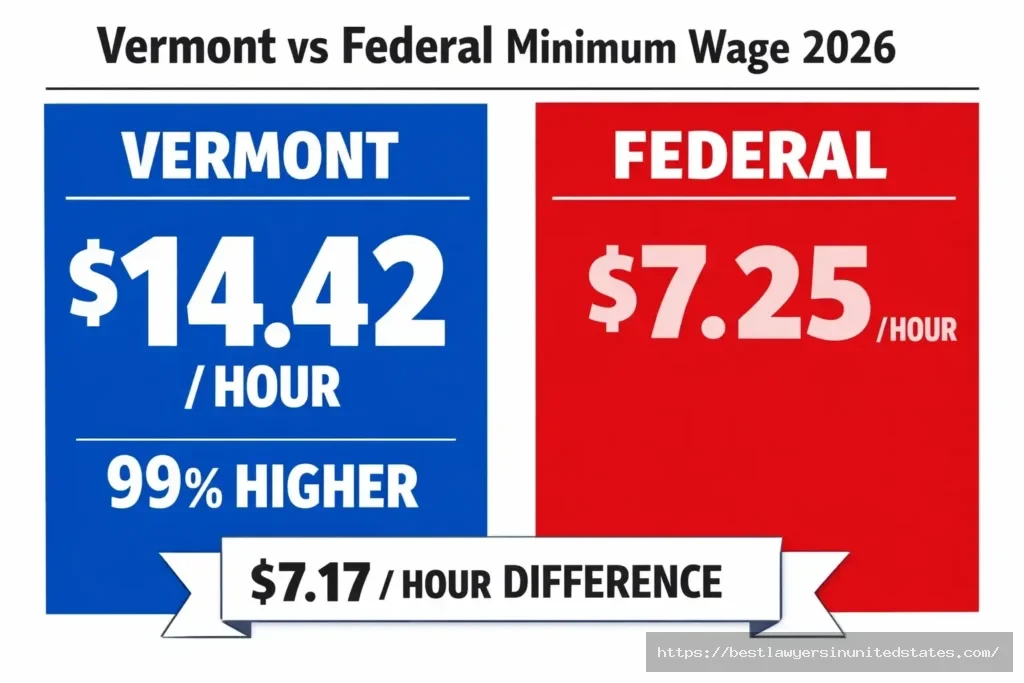
| Federal Minimum Wage | $7.25/hour | No change |
| Vermont Advantage | +$7.17/hour | Higher than federal |
Calculate Your 2026 Earnings in Vermont
Want to know exactly how much you’ll earn at Vermont’s $14.42 minimum wage? This calculator shows your weekly, monthly, and annual income based on your work schedule.
💰 Minimum Wage Earnings Calculator
Calculate your weekly, monthly, and annual earnings with overtime and tax estimates
📊 Your Earnings Breakdown
💰 Gross Earnings
The calculator includes:
- Automatic Vermont wage rates for 2026
- Weekly, monthly, and annual earnings
- Overtime calculations built in
- Tax withholding estimates
- Take-home pay breakdown
Full calculator with all features: Minimum Wage Calculator
Questions about your wages or need legal help?
Email: [email protected]
How Does Vermont's 2026 Minimum Wage Compare to Other States?
Vermont's $14.42 minimum wage ranks in the middle tier of New England states. Connecticut has the highest minimum wage in the region at $16.35 in 2026.
New England State Comparison
| State | 2026 Minimum Wage | Difference from Vermont |
|---|---|---|
| Connecticut | $16.35 | +$1.93 higher |
| Massachusetts | $15.00 | +$0.58 higher |
| Maine | $14.65 | +$0.23 higher |
| Vermont | $14.42 | baseline |
| Rhode Island | $14.00 | -$0.42 lower |
| New Hampshire | $7.25 (federal) | -$7.17 lower |
New Hampshire follows only the federal minimum wage of $7.25 per hour. This creates a significant wage gap for workers just across the state line.
Why Burlington Doesn't Have a Higher Wage
Unlike cities in Massachusetts or New York, Burlington follows the statewide rate. Vermont law doesn't allow municipalities to set their own minimum wages.
All Vermont workers earn $14.42 per hour in 2026, whether they work in Burlington, Montpelier, or Brattleboro.
What Is the Tipped Minimum Wage in Vermont for 2026?
Vermont's tipped minimum wage will be $7.21 per hour in 2026. This is exactly 50% of the regular minimum wage, which is much higher than the federal tipped minimum of $2.13 per hour.
Who Qualifies as a Tipped Employee?
Vermont law defines a tipped employee as someone who:
- Works in hotels, motels, tourist places, or restaurants
- Regularly receives more than $120 per month in tips
Your employer can only pay you the tipped wage if your tips bring you to at least $14.42 per hour. If they don't, your employer must pay the difference.
How the Tip Credit Works
Here's a real example for 2026:
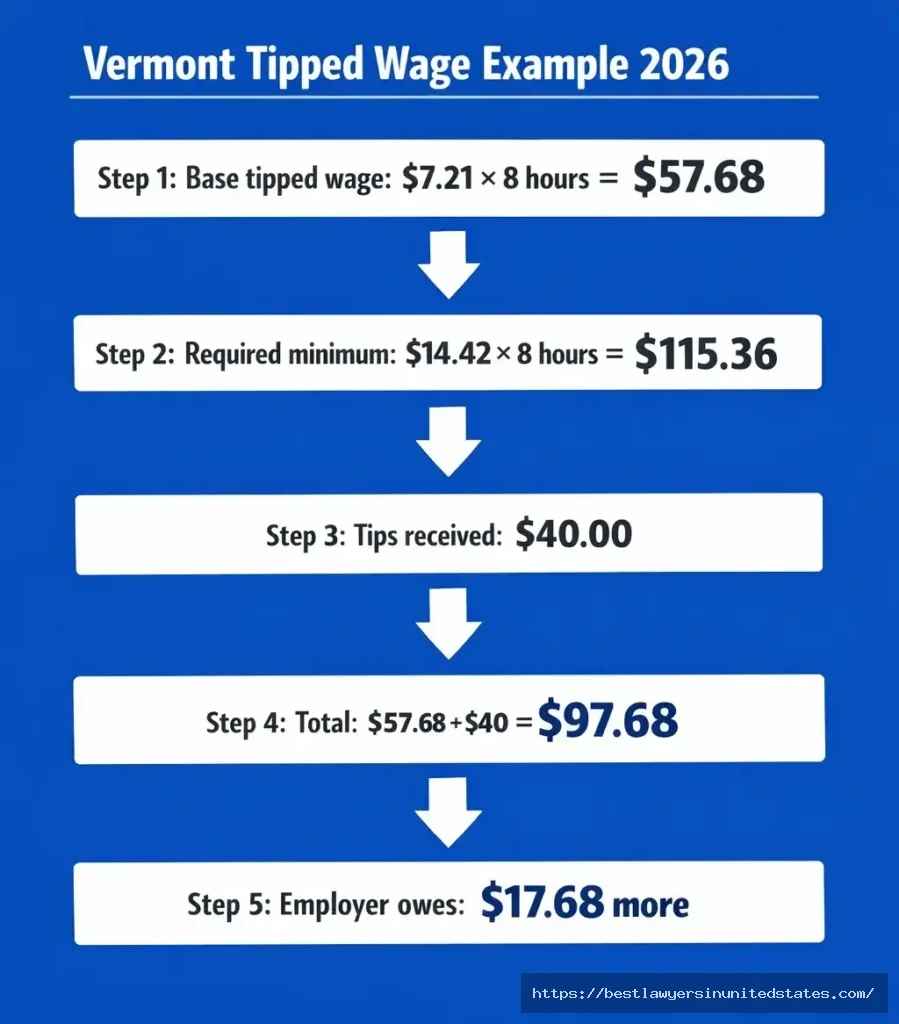
Scenario: You work an 8-hour shift as a server.
- Base tipped wage: $7.21/hour × 8 hours = $57.68
- Required minimum: $14.42/hour × 8 hours = $115.36
- You receive $40 in tips
- Total compensation: $57.68 + $40 = $97.68
- Employer must pay additional: $17.68
Your employer cannot keep any portion of your tips. Vermont law protects all tips for the employees who earn them.
What Happens If Your Employer Doesn't Pay?
This counts as wage theft. You can file a complaint with the Vermont Department of Labor using our wage theft calculator to estimate your claim amount.
Contact the Vermont Wage and Hour Program:
- Phone: 802-951-4083
- Address: 63 Pearl Street, Burlington, VT 05401-4331
Vermont Overtime Laws: When Do You Get Time and a Half?
Vermont requires employers with 2 or more non-exempt employees to pay overtime. You earn 1.5 times your regular wage for hours worked over 40 in a workweek.
Key Points About Vermont Overtime
Vermont calculates overtime weekly, not daily. Working 10 hours in one day doesn't trigger overtime unless you exceed 40 hours that week.
Working on weekends or holidays doesn't automatically mean overtime pay. Only total hours matter.
Important: Paid time off doesn't count toward your 40 hours. If you work 35 hours and take 8 hours of vacation, you only worked 35 hours. No overtime applies.
Calculate Your Vermont Overtime Pay
Working more than 40 hours per week? Calculate your overtime earnings based on Vermont's overtime laws.
⏰ Overtime Pay Calculator
Calculate your overtime earnings based on your state's specific labor laws
📍 Select Your State
💰 Your Hourly Wage
📊 Calculation Method
📅 Weekly Hours
💵 Your Weekly Overtime Pay
📊 Earnings Breakdown
📅 Pay Period Estimates
⚖️ State vs Federal Comparison
The calculator includes:
- Vermont-specific overtime rules
- Weekly overtime calculations
- Time-and-a-half calculations
- Pay period breakdowns
- Regular vs. overtime hour splits
Full overtime calculator: Overtime Pay Calculator
Questions about your wages or need legal help?
Email: [email protected]
Which Vermont Workers Are Exempt from Overtime?
Vermont exempts several types of employers and employees from state overtime requirements. However, federal law may still require overtime pay.
Employer Exemptions
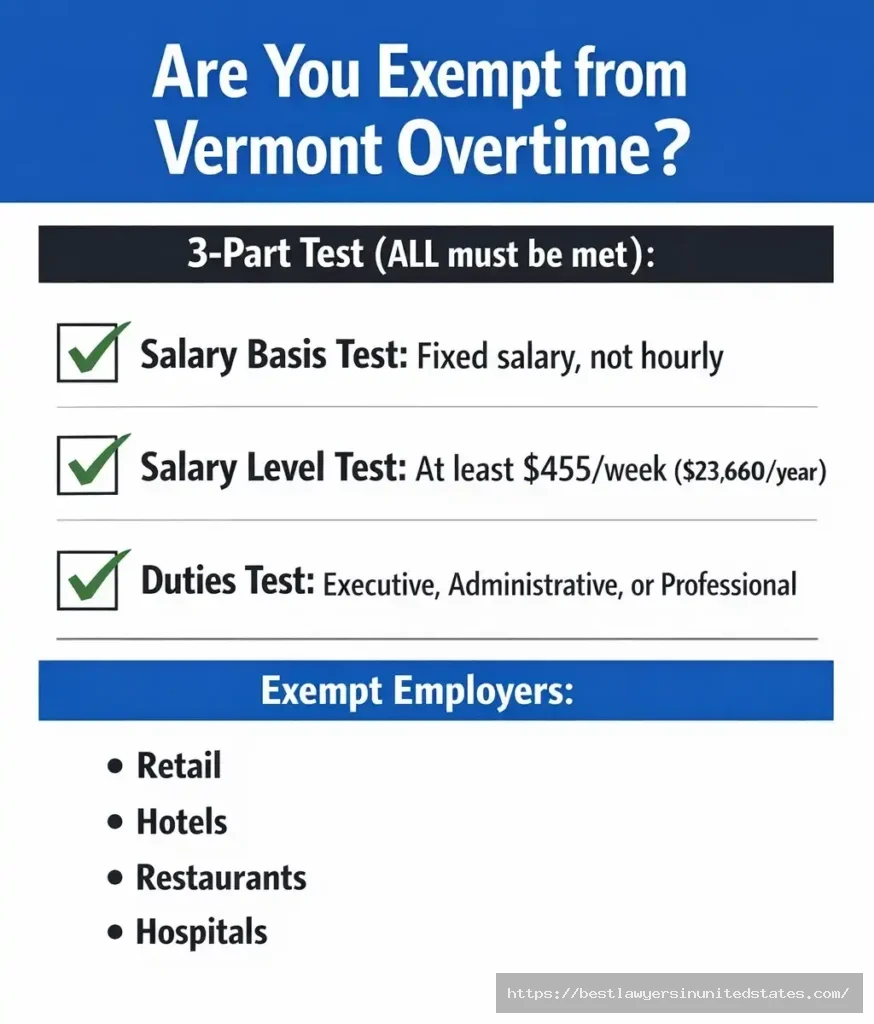
These businesses don't have to pay overtime under Vermont state law:
- Retail or service establishments
- Amusement or recreational establishments
- Hotels, motels, and restaurants
- Hospitals and nursing homes (with some restrictions)
- Transportation businesses not covered by FLSA
- Political subdivisions of Vermont
Critical point: If your employer is exempt from Vermont overtime, you might still qualify for federal overtime under the Fair Labor Standards Act.
Employee Exemptions
You must meet all three tests to be exempt from overtime:
1. Salary Basis Test You receive a fixed salary, not hourly pay.
2. Salary Level Test You earn at least $455 per week ($23,660 per year) under current federal standards.
3. Duties Test Your primary job duties fall into one of these categories:
- Executive (you manage 2+ employees)
- Administrative (office work requiring independent judgment)
- Professional (requires advanced knowledge or creative work)
- Outside sales
- Computer professional (specific technical duties)
Being paid on salary doesn't automatically make you exempt. You must pass all three tests.
Common Misclassification Examples
Retail managers: Your employer might claim you're exempt because you're a manager. If you spend most of your time doing the same work as hourly employees, you may not be truly exempt.
Restaurant workers: Even managers in restaurants may qualify for overtime if they spend more than 50% of their time on non-management tasks.
For workplace disputes about classification, you may need legal options for workplace disputes.
Vermont Minimum Wage History: How Much Has It Grown?
Vermont's minimum wage has increased by $5.57 since 2015. The table below shows the progression.
| Year | Minimum Wage | Tipped Wage | Annual Increase | % Change |
|---|---|---|---|---|
| 2026 | $14.42 | $7.21 | +$0.41 | +2.93% |
| 2025 | $14.01 | $7.01 | +$0.34 | +2.49% |
| 2024 | $13.67 | $6.84 | +$0.49 | +3.72% |
| 2023 | $13.18 | $6.59 | +$0.43 | +3.37% |
| 2022 | $12.75 | $6.38 | +$0.60 | +4.94% |
| 2021 | $12.15 | $6.08 | +$1.03 | +9.27% |
| 2020 | $11.12 | $5.56 | +$0.62 | +5.90% |
| 2019 | $10.50 | $5.25 | +$0.43 | +4.27% |
| 2018 | $10.07 | $5.04 | +$0.50 | +5.23% |
| 2017 | $9.57 | $4.79 | +$0.57 | +6.33% |
| 2016 | $9.00 | $4.50 | +$0.15 | +1.69% |
| 2015 | $8.85 | $4.43 | - | - |
The largest single-year increase was in 2021, with a $1.03 jump representing a 9.27% raise.
What Drives Vermont's Annual Increases?
Vermont law requires the Department of Labor to calculate the new minimum wage every fall. They compare:
- A 5% increase over the current wage
- The percentage increase in the CPI-U
The state uses whichever number is higher. This protects workers from inflation while providing predictable increases for employers.
Vermont Final Paycheck Laws: When You Must Get Paid
Vermont has strict deadlines for final paychecks. Missing these deadlines is illegal.
If You're Fired or Laid Off
Your employer must pay you within 72 hours of termination. This includes:
- All regular wages
- Earned overtime
- Accrued vacation pay (if your company offers payout)
- Earned commissions
- Any other compensation owed
The 72-hour rule applies even if you were fired for cause. The reason for termination doesn't change the payment deadline.
If You Quit Voluntarily
You must receive your final paycheck:
- On the next regular payday, OR
- The following Friday if there's no established payday
Example: You quit on Tuesday. Your company pays bi-weekly on Fridays. You'll get your final check that Friday.
What If Your Employer Misses the Deadline?
Contact the Vermont Department of Labor immediately. Late final paychecks may result in:
- Penalties against your employer
- Additional damages owed to you
- Possible investigation of other wage violations
If you're dealing with unpaid wages after termination, understanding FLSA deadlines can help protect your rights.
How to File a Wage Complaint in Vermont
You can file a wage complaint if your employer pays below minimum wage, refuses overtime, withholds tips, or violates other wage laws.
Step 1: Document Everything
Gather these materials before filing:
- Pay stubs from the past 2 years
- Time sheets or time clock records
- Your work schedule
- Any written communications about pay
- Bank deposits showing actual wages received
You have 2 years from the date wages were due to file a claim. Don't wait. Evidence gets harder to gather over time.
Step 2: Contact Vermont Department of Labor
Vermont Wage and Hour Program 63 Pearl Street Burlington, VT 05401-4331 Phone: 802-951-4083 Fax: 802-863-7655
You can also file online through the Vermont Department of Labor website.
Step 3: Complete Your Wage Claim
The Department will provide a wage claim form. You'll need to specify:
- Your employment dates
- Your hourly rate or salary
- Hours worked vs. hours paid
- Total amount you believe you're owed
Calculate Your Potential Recovery
Use our calculator to estimate how much you could recover under Vermont law.
Wage Theft Recovery Calculator
Estimate how much you can recover in unpaid wages, penalties, and damages based on your state's laws
💵 Estimated Total Recovery
💰 Unpaid Wages
⚖️ Penalties & Damages
📋 Total Summary
The calculator includes:
- Multiple violation types (unpaid wages, overtime, tips)
- Vermont-specific penalties and damages
- Filing deadline tracker
- Total recovery estimate
- Next steps guidance
Full wage theft calculator: Wage Theft Calculator
Questions about your wages or need legal help?
Email: [email protected]
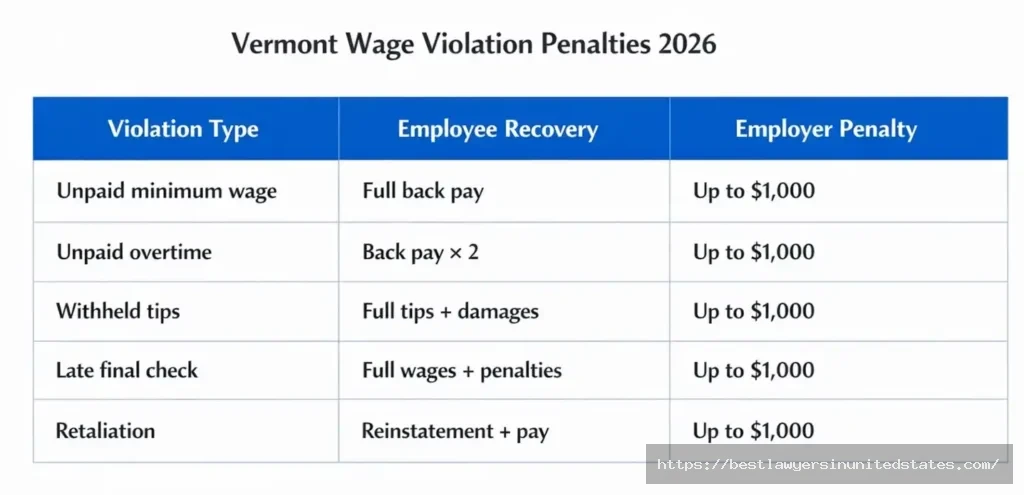
What Damages Can You Recover for Wage Violations?
Vermont law allows you to recover more than just unpaid wages. You may be entitled to:
| Violation Type | Employee Recovery | Employer Penalty |
|---|---|---|
| Unpaid minimum wage | Full back pay | Up to $1,000 per violation |
| Unpaid overtime | Back pay × 2 (liquidated damages) | Up to $1,000 per violation |
| Withheld tips | Full tips + damages | Up to $1,000 per violation |
| Late final paycheck | Full wages + penalties | Up to $1,000 per violation |
| Retaliation | Reinstatement + back pay | Up to $1,000 per violation |
Liquidated damages mean you can potentially double your recovery. If your employer owes you $5,000 in unpaid overtime, you might recover $10,000 total.
Vermont Protects Whistleblowers
Your employer cannot fire you, demote you, or reduce your hours for:
- Filing a wage complaint
- Cooperating with a Department of Labor investigation
- Discussing wages with coworkers
- Asserting your rights under wage and hour laws
Retaliation is illegal. If it happens, file a separate complaint immediately.
Required Vermont Workplace Posters for 2026
All Vermont employers must display these posters where employees can see them:
Vermont State Posters:
- Vermont Minimum Wage Poster (updated for 2026)
- Vermont Wage and Hour Laws
- Vermont Workers' Compensation Notice
- Vermont Unemployment Insurance
- Vermont Earned Sick Time Notice
Federal Posters:
- FLSA Minimum Wage Poster
- OSHA Workplace Safety
- Equal Employment Opportunity
- Family and Medical Leave Act
Download the official 2026 Vermont Minimum Wage Poster from the Vermont Department of Labor website.
Employer Recordkeeping Requirements
Vermont law requires employers to keep these records for 3 years:
- Employee names and Social Security numbers
- Hours worked each day and each week
- Total wages paid each pay period
- All deductions from wages
- Dates of employment
Failure to maintain proper records makes it harder for employers to defend against wage claims.
Frequently Asked Questions About Vermont Minimum Wage 2026
What is Vermont's minimum wage in 2026?
Quick Answer: Vermont's minimum wage is $14.42 per hour starting January 1, 2026, which is $7.17 higher than the federal minimum wage of $7.25.
This applies to all employers with 2 or more employees, regardless of business size.
What will Vermont's tipped minimum wage be in 2026?
Quick Answer: The tipped minimum wage in Vermont will be $7.21 per hour in 2026, exactly 50% of the regular minimum wage.
Employers must pay the difference if tips don't bring workers to $14.42 per hour.
Does Burlington have a different minimum wage than the rest of Vermont?
Quick Answer: No. Burlington and all other Vermont cities follow the statewide minimum wage of $14.42 per hour.
Vermont doesn't allow local governments to set their own minimum wages. This differs from states like New York or California, where city rates can exceed state rates.
When do I get overtime in Vermont?
Quick Answer: You get overtime pay when you work more than 40 hours in a workweek, unless you're exempt.
Working more than 8 hours in a day doesn't trigger overtime in Vermont. Only weekly totals matter.
Do weekends and holidays count as overtime?
Quick Answer: No, not automatically. You only get overtime when you work over 40 hours in the workweek.
Working Saturday and Sunday counts toward your 40 hours, but doesn't trigger automatic overtime pay.
Can my employer pay me less than minimum wage if I'm in training?
Quick Answer: No, with very limited exceptions. Vermont requires full minimum wage for almost all employees.
The only major exception is for full-time high school students under federal youth employment rules. Even then, the reduced rate only lasts 90 days.
How do I calculate my annual salary at Vermont minimum wage?
Quick Answer: At $14.42 per hour working full-time (40 hours/week, 52 weeks), you'll earn $29,993.60 per year before taxes.
Use our minimum wage calculator to see exact numbers for your work schedule.
How much overtime pay am I entitled to in Vermont?
Quick Answer: You earn 1.5 times your regular hourly rate for every hour over 40 in a workweek.
At minimum wage, that's $21.63 per hour ($14.42 × 1.5). Calculate your exact overtime using our overtime calculator.
Can I waive my right to overtime pay?
Quick Answer: No. You cannot sign away your right to overtime compensation in Vermont, even if you agree to it.
Any agreement to waive overtime is legally invalid under Vermont law.
What if my employer says I'm salary so I don't get overtime?
Quick Answer: Being paid on salary doesn't automatically make you exempt from overtime. You must meet all three exemption tests.
Many salaried workers still qualify for overtime. Check if you meet the salary level ($455/week minimum), salary basis, and duties tests.
How long do I have to file a wage claim in Vermont?
Quick Answer: You have 2 years from the date wages were due to file a wage claim with the Vermont Department of Labor.
File as soon as possible. Evidence becomes harder to gather over time, and you want to preserve your rights.
Can my employer fire me for filing a wage complaint?
Quick Answer: No. Retaliation for filing wage complaints is illegal under Vermont law.
If your employer fires, demotes, or reduces your hours after you file a complaint, file a separate retaliation claim immediately.
Where can I download the 2026 Vermont minimum wage poster?
Quick Answer: Download the official poster from labor.vermont.gov/document/minimum-wage-poster-2026.
All Vermont employers must display the updated 2026 poster starting January 1.
Does Vermont have a different minimum wage for workers under 18?
Quick Answer: No. Vermont requires the same $14.42 minimum wage for workers of all ages.
Federal law allows a youth minimum wage ($4.25) for the first 90 days of employment for workers under 20, but this is uncommon in Vermont.
What's the difference between Vermont and federal minimum wage?
Quick Answer: Vermont's minimum wage ($14.42) is $7.17 higher than the federal minimum ($7.25).
When state and federal rates differ, employers must pay the higher rate. All Vermont employers pay at least $14.42 per hour.
Additional Vermont Labor Law Resources
Comparing Minimum Wages Across States
If you're considering work in other states or comparing wages, these guides can help:
- Connecticut Minimum Wage - Highest in New England at $16.35
- Massachusetts Minimum Wage - $15.00 in 2026
- New Hampshire Minimum Wage - Follows federal at $7.25
- Rhode Island Minimum Wage - $14.00 in 2026
- Maine Minimum Wage - $14.65 in 2026
- New York Minimum Wage - Varies by region
Vermont-Specific Legal Resources
For other Vermont legal topics:
- Vermont DUI Laws - DWI penalties and defenses
- Legal Options for Workplace Disputes - Beyond wage claims
- What Employees Should Look for in Employment Agreements - Contract review
National Wage Law Resources
Understanding federal standards helps you know when state law applies:
- Missing the FLSA Deadline - Federal wage claim deadlines
Key Takeaways for Vermont Workers and Employers
Vermont's 2026 minimum wage increase to $14.42 per hour continues the state's commitment to fair wages. Here's what you need to remember:
For Employees:
- You must earn at least $14.42 per hour starting January 1, 2026
- Tipped workers must receive $7.21 base pay plus tips to reach $14.42
- Overtime applies after 40 hours in a workweek
- You have 2 years to file wage complaints
- Retaliation for asserting your rights is illegal
For Employers:
- Update workplace posters by January 1, 2026
- Adjust payroll systems for the new rates
- Remember that being exempt from Vermont overtime doesn't mean FLSA doesn't apply
- Final paychecks have strict deadlines: 72 hours for terminations
- Keep wage records for 3 years
Next Minimum Wage Increase: January 1, 2027 (rate to be announced fall 2026)
Questions or concerns about wage laws?
Vermont Department of Labor Wage and Hour Program Phone: 802-951-4083 Email: [email protected]
Use our free calculators to understand your earnings, overtime pay, and potential wage theft recovery under Vermont's 2026 wage laws.
