
A divorce decree is the final court order that legally ends your marriage. This document contains all binding terms about property division, child custody, support payments, and other divorce settlement details. You’ll need certified copies of your decree for passport applications, name changes, remarriage, and many other legal purposes.
Your divorce isn’t officially final until a judge signs the decree. Many people confuse this document with a divorce certificate, but they serve different purposes. Understanding what’s in your decree and how to get copies can save you time and money after your divorce.
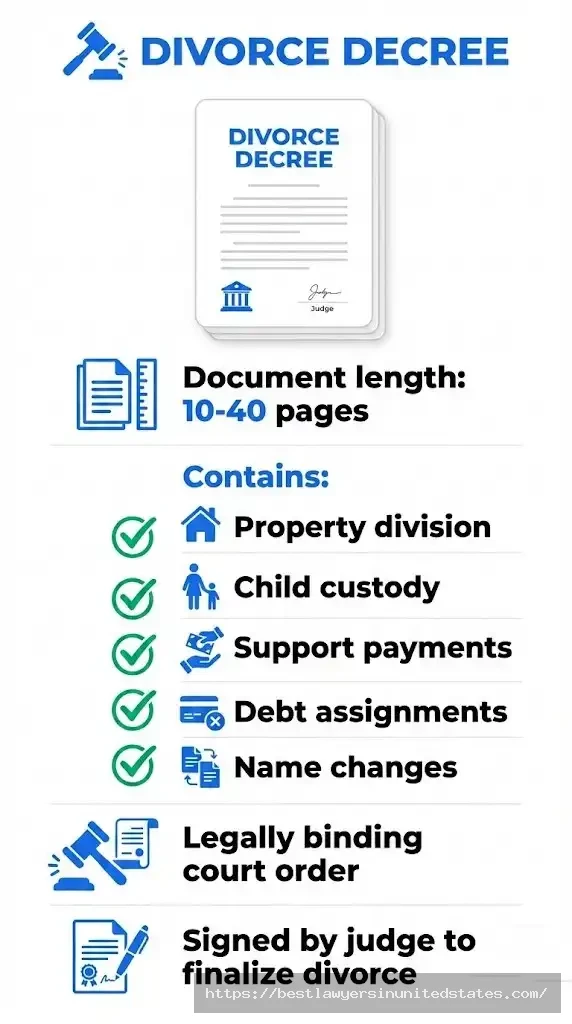
This guide explains everything you need to know about divorce decrees in 2026, from what they contain to how to enforce their terms.
What Is a Divorce Decree?
A divorce decree is a legal court order that officially dissolves your marriage. The judge signs this document after reviewing your case, whether you settled with your spouse or went to trial. Once signed, the decree becomes legally binding on both parties.
The decree serves as proof that your marriage has ended as of a specific date. It also outlines every decision made during your divorce, including who gets what property and who pays what debts. Courts can enforce these terms if either spouse fails to follow them.
When You Receive Your Divorce Decree
You get your decree at the final divorce hearing or shortly after. If you settled out of court, the judge reviews your agreement and signs the decree at a brief hearing. For contested cases, the judge issues the decree after the trial concludes.
Some courts mail the decree to both parties within 7 to 14 days of signing. Others require you to pick it up at the clerk’s office. Ask your local court about their specific process for distributing final divorce documents.
How a Decree Differs From Other Divorce Documents
Many people mix up decrees with other paperwork. Here’s the difference:
Document Comparison
| Document Type | What It Is | When You Get It | What It Contains |
|---|---|---|---|
| Divorce Petition | Initial filing | Start of case | Request to divorce |
| Divorce Decree | Final court order | End of case | All binding terms |
| Divorce Certificate | Vital record | After decree | Basic facts only |
| Settlement Agreement | Negotiated deal | Before decree | Proposed terms |
The decree is the only document that officially ends your marriage. Everything else is either preparation or proof.
What’s Included in a Divorce Decree?
Divorce decrees contain detailed instructions about how to divide your life after marriage. The document typically runs 10 to 40 pages depending on your situation. Texas decrees, for example, include 20 major sections covering everything from custody to debt responsibility.
Most decrees follow a similar structure regardless of state. The judge addresses property, finances, children, and other legal matters in separate sections. Each section creates enforceable obligations for one or both spouses.
Property Division Orders
The decree lists every asset from your marriage and who gets it. This includes your home, cars, bank accounts, retirement funds, and personal belongings. The judge specifies exact details like account numbers and property addresses.
Common property items in decrees:
✅ Real estate with legal descriptions ✅ Vehicles with VIN numbers
✅ Bank accounts with institution names ✅ Retirement accounts (401k, IRA, pension) ✅ Business interests and investments ✅ Personal property by category
Texas and other community property states split marital assets 50/50 by default. Equitable distribution states divide property fairly but not always equally. Your decree reflects your state’s specific property division laws.
Debt Responsibility Assignments
The decree also assigns who pays which debts. This covers mortgages, car loans, credit cards, student loans, and medical bills. The judge typically assigns each debt to whoever benefited from it or can better afford payment.
Critical point: The decree doesn’t change your original agreements with creditors. If you co-signed a loan, the lender can still pursue you for payment even if the decree says your ex must pay.
Child Custody and Visitation
Decrees with children include custody arrangements called “conservatorship” in Texas and some other states. The document specifies legal custody (who makes major decisions) and physical custody (where children live). Most states favor joint legal custody unless safety concerns exist.
The decree also includes a detailed parenting schedule showing:
✅ Regular weekday and weekend schedules ✅ Holiday and vacation time ✅ Summer break arrangements
✅ Transportation responsibilities ✅ Communication rules between parents
Child Support Terms
If you have kids, the decree includes child support orders. This section names the paying parent (obligor) and receiving parent (obligee). It specifies monthly payment amounts, payment methods, and duration of support.
Child support decree elements:
- Monthly payment amount
- Payment due date (usually 1st of month)
- Payment address (state disbursement unit)
- Income withholding instructions for employer
- When support terminates for each child
- Medical insurance requirements
- Uninsured medical expense split
Texas decrees, for instance, direct payments to the Texas Child Support Disbursement Unit in San Antonio. Most states use similar centralized payment systems. You can estimate your potential obligations using a child support calculator.
Child Support Calculator
Calculate child support estimates based on your state’s guidelines. Get accurate payment amounts using income shares model calculations.
Enter Your Information
Provide income, custody, and children details
Estimated Monthly Child Support
📍 State Child Support Guidelines
Information about this state’s child support calculation method will appear here.
📊 Calculation Breakdown
| Component | Value |
|---|
Spousal Support and Alimony
Some decrees include alimony or spousal maintenance orders. These sections specify payment amounts, duration, and conditions for modification or termination. Not all divorces involve alimony.
The decree states whether alimony is temporary (rehabilitative) or permanent. It also covers what triggers the end of payments, such as remarriage or cohabitation. Calculate potential alimony amounts with an alimony calculator based on your state's guidelines.
Alimony Calculator
Estimate spousal support payments based on your state's guidelines. Get monthly payment amounts, duration estimates, and total alimony calculations.
Enter Your Information
Provide details about income, marriage, and circumstances
Estimated Monthly Alimony Payment
📍 State Alimony Guidelines
Information about this state's alimony approach will appear here.
📊 Calculation Breakdown
| Component | Value |
|---|
Name Change Authorization
If you want to return to a previous name, the decree authorizes this change. You'll need to show this decree section when updating your Social Security card, driver's license, and passport. The judge typically approves any name you used before marriage.
Health Insurance and Medical Support
Decrees require one parent to maintain health insurance for children if available at reasonable cost. The document names the parent responsible for coverage and defines what "reasonable cost" means (usually less than 9% of gross income).
The decree also splits responsibility for uninsured medical costs. Most states order parents to share these 50/50, though percentages vary based on income. This includes copays, deductibles, and any care not covered by insurance.
Retirement Account Division
Complex decrees include Qualified Domestic Relations Orders (QDROs) for splitting retirement accounts. These special orders tell 401k or pension administrators how to divide funds without tax penalties. The decree references the QDRO and may include it as an attachment.
Retirement division timeline:
- Decree orders percentage split
- Attorney prepares QDRO
- Plan administrator reviews QDRO
- Judge signs QDRO
- Administrator divides account
Divorce Decree vs. Divorce Certificate
Many people confuse these two documents, but they serve completely different purposes. A decree is a court order while a certificate is a vital record. You'll need to know which one to use for different situations after divorce.
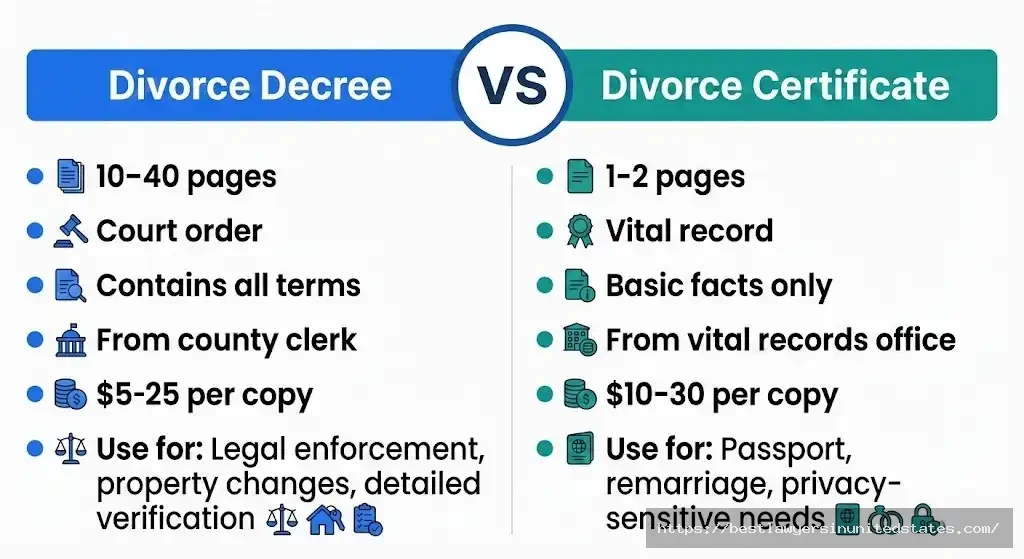
What Makes Them Different
Decree vs. Certificate Comparison
| Feature | Divorce Decree | Divorce Certificate |
|---|---|---|
| Created By | Family court judge | State vital records office |
| Length | 10-40 pages | 1-2 pages |
| Contents | All divorce terms | Basic facts only |
| Privacy | Contains financial details | Minimal personal info |
| Cost | $5-25 per copy | $10-30 per copy |
| Where to Get | County clerk | State vital records |
| Best Used For | Legal enforcement, detailed verification | Quick proof, privacy-sensitive situations |
The decree includes every detail about your divorce settlement. Your certificate only shows names, divorce date, location, and the judge's signature. Think of the certificate as a condensed summary for situations where full details aren't necessary.
When to Use Each Document
Use your decree when you need to prove specific divorce terms. Banks, insurance companies, and courts want to see the actual orders about property or custody. Use the certificate when you just need proof the divorce happened.
Decree required for:
✅ Enforcing support payments ✅ Refinancing property ✅ Dividing retirement accounts ✅ Resolving property disputes ✅ Custody modifications
Certificate works for:
✅ Passport applications ✅ Remarriage licenses
✅ Name changes (sometimes) ✅ General verification ✅ Privacy-sensitive requests
State Availability of Certificates
Not all states issue divorce certificates. About 35 states maintain them through vital records offices. The remaining states only provide court-issued decrees. Check your state's vital records website to see what's available.
States that offer certificates include California, New York, Texas, and Florida. States like Pennsylvania and Virginia primarily rely on court decrees. Your state's divorce laws determine which documents you can obtain.
How to Get a Copy of Your Divorce Decree
Getting decree copies is usually simple but varies by location. You have three main options: request copies when the divorce finalizes, contact the court clerk later, or use third-party services. Each method has different costs and timelines.
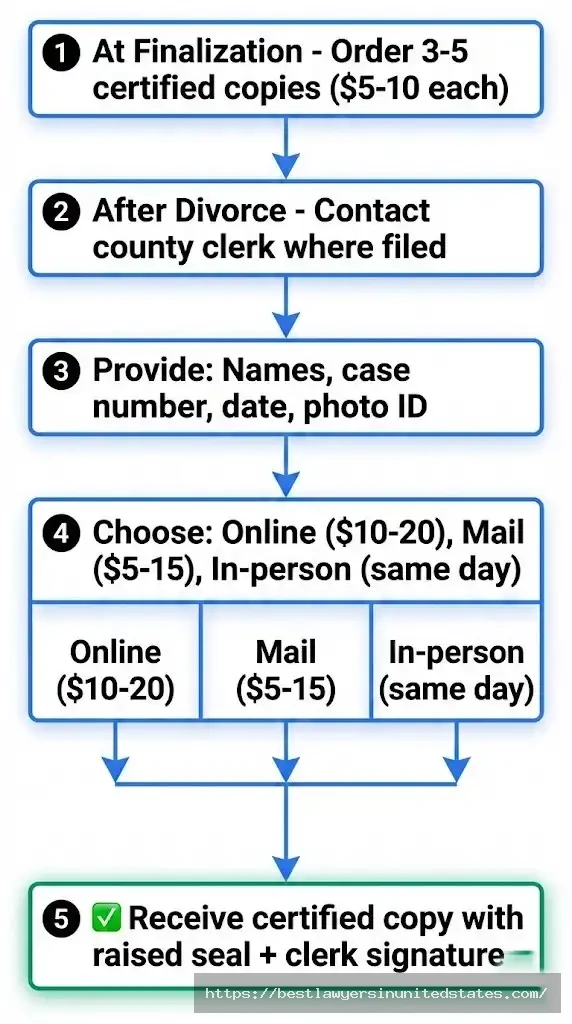
Getting Copies at Finalization
Smart move: Request multiple certified copies when your divorce becomes final. This saves money and time compared to ordering later. Most county clerks charge $5 to $10 per copy at the hearing.
Order at least 3 to 5 certified copies initially. You'll need them for name changes, refinancing, remarriage, and updating accounts. Ordering all at once costs less than individual requests months later.
Requesting From the Court Clerk
If you didn't get enough copies initially, contact the court clerk where your divorce was filed. You'll need specific information to process your request. Most clerks offer online, mail, and in-person ordering.
Information needed to order:
- Full legal names of both spouses
- Case or cause number
- Approximate divorce date
- County where filed
- Your relationship to the case
- Valid photo ID
Filing fees range from $5 to $25 per certified copy depending on county. Processing takes 1 to 3 weeks for mail requests or same-day for in-person pickup in many locations.
Online vs. Mail vs. In-Person
Ordering Method Comparison
| Method | Processing Time | Cost | Best For |
|---|---|---|---|
| Online Portal | 3-7 days | $10-20 + shipping | Convenience |
| Mail Request | 1-3 weeks | $5-15 + postage | Lower cost |
| In-Person | Same day | $5-15 | Urgent needs |
| Third-Party Service | 5-10 days | $25-50 | Out-of-state |
Many courts now offer online ordering through their websites or platforms like VitalChek. These services cost more but provide tracking and faster delivery. Compare prices before choosing a method.
Third-Party Services
Companies like VitalChek partner with government offices to process requests. They charge service fees of $10 to $30 on top of the official cost. Use these if you live far from where you divorced or need records quickly.
Verify any third-party service is authorized by checking your court's website. Unauthorized services can't access official records and may be scams. Stick with vendors listed on government sites.
Cost Breakdown by State
Decree copy costs vary significantly by location. Here's what you'll pay in major states:
Sample State Costs (2026)
| State | Certified Copy | Processing Fee | Total |
|---|---|---|---|
| California | $15 | $0-5 | $15-20 |
| Texas | $10 | $0 | $10 |
| Florida | $13.50 | $0-5 | $13-18 |
| New York | $10 | $5 | $15 |
| Pennsylvania | $7 | $0 | $7 |
Check your county clerk's fee schedule for exact pricing. Fees change periodically and vary even within states.
Certified vs. Uncertified Copies
Understanding the difference between certified and uncertified copies saves frustration when updating documents after divorce. Most official purposes require certified copies with court seals. Knowing when each type works helps you order correctly.
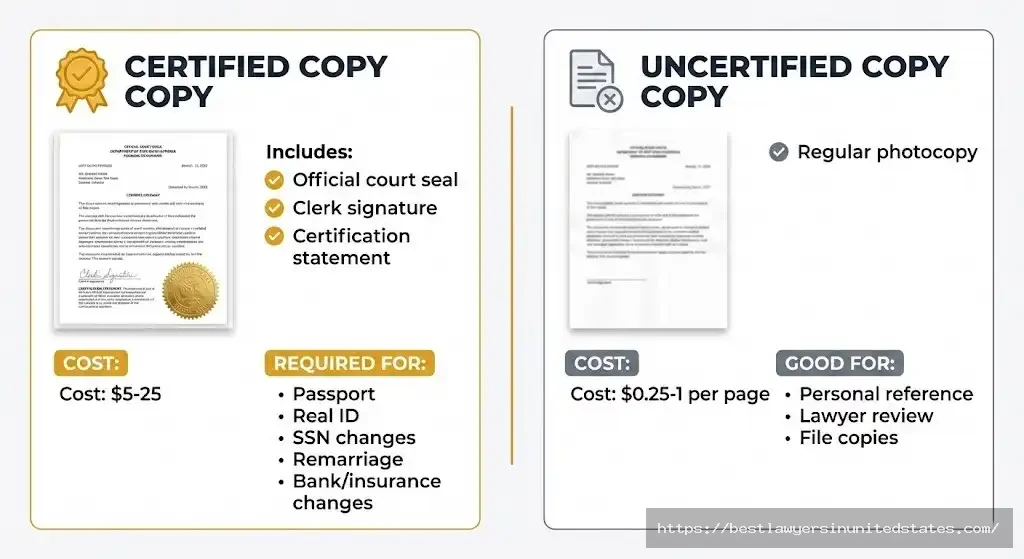
What Makes a Copy Certified
A certified copy includes an official court seal (usually raised or embossed) and the clerk's signature. This stamp and signature prove the copy matches the original court file. The clerk also adds the certification date.
Uncertified copies are plain photocopies without official stamps. These work for personal reference but lack legal weight. Courts and government agencies reject uncertified copies for official business.
When Certification Is Required
Government agencies and financial institutions almost always require certified copies. They need proof the document is legitimate and unaltered. Submit certified copies for these situations:
Certified copies needed:
✅ Social Security name changes ✅ Driver's license updates ✅ Passport applications and renewals ✅ Remarriage license applications ✅ Bank account modifications ✅ Mortgage refinancing ✅ Insurance policy changes ✅ Retirement account divisions ✅ Real ID compliance ✅ Property title transfers
When Uncertified Copies Work
Save money by using uncertified copies for informal purposes. These include personal records, lawyer consultations, and preliminary reviews. Make uncertified copies from your certified original rather than buying multiple certified copies.
Keep one certified original in a safe place. Make regular photocopies for daily reference. This protects your certified copy from damage while giving you working copies.
Verifying True Certification
Legitimate certified copies have specific features. Check for these elements before submitting important documents:
- Raised or embossed court seal
- Clerk's original signature (not stamped)
- Certification statement and date
- Official court header or watermark
- Sequential numbering
Reject flat photocopies of seals or stamped signatures. These aren't properly certified. Request new copies if yours lack proper certification features.
Cost Differences
Certified copies cost $5 to $25 each depending on location. Uncertified copies run $0.25 to $1 per page if you make them yourself. The certification process adds the fee, not the pages themselves.
Some people order one certified copy and make their own photocopies for informal use. This works unless you need multiple certified copies for different agencies at once. Budget accordingly based on your specific needs after divorce.
Why You Need Your Divorce Decree
You'll reference your decree dozens of times after divorce ends. This document proves your marital status changed and authorizes specific actions. Keep certified copies accessible for common post-divorce tasks that require official proof.
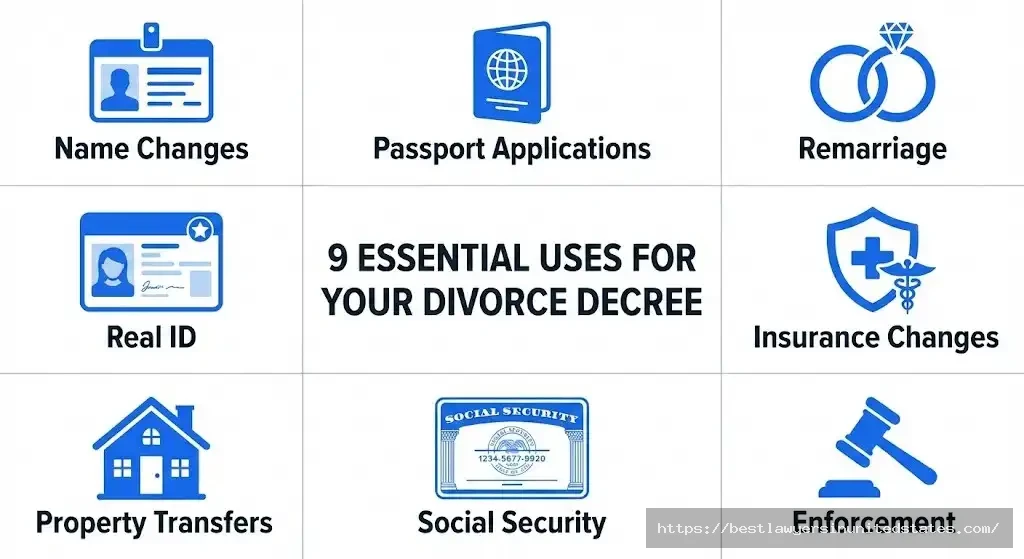
Legal Name Changes
The decree authorizes reverting to your maiden name or previous name. Social Security requires seeing the decree to process name changes. The DMV needs it for driver's license updates. Passport agencies demand it for new passport names.
Follow this sequence for name changes:
- Update Social Security card first
- Change driver's license or state ID
- Apply for passport with new name
- Update bank accounts and credit cards
- Notify employers and insurance
Starting with Social Security matters because other agencies want your updated card as proof. The first step in this process should happen within weeks of receiving your decree.
Remarriage Requirements
Most states require your divorce decree when applying for a new marriage license. The clerk verifies your previous marriage legally ended before issuing a new license. Bring a certified copy to the marriage license office.
Some states accept divorce certificates instead of full decrees for remarriage. Check local requirements before your appointment. Missing documents delay your license application.
Real ID and Passport Applications
The 2026 Real ID Act requires proof of legal name if your ID name differs from your birth certificate. Your divorce decree shows the authorized name change. TSA won't accept your license for flights without this compliance.
Passport applications also need the decree if your passport name changed due to divorce. New passport photos, fees, and the decree are required. Processing takes 6 to 11 weeks, so plan ahead for travel.
Financial Account Changes
Banks and investment firms need your decree to modify joint accounts. The decree shows who owns what property after divorce. Bring certified copies when:
- Removing an ex-spouse from accounts
- Retitling property or vehicles
- Refinancing mortgages
- Dividing retirement accounts
- Updating beneficiaries
- Claiming insurance proceeds
Financial institutions keep the certified copy for their records. Order extras before visiting multiple banks or companies.
Insurance and Benefits Updates
Life insurance, health insurance, and retirement benefits all require decree proof for changes. You'll update beneficiaries, remove ex-spouses from coverage, or claim benefits awarded in the decree.
The decree proves your legal right to make these changes. Insurance companies won't process modifications without seeing the court order. Submit certified copies with all change requests.
Tax Filing Status Changes
Your decree affects how you file taxes going forward. The IRS considers you divorced for the full tax year if your decree finalizes by December 31st. Keep a copy with your tax records as proof of filing status.
Tax issues from divorce costs and deductions require documentation. Your accountant may need decree sections about alimony or property division. These affect deductions and capital gains calculations.
Enforcement When Terms Aren't Followed
If your ex violates decree terms, you need the original to file enforcement motions. The court can't enforce agreements they don't see. Certified copies prove what orders exist and what your ex is ignoring.
Enforcement actions include contempt proceedings, wage garnishment, and license suspension. All require showing the judge the exact decree language being violated.
State-by-State Variations
Divorce decrees follow different formats and use different terminology depending on where you divorce. Understanding your state's specific approach helps you navigate the paperwork. The core elements remain similar but names and details change.
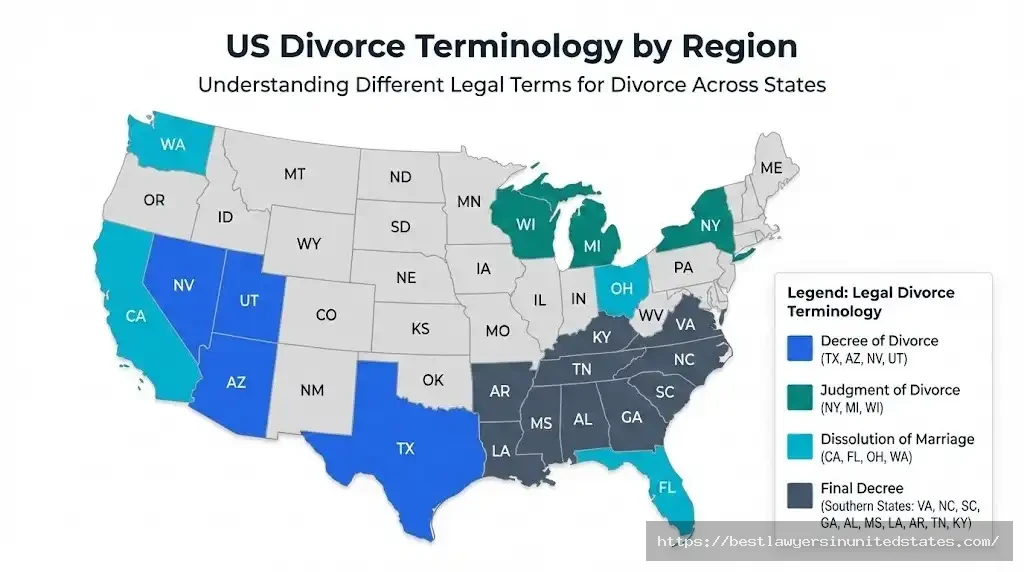
Different Names for the Same Document
States use various terms for the final divorce order. All mean essentially the same thing but appear on documents differently:
State Terminology Guide
| Document Name | Common States |
|---|---|
| Decree of Divorce | Texas, Arizona, Nevada, Utah |
| Judgment of Divorce | New York, Michigan, Wisconsin |
| Dissolution of Marriage | California, Florida, Ohio, Washington |
| Final Decree | Many southern states |
| Divorce Decree | Generic term used everywhere |
Search for the correct term when requesting copies in your state. Using wrong terminology confuses court clerks and delays requests. Check your state's specific divorce laws for proper document names.
Custody Terminology Differences
Texas uses "conservatorship" instead of "custody" in decrees. Parents are "managing conservators" rather than custodial parents. This confuses people moving between states but means the same thing legally.
Other states stick with traditional custody language. Your decree might say "legal custody," "physical custody," or "residential placement" depending on location. All refer to where kids live and who makes decisions.
Property Division Variations
Community property states divide marital assets 50/50 by default. Texas, California, Arizona, Nevada, New Mexico, Washington, Wisconsin, Idaho, and Louisiana follow this rule. Their decrees reflect equal splits unless special circumstances exist.
Equitable distribution states divide property fairly but not necessarily equally. Judges consider factors like income, contributions, and needs. These decrees explain reasoning for unequal divisions.
Property Division by State Type
| Division Type | Approach | Example States |
|---|---|---|
| Community Property | 50/50 split | CA, TX, AZ, NV |
| Equitable Distribution | Fair not equal | NY, FL, PA, OH |
Waiting Period Requirements
Your decree's effective date depends on state waiting periods. Some states finalize divorces immediately after the judge signs. Others impose mandatory waiting periods after filing before the decree becomes final.
Sample Waiting Periods (2026)
| State | Waiting Period | Notes |
|---|---|---|
| California | 6 months | From service date |
| Texas | 60 days | From filing date |
| Florida | 20 days | From filing date |
| New York | None | Immediate when signed |
| Nevada | None | Immediate when signed |
These waiting periods affect when your decree is final even if the judge signs sooner. You can't remarry until the waiting period ends.
Court System Differences
Where your decree is filed and who signs it varies by state. Some use dedicated family courts while others handle divorces in district or circuit courts. Your decree header shows the specific court type.
Common court types for divorce:
- Family Court (New York, Hawaii)
- Superior Court Family Division (California, Arizona)
- District Court (Texas, Colorado)
- Circuit Court (Florida, Illinois)
- Court of Common Pleas (Pennsylvania, Ohio)
The court type affects where you request copies later. Contact the right division to avoid delays.
What Happens If Terms Aren't Followed
Your divorce decree creates enforceable court orders. Both spouses must follow every term or face legal consequences. Courts take violations seriously because decrees protect children and ensure fair property division.
Decree Orders Are Legally Binding
The decree isn't a suggestion or guideline. It's a court order with the same legal weight as any other judgment. Violating decree terms equals disobeying the court itself.
Common violations include:
❌ Missing child support payments ❌ Denying court-ordered visitation
❌ Refusing to transfer property ❌ Not maintaining required insurance ❌ Hiding assets awarded to ex-spouse ❌ Blocking access to children
Contempt of Court Proceedings
When your ex violates the decree, file a motion for contempt with the court. The judge can order them to comply and punish the violation. Contempt findings carry serious penalties.
You must prove three things for contempt:
- A valid court order exists (the decree)
- The violator knew about the order
- The violator willfully disobeyed
Bring your certified decree copy as evidence. Show the exact language being violated and document each violation with dates and details.
Enforcement Mechanisms
Courts have multiple tools to force compliance with decree terms. Judges choose penalties based on violation severity and frequency. Repeat violators face harsher consequences.
Available Enforcement Actions
| Violation Type | Possible Penalty |
|---|---|
| Unpaid Support | Wage garnishment, tax refund intercept, bank levies |
| Custody Violations | Makeup visitation, custody modification, supervised visits |
| Property Transfer | Court order to transfer, sheriff enforcement, fines |
| Insurance Lapses | Pay all medical costs, makeup premiums, fines |
Wage Garnishment for Support
Child support and alimony violations trigger automatic wage garnishment in most states. The court orders your ex's employer to withhold payments directly from paychecks. This continues until arrears are paid.
Income withholding orders accompany most support decrees. Employers must comply or face their own contempt charges. Your ex can't stop garnishment by changing jobs because new employers receive the same order.
License Suspension
Many states suspend driver's licenses, professional licenses, and recreational licenses for unpaid support. This includes medical licenses, contractor licenses, hunting licenses, and more. Suspension continues until payments resume.
The threat of license loss motivates many violators to comply. Losing the ability to drive to work or practice a profession creates immediate consequences.
Jail Time for Willful Non-Compliance
Judges can jail violators for up to 6 months for contempt. This typically happens for repeated violations after warnings and lesser penalties failed. The violator must willfully refuse to comply, not simply be unable.
Inability to pay due to job loss differs from refusal to pay. Courts consider whether violations are willful before imposing jail time. Document your ex's ability to comply when filing contempt motions.
When to Get an Attorney
Consider hiring a lawyer if your ex repeatedly violates decree terms. Divorce attorneys know enforcement procedures and what evidence courts require. They handle filing motions and representing you at hearings.
Some violations resolve with a single letter from an attorney. Others require multiple court appearances. Weigh enforcement costs against the value of what you're trying to enforce.
Can a Divorce Decree Be Changed?
Not all decree terms are permanent. Some provisions can be modified as circumstances change while others remain fixed forever. Understanding what's modifiable helps you know whether to seek changes or accept the current terms.
What Can Be Modified
Courts allow modifications to decree terms that depend on changing circumstances. These provisions affect ongoing relationships and future needs rather than past property division.
Modifiable Terms:
✅ Child support amounts
✅ Custody and visitation schedules ✅ Spousal support duration or amount ✅ Health insurance requirements ✅ Name of school children attend ✅ Parenting plan details
Changes require showing "material and substantial change in circumstances" since the decree was signed. This means significant life changes like job loss, serious illness, or major income increases.
What Cannot Be Modified
Property division and debt assignment are final when the judge signs your decree. You can't change who got the house or who owes the credit card debt. These terms become permanent even if you later think they're unfair.
Permanent Terms:
❌ Property ownership splits ❌ Debt responsibility assignments
❌ Division of retirement accounts ❌ Asset distribution ❌ Initial spousal support amounts (in some states)
Think carefully before agreeing to property terms in uncontested divorces. You can't undo bad deals later.
Child Support Modification Process
Either parent can request child support changes if circumstances changed substantially. Common reasons include job loss, significant income increases, or changes in custody time.
File a petition to modify child support with the same court that issued the decree. You'll need financial documentation proving the change. Expect a hearing where both parents present evidence.
Some states allow automatic reviews every 3 years. Others require proving circumstances changed. Use a child support calculator to estimate what new payments might be before filing.
Custody and Visitation Changes
Custody modifications require showing the change serves the children's best interests. This standard is harder to meet than simple circumstance changes. Courts prefer stability for kids.
Valid reasons for custody changes:
- Parent relocating far away
- Serious safety concerns
- Child's preferences (if old enough)
- Parent's inability to care for child
- Repeated decree violations
Minor schedule adjustments don't require court modification. Parents can agree to small changes informally. Major changes need court approval to be enforceable.
Spousal Support Modifications
Alimony modifications depend on your decree language and state law. Some decrees make support non-modifiable. Others allow changes for specific reasons like retirement or remarriage.
Most support ends automatically when the recipient remarries. Many decrees also end support if the recipient cohabits with a new partner. Check your decree's exact termination provisions.
Modification Costs
Filing modification petitions costs $100 to $400 depending on your court. Add attorney fees of $1,500 to $5,000 if you hire a lawyer. Contested modifications requiring trials cost significantly more.
Both parties agreeing to changes reduces costs dramatically. Draft an agreed modification and submit it to the judge for approval. This avoids fights and keeps fees low.
Agreement vs. Court Decision
If you and your ex agree on modifications, put the agreement in writing and file it with the court. The judge typically approves reasonable agreements. This becomes an amended decree with full legal force.
If you disagree, expect a hearing where both sides present evidence. The judge decides based on testimony and documents. Modification hearings resemble mini-trials with similar preparation needs.
Common Divorce Decree Mistakes
People make predictable mistakes with divorce decrees that cause problems later. Avoiding these errors saves time, money, and frustration after your divorce finalizes. Many mistakes happen because people don't fully understand what the decree means.
Not Getting Enough Certified Copies
Biggest mistake: ordering only one or two certified copies at finalization. You'll need copies for name changes, banks, insurance, remarriage, and more. Ordering later costs more than bulk ordering initially.
Get at least 5 certified copies when your decree is signed. This costs $25 to $50 upfront but saves individual ordering later. Some people need 10+ copies depending on complexity.
Losing Your Original Decree
Keep your original certified decree in a safe, fireproof location. Replacements cost money and take time to order. Some people lose originals during moves or in messy paperwork.
Store the original decree with other vital records like birth certificates and passports. Keep one working photocopy for reference. Never give away your only certified copy.
Not Reading It Thoroughly Before Signing
Many people sign decrees without reading every page. This leads to surprises about terms they didn't understand or remember agreeing to. Read the entire document before the judge asks you to sign.
Ask questions about confusing sections. Insist on understanding every term. Once signed, the decree binds you to its exact language regardless of what you thought you agreed to.
Assuming Joint Debts Disappear
Critical misunderstanding: thinking the decree erases joint debts. Your decree assigns who pays which debts between you and your ex. It doesn't change your original loan agreements with creditors.
If you co-signed a loan, the bank can pursue you for payment even if the decree says your ex must pay. Protect yourself by refinancing joint debts into individual names when possible.
Not Updating Beneficiaries Immediately
Your decree doesn't automatically change beneficiaries on life insurance, retirement accounts, or bank accounts. You must contact each institution separately to make changes. Many people delay this and create problems if someone dies.
Update beneficiaries within weeks of receiving your decree. Bring certified copies to each financial institution. Remove ex-spouses and add new beneficiaries as desired.
Ignoring Decree Violations
Some people ignore violations hoping problems resolve themselves. This sets bad precedents. Courts enforce decrees better when you report violations promptly rather than waiting months or years.
Document every violation with dates and details. Send warning letters before filing contempt motions. Quick action shows courts you take the decree seriously.
Not Enforcing Terms Promptly
Waiting too long to enforce some terms can create legal problems. Courts wonder why violations didn't matter enough to address sooner. Statutes of limitation might even bar old claims.
File enforcement motions within weeks or months of violations, not years later. Exceptions exist for ongoing violations like continuous support nonpayment. But single violations need prompt attention.
Missing Important Deadlines
Decrees often include deadlines for transferring property, refinancing loans, or taking other actions. Missing these dates can cost you property rights or create legal complications.
Common decree deadlines:
- Property transfer: 30-90 days typically
- Refinancing requirements: 6-12 months often
- Name change actions: No deadline but sooner is better
- Account changes: ASAP after decree
- Insurance coverage: 15-30 days common
Calendar all deadlines immediately after receiving your decree. Set reminders to complete tasks early rather than at the last minute.
Frequently Asked Questions
How Long Does It Take to Get a Divorce Decree?
Quick Answer: You receive your divorce decree the day the judge signs it or within 7 to 14 days by mail, but timing depends on your state's waiting period and court schedule.
Uncontested divorces often finalize within 1 to 3 months after filing. Contested cases take 6 to 18 months on average. Some states require waiting periods of 20 days to 6 months regardless of agreement.
Is a Divorce Decree Public Record?
Quick Answer: Yes, divorce decrees are public records in most states, though some courts restrict access to protect privacy regarding children and finances.
Anyone can typically request divorce records from the county clerk. Some states redact sensitive information like Social Security numbers and minor children's names. A few states seal records completely in special circumstances.
Do Both Spouses Get a Copy of the Decree?
Quick Answer: Yes, both spouses receive or can obtain their own certified copies of the divorce decree from the court clerk.
Courts often mail copies to both parties after signing. If not, either spouse can request copies from the clerk's office. Both people have equal rights to access the decree.
What If I Lost My Divorce Decree?
Quick Answer: Contact the county clerk's office where your divorce was filed to order replacement certified copies for $5 to $25 each.
You'll need basic information like names, case number, and divorce date. Most clerks process replacement requests within 1 to 3 weeks. Some offer same-day pickup for in-person requests.
How Much Does a Certified Copy Cost?
Quick Answer: Certified decree copies cost $5 to $25 per copy depending on your county, with most charging $10 to $15.
Fees vary even within states. Large urban counties sometimes charge more than rural counties. Third-party services add $10 to $30 in fees on top of official costs.
Can I Get My Decree Online?
Quick Answer: Many courts offer online ordering for decree copies, though you'll still receive them by mail rather than downloading PDFs.
Some states provide electronic access to view records online. Certified copies still require physical documents with raised seals. Check your county clerk's website for online ordering options.
What's the Difference Between Final and Interlocutory Decree?
Quick Answer: A final decree ends your marriage permanently while an interlocutory decree is a temporary order used in some states before the final decree.
Only California and a few other states use interlocutory decrees. These become final after a waiting period (6 months in California). Most states issue only one final decree when the divorce completes.
Do I Need My Decree to Get Remarried?
Quick Answer: Yes, most states require showing your divorce decree when applying for a new marriage license to prove your previous marriage legally ended.
Bring a certified copy to the marriage license office. Some states accept divorce certificates instead. Check local requirements before your appointment to avoid delays.
How Long Is a Divorce Decree Valid?
Quick Answer: Divorce decrees remain valid forever and never expire since they document a permanent legal status change.
The decree proves your marriage ended on a specific date. That fact doesn't change over time. You can use old decrees decades later for proof of divorce.
Can a Divorce Decree Be Appealed?
Quick Answer: Yes, you can appeal a divorce decree within 30 days in most states, but appeals rarely succeed and require showing the judge made legal errors.
Appeals don't retry cases or review facts. They only consider whether the judge applied law correctly. Most appeals fail because judges have wide discretion in divorce cases. Consult an attorney before attempting appeals.
How Do I Know If My Decree Is Certified?
Quick Answer: Certified decrees have a raised or embossed court seal, the clerk's original signature, and a certification statement with date.
Flat photocopies of seals aren't properly certified. The seal should be tactile when you touch it. Clerk signatures should be in ink, not stamped.
What Happens If My Ex Dies Before Following the Decree?
Quick Answer: Many decree obligations survive death and become estate debts, though specifics depend on the term type and your state's law.
Support obligations often survive as estate claims. Property transfer orders remain enforceable against the estate. The estate executor must satisfy decree terms before distributing to heirs.
Can I Enforce My Decree in Another State?
Quick Answer: Yes, under the Uniform Interstate Family Support Act, you can enforce child support and custody orders from your decree in any U.S. state.
Register your decree with courts in the new state. They'll enforce it as if issued locally. Property division terms are harder to enforce across states but still possible.
Do Decree Terms Override Prenuptial Agreements?
Quick Answer: No, valid prenuptial agreements usually override default decree terms about property division and spousal support.
Courts enforce prenups unless they're unconscionable or improperly executed. Your decree incorporates prenup terms rather than contradicting them. Prenups don't affect child custody or support.
What If the Decree Contains Errors?
Quick Answer: File a motion to correct clerical errors within 30 days or petition to modify substantive errors based on state rules.
Simple typos and calculation mistakes count as clerical errors. Courts fix these quickly. Errors about what you agreed to require proving fraud, mistake, or duress. These corrections are harder to get.
Conclusion
Your divorce decree is the most important document from your divorce. It legally ends your marriage and sets binding rules for property, finances, and children. Keep multiple certified copies safe and accessible for the many times you'll need them after divorce.
Understanding what's in your decree helps you follow its terms and enforce them when your ex doesn't. Know which provisions you can modify later and which are permanent. Read every page before signing to avoid surprises.
Need help understanding your decree or getting copies? Contact your county clerk's office where your divorce was filed or consult a local divorce attorney for guidance.
Questions about divorce or need legal help? Email: [email protected]