
The first step in divorce depends on your situation. If you’re just considering divorce, start by evaluating whether it’s the right decision and exploring alternatives like counseling. If you’ve decided to proceed, consult a divorce attorney before telling your spouse and gather financial documents to protect your assets.
Taking the right first step can save you thousands of dollars and months of stress. This guide covers everything from the decision-making process to filing paperwork, with specific advice for different divorce types and situations.
Your first step also varies by state. Some states require a separation period before filing, while others let you file immediately. Understanding your state’s requirements helps you plan the right timeline.
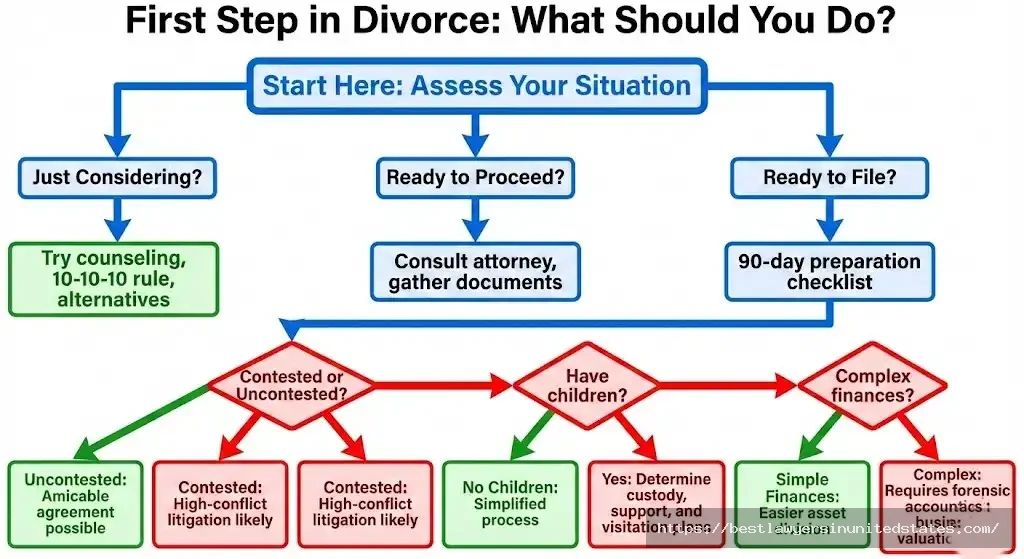
Is Divorce the Right Decision? Evaluating Your Options
Don’t rush into filing without considering alternatives. Many couples who think they want divorce actually need better communication or temporary space. Taking time to evaluate your options now prevents regrets later.
The 10-10-10 Rule for Major Life Decisions
The 10-10-10 rule helps you think beyond immediate emotions. Ask yourself: How will I feel about this decision in 10 minutes, 10 months, and 10 years?
In 10 minutes, you might feel relief or panic. In 10 months, you’ll be deep in the divorce process or reconciliation. In 10 years, you’ll live with the long-term consequences of custody arrangements, financial division, and family dynamics.
This framework stops impulsive decisions based on a single argument or bad week. It forces you to consider whether your marriage problems are temporary or permanent.
Alternatives to Consider Before Filing
Before filing for divorce, consider these alternatives:
Marriage counseling can resolve communication issues, rebuild trust after infidelity, address intimacy problems, and help you decide if divorce is right.
Trial separation gives you space without legal consequences. You live apart temporarily, experience single life before committing to divorce, and see if distance improves the relationship. Some couples reconcile after separation, while others confirm divorce is necessary.
Legal separation (available in some states) is a formal court process that divides assets and establishes custody but doesn’t end the marriage. You remain legally married for health insurance or religious reasons but live separately with legal protections.
Post-nuptial agreements can save marriages by addressing financial conflicts, establishing fair terms if you stay together, and reducing anxiety about divorce. Some couples find that negotiating a post-nup actually improves their marriage.
Signs You’re Ready to Proceed
You may be ready to file for divorce if:
✅ You’ve tried counseling for at least 6 months with no improvement
✅ There’s abuse, addiction, or infidelity with no remorse
✅ You’ve grown into different people with incompatible values
✅ You feel relief thinking about divorce, not just anger
✅ You’ve imagined your future and it doesn’t include your spouse
✅ Your children are suffering from constant conflict
✅ You’ve discussed divorce multiple times over several years
If you’re unsure, talk to a therapist before consulting a divorce attorney. Therapy is cheaper than divorce and helps clarify whether you’re making an emotional or rational decision.
Strategic Preparation: What to Do Before Announcing Divorce
The weeks before announcing divorce are critical. How you prepare affects your financial security, custody arrangements, and negotiating position. Most people announce too early and lose strategic advantages.
Why Silent Preparation Matters
Announcing divorce before preparing gives your spouse time to hide assets, drain accounts, or establish custody advantages. A 30-90 day silent preparation period protects your interests legally.
During this time, gather financial documents, consult an attorney, open individual accounts, and document assets. This isn’t deceptive—it’s prudent legal preparation.
Legal preparation includes consulting an attorney, gathering evidence for custody or support claims, securing important documents, and understanding your state’s laws.
Illegal actions include hiding marital assets, draining joint accounts completely, destroying evidence, or transferring property to friends or family. Courts can punish these actions severely.
The recommended timeline is 90 days for complex finances or contested situations, 60 days for moderate situations, and 30 days for simple uncontested divorces.
Financial First Steps (Do This FIRST)
Financial preparation should happen before any other step. Here’s the exact order:
1. Pull your credit report from all three bureaus (TransUnion, Equifax, Experian). This shows all joint debts, your individual credit score, accounts you didn’t know about, and your spouse’s recent credit activity.
2. Open an individual bank account at a different bank than your joint accounts. Deposit your next paycheck into this account. Transfer up to 50% of joint account balances (more can be considered dissipation of assets). Keep records of all transfers and amounts.
3. Document all marital assets by taking photos of valuables, jewelry, and collectibles. Make spreadsheets of bank accounts, investment accounts, and retirement accounts. Save copies of property deeds, vehicle titles, and mortgage statements. Document your spouse’s income sources.
4. Secure copies of financial documents including the last 3 years of tax returns, 6 months of bank statements, investment and retirement account statements, and life insurance policies. Also gather property deeds, vehicle titles, business documents, and pay stubs.
5. Understand automatic restraining orders in your state. Many states automatically prohibit dissipating assets, canceling insurance, or moving children out of state once divorce is filed. Violating these can result in contempt of court charges.
Legal Document Protection
Gather and secure these documents before announcing divorce:
Personal documents: Birth certificates for you and children, Social Security cards, passports, immigration documents, and medical records.
Financial documents: Tax returns (3 years), bank statements (6 months), investment accounts, retirement accounts, and debt statements.
Property documents: Home deeds, mortgage documents, vehicle titles, property tax records, and appraisals.
Insurance documents: Health insurance policies, life insurance policies, auto insurance, and homeowners/renters insurance.
Business documents (if applicable): Partnership agreements, business valuations, profit and loss statements, and business tax returns.
Store copies in a safe deposit box your spouse can’t access, at a trusted friend or family member’s home, or in secure cloud storage with strong passwords.
Digital Evidence Preservation
Save important digital evidence before it disappears:
Text messages showing agreements about custody, infidelity or abandonment, threats or abuse, and financial discussions should be screenshotted and saved to cloud storage.
Email documentation of financial decisions, custody arrangements, property purchases, and communication about separation should be downloaded and stored securely.
Social media content showing your spouse’s lifestyle (affects alimony), parenting behavior (affects custody), or hidden assets should be preserved. Print or screenshot before it’s deleted.
Financial transaction records from bank apps, Venmo or PayPal, shared credit cards, and automatic payments provide evidence of spending patterns.
Consulting a Divorce Attorney: When and How
Knowing when to consult an attorney can make the difference between a fair settlement and a financial disaster. The timing of your first consultation depends on your situation.
Should You Consult a Lawyer Before Telling Your Spouse?
Consult attorney BEFORE telling spouse if your divorce will be contested, you have significant assets or debts, your spouse handles all finances, there’s domestic violence, or you have children with custody concerns.
You can discuss with spouse first if you both want an uncontested divorce, you agree on major issues, finances are simple, you have no children, or you’re both committed to mediation.
Definitely consult attorney first if there’s any history of controlling behavior, financial abuse, substance abuse, mental health concerns, or threats about custody.
The consultation gives you legal knowledge before negotiations and prevents costly mistakes. It protects your rights if your spouse files first.
Types of Initial Consultations
Most divorce attorneys offer either free or paid consultations:
| Consultation Type | Cost | What You Get | Best For |
|---|---|---|---|
| Free consultation | $0 | 15-30 minutes, basic case overview, attorney compatibility check | Simple cases, initial research |
| Paid consultation | $200-$500 | 60-90 minutes, detailed case review, preliminary strategy, document review | Complex cases, serious planning |
| Retainer consultation | Applied to retainer | Full analysis, immediate representation possible | Ready to hire attorney |
Bring to your first meeting: List of all assets and debts, last 2 years of tax returns, recent pay stubs, questions about process and costs, and timeline for your situation.
Finding the Right Divorce Attorney
Not all divorce attorneys are right for every case. Consider these factors:
Specialization: Family law specialists handle divorce cases daily and know family court judges and procedures. General practice attorneys may be cheaper but less experienced. Choose specialists for contested divorces or complex finances.
Experience with your divorce type: Contested divorce attorneys need litigation skills. Mediation attorneys need negotiation skills. Collaborative divorce attorneys need teamwork skills. Match the attorney to your needs.
Location: Attorneys must be licensed in your state and familiar with local family courts. Local attorneys know county-specific procedures and have relationships with judges.
Fee structure: Understanding divorce attorney fees helps you budget. Hourly rates range from $200-$500 per hour. Flat fees work for simple uncontested cases. Retainers require $2,500-$10,000 upfront. Payment plans may be available.
Compatibility: You’ll work closely with this person during a stressful time. Choose someone who listens, communicates clearly, responds promptly, and makes you feel comfortable.
Understanding Attorney Fees and Retainers
Attorney costs are often the biggest divorce expense after filing fees. Here’s how fees typically work:
Retainer: This is an upfront deposit ranging from $2,500-$10,000 that sits in a trust account. The attorney bills against it hourly and refunds any unused portion.
Hourly rates vary by location and experience. Small town attorneys charge $200-$300 per hour. Mid-size city attorneys charge $300-$400 per hour. Major city attorneys charge $400-$500+ per hour. Senior partners charge more than associates.
Billing increments: Most attorneys bill in 6-minute increments (0.1 hour). A 5-minute phone call is billed as 0.1 hours. A 20-minute email exchange is 0.4 hours. Ask about billing increments during consultation.
Additional costs include court filing fees ($200-$450), process server fees ($50-$100), expert witnesses ($2,000-$10,000), mediation fees ($100-$300 per hour), and court reporter fees ($300-$500 per session).
Use the divorce cost calculator to estimate your total costs based on your situation.
Calculate Your Divorce Costs
Planning a divorce? Use our free calculator to estimate your total costs based on your state’s filing fees, typical attorney rates, and whether your divorce is contested or uncontested.
Divorce Cost Calculator
Get an estimated cost for your divorce based on your specific situation
Your Estimated Divorce Cost
Cost Breakdown
📧 Get a Personalized Consultation
Have questions about your specific situation? Contact our legal experts for guidance tailored to your needs.
Contact Us via EmailCalculator features:
- State-specific filing fees
- Attorney cost estimates by complexity
- Contested vs uncontested comparison
- Total cost breakdown
- Money-saving tips based on your situation
Questions about your divorce or need legal help? Find divorce lawyers in your state for free consultation.
Email: [email protected]
First Steps by Divorce Type
Your first step changes dramatically based on what type of divorce you’re pursuing. Each divorce type has different preparation requirements and strategies.
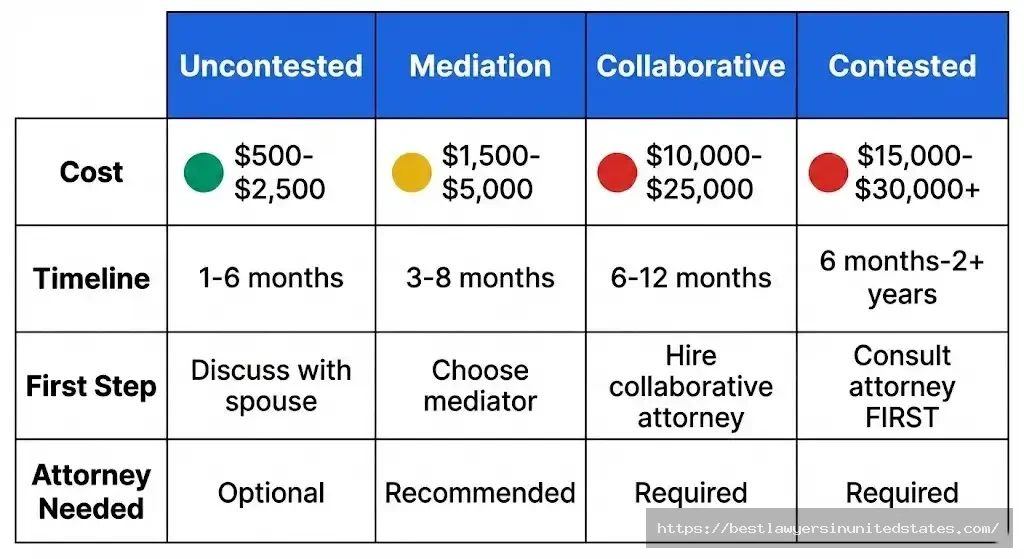
Uncontested Divorce First Steps
An uncontested divorce means both spouses agree on all major issues. This is the cheapest and fastest option.
First steps for uncontested divorce:
- Have an informal discussion with your spouse about wanting divorce
- Confirm agreement on child custody and visitation schedules
- Agree on child support and alimony amounts
- Divide property and debts fairly
- Consider DIY divorce options or online services
- Use mediation for any remaining disagreements
Total cost: $500-$2,500 including filing fees and attorney review.
Timeline: 1-6 months depending on state waiting periods.
You can file uncontested divorce without an attorney in most states. However, attorney review of your agreement costs $500-$1,500 and prevents future problems.
Contested Divorce First Steps
A contested divorce means you disagree on custody, property, support, or other major issues. This requires litigation.
First steps for contested divorce:
- Consult divorce attorney BEFORE telling spouse
- Secure finances and document assets immediately
- Gather evidence for custody or support claims
- Prepare for 6+ months of negotiations or trial
- Budget $15,000-$30,000+ for legal costs
- Consider settlement negotiations before trial
Critical deadline: Don’t move out of the marital home without legal advice. This can hurt custody claims in some states.
Contested divorces take longer and cost more but may be necessary if your spouse is unreasonable or hiding assets.
Divorce Mediation First Steps
Mediation is a middle ground between DIY and contested divorce. A neutral mediator helps you negotiate agreements without court.
First steps for mediation:
- Both spouses must agree to try mediation
- Choose a qualified mediator together (ideally a family law attorney or mental health professional)
- Gather financial documents for full disclosure
- Prepare a list of issues to resolve
- Attend mediation sessions (typically 3-6 sessions)
- Have attorneys review the final agreement
Total cost: $1,500-$5,000 for mediation plus attorney review.
Mediation works best when both spouses are reasonable, want to avoid court, can communicate without abuse, and are willing to compromise.
Collaborative Divorce First Steps
Collaborative divorce is a team approach where both spouses commit to settling without court.
First steps for collaborative divorce:
- Both spouses commit to the no-court process
- Each hires a collaborative divorce attorney
- Sign a participation agreement
- Assemble your collaborative team (financial specialist, child specialist if needed, divorce coach)
- Attend four-way meetings to negotiate
- If collaboration fails, both attorneys must withdraw and you start over
Total cost: $10,000-$25,000 but less than contested litigation.
Collaborative divorce provides more support than mediation but costs less than contested court battles.
First Steps When You Have Children
Children complicate the first steps of divorce significantly. Your decisions now affect custody arrangements for years to come.
When and How to Tell Your Children
Timing matters when telling children about divorce. Don’t tell them until you’ve made a firm decision and have a basic plan for custody and living arrangements.
Age-appropriate messaging:
Preschool (ages 3-5): Keep it very simple. “Mommy and daddy won’t live together anymore but we both still love you.” Reassure about basic needs like food, home, and toys.
Elementary (ages 6-11): Explain without blaming. “We can’t fix our grown-up problems so we’re getting divorced. You’ll have two homes and we’ll both take care of you.” Answer their questions honestly.
Teenagers (ages 12-18): Be more detailed but still age-appropriate. “We’ve been unhappy for a long time and tried to fix things but couldn’t. This isn’t your fault and we need you to know you’re loved.” Respect their feelings but don’t make them take sides.
Both parents should tell children together when possible. This shows unity about the decision and prevents one parent from being blamed. It also gives children a chance to ask both parents questions.
What to say: ✅ We both love you and that will never change
✅ This is a grown-up problem, not your fault
✅ You’ll have two homes where you’re loved
✅ We’ll answer your questions as we figure things out
What NOT to say: ❌ Blame the other parent for the divorce
❌ Share adult details about infidelity or finances
❌ Promise things you can’t guarantee
❌ Make children choose sides or deliver messages
Temporary Custody Arrangements
Before filing for divorce, establish a temporary custody schedule. Courts heavily favor maintaining the status quo, so your temporary arrangement often becomes permanent.
Establishing temporary schedules:
Agree on a parenting time schedule before filing. Decide who stays in the marital home with children. Maintain children’s routines for school, activities, and friends. Document all parenting time in a shared calendar.
Maintaining status quo is critical because courts resist change that disrupts children. The parent providing primary care before filing typically keeps it. The children’s school district usually stays the same. Moving children to a new school without agreement can hurt custody claims.
School district considerations: If you plan to move out, understand how it affects custody. Moving to a different school district may cost you primary custody. Courts keep children in their established school when possible. Consult an attorney before moving if you want primary custody.
Documenting parenting time creates evidence for custody proceedings. Keep a shared calendar of parenting time. Note who attends school events and medical appointments. Save texts or emails about parenting decisions. This documentation supports custody claims later.
Child Support Planning
Understanding child support before filing helps you budget for post-divorce life. Most states use income shares models based on both parents’ incomes.
State calculation methods:
Income shares model (41 states): Both parents’ incomes are combined, then support is calculated based on each parent’s percentage contribution. The non-custodial parent pays their percentage to the custodial parent.
Percentage of income model (9 states): The non-custodial parent pays a fixed percentage of their income based on number of children. This is simpler but may be less fair.
Use the child support calculator to estimate your potential support amounts before filing.
Calculate Child Support
Have children? Our calculator estimates child support payments based on your state’s child support guidelines.
Child Support Calculator
Calculate child support estimates based on your state’s guidelines. Get accurate payment amounts using income shares model calculations.
Enter Your Information
Provide income, custody, and children details
Estimated Monthly Child Support
📍 State Child Support Guidelines
Information about this state’s child support calculation method will appear here.
📊 Calculation Breakdown
| Component | Value |
|---|
Calculator features:
- State-specific child support formulas
- Income shares model calculations
- Custody time adjustments
- Additional expense estimates
Questions about your divorce or need legal help? Find divorce lawyers in your state for free consultation.
Email: [email protected]
How custody percentage affects support: More parenting time typically means lower child support payments. A 50/50 custody split may result in minimal support. Primary custody (70%+ time) results in higher support from the other parent. Calculate costs of each custody arrangement before agreeing.
When support begins: Child support usually begins after the divorce is filed and temporary orders are entered. Retroactive support to the filing date is possible. Final support amounts are set in the divorce decree. Modification requires court approval and changed circumstances.
Financial First Steps in Detail
Financial preparation is the most important first step. How you handle finances now affects your settlement and post-divorce life.
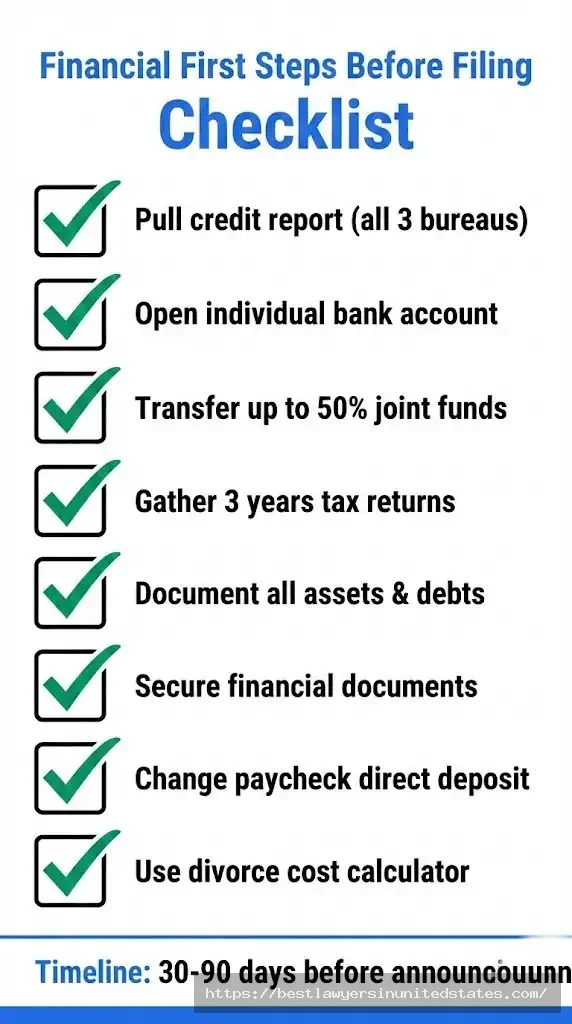
Opening a Separate Bank Account
Opening your own bank account is legal and smart preparation. Here's how to do it correctly:
Legal vs illegal account opening:
Legal: Opening an account in your own name at a different bank. Depositing your paycheck into your new account. Transferring up to 50% of joint account balances with documentation. Keeping records of all transfers and amounts.
Illegal: Transferring more than 50% without agreement or court order. Hiding the new account from your spouse or attorney. Draining joint accounts completely. Depositing marital income and not disclosing it.
How much to transfer initially: Most courts allow 50% of joint accounts without penalty. Transfer exactly 50% and document the date and amount. Keep the other 50% in the joint account for your spouse. More than 50% can be considered dissipation of assets.
Documenting income going forward: Save copies of all deposits to your new account. Keep pay stubs showing direct deposit changes. Document any cash income with receipts or records. This proves your income for support calculations.
Paycheck deposit changes: Change your direct deposit to your new individual account. Notify your employer of the account change. Keep confirmation of the effective date. Your paycheck is your separate income, not marital property.
Understanding Marital vs Separate Property
Property division depends on whether assets are marital or separate. Classification affects what you keep or split.
Assets acquired during marriage (marital): Income from either spouse during marriage. Property bought with marital income. Retirement accounts funded during marriage. Debt incurred during marriage. Business value increase during marriage.
Inheritance and gifts (separate): Property inherited by one spouse. Gifts given to one spouse only. Property owned before marriage. Personal injury settlements. Assets kept completely separate during marriage.
Commingled assets (complex): Inheritance deposited in joint account. Separate property used to improve marital home. Marital income used to pay separate property debt. Mixing separate and marital funds. These require attorney and possibly expert analysis.
State-specific rules: Community property states (AZ, CA, ID, LA, NV, NM, TX, WA, WI) split marital assets 50/50. Equitable distribution states divide fairly but not necessarily equally. The judge considers multiple factors in equitable distribution. Understanding your state's approach shapes negotiation strategy.
Credit and Debt Protection
Protect your credit score during divorce by taking these steps:
Removing spouse as authorized user: Call credit card companies and remove your spouse as an authorized user on your individual cards. This prevents them from running up debt you're responsible for. Do this before announcing divorce if possible.
Closing joint credit cards (properly): Pay off joint credit cards if possible. Call the credit card company to close the account to new charges. Request the balance be split to two individual cards. Never close cards unilaterally with a balance your spouse didn't know about.
Understanding joint debt responsibility: Both spouses remain responsible for joint debts until paid off. Your divorce decree can assign debt to one spouse. But creditors can still pursue both of you if not paid. Refinance jointly held debt into individual names when possible.
Protecting your credit score: Pull your credit report every 4 months during divorce. Set up credit monitoring alerts. Pay all bills on time. Don't max out credit cards. Don't open new credit accounts unnecessarily. Your credit score affects your ability to rent apartments, buy a home, or get car loans after divorce.
Creating a Post-Divorce Budget
Before filing, estimate your post-divorce living expenses. This helps you evaluate settlement offers and plan your new life.
Estimating single-income expenses:
| Expense Category | Monthly Amount | Notes |
|---|---|---|
| Housing (rent or mortgage) | $_______ | May need smaller place |
| Utilities | $_______ | Lower in smaller place |
| Food and groceries | $_______ | For you and kids when with you |
| Transportation | $_______ | Car payment, gas, insurance |
| Childcare | $_______ | When kids are with you |
| Child support (paying or receiving) | $_______ | Use calculator estimate |
| Alimony (paying or receiving) | $_______ | Use calculator estimate |
| Health insurance | $_______ | May increase significantly |
| Debt payments | $_______ | Credit cards, student loans |
| Savings | $_______ | Emergency fund critical |
| Total Monthly Expenses | $_______ |
Factoring in child support and alimony: Use the alimony calculator to estimate potential spousal support. Add child support as income or expense depending on custody. These payments significantly affect your budget.
Calculate Alimony
Wondering about spousal support? Our calculator estimates alimony payments based on your state's guidelines, income difference, marriage length, and other factors.
Alimony Calculator
Estimate spousal support payments based on your state's guidelines. Get monthly payment amounts, duration estimates, and total alimony calculations.
Enter Your Information
Provide details about income, marriage, and circumstances
Estimated Monthly Alimony Payment
📍 State Alimony Guidelines
Information about this state's alimony approach will appear here.
📊 Calculation Breakdown
| Component | Value |
|---|
Calculator features:
- State-specific alimony formulas
- Duration estimates
- Income-based calculations
- Modification factors
Questions about your divorce or need legal help? Find divorce lawyers in your state for free consultation.
Email: [email protected]
Understanding tax implications: Filing status changes to single or head of household after divorce. Child tax credits and dependent exemptions must be allocated. Alimony is no longer tax deductible for divorces finalized after 2018. Child support is not taxable income or tax deductible. Property transfers in divorce are tax-free. Consult a CPA about your specific situation.
Planning for divorce costs: Add attorney fees ($2,500-$10,000+ retainer), filing fees ($200-$450), mediation costs ($1,500-$5,000 if used), moving expenses, and new household setup costs. Budget for these one-time costs separately from ongoing expenses.
State-Specific First Steps: How Location Affects Your Process
Where you live dramatically affects your first steps. State laws vary on residency, separation requirements, property division, and timelines.
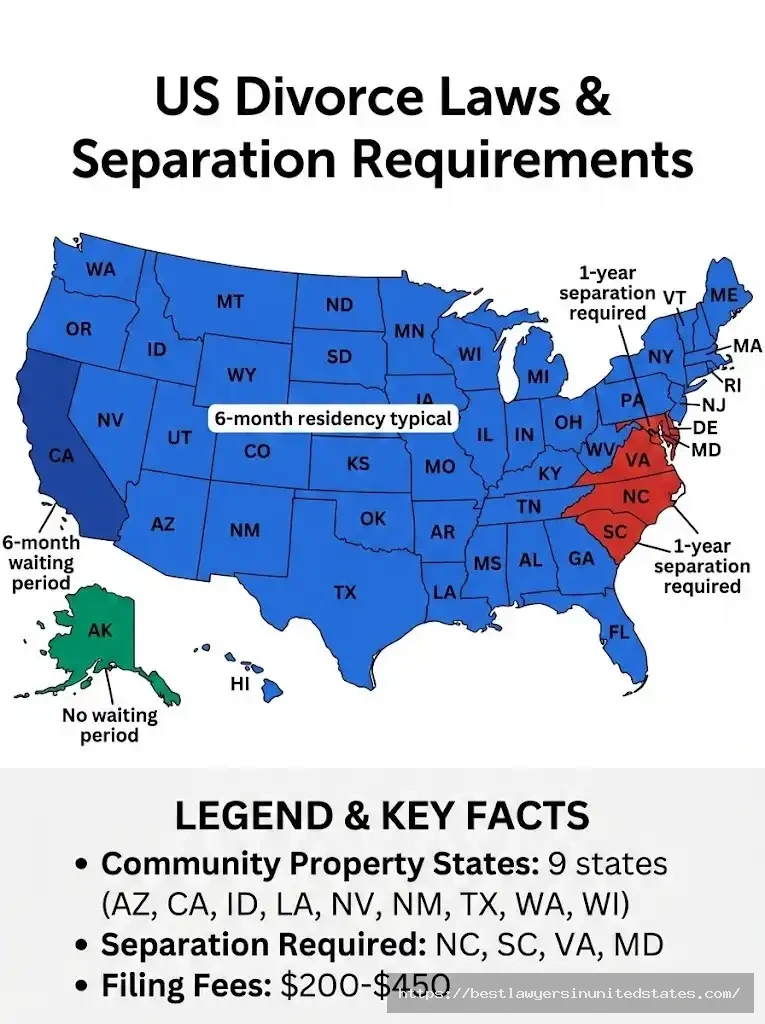
Residency Requirements by State
You must meet your state's residency requirement before filing for divorce. Filing too early gets your case dismissed.
6-month requirements (most common): California, Illinois, Michigan, Wisconsin, and many others require 6 months residency in the state and often 3 months in the county.
1-year requirements (some states): New Jersey, New York, and Rhode Island require 1 year of continuous residency before filing.
No residency requirement states: Alaska, South Dakota, and Washington have no state residency requirement but may have county requirements.
Military exception rules: Active duty military can file in their home state, their current duty station state, or the state where their spouse lives. This gives military members more flexibility.
Verify your state's exact requirement before planning your filing date. The clock starts when you establish residency with intent to stay permanently.
States Requiring Separation Before Filing
Some states require you to live separately for a specific period before filing. This is different from the waiting period after filing.
| State | Separation Required | Notes |
|---|---|---|
| North Carolina | 1 year | Must live separate and apart |
| South Carolina | 1 year | Continuous separation |
| Virginia | 1 year (6 months with agreement) | No children and signed agreement for 6 months |
| Maryland | 1 year contested, 6 months mutual | Depends on type of divorce |
What "separation" legally means: Living in separate residences (can't live in same house). No sexual relations during separation (restarts the clock in some states). Clear intent to end the marriage. Some states require legal separation filing while others just require physical separation.
In these states, your first step is establishing separate residences. The separation period runs before you can even file for divorce. Plan accordingly if you live in these states.
Community Property States First Steps
Nine states follow community property rules that affect your preparation strategy.
Community property states: Arizona, California, Idaho, Louisiana, Nevada, New Mexico, Texas, Washington, and Wisconsin.
50/50 asset division presumption: All income earned during marriage is community property. All debts incurred during marriage are community debts. Property bought with community income is community property. Division is 50/50 regardless of who earned more.
Importance of documenting separate property: Property owned before marriage stays separate. Inheritance and gifts to one spouse stay separate. Income from separate property can be separate or community depending on state. Separate property must be clearly traced and documented.
Preparation strategies specific to community property: Document separate property with pre-marriage account statements, inheritance documents, gift letters from donors, and clear records of separate property use. Don't comingle separate and community property. Consider what's "worth fighting for" since most assets split 50/50. Focus negotiations on custody and support rather than property in most cases.
In equitable distribution states (all others), assets are divided fairly but not necessarily equally. Courts consider factors like length of marriage, each spouse's income and earning capacity, who was primary caregiver, fault in marriage breakdown, and economic circumstances of each spouse.
Filing Fees by State
Filing fees are your first actual divorce expense. They vary significantly by state.
| State | Average Filing Fee | Fee Waiver Available? |
|---|---|---|
| California | $435-$450 | Yes, income-based |
| Texas | $300-$350 | Yes, indigency affidavit |
| Florida | $409 | Yes, poverty affidavit |
| New York | $335 | Yes, poor person order |
| Pennsylvania | $300-$350 | Yes, IFP petition |
| Illinois | $337 | Yes, fee waiver |
| Ohio | $175-$350 | Yes, poverty affidavit |
| Georgia | $200-$400 | Yes, pauper's affidavit |
| North Carolina | $225 | Yes, IFP petition |
| Michigan | $175-$230 | Yes, fee waiver |
Fee waiver eligibility is income-based. You typically qualify if your income is below 125-150% of federal poverty guidelines. You receive certain government benefits like food stamps or Medicaid. You can demonstrate inability to pay filing fees. Each state has different forms and requirements.
Additional court costs to expect: Response fee if you're served ($200-$300). Motion filing fees ($50-$100 each). Court reporter fees for depositions ($300-$500). Subpoena fees ($50-$100). Final hearing fees (sometimes required). These add up quickly in contested cases.
County-specific variations mean fees can vary within a state. Large urban counties sometimes charge more. Check your specific county clerk's website for exact fees.
Common First Step Mistakes (And How to Avoid Them)
Learning from others' mistakes saves you time, money, and stress. These are the most common and costly first-step errors.
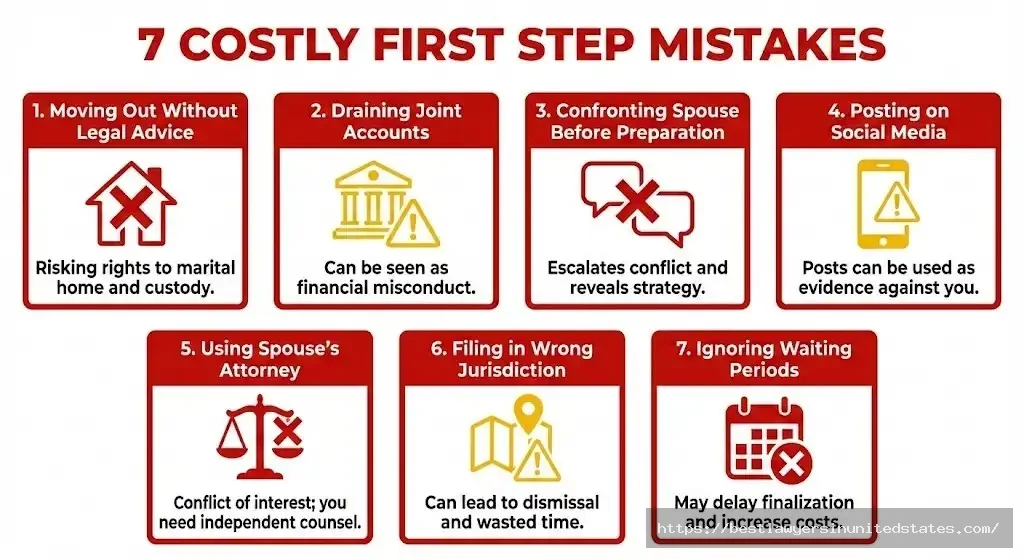
Mistake #1: Moving Out Without Legal Advice
Moving out of the marital home seems natural when you want divorce. But this can devastate your custody case.
Can be seen as "abandonment" in some states. Courts may view moving out as abandoning the family. This affects property division and custody. Some states have laws against abandonment.
Affects child custody claims severely. The parent who stays in the home with children has a major advantage. Courts favor maintaining stability for children. The "status quo" often becomes the permanent custody arrangement. Moving out can mean losing primary custody.
May lose rights to marital home. Some states give the home to the parent with primary custody. Moving out can forfeit your property interest. You may still be responsible for mortgage payments even if you don't live there.
Consult attorney before moving out. If you must leave for safety, document why. If you want custody, stay in the home if possible. If you move out, maximize parenting time immediately. Get a temporary custody order as soon as possible after filing.
Mistake #2: Draining Joint Accounts
Panic drives many people to empty joint accounts before announcing divorce. This backfires spectacularly.
Can be considered dissipation of assets. Courts punish spouses who waste or hide marital property. Dissipation means spending marital funds for non-marital purposes. Examples include gambling, affair-related expenses, or lavish personal spending.
Court can order you to reimburse. If you take more than your fair share, you may have to pay it back. The court "adds back" dissipated funds to your side of the ledger. You could end up with less property overall.
Automatic restraining orders prohibit this. Many states have automatic temporary injunctions when divorce is filed. These prohibit transferring, hiding, or dissipating marital assets. Violating these orders can result in contempt of court.
Legal limit: typically 50% of marital funds. Taking 50% of joint accounts is generally acceptable. Document the exact amount and date of withdrawal. Keep the funds accessible and disclosed. Use for legitimate living expenses only.
Mistake #3: Confronting Spouse Before Preparation
Announcing "I want a divorce" during an argument feels satisfying in the moment. But it gives up all your strategic advantages.
Risk of retaliatory financial actions: Your spouse could drain accounts, cancel credit cards, change locks on the house, or hide assets before you're ready.
Emotional volatility affects negotiations: Announcing during conflict makes rational settlement impossible. Anger and hurt feelings drive unreasonable demands. You may both dig into positions you'll regret later.
Gives spouse time to hide assets: If your spouse handles finances, they know where money is. An angry announcement gives them time to transfer funds or hide property. Undoing this requires expensive forensic accounting.
Strategic disadvantage: You lose the element of surprise. Your spouse hires an attorney first. They may file first and control the initial narrative. They establish custody status quo while you're unprepared.
Better approach: Prepare for 30-90 days first. Consult an attorney before announcing. Secure financial documents and open individual accounts. Then announce when you're ready, not in the heat of anger.
Mistake #4: Posting on Social Media
Social media posts can destroy your divorce case. Everything you post is discoverable and admissible as evidence.
Everything is discoverable in divorce. Your spouse's attorney can subpoena your social media accounts. Deleted posts can still be recovered. "Private" or "friends only" posts aren't truly private. Screenshots preserve everything you post.
Can affect custody decisions. Posts showing drinking, partying, or poor judgment hurt custody claims. Photos without your children suggest you don't prioritize them. Dating posts during separation can affect custody. Posts bad-mouthing your spouse show inability to co-parent.
Can affect spousal support amounts. Lavish vacation posts suggest you don't need alimony. Posts about new purchases show income you didn't disclose. Photos of new romantic partners can affect fault-based alimony. Social media can reveal hidden income sources.
Can affect credibility in court. Posts contradicting your testimony destroy your credibility. Judges hate dishonesty more than anything. One Facebook post can unravel your entire case.
Best practice: Stop posting on social media entirely during divorce. Set all accounts to private (but know this isn't foolproof). Don't accept friend requests from people you don't know well. Ask friends not to tag you in posts. Assume everything you post will be shown to a judge.
Mistake #5: Using Spouse's Attorney
This seems like a money-saving idea for friendly divorces. It's actually a legal nightmare.
Conflict of interest (they represent spouse). An attorney represents ONE client with loyalty and confidentiality. They cannot represent opposing interests. Their duty is to your spouse, not you.
One attorney cannot represent both parties. This is a fundamental rule of professional responsibility. Even in uncontested divorces, you each need your own attorney or neither has an attorney. "Unrepresented party" is not the same as "sharing an attorney."
Even for "friendly" divorce, each needs own attorney. Uncontested doesn't mean you have identical interests. Someone needs to check if the agreement is fair. Each person needs independent legal advice. This prevents claims of coercion or unfairness later.
Consultation with spouse's attorney can disqualify them. If you meet with your spouse's attorney, they may be conflicted out. This prevents your spouse from using them too. You've potentially sabotaged your spouse's representation.
Correct approach: Each spouse consults and hires their own attorney. Or both spouses go without attorneys (risky but legal). Use a mediator (neutral third party) to help negotiate. Have attorneys review the agreement before signing even in mediation.
Mistake #6: Filing in Wrong Jurisdiction
Filing your divorce in the wrong court seems like a technicality. It gets your case dismissed and wastes months.
Must file in county of residence. You must file in the county where you or your spouse lives. Some states require residence in the specific county for 30-90 days. Filing in the wrong county gets your case dismissed.
State residency requirements must be met. You must be a resident of the state for the required period (6 months or 1 year typically). Filing too early restarts the entire process. The waiting period doesn't run while your case is pending.
Military members: special rules. Active duty military can file in their home state, duty station state, or spouse's state. Military spouses have protections against default judgments. Military legal assistance can help navigate these rules.
Can delay entire process if filed incorrectly. Dismissal means starting over from scratch. You lose months of waiting period time. Filing fees are not refunded. Consult an attorney to verify correct jurisdiction before filing.
Mistake #7: Not Understanding Waiting Periods
Every state except Alaska has a mandatory waiting period between filing and finalization. Not planning for this creates unrealistic expectations.
| State Category | Waiting Period | Notes |
|---|---|---|
| No waiting period | 0 days | Alaska only |
| Short waiting period | 30-90 days | Most common |
| Medium waiting period | 3-6 months | Several states including California (6 months) |
| Separation requirement | 6-12 months | NC, SC, VA before filing |
Many states have mandatory waiting periods. The divorce cannot be finalized before this period ends. The clock starts when the divorce is filed and spouse is served. No judge can waive the waiting period even by agreement.
Divorce cannot be finalized until waiting period ends. Even if you agree on everything, you must wait. Even if there's an emergency, you must wait. You can get temporary orders during the waiting period.
Doesn't delay filing, delays finalization. You can file immediately once residency requirements are met. The waiting period runs while you negotiate or litigate. By the time you reach agreement, the waiting period may have passed.
Plan timeline accordingly. Add your state's waiting period to your estimated divorce timeline. Don't make plans assuming faster finalization. Factor waiting period into moving plans or remarriage timing.
Check how long divorce takes in your state to set realistic expectations.
Your First Steps Checklist (90-Day Timeline)
This checklist helps you prepare systematically instead of impulsively. Adjust the timeline based on your situation's complexity.
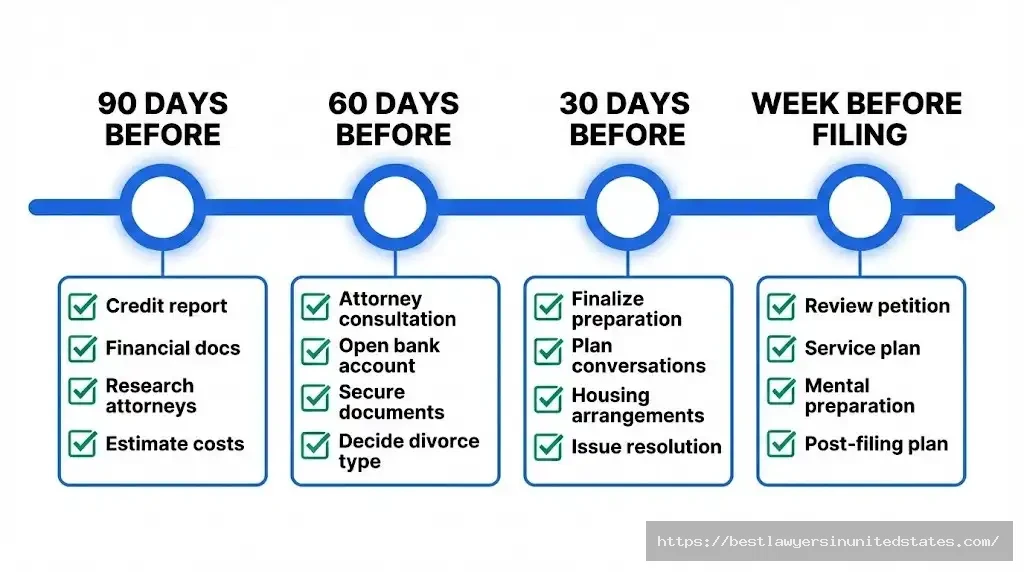
90 Days Before Filing
Financial preparation:
- ☑ Pull credit report from all three bureaus (TransUnion, Equifax, Experian)
- ☑ Gather last 3 years of tax returns
- ☑ Collect 6 months of bank statements for all accounts
- ☑ Document all investment and retirement accounts
- ☑ Take photos of valuable property, jewelry, and collectibles
- ☑ Make spreadsheet of all assets and debts
Legal research:
- ☑ Research divorce attorneys in your area
- ☑ Read reviews and check bar association records
- ☑ Verify state residency requirement is met
- ☑ Learn your state's divorce laws and procedures
- ☑ Understand your state's property division approach
Cost planning:
- ☑ Use divorce cost calculator to estimate expenses
- ☑ Review your budget and cut unnecessary expenses
- ☑ Start emergency fund if possible
- ☑ Research legal aid if low income
Decision making:
- ☑ Evaluate if divorce is right decision
- ☑ Consider counseling or alternatives
- ☑ Use 10-10-10 rule to think long-term
- ☑ Decide if you're truly ready to proceed
60 Days Before Filing
Attorney consultation:
- ☑ Schedule consultations with 2-3 divorce attorneys
- ☑ Prepare questions about process and costs
- ☑ Bring financial documents to consultations
- ☑ Choose and retain an attorney if using one
- ☑ Understand attorney's fee structure and retainer
Financial protection:
- ☑ Open individual bank account at different bank
- ☑ Transfer up to 50% of joint account balances
- ☑ Change paycheck direct deposit to new account
- ☑ Keep detailed records of all financial moves
- ☑ Don't hide assets or make large purchases
Document security:
- ☑ Secure copies of important documents (passports, birth certificates, Social Security cards)
- ☑ Copy property deeds and vehicle titles
- ☑ Save investment and retirement statements
- ☑ Gather insurance policies
- ☑ Store copies somewhere safe (not marital home)
Children (if applicable):
- ☑ Research temporary custody arrangements
- ☑ Document current parenting roles and time
- ☑ Research schools in areas you might move to
- ☑ Think about custody schedule you want
- ☑ Consider how to tell children (but don't tell yet)
Divorce type decision:
- ☑ Decide on divorce type (uncontested, mediation, contested, collaborative)
- ☑ Research requirements for chosen type
- ☑ Understand costs and timeline for your type
- ☑ Prepare accordingly
30 Days Before Filing
Final preparations:
- ☑ Finalize all financial documentation
- ☑ Confirm attorney is ready to file (if using one)
- ☑ Prepare divorce petition or have attorney prepare it
- ☑ Verify filing fee amount for your county
- ☑ Plan for service of process
Planning conversations:
- ☑ Plan conversation with spouse (if uncontested or when ready)
- ☑ Plan conversation with children (wait until closer to filing)
- ☑ Inform close family members or friends for support
- ☑ Line up therapist or counselor for emotional support
Housing:
- ☑ Decide who stays in marital home
- ☑ Research apartments or houses if moving
- ☑ Budget for moving costs and deposits
- ☑ DON'T move out without attorney advice if you want custody
Issue resolution:
- ☑ List all issues to resolve (property, custody, support)
- ☑ Identify which issues you can agree on
- ☑ Identify which issues need negotiation or court
- ☑ Prioritize what matters most to you
- ☑ Know your bottom line on major issues
Week Before Filing
Final checks:
- ☑ Review divorce petition one final time with attorney
- ☑ Ensure service of process is arranged
- ☑ Have filing fee payment ready
- ☑ Confirm court filing location and hours
- ☑ Know what happens after filing
Mental preparation:
- ☑ Prepare for spouse's reaction (could be anger, relief, or surprise)
- ☑ Have support system activated (therapist, friends, family)
- ☑ Plan self-care activities for stress
- ☑ Accept this will be difficult but necessary
- ☑ Remind yourself why you're doing this
Children (if applicable):
- ☑ Plan exactly when to tell children (after filing or right before)
- ☑ Prepare what you'll say (age-appropriate)
- ☑ Plan how to maintain their routine during this time
- ☑ Line up extra childcare support if needed
Post-filing plan:
- ☑ Understand next steps after filing (divorce process)
- ☑ Know timeline for spouse's response
- ☑ Prepare for temporary orders hearing if needed
- ☑ Keep communication log with spouse
- ☑ Plan to document everything going forward
Frequently Asked Questions
What is the very first thing I should do if I want a divorce?
Quick Answer: Consult a divorce attorney before telling your spouse to understand your rights, gather financial documents, and create a 30-90 day preparation timeline.
The first step depends on your situation. If you're just considering divorce, start by evaluating whether it's right and trying alternatives like counseling. If you've decided to proceed with a contested divorce, consult an attorney before announcing anything. If you're planning an amicable uncontested divorce, you can discuss it with your spouse first but still consult attorneys separately.
Should I tell my spouse I'm filing for divorce?
Quick Answer: For uncontested divorces, discuss with your spouse first; for contested divorces, consult an attorney before telling your spouse.
In friendly divorces where you agree on major issues, having a discussion first is appropriate and respectful. However, in contested situations, high-conflict marriages, or cases involving financial control or abuse, consult an attorney first. Your attorney can help you prepare financially and legally before the announcement.
Can I file for divorce if my spouse doesn't want one?
Quick Answer: Yes, divorce is a unilateral decision requiring no permission from your spouse, though it will be a contested divorce.
No state requires both spouses to agree to divorce. You can file even if your spouse objects. However, this becomes a contested divorce which takes longer (6+ months to 2+ years) and costs significantly more ($15,000-$30,000+) than uncontested divorces.
What is the 10-10-10 rule for divorce?
Quick Answer: Ask yourself how you'll feel about divorcing in 10 minutes, 10 months, and 10 years to avoid impulsive decisions.
This decision-making framework prevents choices based purely on temporary emotions. In 10 minutes, you might feel relief or panic. In 10 months, you'll be deep in the process. In 10 years, you'll live with permanent consequences for your children, finances, and future relationships. It helps distinguish temporary marital problems from fundamental incompatibility.
How do I prepare for divorce without my spouse knowing?
Quick Answer: Spend 30-90 days gathering financial documents, consulting an attorney, opening an individual bank account, and securing important papers before announcing divorce.
Legal silent preparation includes consulting attorneys, documenting assets, copying financial records, opening individual accounts (transferring up to 50%), and researching your state's laws. Illegal actions include hiding marital assets, draining accounts completely, destroying evidence, or transferring property to hide it. Everything must be disclosed eventually, so focus on protection rather than deception.
What is the biggest mistake people make when starting divorce?
Quick Answer: Moving out of the marital home without legal advice can devastate custody claims and property rights.
Other major mistakes include draining joint accounts (courts punish dissipation), announcing divorce before preparing (gives spouse advantage), posting on social media (everything is evidence), using spouse's attorney (conflict of interest), filing in wrong jurisdiction (dismissal and delay), and not understanding waiting periods (unrealistic timeline expectations).
Do I need a lawyer for the first step?
Quick Answer: Yes for contested divorces, complex finances, or children; possibly no for simple uncontested divorces with full agreement.
You definitely need an attorney if your divorce involves disagreements on custody, property, or support; significant assets or debts; complex finances or business ownership; or potential conflict. You may not need one for very simple uncontested divorces where both spouses agree on everything, have minimal assets, no children, and short marriages. Even in uncontested cases, attorney review of agreements costs $500-$1,500 and prevents future problems.
How much does it cost to start a divorce?
Quick Answer: $300-$5,000 depending on filing fees ($200-$450), attorney consultation ($0-$500), and attorney retainer ($2,500-$10,000 if hiring one).
Filing fees vary by state and county from $200 to $450. Free consultations provide 15-30 minutes while paid consultations ($200-$500) give 60-90 minutes of detailed advice. Attorney retainers for representation range from $2,500 for simple cases to $10,000+ for complex contested divorces. DIY divorces only cost filing fees, while full representation costs significantly more.
Can I file for divorce online?
Quick Answer: Many states allow online filing, and online divorce services help with simple uncontested cases, though complex cases still need attorneys.
Most court systems now accept electronic filing of divorce petitions. Online divorce services like DIY state-by-state guides help prepare forms for simple uncontested divorces. However, these only work when both spouses agree on all issues, have simple finances, and no children or agreed custody. Complex situations still require attorneys. Check your specific county court website for online filing procedures.
What documents do I need to gather first?
Quick Answer: Last 3 years tax returns, 6 months bank statements, investment accounts, retirement accounts, property deeds, vehicle titles, insurance policies, pay stubs, and debt statements.
Essential documents include personal documents (birth certificates, Social Security cards, passports), financial documents (tax returns, bank statements, investment and retirement account statements), property documents (deeds, mortgages, vehicle titles), insurance policies (health, life, auto, home), and business documents if applicable. Make copies and store securely before announcing divorce.
How long does the divorce process take after the first step?
Quick Answer: Uncontested divorces take 1-6 months; contested divorces take 6 months to 2+ years depending on state waiting periods and case complexity.
Timeline depends on your state's waiting period (0-6 months), divorce type (uncontested vs contested), level of agreement, and court backlog. The fastest possible is 1 month in states with no waiting period and full agreement. Most divorces take 3-12 months. Highly contested cases with trial can take 18-24+ months.
What if I can't afford a divorce attorney?
Quick Answer: Legal aid services, pro bono programs, law school clinics, attorney payment plans, limited scope representation, and DIY options exist for low-income individuals.
Legal aid organizations serve people below certain income levels (typically 125-150% of poverty guidelines). Pro bono programs through bar associations provide free legal help. Law school clinics offer student representation supervised by professors. Some attorneys offer payment plans or limited scope representation (help with specific tasks, not full representation). DIY divorce works for simple uncontested cases.
Should I move out before filing for divorce?
Quick Answer: Generally no; consult an attorney first as moving out can hurt custody claims and property rights except in domestic violence situations where safety is priority.
Moving out can be considered abandonment in some states affecting property division. It significantly hurts custody claims because courts favor maintaining stability for children. The parent who stays with children usually gets primary custody. You may lose rights to the marital home. Exceptions exist for domestic violence situations where safety requires leaving immediately. Always consult an attorney before moving out.
What happens if my spouse files first?
Quick Answer: Filing first gives no legal advantage in most states; you file a response and can include a counterpetition to equalize the playing field.
In most states, filing first doesn't matter legally. A few states give minimal procedural advantages. The respondent gets equal time and rights to present their case. You can file a counterpetition raising all the same issues. Settlement or trial outcomes depend on facts and law, not who filed first. Don't panic if your spouse beats you to filing.
How do I tell my children we're getting divorced?
Quick Answer: Both parents together, using age-appropriate messaging, reassuring about stability, not blaming, and focusing on what stays the same rather than what changes.
Wait until you have a basic plan for custody and living arrangements. Tell all children at the same time. Keep the message simple and honest without adult details. Reassure that both parents love them, this isn't their fault, they'll have two homes, and important things (school, friends, activities) stay the same. Answer questions honestly but age-appropriately. Don't bad-mouth the other parent or make children choose sides.
Next Steps: Moving Forward with Confidence
You now understand the critical first steps in divorce, from decision-making to preparation to filing. The path forward depends on your specific situation, but the principles remain the same.
If you're still deciding about divorce: Give yourself permission to take time with this decision. Try counseling, use the 10-10-10 rule, and explore alternatives before committing to divorce.
If you've decided to proceed: Follow the 90-day checklist to prepare systematically. Consult an attorney, secure your finances, gather documents, and understand your state's requirements before announcing anything.
If you're ready to file: Work with your attorney to prepare the petition, arrange service of process, and plan for the response period. Understand this is just the beginning of a process that will take months or years.
Remember that taking the right first steps saves thousands of dollars and prevents years of regret. Invest time in preparation now rather than spending money fixing mistakes later.
For state-specific guidance, filing fees, and cost estimates, use our resources:
Questions about your specific situation?
Email: [email protected]