
If you’ve been charged under Section 323 IPC or are a victim seeking justice, you need clear answers about punishment, bail rights, and what happens next in court. This comprehensive guide explains everything about voluntarily causing hurt under Indian law, including the critical 2023 transition to the Bharatiya Nyaya Sanhita.

Section 323 IPC addresses one of India’s most frequently charged offenses: voluntarily causing simple hurt. Whether it’s a neighborhood dispute, road rage incident, or domestic altercation, understanding this provision is essential for anyone navigating the criminal justice system.
Quick Reference:
| Aspect | Details |
|---|---|
| Punishment | Up to 1 year imprisonment and/or fine up to ₹1,000 |
| Bailable | Yes – bail is a legal right |
| Cognizable | No – police need warrant to arrest |
| Compoundable | Yes – parties can settle with court approval |
| BNS Equivalent | Section 115 of Bharatiya Nyaya Sanhita |
| Trial Court | Any Magistrate has jurisdiction |
What is Section 323 IPC? (Legal Definition & Scope)

Full Text of Section 323 IPC
The law states: “Whoever, except in the case provided for by Section 334, voluntarily causes hurt, shall be punished with imprisonment of either description for a term which may extend to one year, or with fine which may extend to one thousand rupees, or with both.”
This straightforward language conceals several legal nuances that courts have interpreted over decades. The section criminalizes intentional acts that cause physical pain, injury, or discomfort to another person.
Definition of “Hurt” Under Section 319 IPC
Before understanding Section 323, you must grasp what “hurt” means legally. Section 319 IPC defines hurt as causing:
Bodily pain – Any physical discomfort, from a slap to a punch. The pain doesn’t need to be severe or long-lasting.
Disease – Causing illness or sickness through one’s actions. For example, deliberately contaminating food or spreading infectious disease.
Infirmity – Creating physical or mental weakness. This includes temporary conditions that impair normal functioning.
The Supreme Court has clarified that even minor injuries like scratches, bruises, or redness constitute hurt if intentionally caused. There’s no minimum threshold of severity for Section 323—that distinction comes with Section 325 (grievous hurt).
What Does “Voluntarily Causing Hurt” Mean?
Section 321 IPC explains that a person “voluntarily causes hurt” when they:
- Intend to cause hurt – The accused deliberately wanted to injure the victim
- Know their action will likely cause hurt – Even without specific intent, they understood their conduct would probably result in injury
This mental element (mens rea) is crucial. Accidental injuries don’t qualify. If you accidentally bump someone causing them to fall, that’s not Section 323. But if you push someone knowing they’ll likely get hurt, that satisfies the requirement even if you didn’t specifically want to injure them.
Simple Hurt vs. Grievous Hurt: The Critical Distinction
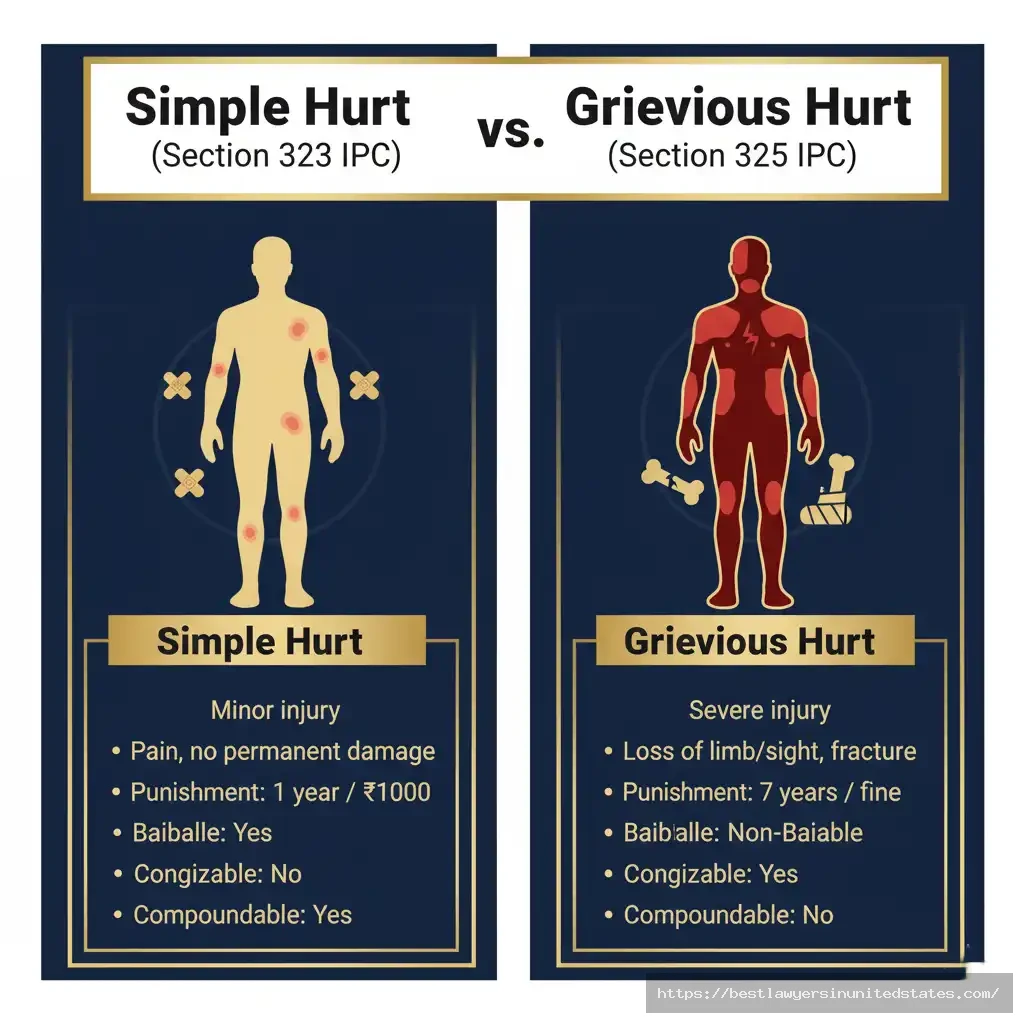
Indian law divides hurt into two categories:
Simple Hurt (Section 323) covers injuries that are:
- Minor in nature
- Heal relatively quickly
- Don’t cause permanent damage
- Examples: bruises, scratches, minor cuts, temporary swelling
Grievous Hurt (Section 325) involves serious injuries like:
- Emasculation
- Permanent loss of sight, hearing, or limb function
- Bone fractures
- Tooth dislodgement
- Severe burns
- Injuries causing severe pain for 20+ days
The difference matters significantly. Section 325 carries up to 7 years imprisonment compared to Section 323’s maximum of 1 year. Prosecutors must prove the injury qualifies as “grievous” under Section 320 IPC’s specific definitions; otherwise, the charge defaults to simple hurt.
Essential Ingredients of Section 323 IPC
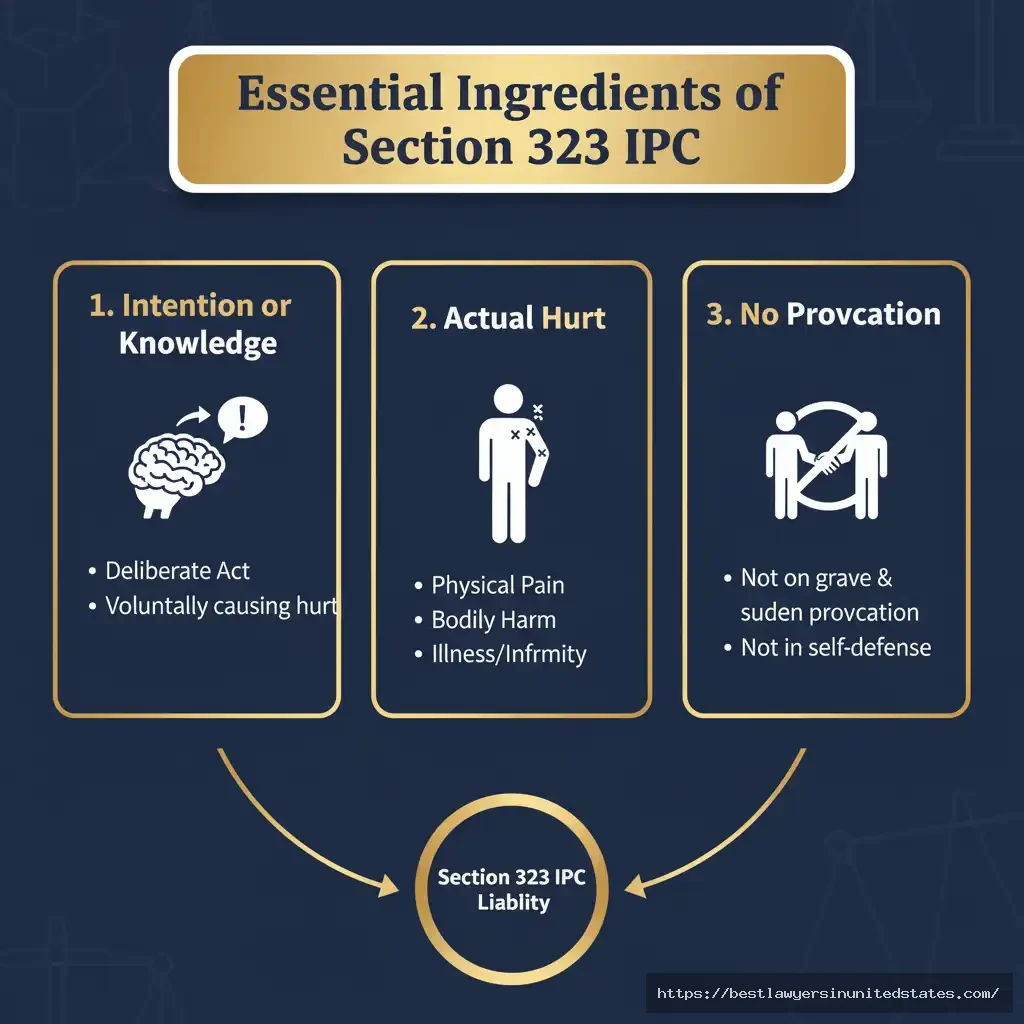
Courts require prosecutors to establish three essential elements beyond reasonable doubt:
1. Intention or Knowledge of Causing Hurt
The accused must have either:
Direct intention – They wanted to cause hurt. For example, in a fight, one person deliberately punches another intending to injure them.
Knowledge of probable consequences – They knew their action would likely cause hurt even if that wasn’t their primary goal. If someone throws a heavy object near a person, knowing it might hit them, that satisfies this requirement.
The Supreme Court in State of Maharashtra v. Balram Bhagirath Patil clarified that reckless disregard for consequences can establish this mental element. You don’t need to prove the accused wanted to cause the specific injury that occurred—only that they knew hurt would likely result.
2. Actual Causation of Hurt
There must be a direct causal link between the accused’s action and the victim’s injury. The prosecution needs to show:
- The accused performed a voluntary act
- That act directly caused bodily pain, disease, or infirmity
- The harm was reasonably foreseeable from the action
Medical evidence usually establishes this element, though eyewitness testimony can suffice if the injury is visible and obvious.
3. No Exception Under Section 334 IPC Applies
Section 334 creates an exception for hurt caused under “grave and sudden provocation.” If the accused can prove they acted in response to serious provocation that would cause a reasonable person to lose self-control, they may receive reduced punishment (up to 3 months imprisonment or ₹500 fine).
However, several limitations apply:
- The provocation must be grave (serious) and sudden (immediate)
- The accused cannot have sought or voluntarily provoked the provocation
- The retaliation must be proportionate
- The accused cannot claim this defense if they acted in obedience to law or at a public servant’s direction
Punishment Under Section 323 IPC
Imprisonment: Up to 1 Year
Courts can impose imprisonment of “either description”—meaning either:
- Simple imprisonment – Less restrictive, with some privileges
- Rigorous imprisonment – Involves hard labor
The maximum term is one year, but judges have full discretion to impose any duration from a few days to the full year, depending on case circumstances.
Fine: Up to ₹1,000
As an alternative or addition to imprisonment, courts can levy fines up to ₹1,000. In practice, judges often impose both imprisonment and fine in serious cases.
While ₹1,000 may seem minimal by today’s standards, remember the IPC dates to 1860. Courts cannot exceed this statutory limit, though they frequently supplement criminal penalties by ordering compensation to victims under Section 357 CrPC.
Factors Affecting Sentencing Severity
Judges consider multiple factors when determining punishment:
Aggravating factors (leading to harsher sentences):
- Severity of injury
- Use of weapon or dangerous means
- Attack on vulnerable victim (elderly, child, disabled person)
- Premeditated assault
- Previous criminal record
- Attack in victim’s home or workplace
- Number of attackers versus victims
Mitigating factors (leading to lighter sentences):
- Minor injury with quick healing
- Provocation by victim
- First-time offender
- Genuine remorse and apology
- Compromise reached between parties
- Young age of accused
- Long delay in trial
In practice, many Section 323 convictions result in fines alone or short imprisonment terms of 1–3 months, especially for first-time offenders with minor injuries.
Section 323 IPC in BNS: Complete Transition Guide (2024-25)
Section 323 IPC is Now Section 115 BNS
On July 1, 2024, India implemented the Bharatiya Nyaya Sanhita (BNS), replacing the 162-year-old Indian Penal Code. Section 323 IPC now corresponds to Section 115 BNS.
The new provision reads almost identically: “Whoever, except in the case provided for by section 117, voluntarily causes hurt, shall be punished with imprisonment of either description for a term which may extend to one year, or with fine which may extend to ten thousand rupees, or with both.”
Side-by-Side Comparison: IPC 323 vs BNS 115
| Feature | Section 323 IPC (Pre-July 2024) | Section 115 BNS (Post-July 2024) |
|---|---|---|
| Offense | Voluntarily causing hurt | Voluntarily causing hurt |
| Maximum Imprisonment | 1 year | 1 year |
| Maximum Fine | ₹1,000 | ₹10,000 |
| Type of Imprisonment | Either description | Either description |
| Bailable | Yes | Yes |
| Cognizable | No | No |
| Compoundable | Yes | Yes |
| Provocation Exception | Section 334 IPC | Section 117 BNS |
Key Change: The maximum fine increased tenfold from ₹1,000 to ₹10,000, reflecting inflation and increased deterrence goals. All other elements remain substantively identical.

What Happens to Cases Filed Under IPC 323?
The transition raised important practical questions about pending cases:
For cases filed before July 1, 2024:
- Continue under IPC 323 if trial already commenced
- Pending investigations may be converted to BNS 115
- Courts apply the law in force when the offense occurred (lex temporis delicti principle)
For offenses committed before July 1, 2024 but charged after:
- Generally prosecuted under IPC 323
- However, if BNS provisions are more favorable to the accused, courts must apply those (Article 20(1) of Constitution prohibits ex post facto laws)
The Bharatiya Nagarik Suraksha Sanhita (BNSS)—the new criminal procedure code—provides detailed transition provisions. Section 531 BNSS specifically addresses pending cases, generally requiring continuation under old law unless new provisions benefit the accused.
Are Old IPC Case Laws Still Valid Under BNS?
Yes, with important caveats. Since Section 115 BNS substantially mirrors Section 323 IPC, established legal precedents remain persuasive and binding.
The Supreme Court has indicated that:
- Judicial interpretations of IPC sections apply to corresponding BNS provisions with identical or nearly identical language
- Case law establishing essential ingredients, defenses, and evidentiary standards continues to guide courts
- Only where BNS introduces substantive changes should courts reconsider prior interpretations
Therefore, landmark judgments like Muhammad Ibrahim v. Shaik Dawood and Kosana Ranganayakamma v. Pasupulati Subbamma remain authoritative for Section 115 BNS cases.
BNS Implementation Timeline in India
| Date | Event |
|---|---|
| December 25, 2023 | President gives assent to BNS Act |
| January-June 2024 | Preparation period – training judges, police, lawyers |
| July 1, 2024 | BNS comes into full force |
| July 1, 2024 onwards | All new offenses charged under BNS |
| Ongoing | Pending IPC cases continue under old law |
The Law Commission of India and Ministry of Home Affairs issued detailed guidelines for the transition, emphasizing that no accused should face harsher punishment due to the changeover.
Classification Under CrPC Schedule I
Understanding how Section 323 IPC (now Section 115 BNS) is classified under criminal procedure determines critical rights and obligations.
Is Section 323 IPC Bailable or Non-Bailable?
Section 323 IPC is BAILABLE. This classification fundamentally affects the accused’s liberty.
What “bailable” means:
- The accused has a legal right to bail
- Magistrates cannot refuse bail except in extraordinary circumstances
- Police must release the accused on bail if they furnish proper surety
- Personal bonds may suffice instead of cash security
- Bail cannot be denied merely because the magistrate thinks the person is guilty
Practical implications: Once arrested (which requires a warrant since it’s non-cognizable), the accused can immediately apply for bail. The Magistrate must grant it unless:
- The accused might flee
- They might tamper with evidence
- They could threaten witnesses
- They have a serious prior criminal record
In over 95% of Section 323 cases, bail is granted within 24-48 hours of arrest. The constitutional mandate under Article 21 (right to life and liberty) heavily favors bail in bailable offenses.
Is Section 323 IPC Cognizable or Non-Cognizable?
Section 323 IPC is NON-COGNIZABLE. This critically limits police powers.
What “non-cognizable” means:
- Police cannot arrest without a warrant
- Police cannot investigate without Magistrate’s order
- Victims must file complaints directly before a Magistrate
- Police cannot register regular FIR—only Non-Cognizable Report (NCR)
Practical process: When someone complains about Section 323 hurt:
- Police record a Non-Cognizable Report (NCR) but cannot investigate
- Victim must approach Magistrate with complaint
- Magistrate reviews complaint and may order police investigation
- Only then does formal investigation begin
- Police cannot arrest the accused without obtaining warrant from Magistrate
This classification exists because simple hurt is considered a minor offense not warranting immediate police action. It prevents misuse of police powers for trivial altercations.
Important exception: Important exception: If Section 323 is combined with cognizable offenses (like Section 506—criminal intimidation), the entire case becomes cognizable.
Is Section 323 IPC Compoundable?
Yes, Section 323 IPC is COMPOUNDABLE. This allows parties to settle the matter even after filing charges.

What “compoundable” means under Section 320 CrPC:
- Victim can agree to settle the case with the accused
- Court approval is required for compounding
- Once compounded, criminal proceedings terminate
- Accused gets clean record (case doesn’t show as conviction)
- No appeal possible after valid compounding
How compounding works:
Step 1: Both parties negotiate settlement (often with lawyer mediation)
Step 2: They draft a compromise petition stating:
- They’ve settled all disputes
- Victim received satisfactory compensation/apology
- Victim has no objection to case closure
- Both parties request court to compound the offense
Step 3: Parties file petition before the trial Magistrate
Step 4: Magistrate examines both parties separately to ensure:
- Compromise is voluntary, not coerced
- Victim understands implications
- Settlement is fair and just
Step 5: If satisfied, Magistrate passes order compounding the offense and acquitting the accused
Important limitations:
- Compounding possible at any stage before final judgment
- Both parties must genuinely consent
- Magistrate can refuse if settlement appears unfair or obtained through pressure
- Already-convicted accused cannot compound after sentencing
In practice, 30-40% of Section 323 cases get compounded, especially between neighbors, relatives, or business associates who need to maintain relationships.
Which Court Tries Section 323 Cases?
Any Magistrate has jurisdiction to try Section 323 IPC cases. This includes:
- Chief Judicial Magistrate
- First Class Judicial Magistrate
- Second Class Judicial Magistrate (for fine-only cases)
Sessions Court does not have original jurisdiction since Section 323 is not a Sessions-triable offense. However, Sessions Court may hear appeals from Magistrate Court convictions.
The case is typically tried in the Magistrate Court having territorial jurisdiction where:
- The offense occurred, OR
- The accused resides, OR
- The accused is found (if residence is unknown)
Evidence Required to Prove Section 323 IPC
Is Medical/Injury Report Mandatory for Conviction?
Short answer: No, but it significantly strengthens the case.
The Supreme Court has consistently held that medical evidence is not mandatory for Section 323 conviction. In Kishan Chand v. State of Himachal Pradesh, the Court ruled: “Medical evidence is not always essential for proving hurt. Ocular testimony of credible witnesses can establish the offense.”

When conviction is possible without medical evidence:
- Multiple credible eyewitnesses testify to assault
- Injuries are visible and photographed soon after incident
- Victim’s testimony is consistent and believable
- Accused admits to causing hurt
- Circumstantial evidence strongly indicates assault
When medical evidence becomes critical:
- No eyewitnesses available
- Significant time gap between assault and complaint
- Accused claims self-defense or accident
- Injuries not externally visible
- Victim’s testimony has inconsistencies
Practical reality: While legally not mandatory, over 90% of successful Section 323 prosecutions involve medical evidence. Defense lawyers effectively challenge cases lacking medical documentation, arguing:
- Injuries were self-inflicted
- Injuries occurred in a different incident
- Severity was exaggerated
- No hurt actually occurred
Types of Evidence Accepted
Courts consider various evidence types:
1. Medical Evidence
- Medico-Legal Case (MLC) report
- Doctor’s examination notes
- Hospital admission records
- Prescription and treatment documentation
- Photographs of injuries
- X-rays or other diagnostic images
2. Testimonial Evidence
- Victim’s testimony (most important)
- Eyewitness statements
- Police investigation officer’s testimony
- Doctor’s testimony (if medical evidence exists)
- Character witnesses for accused
3. Documentary Evidence
- FIR/NCR copy
- Complaint petition
- Correspondence between parties
- CCTV footage (increasingly important)
- Mobile phone videos/photos
- WhatsApp messages or emails showing threats
4. Circumstantial Evidence
- Torn clothing
- Broken objects from altercation
- Accused’s conduct after incident
- Prior disputes between parties
The evidentiary standard is ‘proof beyond reasonable doubt. Prosecution must establish each essential ingredient convincingly enough that no reasonable alternative explanation exists.
Can Minor Injuries (Scratch Marks) Lead to Conviction?
Yes, absolutely. Indian courts have repeatedly held that even trivial injuries suffice for Section 323 if intentionally caused.
Leading case law:
In State of Karnataka v. Shivanna, the Supreme Court upheld conviction where the victim suffered only minor scratches and redness. The Court noted: “The law does not prescribe any minimum degree of hurt. Even a minor injury, if voluntarily caused, attracts Section 323 IPC.”
Similarly, in Raghubir Singh v. State of Haryana, conviction was sustained for:
- Slap marks on face
- Minor swelling
- Temporary redness
The key factor is intention, not injury severity. If someone deliberately slaps another causing temporary pain and redness, that’s sufficient for conviction—even without lasting injury.
However, practical challenges exist:
Judges may be reluctant to convict for extremely minor injuries if:
- The incident appears mutual (both parties hit each other)
- Provocation by victim was significant
- Injuries heal within hours
- No medical evidence documents injury
- Case appears motivated by vendetta rather than justice
In such cases, magistrates often:
- Award only minimal fines
- Compound the offense with stern warnings
- Acquit due to “benefit of doubt” if evidence is weak
Role of Medico-Legal Case (MLC) Report
The MLC is the cornerstone of medical evidence in assault cases.
What is an MLC? A Medico-Legal Case report is a detailed medical examination document prepared by a government or authorized private hospital doctor when someone presents with injuries potentially resulting from crime.
MLC contents include:
- Patient identification details
- Date/time of examination
- History narrated by patient
- Detailed description of each injury:
- Location on body
- Size and dimensions
- Type (abrasion, laceration, contusion, etc.)
- Color and appearance
- Approximate age of injury
- Doctor’s opinion on:
- Cause of injuries
- Whether simple or grievous hurt
- Weapon/object likely used
- Correlation with patient’s history
- Treatment provided
- Doctor’s signature and credentials
Critical legal value:
Courts give MLC reports significant weight because:
- Prepared by neutral medical professional
- Created soon after incident (minimizes memory issues)
- Contains objective findings, not just patient’s claims
- Doctor can be cross-examined in court
- Helps establish temporal connection between assault and injuries
Common MLC-related issues:
Timing discrepancy: If MLC shows injuries older than claimed assault date, it seriously damages prosecution case. Defense argues injuries occurred earlier and false complaint followed.
Inconsistent history: If victim tells doctor one story but testifies differently in court, credibility suffers. Defense highlights contradictions during cross-examination.
“Simple hurt” designation: When doctor opines injuries constitute “simple hurt,” it locks the case into Section 323 (not the more serious Section 325). Prosecution cannot later upgrade charges without fresh evidence.
Delayed MLC: Getting examined days after assault weakens the case. Defense argues:
- Injuries could have occurred in interval
- Victim had time to fabricate injuries
- Lack of urgency suggests trivial matter
Best practice for victims: Get MLC within hours of assault, while injuries are fresh and clearly visible. Accurately describe how each injury occurred. Keep copy for your lawyer.
Challenges in Proving Hurt Without Visible Injuries
Some assaults cause genuine pain without external marks:
- Slaps that don’t leave bruises
- Internal soft tissue injuries
- Pain from blunt impact
- Temporary discomfort from pushing/shoving
Legal position:
Section 319 IPC’s definition includes “bodily pain” even without visible injury. However, proving such cases is difficult.
Strategies prosecution uses:
Immediate complaint: Filing complaint within hours strengthens credibility—shows victim genuinely distressed, not fabricating later.
Victim demeanor evidence: Police/magistrate observations about victim’s condition when filing complaint (crying, distressed, in pain).
Medical examination anyway: Even without visible injuries, MLC showing victim’s complaints of pain and doctor’s findings of “tenderness on palpation” helps.
Eyewitness testimony: Third-party accounts of assault become crucial when injuries aren’t visible.
Circumstantial evidence: Torn clothes, scattered belongings, or environmental evidence of altercation.
Practical reality: Conviction becomes significantly harder without visible injuries or medical documentation. Many such cases result in acquittal due to “insufficient evidence,” even if assault actually occurred. Magistrates apply “benefit of doubt” when evidence is purely testimonial without physical corroboration.
How to File a Complaint Under Section 323 IPC
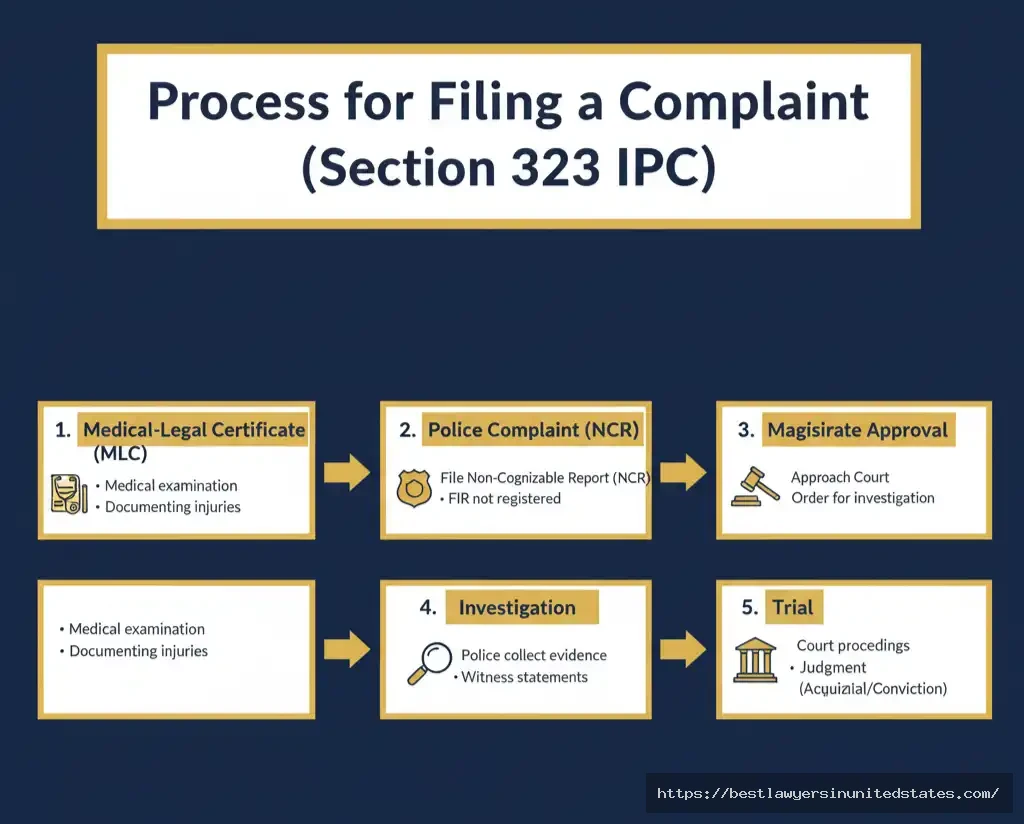
Step 1: Medical Examination (Get MLC)
Immediately after assault:
Go directly to nearest government hospital or authorized private hospital emergency department.
Request Medico-Legal Case (MLC) examination:
- Tell reception/triage staff you were assaulted and need MLC
- Government hospitals cannot refuse MLC
- Bring ID proof if possible (not mandatory in emergency)
During examination:
- Accurately describe how each injury occurred
- Mention all pain points even if no visible injury
- Don’t exaggerate or minimize
- Ask for copy of MLC report
- Get doctor’s contact information for court testimony
MLC is free in government hospitals. Private hospitals may charge ₹500-2,000 but must provide report if patient requests.
Timing matters: Get MLC within 6-12 hours of assault when injuries are most visible. Delayed MLC significantly weakens your case.
Step 2: File Complaint at Police Station or Magistrate Court
Since Section 323 is non-cognizable, you have two options:
Option A: Police Station (Faster, easier but limited power)
- Visit police station in whose jurisdiction assault occurred
- Give written complaint describing:
- Date, time, place of incident
- Names/descriptions of accused persons
- Detailed sequence of events
- Nature of injuries suffered
- Names of witnesses if any
- Police will record Non-Cognizable Report (NCR)
- Get copy of NCR with registration number
- Police will refer you to Magistrate for permission to investigate
What police CANNOT do without Magistrate’s order:
- Register FIR
- Arrest accused
- Conduct formal investigation
- Seize evidence
Option B: Direct Complaint to Magistrate (Slower but more effective)
- Draft complaint petition on plain paper addressed to Chief Judicial Magistrate
- Include:
- Your details (complainant)
- Accused details (names, addresses if known)
- Detailed incident narrative
- List of witnesses
- Request for investigation and prosecution
- Attach:
- MLC report copy
- Any supporting documents (photos, messages, etc.)
- File at Magistrate Court or send by registered post
- Pay nominal court fee (₹10-50)
Magistrate will:
- Review complaint
- May call you for statement under oath
- Decide whether to order police investigation or issue process directly to accused
Which option to choose:
Go to police if:
- You need immediate protection
- Multiple accused or serious assault
- Incident just occurred and accused might flee
- You want police to gather evidence quickly
Go directly to Magistrate if:
- Police refuse to take action
- You have all evidence ready
- Accused is influential and police are reluctant
- You prefer faster judicial process
Step 3: Police Investigation (If Ordered)
Once Magistrate orders investigation:
Police duties include:
- Record your detailed statement (161 CrPC)
- Visit crime scene and prepare panchnama
- Collect evidence (photos, CCTV, weapons, etc.)
- Record witnesses’ statements
- Arrest accused (after obtaining warrant from Magistrate)
- Send injuries for medical opinion if not done
- Prepare investigation report
Your cooperation required:
- Be available for statement recording
- Bring witnesses to police station
- Provide any documents/evidence you have
- Identify accused if needed
- Attend identification parade if required
Investigation timeline: Usually 60-90 days, though delays are common. You can follow up with investigating officer or complaint to Magistrate if unnecessary delay occurs.
Step 4: Filing of Charge Sheet
After investigation, police submit report to Magistrate:
If police find evidence: They file charge sheet (173 CrPC) listing:
- Accused details
- Sections charged (323 IPC and any other applicable sections)
- Evidence collected
- Witness list
- Documents to be relied upon
If police find no evidence: They file “Final Report” recommending case closure. You can protest this before Magistrate and request further investigation or direct trial.
Magistrate’s action on charge sheet:
- Reviews whether evidence prima facie establishes offense
- Decides whether to take cognizance (proceed with case)
- Issues summons to accused
- Fixes dates for trial
Step 5: Court Trial Begins
Once Magistrate takes cognizance:
Pre-trial steps:
- Accused appears before court
- Magistrate explains charges
- Accused pleads guilty or not guilty
- If not guilty plea, trial scheduled
- Bail application if accused in custody
Trial stages covered in detail in next section.
Sample Complaint Format
To,
The Chief Judicial Magistrate,
[District Name]

Subject: Complaint under Section 323 IPC regarding assault

Respected Sir/Madam,

I, [Your Name], son/daughter of [Father's Name], aged [Age] years,
residing at [Full Address], respectfully submit this complaint
regarding the following matter:

1. On [Date] at approximately [Time], I was at [Location] when
   the accused, namely [Accused Name], son/daughter of [Father's Name],
   residing at [Accused Address], suddenly assaulted me without any
   provocation.

2. The accused [describe exact sequence: slapped me, punched me,
   pushed me, etc.], causing [describe injuries: bruising on left
   cheek, swelling on right arm, scratches on neck, etc.].

3. The assault was witnessed by [Witness 1 Name and Address] and
   [Witness 2 Name and Address].

4. Immediately after the incident, I proceeded to [Hospital Name]
   where I underwent medico-legal examination. The MLC report
   (copy enclosed) confirms injuries consistent with assault.

5. The accused has voluntarily caused hurt to me without any
   justification or lawful excuse, thereby committing an offense
   punishable under Section 323 of the Indian Penal Code.

6. I humbly request your honor to:
   a) Take cognizance of the offense
   b) Order police investigation
   c) Initiate criminal proceedings against the accused
   d) Pass such other orders as deemed fit

Enclosed documents:
1. Copy of MLC report
2. [Any other supporting documents]

I verify that the contents of this complaint are true to the best
of my knowledge and belief.

Date: [Date]
Place: [Place]

Signature of Complainant
[Your Name]
[Contact Number]
Bail Procedure in Section 323 IPC Cases
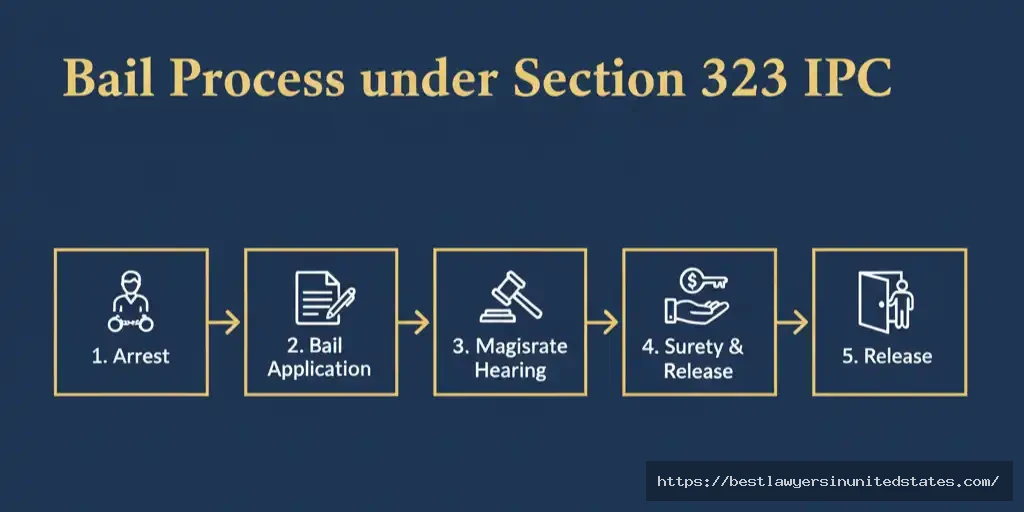
Is Bail Automatic in Section 323 Cases?
While Section 323 is bailable (meaning accused has a right to bail), it’s not entirely “automatic.” The process requires proper application and compliance with procedures.
Legal position:
- Accused has statutory right to bail under Section 436 CrPC
- Magistrate must grant bail unless exceptional circumstances exist
- Bail cannot be denied merely on ground that accused might be guilty
“Automatic” in practice means:
- Application usually approved within 24 hours
- Minimal inquiry required
- Surety requirements are moderate
- Even prior criminal record rarely leads to denial
- Personal bonds often accepted without cash deposit
However, bail can be delayed or denied if:
- Accused has fled jurisdiction
- Multiple serious criminal cases pending
- Likelihood of evidence tampering
- Threat to victim or witnesses
- Accused is flight risk (no fixed address)
In over 95% of pure Section 323 cases, bail is granted on first application.
How to Apply for Bail

If arrested:
Step 1: File bail application
- Can be done by accused personally or through lawyer
- Application addressed to Magistrate having jurisdiction
- Must state grounds for bail
- Mention that offense is bailable under law
Step 2: Application format:
To,
The Learned Judicial Magistrate First Class,
[Court Name]

In the matter of:
[Your Name] ...Applicant/Accused
Versus
State/[Complainant Name] ...Opposite Party

FIR No. [___] / Case No. [___]
Under Section 323 IPC
Police Station: [___]

Application for Bail under Section 436 CrPC

Respected Sir/Madam,

The applicant respectfully submits:

1. The applicant has been arrested in the above case on [Date].

2. The offense under Section 323 IPC is bailable as per Schedule I
   of CrPC.

3. The applicant has no prior criminal record and is ready to abide
   by all conditions imposed by this Hon'ble Court.

4. The applicant has deep roots in the community, residing at [Address]
   for [Duration].

5. The applicant undertakes not to tamper with evidence or influence
   witnesses.

6. The applicant is ready to furnish personal bonds and surety as
   required by this Hon'ble Court.

PRAYER: Grant bail to the applicant on personal bonds and surety.

Date: [Date]
Place: [Place]

Applicant/Counsel for Applicant
Step 3: Court hearing
- Magistrate reviews application (often same day or next day)
- Prosecution may be heard (rarely opposes in Section 323)
- Magistrate sets bail conditions
Step 4: Bail conditions typically include:
- Personal bond of ₹10,000-50,000
- One or two sureties of similar amount
- Surrender passport (rare in Section 323 unless accused has fled before)
- Regular appearance on trial dates
- Not contacting/threatening victim
- Inform police of address changes
Step 5: Execute bonds
- Bring surety persons to court
- Surety must prove they own property or have stable income
- Submit documents (address proof, income proof, property documents)
- Sign bond papers before court
- Get release order
Step 6: Release
- Take release order to jail/police station
- Accused released immediately
Typical timeline: If arrested in morning, bail can be secured by evening same day. If arrested at night, next morning.
Documents Required for Bail
For the accused:
- Copy of FIR/charge sheet
- Identity proof (Aadhaar, PAN, passport, etc.)
- Address proof (utility bills, rent agreement)
- Proof of employment/business (if applicable)
- Character certificates (optional but helpful)
- Previous bail orders (if any)
For surety persons:
- Identity proof
- Address proof
- Property documents (if property owner):
- Sale deed/title documents
- Tax receipts showing property ownership
- Valuation certificate (if court requires)
- OR Employment/income proof (if salaried person):
- Salary slips
- Bank statements showing income
- Employment letter
- ITR/Form 16
Who can be surety:
- Must be adult Indian citizen
- Should own property in jurisdiction OR have stable verifiable income
- Cannot be co-accused in same case
- Should have no serious criminal record
- Family members can be surety
How many sureties: Usually 1-2 persons, each guaranteeing the full bond amount.
Can Bail Be Denied in Section 323?
Yes, though rare. Grounds for denial:
1. Flight risk
- No fixed residence
- History of fleeing
- Previous warrants issued for non-appearance
- Foreign passport holder planning to leave country
2. Evidence tampering concerns
- Past instances of witness intimidation
- Threats made to complainant after arrest
- Attempts to destroy evidence
- Communication with witnesses to change testimony
3. Repeat offender
- Multiple pending criminal cases (especially violent crimes)
- Previous convictions for similar offenses
- Pattern of criminal behavior
- Breach of bail conditions in past cases
4. Serious injury despite Section 323 charge
- Victim hospitalized
- Multiple injuries suggesting brutal assault
- Use of weapons (should be 324, but sometimes initially charged as 323)
- Elderly/disabled/child victim requiring special protection
5. Communal/sensitive case
- Assault part of larger communal tension
- Risk of law and order issues if accused released
- Political or social sensitivity requiring custody
What to Do If Bail is Rejected
Immediate options:
1. File fresh bail application addressing Magistrate’s concerns:
- Offer additional sureties
- Provide better documentary proof of residence
- Submit character certificates
- Address specific objections raised by court
2. Approach Sessions Court (Appellate jurisdiction):
- File bail application under Section 439 CrPC
- Sessions Judge has wider discretion than Magistrate
- Can be filed immediately after Magistrate’s rejection
- Usually heard within 3-7 days
3. Approach High Court (if Sessions Court also denies):
- File criminal miscellaneous petition
- High Court has inherent powers under Section 482 CrPC
- Reserved for cases where lower courts acted arbitrarily
- Takes 2-4 weeks for hearing typically
Practical tips if bail denied:
Don’t panic: Magistrate denials are often overturned by higher courts.
Understand the reason: Get copy of rejection order showing grounds. Address those specific concerns in next application.
Improve documentation: If surety was inadequate, arrange better sureties with stronger financial backing.
Show cooperation: Emphasize willingness to cooperate with investigation, regular appearance, no threat to victim.
Consider compromise: If victim agrees to settlement, file compromise petition. Courts readily grant bail pending compromise approval.
In 323 cases specifically: Bail denial is extremely rare and usually indicates some unusual circumstance (absconding history, serious injury, or procedural error in application). A well-drafted second application or Sessions Court appeal almost always succeeds.
Trial Procedure for Section 323 IPC
Filing of Complaint/Charge Sheet
Trial formally begins when:
Private complaint route: Complainant files petition directly before Magistrate, who takes cognizance and issues process to accused.
Police investigation route: Police file charge sheet after investigation, and Magistrate takes cognizance.
Taking cognizance means the Magistrate officially recognizes that an offense appears to have occurred and judicial proceedings should commence.
Appearance of Accused
Summons issued: Since Section 323 is non-cognizable and bailable, accused typically receives court summons (not arrest warrant).
First appearance: Accused must appear on specified date:
- Court verifies identity
- Accused may be represented by lawyer
- Bail bonds executed if in custody
- Next date fixed for charges
Failure to appear: If accused doesn’t show:
- Magistrate issues bailable warrant
- Second summons sent
- Continued absence may lead to non-bailable warrant
- Can be declared proclaimed offender in extreme cases
Framing of Charges
Charge preparation: After reviewing charge sheet/complaint and hearing both sides briefly, Magistrate prepares formal charge.
Charge reading: In open court, Magistrate reads charge to accused in language they understand. For Section 323:
“I, [Magistrate name], hereby charge you [Accused name] that on [date] at [place] within the jurisdiction of this court, you voluntarily caused hurt to [victim name] by [specific act], and thereby committed an offense punishable under Section 323 of the Indian Penal Code, and within my cognizance. Do you plead guilty or claim trial?”
Accused’s response:
If pleads guilty:
- Magistrate may convict on plea
- Hears mitigation arguments
- Passes sentence immediately
- Trial ends
If claims trial (not guilty plea):
- Magistrate formally frames charges
- Prosecution and defense prepare for trial
- Witness lists exchanged
- Documents listed
- Trial dates fixed
Examination of Witnesses
Prosecution witnesses: Examined first. Typically include:
1. Complainant/Victim (most crucial witness):
- Narrates entire incident in detail
- Identifies accused in court
- Proves injuries through MLC
- Subject to defense cross-examination
2. Eyewitnesses (if any):
- Corroborate victim’s account
- Describe what they saw
- Must be independent (not interested parties)
3. Investigating Officer:
- Proves investigation conducted properly
- Identifies documents collected
- Explains any seizures/recoveries
- Confirms charge sheet filing
4. Medical Officer:
- Proves MLC report
- Explains nature and cause of injuries
- Opines on simple vs. grievous hurt
- Confirms injuries consistent with assault claimed
5. Other witnesses (as needed):
- Character witnesses
- Expert witnesses
- Document witnesses
Examination process:
Chief examination: Prosecution lawyer questions witness first (eliciting favorable facts).
Cross-examination: Defense lawyer questions same witness (attempting to contradict, discredit, or elicit favorable facts).
Re-examination: Prosecution can clarify points raised in cross-examination (limited to matters arising from cross).
Court questions: Magistrate may ask questions at any stage to clarify doubts.
Each witness examined separately. Witnesses waiting outside cannot hear testimony of others (prevents coaching).
Defense Evidence
After prosecution closes its case:
Statement of accused under Section 313 CrPC:
- Magistrate questions accused about incriminating circumstances
- Accused explains their version
- Not on oath (so not subject to cross-examination)
- Can deny allegations, provide alternative explanation, claim defenses
Defense witnesses (if any):
- Accused may call witnesses to:
- Prove alibi (wasn’t present at scene)
- Establish provocation by victim
- Show self-defense
- Prove good character
- Contradict prosecution witnesses
Defense evidence process:
- Defense lawyer examines own witnesses (chief examination)
- Prosecution cross-examines
- Defense re-examines if needed
Accused’s right to remain silent: Accused need not testify on oath. Silence cannot be held against them (burden of proof remains on prosecution).
Arguments by Both Sides
After all evidence recorded:
Prosecution arguments:
- Summarizes evidence proving guilt
- Highlights victim testimony, medical evidence, eyewitness accounts
- Shows essential ingredients established beyond reasonable doubt
- Addresses defenses raised
- Requests conviction and appropriate punishment
Defense arguments:
- Points out weaknesses in prosecution case
- Questions credibility of witnesses
- Highlights inconsistencies in testimonies
- Argues insufficient evidence
- Presents alternative theories
- Claims self-defense, provocation, accident, false implication
- Requests acquittal or benefit of doubt
Judges typically hear arguments across 1-3 hearings, depending on case complexity.
Judgment and Sentencing
Judgment preparation: Magistrate reviews entire evidence, considers arguments, and applies law to facts.
Judgment components:
- Introduction: Case details, charges, parties
- Prosecution case: Summary of evidence presented
- Defense case: Accused’s version and evidence
- Issues for determination: Legal questions to be decided
- Discussion: Analysis of evidence, credibility assessment, legal reasoning
- Findings: Whether prosecution proved guilt beyond reasonable doubt
- Conclusion: Conviction or acquittal
If ACQUITTED:
- Accused discharged immediately
- Bail bonds canceled
- No punishment or criminal record
- Prosecution can appeal to Sessions Court
If CONVICTED:
Sentencing hearing: May be same day or separate hearing:
- Prosecution argues for stringent punishment
- Defense presents mitigation factors:
- First-time offender
- Minor injury
- Provocation existed
- Family responsibilities
- Age, health, social circumstances
- Genuine remorse
- Willingness to compensate victim
Sentencing order: Magistrate imposes punishment within statutory limits:
- Imprisonment (simple or rigorous, up to 1 year)
- Fine (up to ₹1,000 under IPC; ₹10,000 under BNS)
- Both imprisonment and fine
- Only fine (if minor offense)
Additional orders possible:
- Section 357 CrPC compensation: Court can order accused to pay compensation to victim from fine amount or separately (often ₹5,000-50,000 depending on injury severity)
- Benefit of Probation of Offenders Act: First-time offenders may get probation instead of imprisonment (especially if young)
Sentence execution:
- If imprisonment ordered, accused taken into custody immediately
- Time already spent in custody adjusted against sentence
- Fine must be paid within time specified (usually 30 days) or additional imprisonment in default
Right to Appeal
If convicted:
- Accused can appeal to Sessions Court within 30 days
- Sessions Judge reviews trial court record
- Can confirm, modify, or set aside conviction
- Can reduce sentence
- Further appeal to High Court possible
If acquitted:
- Prosecution/complainant can appeal to Sessions Court
- Much harder to overturn acquittal
- Must show perverse findings or legal errors
Typical trial timeline for Section 323:
- Charge framing: 3-6 months after complaint
- Evidence recording: 6-12 months (depends on witness availability)
- Arguments: 1-3 months after evidence closes
- Judgment: 1-3 months after arguments conclude
- Total: 12-24 months on average (varies significantly by court workload and delays)
Defense Strategies for Section 323 IPC Cases
Challenging Weak Medical Evidence
Medical evidence often contains exploitable weaknesses:
Strategy 1: Highlight delayed MLC
If victim got medical examination days after alleged assault:
- Argue injuries could have occurred anytime in interval
- Question why delay if assault was serious
- Suggest injuries fabricated or self-inflicted later
- Emphasize lack of fresh injuries during examination
Cross-examination questions:
- “Doctor, you examined the patient on [date], correct?”
- “The patient claims assault occurred on [earlier date]?”
- “Can you definitively say these injuries occurred on [earlier date] and not any time between?”
- “Is it possible these injuries were caused by other means?”
Strategy 2: Attack inconsistent injury description
Compare MLC description with victim’s testimony:
- If victim describes blow to right cheek but MLC shows left cheek injury, argue false testimony
- If victim claims 10 blows but MLC shows 2 minor marks, argue exaggeration
- If weapon claimed but injury pattern inconsistent with that weapon, challenge weapon use
Strategy 3: Question medical opinion
Doctors sometimes offer conclusive opinions beyond their expertise:
- If doctor states injuries “definitely caused by punch,” challenge certainty—injuries from fall could look similar
- If doctor assigns specific timing (“12 hours old”), ask basis for precision
- If doctor concludes injuries “consistent with assault,” argue equally consistent with accident
Strategy 4: Prove injuries minor/trivial
Even if injuries established, minimize significance:
- Show injuries healed within days
- Demonstrate no medical treatment needed beyond first examination
- Emphasize victim returned to normal activities immediately
- Argue injuries amount to “simple touching” not “hurt”
Real case example: In State v. Ramesh (Delhi High Court), conviction was overturned when defense showed MLC conducted 4 days post-assault described injuries as “healed bruises,” contradicting testimony of fresh beating. Court held delay unexplained and injuries could have other origins.
Proving Lack of Intention (Mens Rea)
Section 323 requires proof of intentional or knowing causation of hurt:
Strategy 1: Accident defense
Argue hurt occurred accidentally:
- During sports/recreational activity
- While preventing someone from falling
- In crowded place (accidental bump)
- While restraining person for their own safety
Example: “My client attempted to prevent complainant from stepping into traffic. In pulling him back, complainant fell and sustained injuries. This was accident, not intentional hurt.”
Strategy 2: No knowledge of hurt
Argue accused didn’t know their action would cause hurt:
- Gentle push that unexpectedly caused fall
- Throwing object near (not at) person who moved into its path
- Door closed not knowing someone’s hand was there
Key argument: “Intent is essential ingredient. Prosecution failed to establish my client intended or knew hurt would occur.”
Strategy 3: Challenge mens rea through contradictions
- If victim claims pre-meditated attack but accused had no prior dispute, question intent
- If incident arose spontaneously during argument, argue no pre-formed intention
- If multiple people involved, argue accused didn’t specifically target victim
Using Section 334 Provocation Defense
Section 334 provides exception reducing punishment if hurt caused under grave and sudden provocation:
Requirements:
- Grave provocation: Serious enough to cause reasonable person to lose self-control
- Sudden provocation: Immediate, not after cooling-off period
- Proportionate response: Hurt inflicted not disproportionate to provocation
What constitutes grave and sudden provocation:
- Victim slapped accused first
- Victim used highly offensive abusive language
- Victim made serious allegations affecting honor/reputation
- Victim threatened accused’s family member
- Victim attempted to harm accused’s property
What does NOT qualify:
- Minor insult or everyday argument
- Provocation accused deliberately invited
- Provocation against which accused could have sought legal remedy
- Disproportionate response (minor insult met with severe beating)
How to raise this defense:
In cross-examination:
- Elicit from prosecution witnesses that victim provoked accused
- Get victim to admit they spoke harshly/acted aggressively first
- Establish temporal proximity between provocation and retaliation
In defense evidence:
- Defense witnesses testify to provocation
- Accused explains provocation in Section 313 statement
In arguments:
- Even if hurt proved, claim Section 334 exception applies
- Request reduced punishment (maximum 3 months imprisonment or ₹500 fine)
Limitations:
- Must raise this defense during trial, not for first time in appeal
- Burden on accused to establish provocation
- Standard: “Would a reasonable person in accused’s position react this way?”
Real case example: In Harish v. State, victim abused accused’s deceased mother using vulgar language. Accused immediately slapped victim causing minor injury. Court applied Section 334, holding grave and sudden provocation established, reducing sentence to nominal fine.
Claiming Self-Defense (Sections 96-106 IPC)
Right of private defense allows using reasonable force to protect oneself:
When self-defense applies:
- Reasonable apprehension of danger to body
- Imminent threat (not future or past)
- No time to seek legal protection
- Force used is proportionate
Strategy for 323 cases:
Argue victim actually attacked first and accused defended themselves:
- Victim approached aggressively
- Victim raised hand to strike
- Accused feared injury
- Accused used minimal force to defend
- Hurt to victim was unintended consequence of lawful self-defense
Burden of proof: Once accused claims self-defense, prosecution must disprove it beyond reasonable doubt.
Cross-examination:
- Question victim about their own aggressive behavior
- Highlight contradictions about who struck first
- Establish victim has violent history/temperament
Defense evidence:
- Witnesses testify victim attacked first
- Show injuries on accused (proves both fought)
- Establish victim’s aggressive reputation
Limitations:
- Force must be reasonable and proportionate
- Cannot claim self-defense if you provoked the attack
- Must act in good faith, not revenge
Case law: Supreme Court in Darshan Singh v. State of Punjab held that even if accused’s perception of danger was mistaken, self-defense applies if fear was genuine and reasonable in circumstances.
Proving False/Malicious Complaint
Common defense where relationship shows motive for false accusation:
Motive for false complaint:
- Property dispute
- Business rivalry
- Matrimonial discord
- Political enmity
- Previous litigation between parties
- Complainant wants leverage in civil case
How to establish:
Show timing suspicious:
- Complaint filed immediately after accused won civil case against complainant
- Complaint during divorce proceedings
- Complaint coincides with other legal disputes
Prove physical impossibility:
- Accused was elsewhere (alibi)
- Accused physically incapable (elderly, disabled)
- Incident couldn’t have occurred as described
Demonstrate inconsistencies:
- Victim’s statements contradict each other
- Medical evidence doesn’t match claimed assault
- Eyewitness accounts differ from victim
- Delayed complaint without explanation
Prior complaints:
- Show complainant has history of filing false cases
- Previous complaints withdrawn or resulted in acquittals
- Pattern of misusing legal process
Real case tactics:
In Amit Kumar v. State, defense proved:
- Complaint filed exactly one day after civil court ruled against complainant
- No eyewitnesses despite alleged assault in crowded market
- MLC showed injuries inconsistent with assault described
- Complainant had filed three prior false complaints against different people
Result: Acquittal with court observations on malicious prosecution.
When to File for Quashing Under Section 482 CrPC
High Court’s inherent powers allow quashing of criminal proceedings in appropriate cases:
Grounds for quashing:
1. No prima facie case: Even taking prosecution allegations as true, no offense made out.
2. Abuse of process: Case filed to harass accused, not secure justice.
3. Settled disputes: Parties genuinely reconciled, continuing trial serves no purpose (especially in compoundable offenses like 323).
4. Civil dispute: Matter essentially civil in nature wrongly given criminal color.
When to file quashing petition:
Early stage preferred:
- After charge sheet filed but before trial starts
- Saves time and resources
- Prevents stigma of prolonged criminal trial
Requirements:
- File criminal miscellaneous petition in High Court
- Must show clear grounds (not disputed facts)
- Attach entire case record
- Show why trial shouldn’t proceed
Quashing due to settlement:
In Section 323 (compoundable offense), High Courts readily quash if:
- Both parties genuinely settled
- Affidavits from both confirming settlement
- Settlement not coerced
- No public interest in continuing prosecution
Procedure:
- Parties reach settlement outside court
- Draft settlement agreement/compromise deed
- File quashing petition with settlement annexed
- Both parties submit affidavits confirming voluntary settlement
- High Court examines genuineness
- If satisfied, quashes FIR/case
Advantages over trial court compounding:
- Faster (few months vs. years)
- No trial record remains
- Complete closure before trial begins
- No conviction stigma even temporarily
Limitations:
- High Court fees higher than Magistrate Court
- Requires lawyer (self-representation not practical)
- Court may refuse if settlement appears coerced or unfair
- Cannot quash if non-compoundable sections also charged
Recent trend: Supreme Court in Narinder Singh v. State of Punjab encouraged quashing of settled compoundable offense cases, noting it advances justice and reduces court backlog.
Best Defense Arguments from Real Cases
Argument 1: “Mutual fight—both participated equally”
In Ram Kumar v. State, defense successfully argued:
- Both parties equally involved in altercation
- Both sustained injuries
- No clear aggressor
- Victim also filed counter-case
Result: Both acquitted as each had equal right to private defense.
Argument 2: “Medical evidence contradicts prosecution version”
In State v. Suresh, MLC showed injuries on back of head, but victim testified accused punched face. Defense argued:
- Victim’s testimony unreliable
- Injuries suggest different scenario
- Possibility of false implication
Result: Acquittal due to material contradictions.
Argument 3: “Delayed complaint without explanation”
In Rajesh v. State, assault allegedly occurred on January 1st, complaint filed January 15th. Defense emphasized:
- 14-day unexplained delay
- Injuries would have healed
- Time to fabricate story
- No emergency medical treatment sought
Result: Acquittal—delay created fatal doubt.
Argument 4: “Single witness with interested motive”
In Mohan v. State, only witness was victim’s close relative with property dispute against accused. Defense argued:
- No independent witness
- Clear motive to falsely implicate
- Interested witness testimony requires corroboration
Result: Acquittal—uncorroborated interested witness insufficient for conviction.
Argument 5: “Injuries possible from other causes”
In Dinesh v. State, victim had minor bruise. Defense argued:
- Victim could have sustained injury from fall
- Victim admitted drinking alcohol before incident
- No witness saw actual assault
- Injury consistent with stumbling/falling
Result: Acquittal—reasonable doubt about cause of injury.
Grounds for Acquittal Under Section 323 IPC
Lack of Sufficient Evidence
Most common acquittal ground—prosecution failed to prove guilt beyond reasonable doubt:
Insufficient evidence scenarios:
1. No medical evidence + weak testimony:
- Victim’s account uncorroborated
- No eyewitnesses
- No MLC or medical documentation
- Injuries not photographed
Court reasoning: “Sole testimony of interested witness without medical corroboration insufficient in criminal case.”
2. Contradictory prosecution witnesses:
- Victim says accused punched face
- Eyewitness says accused pushed from behind
- Medical evidence shows injuries on arm
Court reasoning: “Material contradictions create reasonable doubt—accused entitled to benefit.”
3. Delayed investigation:
- Police registered case late
- Crime scene not preserved
- Evidence degraded
- Witnesses’ memory faded
Court reasoning: “Investigation lapses prejudice prosecution case—doubt resolved in favor of accused.”
4. Incomplete evidence:
- Promised eyewitnesses never testified
- Medical officer not examined in court
- Key documents not produced
- Investigation officer didn’t testify
Court reasoning: “Prosecution must prove case comprehensively—gaps and omissions fatal.”
Failure to Prove Intention
Even if hurt occurred, conviction requires proof of mens rea:
Acquittal scenarios:
1. Accidental hurt: In Kishore v. State, accused pushed complainant during argument. Complainant fell hitting head on wall. Court acquitted noting:
- Accused intended only to push away, not cause injury
- Head injury resulted from accidental impact with wall
- No intention or knowledge that push would cause hurt
2. Hurt during lawful act: In Prakash v. State, shopkeeper grabbed thief’s arm while preventing theft. Thief’s arm bruised. Court acquitted:
- Shopkeeper acted lawfully to protect property
- Minimal force used
- Hurt unintended consequence of lawful restraint
3. Rash or negligent act (not intentional): If hurt resulted from carelessness rather than intention:
- Cannot be convicted under Section 323
- Might be liable under Section 337/338 IPC (rash/negligent act causing hurt)
- But if not charged under those sections, acquittal follows
False Complaint/Malicious Prosecution
When court finds complaint fabricated:
Indicators of false complaint:
1. Impossible timeline: In Sanjay v. State, victim claimed assault at 3:00 PM at Location A, but defense proved accused was at Location B (30 km away) at that time through:
- Office attendance register
- CCTV footage
- Multiple colleague witnesses
Result: Acquittal with observations on false complaint.
2. No injuries despite serious assault claimed: In Mukesh v. State, victim claimed severe beating with stick causing multiple injuries, but:
- MLC showed only minor scratch
- No bruising, swelling, or serious marks
- Doctor opined injuries inconsistent with beating described
Result: Acquittal—exaggerated false complaint.
3. Civil dispute motive: In Ramesh v. State, parties had:
- Ongoing property litigation
- Criminal complaint filed immediately after civil court ruled against complainant
- Previous false complaints admitted by complainant
Result: Acquittal—complaint tool for civil dispute leverage.
4. Prior enmity exploitation: In Deepak v. State, evidence showed:
- Parties had 10-year-old dispute
- Multiple cross-complaints filed over years
- Current complaint lacked credible evidence
- Pattern of misusing criminal process
Result: Acquittal with costs imposed on complainant.
Self-Defense Exception
When accused establishes right of private defense:
Successful self-defense claims:
Case 1: Harjit v. State Facts:
- Victim approached accused with knife
- Accused wrestled knife away
- During struggle, victim sustained cuts
Court held:
- Accused had reasonable apprehension of danger
- Force used was proportionate
- Right of private defense established
Result: Acquittal.
Case 2: Sunil v. State Facts:
- Group of 5 people surrounded accused
- Accused picked up stick in self-defense
- One attacker injured when struck
Court held:
- Outnumbered accused faced real danger
- Using stick reasonable in circumstances
- Injury to one attacker justified self-defense
Result: Acquittal.
Key requirements for self-defense acquittal:
- Imminent threat to body
- No opportunity to seek legal protection
- Force used was reasonable and proportionate
- Acted in good faith
Real Acquittal Case Examples
Case 1: Pradeep Kumar v. State of UP (Allahabad High Court)
Facts:
- Neighborhood dispute over parking
- Victim claimed accused slapped him causing ear injury
- Accused denied, claimed victim fell while drunk
Evidence:
- No eyewitnesses
- MLC showed minor redness on ear
- Victim admitted consuming alcohol
- MLC done 6 hours after alleged incident
Court reasoning:
- Single interested witness insufficient
- Delayed MLC questionable
- Injuries consistent with fall
- Reasonable doubt existed
Result: Acquittal
Case 2: State of Karnataka v. Manjunath (Karnataka High Court)
Facts:
- Domestic dispute between neighbors
- Victim’s wife claimed accused pushed victim causing injuries
- Accused claimed self-defense after victim attacked with rod
Evidence:
- Wife was sole witness (interested)
- Medical evidence showed injuries on accused also
- No independent witnesses
- Prior disputes between families
Court reasoning:
- Interested witness requires corroboration
- Injuries on accused suggest mutual fight
- Both parties equally culpable or both entitled to self-defense
- Prosecution failed to establish accused was aggressor
Result: Acquittal
Case 3: Rajiv v. State of Delhi (Delhi High Court)
Facts:
- Road rage incident
- Victim claimed accused punched him multiple times
- Accused claimed victim initiated altercation
Evidence:
- MLC showed single small bruise
- Victim testified to multiple punches
- Medical evidence contradicted testimony
- CCTV unavailable despite incident on main road
Court reasoning:
- Medical evidence doesn’t support testimony of multiple punches
- Exaggeration by victim creates doubt
- CCTV absence unexplained
- Benefit of doubt to accused
Result: Acquittal
Common Charge Combinations with Section 323 IPC
323 + 504 + 506 IPC: Assault with Insult and Threat
This trio is the most common combination in Indian criminal cases—road rage, neighbor disputes, workplace altercations.
What each section covers:
| Section | Offense | Punishment |
|---|---|---|
| 323 IPC | Voluntarily causing hurt | Up to 1 year + ₹1,000 fine |
| 504 IPC | Intentional insult provoking breach of peace | Up to 2 years + fine |
| 506 IPC | Criminal intimidation | Up to 2 years (or 7 if death/GH/fire threat) |
Typical scenario:
Two people argue → Verbal abuse (504) → Physical assault (323) → Threat of further harm (506)
Real-world example: Parking dispute between neighbors
- Accused abuses victim: “You idiot, I’ll teach you a lesson” [504]
- Accused slaps victim [323]
- Accused threatens: “I’ll break your legs if you park here again” [506]
All three charges filed together.
Legal implications:
Cognizance: Since 506 (criminal intimidation) is cognizable, the entire case becomes cognizable even though 323 and 504 are non-cognizable.
Police can:
- Register FIR immediately
- Arrest without warrant
- Investigate without Magistrate’s permission
Bail: Despite being cognizable, combination remains bailable since all three sections are individually bailable.
Compounding: All three sections are compoundable. Parties can settle with court approval, leading to complete case closure.
Punishment: Court can impose:
- Separate punishment for each offense, OR
- Concurrent sentences (running simultaneously)
Most judges impose concurrent sentences, so effective punishment matches the most serious charge.
Defense strategy:
Challenge each charge separately:
- For 323: Argue no hurt occurred or accidental
- For 504: Argue words not insulting or context misunderstood
- For 506: Argue no real threat or words said in anger without intent
Common outcomes:
- Conviction on 323, acquittal on 504/506 (words disputed)
- Compromise before trial
- Minor punishment (fine only) given minor nature
Hindi keywords: “323 504 506 ipc in hindi” and “धारा 323 504 506” are highly searched, indicating need for vernacular content on this combination.
323 + 341 IPC: Assault with Wrongful Restraint
Common in cases where victim was forcibly stopped before being assaulted.
Section 341 IPC: Voluntarily obstructing any person so as to prevent that person from proceeding in any direction. Punishment: Up to 1 month imprisonment + ₹500 fine.
Typical scenario:
Accused blocks victim’s path (341) → Victim attempts to leave → Accused assaults victim (323)
Real-world example: Shopkeeper-customer dispute
- Customer tries to leave shop
- Shopkeeper blocks exit: “You can’t leave without paying” [341]
- Physical altercation follows where customer sustains injuries [323]
Legal significance:
Kidnapping vs. Restraint: Section 341 is minor wrongful restraint. If restraint is prolonged or involves taking person away, charges upgrade to kidnapping (Section 365) or wrongful confinement (Section 342).
Evidence required:
- For 341: Prove victim attempted to leave and accused prevented
- For 323: Prove hurt occurred
Both sections:
- Non-cognizable
- Bailable
- Compoundable
Defense strategies:
For 341: Argue no restraint occurred—victim free to leave, chose to stay and argue.
For 323: Standard defenses (no hurt, accidental, self-defense).
Common in: Merchant-customer disputes, employer-employee altercations, domestic situations.
498A + 323 + 506 IPC: Domestic Violence Cases
This combination is extremely common in matrimonial disputes.
Section 498A IPC: Husband or relative of husband subjecting woman to cruelty. Punishment: Up to 3 years + fine.
Typical scenario in marital disputes:
Dowry harassment/cruelty (498A) → Physical assault on wife (323) → Threats of further violence (506)
Section comparison:
| Section | Offense | Cognizable | Bailable | Compoundable |
|---|---|---|---|---|
| 498A | Cruelty by husband/relatives | Yes | No | No (as per law, but SC allows quashing) |
| 323 | Voluntarily causing hurt | No* | Yes | Yes |
| 506 | Criminal intimidation | Yes | Yes | Yes |
*Becomes cognizable when charged with 498A/506
Critical differences from other combinations:
498A is non-bailable and non-compoundable, creating complications:
Bail challenges: While 323 and 506 are bailable, 498A is not. Accused must:
- Apply for anticipatory bail (Section 438 CrPC) before arrest, OR
- Apply for regular bail after arrest (higher threshold)
Compounding difficulties: Technically, 498A cannot be compounded. However, Supreme Court in Narinder Singh v. State of Punjab and subsequent cases allows quashing under Section 482 CrPC if parties genuinely reconcile.
Procedure for settlement:
- Parties reconcile and resume cohabitation
- File joint affidavit stating genuine reconciliation
- Move High Court for quashing under Section 482 CrPC
- High Court examines genuineness
- If satisfied, quashes entire case including 498A
Conclusion (Key Takeaways)
Section 323 IPC (now BNS Section 115) covers voluntarily causing simple hurt—a common, lower-gravity offense with bailable, non-cognizable, and compoundable status. Courts look for three things: intention/knowledge, actual hurt, and no Section 334/117 provocation exception.
Punishment remains up to 1 year imprisonment, with BNS raising the maximum fine to ₹10,000 (from ₹1,000 under IPC). In practice, first-time offenders with minor injuries often see fines, probation, or short sentences, while victims can strengthen cases with quick MLC, photos, and credible testimony.
Process-wise, standalone 323 is non-cognizable (police need a Magistrate’s order to investigate/arrest), but if clubbed with a cognizable section (e.g., 506), the case becomes cognizable. Since it’s compoundable, genuine settlements can close matters swiftly—either by trial-court compounding or High Court quashing (especially useful in multi-section cases).
Bottom line: For minor altercations, the system encourages early medical documentation, proportionate handling, bail, and fair settlement—with BNS primarily modernizing the fine while preserving the legal framework you already know.
FAQs on Section 323 IPC / Section 115 BNS
Q1) What is the punishment under Section 323 IPC and Section 115 BNS?
Up to 1 year imprisonment. Fine cap is ₹1,000 (IPC) and ₹10,000 (BNS). Courts may award both.
Q2) Is Section 323 bailable, cognizable, and compoundable?
Bailable: Yes. Cognizable: No (police need Magistrate’s order). Compoundable: Yes, with court’s permission.
Q3) Do I need a medical report (MLC) to win a 323 case?
Not strictly, but MLC and photos massively strengthen the case and rebut “no injury/other cause” defenses.
Q4) Can tiny injuries (redness/scratch) still lead to conviction?
Yes. Any intentional bodily pain qualifies as “hurt.” Severity affects sentencing, not guilt.
Q5) What changed under BNS?
The offense is the same; the notable change is the higher fine limit (₹10,000). The provocation exception moves from IPC 334 to BNS 117.
Q6) I was arrested for 323—will I get bail?
In a pure 323 case, bail under Section 436 CrPC is a right and is typically granted quickly, subject to basic conditions.
Q7) Can police register an FIR for only Section 323?
Ordinarily no (non-cognizable). They record an NCR and seek Magistrate’s order to investigate. If clubbed with a cognizable section (e.g., 506), an FIR is registered.
Q8) Can we settle the case after filing?
Yes. 323 is compoundable. File a joint compromise before the Magistrate. For multi-section cases, you can seek High Court quashing if the dispute is genuinely settled.
Q9) What defenses commonly succeed in 323 trials?
Lack of intention/knowledge, self-defense, grave & sudden provocation, delayed/inconsistent medical evidence, and false implication in civil/relationship disputes.
Q10) How long does a 323 case usually take?
Typically 12–24 months, varying by workload, witness availability, and whether parties settle.
Q11) Can I get probation instead of jail?
Often yes for first-time offenders with minor injuries—courts may use the Probation of Offenders Act.
Q12) What if the incident happened before July 1, 2024?
Generally proceed under IPC for pre-BNS incidents, unless a BNS provision benefits the accused more (no ex-post-facto worsening).
Q13) Can I seek anticipatory bail if 323 is mixed with other sections?
If non-bailable/cognizable sections are added (e.g., 498A), apply for anticipatory bail (S.438 CrPC).
Q14) Is plea bargaining possible?
Yes, for eligible categories, plea bargaining can shorten proceedings and reduce punishment, subject to court scrutiny.
Q15) Which court tries 323?
Any Magistrate (usually where the incident occurred or the accused resides/is found).
