Quick Answer: Divorce costs in New Hampshire range from $500 to $40,000+ depending on whether your case is uncontested or contested. The average divorce in NH costs between $8,000 and $15,000 when you include court filing fees, attorney fees, and additional expenses. Simple uncontested divorces without children can cost as little as $500-$1,500 if you file yourself.
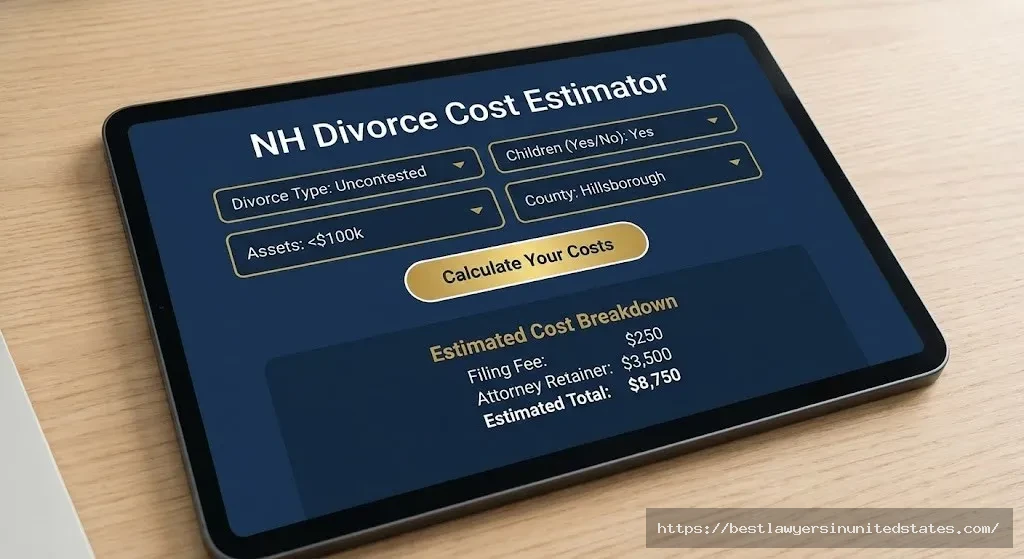
Divorce Cost Calculator
Get an estimated cost for your divorce based on your specific situation
Your Estimated Divorce Cost
Cost Breakdown
📧 Get a Personalized Consultation
Have questions about your specific situation? Contact our legal experts for guidance tailored to your needs.
Contact Us via Email
How Much Does a Divorce Cost in New Hampshire?
The total cost of your divorce in New Hampshire depends primarily on whether you and your spouse can agree on major issues like property division, child custody, and support. An uncontested divorce where both parties agree costs significantly less than a contested divorce that requires court intervention.
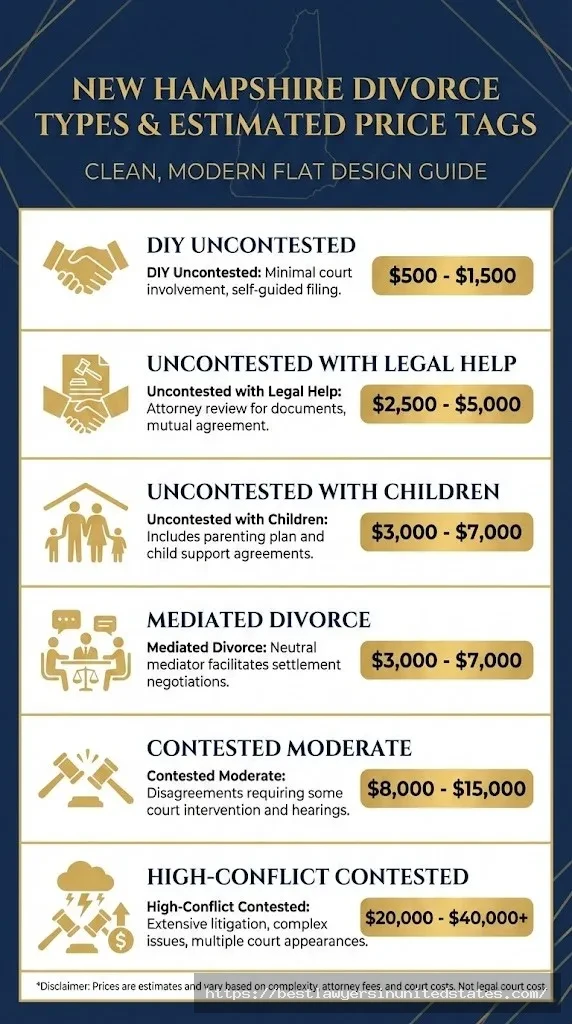
NH Divorce Costs by Type
| Divorce Type | Estimated Total Cost | Timeline |
|---|---|---|
| DIY Uncontested (No Children) | $500 – $1,500 | 2-4 months |
| Uncontested with Limited Legal Help | $2,500 – $5,000 | 3-5 months |
| Uncontested with Children | $3,000 – $7,000 | 4-6 months |
| Mediated Divorce | $3,000 – $7,000 | 3-6 months |
| Contested (Moderate Complexity) | $8,000 – $15,000 | 9-18 months |
| High-Conflict Contested | $20,000 – $40,000+ | 12-24+ months |
These figures represent typical ranges based on current New Hampshire divorce costs in 2025-2026. Your actual costs may vary based on your specific circumstances, county location, and attorney rates.
What Are the Court Filing Fees in New Hampshire?
The divorce filing fee in New Hampshire is $250 statewide. This fee is paid when you submit your divorce petition to the Circuit Court – Family Division in your county. Unlike some states, New Hampshire maintains consistent filing fees across all counties.
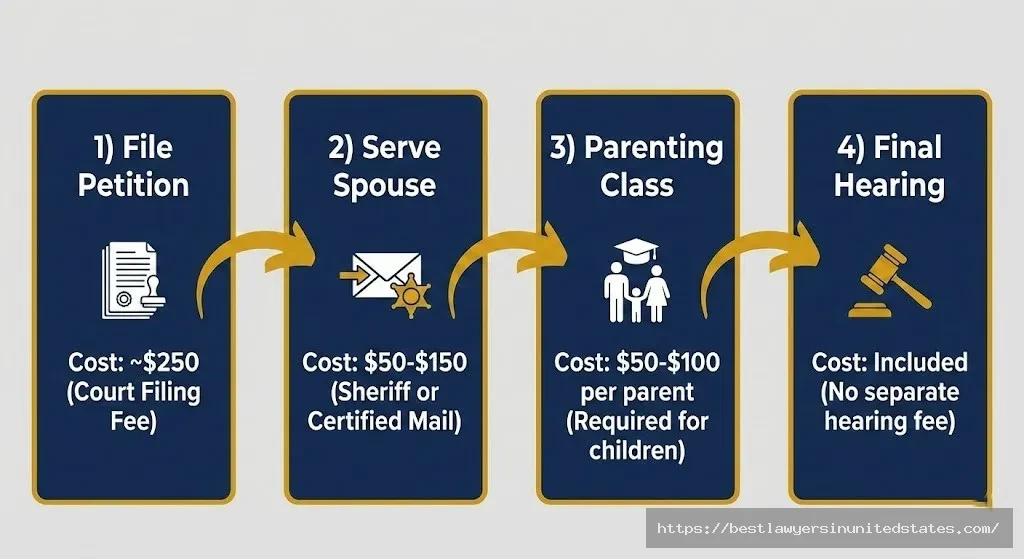
New Hampshire Court Fees Breakdown
| Fee Type | Cost |
|---|---|
| Divorce Petition Filing Fee | $250 |
| Service by Sheriff | $50 – $75 |
| Certified Copy of Divorce Decree | $15 – $25 |
| Motion Filing (if needed) | $0 – $50 |
Fee Waiver Available: If you cannot afford the filing fee, you can request a fee waiver by filing a Motion to Waive Filing Fees with a Financial Affidavit. The court evaluates your income, assets, and expenses to determine eligibility.
How Much Do Divorce Lawyers Cost in New Hampshire?
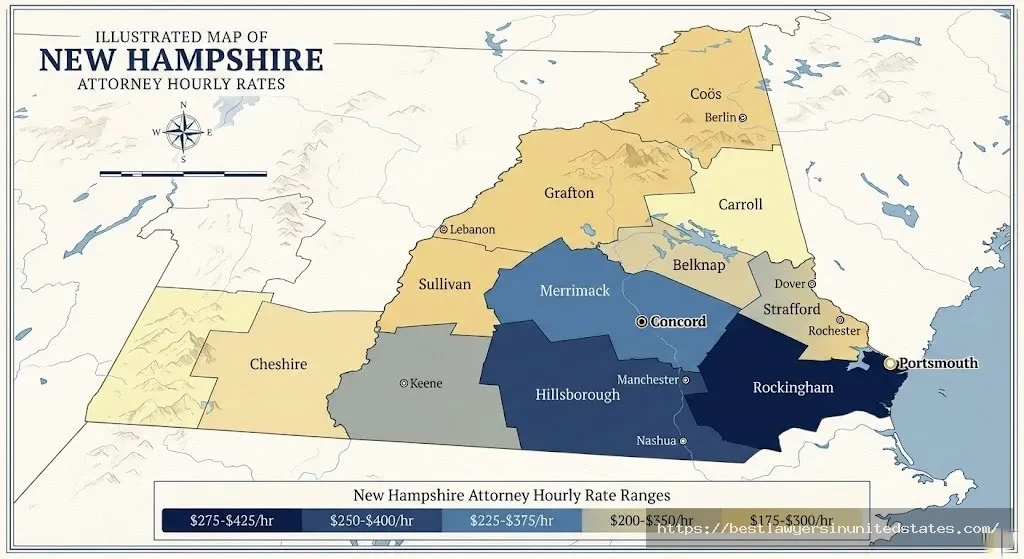
Divorce attorney fees in New Hampshire vary significantly based on location, attorney experience, and case complexity. Most family law attorneys charge hourly rates rather than flat fees for contested cases.
NH Attorney Hourly Rates by Region
| Region | Average Hourly Rate | Typical Retainer |
|---|---|---|
| Manchester/Nashua (Hillsborough County) | $250 – $400/hour | $3,000 – $7,500 |
| Portsmouth/Exeter (Rockingham County) | $275 – $425/hour | $3,500 – $8,000 |
| Concord (Merrimack County) | $225 – $375/hour | $2,500 – $6,000 |
| Dover/Rochester (Strafford County) | $200 – $350/hour | $2,500 – $5,500 |
| Rural Counties | $175 – $300/hour | $2,000 – $5,000 |
Retainer Fees: Most New Hampshire divorce attorneys require an upfront retainer deposit ranging from $2,500 to $8,000. This money goes into a trust account and the attorney bills against it as they work on your case. If you use all the retainer funds, you’ll need to replenish it.
Flat Fees for Uncontested Divorces: Some attorneys offer flat-fee services for simple uncontested divorces, typically ranging from $1,500 to $3,500. This covers document preparation, filing, and finalization but usually excludes contested issues.
What Is the Cheapest Way to Get Divorced in New Hampshire?
The most affordable divorce option in New Hampshire is filing a joint petition for an uncontested divorce without hiring attorneys. If you and your spouse agree on all terms—property division, debt allocation, and child-related matters if applicable—you can handle the divorce yourselves.
Cost-Saving Strategies That Work
File a Joint Petition: When both spouses file together, you split the $250 filing fee and avoid process server costs ($50-$75). A joint petition signals to the court that you’ve reached complete agreement, which typically speeds up the process.
Use Online Divorce Services: Several reputable online services help NH residents prepare divorce documents for $150-$500. These services guide you through questionnaires and generate court-ready forms, though they cannot provide legal advice. Our DIY divorce guide covers this option in detail.
Consider Divorce Mediation: Divorce mediation costs $150-$350 per hour in New Hampshire, with most couples completing mediation in 4-8 sessions. Total mediation costs typically range from $2,400 to $5,600—significantly less than battling in court. Each spouse may still want to hire a consulting attorney for limited advice, adding $500-$1,500 per person.
Limited Scope Representation: Also called “unbundled services,” this allows you to hire an attorney for specific tasks only—like reviewing your settlement agreement or coaching you for a court hearing—rather than full representation. This can reduce attorney costs by 50-70%.
Organize Your Documents: Spend time gathering financial records, asset documentation, and debt statements before meeting with your attorney. Every hour you spend organizing is an hour you’re not paying $250-$400 for your lawyer to do it.
What Hidden Costs Should I Expect in a New Hampshire Divorce?
Beyond court filing fees and attorney costs, several additional expenses catch divorcing couples off guard. Planning for these costs helps you budget more accurately.
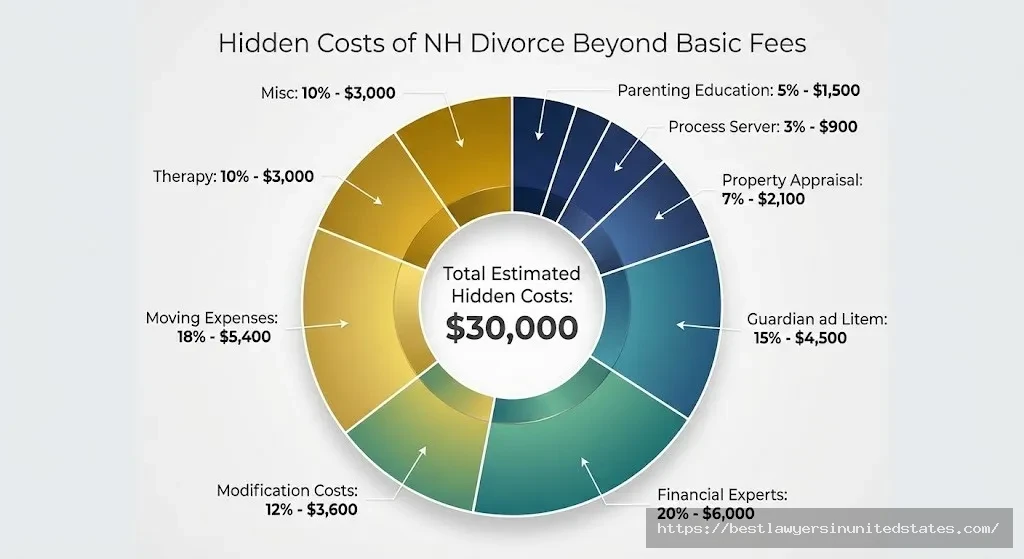
Unexpected Divorce Expenses
Parenting Education Course ($50-$100 per parent): New Hampshire requires all divorcing parents with children under 18 to complete a state-approved parenting education program. Each parent pays separately, and you must file a certificate of completion with the court before your divorce can be finalized.
Process Server Fees ($50-$150): If your spouse won’t sign an Acceptance of Service form, you must have them formally served with divorce papers. Sheriff’s departments charge $50-$75 in most NH counties, while private process servers cost $75-$150.
Guardian ad Litem (GAL) Fees ($1,500-$5,000+): In contested custody cases, the court may appoint a GAL to investigate and make recommendations about the children’s best interests. Parents typically split these costs, though the court can allocate them differently based on each party’s income.
Property Appraisal Costs ($300-$600): If you own a home and can’t agree on its value, you’ll need a professional appraisal. Business valuations can cost $2,000-$10,000+ depending on complexity.
Financial Expert Fees ($2,000-$10,000+): High-asset divorces often require forensic accountants to trace assets, value retirement accounts, or uncover hidden income. These experts charge $200-$500 per hour.
Modification Costs: Even after your divorce is final, you may need to return to court to modify child support, custody, or alimony. Each modification typically costs $500-$3,000 in attorney fees plus court filing fees.
Credit Monitoring and Reports ($50-$200): Protecting your credit during and after divorce is crucial. Many people purchase credit monitoring services and pull credit reports to ensure their ex-spouse isn’t opening accounts in their name.
Moving Expenses ($500-$5,000): One or both spouses typically need to move, which includes deposits, moving trucks, storage, and new furniture. These practical costs add up quickly.
Therapy and Counseling ($100-$250 per session): Individual therapy helps many people process the emotional aspects of divorce. Children may also benefit from counseling, which insurance may partially cover.
How Long Does a Divorce Take in New Hampshire?
New Hampshire has no mandatory separation period before filing for divorce, but the process takes time regardless of whether your case is contested or uncontested.
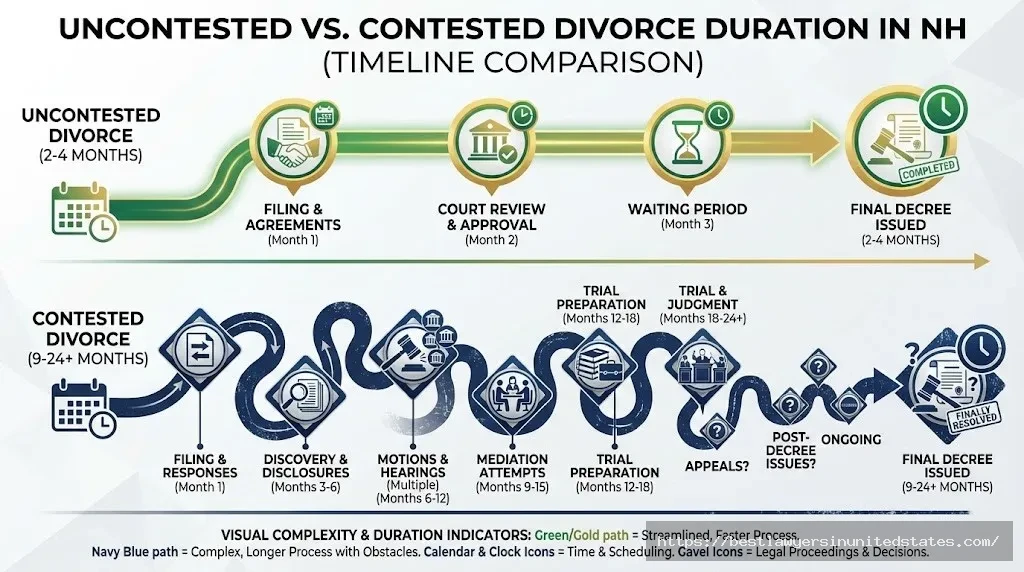
NH Divorce Timeline
Uncontested Divorce: 2-4 months minimum. After filing, you must wait for the court to schedule a final hearing. Even when both parties agree on everything, the court’s calendar determines your timeline. Some counties move faster than others.
Contested Divorce: 9-24+ months. Cases involving property disputes, custody battles, or alimony disagreements take substantially longer. Each motion, hearing, and discovery request extends the timeline—and increases costs.
Factors That Affect Timeline:
- Court calendar availability in your county
- Whether your spouse responds promptly to paperwork
- Complexity of asset division
- Custody and parenting time disputes
- Need for expert evaluations or testimony
- Attorney responsiveness and workload
The faster your divorce concludes, the less you’ll spend on attorney fees. Every additional month of legal representation adds $1,000-$5,000+ in costs for contested cases.
Do I Need a Lawyer to Get Divorced in New Hampshire?
New Hampshire allows you to represent yourself in divorce proceedings, called “pro se” representation. Whether you should handle your divorce without an attorney depends on your specific circumstances.

When DIY Divorce Makes Sense
You can likely handle a divorce yourself if:
- You and your spouse agree on all major issues
- You have no minor children together
- Your marriage was relatively short (under 5 years)
- You have minimal shared assets and debts
- Neither spouse is requesting alimony
- Both parties are employed and self-supporting
- There’s no history of domestic violence
- You’re both willing to cooperate and communicate
In these straightforward cases, filing without an attorney can save you $2,500-$7,500 in legal fees. Just be certain you understand New Hampshire’s divorce laws and complete all required paperwork correctly.
When You Should Hire an Attorney
You need professional legal representation when:
- Your spouse has hired an attorney
- You disagree about child custody or parenting time
- Significant assets are at stake (home, retirement accounts, businesses)
- Your spouse owns a business or has complex income sources
- Either party is requesting alimony
- You suspect your spouse is hiding assets or income
- Domestic violence is a factor
- Your spouse is uncooperative or threatening
- Tax implications are complex
- You’re overwhelmed by the legal process
Trying to save money by going pro se in a complex case often backfires. A $5,000 attorney fee might save you $50,000 in property division or prevent a custody arrangement you’ll regret for years.
Limited Scope Representation Option
If you want to save money but need some legal guidance, consider hiring an attorney for limited tasks:
- Reviewing your settlement agreement ($500-$1,500)
- Coaching you for court hearings ($250-$750)
- Drafting complex sections of your petition ($500-$1,000)
- Advising on property valuation ($300-$800)
This “unbundled” approach gives you professional help where you need it most while keeping costs manageable.
How Do I File for Divorce in New Hampshire?
Filing for divorce in New Hampshire involves several steps, each with potential costs. Understanding the process helps you budget appropriately.
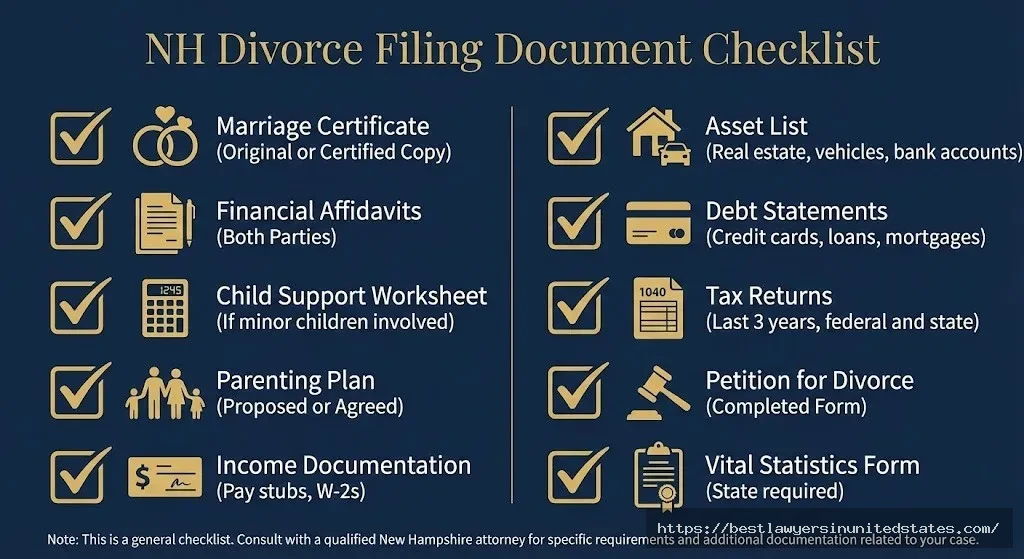
Step-by-Step Filing Process
1. Meet Residency Requirements: You or your spouse must have lived in New Hampshire for at least one year before filing. If the reason for divorce occurred in New Hampshire, you can file immediately after establishing residency.
2. Gather Required Documents:
- Marriage certificate
- Financial affidavits from both spouses
- Child support worksheet (if applicable)
- Proposed parenting plan (if you have children)
- Documentation of income, assets, and debts
3. Complete Divorce Forms: New Hampshire requires specific forms available from the Circuit Court. For an uncontested divorce, you’ll need:
- Petition for Divorce
- Uniform Support Order
- Final Decree of Divorce
- Financial Affidavit
- Various supporting documents
4. File Your Petition ($250 filing fee): Submit your completed forms to the Circuit Court – Family Division in the county where you or your spouse lives. Pay the $250 filing fee unless you’ve been granted a fee waiver.
5. Serve Your Spouse: If filing individually, you must serve your spouse with divorce papers. Options include:
- Acceptance of Service form (free, if spouse cooperates)
- Service by sheriff ($50-$75)
- Service by process server ($75-$150)
- Service by certified mail (allowed in some circumstances)
6. Wait for Response: Your spouse has 30 days to respond to the divorce petition. In uncontested cases, they typically sign an Appearance and Waiver.
7. Complete Mandatory Parenting Class (if applicable): If you have minor children, both parents must attend a state-approved parenting education program before the final hearing.
8. Attend Final Hearing: The court schedules a hearing where a judge reviews your agreement or decides contested issues. In simple uncontested cases, this hearing lasts 15-30 minutes.
9. Obtain Final Decree: After the judge approves your divorce, the court issues a Final Decree of Divorce, which becomes effective immediately.
Is New Hampshire a 50/50 Divorce State?
No, New Hampshire follows “equitable distribution” rather than community property (50/50 split). The court divides marital property fairly based on multiple factors, but “fair” doesn’t always mean “equal.”
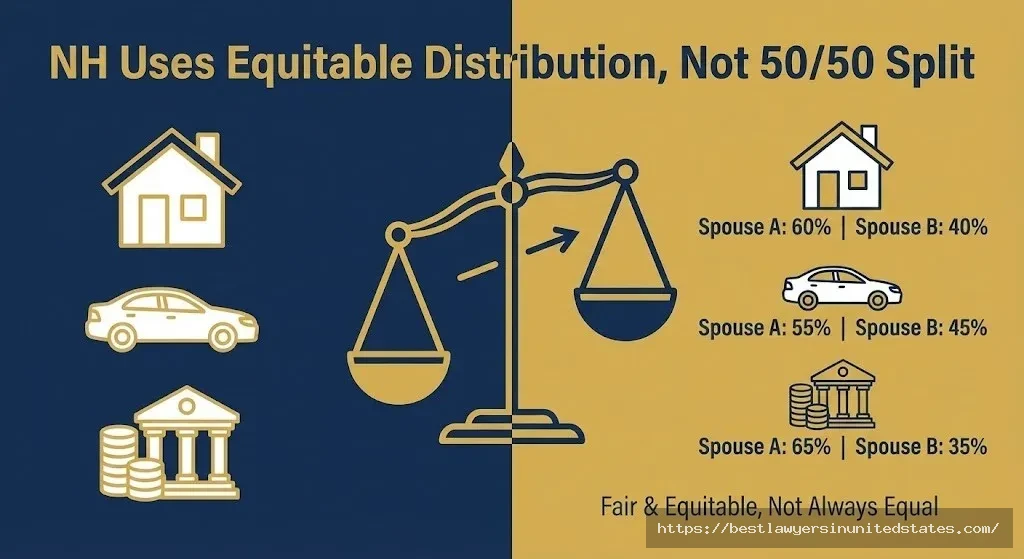
How New Hampshire Divides Property
Under New Hampshire RSA 458:16-a, courts consider:
- Duration of the marriage
- Age and health of both spouses
- Occupation and employability
- Amount and sources of income
- Vocational skills and employability
- Value of property each spouse brought to the marriage
- Contributions to the marriage (including homemaking)
- Economic circumstances of each spouse
- Tax consequences
- Any other relevant factors
Example: If one spouse worked while the other stayed home raising children for 20 years, the working spouse might receive 55-60% of assets to account for their continued earning capacity, while the homemaker spouse receives 40-45% plus alimony. Every case is unique.
Separate Property: Property owned before marriage or inherited during marriage typically remains separate, though the increase in value during marriage might be considered marital property.
What Is a Wife Entitled to in a Divorce in New Hampshire?
New Hampshire law doesn’t distinguish between husbands and wives—both spouses have equal rights to marital property and support regardless of gender. What matters is each spouse’s financial circumstances and contributions to the marriage.
Potential Entitlements
Property Division: A fair share of marital assets including the family home, vehicles, retirement accounts, bank accounts, and other property acquired during marriage.
Alimony: If one spouse earns significantly more or if one spouse sacrificed career advancement to raise children or support the other’s career, alimony may be appropriate. Awards depend on length of marriage, income disparity, and ability to become self-supporting.
Child Custody and Support: New Hampshire courts prioritize children’s best interests when determining custody. Child support follows state guidelines based on both parents’ incomes and parenting time allocation.
Retirement Benefits: Retirement accounts accumulated during marriage are typically divided, even if only in one spouse’s name. This might include 401(k)s, pensions, and IRAs.
The key principle is fairness based on circumstances, not automatic 50/50 splits or gender-based entitlements.
How Do I Protect Myself Financially in a Divorce?
Protecting your financial interests during divorce requires proactive steps, especially early in the process.
Financial Protection Strategies
Document Everything: Before announcing divorce intentions, make copies of:
- Tax returns (last 3-5 years)
- Bank statements
- Investment account statements
- Retirement account statements
- Credit card statements
- Mortgage and loan documents
- Property deeds and titles
- Business records (if applicable)
- Pay stubs and income documentation
Open Individual Accounts: Establish bank accounts and credit cards in your name only. This protects you if your spouse drains joint accounts or runs up debt.
Monitor Credit Reports: Check your credit report monthly during divorce proceedings. Freeze joint credit cards and notify credit bureaus if your spouse opens fraudulent accounts.
Update Beneficiaries (After Divorce): You can’t change beneficiaries on life insurance or retirement accounts during divorce proceedings, but update them immediately once your divorce is final.
Close Joint Accounts: Work with your attorney to close or freeze joint credit cards and lines of credit. Negotiate how to handle joint account balances in your settlement agreement.
Understand Your Expenses: Track your actual monthly living expenses in detail. This information is crucial for calculating child support, alimony, and your post-divorce budget.
Get Professional Valuations: Don’t guess at the value of your home, business, or other major assets. Professional appraisals provide accurate numbers for negotiations.
Consider Tax Implications: Property division has tax consequences. A $100,000 traditional IRA isn’t equivalent to $100,000 in a savings account due to taxes owed when you withdraw IRA funds.
Hire a Financial Advisor: A Certified Divorce Financial Analyst (CDFA) can help you understand the long-term financial implications of settlement proposals, often saving you far more than their fee.
What Money Can’t Be Touched in a Divorce?
New Hampshire law protects certain assets from division in divorce, though exceptions exist depending on circumstances.
Protected Assets
Inheritance Received: Property inherited by one spouse during the marriage typically remains that spouse’s separate property, as long as it wasn’t commingled with marital assets.
Gifts from Third Parties: Gifts given specifically to one spouse (not the couple) generally remain separate property.
Property Owned Before Marriage: Assets you owned before getting married usually stay yours, though any increase in value during marriage might be considered marital property.
Personal Injury Settlements: Compensation received for personal injuries to one spouse is typically considered separate property, except for portions covering lost wages or medical expenses paid from marital funds.
Property Excluded by Prenuptial Agreement: Valid prenuptial agreements can designate certain property as separate and protected from division.
When “Separate” Property Becomes Marital
Commingling: If you deposit inherited money into a joint account and use it for marital expenses, it becomes marital property. If you put your spouse’s name on a deed to property you owned before marriage, you’ve likely made it marital property.
Transmutation: Using marital funds to improve separate property (like renovating a house owned before marriage) can transform some or all of that property into a marital asset.
The best protection is keeping separate property completely separate—different accounts, clear documentation, and no mixing with marital funds.
Can I File for Divorce Online in New Hampshire?
You can complete and file divorce paperwork online in New Hampshire through the court’s e-filing system, though this doesn’t mean an entirely virtual divorce process. You’ll still need to appear in court for your final hearing in most cases.
Online Filing Process
Document Preparation: Several online services help NH residents prepare divorce forms by answering questions through a guided interview. These services cost $150-$500 and generate court-ready documents, though they cannot provide legal advice.
E-Filing System: New Hampshire courts accept electronic filing of divorce documents through the state’s e-filing portal. You’ll need to create an account, upload your documents, and pay the $250 filing fee electronically.
Virtual Hearings: Since 2020, many New Hampshire family courts offer virtual final hearings for uncontested divorces via Zoom or similar platforms. Availability varies by county and case complexity. Contact your local Circuit Court to ask about virtual hearing options.
Limitations: Contested divorces requiring extensive hearings typically need in-person court appearances. Online services work best for simple, uncontested cases where both parties cooperate fully.
Who Pays the Fees in a Divorce?
In New Hampshire, each spouse typically pays their own attorney fees, though courts have authority to order one spouse to pay some or all of the other’s legal costs in specific circumstances.
Fee Payment Standards
General Rule: Under normal circumstances, each party bears their own legal expenses. If you hire an attorney charging $300/hour and bill 40 hours of work, you owe $12,000 regardless of your spouse’s financial situation.
Court-Ordered Fee Payments: New Hampshire RSA 458:17 allows judges to order one spouse to pay the other’s attorney fees when:
- There’s a significant income disparity between spouses
- One spouse has substantially more access to marital funds
- One spouse caused unnecessary litigation costs through bad faith or frivolous claims
- Fairness requires cost-sharing to ensure both parties can afford legal representation
Strategic Considerations: Courts are more likely to order fee payments in cases involving:
- One spouse being a homemaker with no independent income
- Hidden assets or income requiring extensive discovery
- Domestic violence situations
- One spouse unreasonably prolonging litigation
Filing Fee: The person filing for divorce pays the $250 court filing fee initially. This can be allocated differently in the final settlement, though typically isn’t worth negotiating over given its relatively small amount.
If you’re concerned about affording legal representation, raise this issue with the court early. Judges can order interim attorney fee payments to level the playing field.
How to Reduce Divorce Costs in New Hampshire
Divorce doesn’t have to drain your savings. Strategic approaches can substantially reduce your total costs while still protecting your interests.
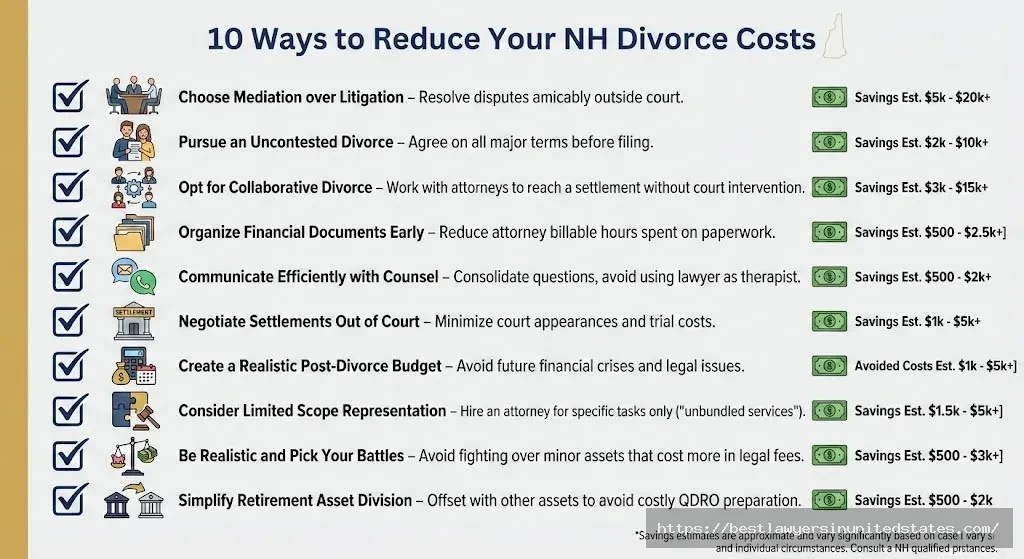
10 Money-Saving Strategies
1. Start with Mediation: Rather than immediately hiring attorneys and filing in court, try divorce mediation first. A neutral mediator helps you negotiate all divorce terms at a fraction of litigation costs. Even if mediation doesn’t resolve everything, partial agreements reduce billable hours.
2. Choose Collaboration Over Litigation: Collaborative divorce involves both parties and their attorneys committing to settle without court intervention. This structured process costs more than DIY but far less than courtroom battles.
3. Organize Financial Documents Yourself: Gather bank statements, tax returns, pay stubs, mortgage documents, and retirement account statements before meeting your attorney. Every hour you spend organizing is an hour you’re not paying $250-$400 for attorney document review.
4. Communicate Directly When Possible: If you and your spouse can discuss minor issues civilly, do so via email rather than having attorneys play telephone at $300/hour each. Save attorney involvement for complex legal matters and negotiations.
5. Be Reasonable About Settlement Demands: Unrealistic demands lead to extended negotiations, additional court hearings, and mounting legal fees. Understanding New Hampshire law helps you evaluate what courts typically order, making settlement more likely.
6. Respond to Requests Promptly: Delays cost money. When your attorney requests documents or needs decisions, respond quickly. Rushed work closer to deadlines often requires more billable hours.
7. Limit Attorney Involvement Strategically: Consider handling routine paperwork yourself while hiring an attorney for limited tasks like reviewing your final agreement or representing you at critical hearings.
8. Attend Free Legal Clinics: New Hampshire offers free legal clinics where volunteer attorneys provide basic guidance. While they can’t represent you, they can answer questions and review documents—potentially saving you several billable hours.
9. File a Joint Petition: When both spouses file together in an uncontested divorce, you split the filing fee, avoid service costs, and signal cooperation to the court—often resulting in faster processing.
10. Understand Billing Practices: Ask your attorney about billing increments. Some attorneys bill in 15-minute increments, others in 6-minute increments. A 6-minute phone call billed in 15-minute increments costs 2.5 times more than necessary.
Bonus Strategy: Stay off social media and avoid workplace drama during your divorce. Many expensive court battles stem from one spouse’s inflammatory social media posts or workplace misconduct that complicates negotiations.
How to Afford Your Divorce: Payment Options and Resources
Financial constraints shouldn’t prevent you from ending an unhealthy marriage or protecting your legal rights. New Hampshire offers several resources for people who can’t afford traditional divorce costs.
Payment Plans
Attorney Payment Plans: Many New Hampshire family law attorneys offer payment plans for the retainer fee, allowing you to pay $500-$1,000 monthly rather than $5,000 upfront. Ask about payment options during initial consultations.
Credit Cards: While not ideal due to interest rates, credit cards provide temporary financing for divorce costs. Some people use 0% introductory APR cards to spread payments over 12-18 months interest-free.
Personal Loans: Banks and credit unions offer personal loans with fixed monthly payments. Rates depend on your credit score but are typically lower than credit card interest.
Borrowing from Retirement Accounts: You can borrow from your 401(k) without penalties if your plan allows loans. However, this reduces your retirement savings and must be repaid with interest. Generally not recommended unless absolutely necessary.
Free and Low-Cost Legal Resources
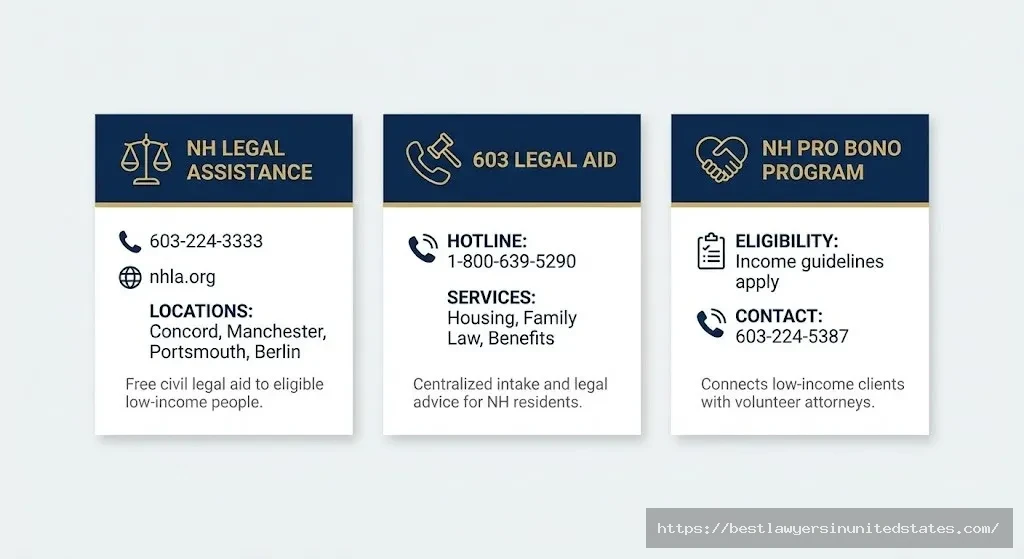
New Hampshire Legal Assistance (NHLA): This nonprofit provides free civil legal services to low-income NH residents. Income eligibility is generally at or below 125% of the federal poverty level. Services include divorce representation, advice, and document preparation.
- Phone: 603-224-3333
- Website: nhla.org
- Office locations: Concord, Manchester, Berlin, Portsmouth, Claremont, Conway
603 Legal Aid: Offers free legal assistance to eligible New Hampshire residents in civil matters including family law. Services include advice, document review, and limited representation.
- Statewide Legal Advice & Referral Center: 1-800-639-5290
- Website: 603legalaid.org
NH Pro Bono Program: Volunteer attorneys provide free representation to low-income individuals through the New Hampshire Bar Association. Eligibility is based on income and asset guidelines.
- Phone: 603-715-3210
- Website: nhbar.org/probono
Court Self-Help Centers: New Hampshire Circuit Court locations offer self-help centers where staff provide forms, basic procedural information, and resource referrals. They cannot provide legal advice but can help you understand court requirements.
Law School Clinics: Franklin Pierce School of Law operates legal clinics where supervised law students provide free or low-cost assistance to qualifying individuals.
Fee Waivers
If your income is at or below 200% of the federal poverty guidelines, you can request a waiver of the $250 court filing fee by filing:
- Motion to Waive Filing Fees
- Financial Affidavit detailing income, expenses, assets, and debts
The court reviews your financial situation and grants the waiver if you genuinely cannot afford the fee. This doesn’t waive other costs like service fees or attorney costs, but it removes a significant initial barrier.
What Are the Grounds for Divorce in New Hampshire?
New Hampshire allows both fault-based and no-fault divorce grounds. Most people file no-fault divorces because they’re simpler, less expensive, and don’t require proving wrongdoing.
No-Fault Grounds
Irreconcilable Differences: This catch-all ground means the marriage is irretrievably broken with no chance of reconciliation. You don’t need to prove abuse, adultery, or any specific misconduct—just that the marriage cannot continue. This is the most common ground for divorce in New Hampshire.
Fault-Based Grounds
New Hampshire RSA 458:7 lists specific fault grounds:
- Impotence: Physical inability to consummate the marriage
- Adultery: Sexual relations with someone other than your spouse
- Extreme cruelty: Physical or mental cruelty that endangers life or health
- Conviction of a crime: Felony conviction punishable by more than one year imprisonment
- Treatment such as to seriously injure health or endanger reason: Ongoing abuse or cruelty
- Willful desertion and absence for two years: Abandonment of the marriage
- Habitual drunkenness for two years: Chronic alcohol abuse
- Joining a religious sect believing marriage unlawful and refusing cohabitation for six months
Why Consider Fault Grounds? Fault grounds might matter when:
- Seeking a larger share of marital property due to spouse’s misconduct
- Proving adultery to avoid paying alimony
- Demonstrating why sole custody is appropriate due to other parent’s behavior
However, proving fault grounds requires evidence, potentially including witness testimony, which increases litigation costs significantly. Unless fault impacts property division or custody substantially, no-fault divorce is usually more cost-effective.
Does New Hampshire Require Separation Before Divorce?
No, New Hampshire has no mandatory separation period before filing for divorce. You can file for divorce immediately after deciding to end your marriage, as long as you meet the residency requirement.
Residency Requirements
Before filing for divorce in New Hampshire, you must meet one of these residency requirements:
- One year residency: You or your spouse has lived in New Hampshire for at least one year immediately before filing
- In-state grounds: If the grounds for divorce occurred in New Hampshire, you can file immediately after establishing residency, without waiting one year
Domicile Requirement: Simply owning property in New Hampshire doesn’t establish residency. You must actually live in the state with the intent to remain indefinitely.
Why Separation Might Still Make Sense
Even though separation isn’t legally required, many couples choose to live apart before finalizing divorce for practical or strategic reasons:
- Testing whether separation might lead to reconciliation
- Establishing independent households and routines
- Creating physical and emotional space during a difficult process
- Documenting separate finances before formal divorce proceedings
- Demonstrating to children that the decision is serious and final
However, informal separation creates risks. Without a legal separation agreement, both spouses retain rights to jointly-titled property and can incur debt in the other’s name. If you separate, consult an attorney about formalizing the arrangement to protect yourself financially.
What Is the Biggest Mistake During a Divorce?
The costliest divorce mistake is letting emotions drive financial decisions. When anger, hurt, or revenge motivate your choices, you typically spend thousands fighting over items worth hundreds or principles that courts don’t value.
Common Costly Mistakes
Fighting Over the House for Emotional Reasons: Many people deplete savings battling to keep the family home, only to realize later they can’t afford the mortgage, taxes, and upkeep alone. The house represents memories, but it’s also just property. Calculate whether keeping it makes financial sense before spending $10,000 in legal fees to win it.
Using Your Attorney as a Therapist: At $250-$400 per hour, your attorney is the world’s most expensive counselor. Hire a therapist for emotional support (typically $100-$200 per session) and use your attorney exclusively for legal strategy.
Hiding Assets: Attempting to conceal bank accounts, income, or property almost always backfires. Discovery rules allow attorneys to subpoena financial records, and judges harshly penalize parties who lie under oath. The cost of being caught—both financial and credibility-wise—far exceeds any temporary advantage.
Moving Out Too Quickly: Leaving the marital home without a legal agreement can hurt your claim to the property and complicate custody arrangements. While remaining in a hostile environment is difficult, consult an attorney before moving to understand the implications.
Ignoring Tax Consequences: Property division involves significant tax considerations. Retirement accounts, capital gains on home sales, and dependency exemptions all affect your post-divorce financial picture. A $100,000 traditional IRA isn’t worth the same as $100,000 in a savings account.
Refusing Reasonable Settlement Offers: Going to trial costs $10,000-$30,000+ more than settling. If your spouse offers a settlement 5% less favorable than you hoped for, spending $20,000 in additional attorney fees to gain $5,000 in property is terrible math.
Prioritizing Possessions Over Financial Security: Spending $5,000 fighting over furniture worth $3,000 is emotional decision-making. Focus on assets that affect your long-term financial stability—retirement accounts, income-producing property, and liquid assets.
Why Is Moving Out the Biggest Mistake in a Divorce?
Moving out of the marital home before finalizing a divorce settlement or legal agreement can negatively impact property rights and child custody arrangements, though it’s not always catastrophic.
Potential Consequences of Moving Out
Property Rights: In New Hampshire’s equitable distribution system, leaving the home doesn’t automatically mean you forfeit ownership. However, it can complicate negotiations. Your spouse might argue they should keep the house because they maintained it and paid expenses while you were gone. Courts can still divide home equity fairly, but you’ve given your spouse possession and some leverage.
Child Custody Impact: If you have children and move out while they remain in the marital home with your spouse, you’ve established a status quo where your spouse is the primary caregiver. Courts prefer maintaining children’s stability and routine. Disrupting an established arrangement requires showing it’s in the children’s best interest—a high bar to clear.
Perception of Abandonment: While New Hampshire requires two years of willful desertion as a fault ground for divorce, leaving the home can still create perception issues. Your spouse might characterize your departure as abandonment, potentially affecting alimony or property division negotiations.
When Moving Out Makes Sense
Despite these risks, staying isn’t always appropriate or safe:
- Domestic violence situations: Your safety comes first. Leave and seek a protective order if you’re in danger.
- Toxic environment harming children: If conflict between parents is severe, separation might benefit children.
- After temporary agreement: With a written agreement about property, expenses, and parenting time, moving out is safer.
Best Practice: Before moving out, consult a family law attorney. They can help you negotiate a temporary separation agreement that protects your property rights and establishes a parenting schedule if you have children. Having an agreement in writing before you leave protects your interests substantially.
What Is the 10 10 10 Rule for Divorce?
The “10/10/10 rule” refers to military pension division requirements under federal law, specifically when a former spouse can receive direct payment from the Defense Finance and Accounting Service (DFAS).
Military Pension Division Rules
The 10/10/10 Requirement:
- The couple must have been married for at least 10 years
- At least 10 years of the marriage must overlap with 10 years of creditable military service
- The member must have performed at least 10 years of service creditable for retirement
What It Means: When these requirements are met, the former spouse can receive their portion of the military pension directly from DFAS rather than relying on the service member to forward payments. However, this rule determines payment method, not entitlement. Even marriages shorter than 10 years may result in pension division—the former spouse just receives payment from the service member directly rather than from DFAS.
New Hampshire Application: New Hampshire courts can divide military pensions as marital property regardless of marriage length. The 10/10/10 rule only affects the direct payment mechanism, not whether the pension is divisible property.
General “10-Year Rules”
The “10-year rule” also appears in other divorce contexts:
Social Security Benefits: A divorced spouse can claim Social Security benefits based on their ex-spouse’s earnings record if the marriage lasted at least 10 years.
State Pension Plans: Some state retirement systems have 10-year marriage requirements for pension division or survivor benefits, though this varies by plan.
These rules emphasize why understanding the specific benefits and retirement accounts in your divorce is crucial. A marriage ending in year nine might mean walking away from significant long-term benefits—knowledge that should inform settlement negotiations.
What Is the 1-3 Rule for Alimony?
While New Hampshire doesn’t have a codified “1-3 rule” for alimony, family law attorneys sometimes reference informal guidelines for estimating spousal support duration based on marriage length.
Common Duration Guidelines
General Principle: Alimony typically lasts approximately one-third to one-half the length of the marriage, though this varies dramatically based on circumstances.
Short-Term Marriages (Under 5 years): Courts rarely award permanent alimony. If awarded, support might last 1-3 years to allow the lower-earning spouse to become self-sufficient through education or job training.
Medium-Term Marriages (5-20 years): Alimony might last from one-third to one-half the marriage length. A 12-year marriage might result in 4-6 years of support, allowing the recipient time to upgrade skills and increase earning capacity.
Long-Term Marriages (20+ years): Courts more frequently award long-term or permanent alimony, especially when one spouse sacrificed career advancement for homemaking and child-rearing. A 30-year marriage where one spouse was the primary earner might result in alimony lasting decades or until the paying spouse’s retirement.
Actual Alimony Factors in New Hampshire
New Hampshire RSA 458:19 requires courts to consider these factors when determining alimony amount and duration:
- Length of the marriage
- Age, health, and social/economic status of each party
- Occupation and employability
- Vocational skills and employment opportunities
- Income and property awarded in property division
- Opportunity for future acquisition of capital assets and income
- Ability of each party to pay alimony
- Fault in the marital breakdown (if claimed)
- Federal tax consequences
- Other relevant factors
Key Insight: New Hampshire courts have significant discretion in alimony decisions. The “1-3 rule” is a rough starting point for negotiations, not a legal requirement. Factors like health issues, disability, age at divorce, and earning capacity differences can result in substantially longer or shorter alimony periods than rough guidelines suggest.
Free and Low-Cost Legal Resources in New Hampshire
If you’re concerned about affording divorce legal help, several New Hampshire organizations provide assistance to qualifying residents.
Legal Aid Organizations
New Hampshire Legal Assistance (NHLA)
- Services: Free legal representation and advice for low-income NH residents in civil matters including divorce, custody, and domestic violence
- Eligibility: Generally 125% of federal poverty level or below
- Contact: 603-224-3333 | nhla.org
- Offices: Concord, Manchester, Berlin, Portsmouth, Claremont, Conway
- Areas served: Statewide
603 Legal Aid
- Services: Free legal advice, document review, and limited representation
- Statewide Legal Advice & Referral Center: 1-800-639-5290
- Website: 603legalaid.org
- Walk-in hours: Available at various locations across New Hampshire
NH Pro Bono Referral Program
- Services: Volunteer attorneys provide free representation to low-income individuals
- Eligibility: Based on income and asset guidelines (typically 200% of federal poverty level)
- Contact: 603-715-3210 | nhbar.org/probono
- Administered by: New Hampshire Bar Association
Court Resources
Family Division Self-Help Centers
- Services: Court staff provide forms, procedural information, and resource referrals (cannot provide legal advice)
- Cost: Free
- Locations: At Circuit Court – Family Division offices statewide
- Resources: Divorce forms, instructions, procedural guides
Law Libraries
- Services: Access to legal research materials and self-help resources
- Locations: County courthouses and law schools
- Cost: Free public access
Legal Clinics and Workshops
Free Legal Clinics
- Various organizations throughout New Hampshire offer periodic free legal clinics where volunteer attorneys provide brief consultations
- Check with local bar associations and legal aid offices for scheduled clinic dates
Franklin Pierce School of Law Clinics
- Law students supervised by experienced attorneys provide free or reduced-cost legal services to qualifying individuals
- Contact: Franklin Pierce School of Law for current clinic offerings and eligibility
Domestic Violence Resources
New Hampshire Coalition Against Domestic and Sexual Violence
- 24-Hour Statewide Hotline: 1-866-644-3574
- Services: Crisis support, safety planning, legal advocacy, referrals
- Website: nhcadsv.org
- Member crisis centers throughout New Hampshire provide free legal advocacy for domestic violence survivors
Frequently Asked Questions
How much does it cost to file for divorce in NH?
The court filing fee is $250 statewide. Total costs range from $500 (simple DIY uncontested) to $40,000+ (complex contested). Average costs are $8,000-$15,000 including attorney fees.
How long does a divorce take in New Hampshire?
Uncontested divorces take 2-4 months minimum. Contested divorces requiring court hearings take 9-24+ months depending on complexity and court calendar availability.
Can I get a free divorce in New Hampshire?
You can potentially get a free divorce if you qualify for a court fee waiver and receive free legal representation from NH Legal Assistance or pro bono attorneys. You must meet income eligibility requirements (typically at or below 125-200% of federal poverty level).
Do I need a lawyer to get divorced in NH?
No, New Hampshire allows self-representation. However, hiring an attorney is strongly recommended for contested cases, cases involving children, significant assets, or when your spouse has an attorney.
What is the cheapest way to get divorced in New Hampshire?
File a joint petition for an uncontested divorce without attorneys. Total cost: $250 filing fee plus minimal document costs. Online document preparation services charge $150-$500 if you need help with forms.
Is New Hampshire a 50/50 divorce state?
No, New Hampshire uses equitable distribution, meaning property is divided fairly based on multiple factors, not automatically split 50/50. The court considers marriage length, each spouse’s contributions, earning capacity, and other relevant factors.
How much does a divorce lawyer cost in NH?
Attorney hourly rates range from $175-$425 per hour depending on location and experience. Retainers typically range from $2,500-$8,000. Simple uncontested divorces might have flat fees of $1,500-$3,500.
What is the fastest way to get a divorce in NH?
File a joint petition for an uncontested divorce where both parties agree on all terms. The court still requires minimum processing time (typically 2-4 months), but cooperation eliminates delays from contested issues and multiple hearings.
Can I file for divorce online in New Hampshire?
Yes, you can prepare forms using online services and file them electronically through the NH court system. However, you’ll still need to attend a final hearing (potentially virtual in some counties for uncontested cases).
Does NH require separation before divorce?
No, New Hampshire has no mandatory separation period. You can file for divorce immediately after meeting the one-year residency requirement (or immediately if grounds occurred in NH).
Who pays attorney fees in a divorce?
Each party typically pays their own attorney fees. However, courts can order one spouse to pay some or all of the other’s legal costs if there’s significant income disparity or to ensure fair access to legal representation.
What is a wife entitled to in a divorce in NH?
New Hampshire law doesn’t distinguish by gender—both spouses are entitled to a fair share of marital property based on contributions, needs, and circumstances. This may include property division, alimony, child support, and custody based on individual case factors.
Can I get alimony in NH?
Potentially yes, if there’s income disparity and one spouse cannot maintain a reasonable standard of living independently. Courts consider marriage length, age, health, earning capacity, and contributions when deciding alimony amount and duration.
How do I protect my money in a divorce?
Document all assets and debts, open individual bank accounts, monitor credit reports, avoid hiding assets, understand tax implications, and hire a qualified attorney or financial advisor to guide property division negotiations.
What happens if I can’t afford a divorce?
Apply for a court fee waiver, contact NH Legal Assistance or 603 Legal Aid for free legal help if you’re low-income, or ask attorneys about payment plans. Pro bono programs may provide free representation to qualifying individuals.
What are grounds for divorce in New Hampshire?
No-fault (irreconcilable differences) or fault-based grounds including adultery, extreme cruelty, abandonment, imprisonment, or habitual drunkenness. Most people file no-fault divorces as they’re simpler and less expensive.
What is the 10 10 10 rule for divorce?
This military pension rule means a former spouse can receive direct payment from DFAS when: (1) marriage lasted 10+ years, (2) 10+ years overlapped with military service, and (3) member served 10+ creditable years. This affects payment method, not entitlement to pension division.
How much does mediation cost in NH?
Divorce mediators in New Hampshire charge $150-$350 per hour. Most couples complete mediation in 4-8 sessions, resulting in total costs of $2,400-$5,600—significantly less than litigation.
What if my spouse won’t agree to divorce?
New Hampshire doesn’t require both spouses to agree. You can file for divorce yourself based on irreconcilable differences. If your spouse doesn’t respond or contests, the case proceeds as a contested divorce, which takes longer and costs more.
Can I date during my divorce?
Legally yes, since you’re still married until the final decree. However, dating during divorce can complicate property division and custody negotiations, provide ammunition to your spouse’s attorney, and may be considered adultery if you’re still cohabiting with your spouse.
Ready to move forward with your divorce in New Hampshire? Understanding the costs involved helps you plan effectively and make informed decisions. Whether you pursue an uncontested divorce, mediation, or full legal representation, knowing your options and resources empowers you to navigate this challenging process with greater confidence and financial awareness.
For complex cases or when significant assets are at stake, consulting with an experienced New Hampshire family law attorney is worth the investment. Many attorneys offer free initial consultations where you can discuss your situation and receive personalized cost estimates based on your specific circumstances.