
Connecticut treats DUI charges seriously. A first offense can mean up to six months in jail and $1,000 in fines. Your license gets suspended for 45 days minimum. You face these penalties even if nobody got hurt.
This guide explains Connecticut DUI laws under CGS 14-227a. You’ll learn exact penalties for each offense level, how much a DUI really costs, and what steps to take if you’re arrested. The state’s Impaired Driver Intervention Program (IDIP) may help first-time offenders avoid conviction.
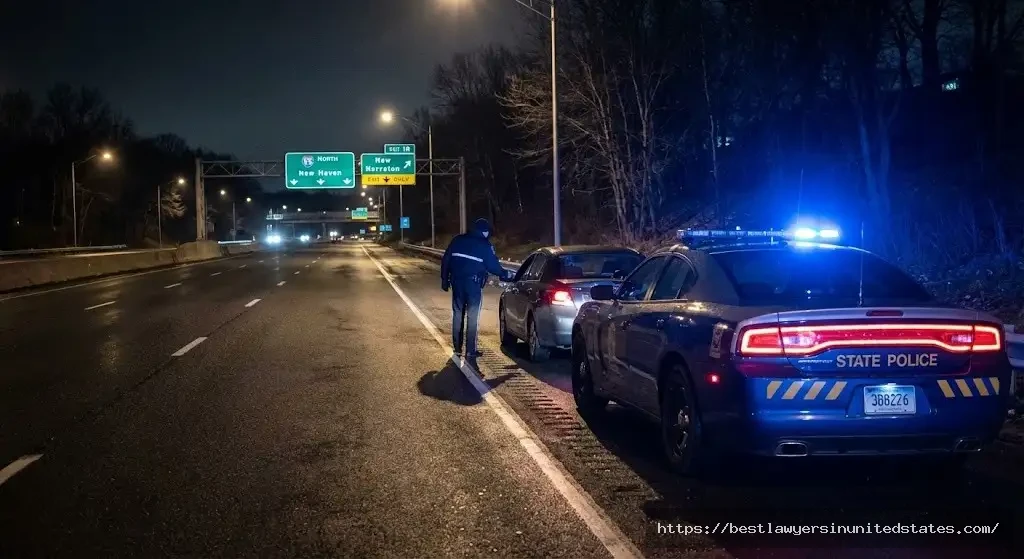
Time matters after a DUI arrest. You have just 10 days to request a DMV hearing or you lose your license automatically. Connecticut runs two separate cases against you: one criminal case in court and one administrative case with the DMV.
What Connecticut Law Says About DUI
Connecticut General Statute 14-227a makes it illegal to operate a vehicle with a blood alcohol content of .08 or higher. The state uses the same legal standard whether you call it DUI, DWI, or OUI. All three terms mean the same thing in Connecticut courts.
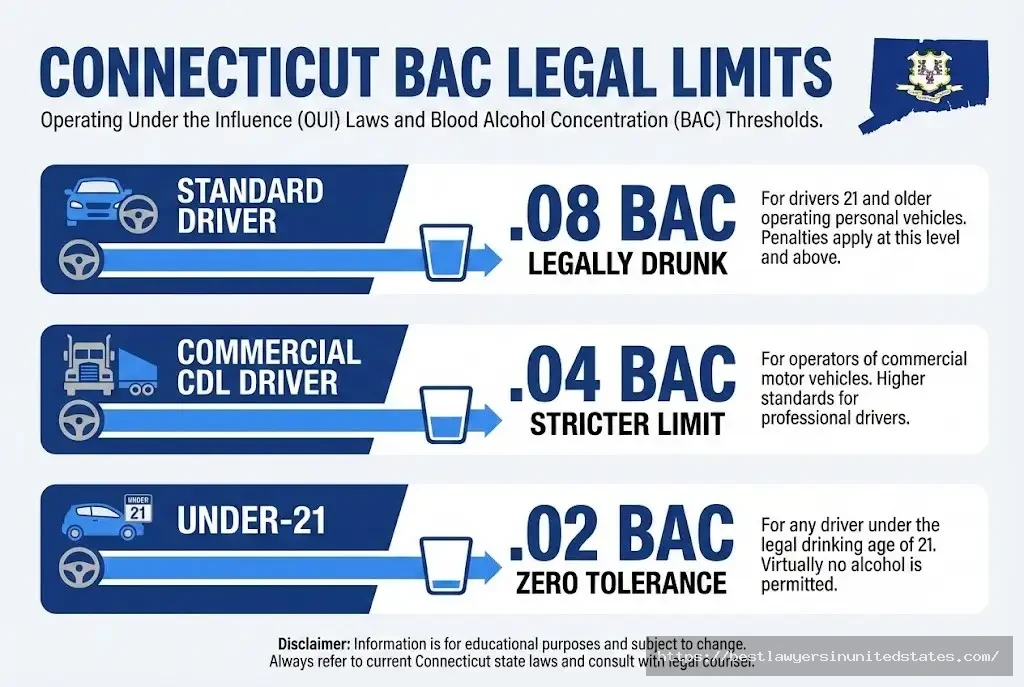
Connecticut follows a “per se” law. This means prosecutors don’t need to prove you drove poorly. A BAC test result of .08 or above is enough evidence for a conviction. You can still face charges even below .08 if the officer believes you’re impaired.
The state’s implied consent law is key. When you got your Connecticut driver’s license, you agreed to submit to chemical testing if arrested for DUI. Connecticut State Police and local departments use this law to require breath, blood, or urine tests.
Connecticut BAC Limits
| Driver Type | Legal BAC Limit |
|---|---|
| Standard drivers (21+) | .08 |
| Commercial drivers (CDL) | .04 |
| Drivers under 21 | .02 |
Connecticut enforces zero tolerance for underage drinking and driving. Anyone under 21 with a BAC of .02 or higher faces license suspension, even though they’re below the standard .08 limit.
Check Your BAC Level
Not sure if you’re over the legal limit? Use our interactive BAC calculator to estimate your blood alcohol content based on your weight, drinks consumed, and time elapsed.
BAC Calculator
Estimate your Blood Alcohol Content
• Commercial Driver (CDL): 0.04% BAC
• Drivers Under 21: 0.00-0.02% BAC (Zero Tolerance)
• Enhanced Penalties: 0.15% BAC or higher in most states
Our calculator shows Connecticut’s specific legal thresholds (.08 standard, .02 under-21, .04 CDL). It also estimates how long until your BAC returns to zero. This helps you understand the “morning after” DUI risk.
Connecticut DUI Penalties by Offense Level
First Offense DUI Penalties
A first DUI in Connecticut is a misdemeanor. The Connecticut Superior Court handles these cases in the Geographical Area (GA) court where you were arrested.
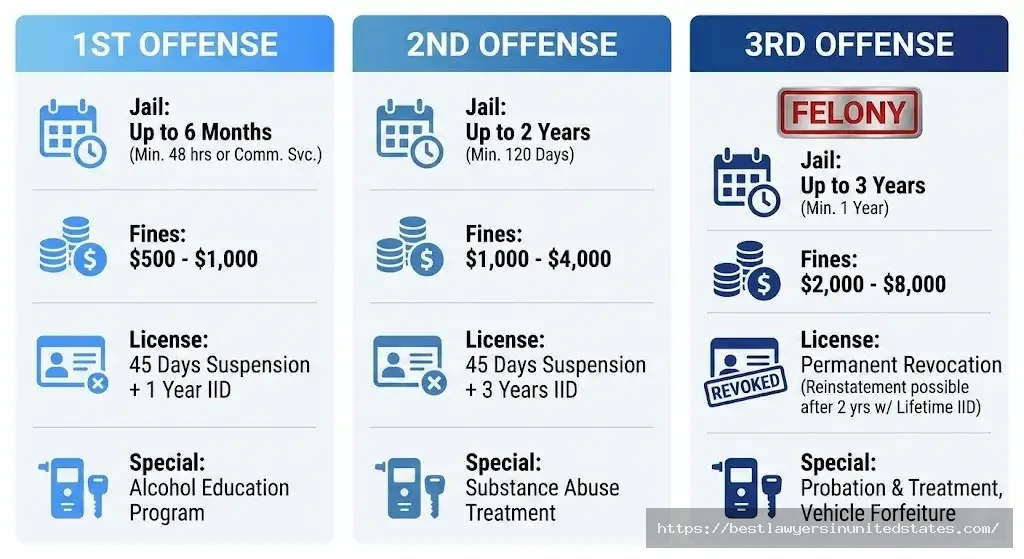
Criminal Penalties:
- Up to 6 months in jail (48 hours mandatory for BAC .16+)
- $500 to $1,000 fine
- 100 hours community service (possible)
- 2 years probation
License Suspension:
- 45 days minimum
- 1 year maximum
- Can apply for IDIP to reduce suspension
The Connecticut DMV suspends your license separately from any criminal penalties. First-time offenders often qualify for the Impaired Driver Intervention Program. Successful IDIP completion can result in case dismissal.
First Offense DUI Penalties Summary
| Penalty Type | First Offense (Standard BAC) | First Offense (High BAC .16+) |
|---|---|---|
| Jail Time | Up to 6 months | 48 hours mandatory minimum |
| Fines | $500 – $1,000 | $1,000 – $1,200 |
| License Suspension | 45 days – 1 year | 45 days – 1 year |
| Probation | Up to 2 years | Up to 2 years |
| Community Service | Possible (100 hours) | Possible (100 hours) |
| IDIP Eligible | Yes | Yes |
Second Offense DUI Penalties
A second DUI within 10 years brings mandatory jail time. Connecticut prosecutors rarely offer plea deals for second offenses, similar to how they handle cases in California and Colorado.
Criminal Penalties:
- 120 days to 2 years in jail (mandatory minimum 120 days)
- $1,000 to $4,000 fine
- 100 hours community service
- 3 years probation
License Consequences:
- 45 days to 3 years suspension
- Ignition Interlock Device required for 2 years
- SR-22 insurance required
The Connecticut DMV requires an Ignition Interlock Device (IID) on all vehicles you own or operate. You pay for installation and monthly monitoring. The device tests your breath before the car starts.
Second Offense DUI Penalties Summary
| Penalty Type | Second Offense |
|---|---|
| Jail Time | 120 days – 2 years (mandatory minimum) |
| Fines | $1,000 – $4,000 |
| License Suspension | 45 days – 3 years |
| Probation | Up to 3 years |
| IID Requirement | 2 years mandatory |
| Community Service | 100 hours |
| IDIP Eligible | No |
Third Offense DUI Penalties (Felony)
A third DUI becomes a Class D felony in Connecticut. You face prison time, not county jail. The Connecticut Department of Correction handles sentencing.
Criminal Penalties:
- 1 to 3 years in prison (mandatory minimum 1 year)
- $2,000 to $8,000 fine
- Permanent criminal record
- 3 years probation after release
License Consequences:
- Permanent revocation (possible)
- 2 to 3 years suspension minimum
- IID required for 3 years
- Must petition for reinstatement
Connecticut courts can permanently revoke your license after a third DUI. Even if you get it back, you’ll need an Ignition Interlock Device for at least three years. SR-22 insurance becomes mandatory for the rest of your driving life.
Third Offense DUI Penalties Summary
| Penalty Type | Third Offense (Felony) |
|---|---|
| Prison Time | 1 – 3 years (mandatory minimum) |
| Fines | $2,000 – $8,000 |
| License Revocation | 2 – 3 years (permanent possible) |
| Probation | 3 years |
| IID Requirement | 3 years minimum |
| Criminal Record | Permanent felony |
Fourth and Subsequent Offense DUI
A fourth DUI in Connecticut means enhanced felony charges. The state treats you as a habitual offender. Federal consequences may apply if you drove across state lines.
Penalties:
- 1 to 5 years prison (mandatory minimum increases)
- $2,000 to $10,000 fine
- Permanent license revocation (likely)
- Habitual offender status
- Federal charges (if applicable)
Connecticut shares DUI records with other states through the Driver License Compact. A fourth offense in Connecticut counts previous DUIs from Alabama, Arizona, or any other member state.
Judges rarely grant license reinstatement after a fourth offense. If they do, you’ll need an IID permanently. Employment becomes difficult with a felony record. Many employers won’t hire habitual DUI offenders.
Calculate Your Total DUI Costs
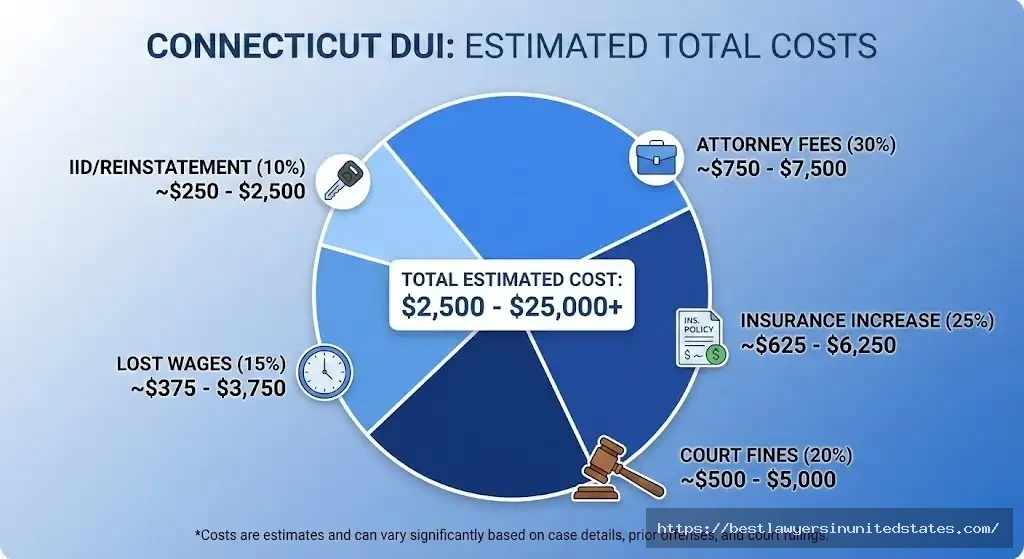
A Connecticut DUI costs much more than court fines. Use our calculator to see the real financial impact including attorney fees, increased insurance, and lost wages.
DUI Cost Calculator
Estimate total DUI expenses by state and offense
Detailed Cost Breakdown
Payment Timeline
Bail bond, towing fees, car impound, attorney retainer
Initial court fines, DMV fees, DUI school enrollment, ignition interlock installation
Monthly probation fees, ignition interlock fees, DUI school payments, attorney balance
Insurance premium increases, license reinstatement, SR-22 filing fees
- Lost wages from missed work (court dates, jail time, DUI school) – $2,000-$10,000
- Job loss or difficulty finding employment – Varies
- Professional license suspension (doctors, lawyers, nurses, pilots) – Career ending
- Rideshare and transportation costs during suspension – $1,500-$5,000
- Travel restrictions and visa denials – Varies
- Security clearance loss – Career impact
- Child custody implications – Legal costs
- Rental car restrictions – Varies
- Personal relationships and mental health costs – Priceless
The calculator shows:
- Court fines and fees by offense level
- Attorney costs ($2,500 – $10,000 typical range)
- License reinstatement fees ($175)
- Ignition Interlock Device costs ($1,200 – $2,000 per year)
- Insurance increases (60-80% higher for 3-5 years)
- Lost wages from jail time
- Total lifetime cost
What a Connecticut DUI Really Costs
Direct Court Costs
First Offense Costs:
- Court fines: $500 – $1,000
- Court fees: $150 – $300
- DMV reinstatement fee: $175
- Alcohol education program: $100 – $200
- Total direct costs: $925 – $1,675
Second Offense Costs:
- Court fines: $1,000 – $4,000
- Court fees: $200 – $400
- DMV reinstatement fee: $175
- IID installation: $75 – $150
- IID monthly monitoring: $720 – $1,080 per year
- Total direct costs: $2,170 – $5,805 (first year)
Third Offense Costs:
- Court fines: $2,000 – $8,000
- Court fees: $300 – $500
- DMV reinstatement fee: $175
- IID costs: $2,160 – $3,240 (3 years)
- Total direct costs: $4,635 – $11,915
Attorney Fees in Connecticut
DUI lawyers in Connecticut charge $2,500 to $10,000 for representation. Fees depend on:
- Case complexity
- Offense level
- Trial vs plea deal
- Attorney experience
Public defenders are free if you qualify. Connecticut determines eligibility based on income. You must apply through the court at your arraignment.
Most private attorneys offer free consultations. They review your case and explain your options before you pay anything.
Insurance Impact
Connecticut requires SR-22 insurance after a DUI conviction. This certificate proves you carry the state minimum coverage. Your insurance company files it with the Connecticut DMV.
Average Insurance Increases:
- First offense: 60% higher premiums
- Second offense: 80% higher premiums
- Third offense: 100%+ higher (many insurers drop you)
SR-22 insurance stays on your record for three years minimum. Some insurers require it longer. Your rates stay elevated even after SR-22 ends.
3-Year Insurance Cost Projection
| Scenario | Before DUI | After DUI | 3-Year Total Increase |
|---|---|---|---|
| First Offense | $1,200/year | $1,920/year | $2,160 extra |
| Second Offense | $1,200/year | $2,160/year | $2,880 extra |
| Third Offense | $1,200/year | $2,400+/year | $3,600+ extra |
Hidden DUI Costs
Lost Wages:
- Jail time (unpaid)
- Court appearances (missed work)
- License suspension (transportation issues)
- Job loss (felony conviction)
Other Expenses:
- Taxi/Uber during suspension: $50 – $200 per week
- Towing and impound fees: $200 – $500
- Bail bonds: $500 – $5,000
- Probation supervision fees: $30 – $50 per month
Total Lifetime DUI Cost Breakdown
| Cost Category | First Offense | Second Offense | Third Offense |
|---|---|---|---|
| Fines & Fees | $925 – $1,675 | $2,170 – $5,805 | $4,635 – $11,915 |
| Attorney | $2,500 – $5,000 | $3,500 – $7,500 | $5,000 – $10,000 |
| Insurance (3 yrs) | $2,160 | $2,880 | $3,600+ |
| Lost Wages | $2,000 – $5,000 | $10,000 – $30,000 | $20,000 – $50,000 |
| Transportation | $1,000 – $3,000 | $2,000 – $5,000 | $3,000 – $8,000 |
| Total | $8,585 – $17,835 | $20,550 – $51,185 | $36,235 – $83,515+ |
The DUI Arrest Process in Connecticut
What Happens During a Traffic Stop
Connecticut State Police and local police departments can stop you for any traffic violation. Common reasons include:
- Swerving between lanes
- Speeding
- Running red lights or stop signs
- Broken taillight
- Expired registration
The officer asks for your license and registration. They look for signs of intoxication: bloodshot eyes, slurred speech, alcohol smell. These observations go in the police report.
You must identify yourself and provide documents. You don’t have to answer questions about drinking. Politely say “I’d prefer not to answer that question.”
Field Sobriety Tests
The officer may ask you to perform roadside tests. Connecticut police use three Standardized Field Sobriety Tests (SFST):
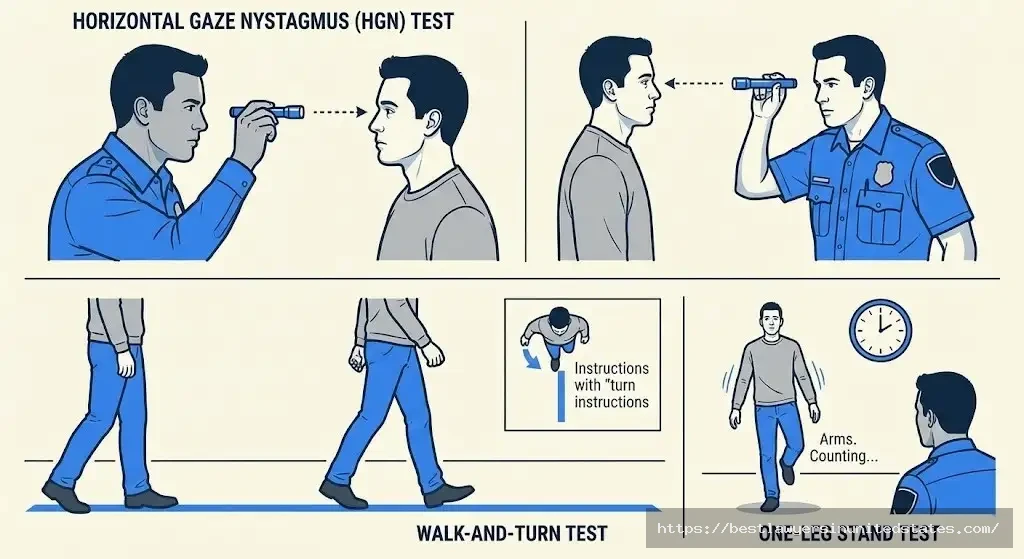
Horizontal Gaze Nystagmus (HGN):
- Officer moves a pen or light
- Watches your eye movements
- Checks for involuntary jerking
Walk and Turn:
- Walk heel-to-toe in a straight line
- Turn and walk back
- Tests balance and ability to follow instructions
One Leg Stand:
- Stand on one foot
- Count out loud
- Hold position for 30 seconds
Field sobriety tests are voluntary in Connecticut. You can refuse without penalty. But refusing gives the officer probable cause for arrest. Most DUI attorneys recommend polite refusal.
Breathalyzer and Chemical Testing
Connecticut’s implied consent law kicks in after arrest. You already agreed to chemical testing when you got your license. Refusing means automatic license suspension.
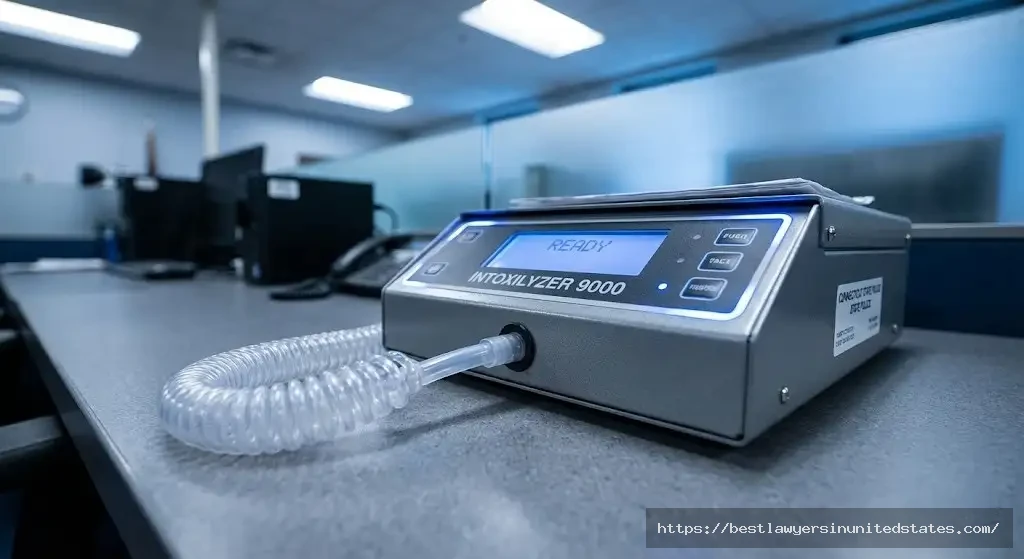
Breathalyzer Process:
- Officer takes you to the station
- You wait 15-20 minutes (observation period)
- You blow into an Intoxilyzer device
- Results print immediately
Connecticut uses the Intoxilyzer 9000. The device must be calibrated within 120 days. Your attorney can challenge calibration records in court.
Blood Test Alternative:
- Hospital or medical facility
- Licensed medical professional draws blood
- Lab analyzes sample
- Results take 2-4 weeks
You can request a blood test instead of breath. Connecticut must provide one if available. Blood tests are often more accurate than breath tests.
Refusal Consequences
Refusing chemical testing in Connecticut triggers harsh penalties:
- Immediate license suspension (6 months first offense)
- 1 year suspension for second refusal
- Refusal used as evidence in criminal trial
- No IDIP eligibility
Connecticut DMV suspends your license before your criminal trial. This administrative suspension runs separately from any criminal penalties. Many drivers face two suspensions: one for refusal, one for conviction.
Refusal Penalties
| Refusal Number | License Suspension | Criminal Case Impact |
|---|---|---|
| First Refusal | 6 months | Can be used as evidence |
| Second Refusal | 1 year | Can be used as evidence |
| Third+ Refusal | 2 years | Can be used as evidence |
Arrest and Booking
The officer takes you to the police station or Connecticut State Police barracks. The booking process includes:
At the Station:
- Fingerprints taken
- Photo (mugshot)
- Personal property inventory
- Chemical test
- Bond hearing (sometimes)
Connecticut releases most first-time DUI offenders on a Promise to Appear. You sign a paper agreeing to show up in court. No bail money required.
Second and third offenses often require bail. Amounts range from $500 to $5,000. You can pay cash or use a bail bondsman. Connecticut bondsmen charge 10% of the total bail.
DMV Hearing vs Criminal Court
Connecticut runs two parallel processes after a DUI arrest. Understanding both is critical.
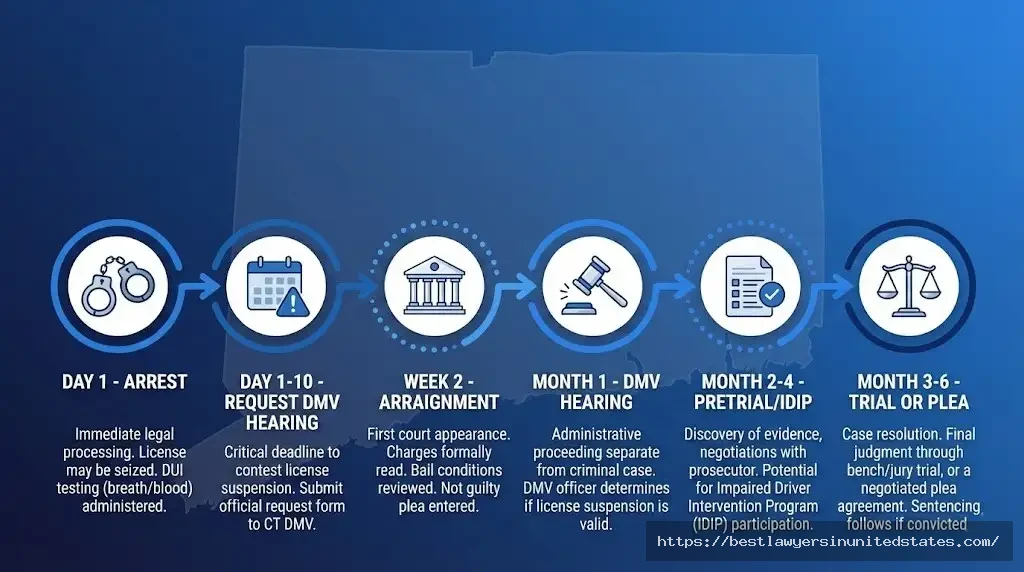
The Administrative License Suspension
The Connecticut DMV starts a separate case against your license. This has nothing to do with your criminal trial.
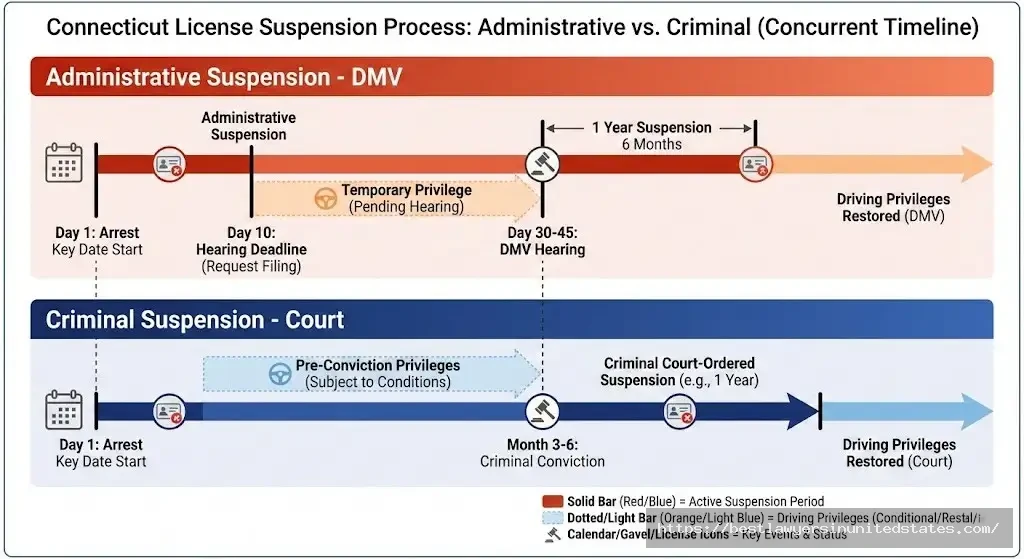
Key Timeline:
- Day 1: Officer takes your license at arrest
- Day 1-10: You must request a DMV hearing
- Day 30-45: DMV hearing scheduled
- Same day: Hearing officer decides suspension
You get a pink temporary license good for 30 days. This gives you time to request a hearing. Miss the 10-day deadline and your license suspends automatically.
The DMV hearing happens at a Connecticut DMV office. Locations include:
- Wethersfield DMV Office (main hearing location)
- Hamden DMV Office
- Danbury DMV Office
- Norwich DMV Office
A hearing officer (not a judge) reviews your case. They only look at three questions:
- Did the officer have probable cause to stop you?
- Did the officer have probable cause to arrest you?
- Did you refuse testing or test over .08?
The hearing officer doesn’t care about your defense strategy. They don’t consider whether evidence was collected legally. They only decide if the suspension is valid.
The Criminal Court Process
Your criminal DUI case moves through Connecticut Superior Court. The process takes 3-6 months on average.
Criminal Case Timeline:
Week 1-2: Arraignment
- First court appearance
- Receive formal charges
- Enter plea (usually not guilty)
- Get assigned public defender if needed
- Set next court date
Week 3-8: Pretrial Hearings
- Attorney reviews evidence
- Prosecutor may offer plea deal
- Discovery (evidence sharing)
- Motion hearings
- IDIP application (first offense)
Month 3-6: Trial or Plea
- Negotiate final plea agreement, or
- Go to trial before judge or jury
- Sentencing if convicted
- Begin serving penalties
Connecticut handles DUI cases in Geographical Area (GA) courts. These courts hear cases from multiple towns. Your GA court depends on where you were arrested:
- GA 1: Hartford area
- GA 2: New London area
- GA 3: New Haven area
- GA 20: Stamford area
Serious DUI cases (felonies, injuries) go to the main Superior Court in each judicial district.
How Both Processes Overlap
DMV Suspension vs Criminal Suspension:
Your license can be suspended twice: once by DMV (administrative) and once by the court (criminal). Connecticut usually runs these suspensions concurrently (at the same time), not consecutively.
Example: First offense
- DMV suspends license for 45 days (administrative)
- Court suspends license for 45 days (criminal)
- Total time without license: 45 days (not 90)
But if you’re convicted after winning your DMV hearing, the criminal suspension starts fresh. You could have no suspension for months, then face the full court-ordered suspension.
IDIP and Both Cases:
The Impaired Driver Intervention Program affects both your DMV and criminal cases. IDIP completion can:
- Reinstate your DMV-suspended license early
- Get your criminal charges dismissed
- Save you from a conviction on your record
The IDIP Program: Connecticut’s Second Chance
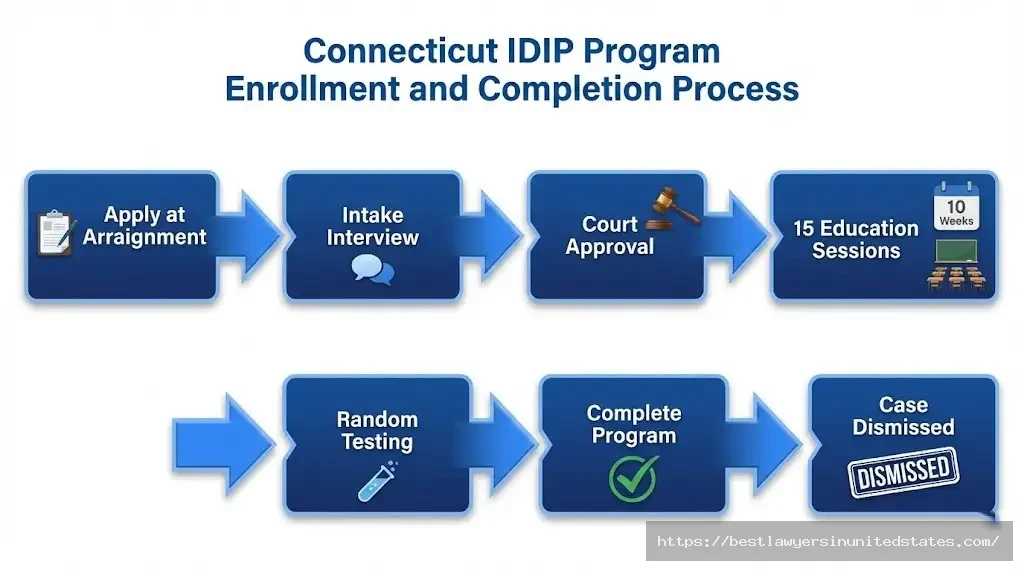
What is IDIP?
The Impaired Driver Intervention Program gives first-time DUI offenders a path to avoid conviction. Complete the program and prosecutors dismiss your criminal charges.
IDIP is a pretrial alcohol education program. You attend classes, complete an assessment, and follow recommendations. The program takes 10-15 weeks to finish.
IDIP Eligibility:
- First DUI arrest in Connecticut
- No previous DUI convictions anywhere
- BAC under .16 (some courts allow higher)
- No accident with serious injury
- No child in vehicle
Second and third offenders don’t qualify for IDIP. Connecticut reserves the program for people who made one mistake.
How to Apply for IDIP
Step 1: Request at Arraignment
Tell the judge you want to apply for IDIP. Your attorney should mention this immediately. The judge either approves your application or tells you to reapply later.
Most Connecticut courts allow IDIP applications at the first appearance. Judges rarely deny the request. They want first-time offenders to complete the program.
Step 2: Complete the Application
You fill out paperwork with:
- Personal information
- Employment details
- Drinking history
- Medical conditions
The Connecticut Alcohol and Drug Policy Council reviews applications. They schedule your intake interview within 2-3 weeks.
Step 3: Attend Intake Interview
A counselor interviews you about your drinking habits. They assess whether you need treatment. The interview takes 1-2 hours.
Be honest during your interview. The counselor determines your program requirements. Lying can get you kicked out of IDIP.
Step 4: Return to Court for Approval
The judge reviews the counselor’s recommendation. The court either:
- Approves you for IDIP
- Adds conditions (like treatment)
- Denies your application (rare)
Once approved, your criminal case pauses. You have 12 months to complete IDIP.
IDIP Program Requirements
Mandatory Components:
- 15-session alcohol education class (10 weeks)
- Victim impact panel (1 session)
- Community service (possible)
- Random drug/alcohol testing
- Treatment (if recommended)
Classes meet once per week for 2-3 hours. Connecticut-approved providers run IDIP classes across the state. You can attend sessions in:
- Hartford
- New Haven
- Bridgeport
- Stamford
- Waterbury
- Norwich
IDIP Costs:
- Application fee: $100
- Program fee: $100
- Class fees: $150 – $300
- Drug testing: $20 – $40 per test
- Treatment (if required): $1,000 – $3,000
You pay these costs yourself. Connecticut doesn’t cover IDIP expenses. Payment plans are available through most providers.
What Happens After IDIP Completion
Criminal Case Dismissal:
The IDIP provider sends a completion certificate to the court. The prosecutor files a nolle prosequi (dismissal). Your case closes with no conviction.
The arrest stays on your record. Connecticut doesn’t expunge DUI arrests. But you can honestly say you were never convicted of DUI.
License Reinstatement:
IDIP completion often shortens your license suspension. The Connecticut DMV may:
- Reinstate your license early
- Reduce suspension time
- Allow you to drive to work
You still pay the $175 reinstatement fee. You still need SR-22 insurance. But you get your license back sooner.
What If You Fail IDIP?
Missing classes or testing positive for drugs/alcohol gets you terminated from IDIP. The consequences are severe:
- Criminal case proceeds to trial
- No dismissal option
- Judge may impose harsher sentence
- You wasted program fees
Connecticut gives one warning for minor violations. Multiple violations or serious issues mean immediate termination. You can’t reapply.
DUI Defense Strategies in Connecticut
Challenging the Initial Stop
Every DUI arrest starts with a traffic stop. Connecticut law requires “reasonable suspicion” for the stop. The officer must point to specific facts that made them pull you over.
Your attorney can challenge stops based on:
- Pretextual stops (minor violations as excuse)
- Anonymous tips without corroboration
- Checkpoints not meeting legal requirements
- Racial profiling
If the judge rules the stop was illegal, all evidence gets suppressed. Your case gets dismissed. This is called the “fruit of the poisonous tree” doctrine.
Connecticut State Police must follow strict checkpoint procedures. The supervisor must decide the location based on DUI data. Officers must stop every car or every third car (systematic pattern). Random stops at checkpoints violate Connecticut law.
Attacking Field Sobriety Tests
Field sobriety tests are designed to make people fail. Your attorney can challenge test results by showing:
Physical Conditions:
- Inner ear problems (balance issues)
- Leg or back injuries
- Neurological conditions
- Age over 65
- 50+ pounds overweight
Environmental Factors:
- Uneven pavement
- Poor lighting
- Bad weather
- Tight or uncomfortable shoes
- Officer distractions
Test Administration Errors:
- Officer didn’t follow NHTSA standards
- Instructions unclear
- Insufficient demonstration
- Counted incorrectly
Connecticut requires officers to complete SFST training. Your attorney can request the officer’s certification records. Expired or invalid training makes the tests inadmissible.
Breathalyzer Challenges
Connecticut’s Intoxilyzer 9000 can give false readings. Your attorney investigates:
Calibration Issues:
- Device not calibrated within 120 days
- Calibration logs missing
- Improper calibration procedure
- Simulator solution expired
Operator Errors:
- No 15-minute observation period
- Insufficient breath sample
- Multiple tests with varying results
- Officer not properly certified
Medical Conditions:
- GERD or acid reflux
- Diabetes (ketones mimic alcohol)
- Dental work trapping alcohol
- Recent use of mouthwash
Connecticut law requires specific protocols for breath testing. Officers must observe you for 15 minutes before testing. This ensures you don’t burp, vomit, or put anything in your mouth. Violations of this rule invalidate the test.
Rising BAC Defense
Your BAC continues rising for 30-90 minutes after your last drink. You might have been under .08 while driving but over .08 when tested.
The rising BAC defense works when:
- You were stopped soon after drinking
- You had drinks right before driving
- Time gap between driving and testing
- Test showed BAC close to .08
Connecticut allows this defense. Your attorney uses a toxicologist to show your BAC was legal while driving. This expert testimony can create reasonable doubt.
When Charges Get Dismissed
Connecticut courts dismiss DUI charges for several reasons:
Constitutional Violations:
- Illegal search and seizure
- No Miranda rights given
- Coerced confession
- Unlawful detention
Procedural Errors:
- Missing police reports
- Lost evidence
- Violated speedy trial rights
- Discovery violations
Weak Evidence:
- No chemical test
- Failed breath test excluded
- Officer’s observations contradicted by video
- No signs of impairment
Witness Problems:
- Officer doesn’t appear in court
- Officer changes testimony
- Civilian witnesses recant
- Video contradicts officer’s story
Your best chance of dismissal comes early in the case. Connecticut prosecutors offer better deals before trial. Once jury selection starts, plea offers disappear.
Should You Take a Plea Deal or Go to Trial?
Reasons to Take a Plea:
- Strong evidence against you (high BAC, video, failed tests)
- Prosecutor offers IDIP or reduced charge
- Prior criminal record makes trial risky
- Can’t afford trial costs
- Want certainty of outcome
Reasons to Go to Trial:
- Weak prosecution case
- Illegal stop or arrest
- Breathalyzer problems
- You were not impaired
- Nothing to lose (already facing max penalty)
Connecticut DUI trials last 1-3 days. Jury trials are rare in first offense cases. Most defendants choose a bench trial (judge decides).
Your trial success rate depends on the evidence. Connecticut prosecutors win about 80% of DUI trials. But cases with illegal stops, bad breathalyzer results, or no testing have higher dismissal rates.
Typical Plea Offers by Offense:
| Offense Level | Common Plea Deals |
|---|---|
| First (Low BAC) | IDIP, no conviction |
| First (High BAC) | IDIP with conditions, reduced jail |
| Second | Reduced jail time, shorter suspension |
| Third | Reduced to misdemeanor, less prison time |
Connecticut judges usually follow plea agreements. But they can reject deals and impose harsher sentences. Ask your attorney about the judge’s reputation before accepting a plea.
Ignition Interlock Device Requirements
When Connecticut Requires IID
Connecticut mandates Ignition Interlock Devices for:
- All second DUI offenses
- All third and subsequent offenses
- First offense with BAC .16 or higher
- First offense with injury accident
The device connects to your car’s ignition. You blow into it before starting the engine. If your BAC exceeds .02, the car won’t start.
Connecticut also allows voluntary IID installation. First-time offenders can install one early to:
- Get their license back sooner
- Show the judge responsibility
- Drive during suspension (with restrictions)
Connecticut-Approved IID Providers
The Connecticut DMV maintains a list of approved installers. Approved providers include:
- LifeSafer
- Intoxalock
- Smart Start
- Guardian Interlock
Choose a provider near you. They install at their service centers across Connecticut. Installation takes 1-2 hours. You schedule an appointment before your court date.
IID Installation Costs:
- Installation fee: $75 – $150
- Monthly monitoring: $60 – $90
- Calibration appointments: $0 (included in monthly fee)
- Removal fee: $50 – $100
You pay these costs monthly. Most providers offer payment plans. Connecticut doesn’t cover IID costs even for low-income drivers.
How Long You Need IID
Required IID Periods:
| Offense Level | Minimum IID Period |
|---|---|
| First (High BAC) | 6 months |
| Second | 2 years |
| Third | 3 years |
| Fourth+ | 3 years minimum (possible lifetime) |
The clock starts when you install the device. Connecticut counts actual usage time, not suspension time. If you wait six months to install, you still need it for the full required period.
IID Violations and Extensions
The device records every test. Connecticut DMV reviews monthly reports. Violations extend your IID requirement:
Violations That Add Time:
- Failed start test (BAC over .02)
- Missed rolling retest
- Tampering with device
- Driving without IID
- Late calibration appointments
Each violation adds 30-60 days to your required period. Multiple violations can double or triple your IID time. Connecticut treats violations seriously.
What Happens If You Drive Without IID:
- Class D felony charge
- Immediate license revocation
- Up to 1 year in jail
- $1,000 – $5,000 fine
Don’t borrow a car without IID. Don’t let someone else blow into your device. Connecticut prosecutes these violations aggressively.
License Suspension and Reinstatement
How Long You Lose Your License
Connecticut suspends licenses through two paths: administrative (DMV) and criminal (court). Both suspensions usually run at the same time.
License Suspension Periods
| Offense | Administrative Suspension | Criminal Suspension | Total (Concurrent) |
|---|---|---|---|
| First (No Refusal) | 45 days | 45 days – 1 year | 45 days – 1 year |
| First (Refusal) | 6 months | 45 days – 1 year | 6 months – 1 year |
| Second | 45 days | 45 days – 3 years | 45 days – 3 years |
| Third | 45 days | 2 – 3 years | 2 – 3 years |
The suspensions start on different dates:
- Administrative: Day of arrest
- Criminal: Day of conviction
If you win your DMV hearing, you keep your license until criminal conviction. If you lose both, the criminal suspension usually absorbs the administrative one.
Getting Your License Back
Connecticut requires several steps for reinstatement:
Step 1: Complete Your Suspension Period
You must serve the full suspension before applying for reinstatement. Connecticut doesn’t give credit for informal suspension time. The official suspension starts when the DMV or court orders it.
Step 2: Complete All Court Requirements
The court must certify you completed:
- Jail time (if ordered)
- Probation
- Fines and fees
- Community service
- IDIP or treatment programs
Connecticut DMV won’t reinstate until courts confirm completion. Get certified copies of completion documents.
Step 3: Install Ignition Interlock Device
For second and third offenses, you install IID before reinstatement. The installer gives you a certificate. You submit this to DMV with your application.
Some first offenders can skip IID by serving a longer suspension. Ask the DMV about your options.
Step 4: Get SR-22 Insurance
SR-22 is a certificate your insurance company files with Connecticut DMV. It proves you carry required coverage:
- $25,000 bodily injury per person
- $50,000 bodily injury per accident
- $25,000 property damage
Your insurer charges extra to file SR-22. Expect to pay 60-100% higher premiums. The SR-22 stays active for three years minimum.
Step 5: Pay Reinstatement Fees
Connecticut charges $175 to reinstate your license. You pay at the DMV when applying. They also charge:
- License renewal fee: $72 (if license expired)
- Reinstatement application: $0
- Documentation fees: varies
Total reinstatement costs range from $175 to $300 depending on your situation.
Step 6: Visit DMV in Person
You must go to a Connecticut DMV office to reinstate. Bring:
- Court completion certificates
- IID installation certificate
- SR-22 certificate
- Payment for fees
- Current photo ID
The DMV reviews your documents and issues a new license. Some offices require appointments. Check ct.gov/dmv for current procedures.
Work Permits and Restricted Licenses
Connecticut doesn’t issue “hardship licenses” for DUI suspensions. You can’t get a work permit for a DUI suspension like you can in Arkansas or Alaska.
Your only option is early reinstatement through IDIP. First-time offenders who complete IDIP can apply for reinstatement after serving 30 days of suspension.
The alternative is installing IID before your suspension ends. Connecticut lets you drive with IID during the last portion of your suspension. But you must serve at least 45 days fully suspended first.
Insurance Impact After a DUI
How Much Rates Increase
Connecticut insurance companies treat DUI as a major violation. Expect rates to jump 60-80% immediately after conviction.
Average Connecticut Premium Increases:
- Before DUI: $1,200/year
- After first DUI: $1,920/year (60% increase)
- After second DUI: $2,160/year (80% increase)
- After third DUI: $2,400+/year (100%+ increase)
These increases last 3-5 years. Even after rates drop, you’ll pay more than before the DUI. Connecticut insurers keep DUI on your record for at least five years.
Some companies drop you entirely. You’ll need to find a high-risk insurer. These companies specialize in DUI drivers but charge premium prices.
SR-22 Insurance Certificate
SR-22 isn’t insurance itself. It’s a certificate proving you carry Connecticut’s minimum coverage. Your insurer files it electronically with the DMV.
SR-22 Requirements:
- File within 30 days of reinstatement eligibility
- Maintain continuously for 3 years minimum
- Any lapse triggers license re-suspension
- Costs $25-50 filing fee (one-time)
If you cancel your insurance or miss a payment, the insurer notifies Connecticut DMV immediately. Your license suspends again within 24 hours. You start the SR-22 clock over when you reinstate.
Finding Affordable DUI Insurance
Not all Connecticut insurers cover DUI drivers. These companies typically accept high-risk drivers:
- Progressive
- The General
- Acceptance Insurance
- National General
- Bristol West
Shop multiple companies. Rates vary by 50-100% for the same coverage. Use an independent agent who works with high-risk insurers.
Ways to Lower DUI Insurance Costs:
- Take defensive driving course
- Increase deductibles
- Drop comprehensive coverage on older cars
- Bundle home and auto insurance
- Ask about good driver discount after 3 years
Connecticut allows insurers to surcharge DUI for up to five years. After five years, the DUI doesn’t impact your rates. But it stays on your driving record permanently.
Connecticut DUI Insurance Cost Comparison (3 Years)
| Company Type | Annual Premium | 3-Year Total | Compared to Standard |
|---|---|---|---|
| Standard (before DUI) | $1,200 | $3,600 | Baseline |
| High-Risk (after DUI) | $1,920 | $5,760 | +$2,160 |
| Progressive | $1,850 | $5,550 | +$1,950 |
| The General | $2,100 | $6,300 | +$2,700 |
| State Minimum Only | $800 | $2,400 | -$1,200 |
Estimates based on 35-year-old driver with clean record except DUI
Special Connecticut DUI Circumstances
Underage DUI (Under 21)
Connecticut enforces zero tolerance for drivers under 21. Any detectable alcohol triggers penalties.
Under-21 BAC Limits:
- .02 or higher: Automatic suspension
- .08 or higher: Adult DUI penalties apply
A .02 BAC means about one drink. Connecticut doesn’t require proof of impairment. The test result alone is enough.
Under-21 Penalties (.02 to .07 BAC):
- License suspension: 60 days minimum
- $150 – $300 fine
- Alcohol education program
- Community service
- Parent/guardian notification
Under-21 Penalties (.08+ BAC):
- Same as adult first offense
- Plus: Parent notification
- Plus: Extended license suspension
- Possible: School notification
Connecticut notifies your parents regardless of your age. If you’re 18-20 and living independently, your parents still get contacted. This is automatic under state law.
Underage DUI affects college applications and financial aid. Many Connecticut colleges ask about criminal history. A DUI conviction can trigger application denials or scholarship losses.
Aggravated DUI (High BAC)
Connecticut treats BAC of .16 or higher as aggravated DUI. The legal limit doubles. Penalties increase even for first-time offenders.
High BAC Enhancements:
- Mandatory 48-hour jail minimum (first offense)
- Higher fines ($1,000 minimum)
- Longer license suspension
- Mandatory IID installation
- May disqualify from IDIP
Judges rarely waive the 48-hour jail minimum. You serve it in county lockup or Connecticut State Police holding. Weekend jail is sometimes allowed for employment reasons.
Connecticut uses the highest BAC test if you took multiple tests. If your first breath test showed .14 but the second showed .17, prosecutors charge you with .17.
DUI With Child Passenger
Driving drunk with a child under 16 in your car triggers additional Connecticut charges.
Risk of Injury to a Minor:
- Separate felony charge
- 1-20 years prison
- $1,000 – $15,000 fine
- Runs consecutive to DUI sentence
DCF Investigation:
- Connecticut Department of Children and Families gets notified
- Social worker investigates your home
- Possible removal of children
- Required parenting classes
- Court oversight of custody
The child doesn’t have to be yours. Any passenger under 16 triggers enhanced charges. Giving a friend’s child a ride while drunk means felony charges.
Connecticut courts treat child endangerment seriously. Even first-time DUI offenders face jail time when children are involved. Plea deals become much harder to negotiate.
Commercial Driver’s License (CDL) DUI
CDL holders face stricter Connecticut DUI laws. The BAC limit drops to .04 in any vehicle, not just commercial trucks.
CDL-Specific Consequences:
- .04 BAC: DUI charge
- .08 BAC: DUI plus CDL revocation
- First offense: 1-year CDL disqualification
- Second offense: Lifetime CDL ban
- Refusal: Same as .04 BAC violation
You lose your CDL even if driving your personal car. Connecticut doesn’t distinguish between on-duty and off-duty DUIs. Any alcohol-related conviction disqualifies you from commercial driving.
The CDL disqualification runs separate from your regular license suspension. You might get your regular license back but lose CDL privileges forever. This ends careers for truck drivers, bus drivers, and delivery drivers.
Connecticut offers no CDL hardship permits. No restricted licenses. No work permits. One DUI means unemployment for most commercial drivers.
Hazmat Endorsement:
- DUI automatically revokes hazmat endorsement
- Cannot reapply for 2-5 years
- TSA background check required to reinstate
- Many employers won’t rehire after DUI
What NOT to Do During a Connecticut DUI Stop
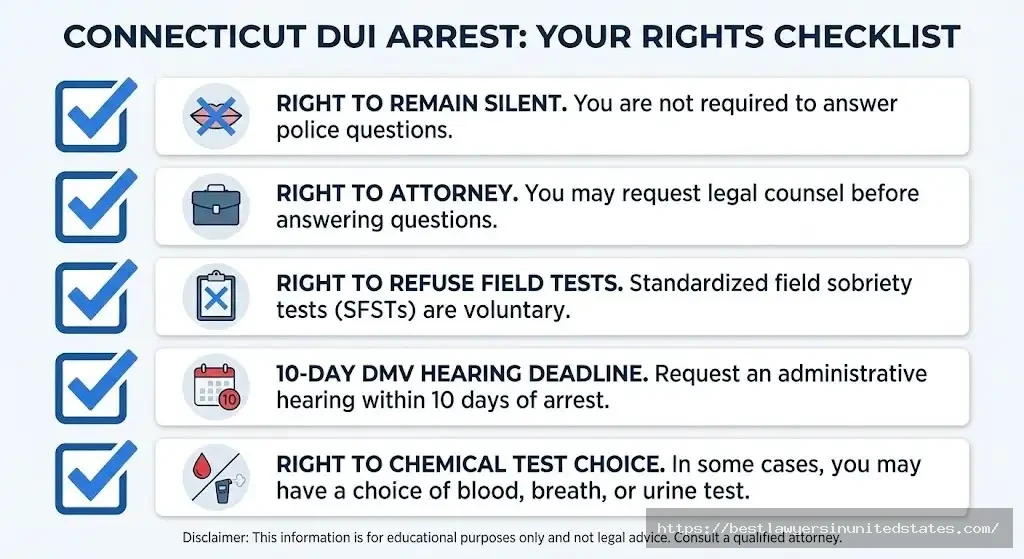
Critical Mistakes to Avoid
Don’t Volunteer Information:
- Don’t say how much you drank
- Don’t estimate your drinks (“two beers”)
- Don’t explain where you’ve been
- Don’t admit to drinking at all
Connecticut officers use your statements against you. Anything you say goes in the police report. Prosecutors quote your words in court.
The correct answer: “I’d prefer not to answer questions without my attorney present.”
Don’t Consent to Searches:
- Officer needs your permission to search
- “Do you mind if I look in your car?” means you can say no
- Open containers give probable cause without consent
- Never physically resist, just verbally decline
Connecticut law requires a warrant for vehicle searches unless:
- Officer sees contraband in plain view
- You consent to the search
- Arrest gives them search authority
- Exigent circumstances exist
Say clearly: “I do not consent to any searches.”
Don’t Perform Field Sobriety Tests:
- These tests are voluntary
- You can politely refuse
- Refusal doesn’t mean automatic arrest
- Results almost always used against you
Connecticut doesn’t penalize you for refusing field tests. The officer may arrest you anyway, but you avoid giving them evidence. Most DUI attorneys recommend refusing.
Don’t Miss Your 10-Day DMV Hearing Deadline:
- You have exactly 10 calendar days from arrest
- Weekends and holidays count
- Missing deadline = automatic license suspension
- No extensions or second chances
Connecticut DMV won’t accept late hearing requests. Your license suspends for the full period. This is the single biggest mistake DUI defendants make.
Don’t Talk to Police After Requesting a Lawyer:
- Once you ask for an attorney, questioning must stop
- Officer may continue talking to you anyway
- Don’t respond to statements or questions
- Remain silent until your lawyer arrives
Connecticut officers sometimes ignore attorney requests. They keep chatting hoping you’ll incriminate yourself. Don’t fall for this. Stay quiet.
Common Connecticut DUI Misconceptions
Myth: “Refusing the breathalyzer means they have no evidence.”
False. Connecticut officers can still charge you based on:
- Field sobriety test results
- Officer observations
- Dash cam or body cam video
- Witness statements
Refusal just removes one piece of evidence. You still face DUI charges. Plus Connecticut adds extra suspension time for refusal.
Myth: “I can beat this DUI without a lawyer.”
Unlikely. Connecticut DUI cases involve:
- Complex scientific evidence
- Strict procedural requirements
- Experienced prosecutors
- Harsh mandatory minimums
Public defenders handle DUI cases daily. They know the judges, prosecutors, and local court rules. Going alone means you miss defenses that could get your case dismissed.
Myth: “Field sobriety tests are mandatory.”
False. Connecticut law makes these tests completely voluntary. You can politely decline without penalty. But refusal gives the officer more reason to arrest you.
The tests are designed to fail. Even sober people struggle with one-leg stands on the roadside at night. Declining removes bad evidence from your case.
Myth: “I only had two beers so I’m safe.”
Maybe not. Two beers in one hour can put you over .08 if:
- You weigh under 160 pounds
- The beers were strong (IPA, craft beer)
- You drank on an empty stomach
- You’re female (higher BAC from same drinks)
Connecticut BAC depends on many factors. Weight, gender, time, and drink strength all matter. “Two beers” often means .09 or .10 BAC.
Myth: “IDIP means the arrest disappears from my record.”
False. The arrest stays on your Connecticut criminal history forever. Background checks show:
- DUI arrest (even with IDIP dismissal)
- Charge filed
- Case dismissed after IDIP completion
You were never convicted. But the arrest remains visible. Connecticut doesn’t expunge DUI arrests. Some employers and landlords still see this as a red flag.
Morning After DUI Risk
Can You Get a DUI the Next Morning?
Yes. Connecticut drivers get arrested for DUI 12-16 hours after their last drink. Your BAC stays elevated longer than you think.
How Alcohol Leaves Your System:
- Body eliminates .015 BAC per hour
- This rate doesn’t change
- Coffee, water, food don’t speed it up
- Sleep doesn’t accelerate elimination
Example scenario:
- Drink until 2 AM
- BAC hits .16 (twice legal limit)
- Go to sleep at 2:30 AM
- Wake up at 7:00 AM
- BAC still .09 (over .08 limit)
You’d need to wait until 9 AM to be under .08. Driving to work at 7 AM means DUI arrest.
Calculate When It’s Safe to Drive
BAC Elimination Timeline:
| Peak BAC | Hours to Reach .08 | Hours to Reach .00 |
|---|---|---|
| .10 | 1.3 hours | 6.7 hours |
| .12 | 2.7 hours | 8.0 hours |
| .16 | 5.3 hours | 10.7 hours |
| .20 | 8.0 hours | 13.3 hours |
| .24 | 10.7 hours | 16.0 hours |
These times start when you STOP drinking, not when you start. Your BAC peaks 30-90 minutes after your last drink.
Heavy drinking sessions often mean BAC over .20. That’s 13+ hours until you’re sober. Going to bed at 2 AM drunk means staying home until 3 PM the next day.
Real Connecticut Morning-After DUI Cases
Connecticut State Police run morning DUI checkpoints. They target commuter hours on I-95, I-84, and Route 15 (Merritt/Wilbur Cross Parkway). Officers specifically look for morning-after impairment.
Common Morning DUI Patterns:
- College students driving home after overnight parties
- Service industry workers (bartenders, servers) commuting after late shifts
- Wedding guests driving home the next morning
- Business travelers heading to airports
Connecticut courts treat morning-after DUIs identically to evening DUIs. No leniency because you thought you were sober. The .08 limit applies 24/7.
Use the BAC calculator before driving the morning after drinking. Better yet, call Uber or take the day off. Morning-after DUIs ruin careers because they happen during work commutes.
Connecticut DUI Court and DMV Locations

Where Your Case Gets Heard
Connecticut divides the state into Geographical Areas (GA) for court purposes. Your DUI case gets assigned based on where you were arrested.
Major GA Court Locations:
GA 1 – Hartford Area:
- 95 Washington Street, Hartford
- Handles arrests from Hartford and surrounding towns
- Busiest DUI court in Connecticut
GA 2 – New London:
- 70 Huntington Street, New London
- Eastern Connecticut DUI cases
- Covers coastal towns
GA 3 – New Haven:
- 121 Elm Street, New Haven
- Southern Connecticut
- High volume DUI docket
GA 20 – Stamford:
- 123 Hoyt Street, Stamford
- Fairfield County DUI cases
- Known for strict judges
Each GA court runs DUI sessions on specific days. Call ahead to confirm your court date and time. Arriving at the wrong courthouse means a warrant for your arrest.
DMV Hearing Locations
Connecticut DMV conducts administrative hearings at four main offices:
Wethersfield DMV (Main Location):
- 60 State Street
- Wethersfield, CT 06161
- Handles most Hartford area hearings
Hamden DMV:
- 2800 Dixwell Avenue
- Hamden, CT 06518
- New Haven area hearings
Danbury DMV:
- 59 Newtown Road
- Danbury, CT 06810
- Western Connecticut hearings
Norwich DMV:
- 56 Huntington Street
- Norwich, CT 06360
- Eastern Connecticut hearings
Arrive 15 minutes early. Bring your pink temporary license and request confirmation letter. The hearing lasts 15-30 minutes. You get the decision the same day.
Connecticut State Police Barracks
DUI arrests by State Police go through these main barracks:
Troop H – Hartford:
- 100 Washington Street, Hartford
- Covers I-84, I-91, Route 2
Troop G – Bridgeport:
- 920 Barnum Avenue, Bridgeport
- Covers I-95, Route 15 (Merritt Parkway)
Troop E – Montville:
- 103 Darling Road, Montville
- Covers I-395, Route 2, eastern Connecticut
Troop L – Litchfield:
- 153 Hillside Avenue, Litchfield
- Covers Route 8, northwestern Connecticut
State Police handle most highway DUI arrests. Local police handle town road arrests. Your police report shows which agency arrested you.
Find a Connecticut DUI Attorney

What to Look For
Experience Matters:
- Handle DUI cases regularly
- Know local judges and prosecutors
- Familiar with GA court procedures
- Understand Connecticut-specific defenses
Connecticut DUI law changes frequently. Choose an attorney who focuses on DUI defense, not a general practitioner. Ask how many DUI cases they handle per month.
Local Representation:
- Attorney licensed in Connecticut
- Practices in your GA court regularly
- Knows the local court staff
- Has relationships with prosecutors
A New York attorney can’t help you in Connecticut Superior Court. Some attorneys advertise in Connecticut but practice elsewhere. Verify their Connecticut bar license.
Track Record:
- Ask about dismissal rates
- Request case outcome examples
- Check disciplinary history
- Read client reviews
Connecticut attorneys can share past results. They should explain realistic outcomes for your case. Promises of guaranteed dismissal are red flags.
Free Consultations
Most Connecticut DUI attorneys offer free initial consultations. They review:
- Your arrest report
- Breathalyzer results
- Your criminal history
- Possible defenses
- Expected costs
Bring all paperwork to your consultation:
- Pink temporary license
- Citation or summons
- Bail paperwork
- Any police documents
The attorney should explain your options clearly. No legal jargon. No pressure to hire immediately. Take notes and compare at least three attorneys.
Expected Attorney Costs
Connecticut DUI Attorney Fees:
| Service Level | First Offense | Second Offense | Third Offense |
|---|---|---|---|
| Basic Plea Deal | $2,500 – $4,000 | $3,500 – $6,000 | $5,000 – $8,000 |
| IDIP Application + Plea | $3,000 – $5,000 | N/A | N/A |
| DMV Hearing + Plea | $3,500 – $5,500 | $4,500 – $7,000 | $6,000 – $9,000 |
| Full Trial | $5,000 – $10,000 | $7,500 – $12,000 | $10,000 – $15,000+ |
Payment plans are common. Most attorneys require 50% upfront, remainder before trial. Public defenders are free if you qualify financially.
What’s Included:
- Court appearances
- DMV hearing representation
- IDIP application assistance
- Evidence review
- Prosecutor negotiations
- Trial (if needed)
Not Usually Included:
- Filing fees
- Expert witness costs
- Investigation expenses
- Appeal costs
Get the fee agreement in writing. Understand what services are covered before you pay.
Need Legal Help Now?
Contact our network for free DUI attorney consultations across Connecticut. Email [email protected] for immediate attorney referrals in your area.
Frequently Asked Questions About Connecticut DUI Laws
What is the penalty for DUI in Connecticut?
First offense: $500-$1,000 fine, up to 6 months jail, 45-day license suspension. Second offense: $1,000-$4,000 fine, 120 days mandatory jail, 45-day to 3-year suspension. Third offense is a felony: $2,000-$8,000 fine, 1-3 years prison, permanent license revocation possible.
Is a DUI in CT a felony?
No for first and second offenses. Third and subsequent DUIs are Class D felonies in Connecticut. You face 1-3 years in state prison and a permanent felony record.
How likely is jail time for first DUI in CT?
Most first offenders avoid jail through IDIP. Without IDIP, judges often suspend jail time for probation. High BAC (.16+) requires mandatory 48-hour minimum jail even for first offense.
How long does a DUI stay on your record in CT?
Forever. Connecticut doesn’t expunge DUI arrests or convictions. The charge appears on background checks permanently. IDIP dismisses the case but the arrest remains visible.
What happens if you refuse a breathalyzer in CT?
Six-month license suspension for first refusal, one year for second refusal. Connecticut uses your refusal as evidence in criminal trial. You lose IDIP eligibility. The suspension runs separately from any conviction penalties.
Can a DUI be dismissed in CT?
Yes. Common dismissal reasons: illegal stop, breathalyzer calibration problems, violated rights, weak evidence, missing witnesses. IDIP completion also results in dismissal for first offenders. Hire an experienced attorney to find dismissal grounds.
What is the difference between DUI and DWI in Connecticut?
None. Connecticut uses DUI, DWI, and OUI interchangeably. They all mean operating a vehicle while impaired. The statute is CGS 14-227a regardless of terminology. The penalties are identical.
How much does a DUI cost in Connecticut?
First offense total costs: $8,000-$18,000 including fines, attorney, insurance increases, and lost wages. Second offense: $20,000-$50,000. Third offense: $35,000-$85,000+. Use the DUI cost calculator for your specific situation.
What is the IDIP program?
The Impaired Driver Intervention Program is Connecticut’s pretrial alcohol education program. First offenders attend 15 classes, complete an assessment, and follow recommendations. Successful completion results in criminal charge dismissal. The program costs $350-$600 total.
Can you get a hardship license after a DUI in CT?
No. Connecticut doesn’t issue hardship or work permits for DUI suspensions. Your only option is early reinstatement through IDIP or installing an Ignition Interlock Device before suspension ends.
Is 2 beers over the legal limit?
It depends. Two 12-ounce regular beers in one hour put a 160-pound man at approximately .04 BAC (under limit). A 120-pound woman hits .07 BAC (close to limit). Craft beers or drinking faster increases BAC significantly.
How many drinks is .08 BAC?
For a 160-pound man: about 4 drinks in one hour. For a 120-pound woman: about 3 drinks in one hour. Variables include drink strength, food consumption, and individual metabolism. Never rely on estimates. Use our BAC calculator for accuracy.
What are the penalties for a second DUI in CT?
Mandatory 120 days jail minimum, $1,000-$4,000 fine, 45-day to 3-year license suspension, required Ignition Interlock Device for 2 years, 3 years probation. No IDIP eligibility. No plea deals avoiding jail time.
What happens with a third DUI in CT?
Class D felony charges. One to three years in state prison (mandatory minimum one year). $2,000-$8,000 fine. Two to three year license suspension or permanent revocation. Three years required IID. Permanent felony criminal record.
Can you go to jail for a 2nd DUI in Connecticut?
Yes, mandatory jail time. Connecticut requires minimum 120 days incarceration for second DUI. Judges cannot waive this requirement. You serve time in county jail or correctional facility. No alternatives like house arrest.
What is the first-time offender program in CT?
IDIP (Impaired Driver Intervention Program). You attend alcohol education classes, complete screening, and follow treatment recommendations if needed. Takes 10-15 weeks. Successful completion results in criminal case dismissal. Costs $350-$600.
How do you beat a DUI in CT?
Challenge the traffic stop legality, attack breathalyzer calibration, question field sobriety test administration, prove rising BAC defense, demonstrate rights violations. Hire an experienced DUI attorney who knows Connecticut defenses. Most dismissals come from procedural errors.
What makes a DUI case weak?
No chemical test, illegal traffic stop, breathalyzer not calibrated properly, no observation period before testing, video contradicts officer testimony, medical conditions explain behavior, officer lacks proper certification, missing evidence or police reports.
Should I hire a lawyer for a DUI in Connecticut?
Yes. Connecticut DUI law is complex. Prosecutors are experienced. Penalties are harsh. An attorney finds defenses you’ll miss, negotiates better deals, handles both DMV and court cases, and increases dismissal chances. Public defenders are free if you qualify.
Can I drink as a passenger in a car in Connecticut?
No. Connecticut bans open containers of alcohol in vehicles. Both drivers and passengers cannot have open alcohol containers. Sealed containers must be in the trunk. Violations mean $90-$150 fine.
Take Action After Your Connecticut DUI Arrest
Immediate Steps (First 48 Hours)
Day 1: Request DMV Hearing
Call Connecticut DMV immediately at 860-263-5700. Request an administrative hearing. You have 10 days total but don’t wait. The DMV sends a confirmation letter within 3-5 business days.
Write down:
- Date you requested hearing
- Name of DMV employee you spoke with
- Confirmation number
Day 1-2: Find a DUI Attorney
Schedule free consultations with at least three attorneys. Bring all arrest paperwork. Ask about:
- IDIP eligibility
- Possible defenses
- Expected costs
- Timeline
Don’t hire the first attorney you meet. Compare options carefully.
Day 2: Document Everything
Write down what you remember while it’s fresh:
- Where you were that night
- What you drank and when
- Events leading to the stop
- What the officer said
- Field sobriety tests performed
- Chemical test process
These details help your attorney find defenses. Memory fades quickly. Document now.
Day 2-7: Gather Evidence
Collect anything supporting your case:
- Receipts from bar or restaurant
- Credit card statements
- Witness phone numbers
- Photos of the stop location
- Medical records (if relevant)
Your attorney needs this evidence for DMV hearings and court.
Next Steps (First 30 Days)
Apply for IDIP (If Eligible)
First-time offenders should apply at arraignment. Tell the judge immediately you want IDIP. Your attorney handles the paperwork. The process starts within 2-3 weeks.
Attend Your DMV Hearing
The hearing happens within 30-45 days of your request. Bring your attorney. The hearing officer decides whether to suspend your license. Win here and you keep driving until criminal trial.
Follow All Court Orders
Don’t miss court dates. Arrive on time. Dress appropriately. Bring your attorney. Warrants issue immediately for missed appearances. That means arrest.
Stay Out of Trouble
No new arrests. No failed drug tests. No drinking if on bail conditions. New violations mean jail and harsher sentences. Keep clean for at least one year.
Protect Your Rights
Connecticut DUI cases are serious but beatable. The state must prove every element beyond reasonable doubt. Police make mistakes. Equipment fails. Rights get violated.
But time matters. Evidence disappears. Witnesses forget. Officers change assignments. Your attorney needs time to investigate and build defenses.
Don’t go through this alone. Connecticut prosecutors win most cases against unrepresented defendants. The penalties are too harsh to risk. One mistake costs thousands in extra fines, months of extra jail time, years of license suspension.
Contact a Connecticut DUI attorney today. Your future depends on the next steps you take.
