
West Virginia enforces strict DUI laws under W.Va. Code § 17C-5-2, with first offense penalties including $100-$500 fines, up to 6 months in jail, and a 6-month license revocation. The state’s 10-year lookback period means any DUI conviction within the past decade counts toward enhanced penalties for repeat offenses.
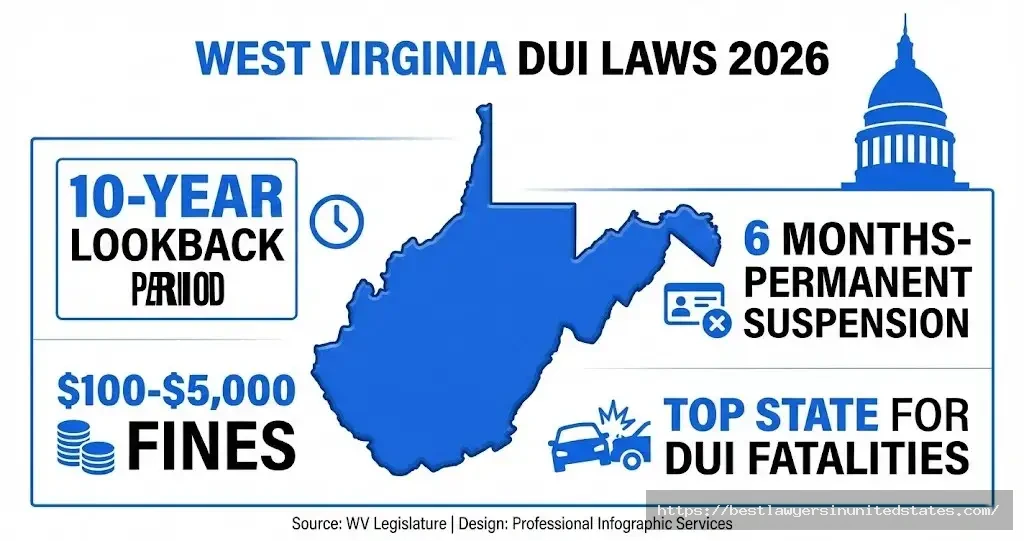
West Virginia ranks among the top states for DUI-related fatalities, making law enforcement particularly aggressive about impaired driving enforcement. Understanding your rights and the consequences you face helps you make informed decisions after an arrest.
This guide breaks down everything you need to know about West Virginia’s DUI laws, including the unique DUI Deferral Program, state-specific penalties, and actual costs you’ll pay.
What Counts as a DUI in West Virginia?
West Virginia law defines DUI as operating a vehicle while under the influence of alcohol, controlled substances, or drugs that impair your ability to drive safely. You can face charges even if your blood alcohol concentration falls below the legal limit if officers observe impaired driving.
Legal BAC Limits in West Virginia
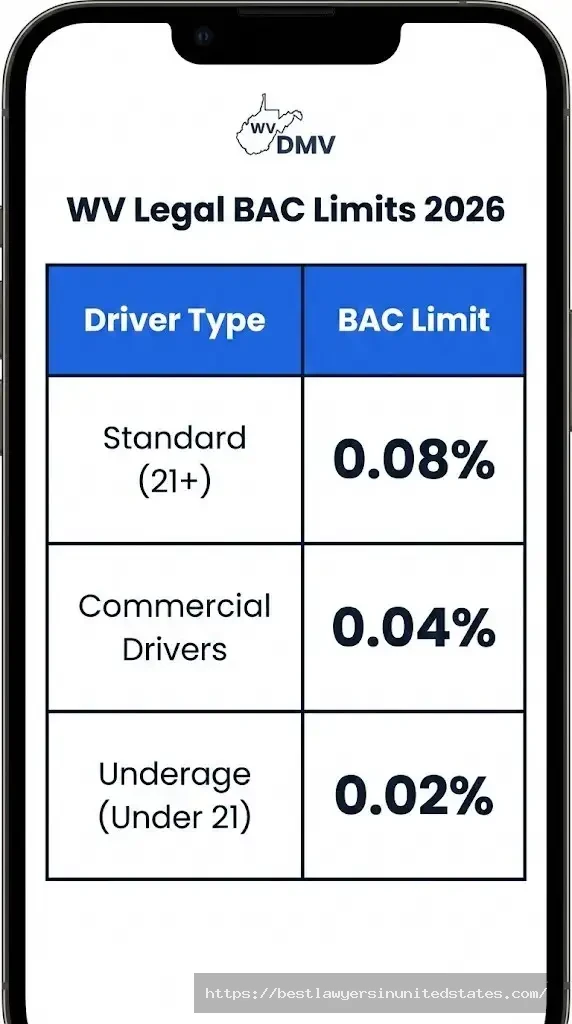
Different driver categories face different BAC thresholds:
| Driver Type | Legal BAC Limit |
|---|---|
| Standard (21+) | 0.08% |
| Commercial drivers | 0.04% |
| Underage (under 21) | 0.02% |
Zero tolerance means: Drivers under 21 face penalties at just 0.02% BAC, which equals roughly one drink for most people. Check your actual BAC level using our BAC calculator to understand how different drinks affect your blood alcohol content.
BAC Calculator
Estimate your Blood Alcohol Content
• Commercial Driver (CDL): 0.04% BAC
• Drivers Under 21: 0.00-0.02% BAC (Zero Tolerance)
• Enhanced Penalties: 0.15% BAC or higher in most states
Per Se DUI Law
West Virginia operates under a “per se” law. This means prosecutors can convict you based solely on BAC test results of 0.08% or higher, regardless of whether you showed visible signs of impairment.
Key statute: W.Va. Code § 17C-5-2 covers standard DUI offenses, while § 17C-5-2b addresses aggravated DUI charges with enhanced penalties.
West Virginia First Offense DUI Penalties
A first DUI conviction in West Virginia carries mandatory minimum penalties that increase based on your BAC level.
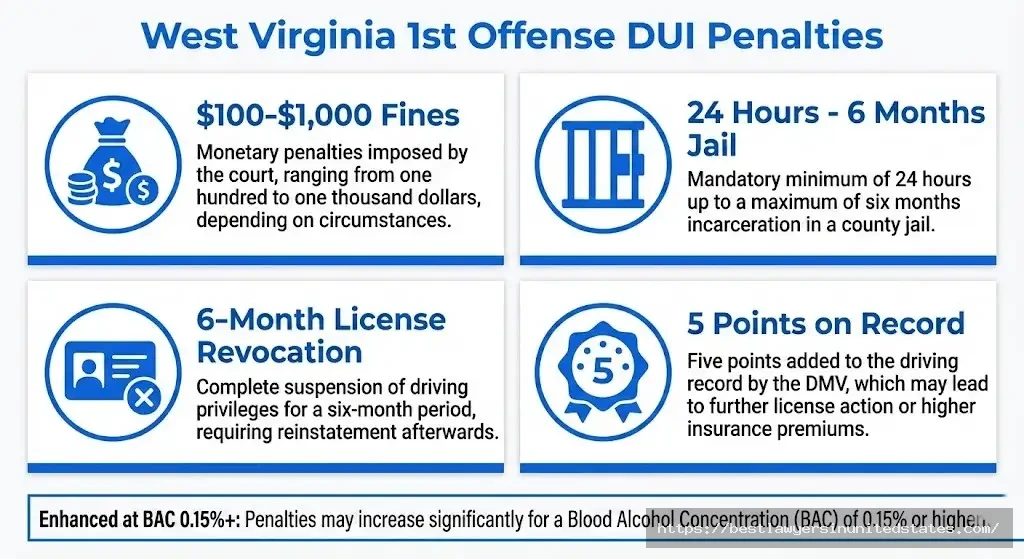
Standard First Offense (BAC 0.08% – 0.14%)
Penalties include:
- Fines: $100 to $500
- Jail time: 24 hours to 6 months
- License revocation: 6 months (15 days minimum)
- Points: 5 points on driving record
Alternative to jail: Courts often allow first-time offenders to complete community service instead of serving jail time.
Enhanced First Offense (BAC 0.15% or Higher)
Higher BAC levels trigger enhanced penalties:
- Fines: $200 to $1,000
- Jail time: 48 hours to 6 months (2-day minimum mandatory)
- License revocation: 6 months minimum
- Ignition interlock: Required for license reinstatement
First Offense Cost Breakdown
| Expense Category | Estimated Cost |
|---|---|
| Court fines | $100 – $1,000 |
| Court costs | $200 – $300 |
| Attorney fees | $1,500 – $5,000 |
| License reinstatement | $115 |
| DUI education program | $200 – $500 |
| Ignition interlock device | $70/month installation + monitoring |
| SR-22 insurance increase | $800 – $1,200/year |
| Total first offense | $3,000 – $10,000 |
Calculate your specific costs using our DUI cost calculator based on your circumstances and BAC level.
DUI Cost Calculator
Estimate total DUI expenses by state and offense
Detailed Cost Breakdown
Payment Timeline
Bail bond, towing fees, car impound, attorney retainer
Initial court fines, DMV fees, DUI school enrollment, ignition interlock installation
Monthly probation fees, ignition interlock fees, DUI school payments, attorney balance
Insurance premium increases, license reinstatement, SR-22 filing fees
- Lost wages from missed work (court dates, jail time, DUI school) – $2,000-$10,000
- Job loss or difficulty finding employment – Varies
- Professional license suspension (doctors, lawyers, nurses, pilots) – Career ending
- Rideshare and transportation costs during suspension – $1,500-$5,000
- Travel restrictions and visa denials – Varies
- Security clearance loss – Career impact
- Child custody implications – Legal costs
- Rental car restrictions – Varies
- Personal relationships and mental health costs – Priceless
Second Offense DUI Penalties in West Virginia
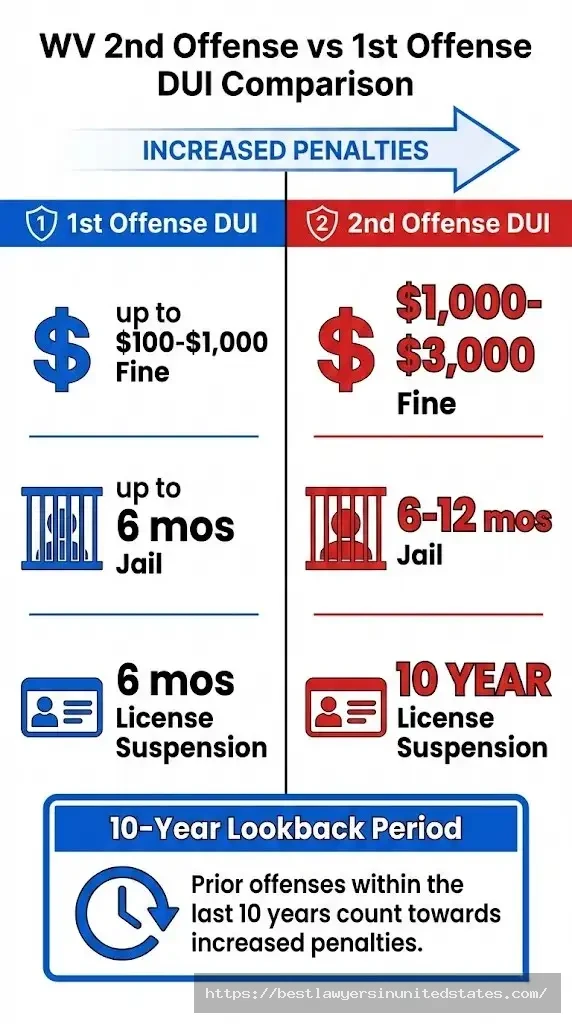
A second DUI within 10 years brings significantly harsher penalties under West Virginia’s lookback period.
Second Offense Requirements
Mandatory penalties:
- Fines: $1,000 to $3,000
- Jail time: 6 months to 1 year
- License revocation: 10 years (minimum 1 year)
- Ignition interlock: Mandatory after revocation period
What Makes Second Offense Different
The 10-year lookback period means any DUI from the past decade counts toward your second offense. Unlike states like Virginia with 10-year lookbacks or Ohio with 6-year lookbacks, West Virginia’s extended period significantly increases your risk.
Critical deadline: You have only 30 days from arrest to request an administrative hearing with the DMV to contest your license suspension.
Second Offense Costs
| Cost Category | Amount |
|---|---|
| Fines | $1,000 – $3,000 |
| Court costs | $300 – $500 |
| Attorney fees | $3,000 – $7,500 |
| Reinstatement fee | $115 |
| Ignition interlock (24 months) | $1,680 + installation |
| Treatment programs | $500 – $2,000 |
| Insurance increase | $1,500 – $2,500/year |
| Total second offense | $8,000 – $20,000+ |
Third Offense DUI: Felony Charges in West Virginia
A third DUI conviction within 10 years becomes a felony offense, carrying prison time and permanent consequences.

Third Offense Penalties
Felony consequences:
- Fines: $3,000 to $5,000
- Prison: 1 to 3 years (minimum 1 year mandatory)
- License revocation: Permanent (possible reinstatement after 10 years)
- Felony record: Affects employment, housing, voting rights
- Ignition interlock: Mandatory for any license reinstatement
Long-Term Impact
A felony DUI conviction creates obstacles beyond criminal penalties. Background checks reveal felony records to employers, landlords, and financial institutions. Professional licenses in healthcare, education, and other regulated fields may be suspended or revoked.
Additional consequences: Federal law prohibits felons from owning firearms. The conviction affects your ability to obtain federal student loans or housing assistance.
What Is Aggravated DUI in West Virginia?
West Virginia Code § 17C-5-2b defines aggravated DUI as a DUI with additional dangerous factors that warrant enhanced penalties.

Aggravated DUI Triggers
You face aggravated charges when:
- Your BAC measures 0.15% or higher
- You drive with a child under 16 in the vehicle
- You cause bodily injury to another person
- You drive recklessly or at excessive speeds while impaired
- You refuse chemical testing after causing an accident
Aggravated DUI Penalties
| Aggravating Factor | Enhanced Penalty |
|---|---|
| BAC 0.15%+ | Double minimum jail time |
| Child passenger under 16 | Additional $1,000 fine + 30 days jail |
| Bodily injury | 30 days – 1 year jail + restitution |
| Reckless driving while impaired | Increased jail time + fines |
Is aggravated DUI a felony? Aggravated first and second offenses remain misdemeanors but carry enhanced penalties. A third aggravated DUI becomes a felony.
Child Endangerment Enhancement
Driving under the influence with a child under 16 in your vehicle adds mandatory penalties. Courts view this as child endangerment and typically impose the maximum available sentences.
West Virginia courts show little leniency for DUIs involving children. Even first-time offenders serve jail time and pay substantial fines when children are present.
West Virginia DUI Deferral Program: Your Second Chance
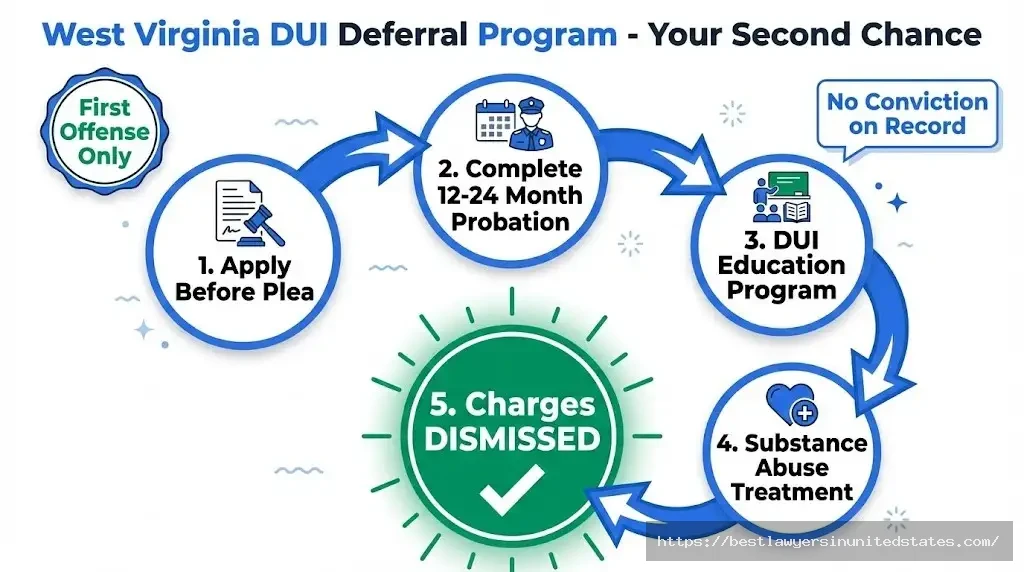
West Virginia offers a unique DUI Deferral Program that allows first-time offenders to avoid a permanent DUI conviction.
How the Deferral Program Works
Eligible defendants can enter a deferral agreement where they complete specific requirements instead of going to trial. Upon successful completion, the court dismisses the DUI charges entirely.
Key benefit: The dismissal means no DUI conviction appears on your criminal record.
Eligibility Requirements
You may qualify if:
- This is your first DUI offense
- No one was injured in the incident
- Your BAC was below 0.15%
- You have no prior deferral in the past 10 years
- The judge approves your application
Deferral Program Requirements
| Requirement | Details |
|---|---|
| Probation period | 12-24 months supervised probation |
| Alcohol education | Complete state-approved DUI education program |
| Substance abuse evaluation | Professional assessment and recommended treatment |
| Community service | Typically 40-100 hours |
| Ignition interlock | May be required during deferral period |
| Fines and costs | Pay all court costs and administrative fees |
Benefits vs. Risks
Deferral benefits:
- ✅ No DUI conviction on record
- ✅ Avoid mandatory minimum jail time
- ✅ Shorter license suspension period
- ✅ Lower insurance increases
- ✅ No felony for future offenses
Potential risks:
- ❌ Any violation terminates the agreement
- ❌ Original charges reinstated if you fail
- ❌ Limited to once every 10 years
- ❌ Still face license suspension during deferral
Application deadline: You must apply for the deferral program before pleading guilty or going to trial. Work with a DUI attorney to file the application properly.
Motor Vehicle Alcohol Test and Lock Program
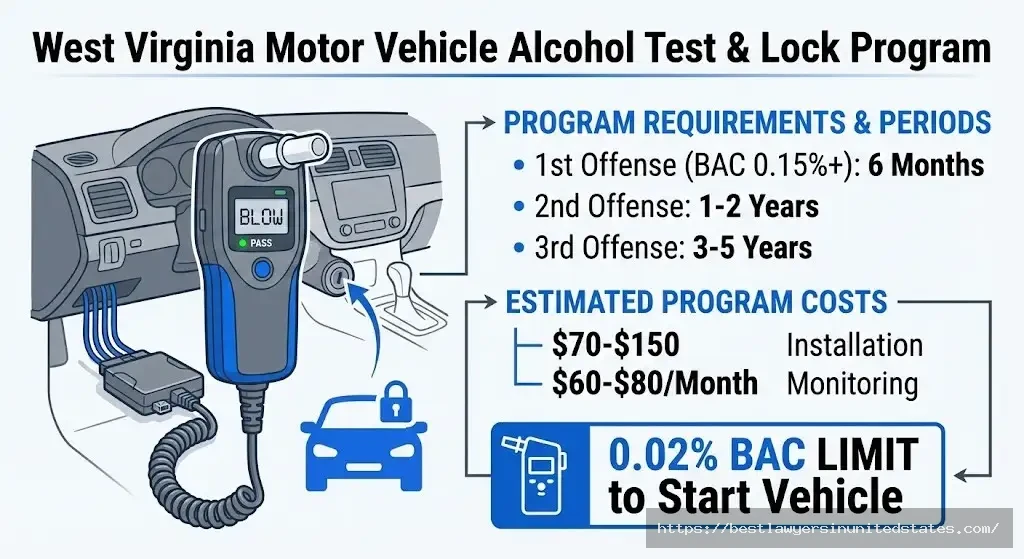
West Virginia’s Motor Vehicle Alcohol Test and Lock Program requires ignition interlock devices (IIDs) for most DUI offenders.
What Is an Ignition Interlock Device?
An IID connects to your vehicle’s ignition system and requires you to provide a breath sample before starting the car. The device prevents the engine from starting if it detects alcohol on your breath.
How it works:
- Blow into the device before starting your vehicle
- Device analyzes your breath for alcohol
- Vehicle starts only if BAC is below 0.02%
- Random rolling retests required while driving
Who Needs an Ignition Interlock?
| Offense | IID Requirement |
|---|---|
| First offense (BAC 0.15%+) | 6 months minimum |
| Second offense | 1-2 years minimum |
| Third offense | 3-5 years minimum |
| Refusal to test | Same as if you failed test |
IID Costs and Installation
Monthly expenses:
- Installation: $70-$150 one-time fee
- Monthly monitoring: $60-$80
- Calibration visits: $50-$100 every 60 days
- Removal fee: $50-$100
Total annual cost: $900-$1,400 per year for device and monitoring.
Approved IID Providers in West Virginia
West Virginia certifies specific vendors to install and monitor ignition interlock devices. Contact the West Virginia Division of Motor Vehicles for the current list of approved providers in your area.
Major service locations:
- Charleston DMV: 5707 MacCorkle Ave SE, Charleston, WV 25304
- Morgantown DMV: Contact for appointment
- Huntington DMV: Contact for appointment
License Suspension and Reinstatement in West Virginia
West Virginia imposes both administrative and criminal license suspensions for DUI offenses.
Administrative License Revocation
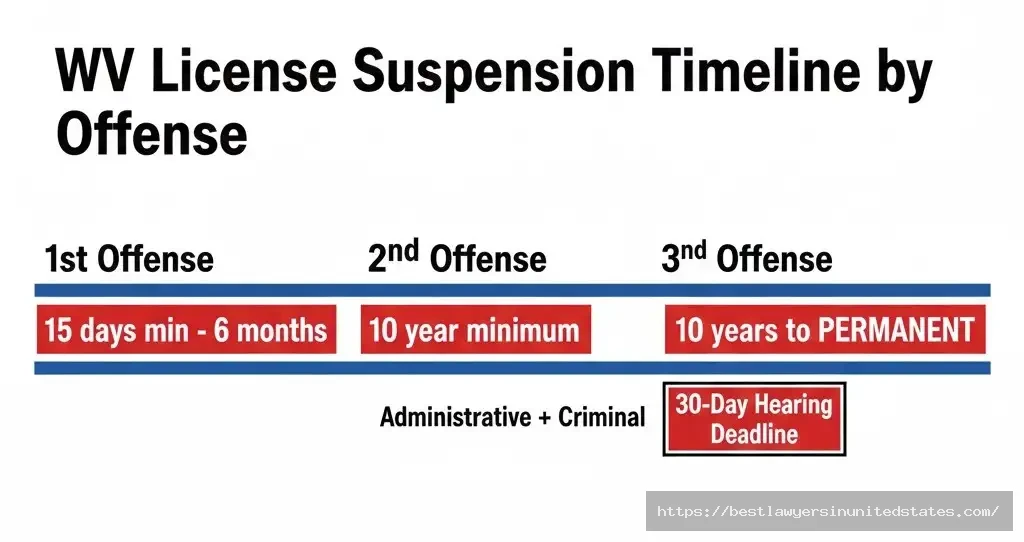
The West Virginia DMV automatically suspends your license immediately after a DUI arrest, separate from any criminal court proceedings.
Administrative suspension periods:
- First offense: 15-day minimum, up to 6 months
- Second offense: 1-year minimum
- Third offense: 10 years to permanent
How to Request an Administrative Hearing
You have 30 days from arrest to:
- Request a hearing with the DMV Office of Administrative Hearings
- Submit written request to the DMV
- Pay the hearing fee
- Receive temporary driving privileges until the hearing
Missing this deadline means: Your suspension becomes automatic with no opportunity to contest it.
Temporary Driving Permits
After 15 days of suspension, first-time offenders may apply for a conditional license that allows driving to:
- Work or business
- School or educational programs
- Medical appointments
- Court-ordered activities
Requirements: You must install an ignition interlock device and maintain SR-22 insurance to receive conditional driving privileges.
License Reinstatement Process
To reinstate your license after the suspension period:
Step-by-step reinstatement:
- Complete suspension period – Serve the full suspension time
- Complete DUI education – Finish state-approved alcohol education program
- Pay reinstatement fee – $115 to West Virginia DMV
- Obtain SR-22 insurance – File proof of financial responsibility
- Install ignition interlock – Required for most offenses
- Pass written/road tests – May be required for longer suspensions
SR-22 Insurance Requirements
West Virginia requires SR-22 insurance (proof of financial responsibility) for DUI offenders. This isn’t a separate insurance policy but a certificate your insurance company files with the DMV.
SR-22 requirements:
- Maintain for 3 years minimum
- Any lapse triggers immediate license suspension
- Increases insurance premiums by $800-$1,500 annually
Compare West Virginia’s requirements to neighboring Pennsylvania and Kentucky, which have similar but slightly different SR-22 duration requirements.
West Virginia Implied Consent Law
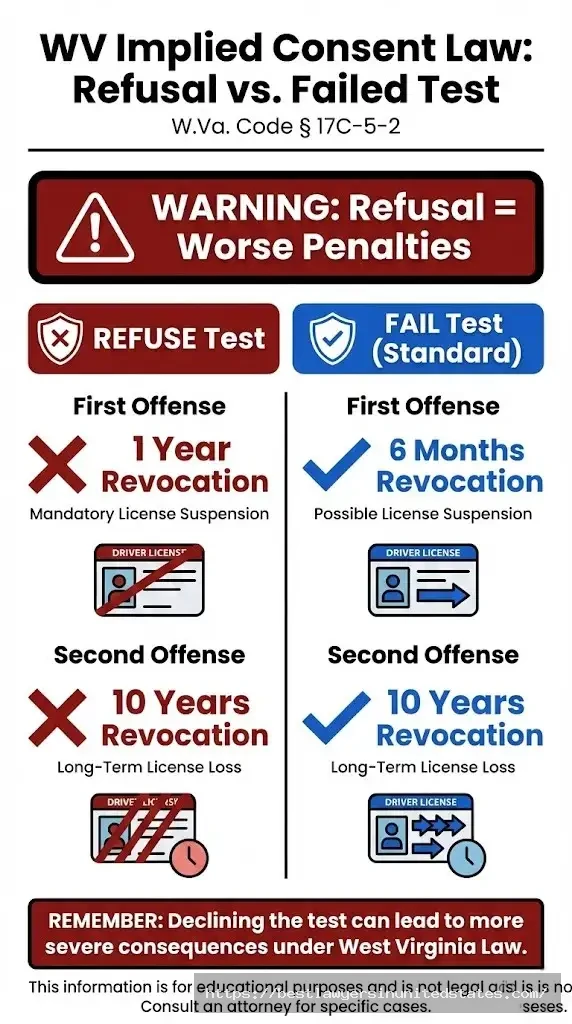
Every driver in West Virginia automatically agrees to chemical testing when they accept their driver’s license. This “implied consent” under W.Va. Code § 17C-5-2 kicks in the moment an officer arrests you for suspected DUI.
What Happens If You Refuse Testing?
Quick Answer: Refusing carries harsher penalties than failing the test in West Virginia.
| Offense | Refusal Penalty | Failed Test Penalty |
|---|---|---|
| First refusal | 1-year revocation | 6-month revocation |
| Second refusal | 10-year revocation | 10-year revocation |
| Third refusal | Permanent revocation | Permanent revocation |
Critical point: The refusal revocation applies even if you’re never convicted of DUI.
Can Police Force You to Take a Test?
Officers cannot physically force you to provide a breath sample without a warrant. However, they increasingly obtain warrants for blood draws in serious cases involving:
- Traffic accidents with injuries
- Property damage
- Child passengers in the vehicle
- Repeat offenders
Exception: You can request additional testing at your own expense after completing the official test. Some defendants use independent lab results to challenge the state’s evidence.
How Refusal Affects Your Case
The law lets you refuse testing, but consequences start immediately:
- ❌ Officer documents the refusal in the arrest report
- ❌ Prosecutors use refusal as evidence of “consciousness of guilt”
- ❌ Juries often view refusal negatively
- ❌ Longer license revocation than failed test
- ❌ Still face DUI charges based on officer observations
Two Separate Proceedings
The refusal revocation runs separately from any criminal court case.
Critical point: Even if a judge dismisses your DUI charge, the DMV revocation remains in effect. You must fight both battles independently through the criminal court system and DMV administrative hearings.
What Happens After a DUI Arrest in West Virginia
Understanding the arrest process helps you protect your rights and prepare your defense.
Immediate Post-Arrest Process
First 24 hours after arrest:
- Traffic stop or checkpoint – Officer observes signs of impairment
- Field sobriety tests – Standardized tests for balance and coordination
- Arrest and booking – Fingerprinting, photos, and processing
- Chemical testing – Breath, blood, or urine test at station
- License confiscation – Officer takes your physical license
- Bail or release – Post bail or sign release agreement
You receive: A temporary driving permit valid for 15 days and a notice of your court date.
West Virginia Magistrate Court Arraignment
Your first court appearance happens at the Magistrate Court within 10-15 days of arrest.
During arraignment:
- Judge reads the charges against you
- You enter a plea (guilty, not guilty, or no contest)
- Judge sets bail conditions if you weren’t released earlier
- Court schedules pre-trial hearings
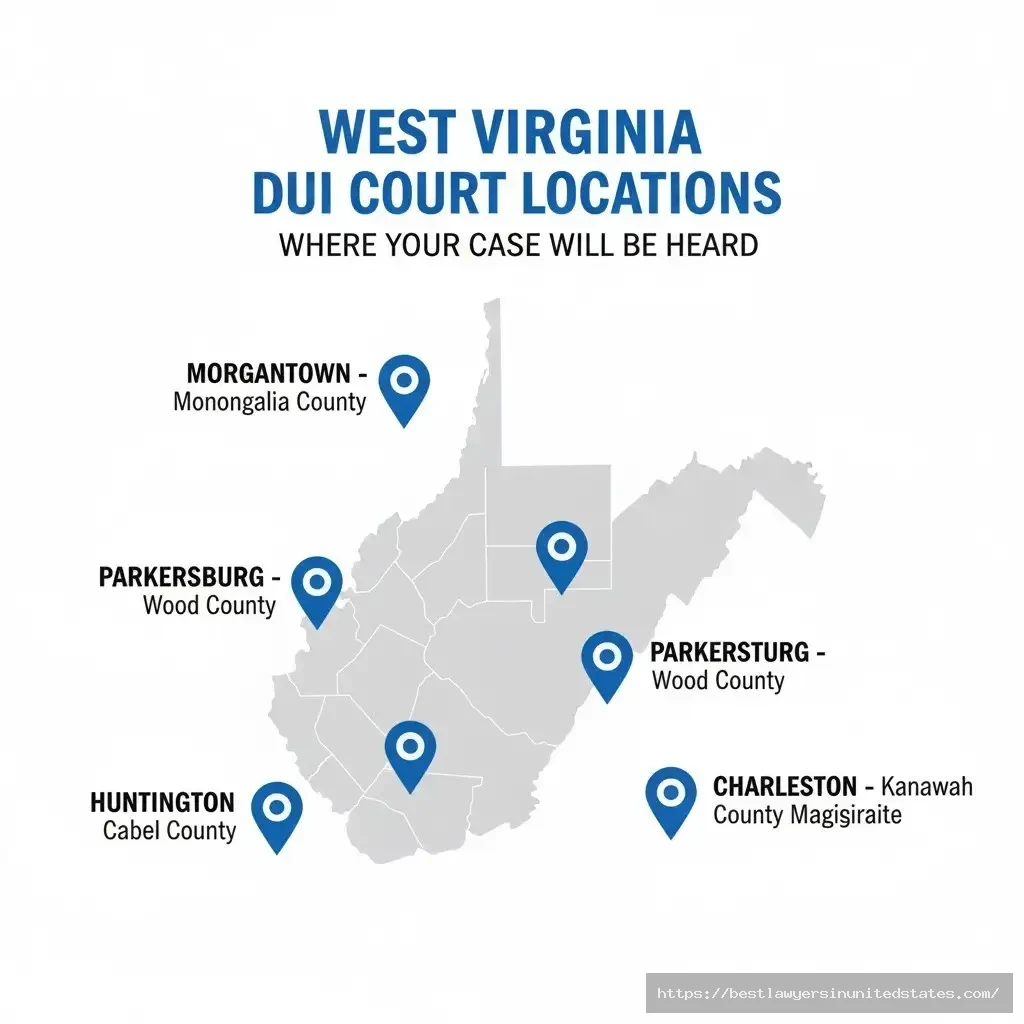
Major Magistrate Court locations:
- Kanawha County Magistrate Court (Charleston)
- Cabell County Magistrate Court (Huntington)
- Monongalia County Magistrate Court (Morgantown)
- Wood County Magistrate Court (Parkersburg)
- Ohio County Magistrate Court (Wheeling)
Pre-Trial and Plea Negotiations
Most DUI cases resolve through plea negotiations rather than trial. Your attorney negotiates with prosecutors to:
- Reduce charges to reckless driving
- Enter the DUI Deferral Program
- Minimize jail time and fines
- Preserve driving privileges
Timeline: Pre-trial negotiations typically take 60-90 days as attorneys review evidence, police reports, and chemical test results.
Trial in Circuit Court
If you reject plea offers, your case proceeds to trial in Circuit Court. Felony DUI cases always go to Circuit Court.
Trial process:
- Jury selection – Choose 12 jurors for your case
- Opening statements – Attorneys present their theories
- Prosecution case – State presents evidence and witnesses
- Defense case – You present your defense evidence
- Closing arguments – Final statements to jury
- Verdict – Jury deliberates and announces decision
Administrative vs. Criminal DUI Proceedings in West Virginia
West Virginia DUI cases involve two separate legal tracks that run simultaneously.
Administrative DMV Proceedings
The Division of Motor Vehicles handles license suspensions independently of criminal court.
Administrative process:
- Automatic suspension upon arrest
- 30-day deadline to request hearing
- Hearing officer reviews arrest circumstances
- Decision based on whether officer had probable cause
- Focuses only on license status, not guilt
Possible outcomes:
- Suspension upheld (most common)
- Suspension reduced or modified
- Suspension overturned (rare)
Criminal Court Proceedings
Criminal courts determine guilt and impose penalties for DUI violations.
Criminal process:
- Arraignment and plea entry
- Pre-trial motions and negotiations
- Trial or plea agreement
- Sentencing if convicted
- Appeals process if desired
Why Two Proceedings Matter
Winning your administrative hearing doesn’t dismiss criminal charges. Similarly, winning your criminal case doesn’t automatically restore your license.
Strategy: You need separate defenses for each proceeding. Many drivers hire attorneys who handle both processes simultaneously to maintain consistent strategies.
2025-2026 Updates to West Virginia DUI Laws
West Virginia implemented several changes to DUI laws effective January 2025, with additional modifications taking effect in 2026.
Enhanced Ignition Interlock Requirements
New 2025 rules:
- All second offenses now require minimum 12-month IID installation
- First offenses with BAC 0.15%+ require 6-month IID minimum
- Commercial drivers face IID requirements at 0.04% BAC
Expanded Deferral Program Eligibility
The 2025 legislative session expanded the DUI Deferral Program to include:
- Higher BAC offenders (up to 0.17% now eligible)
- Broader range of aggravating factors allowed
- Streamlined application process through Magistrate Courts
Stricter Penalties for Refusal
Refusal penalties increased in 2025 to discourage drivers from avoiding chemical testing.
| Change | Old Law | New 2025 Law |
|---|---|---|
| First refusal | 6-month suspension | 1-year revocation |
| Second refusal | 1-year suspension | 10-year revocation |
| Administrative penalties | Limited fines | Enhanced court costs |
New Treatment Court Programs
West Virginia expanded DUI Treatment Courts to additional counties in 2025. These specialized courts focus on rehabilitation rather than punishment for offenders with substance abuse issues.
Available locations (2026):
- Kanawha County DUI Court (Charleston)
- Berkeley County Drug Court (Martinsburg)
- Cabell County Recovery Court (Huntington)
Benefits: Participants who complete treatment court programs may receive reduced sentences and faster license reinstatement.
Compare these recent changes to neighboring Maryland’s DUI laws, which also underwent significant updates in 2025.
Complete Cost Breakdown for a West Virginia DUI
Beyond fines and court costs, a DUI conviction creates numerous hidden expenses that add up quickly.
Direct Legal Costs
| Expense | First Offense | Second Offense | Third Offense |
|---|---|---|---|
| Court fines | $100-$1,000 | $1,000-$3,000 | $3,000-$5,000 |
| Court costs | $200-$300 | $300-$500 | $500-$750 |
| Attorney fees | $1,500-$5,000 | $3,000-$7,500 | $5,000-$15,000 |
| Expert witnesses | $500-$2,000 | $1,000-$3,000 | $2,000-$5,000 |
Administrative and Program Costs
| Category | Amount |
|---|---|
| DMV reinstatement fee | $115 |
| Administrative hearing fee | $50 |
| DUI education program | $200-$500 |
| Substance abuse evaluation | $100-$300 |
| Treatment programs | $500-$5,000 |
| Community service supervision | $50-$200 |
Vehicle and Transportation Costs
| Expense | Annual Cost |
|---|---|
| Ignition interlock device | $900-$1,400 |
| SR-22 insurance increase | $800-$1,500 |
| Vehicle impound/towing | $200-$500 (one-time) |
| Rideshare during suspension | $1,200-$3,000 |
| Alternative transportation | $500-$2,000 |
Long-Term Financial Impact
Employment consequences:
- Lost wages during jail time: $2,000-$10,000
- Job loss or demotion: Variable
- Professional license suspension: Variable
- Background check impact: Affects future opportunities
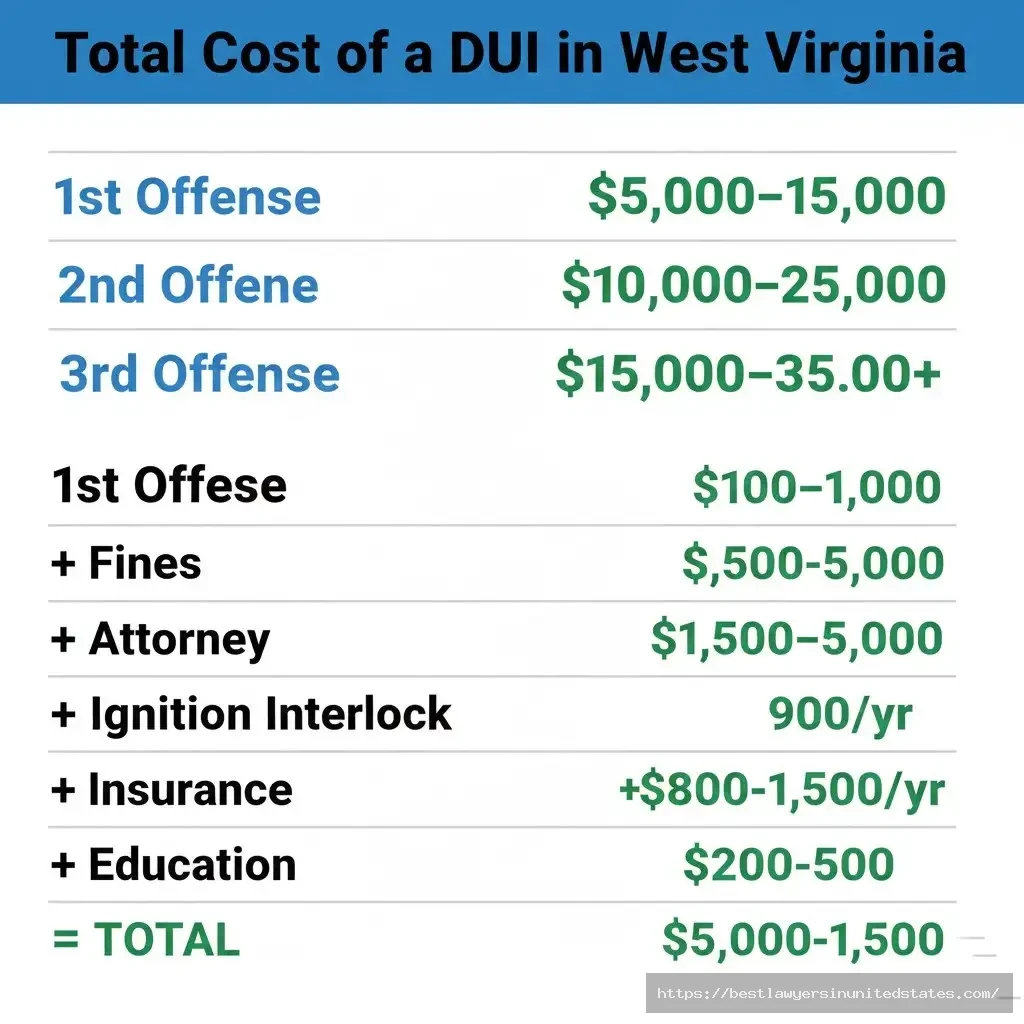
Total estimated costs:
- First offense: $5,000-$15,000
- Second offense: $10,000-$25,000
- Third offense: $15,000-$35,000+
Life changes following a DUI can create additional expenses. Beyond criminal penalties, you might face challenges like those in divorce proceedings in West Virginia, where DUI convictions affect custody decisions and financial settlements.
Underage DUI: Zero Tolerance in West Virginia
West Virginia enforces strict zero tolerance laws for drivers under 21, imposing penalties at just 0.02% BAC.
Zero Tolerance Law Explained
Any detectable alcohol in an underage driver’s system violates West Virginia law. One drink can push most people over the 0.02% threshold.
Legal consequences:
- License suspension: 60 days to 6 months
- Fines: $25 to $100 (first violation)
- Community service: Up to 40 hours
- Alcohol education: Mandatory program completion
- Parental notification: Parents receive notice from DMV
Enhanced Penalties for Higher BAC
Underage drivers with BAC of 0.08% or higher face adult DUI penalties plus additional consequences:
- Adult criminal DUI charges
- Zero tolerance violations
- Enhanced fines and jail time
- Longer license suspensions
Court location: Underage cases typically proceed through Family Court unless BAC exceeds 0.08%, which triggers adult criminal charges in Magistrate Court.
Impact on College Students
DUI convictions affect college students beyond legal penalties:
- Loss of federal student aid eligibility
- University disciplinary action
- Greek life membership suspension
- Housing restrictions on campus
- Scholarship revocation
- Graduate school application issues
Commercial Driver DUI in West Virginia
Commercial driver’s license (CDL) holders face stricter standards and career-ending consequences for DUI violations.
CDL BAC Limits
Commercial drivers violate DUI laws at:
- 0.04% BAC while operating commercial vehicle
- 0.08% BAC while operating personal vehicle
- Any detectable controlled substances
CDL Disqualification Periods
| Offense | Disqualification Period |
|---|---|
| First violation | 1 year minimum |
| Second violation | Lifetime ban |
| Hazmat violation | 3 years minimum |
| Refusal to test | Same as failed test |
Critical point: A lifetime CDL ban means you cannot drive commercially in any state. Most trucking and transportation careers end permanently after a second CDL DUI.
Personal Vehicle DUI Impact
Getting a DUI in your personal vehicle still triggers CDL disqualification. The offense doesn’t need to occur while driving commercially.
Example: A truck driver arrested for DUI on Saturday night while driving their personal car loses their CDL and job, even though the violation occurred off-duty.
DUI Causing Injury or Death in West Virginia
DUI cases involving injuries or fatalities bring the most severe penalties under West Virginia law.
DUI with Bodily Injury
Causing injury while driving under the influence adds enhanced penalties to standard DUI charges.
Additional penalties:
- Extended jail time: 30 days to 1 year added
- Restitution payments: Medical bills and lost wages
- Civil lawsuits: Victims can sue for damages
- Higher fines: Court discretion for maximum penalties
DUI Causing Death
DUI causing death triggers felony charges regardless of prior offense history.
Potential charges:
- DUI causing death: 2-10 years prison
- Vehicular manslaughter: 3-15 years prison
- Aggravated vehicular homicide: 5-20 years prison
Factors affecting sentence:
- BAC level at time of crash
- Prior DUI history
- Reckless driving behavior
- Number of victims
- Presence of children in vehicle
Civil Liability
Criminal penalties represent only part of the consequences. Victims and their families can file civil lawsuits seeking:
- Medical expenses
- Lost wages and future earnings
- Pain and suffering damages
- Wrongful death damages
- Punitive damages for egregious conduct
Financial impact: Civil judgments often reach hundreds of thousands or millions of dollars, amounts rarely covered by insurance policies.
Defense Strategies Against West Virginia DUI Charges
Several legal defenses can challenge DUI charges in West Virginia courts.
Challenging the Traffic Stop
Officers need reasonable suspicion to stop your vehicle. Defense attorneys examine whether the stop was legal.
Common challenges:
- Lack of probable cause for initial stop
- Improper checkpoint procedures
- Racial or discriminatory profiling
- Mistaken observations of erratic driving
Questioning Field Sobriety Tests
Field sobriety tests carry inherent reliability problems that skilled attorneys exploit.
Defense arguments:
- Medical conditions affecting balance
- Poor weather or road conditions
- Officer training or administration errors
- Inappropriate test selection for conditions
- Language barriers or confusion
Attacking Chemical Test Results
Breath and blood tests aren’t infallible. Several factors affect accuracy:
Breath test challenges:
- Improper calibration or maintenance
- Radio frequency interference
- Mouth alcohol contamination
- Medical conditions (GERD, diabetes)
- Officer certification issues
Blood test challenges:
- Chain of custody breaks
- Contamination or improper storage
- Lab errors or miscalculations
- Delayed testing affecting results
Necessity Defense
Rare circumstances justify driving while impaired to prevent greater harm.
Examples:
- Medical emergency requiring immediate hospital transport
- Escaping immediate danger or violence
- No reasonable alternative available
Requirements: You must prove the emergency was real, immediate, and left no other options.
Working With a West Virginia DUI Attorney
Experienced DUI attorneys understand West Virginia’s unique laws and court procedures. They navigate both administrative DMV hearings and criminal court proceedings simultaneously.
What attorneys do:
- Review arrest reports and evidence
- Identify weaknesses in prosecution case
- Negotiate with prosecutors for reduced charges
- Apply for DUI Deferral Program
- Represent you at DMV hearings
- Challenge test results and procedures
- Present defense at trial if necessary
Email for consultation: [email protected]
Frequently Asked Questions About West Virginia DUI Laws
What is the penalty for first offense DUI in West Virginia?
Quick Answer: First offense DUI in West Virginia carries $100-$500 fines, 24 hours to 6 months jail, and 6-month license revocation under W.Va. Code § 17C-5-2.
Higher BAC levels (0.15%+) trigger enhanced penalties including mandatory 2-day jail time, $200-$1,000 fines, and required ignition interlock device installation.
Is DUI a felony in West Virginia?
Quick Answer: DUI becomes a felony in West Virginia on your third offense within 10 years, carrying 1-3 years prison time and permanent license revocation.
First and second offenses remain misdemeanors unless they involve serious injury or death. Aggravated DUI charges carry enhanced penalties but stay misdemeanors until the third conviction.
How long does a DUI stay on your record in West Virginia?
Quick Answer: DUI convictions remain on your criminal record permanently in West Virginia unless you receive a pardon from the governor.
The 10-year lookback period affects penalties for new offenses, but the conviction itself never disappears from background checks. Successful completion of the Deferral Program results in dismissal rather than conviction.
Can you get out of a DUI in West Virginia?
Quick Answer: The DUI Deferral Program offers first-time offenders a path to dismissal by completing probation, education programs, and treatment requirements.
Other defense strategies include challenging illegal stops, faulty test results, and procedural violations. Success depends on your case’s specific circumstances and evidence quality.
Do you lose your license immediately after a DUI in West Virginia?
Quick Answer: Yes, officers confiscate your physical license immediately and issue a 15-day temporary permit that expires before your administrative hearing.
You have 30 days from arrest to request an administrative hearing to contest the suspension. After 15 days, first offenders may apply for conditional driving privileges with an ignition interlock device.
What are the new DUI laws in West Virginia for 2025-2026?
Quick Answer: West Virginia expanded ignition interlock requirements, enhanced refusal penalties to 1-year revocation, and broadened DUI Deferral Program eligibility in 2025.
Additional changes include expanded treatment court programs in more counties and streamlined administrative hearing processes through DMV offices.
How much does a DUI cost in West Virginia?
Quick Answer: A first DUI in West Virginia costs $5,000-$15,000 total, including fines ($100-$1,000), attorney fees ($1,500-$5,000), ignition interlock ($900/year), and insurance increases ($800-$1,500/year).
Second offenses cost $10,000-$25,000, while third offenses can exceed $35,000 when including all legal fees, programs, and long-term financial impacts.
What is West Virginia’s Motor Vehicle Alcohol Test and Lock Program?
Quick Answer: West Virginia’s ignition interlock program requires DUI offenders to install breath-testing devices that prevent vehicle operation if alcohol is detected above 0.02% BAC.
Most DUI convictions require IID installation ranging from 6 months (first offense, high BAC) to permanent installation for multiple offenses. Costs average $70-80 monthly plus installation fees.
Can you refuse a breathalyzer in West Virginia?
Quick Answer: You can refuse breathalyzer testing in West Virginia, but refusal triggers automatic 1-year license revocation for first refusal, compared to 6-month revocation for failing the test.
Prosecutors use refusal as evidence of guilt in criminal proceedings. Officers increasingly obtain warrants for blood draws when drivers refuse breath tests, especially in accident cases.
How does West Virginia DUI law compare to neighboring states?
Quick Answer: West Virginia’s penalties align closely with Virginia, Kentucky, and Maryland, but the 10-year lookback period is longer than Ohio’s 6-year period.
West Virginia’s unique DUI Deferral Program offers better outcomes for first offenders compared to some neighboring states without similar diversion programs.
Final Takeaway: West Virginia DUI laws carry serious consequences that extend far beyond fines and jail time. The 10-year lookback period, mandatory ignition interlock requirements, and permanent felony consequences for third offenses make every DUI charge a critical legal matter. Whether facing your first offense or dealing with enhanced charges, understanding your options through the Deferral Program and working with experienced legal counsel provides your best path to minimizing long-term damage.
