Quick Answer: Indiana’s minimum wage is $7.25 per hour in 2026, unchanged since July 24, 2009. Tipped workers must receive at least $2.13 per hour plus tips. Workers under 20 can be paid $4.25 per hour for their first 90 days.
Indiana follows the federal minimum wage with no state-level increases scheduled for 2026 or beyond. This makes Indiana one of 20 states that still use the federal floor of $7.25 per hour.
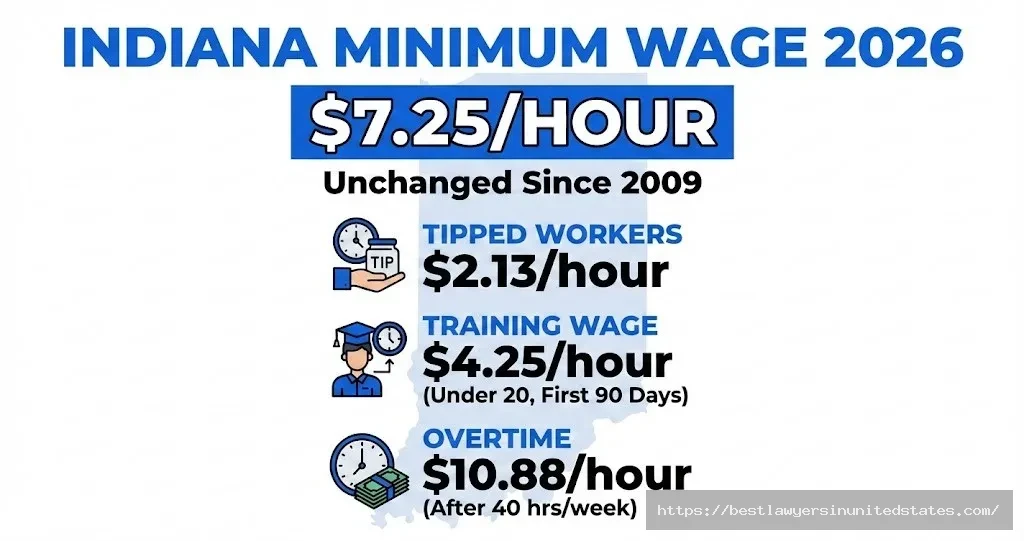
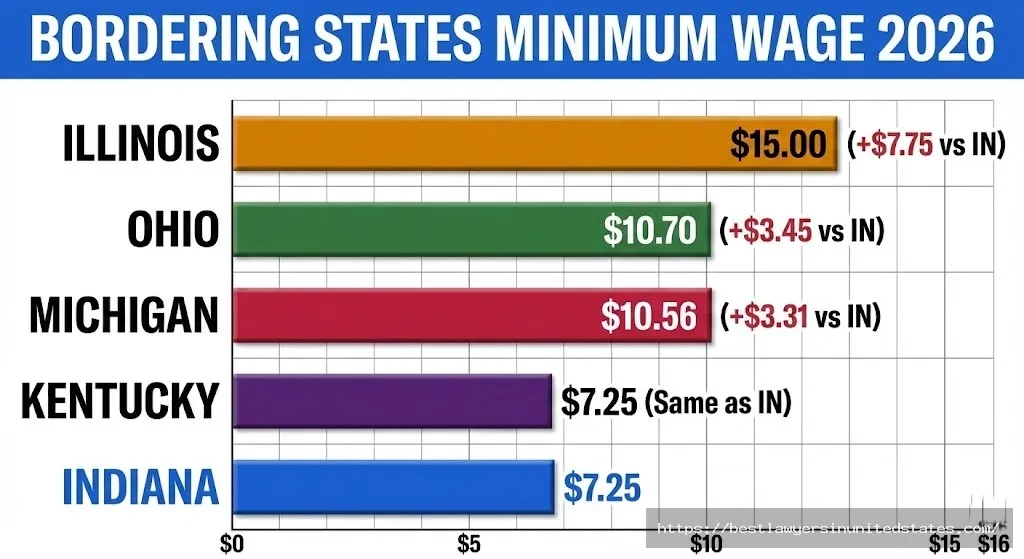
Unlike neighboring Illinois ($15.00) or Ohio ($10.70), Indiana has not raised its minimum wage in over 16 years. The last increase happened when both federal and state rates jumped from $6.55 to $7.25 in 2009.
Calculate Your Earnings in Indiana
Want to know exactly how much you’ll earn at Indiana’s $7.25 minimum wage? Use our free calculator to estimate your weekly, monthly, and annual income based on your hours worked.
💰 Minimum Wage Earnings Calculator
Calculate your weekly, monthly, and annual earnings with overtime and tax estimates
📊 Your Earnings Breakdown
💰 Gross Earnings
Calculator features:
- Automatic Indiana wage rates for 2026
- Weekly, monthly, and annual earnings
- Overtime calculations
- Tax withholding estimates
- Take-home pay breakdown
Full calculator with all features: Calculate your Indiana minimum wage earnings
Questions about your wages or need legal help? Email: [email protected]
What Is Indiana's Minimum Wage in 2026?
Indiana's minimum wage remains at $7.25 per hour for the year 2026. This rate matches the federal minimum wage set by the Fair Labor Standards Act (FLSA).
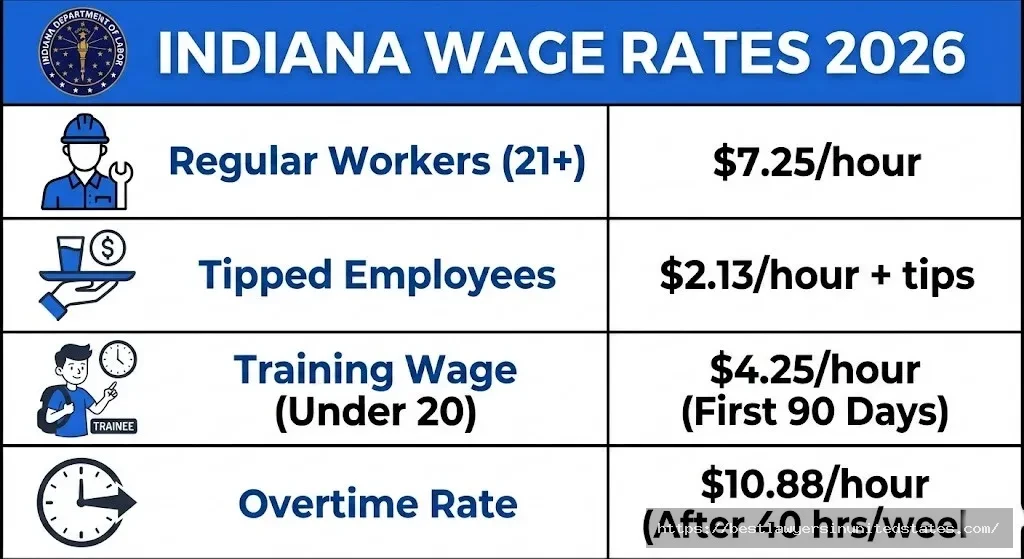
Most Indiana workers are covered under the FLSA. Those who aren't covered by federal law fall under the Indiana Minimum Wage Law, which also sets the rate at $7.25 per hour.
Current Indiana Minimum Wage Rates
| Worker Type | Hourly Rate | Notes |
|---|---|---|
| Regular Workers (21+) | $7.25 | Standard minimum wage |
| Tipped Employees | $2.13 base + tips | Must equal $7.25 with tips |
| Training Wage (Under 20) | $4.25 | First 90 consecutive days only |
| Overtime Rate | $10.88 | 1.5x regular rate after 40 hours/week |
Annual earnings at minimum wage: A full-time worker earning $7.25 per hour makes approximately $15,080 per year before taxes (40 hours × 52 weeks).
Federal vs Indiana Minimum Wage
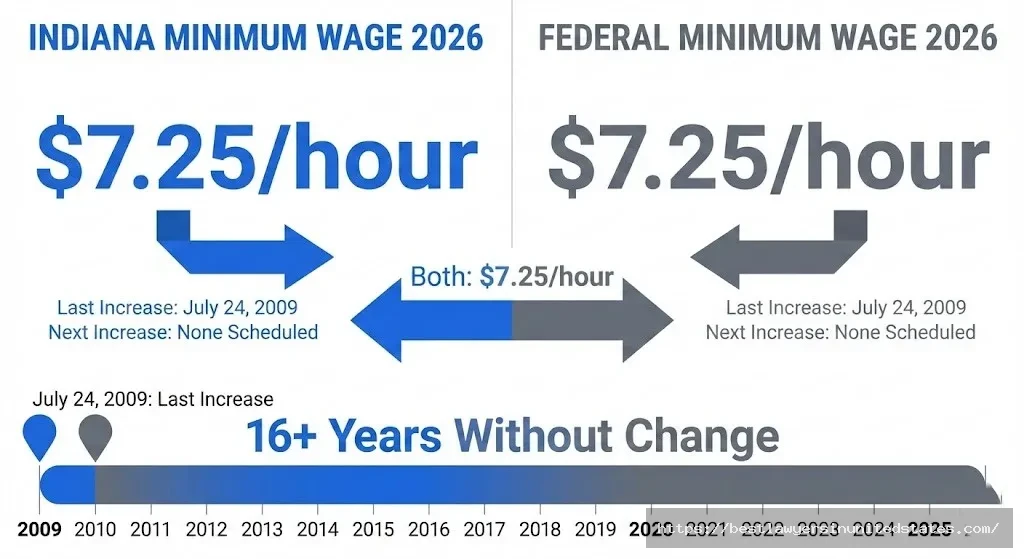
Both Indiana and federal minimum wage are identical at $7.25 per hour. When state and federal minimum wages differ, employers must pay whichever rate is higher.
| Jurisdiction | Minimum Wage | Last Increase | Next Scheduled Increase |
|---|---|---|---|
| Indiana | $7.25 | July 24, 2009 | None scheduled |
| Federal | $7.25 | July 24, 2009 | None scheduled |
The Indiana Department of Labor enforces wage laws for workers not covered by the FLSA. You can reach them at (317) 232-2655 or [email protected].
Will Indiana Raise Minimum Wage in 2026 or 2027?
No. Indiana has no minimum wage increase scheduled for 2026, 2027, or any future year. The state legislature has not passed any bills to raise the wage floor above $7.25.
This puts Indiana behind several neighboring states that have implemented gradual increases:
| State | 2026 Minimum Wage | Difference from Indiana |
|---|---|---|
| Illinois | $15.00 | +$7.75 higher |
| Ohio | $10.70 | +$3.45 higher |
| Michigan | $10.56 | +$3.31 higher |
| Kentucky | $7.25 | Same as Indiana |
Workers near state borders may find higher-paying opportunities in Illinois or Ohio. However, Indiana's lower cost of living can offset some of the wage difference.
Tipped Employee Minimum Wage in Indiana
Indiana allows employers to pay tipped workers a base wage of $2.13 per hour if the employee regularly receives more than $30 per month in tips.
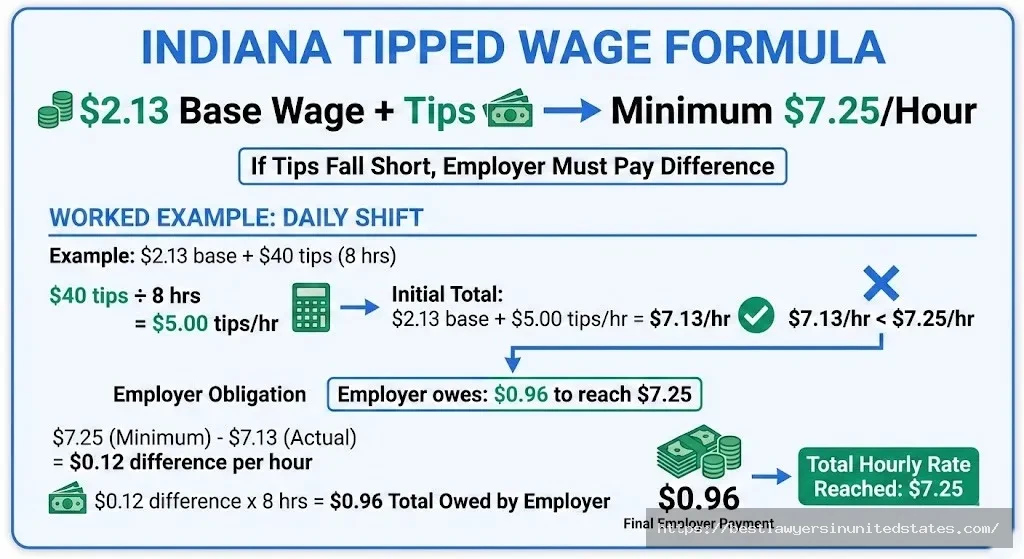
This matches the federal tipped minimum wage. The employer can claim a "tip credit" of $5.12 per hour, which covers the difference between $2.13 and $7.25.
How the Tip Credit Works
The formula is simple: Base wage ($2.13) + Tips = At least $7.25 per hour
If your tips plus base wage don't equal $7.25 per hour for your entire shift, your employer must make up the difference. This is called "making you whole."
Example calculation:
- You work 8 hours and earn $2.13 per hour base = $17.04
- You receive $40 in tips for that shift
- Total earnings: $57.04 for 8 hours = $7.13 per hour
- Your employer owes you: $0.96 to reach $7.25 per hour ($58 total)
Who Qualifies as a Tipped Employee?
Indiana law defines tipped employees as workers who "customarily and regularly" receive more than $30 per month in tips.
Common tipped positions:
- Restaurant servers and waitstaff
- Bartenders
- Bussers and food runners
- Hotel bellhops and valets
- Hair stylists and barbers
- Delivery drivers (in some cases)
Not eligible for tip credit:
- Fast food workers who receive occasional tips
- Workers who spend less than 20% of their time on tip-generating activities
- Back-of-house kitchen staff
Tip Pooling Rules in Indiana
Employers can require tip pooling among employees who "customarily and regularly" receive tips. However, managers and supervisors cannot participate in tip pools.
Legal tip pools include:
- Servers, bartenders, and bussers sharing tips
- Hair stylists pooling tips in a salon
- Valets sharing gratuities
Illegal practices:
- Managers taking any portion of employee tips
- Requiring employees to tip out kitchen staff who don't regularly receive tips
- Deducting credit card processing fees from tips
If your employer violates these rules, contact the Indiana Department of Labor at [email protected] or call (317) 232-2655.
Training Wage for Young Workers in Indiana
Indiana allows employers to pay workers under 20 years old a training wage of $4.25 per hour for their first 90 consecutive calendar days of employment.
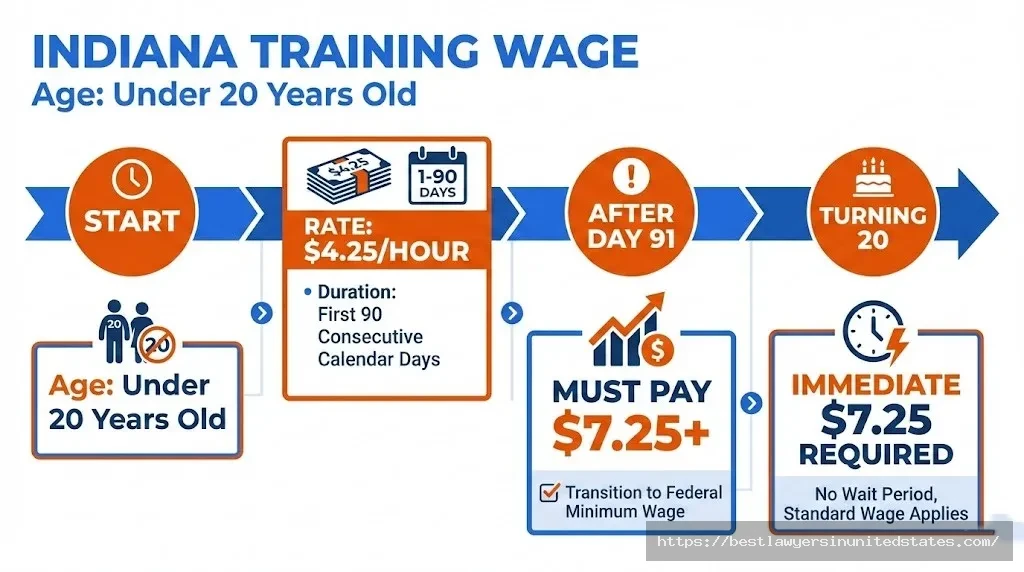
This federal provision under the FLSA gives employers flexibility when hiring inexperienced workers. After 90 days, the wage must increase to at least $7.25 per hour.
Training Wage Requirements
| Requirement | Details |
|---|---|
| Age limit | Must be under 20 years old |
| Duration | First 90 consecutive calendar days only |
| Rate | $4.25 per hour minimum |
| After 90 days | Must increase to $7.25 or higher |
| 20th birthday | Must pay $7.25 immediately upon turning 20 |
Important: The 90-day period is based on calendar days, not working days. If you start a job on January 1, your training wage period ends on March 31, regardless of how many shifts you worked.
What Happens After 90 Days?
On day 91, your employer must pay you at least $7.25 per hour. If they continue paying $4.25, they're violating federal and state wage laws.
Your employer cannot:
- Restart the 90-day clock by firing and rehiring you
- Use the training wage for workers 20 or older
- Extend the training period beyond 90 days
- Pay less than $4.25 during the training period
Youth Employment Rules for Ages 14-19
Indiana allows 14-year-olds to work, but with restrictions on hours and types of work. These rules come from both federal and Indiana law.
Work hour limits for 14-15 year olds:
- 3 hours per day on school days
- 18 hours per week during school
- 8 hours per day on non-school days
- 40 hours per week during summer
Prohibited jobs for workers under 18:
- Manufacturing or processing jobs
- Operating power-driven machinery
- Construction work
- Jobs involving hazardous chemicals
- Most driving jobs
For detailed guidance on what 14-year-olds can do in Indiana, check the Indiana Department of Labor's youth employment page.
Indiana Overtime Laws 2026
Indiana requires employers to pay overtime at 1.5 times the regular rate for hours worked beyond 40 in a workweek. This rate equals $10.88 per hour for minimum wage workers ($7.25 × 1.5).
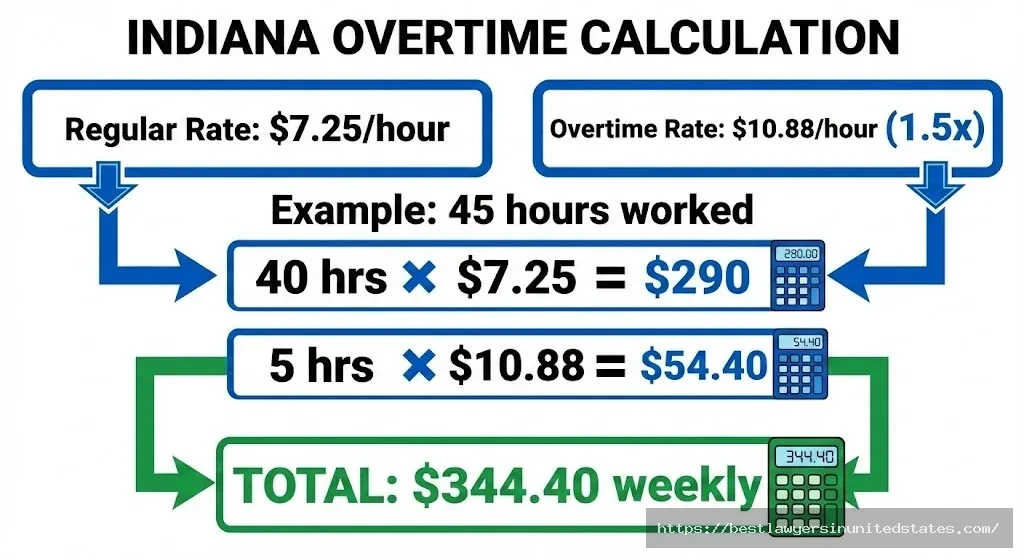
The overtime requirement comes from both the FLSA and Indiana Minimum Wage Law. Most Indiana workers are covered by one or both laws.
How to Calculate Overtime Pay
Basic formula: Regular hourly rate × 1.5 × overtime hours
Example for minimum wage worker:
- Regular rate: $7.25 per hour
- Overtime rate: $10.88 per hour ($7.25 × 1.5)
- You work 45 hours in one week
- Regular pay: 40 hours × $7.25 = $290
- Overtime pay: 5 hours × $10.88 = $54.40
- Total weekly pay: $344.40
Calculate Your Overtime Pay in Indiana
Working more than 40 hours per week? Calculate your overtime earnings based on Indiana's overtime laws. This calculator accounts for Indiana's specific overtime rules and helps you verify your paycheck.
⏰ Overtime Pay Calculator
Calculate your overtime earnings based on your state's specific labor laws
📍 Select Your State
💰 Your Hourly Wage
📊 Calculation Method
📅 Weekly Hours
💵 Your Weekly Overtime Pay
📊 Earnings Breakdown
📅 Pay Period Estimates
⚖️ State vs Federal Comparison
Calculator features:
- Indiana-specific overtime rules
- Weekly overtime calculations
- Pay period breakdowns
- Comparison with regular earnings
- Verification of employer calculations
Full overtime calculator: Calculate your Indiana overtime pay
Questions about unpaid overtime? Email: [email protected]
Indiana Code § 22-2-2-3 Overtime Exemptions
Indiana Code § 22-2-2-3 lists 16 specific categories of workers exempt from overtime pay requirements. These exemptions apply only to state law, not federal FLSA coverage.
Common overtime exemptions:
- Executive employees - Managers who supervise two or more employees and earn salary
- Administrative employees - Office workers performing non-manual work
- Professional employees - Doctors, lawyers, teachers, engineers
- Outside sales employees - Salespeople who work primarily off-site
- Agricultural workers - Farm laborers and seasonal agricultural employees
- Domestic service employees - In-home caregivers and household workers
- Commissioned employees - Workers paid primarily through commissions
- Seasonal amusement employees - Theme park and seasonal recreation workers
- Small newspaper employees - Workers at newspapers with circulation under 4,000
- Taxi drivers - Cab and ride-share drivers in some cases
- Fishing and seafood employees - Commercial fishing workers
- Switchboard operators - Telephone operators at small companies
- Seamen - Crew members on vessels
- Railroad employees - Train crews and railroad workers
- Motor carrier employees - Truck drivers under DOT regulations
- Announcers and producers - Radio and TV station employees
Just because your job title matches these categories doesn't automatically exempt you. The exemption depends on your actual job duties and how you're paid.
For complete exemption details, see Indiana Code § 22-2-2-3.
Common Overtime Violations
Watch for these illegal practices:
- Off-the-clock work - Requiring work before clocking in or after clocking out
- Comp time instead of overtime - Private employers cannot offer compensatory time off instead of overtime pay
- Misclassification - Calling you "exempt" when your duties don't qualify
- Salary misuse - Paying salary to avoid overtime when job duties don't meet exemption tests
- Working through breaks - Not paying for meal breaks you actually work through
If you suspect overtime violations, document your hours and contact the Indiana Wage and Hour Division.
Minimum Wage by Indiana City
Indiana has no local minimum wage ordinances. Every city and county in Indiana follows the state minimum wage of $7.25 per hour.
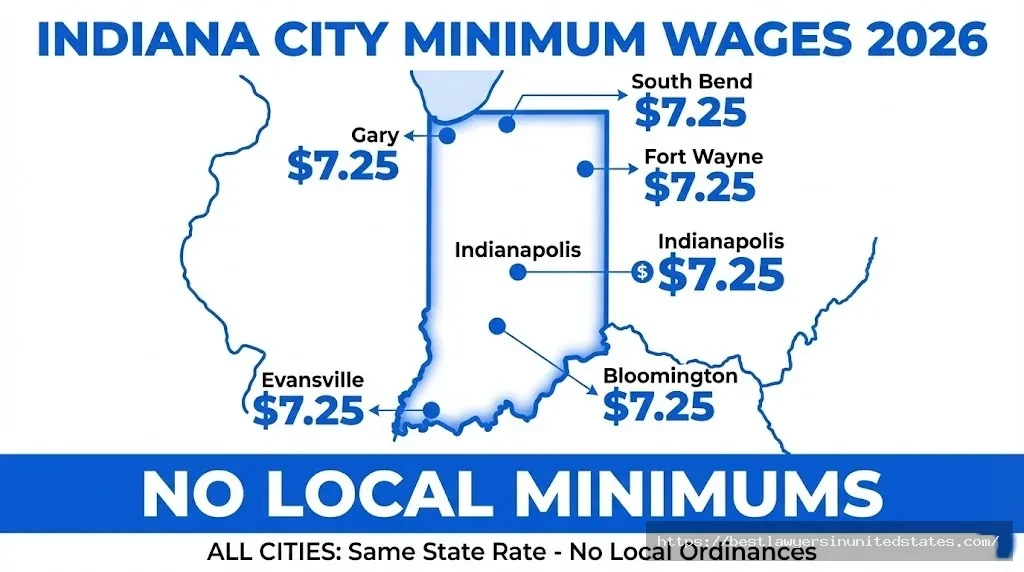
This differs from states like California or Washington, where cities can set higher minimum wages than the state rate. Indiana law prevents local governments from establishing their own wage floors.
Major Indiana Cities and Minimum Wage
| City | Population | Minimum Wage | Cost of Living Index |
|---|---|---|---|
| Indianapolis | 880,000 | $7.25 | 89.3 (below national average) |
| Fort Wayne | 270,000 | $7.25 | 83.1 (well below average) |
| Evansville | 118,000 | $7.25 | 79.8 (lowest in state) |
| South Bend | 103,000 | $7.25 | 81.2 (below average) |
| Carmel | 100,000 | $7.25 | 117.5 (above average) |
| Bloomington | 85,000 | $7.25 | 94.7 (near average) |
Living costs vary significantly across Indiana cities. While the minimum wage stays at $7.25 everywhere, your purchasing power depends on where you live.
Why Indiana Has No Local Minimum Wages
Indiana's state law preempts local wage ordinances. This means cities and counties cannot pass laws setting minimum wages higher than the state rate.
States that allow local minimum wages:
- California (Los Angeles: $17.28, San Francisco: $18.07)
- Washington (Seattle: $19.97)
- New York (New York City: $16.50)
- Colorado (Denver: $18.29)
Border-city workers near Illinois might commute to access that state's $15 minimum wage. The economic impact depends on transportation costs and time.
Is $7.25 a Living Wage in Indiana?
No. At $7.25 per hour, a full-time worker earns $15,080 annually before taxes. This falls well below a living wage in every Indiana county.
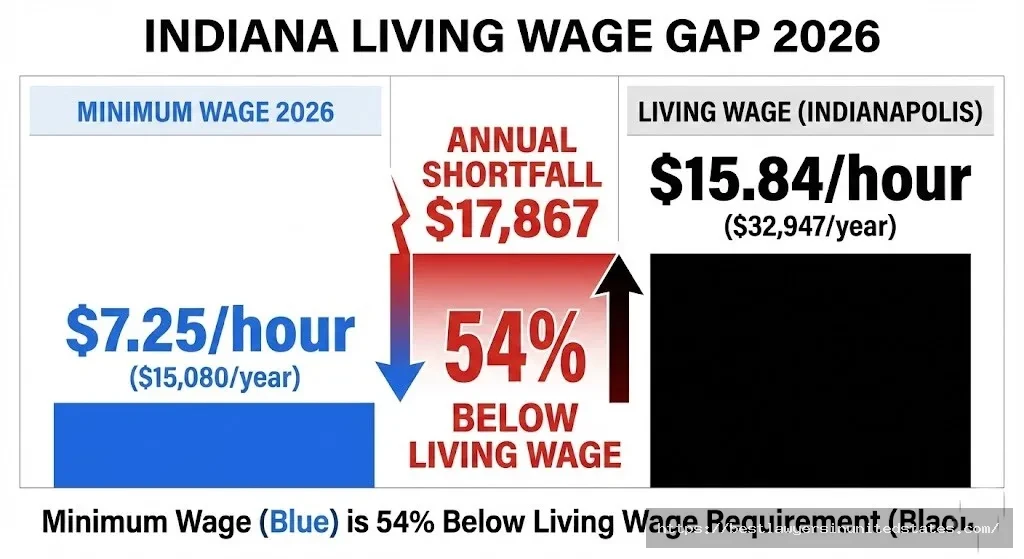
The MIT Living Wage Calculator estimates that a single adult needs $15.84 per hour to cover basic expenses in Indianapolis. That's more than double Indiana's minimum wage.
Living Wage vs Minimum Wage Gap
| Location | Living Wage (Single Adult) | Minimum Wage | Annual Gap |
|---|---|---|---|
| Indianapolis | $15.84/hour | $7.25/hour | -$17,867 shortage |
| Fort Wayne | $14.92/hour | $7.25/hour | -$15,954 shortage |
| Evansville | $14.23/hour | $7.25/hour | -$14,558 shortage |
| Bloomington | $15.45/hour | $7.25/hour | -$17,056 shortage |
| State Average | $15.23/hour | $7.25/hour | -$16,598 shortage |
A single adult working full-time at minimum wage in Indianapolis would need to work 88 hours per week to meet basic living expenses. That's more than double the standard 40-hour workweek.
Budget Breakdown: Living on $7.25 Per Hour
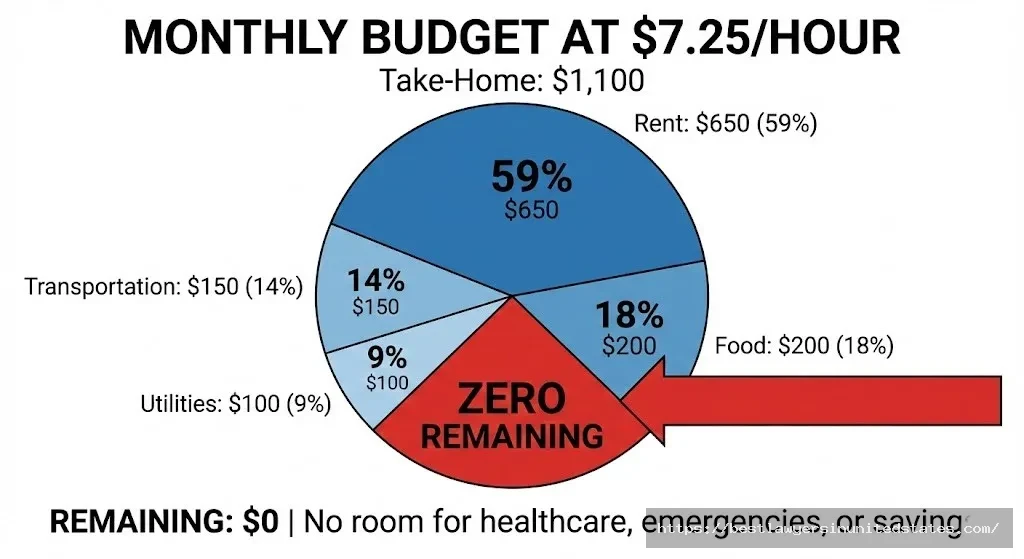
Annual income: $15,080 (before taxes) Monthly gross: $1,257 Monthly take-home (estimated): $1,100 (after federal and state taxes)
Sample monthly budget on minimum wage:
| Expense Category | Cost | % of Income |
|---|---|---|
| Rent (studio apartment) | $650 | 59% |
| Food | $200 | 18% |
| Transportation | $150 | 14% |
| Utilities | $100 | 9% |
| Total | $1,100 | 100% |
| Remaining | $0 | 0% |
This budget leaves nothing for healthcare, phone bills, clothing, emergencies, or savings. Any unexpected expense creates a financial crisis.
What's a Good Hourly Wage in Indiana?
Indiana median wage: $19.50 per hour (Bureau of Labor Statistics, 2025)
For comfortable living in Indiana:
- Entry-level: $15-$17 per hour
- Moderate comfort: $20-$25 per hour
- Financial security: $30+ per hour
Many Indiana workers earning minimum wage work multiple jobs to meet basic needs. Understanding your rights under employment agreements can help protect your income.
Common wages by industry in Indiana:
- Retail sales: $12-$15 per hour
- Fast food: $10-$13 per hour
- Manufacturing: $16-$22 per hour
- Healthcare support: $14-$18 per hour
- Warehouse: $15-$19 per hour
Indiana Minimum Wage History
Indiana's minimum wage has remained at $7.25 per hour since July 24, 2009. That's over 16 years without an increase.
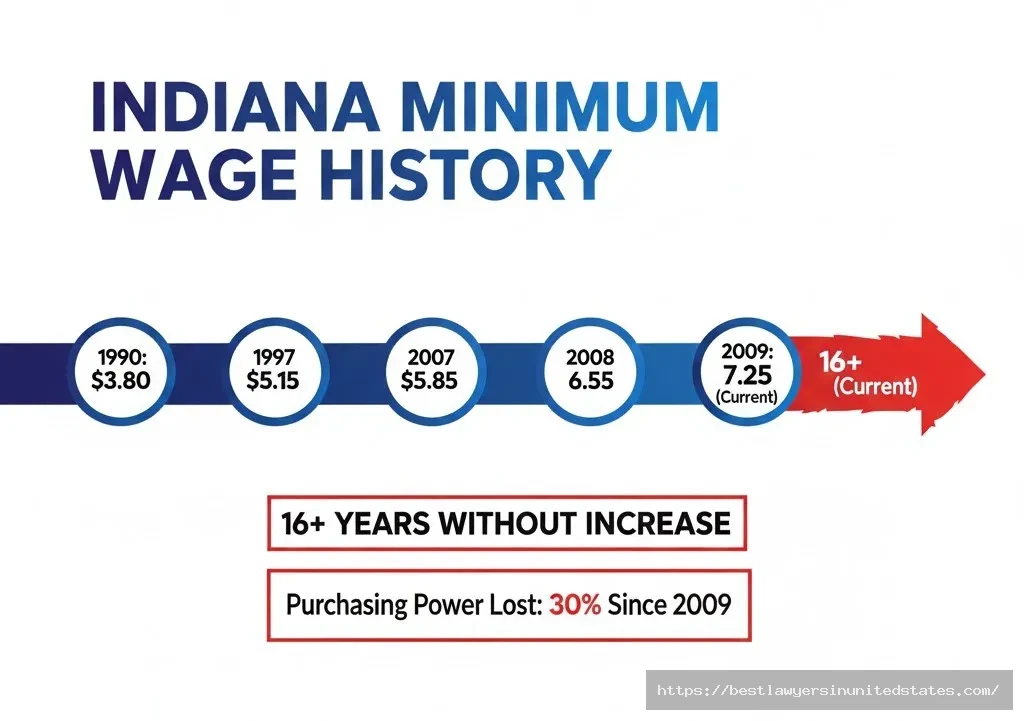
The state's minimum wage history closely follows federal changes. Indiana has never set a state minimum wage higher than the federal floor.
Historical Minimum Wage Rates
| Effective Date | Indiana Minimum Wage | Federal Minimum Wage | Notes |
|---|---|---|---|
| July 24, 2009 | $7.25 | $7.25 | Current rate (17 years) |
| July 24, 2008 | $6.55 | $6.55 | Federal increase |
| July 24, 2007 | $5.85 | $5.85 | Federal increase |
| Sept 1, 1997 | $5.15 | $5.15 | Federal increase |
| Oct 1, 1996 | $4.75 | $4.75 | Federal increase |
| April 1, 1991 | $4.25 | $4.25 | Federal increase |
| April 1, 1990 | $3.80 | $3.80 | Federal increase |
Purchasing Power Decline
The $7.25 minimum wage has lost significant purchasing power due to inflation. A dollar in 2009 is worth only about $1.43 in 2026 dollars.
Inflation-adjusted comparison:
- 2009: $7.25 per hour
- 2026 equivalent: $10.36 per hour (adjusted for inflation)
- Actual 2026 wage: $7.25 per hour
- Real wage loss: 30% decline in purchasing power
A minimum wage worker today can buy 30% less with their paycheck than they could in 2009.
Neighboring States Comparison Over Time
Indiana has fallen behind neighboring states that implemented gradual minimum wage increases. Border workers often see better opportunities in Illinois or Ohio.
2026 comparison:
- Illinois increased from $7.25 (2009) to $15.00 (2026) - 107% increase
- Ohio indexed to inflation, now at $10.70 - 48% increase
- Michigan raised to $10.56 - 46% increase
- Indiana unchanged at $7.25 - 0% increase
If you're considering relocation or commuting for better wages, compare the total picture including cost of living and transportation costs.
Indiana Minimum Wage Law Requirements
Employers in Indiana must follow specific legal requirements beyond just paying minimum wage. The Indiana Minimum Wage Law includes rules about wage statements, record-keeping, and workplace postings.
Many employers don't know about these requirements. Violations can result in civil and criminal penalties.
Wage Statement Requirements
Indiana law requires employers to provide each employee with a written statement showing:
- Total hours worked during the pay period
- Gross wages earned
- All deductions taken from wages
This requirement appears in Indiana Code and applies to all employers subject to the Indiana Minimum Wage Law. You should receive this statement with each paycheck.
Your wage statement must include:
- Your name and employee identification
- Pay period start and end dates
- Regular hours and overtime hours worked separately
- Hourly rate and overtime rate
- Gross wages before deductions
- Each deduction itemized (taxes, insurance, etc.)
- Net pay after deductions
If your employer doesn't provide wage statements, they're violating Indiana law. Contact the Indiana Department of Labor at [email protected].
Posting Requirements
Indiana requires employers to display an official minimum wage poster where all employees can easily see it. The poster must show current wage rates and employee rights.
Required workplace postings:
- Indiana Minimum Wage Law poster
- Federal Fair Labor Standards Act poster
- Other required labor law notices
You can download the official Indiana minimum wage poster at www.in.gov/dol.
Penalties for non-compliance: Employers who fail to post required notices can face fines and penalties from the Indiana Department of Labor.
Record-Keeping Obligations
Employers must keep accurate records of:
- Employee hours worked each day and week
- Wages paid each pay period
- All deductions from wages
- Employee personal information
Minimum retention period: Indiana requires employers to keep wage records for at least 2 years. Federal law may require longer retention for some records.
These records become critical if you file a wage complaint. Without proper records, employers often lose wage theft cases.
What to Do If You're Paid Below Minimum Wage
If your employer pays less than $7.25 per hour (or $2.13 plus tips for tipped workers), they're breaking the law. You have several options to recover unpaid wages.
Act quickly. Indiana's statute of limitations for wage claims is typically 2 years, though it extends to 3 years for willful violations under federal law.
Step-by-Step Wage Complaint Process
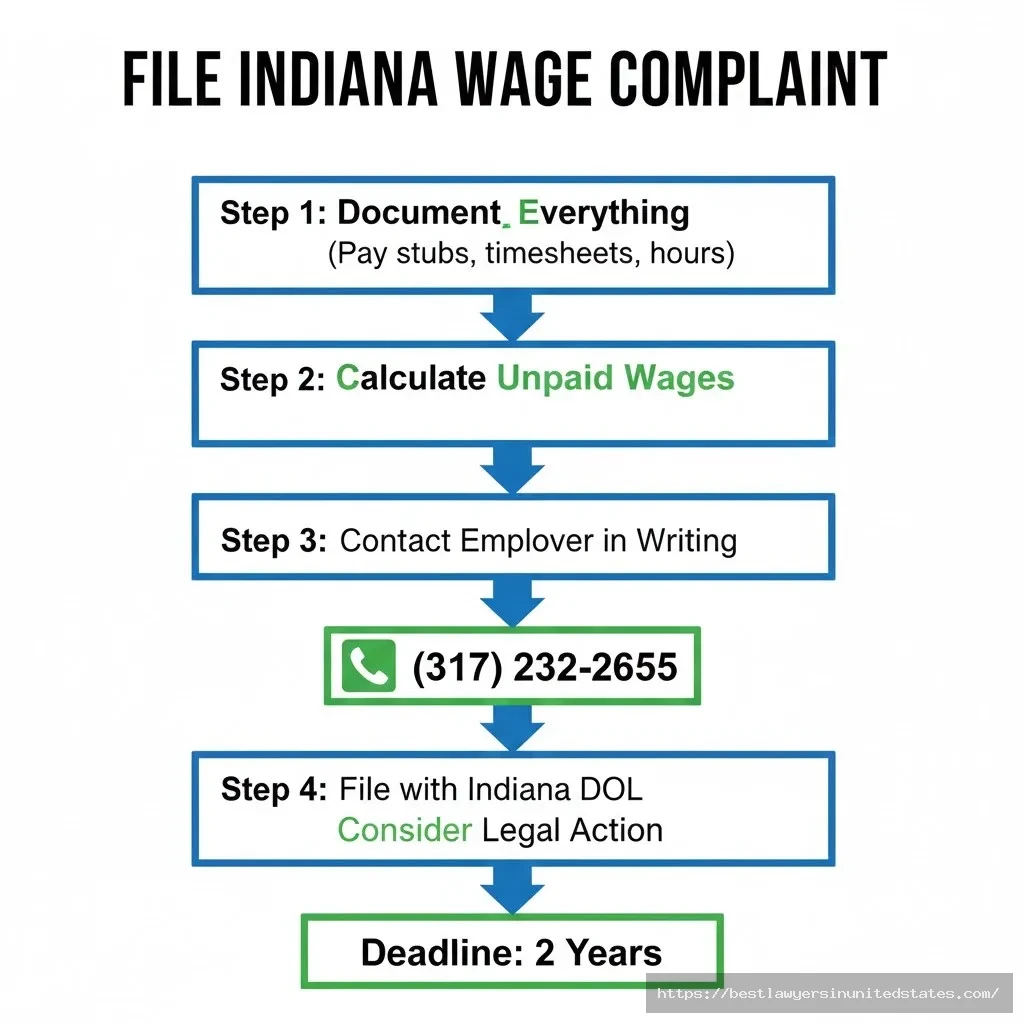
1. Document Everything
Keep detailed records of:
- All pay stubs and wage statements
- Time sheets or clock-in records
- Work schedules
- Text messages or emails about your hours
- Written notes about unpaid work time
2. Calculate What You're Owed
Use our wage theft calculator below to estimate your unpaid wages. Include:
- Regular hours paid below minimum wage
- Unpaid overtime hours
- Tips that didn't bring you to minimum wage
- Any work done off the clock
3. Contact Your Employer First
Send a written request asking for back wages. Keep a copy of this letter. Some employers pay immediately when confronted with documentation.
4. File a Complaint with Indiana DOL
If your employer refuses to pay:
Indiana Department of Labor - Wage and Hour Division
- Email: [email protected]
- Phone: (317) 232-2655
- Address: 402 West Washington St., Rm 195, Indianapolis, IN 46204
You can file online, by mail, or in person. The Indiana DOL will investigate your claim at no cost to you.
5. Consider Legal Action
For large amounts or complex cases, consult an employment attorney. Many offer free consultations and work on contingency (they only get paid if you win).
Understanding legal options for workplace disputes can help you decide the best path forward.
Calculate Your Wage Theft Recovery in Indiana
Think your employer owes you money? Use our wage theft calculator to estimate how much you could recover, including unpaid wages, penalties, and interest under Indiana law.
💰 Minimum Wage Earnings Calculator
Calculate your weekly, monthly, and annual earnings with overtime and tax estimates
📊 Your Earnings Breakdown
💰 Gross Earnings
Calculator features:
- Multiple violation types (unpaid wages, overtime, tips)
- Indiana-specific penalties and damages
- Filing deadline tracker
- Total recovery estimate
- Next steps guidance
Full wage theft calculator: Calculate your wage theft recovery in Indiana
Need help with unpaid wages? Email: [email protected]
Indiana Wage Theft Penalties
Employers who violate minimum wage laws face both civil and criminal penalties under Indiana law.
Civil penalties include:
- Back pay for all unpaid wages
- Liquidated damages (often equal to back pay owed)
- Attorney fees and court costs
- Interest on unpaid wages
Criminal penalties for willful violations:
- Misdemeanor charges for intentional wage theft
- Fines up to $10,000
- Possible jail time for repeat offenders
Indiana law treats willful wage theft seriously. "Willful" means the employer knew they were violating the law or showed reckless disregard for wage requirements.
How Long Do You Have to File?
Filing deadlines vary depending on which law covers your claim:
| Claim Type | Statute of Limitations | Where to File |
|---|---|---|
| Indiana wage claim | 2 years | Indiana DOL |
| FLSA federal claim | 2 years (3 if willful) | U.S. DOL or federal court |
| Retaliation claim | 180 days | Indiana Civil Rights Commission |
The clock starts when the violation occurred, not when you discovered it. File as soon as possible to preserve your rights.
If your employer retaliates against you for filing a wage claim, that's a separate violation. Indiana law prohibits firing or punishing employees who report wage theft.
For cases involving wage garnishment or other complex wage issues, consider consulting an attorney who specializes in employment law.
Frequently Asked Questions
Does Indiana have a state minimum wage?
Quick Answer: Yes, Indiana's state minimum wage is $7.25 per hour, matching the federal minimum wage.
Most Indiana employers must follow the Fair Labor Standards Act (FLSA). Those not covered by federal law must comply with the Indiana Minimum Wage Law, which also sets the rate at $7.25.
Is Indiana raising minimum wage to $15?
Quick Answer: No, Indiana has no plans to raise the minimum wage to $15 per hour in 2026 or any future year.
The Indiana legislature has not passed any bills to increase the minimum wage above $7.25. This differs from neighboring Illinois, which reached $15 per hour in 2025.
What states have $15 minimum wage in 2026?
Several states have reached or exceeded $15 per hour minimum wage:
| State | 2026 Minimum Wage | Effective Date |
|---|---|---|
| California | $16.50 | Jan 1, 2026 |
| Washington | $16.66 | Jan 1, 2026 |
| Massachusetts | $15.00 | Jan 1, 2023 |
| Connecticut | $16.35 | June 1, 2025 |
| New York | $16.50 | Jan 1, 2026 |
| Illinois | $15.00 | Jan 1, 2025 |
Indiana remains at $7.25 per hour with no scheduled increases.
Who is exempt from Indiana minimum wage?
Quick Answer: Workers exempt from overtime pay under Indiana Code § 22-2-2-3 may also have minimum wage exemptions, including executives, administrators, professionals, outside salespeople, and certain agricultural workers.
However, most workers must receive at least $7.25 per hour. Exemptions are narrow and depend on specific job duties, not just job titles.
How much is Indiana minimum wage per year?
Quick Answer: A full-time minimum wage worker in Indiana earns $15,080 per year before taxes ($7.25 × 40 hours × 52 weeks).
After federal and state taxes, take-home pay is approximately $13,200 annually, or $1,100 per month. This assumes no overtime or additional income.
Is $20 an hour good in Indiana?
Quick Answer: Yes, $20 per hour ($41,600 annually) provides comfortable living in most Indiana cities.
At $20 per hour, you earn 176% more than minimum wage and about 26% above the living wage requirement in Indianapolis ($15.84). This allows for savings, emergency funds, and discretionary spending.
What is the 48-hour rule in Indiana?
Quick Answer: There is no "48-hour rule" specific to Indiana wage claims. You generally have 2 years to file a wage claim under Indiana law, or 2-3 years under federal law.
Some people confuse this with FMLA job-protected leave rules or other employment regulations. For wage theft, act as quickly as possible but know you have at least 2 years.
How many hours is full-time in Indiana?
Quick Answer: Full-time employment is typically 40 hours per week for overtime calculation purposes.
Indiana follows the FLSA standard: overtime pay kicks in after 40 hours in a workweek. However, "full-time" for benefits eligibility may vary by employer.
Can 14-year-olds work in Indiana?
Quick Answer: Yes, 14-year-olds can work in Indiana with restrictions on hours and job types.
During the school year, 14-15 year olds can work up to 18 hours per week (3 hours per school day). In summer, they can work up to 40 hours per week. Hazardous jobs are prohibited.
What's McDonald's pay in Indiana?
Quick Answer: McDonald's in Indiana typically pays $10-$13 per hour for crew members, well above the $7.25 minimum wage.
Actual pay varies by location, experience, and position. Shift managers earn $13-$16 per hour. Many fast food employers in Indiana now pay above minimum wage due to labor market competition.
How do I calculate my earnings at Indiana minimum wage?
Use our minimum wage calculator to instantly calculate your weekly, monthly, and annual earnings based on hours worked at Indiana's $7.25 hourly rate.
The calculator includes overtime calculations and tax estimates to show your take-home pay.
How much overtime pay am I entitled to in Indiana?
Quick Answer: You're entitled to 1.5 times your regular hourly rate for hours worked beyond 40 in a workweek, unless you're exempt.
For minimum wage workers, that's $10.88 per hour for overtime. Use our overtime calculator to calculate your exact overtime pay.
How do I calculate wage theft recovery in Indiana?
Our wage theft recovery calculator estimates total unpaid wages plus penalties and damages under Indiana law.
You'll need to input hours worked, wages paid, and the time period to calculate potential recovery amounts.
Indiana Minimum Wage Resources
Official State Resources
Indiana Department of Labor
- Website: www.in.gov/dol
- General inquiries: (317) 232-2655
Wage and Hour Division
- Email: [email protected]
- Phone: (317) 232-2655
- Address: 402 West Washington St., Rm 195, Indianapolis, IN 46204
Indiana Minimum Wage Law Poster
- Download at: www.in.gov/dol/wage-and-hour
Federal Resources
U.S. Department of Labor
- Website: www.dol.gov/agencies/whd
- Toll-free: 1-866-4-US-WAGE (1-866-487-9243)
Fair Labor Standards Act Information
- FLSA fact sheets and guidance
- Minimum wage and overtime calculators
- Filing federal wage complaints
Legal Assistance
Need legal help with wage violations?
Indiana workers facing wage theft or minimum wage violations can seek free or low-cost legal assistance through:
- Indiana Legal Services (income-eligible clients)
- Indiana Civil Rights Commission
- Private employment attorneys (many offer free consultations)
For other legal matters in Indiana, explore our resources on Indiana DUI laws or divorce costs in Indiana.
Conclusion
Indiana's minimum wage remains at $7.25 per hour in 2026, unchanged since 2009. Tipped workers earn $2.13 per hour plus tips, and workers under 20 can receive $4.25 for their first 90 days.
With no scheduled increases, Indiana lags behind neighboring states like Illinois ($15) and Ohio ($10.70). The purchasing power of $7.25 has declined 30% since 2009 due to inflation.
Know your rights: Employers must pay overtime after 40 hours, provide detailed wage statements, and make up the difference if tips don't reach minimum wage. Use our calculators to verify you're being paid correctly.
If you're underpaid: Contact the Indiana Department of Labor at (317) 232-2655 or [email protected]. You have at least 2 years to file a wage claim and may recover back pay plus penalties.
Understanding Indiana's wage laws protects your paycheck and helps you make informed decisions about your employment.