
North Carolina’s minimum wage remains $7.25 per hour in 2026, unchanged since July 24, 2009. This matches the federal minimum wage exactly. North Carolina has no scheduled increases for 2026 or beyond.

Unlike 30+ states that have raised their minimum wages, North Carolina follows federal law with no state-specific increases. Workers in Charlotte, Raleigh, and all NC cities earn the same $7.25 rate because state law prevents local governments from setting higher minimum wages.
Key facts about NC minimum wage in 2026:
- Standard minimum wage: $7.25/hour
- Tipped employees: $2.13/hour (plus tips)
- No increases scheduled
- State preemption prevents local wage increases
- Same rate since 2009 (17 years)
Calculate Your Earnings in North Carolina
Want to know exactly how much you’ll earn at North Carolina’s $7.25 minimum wage? Use our free calculator to estimate your weekly, monthly, and annual income based on your hours worked.
💰 Minimum Wage Earnings Calculator
Calculate your weekly, monthly, and annual earnings with overtime and tax estimates
📊 Your Earnings Breakdown
💰 Gross Earnings
Calculator features:
- Automatic North Carolina wage rates for 2026
- Weekly, monthly, and annual earnings
- Overtime calculations
- Tax withholding estimates
- Take-home pay breakdown
Full calculator with all features: Minimum Wage Calculator
Questions about your wages or need legal help? Email: [email protected]
North Carolina Minimum Wage Rates for 2026
Current Wage Rates
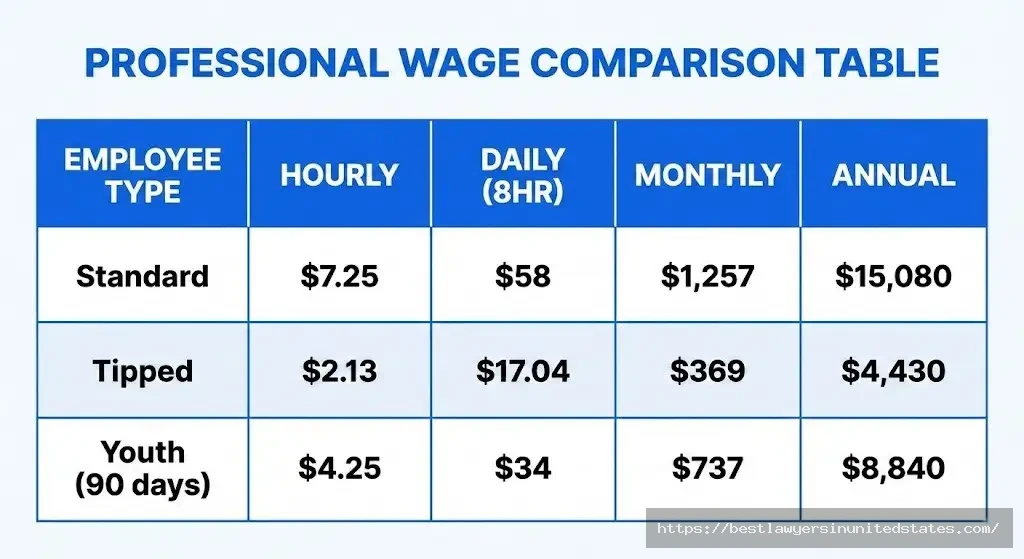
North Carolina maintains three different wage rates depending on worker type. The standard minimum wage applies to most employees, while tipped workers and some youth employees may receive different rates.
| Employee Type | Hourly Rate | Daily (8hr) | Monthly (Full-time) | Annual (Full-time) |
|---|---|---|---|---|
| Standard Workers | $7.25 | $58.00 | $1,256.67 | $15,080 |
| Tipped Employees | $2.13* | $17.04 | $369.07 | $4,430 |
| Youth (First 90 days) | $4.25** | $34.00 | $736.67 | $8,840 |
*Must reach $7.25/hour with tips combined **Federal youth wage provision, rarely used in NC
How North Carolina Compares to Federal Law
North Carolina follows federal minimum wage law exactly. The state has no separate minimum wage statute that differs from federal requirements under the Fair Labor Standards Act (FLSA).
Key difference: States like California ($16.50/hour) and New York ($16.50/hour) have set their own higher rates. North Carolina has not.
Will North Carolina Minimum Wage Increase in 2026?
No Increases Scheduled
Quick Answer: No. North Carolina has no minimum wage increases scheduled for 2026, 2027, or any future year.
The last increase occurred on July 24, 2009, when the federal minimum wage rose to $7.25. Since North Carolina follows federal law, the state rate increased automatically. No changes have occurred in the 17 years since.
Why North Carolina's Wage Hasn't Increased
North Carolina's Republican-controlled General Assembly has blocked all minimum wage increase proposals since 2009. Business groups argue that wage increases would hurt small businesses and reduce jobs.
Worker advocacy groups counter that the current wage fails to meet basic living costs. The MIT Living Wage Calculator shows a single adult in North Carolina needs $16.21/hour to cover basic expenses—more than double the current minimum wage.
The $15 Minimum Wage Debate
House Bill 353, titled the "Fair Minimum Wage Act," proposes raising North Carolina's minimum wage to $22 per hour by 2030. The bill includes gradual increases:
- 2024: $10.00/hour
- 2025: $12.50/hour
- 2026: $15.00/hour
- 2030: $22.00/hour
Legislative status: The bill remains stalled in committee. Similar proposals have failed every year since 2013.
North Carolina vs. Neighboring States

Regional Wage Comparison
North Carolina pays significantly less than some neighboring states. This wage gap has led to worker migration to higher-paying states like Virginia and Florida.
| State | 2026 Minimum Wage | Difference from NC | Tipped Wage |
|---|---|---|---|
| North Carolina | $7.25 | — | $2.13 |
| Virginia | $12.41 | +$5.16 (+71%) | $2.13 |
| Florida | $13.00 | +$5.75 (+79%) | $8.98 |
| South Carolina | $7.25 | $0.00 (same) | $2.13 |
| Tennessee | $7.25 | $0.00 (same) | $2.13 |
| Georgia | $5.15* | -$2.10 | $2.13 |
*Federal minimum wage of $7.25 applies to most Georgia workers

Why the Wage Gap Matters
Workers in Virginia earn $5.16 more per hour than North Carolina workers doing the same jobs. Over a year, that equals $10,732 more in gross income.
Annual earnings comparison:
- North Carolina: $15,080
- Virginia: $25,812
- Florida: $27,040
Some North Carolina border towns have seen workers commute to Virginia for higher wages, particularly in retail and food service industries.
North Carolina Tipped Minimum Wage

Tipped Employee Wage Rules
North Carolina allows employers to pay tipped employees just $2.13 per hour in direct wages. This is called a "tip credit" under federal law.
Requirements for tip credit:
- Employee must regularly receive more than $30/month in tips
- Tips plus $2.13/hour must equal at least $7.25/hour
- Employer must make up the difference if tips fall short
- Employee must be informed of tip credit provisions
What Counts as a Tipped Employee
The North Carolina Department of Labor follows federal guidelines on tipped employees. Workers in these positions typically qualify:
- Servers and waitstaff
- Bartenders
- Bussers (if tips are pooled)
- Food delivery drivers who receive tips
- Hair stylists and barbers who receive tips
When Employers Must Pay More
If your tips plus the $2.13 base wage don't reach $7.25/hour, your employer must pay the difference. This happens weekly or by pay period.
Example calculation:
- Hours worked: 30 hours
- Base pay (30 × $2.13): $63.90
- Minimum required (30 × $7.25): $217.50
- Tips received: $120.00
- Total (base + tips): $183.90
- Employer owes additional: $33.60
Tip Pooling and Sharing Rules
North Carolina follows federal tip pooling rules under N.C.G.S. § 95-25.3. Employers can require tip pooling among employees who customarily receive tips.
Tip pooling rules:
- ✅ Can share tips with servers, bartenders, bussers
- ❌ Cannot include managers or supervisors
- ❌ Cannot force employees to share tips with kitchen staff (unless no tip credit is used)
- ✅ Employees keep 100% of directly given tips unless pooling agreement exists
Charlotte and Raleigh Minimum Wage
Why Cities Cannot Set Higher Wages
Quick Answer: North Carolina law prevents Charlotte, Raleigh, and all other cities from setting local minimum wages above the state rate.
This is called "state preemption." Unlike California cities (San Francisco: $18.07) or New York City ($16.50), North Carolina cities cannot raise wages locally.
Living Wage vs. Minimum Wage in Major Cities
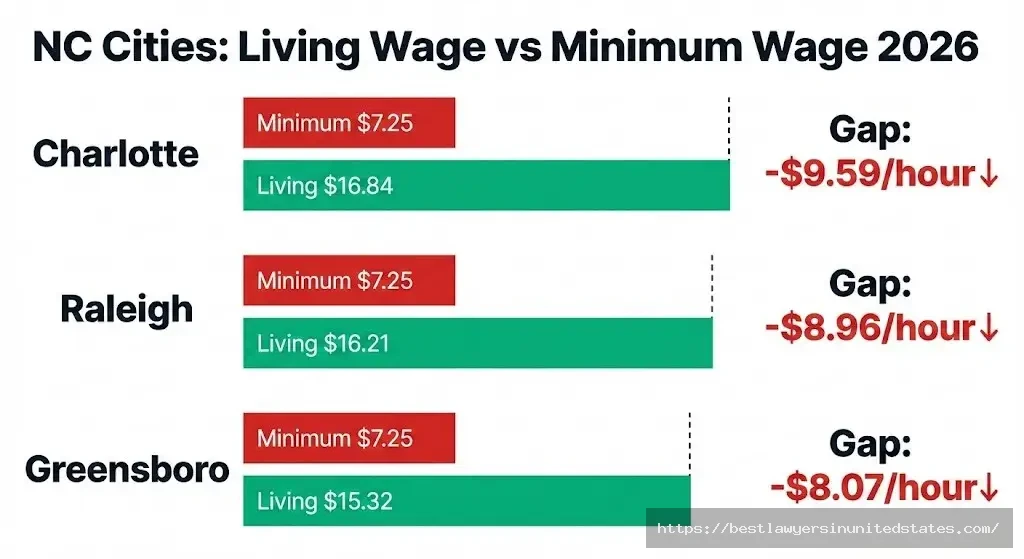
The gap between North Carolina's minimum wage and actual living costs creates significant financial hardship for minimum wage workers.
| City | Minimum Wage | Living Wage* | Monthly Shortfall | Annual Shortfall |
|---|---|---|---|---|
| Charlotte | $7.25/hour | $16.84/hour | $1,662 | $19,947 |
| Raleigh | $7.25/hour | $16.21/hour | $1,554 | $18,643 |
| Durham | $7.25/hour | $16.21/hour | $1,554 | $18,643 |
| Greensboro | $7.25/hour | $15.32/hour | $1,399 | $16,786 |
*MIT Living Wage Calculator for single adult, no children
What This Means for Charlotte and Raleigh Workers
A full-time minimum wage worker in Charlotte earns $1,257 per month gross ($1,100 after taxes). The average one-bedroom apartment in Charlotte costs $1,450/month.
Monthly budget reality:
- Rent: $1,450 (exceeds entire income)
- Food: $250
- Transportation: $200
- Utilities: $150
- Healthcare: $100
- Total needs: $2,150
- Actual income: $1,100
- Monthly deficit: $1,050
Calculate Your Overtime Pay in North Carolina
Working more than 40 hours per week? Calculate your overtime earnings based on North Carolina's overtime laws. This calculator accounts for state-specific overtime rules.
⏰ Overtime Pay Calculator
Calculate your overtime earnings based on your state's specific labor laws
📍 Select Your State
💰 Your Hourly Wage
📊 Calculation Method
📅 Weekly Hours
💵 Your Weekly Overtime Pay
📊 Earnings Breakdown
📅 Pay Period Estimates
⚖️ State vs Federal Comparison
Calculator features:
- North Carolina-specific overtime rules
- Weekly overtime calculations
- Time-and-a-half calculations
- Pay period breakdowns
- Comparison with federal law
Full overtime calculator: Overtime Pay Calculator
Questions about your wages or need legal help? Email: [email protected]
Overtime Laws in North Carolina

When You Qualify for Overtime
North Carolina follows federal overtime law under the Fair Labor Standards Act (FLSA). You receive overtime pay at 1.5 times your regular rate for hours worked over 40 in a workweek.
Overtime calculation for minimum wage workers:
- Regular rate: $7.25/hour
- Overtime rate: $10.88/hour (7.25 × 1.5)
- Applies after 40 hours per week
North Carolina vs. Other State Overtime Rules
Unlike California, North Carolina has no daily overtime requirement. California requires overtime after 8 hours in a day. North Carolina only counts weekly hours.
Key differences:
- ✅ Overtime after 40 hours/week
- ❌ No daily overtime requirement
- ❌ No double-time provisions
- ❌ No 7th consecutive day premium
Who Is Exempt from Overtime in North Carolina
Not all workers qualify for overtime pay. North Carolina follows federal exemptions under N.C.G.S. § 95-25.14.
Common overtime exemptions:
- Executive, administrative, and professional employees
- Outside sales representatives
- Certain computer professionals
- Some agricultural workers
- Independent contractors (not employees)
Salary threshold for 2026: $844/week ($43,888/year). Salaried employees earning less than this amount generally qualify for overtime, even if their job title suggests exemption.
Overtime Pay Examples
Example 1: Retail worker
- Hours worked: 45 hours
- Regular pay (40 × $7.25): $290.00
- Overtime pay (5 × $10.88): $54.40
- Total weekly pay: $344.40
Example 2: Restaurant server (tipped)
- Base hourly rate: $7.25 (for overtime calculation)
- Overtime rate: $10.88/hour
- Tips do not reduce overtime rate
North Carolina Minimum Wage History

Historical Wage Rates
North Carolina has never set a state minimum wage higher than federal law. The state followed each federal increase automatically.
| Year | NC Minimum Wage | Federal Minimum Wage | Inflation-Adjusted (2026 $) |
|---|---|---|---|
| 2026 | $7.25 | $7.25 | $7.25 |
| 2025 | $7.25 | $7.25 | $7.30 |
| 2024 | $7.25 | $7.25 | $7.65 |
| 2020 | $7.25 | $7.25 | $8.60 |
| 2015 | $7.25 | $7.25 | $9.20 |
| 2010 | $7.25 | $7.25 | $10.15 |
| 2009 | $7.25 | $7.25 | $10.40 |
| 2008 | $6.55 | $6.55 | $9.30 |
| 2007 | $5.85 | $5.85 | $8.55 |
Lost Purchasing Power Since 2009
The $7.25 minimum wage buys significantly less in 2026 than it did in 2009. Inflation has eroded 30% of the wage's purchasing power.
What this means:
- 2009: $7.25 had purchasing power of $10.40 in 2026 dollars
- 2026: $7.25 buys what $5.08 bought in 2009
- Effective wage cut: 30% over 17 years
A minimum wage worker in 2026 needs to work 43 hours to buy what 30 hours purchased in 2009.
North Carolina Wage Laws and Employee Rights
North Carolina Wage and Hour Act
The North Carolina Wage and Hour Act (N.C.G.S. § 95-25.1 et seq.) governs wage payment in the state. The North Carolina Department of Labor enforces these provisions.
Key provisions:
- All wages must be paid in U.S. currency or by check
- Pay must occur at least monthly (most employers pay more frequently)
- Employers must provide written notice of wage rates
- Paystubs must show hours worked and deductions
- Employers cannot make illegal deductions from wages
Your Rights as a North Carolina Employee

Every North Carolina worker has specific wage and hour rights under state and federal law:
Your legal rights:
- Receive at least $7.25/hour
- Get overtime pay if non-exempt
- Keep all your tips (if tipped employee)
- Receive accurate pay stubs
- File wage complaints without retaliation
- Access your employment records
What Employers Must Do
North Carolina employers must comply with both state and federal wage laws. The North Carolina Department of Labor provides specific requirements.
Employer obligations:
- Pay at least $7.25/hour
- Calculate overtime correctly
- Keep time records for 3 years
- Display minimum wage poster
- Provide pay stubs each pay period
- Pay final wages on time when employment ends
Calculate Wage Theft Recovery in North Carolina
Think your employer owes you money? Use our wage theft calculator to estimate how much you could recover, including unpaid wages, penalties, and interest under North Carolina law.
Wage Theft Recovery Calculator
Estimate how much you can recover in unpaid wages, penalties, and damages based on your state's laws
💵 Estimated Total Recovery
💰 Unpaid Wages
⚖️ Penalties & Damages
📋 Total Summary
Calculator features:
- Multiple violation types (unpaid wages, overtime, tips)
- North Carolina-specific penalties and damages
- Filing deadline tracker
- Total recovery estimate
- Next steps guidance
Full wage theft calculator: Wage Theft Calculator
Need help with unpaid wages? Email: [email protected]
What If You're Not Being Paid Properly?

Common Wage Violations in North Carolina
Wage theft affects thousands of North Carolina workers each year. The North Carolina Department of Labor investigates hundreds of wage complaints annually.
Most common violations:
- Not paying for all hours worked
- Failing to pay overtime
- Taking illegal tip deductions
- Misclassifying employees as independent contractors
- Not paying the final paycheck on time
- Making illegal uniform or tool deductions
How to File a Wage Complaint
You can file a wage complaint with the North Carolina Department of Labor or the U.S. Department of Labor's Wage and Hour Division.

Filing process:
- Document everything: Save pay stubs, timesheets, work schedules
- Calculate amounts owed: Use our wage theft calculator
- Contact NC DOL: Call 1-800-625-2267 or file online
- Provide evidence: Submit documentation with complaint
- Attend investigation: Cooperate with labor investigators
Filing deadlines:
- Unpaid wages: 2 years from violation (3 years if willful)
- Retaliation claims: 180 days from adverse action
- Federal claims: 2-3 years depending on violation type
Penalties for Wage Violations

Employers who violate North Carolina wage laws face significant penalties under N.C.G.S. § 95-25.22.
| Violation Type | Employer Penalty | Employee Recovery |
|---|---|---|
| Unpaid Wages | $1,000 per violation | Full back pay + interest |
| Unpaid Overtime | $1,000 per violation | Double back pay (liquidated damages) |
| Tip Theft | $1,000 per violation | Full tips + penalties |
| Retaliation | $1,000 per violation | Reinstatement + back pay |
Protection from Retaliation
North Carolina's Retaliatory Employment Discrimination Act (REDA) protects workers who file wage complaints. Your employer cannot fire, demote, or retaliate against you for reporting wage violations.
Protected activities:
- Filing a wage complaint
- Participating in an investigation
- Testifying about wage violations
- Discussing pay with coworkers
- Asking about overtime eligibility
Special Cases and Exemptions
Youth Employment and Minimum Wage
North Carolina applies the same $7.25 minimum wage to workers under age 18. Unlike some states, North Carolina has no separate youth minimum wage.
Federal youth wage option:
- $4.25/hour for first 90 consecutive days
- Only for workers under age 20
- Rarely used by North Carolina employers
- Must still pay $7.25 after 90 days
Agricultural Workers
Most North Carolina agricultural workers receive minimum wage protection under federal and state law. Small farm exemptions apply in limited cases.
Agricultural wage rules:
- Most farm workers: $7.25/hour minimum
- Hand-harvest laborers paid by piece rate must average $7.25/hour
- H-2A visa workers receive special rates (often higher than minimum wage)
- Family farm exemptions exist for immediate family members
Student Learners and Interns
Full-time students in certain vocational programs may be paid 75% of minimum wage ($5.44/hour in 2026) under special certificates.
Requirements:
- Must be enrolled in vocational education program
- Work must relate to coursework
- Limited to 20 hours/week during school
- Employer must obtain certificate from U.S. Department of Labor
FAQ: North Carolina Minimum Wage
What is the minimum wage in North Carolina for 2026?
Quick Answer: North Carolina's minimum wage is $7.25 per hour in 2026, matching the federal minimum wage.
This rate has remained unchanged since July 24, 2009. It applies to all employers in North Carolina regardless of size.
Will North Carolina's minimum wage increase in 2026?
Quick Answer: No. North Carolina has no scheduled minimum wage increases for 2026 or any future year.
The state follows federal minimum wage law. Unless Congress raises the federal rate or North Carolina passes new legislation, the wage will remain $7.25.
How much does North Carolina's minimum wage worker earn annually?
Quick Answer: A full-time minimum wage worker in North Carolina earns $15,080 per year before taxes ($7.25 × 40 hours × 52 weeks).
After taxes, take-home pay is approximately $13,200 annually. Use our minimum wage calculator to calculate your exact earnings based on your hours.
What is the tipped minimum wage in North Carolina?
Quick Answer: Tipped employees in North Carolina can be paid $2.13 per hour in direct wages if tips bring total compensation to at least $7.25/hour.
If tips don't reach the $7.25 threshold, employers must make up the difference. Employers cannot use the tip credit unless they inform employees of the policy.
Is there a different minimum wage in Charlotte or Raleigh?
Quick Answer: No. All North Carolina cities, including Charlotte and Raleigh, have the same $7.25/hour minimum wage.
North Carolina law prevents cities and counties from setting local minimum wages. This differs from states like California and New York, where cities can set higher rates.
How do I calculate my overtime pay in North Carolina?
Quick Answer: Multiply your regular hourly rate by 1.5 for all hours worked over 40 in a week.
For minimum wage workers, overtime is $10.88/hour ($7.25 × 1.5). Use our overtime calculator to calculate your exact overtime pay.
Why is North Carolina's minimum wage so low?
Quick Answer: North Carolina's minimum wage hasn't increased since 2009 due to legislative opposition in the Republican-controlled General Assembly.
Business groups oppose increases, arguing they would hurt small businesses. Worker advocates say the current wage creates poverty-level conditions. The debate continues with no resolution in sight.
What is the youth minimum wage in North Carolina?
Quick Answer: North Carolina has no separate youth minimum wage—minors receive the same $7.25/hour as adults.
Federal law allows a $4.25/hour "youth wage" for workers under 20 during their first 90 days, but few North Carolina employers use this provision.
Can my employer pay me less than $7.25 in North Carolina?
Quick Answer: No, except for specific exemptions: tipped employees ($2.13 + tips), some student learners, and certain workers with disabilities who have special federal certificates.
All other North Carolina workers must receive at least $7.25/hour. Paying less violates both state and federal law.
How do I report wage violations in North Carolina?
Quick Answer: File a complaint with the North Carolina Department of Labor at 1-800-625-2267 or online at labor.nc.gov.
You can also file with the U.S. Department of Labor's Wage and Hour Division. You have 2-3 years from the violation date to file most claims.
How much can I recover for wage theft in North Carolina?
Quick Answer: You can recover all unpaid wages plus an equal amount in liquidated damages (double your unpaid wages) for overtime violations.
Use our wage theft calculator to estimate your potential recovery based on your specific situation.
Do North Carolina's neighboring states pay more?
Quick Answer: Yes. Virginia pays $12.41/hour (+71%) and Florida pays $13.00/hour (+79%), while South Carolina and Tennessee match NC at $7.25.
This wage gap has created worker migration to higher-paying neighboring states, particularly Virginia and Florida.
How to Use Our Wage Calculators
Minimum Wage Calculator
Our minimum wage calculator helps you calculate exact earnings based on North Carolina's wage rates.
What it calculates:
- Hourly to annual salary conversion
- Weekly, bi-weekly, and monthly pay
- Overtime earnings if you work over 40 hours
- Estimated tax withholdings
- Take-home pay after deductions
Overtime Calculator
The overtime calculator shows exactly how much you earn for overtime hours in North Carolina.
Calculator features:
- Calculates time-and-a-half rate
- Weekly overtime earnings
- Comparison of regular vs. overtime pay
- Annual overtime earnings projection
- Pay period breakdowns
Wage Theft Calculator
If your employer hasn't paid you properly, the wage theft calculator estimates your total recovery under North Carolina law.
What it calculates:
- Unpaid regular wages
- Unpaid overtime (including liquidated damages)
- Stolen tips or improper deductions
- Interest on unpaid amounts
- Total potential recovery amount
Resources and Next Steps
North Carolina Department of Labor
The North Carolina Department of Labor (NCDOL) enforces state wage laws and investigates complaints.
Contact information:
- Phone: 1-800-625-2267
- Website: labor.nc.gov
- Address: 4 West Edenton Street, Raleigh, NC 27601
- Wage and Hour Bureau: (919) 807-2796
U.S. Department of Labor
The federal Wage and Hour Division investigates violations of the Fair Labor Standards Act (FLSA).
Contact information:
- Phone: 1-866-487-9243
- Website: dol.gov/agencies/whd
- Charlotte office: (704) 749-3360
- Raleigh office: (919) 790-2741
Legal Assistance
If you need help with wage violations, several resources provide free or low-cost legal help:
Legal resources:
- Legal Aid of North Carolina: legalaidnc.org
- NC Justice Center Workers' Rights Project: ncjustice.org
- Bar Association lawyer referral: ncbar.org
- Email for attorney referrals: [email protected]
Conclusion
North Carolina's $7.25 minimum wage remains among the lowest in the United States, tied with 20 other states that follow the federal minimum. The wage has not increased since 2009, losing 30% of its purchasing power to inflation over 17 years.
Workers earning minimum wage in North Carolina earn $15,080 annually before taxes—barely above the federal poverty line and far below the living wage of $16.21/hour needed for basic expenses. Major cities like Charlotte and Raleigh cannot raise local minimum wages due to state preemption laws.
While House Bill 353 proposes raising the wage to $22 by 2030, political opposition has blocked all increase attempts. Until North Carolina passes new legislation or Congress raises the federal rate, the minimum wage will remain at $7.25.
If you're not being paid properly:
- Use our calculators to document what you're owed
- File a complaint with the NC Department of Labor
- Contact an employment attorney if needed
The wage gap between North Carolina and higher-paying states like Virginia, Florida, and Massachusetts continues to widen, affecting worker retention and economic competitiveness across the state.
