
South Carolina does not have a state minimum wage law. Workers in South Carolina are covered by the federal Fair Labor Standards Act (FLSA), which sets the minimum wage at $7.25 per hour as of 2026. This rate has remained unchanged since July 24, 2009.
South Carolina is one of only five states without its own minimum wage law, along with Alabama, Louisiana, Mississippi, and Tennessee. All workers covered by federal law earn the federal rate. Workers not covered by the FLSA have no wage floor protection.
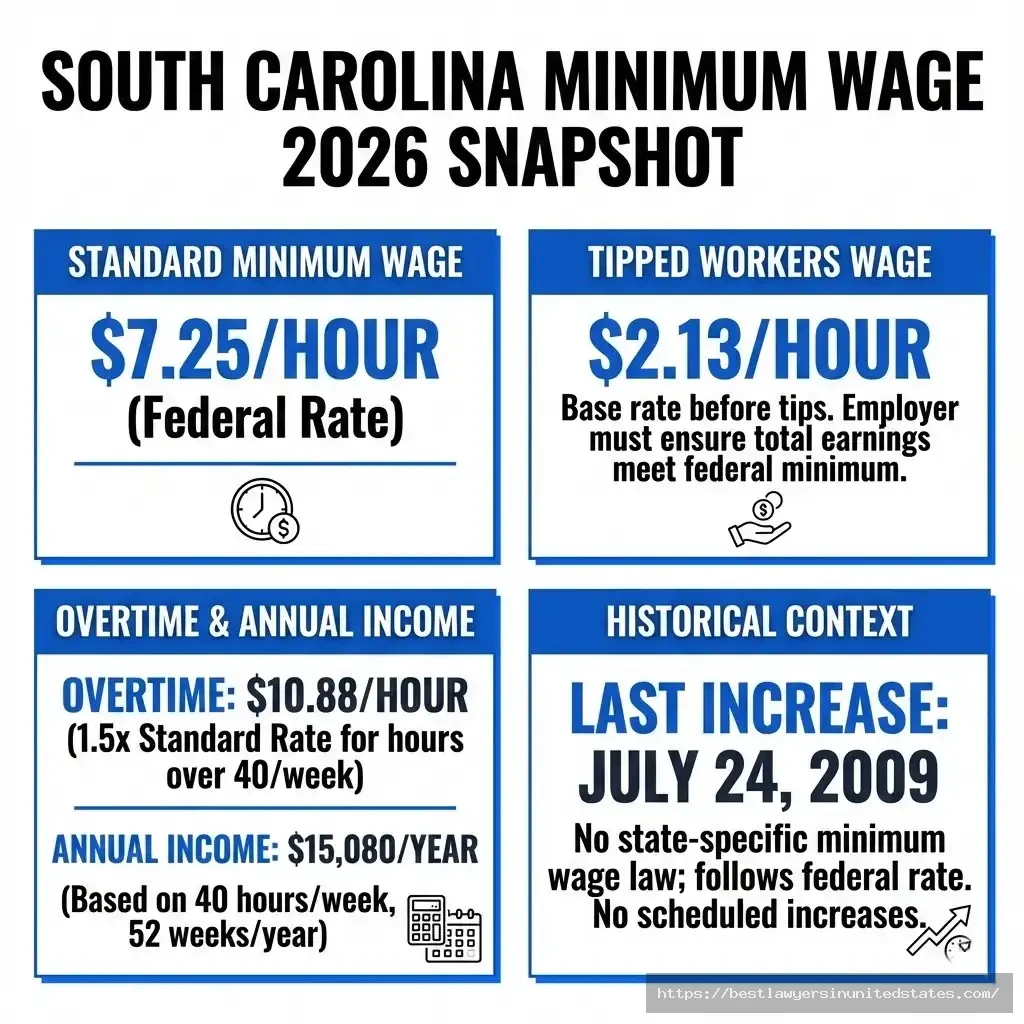
Quick Facts:
- Current SC minimum wage: $7.25/hour (federal rate)
- Tipped minimum wage: $2.13/hour cash wage plus tips
- Last increase: July 24, 2009 (federal)
- Overtime rate: $10.88/hour (1.5x after 40 hours/week)
- Annual salary (full-time): $15,080/year
Calculate Your Earnings in South Carolina
Want to know exactly how much you’ll earn at South Carolina’s $7.25 minimum wage? Use our free calculator to estimate your weekly, monthly, and annual income based on your hours worked.
💰 Minimum Wage Earnings Calculator
Calculate your weekly, monthly, and annual earnings with overtime and tax estimates
📊 Your Earnings Breakdown
💰 Gross Earnings
Calculator features:
- Automatic South Carolina wage rates for 2026
- Weekly, monthly, and annual earnings
- Overtime calculations
- Tax withholding estimates
- Take-home pay breakdown
Full calculator with all features: South Carolina Minimum Wage Calculator
Questions about your wages or need legal help?
Email: [email protected]
What Is the Current Minimum Wage in South Carolina?
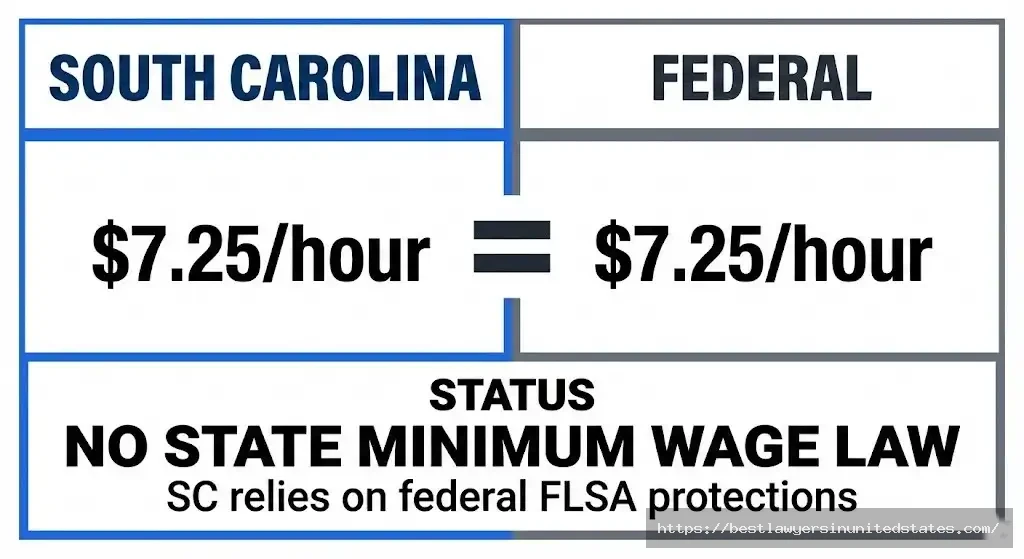
Quick Answer: South Carolina's minimum wage is $7.25 per hour in 2026, which equals the federal minimum wage. The state has no separate minimum wage law.
Why South Carolina Has No State Minimum Wage
South Carolina relies entirely on federal wage protections under the Fair Labor Standards Act. The state legislature has not enacted its own minimum wage statute. This means workers depend on federal law for wage guarantees.
Employees covered by the FLSA receive the federal minimum wage of $7.25 per hour. Workers not covered by federal law have no state-level wage protection. This includes some agricultural workers, independent contractors, and certain small business employees.
Who Gets Paid Federal Minimum Wage in South Carolina
Workers covered by FLSA in South Carolina:
- Employees of businesses with annual sales of $500,000 or more
- Workers engaged in interstate commerce
- Employees of hospitals, schools, and government agencies
- Domestic service workers
Workers potentially not covered:
- Some seasonal agricultural workers
- Independent contractors
- Certain family business employees
- Newspaper delivery workers
| Worker Category | Minimum Wage | Coverage |
|---|---|---|
| Regular employees (FLSA-covered) | $7.25/hour | Federal FLSA applies |
| Tipped employees | $2.13/hour cash wage | Must earn $7.25 total with tips |
| Workers not covered by FLSA | No minimum | No federal or state protection |
| Youth workers (under 20, first 90 days) | $4.25/hour | Federal youth minimum |
South Carolina Minimum Wage History
South Carolina has never had its own state minimum wage. The state has always followed federal rates.
| Effective Date | Federal Minimum Wage | South Carolina Rate |
|---|---|---|
| July 24, 2009 | $7.25 | $7.25 |
| July 24, 2008 | $6.55 | $6.55 |
| July 24, 2007 | $5.85 | $5.85 |
| January 1, 2026 | $7.25 | $7.25 (current) |
No increases are scheduled for 2026 or 2027. South Carolina has no automatic indexing to inflation like some states.
South Carolina Tipped Minimum Wage: Rules for Servers & Restaurant Workers
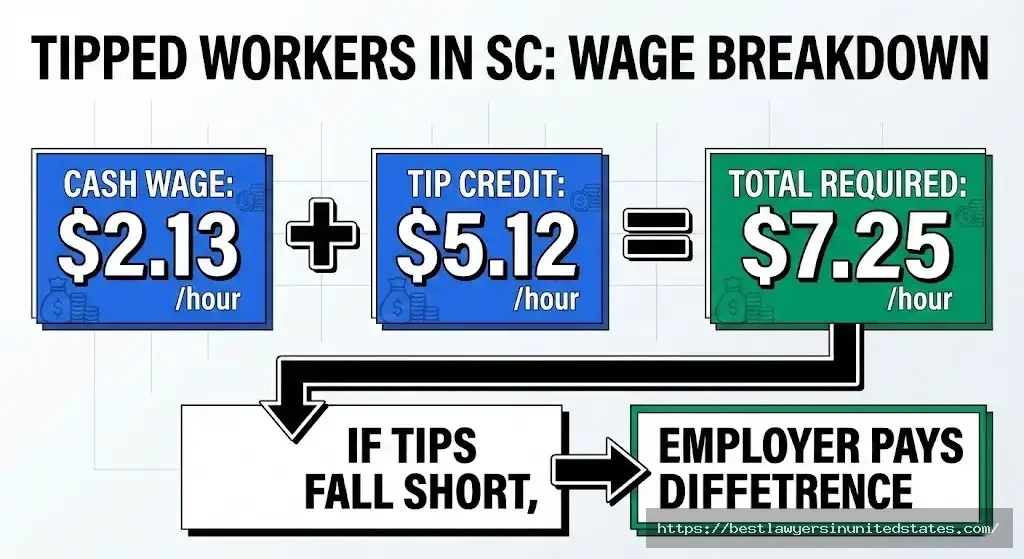
Quick Answer: Tipped employees in South Carolina can be paid $2.13 per hour in cash wages. Employers can claim a tip credit of up to $5.12 per hour. Total earnings (cash wage plus tips) must equal at least $7.25 per hour.
How the Tip Credit Works in South Carolina
South Carolina follows federal tip credit rules under the FLSA. Employers can pay tipped employees as little as $2.13 per hour if tips make up the difference to reach $7.25 per hour total.
The math:
- Minimum cash wage: $2.13/hour
- Maximum tip credit: $5.12/hour
- Required total: $7.25/hour
Real Examples of Tip Credit Calculations
Example 1: Server earning good tips
- Cash wage: $2.13/hour
- Tips earned: $15/hour
- Total earnings: $17.13/hour
- Result: Employer meets minimum wage requirement
Example 2: Server with slow shift
- Cash wage: $2.13/hour
- Tips earned: $3/hour
- Total earnings: $5.13/hour
- Result: Employer must pay additional $2.12/hour to reach $7.25
Example 3: Bartender working 8-hour shift
- Cash wage for shift: $17.04 (8 hours × $2.13)
- Tips collected: $40
- Tips per hour: $5/hour
- Total hourly rate: $7.13/hour
- Result: Employer must pay additional $0.96 for the shift
What Employers Must Do for Tipped Employees
Legal requirements under federal law:
- Inform employees about tip credit policy before hiring
- Ensure tips plus cash wage equal at least $7.25/hour
- Keep accurate records of tips reported
- Make up the difference when tips fall short
- Allow employees to keep 100% of their tips (tip pooling allowed)
Employers cannot:
- Take any portion of employee tips for themselves
- Include managers or supervisors in tip pools
- Require employees to share tips with non-service workers
- Use tips to cover business expenses
| Employee Type | Cash Wage Required | Tip Credit Allowed | Total Guaranteed |
|---|---|---|---|
| Servers | $2.13/hour | Up to $5.12/hour | $7.25/hour minimum |
| Bartenders | $2.13/hour | Up to $5.12/hour | $7.25/hour minimum |
| Bussers/Runners | $2.13/hour | Up to $5.12/hour | $7.25/hour minimum |
| Non-tipped staff | $7.25/hour | Not allowed | $7.25/hour |
Minimum Wage by City in South Carolina
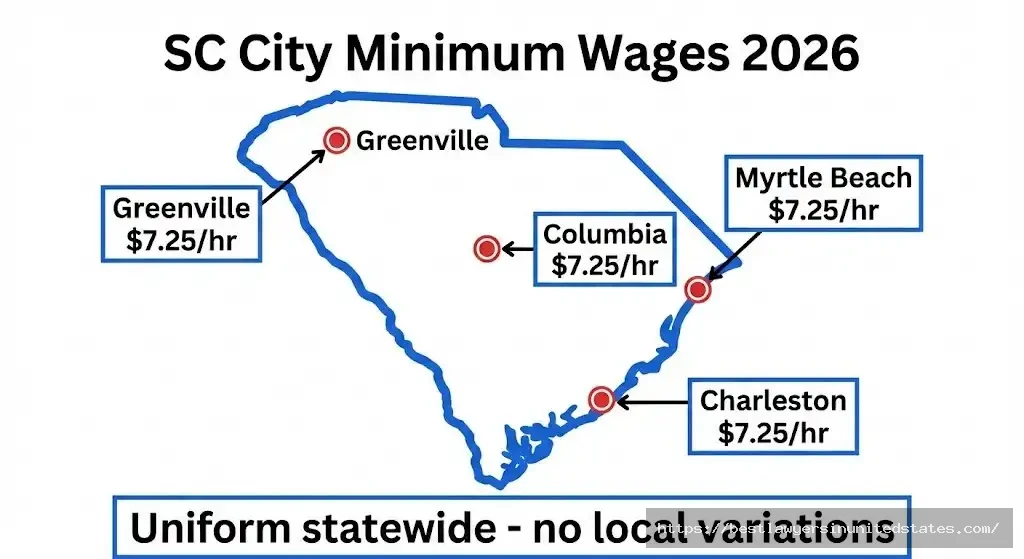
Quick Answer: All South Carolina cities and counties follow the same $7.25 federal minimum wage. Unlike some states, South Carolina does not allow local governments to set higher minimum wages.
Charleston Minimum Wage
Charleston's minimum wage is $7.25 per hour, the same as the rest of South Carolina. The city cannot set its own higher rate under current state law.
Charleston's cost of living exceeds the state average. Housing costs in downtown Charleston and surrounding areas often require workers to earn significantly above minimum wage to afford basic expenses. Many Charleston employers pay $12-15/hour for entry-level positions due to market competition.
Columbia Minimum Wage
Columbia, South Carolina's capital city, has a minimum wage of $7.25 per hour. The city follows federal law with no local wage ordinances.
State government jobs in Columbia typically pay above minimum wage. Entry-level state positions often start at $12-14/hour. Private sector employers near the state capitol area face similar market pressures to offer competitive wages.
Myrtle Beach Minimum Wage
Myrtle Beach maintains the federal minimum wage of $7.25 per hour. The city's tourism and hospitality industry heavily employs tipped workers at $2.13/hour plus tips.
Seasonal employment considerations:
- Peak season (summer): Higher tips typically offset low cash wages
- Off-season (winter): Many service workers struggle with reduced hours and tips
- Year-round workers: Often need multiple jobs to maintain steady income
Greenville Minimum Wage
Greenville's minimum wage is $7.25 per hour, matching the federal rate. The city's growing manufacturing and business sector creates competitive pressure for higher starting wages.
Many Greenville employers in manufacturing, healthcare, and professional services pay $14-18/hour for entry-level positions. The city's economic growth has pushed market wages above the legal minimum.
| City | Population | Minimum Wage | Average Entry Wage | Notes |
|---|---|---|---|---|
| Charleston | 150,000+ | $7.25/hour | $12-15/hour | Tourism, hospitality driven |
| Columbia | 130,000+ | $7.25/hour | $12-14/hour | State government hub |
| Myrtle Beach | 35,000+ | $7.25/hour | $10-13/hour | Heavy seasonal variation |
| Greenville | 70,000+ | $7.25/hour | $14-18/hour | Manufacturing growth |
Is South Carolina's Minimum Wage Going Up in 2026?
Quick Answer: No. South Carolina has no scheduled minimum wage increases for 2026 or beyond. The state follows the federal minimum wage, which remains at $7.25 per hour.
Current Status of Wage Increases
South Carolina has no automatic cost-of-living adjustments for minimum wage. The state legislature must pass new laws to raise wages above the federal floor. As of 2026, no such legislation has been enacted.
The federal minimum wage has not increased since July 24, 2009. Unless Congress raises the federal rate or South Carolina passes its own law, wages will remain at $7.25/hour indefinitely.
Pending Legislation in South Carolina
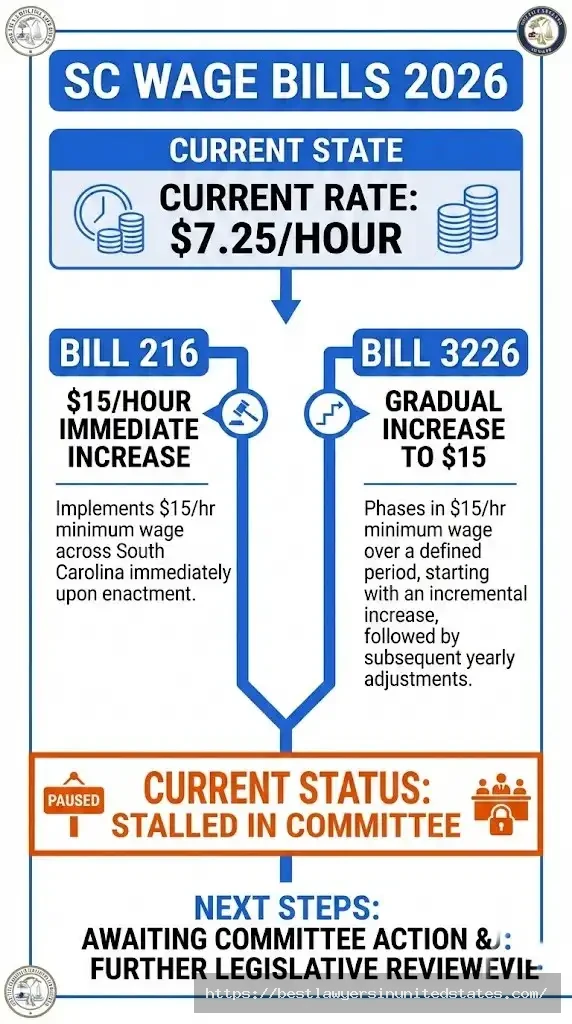
Bill 216: South Carolina Minimum Wage Act
This bill proposes raising South Carolina's minimum wage to $15 per hour. The legislation has been introduced but remains stalled in committee as of 2026.
Key provisions if passed:
- Immediate increase to $15/hour
- Applies to all workers currently covered by FLSA
- Creates state enforcement mechanisms
- Allows for future inflation adjustments
Current status: No vote scheduled, unlikely to pass in current legislative session
Bill 3226: Gradual Wage Adjustment
This alternative proposal suggests a phased increase approach over several years. The bill aims to minimize economic disruption while raising worker pay.
Proposed timeline (if passed):
- Year 1: Increase to $10/hour
- Year 2: Increase to $12/hour
- Year 3: Increase to $15/hour
- Subsequent years: Annual inflation adjustments
Current status: Under committee review, no floor vote scheduled
Reality check: Both bills have faced strong opposition from business groups. Historical attempts to raise South Carolina's minimum wage have failed. Workers should not expect increases without significant political changes.
South Carolina Overtime Laws
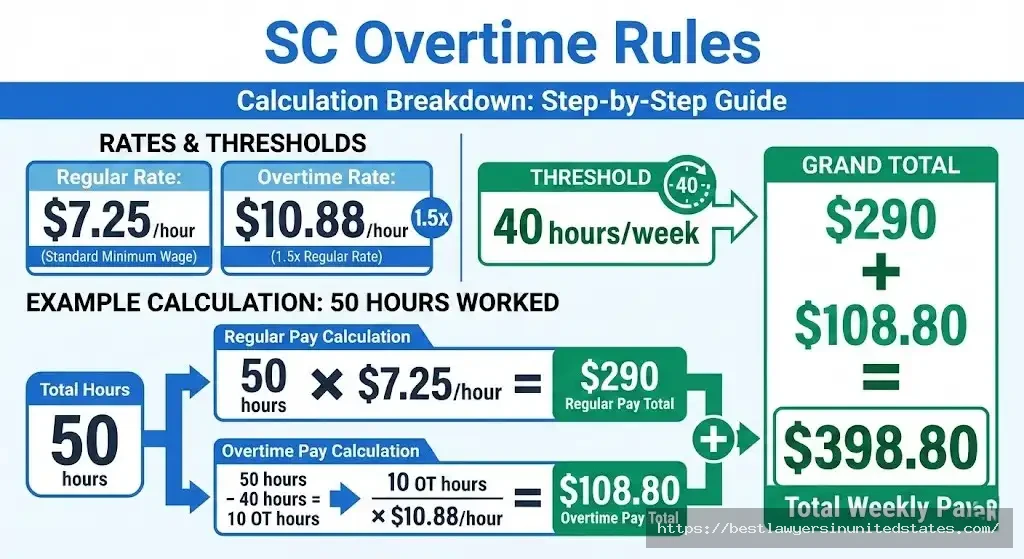
Quick Answer: South Carolina follows federal overtime rules. Workers earn $10.88 per hour (1.5 times $7.25) for hours worked beyond 40 in a week. There is no daily overtime requirement.
Who Gets Overtime Pay in South Carolina
Non-exempt employees receive overtime pay at 1.5 times their regular rate for all hours over 40 per week. South Carolina has no state-specific overtime laws beyond federal requirements.
Calculate your overtime pay:
Calculate Your Overtime Pay in South Carolina
Working more than 40 hours per week? Calculate your overtime earnings based on South Carolina's overtime laws. This calculator follows federal FLSA rules that apply in South Carolina.
⏰ Overtime Pay Calculator
Calculate your overtime earnings based on your state's specific labor laws
📍 Select Your State
💰 Your Hourly Wage
📊 Calculation Method
📅 Weekly Hours
💵 Your Weekly Overtime Pay
📊 Earnings Breakdown
📅 Pay Period Estimates
⚖️ State vs Federal Comparison
Calculator features:
- South Carolina-specific overtime rules (40+ hours per week)
- Weekly overtime calculations
- Pay period breakdowns
- Comparison with federal law
- Time-and-a-half calculations
Full overtime calculator: South Carolina Overtime Calculator
Questions about your wages or need legal help?
Email: [email protected]
Overtime Exemptions in South Carolina
Workers exempt from overtime pay:
- Executive, administrative, and professional employees (white-collar exemptions)
- Outside sales representatives
- Computer professionals earning above salary threshold
- Certain agricultural workers
- Seasonal recreational establishment employees
- Some transportation workers
Salary test for exemption: Employees must earn at least $844 per week ($43,888 annually) as of 2026 to qualify for white-collar exemptions. Earning above this threshold does not automatically exempt workers. Job duties must also meet specific federal tests.
Daily Overtime Rules
South Carolina has no daily overtime requirements. Unlike California minimum wage rules that require overtime after 8 hours in a single day, South Carolina only counts weekly hours.
Example:
- Monday-Thursday: 12 hours per day (48 hours total)
- Friday: 0 hours
- Total week: 48 hours
- Overtime owed: 8 hours at $10.88/hour
The employee receives regular pay for the first 40 hours and overtime for the remaining 8 hours, regardless of how those hours were distributed across the week.
| Overtime Scenario | Regular Hours | Overtime Hours | Regular Pay | Overtime Pay | Total Pay |
|---|---|---|---|---|---|
| 45 hours/week at $7.25/hour | 40 | 5 | $290.00 | $54.40 | $344.40 |
| 50 hours/week at $7.25/hour | 40 | 10 | $290.00 | $108.80 | $398.80 |
| 60 hours/week at $7.25/hour | 40 | 20 | $290.00 | $217.60 | $507.60 |
South Carolina Minimum Wage vs Federal & Neighboring States
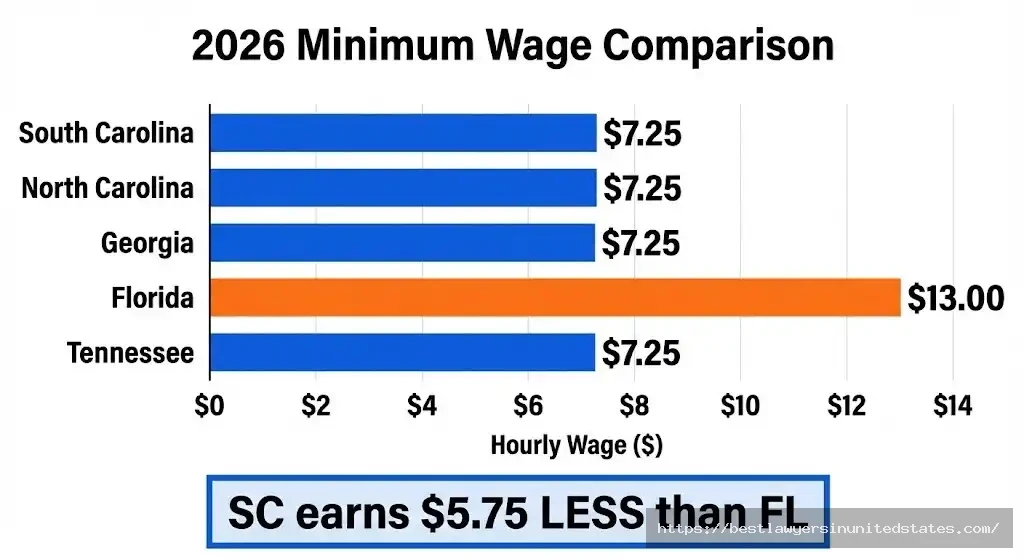
Quick Answer: South Carolina's $7.25 minimum wage equals the federal rate and matches North Carolina and Georgia. However, Florida minimum wage workers earn $13.00 per hour, which is $5.75 more.
Regional Wage Comparison
Southern states show significant variation in minimum wage rates. South Carolina workers earn substantially less than those in nearby Florida while matching rates in North Carolina and Georgia.
| State | Minimum Wage (2026) | Tipped Minimum | Last Increase | Future Increases |
|---|---|---|---|---|
| South Carolina | $7.25 | $2.13 | 2009 (federal) | None scheduled |
| North Carolina | $7.25 | $2.13 | 2009 (federal) | None scheduled |
| Georgia | $7.25* | $2.13 | 2009 (federal) | None scheduled |
| Florida | $13.00 | $9.98 | 2025 | $14 in 2026, $15 in 2028 |
| Tennessee | $7.25 | $2.13 | 2009 (federal) | None scheduled |
| Virginia | $12.00 | $2.13 | 2023 | Under review |
*Georgia's state minimum is technically $5.15, but FLSA-covered workers get $7.25
The Florida Advantage
South Carolina workers at minimum wage earn $5.75 per hour less than Florida workers. This gap represents over $11,000 annually for full-time employees.
Annual income comparison:
- South Carolina minimum wage (40 hours/week): $15,080
- Florida minimum wage (40 hours/week): $27,040
- Difference: $11,960 per year
Many South Carolina residents near the border consider commuting to Florida for higher wages. The significant pay difference drives worker migration between states.
Living Wage vs Minimum Wage in South Carolina
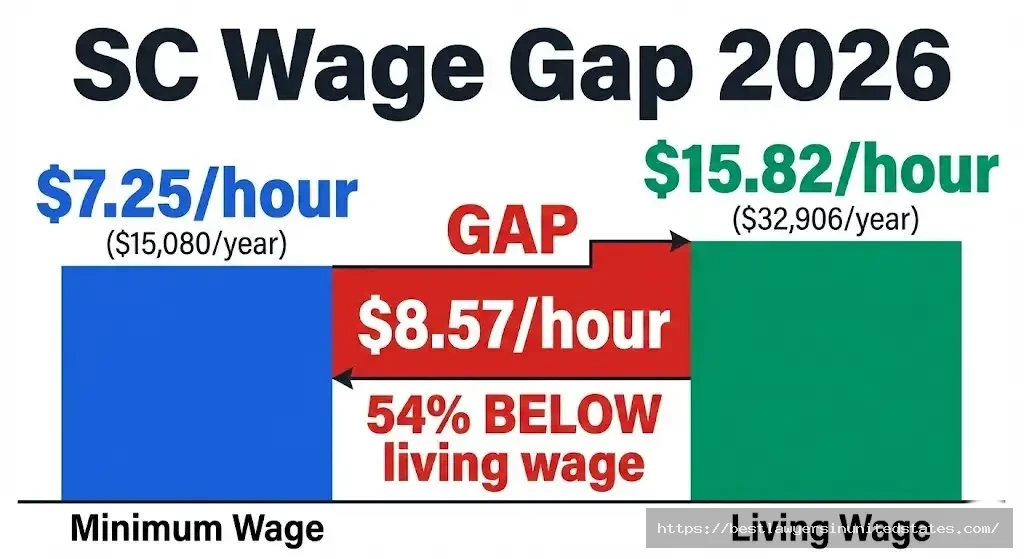
Quick Answer: A living wage in South Carolina is $15.82 per hour for a single adult, according to MIT's Living Wage Calculator for 2026. This is $8.57 per hour higher than the $7.25 minimum wage.
What Is a Living Wage?
A living wage represents the hourly rate needed to cover basic expenses without government assistance. This includes housing, food, transportation, healthcare, and other necessities. The minimum wage rarely meets this threshold.
MIT Living Wage Calculator data for South Carolina (2026):
- Single adult: $15.82/hour
- Single adult with one child: $32.48/hour
- Two working adults with two children: $21.16/hour per adult
- Two working adults with three children: $23.45/hour per adult
The Financial Reality for South Carolina Workers
South Carolina's $7.25 minimum wage falls 54% below the living wage for a single adult. Workers earning minimum wage cannot afford basic necessities without multiple jobs or government assistance.
Annual income comparison:
- Minimum wage (full-time): $15,080/year
- Living wage (single adult): $32,906/year
- Federal poverty line (2026, single person): $15,060/year
- Gap between minimum and living wage: $17,826/year
South Carolina minimum wage workers earn barely above the poverty line. A single full-time worker at minimum wage makes only $20 more annually than the federal poverty threshold.
Why This Matters for South Carolina Families
Cost breakdown at minimum wage ($7.25/hour, 40 hours/week):
- Monthly gross income: $1,256.67
- Estimated take-home (after taxes): $1,130
- Average rent (1-bedroom SC): $850-1,100
- Remaining for food, transport, healthcare, utilities: $30-280
The reality: Most minimum wage workers in South Carolina need multiple jobs or government assistance to survive. Many work 50-60 hours per week across multiple employers.
| Household Type | Required Hourly Wage | Annual Income Needed | Gap from SC Minimum |
|---|---|---|---|
| Single adult | $15.82/hour | $32,906 | +$8.57/hour |
| Single adult + 1 child | $32.48/hour | $67,558 | +$25.23/hour |
| 2 adults (both working) + 2 children | $21.16/hour each | $87,974 total | +$13.91/hour each |
What Major South Carolina Employers Actually Pay
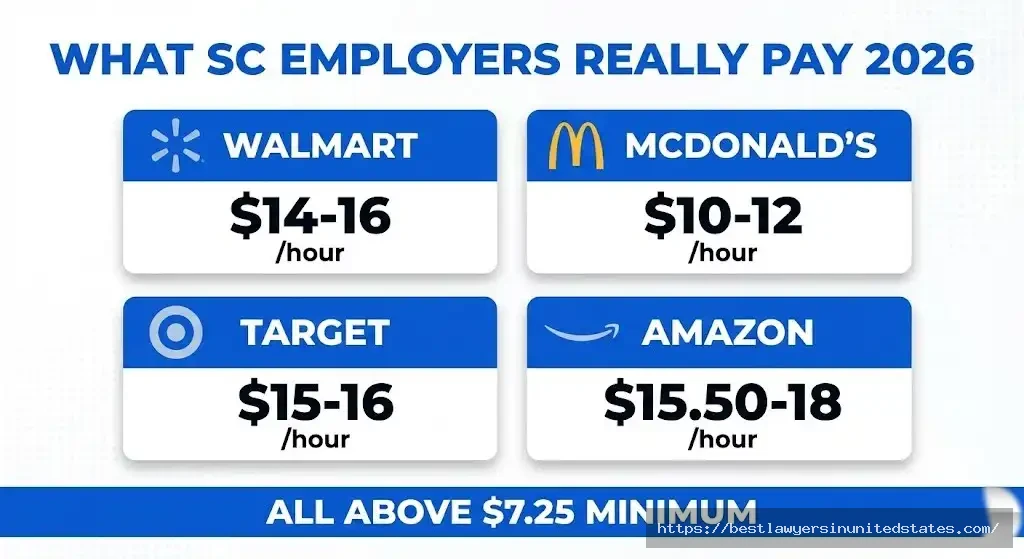
Quick Answer: Major South Carolina employers typically pay $10-16 per hour for entry-level positions, well above the $7.25 minimum wage. Market competition forces higher wages.
Walmart Starting Wages in South Carolina
Walmart stores in South Carolina pay starting wages of $14-16 per hour depending on position and location. This is nearly double the state minimum wage.
Walmart South Carolina pay structure (2026):
- Entry-level sales associate: $14/hour
- Stocking and unloading: $15/hour
- Department supervisor: $16-18/hour
- Pharmacy technician: $16-19/hour
Walmart raised wages nationwide to compete for workers. The company cannot attract employees at $7.25 in South Carolina's current labor market.
McDonald's and Fast Food Wages
McDonald's franchises in South Carolina typically pay $10-12 per hour for crew members. Manager positions start at $15-18 per hour.
Fast food wage ranges in South Carolina (2026):
- Crew member/cashier: $10-12/hour
- Shift supervisor: $13-15/hour
- Assistant manager: $15-18/hour
- Store manager: $40,000-50,000/year
Note: Pay varies by franchise owner, location, and experience. Urban areas typically pay higher than rural locations.
Other Major Employers
Target: $15-16/hour starting wage (matches corporate minimum) Amazon warehouses: $15.50-18/hour depending on shift Publix: $12-14/hour for entry-level positions Hospital systems (MUSC, Prisma): $14-16/hour for support staff
Why Employers Pay Above Minimum Wage
Market forces driving higher wages:
- Worker shortage in hospitality and retail
- Competition with neighboring states
- Need to attract reliable employees
- High turnover costs at minimum wage
- Difficulty filling positions at $7.25
Reality check: Very few South Carolina employers actually pay the $7.25 minimum wage in 2026. Market rates have exceeded the legal minimum. However, many service workers still earn only $10-13/hour, which remains below the living wage.
South Carolina Wage Theft & Worker Rights
Quick Answer: Wage theft occurs when employers fail to pay earned wages, overtime, or tips. South Carolina workers can file complaints with the state Department of Labor, Licensing and Regulation (LLR) or the federal Department of Labor.
South Carolina Payment of Wages Act
South Carolina Code § 41-10-10 et seq. protects workers' right to receive earned wages on time. The law requires employers to pay workers at regular intervals and provide accurate wage statements.
Key protections under the Payment of Wages Act:
- Wages must be paid at least monthly
- Employers must establish regular pay periods
- Final paychecks due within 48 hours of termination or next regular payday
- Employers cannot withhold wages as "punishment"
- Illegal deductions prohibited
What Is Wage Theft?
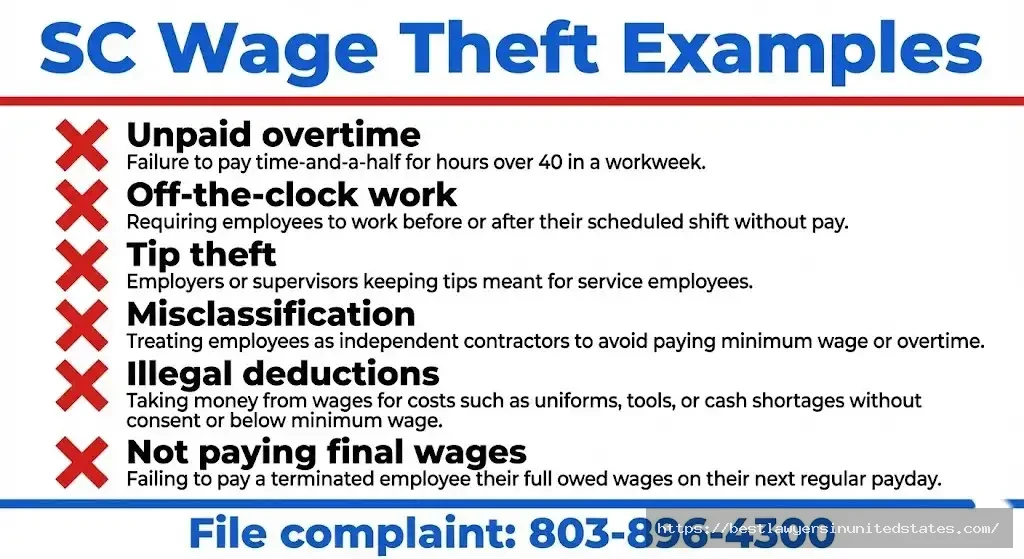
Common forms of wage theft in South Carolina:
- Not paying for all hours worked
- Requiring off-the-clock work
- Denying overtime pay for hours over 40/week
- Taking tips from tipped employees
- Misclassifying employees as independent contractors
- Illegal paycheck deductions
- Not paying final wages after termination
- Requiring work during unpaid breaks
Calculate Your Wage Theft Recovery in South Carolina
Think your employer owes you money? Use our wage theft calculator to estimate how much you could recover, including unpaid wages, penalties, and interest under South Carolina and federal law.
Wage Theft Recovery Calculator
Estimate how much you can recover in unpaid wages, penalties, and damages based on your state's laws
💵 Estimated Total Recovery
💰 Unpaid Wages
⚖️ Penalties & Damages
📋 Total Summary
Calculator features:
- Multiple violation types (unpaid wages, overtime, tips)
- South Carolina-specific penalties and damages
- Federal FLSA violation calculations
- Filing deadline tracker
- Total recovery estimate
- Next steps guidance
Full wage theft calculator: South Carolina Wage Theft Calculator
Need help with unpaid wages? Contact South Carolina Department of Labor, Licensing and Regulation or consult with an employment attorney.
Questions about your wages or need legal help?
Email: [email protected]
How to File a Wage Complaint in South Carolina
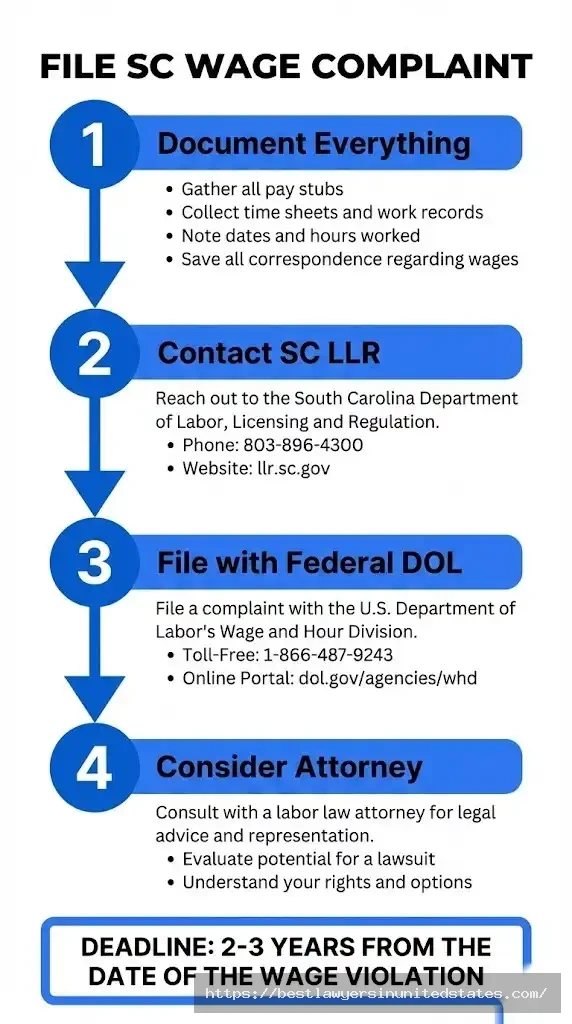
Step 1: Document Everything
Gather all evidence of wage violations:
- Pay stubs showing incorrect pay
- Time sheets or work schedules
- Text messages or emails about work hours
- Bank statements showing deposits
- Photos of time clocks or schedules
- Witness statements from coworkers
Step 2: Contact South Carolina Department of LLR
File a complaint with the South Carolina Department of Labor, Licensing and Regulation:
- Phone: 803-896-4300
- Website: llr.sc.gov
- Office: 110 Centerview Drive, Columbia, SC 29210
- Filing deadline: 2 years from wage violation (3 years if willful)
Step 3: File with Federal Department of Labor
You can also file with the U.S. Department of Labor Wage and Hour Division:
- Phone: 1-866-487-9243
- Website: www.dol.gov/agencies/whd
- Atlanta District Office (covers SC): 404-893-4600
- Filing deadline: 2 years (3 years for willful violations)
Step 4: Consider Private Legal Action
Hire an employment attorney for serious violations. South Carolina law allows private lawsuits for wage theft. Courts can award:
- Full back pay owed
- Liquidated damages (double the wages owed)
- Attorney fees and court costs
- Interest on unpaid wages
Penalties for Wage Violations in South Carolina
| Violation Type | Employer Penalty | Employee Recovery |
|---|---|---|
| Unpaid minimum wages | $1,000 per violation + back pay | Full back pay + equal amount as damages |
| Unpaid overtime | $1,000 per violation | 2x unpaid overtime amount |
| Tip theft | Criminal penalties possible | Full tips + damages + attorney fees |
| Retaliation for complaint | $10,000 per violation | Reinstatement + back pay + damages |
| Repeat violations | $10,000 per violation + criminal charges | Enhanced damages available |
Criminal penalties: Employers who willfully violate wage laws can face criminal prosecution in South Carolina. Conviction carries fines up to $10,000 and potential jail time.
Employer Compliance Requirements in South Carolina
Quick Answer: South Carolina employers must follow federal FLSA posting requirements, keep accurate wage records, and pay workers at regular intervals under state law.
Required Workplace Postings
Federal posters required in all South Carolina workplaces:
- Fair Labor Standards Act (minimum wage notice)
- Equal Employment Opportunity notice
- OSHA safety information
- Family and Medical Leave Act (if 50+ employees)
State posters required:
- South Carolina Payment of Wages Act notice
- Workers' compensation insurance information
- Unemployment insurance notice
Where to display: Post in break rooms, time clock areas, or other locations where all employees can easily see them.
Penalties for non-compliance: $100-500 per violation for failure to display required posters.
Record-Keeping Requirements
Employers must maintain for at least 3 years:
- Employee personal information (name, address, SSN, birth date if under 19)
- Hours worked each day and week
- Regular hourly rate and total straight-time earnings
- Overtime hours and overtime pay
- Wage deductions and additions
- Total wages paid per pay period
- Pay dates
For tipped employees, also keep:
- Weekly or monthly tip reports from employees
- Documentation of tip credit claimed
- Records showing cash wage plus tips equals minimum wage
- Tip pool distributions
Pay Schedule Requirements Under South Carolina Law
South Carolina requires employers to establish regular pay periods. Employees must receive wages at least once per month. Most employers pay weekly, bi-weekly, or semi-monthly.
Final paycheck rules:
- Voluntary termination: Next regular payday or within 48 hours (employee's choice)
- Involuntary termination: Within 48 hours or next regular payday
- Failure to pay: Employee can file complaint or lawsuit
Special Wage Categories in South Carolina
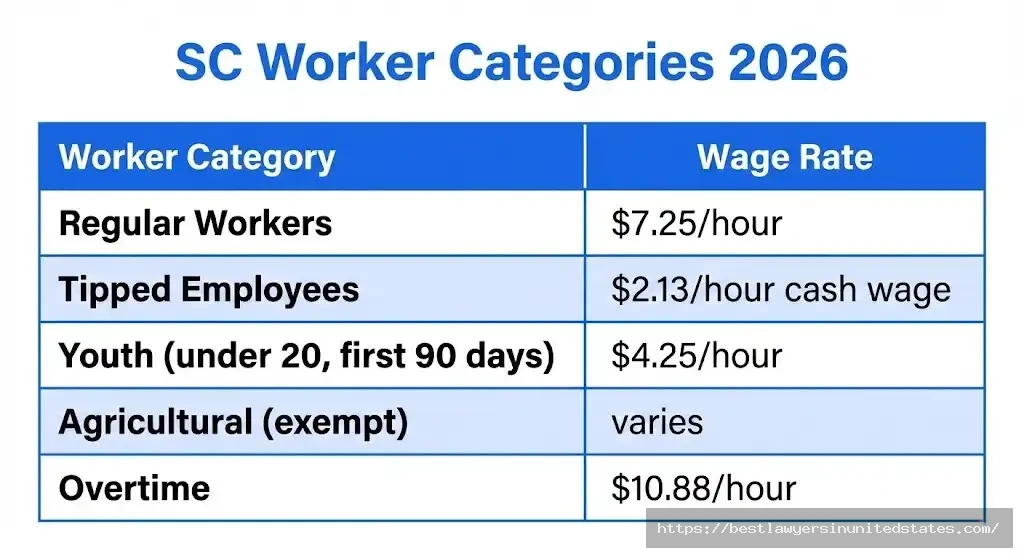
Youth Minimum Wage (Under Age 20)
Quick Answer: Employers can pay workers under age 20 a youth minimum wage of $4.25 per hour for their first 90 consecutive calendar days of employment.
After 90 days, the employee must receive the full $7.25 minimum wage. The youth wage is a federal provision under the FLSA.
Restrictions on youth minimum wage:
- Cannot displace existing workers to hire youth at lower rate
- Cannot reduce hours of existing employees to hire youth workers
- Only applies to workers under 20 years old
- Limited to first 90 calendar days (not working days)
Agricultural Worker Wages
Many agricultural workers in South Carolina are exempt from minimum wage under FLSA exemptions. Small farm operations with limited labor costs do not need to pay minimum wage.
Agricultural exemptions apply when:
- Farm uses 500 or fewer "man-days" of agricultural labor per quarter
- Employee is immediate family member of farm owner
- Hand harvest workers paid piece rates on small farms
- Workers employed on range production of livestock
Agricultural workers who must receive minimum wage:
- Large farm operations (over 500 man-days per quarter)
- Workers in farm processing operations
- Employees of agricultural businesses engaged in interstate commerce
Student-Learners and Vocational Education
Students enrolled in vocational education programs can be paid 75% of minimum wage ($5.44/hour in 2026) if they obtain a special certificate from the Department of Labor.
Requirements:
- Student must be enrolled in vocational training program
- Work must be part of the educational curriculum
- Employer must obtain student-learner certificate from DOL
- Work must provide educational benefit
Frequently Asked Questions
What is South Carolina's minimum wage in 2026?
Quick Answer: South Carolina's minimum wage is $7.25 per hour in 2026, which equals the federal minimum wage.
South Carolina has no state minimum wage law. All covered workers receive the federal FLSA minimum of $7.25 per hour. This rate has not changed since 2009.
Does South Carolina have a state minimum wage?
Quick Answer: No. South Carolina relies entirely on federal minimum wage protections under the Fair Labor Standards Act.
South Carolina is one of five states (along with Alabama, Louisiana, Mississippi, and Tennessee) without a state minimum wage. Workers depend on federal law for wage guarantees. The state legislature has not passed its own minimum wage statute.
What is the tipped minimum wage in South Carolina?
Quick Answer: Tipped employees in South Carolina can be paid $2.13 per hour in cash wages. With tips, total earnings must reach at least $7.25 per hour.
Employers can claim a tip credit of up to $5.12 per hour. If tips plus cash wage do not equal $7.25 per hour, the employer must make up the difference.
Is minimum wage going up in South Carolina in 2026?
Quick Answer: No. South Carolina has no scheduled minimum wage increases for 2026 or beyond.
Two legislative bills (Bill 216 and Bill 3226) propose raising the minimum wage, but both remain stalled in committee. Without new legislation, the wage will remain $7.25 per hour.
What is overtime pay in South Carolina?
Quick Answer: Overtime pay is $10.88 per hour (1.5 times $7.25) for hours worked beyond 40 in a week.
South Carolina follows federal overtime rules. Non-exempt employees earn time-and-a-half for all hours over 40 per workweek. There is no daily overtime requirement.
Can Charleston or Myrtle Beach set their own minimum wage?
Quick Answer: No. South Carolina law does not allow cities or counties to set their own minimum wages.
All South Carolina municipalities must follow the federal $7.25 minimum wage. Cities cannot create local ordinances establishing higher rates.
What is a living wage in South Carolina?
Quick Answer: A living wage in South Carolina is $15.82 per hour for a single adult, according to MIT's 2026 Living Wage Calculator.
This is $8.57 per hour higher than the current $7.25 minimum wage. The living wage represents the amount needed to cover basic expenses without government assistance.
What do Walmart and McDonald's pay in South Carolina?
Quick Answer: Walmart pays $14-16 per hour for entry-level positions. McDonald's typically pays $10-12 per hour for crew members.
Both companies pay well above the $7.25 legal minimum. Market competition forces higher wages to attract workers.
How do I report wage theft in South Carolina?
Quick Answer: File a complaint with the South Carolina Department of Labor, Licensing and Regulation at 803-896-4300 or the federal Department of Labor Wage and Hour Division.
You have 2-3 years to file a wage claim depending on whether the violation was willful. You can also hire an attorney for private legal action.
Are servers paid $2.13/hour in South Carolina?
Quick Answer: Yes. Servers and other tipped employees can legally be paid $2.13 per hour in cash wages, but total earnings including tips must reach $7.25 per hour.
If tips do not bring total pay to $7.25 per hour, the employer must make up the difference. Employers cannot take any portion of employee tips.
How do I calculate my earnings at South Carolina minimum wage?
Quick Answer: Use our South Carolina minimum wage calculator to estimate weekly, monthly, and annual earnings based on hours worked.
At $7.25 per hour working 40 hours per week, you'll earn $290 weekly, $1,257 monthly, and $15,080 annually before taxes.
How much overtime pay am I entitled to in South Carolina?
Quick Answer: Use our overtime pay calculator to calculate your overtime earnings for hours over 40 per week.
You earn $10.88 per hour (1.5 times $7.25) for all overtime hours. For example, working 50 hours in a week earns you $398.80 total ($290 regular + $108.80 overtime).
How do I calculate wage theft recovery in South Carolina?
Quick Answer: Use our wage theft recovery calculator to estimate unpaid wages, penalties, and damages under South Carolina law.
You may recover back pay plus an equal amount in liquidated damages. The calculator helps estimate your total recovery based on violation type and duration.
What is the minimum wage in North Carolina compared to South Carolina?
Quick Answer: Both states have the same $7.25 federal minimum wage. Neither state has enacted its own higher minimum wage law.
North Carolina minimum wage and South Carolina both rely on federal FLSA protections. Workers in both states earn the same minimum rate.
Is South Carolina's minimum wage lower than Florida's?
Quick Answer: Yes. South Carolina workers earn $5.75 per hour less than Florida workers. Florida's minimum wage is $13.00 per hour in 2026.
Florida minimum wage increases annually and will reach $15 per hour by 2028. South Carolina has no scheduled increases.
What are my rights if I'm not paid minimum wage?
Quick Answer: You can file a complaint with state or federal labor departments, recover back pay plus damages, and sue your employer in court.
Contact the South Carolina Department of LLR at 803-896-4300 or the federal DOL at 1-866-487-9243. You may also consult an employment attorney for serious violations.
Can my employer pay me less than $7.25 per hour?
Quick Answer: Only in specific circumstances: tipped employees ($2.13 cash wage), youth workers under 20 for first 90 days ($4.25), and certain exempt workers.
Regular employees covered by FLSA must receive at least $7.25 per hour. Paying less violates federal law and subjects employers to penalties.
How does South Carolina minimum wage compare to surrounding states?
Quick Answer: South Carolina matches Georgia, North Carolina, and Tennessee at $7.25. Florida pays significantly more at $13.00 per hour.
Check our guides for Georgia minimum wage and other neighboring states to compare rates and worker protections.
What should I do if my employer doesn't pay overtime?
Quick Answer: Document all hours worked, file a wage complaint with state or federal authorities, and consider hiring an employment attorney.
Unpaid overtime violations can result in double the amount owed plus attorney fees. Use our overtime calculator to estimate what you're owed.
Are there any exceptions to South Carolina minimum wage?
Quick Answer: Yes. Tipped workers, youth workers under 20 (first 90 days), some agricultural workers, and certain exempt employees may have different wage rules.
Most regular employees must receive $7.25 per hour. Exemptions are limited and specific. Contact the DOL if you're unsure about your classification.
How to Stay Updated on South Carolina Minimum Wage Changes
Track federal wage legislation: Congress periodically introduces bills to raise the federal minimum wage. Follow federal labor law updates through the Department of Labor website.
Monitor South Carolina General Assembly: Visit scstatehouse.gov to track Bills 216, 3226, and other wage-related legislation. Sign up for bill tracking alerts to receive updates when committee action occurs.
Follow labor advocacy groups: Organizations like the South Carolina AFL-CIO and worker advocacy groups provide updates on wage legislation and worker rights.
Subscribe to DOL notifications: The U.S. Department of Labor offers email updates on wage and hour rule changes. Register at dol.gov to receive automatic notifications.
Check this page regularly: We update this guide whenever South Carolina minimum wage laws change. Bookmark this page for the most current information.
South Carolina's $7.25 minimum wage remains one of the lowest in the nation. Workers face significant challenges making ends meet at this rate, with the living wage nearly double the legal minimum. While major employers pay above minimum wage due to market forces, thousands of South Carolina workers still struggle with low pay.
Understanding your rights under South Carolina and federal wage laws helps protect you from exploitation. Use our calculators to check your pay, and contact authorities immediately if you believe your employer is violating wage laws.
Need legal assistance with wage issues?
Email: [email protected]
