
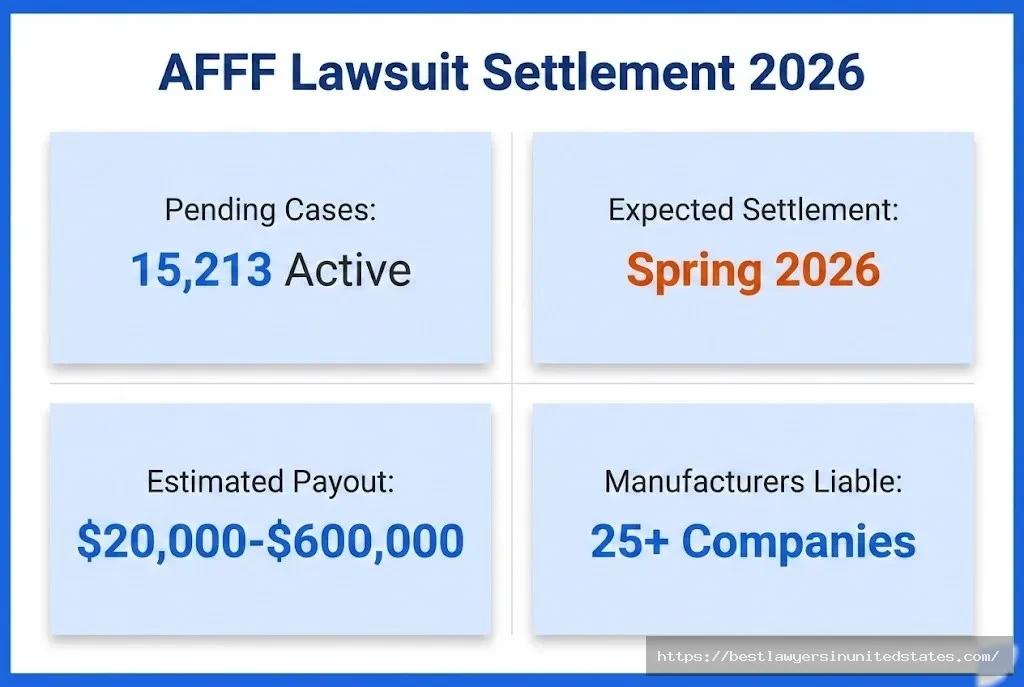
The AFFF lawsuit involves thousands of firefighters, military personnel, and others who developed cancer after exposure to toxic firefighting foam containing PFAS chemicals. No global settlement has been reached yet, but attorneys expect settlement announcements by spring 2026 with estimated individual payouts ranging from $20,000 to $600,000. As of February 2026, there are 15,213 active cases pending in federal court. hawthorne residential partners lawsuit
Quick Answer: The AFFF (Aqueous Film-Forming Foam) lawsuit targets manufacturers who made firefighting foam containing dangerous PFAS “forever chemicals” that cause cancer. While there’s no official claim deadline yet for a global settlement (which hasn’t been finalized), many law firms stopped accepting new cases after the court’s September 5, 2025 filing facilitation window ended. If you were exposed to AFFF and developed cancer, you should contact an attorney immediately as settlement negotiations are progressing and opportunities may close soon.
This is your complete guide to the AFFF lawsuit. You’ll learn who qualifies, how much compensation you might receive, how to file a claim, and what to expect from the settlement timeline. We’ve researched the latest court documents, settlement projections, and legal developments to give you accurate information you can trust.
What Is the AFFF Lawsuit About?
Background of the Lawsuit
AFFF stands for Aqueous Film-Forming Foam, a firefighting product developed in the 1960s by the U.S. Navy and 3M to fight fuel fires. The foam was incredibly effective at putting out fires caused by gasoline, jet fuel, and other flammable liquids. For decades, it was used extensively at military bases, airports, fire departments, and industrial facilities across the country.
The problem? AFFF contains PFAS chemicals—per- and polyfluoroalkyl substances—often called “forever chemicals” because they don’t break down in the environment or in the human body. These chemicals accumulate over time and have been linked to serious health problems, especially cancer.
Firefighters, military personnel, and others who used AFFF regularly absorbed these chemicals through their skin, breathed them in during firefighting operations, and in many cases, drank water contaminated by AFFF runoff from training exercises. Studies now show that PFAS exposure significantly increases the risk of several types of cancer. Mary Ruth Organics Lawsuit
Timeline of Key Events
| Date | Event | Details |
|---|---|---|
| 1960s | AFFF developed | U.S. Navy and 3M create firefighting foam with PFAS chemicals |
| 1970s-2020s | Widespread AFFF use | Military bases, airports, and fire departments use AFFF extensively |
| December 2018 | MDL created | Federal court consolidates AFFF cases into MDL 2873 in South Carolina |
| 2023 | 3M water settlement | $10.3 billion settlement for PFAS water contamination (separate from personal injury cases) |
| 2024 | DuPont settlement | $1.185 billion settlement approved for PFAS water contamination claims |
| September 5, 2025 | Filing deadline | Court-ordered deadline for unfiled claims to join MDL |
| October 20, 2025 | Bellwether trial delayed | First kidney cancer trial postponed due to massive case filing surge |
| January 2026 | Current status | 15,213 active personal injury cases pending; settlement negotiations ongoing |
| Spring 2026 (projected) | Expected settlement | Attorneys predict global settlement announcement within 2-4 months |
| Late 2026-2027 (projected) | Payment distribution | Estimated timeframe for settlement payments to begin |
Who Filed the Lawsuit?
The AFFF lawsuits were filed by thousands of individuals who were exposed to firefighting foam and later developed serious health conditions. Lead plaintiffs include:
- Firefighters (both civilian and military) who used AFFF during their careers
- Military service members from all branches who were exposed at bases and training facilities
- Airport workers involved in fire suppression and emergency response
- Family members who lived near contaminated sites or in on-base housing
The cases are being handled by plaintiffs’ attorneys from law firms across the country, coordinated through a Plaintiffs’ Executive Committee in the multidistrict litigation.
What Are the Allegations?
The lawsuits allege that AFFF manufacturers knew about the dangers of PFAS chemicals for decades but failed to warn users about the serious health risks. Key allegations against companies like 3M, DuPont, Chemours, BASF, Tyco Fire Products, and others include:
Major allegations:
- Manufacturing and selling firefighting foam containing toxic PFAS chemicals that cause cancer and other serious health conditions
- Knowingly concealing the health risks from firefighters, military personnel, and other end users despite internal research showing dangers
- Failing to provide adequate warnings or safety information about the long-term health consequences of PFAS exposure
- Contaminating drinking water supplies at military bases, airports, and communities near training facilities with PFAS runoff
- Prioritizing profits over public safety by continuing to sell dangerous products even after learning about the health hazards
- Negligently designing and manufacturing a defective product that was unreasonably dangerous for its intended use
Who Qualifies for the AFFF Lawsuit Settlement?
Quick Answer: You may qualify if you were regularly exposed to AFFF firefighting foam for at least one year and were later diagnosed with kidney cancer, testicular cancer, thyroid disease, liver cancer, ulcerative colitis, or certain other PFAS-related conditions. You’ll need medical records proving your diagnosis and evidence of AFFF exposure through employment or military service records. While no official settlement deadline exists yet, many attorneys have stopped accepting new cases.
Eligibility Requirements
To qualify for the AFFF lawsuit, you must meet two basic criteria: proof of exposure to AFFF and a diagnosis of a qualifying condition linked to PFAS chemicals.
| Requirement | Details | Documentation Needed |
|---|---|---|
| AFFF Exposure | Minimum 1 year of regular, direct exposure to AFFF firefighting foam | Employment records, military service records, training logs, work history |
| Qualifying Diagnosis | Diagnosis of cancer or health condition scientifically linked to PFAS exposure | Medical records, pathology reports, diagnosis documentation |
| Timing | Diagnosis occurred after AFFF exposure (typically years or decades later) | Medical timeline showing exposure preceded diagnosis |
| Documentation | Ability to prove connection between exposure and illness | Combination of work/military records and medical evidence |
Detailed eligibility factors:
You likely qualify if you can answer “yes” to these questions:
- Did you work with or around AFFF for at least one year in your profession or military service?
- Were you diagnosed with one of the qualifying cancers or conditions after your exposure?
- Do you have documentation proving both your exposure and your diagnosis?
The strongest cases involve people who used AFFF directly—spraying it at fires or during training exercises. However, some cases also involve drinking water contamination, particularly on military bases where AFFF seeped into groundwater.
Eligible Occupations and Exposure Types
| Occupation/Role | Exposure Type | Typical Timeframe |
|---|---|---|
| Civilian Firefighters | Direct use in firefighting and training | 1970s-present |
| Military Firefighters | Firefighting on bases, ships, training facilities | 1960s-present |
| Air Force Personnel | Hangar fires, flight line operations | 1970s-present |
| Navy Personnel | Shipboard firefighting, base operations | 1960s-present |
| Airport Rescue Workers | Aircraft fire response and training | 1970s-present |
| Military Base Residents | Contaminated drinking water in on-base housing | 1970s-2020s |
| Chemical Plant Workers | AFFF manufacturing and handling | 1960s-present |
| Oil Refinery Workers | Industrial fire suppression | 1970s-present |
| Industrial Firefighters | Fuel fire response at industrial facilities | 1970s-present |
Qualifying Health Conditions
The AFFF litigation currently focuses on health conditions with the strongest scientific evidence linking them to PFAS exposure. These are organized into tiers based on the strength of causation evidence.
| Condition | Tier/Priority | Scientific Evidence Strength | Typical Settlement Range |
|---|---|---|---|
| Kidney Cancer | Tier 1 (Highest) | Very Strong | $200,000-$600,000 |
| Testicular Cancer | Tier 1 (Highest) | Very Strong | $200,000-$600,000 |
| Thyroid Cancer | Tier 2 | Strong | $100,000-$400,000 |
| Thyroid Disease | Tier 2 | Strong | $75,000-$300,000 |
| Ulcerative Colitis | Tier 2 | Moderate-Strong | $75,000-$300,000 |
| Liver Cancer | Tier 3 | Moderate | $50,000-$250,000 |
| Pancreatic Cancer | Under Review | Emerging | Case-dependent |
| Prostate Cancer | Under Review | Emerging | Case-dependent |
Note on prostate cancer: While some studies link PFAS to prostate cancer, it’s not currently among the officially accepted conditions in the AFFF MDL. Some law firms are accepting prostate cancer cases, but these are being “warehoused” pending stronger scientific evidence. This may change as more research emerges.
Who Does NOT Qualify?
You won’t be eligible for the AFFF lawsuit if:
- You have no documented exposure to AFFF or PFAS-contaminated water
- Your diagnosis isn’t one of the qualifying conditions with established PFAS links
- You can’t provide medical records proving your diagnosis
- You have no evidence of when or where AFFF exposure occurred
- Your statute of limitations has expired in your state (typically 1-3 years from diagnosis, but varies)
- You only had minimal or incidental exposure (brief one-time contact typically doesn’t qualify)
- Your diagnosis occurred before any possible AFFF exposure
How to Prove Your Claim
Building a strong AFFF lawsuit requires solid documentation. Here’s what you’ll need:
| Document Type | Why It’s Needed | Where to Find It | Alternatives If You Don’t Have It |
|---|---|---|---|
| Medical Records | Proves diagnosis of qualifying condition | Your doctors, hospitals, oncologists | Contact medical records departments; most keep records 7-10 years |
| Pathology Reports | Confirms type and stage of cancer | Hospital lab, oncology office | Request from diagnosing physician |
| Military Service Records | Proves military AFFF exposure | DD-214, service records from National Archives | Request from National Personnel Records Center |
| Employment Records | Documents civilian firefighting career | Fire department, employer HR | Sworn affidavit about work history; pension records |
| Training Logs | Shows specific AFFF training exercises | Military or fire department records | Testimony from colleagues who trained with you |
| Duty Station Records | Proves you were at contaminated bases | Military personnel file | Base assignment orders, PCS orders |
| Water Test Results | Proves PFAS in drinking water | EPA, military environmental reports | Public records from contaminated base lists |
| Photos/Equipment | Visual evidence of AFFF use | Personal collection | Department archives, yearbooks |
If you’re missing documentation: Don’t panic. Attorneys experienced in AFFF cases know how to track down records and build cases even when some documentation is missing. They can request military records on your behalf, obtain medical records, and use other evidence like testimony from colleagues.
How Much Money Can You Get from the AFFF Settlement?
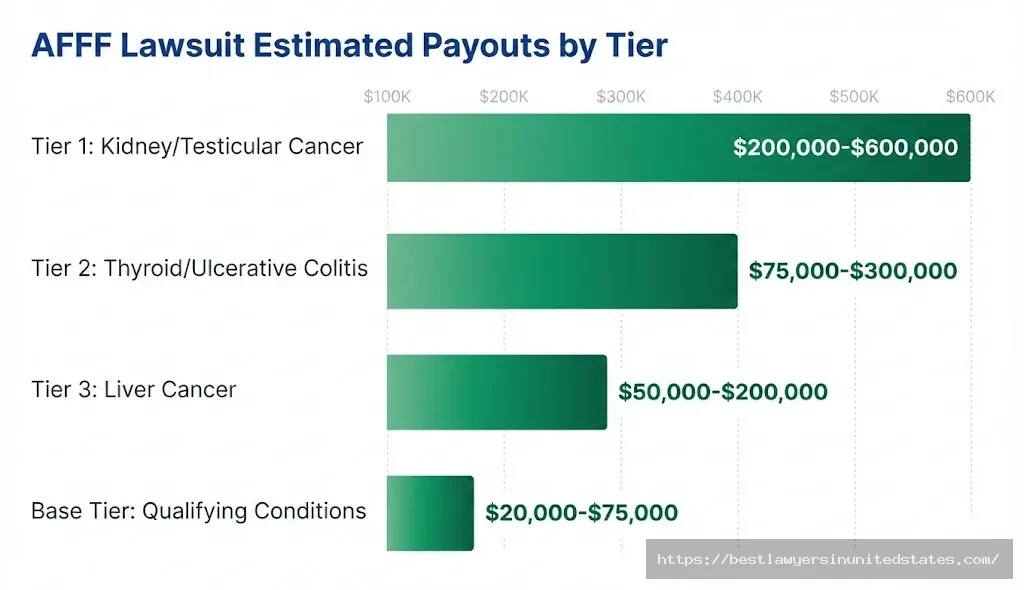
Quick Answer: Settlement payouts are projected to range from $20,000 to $600,000 depending on several factors. Top-tier cases involving aggressive cancers like kidney or testicular cancer with long-term occupational exposure could receive $200,000-$600,000. Mid-tier cases involving thyroid disease or ulcerative colitis may receive $75,000-$300,000. No global settlement has been finalized yet, but these are estimates based on similar mass tort settlements and attorney projections. Crepe Erase Lawsuit
Settlement Fund Breakdown
While no official global settlement has been announced yet, previous PFAS-related settlements provide insight into potential fund sizes. Here’s what we know from related cases:
| Settlement Category | Amount | Purpose/Status |
|---|---|---|
| 3M Water Contamination | $10.3 billion | Settled in 2023 for municipal water systems (separate from personal injury) |
| DuPont/Chemours/Corteva Water | $1.185 billion | Approved in 2024 for PFAS water contamination claims |
| BASF Water Settlement | $316.5 million | Approved in 2024 for public water systems |
| Carrier Global/Kidde-Fenwal | $730 million | Settled in 2023 for AFFF exposure claims |
| Carrier Global (Additional) | $615 million | Announced October 2024 for ongoing AFFF lawsuits |
| DuPont (Delaware) | $50 million | State settlement for water pollution |
| DuPont (New Jersey) | $450 million | 3M settlement for Chambers Works facility contamination |
| Personal Injury MDL | TBD | No global settlement yet; 15,213 pending cases as of Jan 2026 |
What this means: The manufacturers have already paid over $13 billion for water contamination alone. Personal injury settlements typically pay more per person than environmental settlements because they compensate for cancer, pain and suffering, and lost wages. Attorneys expect a substantial settlement pool when negotiations conclude.
Estimated Payout Tiers
Based on attorney projections, similar mass tort settlements, and the severity of injuries, here are the estimated payout ranges:
| Tier | Claim Characteristics | Estimated Payout | Qualifying Conditions |
|---|---|---|---|
| Tier 1 | Long-term occupational exposure + aggressive cancer diagnosis | $200,000-$600,000 | Kidney cancer, testicular cancer (strongest causation evidence) |
| Tier 2 | Moderate exposure + serious health condition | $75,000-$300,000 | Thyroid cancer, thyroid disease, ulcerative colitis |
| Tier 3 | Documented exposure + qualifying condition | $50,000-$200,000 | Liver cancer, other qualifying conditions |
| Base Tier | Minimal qualifying exposure + diagnosis | $20,000-$75,000 | Lower-severity cases with limited exposure proof |
Important disclaimers: These are projections, not guarantees. Your actual payout depends on:
- The strength of your individual case
- The total settlement amount (if reached)
- How many people file valid claims
- Your specific injuries and damages
- Your age at diagnosis
- Lost wages and medical expenses
- Whether you go to trial or settle
Factors That Affect Your Payout
Your compensation amount isn’t random. Here’s what influences how much you might receive:
Duration of AFFF exposure: Firefighters and military personnel who used AFFF for 10, 20, or 30+ years typically receive higher settlements than those with shorter exposure periods. Longer exposure usually means higher PFAS blood levels and stronger causation.
Type of cancer: More aggressive cancers with higher mortality rates generally receive larger settlements. Kidney and testicular cancers have the strongest scientific links to PFAS, making them the highest-value claims.
Age at diagnosis: Younger victims who face decades of health impacts and lost earning potential typically receive more than older retirees. A firefighter diagnosed at age 45 has different economic damages than someone diagnosed at 75.
Medical expenses: Cases with extensive treatment costs—chemotherapy, surgeries, ongoing monitoring—justify higher compensation. Keep all medical bills and treatment records.
Lost wages and earning capacity: If cancer treatment forced you to stop working or limited your career, this increases your damages. Document all income losses.
Strength of documentation: Cases with clear employment records, medical documentation, and proof of AFFF exposure receive better settlements than those with gaps in evidence.
Individual vs. settlement participation: Some plaintiffs may choose to opt out of a global settlement and go to trial individually. Trial verdicts can be much higher but also carry the risk of receiving nothing.
When Will You Receive Payment?
The timeline for AFFF settlement payments is uncertain because no global settlement has been finalized yet. Here’s the realistic timeline based on attorney projections and similar mass tort cases:
| Stage | Projected Timeframe | What Happens |
|---|---|---|
| Settlement Negotiations | Ongoing (Feb 2026) | Attorneys for both sides working toward agreement |
| Settlement Announcement | Spring 2026 (projected) | If reached, terms would be publicly announced |
| Preliminary Court Approval | 2-4 months after announcement | Judge reviews and preliminarily approves settlement |
| Claims Period Opens | After preliminary approval | Eligible claimants submit claim forms |
| Claims Review | 3-6 months | Settlement administrator processes and validates claims |
| Final Court Approval | 6-12 months after announcement | Judge gives final approval after fairness hearing |
| Payment Distribution | 2-4 months after final approval | Checks or direct deposits sent to claimants |
| Expected Receipt | Late 2026 to mid-2027 | Realistic timeframe for most claimants to receive money |
Important timing note: These projections assume a settlement is reached in spring 2026. If negotiations fail, bellwether trials would proceed, potentially pushing any settlement into 2027 or beyond. Individual trial verdicts could come sooner but would only affect those specific plaintiffs.
Comparison with Similar Lawsuit Settlements
How does the AFFF lawsuit compare to other major mass tort cases? Here’s context:
| Lawsuit | Total Settlement | Affected Parties | Individual Payout Range | Timeline |
|---|---|---|---|---|
| AFFF Personal Injury | TBD (pending) | 15,000+ | $20,000-$600,000 (projected) | Ongoing |
| Roundup/Glyphosate | $10+ billion | 100,000+ | $5,000-$250,000 | 2020-2022 |
| Talcum Powder (J&J) | $8.9 billion | 70,000+ | Varies widely | 2023 (proposed) |
| Hernia Mesh | $7.6 billion | 200,000+ | $30,000-$250,000 | 2011-2020 |
| Opioid Settlements | $50+ billion | States/municipalities | Varies (public health funding) | 2021-ongoing |
| Camp Lejeune Water | TBD | 100,000+ | Varies by injury | 2022-ongoing |
What makes this settlement unique:
Unlike many mass torts where one or two companies are defendants, the AFFF litigation involves 25+ manufacturers, making settlement negotiations complex. The cases span both personal injury (cancer victims) and environmental contamination (water systems), complicating the settlement structure. Many victims are military veterans, adding political pressure for fair resolution.
How to File Your AFFF Claim – Step by Step
⚠️ IMPORTANT NOTE: While there is no official claim deadline for a global settlement (which hasn’t been finalized yet), the federal court set a September 5, 2025 deadline for joining the MDL litigation. After this date, new filings face stricter requirements including complete medical records, Plaintiff Fact Sheets within 90 days, and expert witness disclosures within 120 days. Many law firms have stopped accepting new AFFF cases. If you believe you qualify, contact an attorney immediately to discuss your options.

Understanding the Current Status
Before we walk through filing steps, you need to understand where things stand:
No global settlement exists yet. There’s no claim form to fill out for a settlement because settlement terms haven’t been finalized. What attorneys are doing now is filing individual lawsuits that will be eligible for any future settlement or trial.
The MDL filing window has passed. The court created a “Filing Facilitation Window” that closed September 5, 2025. Cases filed after this face much stricter deadlines and scrutiny.
Many law firms have stopped taking cases. As of January 2026, major firms handling AFFF litigation (including some mentioned in our research) are no longer accepting new clients. They’re waiting to see how settlement negotiations progress.
If a settlement is reached, there will be a claims process similar to other mass torts, with a claims administrator, forms to complete, and deadlines to submit documentation.
What You Can Do Right Now
Even though the main filing window has closed, here’s what you should do:
Step 1: Preserve Your Evidence
Start gathering documentation immediately:
- Medical records showing your cancer diagnosis
- Employment or military service records
- Any photos of you using AFFF equipment
- Records of duty stations or fire departments where you worked
- Treatment records and medical bills
- List of medications and ongoing care
Step 2: Consult with an Attorney
Despite many firms closing intake, some attorneys may still be able to help depending on your circumstances:
- Contact AFFF lawsuit attorneys in your state
- Many offer free consultations to evaluate your case
- They’ll tell you honestly if your case can still be filed
- If the statute of limitations hasn’t passed in your state, you may still have options
For attorney referrals, you can contact: [email protected]
Step 3: Understand Your State’s Statute of Limitations
Time limits for filing vary by state:
| Statute of Limitations | Common States | Notes |
|---|---|---|
| 1 year | Louisiana, Kentucky, Tennessee | Very strict; often from diagnosis date |
| 2 years | California, Florida, Georgia, Illinois, Michigan, Ohio, Pennsylvania, Texas | Most common timeframe |
| 3 years | Alaska, Arizona, New Jersey, New York, Wisconsin | Slightly more time |
| 4-6 years | Maine, Minnesota, North Dakota | Longer windows (rare) |
Discovery rule: Most states use a “discovery rule” meaning the clock starts when you were diagnosed and reasonably should have connected your cancer to AFFF exposure, not when you were first exposed.
Step 4: Monitor Settlement Developments
Stay informed about settlement progress:
- Check legal news websites for AFFF settlement updates
- If you consulted an attorney, stay in contact
- Look for announcements about settlement claims periods
- Join support groups where affected individuals share information
Step 5: Be Ready to Act Quickly
When (and if) a global settlement is announced:
- There will be a claims period with a deadline
- You’ll need your documentation ready
- Claims administrators will require specific proof
- Missing the deadline means missing out on compensation
What the Filing Process Would Look Like (If Settlement Reached)
Based on similar mass tort settlements, here’s what would likely happen:
Settlement claims process:
- Settlement announcement – Terms become public
- Claims period opens – Usually 6-12 months to file
- Claim forms distributed – Available online and by mail
- Documentation submission – Upload or mail proof of exposure and diagnosis
- Claims review – Administrator verifies eligibility
- Additional information requests – You may need to provide more documentation
- Approval notification – You’ll learn if your claim is approved and estimated payout
- Appeals period – Opportunity to contest if denied
- Payment distribution – Checks mailed or direct deposit
Common Filing Mistakes to Avoid
Even if you can’t file a lawsuit right now, knowing these mistakes helps you prepare:
Waiting too long: Statutes of limitations keep running regardless of settlement negotiations. If yours expires, you lose all rights to compensation.
Not keeping documentation: Medical records, employment records, and other evidence may be destroyed after a certain number of years. Request and save copies now.
Assuming you don’t qualify: You might think your case is too weak, but attorneys can evaluate circumstances you don’t realize are important. Get a professional opinion.
Going it alone: AFFF litigation is extremely complex. Attorneys have resources, experts, and experience you don’t. Most work on contingency (no fee unless you win).
Ignoring VA benefits: If you’re a veteran, you may qualify for VA disability compensation in addition to (not instead of) an AFFF lawsuit settlement. These are separate claims and don’t conflict.
Current Lawsuit Status & Latest Updates
Settlement Approval Status (as of February 2026)
No global settlement has been reached yet, but significant progress is being made behind the scenes. Here’s where things stand:
MDL case count: As of January 2026, there are 15,213 pending AFFF personal injury cases in the federal multidistrict litigation (MDL 2873) in South Carolina, with 19,788 total cases filed since the MDL began. This represents one of the largest toxic exposure litigations in U.S. history.
Bellwether trial status: The first bellwether trial was scheduled for October 20, 2025, focusing on kidney cancer claims. This trial was postponed due to the massive surge in case filings between July and October 2025. The court needed time to manage the influx of claims before proceeding to trial.
Settlement negotiations: Judge Richard M. Gergel, who oversees the MDL, has publicly encouraged defendants (including 3M, DuPont, BASF, and Johnson Controls) to move toward settlements. Attorney projections suggest settlement announcements could come within 2-4 months as of January 2026, meaning spring 2026 is the target timeframe.
Why settlement is likely: Defendants have already paid over $13 billion for PFAS water contamination cases. They’ve shown a strong preference for settlement over trial verdicts, which could be much higher. The science linking PFAS to cancer continues to strengthen, making these cases increasingly difficult for defendants to win at trial.
Recent Developments
January 2026: The MDL saw a slight decrease of 121 cases from December to January (from 15,334 to 15,213), attributed to routine dismissals and administrative adjustments rather than substantive changes.
December 2025: Some major law firms announced they are no longer accepting new AFFF clients as they focus resources on existing cases and settlement preparations.
September 2025: Judge Gergel set a September 5, 2025 deadline for unfiled claims, creating urgency for potential claimants. After this deadline, stricter procedural requirements apply to new filings.
July-October 2025: The MDL experienced one of its largest filing surges in history, with over 1,300 cases added in October alone and 968 new cases between July and August. This “rush to file” signaled that attorneys expected a settlement deadline was approaching.
2024 Major Settlements:
- Judge approved $1.185 billion settlement from DuPont, Chemours, and Corteva for PFAS contamination
- Carrier Global announced $615 million in AFFF lawsuit settlements
- BASF reached $316.5 million settlement with public water systems
Scientific developments: A 2025 study confirmed PFAS can be absorbed directly through skin and enter the bloodstream, strengthening causation evidence. Research published in the International Journal of Epidemiology found occupational AFFF exposure significantly increases cancer risks among U.S. firefighters.
What Happens Next?
Expected upcoming events and milestones:
Spring 2026 (projected): Potential global settlement announcement if negotiations succeed. Attorneys handling these cases have indicated they expect movement within 2-4 months of January 2026.
Bellwether trials (if no settlement): If settlement talks fail, the court will proceed with test trials. These would likely focus on kidney cancer cases first (strongest scientific evidence), followed by testicular cancer, thyroid cancer, and ulcerative colitis cases.
Claims period (if settlement): Once a settlement is announced, there would be a claims filing period of 6-12 months for eligible individuals to submit documentation.
Final approval hearing: Any global settlement would require court approval. Judge Gergel would hold a fairness hearing where objectors could voice concerns before granting final approval.
Payment distribution: Assuming settlement approval, payments would likely begin flowing to claimants in late 2026 or 2027.
Do You Need a Lawyer to File an AFFF Claim?
Quick Answer: You’ll almost certainly need a lawyer to pursue an AFFF lawsuit. Unlike simple consumer class actions where you just fill out a form online, AFFF cases require extensive legal work, expert witnesses, medical causation analysis, and complex litigation. The good news: AFFF attorneys work on contingency, meaning you pay nothing unless you win. If a settlement is eventually reached, you won’t need a lawyer to file a claim against the settlement fund—that would be a simpler administrative process.
The Difference Between Filing a Lawsuit and Filing a Settlement Claim
There’s an important distinction people often miss:
Filing a lawsuit (what happened before Sept 2025): This required an attorney. You couldn’t just fill out a form online. Attorneys had to draft complaints, conduct discovery, retain experts, and litigate your case in federal court. This is complex legal work.
Filing a settlement claim (what will happen IF a settlement is reached): This would be an administrative process managed by a claims administrator. You’d fill out forms, submit documentation, and prove you meet the settlement criteria. Many people do this without lawyers in other class action settlements.
Current situation: We’re in between these two phases. The lawsuit filing window has mostly closed, and no settlement exists yet. If you’re trying to get involved now, you’d need an attorney to assess if filing is still possible in your situation. Janice Griffith Lawsuit
When You Can Handle It Yourself
If a global settlement is reached and a claims period opens, you might be able to file a claim without an attorney if:
- The claim form is straightforward
- You have all required documentation
- Your case is clear-cut (obvious exposure, qualifying diagnosis)
- You’re comfortable navigating the process alone
- The settlement administrator provides good guidance
Many class action settlements are designed for people to file claims without lawyers. However, even then, having an attorney review your claim can help maximize your recovery.
When Legal Help Is Essential
You need an attorney if:
You’re trying to file a lawsuit now: Post-September 2025, the requirements are strict and complex. Only an experienced attorney can determine if your case can still be filed and meet the court’s deadlines.
Your case is complex: If you have documentation gaps, unclear exposure history, or complications in your medical timeline, an attorney knows how to overcome these obstacles.
You have a high-value case: If you have aggressive cancer, substantial lost wages, or other significant damages, an attorney can ensure you receive fair compensation. They know how to value cases and negotiate.
You’re unsure about eligibility: Attorneys understand the medical and legal requirements. They can tell you whether your specific situation qualifies when you’re uncertain.
You want to opt out and go to trial: If you believe your case is worth more than a settlement offer, an attorney is absolutely required to pursue an individual trial.
Your claim is denied: If a claims administrator denies your settlement claim, an attorney can help you appeal and fight for approval.
How AFFF Lawyers Work (No Upfront Costs)
AFFF attorneys operate on a contingency fee basis, which means:
No upfront costs: You don’t pay anything to hire them. They cover all case expenses upfront.
No hourly fees: Unlike most lawyers who bill by the hour, you’re never charged for phone calls, meetings, or their time.
Percentage of recovery: Attorneys only get paid if you receive compensation. Typical fees are 30-40% of your settlement or verdict. If you get $100,000, the attorney might take $33,000-$40,000.
No recovery = no fee: If your case is unsuccessful, you owe nothing. The attorney absorbs the loss.
They cover costs: Attorneys pay for expert witnesses, medical record retrieval, court filing fees, and other litigation expenses. These are usually deducted from your settlement before the percentage fee is calculated.
This arrangement aligns the attorney’s interests with yours—they’re motivated to get you the highest possible recovery.
Free Legal Consultation
If you’re considering an AFFF lawsuit, most attorneys offer free case evaluations where they’ll:
- Review your exposure history
- Look at your medical diagnosis
- Evaluate your documentation
- Tell you honestly if you have a case
- Explain your legal options
- Answer your questions
How to find an AFFF attorney:
- Search for “AFFF lawsuit attorney [your state]”
- Look for firms with mass tort experience
- Check reviews and track records
- Ask about their specific AFFF case experience
For attorney referrals: [email protected]
What to bring to your consultation:
- Medical records showing your diagnosis
- Employment or military service records
- Any documentation of AFFF exposure
- List of questions you have
- Timeline of your work history and diagnosis
VA Benefits vs. AFFF Lawsuits (For Veterans)
If you’re a military veteran, you might qualify for both:
VA Disability Compensation: Government benefits for service-connected health conditions. Veterans with PFAS-related cancers may receive $3,800+ per month in tax-free disability payments, depending on their diagnosis and rating.
AFFF Lawsuit: Civil litigation against manufacturers for making dangerous products. This is separate from VA benefits.
Important: Filing an AFFF lawsuit does NOT affect your VA benefits. You can pursue both simultaneously. These are separate claims:
- VA benefits come from the government for your service-connected disability
- AFFF lawsuit compensation comes from manufacturers for making toxic products
Many law firms have VA-accredited attorneys who can help with both your lawsuit and your VA claim.
Frequently Asked Questions
What is the AFFF lawsuit about?
Quick Answer: The AFFF lawsuit is a massive multidistrict litigation (MDL 2873) consolidating over 15,000 federal cases against manufacturers of Aqueous Film-Forming Foam containing toxic PFAS “forever chemicals.”
Firefighters, military personnel, and others exposed to AFFF claim the manufacturers knew for decades that PFAS chemicals caused cancer but failed to warn users. The lawsuits seek compensation for medical expenses, lost wages, pain and suffering, and other damages. While no global settlement has been reached, attorneys project announcements could come in spring 2026 with individual payouts ranging from $20,000 to $600,000 depending on case strength.
Who is eligible for the AFFF lawsuit?
Quick Answer: You’re eligible if you had regular occupational exposure to AFFF for at least one year and were diagnosed with kidney cancer, testicular cancer, thyroid disease, liver cancer, ulcerative colitis, or certain other PFAS-related conditions.
Qualifying occupations include civilian firefighters, military firefighters, Air Force/Navy personnel, airport rescue workers, and others who regularly used AFFF. You’ll need medical records proving your diagnosis and employment or military records showing AFFF exposure. Family members who lived near contaminated bases and developed qualifying conditions may also be eligible. Contact an attorney for a case evaluation since eligibility depends on your specific circumstances.
How much money will I receive from the AFFF settlement?
Quick Answer: Projected settlements range from $20,000 to $600,000, with top-tier kidney and testicular cancer cases potentially receiving $200,000-$600,000 based on attorney estimates.
Your actual payout depends on your cancer type, exposure duration, age at diagnosis, lost wages, medical expenses, and the total number of valid claims filed. These are projections, not guarantees—no official settlement has been finalized yet. Cases with long-term occupational exposure and aggressive cancers typically receive higher compensation. Individual trial verdicts could be much higher, but most cases are expected to settle.
When is the deadline to file an AFFF claim?
Quick Answer: There’s no official settlement claim deadline yet because no global settlement has been reached. However, the court set a September 5, 2025 deadline for joining the MDL litigation, and many law firms have stopped accepting new cases.
The statute of limitations in your state (typically 1-3 years from diagnosis) is your real deadline for filing a lawsuit. If a settlement is eventually reached, there would be a claims period with specific deadlines to submit documentation. Contact an attorney immediately to discuss whether filing is still possible in your situation, as waiting could mean losing all rights to compensation.
How do I file an AFFF claim?
Quick Answer: If a settlement is reached, you’d file a claim through an online portal or mail by completing forms and submitting medical records and proof of AFFF exposure.
Currently, no settlement exists and the main MDL filing window closed September 5, 2025. If you haven’t already filed a lawsuit, contact an attorney to see if you can still join the litigation under stricter post-deadline requirements. When a settlement is eventually announced, the process would involve: (1) obtaining claim forms from the settlement administrator’s website, (2) completing forms with your personal information, exposure history, and diagnosis details, (3) uploading or mailing supporting documentation like medical records and employment history, (4) submitting before the claims deadline, and (5) waiting for claims review and approval.
Do I need a lawyer to file an AFFF lawsuit?
Quick Answer: Yes, you need a lawyer to file an AFFF lawsuit in federal court, but you might not need one to file a claim if a settlement is reached.
AFFF litigation is extremely complex, requiring expert witnesses, medical causation analysis, and extensive legal work. Attorneys work on contingency (no fees unless you win), typically taking 30-40% of any recovery. They cover all upfront costs including expert witnesses and court fees. If a settlement is reached, the claims process would be simpler and some people might handle it without lawyers, though having legal review can maximize recovery. For lawsuit evaluation, most AFFF attorneys offer free consultations.
What documents do I need to file an AFFF claim?
Quick Answer: You need medical records proving your cancer diagnosis and employment or military service records documenting AFFF exposure.
Specifically, gather: (1) medical records and pathology reports confirming your diagnosis of a qualifying condition, (2) military DD-214 or service records showing duty stations and dates of service, or civilian employment records from fire departments, (3) treatment records showing cancer care and medical expenses, (4) photos or documentation of AFFF use if available, (5) records from contaminated military bases (if applicable), and (6) any other evidence connecting your exposure to your diagnosis. If you’re missing some documents, attorneys can help track down records. Don’t assume your case is too weak without consulting a lawyer first.
What if I don’t have receipts or proof of AFFF exposure?
Quick Answer: You can still qualify without receipts because this isn’t a product purchase case—it’s about occupational exposure, which is proven through employment or military service records.
If you were a firefighter or military firefighter, your employment records showing where and when you worked can establish AFFF exposure, as these facilities used AFFF during those time periods. Military veterans can obtain service records showing duty stations at bases known to use AFFF. Attorneys can help reconstruct exposure history using: duty station assignment orders, fire department employment verification, testimony from colleagues, training facility records, photos from your service, and public records of AFFF use at specific locations. Even with documentation gaps, experienced attorneys know how to build cases.
When will I receive my payment from the AFFF settlement?
Quick Answer: Based on attorney projections, payments might begin in late 2026 or 2027 if a settlement is reached in spring 2026, but this timeline is uncertain.
Here’s the realistic sequence: settlement announcement (spring 2026 projected), preliminary court approval (2-4 months later), claims filing period (6-12 months), claims review (3-6 months), final court approval (after fairness hearing), payment distribution (2-4 months after final approval). Complex settlements take time to finalize and distribute. If settlement negotiations fail, the timeline extends further as bellwether trials proceed. Individual trial verdicts come faster but only affect those specific plaintiffs. Be patient—mass tort settlements typically take 12-24 months from announcement to payment.
How will I receive payment from the settlement?
Quick Answer: Settlement payments are typically distributed by check or direct deposit, depending on the claims administrator’s procedures and your preferences.
In most class action and MDL settlements, you’ll receive a check mailed to your address on file. Some settlement administrators offer direct deposit options where you provide banking information. You might also be able to choose payment methods when filing your claim. The settlement agreement (when reached) will specify the payment method. Payments usually come from a qualified settlement fund managed by a court-approved claims administrator, not directly from the defendant companies. If you have an attorney, they may receive the payment first, deduct their fee and costs, then send you the remainder.
What is the total AFFF settlement amount?
Quick Answer: No global settlement amount has been announced yet for the personal injury cases. Previous PFAS water contamination settlements totaled over $13 billion, suggesting the personal injury fund could also be substantial.
Major related settlements include: 3M’s $10.3 billion for water contamination (2023), DuPont/Chemours/Corteva’s $1.185 billion for water claims (2024), Carrier Global’s $615 million for AFFF lawsuits (2024), and BASF’s $316.5 million for water systems (2024). Personal injury settlements typically pay more per person than environmental settlements because they compensate for cancer, suffering, and lost wages. With 15,000+ cases pending and manufacturers already paying billions, attorneys expect a multi-billion-dollar fund when settlement is reached.
Has the AFFF settlement been approved by the court?
Quick Answer: No settlement has been reached yet, so there’s nothing for the court to approve. Settlement negotiations are ongoing as of February 2026.
Judge Richard M. Gergel oversees MDL 2873 in South Carolina federal court and has encouraged defendants to pursue settlement. When a settlement is eventually reached, it would go through: (1) preliminary approval by Judge Gergel after reviewing terms, (2) a notice period informing all class members, (3) a fairness hearing where anyone can object, and (4) final approval after the judge determines the settlement is fair and reasonable. This process typically takes 6-12 months. Separate water contamination settlements have been approved, but the personal injury litigation is still pending.
Can I opt out of the AFFF settlement?
Quick Answer: Yes, when a settlement is reached, you’ll have the right to opt out if you want to pursue an individual lawsuit instead, though specific opt-out procedures haven’t been established yet since no settlement exists.
Opting out means you’re not bound by the settlement terms and can file your own lawsuit seeking a potentially higher verdict at trial. However, going to trial is riskier—you might win more, but you could also lose and get nothing. Most people participate in settlements because they guarantee compensation without the uncertainty of trial. If you opt out, you’ll need an attorney to pursue your individual case. The settlement notice (when issued) would explain opt-out deadlines and procedures. Consult an attorney before deciding whether to participate or opt out.
What if I already threw away the AFFF product or equipment?
Quick Answer: You don’t need to have the physical product to qualify. This lawsuit is about exposure to AFFF during your occupation, not about possessing the product now.
The key evidence is proving you were exposed, which comes from your employment or military service records showing you worked where AFFF was used. Physical possession of AFFF canisters or equipment isn’t required. Most firefighters and military personnel didn’t own the AFFF—it belonged to their department or base. What matters is documenting: where you worked, when you worked there, that AFFF was used at those locations, and that you have a qualifying diagnosis. Photos of you using AFFF equipment can strengthen your case but aren’t mandatory.
Do I have to give up my right to sue separately if I join the settlement?
Quick Answer: If you participate in a settlement, yes, you typically release your right to sue the manufacturers separately for the same AFFF claims.
This is standard in class action and MDL settlements—you can’t accept settlement money and then sue again for more. However, you can opt out of the settlement if you want to preserve your right to sue individually. The settlement release would only cover claims against AFFF manufacturers for PFAS exposure, not unrelated legal claims. You’d still be able to pursue VA benefits, workers’ compensation, or other separate claims. The settlement notice (when issued) would explain exactly what rights you’re releasing. Review these terms carefully and consult an attorney before accepting any settlement.
What if I missed the September 2025 filing deadline?
Quick Answer: Cases can still be filed after September 5, 2025, but they face much stricter requirements including complete medical records, Plaintiff Fact Sheets within 90 days, and expert witness disclosures within 120 days.
Whether you can still file depends on your state’s statute of limitations. If the deadline hasn’t passed, an attorney may be able to file your case, though you’ll face accelerated deadlines and heightened scrutiny. Some law firms have stopped accepting new cases, but others may still evaluate claims. The September deadline was for joining the MDL under easier procedures, not an absolute cutoff for all legal rights. Contact an attorney immediately to discuss whether filing is still possible in your situation.
How do I check my AFFF claim status?
Quick Answer: Once a settlement is reached and you file a claim, the settlement administrator would provide a claims portal or phone number to check status, but this doesn’t exist yet.
Currently, there’s no settlement claims process, so there’s no status to check. If you’ve filed a lawsuit with an attorney, contact them for updates on your case status. When a settlement is eventually reached, the claims administrator would set up: an online portal where you enter your claim number to see status, a toll-free phone number for inquiries, and regular emails or letters updating you on claim review progress. You’d receive notification when your claim is approved or denied, with reasons if denied. CarGuard Lawsuit
What if my AFFF claim is denied by the settlement administrator?
Quick Answer: If your claim is denied, you’d have the right to appeal the decision during a specified appeals period, and an attorney can help you challenge the denial.
Settlement agreements typically include an appeals process where you can: (1) request reconsideration by providing additional documentation the administrator might have missed, (2) appeal to a special master or arbitrator who reviews denied claims, or (3) object to the settlement terms if you believe the criteria are unfair. Common denial reasons include: insufficient proof of AFFF exposure, missing required medical documentation, diagnosis doesn’t qualify, exposure period doesn’t meet requirements, or statute of limitations expired. An attorney experienced in AFFF cases knows how to overcome denials and strengthen appeals.
Will receiving an AFFF settlement affect my taxes?
Quick Answer: Settlement compensation for physical injury or sickness (like cancer) is generally not taxable under federal law, but compensation for lost wages or emotional distress may be taxable.
Here’s how settlements are typically taxed: proceeds for medical expenses and pain and suffering from physical illness are tax-free, compensation for lost wages is taxable income, punitive damages (if any) are taxable, and attorney fees are sometimes deductible. Your settlement would likely include a Form 1099 detailing taxable vs. non-taxable portions. Consult a tax professional about your specific situation. Most AFFF settlement proceeds compensate for cancer, which is a physical injury, so the majority of your recovery would likely be tax-free. Keep all settlement documentation for your tax records.
Where can I find the official AFFF claim form?
Quick Answer: No official claim form exists yet because no settlement has been finalized. When a settlement is reached, claim forms would be available on the settlement administrator’s website and by mail.
Watch for announcements from: the AFFF MDL court website (scd.uscourts.gov/mdl-2873), your attorney if you have one, legal news websites covering the litigation, and settlement administrator notices mailed to potential claimants. The settlement notice would include: the administrator’s website URL, phone number for requesting forms by mail, deadline to submit claims, and instructions for completing the form. Don’t trust forms from random websites—only use forms from the court-appointed settlement administrator to avoid scams.
Can my family file a wrongful death claim if I died from AFFF-related cancer?
Quick Answer: Yes, spouses, children, or estates of people who died from PFAS-related cancers can file wrongful death claims on behalf of the deceased.
Wrongful death claims seek compensation for: the deceased’s pain and suffering before death, medical expenses related to their cancer, funeral and burial costs, loss of financial support for dependents, loss of companionship for spouse and children, and estate losses. Who can file depends on state law, but typically spouses have priority, followed by children, then other family members or the estate administrator. The same statute of limitations applies (1-3 years in most states), often running from the date of death. Contact an AFFF attorney to discuss your family’s rights.
What proof do I need to show AFFF caused my cancer?
Quick Answer: You don’t need to prove causation yourself—attorneys use expert medical witnesses who testify that AFFF exposure can cause your type of cancer based on scientific studies and your exposure history.
The plaintiffs’ expert witnesses in the MDL establish “general causation” (PFAS in AFFF can cause cancer in humans) through peer-reviewed studies, epidemiological research, and toxicology evidence. Your attorney then proves “specific causation” (AFFF exposure caused YOUR cancer) by showing: you were exposed to AFFF, you developed a qualifying cancer, the exposure occurred before diagnosis, and no other obvious cause explains your cancer. You don’t need to be a scientist or doctor—the legal team handles causation arguments using medical experts.
Is the AFFF lawsuit a class action?
Quick Answer: No, it’s a multidistrict litigation (MDL), not a class action, which means individual cases are consolidated for pretrial proceedings but remain separate lawsuits.
The difference matters: in a class action, one settlement applies to everyone and individual claims aren’t evaluated separately. In an MDL, each plaintiff has their own case, and settlements can be tiered based on individual damages. The AFFF MDL (MDL 2873) consolidates cases before one judge (Judge Richard M. Gergel in South Carolina) for efficiency, but you have your own claim for your specific damages. This structure typically results in fairer compensation than class actions because payouts reflect individual circumstances rather than one-size-fits-all amounts.
If I’m in the military now, can I still file an AFFF lawsuit?
Quick Answer: Yes, active-duty military members can file AFFF lawsuits against the manufacturers who made the foam. The lawsuit is against private companies, not the government.
The Feres Doctrine prevents military members from suing the government for service-related injuries, but AFFF lawsuits target 3M, DuPont, and other manufacturers, not the Department of Defense. Your military status doesn’t prevent you from pursuing claims against these companies. In fact, many AFFF plaintiffs are current or former service members. You can file while on active duty, and receiving settlement compensation won’t affect your military career, pay, or benefits. Consult an attorney who understands military issues to ensure filing doesn’t create complications.
Take Action to Protect Your Rights
If you were exposed to AFFF and developed cancer, time is critical. While no settlement has been reached yet, the litigation is progressing rapidly. Here’s what you should do now:
Contact an attorney immediately to discuss your case before statutes of limitations expire. Most AFFF lawyers offer free consultations and work on contingency.
Gather your documentation including medical records, employment history, and military service records. Don’t wait until you need them—some records may be destroyed if you delay.
Stay informed about settlement developments. Settlement announcements could come within months, and you’ll need to act quickly when they do.
Consider VA benefits if you’re a veteran. You may qualify for disability compensation in addition to lawsuit settlement.
For legal assistance and attorney referrals: [email protected]
The manufacturers knew AFFF contained dangerous chemicals but prioritized profits over your safety. Now it’s time to hold them accountable and get the compensation you deserve for your suffering.
This article provides information about the AFFF lawsuit but does not constitute legal advice. Settlement amounts are attorney projections, not guarantees. Consult with a licensed attorney experienced in AFFF litigation for guidance specific to your situation. Information is current as of February 2026 but may change as the litigation progresses.

Comments