
A divorce trial is a formal court proceeding where a judge decides unresolved issues in your divorce after you and your spouse cannot reach an agreement. Most divorces (90-95%) settle before trial, but when settlement fails, a judge will make final decisions on custody, property division, support, and alimony. Divorce trials are bench trials in almost all states, meaning a judge decides your case without a jury.
Going to trial is the last step in the divorce process. It happens only after failed settlement negotiations, mediation, and pretrial conferences. The trial can take anywhere from a few hours to several days depending on how complex your issues are.
When Does a Divorce Go to Trial?
Your divorce goes to trial when you and your spouse cannot agree on one or more major issues. Contested divorces require trials when settlement talks break down. The most common disputed issues include child custody arrangements, child support amounts, spousal support (alimony), and how to divide marital property and debts.
Settlement negotiations can happen at any point before trial. Many couples reach agreements even on the day of trial after seeing the evidence each side has gathered. Courts encourage settlement because trials are expensive and time-consuming for everyone involved.
Issues That Require a Trial
Courts must resolve these disputes when spouses disagree:
Child-Related Issues:
- Physical and legal custody arrangements
- Parenting time schedules
- Child support amounts
- Decision-making authority
- Relocation requests
Financial Issues:
- Property division and asset valuation
- Debt allocation
- Spousal support amount and duration
- Business valuations
- Retirement account division
Other Disputes:
- Date of separation
- Hidden assets claims
- Attorney fee awards
Why Most Divorces Settle Before Trial
Between 90% and 95% of divorce cases settle without a trial. Couples avoid trials because:
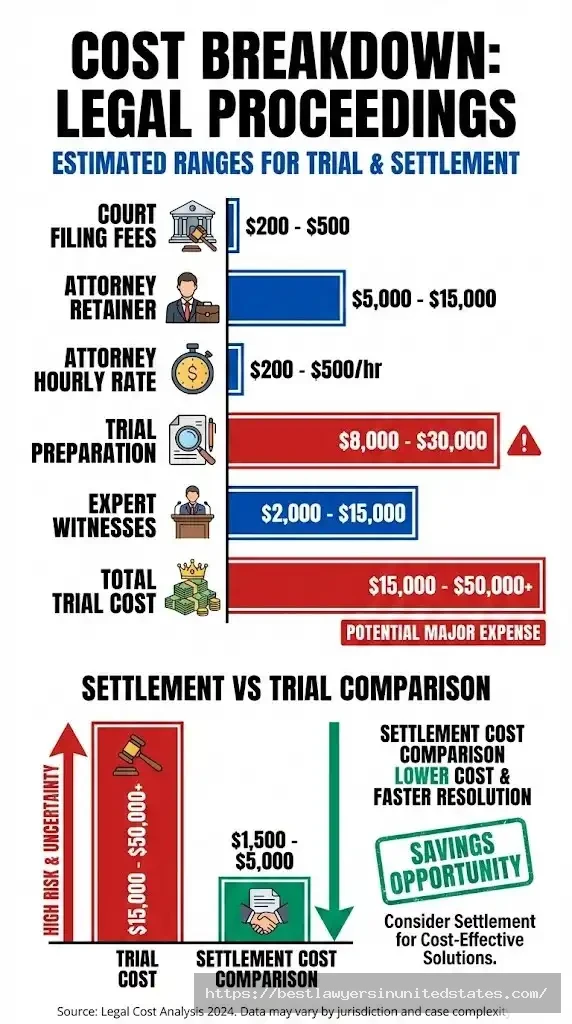
- Cost: Trials typically cost $15,000 to $50,000+ in attorney fees
- Time: Preparation takes months, trials can span weeks
- Uncertainty: You lose control over the outcome
- Privacy: Trials become public record
- Relationships: Adversarial process damages co-parenting
The discovery process often reveals information that makes both sides more willing to compromise. When you understand the strengths and weaknesses of your case, settlement becomes more attractive than gambling on a judge’s decision.
Understanding Divorce Trials: Bench Trial vs Jury Trial
Quick Answer: Almost all divorce trials are bench trials, where a judge alone decides your case. Only Texas and Georgia allow jury trials in divorce cases, and even then, juries cannot decide every issue.
Bench Trials Are Standard
A bench trial means the judge hears all evidence, evaluates witness credibility, and makes final decisions on all disputed issues. You present your case directly to the judge without a jury panel. The judge applies state law to the facts of your case and issues a written ruling called a divorce decree or judgment.
Judges in family law cases typically have significant experience with divorce issues. They understand property division rules, child support guidelines, and custody factors. Most family law attorneys prefer bench trials because judges focus on legal standards rather than emotional appeals.
Jury Trials in Divorce (Texas and Georgia Only)
Texas and Georgia allow either spouse to request a jury trial for certain divorce issues. However, juries have limits on what they can decide:
Texas Jury Limits:
- Cannot decide child support amounts
- Cannot set custody conditions
- Can decide property division and fault grounds
- Requires 6-person jury in family court
Georgia Jury Limits:
- Can decide grounds for divorce
- Can decide alimony eligibility
- Judge still determines amounts and custody
Even in these states, most divorces proceed as bench trials. Jury trials cost significantly more and take longer to complete.
Divorce Trial Preparation Timeline
Proper preparation can make the difference between winning and losing your case. Attorneys dedicate themselves exclusively to trial work during the final weeks before trial. You should do the same if you want to perform well.
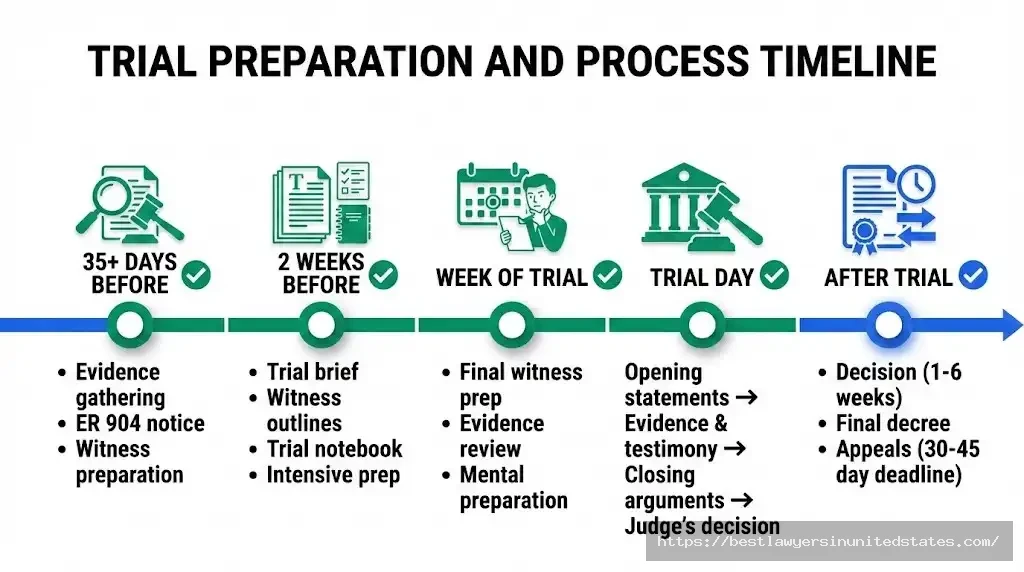
35+ Days Before Trial: Early Preparation
Start identifying your witnesses and exhibits at least 35 days before your trial date. Early preparation gives you time to gather evidence, locate witnesses, and build a strong case.
Critical Early Steps:
Evidence Rule 904 Notice (30 Days Before): Submit your intended exhibits to your spouse 30 days before trial. Any documents on this list become automatically admissible unless your spouse objects within 14 days. This shortcut helps you get bank statements, bills, text messages, and other documents admitted without complicated foundation requirements at trial.
Witness Arrangements: Contact all witnesses who will testify on your behalf. Ask them to appear in person at trial. Telephonic or video testimony is rarely allowed except in extreme circumstances. If a witness might not appear voluntarily, serve them with a subpoena to compel attendance.
Document Organization: Gather all financial records, communication evidence, photos, medical records, and other documents that support your position. Number each exhibit and organize them in the order you plan to introduce them.
Two Weeks Before Trial: Intensive Preparation
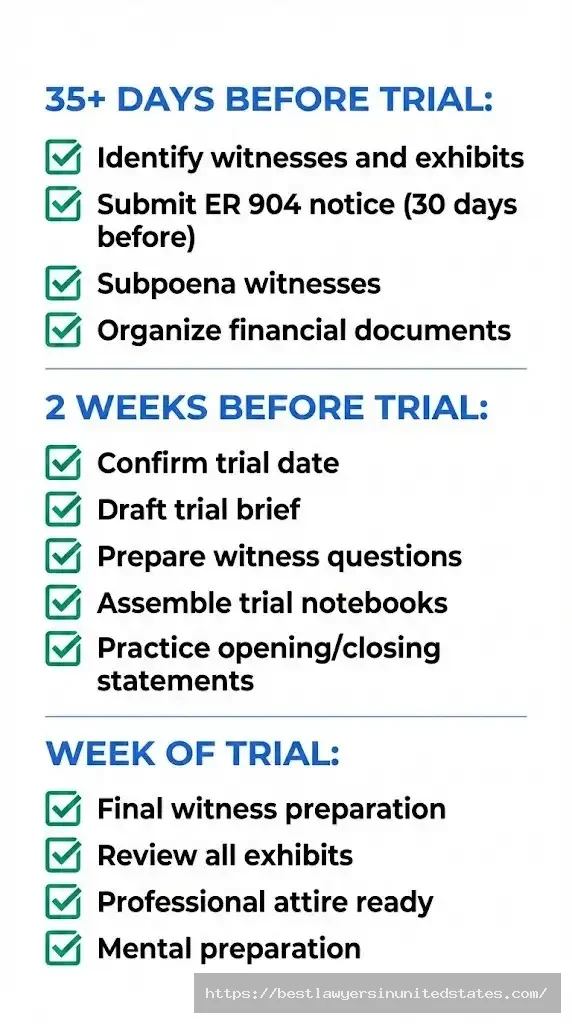
The two-week period before trial requires your full attention. This is when you draft everything you plan to say and do at trial.
Trial Confirmation
Many courts require you to “confirm” your trial date about two weeks in advance. Failure to confirm can result in your trial date being canceled or your case being dismissed entirely. Check your local court rules or contact the family law facilitator to learn confirmation requirements in your county.
Trial Brief and Documents
Your trial brief is a written document that tells the judge your position, the relevant facts, and applicable law. It typically includes:
- Summary of disputed issues
- Statement of facts from your perspective
- Legal arguments supporting your position
- Proposed parenting plan (if custody is disputed)
- Child support worksheets (if support is disputed)
- Financial declaration
- Asset and debt spreadsheet
Attach your proposed orders as exhibits to your trial brief. The judge reviews these documents before trial to understand your case.
Witness Preparation Outlines
Draft detailed outlines of questions you will ask each witness. Practice with your witnesses so you know exactly what they will answer. Never ask a question at trial unless you already know the answer.
Direct Examination Guidelines:
- Start with background questions
- Build chronologically through events
- Use open-ended questions (who, what, when, where, why, how)
- Avoid leading questions that suggest the answer
- Introduce exhibits through witness testimony
- Stay organized with numbered exhibits
Cross Examination Strategy:
- Use only leading questions
- Never ask a question unless you can prove the answer
- Keep questions short and focused
- Use documents to impeach false testimony
- Don’t argue with witnesses
Opening and Closing Statements
Draft bullet-point outlines for your opening statement and closing argument. Opening statements explain what your case is about and what evidence you will present. You cannot argue or construe facts during opening statements.
Closing arguments let you explain why you should win based on the evidence presented. Practice your statements enough that you can deliver them while looking at the judge rather than reading from notes.
Trial Notebook Assembly
Create four identical trial notebooks (one for opposing party, one working copy for judge, one original for court clerk, one for yourself). Each notebook should include:
- Table of contents
- Trial brief with attachments
- Any pretrial motions
- Numbered exhibit list
- All exhibits organized with tabs
Use three-ring binders with hole-punched documents and tabbed exhibit dividers. Judges appreciate organized presentations.
Week of Trial: Final Preparations
Witness Final Prep: Meet with each witness one final time. Review their testimony and remind them of courtroom procedures. Tell them to answer only the question asked, to speak clearly, and to tell the truth.
Evidence Review: Review all exhibits one final time. Make sure you have originals or certified copies where required. Organize exhibits in the exact order you plan to introduce them.
Mental Preparation: Get adequate sleep before trial. Trials are mentally exhausting and require sharp focus. Prepare professional courtroom attire. Plan to arrive 30 minutes early on trial day.
The Discovery Process Before Trial
Discovery is the legal process for gathering information from your spouse before trial. It ensures both sides can prepare their cases with access to relevant evidence.
Mandatory Financial Disclosures
Most states require both spouses to exchange detailed financial information early in the divorce process. These mandatory disclosures typically include:
- Complete income documentation (pay stubs, tax returns, W-2s)
- Bank account statements (all accounts, past 3-12 months)
- Retirement account statements
- Investment and brokerage account statements
- Credit card statements
- Debt documentation
- Real estate appraisals
- Business financial records (if applicable)
You must sign these disclosures under oath, certifying the information is complete and accurate. Filing false disclosures can result in sanctions or an adverse court ruling.
Discovery Tools and Methods
When mandatory disclosures don’t provide enough information, you can use formal discovery methods:
| Discovery Method | What It Does | Timeline |
|---|---|---|
| Interrogatories | Written questions answered under oath | 30 days to respond |
| Document Requests | Demand for specific financial records | 30 days to produce |
| Depositions | Recorded testimony under oath | Scheduled by agreement |
| Subpoenas | Demand documents from third parties | Varies by jurisdiction |
| Expert Evaluations | Professional assessments of custody/assets | 60-120 days typical |
Common Expert Witnesses in Divorce Trials
Expert witnesses provide specialized knowledge that helps judges make informed decisions:
Custody Evaluators: Licensed mental health professionals who assess parenting capabilities and recommend custody arrangements. They interview parents, observe parent-child interactions, review records, and may conduct psychological testing. Their reports carry significant weight in custody disputes.
Forensic Accountants: Financial experts who trace hidden assets, value businesses, analyze income, and identify financial misconduct. They’re essential in high-asset divorces or when you suspect your spouse is hiding money.
Real Estate Appraisers: Licensed professionals who determine fair market value of marital real property. Accurate valuations ensure equitable property division.
Vocational Evaluators: Experts who assess a spouse’s earning capacity and employability. Courts use these evaluations when deciding spousal support amounts and duration.
Discovery Deadlines and Local Rules
Discovery deadlines vary significantly by jurisdiction. Some counties require all discovery to be completed 30 days before trial. Others allow discovery up to the trial date. Check your local court rules or scheduling order for specific deadlines.
Failure to respond to discovery requests can result in court sanctions, including:
- Orders compelling responses
- Monetary penalties
- Exclusion of evidence at trial
- Default judgment against you
What Happens at a Divorce Trial? Step-by-Step Process
Understanding the trial process helps reduce anxiety and improves your preparation. Trials follow a predictable sequence of events.
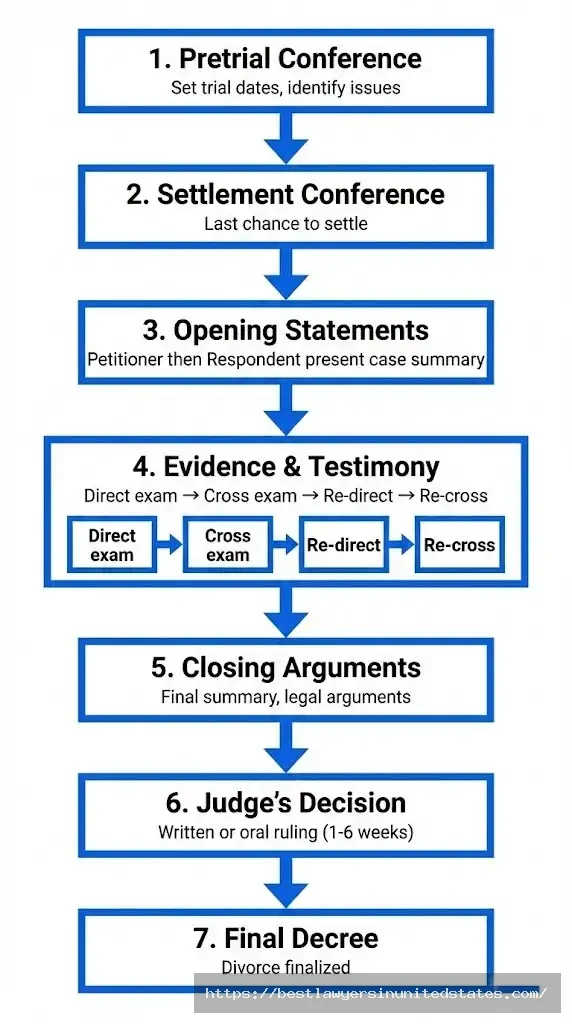
Pretrial Conference
About 2-4 weeks before trial, you’ll attend a pretrial conference with both parties, attorneys (if any), and the judge. This conference serves several purposes:
Trial Scheduling:
- Set exact trial dates and times
- Estimate how long trial will take
- Schedule settlement conferences
- Set deadlines for exhibit and witness disclosure
Issue Identification: The judge asks what issues remain disputed and what issues have been resolved. This helps focus the trial on actual disagreements rather than wasting time on settled matters.
Procedural Matters:
- Discuss whether opening statements will be given
- Determine order of witness testimony
- Resolve any pending motions
- Address evidentiary concerns
Settlement Conference (Last Chance to Settle)
Many jurisdictions require a mandatory settlement conference before trial. You meet with a different judge (not your trial judge) along with your spouse and attorneys. This judge facilitates settlement negotiations and helps identify potential compromises.
Settlement conferences work because:
- A neutral judge provides reality checks on your case strengths and weaknesses
- You avoid the cost and stress of trial
- You maintain control over the outcome
- Settlement conferences are confidential
- The settlement judge cannot communicate with your trial judge about what happens
If you reach an agreement during the settlement conference, you can put the terms on the record immediately and avoid trial entirely. Divorce mediation serves a similar purpose but typically happens earlier in the process.
Opening Statements
Opening statements are optional. Many family law attorneys agree to waive them in bench trials because the judge has already read your trial brief. When opening statements are given, they follow this format:
Petitioner (filing spouse) goes first:
- Explains what the case is about
- States what you’re asking the court to do
- Outlines the facts you will prove
- Identifies key witnesses and exhibits
- Sets a theme or story for the case
Respondent (other spouse) follows:
- Presents their version of events
- Explains why their position is reasonable
- Identifies contradictory evidence
- Challenges petitioner’s narrative
Critical Rules for Opening Statements:
- No arguing allowed (just state facts)
- Cannot discuss evidence not yet admitted
- Cannot make legal arguments
- Should be brief and focused
- Look at the judge, don’t read from notes
Presentation of Evidence and Testimony
This is the longest part of any trial. Each side presents witnesses and exhibits to prove their case.
How Witness Testimony Works
Petitioner’s Case: The petitioner calls witnesses first. For each witness:
- Direct Examination: Petitioner asks questions to elicit testimony supporting their case
- Cross Examination: Respondent asks questions to challenge credibility or get favorable testimony
- Re-direct: Petitioner can ask follow-up questions to clarify cross examination answers
- Re-cross: Respondent can ask additional questions about re-direct testimony
After all petitioner’s witnesses testify, the respondent presents their witnesses using the same process.
Introducing Exhibits Through Witnesses
You must introduce documents and other exhibits through witness testimony. The witness provides “foundation” by explaining what the document is and how they know about it.
Sample Script for Introducing Documents:
You: “Your Honor, I’m handing the witness what’s been marked as Exhibit 5.”
[Hand document to witness]
You to witness: “Do you recognize this document?”
Witness: “Yes.”
You: “What is it?”
Witness: “It’s a bank statement from our joint checking account for June 2025.”
You: “How do you recognize it?”
Witness: “I see my name on the account, and I remember these transactions.”
You: “Your Honor, I move to admit Exhibit 5 into evidence.”
Judge: [Rules on whether to admit]
Documents admitted through Evidence Rule 904 (submitted 30 days in advance) skip this process and come in automatically if not objected to.
Common Objections During Testimony
Hearsay: “Objection, hearsay” means the witness is testifying about what someone else said rather than their own first-hand knowledge. Hearsay is generally not allowed unless an exception applies.
Foundation: “Objection, lack of foundation” means the witness hasn’t established sufficient personal knowledge to testify about a document or event.
Leading Question: “Objection, leading” means a question on direct examination suggests the answer to the witness.
Argumentative: “Objection, argumentative” means the attorney is arguing with the witness rather than asking legitimate questions.
When the judge says “sustained,” they agree with the objection and the testimony or question is disallowed. When the judge says “overruled” or “denied,” they disagree with the objection and the testimony or question is allowed.
Closing Arguments
After all witnesses have testified and all evidence has been presented, each side delivers closing arguments. Unlike opening statements, closing arguments allow you to argue why you should win.
What to Include in Closing Arguments:
Reference Specific Evidence: Point to exact testimony and exhibits that support your position. Remind the judge of key facts that came out during trial.
Apply Law to Facts: Explain how the evidence proves you meet the legal standards for what you’re requesting. For example, if seeking primary custody, explain how the evidence shows your proposed arrangement serves the child’s best interests.
Address Weaknesses: Acknowledge weak points in your case before your spouse emphasizes them. Explain why they don’t undermine your overall position.
Make It Memorable: Return to your theme or story from opening statements. The judge should be able to summarize your case in one clear sentence after closing arguments.
Speaking Tips:
- Speak slowly so the judge can take notes
- Make eye contact with the judge
- Use an outline, don’t read word-for-word
- Stay professional and unemotional
- Focus on facts, not personal attacks
Petitioner argues first, respondent responds, and petitioner gets a brief final rebuttal.
Judge’s Decision
After closing arguments, the judge typically takes the case under advisement. This means the judge needs time to review all evidence and draft a decision. Decisions can come in two forms:
Oral Decision: The judge schedules another court date (usually 1-4 weeks later) and reads the decision aloud in court. A court reporter transcribes the oral decision. Either party can order a written transcript.
Written Memorandum Decision: The judge prepares a detailed written decision and sends it to both parties. This usually takes 2-6 weeks depending on case complexity and the judge’s calendar.
The decision resolves all disputed issues and includes:
- Findings of fact (what the judge believes happened)
- Conclusions of law (how the law applies)
- Orders (what each party must do)
- Custody and parenting time schedule
- Child support amounts
- Spousal support terms
- Property and debt division
How Long Does a Divorce Trial Take?
Quick Answer: Simple divorce trials take 3-8 hours and can finish in one day. Complex trials involving custody disputes, business valuations, or significant assets can take 3-5 days spread over several weeks or months.
Factors Affecting Trial Length
| Factor | Impact on Duration |
|---|---|
| Number of Disputed Issues | Each issue requires evidence and testimony |
| Complexity of Assets | Business valuations and complex property add time |
| Custody Disputes | Evaluators, witnesses, and detailed testimony needed |
| Number of Witnesses | Each witness requires direct, cross, re-direct, re-cross |
| Expert Witnesses | Experts often testify for several hours |
| Attorney Experience | Inexperienced attorneys waste time |
| Judge’s Schedule | Continuations spread trial over months |
Trial Duration by Case Type
Uncontested Divorce: No trial needed. The steps of an uncontested divorce typically involve a brief final hearing of 10-15 minutes for the judge to review your settlement agreement.
Simple Contested Divorce: One or two disputed issues, straightforward finances, no custody dispute. Trial typically lasts 4-6 hours in one day.
Moderate Complexity: Multiple disputed issues, children involved, moderate assets. Trial usually takes 2-3 days spread over 2-4 weeks.
High Complexity: Business ownership, hidden assets, custody evaluation, expert witnesses. Trial can take 5+ days spread over several months.
Trial vs Settlement Timeline Comparison
| Timeline Stage | Settlement Path | Trial Path |
|---|---|---|
| Filing to Final | 3-6 months typical | 12-24+ months typical |
| Discovery | Minimal, voluntary exchange | Extensive, formal requests |
| Preparation | Draft settlement terms | 40-100+ hours trial prep |
| Final Resolution | Sign agreement, brief hearing | Multi-day trial + waiting for decision |
| Total Cost | $1,500-$5,000 typical | $15,000-$50,000+ typical |
Divorce Trial Cost Breakdown
Divorce trials are expensive. Understanding where money goes helps you make informed decisions about settlement versus trial.
Average Divorce Trial Costs
Quick Answer: Expect to spend $15,000 to $50,000+ on a divorce trial, depending on complexity. Simple trials with few contested issues cost less; complex trials involving businesses, custody evaluations, and expert witnesses can exceed $100,000.
| Cost Component | Low End | High End | Notes |
|---|---|---|---|
| Court Filing Fees | $200 | $500 | Initial petition filing |
| Attorney Retainer | $5,000 | $15,000 | Upfront deposit |
| Attorney Hourly Rate | $200/hr | $500+/hr | Varies by location and experience |
| Trial Preparation | $8,000 | $30,000 | 40-100+ hours |
| Trial Time | $1,600 | $10,000 | 8-20+ hours in court |
| Expert Witnesses | $2,000 | $15,000 | Evaluators, appraisers, accountants |
| Depositions | $500 | $5,000 | Per deposition |
| Court Reporter | $300 | $2,000 | Transcripts |
| Discovery Costs | $500 | $5,000 | Document production, copying |
| Total | $15,000 | $50,000+ | Can exceed $100,000 |
Use our divorce cost calculator to estimate your total trial expenses based on your specific situation.
Divorce Cost Calculator
Get an estimated cost for your divorce based on your specific situation
Your Estimated Divorce Cost
Cost Breakdown
📧 Get a Personalized Consultation
Have questions about your specific situation? Contact our legal experts for guidance tailored to your needs.
Contact Us via EmailAttorney Fees for Divorce Trials
Divorce attorney fees vary widely based on location, experience, and case complexity. Most attorneys charge hourly rates for contested cases that go to trial.
Typical Attorney Time Requirements:
Pre-Trial Work (40-100 hours):
- Discovery drafting and responses: 10-20 hours
- Deposition preparation and attendance: 10-30 hours
- Trial brief research and writing: 10-20 hours
- Witness preparation: 5-10 hours
- Exhibit organization: 5-10 hours
- Pretrial motions and conferences: 5-10 hours
Trial Time (8-40 hours):
- Opening statements: 1-2 hours
- Direct examination: 2-10 hours
- Cross examination: 2-10 hours
- Closing arguments: 1-2 hours
- Multi-day trials multiply these hours
Post-Trial Work (5-15 hours):
- Reviewing decision
- Drafting final orders
- Post-trial motions if needed
At $300/hour, a moderate trial requiring 70 total attorney hours costs $21,000 in legal fees alone.
Expert Witness Costs
Expert witnesses charge for their time evaluating your case and testifying:
Custody Evaluator Fees:
- Initial evaluation: $2,500-$7,500
- Court testimony: $200-$400/hour
- Report preparation: $500-$2,000
Forensic Accountant Fees:
- Asset search and analysis: $3,000-$10,000
- Business valuation: $5,000-$20,000
- Trial testimony: $300-$500/hour
Real Estate Appraiser Fees:
- Property appraisal: $400-$800
- Trial testimony: $200-$400/hour
Vocational Evaluator Fees:
- Earning capacity evaluation: $1,500-$4,000
- Trial testimony: $200-$350/hour
Trial vs Settlement Cost Comparison
| Cost Factor | Settlement | Trial |
|---|---|---|
| Attorney Fees | $1,500-$5,000 | $15,000-$50,000+ |
| Expert Witnesses | $0-$2,000 | $2,000-$15,000+ |
| Total Time | 3-6 months | 12-24+ months |
| Emotional Cost | Lower stress | High stress |
| Control | You decide terms | Judge decides |
| Privacy | Private agreement | Public record |
Even a “cheap” divorce trial costs significantly more than settlement. Consider whether the issues at stake justify the expense and emotional toll.
Questions about divorce costs? Use our divorce cost calculator or contact divorce attorneys for a free consultation at [email protected].
Divorce Trial Without a Lawyer (Pro Se Representation)
Representing yourself in a divorce trial is legally allowed but challenging. Courts hold pro se litigants to the same standards as licensed attorneys.
When Self-Representation Might Work
Best Case Scenarios:
- Very limited disputed issues (one or two items)
- Straightforward finances with no business ownership
- No child custody disputes
- Both parties have similar access to information
- Low total marital assets (under $50,000)
- No hidden asset concerns
- You have strong organizational skills
- You can remain calm under pressure
Risks of Going Pro Se in Trial
Common Pro Se Mistakes:
Evidence Problems:
- Failing to establish proper foundation for documents
- Violating hearsay rules
- Missing discovery deadlines
- Not knowing how to object to improper evidence
Procedural Errors:
- Missing trial confirmation deadlines
- Failing to follow local court rules
- Improper witness preparation
- Inadequate trial brief preparation
Strategic Weaknesses:
- Not recognizing beneficial settlement opportunities
- Asking dangerous questions on cross examination
- Missing legal arguments that could help your case
- Emotional reactions that hurt credibility
Critical Point: If your spouse has an attorney and you don’t, you face a significant disadvantage. Experienced attorneys know how to present evidence, make effective objections, and argue legal points. You’re competing against someone with years of training and experience.
How to Prepare Without an Attorney
If you proceed pro se despite the risks, take these steps:
Use Court Resources:
- Family law facilitator ($10 per session)
- Law library resources and librarians
- Court self-help centers
- Free legal aid organizations
- Online legal research tools
Study Evidence Rules:
- Learn hearsay exceptions
- Understand foundation requirements
- Know when objections are appropriate
- Review your state’s rules of evidence
Practice Extensively:
- Rehearse your direct examination questions
- Practice introducing exhibits
- Prepare opening and closing statements
- Conduct mock cross examinations
Get Limited Scope Help: Unbundled legal services let you hire an attorney for specific tasks like reviewing your trial brief, coaching you on trial strategy, or appearing only for the trial itself. This costs far less than full representation while providing critical expertise.
Resources for Pro Se Litigants
Many state courts provide resources specifically for self-represented parties:
- Template trial briefs and motions
- Instructional videos on trial procedures
- Sample direct and cross examination scripts
- Evidence foundation checklists
- Local court rule summaries
- Pro se trial preparation workshops
Contact your county’s family law facilitator or self-help center to learn what resources are available.
Evidence and Exhibits in Divorce Trials
Properly presenting evidence can determine whether you win or lose at trial. Understanding evidence rules gives you a significant advantage.
Evidence Rule 904 Automatic Admission Strategy
ER 904 is your secret weapon for getting documents admitted without complex foundation requirements. This evidence rule allows you to propose exhibits 30 days before trial, and they become automatically admissible unless your spouse objects within 14 days.
How ER 904 Works:
- Create exhibit list: Number all documents you want to introduce at trial
- Serve your spouse: Deliver the list and copies of exhibits at least 30 days before trial
- Wait 14 days: Your spouse has 14 days to object to any exhibits
- Automatic admission: Any exhibits not objected to come into evidence automatically
Documents Perfect for ER 904:
- Bank statements and financial records
- Credit card statements
- Bills and invoices
- Text messages and emails
- Medical records
- Police reports
- Photos and videos
- Employment records
This strategy is especially valuable for pro se litigants who might struggle with foundation requirements at trial. Submit everything through ER 904 to avoid complicated authentication procedures.
Important: Have the person who served the ER 904 notice testify at trial to confirm they served it timely. Save your proof of service documentation.
Types of Evidence in Divorce Trials
Courts accept various types of evidence to prove your case:
| Evidence Type | Examples | Foundation Required |
|---|---|---|
| Financial Documents | Bank statements, tax returns, pay stubs | Yes, unless ER 904 |
| Communication Records | Texts, emails, social media posts | Yes, authentication needed |
| Photos/Videos | Custody evidence, property condition | Yes, date and context |
| Medical Records | Health issues, therapy records | Yes, certified copies |
| Official Records | Police reports, court orders | Yes, certified/stamped |
| Expert Reports | Evaluations, appraisals, assessments | Yes, expert must testify |
| Witness Testimony | Live testimony under oath | No documentary foundation |
How to Introduce Exhibits at Trial
When exhibits don’t come in through ER 904, you must establish foundation through witness testimony.
Step-by-Step Foundation Script:
Step 1 – Mark and Present: “Your Honor, I’m showing the witness what’s been pre-marked as Exhibit 12.” [Hand document to witness]
Step 2 – Recognition: “Do you recognize this document?” [Witness answers yes]
Step 3 – Identification: “What is it?” [Witness identifies the document]
Step 4 – Personal Knowledge: “How do you know what this document is?” [Witness explains their knowledge – they created it, received it, were present when it was made, etc.]
Step 5 – Relevance (if needed): “Does this document relate to [relevant issue in the case]?” [Witness explains relevance]
Step 6 – Move for Admission: “Your Honor, I move to admit Exhibit 12 into evidence.” [Judge rules on admission]
Common Evidence Objections
Hearsay: The witness is testifying about what someone else said rather than their own first-hand knowledge. Exception: You can testify about what your spouse said (admission of a party opponent).
Lack of Foundation: The witness hasn’t demonstrated sufficient personal knowledge about the document or event. Cure this by asking the witness how they know about the evidence.
Relevance: The evidence doesn’t relate to any disputed issue in your divorce. Explain briefly how it’s relevant to custody, property division, or another disputed matter.
Authentication: You haven’t proven the document is what you claim it is. Cure this through witness testimony about creating, receiving, or recognizing the document.
Best Evidence Rule: You’re offering a copy when the original is available and should be produced. Bring original documents when possible, especially for crucial evidence.
Witnesses in Divorce Trials
Witness testimony forms the foundation of most divorce trials. Choosing the right witnesses and preparing them properly strengthens your case.
Types of Witnesses
Your Own Testimony: You will testify about the marriage, finances, children, and disputed issues. This is your opportunity to tell your story directly to the judge. Prepare thoroughly because you’ll face cross examination from your spouse or their attorney.
Your Spouse’s Testimony: Your spouse will testify for their side. You can cross examine them about inconsistencies, financial issues, or parenting concerns. Never ask questions unless you can prove the answer with documents.
Lay Witnesses: Friends, family, neighbors, teachers, and others who have first-hand knowledge of relevant facts. These witnesses can testify about:
- Your parenting involvement and capabilities
- Your spouse’s conduct or parenting deficiencies
- Financial circumstances
- Events they personally witnessed
- Children’s relationships with each parent
Expert Witnesses: Professionals with specialized knowledge who provide opinions:
- Custody evaluators: Mental health professionals who assess parenting capabilities and recommend custody arrangements
- Forensic accountants: Financial experts who trace assets, value businesses, and analyze income
- Real estate appraisers: Licensed appraisers who determine property values
- Vocational evaluators: Experts who assess earning capacity for spousal support determinations
Guardian ad Litem: If appointed by the court, the GAL investigates and makes recommendations regarding the child’s best interests. They typically testify about their investigation findings and custody recommendations.
Witness Preparation Best Practices
Practice Questions and Answers: Meet with each witness before trial. Review the questions you’ll ask and ensure you know what answers they’ll give. Never ask a surprise question at trial.
Prepare for Cross Examination: Discuss what opposing counsel might ask on cross examination. Practice staying calm and answering only the question asked without volunteering extra information.
Courtroom Procedures: Explain basic courtroom rules:
- Answer only the question asked
- Say “I don’t know” or “I don’t remember” if uncertain
- Wait for the complete question before answering
- Speak clearly and loudly enough for the court reporter
- Remain calm even during hostile cross examination
- Tell the truth always
What to Wear and Bring: Professional, conservative attire. Bring any documents the witness might need to reference during testimony. Arrive early and wait in the hallway until called.
Subpoenas for Uncooperative Witnesses: If a witness might not appear voluntarily, serve them with a trial subpoena. The subpoena legally requires attendance and subjects the witness to potential arrest for non-appearance.
Geographic Limits: Subpoenas cannot force witnesses to travel long distances. Check your state’s rules for subpoena geographic limitations (typically 100-150 miles from the courthouse).
Children as Witnesses
Courts strongly discourage children testifying in divorce trials. Requiring children to choose between parents or testify against a parent is considered “putting the children in the middle.” This can create a presumption you’re acting against the child’s best interests.
When Judges Allow Child Testimony:
- Older teenagers with strong preferences (age 14+)
- Child abuse allegations requiring the child’s direct testimony
- Special circumstances where no other evidence exists
Alternatives to Live Testimony:
- Judge interviews child in chambers (private office)
- Guardian ad Litem conveys child’s preferences
- Custody evaluator reports on child’s wishes
- Written statement submitted for review
Avoid calling your children as witnesses unless absolutely necessary and approved by the court.
Common Divorce Trial Mistakes to Avoid
Learning from common mistakes helps you avoid costly errors at trial.
Evidence and Procedure Mistakes
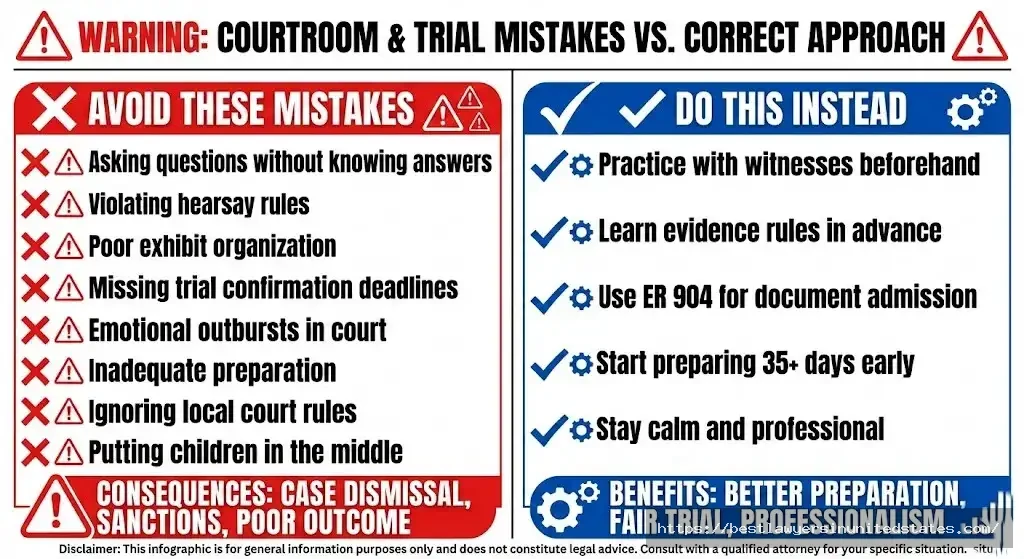
Asking Questions Without Knowing Answers: This is the cardinal rule of cross examination. Only ask questions when you can prove the answer with a reliable document. Otherwise, you risk getting unexpected answers that hurt your case.
Violating the Hearsay Rule: Trying to introduce out-of-court statements without a proper exception. Know the hearsay rules and exceptions before trial.
Failing to Establish Foundation: Attempting to introduce documents without showing the witness has sufficient personal knowledge. Practice the foundation script until it becomes automatic.
Poor Exhibit Organization: Disorganized exhibits waste the judge’s time and make you look unprepared. Number exhibits clearly, create tabs, and organize them in presentation order.
Missing Deadlines: Forgetting to confirm trial, missing discovery deadlines, or failing to submit required pretrial documents can result in sanctions or case dismissal.
Inadequate Preparation: Winging it at trial never works. Dedicate the final two weeks before trial to intensive preparation.
Courtroom Behavior Mistakes
Emotional Outbursts: Crying, yelling, or showing anger damages your credibility. Judges want calm, rational parties. Practice emotional control before trial.
Arguing With the Judge: Never argue with the judge’s rulings. You can politely ask for reconsideration or clarification, but accept rulings gracefully.
Interrupting: Don’t interrupt your spouse, opposing counsel, or the judge. Wait your turn to speak.
Hostile Cross Examination: Aggressive or argumentative questioning backfires. Stay professional and focused on facts, not personal attacks.
Disrespecting Your Spouse: Insulting or badmouthing your spouse hurts your credibility. Present facts professionally without personal attacks.
Strategic Mistakes
Ignoring Local Court Rules: Each county has specific local rules governing trial procedures. Failure to follow local rules can result in your evidence being excluded or your case being dismissed.
Not Recognizing Settlement Opportunities: Sometimes the best outcome is a negotiated settlement even during trial. Stay open to reasonable compromise.
Focusing on “Winning” Rather Than Best Outcome: Divorce isn’t about beating your spouse. Focus on achieving a fair outcome that serves your children’s needs and your future wellbeing.
Putting Children in the Middle: Never use children as messengers, spies, or witnesses against the other parent unless absolutely necessary. Courts view this extremely negatively.
Unrealistic Expectations: Expecting the judge to award you everything you want is unrealistic. Judges apply legal standards, not emotional preferences.
Trial vs Settlement: Making the Right Decision
Deciding whether to settle or proceed to trial is one of the most important choices in your divorce. Consider all factors before committing to trial.
Pros and Cons of Going to Trial
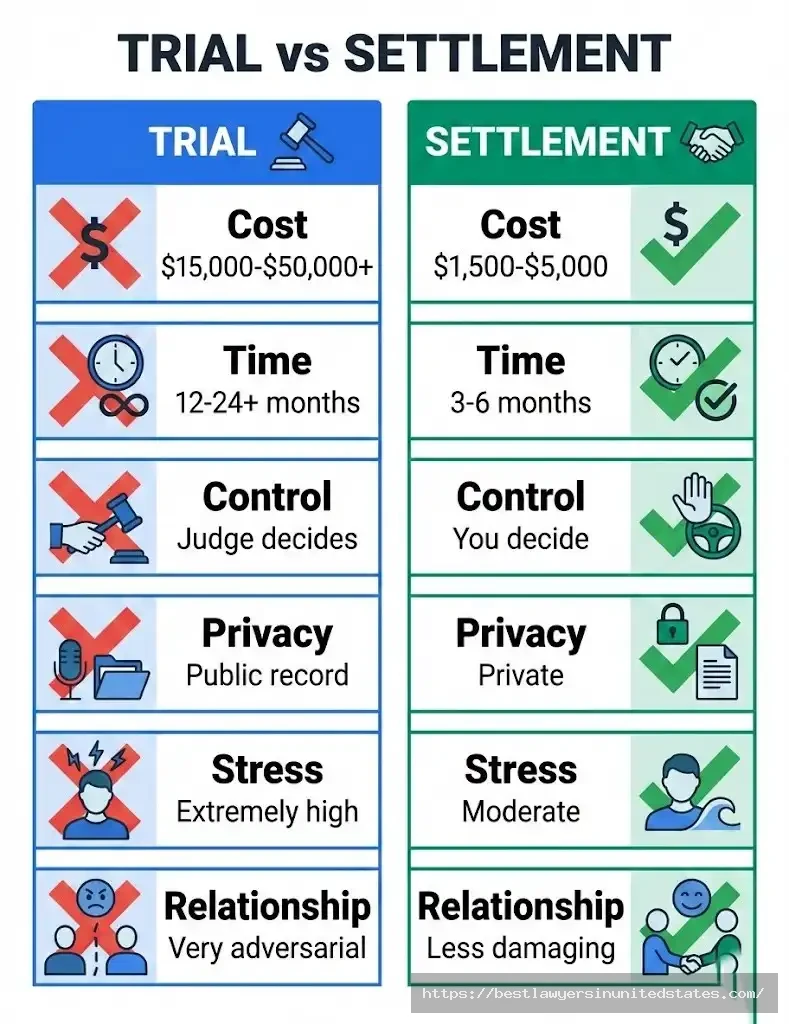
| Factor | Trial | Settlement |
|---|---|---|
| Cost | $15,000-$50,000+ | $1,500-$5,000 |
| Time | 12-24+ months | 3-6 months |
| Control | Judge decides | You decide |
| Outcome Certainty | Unpredictable | Known in advance |
| Privacy | Public record | Private |
| Relationship Impact | Very adversarial | Less damaging |
| Stress Level | Extremely high | Moderate |
| Finality | Can appeal | Final when signed |
When Settlement Makes More Sense
Strong Settlement Scenarios:
- You can live with a compromise outcome
- Children’s wellbeing matters more than “winning”
- Preserving a co-parenting relationship is important
- Legal costs could consume your marital assets
- Your case has significant weaknesses
- You want privacy and confidentiality
- Faster resolution benefits you financially
Settlement Methods:
- Direct negotiation through attorneys
- Divorce mediation with a neutral third party
- Collaborative divorce process
- Mandatory settlement conferences before trial
When Trial May Be Necessary
Trial Scenarios:
- Your spouse refuses reasonable settlement offers
- Domestic violence or safety concerns exist
- Your spouse is hiding assets or income
- Extreme custody disputes where child safety is at stake
- Your spouse won’t engage in good-faith negotiations
- Settlement offers are completely unreasonable
Cost Comparison: Trial vs Mediation
Mediation costs a fraction of trial expenses while still addressing all divorce issues:
| Service | Trial Cost | Mediation Cost |
|---|---|---|
| Professional Fees | $15,000-$50,000 attorney | $2,000-$5,000 mediator |
| Duration | 12-24+ months | 2-4 months |
| Sessions Required | Multiple court appearances | 3-8 mediation sessions |
| Expert Fees | $5,000-$15,000 | $0-$2,000 |
| Court Costs | $500-$2,000 | $200-$500 filing only |
Even if mediation requires each spouse to hire a consulting attorney for advice, total costs typically stay well below trial expenses.
Privacy Considerations
Trial Privacy: Trials are public proceedings. Anyone can attend and view filed documents (with few exceptions). Your financial information, custody disputes, and personal matters become public record.
Settlement Privacy: Negotiated agreements remain private. Only the final divorce decree is filed publicly, and it typically contains minimal detail compared to trial transcripts and evidence.
Emotional Toll
The adversarial nature of trials creates lasting damage to relationships. This matters especially when you need to co-parent children for years after divorce.
Trial Impact:
- Highly confrontational process
- Witnesses may testify about personal matters
- Cross examination can feel like personal attacks
- Extended stress over many months
- Damaged communication between spouses
Settlement Impact:
- Requires cooperation and compromise
- Less confrontational environment
- Preserves some relationship functionality
- Faster stress resolution
- Easier transition to post-divorce co-parenting
Consider whether the issues at stake justify the financial and emotional costs of trial. Sometimes accepting an imperfect settlement preserves resources for your post-divorce life.
Questions about whether to settle or go to trial? Contact divorce attorneys for consultation at [email protected].
Virtual and Remote Divorce Trials
Many courts adopted virtual trial capabilities during COVID-19 and continue offering remote proceedings in 2026.
Courts Allowing Remote Trials
Virtual trial availability varies by jurisdiction. Some courts allow fully remote trials, others use hybrid formats, and some require in-person attendance.
Typical Remote Trial Policies:
- Pretrial conferences often conducted virtually
- Settlement conferences commonly held remotely
- Full trials may require in-person attendance
- Certain witness testimony allowed remotely
- Emergency hearings frequently held virtually
Check your local court’s website or contact the clerk’s office to learn current virtual trial policies.
Technology Requirements
Equipment Needed:
- Computer, tablet, or smartphone with camera
- Stable internet connection (minimum 10 Mbps recommended)
- Microphone and speakers (headphones recommended)
- Quiet, well-lit location
- Neutral background
Platform Familiarity: Courts typically use Zoom, Microsoft Teams, or specialized court platforms. Practice with the technology before your court appearance.
Virtual Hearing Etiquette
Professional Standards:
- Dress professionally from head to toe
- Position camera at eye level
- Use plain background without distractions
- Ensure good lighting on your face
- Test audio and video before joining
Participation Rules:
- Stay muted when not speaking
- Don’t interrupt other speakers
- Look at the camera when speaking (not the screen)
- Minimize off-screen distractions
- Have documents ready to screen share if needed
Common Mistakes to Avoid:
- Forgetting you’re visible and on the record
- Eating, drinking, or smoking on camera
- Having other people visible in your background
- Using virtual backgrounds (courts usually prohibit these)
- Technical difficulties from poor internet connections
Benefits and Limitations of Virtual Trials
Benefits:
- No travel to courthouse
- Lower costs (no parking, time off work)
- Easier witness participation from distant locations
- Recorded proceedings for review
- More comfortable environment
Limitations:
- Technical difficulties can delay proceedings
- Harder to read judge’s reactions
- Document presentation more complicated
- Less personal connection with the court
- Some witnesses seem less credible virtually
Virtual trials work well for straightforward matters but may disadvantage parties in complex cases requiring detailed exhibit presentation.
After the Divorce Trial
The trial ends when closing arguments conclude, but several steps remain before your divorce is truly final.
The Divorce Decree
The judge reviews all evidence and testimony before preparing a written decision. This decision becomes your divorce decree (also called divorce judgment) once signed and filed.
What the Decree Includes:
- Findings of fact (what the judge determined happened)
- Conclusions of law (how the law applies to your case)
- Parenting plan and custody orders (if applicable)
- Child support amounts and payment terms
- Spousal support/alimony orders
- Property division specifics
- Debt allocation
- Attorney fee awards (if any)
- Effective date of divorce
Timeline for Decision:
- Oral decisions: 1-4 weeks after trial, delivered in court
- Written decisions: 2-6 weeks after trial, mailed to parties
Drafting Final Orders: After the judge issues a decision, the prevailing party typically drafts the formal orders implementing the decision. These orders must match the judge’s ruling exactly.
Both parties review the proposed orders. If you disagree with how the prevailing party worded the orders, you can request changes or schedule a presentation hearing where the judge resolves drafting disputes.
Appeals Process
Either spouse can appeal the trial court’s decision if they believe the judge made significant legal errors.
Important Appeal Limitations:
- Appeals review errors of law, not factual disputes
- Appellate courts don’t re-try your case
- You cannot present new evidence on appeal
- Appeals are expensive and time-consuming
- Success rates are low (most trial decisions are affirmed)
Common Grounds for Appeal:
Error of Law: The trial judge misinterpreted or misapplied a statute. For example, using the wrong property division standard or miscalculating child support.
Abuse of Discretion: The judge’s decision was so unreasonable given the facts that it constitutes an abuse of discretion. This is a very high standard to meet.
Procedural Errors: The trial court violated your procedural rights, such as refusing to let you present relevant evidence or failing to follow required procedures.
Appeal Deadlines: Most jurisdictions require filing a notice of appeal within 30-45 days after entry of the final judgment. Missing this deadline forfeits your appeal rights forever.
Appeal Costs: Appeals typically cost $10,000-$30,000 in additional attorney fees. The appellate court can affirm (uphold) the decision, reverse it, or remand (send it back) to the trial court with instructions.
Post-Trial Modifications
Unlike appeals, modification requests assert that circumstances have changed since the trial court’s decision, justifying a change to existing orders.
What Can Be Modified:
Child Support: Child support can be modified when income significantly changes, the child’s needs change, or parenting time shifts substantially. Most states allow modification when support would change by 10-20% or more.
Use our child support calculator to estimate how changed circumstances might affect your support obligation.
Child Support Calculator
Calculate child support estimates based on your state’s guidelines. Get accurate payment amounts using income shares model calculations.
Enter Your Information
Provide income, custody, and children details
Estimated Monthly Child Support
📍 State Child Support Guidelines
Information about this state’s child support calculation method will appear here.
📊 Calculation Breakdown
| Component | Value |
|---|
Custody and Parenting Time: Custody modifications require showing either:
- Material change in circumstances affecting the child, AND
- Modification serves the child's best interests
Examples include parental relocation, changes in the child's needs, or parental misconduct.
Alimony: Spousal support can often be modified based on:
- Recipient's remarriage or cohabitation
- Significant income changes for either party
- Disability or health changes
- Retirement at normal retirement age
Calculate potential alimony changes with our alimony calculator.
Alimony Calculator
Estimate spousal support payments based on your state's guidelines. Get monthly payment amounts, duration estimates, and total alimony calculations.
Enter Your Information
Provide details about income, marriage, and circumstances
Estimated Monthly Alimony Payment
📍 State Alimony Guidelines
Information about this state's alimony approach will appear here.
📊 Calculation Breakdown
| Component | Value |
|---|
What Cannot Be Modified:
Property Division: Except for errors or fraud, property division is generally final and cannot be modified later. The time to dispute property division is through appeal, not modification.
Modification Process: File a motion to modify with the court, serve your ex-spouse, and schedule a hearing. You bear the burden of proving that changed circumstances justify the modification.
State-Specific Divorce Trial Procedures
Trial procedures vary significantly by state and even by county within states. Understanding your local rules prevents costly mistakes.
Local Court Rules and Variations
Each county maintains local court rules governing trial procedures. These rules address:
Trial Assignment:
- How cases are assigned to judges
- Trial confirmation requirements and deadlines
- Trial setting preferences
- Continuance policies
Discovery:
- Mandatory disclosure requirements
- Discovery cutoff dates
- Deposition procedures
- Expert witness disclosure deadlines
Pretrial Procedures:
- Settlement conference requirements
- Pretrial statement formats and deadlines
- Witness and exhibit disclosure requirements
- Pretrial motion deadlines
Trial Procedures:
- Time limits for trials
- Opening statement expectations
- Exhibit marking conventions
- Closing argument formats
Find Your Local Rules: Search "[County Name] Superior Court Local Rules" or "[County Name] Family Court Rules" to find applicable rules. County law libraries and family law facilitators can help you interpret local requirements.
Family Court vs Superior Court
Court structures vary by state:
States with Specialized Family Courts:
- Dedicated judges handling only family law matters
- Streamlined procedures for domestic cases
- Family law facilitators and self-help centers
- Mediation programs integrated into court system
States Using General Jurisdiction Courts:
- Divorce cases heard in superior court, circuit court, or court of common pleas
- Cases often assigned to family law division within general court
- Judges rotate between family law and other civil cases
- Fewer specialized support services
Mandatory Settlement Conferences
Some jurisdictions require settlement conferences before trial:
States with Mandatory Conferences:
- California requires settlement conferences in most contested cases
- Washington requires settlement conferences in many counties
- Oregon mandates settlement conferences before trial setting
Conference Procedures:
- Meet with settlement judge (different from trial judge)
- Present settlement positions
- Judge facilitates negotiation
- Confidential discussions (cannot be used at trial)
Settling at the mandatory conference avoids trial entirely while still having judicial input on reasonable outcomes.
Virtual Trial Availability by State
Virtual trial policies differ significantly:
States with Broad Virtual Options:
- Many allow pretrial conferences and hearings virtually
- Some permit full trials remotely for uncontested matters
- Emergency hearings commonly conducted remotely
States Requiring In-Person Trials:
- Several states require in-person attendance for contested trials
- Final trial hearings often require physical presence
- Witness testimony may have mixed requirements
Check your specific county court's website for current virtual trial policies. These continue evolving in 2026.
Jury Trial States
Texas: Either spouse can request a jury trial. Jury decides property division and grounds for divorce. Judge decides custody, child support, and support amounts.
Georgia: Either spouse can request a jury trial. Jury decides grounds for divorce and alimony eligibility. Judge determines amounts and custody.
Jury trials in these states are rare but available. They cost significantly more and take longer than bench trials.
Frequently Asked Questions About Divorce Trials
How much does a divorce trial cost?
Quick Answer: Divorce trials typically cost $15,000 to $50,000+ depending on complexity, with some high-conflict cases exceeding $100,000.
Attorney fees make up the largest expense. Expect to pay $200-$500 per hour for 60-150 total attorney hours. Add $2,000-$15,000 for expert witnesses, $500-$2,000 for depositions, and various court costs. Simple trials with limited issues cost less, while complex trials involving business valuations, hidden assets, or custody evaluations cost significantly more.
How long does a divorce trial take?
Quick Answer: Simple trials last 3-8 hours (one day), moderate complexity trials take 2-3 days spread over several weeks, and complex trials can take 5+ days over several months.
The number of disputed issues, witness count, and case complexity determine trial length. Financial complexity, business ownership, and custody disputes extend trial duration. Most trials don't happen consecutively—they're spread across multiple court dates based on judge availability.
Can I represent myself at a divorce trial?
Quick Answer: Yes, you can represent yourself (pro se), but it's risky, especially if your spouse has an attorney.
Courts hold pro se litigants to the same evidence rules and procedures as licensed attorneys. Most people struggle with foundation requirements, objections, cross examination, and trial strategy without legal training. Consider limited scope representation where an attorney helps with specific trial tasks while you handle other parts yourself.
What questions are asked at a divorce trial?
Quick Answer: Questions focus on disputed issues like income and assets, parenting capabilities, marriage history, and reasons for positions you're taking.
You'll testify about your employment and earnings, bank accounts and financial records, property values and debts, parenting involvement and schedule preferences, and why your proposed arrangement serves everyone's best interests. Your spouse will be asked similar questions. Witnesses testify about what they personally observed regarding finances, parenting, or other relevant facts.
Can a divorce trial be postponed?
Quick Answer: Yes, trials can be continued (postponed) for good cause, but courts grant continuances reluctantly close to the trial date.
Valid reasons for continuances include serious illness, attorney conflicts, newly discovered evidence requiring additional preparation, or settlement negotiations showing promise. File a motion to continue well in advance with compelling reasons. Last-minute continuances are rarely granted and may require the party requesting continuation to pay the other side's wasted preparation costs.
Will there be a jury at my divorce trial?
Quick Answer: No jury in almost all states. Only Texas and Georgia allow jury trials in divorce, and even then juries cannot decide all issues.
Your divorce trial will be a bench trial where a judge alone hears evidence and makes all decisions. This is true in 48 states. In Texas and Georgia, either spouse can request a jury for limited issues (property division and fault grounds in Texas; grounds and alimony eligibility in Georgia), but juries still cannot decide custody or support amounts.
What happens if I lose at my divorce trial?
Quick Answer: "Losing" at trial means the judge ordered an outcome less favorable than you wanted, but trials rarely result in total wins or losses.
Judges typically split disputed issues, giving each spouse some favorable and some unfavorable rulings. You're bound by the divorce decree and must follow all orders regarding custody, support, and property division. Violating court orders can result in contempt findings, jail time, or financial sanctions. You can appeal if the judge made significant legal errors, but appeals are expensive with low success rates.
Can I appeal a divorce trial decision?
Quick Answer: Yes, either spouse can appeal within 30-45 days after entry of the final judgment (deadline varies by state).
Appeals review legal errors, not factual disputes. Appellate courts don't retry your case or consider new evidence. You must show the trial judge misapplied the law or abused discretion. Appeals cost $10,000-$30,000+ in additional attorney fees and take 6-18 months. Most trial decisions are affirmed (upheld) on appeal. File your notice of appeal before the deadline or you lose appeal rights forever.
Do I have to testify at my divorce trial?
Quick Answer: You're not legally required to testify, but refusing to testify usually guarantees you'll lose on disputed issues.
Judges need to hear directly from you about income, assets, parenting, and other disputed matters. Your spouse or their attorney will likely call you as a witness anyway through subpoena. Testifying gives you the opportunity to explain your position, present your evidence, and tell your side of the story. Refusing to testify makes judges suspicious and damages your credibility.
What should I wear to divorce trial?
Quick Answer: Wear professional business attire as you would for an important job interview.
Men should wear suits or dress pants with button-down shirts and ties. Women should wear conservative business suits, dresses, or professional separates. Avoid jeans, shorts, t-shirts, revealing clothing, or casual wear. Your appearance affects the judge's perception of you. Dress shows respect for the court and demonstrates you take the proceedings seriously.
How do I prepare for a divorce trial?
Quick Answer: Start preparation 35+ days before trial by identifying witnesses and exhibits, submitting ER 904 notices, drafting your trial brief, and practicing testimony.
Two weeks before trial, intensify preparation by confirming your trial date, organizing exhibits, preparing witness examination outlines, drafting opening and closing statements, and assembling trial notebooks. Practice extensively with your witnesses. The week of trial, conduct final witness preparation, review all evidence, and prepare mentally for the stressful experience.
What is a divorce trial brief?
Quick Answer: A trial brief is a written document submitted to the judge explaining your position, relevant facts, and applicable law.
Your trial brief should summarize the disputed issues, present facts from your perspective, cite legal authority supporting your position, and include proposed orders as attachments (parenting plan, child support worksheets, financial declarations, property spreadsheets). The judge reviews trial briefs before trial to understand your case. File your trial brief according to local court deadlines, usually 1-2 weeks before trial.
Can we settle during the trial?
Quick Answer: Yes, you can settle at any point before the judge issues a final decision, even in the middle of trial.
Many cases settle during trial after both sides see the evidence and witness testimony. Once you see the strengths and weaknesses of each position, settlement often becomes more attractive than gambling on the judge's decision. Tell your attorney or the judge if settlement discussions are promising. The judge may recess to allow settlement negotiations. Settling mid-trial saves remaining legal fees and gives you control over the outcome.
How long after trial do I get the divorce decree?
Quick Answer: Judges typically issue decisions 1-6 weeks after trial, depending on whether they give oral or written decisions.
Oral decisions are usually delivered 1-4 weeks after trial at a scheduled court hearing. Written memorandum decisions are typically mailed 2-6 weeks after trial. After the decision, the prevailing party drafts formal orders implementing the decision. Both sides review and approve the order language. Once the judge signs the final decree, your divorce is complete. The entire post-trial process typically takes 1-3 months from end of trial to final signed decree.
What is the difference between a divorce hearing and a divorce trial?
Quick Answer: Hearings are shorter court appearances for specific issues or motions, while trials are full proceedings that resolve all final disputed issues in your divorce.
Temporary hearings address immediate needs like temporary custody, support, or restraining orders while your divorce is pending. Motion hearings resolve specific disputes like discovery violations or contempt. Settlement hearings review proposed agreements. Trials are comprehensive proceedings where judges make final binding decisions on all unresolved divorce issues after hearing all evidence and witness testimony.
Conclusion
Divorce trials represent the final resolution method when spouses cannot reach agreement on disputed issues. While only 5-10% of divorces actually go to trial, understanding the trial process helps you make informed decisions about settlement versus litigation.
Trials are expensive, time-consuming, and emotionally difficult. They typically cost $15,000-$50,000+ and can take 12-24 months from filing to final judgment. You lose control over the outcome when a judge makes decisions instead of you negotiating terms. Most experienced divorce attorneys encourage settlement whenever possible.
However, trials serve an important purpose when settlement isn't achievable. Some spouses refuse to negotiate reasonably. Some cases involve safety concerns, hidden assets, or extreme disputes requiring judicial intervention. When trial becomes necessary, thorough preparation is critical.
Start preparing at least 35 days in advance. Use Evidence Rule 904 to get documents admitted automatically. Practice extensively with your witnesses. Draft comprehensive trial briefs. Organize evidence meticulously. Consider hiring an attorney even if you handle other aspects of your divorce yourself.
Remember that settlement remains possible even during trial. Stay open to reasonable compromises that serve your children's wellbeing and your financial future. Focus on achieving fair outcomes rather than "winning" against your spouse.
Understanding the divorce process helps you navigate trials successfully, whether you proceed pro se or with attorney representation. For questions about divorce trials or legal assistance, contact experienced divorce attorneys at [email protected].