Quick Reference Summary
| Aspect | Details |
|---|---|
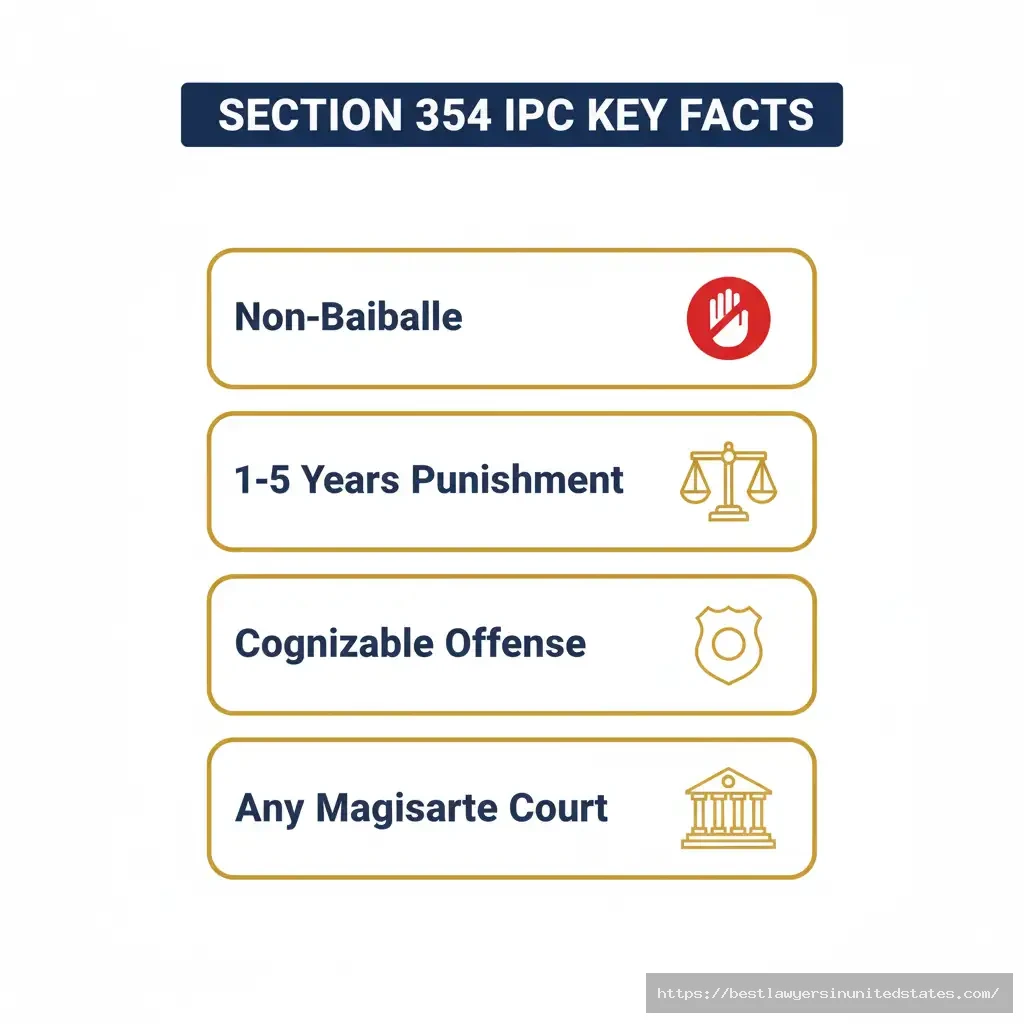
| Offense | Assault or criminal force to woman with intent to outrage modesty |
| Punishment | 1 to 5 years imprisonment + Fine |
| Bailable Status | Non-bailable |
| Cognizable | Yes (police can arrest without warrant) |
| Compoundable | No (victim cannot withdraw case) |
| Court Jurisdiction | Any Magistrate |
| BNS Equivalent | Section 74 BNS (2023) |
What is Section 354 IPC?
Section 354 of the Indian Penal Code criminalizes any act where a person assaults or uses criminal force against a woman with the intent to outrage her modesty. This law was significantly strengthened through the Criminal Law Amendment Act of 2013 following nationwide protests demanding better protection for women.
Legal Text
The exact wording states:
“Whoever assaults or uses criminal force to any woman, intending to outrage or knowing it to be likely that he will thereby outrage her modesty, shall be punished with imprisonment of either description for a term which shall not be less than one year but which may extend to five years, and shall also be liable to fine.”

Key Elements That Must Be Proven
For a conviction under Section 354 IPC, the prosecution must establish:
- Assault or criminal force was used against a woman
- Intent existed to outrage her modesty, OR the accused knew his actions would likely outrage her modesty
- The act actually outraged the woman’s sense of modesty
The term “modesty” has been interpreted by courts as a woman’s sense of dignity and decency. It’s not limited to sexual dignity alone but encompasses her right to bodily integrity and respectful treatment.
What Constitutes “Outraging Modesty”?
Courts have recognized various acts under this section:
- Unwanted physical touching or groping
- Pulling a woman’s clothing
- Making physical gestures with sexual overtones
- Inappropriate physical advances
- Restraining a woman against her will with ulterior intent
The Supreme Court has clarified that actual physical contact isn’t always necessary. Even gestures or attempts can fall under this provision if they clearly indicate intent to outrage modesty.
Section 354 IPC in BNS (Bharatiya Nyaya Sanhita 2023)
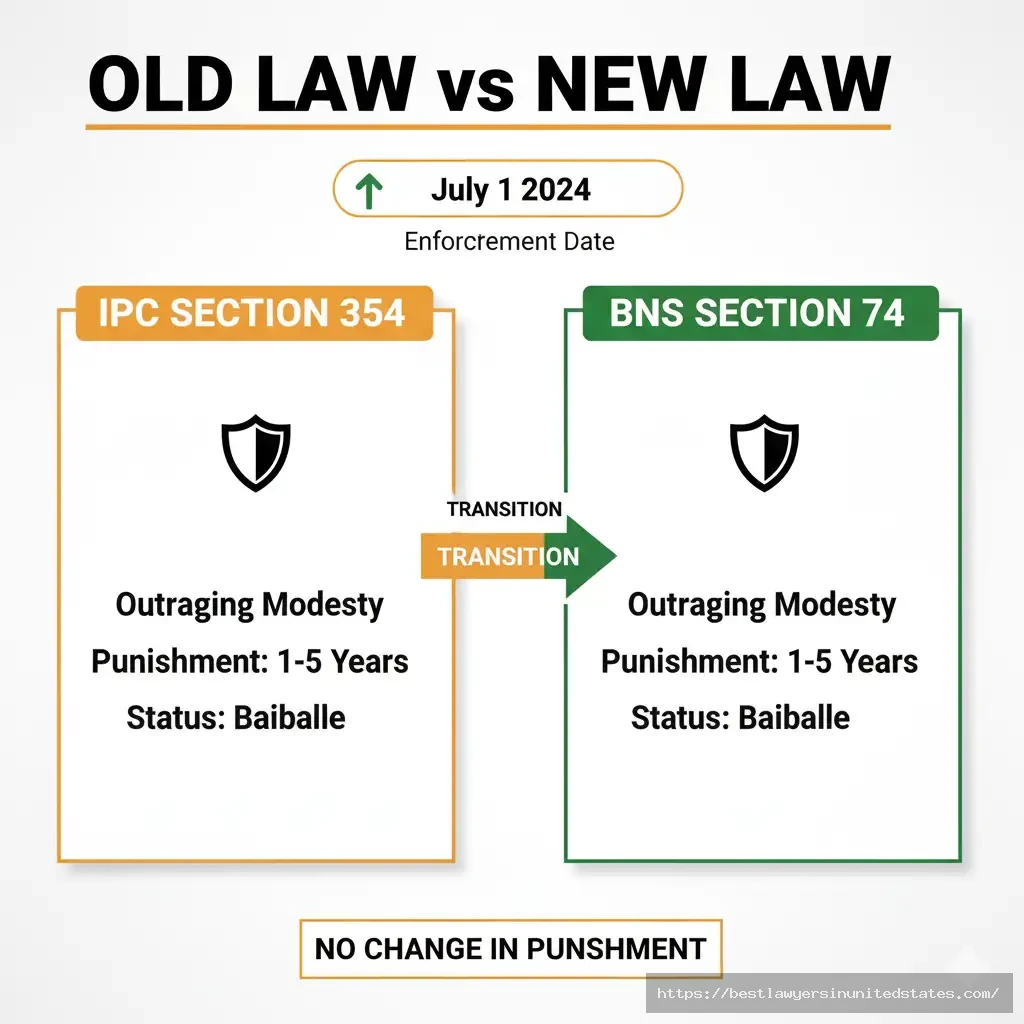
India replaced the Indian Penal Code with the Bharatiya Nyaya Sanhita (BNS) effective July 1, 2024. Here’s what changed:
IPC to BNS Conversion Table
| Old Law | New Law | Changes |
|---|---|---|
| Section 354 IPC | Section 74 BNS | No substantial change in offense definition |
| Section 354A IPC | Section 75 BNS | Sexual harassment provisions remain same |
| Section 354B IPC | Section 76 BNS | Disrobing provisions unchanged |
| Section 354C IPC | Section 77 BNS | Voyeurism definition identical |
| Section 354D IPC | Section 78 BNS | Stalking provisions retained |
Which Law Applies to Your Case?
- Cases registered before July 1, 2024: Continue under IPC provisions
- Cases registered on or after July 1, 2024: Fall under BNS
- Punishment quantum: Remains identical in both codes
- Procedural aspects: No change in bail, cognizance, or compoundability status
The substantive law hasn’t changed. The government simply renumbered and reorganized provisions while retaining the core legal framework.
Four Sub-Sections of Section 354 IPC Explained
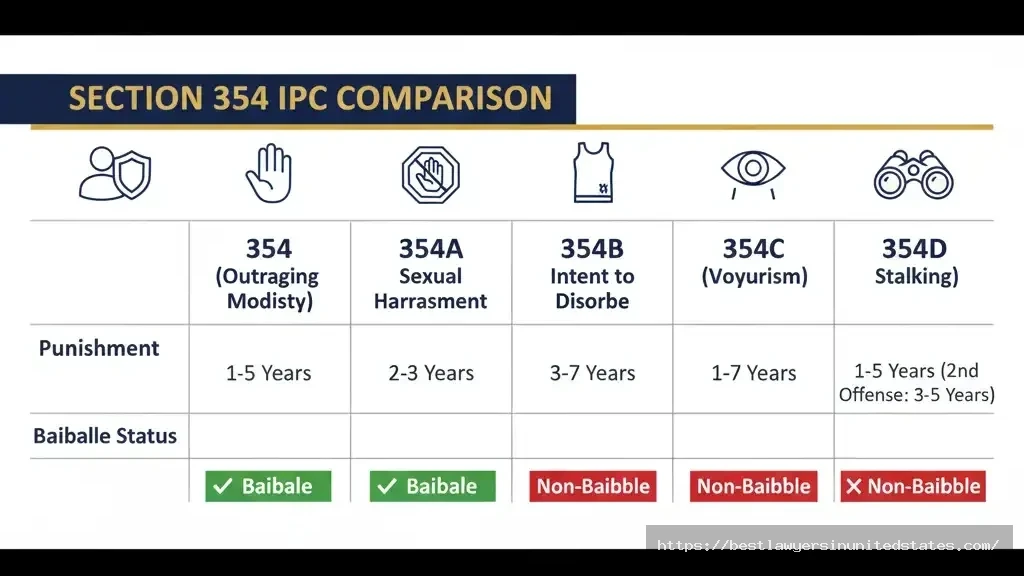
The 2013 Amendment Act added four new subsections to address specific forms of harassment. Understanding the distinctions is crucial.
Section 354: Outraging Modesty (Main Provision)
What it covers: General assault or criminal force with intent to outrage modesty.
Examples:
- Unwanted touching in public spaces
- Grabbing or groping
- Physical restraint with improper intent
Punishment: 1 to 5 years + Fine
Bailable: Non-bailable
Cognizable: Yes
Section 354A: Sexual Harassment
What it covers: Four specific acts constitute sexual harassment:
- Physical contact and unwelcome sexual advances
- Demand or request for sexual favors
- Showing pornography against a woman’s will
- Making sexually colored remarks
Punishment:
- Acts (i), (ii), (iii): Up to 3 years rigorous imprisonment OR fine OR both
- Act (iv) [sexually colored remarks]: Up to 1 year OR fine OR both
Bailable: Yes (for first three categories), Yes (for remarks)
Cognizable: Yes
Key distinction from 354: This specifically addresses workplace harassment and verbal/non-physical sexual harassment.
Section 354B: Intent to Disrobe
What it covers: Assault or criminal force with the specific intention of disrobing a woman or compelling her to be naked.
Examples:
- Forcibly removing clothing
- Attempting to strip a woman in public
- Using force to expose private body parts
Punishment: 3 to 7 years + Fine (mandatory minimum 3 years)
Bailable: Non-bailable
Cognizable: Yes
Key distinction: This is more serious than Section 354 due to the specific disrobing intent, reflected in higher mandatory minimum sentence.
Section 354C: Voyeurism
What it covers: Watching or capturing images of a woman engaged in private acts without consent, or disseminating such images.
What qualifies as “private act”:
- In a place with reasonable expectation of privacy
- When victim’s private body parts are exposed or covered only in underwear
- When victim is using a lavatory
- Sexual acts not ordinarily done in public
Punishment:
- First conviction: 1 to 3 years + Fine
- Subsequent conviction: 3 to 7 years + Fine
Bailable: Yes for first offense, Non-bailable for repeat offense
Cognizable: Yes
Important note: Even if the woman consented to image capture but NOT to dissemination, sharing those images is an offense.
Section 354D: Stalking
What it covers: Two forms of stalking:
- Following a woman and attempting contact despite clear disinterest
- Monitoring a woman’s internet, email, or electronic communication
Legal defenses available:
- Pursuit was for crime prevention by law enforcement
- Conduct was required under law
- Conduct was reasonable and justified in circumstances
Punishment:
- First conviction: Up to 3 years + Fine
- Subsequent conviction: Up to 5 years + Fine
Bailable: Yes for first offense, Non-bailable for repeat offense
Cognizable: Yes
Comparison Table: All Sub-Sections at a Glance
| Section | Offense | Min-Max Punishment | Bailable | Cognizable |
|---|---|---|---|---|
| 354 | Outraging modesty | 1-5 years + Fine | Non-bailable | Yes |
| 354A | Sexual harassment | 1-3 years + Fine | Bailable | Yes |
| 354B | Intent to disrobe | 3-7 years + Fine | Non-bailable | Yes |
| 354C | Voyeurism | 1-3 years (first)<br>3-7 years (repeat) | Bailable (first)<br>Non-bailable (repeat) | Yes |
| 354D | Stalking | Up to 3 years (first)<br>Up to 5 years (repeat) | Bailable (first)<br>Non-bailable (repeat) | Yes |
Punishment Under Section 354 IPC
Sentencing Framework
For the main Section 354 offense:
- Mandatory minimum: 1 year imprisonment
- Maximum: 5 years imprisonment
- Fine: Mandatory (amount at court’s discretion)
- Type of imprisonment: Either simple or rigorous (court decides)
Courts cannot impose a sentence below one year. This mandatory minimum was introduced in 2013 to ensure deterrence.
Factors Courts Consider During Sentencing
While the law prescribes a range, actual sentences vary based on:
- Severity of the act: Momentary touching vs. prolonged assault
- Circumstances: Public place, isolated area, position of trust
- Impact on victim: Physical injury, psychological trauma
- Prior criminal record: First-time offender vs. repeat offender
- Age of victim: Particularly harsh for crimes against minors
- Abuse of authority: Teachers, employers, public officials face stricter sentences
Real Sentencing Patterns
Based on recent High Court judgments:
- Minor touching/groping: 1-2 years (minimum range)
- Aggressive assault with restraint: 2-3 years (mid-range)
- Violent assault causing injury: 3-5 years (maximum range)
- Repeat offenders: Courts lean toward maximum sentences
Courts also consider whether the accused showed remorse, cooperated with investigation, or has dependents to support.
Is Section 354 IPC Bailable or Non-Bailable?
Main Section 354: Non-Bailable
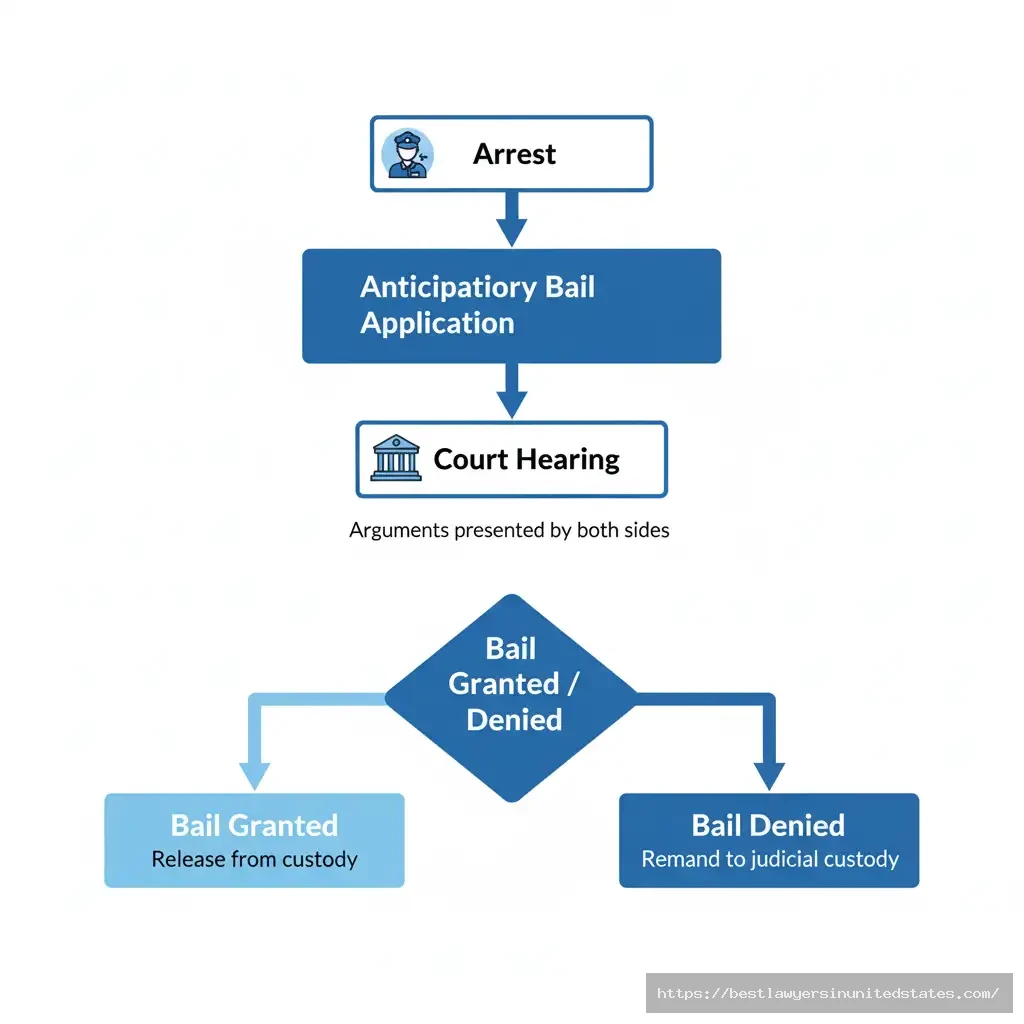
Section 354 (outraging modesty) is a non-bailable offense. This means:
- Police can arrest without a warrant
- Accused does NOT have automatic right to bail
- Court decides whether to grant bail after hearing arguments
- Bail can be denied if court believes accused might:
- Flee from justice
- Tamper with evidence
- Threaten or influence the victim/witnesses
How to Apply for Bail in Section 354 Cases
Step 1: Anticipatory Bail (Before Arrest)
If you anticipate arrest, you can file for anticipatory bail under Section 438 CrPC (now Section 482 BNSS). This must be filed in:
- Sessions Court, OR
- High Court
Success factors:
- Clean criminal record
- Willingness to cooperate with investigation
- No likelihood of absconding
- Case involves disputed facts or minor nature
Timeline: Courts typically decide within 1-2 weeks, but can grant interim protection immediately.
Step 2: Regular Bail (After Arrest)
Once arrested, the accused can apply for regular bail. The application goes to:
- Magistrate Court (for most cases), OR
- Sessions Court (if case transferred)
Documents needed:
- Bail application with grounds
- Surety bonds (from solvent persons)
- Permanent address proof
- Character certificates (if available)
Court considerations:
- Nature and gravity of accusation
- Position and status of accused
- Likelihood of accused fleeing
- Possibility of repeat offense
- Whether accused needed for further investigation
Timeline: Magistrate courts usually decide within 7-15 days.
Bail Conditions Typically Imposed
When bail is granted in Section 354 cases, courts impose conditions like:
- Surety bond: Usually ₹10,000-₹50,000 depending on case severity
- Personal bond: Signed undertaking to appear at all hearings
- No-contact order: Cannot approach or contact victim
- Reporting requirement: Appear before investigating officer weekly/biweekly
- Passport surrender: Cannot leave country without court permission
- Residence restriction: Must inform court before changing address
Violating bail conditions leads to immediate cancellation and re-arrest.
Sub-Section Bail Status
| Section | First Offense | Repeat Offense |
|---|---|---|
| 354 | Non-bailable | Non-bailable |
| 354A | Bailable | Bailable |
| 354B | Non-bailable | Non-bailable |
| 354C | Bailable | Non-bailable |
| 354D | Bailable | Non-bailable |
Evidence Required to Prove Section 354 IPC
Conviction requires the prosecution to prove the case “beyond reasonable doubt.” Here’s what courts consider as evidence:
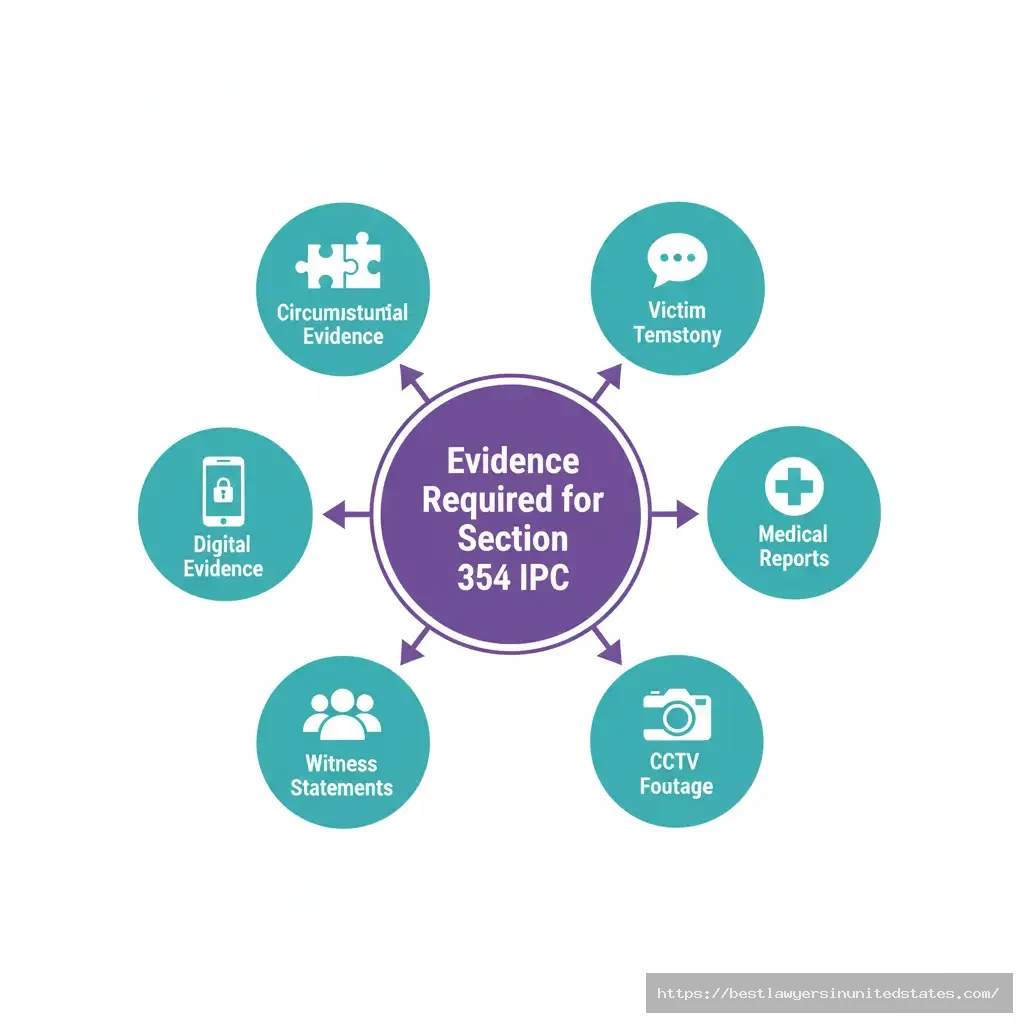
1. Victim’s Testimony
The victim’s statement is the most critical piece of evidence. Courts have held that conviction can be based on victim testimony alone if it is:
- Consistent and coherent
- Corroborated by circumstances
- Given without material contradictions
- Not influenced by external pressures
Important: Delayed reporting doesn’t automatically discredit the victim. Courts recognize trauma and social stigma often prevent immediate complaints.
2. Eyewitness Testimony
If the incident occurred in a public place:
- Witness statements strengthen the case significantly
- Even a single credible witness can secure conviction
- Witnesses should ideally be independent (not related to victim)
3. Medical Evidence
Medical examination reports help establish:
- Injuries consistent with assault
- Torn clothing or physical signs of struggle
- Psychological trauma assessment
Process: Victim should undergo medical examination at a government hospital as soon as possible after the incident. Doctors prepare a medico-legal report that becomes court evidence.
Limitation: In many 354 cases, visible injuries may not exist (e.g., touching, groping). Absence of injury doesn’t weaken the case if other evidence exists.
4. CCTV and Digital Evidence
In modern cases:
- CCTV footage from public places/establishments
- Mobile phone videos recorded by bystanders
- For 354A/C/D: Screenshots of messages, emails, social media interactions
- Call records showing harassment pattern
Digital evidence must follow proper procedures:
- Chain of custody maintained
- Certified by forensic experts
- Presented in original format
5. Circumstantial Evidence
When direct evidence is limited:
- Victim’s distressed state immediately after incident
- Witness testimony about victim’s emotional condition
- Accused’s behavior (fleeing scene, avoiding investigation)
- Past complaints against accused
6. Expert Testimony
In complex cases:
- Psychologists assess victim’s trauma
- Forensic experts analyze digital evidence
- Medical specialists explain injury patterns
Common Defense Arguments and Counter-Evidence
| Defense Claim | Prosecution Counter |
|---|---|
| “Consensual interaction” | Victim’s consistent denial, circumstances showing force |
| “False accusation for revenge” | No prior animosity, immediate complaint, witness corroboration |
| “Accidental contact” | Nature of contact, body parts touched, repeated attempts |
| “Mistaken identity” | Victim’s identification, CCTV footage, witness confirmation |
How to File a Complaint Under Section 354 IPC
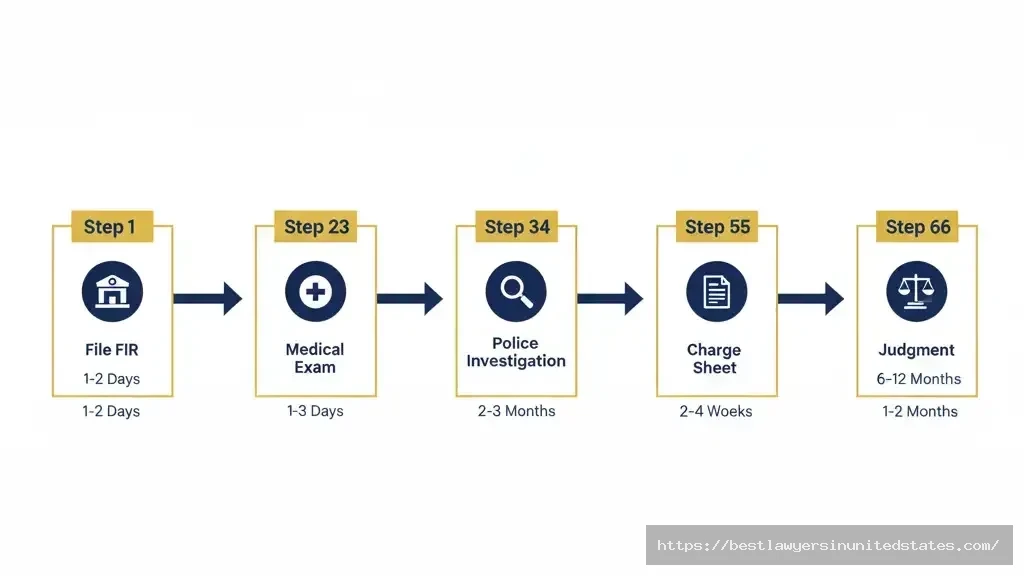
Step 1: Where to File
You have multiple options:
Option A: Police Station
- Go to the police station with jurisdiction (where incident occurred)
- File a First Information Report (FIR)
- Important: You can file FIR at ANY police station if you fear approaching the local station. They must record it and transfer to concerned station.
Option B: Women’s Helpline
- Call National Women Helpline: 181 or 1091
- Operators will guide you through process and can arrange police assistance
Option C: Online Complaint
- Many states have online FIR portals
- Visit your State Police website
- Upload incident details and documents
- Police will contact you for follow-up
Option D: Magistrate Court
- If police refuse to register FIR
- File complaint directly before Magistrate under Section 156(3) CrPC
- Magistrate can order police to investigate
Step 2: Filing the FIR
When you reach the police station:
What to bring:
- Identity proof (Aadhaar, PAN, any government ID)
- Details of accused (name, description, or “unknown” if identity unclear)
- Details of incident (date, time, location)
- Names of witnesses (if any)
Your rights during FIR:
- FIR must be written in language you understand
- You have right to read the FIR before signing
- You must receive a free copy immediately
- Female officer should record statement (for female victims)
- You can bring a trusted person with you
What police will do:
- Record your statement in detail
- Note all circumstantial evidence you provide
- Issue FIR copy with reference number
- Begin investigation
Timeline: FIR registration is immediate. Police cannot delay or refuse.
Step 3: Medical Examination
Police will arrange medical examination:
Purpose:
- Document physical injuries
- Collect forensic evidence
- Assess psychological state
Your rights:
- Male doctors cannot examine female victims alone (female attendant must be present)
- You can request a female doctor
- Examination should happen in private
- You can refuse parts of examination, but this may affect case
What to expect:
- External injury examination
- Clothing inspection (torn/damaged items)
- Photography of injuries (with consent)
- Psychological assessment
The doctor prepares a medico-legal certificate (MLC) that becomes part of case evidence.
Step 4: Investigation Process
After FIR, police investigation begins:
Police actions:
- Visit crime scene
- Collect CCTV footage if available
- Record witness statements
- Arrest accused if evidence warrants
- Send forensic samples for analysis
Your role:
- Cooperate with investigation
- Provide additional information if remembered
- Identify accused if known
- Attend identification parade if needed
Timeline: Investigation should complete within 60-90 days, but extensions are common in complex cases.
Step 5: Charge Sheet and Trial
Once investigation completes:
If police find evidence:
- Police file charge sheet in Magistrate Court
- Court issues summons to accused
- Trial proceedings begin
- You will be called as prosecution witness
If police find no evidence:
- Police file closure report
- You can challenge this before Magistrate
- Court can order further investigation or accept closure
Trial duration: Section 354 trials typically take 12-24 months, depending on court backlog and case complexity.
Step 6: Court Proceedings
Your responsibilities:
- Attend all hearings (court will issue dates)
- Give testimony truthfully
- Bring any additional evidence requested
- Inform court if facing threats or pressure
Support available:
- Legal aid lawyers if you cannot afford one
- Victim support services in many courts
- In-camera trial (closed courtroom) available on request
- Identity protection in certain cases
Timeline Expectations (Realistic)
| Stage | Typical Duration |
|---|---|
| FIR registration | Same day |
| Medical examination | Within 24-48 hours |
| Police investigation | 60-180 days |
| Charge sheet filing | After investigation |
| First hearing | Within 15-30 days of charge sheet |
| Trial completion | 12-24 months |
| Total duration | 18-30 months on average |
Landmark Supreme Court Judgments on Section 354 IPC
1. State of Punjab v. Major Singh (1967)
Facts: Accused pulled a woman’s dupatta in a public market.
Court held:
- Physical contact is not always necessary for Section 354
- Gesture or action with clear intent to outrage modesty is sufficient
- The act must be done with knowledge that modesty would be outraged
Legal principle established: Intent is as important as the act itself.
2. Rupan Deol Bajaj v. K.P.S. Gill (1995)
Facts: K.P.S. Gill (then Director General of Police) slapped a woman IAS officer on her posterior at a dinner party.
Court held:
- Position and status of accused is irrelevant
- Even a “playful” act can constitute offense if it outrages modesty
- Victim’s perception of modesty matters, not accused’s claimed intent
Significance: Established that no one is above the law, regardless of official position.
Sentence: 3 months imprisonment and ₹2,100 fine (though considered lenient by many).
3. Vishaka v. State of Rajasthan (1997)
Facts: Though primarily about workplace sexual harassment, this case led to Section 354A’s creation.
Court held:
- Workplace sexual harassment violates fundamental rights
- Laid down detailed guidelines (Vishaka Guidelines) until legislation was enacted
- Led to Sexual Harassment of Women at Workplace Act, 2013 and Section 354A IPC
Impact: Revolutionary judgment that forced legal reforms.
4. Aman Kumar v. State of Haryana (2004)
Facts: Accused grabbed victim while she was going to school and attempted to drag her.
Court held:
- Even unsuccessful attempt constitutes offense
- Victim’s age (minor) is an aggravating factor
- Minimum sentence must be imposed unless exceptional circumstances
Sentence: 2 years rigorous imprisonment upheld.
5. Ramkripal v. State of Madhya Pradesh (2007)
Facts: Accused touched victim inappropriately under pretext of blessing.
Court held:
- Motive behind touching is crucial
- Cultural or religious pretext doesn’t justify inappropriate touch
- Courts must consider totality of circumstances
Legal principle: Context and manner of touch determine criminality.
Recent Judgments (2023-2025)
Increasing trend in recent cases:
- Higher sentences: Courts now routinely impose 2-3 year sentences even for first-time offenders in aggravated cases
- Victim-centric approach: Supreme Court has emphasized that victim testimony should be believed unless there are compelling reasons to doubt it
- Technology evidence: Courts increasingly rely on CCTV, mobile footage, and digital evidence to corroborate victim statements
- Bail denial: Higher courts are upholding lower court decisions denying bail in serious Section 354 cases
Difference Between Section 354 and Other IPC Sections
Section 354 vs Section 376 (Rape)
| Aspect | Section 354 IPC | Section 376 IPC |
|---|---|---|
| Nature of offense | Assault to outrage modesty | Sexual intercourse without consent |
| Physical contact | Can be brief or without penetration | Requires penetrative sexual act |
| Intent required | Intent to outrage modesty | Intent to have sexual intercourse |
| Punishment | 1-5 years | Minimum 10 years, can extend to life |
| Bailable | Non-bailable | Non-bailable |
| When both apply | If assault occurs before rape attempt, both sections can be charged together |
Key distinction: Section 376 IPC is far more serious. However, attempted rape without completion may still be charged under both 354 and 376 read with Section 511 (attempt).
Section 354 vs Section 323 (Voluntary Causing Hurt)
| Aspect | Section 354 IPC | Section 323 IPC |
|---|---|---|
| Nature of offense | Assault with intent to outrage modesty | Causing hurt voluntarily |
| Gender specific | Only protects women | Gender neutral |
| Intent requirement | Must intend to outrage modesty | Intent to cause bodily pain/harm |
| Punishment | 1-5 years + Fine | Up to 1 year OR fine OR both |
| Bailable | Non-bailable | Bailable |
| When both apply | If assault causes injury AND outrages modesty, police often charge both sections |
Practical note: In many street harassment cases involving physical assault on women, police charge both 354 and Section 323 IPC to ensure prosecution under at least one section if evidence for the other is weak.
Section 354 vs Section 506 (Criminal Intimidation)
| Aspect | Section 354 IPC | Section 506 IPC |
|---|---|---|
| Nature of offense | Physical assault to outrage modesty | Threatening harm to cause alarm |
| Physical contact | Required (assault or force) | Not required (verbal threats) |
| Intent | Outrage modesty | Cause fear or alarm |
| Punishment | 1-5 years + Fine | Up to 2 years OR fine OR both<br>(Up to 7 years if threat is of death/serious injury) |
| Bailable | Non-bailable | Bailable (first part)<br>Non-bailable (second part) |
| When both apply | When accused both assaults AND threatens the victim (common in stalking cases) |
Common combination: Section 354D (stalking) cases often include Section 506 charges when accused threatens victim after being asked to stop.
Section 354 vs Section 509 (Word, Gesture, or Act Intended to Insult Modesty)
| Aspect | Section 354 IPC | Section 509 IPC |
|---|---|---|
| Nature of offense | Assault or criminal force | Insulting word, gesture, or act |
| Physical contact | Required | NOT required |
| Severity | More serious | Less serious |
| Punishment | 1-5 years + Fine | Up to 3 years + Fine |
| Bailable | Non-bailable | Bailable |
| Examples | Groping, touching inappropriately | Catcalling, lewd gestures, passing vulgar comments |
When to use which: If there’s physical contact, charge 354. If only verbal harassment or obscene gestures, charge 509 or 354A.
Victim Rights & Protection Under Section 354 IPC
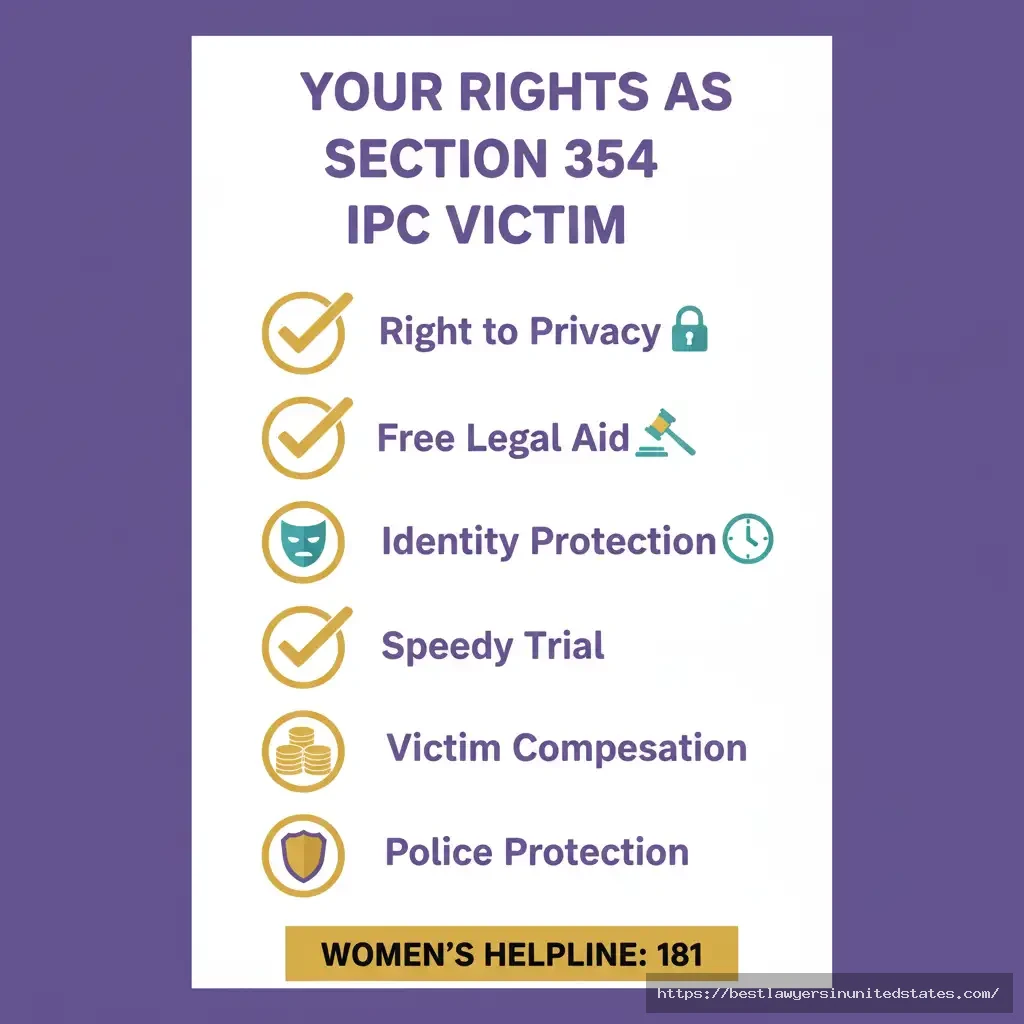
Constitutional and Legal Rights
1. Right to Privacy
- Your identity can be protected during trial
- Courts can order in-camera proceedings (closed courtroom)
- Media cannot publish victim’s name or identifying details (punishable under law)
2. Right to Dignity
- Defense lawyers cannot ask irrelevant or embarrassing questions
- Questions about past sexual history are prohibited unless directly relevant
- Victim cannot be called a “characterless woman” or similar terms
3. Right to Legal Assistance
- Free legal aid if you cannot afford a lawyer
- Legal Services Authority provides lawyers at no cost
- You can approach District Legal Services Authority (DLSA) for assistance
4. Right to Speedy Trial
- Fast-track courts exist in many states for crimes against women
- Court can impose costs on parties causing unnecessary delays
- You can file for speedy trial if case drags unreasonably
5. Right to Compensation
Under Section 357A CrPC (now Section 402 BNSS):
- Victim Compensation Scheme exists in all states
- You can claim compensation for:
- Medical expenses
- Loss of income during trial
- Rehabilitation costs
- Mental trauma treatment
- Amount varies: ₹10,000 to ₹5,00,000 depending on state and case severity
How to apply: File application before District Legal Services Authority with medical bills, loss of income proof, and court documents.
Police Protections
During Investigation:
- Statement recording by female officer (if victim is female)
- Statement cannot be recorded at police station (must be at victim’s residence or safe place)
- Victim cannot be called to police station after sunset and before sunrise
- Right to have a trusted person present during statement
Against Accused:
- Police can provide protection if threats are made
- Restraining orders against accused available
- PCR (police) protection during court hearings if needed
Court Protections
During Trial:
- Separate waiting room for victim (not common waiting area with accused)
- Screen or video-conferencing if victim fears accused
- In-camera trial on request
- Limited adjournments (accused cannot delay trial indefinitely)
Cross-Examination Protections:
- Victim cannot be recalled for cross-examination without strong reason
- Defense questions must be submitted to judge first (in sensitive cases)
- Court can disallow irrelevant or harassing questions
- Victim can request breaks during testimony
Support Services
Government Resources:
| Service | Contact | Purpose |
|---|---|---|
| Women Helpline | 181 | 24/7 support, guidance, police coordination |
| One Stop Centre | 181 or local center | Medical, legal, psychological support |
| National Commission for Women | 7827-170170 | Complaint registration, intervention |
| State Women Commission | State-specific | Legal aid, follow-up support |
NGO Support:
Many NGOs provide counseling services, legal representation, shelter (if victim needs safe space), rehabilitation support, and awareness about rights.
What to Do if Your Rights Are Violated
If police misbehave or refuse to file FIR:
- File complaint with Superintendent of Police
- Approach State Human Rights Commission
- File complaint with National Commission for Women
If lawyer is not representing properly:
- Approach District Legal Services Authority for replacement
- File complaint with State Bar Council
If court proceedings violate your rights:
- Inform court immediately
- File written application highlighting violation
- Approach higher court if lower court doesn’t address concern
Frequently Asked Questions (FAQs)
1. Is Section 354 IPC bailable or non-bailable?
Section 354 is non-bailable. The accused does not have an automatic right to bail and must apply to court. However, bail can be granted based on case facts, accused’s background, and severity of allegations. Sub-sections vary: 354A is bailable, while 354B is non-bailable. Sections 354C and 354D are bailable for first offense but non-bailable for repeat offenses.
2. Can a Section 354 IPC case be withdrawn or settled?
No. Section 354 is a non-compoundable offense under Section 320 CrPC. This means the victim cannot withdraw the case even if she reaches a settlement with the accused. Once an FIR is filed, only the court can decide whether to proceed or close the case based on evidence, not on the victim’s wish to withdraw.
3. What is the punishment for Section 354 IPC?
The punishment is imprisonment for a minimum of 1 year, which can extend up to 5 years, along with a mandatory fine. Courts decide actual sentence based on severity of the act, circumstances, impact on victim, and accused’s criminal history. Minimum sentence cannot be reduced below one year.
4. What is the difference between Section 354 and Section 354A?
Section 354 covers physical assault or criminal force to outrage a woman’s modesty. It requires physical contact or force.
Section 354A covers sexual harassment, which includes four specific acts:
- Unwelcome physical contact and sexual advances
- Demand or request for sexual favors
- Showing pornography against will
- Making sexually colored remarks
354A can be non-physical (like verbal harassment), while 354 requires physical element. Also, 354A is bailable while 354 is non-bailable.
5. How long does a Section 354 IPC case take to resolve?
On average, 18 to 30 months from FIR to final judgment. This includes:
- Investigation: 2-6 months
- Charge sheet filing and first hearing: 1-2 months
- Trial: 12-24 months
Fast-track courts can reduce this timeline to 8-12 months. Complex cases with multiple accused or witnesses may take longer.
6. Can anticipatory bail be granted in Section 354 IPC cases?
Yes, anticipatory bail can be granted, but courts are generally strict. Factors courts consider:
- Nature and severity of allegations
- Whether accused is likely to flee
- Possibility of evidence tampering
- Accused’s past criminal record
- Whether accused is cooperating with investigation
Courts often grant anticipatory bail in disputed cases or where allegations appear false, but deny it in clear-cut cases with strong evidence.
7. What evidence is needed to prove Section 354 IPC?
Key evidence includes:
- Victim’s testimony (most critical)
- Eyewitness accounts (if available)
- Medical examination report (showing injuries or trauma)
- CCTV footage (if incident occurred in public/monitored area)
- Circumstantial evidence (victim’s distressed state, torn clothing)
- Digital evidence (for 354A/C/D cases: messages, emails, social media)
can be based on victim testimony alone if it is consistent and credible. Absence of physical injuries does not weaken the case if other evidence supports the victim’s account.
8. Can a woman file a false case under Section 354 IPC?
While the law is designed to protect victims, false cases can be filed. However:
- Filing a false case is a serious offense under Section 211 IPC (now Section 217 BNS) – punishable with up to 2 years imprisonment
- Courts thoroughly examine evidence and inconsistencies
- Accused has full right to defend and prove innocence
- If court finds the case was false, victim can face prosecution for filing false cases under Section 211 IPC (now Section 217 BNS) – punishable with up to 2 years imprisonment.
Reality check: Studies show false cases are relatively rare (estimates vary from 2-10%). Most genuine victims face difficulty in getting justice rather than the reverse.
9. What is Section 354 IPC in BNS?
Section 354 IPC has been renumbered as Section 74 BNS (Bharatiya Nyaya Sanhita) effective July 1, 2024. The offense definition, punishment, and procedural aspects remain identical. The government simply reorganized the criminal code. Cases filed before July 1, 2024 continue under IPC, while new cases fall under BNS.
10. Can Section 354 IPC be applied to incidents that happened years ago?
Yes, but with practical limitations:
- No statutory limitation period for filing complaint
- However, delay weakens the case due to:
- Faded memories of witnesses
- Loss of physical evidence
- Difficulty in establishing timeline
Courts may question why the victim delayed reporting, though valid reasons (trauma, social pressure, fear) are considered. Medical and forensic evidence becomes nearly impossible to collect after significant time has passed.
11. What happens to the accused during trial?
During trial proceedings:
- If granted bail: Accused remains out but must attend all hearings
- If bail denied: Accused remains in judicial custody until trial completes or bail is granted
- Court appearances: Must attend whenever summoned
- Bail conditions: Cannot contact victim, must report to police periodically
- Employment: Can continue job if on bail, but custody affects employment
After conviction: Sentenced to imprisonment as per court order. Can file appeal in higher court.
12. Can Section 354 IPC and Section 376 IPC be charged together?
Yes. In cases involving both assault to modesty and rape:
- Both sections can be charged simultaneously
- Each charge is tried based on its own evidence requirements
- Conviction on one doesn’t automatically mean conviction on other
- Sentences can run concurrently or consecutively (court decides)
Common scenario: Attempted rape cases where the accused assaulted the victim (354) and attempted sexual intercourse (376 with Section 511).
13. Is medical examination mandatory in Section 354 IPC cases?
Medical examination is not legally mandatory but is highly recommended because:
- Provides objective evidence of injuries
- Documents victim’s physical and psychological state
- Strengthens case significantly
- Required for compensation claims
However: Absence of medical examination doesn’t invalidate the case. Victim testimony and other evidence can still lead to conviction.
14. Can Section 354 IPC apply to transgender persons?
The law specifically uses the term “woman” in Section 354 IPC. However:
- Courts have increasingly interpreted “woman” to include transgender women
- Some High Courts have extended protection to transgender persons
- The BNS may see clearer interpretations on this issue
- Alternative sections like 354A (sexual harassment) have broader interpretation
Current legal position: Evolving. Transgender persons can file complaints, and courts are taking cognizance, though appellate clarity is still developing.
15. What if the accused is a minor (juvenile)?
If the accused is under 18 years:
- Case goes to Juvenile Justice Board, not regular criminal court
- Tried under Juvenile Justice (Care and Protection of Children) Act, 2015
- Exception: If accused is 16-18 years and offense is heinous (serious nature), JJ Board can transfer to regular court
- Focus is on reformation, not just punishment
- Identity of juvenile offender is protected
For victims: Process is similar, but trial happens in juvenile justice system.
16. Can I file a Section 354 IPC case if the incident happened at workplace?
Yes. You have two legal options:
Option 1: Criminal case under Section 354/354A IPC
- File FIR at police station
- Criminal trial proceeds as explained above
Option 2: Complaint under Sexual Harassment of Women at Workplace Act, 2013
- File complaint with Internal Committee (IC) at workplace
- IC investigates and can recommend action against accused
- Faster process (90 days timeline)
- Can run parallel to criminal case
Best approach: File both for comprehensive protection.
17. What if police refuse to file FIR in Section 354 case?
If police refuse:
Immediate step: Insist on speaking to senior officer (Station House Officer or above)
If still refused:
- Send written complaint via registered post to Superintendent of Police
- File online complaint on state police website
- Approach Magistrate Court under Section 156(3) CrPC (now Section 173 BNSS) – Magistrate can order police to register FIR
- Complaint to National Commission for Women (NCW) or State Women’s Commission
Legal fact: Police refusing to register FIR is a punishable offense under law.
18. Can I claim compensation in Section 354 IPC cases?
Yes. Every state has a Victim Compensation Scheme under Section 357A CrPC (now Section 402 BNSS).
Compensation ranges: ₹10,000 to ₹5,00,000 depending on:
- Nature and severity of offense
- Physical injuries sustained
- Psychological trauma
- Loss of income
- State-specific scheme guidelines
How to apply:
- Submit application to District Legal Services Authority (DLSA)
- Attach medical reports, FIR copy, income loss proof
- DLSA decides within 2-3 months
- Compensation paid regardless of trial outcome (even if accused is acquitted)
Important: You can claim compensation even while trial is ongoing.
19. What is the conviction rate in Section 354 IPC cases?
National conviction rates for Section 354 IPC:
- Overall: Approximately 25-30% (National Crime Records Bureau data)
- Reasons for low rate: Evidence challenges, victim turning hostile, lengthy trials, procedural delays
Recent trend: Conviction rates are improving due to:
- Fast-track courts
- Better forensic evidence collection
- Stricter court monitoring
- Victim support mechanisms
State-wise variation: Some states like Kerala, Delhi have higher conviction rates (35-40%) due to better investigation and prosecution.
20. Can the accused take photographs or videos during court hearings?
Absolutely not.
- Photography and videography inside courtrooms are strictly prohibited
- Recording victim’s testimony is contempt of court
- Victim’s identity cannot be shared publicly
- Media cannot publish victim’s photographs or identifying information
- Violation can lead to prosecution and penalties
Protection available: Courts can impose strict orders preventing any attempt to identify or harass the victim during trial.
Need Legal Help?
If you’re facing a Section 354 IPC situation – whether as a victim seeking justice or an accused seeking defense – consulting an experienced criminal lawyer is essential.
When to consult immediately:
- You’ve experienced assault and want to file a complaint
- Police have registered an FIR against you
- You need anticipatory bail
- Trial has begun and you need representation
- You want to understand your legal options
How to find legal assistance:
| Situation | Contact |
|---|---|
| Cannot afford lawyer | District Legal Services Authority (DLSA) – Free legal aid |
| Need immediate guidance | Women Helpline: 181 |
| Want experienced counsel | State Bar Association for lawyer referral |
| Complex case requiring senior counsel | Consult criminal law specialists |
Cost considerations:
- Legal aid: Free
- Junior advocates: ₹10,000 – ₹50,000 for entire case
- Senior advocates: ₹1,00,000 – ₹5,00,000+ depending on complexity
Regional Language Resources
Understanding your legal rights in your native language is crucial. Here are key translations:
Section 354 IPC in Hindi (धारा 354 आईपीसी)
अपराध: किसी महिला की मर्यादा भंग करने के इरादे से उस पर हमला या बल प्रयोग
सजा: न्यूनतम 1 वर्ष से अधिकतम 5 वर्ष की कैद और जुर्माना
जमानती: गैर-जमानती अपराध
संज्ञेय: हाँ (पुलिस बिना वारंट गिरफ्तार कर सकती है)
समझौता: नहीं (पीड़िता केस वापस नहीं ले सकती)
Section 354 IPC in Tamil (பிரிவு 354 ஐபிசி)
குற்றம்: பெண்ணின் கற்பை அவமதிக்கும் நோக்கத்துடன் தாக்குதல் அல்லது வலுவைப் பயன்படுத்துதல்
தண்டனை: குறைந்தபட்சம் 1 ஆண்டு முதல் அதிகபட்சம் 5 ஆண்டுகள் சிறைத்தண்டனை மற்றும் அபராதம்
ஜாமீன் கிடைக்குமா: இல்லை (ஜாமீன் இல்லாத குற்றம்)
Section 354 IPC in Marathi (कलम 354 आयपीसी)
गुन्हा: स्त्रीच्या लाजेला हात लावण्याच्या हेतूने प्रहार किंवा बळजबरी
शिक्षा: किमान 1 वर्षापासून कमाल 5 वर्षे कारावास आणि दंड
जामीन मिळेल का: नाही (जामीन न मिळणारा गुन्हा)
Section 354 IPC in Kannada (ವಿಭಾಗ 354 ಐಪಿಸಿ)
ಅಪರಾಧ: ಮಹಿಳೆಯ ಮರ್ಯಾದೆಗೆ ಧಕ್ಕೆ ತರುವ ಉದ್ದೇಶದಿಂದ ಆಕ್ರಮಣ ಅಥವಾ ಬಲಪ್ರಯೋಗ
ಶಿಕ್ಷೆ: ಕನಿಷ್ಠ 1 ವರ್ಷದಿಂದ ಗರಿಷ್ಠ 5 ವರ್ಷಗಳ ಜೈಲು ಶಿಕ್ಷೆ ಮತ್ತು ದಂಡ
ಜಾಮೀನು ಸಿಗುತ್ತದೆಯೇ: ಇಲ್ಲ (ಜಾಮೀನು ಇಲ್ಲದ ಅಪರಾಧ)
Section 354 IPC in Telugu (సెక్షన్ 354 ఐపిసి)
నేరం: స్త్రీ గౌరవాన్ని దెబ్బతీసే ఉద్దేశంతో దాడి లేదా బలప్రయోగం
శిక్ష: కనీసం 1 సంవత్సరం నుండి గరిష్ఠంగా 5 సంవత్సరాల జైలు శిక్ష మరియు జరిమానా
బెయిల్ లభిస్తుందా: లేదు (బెయిల్ లేని నేరం)
Section 354 IPC in Malayalam (വകുപ്പ് 354 ഐപിസി)
കുറ്റം: സ്ത്രീയുടെ മാന്യത ഹനിക്കുക എന്ന ഉദ്ദേശത്തോടെ ആക്രമണം അല്ലെങ്കിൽ ബലപ്രയോഗം
ശിക്ष: കുറഞ്ഞത് 1 വർഷം മുതൽ പരമാവധി 5 വർഷം വരെ തടവും പിഴയും
ജാമ്യം ലഭിക്കുമോ: ഇല്ല (ജാമ്യമില്ലാത്ത കുറ്റം)
Important Legal Disclaimers
1. This article is for informational purposes only
The information provided here is meant to educate and inform about Section 354 IPC and related provisions. It does not constitute legal advice for any specific situation.
2. Laws and procedures vary
While we’ve covered general principles applicable across India:
- State-specific procedures may differ
- Court interpretations evolve over time
- Recent judgments may have modified established principles
3. Consult a lawyer for your case
Every legal situation is unique. For specific advice regarding your circumstances:
- Consult a qualified criminal lawyer
- Do not rely solely on online information for legal decisions
- Seek professional guidance before taking legal action
4. Information current as of November 2025
Laws, particularly the transition from IPC to BNS, are evolving. Always verify current legal provisions with recent sources or legal professionals.
5. Emergency situations
If you’re in immediate danger:
- Call police: 100 or 112 (emergency)
- Women’s helpline: 181
- Do not delay seeking help while researching legal provisions
Conclusion
Section 354 IPC (now Section 74 BNS) represents a crucial legal protection for women against assault and harassment. The 2013 amendments significantly strengthened this provision by adding specific subsections addressing sexual harassment, disrobing, voyeurism, and stalking.
Key takeaways:
- Section 354 is a non-bailable, cognizable, and non-compoundable offense
- Punishment ranges from 1 to 5 years with mandatory fine
- Sub-sections 354A through 354D cover specific forms of harassment with varying punishment and bail provisions
- Conviction can be based on victim testimony alone if credible
- Victims have extensive legal rights and access to compensation
- The law applies equally regardless of the accused’s position or status
For victims: Know your rights, file complaints promptly, preserve evidence, and seek legal assistance. The law is on your side.
For the accused: Take allegations seriously, seek immediate legal counsel, cooperate with investigation, and understand that proper legal defense is essential.
For society: Understanding these provisions helps create awareness, prevents harassment, and ensures that both victims get justice and innocent persons get fair trials.