
Quick Answer: A divorce in South Dakota costs between $500 and $30,000+ depending on complexity. An uncontested divorce typically runs $500-$3,000, while contested cases average $10,000-$25,000. The court filing fee is $115 statewide, with additional costs for attorney fees, mediation, and document preparation.
Divorce Cost Calculator
Get an estimated cost for your divorce based on your specific situation
Your Estimated Divorce Cost
Cost Breakdown
📧 Get a Personalized Consultation
Have questions about your specific situation? Contact our legal experts for guidance tailored to your needs.
Contact Us via Email
South Dakota Divorce Cost Breakdown
Understanding exactly where your money goes helps you budget effectively and identify areas where you might save. Here’s what you’ll actually pay when filing for divorce in South Dakota.
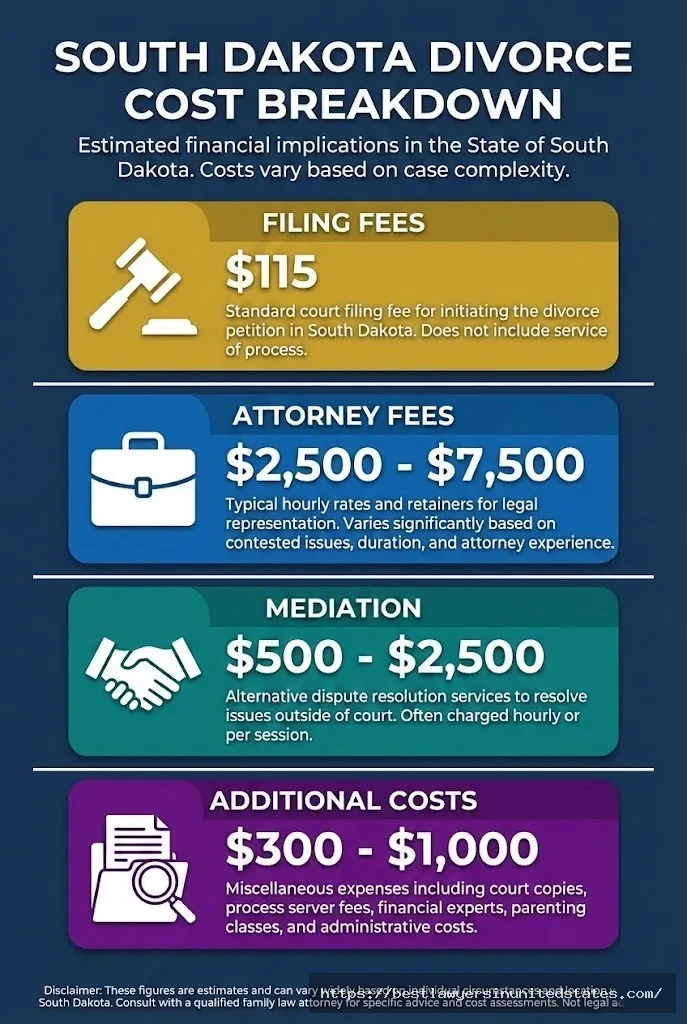
Court Filing Fees
The filing fee to start a divorce case in South Dakota is $115 across all circuit courts. This fee covers the initial petition and is paid when you file your paperwork with the clerk of court. If you’re responding to a divorce your spouse filed, there’s no separate appearance fee in most South Dakota counties.
Can’t afford the filing fee? You can request a fee waiver by filing an Affidavit of Indigency. If the court determines you qualify based on your income and expenses, you won’t pay the $115 filing fee. Forms are available through the South Dakota Unified Judicial System website or your local circuit court clerk.
| Filing Type | Cost |
|---|---|
| Divorce Petition | $115 |
| Response (if required) | $0-$50 (varies by county) |
| Motion filings | $25-$50 per motion |
| Certified copies | $5 per document |
Attorney Fees & Retainers
Attorney fees represent the largest expense for most South Dakota divorces. Family law attorneys in South Dakota charge between $150 and $400 per hour, with rates varying by location and attorney experience.
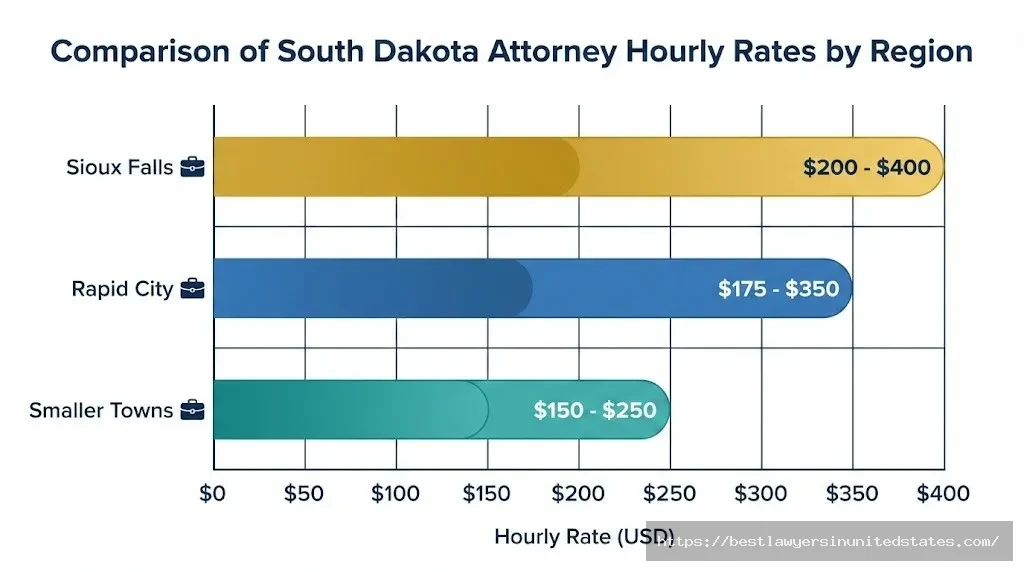
Sioux Falls area: $200-$400/hour
Rapid City area: $175-$350/hour
Smaller towns: $150-$250/hour
Most divorce attorneys require an upfront retainer—typically $2,500 to $5,000 for straightforward cases and $7,500 to $15,000 for contested divorces. The attorney bills against this retainer at their hourly rate. If your case uses up the retainer, you’ll need to replenish it.
How many hours will your case take? An uncontested divorce might need 8-15 attorney hours ($1,200-$6,000), while a contested divorce with custody disputes can require 40-100+ hours ($6,000-$40,000).
Mediation Costs
Divorce mediation in South Dakota costs $100-$300 per hour. Most couples need 3-8 hours of mediation to resolve property division, custody, and support issues. Total mediation costs typically range from $500 to $2,500.
South Dakota courts often require mediation before allowing contested custody cases to proceed to trial. Some counties offer reduced-fee mediation programs—check with your circuit court.
Additional Legal Costs
| Cost Item | Typical Range |
|---|---|
| Process server fees | $50-$100 |
| Document preparation (pro se) | $150-$500 |
| Online divorce service | $150-$300 |
| Parenting class (if required) | $40-$75 |
| Property appraisal | $300-$600 |
| Business valuation | $5,000-$15,000 |
| Financial affidavit preparation | $200-$800 |
| Parenting plan evaluation | $1,500-$5,000 |
| Court reporter (trial) | $500-$2,000 |
What Factors Increase or Decrease Your Divorce Costs?
The difference between a $500 divorce and a $30,000 divorce comes down to these key factors.
Contested vs. Uncontested Divorce
Uncontested divorce: Both spouses agree on all terms—property division, debt allocation, custody, child support, and alimony. You file agreed-upon paperwork, wait the mandatory 60 days, and finalize. Total cost: $500-$3,000.

Contested divorce: Spouses disagree on major issues requiring negotiation, mediation, or trial. Each round of discovery, motions, and hearings adds attorney hours. Total cost: $10,000-$30,000+.
The single biggest cost-control decision is whether you can reach agreements before filing. Even one contested issue can triple your expenses.
Children & Custody Disputes
Divorces involving children cost more because they require additional legal work:
- Parenting plan preparation
- Child support worksheet calculations
- Custody evaluations (if disputed)
- Parenting time schedules
- Potential guardian ad litem fees ($2,000-$5,000)
If custody is contested, expect to add $5,000-$15,000 to your total costs. South Dakota courts prioritize the child’s best interests, and proving your case requires documentation, witnesses, and often expert testimony.
Property & Asset Complexity
Simple estates (one home, retirement accounts, vehicles) add minimal cost. Complex estates (multiple properties, businesses, investment portfolios, pension plans) require appraisals, valuations, and expert witnesses.
Business owners should budget an additional $5,000-$20,000 for business valuation and forensic accounting if the business value is disputed.
South Dakota follows equitable distribution—not automatic 50/50 splits. Courts consider factors like marriage length, earning capacity, and contributions to marital property. Arguing for unequal distribution increases legal costs.
Attorney vs. Pro Se Representation
Hiring an attorney costs $3,000-$25,000+ but ensures proper legal procedures, protects your rights, and handles complex paperwork. Attorneys are essential for contested cases, custody disputes, or high-asset divorces.
Filing pro se (representing yourself) saves attorney fees but requires you to handle all paperwork, court appearances, and legal research. DIY divorce works best for uncontested cases with no children and minimal assets.
Real South Dakota Divorce Cost Examples
Here’s what actual South Dakota couples paid, broken down by case type.
Case Study 1: Simple Uncontested Divorce
Situation: Married 3 years, no children, minimal shared assets (one vehicle, household items), both agree to separate terms.
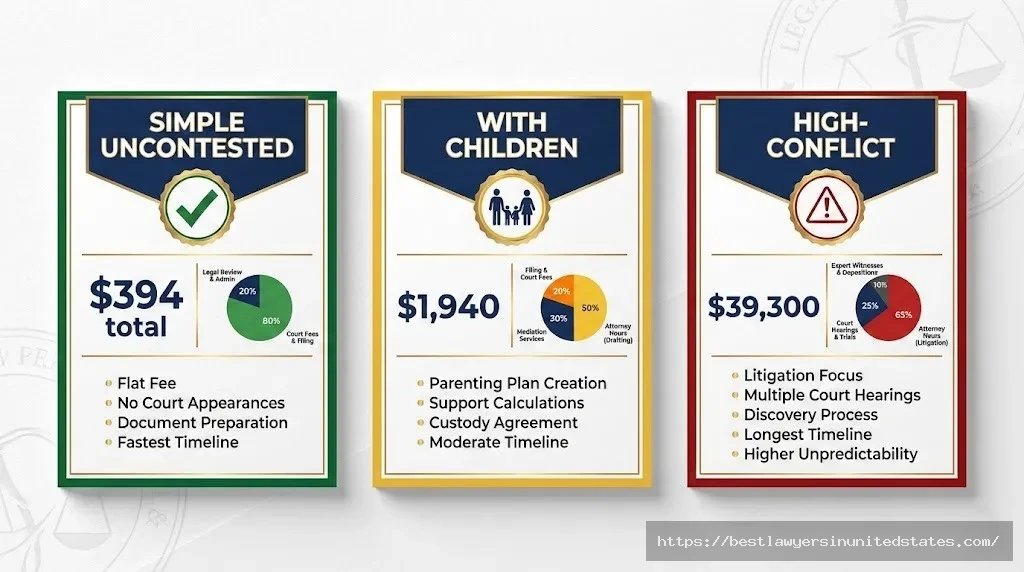
Cost breakdown:
- Filing fee: $115
- Online divorce document service: $199
- Process server: $65
- Notary fees: $15
- Total: $394
Timeline: 75 days (60-day waiting period + processing)
Cost-saving decision: Used online forms instead of hiring attorney for uncontested case.
Case Study 2: Uncontested Divorce with Children
Situation: Married 9 years, 2 children (ages 5 and 7), one home with equity, retirement accounts, agreed custody arrangement.
Cost breakdown:
- Filing fee: $115
- Limited-scope attorney (document review): $800
- Mediation (2 sessions): $500
- Parenting class: $50
- Property appraisal: $400
- Process server: $75
- Total: $1,940
Timeline: 4 months
Cost-saving decision: Used mediation to reach agreements, hired attorney only for document preparation and review rather than full representation.
Case Study 3: High-Conflict Contested Divorce
Situation: Married 14 years, 2 children (ages 8 and 11), disputed custody, family business, multiple properties, significant retirement assets.
Cost breakdown:
- Filing fee: $115
- Attorney retainer + additional fees: $18,500
- Guardian ad litem: $3,200
- Business valuation: $8,000
- Custody evaluator: $4,500
- Expert witnesses: $2,400
- Mediation (unsuccessful): $900
- Court reporter: $1,200
- Process server and court fees: $485
- Total: $39,300
Timeline: 18 months
What drove costs: Custody battle requiring evaluators, business valuation dispute, multiple court hearings, and failed mediation before settlement.
How South Dakota Compares to Neighboring States
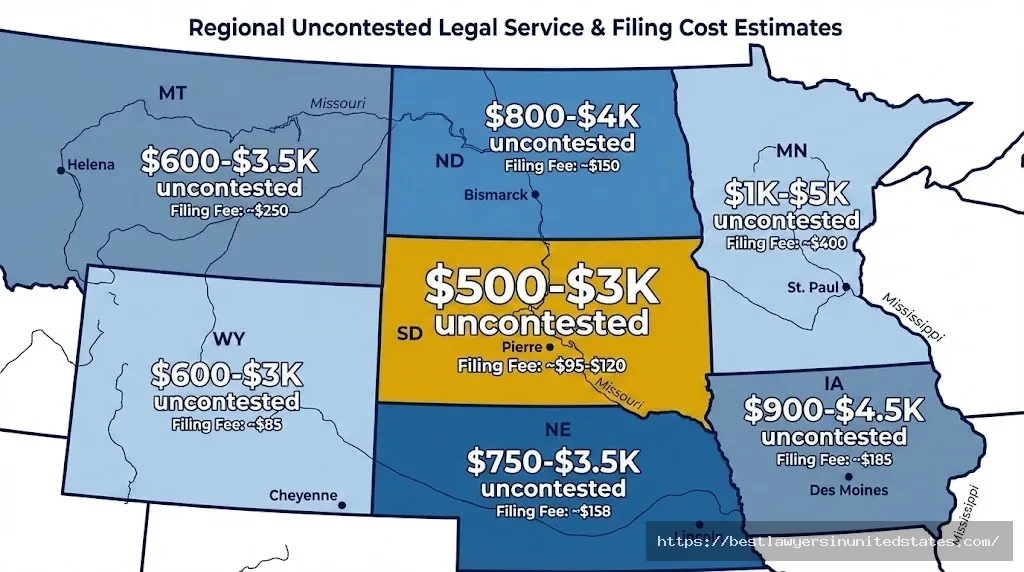
If you’re considering where to file based on cost or residency, here’s how South Dakota stacks up against nearby states.
| State | Filing Fee | Avg. Uncontested | Avg. Contested | Residency Requirement |
|---|---|---|---|---|
| South Dakota | $115 | $500-$3,000 | $10,000-$25,000 | 60 days (county) |
| North Dakota | $80 | $400-$2,500 | $8,000-$20,000 | 6 months (state) |
| Minnesota | $400 | $1,000-$5,000 | $15,000-$30,000 | 180 days (state) |
| Iowa | $185 | $1,200-$4,000 | $12,000-$28,000 | 1 year (state) |
| Nebraska | $158 | $600-$3,500 | $9,000-$22,000 | 1 year (state) |
| Montana | $200 | $800-$3,500 | $10,000-$27,000 | 90 days (state) |
South Dakota advantages: Lower filing fees than most neighbors, shortest residency requirement (60 days in your county vs. 6-12 months state residency elsewhere), and generally lower attorney hourly rates outside major metro areas.
Hidden Divorce Costs You Might Not Expect
Beyond the obvious expenses, several costs catch South Dakota divorcing couples off guard.

Process server fees ($50-$100): If your spouse doesn’t sign an acceptance of service, you must have them formally served. Out-of-state service costs more.
Parenting classes ($40-$75): Many South Dakota courts require divorcing parents to complete parenting education programs before finalizing a divorce involving minor children.
Tax implications: Your filing status changes immediately upon divorce finalization. Alimony received is taxable income; alimony paid is no longer tax-deductible under federal law (for divorces finalized after 2018). Capital gains from selling the marital home may apply.
Health insurance transition ($200-$1,500/month): If you’re covered under your spouse’s employer plan, you’ll lose coverage at divorce finalization. COBRA continuation costs are typically much higher than employee contribution rates.
Refinancing costs ($2,000-$5,000): If one spouse keeps the house, they’ll need to refinance to remove the other spouse from the mortgage. This includes application fees, appraisal, and closing costs.
Credit monitoring and repair: Divorce often impacts credit scores, especially if joint debts exist. Some spouses invest in credit monitoring services ($10-$30/month).
Moving expenses: Whether renting a new apartment or buying a home, moving costs (deposits, truck rental, utility connections) add up quickly—budget $2,000-$5,000.
Lost retirement account value: Dividing 401(k)s or pensions requires a Qualified Domestic Relations Order (QDRO), which costs $500-$2,500 to prepare. Early withdrawals trigger taxes and penalties.
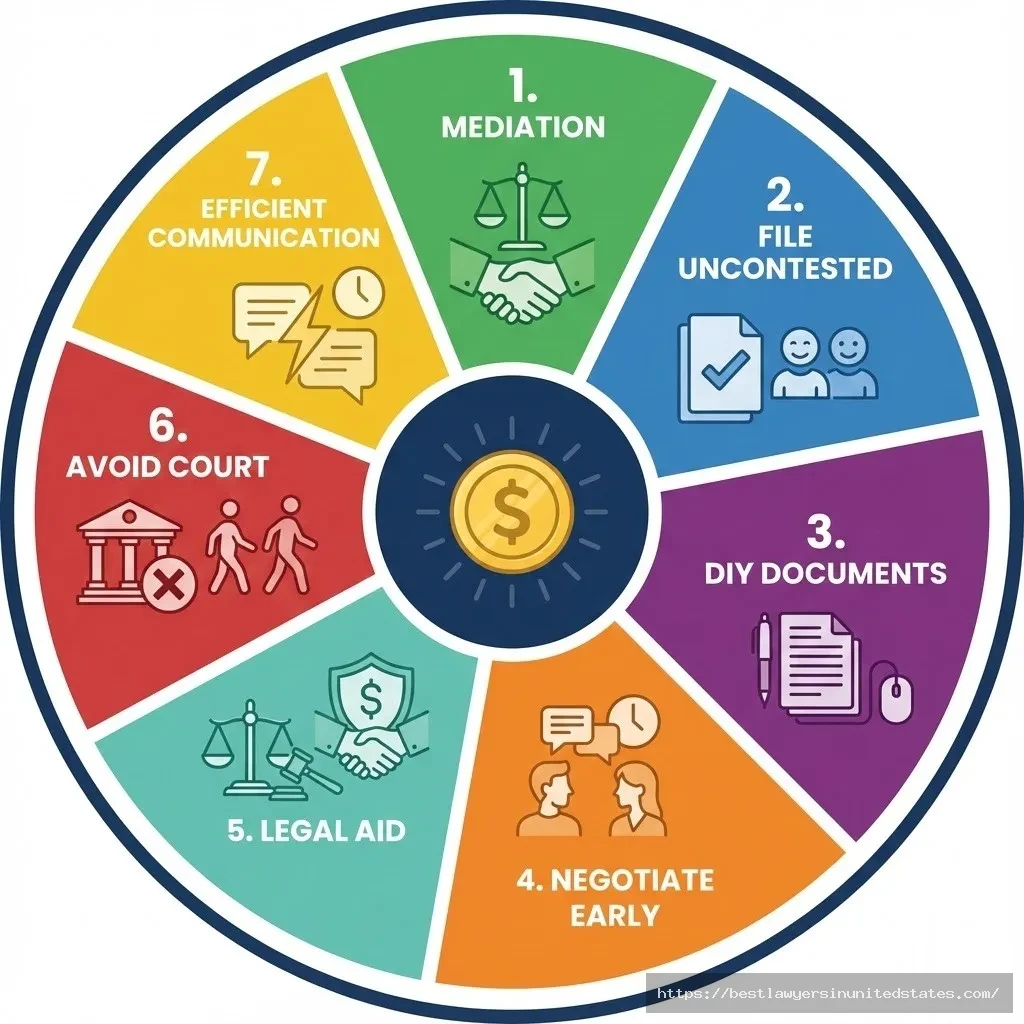
7 Ways to Reduce Your Divorce Costs in South Dakota
Smart planning can cut your divorce expenses significantly without sacrificing important rights.
Consider Mediation Instead of Litigation
Mediation costs $100-$300 per hour versus attorney litigation at $200-$400 per hour. More importantly, mediation resolves cases in 6-15 hours versus contested litigation that can take 100+ attorney hours.
Even if you hire attorneys, using mediation to resolve specific disputes (property division, custody schedules) before going to court saves substantial money. South Dakota courts encourage mediation—some judges won’t schedule trial dates without proof you’ve attempted mediation.
File Uncontested if Possible
The cost gap between uncontested and contested divorce is dramatic: $500-$3,000 versus $10,000-$30,000. If you can negotiate agreements before filing, you’ll save tens of thousands.
Negotiation tips:
- Focus on interests, not positions (“I need financial security” vs. “I demand the house”)
- Trade assets rather than fighting over each item
- Research South Dakota’s equitable distribution guidelines so your expectations are realistic
- Consider the tax implications of different settlement options
Handle Document Preparation Yourself
Court forms are available free through the South Dakota Unified Judicial System website. Online divorce services like those listed in our divorce filing fees guide charge $150-$300 to prepare your paperwork—far less than attorney document preparation fees of $800-$2,000.
When DIY makes sense: Uncontested divorces with no children, limited assets, short marriages, and both spouses agreeing on all terms.
When to hire help: Cases involving children, significant assets, retirement accounts, businesses, or any contested issues.
Negotiate Before Filing
Every issue you resolve before filing saves attorney time. Sit down with your spouse (or through mediation) and work through:
- How you’ll divide bank accounts and vehicles
- Who keeps the house or how you’ll sell it
- Debt responsibility for credit cards, loans, mortgages
- Custody schedule and decision-making authority
- Child support calculations (use South Dakota’s online calculator)
- Whether alimony is appropriate
Document your agreements in writing. Your attorney can convert these into formal settlement agreements, saving hours of negotiation time at $200-$400 per hour.
Use Legal Aid Resources
If you meet income eligibility requirements, free or low-cost legal assistance is available through:
East River Legal Services: Serves eastern South Dakota counties, including Sioux Falls area. Provides free legal help to qualifying low-income residents. Call (605) 336-9230.
Dakota Plains Legal Services: Covers western South Dakota, including Rapid City. Free legal assistance for eligible individuals. Call (605) 342-7171.
South Dakota Unified Judicial System Self-Help Resources: Free forms, instructions, and court information at ujslawhelp.sd.gov.
State Bar of South Dakota Lawyer Referral Service: First 30-minute consultation typically offered at reduced rates ($25-$50) through (605) 224-7554.
Income eligibility: Generally, you must earn below 125% of federal poverty guidelines ($15,950 for individuals, $32,750 for families of four in 2025).
Avoid Unnecessary Court Appearances
Every court hearing requires attorney preparation time (2-4 hours) plus appearance time (1-3 hours). At $200-$400 per hour, a single hearing costs $800-$2,800.
How to minimize hearings:
- Resolve temporary orders through stipulation rather than contested hearings
- Use email or phone conferences instead of in-person meetings when possible
- Combine multiple issues into single hearings rather than scheduling separately
- Respond promptly to discovery requests to avoid motions to compel
Communicate Efficiently with Your Attorney
Attorney time is expensive. Reduce costs by:
Batching questions: Save non-urgent questions for a weekly email rather than calling daily Being organized: Bring complete financial documents to meetings instead of requiring follow-up Using paralegals: Many tasks (document preparation, filing) can be handled by paralegals at $75-$125/hour instead of attorneys at $200-$400/hour Staying focused: Social media venting, rehashing old arguments, and emotional processing belong in therapy, not attorney billable hours
Free & Low-Cost Divorce Resources in South Dakota
Legal Aid Organizations

East River Legal Services
- Counties served: Aurora, Beadle, Bon Homme, Brookings, Brown, Brule, Buffalo, Charles Mix, Clark, Clay, Codington, Davison, Day, Deuel, Douglas, Edmunds, Faulk, Grant, Gregory, Hamlin, Hand, Hanson, Hughes, Hutchinson, Hyde, Jerauld, Kingsbury, Lake, Lincoln, Lyman, Marshall, McCook, McPherson, Miner, Minnehaha, Moody, Roberts, Sanborn, Spink, Stanley, Sully, Todd, Tripp, Turner, Union, Walworth, Yankton
- Phone: (605) 336-9230
- Eligibility: Income below 125% federal poverty level
- Services: Divorce representation for qualifying domestic violence victims, document preparation assistance, legal advice
Dakota Plains Legal Services
- Counties served: Bennett, Butte, Campbell, Corson, Custer, Dewey, Fall River, Haakon, Harding, Jackson, Jones, Lawrence, Meade, Mellette, Pennington, Perkins, Potter, Shannon, Washabaugh, Ziebach
- Phone: (605) 342-7171
- Eligibility: Income-based qualification
- Services: Free representation in qualifying divorce cases, especially those involving domestic abuse
Court Self-Help Centers
South Dakota Unified Judicial System Self-Help
- Website: ujslawhelp.sd.gov
- Resources: Free divorce forms, filing instructions, video guides, FAQ database
- Forms available: Divorce petition, response, financial affidavit, parenting plan templates, child support worksheets
In-person assistance: Many circuit court clerk offices offer assistance with form completion during regular business hours. Call your local circuit court for walk-in help availability.
Online Divorce Services Comparison
| Service | Cost | Best For | Includes |
|---|---|---|---|
| DivorceWriter | $159 | Simple uncontested | State-specific forms, filing instructions |
| 3StepDivorce | $299 | Uncontested with children | Forms, parenting plan templates, support |
| CompleteCase | $299 | DIY with guidance | Forms + phone support |
| MyDivorcePapers | $149 | Budget option | Basic forms only |
What these services do: Provide state-specific forms customized to your situation through online questionnaires. You print, sign, and file the paperwork yourself.
What they don’t do: Provide legal advice, represent you in court, or guarantee court acceptance of your paperwork. These aren’t attorneys—they’re document preparation services.
Sliding-Scale & Pro Bono Attorneys
Many South Dakota family law attorneys offer reduced fees based on income or accept occasional pro bono cases. Contact:
State Bar of South Dakota Lawyer Referral Service
- Phone: (605) 224-7554
- Service: Matches you with attorneys offering initial consultations at reduced rates ($25-$50 for 30 minutes)
Local bar associations: Minnehaha County Bar Association and Pennington County Bar Association both coordinate pro bono programs. Call to inquire about eligibility.
Law school clinics: University of South Dakota School of Law operates a family law clinic where law students (supervised by attorneys) provide free representation in qualifying cases. Call (605) 658-6000.
Can You File for Divorce Without a Lawyer in South Dakota?
Yes. South Dakota law allows pro se divorce—representing yourself without an attorney. Whether you should depends on your situation’s complexity.
When DIY Divorce Makes Sense
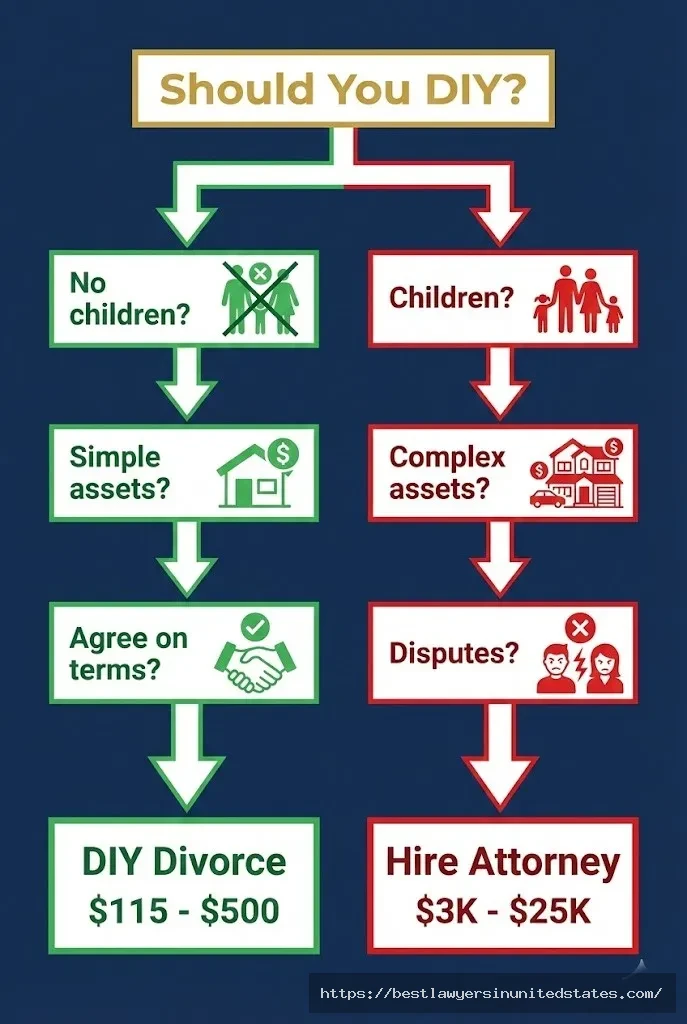
Ideal candidates for pro se divorce:
- Both spouses agree on all terms (truly uncontested)
- No minor children
- Limited marital assets (less than $50,000 total)
- Short marriage (under 5 years)
- No retirement accounts requiring division
- No real estate
- No business ownership
- No spousal support disputes
- Both spouses can communicate civilly
Realistic expectations: Even simple DIY divorces require 10-20 hours of work reading instructions, completing forms, filing paperwork, and attending court hearings. You’ll need basic computer skills, attention to detail, and ability to follow legal instructions.
Step-by-Step Pro Se Filing Process
Step 1: Verify residency – Either you or your spouse must have lived in your South Dakota county for 60 continuous days before filing.
Step 2: Determine grounds – South Dakota allows no-fault divorce based on irreconcilable differences (most common) or fault-based grounds like adultery, extreme cruelty, or abandonment.
Step 3: Gather financial documents – Collect tax returns (past 2 years), bank statements, pay stubs, retirement account statements, mortgage documents, vehicle titles, and credit card statements.
Step 4: Complete required forms:
- Complaint for Divorce (initiating document)
- Summons
- Confidential Information Form
- Financial Affidavit
- Parenting Plan (if children involved)
- Child Support Obligation Worksheet (if children involved)
- Decree of Divorce (final document)
Step 5: File with circuit court – Take original documents plus 2-3 copies to your county circuit court clerk. Pay the $115 filing fee. The clerk stamps your copies with the case number.
Step 6: Serve your spouse – Your spouse must be formally notified. Options include:
- Acceptance of Service (spouse signs voluntarily—cheapest option)
- Sheriff’s service ($50-$75)
- Private process server ($75-$100)
- Certified mail (only if spouse lives out of state)
Your spouse has 30 days to respond. If they don’t respond, you can proceed with a default divorce.
Step 7: Wait 60 days – South Dakota requires a 60-day waiting period from service date to finalization. Use this time to finalize all paperwork.
Step 8: Attend final hearing – Some counties require brief court appearances; others finalize divorces on paperwork alone if uncontested. The judge reviews your settlement, asks basic questions, and signs the Decree of Divorce.
Step 9: File the decree – Once signed, file the decree with the circuit court clerk. This finalizes your divorce. Request certified copies for your records (you’ll need these for name changes, benefit enrollment, etc.).
Required Forms & Where to Get Them
Official source: South Dakota Unified Judicial System at ujslawhelp.sd.gov provides free, court-approved forms in fillable PDF format.
Forms you’ll need:
- UJS-250: Complaint for Divorce
- UJS-251: Summons
- UJS-252: Confidential Information Form
- UJS-260: Financial Affidavit
- UJS-282: Parenting Plan (if children)
- UJS-283: Child Support Obligation Worksheet (if children)
- UJS-290: Decree of Divorce
County-specific requirements: Call your circuit court clerk to confirm if your county requires additional local forms or has specific formatting requirements.
Understanding South Dakota Divorce Requirements
South Dakota has specific legal requirements you must meet before filing or finalizing a divorce.
Residency Requirements (183-Day Rule)
To file for divorce in South Dakota, either you or your spouse must be a resident of South Dakota and have lived in the county where you’re filing for at least 60 continuous days before filing.
South Dakota also has a separate 183-day presence rule for establishing domicile (legal residence), but for divorce purposes, the 60-day county residency requirement is what matters.
Military exception: Active-duty military members stationed in South Dakota can file for divorce here if they’ve been stationed in the state for 60 consecutive days, even if they’re not legal residents.
Proof of residency: The court may require documentation like a driver’s license, voter registration, utility bills, or lease agreement showing your county address.
Grounds for Divorce
South Dakota recognizes both no-fault and fault-based grounds for divorce.
No-fault ground (most common):
- Irreconcilable differences – The marriage relationship has broken down with no reasonable prospect of reconciliation. No specific evidence required; either spouse’s statement that the marriage is irretrievably broken is sufficient.
Fault-based grounds:
- Adultery – Voluntary sexual intercourse with someone other than your spouse
- Extreme cruelty – Physical harm or mental suffering making cohabitation unsafe
- Willful desertion – Abandonment for more than one year
- Willful neglect – Failure to provide necessities for more than one year
- Habitual intemperance – Chronic drunkenness or drug abuse
- Conviction of a felony
Does fault matter? In most cases, no. South Dakota courts typically finalize divorces based on irreconcilable differences regardless of who caused the marriage breakdown. Fault grounds rarely affect property division or alimony unless the misconduct was extreme and directly impacted marital finances.
Waiting Period (60 Days)
South Dakota imposes a mandatory 60-day waiting period from the date your spouse is served (or signs acceptance of service) until the divorce can be finalized.
This cooling-off period gives couples time to reconsider, attempt reconciliation, or finalize settlement negotiations. The court will not sign your Decree of Divorce until 60 days have elapsed, even in uncontested cases where all paperwork is complete.
Timeline reality: While the minimum is 60 days, most divorces take longer:
- Uncontested, no children: 2-3 months
- Uncontested with children: 3-5 months
- Contested divorce: 6-18 months
- High-conflict with trial: 12-24+ months
Who Pays for the Divorce in South Dakota?
Default Rule: Each Party Pays Their Own Costs
South Dakota generally follows the “American Rule”—each spouse pays their own attorney fees and costs unless the court orders otherwise. This means if you hire an attorney and spend $10,000 on your divorce, you’re responsible for that expense regardless of who filed or who was at fault.
Filing fees and court costs are typically paid by the person filing each document. The petitioner (person filing for divorce) pays the $115 filing fee. If the respondent files motions or counterclaims, they pay those filing fees.
When Courts Order Fee Sharing
South Dakota courts can order one spouse to contribute to the other spouse’s attorney fees and costs in specific circumstances:
Financial disparity: When one spouse has significantly greater income or assets than the other, courts may order the higher-earning spouse to pay part of the other’s legal fees. This ensures both parties can afford adequate legal representation.
Bad faith conduct: If one spouse unnecessarily prolongs the case, files frivolous motions, refuses to comply with discovery, or engages in other unreasonable behavior that increases costs, courts can order that spouse to pay the other’s attorney fees incurred because of the bad conduct.
Contempt of court: Spouses who violate court orders (failing to pay temporary support, hiding assets, refusing to allow parenting time) can be ordered to pay the other spouse’s attorney fees for enforcement actions.
Can Your Spouse Be Ordered to Pay Your Attorney Fees?
Maybe. To request attorney fees, you must file a motion asking the court to order your spouse to contribute. You’ll need to prove:
- Financial need: You cannot afford attorney fees without assistance
- Spouse’s ability to pay: Your spouse has income or assets sufficient to contribute
- Reasonableness: The fees you’re requesting are reasonable and necessary
Courts consider factors like:
- Income difference between spouses
- Separate property each spouse owns
- Which spouse primarily caused the divorce expenses
- Whether either spouse wasted marital assets
- Each spouse’s earning capacity
When it’s likely: Stay-at-home parent divorcing a high-earning spouse, especially if the higher earner has separate property while the other has minimal assets.
When it’s unlikely: Both spouses work and earn similar incomes with comparable assets.
Timing: Attorney fee requests are typically decided at the final hearing after the court has divided property and determined support obligations.
Month-by-Month Divorce Cost Timeline
Understanding when expenses hit helps you budget for divorce without financial surprise.
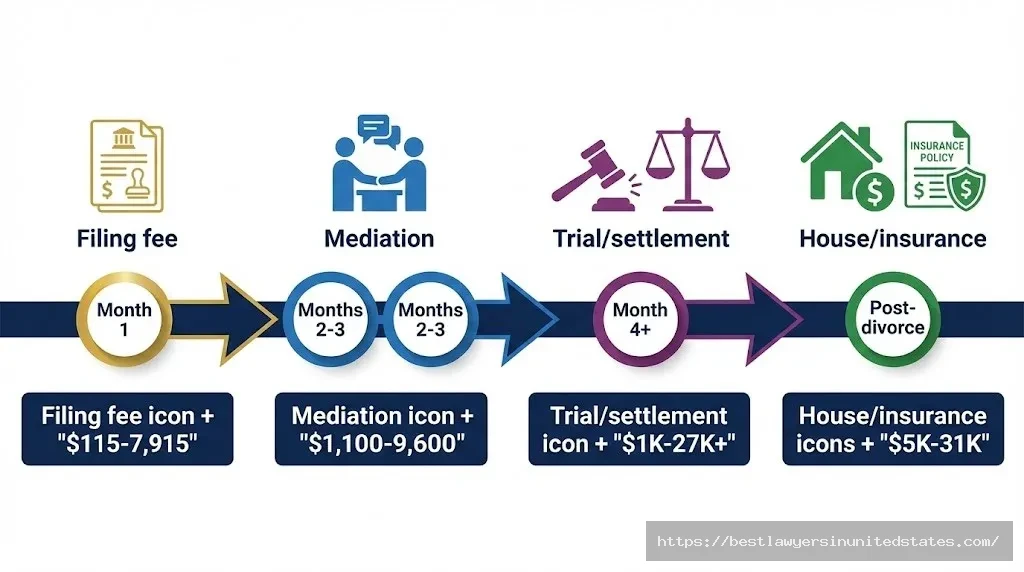
Month 1 (Initial filing):
- Attorney consultation: $0-$300 (many offer free initial consults)
- Retainer fee: $2,500-$7,500 (if hiring attorney)
- Filing fee: $115
- Process server: $50-$100
- Total Month 1: $2,665-$7,915
Months 2-3 (Discovery and negotiation):
- Attorney hours: $500-$3,000/month (varies by case complexity)
- Mediation: $300-$1,200 (if attempting settlement)
- Property appraisal: $300-$600 (if needed)
- Financial document gathering: $0-$500
- Total Months 2-3: $1,100-$9,600
Month 4+ (Settlement or trial preparation):
- Additional attorney hours: $1,000-$5,000+/month (contested cases)
- Expert witnesses: $1,500-$5,000 (if needed)
- Custody evaluation: $2,000-$5,000 (if ordered)
- Court reporter: $500-$2,000 (if trial occurs)
- Trial preparation: $3,000-$10,000 (contested cases)
- Total Month 4+: $1,000-$27,000+
Post-divorce (first 6 months):
- QDRO preparation: $500-$2,500 (retirement account division)
- Refinancing costs: $2,000-$5,000 (if keeping house)
- Moving expenses: $1,500-$4,000
- New housing deposits: $1,000-$3,000
- Health insurance: $200-$1,500/month (if losing spouse’s coverage)
- Total post-divorce: $5,200-$31,000 first year
Financial Readiness: Can You Afford to Divorce?
Divorce costs aren’t just legal fees—your entire financial picture changes. Understanding post-divorce economics helps you make informed decisions.

Pre-Divorce Financial Planning Checklist
Before filing, address these financial basics:
☐ Build an emergency fund – Aim for $3,000-$5,000 to cover initial filing costs, retainers, and moving expenses
☐ Open individual bank accounts – Establish checking and savings in your name only for post-divorce finances
☐ Document all marital assets – Photograph valuables, copy account statements, and list property you’ll want in settlement
☐ Check credit reports – Review your credit for joint accounts, understand your score, and document pre-divorce credit status
☐ Calculate post-divorce income – Estimate your actual take-home pay after losing spouse’s income contribution
☐ Price housing options – Research rental prices or mortgage payments you’ll afford on single income
☐ Evaluate health insurance – If covered under spouse’s plan, get quotes for individual coverage (often $300-$800/month)
☐ Update estate planning – You’ll need new beneficiary designations, power of attorney, and possibly a revised will
☐ Consider tax implications – Switching from married filing jointly to single or head of household changes tax brackets and deductions
☐ Protect assets – Close joint credit cards, remove spouse from bank account access, and secure valuable property
Post-Divorce Budget Considerations
Income changes:
- Loss of spouse’s income contribution to household
- Potential child support received (or paid)
- Possible spousal support (temporary or permanent)
Housing cost changes:
- If keeping marital home: full mortgage, insurance, maintenance, utilities
- If renting: deposit, first/last month rent, renters insurance
- Average housing cost increases 20-30% when going from dual to single income
New expenses:
- Individual health insurance premiums
- Separate auto insurance policy
- Full childcare costs (if previously shared)
- Separate utility accounts and deposits
- Moving costs and new household setup
Reduced expenses:
- One less person’s food, clothing, entertainment
- Potential debt reduction through settlement
Budget recommendation: Plan for monthly expenses to increase 25-40% while household income drops 30-60% (depending on each spouse’s earnings). Most financial advisors recommend having 6-12 months of expenses saved before filing.
Payment Plans & Financing Options
Attorney payment plans: Many South Dakota family law attorneys offer payment arrangements, especially for clients who cannot afford full retainers upfront. Ask about:
- Monthly payment plans (spread retainer over 3-6 months)
- Billing against retainer (pay as you go rather than upfront lump sum)
- Reduced retainer for uncontested cases
Legal financing companies: Companies like LawPay and Paybright offer loans specifically for legal fees. Interest rates typically run 8-18% APR. Use only if absolutely necessary—these are expensive debts.
Credit cards: Some clients pay retainers via credit card. Only advisable if you have 0% promotional APR or can pay balance quickly. Average credit card interest (19-29%) makes this the most expensive financing option.
Family loans: Borrowing from family avoids interest but creates different complications. Put agreements in writing to prevent misunderstandings.
401(k) loans: You can borrow from your own 401(k) (not yet divided) to fund divorce costs. You’ll repay yourself with interest, but you lose investment growth during repayment period. Consider this only for essential costs in contested divorces.
Frequently Asked Questions
How much does a divorce lawyer cost per hour in South Dakota?
South Dakota divorce attorneys charge $150-$400 per hour depending on location and experience. Sioux Falls and Rapid City attorneys typically charge $200-$400/hour, while attorneys in smaller towns charge $150-$250/hour. Most require an upfront retainer of $2,500-$7,500.
What happens if I can’t afford the filing fee?
File an Affidavit of Indigency requesting a fee waiver. If the court determines you qualify based on your income and expenses, you won’t pay the $115 filing fee. Forms are available at ujslawhelp.sd.gov or your local circuit court clerk’s office.
Does adultery affect divorce costs in South Dakota?
Rarely. While adultery is a legal ground for divorce in South Dakota, most divorces are filed as no-fault (irreconcilable differences). Proving adultery requires evidence and witnesses, which increases legal costs. Unless the cheating spouse spent significant marital assets on the affair, fault grounds don’t typically affect property division or alimony, making the extra cost unnecessary.
How much does it cost if both parties agree?
An uncontested divorce where both parties agree on all terms costs $500-$3,000 in South Dakota, including the $115 filing fee, process server ($50-$100), and document preparation ($150-$2,500 depending on whether you DIY or hire an attorney for limited representation).
What is the cheapest way to get divorced in South Dakota?
File pro se (represent yourself) in an uncontested case with no children and minimal assets. Use free forms from ujslawhelp.sd.gov, have your spouse sign an Acceptance of Service (avoiding process server fees), and file all paperwork yourself. Total cost: $115 filing fee only.
Can my spouse be ordered to pay my attorney fees?
Yes, if you can prove financial need and your spouse has the ability to pay. Courts consider income disparity, separate property, and whether either spouse caused unnecessary legal expenses. Stay-at-home parents divorcing higher-earning spouses most commonly receive attorney fee contributions.
How long does a divorce take in South Dakota?
Minimum 60 days due to the mandatory waiting period. Realistically: uncontested divorces take 2-5 months, contested divorces take 6-18 months, and high-conflict cases requiring trial can take 12-24+ months.
Is South Dakota a 50/50 divorce state?
No. South Dakota follows equitable distribution, not automatic 50/50 splits. Courts divide property fairly based on factors like marriage length, each spouse’s income and earning capacity, contributions to marital property, and custodial arrangements. “Equitable” means fair, not necessarily equal.
What is the 10-10-10 rule for divorce?
This refers to military pension division. A former spouse qualifies for direct payment of military retirement if: (1) the marriage lasted at least 10 years, (2) the servicemember performed at least 10 years of creditable military service, and (3) there was at least 10 years of overlap between the marriage and military service.
Can I get a divorce without going to court in South Dakota?
In some counties, yes. If your divorce is uncontested and all paperwork is complete and agreed upon, some South Dakota circuit courts will finalize divorces without requiring a court appearance. Check with your local circuit court clerk about their specific procedures.
Do I have to live in South Dakota for a year before divorcing?
No. You only need to live in your South Dakota county for 60 continuous days before filing. This is one of the shortest residency requirements in the nation—many states require 6-12 months of state residency.
How much does divorce mediation cost in South Dakota?
$100-$300 per hour. Most couples need 3-8 hours of mediation (total cost $500-$2,500) to resolve property, custody, and support issues. This is significantly cheaper than attorney-led litigation.
What happens to retirement accounts in a South Dakota divorce?
Retirement accounts earned during the marriage are marital property subject to equitable division. Dividing 401(k)s, IRAs, and pensions requires a Qualified Domestic Relations Order (QDRO) prepared by an attorney (cost: $500-$2,500). Funds transferred via QDRO aren’t taxed or penalized.
Can I stop paying if my ex remarries?
For spousal support (alimony), yes—South Dakota law automatically terminates alimony when the recipient remarries. For child support, no—remarriage doesn’t affect child support obligations. Child support continues until the child turns 18 or graduates high school (whichever is later).
How is child support calculated in South Dakota?
South Dakota uses an income shares model based on both parents’ gross incomes and the number of children. The state provides an online calculator at dss.sd.gov. Basic support covers food, shelter, clothing, and education. Additional expenses (medical insurance, daycare, extracurriculars) are typically split proportionally.
Do we have to sell our house in a divorce?
Not necessarily. Options include: (1) one spouse buys out the other’s equity and refinances, (2) both spouses agree to sell and split proceeds, (3) continue co-owning (rare—typically temporary until market improves or children graduate), or (4) one spouse keeps the house and the other receives offsetting assets. Courts can order a sale if spouses can’t agree.
What’s the difference between legal separation and divorce in South Dakota?
Legal separation divides assets, determines custody, and establishes support without terminating the marriage. You remain legally married (can’t remarry) but live separately with court-ordered financial arrangements. Some couples choose this for religious reasons or to maintain health insurance benefits. Separation can be converted to divorce later.
How much does a custody evaluation cost?
$2,000-$5,000 in South Dakota. Courts order custody evaluations in contested cases when they need expert assessment of parenting abilities, home environments, and the child’s best interests. The evaluator (psychologist or social worker) interviews parents and children, conducts home visits, and provides recommendations to the court.
Can I modify child support or custody after divorce?
Yes. Either parent can request modification by filing a motion showing a substantial change in circumstances. For child support, this typically means a significant income change (20% or more). For custody, you must prove changes affecting the child’s best interests. Each modification attempt requires court filing fees and potentially attorney fees.
What if my spouse hides assets during divorce?
This is called dissipation or fraud. If you suspect hidden assets, your attorney can use discovery tools (subpoenas, depositions, forensic accountants) to locate them. If proven, courts can award you a greater share of marital property to compensate. Hiding assets is illegal and can result in contempt charges and additional attorney fee awards.
Next Steps: Getting Started with Your South Dakota Divorce
Ready to move forward? Here’s what to do next:
- Assess your situation – Determine if your divorce will be uncontested or contested, whether children are involved, and what assets need division
- Decide on representation – Choose between hiring a full-service attorney, using limited-scope representation, mediation, or filing pro se
- Gather financial documents – Collect tax returns, bank statements, retirement account statements, mortgage documents, and credit card statements
- Consult with attorneys – Most offer free initial consultations where you can discuss your case specifics and get cost estimates
- Start budgeting – Calculate your post-divorce financial reality and begin saving for upfront costs
- Access free resources – Download forms from ujslawhelp.sd.gov and explore legal aid eligibility if needed
Need to estimate your specific divorce costs? Use our divorce cost calculator customized for South Dakota to get a personalized cost breakdown based on your situation.
Comparing options nationwide? See how much divorce costs across America to understand how South Dakota compares.
