
Alaska’s minimum wage will increase to $14.00 per hour on January 1, 2026, continuing the state’s voter-approved path toward $15.00 by 2027. This represents a $2.09 increase from the current $11.91 rate and affects over 95,000 workers across the state. Alaska’s rate remains significantly higher than the federal minimum wage of $7.25.
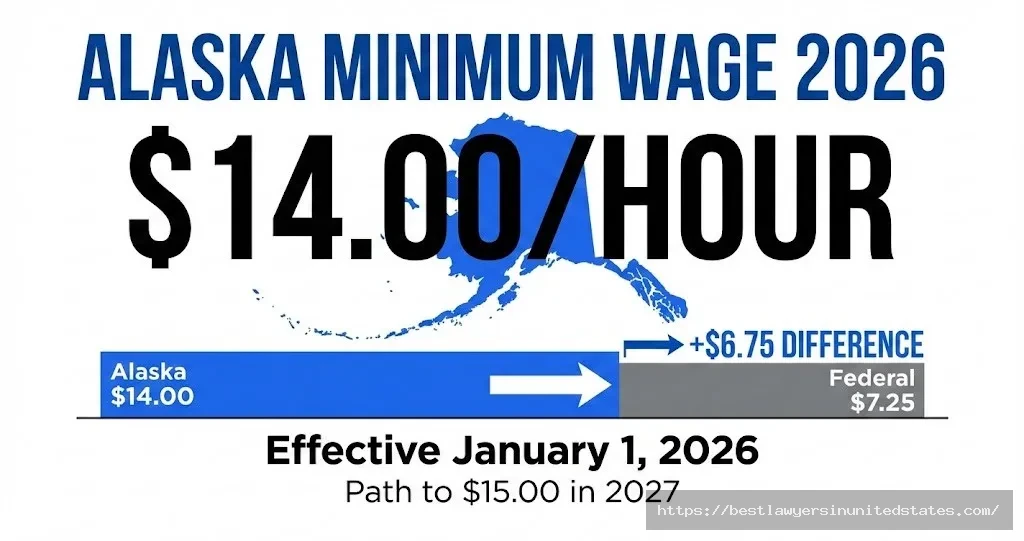
The increase follows Ballot Measure 1, passed by Alaska voters in 2024, which established a multi-year wage increase schedule and mandatory paid sick leave requirements. Unlike many states, Alaska applies its minimum wage uniformly statewide—Anchorage, Fairbanks, and Juneau all follow the same rate.
Key facts for 2026:
- Current rate: $13.00/hour (through December 31, 2025)
- New rate: $14.00/hour (effective January 1, 2026)
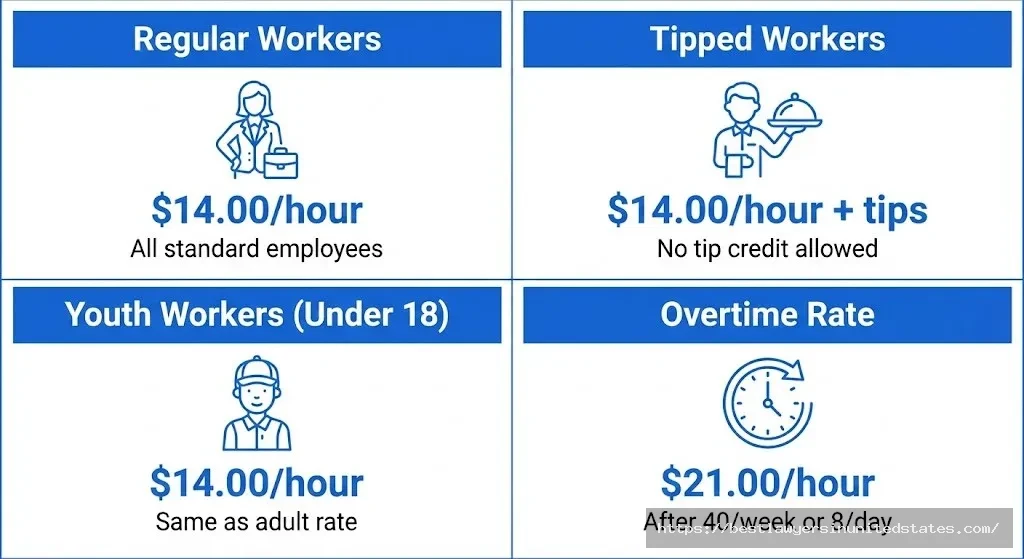
- Tipped workers: Receive full $14.00/hour PLUS tips (no tip credit)
- Paid sick leave: 40-56 hours annually based on employer size
- Next increase: $15.00/hour on January 1, 2027
Calculate Your Earnings in Alaska
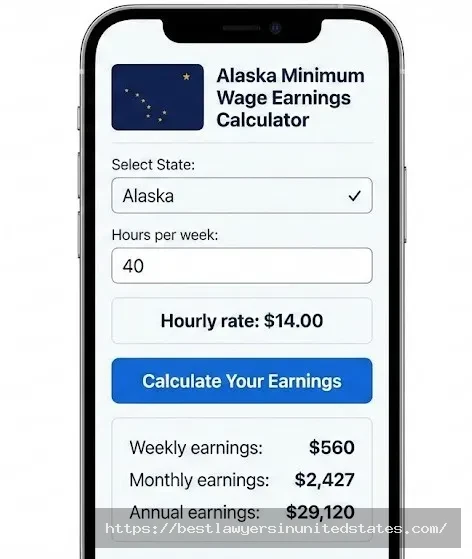
Want to know exactly how much you’ll earn at Alaska’s $14.00 minimum wage? Use our free calculator to estimate your weekly, monthly, and annual income based on your hours worked.
💰 Minimum Wage Earnings Calculator
Calculate your weekly, monthly, and annual earnings with overtime and tax estimates
📊 Your Earnings Breakdown
💰 Gross Earnings
Calculator features:
- Automatic Alaska wage rates for 2026
- Weekly, monthly, and annual earnings
- Overtime calculations
- Tax withholding estimates
- Take-home pay breakdown
Full calculator with all features: Calculate your exact earnings with our minimum wage calculator
Questions about your wages or need legal help?
Email: [email protected]
What Is Alaska's Minimum Wage in 2026?
Quick Answer: Alaska's minimum wage is $14.00 per hour as of January 1, 2026, which is $6.75 higher than the federal minimum wage of $7.25.
Alaska law requires all employers to pay at least the state minimum wage, regardless of business size or industry. The Alaska Department of Labor and Workforce Development enforces these requirements under Alaska Statute 23.10.065.
How Alaska's Minimum Wage Compares
Alaska ranks among the top 10 states for minimum wage rates nationally. The state's $14.00 rate exceeds the federal standard by 93%.
| Jurisdiction | Minimum Wage | Difference from Federal |
|---|---|---|
| Alaska | $14.00 | +$6.75 (93% higher) |
| Federal | $7.25 | Baseline |
| Washington | $16.66 | +$9.41 (130% higher) |
| Oregon | $14.70 | +$7.45 (103% higher) |
Who Must Pay Alaska Minimum Wage?
All Alaska employers must comply with state minimum wage laws. This includes:
- Private sector businesses
- Non-profit organizations
- Government contractors
- Seasonal employers
- Agricultural operations
- Restaurants and hospitality
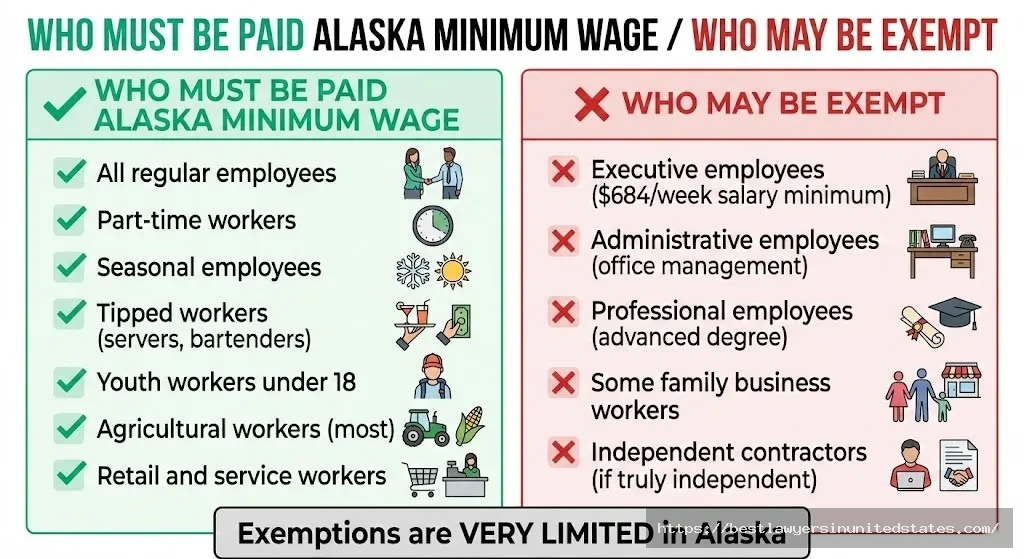
Exemptions are extremely limited. Most workers in Alaska receive full minimum wage protection under state law.
Alaska Minimum Wage History and Future Increases
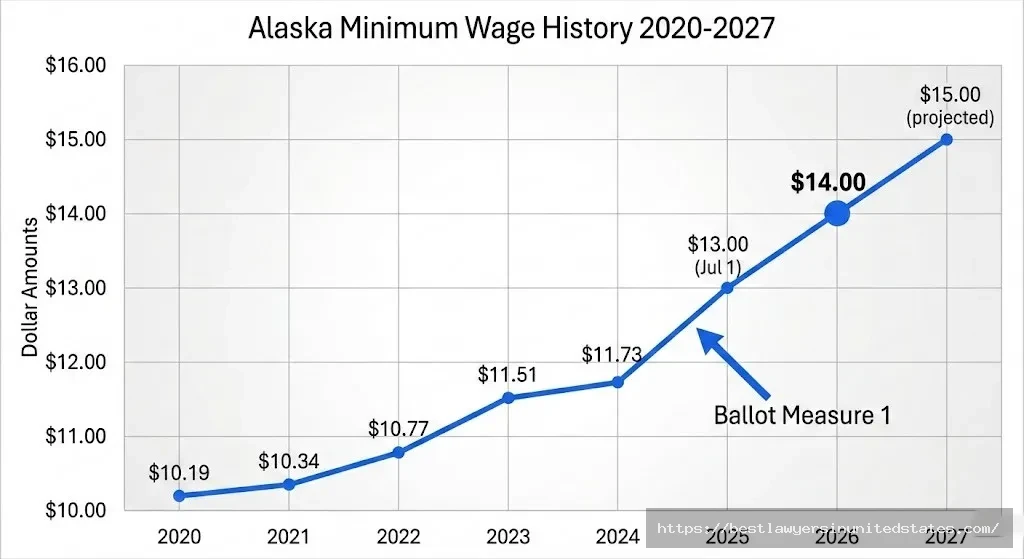
Alaska has maintained a minimum wage above federal levels since 2015, when voters approved Ballot Measure 3. The state uses automatic annual adjustments based on the Consumer Price Index (CPI) for Anchorage.
Complete Timeline: 2024-2027
| Effective Date | Minimum Wage | Increase Amount | Notes |
|---|---|---|---|
| Jan 1, 2024 | $11.73 | +$0.23 | CPI adjustment |
| Jan 1, 2025 | $11.91 | +$0.18 | CPI adjustment |
| Jul 1, 2025 | $13.00 | +$1.09 | Ballot Measure 1 |
| Jan 1, 2026 | $14.00 | +$1.00 | Ballot Measure 1 |
| Jan 1, 2027 | $15.00 | +$1.00 | Final scheduled increase |
2024 Ballot Measure 1: What Changed
Alaska voters approved Ballot Measure 1 in November 2024, creating the most significant wage increase in state history. The measure includes:
Wage increases:
- July 1, 2025: Jump to $13.00/hour
- January 1, 2026: Increase to $14.00/hour
- January 1, 2027: Final increase to $15.00/hour
- After 2027: Annual CPI adjustments continue
Paid sick leave:
- Small employers (1-14 workers): 40 hours/year
- Large employers (15+ workers): 56 hours/year
- Accrual rate: 1 hour per 30 hours worked
- Carryover: Up to 40 hours to next year
Impact: These changes affect approximately 95,000 Alaska workers, or about 28% of the state's workforce.
How CPI Adjustments Work
Alaska's minimum wage adjusts annually based on the Consumer Price Index for all Urban Consumers in the Anchorage metropolitan area. The Alaska Department of Labor calculates the adjustment each September and announces the new rate by October 15.
Historical CPI adjustments (2015-2025):
- Average annual increase: $0.20-$0.30
- Largest increase: $0.43 (2022)
- Smallest increase: $0.05 (2020)
This mechanism helps Alaska workers maintain purchasing power as living costs rise. However, understanding broader labor law protections remains important for all employees.
Alaska Tipped Employee Minimum Wage
Quick Answer: Alaska does NOT allow tip credits. All tipped workers must receive the full $14.00/hour minimum wage PLUS any tips they earn.
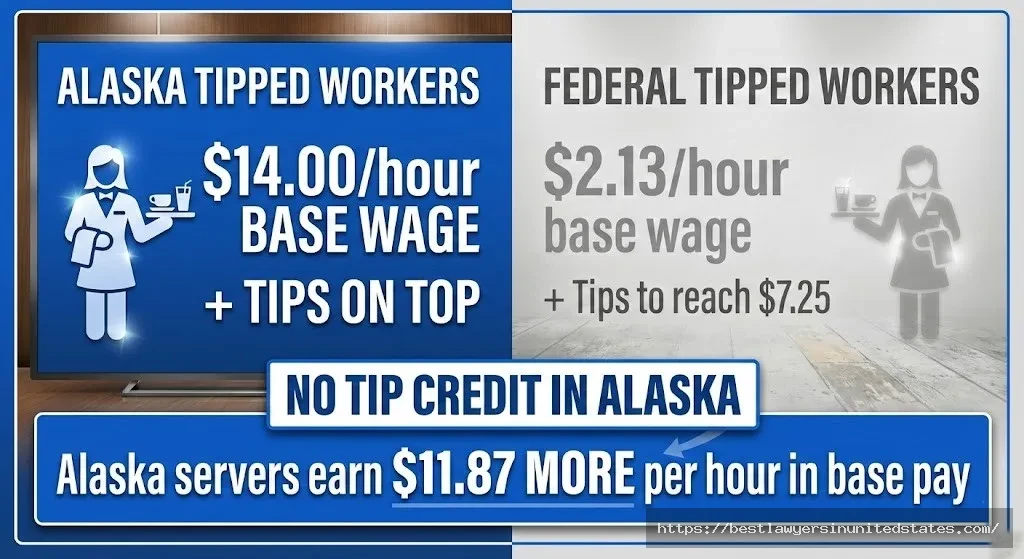
Alaska is one of only seven states that prohibit tip credits entirely. This means servers, bartenders, and other tipped employees earn significantly more than their counterparts in most other states.
Alaska vs Federal Tipped Wage Rules
The difference between Alaska and federal law creates substantial wage advantages for service workers.
| Jurisdiction | Base Wage | Tips | Total Compensation |
|---|---|---|---|
| Alaska | $14.00/hour | Additional | $14.00+ |
| Federal | $2.13/hour | Additional | $2.13+ |
| Texas | $2.13/hour | Additional | $2.13+ |
| California | $16.50/hour | Additional | $16.50+ |
Example calculation: An Alaska server working 40 hours per week earns a guaranteed $560 base pay, before tips. The same server in Texas would earn only $85.20 base pay.
Who Qualifies as a Tipped Employee?
Alaska law defines tipped employees as workers who regularly receive more than $30 per month in tips. Common positions include:
- Restaurant servers and waitstaff
- Bartenders and barbacks
- Hotel bellhops and doormen
- Valet parking attendants
- Hair stylists and barbers
- Food delivery drivers
All these workers receive full minimum wage under Alaska Statute 23.10.055.
Tip Pooling Rules in Alaska
Alaska law permits voluntary tip pooling among employees who regularly receive tips. Employers cannot participate in tip pools or retain any portion of employee tips.
Legal tip pooling:
- ✓ Servers sharing with bussers
- ✓ Bartenders sharing with barbacks
- ✓ Voluntary agreements among staff
- ✓ Pooling among similar positions
Illegal tip practices:
- ✗ Managers taking tips
- ✗ Owners keeping any tip portion
- ✗ Forced contributions to non-service staff
- ✗ Tip pools including kitchen staff (in most cases)
Violations can trigger significant penalties. Workers experiencing tip theft should use our wage theft recovery calculator to estimate potential damages.
Alaska Overtime Laws and Regulations
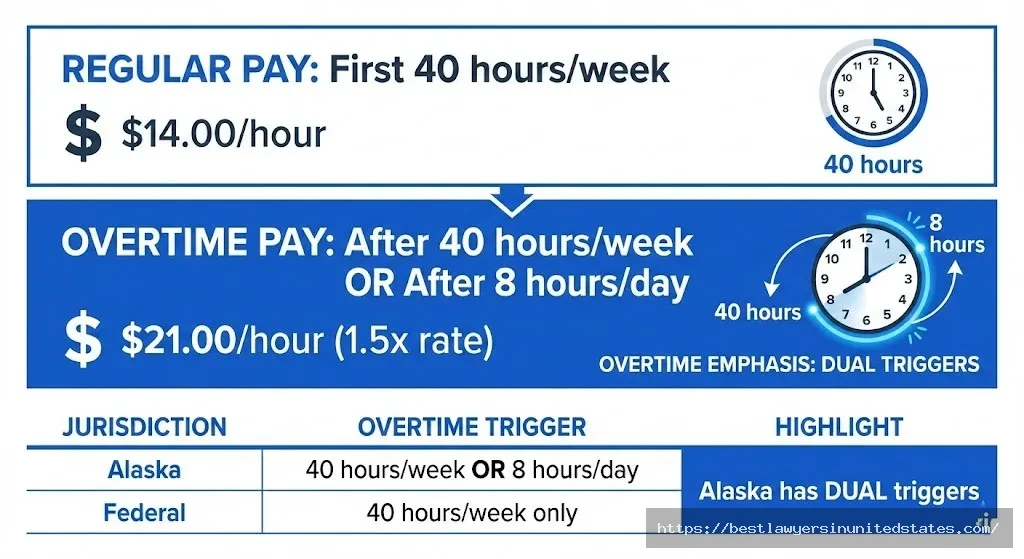
Alaska requires overtime pay at 1.5 times the regular rate for hours exceeding either 40 per week OR 8 per day. This dual trigger system provides stronger protections than federal law.
Calculate Your Overtime Pay in Alaska
Working more than 40 hours per week? Calculate your overtime earnings based on Alaska's overtime laws. This calculator accounts for Alaska's specific daily and weekly overtime rules.
⏰ Overtime Pay Calculator
Calculate your overtime earnings based on your state's specific labor laws
📍 Select Your State
💰 Your Hourly Wage
📊 Calculation Method
📅 Weekly Hours
💵 Your Weekly Overtime Pay
📊 Earnings Breakdown
📅 Pay Period Estimates
⚖️ State vs Federal Comparison
Calculator features:
- Alaska-specific overtime rules
- Daily and weekly overtime calculations
- Double-time calculations (if applicable)
- Pay period breakdowns
- Comparison with federal law
Full overtime calculator: Calculate your exact overtime pay
Questions about your wages or need legal help?
Email: [email protected]
Alaska's Dual Overtime Triggers
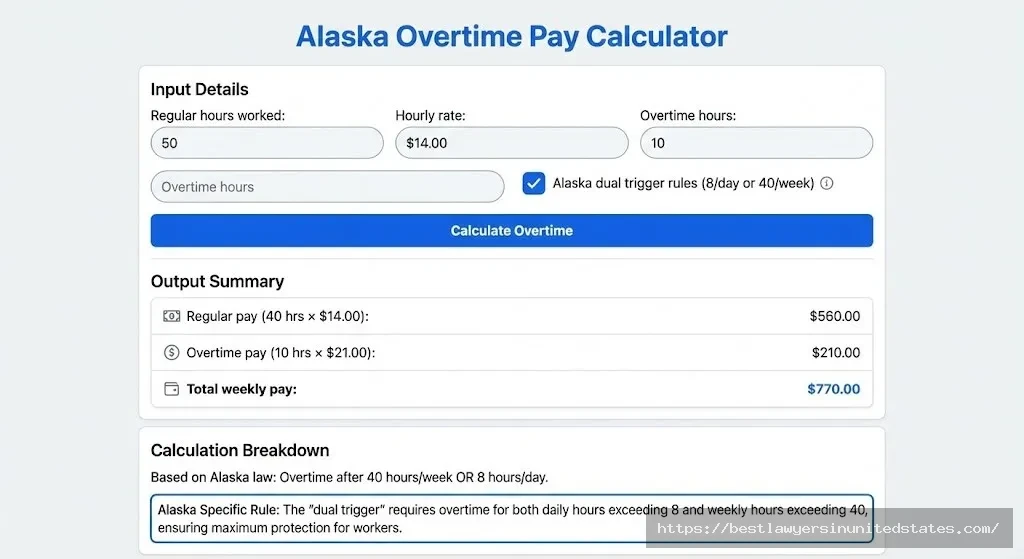
Alaska law (AS 23.10.060) requires overtime pay when workers exceed:
Daily threshold: 8 hours in a single workday Weekly threshold: 40 hours in a workweek
Employers must pay overtime for whichever threshold applies first. This means Alaska workers can earn overtime even if they work less than 40 hours weekly.
Example scenario:
- Monday-Thursday: 10 hours each day = 8 hours straight + 2 hours overtime daily
- Friday: 6 hours
- Total: 40 hours straight + 8 hours overtime
- Weekly hours: 48 total, but 8 already counted as overtime
Alaska Overtime Rate Calculations
Standard overtime pays 1.5 times the regular hourly rate. At Alaska's $14.00 minimum wage:
- Regular rate: $14.00/hour
- Overtime rate: $21.00/hour
- Weekly earnings (50 hours): $560 regular + $210 overtime = $770
| Hours Worked | Regular Pay | Overtime Pay | Total Pay |
|---|---|---|---|
| 40 hours | $560.00 | $0.00 | $560.00 |
| 45 hours | $560.00 | $105.00 | $665.00 |
| 50 hours | $560.00 | $210.00 | $770.00 |
| 60 hours | $560.00 | $420.00 | $980.00 |
Who Is Exempt from Alaska Overtime?
Alaska follows federal Fair Labor Standards Act (FLSA) exemptions with some modifications. Common exemptions include:
Executive exemption:
- Primary duty: Managing business or department
- Supervises at least two employees
- Authority to hire/fire or make recommendations
- Salary: At least $684/week ($35,568/year)
Administrative exemption:
- Office or non-manual work
- Directly related to management or business operations
- Exercises discretion and independent judgment
- Salary: At least $684/week
Professional exemption:
- Work requires advanced knowledge
- Knowledge predominantly intellectual in character
- Requires prolonged specialized instruction
- Salary: At least $684/week
Important: Employers cannot simply declare workers "exempt." Job duties must genuinely meet legal requirements. Misclassification issues often arise in workplace disputes and may entitle workers to back pay.
Common misclassifications:
- Assistant managers without real authority
- "Salaried" workers performing hourly tasks
- Workers paid flat daily rates
- Employees labeled "independent contractors"
Alaska Wage and Hour Laws
The Alaska Wage and Hour Act (AS 23.10) establishes comprehensive protections for workers. The Alaska Department of Labor and Workforce Development enforces these requirements through its Wage and Hour Administration.
Alaska Wage Payment Requirements
Alaska law mandates specific payment schedules and methods to protect workers.
Payment frequency:
- Most employees: At least semi-monthly
- Manual laborers: Weekly or semi-monthly
- Commission-based workers: At least monthly
Final paycheck rules:
- Voluntary resignation: Next regular payday
- Termination/layoff: Within 3 working days
- Seasonal worker separation: Within 24 hours if possible
Acceptable payment methods:
- Direct deposit (with employee consent)
- Payroll checks
- Cash (with proper documentation)
- Payroll cards (with specific protections)
Required Wage Deductions vs Prohibited Deductions
Alaska restricts what employers can deduct from paychecks.
Legal deductions:
- Federal and state income taxes
- Social Security and Medicare (FICA)
- Court-ordered garnishments
- Health insurance premiums (with consent)
- Retirement contributions (with authorization)
Illegal deductions (without written consent):
- Cash register shortages
- Damaged equipment or property
- Uniforms or tools required for work
- Training costs
- Customer walkouts (restaurants)
Key rule: Deductions cannot reduce wages below minimum wage, even with employee consent.
Alaska Wage Poster Requirements
Alaska employers must display official wage and hour posters in conspicuous locations. The poster must include:
- Current Alaska minimum wage rate
- Overtime pay requirements
- Employee rights under Alaska law
- Alaska Department of Labor contact information
- Equal pay and discrimination notices
Posting requirements:
- Location: Where employees can easily read it
- Language: English plus languages spoken by employees
- Updates: Replace when rates change
- Penalties: Up to $500 per violation
Download the official poster from the Alaska Department of Labor website. Employers must post the updated version by December 31, 2025, reflecting the $14.00 rate.
How to File a Wage Complaint in Alaska
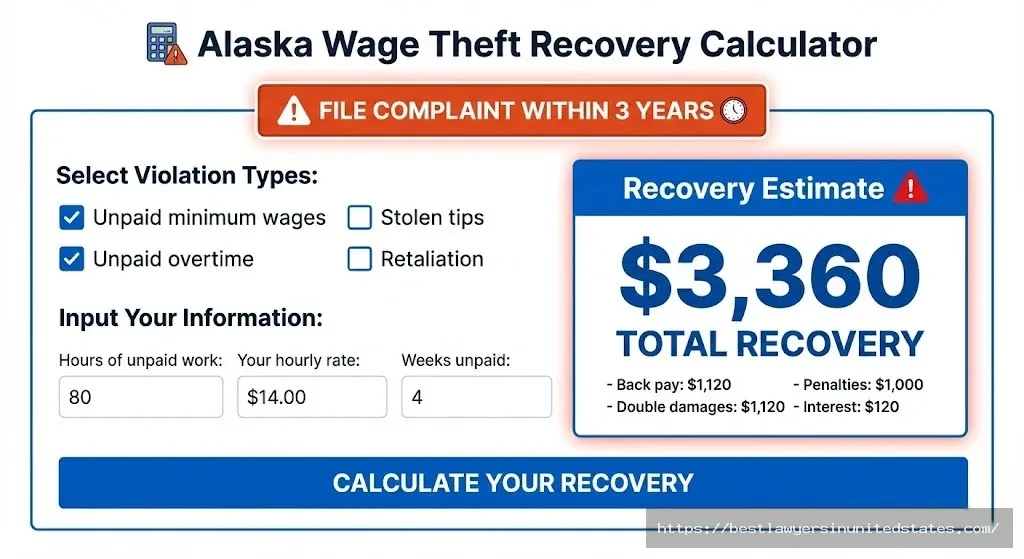
Think your employer owes you money? Use our wage theft calculator to estimate how much you could recover, including unpaid wages, penalties, and interest under Alaska law.
Wage Theft Recovery Calculator
Estimate how much you can recover in unpaid wages, penalties, and damages based on your state's laws
💵 Estimated Total Recovery
💰 Unpaid Wages
⚖️ Penalties & Damages
📋 Total Summary
Calculator features:
- Multiple violation types (unpaid wages, overtime, tips)
- Alaska-specific penalties and damages
- Filing deadline tracker
- Total recovery estimate
- Next steps guidance
Full wage theft calculator: Calculate your potential recovery
Questions about your wages or need legal help?
Email: [email protected]
Alaska Department of Labor Complaint Process
Workers can file wage complaints with the Alaska Department of Labor and Workforce Development Wage and Hour Administration.
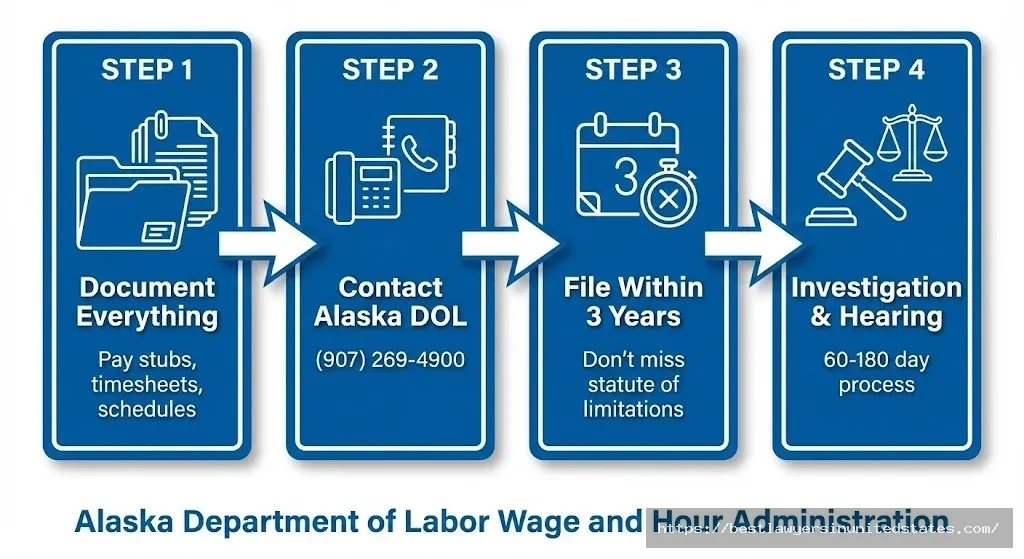
Step 1: Gather documentation
- Pay stubs showing hours and wages
- Time sheets or work schedules
- Employment contract or offer letter
- Written communications about pay
- Bank statements showing deposits
Step 2: File your complaint
- Online: Alaska Department of Labor website
- Mail: 1251 Muldoon Road, Suite 113, Anchorage, AK 99504
- Phone: (907) 269-4900
- In-person: Visit local office during business hours
Step 3: Investigation timeline
- Initial review: 2-4 weeks
- Employer notification: Within 30 days
- Investigation period: 60-90 days typically
- Resolution or hearing: 90-180 days
Step 4: Potential outcomes
- Voluntary employer compliance
- Wage and Hour Administration order
- Civil court action
- Criminal prosecution (severe cases)
Alaska Wage Theft Penalties
Alaska law imposes strict penalties on employers who violate wage requirements.
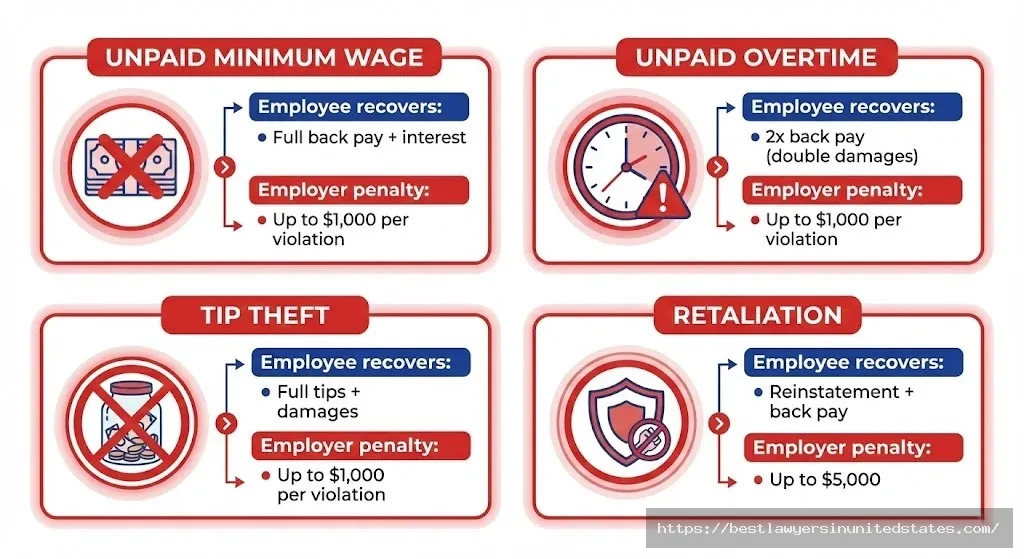
| Violation Type | Employee Recovery | Employer Penalty |
|---|---|---|
| Unpaid minimum wage | Back pay + interest | Up to $1,000 per violation |
| Unpaid overtime | Back pay + equal amount (double damages) | Up to $1,000 per violation |
| Tip theft | Full tips + damages | Up to $1,000 per violation |
| Retaliation | Reinstatement + back pay | Up to $5,000 per violation |
| Repeat violations | Triple damages possible | Enhanced penalties |
Statute of limitations: Workers have 3 years to file wage claims under Alaska law. However, filing earlier preserves evidence and prevents further losses.
Contact Alaska Wage and Hour Administration
Anchorage Office: Alaska Department of Labor and Workforce Development Wage and Hour Administration 1251 Muldoon Road, Suite 113 Anchorage, AK 99504 Phone: (907) 269-4900
Juneau Office: Alaska Department of Labor and Workforce Development P.O. Box 115509 Juneau, AK 99811-5509 Phone: (907) 465-4842
Fairbanks Regional Office: 675 7th Avenue, Station A Fairbanks, AK 99701 Phone: (907) 451-2886
Online resources:
- File complaint: labor.alaska.gov/lss/whforms.htm
- Wage information: labor.alaska.gov/lss/wage.htm
- Employment standards: labor.alaska.gov/lss/
Understanding employment agreement provisions can help prevent wage disputes before they start.
Alaska Minimum Wage by City and Region
Alaska maintains a uniform statewide minimum wage. Unlike states with city-specific rates, Anchorage, Fairbanks, Juneau, and all other Alaska communities follow the same $14.00/hour standard.
Anchorage Minimum Wage
Statutory rate: $14.00/hour (same as statewide) Local ordinance: None Living wage estimate: $22.50/hour for single adult Average hourly wage: $28.10 (all occupations)
Anchorage is Alaska's largest city with approximately 40% of the state's workforce. The $14.00 minimum wage applies to all Anchorage employers, from restaurants in downtown to retailers in Midtown to service businesses in South Anchorage.
Cost of living context: Anchorage's housing costs run 30-40% above national averages. The gap between minimum wage ($14.00) and living wage ($22.50) means minimum wage workers often need roommates or multiple jobs.
Fairbanks Minimum Wage
Statutory rate: $14.00/hour (same as statewide) Local ordinance: None Living wage estimate: $20.80/hour for single adult Average hourly wage: $26.30 (all occupations)
Fairbanks represents Alaska's second-largest labor market. The Interior region's extreme climate creates higher heating costs that impact living wage calculations.
Seasonal considerations: Many Fairbanks employers hire seasonal workers for tourism (summer) or support services. All receive the same $14.00 minimum wage regardless of season.
Juneau Minimum Wage
Statutory rate: $14.00/hour (same as statewide) Local ordinance: None Living wage estimate: $23.10/hour for single adult Average hourly wage: $29.50 (all occupations)
Alaska's capital city has the state's highest average wages due to government employment concentration. State workers and contractors must comply with prevailing wage requirements that often exceed minimum wage.
Remote Community Wages
Remote Alaska communities often pay significantly above minimum wage due to isolation, high cost of living, and recruitment challenges.
Typical premiums in remote areas:
- Barrow (Utqiaġvik): $18-$25/hour entry positions
- Nome: $16-$22/hour retail and service jobs
- Bethel: $17-$24/hour general labor
- Kotzebue: $16-$23/hour various positions
Why remote wages exceed minimums:
- Extreme cost of living (food costs 2-3x Anchorage)
- Limited housing availability
- Isolation and harsh climate
- Difficulty recruiting workers
- High employee turnover
Bureau of Labor Statistics data shows remote Alaska workers earn 25-60% above minimum wage on average, making the $14.00 floor less relevant in practice.
Alaska Minimum Wage vs Other States (2026)
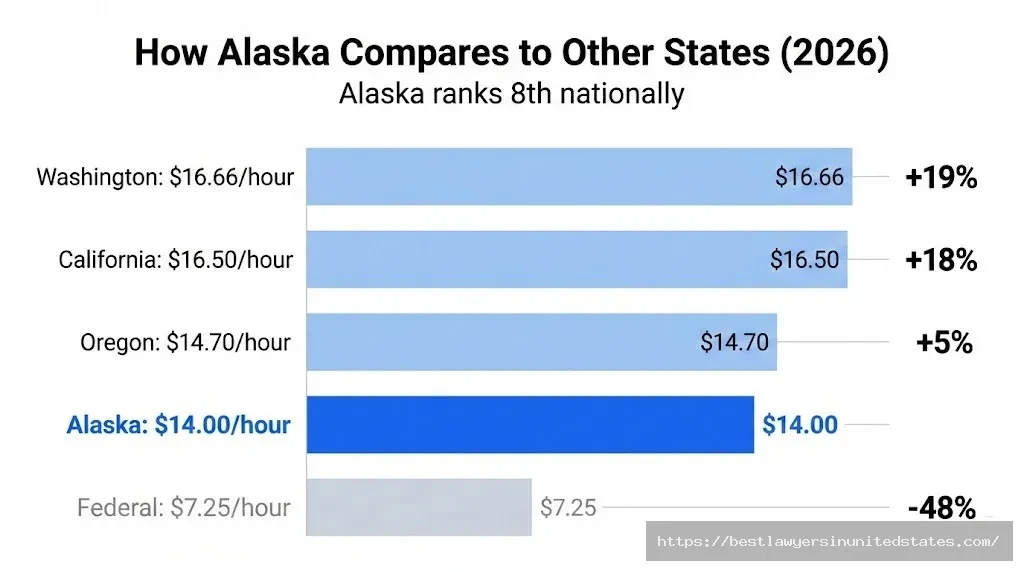
Alaska ranks 8th nationally for minimum wage rates in 2026. The state's $14.00/hour places it above most states but below West Coast leaders.
Top 10 Highest Minimum Wage States
| Rank | State | 2026 Minimum Wage | % Above Federal |
|---|---|---|---|
| 1 | Washington | $16.66 | 130% |
| 2 | California | $16.50 | 127% |
| 3 | Connecticut | $15.69 | 116% |
| 4 | New York | $15.50 | 114% |
| 5 | Massachusetts | $15.00 | 107% |
| 6 | Oregon | $14.70 | 103% |
| 7 | Colorado | $14.42 | 99% |
| 8 | Alaska | $14.00 | 93% |
| 9 | Maine | $14.15 | 95% |
| 10 | Arizona | $14.35 | 98% |
Alaska vs Neighboring States
Alaska's geographic isolation means few direct labor market competitors. However, comparison with Pacific Northwest states provides context.
| State | Minimum Wage | Tipped Wage | Difference from Alaska |
|---|---|---|---|
| Alaska | $14.00 | $14.00 | Baseline |
| Washington | $16.66 | $16.66 | +$2.66 (19% higher) |
| Oregon | $14.70 | $14.70 | +$0.70 (5% higher) |
| Idaho | $7.25 | $3.35 | -$6.75 (48% lower) |
| Montana | $10.55 | $10.55 | -$3.45 (25% lower) |
| British Columbia | $17.40 CAD (~$13.10 USD) | $17.40 CAD | -$0.90 (6% lower) |
Key differences:
- Washington leads all states, no tip credit
- Oregon slightly ahead of Alaska, no tip credit
- Idaho follows federal minimums only
- Montana below Alaska, no tip credit
- Canadian provinces use different systems
States Still at Federal Minimum
Twenty states maintain the $7.25 federal minimum wage with no scheduled increases. Alaska workers earn nearly double these rates.
States at $7.25 (2026):
- Wyoming, Georgia, Texas, Louisiana, Mississippi
- Tennessee, North Carolina, South Carolina, Alabama
- Oklahoma, Kansas, Kentucky, Indiana, Wisconsin
- Pennsylvania, New Hampshire, North Dakota, Utah
Workers in these states earn $6.75 less per hour than Alaska workers. Over a full year (2,080 hours), this represents $14,040 in additional earnings for Alaska minimum wage workers. For context, Alabama maintains the federal minimum with no state-specific increases.
Employer Compliance Guide: Alaska Minimum Wage
Alaska employers must update payroll systems, notify employees, and post required notices before January 1, 2026. Failure to comply triggers penalties and back pay obligations.
Payroll System Updates for 2026
Deadline: December 31, 2025 Action required: Update all wage rates to $14.00/hour minimum
Compliance checklist:
- ☐ Update payroll software with $14.00 rate
- ☐ Recalculate overtime rates ($21.00/hour)
- ☐ Adjust tipped employee base wages
- ☐ Review exempt employee salaries ($35,568/year minimum)
- ☐ Update automatic payment systems
- ☐ Test payroll before first 2026 pay period
Retroactive pay obligations: Employers who miss the January 1 deadline must pay retroactive wages back to January 1, plus interest.
Employee Notification Requirements
Alaska law requires written notice of wage changes. Employers should notify all affected workers by mid-December 2025.
Notice must include:
- New minimum wage rate ($14.00/hour)
- Effective date (January 1, 2026)
- New overtime rate if applicable
- Updated paid sick leave accrual information
- Contact for questions
Distribution methods:
- Individual written notices
- Paycheck inserts
- Email (if employees regularly use)
- Posted in break rooms
- Employee handbook updates
Required Workplace Postings
Employers must display updated Alaska wage and hour posters by December 31, 2025.
Posting requirements:
- Official Alaska Department of Labor poster
- Reflects $14.00 minimum wage
- Includes paid sick leave information
- Posted where employees can read it
- Languages spoken by employees
- Replaced immediately when rates change
Download official poster: labor.alaska.gov/lss/forms/ls-poster.pdf
Posting violations:
- First offense: Warning + compliance order
- Subsequent violations: $500 per violation
- Intentional non-compliance: Up to $1,000 per violation
Recordkeeping Requirements
Alaska employers must maintain detailed wage and hour records for at least 3 years.
Required records:
- Employee names and addresses
- Hours worked each day and week
- Hourly rates and total wages
- Overtime hours and overtime pay
- Deductions from wages
- Pay dates and amounts
- Tip records (for tipped employees)
Record format: Paper or electronic acceptable. Must be available for Alaska Department of Labor inspection.
Retention: 3 years from last entry date. Longer for ongoing employment relationships.
Penalties for Non-Compliance
Alaska imposes significant penalties for minimum wage violations.
| Violation Type | First Offense | Repeat Violations |
|---|---|---|
| Underpayment | Back pay + interest + up to $1,000 | Enhanced penalties |
| Poster violation | Warning | $500-$1,000 |
| Recordkeeping | $500 per violation | $1,000 per violation |
| Retaliation | $5,000 + reinstatement | Criminal charges possible |
| Willful violation | Triple damages | Criminal prosecution |
Civil vs criminal violations:
- Most violations: Civil penalties and back pay
- Willful/repeated violations: Potential criminal charges
- Retaliation: Both civil and criminal consequences
Employers facing wage claims should consult employment counsel immediately. Workers can also seek guidance on FLSA deadline requirements that may affect their cases.
Alaska Living Wage vs Minimum Wage
Alaska's $14.00 minimum wage falls short of living wage requirements across the state. The gap between statutory minimums and actual living costs creates financial pressure for low-wage workers.
What Is a Living Wage in Alaska?
MIT Living Wage Calculator defines living wage as the hourly rate needed to cover basic expenses without public assistance.
Alaska living wages (2026 estimates):
| Household Type | Living Wage | Annual Income | Gap from Minimum |
|---|---|---|---|
| Single adult | $18.50/hour | $38,480 | -$4.50/hour |
| Adult + 1 child | $37.80/hour | $78,624 | -$23.80/hour |
| Adult + 2 children | $47.20/hour | $98,176 | -$33.20/hour |
| 2 adults + 2 children | $24.90/hour per adult | $103,584 total | -$10.90/hour |
Components of living wage:
- Housing (largest expense: 30-40% of budget)
- Food (higher in Alaska due to shipping)
- Transportation (longer distances, harsh climate)
- Healthcare (limited providers in rural areas)
- Childcare (among highest in nation)
- Taxes and other necessities
Minimum Wage Gap Analysis
A single adult working full-time at Alaska's $14.00 minimum wage earns $29,120 annually (before taxes). This falls $9,360 short of the estimated living wage.
Monthly shortfall example:
- Living wage income needed: $3,207/month
- Minimum wage earnings: $2,427/month (gross)
- Monthly gap: $780
- Annual gap: $9,360
Coping strategies workers use:
- Multiple jobs or overtime hours
- Roommates to share housing costs
- Public assistance programs
- Postponing healthcare
- Eliminating savings
- Accumulating debt
Regional Living Wage Variations
Living costs vary significantly across Alaska, creating different wage requirements by region.
| Region | Single Adult Living Wage | Minimum Wage Gap |
|---|---|---|
| Anchorage | $22.50/hour | -$8.50 |
| Fairbanks | $20.80/hour | -$6.80 |
| Juneau | $23.10/hour | -$9.10 |
| Mat-Su Valley | $19.40/hour | -$5.40 |
| Remote communities | $26.00-$32.00/hour | -$12.00 to -$18.00 |
Key factors in regional differences:
- Housing availability and costs
- Food prices (shipping distances)
- Energy costs (heating fuel)
- Transportation expenses
- Healthcare access
Why remote areas cost more:
- Limited housing stock
- All goods shipped by air or barge
- Heating oil costs 2-3x urban rates
- Vehicle maintenance from harsh conditions
- Medical flights for serious care
Alaska Paid Sick Leave Law (2026)
Alaska's mandatory paid sick leave law takes effect July 1, 2025, with full implementation continuing through 2026. All Alaska employers must provide accrued sick leave to employees.
Alaska Paid Sick Leave Requirements
Accrual rate: 1 hour of paid sick leave for every 30 hours worked
Annual caps:
- Small employers (1-14 employees): 40 hours per year maximum
- Large employers (15+ employees): 56 hours per year maximum
Carryover rules:
- Employees can carry up to 40 hours to next year
- Employers may cap usage at annual maximum
- Use-it-or-lose-it policies prohibited for amounts under cap
Eligible employees:
- All employees (full-time, part-time, seasonal)
- No waiting period required
- Accrual begins first day of employment
How Paid Sick Leave Increases Compensation
Paid sick leave adds significant value to Alaska's minimum wage. Workers earning $14.00/hour receive additional compensation through guaranteed sick time.
Value calculation examples:
Small employer (40 hours/year):
- Sick leave hours: 40
- Hourly rate: $14.00
- Annual sick leave value: $560
- Effective hourly increase: $0.27/hour
Large employer (56 hours/year):
- Sick leave hours: 56
- Hourly rate: $14.00
- Annual sick leave value: $784
- Effective hourly increase: $0.38/hour
Total compensation comparison:
- Base minimum wage: $14.00/hour
- Plus sick leave value: +$0.27 to $0.38/hour
- Effective rate: $14.27 to $14.38/hour
Permitted Uses for Sick Leave
Alaska law allows employees to use accrued sick leave for:
Employee's own:
- Illness or injury
- Medical appointments
- Preventive care
- Mental health treatment
Family member care:
- Child's illness or medical appointments
- Spouse or domestic partner care
- Parent or grandparent care
- Sibling care in some circumstances
Other permitted uses:
- Domestic violence situations
- Sexual assault recovery
- Stalking-related needs
- Public health emergency closures
Definition of family member: Child, spouse, domestic partner, parent, grandparent, grandchild, or sibling. Includes step-relationships and in-laws.
Employer Notice Requirements
Employers must notify employees about sick leave rights.
Required notices:
- Accrual rate and annual cap
- Permitted uses for sick leave
- Anti-retaliation protections
- How to request sick leave
- Contact for questions or complaints
Notice methods:
- Posted workplace notice (like wage poster)
- Employee handbook policies
- Individual written notice at hire
- Pay stub showing accrued balance
Special Worker Categories in Alaska
Alaska minimum wage law covers nearly all workers, but specific categories face unique rules or limited exemptions.
Youth Employment and Minimum Wage
Alaska law: No youth sub-minimum wage permitted. Workers under 18 receive the full $14.00/hour minimum wage.
Alaska is among the majority of states that prohibit youth wage differentials. This contrasts with federal law, which allows employers to pay workers under 20 years old $4.25/hour for their first 90 days.
Youth employment restrictions:
- Age 14-15: Limited hours and occupations
- Age 16-17: Broader work permits, some restrictions
- Age 18+: Full adult employment rights
Prohibited occupations for minors:
- Manufacturing or mining
- Operating power-driven machinery
- Roofing or excavation
- Handling explosives
- Most hazardous occupations per FLSA
Work permits: Required for workers under 18. Schools issue permits after verifying age and parental consent.
Agricultural Workers
Alaska's agricultural sector operates under standard minimum wage rules with limited exemptions.
Coverage: Most agricultural workers receive full minimum wage protection ($14.00/hour)
Exemptions (very limited):
- Small farms with limited hand-harvest labor
- Immediate family members working on family farm
- Some piece-rate workers (must still average minimum wage)
Overtime in agriculture:
- Generally required for hours over 40/week
- Some exemptions for seasonal peak periods
- Range workers may have different rules
Important: Agricultural exemptions are narrow. Most Alaska farm workers, including seasonal workers, receive full wage protections.
Exempt vs Non-Exempt Employees
The distinction between exempt and non-exempt employees determines overtime eligibility.
Non-exempt employees:
- Receive overtime for hours over 40/week or 8/day
- Entitled to minimum wage protections
- Covers most hourly workers
- Includes many salaried workers
Exempt employees:
- No overtime requirement
- Must meet strict salary and duties tests
- Minimum salary: $684/week ($35,568/year)
- Limited to specific categories
Common exempt categories:
- Executive: Manage business/department, supervise 2+ employees
- Administrative: Office work, discretion on significant matters
- Professional: Advanced knowledge, prolonged training
- Computer professionals: Systems analysts, programmers (specific duties)
- Outside sales: Regular sales work away from employer's premises
Misclassification warning: Simply calling someone "manager" or "salaried" doesn't create an exemption. Actual job duties must meet legal tests. Misclassified workers can recover years of unpaid overtime.
Frequently Asked Questions
What is Alaska's minimum wage in 2026?
Quick Answer: Alaska's minimum wage is $14.00 per hour as of January 1, 2026, which is $6.75 higher than the federal minimum wage of $7.25.
This rate applies to all employers and most workers statewide. Alaska's minimum wage will increase again to $15.00 on January 1, 2027.
When does Alaska minimum wage increase to $15.00?
Quick Answer: Alaska's minimum wage increases to $15.00 per hour on January 1, 2027, as approved by voters in Ballot Measure 1 (2024).
After reaching $15.00, Alaska will continue annual cost-of-living adjustments based on the Consumer Price Index for Anchorage.
Does Alaska have a tipped minimum wage?
Quick Answer: No. Alaska does not allow tip credits. All workers, including servers and bartenders, must receive the full $14.00/hour minimum wage plus any tips.
Alaska is one of only seven states that prohibit paying tipped workers a lower base wage. This policy significantly benefits service industry workers.
How do I calculate my earnings at Alaska minimum wage?
Quick Answer: Multiply your weekly hours by $14.00 to get weekly pay, then multiply by 52 for annual earnings. A full-time worker (40 hours/week) earns $29,120 annually.
Use our minimum wage calculator for precise calculations including overtime, taxes, and take-home pay estimates.
How much overtime pay am I entitled to in Alaska?
Quick Answer: Alaska requires 1.5x your regular rate (time-and-a-half) for hours over 40 per week OR over 8 per day, whichever comes first. At $14.00/hour, overtime pays $21.00/hour.
Calculate your exact overtime earnings with our overtime pay calculator that accounts for Alaska's dual overtime triggers.
How do I calculate wage theft recovery in Alaska?
Quick Answer: Alaska law allows recovery of unpaid wages plus an equal amount in damages (double your unpaid wages), plus interest and potential penalties up to $1,000 per violation.
Use our wage theft calculator to estimate your potential recovery based on unpaid wages, overtime, or tips.
How is Alaska's minimum wage calculated?
Quick Answer: Alaska's minimum wage increases through voter-approved amounts ($14.00 in 2026, $15.00 in 2027), then adjusts annually based on the Consumer Price Index for Anchorage.
The Alaska Department of Labor calculates CPI adjustments each September and announces the new rate by October 15 for the following January 1.
Will Alaska minimum wage keep increasing after 2027?
Quick Answer: Yes. After reaching $15.00 in 2027, Alaska's minimum wage will continue to increase annually based on the Anchorage metropolitan area Consumer Price Index.
Historical CPI adjustments have averaged $0.20-$0.30 per year. Future increases will vary based on inflation.
What are Alaska's overtime laws?
Quick Answer: Alaska requires overtime pay (1.5x regular rate) for hours over 40 in a workweek OR over 8 in a workday, whichever provides greater protection.
This dual trigger system is stronger than federal law, which only requires overtime for hours exceeding 40 per week.
Do Anchorage and Fairbanks have different minimum wages?
Quick Answer: No. Alaska has a uniform statewide minimum wage of $14.00/hour. Anchorage, Fairbanks, Juneau, and all other cities follow the same rate.
Unlike some states with city-specific minimum wages, Alaska does not permit local variations from the state standard.
What happens if my employer doesn't pay Alaska minimum wage?
Quick Answer: You can file a complaint with the Alaska Department of Labor within 3 years. You may recover unpaid wages, an equal amount in damages, interest, and your employer faces penalties up to $1,000 per violation.
Contact the Alaska Wage and Hour Administration at (907) 269-4900 or file online at labor.alaska.gov/lss/whforms.htm.
Are there exemptions to Alaska minimum wage?
Quick Answer: Very few. Nearly all Alaska workers receive minimum wage protection. Limited exemptions include some immediate family members working in family businesses and certain small farm operations.
Executive, administrative, and professional employees earning at least $684/week may be exempt from overtime but still protected by other wage laws.
How does Alaska's paid sick leave law work?
Quick Answer: Starting July 1, 2025, all Alaska employees accrue 1 hour of paid sick leave for every 30 hours worked, capped at 40-56 hours annually based on employer size.
Employees can use accrued sick leave for their own illness, family member care, or domestic violence situations. Up to 40 hours carry over each year.
Can employers pay less than minimum wage during training?
Quick Answer: No. Alaska does not permit training wages below the $14.00/hour minimum wage, even for new employees or during training periods.
Federal law allows a 90-day youth training wage, but Alaska law supersedes this and requires full minimum wage from the first day of employment.
What should I do if I'm not receiving proper wages in Alaska?
Quick Answer: Document all wage issues, calculate what you're owed using our wage calculators, then file a complaint with the Alaska Department of Labor within 3 years.
You can also consult with an employment attorney. Contact [email protected] for legal assistance.
Alaska Minimum Wage Resources
Official Government Resources
Alaska Department of Labor and Workforce Development Website: labor.alaska.gov Main line: (907) 465-2700
Wage and Hour Administration Anchorage: (907) 269-4900 Juneau: (907) 465-4842 Fairbanks: (907) 451-2886 Online complaints: labor.alaska.gov/lss/whforms.htm
Alaska Statutes
- AS 23.10.065: Minimum wage requirements
- AS 23.10.060: Overtime requirements
- AS 23.10.055: Tipped employee provisions
- AS 23.10.110: Penalties for violations
Full text: akleg.gov/basis/statutes.asp
Free Calculation Tools
Minimum Wage Calculator Calculate your exact earnings at Alaska's minimum wage
Overtime Pay Calculator Estimate overtime pay based on Alaska's dual triggers
Wage Theft Recovery Calculator Calculate potential recovery for unpaid wages
Additional Alaska Labor Law Resources
Alaska DUI Laws: Understanding Alaska's impaired driving laws
Alaska Divorce Costs: Legal expense guide for Alaska divorces
Employment Agreement Review: What to look for in employment contracts
