
Quick Answer: North Dakota’s minimum wage is $7.25 per hour in 2026, matching the federal rate. This wage has not increased since 2009. Unlike most states, North Dakota requires employers to pay servers and tipped workers the full $7.25 minimum wage with no tip credit.
North Dakota follows federal minimum wage law because it has no state-specific minimum wage statute. This means the state’s wage rate equals the federal floor of $7.25 per hour. No increases are scheduled for 2026 or beyond.
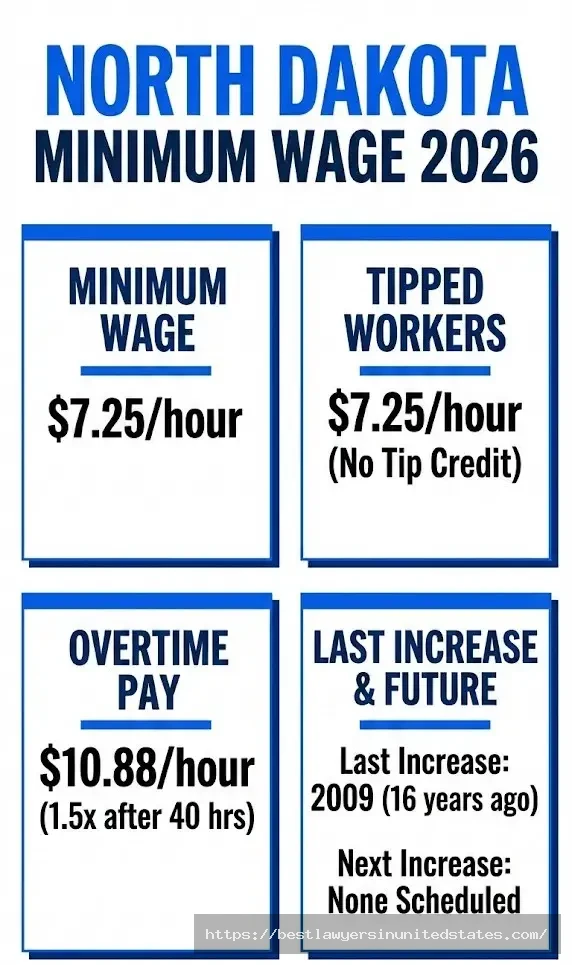
The state stands out for protecting tipped workers. Servers, bartenders, and other tipped employees must receive the full minimum wage before tips. This policy differs from federal law and most other states.
Calculate Your Earnings in North Dakota
Want to know exactly how much you’ll earn at North Dakota’s $7.25 minimum wage? Use our free calculator to estimate your weekly, monthly, and annual income based on your hours worked.
💰 Minimum Wage Earnings Calculator
Calculate your weekly, monthly, and annual earnings with overtime and tax estimates
📊 Your Earnings Breakdown
💰 Gross Earnings
Calculator features:
- Automatic North Dakota wage rates for 2026
- Weekly, monthly, and annual earnings
- Overtime calculations
- Tax withholding estimates
- Take-home pay breakdown
Full calculator with all features: Calculate your minimum wage earnings
Questions about your wages or need legal help? Email: [email protected]
What Is North Dakota's Minimum Wage for 2026?
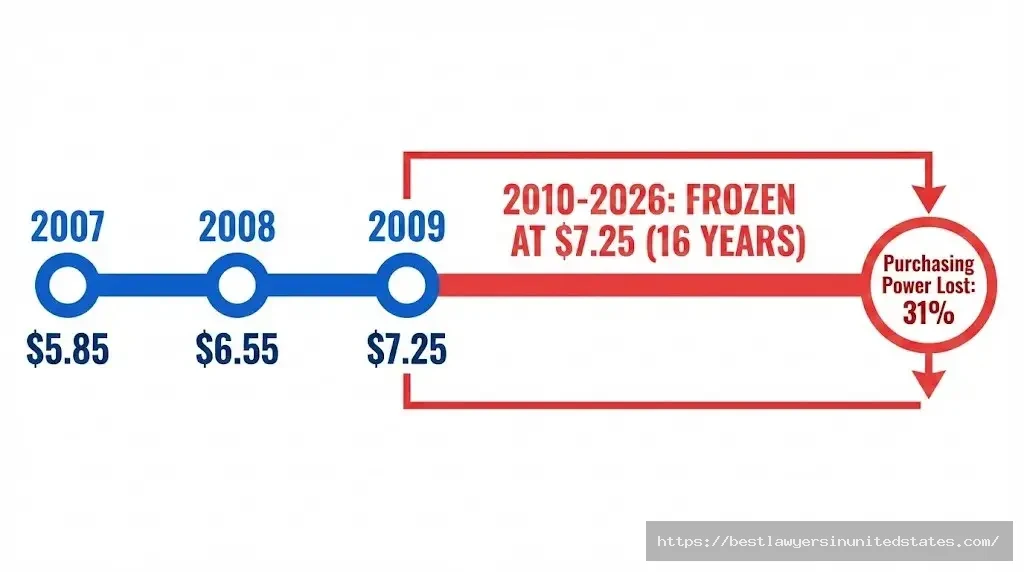
North Dakota's minimum wage remains $7.25 per hour throughout 2026. The state has maintained this rate since July 24, 2009, when the federal minimum wage last increased. No legislation exists to raise the wage in the coming years.
Current Wage Rates
Key wage information for 2026:
- Regular minimum wage: $7.25/hour
- Tipped minimum wage: $7.25/hour (no tip credit)
- Annual full-time income: $15,080 (40 hours/week)
- Monthly income: $1,257 (before taxes)
Why North Dakota's Wage Hasn't Increased
North Dakota does not have a state minimum wage law. The state defaults to federal requirements under the Fair Labor Standards Act (FLSA). When Congress froze the federal minimum at $7.25 in 2009, North Dakota's wage also stopped rising.
The Republican-controlled legislature opposes state-mandated wage increases. Lawmakers argue that low unemployment rates (typically 2-3%) prove the labor market works without intervention. The state's median wage of approximately $19 per hour exceeds the minimum by a wide margin.
North Dakota vs Federal and Neighboring State Wages
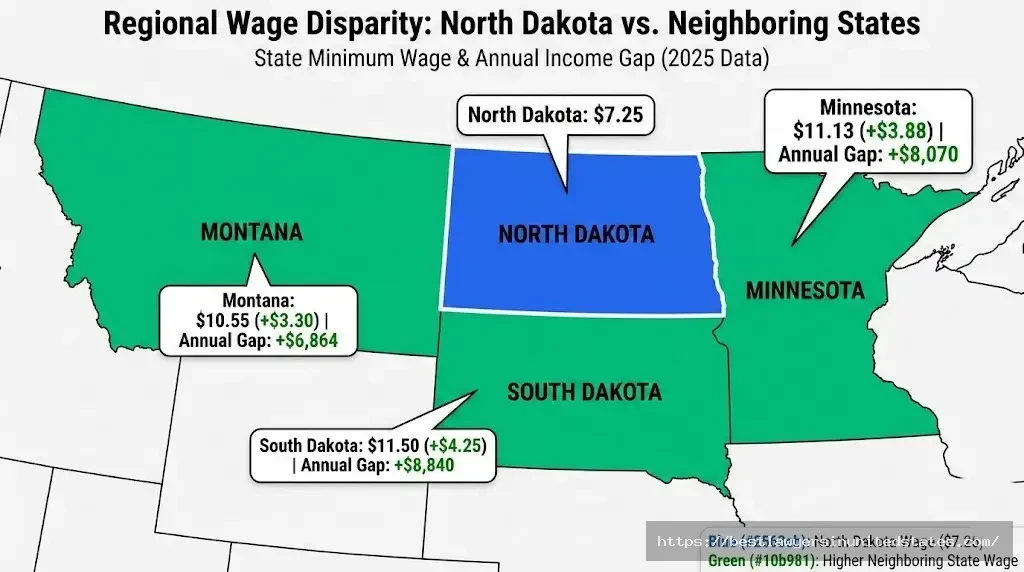
North Dakota's $7.25 minimum wage creates a significant gap with surrounding states. All neighboring states have implemented higher wage floors through state legislation.
| Jurisdiction | Minimum Wage | Tipped Wage | Difference from ND |
|---|---|---|---|
| North Dakota | $7.25 | $7.25 | - |
| Minnesota | $11.13 | $11.13 | +$3.88 |
| South Dakota | $11.50 | $5.75 | +$4.25 |
| Montana | $10.55 | $10.55 | +$3.30 |
| Federal | $7.25 | $2.13 | $0.00 |
Border Wage Gap Impact
The wage difference drives cross-border employment patterns. Workers in Fargo often commute to Moorhead, Minnesota, for jobs paying $3.88 more per hour. A full-time worker earns $8,070 more annually by working across the Red River.
Minnesota's minimum wage applies to all employers with annual revenue exceeding $500,000. Workers in border communities can significantly increase earnings by seeking Minnesota employment. However, they should consider commute costs and Minnesota's higher income tax rates.
Unlike Minnesota's minimum wage, which increases annually with inflation, North Dakota's wage remains static. Montana's minimum wage also includes automatic adjustments, leaving North Dakota behind regional competitors.
Historical Wage Comparison
| Effective Date | North Dakota | Federal | Notes |
|---|---|---|---|
| Jan 1, 2024 | $7.25 | $7.25 | No change |
| Jan 1, 2025 | $7.25 | $7.25 | No change |
| Jan 1, 2026 | $7.25 | $7.25 | Current rate |
| Jan 1, 2027 | $7.25 | $7.25 | No scheduled increase |
Tipped Employees and Server Minimum Wage Rules
Does North Dakota Allow Tip Credits?
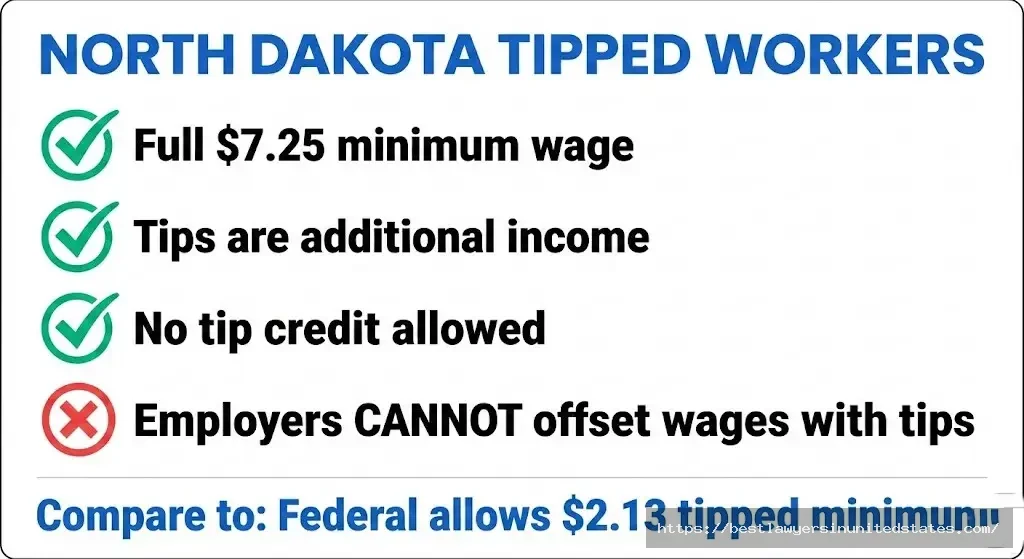
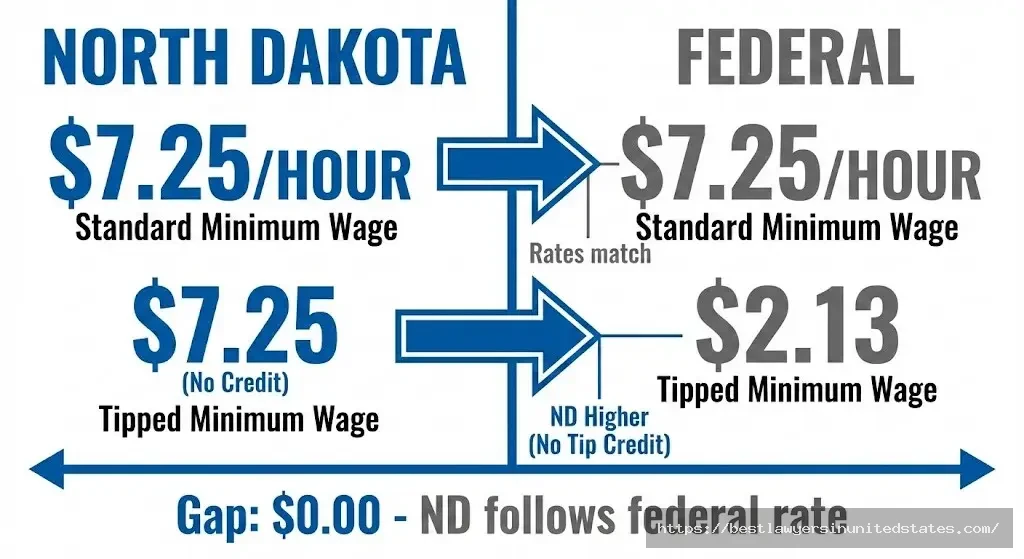
Quick Answer: No. North Dakota requires employers to pay all tipped workers the full $7.25 minimum wage. Tips are additional income that employers cannot use to offset base wages.
This policy makes North Dakota one of eight states that prohibit tip credits. Federal law permits employers to pay tipped workers $2.13 per hour if tips bring total earnings to $7.25 or higher. North Dakota rejects this approach.
Who Benefits from No Tip Credit
Workers protected by this policy:
- Servers and waitstaff
- Bartenders
- Bussers and food runners
- Hotel housekeepers who receive tips
- Delivery drivers
- Hair stylists and barbers
- Casino dealers
These workers earn significantly more than tipped employees in states that allow tip credits. A server in North Dakota receives $7.25 base pay plus tips. A server in Texas receives $2.13 base pay plus tips, relying on customers to reach minimum wage.
Tip Pooling Rules
North Dakota permits tip pooling among customarily tipped employees. Employers can require servers to share tips with bussers, bartenders, and other service staff. Managers and supervisors cannot participate in tip pools or receive any portion of employee tips.
Tip pooling requirements:
- ✅ Must include only employees who regularly receive tips
- ✅ Distribution must be fair and reasonable
- ❌ Managers cannot take any share
- ❌ Employers cannot keep any portion
- ❌ Back-of-house staff (cooks, dishwashers) are excluded
City-Specific Minimum Wage Rates in North Dakota
Do Major Cities Have Higher Minimum Wages?
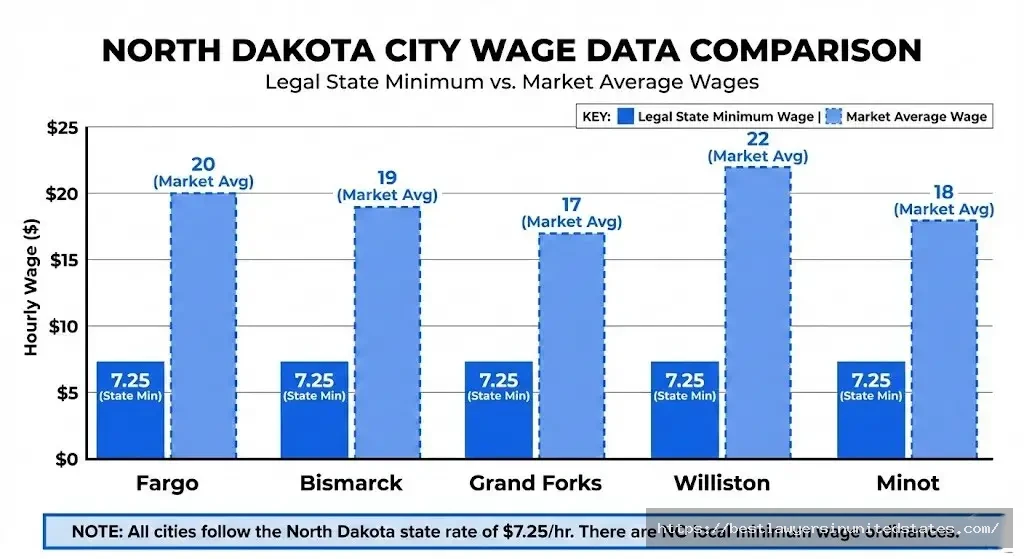
Quick Answer: No. North Dakota has no local minimum wage ordinances. All cities follow the state rate of $7.25 per hour.
Unlike California's minimum wage system, where cities like San Francisco and Los Angeles set higher local rates, North Dakota maintains uniform statewide standards. State law prevents municipalities from establishing separate wage requirements.
Major City Wage Information
Fargo (Population: 125,000+)
- Minimum wage: $7.25/hour
- Market average: $20/hour
- Border impact: Many residents work in Moorhead, MN for $11.13 minimum
- Industries: Healthcare, retail, food service
Bismarck (State Capital)
- Minimum wage: $7.25/hour
- Market average: $19/hour
- Government jobs typically exceed minimum
- Industries: Government, healthcare, energy
Grand Forks (University City)
- Minimum wage: $7.25/hour
- Market average: $17/hour
- Student employment common
- Industries: Education, retail, hospitality
Williston (Oil Region)
- Minimum wage: $7.25/hour
- Market wages: $15-25/hour
- Oil boom drives wages above minimum
- Industries: Oil and gas, construction, services
Minot (Air Force Base)
- Minimum wage: $7.25/hour
- Market average: $18/hour
- Military presence supports local economy
- Industries: Military, retail, healthcare
Market forces, not laws, determine actual wages in North Dakota cities. The oil industry in western North Dakota and border proximity to Minnesota create regional wage variations despite uniform legal minimums.
Overtime Pay Laws in North Dakota
When Does Overtime Apply?
North Dakota follows federal overtime rules under the Fair Labor Standards Act. Employers must pay 1.5 times the regular hourly rate for hours worked beyond 40 in a workweek. The state does not require daily overtime or double-time pay.
Overtime calculation:
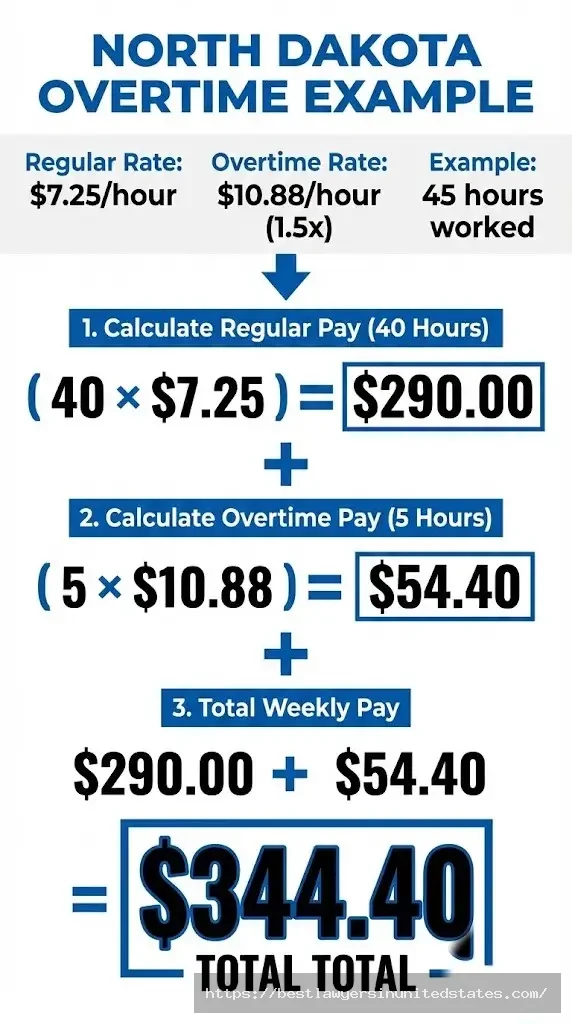
- Regular rate: $7.25/hour
- Overtime rate: $10.88/hour (1.5 × $7.25)
- Threshold: 40 hours per week
- No daily overtime requirement
Calculate Your Overtime Earnings
Working more than 40 hours per week? Calculate your overtime earnings based on North Dakota's overtime laws. This calculator accounts for weekly overtime calculations and helps you verify your paychecks.
⏰ Overtime Pay Calculator
Calculate your overtime earnings based on your state's specific labor laws
📍 Select Your State
💰 Your Hourly Wage
📊 Calculation Method
📅 Weekly Hours
💵 Your Weekly Overtime Pay
📊 Earnings Breakdown
📅 Pay Period Estimates
⚖️ State vs Federal Comparison
Calculator features:
- North Dakota-specific overtime rules
- Weekly overtime calculations
- Pay period breakdowns
- Comparison with federal law
- Verification of employer payments
Full overtime calculator: Calculate your overtime pay
Questions about your wages or need legal help? Email: [email protected]
Overtime Exemptions
Not all employees qualify for overtime pay. Federal exemptions apply in North Dakota for certain professional, administrative, and executive positions.
| Employee Type | Overtime Required? | Minimum Salary (if exempt) |
|---|---|---|
| Hourly workers | ✅ Yes | N/A |
| Salaried under $43,888/year | ✅ Yes | N/A |
| Executive employees | ❌ No | $43,888/year |
| Administrative employees | ❌ No | $43,888/year |
| Professional employees | ❌ No | $43,888/year |
| Outside sales | ❌ No | None |
| Computer professionals | ❌ No | $27.63/hour or $107,432/year |
Exemption requirements: Both salary and duties tests must be met. An employee earning $50,000 annually who does not perform exempt duties remains eligible for overtime. Misclassifying employees as exempt violates federal law.
Common Overtime Violations
Employers cannot:
- Average hours across two weeks to avoid overtime
- Require "off the clock" work
- Misclassify hourly workers as salaried exempt
- Refuse overtime pay for unapproved extra hours
- Retaliate against workers who request overtime pay
Workers who experience these violations should document all hours worked and contact the North Dakota Department of Labor and Human Rights or the U.S. Department of Labor.
H-2A Agricultural Workers and Special Wage Rates
What Is the H-2A Minimum Wage?
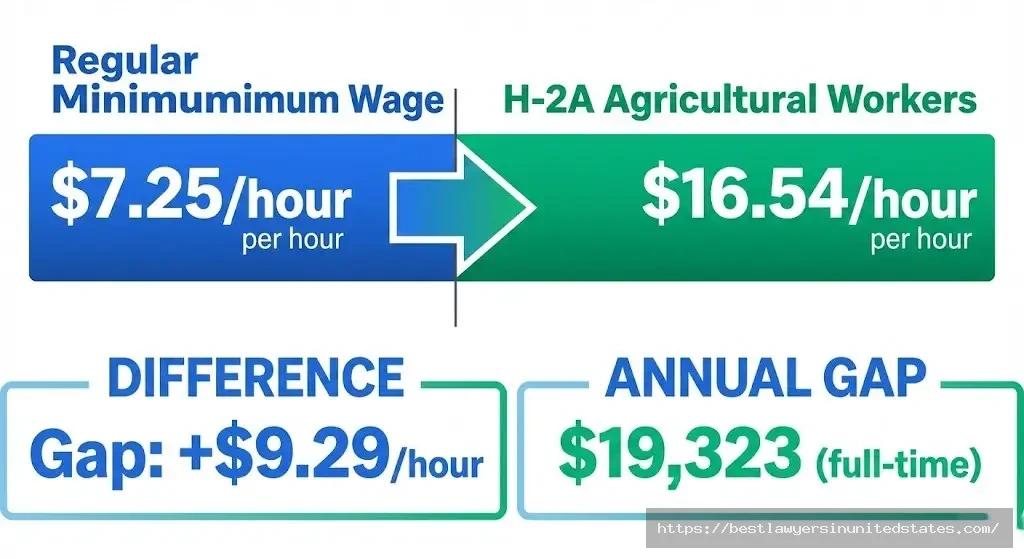
Quick Answer: H-2A agricultural workers in North Dakota must receive $16.54 per hour (2024 rate), which is $9.29 more than the state minimum wage. The U.S. Department of Labor updates this rate annually.
The H-2A temporary agricultural worker program allows farms to hire foreign workers for seasonal jobs. The Adverse Effect Wage Rate (AEWR) prevents these workers from depressing wages for domestic agricultural employees.
Who Does H-2A Apply To?
Affected workers:
- Seasonal farm workers
- Crop harvesters
- Livestock workers
- Agricultural equipment operators
- Farm labor contractors
Affected employers:
- Wheat and soybean farms
- Corn and barley operations
- Cattle ranches
- Vegetable and fruit growers
- Agricultural processing facilities
North Dakota's agricultural economy relies heavily on seasonal labor. The H-2A program provides legal employment for thousands of temporary workers during planting and harvest seasons.
H-2A vs Regular Minimum Wage
| Worker Type | Minimum Wage | Applies To |
|---|---|---|
| H-2A Agricultural | $16.54/hour (2024) | Temporary foreign agricultural workers |
| Regular | $7.25/hour | All other covered employees |
| Difference | +$9.29/hour | H-2A rate updated annually |
Employers who hire H-2A workers must also offer the same wage to U.S. workers performing similar duties. This requirement protects domestic workers from wage competition.
Living Wage vs Minimum Wage in North Dakota
Can You Live on Minimum Wage in North Dakota?
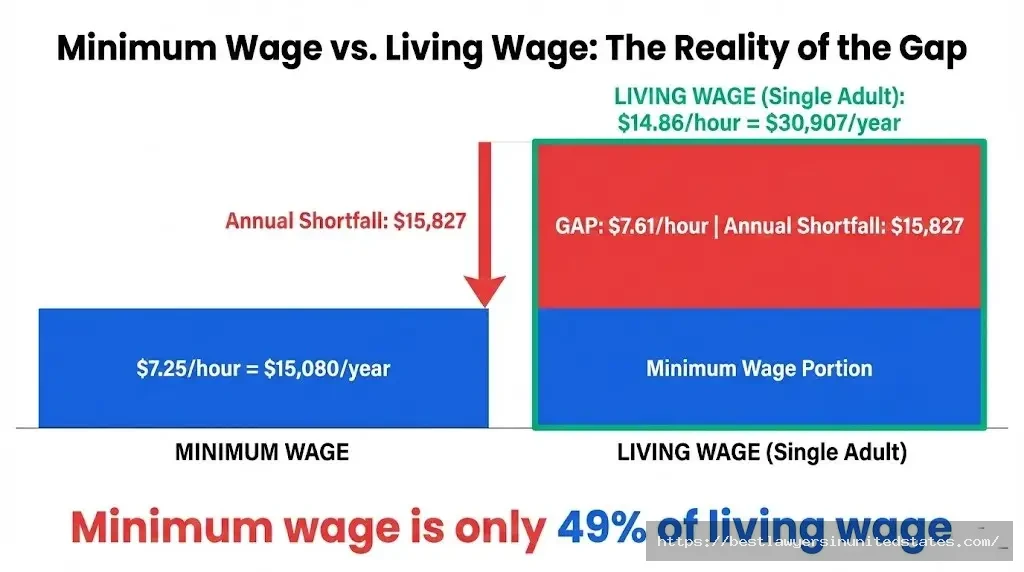
Quick Answer: No. A single adult needs $14.86 per hour to cover basic expenses in North Dakota, which is double the $7.25 minimum wage. Families require even higher wages to meet essential needs.
The MIT Living Wage Calculator shows the gap between minimum wage and actual living costs. North Dakota's relatively low cost of living compared to New York's minimum wage requirements still leaves minimum wage workers struggling.
Living Wage by Household Type
| Household Type | Living Wage/Hour | Annual Income Needed | Gap from Minimum Wage |
|---|---|---|---|
| Single Adult | $14.86 | $30,907 | -$9.61/hour |
| Single Adult + 1 Child | $29.56 | $61,485 | -$22.31/hour |
| 2 Working Adults | $11.81 each | $49,094 total | -$4.56/hour each |
| 2 Adults + 2 Children | $18.32 each | $76,173 total | -$11.07/hour each |
Minimum wage limitations:
- Full-time minimum wage income: $15,080/year
- Federal poverty line (individual): $15,060/year
- Minimum wage barely exceeds poverty threshold
- Families fall far below poverty line on minimum wage
Why the Gap Exists
North Dakota's cost of living includes substantial heating expenses during harsh winters. Housing costs have risen in cities like Fargo and Bismarck. Healthcare and childcare consume large portions of minimum wage income.
Essential expenses that minimum wage cannot cover:
- ❌ Market-rate apartment rental ($800-1,200/month)
- ❌ Reliable transportation and vehicle maintenance
- ❌ Healthcare insurance and medical costs
- ❌ Childcare for working parents
- ❌ Emergency savings or retirement contributions
Workers earning minimum wage often rely on government assistance programs, work multiple jobs, or share housing to survive. The wage gap affects retail workers, food service employees, and entry-level positions across industries.
Worker Categories and Minimum Wage Rates
Does Everyone Get the Same Minimum Wage?
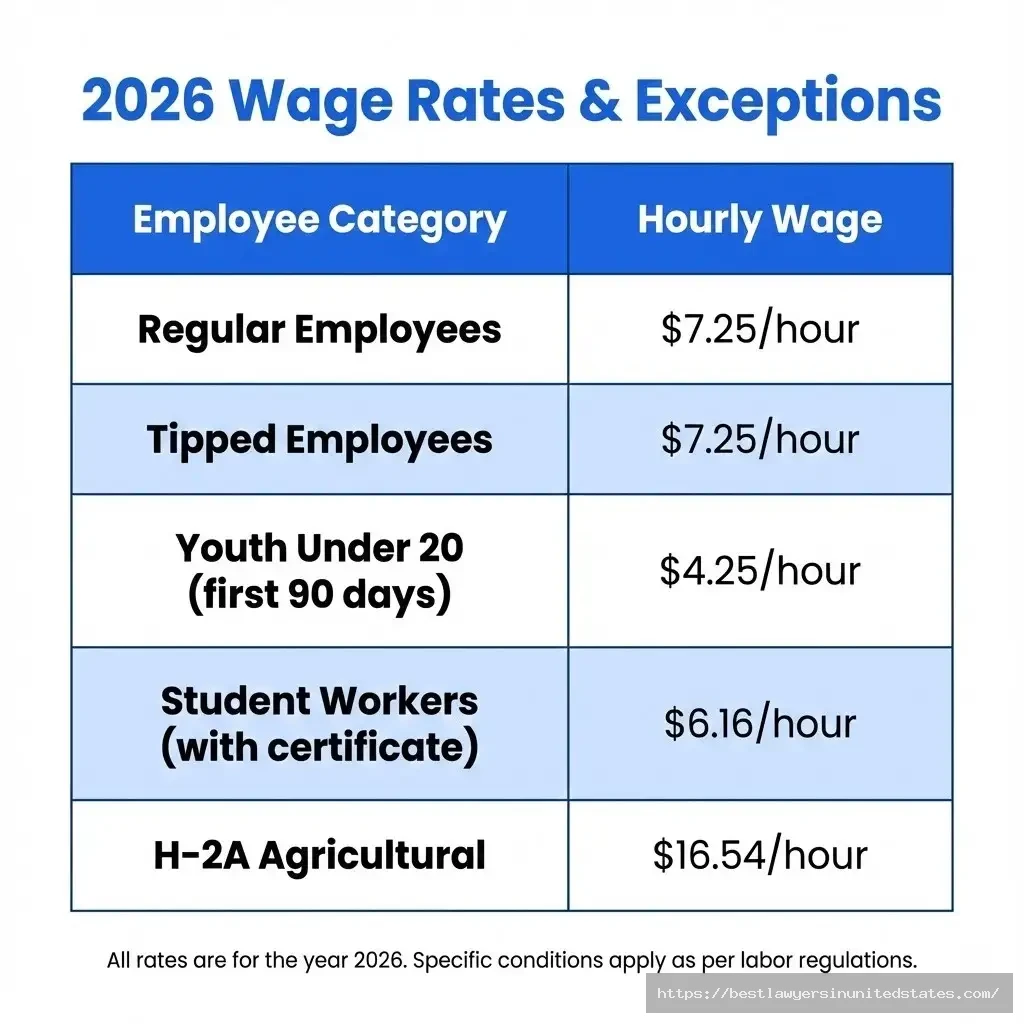
Most North Dakota workers receive $7.25 per hour. However, certain categories have different requirements or exemptions under federal law.
| Worker Category | Minimum Wage | Overtime Required? | Special Rules |
|---|---|---|---|
| Regular employees (18+) | $7.25/hour | ✅ Yes (after 40 hours) | Standard coverage |
| Tipped employees | $7.25/hour | ✅ Yes | No tip credit allowed |
| Youth under 20 | $4.25/hour | ✅ Yes | First 90 days only |
| Students (retail/service) | $6.16/hour | ✅ Yes | Requires DOL certificate |
| Agricultural workers | $7.25/hour | ❌ Limited | Many exemptions apply |
| H-2A agricultural | $16.54/hour | Varies | Federal AEWR rate |
Youth Minimum Wage
Federal law permits employers to pay workers under 20 years old $4.25 per hour during their first 90 consecutive calendar days of employment. After 90 days or when the worker turns 20, whichever comes first, the regular minimum wage applies.
Youth wage restrictions:
- Cannot displace other workers to hire youth
- Cannot reduce hours of existing employees
- Rarely used in North Dakota due to labor shortages
- Most employers pay regular minimum to attract workers
Student Worker Wage
Full-time students working in retail or service establishments may receive 85% of minimum wage ($6.16/hour) if their employer obtains a certificate from the U.S. Department of Labor. Students cannot work more than 8 hours per day or 20 hours per week while school is in session.
This provision applies minimally in North Dakota. Most student employers pay full minimum wage or higher to compete for workers.
What If You're Not Being Paid Properly?
How to Identify Wage Theft
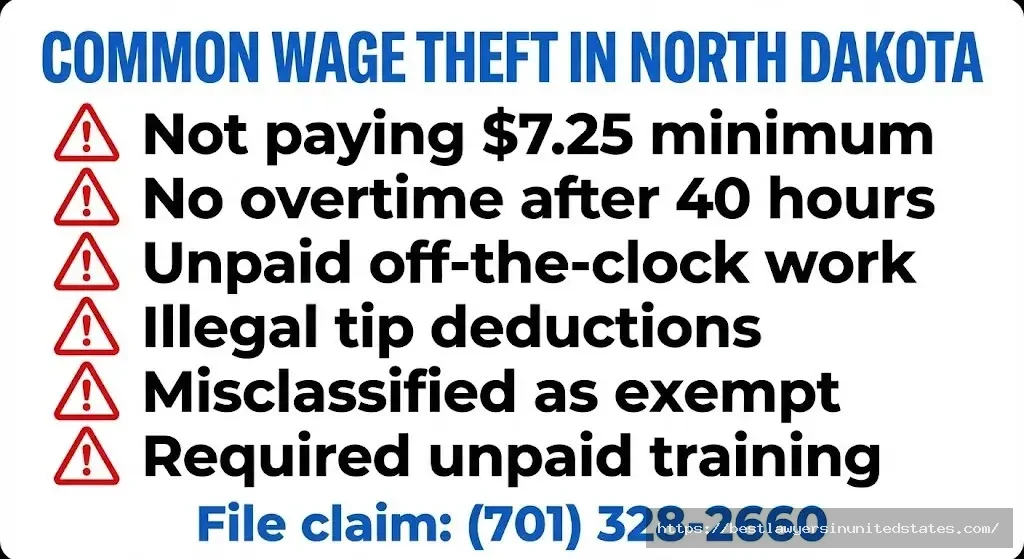
Common wage violations in North Dakota:
- Employer pays less than $7.25/hour
- No overtime pay for hours beyond 40 per week
- Deductions that drop pay below minimum wage
- Unpaid work before or after shifts
- Misclassification as independent contractor
- Manager taking portions of employee tips
- Required "off the clock" work
Wage theft costs American workers billions annually. North Dakota workers have multiple options for recovering unpaid wages.
Calculate Your Potential Recovery
Think your employer owes you money? Use our wage theft calculator to estimate how much you could recover, including unpaid wages, penalties, and interest under North Dakota and federal law.
Wage Theft Recovery Calculator
Estimate how much you can recover in unpaid wages, penalties, and damages based on your state's laws
💵 Estimated Total Recovery
💰 Unpaid Wages
⚖️ Penalties & Damages
📋 Total Summary
Calculator features:
- Multiple violation types (unpaid wages, overtime, tips)
- North Dakota-specific penalties and damages
- Filing deadline tracker
- Total recovery estimate
- Next steps guidance
Full wage theft calculator: Calculate wage theft recovery
Need help with unpaid wages? Email: [email protected]
Filing a Wage Claim in North Dakota
Step 1: Document everything Gather pay stubs, timesheets, work schedules, and any written communications about wages. Record dates, hours worked, and wages received. This documentation proves your case.
Step 2: Contact your employer in writing Send a written request for unpaid wages. Give the employer 7-14 days to respond. Some violations result from payroll errors rather than intentional theft.
Step 3: File with North Dakota Department of Labor
- Agency: North Dakota Department of Labor and Human Rights
- Wage and Hour Division
- Phone: (701) 328-2660
- Deadline: 2 years from wage due date (3 years for willful violations)
Step 4: File federal complaint (alternative)
- U.S. Department of Labor, Wage and Hour Division
- Phone: 1-866-487-9243
- Covers FLSA violations including minimum wage and overtime
Step 5: Consider legal action Small claims court handles wage disputes under $15,000. For larger claims, consult an employment attorney. Successful wage theft cases often recover attorney's fees.
Employer Penalties for Wage Violations
| Violation Type | Employer Penalty | Employee Recovery |
|---|---|---|
| Unpaid minimum wage | Back wages + liquidated damages | Up to double unpaid wages |
| Unpaid overtime | Back wages + liquidated damages | Up to double unpaid wages |
| Tip theft | Criminal prosecution possible | Full tips + damages |
| Retaliation | Reinstatement + back pay | Full damages + attorney fees |
The North Dakota Attorney General can prosecute intentional wage theft as a criminal offense. Penalties include fines and potential imprisonment for repeat offenders.
Minimum Wage Exemptions in North Dakota
Who Is Exempt from Minimum Wage Laws?
Several employee categories fall outside minimum wage requirements. These exemptions come from federal law and apply in North Dakota.
Commonly exempt positions:
- Executive employees earning $43,888+ annually
- Administrative employees earning $43,888+ annually
- Professional employees earning $43,888+ annually
- Outside sales representatives
- Computer professionals earning $27.63/hour or $107,432/year
- Highly compensated employees earning $107,432+ annually
Both tests required for exemption:
- Salary threshold: Employee must earn above minimum salary
- Duties test: Employee must perform primarily exempt duties
An office manager earning $50,000 who spends most time on non-managerial tasks remains eligible for overtime. Employers frequently misclassify employees to avoid overtime payments.
Small Business Exemption
Businesses with less than $500,000 in annual gross revenue may fall outside FLSA coverage. However, most North Dakota businesses engage in interstate commerce through credit card processing, phone systems, or internet use. These activities typically trigger FLSA requirements regardless of revenue.
Agricultural Worker Exemptions
Farm workers face limited minimum wage and overtime protections. Small farm exemptions apply to operations using fewer than 500 "man-days" of agricultural labor per quarter. Family farm exemptions protect parents employing their children.
Agricultural overtime exemptions:
- Most farm workers have no overtime rights
- Seasonal workers often work 50-70 hours weekly
- H-2A workers receive higher base wages but limited overtime
- Federal law provides minimal protection
This differs significantly from California's minimum wage system, which extends full overtime rights to agricultural employees.
Employer Compliance Requirements
What Must Employers Do?
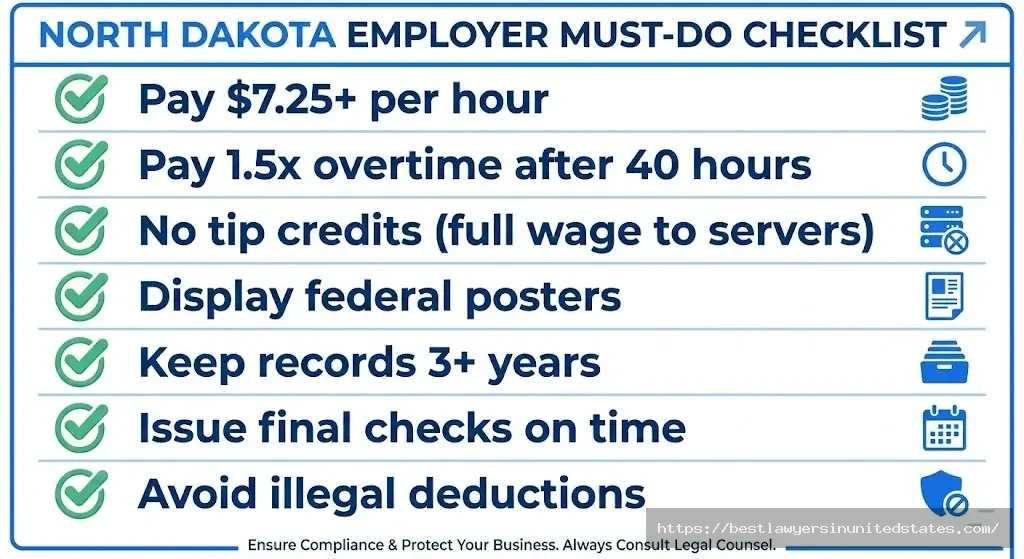
North Dakota employers must follow federal wage and hour laws. Compliance protects businesses from penalties and lawsuits.
Basic requirements:
- Pay at least $7.25/hour to covered employees
- Pay overtime at 1.5x for hours over 40 per week
- Pay tipped workers full minimum wage (no tip credit)
- Display required labor law posters
- Keep accurate payroll records for 3+ years
- Issue final paychecks by next regular payday
- Avoid illegal paycheck deductions
Required Workplace Posters
Mandatory federal posters:
- Fair Labor Standards Act (minimum wage notice)
- Employee Rights under FLSA
- Equal Employment Opportunity notice
- OSHA workplace safety notice
Download free posters from the U.S. Department of Labor website. Display posters where all employees can easily see them, typically in break rooms or near time clocks.
Record-Keeping Requirements
Employers must maintain records showing:
- Employee name, address, Social Security number
- Birth date (if under 19 years old)
- Job title and occupation
- Time and day workweek begins
- Hours worked each day and each week
- Regular hourly rate
- Overtime hourly rate
- Total straight-time earnings
- Total overtime earnings
- Deductions from wages
- Total wages paid each pay period
- Date of payment and period covered
Record retention: Keep all records for at least 3 years. Some records require 2-year retention. The Department of Labor can audit records during investigations.
Common Compliance Mistakes
Employers frequently violate laws by:
- Averaging hours across two weeks to avoid overtime
- Requiring employees to work through breaks
- Deducting costs that drop wages below minimum
- Misclassifying employees as independent contractors
- Failing to pay for required training time
- Not paying for travel time between job sites
- Retaliating against workers who complain
Small businesses should consult with employment attorneys or contact the North Dakota Department of Labor for compliance guidance. Prevention costs far less than penalties and lawsuits.
Why North Dakota's Minimum Wage Hasn't Increased
Political Factors
North Dakota's Republican-controlled legislature opposes state-mandated wage increases. The party platform emphasizes market-based wages rather than government intervention. Bills to raise the minimum wage have not gained traction in recent legislative sessions.
Arguments against increasing the minimum:
- Low unemployment (2-3%) shows the labor market functions well
- Median wage ($19/hour) exceeds minimum significantly
- Small businesses would face higher labor costs
- Market forces already push wages above minimum
- State interference disrupts free market principles
Arguments for increasing the minimum:
- $7.25 fails to meet basic living expenses
- All neighboring states have raised their minimums
- Workers commute to Minnesota and South Dakota for better pay
- Inflation has eroded purchasing power since 2009
- Full-time work should lift families above poverty
Comparison to Other Low-Wage States
North Dakota shares its $7.25 minimum with 19 other states. Southern states including Mississippi's minimum wage, Alabama's minimum wage, and Louisiana's minimum wage also follow federal standards.
However, North Dakota differs from these states in important ways. The state has extremely low unemployment and higher median wages. Unlike Texas minimum wage policies, which affect millions of low-wage workers, relatively few North Dakotans earn actual minimum wage.
Economic Reality vs Legal Minimum
Most North Dakota employers pay well above minimum wage due to labor shortages. The state's unemployment rate consistently ranks among the nation's lowest. Competition for workers drives wages up regardless of legal requirements.
Average wages by sector (2024):
- Retail: $13-15/hour
- Food service: $12-14/hour (plus tips)
- Healthcare support: $16-18/hour
- Manufacturing: $18-22/hour
- Construction: $20-25/hour
The legal minimum has become somewhat irrelevant in practice. However, it still affects entry-level positions and provides a wage floor during economic downturns.
Will North Dakota Raise Its Minimum Wage?
Future Outlook for 2026-2030
Quick Answer: North Dakota is unlikely to raise its minimum wage through state legislation in the next five years. Any increase would most likely come from federal action raising the national minimum wage.
The state lacks mechanisms for citizen-initiated ballot measures on statutory issues. Voters cannot bypass the legislature to implement wage increases as they can in states like Florida's minimum wage system, which voters approved through referendum.
Possible Scenarios
Scenario 1: Federal increase (most likely) If Congress raises the federal minimum to $10, $12, or $15 per hour, North Dakota would automatically adopt the new rate. President Biden proposed a $15 federal minimum, but the legislation stalled in Congress.
Scenario 2: Continued status quo (likely) North Dakota remains at $7.25 indefinitely. The wage gap with neighboring states widens. More workers commute to Minnesota and South Dakota for employment.
Scenario 3: State legislative action (unlikely) A bipartisan coalition passes a modest increase to $9 or $10 per hour. This scenario requires significant political shifts in the legislature.
Scenario 4: Business-led wage increases (ongoing) Major employers voluntarily raise starting wages. Market forces continue pushing wages up while the legal minimum remains unchanged.
What This Means for Workers
North Dakota workers earning minimum wage should not expect state-level relief. The most realistic path to higher wages involves:
- Seeking employment in Minnesota or South Dakota
- Pursuing positions with employers offering above-minimum starting wages
- Acquiring skills and certifications that command higher pay
- Advocating for federal minimum wage increases
- Organizing with other workers to pressure employers
The state's labor market will likely continue functioning primarily through supply and demand rather than legal mandates.
Frequently Asked Questions
What is the minimum wage in North Dakota for 2026?
Quick Answer: North Dakota's minimum wage is $7.25 per hour in 2026, the same rate that has applied since July 24, 2009.
This rate matches the federal minimum wage under the Fair Labor Standards Act. North Dakota has no state minimum wage law, so it defaults to federal requirements. No increases are scheduled for 2026 or future years.
Is North Dakota's minimum wage going up in 2026?
Quick Answer: No. North Dakota's minimum wage remains $7.25 per hour throughout 2026 with no scheduled increases.
The state legislature has not passed bills to raise the minimum wage. Without state action or federal increases, the wage will remain at $7.25 indefinitely. North Dakota does not have automatic inflation adjustments like some other states.
What is the tipped minimum wage in North Dakota?
Quick Answer: North Dakota requires employers to pay tipped workers the full $7.25 minimum wage. The state does not allow tip credits.
Servers, bartenders, and other tipped employees receive $7.25 per hour plus tips. Employers cannot use tips to offset base wage obligations. This policy makes North Dakota more protective of tipped workers than federal law or most other states.
Does Fargo have a higher minimum wage than other North Dakota cities?
Quick Answer: No. All North Dakota cities including Fargo, Bismarck, and Grand Forks follow the state minimum wage of $7.25 per hour.
North Dakota prohibits local governments from setting higher minimum wages. Unlike Seattle or San Francisco, which have $15+ minimums, North Dakota cities cannot establish separate wage floors. The $7.25 rate applies statewide.
Is Minnesota's minimum wage higher than North Dakota's?
Quick Answer: Yes. Minnesota's minimum wage is $11.13 per hour for large employers, which is $3.88 more than North Dakota's $7.25 rate.
This wage gap causes many North Dakota residents to commute to Minnesota for work, particularly in the Fargo-Moorhead area. A full-time Minnesota worker earns $8,070 more annually than a North Dakota worker at minimum wage.
Can you live on minimum wage in North Dakota?
Quick Answer: No. A single adult needs $14.86 per hour to cover basic expenses in North Dakota according to MIT's Living Wage Calculator, which is double the $7.25 minimum wage.
Full-time minimum wage work provides $15,080 annually before taxes. This barely exceeds the federal poverty line for an individual and falls far short of covering housing, food, transportation, healthcare, and other necessities.
When do I get overtime pay in North Dakota?
Quick Answer: North Dakota requires overtime pay at 1.5 times your regular rate for hours worked over 40 in a workweek.
At minimum wage, overtime pays $10.88 per hour. North Dakota follows federal overtime rules with no daily overtime requirement. You get overtime only after working more than 40 hours in a single workweek, not for working more than 8 hours in a day.
How do I calculate my earnings at North Dakota's minimum wage?
Quick Answer: Use our minimum wage calculator to instantly calculate weekly, monthly, and annual earnings at $7.25 per hour based on your work schedule.
The calculator shows gross pay, estimated taxes, and take-home pay. For full-time work (40 hours/week), you earn $290 weekly, $1,257 monthly, and $15,080 annually before taxes.
How much overtime pay am I entitled to in North Dakota?
Quick Answer: Use our overtime calculator to calculate your overtime earnings at 1.5 times your regular hourly rate for all hours over 40 per week.
If you earn minimum wage ($7.25/hour), overtime pays $10.88/hour. For example, working 45 hours pays: (40 × $7.25) + (5 × $10.88) = $344.40 for the week.
How do I calculate wage theft recovery in North Dakota?
Quick Answer: Use our wage theft calculator to estimate your potential recovery including unpaid wages, liquidated damages, and interest.
North Dakota law allows workers to recover unpaid wages plus an equal amount in liquidated damages. For $1,000 in unpaid wages, you could recover $2,000 total. You have 2-3 years to file claims depending on violation type.
What are the penalties for not paying minimum wage in North Dakota?
Quick Answer: Employers who violate minimum wage laws must pay back wages plus liquidated damages equal to the unpaid amount, potentially doubling what workers recover.
The North Dakota Attorney General can prosecute intentional wage theft as a criminal offense. Employers face fines, court costs, and possible imprisonment for willful violations. Workers can also sue in civil court for unpaid wages.
Who is exempt from minimum wage in North Dakota?
Quick Answer: Executive, administrative, and professional employees earning at least $43,888 annually may be exempt from minimum wage and overtime if they meet both salary and duties tests.
Common exemptions include outside sales workers, certain computer professionals earning $27.63/hour or more, and some agricultural workers. Most hourly workers in retail, food service, and healthcare remain covered by minimum wage laws.
Can employers pay less than minimum wage to teenagers in North Dakota?
Quick Answer: Federal law allows employers to pay workers under 20 years old $4.25/hour during their first 90 calendar days of employment, but this provision is rarely used in North Dakota.
After 90 days or when the worker turns 20, whichever comes first, the regular $7.25 minimum applies. Most North Dakota employers pay full minimum wage or higher to attract young workers in a tight labor market.
What is the H-2A minimum wage in North Dakota?
Quick Answer: H-2A temporary agricultural workers in North Dakota must receive $16.54 per hour based on 2024 rates, which is $9.29 more than the regular state minimum wage.
The U.S. Department of Labor updates this Adverse Effect Wage Rate annually. The higher rate protects domestic agricultural workers from wage depression and ensures foreign temporary workers receive fair compensation.
How do I file a wage complaint in North Dakota?
Quick Answer: Contact the North Dakota Department of Labor and Human Rights at (701) 328-2660 or file a federal complaint with the U.S. Department of Labor at 1-866-487-9243.
You have 2 years to file most wage claims (3 years for willful violations). Document all hours worked and wages received. The department investigates complaints and can order employers to pay back wages plus penalties.
