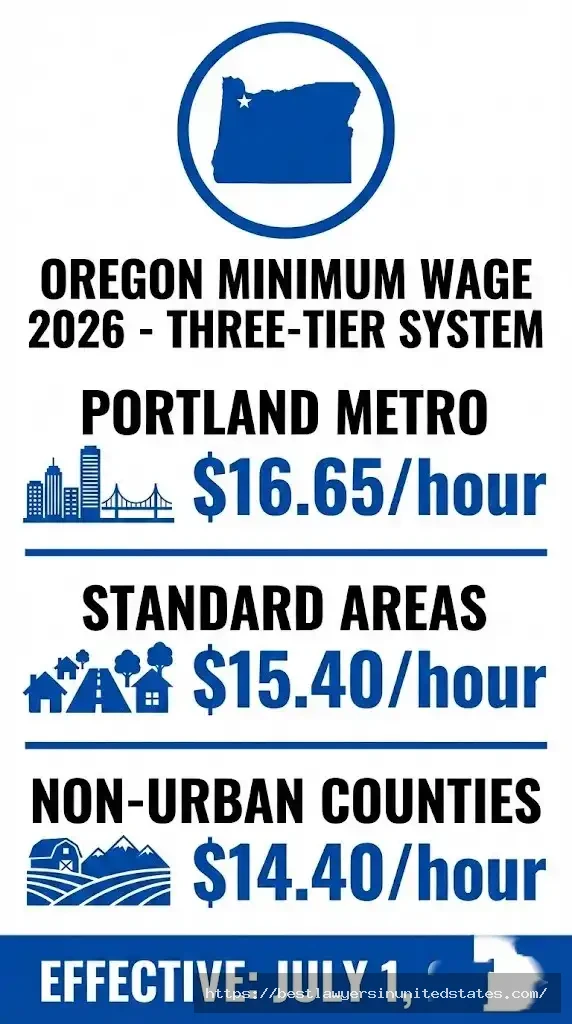
Oregon’s minimum wage for 2026 will be $16.65 per hour in Portland metro, $15.40 per hour in standard areas, and $14.40 per hour in non-urban counties, effective July 1, 2026. Oregon uses a three-tier regional wage system based on location, with annual increases tied to the Consumer Price Index.
Unlike many states, Oregon requires tipped workers like servers and bartenders to receive the full minimum wage plus tips. There is no tip credit that reduces base pay.
The Oregon Bureau of Labor and Industries (BOLI) enforces these wage laws under Oregon Revised Statutes (ORS) 653.025. Workers who don’t receive proper pay can file wage claims to recover unpaid wages plus penalties.
Calculate Your Earnings in Oregon
Want to know exactly how much you’ll earn at Oregon’s 2026 minimum wage? Use our free calculator to estimate your weekly, monthly, and annual income based on your hours worked.
💰 Minimum Wage Earnings Calculator
Calculate your weekly, monthly, and annual earnings with overtime and tax estimates
📊 Your Earnings Breakdown
💰 Gross Earnings
Calculator features:
- Automatic Oregon wage rates for 2026
- Weekly, monthly, and annual earnings
- Overtime calculations
- Tax withholding estimates
- Take-home pay breakdown
Full calculator with all features: Oregon Minimum Wage Calculator
Questions about your wages or need legal help?
Email: [email protected]
What Is Oregon's Three-Tier Minimum Wage System?
Oregon divides the state into three wage zones instead of using one statewide rate. This system started in 2016 to account for different costs of living across the state.
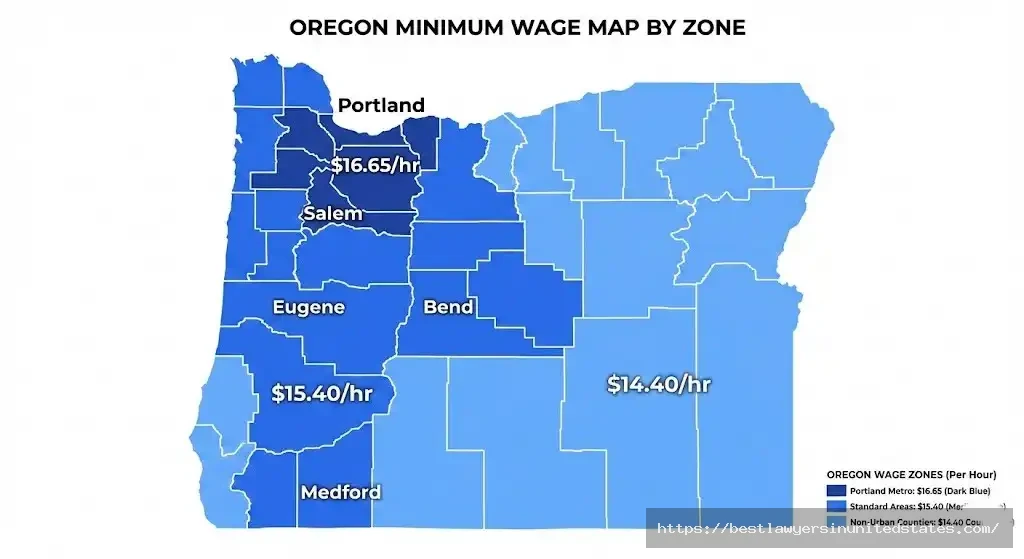
The three tiers are Portland metro (highest), standard (middle), and non-urban (lowest). Your rate depends on where you work, not where you live.
Portland Metro Area Rate
The Portland metro rate applies within the Urban Growth Boundary (UGB). This includes Portland city and parts of surrounding counties.
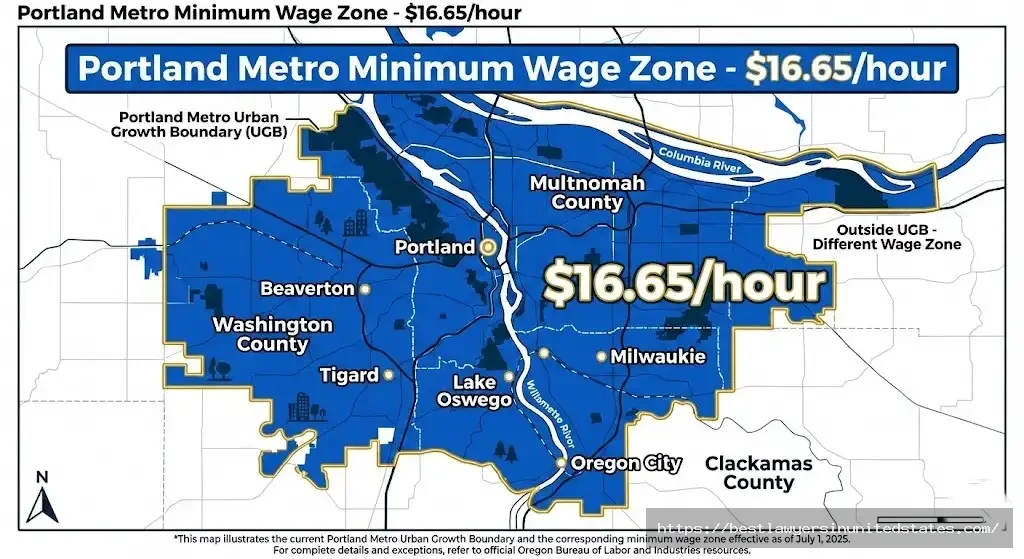
2026 Portland Metro Rate: $16.65/hour
Cities and areas covered:
- Portland
- Beaverton
- Tigard
- Lake Oswego
- Oregon City
- Milwaukie
- Parts of Hillsboro
- Parts of Gresham
- Parts of Washington County
- Parts of Clackamas County
- Parts of Multnomah County
The UGB boundary determines coverage, not city limits. Some areas outside Portland proper still get the metro rate if they fall within the UGB.
Standard Rate Areas
Most Oregon cities and suburban areas use the standard rate. This applies to mid-sized cities and their surrounding areas.
2026 Standard Rate: $15.40/hour
Cities covered:
- Eugene
- Salem
- Bend
- Medford
- Corvallis
- Springfield
- Albany
- Grants Pass
- Roseburg
- Parts of Washington County (outside UGB)
- Parts of Clackamas County (outside UGB)
Non-Urban Rate Areas
Rural counties with populations under 40,000 use the non-urban rate. These are mostly agricultural and small-town areas.
2026 Non-Urban Rate: $14.40/hour
Counties covered:
- Baker County
- Coos County
- Crook County
- Curry County
- Douglas County (parts)
- Gilliam County
- Grant County
- Harney County
- Jefferson County
- Klamath County
- Lake County
- Malheur County
- Morrow County
- Sherman County
- Umatilla County
- Union County
- Wallowa County
- Wheeler County
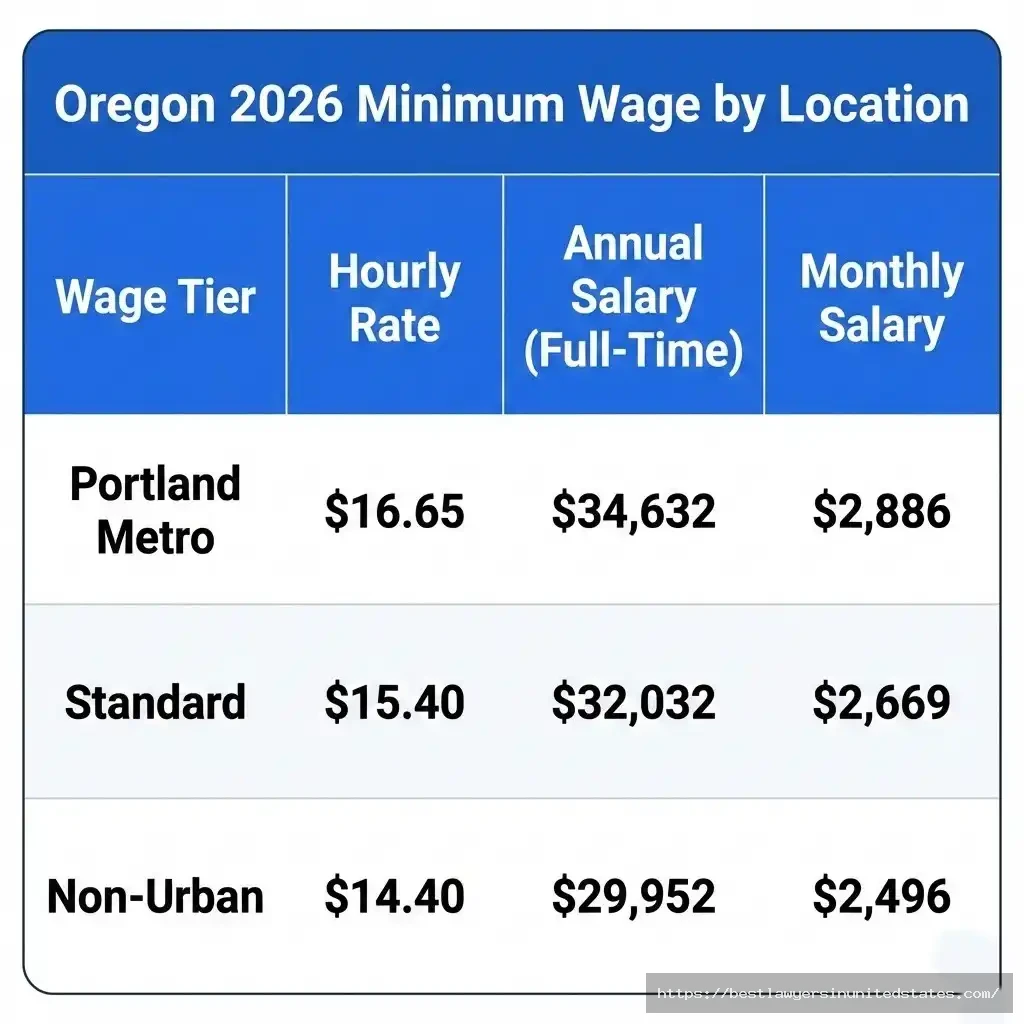
| Wage Tier | 2026 Hourly Rate | Annual Salary (Full-Time) | Monthly Salary |
|---|---|---|---|
| Portland Metro | $16.65 | $34,632 | $2,886 |
| Standard | $15.40 | $32,032 | $2,669 |
| Non-Urban | $14.40 | $29,952 | $2,496 |
Based on 40 hours/week, 52 weeks/year
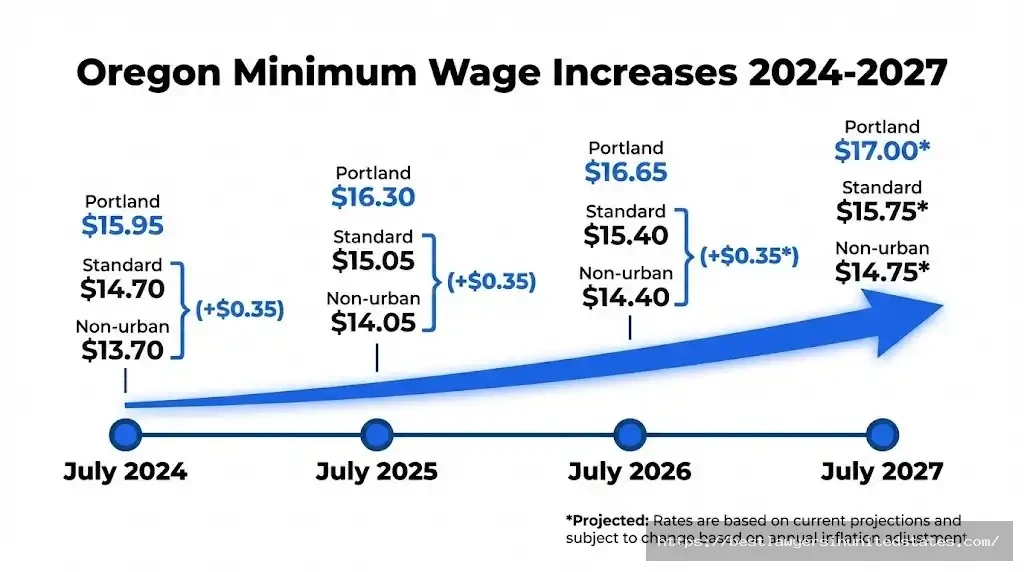
Oregon Minimum Wage Increases: 2024-2027
Oregon adjusts minimum wage rates every July 1 based on inflation. The Consumer Price Index for Urban Wage Earners determines the increase percentage.
Historical Rates and Future Projections
| Effective Date | Portland Metro | Standard | Non-Urban | Increase Amount |
|---|---|---|---|---|
| July 1, 2024 | $15.95 | $14.70 | $13.70 | ~$0.50 |
| July 1, 2025 | $16.30 | $15.05 | $14.05 | $0.35 |
| July 1, 2026 | $16.65 | $15.40 | $14.40 | $0.35 |
| July 1, 2027 | $17.00* | $15.75* | $14.75* | $0.35* |
*2027 rates are projected estimates based on moderate inflation
Why 2025 Had the Smallest Increase in a Decade
The 2025 increase of 35 cents was the smallest since Oregon's three-tier system began. Lower inflation in 2024 resulted in a smaller CPI adjustment.
Previous years saw increases of 50 cents to $1.00 or more. The 2026 increase is projected to be similar at 35 cents based on current inflation trends.
Key difference: Oregon minimum wage increases are automatic under state law. No legislative action is needed each year.
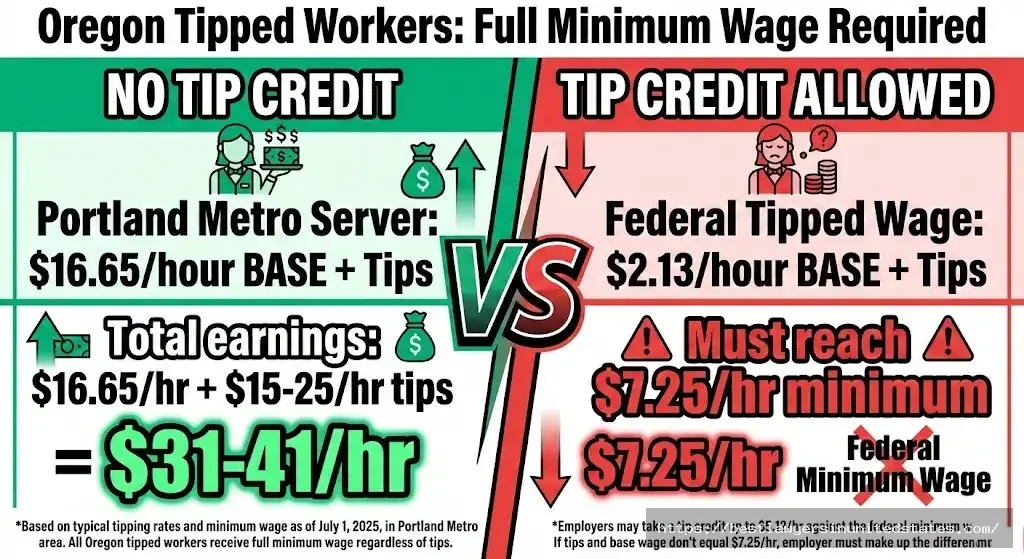
Oregon Tipped Workers: Full Minimum Wage Required
Oregon requires employers to pay tipped employees the full minimum wage before tips. This makes Oregon one of the best states for restaurant and service workers.
No Tip Credit Allowed
Quick Answer: Oregon does NOT allow tip credits. Servers, bartenders, and other tipped workers must receive the full minimum wage plus any tips.
Federal law allows employers to pay tipped workers as low as $2.13 per hour if tips make up the difference. Oregon prohibits this practice completely.
A server in Portland metro must earn at least $16.65 per hour in 2026, regardless of tips. Any tips received are additional compensation on top of the base wage.
Oregon vs Federal Tipped Wage Comparison
| Jurisdiction | Base Wage for Tipped Workers | Tip Credit Allowed? | Total Earnings |
|---|---|---|---|
| Oregon (Portland Metro) | $16.65/hour | ❌ No | $16.65 + tips |
| Oregon (Standard) | $15.40/hour | ❌ No | $15.40 + tips |
| Oregon (Non-Urban) | $14.40/hour | ❌ No | $14.40 + tips |
| Federal Law | $2.13/hour | ✅ Yes | $7.25 minimum (with tips) |
How Much Can Servers Earn in Oregon?
Portland metro servers can earn significantly more than in most states. The base wage alone provides $34,632 annually before tips.
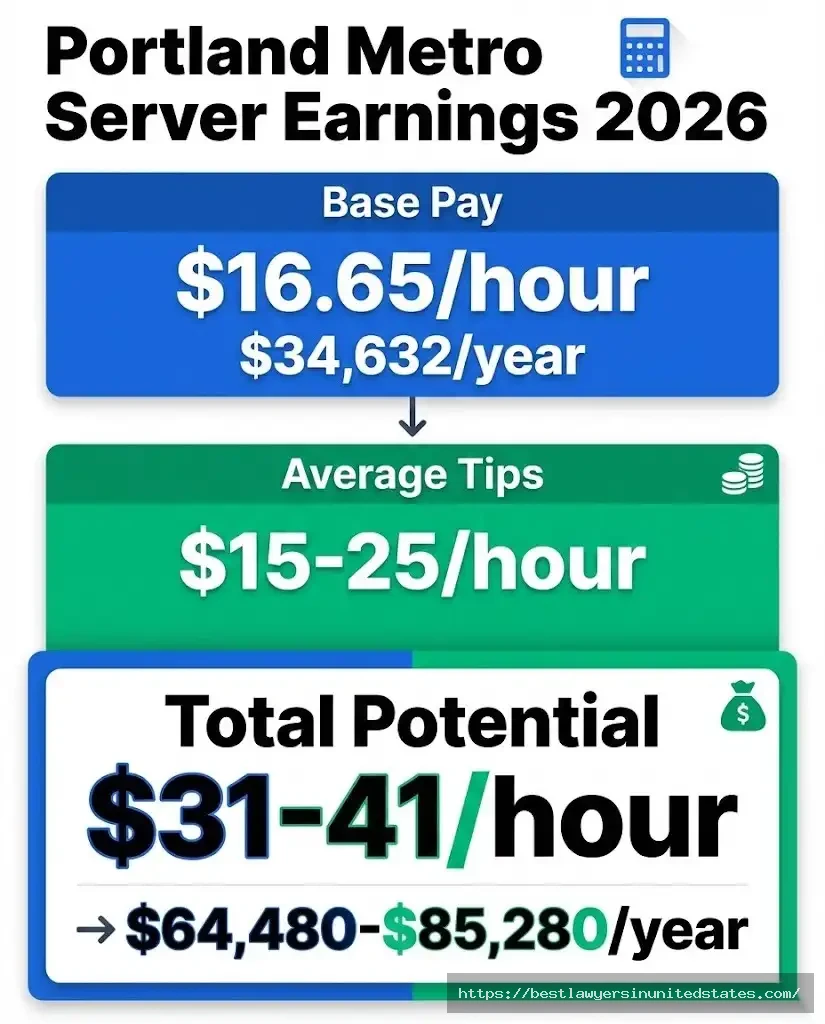
Estimated Portland Metro Server Earnings:
- Base pay: $16.65/hour ($34,632/year)
- Average tips: $15-25/hour
- Total potential: $31-41/hour ($64,480-$85,280/year)
This analysis assumes standard restaurant service positions. High-end establishments may have higher tip averages.
Tip Pooling and Distribution Rules
Oregon law allows tip pooling but protects worker rights:
- ✅ Employees keep 100% of customer tips
- ✅ Tip pools allowed among service staff only
- ❌ Managers and supervisors cannot share tip pools
- ❌ Employers cannot take any portion of tips
- ❌ Mandatory tip pools cannot include kitchen staff
Voluntary tip sharing with kitchen staff is allowed if servers choose. Employers cannot require this arrangement.
Overtime Laws in Oregon
Oregon follows federal overtime rules with some additional protections. Understanding these rules helps you calculate your correct pay.
When Overtime Applies
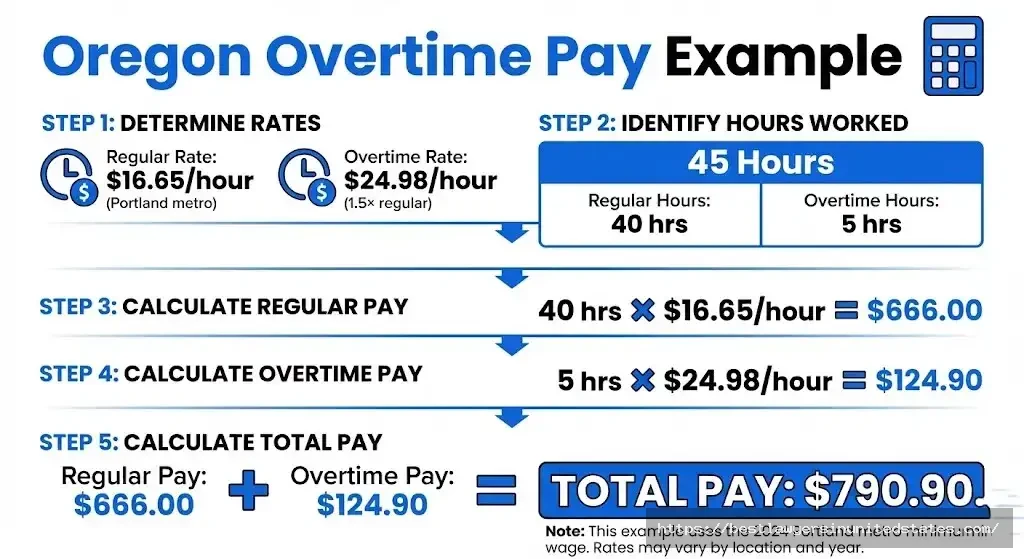
Overtime triggers at 40 hours per workweek. The rate is 1.5 times your regular hourly wage.
Oregon does not require daily overtime like California. Working 10 hours in one day does not automatically trigger overtime unless you exceed 40 hours for the week.
Example calculation:
- Regular rate: $16.65/hour (Portland metro)
- Overtime rate: $24.98/hour (1.5 × $16.65)
- 45 hours worked: (40 × $16.65) + (5 × $24.98) = $666.00 + $124.90 = $790.90
Who Is Exempt from Overtime?
Not all workers qualify for overtime pay. Oregon exemptions mirror federal Fair Labor Standards Act (FLSA) categories.
Common overtime exemptions:
- Executive employees (manage 2+ people, authority to hire/fire)
- Administrative employees (office work, independent judgment)
- Professional employees (advanced knowledge, specialized training)
- Outside sales employees (primary duty is sales outside workplace)
- Computer professionals (systems analysis, programming)
Salary threshold for 2026: $1,358.40 per week ($70,636.80 annually)
Exempt employees must meet both the salary threshold AND job duties tests. Meeting one requirement is not enough.
Calculate Your Overtime Pay
Working more than 40 hours per week? Calculate your overtime earnings based on Oregon's overtime laws.
⏰ Overtime Pay Calculator
Calculate your overtime earnings based on your state's specific labor laws
📍 Select Your State
💰 Your Hourly Wage
📊 Calculation Method
📅 Weekly Hours
💵 Your Weekly Overtime Pay
📊 Earnings Breakdown
📅 Pay Period Estimates
⚖️ State vs Federal Comparison
Calculator features:
- Oregon-specific overtime rules
- Weekly overtime calculations
- Pay period breakdowns
- Comparison with federal law
- Time-and-a-half calculations
Full overtime calculator: Oregon Overtime Pay Calculator
Oregon overtime laws are similar to those in neighboring Washington State, which also follows federal FLSA standards. However, California minimum wage includes daily overtime requirements that Oregon does not have.
Questions about your wages or need legal help?
Email: [email protected]
Special Oregon Wage Rules You Should Know
Oregon has unique labor requirements beyond basic minimum wage. These rules provide additional worker protections.
Four-Hour Minimum Reporting Pay
If you report for a scheduled shift, your employer must pay you for at least four hours. This applies even if they send you home early.
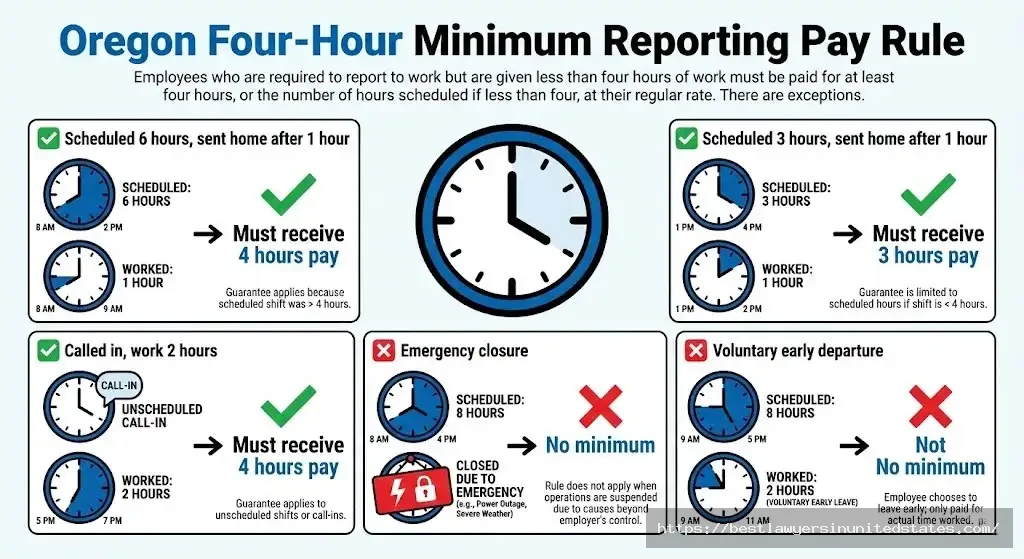
Example scenarios:
- Scheduled for 6-hour shift, sent home after 1 hour: Must receive 4 hours pay
- Scheduled for 3-hour shift, sent home after 1 hour: Must receive 3 hours pay (scheduled amount)
- Called in for emergency, work 2 hours: Must receive 4 hours pay
Exceptions to the four-hour rule:
- Employee voluntarily chooses to leave early
- Workplace emergency requires closure
- Natural disaster or unforeseen circumstances
- On-call workers who are not required to report
Youth and Training Wages
Oregon generally requires full minimum wage for workers of all ages. Youth wages are very limited compared to other states.
Training wage exception: Employers can pay 95% of standard minimum wage for first 150 hours of employment in limited occupations.
2026 training wage rates:
- Portland metro: $15.82/hour (95% of $16.65)
- Standard: $14.63/hour (95% of $15.40)
- Non-urban: $13.68/hour (95% of $14.40)
Training wage cannot apply to workers under 18. It only applies to adults in specific occupations approved by BOLI.
Agricultural Worker Exemptions
Most agricultural workers must receive minimum wage. However, specific exemptions exist for certain farm operations.
Agricultural exemptions under ORS 653.025:
- Immediate family members of farm owner
- Workers on small farms (limited production)
- Piece-rate workers (must still average minimum wage)
- Hand harvest laborers (specific conditions)
Piece-rate agricultural workers must earn at least minimum wage when averaged over the workweek. If piece-rate earnings fall short, employers must make up the difference.
What If You're Not Being Paid Properly?
Oregon law provides strong protections for workers who don't receive proper wages. BOLI enforces these rights and helps recover unpaid money.
Common Wage Violations
Typical wage theft scenarios:
- Paying below minimum wage
- Not paying overtime after 40 hours
- Taking illegal deductions from paychecks
- Keeping employee tips
- Not paying for all hours worked
- Failing to pay final wages on time
- Misclassifying employees as independent contractors
How to File a Wage Claim with BOLI
Oregon workers can file wage claims for violations within two years. The process is free and does not require an attorney.
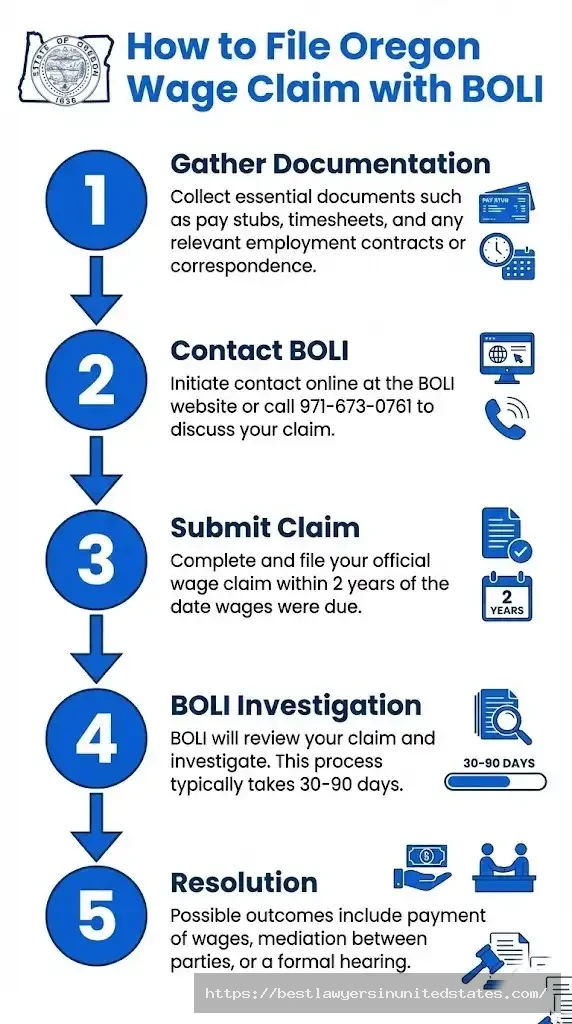
Step-by-step BOLI complaint process:
- Gather documentation - Collect pay stubs, timesheets, work schedules, employment contracts, and communication records
- Contact BOLI - File online at oregon.gov/boli or call 971-673-0761
- Submit your claim - Provide details about unpaid wages, dates, amounts, and employer information
- BOLI investigation - Agency investigates your claim and contacts employer (30-90 days typical)
- Resolution - BOLI may order employer to pay, mediate a settlement, or hold a hearing
BOLI office locations:
- Portland: 800 NE Oregon St, Suite 1045
- Eugene: 1400 Executive Parkway, Suite 200
- Salem: 3865 Wolverine St NE, Building E-1
- Medford: 119 N Oakdale Ave
Calculate Your Wage Theft Recovery
Think your employer owes you money? Use our calculator to estimate how much you could recover, including unpaid wages, penalties, and interest under Oregon law.
Wage Theft Recovery Calculator
Estimate how much you can recover in unpaid wages, penalties, and damages based on your state's laws
💵 Estimated Total Recovery
💰 Unpaid Wages
⚖️ Penalties & Damages
📋 Total Summary
Calculator features:
- Multiple violation types (unpaid wages, overtime, tips)
- Oregon-specific penalties and damages
- Filing deadline tracker
- Total recovery estimate
- Next steps guidance
Full wage theft calculator: Oregon Wage Theft Recovery Calculator
Workers facing wage theft should document everything carefully. Keep copies of all pay stubs, timesheets, and communication with your employer about wages.
Questions about your wages or need legal help?
Email: [email protected]
Oregon Wage Violation Penalties
Oregon imposes significant penalties on employers who violate wage laws. These penalties help deter violations and compensate workers.
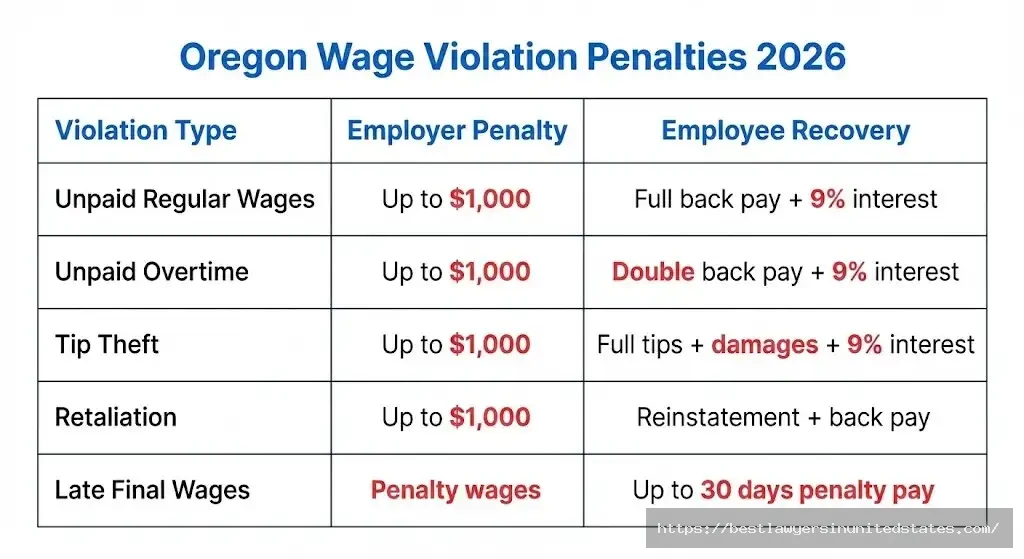
Employer Penalties and Worker Recovery
| Violation Type | Employer Penalty | Employee Recovery | Interest Rate |
|---|---|---|---|
| Unpaid Regular Wages | Up to $1,000 per violation | Full back pay + penalty | 9% annual |
| Unpaid Overtime | Up to $1,000 per violation | Double back pay | 9% annual |
| Tip Theft | Up to $1,000 per violation | Full tips + damages | 9% annual |
| Retaliation | Up to $1,000 per violation | Reinstatement + back pay | 9% annual |
| Late Final Wages | Penalty wages (8 hours/day) | Up to 30 days penalty pay | 9% annual |
Oregon Wage Security Fund
The Oregon Wage Security Fund pays workers when employers cannot or will not pay judgments. This state fund helps workers recover money even if the employer goes out of business.
Fund coverage limits:
- Maximum payment: $40,000 per employee
- Covers wages, vacation pay, and some benefits
- Does not cover all types of claims
After the fund pays a worker, Oregon pursues the employer for reimbursement. Criminal prosecution is possible for willful wage theft.
Criminal Wage Theft Prosecution
Intentional wage theft can result in criminal charges in Oregon. The Oregon Department of Justice prosecutes serious cases.
Criminal penalties may include:
- Class A misdemeanor charges
- Fines up to $6,250
- Jail time up to one year
- Restitution to employees
- Probation requirements
Most cases resolve through BOLI's civil process. Criminal charges typically apply to egregious or repeat violations.
Filing Deadlines for Oregon Wage Claims
Time limits apply to wage claims. Missing deadlines can prevent recovery of unpaid wages.
Statute of Limitations by Claim Type
| Claim Type | Filing Deadline | Statute of Limitations | Notes |
|---|---|---|---|
| Unpaid Regular Wages | 2 years | 2 years from violation | Clock starts when wages due |
| Unpaid Overtime | 2 years | 2 years from violation | Each pay period is separate |
| Tip Violations | 2 years | 2 years from violation | Covers all tip-related claims |
| Final Wage Payment | 2 years | 2 years from last day | Must be paid immediately upon termination |
| Retaliation | 90 days | 1 year from retaliation | Must notify BOLI within 90 days |
Important deadline notes:
The two-year deadline applies to most wage claims. Each unpaid paycheck may have its own deadline.
For example, if your employer didn't pay overtime in January 2024, you have until January 2026 to file. Earlier violations may be time-barred.
Final wage claims are time-sensitive. Oregon requires employers to pay all wages immediately upon termination. File quickly if you don't receive your final paycheck.
Oregon vs Neighboring States Comparison
Oregon's minimum wage is competitive with neighboring states but structured differently. Understanding regional differences helps if you work near state borders.
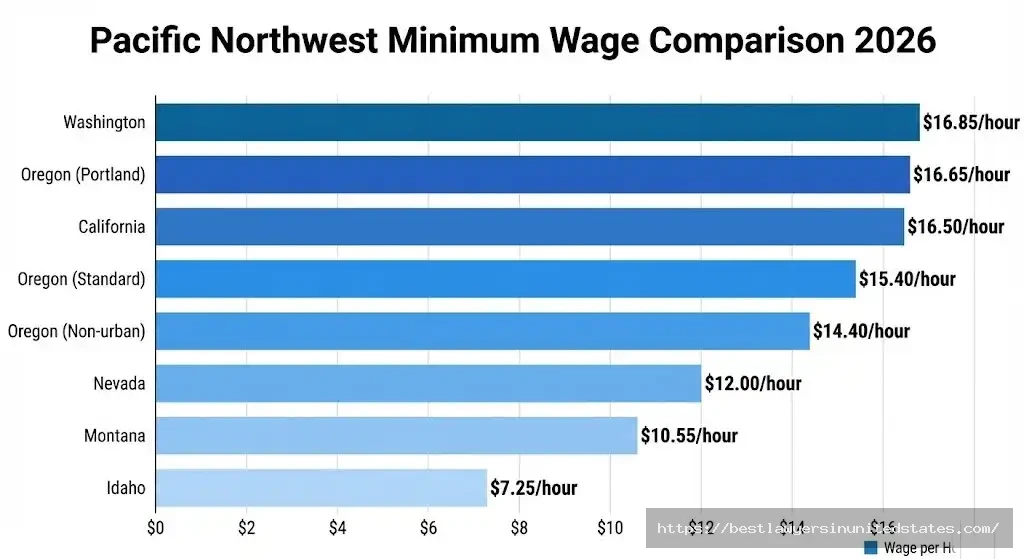
Pacific Northwest Wage Comparison
| State | 2026 Minimum Wage | Tipped Wage | Overtime Threshold | Annual Increases |
|---|---|---|---|---|
| Oregon (Portland) | $16.65 | $16.65 (no credit) | 40 hrs/week | CPI-based |
| Washington | $16.85* | $16.85 (no credit) | 40 hrs/week | CPI-based |
| Idaho | $7.25 | $3.35 | 40 hrs/week | Follows federal |
| California | $16.50 | $16.50 (no credit) | 40 hrs/week | Legislative |
| Nevada | $12.00 | $12.00 (no credit) | 40 hrs/week | CPI-based |
| Montana | $10.55* | $10.55 (no credit) | 40 hrs/week | CPI-based |
*Projected 2026 rates based on typical CPI adjustments
Key Regional Differences
Washington State has a single statewide rate instead of regional tiers. Seattle and other cities have separate local ordinances with higher rates.
California's minimum wage varies by city and industry. Fast food workers have different rates than other workers in some areas.
Idaho minimum wage follows the federal $7.25 rate with a reduced tipped wage. This creates a significant gap with Oregon rates.
Nevada minimum wage eliminated its two-tier system in 2024. All workers now receive the same base rate regardless of health benefits.
Montana minimum wage adjusts annually for inflation like Oregon. However, the base rate is significantly lower.
Vancouver, WA Workers in Portland
Workers who live in Vancouver, Washington but work in Portland must receive Oregon's wage rates. The work location determines which state's laws apply.
Portland employers must pay the Portland metro rate ($16.65 in 2026) to all employees working within the Urban Growth Boundary. This applies regardless of where employees live.
Some workers commute from Idaho to Oregon for higher wages. The wage gap between states creates this cross-border employment pattern.
Employer Compliance Requirements
Oregon employers must follow specific posting, record-keeping, and payment requirements. Understanding these rules helps both employers and workers.
Wage and Hour Poster Requirements
Employers must display current wage posters in visible locations. BOLI provides free posters that include current minimum wage rates.
Poster requirements:
- Display in break rooms or common areas
- Update annually when rates change (July 1)
- Available in English and Spanish
- Post where all employees can see them
- Include federal and state labor law information
BOLI offers free downloadable posters at oregon.gov/boli. Employers can also request printed copies.
Record-Keeping Requirements
Oregon law requires employers to maintain detailed wage and hour records. These protect both workers and employers in disputes.
Required employment records:
- Employee names and addresses
- Hours worked each day and workweek
- Regular and overtime hours
- Wages paid each pay period
- Deductions from pay
- Total wages paid
- Pay rate and basis (hourly, salary, commission)
Record retention: Employers must keep these records for three years. Workers can request copies of their own records.
Multi-Location Employer Compliance
Employers with workers in multiple Oregon counties face complex compliance. Different locations may have different minimum wage rates.
Compliance strategies:
- Track each employee's primary work location
- Assign appropriate wage rate by location
- Update payroll systems when rates change
- Maintain records of where employees work
- Pay higher rate if employee works multiple locations
If an employee works in both Portland metro and standard areas, employers should pay the higher Portland metro rate to avoid violations.
Frequently Asked Questions
What Is Oregon's Minimum Wage in 2026?
Quick Answer: Oregon's 2026 minimum wage ranges from $14.40 to $16.65 per hour depending on location, effective July 1, 2026.
Portland metro areas get $16.65/hour, standard areas get $15.40/hour, and non-urban counties get $14.40/hour. Your rate depends on where you work.
Do Servers in Oregon Get Full Minimum Wage?
Quick Answer: Yes. Oregon servers and tipped workers must receive the full minimum wage before tips, with no tip credit allowed.
This makes Oregon one of the best states for restaurant workers. A Portland metro server earns $16.65/hour base pay plus all tips in 2026.
When Does Oregon Minimum Wage Increase?
Quick Answer: Oregon minimum wage increases every July 1 based on the Consumer Price Index for the previous year.
The Oregon Bureau of Labor and Industries announces new rates each spring. Increases are automatic under state law and don't require legislative action.
How Do I Calculate My Earnings at Oregon Minimum Wage?
Quick Answer: Use our free Oregon minimum wage calculator to estimate weekly, monthly, and annual earnings based on your hours and location.
The calculator automatically applies the correct 2026 rate for your area. It includes overtime calculations and tax estimates for accurate take-home pay projections.
How Much Overtime Pay Am I Entitled to in Oregon?
Quick Answer: Oregon overtime is 1.5 times your regular rate for hours over 40 per week. Use our overtime calculator for exact amounts.
For example, at $16.65/hour regular rate, your overtime rate is $24.98/hour. The calculator handles all calculations automatically based on your hours worked.
How Do I Calculate Wage Theft Recovery in Oregon?
Quick Answer: Our wage theft calculator estimates recovery amounts including unpaid wages, penalties, and interest under Oregon law.
Enter your unpaid hours and rate to see potential recovery. Oregon allows double damages for overtime violations plus penalties up to $1,000 per violation.
Which Oregon Counties Have the Highest Minimum Wage?
Quick Answer: Multnomah, Washington, and Clackamas counties have areas within the Portland metro Urban Growth Boundary that get the highest rate of $16.65/hour in 2026.
Not all parts of these counties qualify for the metro rate. The specific location determines whether you get metro, standard, or non-urban rates.
What Is the Four-Hour Rule in Oregon?
Quick Answer: If you report for a scheduled shift in Oregon, your employer must pay you for at least four hours, even if sent home early.
This applies to all employees who show up for work as scheduled. Exceptions include voluntary early departure or emergency workplace closures.
Can My Employer Take My Tips in Oregon?
Quick Answer: No. Oregon law prohibits employers from keeping any portion of employee tips. Employees keep 100% of customer tips.
Managers and supervisors also cannot participate in tip pools. Only customer-facing service employees can share tips through voluntary or mandatory tip pools.
How Long Do I Have to File a Wage Claim in Oregon?
Quick Answer: You have two years from the date wages were due to file a wage claim with BOLI for unpaid wages or overtime.
Each unpaid paycheck may have its own two-year deadline. File as soon as possible to preserve all claims and maximize recovery.
Does Oregon Require Daily Overtime?
Quick Answer: No. Oregon only requires overtime after 40 hours per workweek, following federal law. There is no daily overtime requirement.
This differs from California, which requires overtime after 8 hours per day. Working 10 hours in one day does not trigger overtime in Oregon unless you exceed 40 hours for the week.
What Is Considered Full-Time Employment in Oregon?
Quick Answer: Oregon does not legally define full-time employment. Most employers consider 30-40 hours per week as full-time for benefits purposes.
The Affordable Care Act defines full-time as 30+ hours per week for health insurance requirements. Overtime laws apply regardless of full-time or part-time status.
Can Employers Pay Different Rates to Different Employees?
Quick Answer: Yes, as long as all employees receive at least the applicable minimum wage and pay differences are not based on protected characteristics.
Employers cannot pay different wages based on gender, race, or other protected classes. Performance-based or seniority-based pay differences are legal.
Related Oregon Legal Resources
Understanding minimum wage is just one aspect of employment law. Oregon has additional worker protections you should know about.
If you're dealing with wage issues alongside other legal matters, you may find these resources helpful. Oregon employment law intersects with various other areas of state law.
For workers facing DUI charges in Oregon, understanding how legal problems might affect employment is important. Criminal charges can impact your job even if unrelated to work.
Families going through major life changes may need multiple legal services. If you're researching divorce costs in Oregon, employment and wage issues often arise during separation proceedings.
Understanding your full legal picture helps you make informed decisions. Wage and employment issues rarely exist in isolation from other life circumstances.
Conclusion
Oregon's minimum wage system provides better protection than many states. The three-tier structure accounts for regional cost-of-living differences while the no-tip-credit rule benefits service workers.
For 2026, rates range from $14.40 to $16.65 per hour depending on location. All rates increase annually based on inflation without requiring new legislation.
Workers who don't receive proper pay have strong recovery options through BOLI. The two-year filing deadline gives you time to gather evidence and file claims.
Use the calculators provided to understand your exact earnings, overtime pay, and potential wage theft recovery. These tools give you accurate estimates based on Oregon's specific laws.
Need help with unpaid wages or have questions?
Contact the Oregon Bureau of Labor and Industries at 971-673-0761 or visit oregon.gov/boli.
Email: [email protected]